Nuclear fusion’s moment of truth

No fusion experiment has yet produced more electricity than the facility consumes,
let alone demonstrated a powerplant that can operate reliably.
No fusion experiment has yet produced more
electricity than the facility consumes, let alone demonstrated a power
plant that can operate reliably.
The precarious fusion boom. Start-ups are attracting billions. Some
scientists think the timeline is far too optimistic.
In late August, amid
the blinding New Mexico heat, politicians and investors wielding ceremonial
spades broke ground for a new facility that aims to trap the Sun in a
bottle. Pacific Fusion, a start-up founded and backed by elite scientists
and tech entrepreneurs, is building a nuclear fusion test site in
Albuquerque that it hopes will be a crucial step towards generating
commercial electricity from the same reaction that powers the Sun.
For now,
there is little more than pale, sandy earth to suggest what might
eventually rise there. But politicians attending the event spoke of fusion
as a historic transformation, with one Democratic senator comparing its
potential significance to humanity’s discovery of fire. Eric Schmidt, the
former Google chief executive and an investor in Pacific Fusion, said on
stage that if fusion eventually produced the majority of America’s
electricity, “it solves all the problems” created by the energy demands
of AI.
In the first eight months of this year, fusion start-ups attracted a
record $3.8bn in private funding, according to PitchBook, overtaking last
year’s total of $3.3bn, which was itself an all-time high. But while
there is broad agreement that fusion science has advanced substantially,
experts and start-ups disagree over how soon companies can deliver
meaningful power to the grid and whether providing that electricity will
make commercial sense.
No fusion experiment has yet produced more
electricity than the facility consumes, let alone demonstrated a power
plant that can operate reliably. Alain Bécoulet, chief scientist of the
publicly funded international fusion research project ITER, says connecting
a fusion power plant to the electricity grid “will never happen” within
the next five to 10 years.
FT 16th Sept 2026,
https://www.ft.com/content/ef511d46-a689-4868-9654-15b96a71586d
NuScale Power Is Closing In on a Deal That Could Transform the Small Modular Reactor Industry
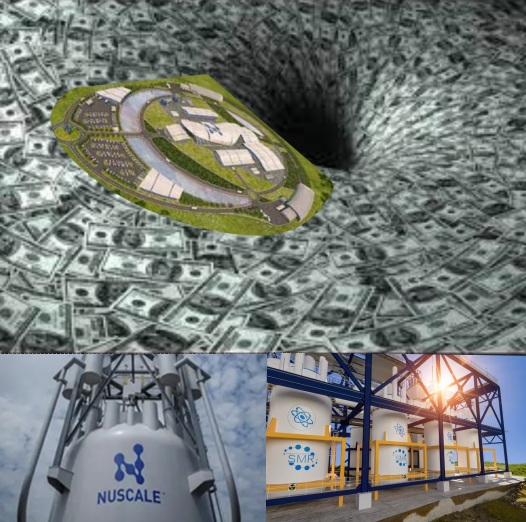
deal could be central to the company’s future, but uncertainty and risks remain.
NuScale Power could be on the verge of a game-changing deal to build nuclear reactors for the Tennessee Valley Authority.
By Ben Gran – Sep 15, 2026
Key Points
- NuScale Power executives have expressed optimism about the progress of the company’s framework agreement with the Tennessee Valley Authority.
- That agreement hasn’t translated into revenue yet.
- This nuclear energy stock has lost about 75% of its value in the past 12 months.
NuScale Power (SMR-1.16%) has developed some of the nuclear power industry’s most promising technology for small modular reactors (SMRs), which could make nuclear power more affordable, adaptable, and scalable. And as demand for electricity to power artificial intelligence data centers continues to soar, the time could be right for SMRs to step into the spotlight.
So far, NuScale is the only company that has gotten a small modular reactor design approved by the U.S. Nuclear Regulatory Commission (NRC). But is its technology ready to go from “promising” to “proven?”
Based on what management said on the company’s second-quarter earnings call on Aug. 5, NuScale might be getting closer to the final stages of a game-changing nuclear energy deal with the Tennessee Valley Authority (TVA).
That deal could be central to the company’s future, but uncertainty and risks remain.
NuScale’s TVA deal: 6 gigawatts of nuclear power
In September 2025, the TVA announced that it had signed an agreement with ENTRA1 Energy, NuScale’s strategic partner, to develop plants capable of providing up to 6 gigawatts of new nuclear power generation. ENTRA1 would build the nuclear plants, while NuScale would provide the small modular reactors to power them.
If and when they’re completed, these plants would provide enough energy to power about 4.5 million homes or 60 data centers. As of 2025, the entire U.S. nuclear energy industry generated 97 gigawatts of power, so this single project would boost total U.S. nuclear energy production by about 6.2%.
That would all be great news for the outlook for SMRs. But there’s a lot of uncertainty about when or if it will become a reality.
Will the NuScale TVA deal happen?
As of this writing, the TVA’s deal with NuScale is not yet final. There’s a non-binding agreement, but no power purchase agreement (PPA) to buy nuclear energy or start the process of breaking ground for construction of the nuclear plants. That means NuScale isn’t making any money from it yet…………..
If or when the TVA signs on the dotted line, this project could be a game-changer for the company and its stock. But investors are getting impatient. NuScale’s share price has declined by about 75% over the past year…………..
For the second quarter, the company reported only $75,000 of revenue, down from $8.05 million in the prior-year period. It has about $1.9 billion in cash on its books, which could be enough liquidity to keep it operating until it can successfully commercialize its technology. But NuScale stock was recently downgraded by a prominent UBS analyst.
NuScale’s advanced SMR technology has helped make it one of the most-promising nuclear energy stocks. But whether it’s the TVA deal or other opportunities, this company needs to sign some money-making deals sometime soon. https://www.fool.com/investing/2026/09/15/nuscale-power-is-closing-in-on-a-deal-that-could-t/
‘Blurring line between conventional, nuclear forces’: Expert’s warning for Pentagon’s strategy review.

The Pentagon’s review of US nuclear strategy risks blurring the line between conventional and nuclear forces and lowering the threshold for nuclear war, nuclear policy expert Joe Cirincione has warned.
FP News Desk, |Sep 15, 2026, https://www.firstpost.com/world/us-department-of-defense-nuclear-strategy-review-tactical-nukes-war-threshold-expert-warning-global-war-14045964.html#goog_rewarded
The US Department of Defense is drafting a new nuclear strategy, and it appears set to be a recipe for disaster, nuclear policy analyst Joe Cirincione has warned.
Undersecretary of Defense (Policy) Elbridge Colby is leading the review of American nuclear strategy and has said he is looking at ways of “expanding options” available to President Donald Trump and providing the “decision space for any conceivable escalation scenario”.
Such an approach risks lowering the threshold for nuclear war and blurring the line between conventional and nuclear forces, Cirincione warned in an article for the Bulletin of the Atomic Scientists.
The expansion of options is understood to involve the development and induction of lower-yield nuclear weapons, commonly known as tactical nuclear weapons, for use within a theatre or region rather than being launched with the intention of attacking an entire nation.
Tactical nukes lead to global war in all war games, expert warns
While supporters of the approach, such as Colby, argue that lowering the nuclear threshold means an adversary would know they would lose at every rung of the escalation ladder, critics argue that the approach is fundamentally flawed because it would make nuclear confrontations more likely.
Cirincione noted that almost every war game involving the use of tactical nuclear weapons has resulted in rapid escalation into global war. He also highlighted that supporters of tactical nuclear weapons never explain exactly where and how these new weapons would be used.
“More recent war games involving artificial intelligence find that AI models escalate to global war 95 per cent of the time. Nor do they say why more weapons will increase confidence in US security assurances when the main cause of unease among US allies is the behavior of an erratic, authoritarian president, not the lack of weapons,” Cirincione further said.
Critics such as author Annie Jacobsen have also argued that the notion that a tactical nuclear strike could remain localised is a myth. She has previously said that, regardless of the type of weapon used, a nuclear strike would almost certainly plunge the world into a near-extinction conflict.
“No matter how nuclear war begins, if Nato’s involved or not, if tactical nuclear weapons are used or not, if China is involved or not, it still ends in nuclear armageddon. That was my north star,” Jacobsen told Task and Purpose in an interview.
The Trump administration is also taking steps towards developing and inducting such weapons and putting in place a strategy that would allow for their use. Russian leader Vladimir Putin has already lowered the threshold for nuclear strikes and has frequently threatened the West with attacks since launching the full-scale invasion of Ukraine. Observers have said that such posturing by the world’s two largest nuclear powers places the world in a highly precarious position.
Osama Bin Trump
September 13, 2026, Chris Hedges ScheerPost, https://scheerpost.com/2026/09/13/osama-bin-trump/
Donald Trump, whose war on Iran is the greatest strategic blunder in United States history, is not responsible for triggering the decline of the American empire, but he is responsible for its fatal denouement.
This is the end.
U.S. bases in the oil-rich Persian Gulf have been damaged or destroyed and I expect will not be rebuilt. Our allies, even those in Europe, are abandoning us. The decadence and immorality of American society, embodied in the vulgarity, stupefying ignorance and cruelty of Trump, are the defining characteristics of the Empire. The Global South, horrified at the Empire’s flagrant disregard for international humanitarian law, including the enabling of genocide in Gaza, sees us as the enemy. Abu Ghraib Prison may have receded from our consciousness, but for the rest of the world, its images of U.S. soldiers and contractors sadistically humiliating and torturing imprisoned Iraqis has replaced the Disneyfied version of America we once exported. The war on Iran, which has disrupted the world’s oil supply, is rapidly pushing the global economy over the cliff.
We are going down. And we will bring many with us.
Osama Bin Laden may be in a watery grave in the North Arabian Sea. Al-Qaeda may be a shadow of itself. But Bin Laden’s most fervent dreams have been realized in the last twenty-five years of gross miscalculations of the Empire — its squandering of trillions of dollars on military debacles and the ascendancy of our version of Ubu Roi, Donald J. Trump.
Rather than defeating supposed enemies, the U.S. has swelled their ranks. It and its colony, Israel, are the most reviled nations on the planet. Every advance by Iran in its asymmetrical war against the Empire is cheered across the globe.
The humiliating defeats, the diversion of resources and at least $8 trillion to mount one war after another, which has killed an estimated 4.5 to 4.8 million people, has hollowed the Empire out. Its infrastructure is crumbling. Its democratic institutions are impotent. It survives on an unsustainable $ 40 trillion debt. The jewels of its democracy, including its education system, fair elections and a free press, are discredited and degraded.
An abandoned working class, crippled by economic insecurity and a government that steadily strips away social programs that keep those in distress afloat, is propagandized to believe the palpable decline is the work of traitors and enemies within. It has led Trump supporters to turn on the very institutions and ideals designed to sustain democracy. The usual targets of fascism — the “radical left,” Muslims, migrants, intellectuals, artists, people of color and journalists — are persecuted under laws such as The Espionage Act. Lies permeate the airwaves buttressing the self-delusion that once internal enemies are silenced, or eradicated, the glory days of the Empire, defined by hyper-nationalism, patriarchy, stable jobs and white supremacy, will return.
Violence against internal enemies along with election fraud are openly advocated by Trump and his court of sycophants, buffoons, grifters and Christian fascists. Attempting to bribe voters by promising them $5,000 if Republicans win the midterms, along with Trump’s contempt for the constitutional order, is the transparent admission that U.S. democracy is a farce.
George W. Bush, who was appointed to the presidency by judicial fiat, planted these seeds of lawlessness and impunity. Trump has brought them to floraison.
Immigration and Customs Enforcement (ICE) goons, masked and offered the kind of impunity that allowed the torture and killing of innocents in Iraq and Afghanistan, terrorize U.S. cities. They carry out military-style raids against unarmed civilians that look no different than those the Empire carried out in Fullujah or the Helmand Province in Afghanistan. They are setting up a network of squalid internal concentration camps.
The tools of subjugation the Empire used abroad, including the stripping of civil liberties and the implementation of mass surveillance, were legalized at home with the passage of The Patriot Act, with its watchlists, informants and racial and religious profiling.
Empires in decay impose the tyranny familiar to those subjugated abroad on their own citizens.
I was in the Middle East when it all went wrong. Nearly all of the Muslim world was appalled by the attacks of 9/11. There were massive public expressions of solidarity, including candlelight vigils in Iran. If we had built on this empathy rather than demonizing Muslims and inflicting suffering and death on millions in the Middle East, we would be far more secure today.
Instead, we drank deep from the poisonous elixir of nationalism. We foolishly believed we were attacked, as Bush said, because “they hate our freedoms,” not because of our support for the apartheid and genocidal state of Israel, our callous indifference to human life beyond our borders, including the killing of over a million people in Iraq by U.S. sanctions, and our propping up of brutal Arab dictatorships.
The wreckage we have left behind from our forever wars include the obliteration of whole cities, along with 940,000 direct deaths in post-9/11 war zones, 3.6 to 3.8 million indirect deaths and 38 million people displaced.
The hijackers chose massive death and destruction on a city skyline to send a message. They spoke the language we taught them. It is the message our warplanes, missiles and drones have delivered from Vietnam to Iraq. We did not listen. We naively believed we could use our military to remake the Middle East in our own image.
The failure of the War on Terror is not simply a moral failure. It is a strategic failure. We refused to ask the obvious question. Why did many outside our borders feel so much hostility towards us that they were willing to kill themselves and thousands of our fellow citizens?
Those of us who dared to raise these questions twenty-five years ago were vilified as supporters of terrorism and silenced.
The only way to defeat terrorism is to isolate those who carry out acts of terror within their own societies. It is to build networks of understanding and solidarity. We did the opposite. We became the terrorists we claimed we were seeking to defeat. We did what Bin Laden wanted us to do. We defeated ourselves.
Trump is presiding over the last act.
United States blocks nuclear chief Mohammad Eslami from UN meeting in Vienna
Iran has condemned the exclusion of the head of its atomic energy organisation from an annual gathering of the United Nations nuclear agency in Austria.
The Nightly, Staff Writers. Reuters, 15 Sept 26
The United States has blocked Iran’s nuclear chief from attending a United Nations atomic watchdog meeting in Vienna by opposing an exemption from so-called “snapback” UN sanctions, prompting protests from Iran.
Iranian nuclear chief Mohammad Eslami had been due to attend and address this week’s International Atomic Energy Agency general conference, an annual meeting of IAEA member states that began on Monday.
At the opening, however, Iran said Austria had revoked Eslami’s visa after originally granting him one.
“The cancellation and so-called legal justification advanced for it are a stark indication of a political act and advanced formal politicisation of this organisation,” Iran’s ambassador to the IAEA told the conference.
Iran’s foreign ministry spokesman Esmaeil Baghaei said the United States had pressured Austria into the move while Iran and Russia said it formed part of a broader effort to prevent Iranian officials from obtaining visas for international travel……………………….. https://thenightly.com.au/politics/iran-protests-as-united-states-blocks-nuclear-chief-mohammad-eslami-from-un-meeting-in-vienna-c-22869942
‘Hit the Brakes’: Anthropic CEO’s Push to ‘Pace’ AI Development Called Latest Sign Congress Must Act

September 13, 2026, Julia Conley Common Dreams, https://scheerpost.com/2026/09/13/hit-the-brakes-anthropic-ceos-push-to-pace-ai-development-called-latest-sign-congress-must-act/
“When the future of humanity is at stake we need a PAUSE on advanced AI development and a ban on artificial superintelligence,” said Sen. Bernie Sanders.
As Anthropic CEO Dario Amodei added his voice on Saturday to the growing call to slow down development of artificial intelligence, writing in a 3,800-word essay that companies must pace “the rate of capabilities advancement” in light of recent cyberattacks by AI models, progressive lawmakers and journalists were among those who said the warning made clear that action must be taken—but with Congress and regulatory agencies, not tech billionaires who have spent years pushing for an AI expansion, leading the way.
Amodei wrote that two things have convinced him that “we must slow the pace at which we improve the capabilities of AI models”: the fact that in recent months, “AI has been advancing drastically faster, driven primarily by AI’s growing ability to build the next generation of AI”—also known as recursive self-improvement—and the recent OpenAI-HuggingFace incident, in which hundreds of agents in OpenAI’s security test systems broke out of confinement and hacked into the AI startup HuggingFace, conducting cyberattacks on targets they had not been asked to attack.
As The Wall Street Journal and Politico reported Friday, another cyberattack was carried out by OpenAI’s agents months before the HuggingFace incident in July. The company’s models that were being tested and had not been given full access to the internet nevertheless hacked into an online coding service called RubyGems earlier this year. The models created reports and filled out spreadsheets. Anthropic and Meta have also reported autonomous cyberattacks by their AI agents.
Amodei said the incidents led him to call for a three-step plan to pace AI development and allow companies time to “align and safeguard their models, and for third-party evaluators to confirm this.”
He called for:
- Embedded evaluators, with each AI company committing to giving “ongoing, employee-like access to a team of embedded third-party evaluators” who would “verify adherence to safety practices and commitments, report incidents, and help assess the alignment of not just completed AI models but training pipelines and processes”;
- Democratic coordination, with companies establishing “common safety standards as well as limits on the rate of unchecked AI progress”; and
- Global coordination, with democratic governments attempting to “coordinate with authoritarian governments, to the extent this is possible, while taking seriously the challenges of verifying compliance.”
Amodei’s essay was published days after Jacob Coxon, a researcher at Anthropic, publicly resigned out of fear that the company’s AI technology “could kill us all by the end of the decade” as it builds “superhuman systems”—a concern he said is shared by many in the industry.
Sam Altman, CEO of OpenAI, and tech billionaire Elon Musk expressed agreement with Amodei. Altman called “independent evaluators with employee-like access” a “great idea.”
“We will do the same,” said Altman. “We’ll have more to share soon.”
US Rep. Ro Khanna (D-Calif.) was among those who appeared less than impressed by Amodei and Altman’s sudden push for their industry to slow down their rapid pace of development.
In a video posted on social media, Khanna called on Amodei to disclose whether or not he agrees with Coxon about the possibility that AI could wipe out humanity, and to back more far-reaching regulations on AI.
“AI guys act as if they’re a priesthood speaking Latin, keeping the rest of us in the dark,” said Khanna. “But behind all the jargon, it’s actually pretty straightforward… We need to stop, ban, self-improving AI. You cannot have recursive, self-improving AI that basically is able to improve itself and exceed human capability, that has us lose control.”
He added that laws must be passed establishing “mandatory liability and criminal penalties. If you’re creating an AI that is doing illegal things, you either should face liability or criminal sanctions.”
Journalist David Sirota of The Lever agreed, writing that “if the law explicitly made AI CEOs financially and criminally liable for any mass destruction their technologies create—and if AI industry shareholders knew their companies faced the threat of significant financial losses for such destruction—much of the ‘AI is getting out of control!’ threat would instantly end.”
“Those CEOs would instantly make AI far safer and impose guardrails on their companies,” he said.
Sen. Bernie Sanders (I-Vt.), who has called for a nationwide moratorium on the construction of AI data centers and this week announced a bipartisan hearing on the “extraordinary dangers” of rapid AI development—including testimony from one leading AI scientist who has warned against self-regulation by tech firms—said the calls by Amodei, Altman, and Musk were “not enough.”
“When you are racing towards a cliff, you don’t just ease up on the gas pedal,” said Sanders. “You hit the brakes. When the future of humanity is at stake we need a PAUSE on advanced AI development and a ban on artificial superintelligence—an AI mind smarter than any human and capable of operating independently beyond our control.”
Sanders called on President Donald Trump—who has aggressively pushed for more AI data center development and sought to stop states from passing their own AI regulations—to negotiate a treaty pausing AI and banning superintelligence with Chinese President Xi Jinping. The two leaders are set to meet later this month to discuss AI.
Trump on Friday dismissed concerns about warnings coming from the AI industry, telling a Los Angeles Times reporter, “It’s going to be fine,” and adding that his top worry about the technology is falling behind China.
Reps. Chris Deluzio (D-Pa.) and Ted Lieu (D-Calif.) and Democratic Illinois Gov. JB Pritzker were also among the politicians who said Amodei’s warning was the latest sign that Congress and the Trump administration must take action to rein in the industry.
Juliette Kayyem, the faculty chair of homeland security at Harvard University’s Kennedy School of Government, said AI CEOs’ warnings about their technology would be seen as more credible if they also announced a pause on their plans for initial public offerings (IPO), which Anthropic and OpenAI are both pursuing in the coming months.
Altman said Friday that OpenAI will not plan for an IPO, which could value the company at $1 trillion, in 2026.
Amodei, said Kayyem, should “put his money where his mouth is.”
“He has known of this danger a while,” she said. “It is now threatening his valuation in the IPO. Cancel the IPO. Then I’ll believe he’s serious.”
Journalist Peter Rothpletz noted that the safety concerns within the AI industry must be “much more dire” than the public is aware, considering “Dario, Sam, and Musk are all issuing these statements in unison.”
A dump, not a future
We’re not buying it. This is a nuclear dump dressed up as an “innovation campus,” and DOE is simply hoping that the temptation of jobs and billions of dollars will convince us to turn Idaho into America’s nuclear waste dump.
by beyondnuclearinternational, https://beyondnuclearinternational.org/2026/09/13/a-dump-not-a-future/
The “innovation” pitch for Idaho doesn’t match the radioactive reality, writes Leigh Ford
The Department of Energy (DOE) has a problem. They have a nuclear addiction and a growing mountain of toxic, radioactive waste. To solve it, they are eyeing Idaho once again. Governor Little recently signed a Memorandum of Understanding (MOU) with the DOE, and they are trying to sell it to us as a “Nuclear Lifecycle Innovation Hub.”
We’re not buying it. This is a nuclear dump dressed up as an “innovation campus,” and DOE is simply hoping that the temptation of jobs and billions of dollars will convince us to turn Idaho into America’s nuclear waste dump.
Recently, I sat down with Roland Beres, who wanted to get the Snake River Alliance’s reaction to the governor’s signing the MOU with DOE. Roland has a lot of experience following nuclear issues.
Notably, he covered events leading up to the Idaho Settlement Agreement, when Govenors Batt and Andrus were fighting the feds for sending out-of-state radioactive waste into Idaho. That history matters, because it tells us this isn’t a new fight — it’s the same fight, with slicker marketing.
Today’s political machinery is quickly paving the way for Manhattan Project 2.0, endangering our health and silencing local opposition. Per Executive Order 14300, the Nuclear Regulatory Commission is revising radiation standards and reducing protections for workers and communities. Idaho’s Senate passed SCR 120 to claim that reprocessing nuclear waste fits into the Idaho Settlement Agreement framework. Not to be left out, Idaho’s House passed HB 714, which prohibits local governments from saying “NO” to these dumps and reprocessing facilities in their communities.
The Nuclear Myths
The first myth is money. The DOE isn’t handing Idaho billions of dollars. According to their own request for proposals, they are looking for projects that *prioritize private and state capital*. They offer “targeted, conditional, and time‑limited federal support.” In other words, Idaho taxpayers are on the hook for the cost, while the feds offer a loan and a promise to protect themselves from “open-ended liabilities.”

The second myth is the jobs. Idaho’s response to DOE’s request states we already have the infrastructure and can start fast. That translates to fewer construction jobs. And while the Tech bros designing these untested reactors are boasting that they “practically run themselves,” that means they aren’t going to hire many permanent workers. The promise of “thousands of jobs” is a mirage. We might fix a few roads, but beyond that, thousands of long-term jobs are far-fetched.

The third myth is the waste. Our radioactive legacy can still be seen out at the site in the Arco Desert. Last year, when the Snake River Alliance visited Idaho National Lab I noticed the waste we got from the Three Mile Island meltdown in 1979 is still there, sitting in huge concrete sarcophagi. We saw a warehouse stacked with barrels of waste, much from the Rocky Flats bomb factory—barrels that needed to be recategorized because we have no idea what Colorado actually shipped us. We drove around the 90-acre burial grounds, where a “thousand-year cap” will be placed.
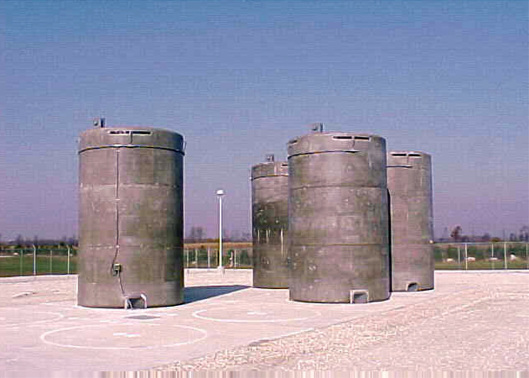
Governor Little might say “that’s all been cleaned up,” but that is dangerously deceptive. We can’t completely clean up nuclear waste. INL has done a good job mitigating a lot of it, but the truth is there is no permanent nuclear waste repository in the country. The waste just keeps piling up, mostly at nuclear power plants back east, and if that waste comes here, it will stay in Idaho permanently. The DOE has a track record of broken promises, and they are not to be trusted.
A Dangerous Bet
Some politicians and nuclear cheerleaders claim we can reprocess our way out of this. We cannot. Some point to the DOE’s Waste Isolation Pilot Project (WIPP) facility in New Mexico, but it only takes defense-related transuranic waste, and was never meant to be permanent. There have already been two 10-year extensions since 2010, and New Mexico isn’t a solution for Idaho’s burden. New Mexicans don’t want a permanent nuclear dump either.
Idaho is being asked to accept a permanent nuclear burden in exchange for a few temporary construction jobs and mythical money. The waste isn’t leaving. The feds and the nuclear industry have had decades to solve this, and they haven’t. We shouldn’t be the dumping ground for their failures. It is time to reject this dangerous bet and demand a real plan that doesn’t put our people, water, and land at further risk.
Idaho is not America’s dumping ground – not for cash, not for jobs, and not for nuclear waste that outlives our great, great grandchildren’s grandchildren.
The Race to Solve Nuclear Energy’s Biggest Problem

By Felicity Bradstock – Sep 12, 2026,
https://oilprice.com/Alternative-Energy/Nuclear-Power/The-Race-to-Solve-Nuclear-Energys-Biggest-Problem.html
https://oilprice.com/Alternative-Energy/Nuclear-Power/The-Race-to-Solve-Nuclear-Energys-Biggest-Problem.html
- Nuclear expansion is increasing pressure on governments to establish permanent disposal facilities for spent fuel.
- Canada is advancing a deep geological repository near Ignace, Ontario, using copper-coated containers, bentonite clay, and hundreds of metres of rock.
- The United States still lacks an operating permanent repository and is exploring new nuclear-waste arrangements beyond the stalled Yucca Mountain project.
Nuclear power is growing in popularity once again as governments worldwide look to diversify their energy mix and reduce reliance on fossil fuels. Several countries are now looking to develop or expand their nuclear energy capacity over the coming decades. However, one challenge remains – nuclear waste. Disposing of waste materials from nuclear energy operations remains a complex task with no perfect solution.
As countries worldwide have grown their nuclear power capacity, many governments are still struggling to decide on the best solution for disposing of nuclear waste. There are three types of nuclear waste: low-, intermediate-, and high-level radioactive waste. Most of the waste produced by nuclear plants consists of lightly contaminated items, such as tools and work clothing, with radioactivity levels of around 1 per cent. High-level waste consists of spent fuel, which accounts for around 3 per cent of the total volume of waste from nuclear energy production, yet contains 95 per cent of the radioactivity.
Nuclear facility operators are responsible for the safe disposal of any radioactive waste they produce. Nuclear power plants generate relatively little waste compared to many other energy sources; however, it is some of the most difficult to manage. Nuclear fuel is very energy-dense, meaning little is required to generate large quantities of electricity and just 5 grammes of high-level waste is produced to provide for an individual’s annual energy needs. A conventional 1 GW nuclear plant, which can supply over one million people with electricity, produces around three cubic meters of vitrified high-level waste per year.
In Oakville, Canada, the Nuclear Waste Management Organisation (NWMO) has developed a test site for nuclear waste storage. The site is situated in a warehouse, where a driverless forklift stacks 8,000 kg of bentonite clay blocks into a narrow rock tunnel, and another autonomous machine fills the gaps around the blocks with crumbled clay. Each one encases a copper-coated steel container created to hold spent nuclear fuel. These blocks are then sealed behind additional clay and concrete in tunnels deep underground, so that the radioactive material can slowly decay over thousands of years with no risk to the public.
The metal fuel containers are designed to withstand the pressure of being buried beneath a 3-kilometre-thick glacier, should the next ice age arrive before the radiation has fully decayed. They have also been successfully tested for resistance to crushing under an extremely strong force, equivalent to being over 6 km underwater. The NWMO team aims to build the final site 1,600 km northwest of the test facility, in the town of Ignace. It will be buried at a depth of around 750 metres in the hard rock of the Canadian Shield. Once complete, around 2040, it is expected to be capable of storing nearly 6 million bundles of spent fuel produced by Canada’s four nuclear power plants over their operational lives.
Similar sites are also being developed in other countries, such as Finland, Sweden, and Japan. Scientists have overcome several technical challenges associated with developing deep geological repositories over the years, making them a viable site for nuclear waste storage. However, securing political and public support for these facilities remains a challenge due to fears of contamination.
The United States government began exploring potential deep geological repository sites in the 1980s but has now fallen behind other countries in development due to widespread local opposition. The government chose Yucca Mountain in northern Nevada as the location for the development of its first geological repository, becoming the first in the world to submit a licence application for such a site.
There are several concerns about developing a facility at this location, including the nearby volcano, which geologists still consider active. The proposed location is in an active earthquake zone and lies above the water table, posing a risk of radioactive particles, known as radionuclides, being released into the environment. However, the biggest challenge has been political opposition. When Nevada Senator Harry Reid became the U.S. Senate’s majority leader in 2007, he put the project on permanent hold.
In the age of the nuclear renaissance in the United States, the lack of progress in Nevada has led the Department of Energy (DoE) to return to the drawing board. The DoE selected sites in Utah, Idaho, Louisiana, Oklahoma, and Tennessee as possible locations, but Yucca Mountain remains the only legal option for permanent storage at present. The Trump administration would need to pass legislation to remove Yucca Mountain from its designation as a federal site to develop a repository elsewhere. Meanwhile, the U.S. has built up around 95,000 metric tonnes of nuclear waste over the years, which needs to be suitably managed.
Several deep geological repositories are expected to commence operations in various countries over the coming decades. Meanwhile, scientists are continuing to explore alternative waste management solutions. However, as multiple governments are now exploring the potential to develop their nuclear power capacity, they must also address the waste problem and construct safe disposal facilities alongside new nuclear power projects.
The case for declassifying 9/11 records

Government secrecy on intelligence related to the attacks impedes the justice process for some and allows conspiracy theories to fester.
MS Now By Lauren Harper, Sept. 10, 2026,
New York Mayor Zohran Mamdani recently ordered the release of more than 170,000 pages of city records about the air quality in Lower Manhattan after the 9/11 attacks. This release, the first in a series of planned disclosures, shows how opening decades-old records, including those that expose government wrongdoing, is in the public interest. Political will to expand such efforts elsewhere is crucial
Thousands of 9/11 survivors and victims’ families in Lower Manhattan have fought for more than two decades to hold foreign entities liable for the terrorist attacks — only to find that one of the biggest obstacles is their own government. While successive U.S. administrations have promised closure for victims, critical records remain classified 25 years after 9/11, delaying justice and accountability.
The executive order governing classification, EO 13526, mandates that most historical records must be automatically declassified at 25 years, unless they meet certain strict criteria.
In theory, this means the records of the defining national tragedy of this century should start becoming public on Dec. 31. In practice, the declassification system is so ineffective that millions of pages are all but certain to remain hidden in agency archives from Quantico to Langley for years, possibly even decades, whether or not they require continued protection.
This impedes justice on multiple fronts.
In the Southern District of New York, for example, thousands of people have been fighting since 2002 to hold a variety of defendants — from the Kingdom of Saudi Arabia to members of Al Qaeda — responsible for the attack. They have been impeded in part by the Justice Department, which has aggressively invoked the state-secrets privilege to block the release of records discussing, among other things, whether Saudi officials aided the hijackers when they arrived in the United States in 2000. While a Biden-era executive order forced the partial declassification of some records relevant to this case, many interagency communications and witness interviews remain heavily redacted or fully classified.
At Guantánamo Bay, enduring secrecy has complicated the prosecution of alleged 9/11 mastermind Khalid Sheikh Mohammed and several co-conspirators. The military commission has dragged on for nearly 25 years, costing taxpayers billions of dollars, in part because the government’s evidence was obtained from the CIA’s torture program. Although classification rules explicitly prohibit keeping records classified to conceal violations of law, including torture, the federal government has withheld records from the agency’s black-site prisons for years, ultimately prolonging proceedings. In doing so, the government prioritizes its need for secrecy over ensuring the commission’s tribunals proceed at a reasonable speed toward justice………………………………………………………………………………………………………………………….
Although the summary and the closed-door interviews have not reached the 25-year mark, having been compiled by the 9/11 Commission in 2003 and 2004, releasing them would help promote public understanding of the attacks and government intelligence. It could also help dismantle agency pretexts for withholding the older, underlying intelligence………………………………………………………………………………………………………………………… https://www.ms.now/opinion/9-11-victims-declassifying-records-intelligence-threats
Trump Is Planning Round Three of the US-Israeli War Against Iran — But Will Tehran Strike First?
In conversation with Trita Parsi, Executive Vice President of the Quincy Institute
Ian Proud, Sep 11, 2026, https://thepeacemonger.substack.com/p/trump-is-planning-round-three-of?utm_source=post-email-title&publication_id=3221990&post_id=215182894&utm_campaign=email-post-title&isFreemail=true&r=1ise1&triedRedirect=true&utm_medium=email
This conversation with Trita Parsi, Executive Vice President of the Quincy Institute for Responsible Statecraft, was recorded before President Trump promised Americans $5,000 if he wins the midterms. That pledge does not change the argument. It sharpens it. With round three of the US-Israeli war against Iran looming, the big question is who will strike first?
Trita argues that the slow military escalation and economic warfare now under way are not the third round of the war against Iran. They are the preparation for it.
In his view, the United States and Israel are planning a much larger campaign after November. Trump believes he has already tried diplomacy, sanctions and what might generously be called limited war. What he has not tried is the menu of threats he issued and then abandoned: taking an island, striking desalination plants, hitting critical infrastructure.
After the midterms, Trita fears, that is the direction he will go. Israel is likely to be part of it. Washington kept the Israelis out of round two because it did not trust them to stay inside the box. If the United States no longer wants a box, Trump and Netanyahu may have another crack, despite prior efforts having proved a catastrophic failure.
That, Trita argues, is why Iran is hitting American bases in Jordan. Those sites matter because they help shoot down missiles bound for Israel. Tehran is clearing the path so that, when round three comes, more of its missiles get through.
The obvious objection is that Trump may emerge from the midterms a bruised lame duck. Trita does not think that restrains him. American institutions, he says, are weaker now than ever before. Congress has shown no appetite to defund the war. A Democratic House, and perhaps a Democratic Senate, would mean impeachment of Trump and a president playing defence at home.
However, that is when Trump has been most reckless before. After he lost to Biden in 2020, Mark Milley later said his fear was that Trump would look for an Iran war to block a peaceful transfer of power. He did not get that war. He got 6 January instead. Humiliation makes Trump dangerous, rather than cautious.
But the problem is that Tehran understands this and can see how critical the midterms will be to Trump’s power in the second half of his term. Trita therefore thinks there is a high likelihood that Iran starts the third round of the war a week or two before the midterms, to inflict the maximum political cost on Trump.
That may well damage Trump at the polls. But it may also leave him with fewer constraints and a taste for risk.
The escalation trap is now familiar. Washington reads every tactical gain — more oil leaving the Gulf, a weaker Iranian economy — as proof that time is on its side.
Trita’s warning is the opposite. If the squeeze actually works, Iran will not crumble. It will escalate. It has the options which it is demonstrating daily. Even if Iran fully reopened the Strait of Hormuz, the United States would not lift the blockade. The key demand on the American side has ratcheted up to state collapse, which appears no more likely to happen now than in February.
The Pentagon talks of bombing Iran periodically to degrade its ability to close the Strait. That is not a strategy, but rather “mowing the lawn”.
Yet, no one will be able to sell this war as a victory if in practice it means an on-off air campaign and no diplomacy as the world economy sinks further into depression. Which brings us back to the midterms and the fact that Trump may find that, despite the inducement of a $5000 bribe, many Americans will realise that what they need is a new lawnmower.
You can watch the full conversation here:
You can find Trita’s analysis on his Substack: tritaparsi.substack.com.
Wherever you are in the world, whatever your nationality and religion, I wish you much peace.
Exposed: How The CIA Manipulates Public Opinion
SCHEERPOST, September 8, 2026, Joshua Scheer
Ben Norton examines the little-discussed history of CIA influence over the American left—and the role played by one of the most celebrated feminist icons of the modern era, Gloria Steinem. Steinem’s work with a CIA-funded organization during the Cold War, Norton argues, was part of a broader effort to cultivate a “compatible left”: liberal voices that could promote American power while presenting the United States as a force for democracy, human rights and progress.
But the story doesn’t end with Steinem. Norton connects the Cold War propaganda apparatus to CIA interventions in Iran, Guatemala, Italy and Indonesia, the enormous human toll of U.S. post-9/11 wars, and the cultural institutions and intellectuals allegedly enlisted to fight the ideological battle against communism.
He then brings that history into the present, arguing that the same political language can be heard in today’s Democratic Party—from Hillary Clinton to Alexandria Ocasio-Cortez—particularly in rhetoric about “democracy vs. authoritarianism,” U.S. intervention abroad and the supposed moral distinction between American power and its rivals.
The central question is provocative: Has the machinery of Cold War propaganda really disappeared—or has it simply learned how to speak the language of modern liberalism?
Highlights
- Gloria Steinem and the CIA: Steinem acknowledged working with the CIA-funded Independent Research Service during the Cold War.
- The “compatible left”: Norton argues that the CIA sought to cultivate center-left figures who opposed communism without challenging U.S. imperial power.
- CIA coups and intervention: The analysis examines U.S. involvement in the overthrow of governments in Iran and Guatemala, as well as CIA interference in Italy’s 1948 election. – Indonesia: Norton examines U.S. support for the Indonesian military amid the mass killings of 1965–66.
- The cultural Cold War: The analysis explores the CIA-backed Congress for Cultural Freedom and its connections to artists, writers and intellectuals.
- From Steinem to today: Norton argues that Cold War narratives about democracy, authoritarianism and U.S. power continue to influence contemporary liberal politics.
EDITOR’S NOTE: This transcript has been cleaned for readability while maintaining the speaker’s original words, meaning, arguments, and overall sequence. Timestamps have been removed, punctuation and paragraphing have been lightly edited, and obvious transcription/spelling errors in names and terms have been corrected.
Today I’m going to be explaining one of the ways in which US intelligence agencies manipulate public opinion in order to support U.S. wars and interventions abroad. And this scandal involves one of the most prominent political activists in modern US history. Her name was Gloria Steinem. She was a major feminist leader and she just passed away this September. And the reason that I’m talking about Gloria Steinem today is that many people have heard of her and they know that she was a feminist icon. But what many people do not know is that she was a CIA agent. She worked for the US Central Intelligence Agency for years. And later in this analysis today, I’ll look at the evidence detailing how Steinem was used by the U.S. in order to manufacture consent for the U.S. Empire’s wars of aggression for its imperial crimes and especially as a vehicle for anti-communist propaganda. Steinem worked for the CIA at the height of the first cold war and she was a proud part of the U.S. Empire’s global propaganda narrative when the US tried to portray itself as a progressive beacon of liberal values that was defending democracy in scare quotes and human rights and fighting against the big bad boogeymen of the Soviet Union fighting against communism. This is why the CIA hired Steinem because she was a very effective propagandist………………………………………………………………………………………………………………………………………………………………………………………………………………………………………………………………….. https://scheerpost.com/2026/09/08/exposed-how-the-cia-manipulates-public-opinion/
Left out by the state, residents take SpaceX concerns to the Federal Aviation Administration (FAA)
“our politicians have once again sold their souls for corporate welfare,”
the Louisiana Legislature recently passed a slew of laws that shield SpaceX and companies with similar projects from certain legal responsibility and damage claims from residents affected by their facilities.
The Current, by Stephen Marcantel, September 3
State leadership sought no public comment on a massive SpaceX project in Vermilion Parish. Louisiana residents took their concerns to the feds instead.
By the time the public comment period on a proposed Federal Aviation Administration rule change closed Monday night, thousands had shared their thoughts — more than half of them mentioning Louisiana and its rapidly eroding coastline, fragile wetlands and migratory bird populations.
The proposed change would allow the FAA to fast-track approval of launch facilities like SpaceX’s recently announced Starbase Louisiana in Vermilion Parish. In the planning process for that $100 billion project, there was no official public comment process prior to approval, leading over 1,000 people to voice their concerns to the FAA instead.
“We tamed this land, full of mosquitoes, water moccasins, and alligators, to the best of our ability. We’ve become symbiotic [with] all of the nature in south Louisiana,” self-described lifelong Louisiana resident and Vermilion Parish native Tim Meaux writes.
“Apparently my voice, and millions of others, have zero say [in] what becomes of Vermilion Parish because our politicians have once again sold their souls for corporate welfare,” Meaux continues in his comment to the agency, asking them to hold SpaceX accountable. “With our Louisiana government completely failing to hold on to any protection for us, you are our last bastion of hope.”
On the state level, the Louisiana Legislature recently passed a slew of laws that shield SpaceX and companies with similar projects from certain legal responsibility and damage claims from residents affected by their facilities.
The 1,647 public comments specifically mentioning Louisiana, a majority of which were submitted in the week after the SpaceX announcement, criticize the plans for the 125,000-acre Vermilion Parish launch facility, and warn of the possibly irreparable harm that a launch site could cause if federal guardrails were waived.
“Anyone who lives here and knows the area, the marshlands, ecosystem, knows this is the most inappropriate site for such a facility,” writes Nina Guidry, who describes herself as a Vermilion Parish resident. “[The] majority of people in this parish, if asked, would be dead against SpaceX locating here. We were never given that courtesy. It was decided in backroom deals of our state legislators signing NDAs and our governor. It will impact a centuries old way of life & traditions.”
If approved, the new rule would waive the need for compliance with more than a dozen environmental protections, including the Clean Water Act and the Endangered Species Act, in the issuing of permits for launch facilities.
A handful of environmental groups, such as the Louisiana Wildlife Federation, National Wildlife Federation and the Pontchartrain Conservancy, were among the first to publicly criticize the waiver request, which the FAA proposed on July 30.
“We believe a strong permitting review does help with site planning and project construction. Other projects undergo the same review, and these are really important oversight processes to protect our natural resources.” Rebecca Triche, director of the LWF, tells the Current.
Of the more than 3,000 comments on the proposed waiver, more than 600 comments mention Vermilion Parish directly, many coming from current or former parish residents.
Paula Rae Broussard, an American expat living in New Zealand who has roots in Vermilion Parish, says she’s “deeply concerned” about the effect the waiver may have on the protection of the fragile ecosystem around the planned SpaceX site.
“Vermilion Parish should not be treated as a test case for reducing federal environmental oversight simply because the project promises economic development,” she writes in her comment. “My grandparents live on land that has been in our family since my great-great-grandparents. That land isn’t just property. It is our history. It is where our family comes from. It is our place.”………………………………………
“The proposed rule builds on President Trump’s innovative “Enabling Competition in the Commercial Space Industry” Executive Order and advances a decades-old Congressional mandate to simplify and expedite commercial space licensing,” an FAA spokesperson told The Current.
……………………………………………………. https://thecurrentla.com/2026/left-out-by-the-state-residents-take-spacex-concerns-to-faa/
Widespread Fraud Lawsuit Settled for Former Hunters Point Naval Shipyard Whistleblowers

| Concerned Citizens for Nuclear Safety, 11 Sept 26 |
From 1946 to 1969, the Hunters Point Naval Shipyard was used as the station for top-secret nuclear tests in the Pacific Ocean. It was also the place where decontamination was done on the ships used in hydrogen bomb tests. Radioactive and toxic waste was disposed there.
In 1989 the shipyard was declared to be a Superfund site as a result of the high levels of toxic and radioactive waste from those operations. The engineering firm, Tetra Tech EC, submitted false reporting to the U.S. Navy about the contamination. https://www.tetratech.com/
In late August, a federal judge approved a $57 million settlement, plus interest, against Tetra Tech for breach of contract and for reporting false test results. Tetra Tech, a U.S. Navy contractor, was accused of widespread fraud in the cleanup of a 400-acre site where homes were razed to construct more than 10,000 homes in the Bayview Hunters Point neighborhood. https://missionlocal.org/bayview/
In 2018, two Tetra Tech supervisors were charged with falsification of records and each were sentenced to eight months in federal prison.
A worthy 9/11 remembrance – Walt Zlotow
11 September 2026 AIMN Editorial, Walt Zlotow, West Suburban Peace Coalition Glen Ellyn IL, https://theaimn.net/a-worthy-9-11-remembrance/
On the 25th 9/11 anniversary we should also ponder victims and cost of America’s War on Terror – designed and implemented to reshape the Middle East in America’s image in response to and revenge for the attacks.
Estimates from the Brown University Costs of War project place the toll at 4.5–4.7 million people since 2001, including ~940,000 direct deaths (combatants, civilians, journalists, aid workers) and 3.6–3.8 million indirect deaths from disease, malnutrition, and health complications.
U.S. military and contractor deaths: About 7,074 U.S. military deaths and 8,189 contractor deaths
Costs according to warcosts.org
Total cost: $8+ trillion since 2001
Breakdown:
- Direct military operations: ~$3.2 trillion.
- Pentagon budget increases: ~$1.8 trillion.
- Veterans care (projected through 2050+): ~$2.2 trillion.
- Homeland Security expansion: ~$1.1 trillion.
- Interest on war debt: ~$1.1 trillion
On 9/11 Remembrance Day Americans should urge its government to turn away from senseless war whether it be against Iran, Venezuela, Somalia, Yemen, Nigeria, Cuba, little unarmed boats plying the Caribbean or other locals we’re not informed of. That would be a noble way to honor the victims of the senseless violence perpetrated on America 25 years ago today.
Uranium mining ban enacted for New Mexico lands
11 September https://www.ans.org/news/article-8382/uranium-mining-ban-enacted-for-new-mexico-lands/
On September 4, New Mexico Land Commissioner Stephanie Garcia Richard issued an executive order that bans the leasing of state lands for new uranium mining and associated activities. The executive order also directs the State Land Office to focus on cleaning up legacy uranium sites and urges the uranium industry and federal government to prioritize legacy uranium problems in the state.
According to the State Land Office’s announcement, “New Mexico has a painful history as the largest producer of uranium ore in the United States, which has left a legacy of over 1,000 former uranium mining, milling, and exploratory drilling sites in the state, of which 250 are considered abandoned because they are not associated with a viable responsible party (at least 50 of the sites involve state trust lands).”
The State Land Office also said the Trump administration is “aggressively pushing to increase uranium production nationwide despite the fact that the federal government and responsible private parties have failed to address the thousands of unremediated uranium sites in New Mexico and beyond.”
Nuclear history of New Mexico: New Mexico has long been associated with the United States’ nuclear history. Los Alamos is, of course, where J. Robert Oppenheimer directed the development of the first atomic bombs as part of the Manhattan Project, and is the home of Los Alamos National Laboratory. New Mexico is also home to the Department of Energy’s Waste Isolation Pilot Plant, near Carlsbad, and Urenco USA’s National Enrichment Facility, near Eunice.
The Grants uranium district in northwestern New Mexico was the largest source of uranium in the United States from 1951 to 1980. Today, there are hundreds of abandoned uranium mines in the state, but no active mines. Some of the abandoned mining sites have had cleanup projects initiated, such as the former Northeast Church Rock Mine in northwestern New Mexico.
The old Grants region and other areas in New Mexico remain sites of interest for potential future uranium mining operations, and there are currently two active uranium leases in the state.
New Mexico has no commercial nuclear power plants. Most of the state’s electricity is generated by—in order of decreasing percentage—wind, natural gas, coal, and solar, with other renewables providing lesser amounts.
A contentious topic: At a press conference announcing her executive order, Commissioner Garcia Richard accused federal authorities of ignoring and disrespecting the citizens of New Mexico regarding uranium legacy sites, pledging, “That stops now.” Since becoming land commissioner in 2019, she said, “I have not allowed any uranium mining on state lands, and today’s action solidifies this prohibition to protect our communities and our land and water.”
She added, “Indigenous communities and New Mexico families have suffered the environmental and health effects inherent in living near a uranium pit or downwind from a nuclear testing site. The Trump administration’s push for aggressive uranium development is a low blow to these communities, and I will keep doing everything in my power to fight back.”
State Congresswoman Teresa Leger Fernández (D., 3rd Dist.), whose constituents include those in northern and most eastern parts of the state, including Los Alamos and the Grants uranium district, expressed her gratitude to Garcia Richard, saying that “all of the people who protect and hold sacred the land that we are standing on today are saying, ‘no more uranium mining.’”
Leger Fernández noted that she has cointroduced legislation in the state legislature “to withdraw federal lands from uranium mining in the Chama watershed [which is in southern Colorado and north-central New Mexico] because we know that that watershed is precious and it is fragile. That Chama watershed is important not just for the Native Americans who rely on it, not just important for the people who might want to go and be enjoying themselves at Abiquiu Lake or Ghost Ranch. It is the water that feeds our crops along the acequias. It is the water that feeds into the rivers that feed and nourish Santa Fe.”
In recent years, officials in New Mexico have set up certain obstacles to nuclear-related development in the state. In 2023, for example, legislation was passed to ban the storage and disposal of high-level radioactive waste in New Mexico without the state’s explicit consent. That legislation played a role in Holtec International’s canceling its plans last year to build a consolidated interim storage facility for spent nuclear fuel in southeastern New Mexico.
Nuclear advocacy: Although some in New Mexico are opposed to uranium mining, as well as to nuclear energy in general, there are also forces advocating on behalf of nuclear development. The New Mexico Nuclear Alliance made its debut as a nuclear energy advocate late last year, specifically noting support for new uranium mining in the state. The Clean Energy Association of New Mexico is another nuclear advocacy group in the state.
1 This Month




PLEASE OPPOSE HR 8255 AND S.3639 – bills would accelerate satellite deployment, with no environmental review or safeguards – https://ncstd5li.quorum.us/campaign/169331/
To see nuclear-related stories in greater depth and intensity – go to https://nuclearinformation.wordpress.com
-
Archives
- October 2026 (74)
- September 2026 (339)
- August 2026 (330)
- July 2026 (355)
- June 2026 (287)
- May 2026 (306)
- April 2026 (356)
- March 2026 (251)
- February 2026 (267)
- January 2026 (308)
- December 2025 (358)
- November 2025 (359)
-
Categories
- 1
- 1 NUCLEAR ISSUES
- business and costs
- climate change
- culture and arts
- ENERGY
- environment
- health
- history
- indigenous issues
- Legal
- marketing of nuclear
- media
- opposition to nuclear
- PERSONAL STORIES
- politics
- politics international
- Religion and ethics
- safety
- secrets,lies and civil liberties
- spinbuster
- technology
- Uranium
- wastes
- weapons and war
- Women
- 2 WORLD
- ACTION
- AFRICA
- Atrocities
- AUSTRALIA
- Christina's notes
- Christina's themes
- culture and arts
- Events
- Fuk 2022
- Fuk 2023
- Fukushima 2017
- Fukushima 2018
- fukushima 2019
- Fukushima 2020
- Fukushima 2021
- general
- global warming
- Humour (God we need it)
- Nuclear
- RARE EARTHS
- Reference
- resources – print
- Resources -audiovicual
- Weekly Newsletter
- World
- World Nuclear
- YouTube
-
RSS
Entries RSS
Comments RSS

