Any aliens who have been monitoring radio and television transmissions streaming outwards into space from Planet Earth over the past few decades will likely be intrigued, bemused or simply horrified at humanity’s headlong drive towards climate catastrophe. No matter the urgent warnings from climate scientists, the power of billionaires, financial speculators and corporations maintains a death-like grip on governments around the world. Amid the occasional flurry of big business greenwashing and government rhetoric about ‘climate protection’ and ‘eco-friendly’ initiatives, billions of people are being held hostage by the forces that are dragging everyone to the edge of the climate abyss.
New warnings about climate change do, of course, occasionally appear in the press. But rarely, if ever, are there prominent and sustained front-page headlines and news-leading television coverage. Rarer still are impassioned editorials, high-profile presenters and commentators demanding the substantive, radical changes that are needed to avoid the most damaging predicted impacts of business as usual.
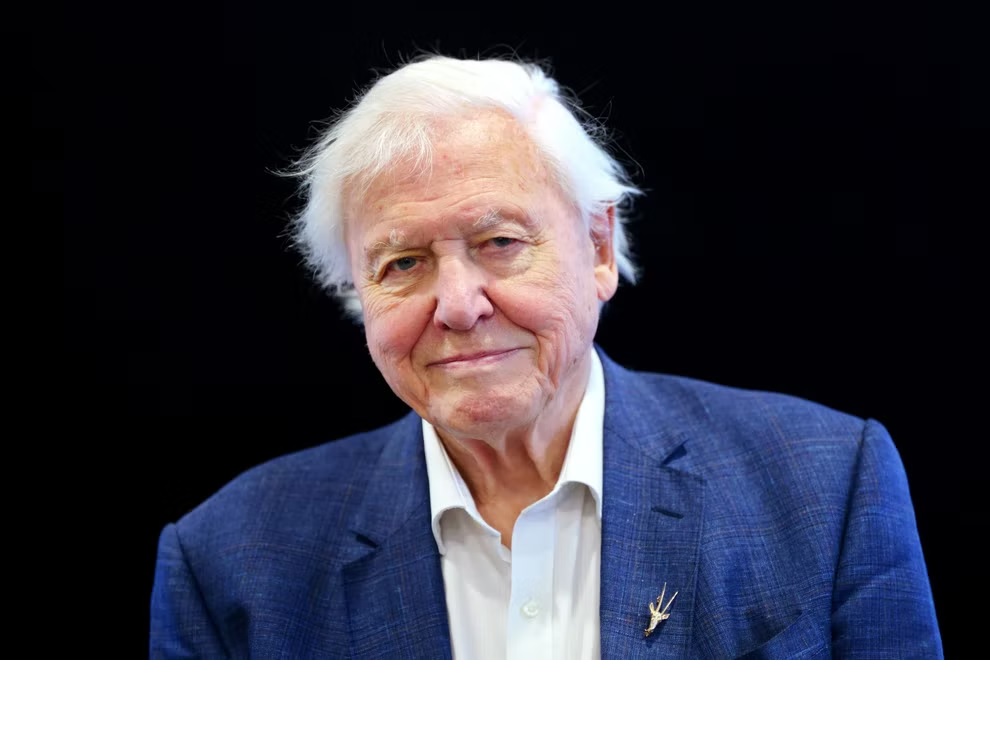
Earlier this month, the Royal Albert Hall hosted a 100th birthday party for naturalist David Attenborough, Britain’s most beloved broadcaster. Celebrities showered him with love and praise: Leonardo DiCaprio, Judi Dench, Olivia Colman, Emily Eavis, Chris Martin, Ben Fogle, Raye, Kate Winslet. And Paddington Bear. Attenborough sat in the royal box, alongside Prince William. King Charles delivered a handwritten message from Balmoral Castle via a ‘cavalcade of creature couriers’, including eagles, a red squirrel, a hedgehog, otters, ducks, a fox and deer, thanks to the wonders of CGI. All very nice; all very Disneyfied.
For many years now, Attenborough has been warning about the dangers of mass consumption, pollution, worldwide species loss and global warming. These subjects are clearly of great concern to him, although he started ringing the alarm bell very late.
But the evening gave a wide berth to such uncomfortable topics. ‘Life on Earth’? The climate crisis must be happening on a different planet entirely.
As Jonathan Liew, a Guardian sports journalist and columnist, pointed out:
‘This is, of course, the Attenborough with which our public discourse is most comfortable: depoliticised, universally adored, a man-sized Paddington Bear fit only for our veneration. Who teaches us about tree frogs and seal cubs and stick insects and asks for nothing in return.’
Of course, what Liew called ‘public discourse’ is the tightly constrained media space permitted by state and corporate power.
Liew continued:
‘And perhaps there are more difficult questions to negotiate here: the extent to which he has been a force for the meaningful and revolutionary change he seeks, and the extent to which his broad, inoffensive appeal has been more hindrance than help, allowing the powerful to feign concern for the planet while shirking the tough and bloody compromises required to secure it.’
To his credit, Attenborough has been eloquent and impassioned in recent years about the climate crisis. He addressed the COP26 climate summit in Glasgow in 2021, saying that:
‘We are already in trouble. The stability we all depend on is breaking. This story is one of inequality, as well as instability. Today, those who’ve done the least to cause this problem, are being the hardest hit. Ultimately, all of us will feel the impact, some of which are now unavoidable.’
But, even five years on, as the climate crisis worsens, the topic was deemed unmentionable by the organisers of Attenborough’s 100th birthday party.
‘Hothouse Earth’ And Collapsing Currents
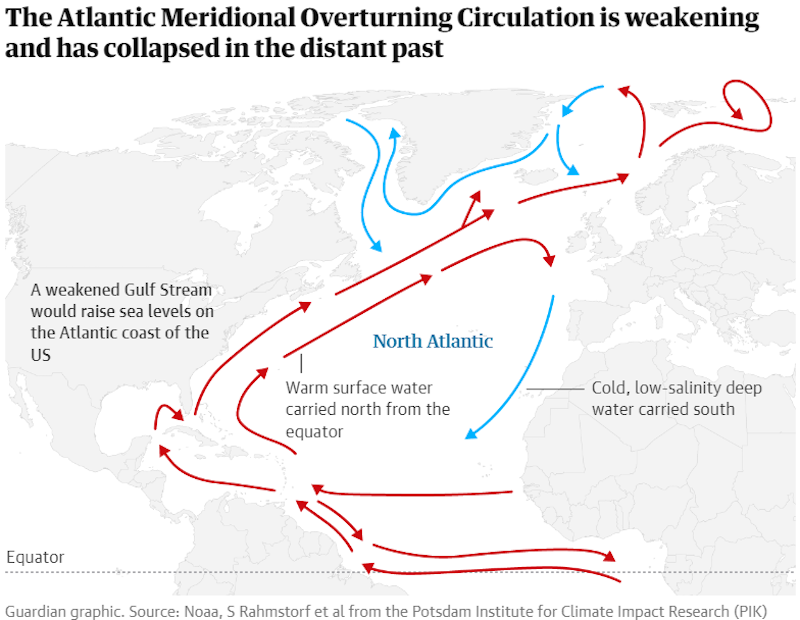
In February, a new scientific report warned that runaway global warming is closer than had previously been thought. We are heading for the ‘point of no return’ after which we would be locked into a hellish ‘hothouse Earth’. Climate ‘tipping points’ would be triggered, producing rapid heating, which would lead to a domino effect of yet more tipping points and feedback loops. These include the melting of the Greenland and Antarctic ice sheets, drastic dieback of the Amazon rainforest and the weakening, and possible shutdown, of the Atlantic ocean conveyor belt known as the Atlantic Meridional Overturning Circulation (AMOC).The scientists stated that:
‘Earth’s climate is now departing from the stable conditions that supported human civilization for millennia.’
The world has already experienced a global average temperature rise of over 1.3C since pre-industrial times and is likely to surpass the Paris Agreement ‘limit’ of long-term average heating of 1.5C in the next few years. Current government and business policies are pushing us towards 2-3C of global warming, if not more, by 2100.
But, if trigger points are breached and runaway global warming occurs, we are talking about much higher temperature rises, perhaps 10C or more. This would mean almost unimaginable catastrophic effects on the climate system, global agriculture and societal infrastructure; not to mention the extinction of humans. Scientists have warned that even a rise of 3-4C means that ‘the economy and society will cease to function as we know it’.
Bill McGuire, Professor Emeritus of Geophysical and Climate Hazards at University College London, put things in grim perspective via X:
‘We are already locked-in to a return to Pliocene [around 2.6 to 5.3 million years ago] conditions (3C hotter and (eventually) ~ 20m sea-level rise)
‘Keep going as we are, and hotter Miocene [5.3 to 23 million years ago] conditions will result
‘Beyond this a return to early Eocene [around 48 to 56 million years ago] hothouse beckons – and potential oblivion’
During the Eocene, the global average temperature was well over 10C higher than present. Oblivion would hit humanity long before such a temperature rise occurred.
Earlier this month, yet another deeply disturbing scientific studyrevealed that the risk of AMOC reaching a tipping point by 2100, after which its shutdown would be inevitable, is as high as 50 per cent. Previously, this was considered ‘a low likelihood event’ of around five per cent. But even this should be held in perspective. How many of us would board a plane knowing that there was a five per cent chance that it would crash?
AMOC, of which the Gulf Stream is the best-known component, is a vital carrier of warm water from the tropics to high latitudes in the North Atlantic, returning cold water southwards. It is a primary source of heat for western and northern Europe, leading to the temperate climate here. AMOC connects with other ocean current systems in a global network that transports heat, water, nutrients and carbon around the planet. Any disturbance to AMOC, far less its collapse, would have devastating global consequences for climate, agriculture, infrastructure and even for the habitability of Earth.
Professor Stefan Rahmstorf of the Potsdam Institute for Climate Impact Research in Germany, who has studied AMOC for 35 years, said:
‘This is an important and very concerning result. It shows that the “pessimistic” models, which show a strong weakening of the AMOC by 2100, are, unfortunately, the realistic ones, in that they agree better with observational data.’
He added:
‘I now am increasingly worried that we may well pass that AMOC shutdown tipping point, where it becomes inevitable, in the middle of this century, which is quite close.’
To emphasise: the tipping point may be much earlier than 2100; it could happen by 2050, or even sooner. The vital point here is that scientists increasingly agree that the ‘safe window’ to stabilise the current by halting emissions is closing far faster than previously thought. And the public likely does not even realise it.
Rahmstorf had previously said that a collapse must be avoided ‘at all costs’. Now he added:
‘I argued this when we thought the chance of an AMOC shutdown was maybe 5%, and even then we were saying that risk is too high, given the massive impacts. Now it looks like it’s more than 50%. The most dramatic and drastic climate changes we see in the last 100,000 years of Earth history have been when the AMOC switched to a different state.’
In an English-language video for the German DW news channel, Rahmstorf explained the importance of AMOC for European and global climate, and the significance of the latest alarming results. He warned that we should expect more climate extremes in heat, cold, drought, floods and storms.
If and when the AMOC collapses, the impact on agriculture in the northern hemisphere will be devastating. The drop in harvest yields for key crops could be as high as 50 per cent. Mass starvation is a very real possibility.
Climate Shocks
……………………………………………………………………………………………………. The fact that deeply disturbing findings about a likely collapse of a vital component of the climate system were not given wider, extensive and sustained coverage is a devastating indictment of ‘mainstream’ journalism.
……………………….Scientists are warning, as loudly as they possibly can, that the present economic system of rampant capitalism is destroying the very life-support systems that made Planet Earth a habitable environment for humans to evolve and flourish.
……………………………………………………………………………………………………………………………………………….. Look at the daily, hour-by-hour obsessing over the endless maneuvering within the Labour government; every single statement from ministers and their allies scrutinised by the Westminster bubble of political correspondents.
Imagine that, instead of focusing on short-term melodramas, leading news organisations rigorously probed politicians, day in and day out, about the climate crisis.
Imagine that news editors and journalists relentlessly challenged the government about current policies that are bringing us closer to the brink of climate chaos.
Imagine that reporters investigated and exposed the deep reluctance and state-corporate obstacles, including the establishment media, that are blocking alternatives to climate Armageddon.
The financing of Sizewell C has been scrutinised by the National Audit Office (NAO), which found it “places more risks on taxpayers and consumers than other electricity projects” and that benefits to consumers will only outweigh costs after 2060.
In July 2022, the Department for Energy Security and Net Zero (DESNZ) announced it had secured the final investment decision (FID) for the project on the Suffolk coast, which is expected to produce 3.2GW of electricity.
Achieving the FID meant that investors and the government had agreed the terms on which investment would be put into the project, how returns on investment would work, and what this meant for consumers.
The government confirmed that the project would cost “around £38bn”, nearly double the original £20bn estimate stated by EDF in 2020.
Today’s [20 May] NAO report, simply titled Sizewell C, assessed “the implications of the deal for taxpayers, electricity consumers, and investors, and provides a baseline against which progress can be measured.”
A statement from the NAO, announcing the report, said DESNZ’s “delivery model for Sizewell C places more risks on taxpayers and consumers than other electricity projects, but the Department believes this model has reduced finance costs and will allow the project to be delivered on time and to budget.”
It added that the “novel approach has costs and relies on big assumptions
Once construction at the plant has been completed, the government’s modelling “predicts that the net benefits for consumers could be up to £18bn, primarily delivered through energy bill savings and reduced electricity costs compared to other ways of reaching net zero,” the NAO said.
“However, as a large infrastructure project, DESNZ’s modelling of these benefits shows they will not outweigh the costs to consumers until after 2060.”
The report also assessed the claims by Sizewell C that it will be easier to build because it is largely copying the designs of Hinkley Point C.
The NAO pointed out that Hinkley Point C “is currently expected to cost double its initial projected cost, with a seven-year delay”, and that this “has sparked concerns that these problems may be mirrored in Sizewell C”.
The spending watchdog said DESNZ hoped to avoid repetition of mistakes by “applying the lessons and final designs from Hinkley Point C”, and, as such, “Sizewell C’s plans are already at a much more advanced stage than Hinkley’s were at the equivalent point”.
NAO head Gareth Davies said: “Sizewell C forms a significant part of the government’s plan for a secure and affordable clean energy supply. There has been a concerted attempt to learn from the problems of previous nuclear power construction projects and other large infrastructure schemes.
“This has resulted in a novel financing structure and DESNZ will need to monitor the risks to taxpayers and billpayers closely.”
Public Accounts Committee chair Geoffrey Clifton-Brown commented on the report, raising concerns about the “substantial” risks of Sizewell C, which are being borne by the public.
“Sizewell C is a project of exceptional scale, complexity and significance for taxpayers. Costs are estimated to be £38.2bn, largely financed by government”, he said.
“While the potential benefits are considerable, they remain uncertain; by contrast, the risks are immediate, substantial and borne by the public. Consumers are already contributing through their electricity bills, and the government has assumed most of the project’s financial risk.”
He added: “Experience from comparable nuclear projects in the UK and overseas highlights their vulnerability to delays and cost overruns.
“Although the government has introduced a new delivery and financing model to mitigate these risks, it must now ensure it works in practice through close monitoring, greater transparency to Parliament, and by securing value for money from the significant public and private investment.”
Reaction to the report..…………………………………………………………………………………………………………….
University of Greenwich emeritus professor of energy policy Steve Thomas gave NCE his reaction to the NAO report, asking, “Is this the best NAO can do after a year of effort?”
He pointed to a line from the NAO press release about the report, which said: “Sharing risk between the investors and taxpayers and consumers appears to have reduced the cost of financing Sizewell C, but the rewards for investors still appear high.”
He said the statement that financing costs had been reduced was “rubbish on two grounds”.
“First, the finance costs are being paid by consumers in the construction period under the RAB (Regulated Asset Base) surcharge. Getting someone else to pay does not reduce them, it just shifts them.
“Second, the finance is being provided by the government National Wealth Fund and the interest rate will be whatever the government tells it to charge, so if finance charges are lower because the interest rate is reduced, that is because the government has imposed the interest rate.”
The press release also said: “Investor financial returns will cost consumers over £4bn but will be justified if they help the project to cut construction costs and speed up delivery times.” Thomas described this as “unclear”.
He said: “If it refers to the 4.8% of the 10.8% real rate of return investors will be given, that will be a gift from consumers to investors, it is an underestimate. Centrica says that of its £3bn equity contribution, only £1.3bn will come from itself, the rest will come from this 4.8% which investors are required to use as equity contribution.
“Centrica euphemistically describes this as ‘RAB Growth’.”
The NAO statement adds that DESNZ assumes “the involvement of private investors is justified, as their expertise will reduce construction costs and speed up delivery.”
In response, University of Greenwich academic Thomas asks: “What expertise does La Caisse, Centrica, NLF have on building nuclear projects? EDF has expertise but that didn’t stop Hinkley, Flamanville, and even Taishan going horribly wrong.”
He also questions the government’s use of £38.2bn as a baseline cost for Sizewell C, describing it as “wrong”, because the lower regulatory threshold cost is £40.5bn, which the government is using as its central estimate.
“£38.2bn is clearly the lower end of the range. A very basic element of project appraisal is to use central estimates, not bottom of the range ones,” he added.
A Stop Sizewell C spokesperson told NCE that the campaign group shares a lot of the NAO’s concerns, and asked for the government to commit to a public, “realistic” completion date for the project.
“The NAO’s report confirms what we already suspected – that ‘big assumptions’ and the ‘significant uncertainty’ of factors underpinning DESNZ’s claimed benefits could easily turn Sizewell C into a financial disaster, with its investors – thanks to RAB – being the only ones who can’t lose,” the spokesperson said.
“As the NAO confirms, households are relying on those investors to produce significant savings and reduce Sizewell C’s construction time to justify the nuclear tax on our energy bills, but we share the NAO’s questions about whether investors can or have the incentives to do this.”
They added: “We had asked the NAO to look at Sizewell C before it reached Final Investment Decision and are dismayed it did not do so, but at least some critical information withheld by the government is now in the public domain.
“We agree with the NAO that DESNZ must provide transparency of forecast cost and schedule for Sizewell C. We call for the government’s promised Sizewell C Strategy and Delivery plan, containing a public, realistic completion date, to be laid before parliament immediately.”
TASC spokesperson Chris Wilson told NCE: “The NAO report regarding the Sizewell C project confirms that this government’s ideological pursuit of nuclear power is based on hope and belief rather than objective judgement.
“Ignoring all the warnings and project risks, the usual optimism bias regularly expounded by the nuclear industry is there in spades, at the same time negative assumptions are made about the cost of renewables
“That DESNZ went ahead with the Sizewell C investment decision on the basis that consumers would not benefit until 2064 beggars belief.
“The NAO report highlights a stark imbalance in DESNZ’s Sizewell C funding model: the investors are shielded from risk while reaping massive profits, leaving the public purse and electricity consumers to shoulder an unfair and excessive financial burden.”
Wilson added: “A major concern highlighted by the NAO is the lack of incentive for EDF to complete Sizewell C on time and budget – they will get paid to develop and supply major components while receiving a guaranteed return on their investment.
“EDF have been involved in every previous EPR reactor project and all of them have gone woefully over time and budget – they now have the added distraction and priority of building the new EPR2 reactor programme in France. What could possibly go wrong?”
The police force tasked with stopping terrorist attacks at UK nuclear sites dealt with dozens of internal security breaches last year – including a classified laptop going missing, contractors working without proper background checks, and armed officers losing ID cards.
Three breaches involved classified material being lost or stolen outside the Civil Nuclear Constabulary’s (CNC) premises – including two police warrant cards, used to identify officers, which were supposed to arrive via courier.
A further nine cases involved the loss of identity passes, including those belonging to armed officers, and two contractors were found to be working without “appropriate” vetting.
Other breaches included confidential material being left inside body armour sent for destruction, a staff member accessing information they were no longer authorised to see, and compromised personal data. There were 35 breaches in total, the CNC reported.
The CNC is the armed police force that protects civilian nuclear facilities across the UK, including Torness and Dounreay in Scotland. The force also escorts nuclear material when it is being transported and guards other “critical national infrastructure” such as gas terminals.
Our findings come after we submitted a freedom of information request to the force. You can read full details of the breaches here.
Opponents of nuclear energy said the UK “cannot afford to be sloppy when it comes to nuclear security” and claimed “very little appears to have been done” to tackle breaches in recent years.
The CNC described the security incidents last year as “minor” and a spokesperson told The Ferret the force “takes action on all incidents and seeks to learn lessons” from them.
National Audit Office report says consumers will pay higher amount for energy from Suffolk project compared to its Somerset counterpart. Electricity from the Sizewell C nuclear project is set to be more expensive than power from Hinkley Point, even though the Suffolk plant is cheaper to build, Britain’s public spending watchdog has said.
Sizewell C is on course to cost about 22 per cent less than Hinkley Point C, which is being built in Somerset. But the latter has agreed to sell its electricity at a fixed price, limiting the cost to end users because developer EDF has to absorb any cost overruns.
A National Audit Office report published on Wednesday estimates that if construction costs are in line with forecasts of £38bn-£48bn, electricity from Sizewell C will cost between £131-£155 per megawatt hour in 2024-2025 prices. This compares to £129 per MWh for electricity from Hinkley Point C.
The government and a consortium of developers had regularly highlighted that Sizewell C would be cheaper to build than Hinkley amid concerns about the cost of the project. But the NAO report says: “Although Sizewell C should cost less to build than Hinkley Point C, it is likely that consumers will pay more for energy . . . because the price of Hinkley’s electricity was set before its cost over-ran (which has been borne by EDF), and the cost of borrowing has also increased since then.”
The nuclear industry will become “more dangerous” and regulation of the sector has been captured by “vested interests,” campaigners and experts have told the Canary, after the Nuclear Regulation Bill was put forward in the 2026 King’s Speech.
The Labour Government had already said in March 2026 that it was committed to implementing the recommendations of the Nuclear Regulatory Review, which was led by John Fingleton – sometimes referred to as the Fingleton Review.
Announcing the findings of the review in March 2026, the government said:
overly complex regulation in the UK has contributed to the ‘relative decline’ in the UK’s global leadership position in nuclear.
It also set out 47 recommendations to:
to speed up building new nuclear projects.
King’s speech 2026
The King announced the Bill in his King’s Speech, saying:
My Ministers will also take forward recommendations of the Nuclear Regulatory Review and encourage a new era of British nuclear energy generation.
In briefing notes published by the government, which explain their plans in more detail, the government referenced the Fingleton Review, which it characterized as calling for “a radical refresh” of the nuclear regulatory regime.
It went on to say that the Nuclear Regulation Bill is:
modernising the way that new nuclear projects are regulated so we can deliver safe, secure and affordable nuclear power and infrastructure sooner, while maintaining strong environmental protections.
The briefing notes tried to placate fears that the recommendations in the Fingleton Review could erode environmental protections.
They added:
To speed up the delivery of new nuclear and reduce costs, the Government is overhauling planning and regulation in a boost to the UK’s energy sovereignty and the nuclear deterrent.
This Bill will support quicker delivery of nuclear projects in a way that produces a win-win for building critical infrastructure while protecting nature and the environment, and high standards of nuclear safety.
‘Industry falsehoods’ used to justify risk nuclear projects pose to nature – conservationist
The Wildlife Trusts‘ head of public affairs Matthew Browne told the Canary:
This Government was elected to govern on the basis of a manifesto that promised to restore the natural world. We are a long way from this promise being delivered. Today’s King’s Speech is silent on nature recovery, and includes measures that will actively harm wildlife.
Whilst early proposals for the ripping up of nature protections have thankfully been dropped, the Nuclear Regulation Bill is justified on the grounds of industry falsehoods which minimise the risk projects can pose to nature. The Regulating for Growth Bill gives environmental regulators an inappropriate focus on growth, bending their work away from vital nature recovery objectives.
With ongoing nature loss impacting our ability to grow food, to protect communities from flooding and our ability to stay healthy, this failure to respond to a growing national security crisis risks fundamental dereliction of duty. The Government needs to change course, and face up to environmental reality, before it comes an economic and social disaster.
Bill will make ‘inherently dangerous’ nuclear power ‘more dangerous’ – anti-nuclear campaigner
When you think of nuclear accidents like at Windscale in 1957, Chernobyl in 1986, or Fukushima in 2011, it’s easy to see that Britain’s current nuclear regulatory procedures and rules are in place for a simple reason – that nuclear power is inherently dangerous.
Rather than acknowledge these risks or legacy issues – like tackling the toxic waste generated by nuclear power – the government’s plan to cut regulations essentially means this industry will be more dangerous.
This is disturbingly similar to what Donald Trump did earlier this year when he gutted the US Nuclear Regulatory Commission and the US Environmental Protection Agency.
These proposed regulatory changes are also for the benefit of Britain’s deadly and costly nuclear weapons programme, which already accounts for almost a quarter of Britain’s military budget. Rather than strengthening our security, these proposals will instead weaken it and put us all at even greater risks from the nuclear industry.
Government should pursue renewables instead of nuclear – SNP
Scottish National Party (SNP) Alex Kerr MSP told the Canary:
Under Keir Starmer’s watch, energy bills have spiralled out of control, 1,000 jobs are being lost every month in the North Sea and Scotland’s only refinery at Grangemouth has closed – the Labour party has zero credibility when it comes to energy.
Now Labour is ripping up regulations to pursue its dangerous obsession with nuclear power.
Scotland has an abundance of clean energy sources – we don’t need new nuclear power stations, which are ludicrously expensive, take years to build, and leave us with dangerous waste.
Another energy superpower, Norway, has just ruled out using nuclear energy. With the fresh start of independence, Scotland can do the same and use our vast energy wealth to lower bills, enhance our energy security, and build a wealthier country.
Pursuit of nuclear instead of renewables unjustifiable – academic
University of Sussex emeritus professor Andy Stirling told the Canary that the evidence shows renewables should be pursued instead of nuclear, and the only reason that the government wants a civil nuclear sector is to enable the UK’s nuclear weapons programme.
He said:
Detailed plans for deregulating nuclear power set out in the King’s speech further underscore how deeply policy making in this field has been captured by vested interests.
Despite huge official noise around this issue, no UK Government document has systematically compared nuclear with alternative options to deliver affordable, safe, secure, domestic low carbon power. This situation in itself seriously undermines both sound policy making and wider democracy.
If any such analysis were to have been undertaken, the overwhelming independent evidence is, that it would have had to conclude that nuclear is verging on obsolescent as a means to deliver these objectives. Even existing mature forms of nuclear power costs many times more than comparable means to deliver firm-equivalent electricity and are far slower and problematic in other ways. So consumer bills are raised and climate action delayed.
That the Government does not even try to make arguments against this, shows the real reason for supporting high price, slow, troublesome nuclear power, is to underpin equally problematic and ineffective nuclear weapons ambitions.
Bill sets government on ‘collision course with communities’ – anti-Sizewell C campaigner
Stop Sizewell C executive director Alison Downes told the Canary:
The government is on a collision course with communities over its plans for a Nuclear Regulation Bill, for example in response to the Nuclear Regulatory Task Force it included the concerning promise to ‘go further’ in creating a new pathway to allow semi-urban nuclear power stations.
Ironically, rigorous public consultations are promised, but the Prime Minister’s inflammatory rhetoric directed at those who express concern about new nuclear plants in no way builds public confidence. We need assurances of strong, independent regulators and affected communities to be allowed to actively engage, not be insulted.
“This place is not a place of honor … no highly esteemed dead is commemorated here … nothing valued is here. What is here was dangerous and repulsive to us. This message is a warning about danger
Very soon, likely within a few weeks, one of the world’s most interesting pieces of infrastructure will open after 22 years of construction and almost half a century of contemplation. Called Onkalo – Finnish for “cavity” – the site will be the world’s first permanent repository for nuclear waste.
By law, Finland obliges that nuclear waste produced domestically must be stored domestically. That will now occur on the island of Olkiluoto at a depth of more than 400 metres within bedrock that’s almost two billion years old. Currently, the repository area is about two square kilometres and comprised of 10 kilometres of tunnels – this number will likely quadruple before the site’s decommissioning in around 2100, when this cavern will be backfilled and sealed, creating a self-maintained nuclear sarcophagus for the approximately 100,000 years it will take for the waste’s radioactivity to have decayed to safe levels.
Perhaps by now you’re beginning to intuit a little about a) the complexity of its design, b) the richness of its semiotic implications, and c) the sobering absence of anything approaching a precedent for this. Consider: after its decommissioning, Onkalo must remain perfectly passive, requiring no active management or monitoring for 100,000 years. Second, its profound danger must be communicated so far into the future that current languages, customs – even genetic dispositions – can no longer be assumed to exist. It’s a strange and disquieting fact that the radioactivity of our nuclear waste might outlive our languages for communicating its danger. Third, no man-made structure has ever lasted anything close to the length of time that Onkalo is hoped to be preserved for.
Let’s start with the simpler facts of the site. Olkiluoto Island was chosen for its geological stability – the low-permeability of its bedrock and its low-risk of seismic tremors. In Michael Madsen’s fascinating 2010 documentary about the site’s design, Into Eternity, one project adviser explains how time down there goes slowly, while up here, on the surface, it passes very, very quickly.
In other words, the crystalline rock 450 metres below ground here looks much the same as it did 500,000 years ago. The surface of our planet, however, would look unrecognisable if we travelled back just 200 years. Our natural, political and material world changes often and quickly – the latter to the whims and passions of its human inhabitants, our creative and destructive ingenuities, and the gravity of civilisational entropy. The natural world, meanwhile, forever remains subject to the whims and passions of storms and droughts and a climate that’s being altered by us.
Currently, the world’s approximately half-a-million tonnes of nuclear waste is kept in temporary storage on the surface of our planet, and is thus subject to war, sabotage or natural calamity. Much safer to secure it deep down where time moves slowly.
There is something lusciously strange and dreamlike about the projections and assumptions Onkalo’s designers were asked to make. They did nothing less than imaginatively commune with a form of humanity far into the future.
The weirdness of this can be emphasised by offering some modest timescale. The birth of Jesus Christ was 2000 years ago. The pyramids of Giza were completed about 4500 years ago. The previous Ice Age ended almost 12,000 years ago and found the peak of its severity about 10,000 years before that. That is still nowhere near 100,000 years, the length of time into the future for which Onkalo must remain independently stable and for which the warnings we write today must travel and remain intelligible.
And so, the niche field of nuclear semiotics: how do we communicate today’s intentions to a civilisation so distant that we presume it to be almost alien and to not share our language? Preceding this question though, is another: should we even try? Can we assume that humanity will, in 80,000 years, say, possess the same curiosity we do today? That is, will they perform the same enthusiastic archaeological excavations as we do now? And, if so, will they treat the nuclear tomb as we might an Incan crypt?
Might it be that by signposting the danger, we simply encourage their curiosity? Would warnings, even if we could guarantee their future intelligibility, serve to appropriately quell curiosity or dangerously arouse it?
The questions only birth more questions. Given that Onkalo is so deeply buried, and its decommissioning would involve erasing all surface infrastructure, can it not be assumed that it would never be accidentally found? Or might some evidence of its existence survive? Physical evidence, or digital? Is it preposterous to think that any digital evidence of our civilisation today could survive so far into the future – when, between now and the safe decay of the waste, there is assumed to fall several new ice ages?
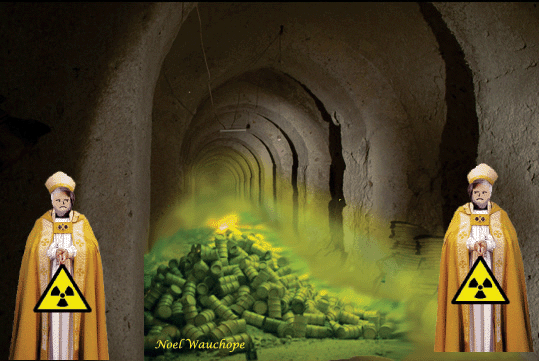
The designers answered at least one big question: they would, via ceramic tablets, leave warnings to our future selves about the site. Detailed warnings, in several languages unlikely to survive several epochs, have been suggested: “This place is not a place of honor … no highly esteemed dead is commemorated here … nothing valued is here. What is here was dangerous and repulsive to us. This message is a warning about danger.”
Also proposed are simple pictographs that are assumed to have a universally intelligible quality: a triangle that includes the radioactive symbol, a skull and crossbones, an arrow pointing away from the danger, and a human stick-figure running in the direction it suggests.
Given the spookiness of radioactivity – and the oddity of communicating its dangers across a chasm of time to unknowable descendants – the project invited some strange proposals. One was rendering the surface above the tomb conspicuously forbidding: lightning bolt sculptures amongst forests of barbed wire. (But optimistically assuming their material survival, how can we assume that their symbolic charge would survive, and not simply invite curiosity as cryptic anachronisms?) Another proposal was made for genetically engineering cats who change colour in the proximity of radiation – a kind of bizarre Geiger counter.
In 2020, the American electronic music producer (and roboticist) Skytree, aka Evan Snyder, released a track called “Atomic Priest” written with rapper Jackson Whalan. Its lyrics were about precisely the problem of communicating danger forward through “deep time”:
This is for the humans living ten thousand years from now With radioactive capsules, thousands of feet underground Grabbin’ the mic to warn you of these hazardous sites For those who lack in the sight in the black of the night The least good that we could do is form an Atomic Priesthood To keep the future species from going where no one should We’ve buried the mistakes of past nuclear waste Hidden underground for future races to face It’s our task to leave signs for civilization to trace But who’s to say what language these generations will embrace?
The American-Hungarian linguist Thomas Sebeok minted the term “atomic priesthood” in the early 1980s. Sebeok thought that, given that radioactivity of our waste would outlive current languages (and God knows what else), the trick to communicating our warnings about it lay in folklore. Sebeok had been commissioned by the US Department of Energy to this end. In 1980, the department had established the “Human Interference Task Force”, which was asked to “investigate the problems connected with the post-closure, final marking of a filled nuclear waste repository. The task of the HITF is to devise a method of warning future generations not to mine or drill at that site unless they are aware of the consequences of their actions.”
In 1984, Sebeok submitted his report. It was called “Communication Measures to Bridge Ten Millenia”. Semiotics were everything here, Sebeok wrote, given its relevance to “the problems of human interference and message exchanges involving long periods of time, over which spoken and written languages are sure to decay to the point of incomprehensibility, making it necessary to utilize a perspective that goes well beyond linguistics”.
Here, then, is the luscious strangeness of nuclear semiotics – a field that overlaps with our formal considerations of communicating with extraterrestrial intelligence, but which seems even stranger to me given that the aliens in this case are our future selves.
Sebeok suggested that the best way to ensure the survival of our warnings deep into the future was through mythology – the enactment of annual rituals and the ratification of legends that were upheld by an “atomic priesthood”. The stories would alter over time, but perhaps the core desire of the transmission – to effectively warn off future excavators – would survive. It wouldn’t matter if the sense of hazard had degraded into superstition, long untethered to science or the danger at hand. Only that a sense of fear and repulsion was maintained.
“A ritual annually renewed can be foreseen, with the legend retold year-by-year (with, presumably, slight variations),” Sebeok wrote in his government report. “The actual ‘truth’ would be entrusted exclusively to what we might call for dramatic emphasis an ‘atomic priesthood’, that is, a commission of knowledgeable physicists, experts in radiation sickness, anthropologists, linguists, psychologists, semioticians, and whatever additional expertise may be called for now and in the future. Membership in this ‘priesthood’ would be self-selective over time.
“The best mechanism for embarking upon a novel tradition … is at present unclear. Folklore specialists consulted have advised that they know of no precedent, nor could they think of a parallel situation, except the well-known, but ineffectual, curses associated with the burial sites (viz., pyramids) of some Egyptian Pharaohs … which did not deter greedy grave-robbers from digging for ‘hidden treasure’.”
Here, then, is the weird world of considering future ones. In a few weeks, Onkalo will become operational, accepting the copper-encased tubes of nuclear waste into its deep tombs of crystalline rock, where things remain more stable than the conditions half a kilometre above.
On April 15th, Declassified UK published a bombshell investigation exposing how in the mid-1990s, senior British political and military officials were well-aware NATO expansion into Central and Eastern Europe “would provoke [the] Russians,” and likely trigger all-out war. Hitherto unreported Ministry of Defence files reveal London knew Moscow’s “sensitivities” over a “hostile military alliance” enlarging up to its borders were profound, and based on very “real” concerns. Yet, NATO’s dangerous crusade to absorb Central and Eastern Europe continued apace, ultimately producing the Ukraine proxy conflict.
Since the so-called Special Military Operation’s February 2022 eruption, British officials have relentlessly reiterated the mantra the proxy war was “unprovoked”. However, a declassified March 1995 Foreign Office memo noted “there was a widespread psychological and intellectual perception in Moscow that NATO was a real threat.” In May that year, then-Prime Minister John Major succinctly articulated Russian anxieties to his Irish counterpart John Bruton, as a “fundamental fear…of encirclement.” Concerns about EU membership were comparatively muted:
“For the Russians, NATO had a much more threatening symbolism and political resonance…The Baltics were particularly difficult, with extreme sensitivity for Russia. It would be very hard to have a NATO border directly against Russia.”
Still, in 1997 NATO invited Czechia, Hungary, and Poland to join, which they did two years later. In 2004, Estonia, Latvia and Lithuania simultaneously joined the military alliance. So too did ex-Warsaw Pact members Bulgaria, Romania, Slovakia, and former Yugoslav republic Slovenia. Declassified UK shows how back in August 1996, British Defence Intelligence prepared a NATO enlargement study specifically forecasting that these countries joining could trigger war, and an alliance military operation launched via Article 5 of the NATO treaty in response.
This refers to collective self-defence, under which NATO members are obligated to come to each other’s defence if attacked. In the scenario, Defence Intelligence assumed “Russia has vehemently opposed NATO membership for the Baltic states and has threatened retaliation to preserve her own security against a perceived hostile military alliance on her borders.” In the real world, Boris Yeltsin made at-times irate public statements about NATO enlargement into the Baltics at the time, while lobbying US President Bill Clinton on the issue behind closed doors.
NATO expansion continued regardless. In December 1996, Declassified UK reports then-Russian premier Viktor Chernomyrdin privately warned Major: “Russia could not stop NATO enlarging, but this would create a fragile situation which could explode.” Otherdeclassified files from this time show senior apparatchiks in London were acutely aware of Moscow’s “concern,” “fears,” “hostility,” “negative attitudes,” and “resentment” over alliance enlargement. Both Major and his successor Tony Blair explicitly pledged in person to Kremlin officials that NATO wouldn’t “move up to Russia’s borders.”
However, a secretSeptember 1996policy paper made clear Britain was committed “to enlarge NATO to the East,” even if “Russian acquiescence is not possible.” In February 1997, Russia’s deputy foreign minister Nikolai Afanasievsky angrily branded public discussions in Western capitals of admitting former Soviet republics to the alliance a “blatant provocation” in a meeting with Jeremy Greenstock, Britain’s ambassador to Moscow. Greenstock reassured his Russian opposite number NATO had “no intention” of admitting former Soviet states “at this stage” – which, technically, was true.
‘Russian Problem’
A March 1997 Foreign Office memo forecast rapid NATO enlargement would “antagonise,” and ultimately “provoke,” Russia into a belligerent counter-response. Yeltsin’s “anxiety” about the “possible accession of Ukraine, the Baltic states and other states of the former Soviet Union” was considered the “most difficult issue” affecting Western relations with Moscow. A more staggered approach was thus required. That month, John Major met with NATO secretary general Javier Solana, who spoke of “Russians fears about NATO troops and equipment moving eastwards.”…………………………………………………………………………………………………………………………………………………………………………………………………………………………..https://www.kitklarenberg.com/p/declassified-uk-knew-nato-expansion
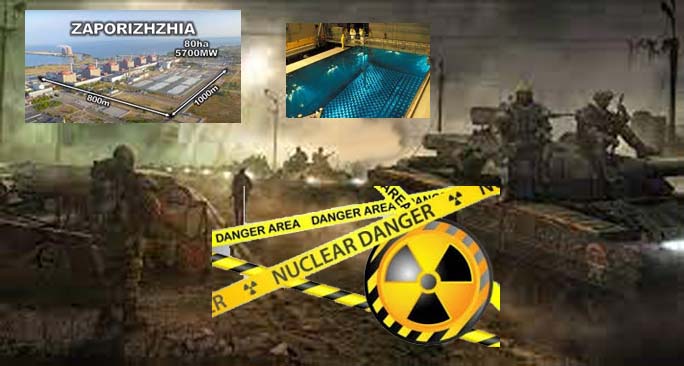
The Zaporizhzhia Nuclear Power Plant in Ukraine was targeted again last week, with continual concern over its safety since the start of the war with Russia in 2022. Safety at Europe’s biggest nuclear power plant is “rapidly deteriorating”, Russia’s nuclear energy chief has warned.
A long-term project we have had here at Bella, that is charting the toxic legacy of the British State. Our map, Scotland the Dump, produced by the wonderful Magnificent Octopus Illustration is being prepared for shipping right now. The map details the weapons ranges, munitions dumps, biological and chemical weapons dumps and nuclear waste scattered around Scotland.
Russia is in the late stages of a multi-decade-long modernization program to replace all of its Soviet-era nuclear-capable systems with newer versions. However, this program is facing significant challenges that will further delay the entry into force of these newer systems. In this issue of the Nuclear Notebook, we estimate that Russia now possesses approximately 4,400 nuclear warheads for its strategic and non-strategic nuclear forces—a slight increase from the previous year. The significant increase in non-strategic nuclear weapons that the Pentagon predicted five years ago has so far not materialized. A nuclear weapons storage site in Belarus appears to be nearing completion. The Nuclear Notebook is researched and written by the staff of the Federation of American Scientists’ Nuclear Information Project: director Hans M. Kristensen, associate director Matt Korda, and senior research associates Eliana Johns and Mackenzie Knight-Boyle
This article is freely available in PDF format in the Bulletin of the Atomic Scientists’ digital magazine (published by Taylor & Francis) at this link.
Russia is nearing the completion of a decades-long effort to replace most of its strategic and non-strategic nuclear-capable systems with newer versions. But despite Moscow’s continued rhetorical emphasis on its nuclear forces, commercial satellite imagery and other open sources indicate that elements of Russia’s nuclear modernization are proceeding much more slowly than planned: Upgrades to intercontinental ballistic missiles (ICBMs) and bombers face significant delays, and the “significant” increase of Russian non-strategic nuclear weapons that US Strategic Command (STRATCOM) predicted five years ago has so far not materialized (Richard 2020, 5).
As of March 2026, we estimate that Russia has a stockpile of approximately 4,400 nuclear warheads assigned for use by long-range strategic launchers and shorter-range tactical nuclear forces. This number is greater than last year, largely due to a change in our estimate of warheads assigned to non-strategic nuclear forces following STRATCOM’s publication of its estimate for the number of warheads in the Russian arsenal. The estimate, which is the first time in more than three decades that the US government has disclosed how many warheads it believes Russia possesses, stated that “Russia’s nuclear warhead arsenal consists of approximately 4,600 nuclear warheads; 2,600 are intended for its strategic triad and up to 2,000 are warheads intended for theater nuclear weapons” (Correll 2026). Given that the US Intelligence Community for several years has estimated Russia has 1,000–2,000 nonstrategic warheads (US Department of State 2025a), the “approximately” in the STRATCOM statement indicates the stockpile is less than 4,600 and the number of nonstrategic warheads is less than 2,000. We were able to match the estimate for strategic warheads, but the total stockpile number
necessitated a revision of our estimate for nonstrategic warheads closer to the estimate we published in 2023 (Kristensen, Korda, and Reynolds 2023).
Of the estimated 4,400 stockpiled warheads, approximately 1,796 strategic warheads are deployed: about 892 on land-based ballistic missiles, about 704 on submarine-launched ballistic missiles, and about 200 at heavy bomber bases. Another approximately 810 strategic warheads are in storage, along with about 1,794 nonstrategic warheads. In addition to the military stockpile for operational forces, a large number—approximately 1,020—of retired but still largely intact warheads await dismantlement, for a total inventory of approximately 5,420 warheads[1] (see Table 1 on original).
Rudyard Kipling, a modern classic of the Western literary canon, was both a champion of British imperialism and too honest not to know its very sordid underpinnings of greed, lies, and sheer selfishness.
That’s why the same man who extolled the “white man’s burden” also wrote ‘The Man Who Would Be King,’ a story of two lowlife, ambitious adventurers who manage to swindle their way to becoming kings as well as rich in a remote country on the fringes of the empire, then at its late-nineteenth-century zenith of global primacy. Until, that is, one of them makes the mistake of messing with the wrong woman, who ends up biting him in public. Seeing him bleed, his subjects realize he is a mere mortal and mercilessly dispense with the two imposters.
Ukraine’s ruler – and de facto king (of the old-fashioned, non-constitutional kind) – Vladimir Zelensky is a social climber, too. In his formative years, his native Krivoy Rog was a provincial post-Soviet rustbelt town with a lively gangster scene, a “bandit city” in his own words. Zelensky is also an expert in make-believe by profession, a cynically profane showman of the ‘give-them-whatever-they-want-as-long-as-it-pays’ variety, the cruder and smuttier the better.
Indeed, Zelensky even has a sidekick, who, as in Kipling’s dark story, has shared in the scheme of power-grabbing and plunder: Andrey Yermak, his former chief of staff and very intimate friend, making headlines (again) for being so corrupt and sinister that he stands out, even in Kiev.
And now Zelensky, the man who, it seems, would be Ukraine’s president forever, has just been bitten in public by a woman. Judging by the fierce, clearly orchestrated reaction of his media propagandists in Ukraine and the fact that the Western mainstream media are largely pretending not to have noticed, he must be bleeding, too.
The woman is his former press secretary Yulia Mendel. And she has been able to draw (metaphorical) blood because Tucker Carlson, American alternative-media heavyweight and conservative dissident from Trumpism, has interviewed her for his show.
That has made it a very public bloodletting indeed. What Mendel has had to say is one thing, her ability to reach breathtaking numbers of Americans and other inhabitants of the West is at least as important and, from Kiev’s point of view, frustrating: Across various platforms, shows of the Tucker Carlson Network (TCN) are watched by, on average, over 55 million viewers, dwarfing, for instance, Fox News (Carlson’s former employer) with its prime time rating of 3.2 million.
Recently, the Israeli-US war against Iran has further undermined public confidence in the mainstream media and boosted TCN. “Explosive growth” in the two first months of the war has produced over 1.5 billion “views across social media and podcast platforms.” Indeed, TCN is on such a roll that Carlson is now rumored to be a contender for the presidency, and he has not ruled out a run.
This is the amplifier for Mendel’s harsh memo to the US and the West. It is hard to think of a bigger one. And what a message she had to deliver.
Consider a few highlights: Speaking, she underlined, as “an insider,” from her own close experience with Zelensky and the inner circle of his regime, Mendel has told us all that she believes Zelensky personally “stands behind many schemes of money laundering” and that he has always remained an “amazing actor” whose image “on camera” is “very different” from his real self.
For instance, while he is posturing as not merely some democrat but a shining epitome of democracy as well as everything else that is good and beautiful, such as rule of law, freedom of speech, civil society, and national unity, his real view, relentlessly repeated behind closed doors, is, as we learn from Mendel, that “Ukraine is not ready for democracy” and “dictatorship is an order,” too.
So much, by the way, for those Zelensky propagandists in Ukraine and the West who habitually smear every critic of his devastating regime as diminishing Ukraine or not trusting ordinary Ukrainians with “agency.” The one really despising his compatriots as too backward to rule themselves and in need of a strong – namely, his – hand, is, it turns out, Vladimir Zelensky. And as Mendel rightly points out, that also means that he does not symbolize or provide unity; he abuses it.
Zelensky’s profound hypocrisy permeates his private life and politics. Mendel reveals, for instance, that he was still going on trips to Crimea – to have fun with friends and drugs – while it was already under Russian control. In December 2019, he privately told Russian President Vladimir Putin that Ukraine would never join NATO. While Zelensky’s public poll ratings are steadily declining, the polls produced for internal use are so bad that even some of his fixers privately admit that he is “unelectable.”
With no respect for the truth, Zelensky’s attitude to reality itself seems broken, even deranged. From her own conversations with him, Mendel reports that Ukraine’s leader believes that “it doesn’t matter what is [actually] happening.” Things, he has argued behind closed doors, become real when they are said often enough by enough propagandists or, as she quotes him, by “thousands of talking heads.” Considering this bizarre outlook, it is revealing and revolting but also somehow, sadly consistent that Zelensky, who is Jewish, has literally demanded “Goebbels”-type “propaganda” from his communications team.
Beyond a ruthless and deliberate regime of lying and manipulation, there also is pressure and compulsion. Again, Mendel’s catalogue of Zelensky’s dictatorial strong-arm methods is depressing and plausible: from threats to perfectly illegal “sanctions” imposed via Zelensky’s personal fiat, to lawfare and process-as-punishment to long and open-ended jail terms to sending critics to the frontline as a punishment to very odd lethal accidents – Zelensky and his regime have, as Mendel puts it, “no limits.” Their rule has established a situation that is “inhuman.”
Mendel is believable. Zelensky regime propagandists, in Ukraine and the West, have, unsurprisingly, smeared her as, in effect, a Russian asset, as reproducing “Russian narratives” and, worst sin of them all, sharing Kiev’s very dirty secrets with the West. Because – this seems to be the underlying logic – the West must share hundreds of billions with Zelensky and his ultra-corrupt cronies, but no one has a right to share the truth about them with the West.
In reality, Mendel’s biography proves that she is what she claims to be: an insider who has had enough. She has had an exemplary “national” career and if she had not broken with Zelensky a few years ago, she would still be part of the eager cadre who once caused scandals for physically shoving away journalists to protect her former boss.
Even in the interview with Tucker Carlson, Mendel has made a point of carefully distinguishing between what she has seen herself and what she knows from – extremely strong – circumstantial evidence, for instance, that Zelensky has a long-standing cocaine habit.
And yet, by now Mendel – who displays no favor at all to Russia – considers Zelensky an evil and the key obstacle to peace for Ukraine. This peace, she warns, is the only alternative to what she calls being “on the verge of extinction.” She means it quite literally: There are far fewer Ukrainians left in the country than official statistics admit, perhaps 25 million, including 11 million impoverished pensioners. The only way to really support Ukraine, Mendel insists, is to “push for peace.”
Yet this is where, unfortunately, Ukraine’s would-be king is different from Kipling’s adventurers. They at least had no support from the empire on the fringe of which they ran their scheme of mass manipulation and self-enrichment. When their subjects lost their illusions, they fell.
Zelensky and his crew, however, still enjoy massive, cynical support from the West, even if it is now Germany and no longer the US that is in the lead. Perhaps Zelensky’s rule and its mistreatment of Ukraine and ordinary Ukrainians can only end when he loses his last Western backers. Until then, Mendel can make them bleed, but Ukrainians alone, it seems, will find it hard to shake them off.
Comment: There’s a lot more to the story than a Baltic chihuahua’s inept defense system. Ukraine has been hitting targets so far from itself that there is no way they could reach their objective, UNLESS, the munitions were flown over (or from?) NATO-controlled airspace.
Latvia’s Prime Minister Evika Silina resigned on May 14 after a key party in her coalition withdrew support in a row over Ukrainian drones that strayed into the Baltic nation.
The drones were on an attack mission across the border in Russia, and Ukraine said they crashed into Latvian territory on May 7 after being electronically diverted by the Russian military.
One caused a fire at a disused oil storage site in eastern Latvia.
Ms Silina on May 10 sacked her Defence Minister Andris Spruds over the affair.
She said Latvia’s anti-drone systems had not been deployed quickly enough to counter the drone intrusions.
Mr Spruds’s sacking prompted nine of his allies, fellow members of the left-wing Progressive party, to quit Ms Silina’s ruling coalition, alleging she had made him a scapegoat.
Mr Spruds formally resigned on May 11 and Ms Salina proposed a military officer as his replacement but the Progressive party rejected him.
Their withdrawal left her government with just 41 seats in the 100-seat Parliament and opposition parties said they would call a vote of confidence just five months out from legislative elections.
In a further blow on May 14, Mr Armands Krauze, Minister for Agriculture, from the Union of Greens and Farmers, was briefly detained as part of ongoing enquiries by anti-corruption body KNAB into state aid to firms in the forestry sector.
Ms Silina, from the Unity party, had been prime minister since September 2023.
Announcing her resignation, she told a press conference: “The most important thing for me is the well-being of Latvians and the security of our country.”
She added: “We are fully aware of the times we are all living in. The brutal war waged by Russia in Ukraine has changed the security situation throughout Europe.”
President Edgars Rinkevics has said he will meet party leaders on May 15 for talks on a new government.
Several Russian and Ukrainian drones have crashed in Latvia, Lithuania and Estonia since Russia launched its invasion of Ukraine in 2022.
A Ukrainian drone fell in Latvia on March 25.
Ukraine has stepped up attacks on Russian ports and energy facilities in the region in recent months.
The drone intrusions have not caused victims but they have exposed weaknesses in the Latvia’s air defence system.
Following talks with Mr Rinkevics at a summit in Bucharest on May 13, Ukraine’s President Volodymyr Zelensky said he would send experts to Latvia to help with their air defences.
Ukraine would also work with Latvia “to build a multi-layered air defence system against different types of threats”, he said.
Mr Rinkevics said a “long-term” air defence accord would be prepared.
Comment: There’s a lot more to the story than a Baltic chihuahua’s inept defense system. Ukraine has been hitting targets so far from itself that there is no way they could reach their objective, UNLESS, the munitions were flown over (or from?) NATO-controlled airspace.
How 🇱🇻 Latvia and 🇪🇪 Estonia organized the passage of Ukrainian strike drones to the borders of Russia through their airspace
❗️The facts have been established that official closure (restriction) of the airspace over the eastern part of the Latvian and Estonian Republics was organized for the unimpeded flight of Ukrainian UAVs to strike Russia.
🇱🇻In Latvia, the “Aeronautical Information Supplement (AIP SUP 005/2026)” about the establishment of a temporary flight restriction zone EVR444 EVENTIDE has been published. The airspace is closed from 19.02.2026 to 31.12.2026 on the initiative of the Ministry of Defense of Latvia. The boundaries of the zone are from the surface of the earth (GND) to the FL195 flight level (about 5950 meters). The restrictions are in effect daily from 18:00 to 05:00, and in the summer – from 17:00 to 04:00 according to UTC.
🇪🇪In Estonia, a similar notice (AIP SUP 04/2026) about the establishment of the EER2615 zone has been published. According to the document, the closure of the airspace is in effect from 28.03.2026 to 31.12.2026 around the clock (H24 mode) at altitudes from 500 feet above ground level (AGL) to the FL095 flight level.
It is also worth noting that the Estonian side has closed access to previously published notifications on airspace restrictions, which indicates a desire to hide its involvement in providing airspace for the flights of Ukrainian UAVs.
✨According to our experts, these actions are part of a systematic strengthening of airspace control on the eastern border of NATO. The Latvian documents directly confirm that this is a continuation of restrictions along the borders with the Russian Federation and Belarus🇧🇾.
The zone is a long line along the State border of Latvia with Estonia, Russia, Belarus and Lithuania. It includes an internal side buffer of 5 nautical miles and a vertical top buffer of 1000 feet. It works as a single mass without gaps between military and border sections. Flights are prohibited for any non-participating aircraft.
assive attacks on the seaports of the Leningrad region in February and March of this year became possible with the direct participation of Latvia and Estonia
▪️One of the Ukrainian drones, by the way, hit right into the oil refinery in Rezekne – this is 40 km from Russia, when the UAVs attacked the Leningrad region, but in the end, four tanks of the oil depot in Latvia burned.
Due to the direct involvement of the governments of these countries in the military activity of Ukraine against Russia, the negative consequences for the population of the Baltic states will only increase.
Russia has been warning for weeks now that Ukrainian drone attacks had been using Baltic airspace to hit targets in Russia’s northern regions, directly involving European states in the fight directly against Russia. This reportedly crossed redlines in Moscow that other Russian voices claim has led them to decide to take action against military factories in the West, even risking an Article 5 trigger.
The Defense Minister of Latvia resigned after two Ukrainian drones coming from Russia struck oil storage facilities.
The Defense Minister of Ukraine stated that the drones were intentionally diverted from their targets by Russian electronic warfare systems and redirected toward Latvia instead of targets inside Russia.
Government faces scrutiny over reactor restart costs and long-term energy strategy
Seyma Erkul Dayanc, 15 May 2026,
Questions are growing in Belgium over the government’s plan to acquire the Belgian nuclear activities of French energy company Engie, according to French daily Le Monde on Friday.
The project, backed by Prime Minister Bart De Wever, comes as five of Belgium’s seven nuclear reactors remain shut down, with some already undergoing dismantling procedures.
Le Monde reported that restarting the inactive reactors could require investments estimated between €3 billion ($3.4 billion) and €4 billion ($4.5 billion), particularly to comply with post-Fukushima safety standards.
The Belgian government has already decided to extend the operation of two reactors — Tihange 3 and Doel 4 — by 10 years.
The report added that financial and technical audits will be carried out before a memorandum of understanding (MoU) expected by Oct. 1.
“There is always a possibility that there will be no agreement,” Belgian Energy Minister Mathieu Bihet said.
Iran today: a different geopolitical climate for nuclear energy. In the most recent war in Iran, Russia has so far refrained from making explicit nuclear threats, but the United States and Israel may have adopted a similar ad hoc approach that substitutes threats on civilian nuclear energy infrastructure for traditional nuclear threats.
Trump’s threats suggest that the United States has begun blurring the lines between conventional energy infrastructure, nuclear energy infrastructure, and nuclear weapons.
The Russian state-run nuclear energy company Rosatom evacuated hundreds of workers from the Bushehr nuclear power plant in Iran in late March. The Rosatom employees who remain are responsible for ensuring the safe operation of a nuclear power plant in a war zone—but may also serve the dual purpose of re-affirming Russia’s interests in the region. Long treated as the peaceful counterpart of nuclear weapons, civil nuclear power plants now play a role as a nuclear signaling option in wartime. (Nuclear signaling can be thought of as a non-explicit reminder, at a step below a direct threat, that is meant to call an adversary’s attention to the risk posed by one’s possession of nuclear weapons—though experts disagree on terminology and definitions.)
Russia began its pattern of power plant-based nuclear signaling at Ukraine’s Zaporizhzhia nuclear power plant. There, Russia has deterred Ukrainian forces from retaking the plant by threatening nuclear destruction, potentially leading to nuclear weapons use, should Ukraine and its allies attack Zaporizhzhia. In recent months, Russia has made similarstatements about the potential for nuclear catastrophe at the Bushehr plant, as a deterrent to further US strikes.
Although this type of nuclear signaling is likely not a fully developed aspect of state nuclear strategy, Russia has increasingly relied on nuclear power plants as an ad hoc line of defense during wartime. Given Rosatom’s global footprint—Rosatom’s civil nuclear energy projects are expanding across the world, with at least 41 civil nuclear energy projects planned in 11 countries ranging from Bangladesh to Hungary—states must reconsider their nuclear energy contracts with the nationalized energy company. And because there are indications that the United States and Israel may be following Russia’s lead in their recent
strikes on Bushehr, the global community must redefine and condemn signaling with nuclear power plants as a new nuclear threat.
Nuclear signaling at Zaporizhzhia. The Russian occupation of Ukraine’s Zaporizhzhia plant—the largest nuclear power plant in Europe—was a watershed moment in nuclear history: the first military occupation of a civilian nuclear power plant. Russia first invaded the Zaporizhzhia power plant in March 2022, and after Rosatom’s efforts to redirect the plant’s electricity from the Ukrainian to Russian energy grids failed, the Russian military repurposed the plant as a military base from which to launch further operations in Eastern Ukraine.
Russia warned that attempts to retake the plant could trigger a nuclear disaster, followed by potential Russian nuclear weapons use. In September 2022, Russian President Vladimir Putin said he was not afraid to use nuclear weapons to protect Russian territory, including the Russian-occupied Zaporizhzhia plant. These statements served as a nuclear deterrent without the deployment of a single warhead—and consequently were less risky for Russia. Although Russia’s occupation of the plant constitutes a serious nuclear, environmental, and humanitarian risk, Russia has attempted to reverse the narrative to signal that a Ukrainian effort to retake the nuclear power plant would be an unjustifiable nuclear risk.
In Ukraine, Russia’s occupation of Zaporizhzhia has become an essential aspect of its nuclear posture, which treats a potential Ukrainian defense of the plant as a nuclear redline. Although Russia has faced international condemnation for its activities in Zaporizhzhia, Russia may view statements about the reactor as less risky and escalatory than those involving weapons capabilities.
Nuclear signaling in the Twelve-Day War. During the Twelve-Day War between Iran and Israel in June 2025, Russia proved itself willing to use similar rhetoric about the potential for civil nuclear disaster. After the United States got involved toward the end of the war and bombed Iranian nuclear enrichment facilities in Isfahan, Natanz, and Fordow, Russia sought to deter further attacks—but without providing political support or military hardware that would detract from its objectives in Ukraine. Russian Foreign Minister Maria Zakharova warned that any US strike on the Bushehr plant “would be an extremely dangerous step with truly unpredictable negative consequences.”
Putin went a step further. When asked how Russia was supporting Iran, Putin implied that continued operation of the Bushehr reactor during the June 2025 war was Russia’s primary means of support for Iran. “Isn’t that support? Iran has not asked us for any other support,” Putin said.
Russia’s approaches in Ukraine and in the Twelve-Day War are not identical, but they both demonstrate a willingness to weaponize civilian nuclear infrastructure through deterring attacks and in service of its strategic objectives.
Iran today: a different geopolitical climate for nuclear energy. In the most recent war in Iran, Russia has so far refrained from making explicit nuclear threats, but the United States and Israel may have adopted a similar ad hoc approach that substitutes threats on civilian nuclear energy infrastructure for traditional nuclear threats. Since mid-March, the United States and Israel have launched fourseparatestrikes that have reportedly hit within the perimeter of the Bushehr nuclear complex. Although the United States and Israel have not claimed responsibility for the strikes—and the projectiles have not hit the reactor or resulted in radiation leaks—the possible targeting of a nuclear power plant is an alarming escalation.
This risk is particularly acute in light of US President Donald Trump’s March 21, 2026, threat to “obliterate their [Iran’s] power plants, starting with the biggest one first.” Some experts have speculated that Trump intended to threaten a strike on Bushehr, which is not Iran’s largest power plant but is the country’s largest nuclear plant. While attacks on civilian energy infrastructure are generally illegal under the Geneva Conventions, a strike on Bushehr would also constitute a risky weaponization with serious nuclear escalation risks beyond those associated with non-nuclear civilian energy infrastructure. Although less thoroughly articulated than Russian threats involving Zaporizhzhia, Trump’s threats suggest that the United States has begun blurring the lines between conventional energy infrastructure, nuclear energy infrastructure, and nuclear weapons.
Rosatom’s reactors worldwide and implications for the global nuclear order. Scholars have begun to identify the new role of nuclear energy infrastructure in war, but what is missing is a serious reckoning with not only the environmental and human effects of attacks on nuclear energy infrastructure but also the ways in which such threats intersect with traditional nuclear signaling. Nuclear energy is not a new wartime technology akin to drones or cyber warfare. Instead, it should be understood as an object of evolving strategic thought. This is not to say that signaling with nuclear power plants isn’t dangerous; to the contrary, it is extraordinarily dangerous. But experts should resist the urge to view nuclear energy and nuclear weapons as distinct threats. The risks of nuclear weapons—physical radiation and uninhibited escalation—can also occur in a world in which nuclear powers see nuclear energy as a platform on which to project their strategic objectives.
This moment not only requires a clear articulation of the risks but also a willingness of all states to reject the use of nuclear energy for wartime signaling. This refusal crucially includes nuclear weapons states but also countries across the world who have increasingly become recipients of Rosatom power plants in what has sometimes been dubbed “the new nuclear age.” As Rosatom’s civil nuclear reactor enterprise expands, Russia’s allies and partners, neutral states, and the global nuclear community must take steps to lessen these risks.
Even for Russian allies and partners like Iran, Rosatom’s nuclear power plants do not serve as a meaningful form of defense but rather as a way for Russia to provide rhetorical—but not tangible—support. For example, Iran has not benefited from Russian signaling as it continues to face devastating losses. Meanwhile Russia has received much-needed financial relief from oil sanctions lifted by the Trump administration. Russia’s allies considering contracts with Rosatom might take the Iranian case as a cautionary tale………………………………………………………………………………………………………………………
Nuclear energy at the 2026 NPT Review Conference. At the ongoing NPT Review Conference, states have already raised the alarm about threats to nuclear energy infrastructure during wartime. The European Union, for instance, urged Russia “to refrain from carrying [out] attacks on such infrastructure, which constitute a serious threat to nuclear safety and security.” The Non-Aligned Movement broadly condemned strikes on nuclear infrastructure. Both statements treated risks at nuclear energy installations as the unfortunate byproduct of careless actions and armed conflict in the vicinity of power plants. But the connection between nuclear energy and nuclear escalation is not accidental; it is the result of an increasingly prevalent nuclear signaling strategy.
During the Cold War, US and international diplomats saw nuclear energy and other civil nuclear technologies as the peaceful partner to nuclear weapons, an assumption embedded in the NPT and other global nuclear treaties. But recent developments raise the possibility that nuclear energy installations will increasingly become flashpoints in war.
Preventing this outcome requires states to hold each other accountable and to forcefully denounce the use of nuclear energy infrastructure in nuclear signaling. At the NPT Review Conference, state parties should, at a minimum, resolve to follow and implement the International Atomic Energy Agency’s Seven Indispensable Pillars for nuclear safety and security in Ukraine, which include resolutions to maintain the physical integrity and backup power supply of nuclear plants……………….. https://thebulletin.org/2026/05/how-russia-signals-nuclear-resolve-with-civilian-nuclear-energy-infrastructure/
BARCELONA, Spain (AP) – A Russian ship that sank in the Mediterranean over a year ago after its engine room exploded may have been carrying pieces for nuclear reactors used in submarines, a Spanish government document shows.
The Ursa Major sank on Dec. 23, 2024, between Spain and Algeria while allegedly on a journey from St. Petersburg to Russia’s eastern port of Vladivostok. Two crew members were lost while 14 other people were saved by Spanish rescue craft.
In a written response to opposition lawmakers, the Spanish government wrote that the ship´s captain “confessed” that the ship was carrying “components for two nuclear reactors similar to those used in submarines.”
The response was included in a document registered by the Spanish parliament on Feb. 23 and was first reported by CNN on Tuesday. The document has been seen by The Associated Press.
At the time of the sinking, the Russian state-owned ship owner, Oboronlogistika, said that the Ursa Major was sabotaged. It said three powerful explosions damaged the boat just above the water line in what the company described as a “terrorist attack.”
Oboronlogistika was established under Russia´s defense ministry and placed under U.S. and European Union sanctions for its ties to Russia´s military.
According to the document, the boat’s manifest said the boat was carrying 129 containers, two large cranes and “two well covers.”
Officials said that when questioned upon rescue by the Harbor Master in Cartagena, Spain, the boat captain revealed that the well covers were nuclear components. He added that the boat was not carrying nuclear fuel.
Spanish authorities said they were not able to search the ship to confirm the information during the rescue operation which focused on saving the crew and searching for the two missing members. The wreck rests at 2,500 meters (8,200 feet) deep.
Kremlin spokesman Dmitry Peskov told a conference call with reporters on Wednesday that he hasn´t seen the reports regarding the ship´s cargo while adding: “there is nothing for us to comment on here.”