Indonesia’s smoke haze returns with land clearinng
Key points:
- Conservation scientist Erik Meijaard says there is a “laissez-faire approach” to combating fires
- “Seriousness of political message hasn’t filtered through to the ground,” he says
- Disaster Management Agency insists fires are under control, confident they will not escalate
Environmentalists have urged Indonesian authorities to make good on their promises to get serious about the burning-off.
So far, much of the haze seems to be coming from the Indonesian province of West Kalimantan, on the island of Borneo.
Indonesia-based conservation scientist Erik Meijaard, with the group Borneo Futures, said he was not seeing much effort to extinguish the fires but was hopeful Indonesia would act more quickly.
“West Kalimantan is again on fire quite badly — there’s a few hundred fires at least throughout the province,” he said…….http://www.abc.net.au/news/2016-08-25/indonesia-fires-environmentalists-urge-authorities-to-act/7782696
TEPCO apologizes to Niigata for meltdown cover-up
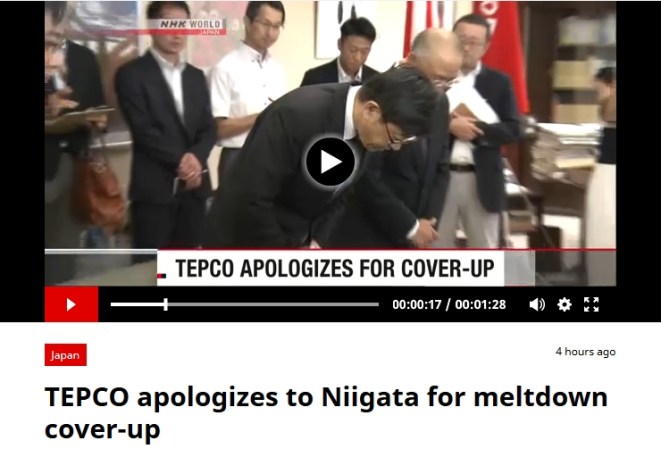
A top official of the operator of the Fukushima Daiichi nuclear power plant has apologized to the Niigata Prefecture governor for having concealed the 2011 reactor meltdowns for more than two months.
Takafumi Anegawa, Managing Executive Officer of the Tokyo Electric Power Company, met Niigata Governor Hirohiko Izumida on Thursday.
In February this year, TEPCO admitted the utility could have ascertained there was a meltdown three days after its occurrence if utility workers had followed an in-house manual. It was also later found that TEPCO’s then-president had instructed officials not to use the words “core meltdown.”
The prefecture, which hosts another TEPCO nuclear power plant on the Japan Sea coast, has put together a panel of experts to study the utility’s handling of the Fukushima accident.
Anegawa told the governor that TEPCO apologizes for not having presented a report based on an adequate investigation.
Izumida said information on meltdowns is critical for residents living near nuclear power plants to decide whether to flee or not. He said the prefecture expresses regret that TEPCO has not admitted its meltdown cover-up for five years.
Later this month, a joint panel set up by Niigata Prefecture and TEPCO plans to begin a detailed investigation.
Governor Izumida said additional probes are necessary to find out what in-house problems TEPCO had.
The governor said it is too soon to discuss resuming operations at the nuclear plant in his prefecture without a complete review of the Fukushima accident.
http://www3.nhk.or.jp/nhkworld/en/news/20160825_21/
Film focuses on ‘irradiated’ cattle kept alive in Fukushima
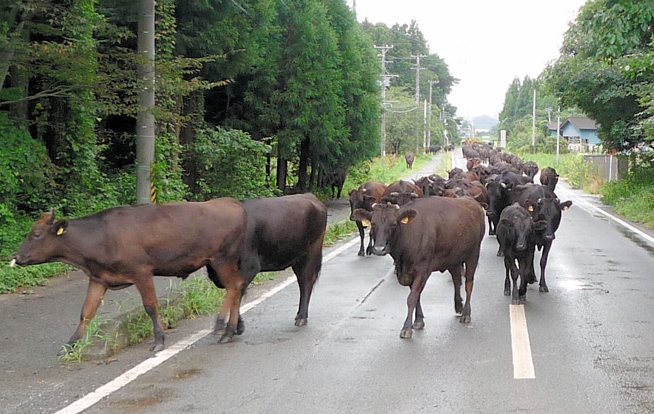
In a scene from “Hibaku-ushi to Ikiru” (Living with irradiated cattle), stray cattle head down a road in the 20-kilometer no-entry zone around the crippled Fukushima No. 1 nuclear power plant in August 2011.
OSAKA–For some cattle farmers in Fukushima Prefecture, the thought of destroying their herds is too painful to bear even if they are contaminated with radioactive fallout.
A new documentary to be shown here this week records the plight of these farmers, who continue to look after their beef cattle in defiance of a government request to euthanize the animals.
“I took on this project because I wanted to capture what is driving farmers to keep their cattle. For all the trouble it is worth, the animals are now worthless,” said Tamotsu Matsubara, a visual director who shot the documentary.
Four years in the making, “Hibaku-ushi to Ikiru” (Living with irradiated cattle) is set for its first screening on Aug. 26 at a local community center in the city.
Matsubara’s interactions with the cattle farmers date to the summer of 2011, a few months after the nuclear crisis unfolded at the Fukushima No. 1 nuclear power plant following the Great East Japan Earthquake and tsunami on March 11 that year. His assignment was to cover a traditional festival in Minami-Soma, which is located near the stricken nuclear plant.
Matsubara, 57, became acquainted with a farmer caring for more than 300 cattle on his land in the 20-kilometer no-entry zone set by the government. Residents in the zone were ordered to evacuate, but the farmer stayed on to look after his animals.
At that time, the government was seeking to destroy the cattle within the no-entry zone by obtaining their owners’ consent, saying animals that were heavily contaminated with radiation from the nuclear accident could not be sold at market.
But some farmers did not want to put their livestock down.
However, keeping them alive costs 200,000 yen ($2,000) a year in feed per head.
Matsubara became curious why the farmers continued to look after cattle that cannot be sold or bred, despite the heavy economic burden.
He soon began making weekly trips from Osaka to Fukushima to film the lives of the farmers, their cattle and the people around them.
After finishing his regular job in promotional events on Fridays, Matsubara would drive 11 hours to Fukushima and spend the weekend documenting the plight of the farmers before returning to Osaka by Monday morning.
He had 5 million yen saved for the documentary, his first feature film. When the money ran out, Matsubara held a crowdfunding campaign to complete it. Shooting wrapped up at the end of December.
About 350 hours of footage was edited into the 104-minute “Hibaku-ushi to Ikiru.”
The film documents the farmers and their supporters who are struggling to keep the cattle alive.
One couple in the film returns to their land in Okuma, a town that co-hosts the Fukushima plant, to care for their herd. They affectionately named each animal and said it would be unbearable to kill them. Their trips are financed using a bulk of the compensation they received for the nuclear accident.
A former assemblyman of Namie, a town near the plant, tends to his animals while asking himself why he used to support nuclear power.
The documentary also sheds light on scientists who are helping the farmers. The researchers believe that keeping track of the contaminated cattle will provide clues in unraveling how low-level radiation exposure impacts large mammals like humans.
Matsubara said the documentary tells the real story of what is going on with victims of the nuclear disaster.
“Not all the farmers featured in the documentary share the same opinion or stance,” Matsubara said. “I would like audiences to see the reality of people who cannot openly raise their voices to be heard.”
Takeshi Shiba, a documentary filmmaker who served as producer of this project, hopes the film will reach a wide audience.
“Matsubara broke his back in making this movie,” he said. “I hope that many people will learn what Fukushima people are thinking.”
Hong Kong still testing food imports for Fukushima’s radiation
More than five years ago on Friday, March 11, 2011, the Great East Japan Earthquake with a magnitude of 9.0 set off a large tsunami sending a 50-foot wall of water over three Fukushima Daiichi reactors. Three of the nuclear cores melted down in the next three days.
About 1,600 miles away on the next day, Saturday, March 12, 2011, the Center for Food Safety (CFS) in Hong Kong began stepped up surveillance of fresh foods including milk, vegetables and fruits, imported from Japan for radiation testing.
Eleven days later, on Wednesday, March 23, 2011, CFS discovered three samples imported from Japan with radioactivity levels exceeding those considered to be safe by international Codex Alimentarius Commission.
CFS is a unit of the Food and Environmental Hygiene Department of Hong Kong’s City government, which is part of China. The CFS continues to test those Japanese imports but hasn’t found any additional shipments with unsafe radiation levels.
And its not for lack of looking. Since one week before CFS found those hot white radishes, turnips and spinach samples, Hong Kong has tested 344,881 samples.
It breaks down this way: 19,420 vegetable samples; 19,338 fruit samples; 2,189 milk and milk beverage samples; 900 milk powder samples; 594 frozen confection samples; 54,468 aquatic product samples; 9,487 meat product smples; 31,744 drink samples, and 206,741 other samples including cereals and snacks.
The totals are through Aug. 22. CFS continues to test samples from Japanese imports, conducting testing around the clock five days a week.
Hong Kong’s continued surveillance for radioactivity is just one sign of how cautious Asia remains about the Fukushima meltdown. Japan has excluded people and crop production in a 310-square-mile zone around the nuclear plants. No deaths or cases of radiation sickness are attributed to the nuclear accident. And, perhaps due to the large exclusion zone, future cancers and deaths from potential exposures are projected to be low.
The U.S. Food and Drug Administration treats Fukushima with a periodically updated Import Alert that permits certain Japanese food imports to be detained without inspection.
“Districts may detain, without physical examination, the specified products from firms in the Fukushima, Aomori, Chiba, Gumna, Ibaraki, Iwate, Miyagi, Nagano, Niigata, Saitama Shizuoka, Tochigig, Yamagata and Yamanashi prefectures,” the July 18 Import Alert from FDA says.
Japanese imports from those areas that can still be detained at the U.S. border include:
- Rice, Cultivated, Whole Grain;
- Milk/Butter/Dried Milk Products;
- Filled Milk/Imitation Milk Products;
- Fish, N.E.C.;
- Venus Clams;
- Sea Urchin/Uni;
- Certain Meat, Meat Products and Poultry, specifically(beef, boar, bear, deer, duck, hare and pheasant products;
- Yuzu Fruit;
- Kiwi Fruit;
- Vegetables/Vegetable Products;
- Baby Formula Products; and
- Milk based formulas.
http://www.foodsafetynews.com/2016/08/hong-kong-still-testing-food-imports-for-fukushimas-radiation/
North Korea’s nuclear threats to USA and South Korea
 North Korea threatens to turn Washington and Seoul into a ‘heap of ash’ AUGUST 24, 2016 Gavin
  Fernando news.com.au@GavinDFernando NORTH Korea has issued a fresh warning to Seoul and Washington, threatening a huge nuclear attack if provoked.
The North’s military warned it will turn the cities into “a heap of ash through a Korean-style pre-emptive nuclear strike” if they show any signs of aggression towards their territory, a spokesman for North Korea’s military was quoted as saying by the country’s state media.
This comes as South Korea and the US begin their annual military drills, which South Korea has described as defensive in nature. The allied countries have repeatedly stated they have no intention of invading or taking aggressive action against North Korea capital Pyongyang.
South Korea President Park Geun-Hye responded to the threats saying: “The North Korean regime has been continuously suppressing its people by its reign of terror while ignoring the livelihood of its people.”
She also said the South would “prepare” for any potential attacks by North Korea, adding that the communist country’s nuclear and missile threats are “direct and realistic”.
Relations between the countries are tenser than usual now, following the defection of a senior North Korean diplomat and a US plan to place a hi-tech missile defence system in South Korea.
Earlier this month, it was reported South Korea intends to arm itself with nuclear weapons.The state will develop a nuclear self-defence strategy in defiance of a treaty that has been in place for almost 50 years. “It will become a domino effect and even South Korea will become concerned and develop nuclear weapons, and maybe Japan as well,” a senior official in the Seoul government told Fairfax.
Meanwhile, over the weekend, Australia surprised the world by being the only country to attempt to block an international ban on nuclear weapons.
The Australian government tried — and ultimately failed — to block a United Nations report for a complete international ban on nuclear weapons……http://www.news.com.au/world/asia/north-korea-threatens-to-turn-washington-and-seoul-into-a-heap-of-ash/news-story/f1851e5cde3ef6cf88697b57a8a1f11f
10,000 tons of toxic water pools in Fukushima nuclear plant trenches
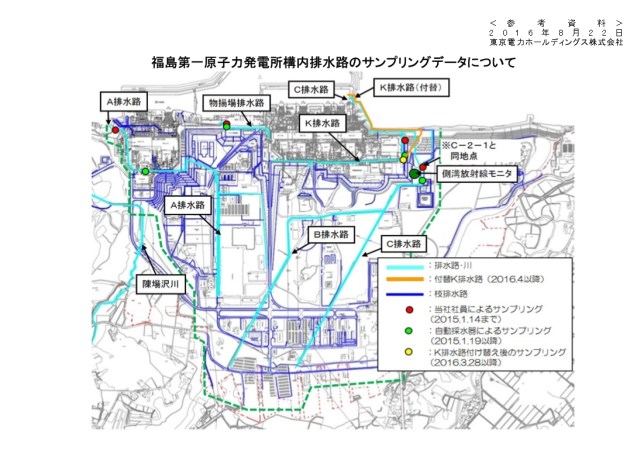
Drainage chart/map
TOKYO (Kyodo) — Around 10,000 tons of contaminated water have pooled in underground trenches around the Nos. 1 to 4 reactor buildings of the crippled Fukushima Daiichi nuclear power plant, according to the plant operator Tokyo Electric Power Company Holdings Inc.
Tokyo Electric has no immediate plan to remove the water in the trenches where cables run for the nuclear power complex devastated by the March 2011 earthquake and tsunami disaster.
Water that flew into the trenches in the wake of the huge tsunami is believed to have been mixed with highly radioactive water leaking from the basements of reactor buildings and contaminated rain water.
“Compared with around 70,000 tons of highly contaminated water that remain in the basements of the reactor buildings, (the water in the trenches) has a low level of concentration and thus poses little threat in terms of radiation exposure and the environment,” said an official of the utility known as TEPCO.

TEPCO said in a report issued in July — based on research conducted in fiscal 2015 — that it has found around 8,000 tons of toxic water in 17 locations in the trenches that connect with reactor buildings where highly radioactive water accumulates, as well as around 3,000 tons of toxic water at 11 locations in trenches that do not connect with reactor buildings.

Of the water in the trenches around the Nos. 1 to 4 reactor buildings, a removal procedure was completed by June for around 500 tons of water in a pipe that measured the highest level of radioactive cesium at 500,000 becquerels per liter.
The level of radioactive cesium in water at other locations in the trenches was mostly measured at several thousands becquerels or below.
The level in toxic water in the basements of reactor buildings has been measured at around dozens of millions becquerels at maximum.
TEPCO has said it will continue to monitor and measure the level of contamination in water in the trenches regularly and consider taking measures to remove the water in the future. But no concrete plan has been created yet.
The electricity firm has so far removed a total of around 10,000 tons of highly radioactive water at three locations in the trenches running in the seaside of the complex and completed the procedure to fill locations concerned with cement to prevent water leaks.
Still, the level of radioactive cesium remains unchecked at 40 locations in the trenches due to high radioactive levels as well as debris and other objects blocking the research operation.
Around 8,000 tons of contaminated water, including those with an extremely low level of contamination, have also been found in the trenches running around the Nos. 5 and 6 reactor buildings. The two units have lower levels of radiation doses than the Nos. 1 to 4 units as there were no nuclear meltdowns or hydrogen explosions there during the nuclear disaster.
http://mainichi.jp/english/articles/20160823/p2g/00m/0dm/074000c
Drainage charts/maps.
https://t.co/EIJkR80Biq
Tepcos Reports (PDF)
https://t.co/lTM563FjQe
Government subsidies to help Fukushima farmers restart operations

The central government plans to set up a new subsidy system to help farmers in 12 municipalities near the stricken Fukushima No. 1 nuclear plant restart their operations, according to sources.
The program represents part of the government’s efforts to promote the reconstruction of areas damaged by the March 2011 earthquake and tsunami in the Tohoku region and the subsequent meltdowns at the Tokyo Electric Power Co. nuclear station.
The government will earmark around ¥7 billion for the program under a planned supplementary budget for its special account related to the 2011 disaster, the sources said Monday.
The program will help farmers buy equipment and livestock.
A support system is already available in which the 12 municipalities in Fukushima Prefecture buy facilities and equipment such as greenhouses and tractors and lend them for free to farmers aiming to get back on their feet.
But the system is inconvenient for individuals who want to resume farming operations, because it is mainly designed for group farming and other big operations. Also, approval from local assemblies is necessary to lend out the facilities and gear.
Under the new program, the Fukushima Prefectural Government will cover 75 percent of farmers’ purchase costs for farming equipment and livestock, the sources said. The upper limit on support per farmer will likely be ¥10 million, they said.
The central government will shoulder all costs incurred by prefectural government, the sources said.
The 12 municipalities are Tamura, Minamisoma, Kawamata, Hirono, Naraha, Tomioka, Okuma, Futaba, Namie, Kawauchi, Katsurao and Iitate.

Wind and cars disperse radioactive material
By Kurumi Sugita
A remarkable documentary of the RTBF about contaminated areas, including Minami Soma in Fukushima prefecture. These areas are heavily contaminated. Nevertheless, the Japanese government makes the people return by lifting the evacuation order and stopping aid.
The Nos Voisins Lointains 3.11 association, exchanged messages with Mr. Ozawa, the engineer interviewed in the documentary. According to him, the most worrisome problem is the fact that black substances in the mall parking area get attached to car tires and are transported everywhere, as we can see in the documentary. The risk of radiation is thus dispersed.

On the other side of the parking area, we see collective dwellings from where children play outside, according to Mr. Owaza.
See also the video sent by Mr. Ozawa showing the wind lifting and dispersing the contaminated dust from fields now uncultivated.
Linens that are drying on the balcony outside are exposed to radioactive material transported by these dusty winds. Just watch at which height the dust is lifted compared to the passing car towards the end of the video. Farmers working the land inhale this dust.
With the forced return of the population this will become their daily reality.
American nuclear expert Arnie Gundersen warns: “There is a possibility that now in Fukushima recontamination is occurring.”
CCTV (Channel 17 in Burlington, Vermont), published Jun 20, 2016
Maggie Gundersen, Chiho Kaneko and Caroline Phillips of Fairewinds Energy Education discuss the nuclear risk concerns for children not only near the nuclear disaster sites of Fukushima-Dai-ichiin Japan and Chernobyl in Ukraine, formerly the Soviet Union, but globally where areas near all nuclear power plants are contaminated with radiation. Since mothers in Japan especially bear the responsibility to protect children, they experience greater hardships in an environment where just expressing one’s concern about radiation is seen as a treasonous act. Even 30 years later, the Belarus government recognizes the merits of relocating children away from radiation contaminated areas but the children of Japan are socially forced to stay put in highly contaminated areas.
Margaret Harrington, host: I know you mentioned Arnie Gundersen, the chief engineer at Fairewinds, and he said that he measured the radiation there, too. Could you talk about that a little bit?
Maggie Gundersen, Fairewinds Energy Education founder and CEO: He’s working with some other scientists who are studying — both Japanese scientists, the samples that they took, and the US scientists who are evaluating the samples — and they’re finding astronomical amounts of radiation, even in downtown Tokyo outside of METI’s door. METI is the regulatory agency over nuclear power… When he and others were downtown in Tokyo, they took samples right there in a garden right outside the door and on the front doormat, and these are really, really high samples. Frightening, because people walking in Tokyo will then be inhaling that dust. What was the film we saw from Japan that had the mothers who were in an area where kids play and run from middle school?
Caroline Phillips, Fairewinds Energy Education: It’s a fantastic video… it’s a mothers organization, they live in the Fukushima Prefecture and they’re actually using Geiger counters that have been issued by the government. They’re walking along the river [in Fukushima City.]
Maggie Gundersen: What’s so tragic about it – kids are running along dirt paths doing gym class and track and things like that and the mothers are right down in areas that are not posted and the kids can go after school and play, and people do nature hikes and stuff. And the radiation readings are horrific.

Gendai Business Online’s top ranked article is an exclusive interview with Fairewinds Chief Engineer Arnie Gundersen titled, American nuclear expert warns: “There is a possibility that now in Fukushima recontamination is occurring.” With more than 10,000 likes on Facebook, this Japanese article delves into the truth about nuclear contamination from Fukushima Daiichi as uncovered by Arnie Gundersen during his most recent trip to Japan. Fairewinds, with the help of Japanese translators, provides you with an English translation:
On a mid-February morning, just before the 5th anniversary of the triple meltdown at Fukushima Daiichi, a group of young girls in the city of Minami-Soma rode their bikes to school past a shocked and saddened pedestrian. That upset observer was Arnie Gundersen, nuclear reactor expert and Chief Engineer with Fairewinds Associates. Mr. Gundersen has 45 years of experience as a design, operations, and decommissioning nuclear engineer. He has engaged in research of the effects of the meltdown at Three Mile Island (TMI) and conducts independent research of the triple meltdown at Fukushima Daiichi. Mr. Gundersen is in ongoing conversations with both the US and Japanese media concerning the dangers of nuclear reactors and nuclear power operation. Invited by “Peace News Japan” and several other civil groups, Mr. Gundersen visited the Fukushima prefecture five years after the catastrophe at Fukushima Daiichi.
“What surprised me at this visit to Japan [his third since the meltdowns] is that the decontaminated area is contaminated again,” Mr. Gundersen said while explaining why it was such as sad shock to witness the girls on their bicycles. “This was not what I had expected. I had thought that we would not find such high doses of radiation in the decontaminated area. But, sadly, our results prove otherwise.”
During his Japan visit, Mr. Gundersen collected samples of dust from the rooftop of Minami-Soma city town hall, the floor mat of a 7-Eleven convenience store, and the roadsides of Minami-Soma city. Although the official data cannot be released before the publication of formal scientific papers, it is evident that high doses of radiation, usually found in nuclear waste, was detected from these samples.
“This means that highly radioactive dust is flying around the city. In other words, the decontaminated land is contaminated again. Little girls are affected by the radiation 20 times as much as adult men. The Japanese government’s standard of 20 mSv is based on exposure assessments for adult men. The girls on their bicycles are actually being affected by a radiation dose equivalent to as much as 400 mSv.”
Mr. Gundersen also pointed out that human lungs are heavily affected by internal exposures to radiation.
“At this visit, I wore a radiation proof mask that can filter out 99.98% of radiation for six hours. I sent my filter to the lab, and they found a high dose of Cesium. But, unfortunately, the Japanese government only cares about the number on a Geiger counter and does not consider the internal exposure. This has resulted in a hazardous downplay of this kind of data and human lungs are affected by the serious internal exposure.”
Why is the recontamination happening? One of the reasons is that the government did not decontaminate thoroughly. Mr. Gundersen witnessed first-hand the poor decontamination of the prefecture.
“In the house I visited, only half of the garden area was decontaminated because only that half fell into the category of a contaminated area. It should not be like that. The other half would be contaminated too. Furthermore, one person discovered highly radioactive dust in their driveway where decontamination had occurred. So, of course, this person notified the related offices but the related offices told them that it was not necessary to decontaminate the driveway again because it had already been done once. It’s unbelievable. This person’s house is located near a ravine and the opposite side of the ravine is designated a non-habitable zone.”
Another reason for recontamination is that the radiation from the mountains are coming back to the city by way of wind and rain. Mr. Gundersen noted the extreme radioactive contamination of the mountains.
“We tracked wild monkeys in the mountains and found a high dose of radiation in their feces. I received the meat of a wild pig as a gift and since I could not bring it back to the US [it is illegal to bring meat back to the United States from Japan], tested the meat on a Geiger counter. The meat showed 120 counts/min. I think that the Japanese government should spend more money to decontaminate the mountains but they don’t appear to have that kind of political will. I also worry that contamination in the rivers is not monitored as rain from the mountains flow down into the rivers.”
Due to the heavy radiation contamination of the mountains, vegetables grown in that area exceed the government’s standard by 1500 Bq. These vegetables were sold at the MichinoEki in Tochigi prefecture, and the bamboo shoot grown in this contaminated region was used for elementary school lunches in Utsunomiya. These school lunches contained more than twice as much radiation as the government’s standard.
Recontamination is happening due to poor decontamination and residents of Kawauchi village in Fukushima prefecture claim that the decontamination in the forests is not enough. However, the government continues to push for the end of people’s relocation and force the return to recontaminated areas.
“If I had a little child, I would never let them live there,” Mr. Gundersen pointedly states.
Mr. Gundersen also found that Tokyo remains contaminated. He measured dust collected from the sidewalk in front of MITI (Ministry of International Trade and Industry) and found a high dose of radiation. That dust is in the air that will be inhaled by the visitors and athletes of the 2020 Olympic Games. Needless to say, the current residents are inhaling it every day. “Mr. Abe should not take the advice from IAEA, MITI and TEPCO seriously,” Mr. Gundersen insists. “Instead, he should have an independent organization conduct research and listen to the advice from them.”
Japan asks Pokemon GO players to stay out of Fukushima fallout zone – but yet still allows thousands to return living in contaminated land

Evolution at its best! Japan asks Pokemon GO players to stay out of Fukushima fallout zone – but yet still allows thousands to return living in contaminated land.
So far, everything from car crashes to shootings have been associated with the addictive game, and countries all over the world are now trying to stop accidents before they can happen. That, you see, is why Japan is asking Niantic to remove any wild pokemon that are currently cropping up in the Fukushima fallout zone.
TEPCO has asked the developer to keep pocket monsters far, far away from the radioactive site. Obviously, they are worried about trainers stumbling upon the area in their pursuit to catch, say, a Nucleon.
Currently, Tepco has confirmed, “the Fukushima Daiichi plant, the Fukushima Daini plant and the Kashiwazaki-Kariwa plant in Niigata Prefecture,” were all scouted. Unsurprisingly, pokemon were found at all three of the sites.
Masao Uchibori, the governor of Fukushima, said it would be dangerous for trainers to enter the areas due to their radioactive nature. As such, he’s confirmed that, “the prefectural government will consider how to draw attention to this.” Beyond that, the city of Nagasaki has also asked for Niantic to remove the app’s presence from Nagasaki Peace Park, a local memorial for the victims of the 1945 atomic bombing.
A month later following the announcement though, Earthquake-stricken regions in Japan are turning to the “Pokemon Go” phenomenon to catch more tourism money.
The Iwate, Miyagi, Fukushima and Kumamoto prefectural governments said Aug. 10 they will partner with Niantic Inc., operator of the popular “Pokemon Go” smartphone app, to promote local tourism.
Money talks !
Credit to Nelson Surjon
14 arrested for smuggling illegal irradiated seafood into China from waters off coast of Fukushima

14 arrested for smuggling irradiated seafood in Shandong
Customs authorities in Qingdao, East China’s Shandong Province, detained 14 people for smuggling frozen seafood from Japan, including irradiated high-end seafood from waters near Fukushima prefecture, China Central Television (CCTV) reported on Monday.
The group has smuggled over 5,000 tons of frozen seafood – including shrimp and king crab – valued at 230 million yuan ($34.5 million) into China over the past two years, according to an announcement by the Qingdao Customs District (QCD) posted on its official website on Monday.
Some of the high-end products were from Fukushima, one of 12 Japanese prefectures from which China has banned any seafood imports due to the contamination of their waters after the Fukushima nuclear accident in 2011, according to CCTV.
Before sending the products to Shandong, smugglers transferred the seafood from Hokkaido to Vietnam, where they changed the items’ packaging and altered their production dates to evade taxes and avoid quarantine, Li Fudong of the QCD Anti-Smuggling Department told CCTV.
An investigation by officers from the Anti-Smuggling Department in the neighboring city of Yantai traced some low-priced seafood on the local market to a Shandong-based import corporation that had opened branches in East China’s Fujian Province, South China’s Guangxi Zhuang Autonomous Region and Northeast China’s Liaoning Province.
Qingdao preventive officers arrested the smuggling group’s head in June after he returned to China from the US.
Most of the smuggled seafood products were sold in Beijing, Shanghai and Guangzhou, Shandong-based dzwww.com reported.
An expert from a tissue engineering and regenerative medicine research center who asked for anonymity told the Global Times on Monday that radioactive nuclear materials can cause irreversible damage to the human body at the cellular level. The expert said such radiation can even damage our DNA and may be present in the body for many years before symptoms occur.
She said that remaining nuclear material may still affect sea life in the waters surrounding the Fukushima site, even though five years have passed since the nuclear accident.
http://www.globaltimes.cn/content/1002105.shtml
【Thyroid Cancer in Fukushima】Fukushima Thyroid Examination Under Dual Review

Monday, August 8, 2016
Below is unofficial translation of two Fukushima Minyu articles regarding the review of the thyroid examination, published on August 8, 2016 and July 4, 2016. The August article is based on an interview of Hokuto Hoshi, Chair of Oversight Committee for the Fukushima Health Management Survey. It might be tied to this post. The July article covers the launch of an independent exploratory committee by Fukushima Pediatric Association.
Interestingly, a telephone inquiry by a concerned citizen revealed the Division of the Fukushima Health Management Survey at the Fukushima Prefectural Office was unaware of the content of the August article before its publication in newspaper. They declined to comment on the issue for the time being while contacting Oversight Committee Chair Hoshi to confirm facts and discuss the issue internally.
On September 26-27, 2016, the 5th International Expert Symposium “Chernobyl+30, Fukushima+5: Lessons and Solutions for Fukushima’s Thyroid Question” will be held in Fukushima, organized by Nippon Foundation and co-organized by Fukushima Medical University, Nagasaki University and Sasakawa Memorial Health Foundation. Judging from the symposium theme, there seems to be a rush to bring closure to the thyroid cancer issue even before the final results of the second round screening are released. A glance at the program is quite revealing.
*****
Oversight Committee for the Fukushima Health Management Survey Plan to Review the Thyroid Examination: Reduction in Target Population Considered
August 8, 2016
Oversight Committee for the Fukushima Health Management Survey, engaged in discussion on the status of the survey to examine the health effects due to the nuclear accident, will begin discussions as early as September to consider reduction in target population as well as review of the screening procedure.
The thyroid examination that targets all residents who were age 18 or younger at the time of the accident will face a big turning point, as revealed by the Oversight Committee Chair Hokuto Hoshi in the interview with Fukushima Minyu as of August 7th.
The thyroid examination targets about 380,000 residents. Thyroid cancer cases detected by the examination are considered “unlikely to be the effect of radiation exposure at this time” by the Oversight Committee.
What lies behind starting the discussion to consider review of the examination is the concern about detection of “latent cancer” cases, which exist at a constant rate regardless of radiation exposure, by screening with high sensitivity.
Thyroid cancer is curable in many cases, and the across-the-board cancer screening is unlikely to give rise to the merit of “reduced mortality.” Thus thyroid cancer screening is not globally recommended. This has led medical providers to voice concerns that “participation in the examination alone can be detrimental to the participants.”
Under the circumstance, the Oversight Committee is expected to begin discussions on issues such as: 1) Whether residents older than age 18 should be included in the target population in the future; and 2) Whether to change the method of mass screening currently conducted in school settings which has been pointed out to interfere with the participant’s wish not to participate.
*****
“Thyroid Examination” Should Be Reviewed: Fukushima Pediatric Association to Establish an Independent Committee
July 4, 2016
Fukushima Pediatric Association (president: Kazuhiro Ohga) adopted a general assembly statement incorporating the establishment of its own exploratory committee to consider the status of the thyroid examination on July 3, 2016 at the general meeting held in Kooriyama City. The thyroid examination, part of the Fukushima Health Management Survey that investigates health effects of the Tokyo Electric Fukushima Daiichi nuclear power plant accident, is conducted by the prefecture targeting residents who were age 18 or younger at the time of the accident. The association deems necessary to review the thyroid examination, taking a fresh look at part of it. This is the first time the association expresses the need to review the examination.
Five years have passed since the nuclear accident, a question was raised about the status of the thyroid examination mainly by pediatricians performing medical examinations on residents who are targeted for the thyroid examination.
According to the Fukushima Pediatric Association, there are 172 individuals (as of the end of March 2016) who have been diagnosed with thyroid cancer or “suspicion of cancer.” Thyroid cancer is curable in many cases, and the screening is unlikely to give rise to the merit of “reduced mortality,” while there is a mental detriment when diagnosed with cancer. Thus thyroid cancer screening is not globally recommended.
The general assembly statement referred to health worries experienced by children participating in the thyroid examination and their guardians as well as residents, stating “It is necessary to explain (the results) to the participants with care and compassion and offer an easily comprehensible explanation to residents.”
President Ohga stated, “The thyroid examination was started in order to alleviate anxiety of residents, but it is possible the examination created (new) anxieties. It is necessary to review the examination from the standpoint of the participants.”
The Exploratory Committee, comprising the association members, is scheduled to begin discussions this fall. It will take up opinions of those diagnosed with thyroid cancer and intend to set directions before next year’s general assembly. In addition, the content of the general assembly statement will be sent to the prefectural government as a request in the future.
The statement also incorporates items regarding the response to health effects on children, long-term health management, and continuing support for children and their families who are evacuated or returning.
Anti-nuclear power protest tents forcibly removed from outside ministry
Yesterday I wrote a long-ish post about last weekend’s attack on the anti-nuclear power protest tents that have occupied a corner of land outside the Ministry of Economy, Trade and Industry (METI) in Kasumigaseki since 2011. I included some of the history of the tents and resistance against the orders calling for their removal. After the Supreme Court rejected the activists’ final appeal in late July, the end seemed nigh and it seems I jumped the gun.
The post about last week’s incident swiftly became obsolete when around 100 security guards and court officials arrived at the tents in the early hours of today, August 21st. Starting at 3.30 a.m. on the 1,807th day of the sit-in, it took all of 90 minutes for them to remove the tents, placards and other materials that were the signs of a five-year protest movement. There were apparently some five activists staying at the tents overnight but they could do nothing to prevent the removal.
The choice of the early morning to enforce the eviction was surely a deliberate one to avoid trouble with protestors. If it had been during the daytime, the activists could have quickly mobilised dozens, maybe even hundreds, of supporters, as we saw at last weekend’s incident. Earlier on August 21st, police and security guards completely barricaded the corner of the street in a show of force in case there was an ugly response from activists.
Today there was also a demonstration by a hate group in Kawaguchi City, on the outskirts of Tokyo, which consumed the manpower of the counter-protest group C.R.A.C., who otherwise may have rallied activists to the ministry.

Ironically, I had been planning to go see the tents today, since I knew it might be my last chance. In the end, I missed my opportunity. Nonetheless I went to see the aftermath and found a mood that was muted yet resilient. There were no more tents; the iconic facade of the site was gone, replaced by large fences obstructing any new tents from being erected. But still there were some 15 protestors sitting on chairs, banners unfurled on the pavement and flags stuck into the hedges. A couple of activists were banging a drum. There was a police presence, of course: a few officers and some riot police vans. A random rightist was spewing forth anger at the protestors from the street while being physically held back by police officers. You can just about see him in the right of the photograph below.

Earlier an activist had been arrested and was being held at a police station in Marunouchi, and many of others had gone there to call for his or her release. By chance, Masami Yoshizawa from Kibō no Bokujō (Farm of Hope) was also in the area, driving around a car with a fake cow on a trailer. He has previously brought actual diseased cattle to Tokyo in an attempt to remind bureaucrats of the continuing plight of Fukushima.
The activists told me that they would be continuing the protest at the site, only no longer with tents. Alternatively known in English as the Occupy Tents, Anti-Nuclear Occupy Tent, No Nukes Plaza or Tent Plaza, the central structures are now gone but the idea of the “plaza” survives.
However, Japan’s relatively harsh rules on public assembly may make it harder for protestors to gather at the location in greater numbers for events like they used to, since now they will literally just be standing or sitting on the street. In theory, any public demonstration is required to be registered with police in advance.
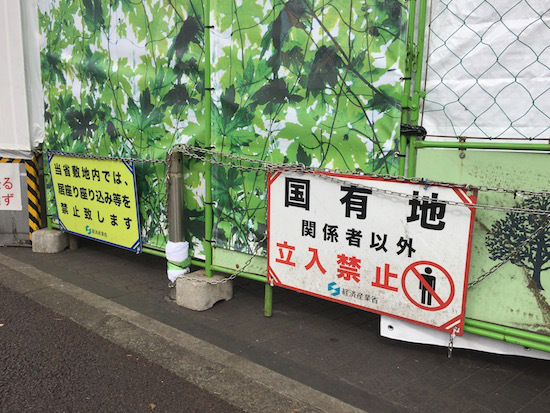
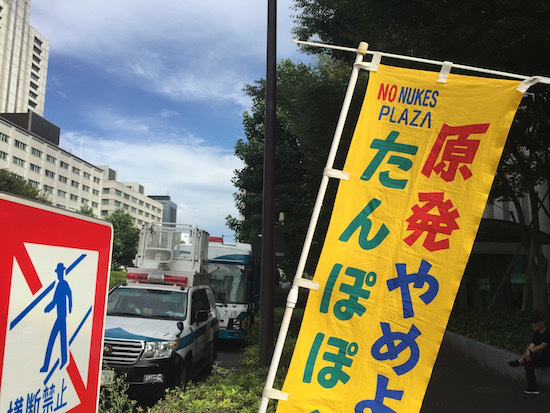
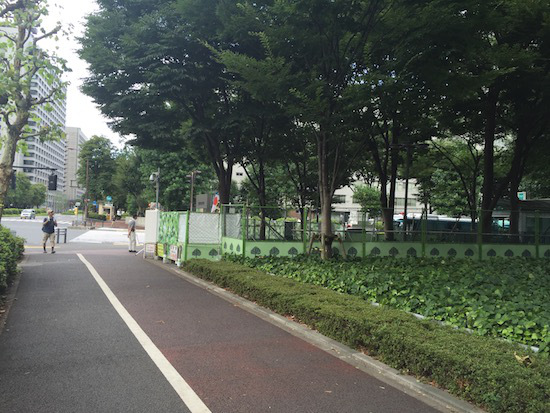
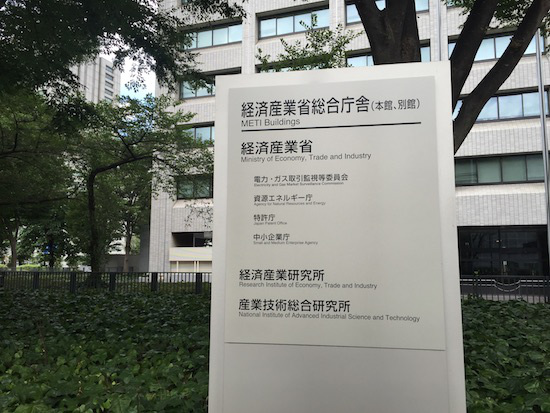
In my post on August 20th, I wrote that “the fury of Fukushima lives on in Kasumigaseki”. Was that too optimistic? We shall see.
WILLIAM ANDREWS
Anti-nuclear activists’ tents forcibly removed from economy ministry premises after yearslong battle

Police stand guard as Tokyo District Court officials remove tents built by anti-nuclear activists in the Kasumigaseki district of the capital at 3:59 a.m. Sunday
Tokyo District Court officials on Sunday removed activists’ tents on the economy ministry’s premises nearly five years after they were erected by anti-nuclear campaigners protesting the government’s handling of the Fukushima nuclear crisis.
The removal of the three tents — which took place before daybreak Sunday — came after the government asked the court to enforce its order to dismantle the site.
Handed down in February 2015, the order was upheld by the Tokyo High Court last October. It became final after the Supreme Court in July rejected an appeal filed by the two anti-nuclear campaigners.
The three tents were set up in September 2011 on a roughly 50-sq. meter plot of land at the economy ministry, which oversees the nuclear power industry.
The site had been used as a base to conduct anti-nuclear activities outside the ministry after the March 2011 triple meltdown at the Fukushima No. 1 power plant, with activists uploading live video footage online, staging a hunger strike and forming human chains.
The forcible removal by court officials took place in the early hours of Sunday, a time when there were few passers-by.
About 10 citizens, including some who were staying in the tents overnight, protested as officials fenced off the encampment and blocked the road around the premises before dismantling the tents.
“The government is pushing through the reactivation of nuclear power plants without taking responsibility (for the Fukushima crisis),” said a 53-year-old company employee who had been staying in one of the tents on Saturdays since the first one was erected in September 2011.
“We will carry on with our protests,” he added.
In its ruling last year, the Tokyo District Court also ordered the activists to pay roughly ¥21,000 ($209) per day in fees for using the land for as long as they remained at the site. The unpaid amount has now totaled more than ¥30 million.
The district court said that while it “understands the campaigners’ compelling motive to join anti-nuclear activities after the atomic accident” that affected many people, they “do not have special rights to use the land” belonging to the Ministry of Economy, Trade and Industry in the capital.
1 This Month





PLEASE OPPOSE HR 8255 AND S.3639 – bills would accelerate satellite deployment, with no environmental review or safeguards – https://ncstd5li.quorum.us/campaign/169331/
To see nuclear-related stories in greater depth and intensity – go to https://nuclearinformation.wordpress.com
-
Archives
- October 2026 (39)
- September 2026 (339)
- August 2026 (330)
- July 2026 (355)
- June 2026 (287)
- May 2026 (306)
- April 2026 (356)
- March 2026 (251)
- February 2026 (267)
- January 2026 (308)
- December 2025 (358)
- November 2025 (359)
-
Categories
- 1
- 1 NUCLEAR ISSUES
- business and costs
- climate change
- culture and arts
- ENERGY
- environment
- health
- history
- indigenous issues
- Legal
- marketing of nuclear
- media
- opposition to nuclear
- PERSONAL STORIES
- politics
- politics international
- Religion and ethics
- safety
- secrets,lies and civil liberties
- spinbuster
- technology
- Uranium
- wastes
- weapons and war
- Women
- 2 WORLD
- ACTION
- AFRICA
- Atrocities
- AUSTRALIA
- Christina's notes
- Christina's themes
- culture and arts
- Events
- Fuk 2022
- Fuk 2023
- Fukushima 2017
- Fukushima 2018
- fukushima 2019
- Fukushima 2020
- Fukushima 2021
- general
- global warming
- Humour (God we need it)
- Nuclear
- RARE EARTHS
- Reference
- resources – print
- Resources -audiovicual
- Weekly Newsletter
- World
- World Nuclear
- YouTube
-
RSS
Entries RSS
Comments RSS

