Lesson from Nagasaki: Lighten up on Dark Tourism
“I see those people from Hiroshima and Nagasaki on the news every year and I wonder why they just can’t let it go. Hasn’t it been long enough already?”
These words were spoken to my wife recently by a Japanese co-worker when we returned from Nagasaki. This attitude might seem startling to peace activists in Japan and throughout the world who participate in memorial events every year on August 6th and 9th, but it is a sobering reminder that many people in Japan and throughout the world have let the memory fade, not even knowing what they don’t know about the perils of nuclear weapons as they exist in today’s world.
In a consumer society based on employment in a military economy, the institutions people pass through in their formative years do very little to teach history, political consciousness or the meaning of citizenship. Whatever lessons exist are delivered as tedious, obligatory lectures, followed by multiple choice tests. Lessons might also have come from elders in the form of scoldings about how tough things were during the war, how “you youngsters” have no idea and so on. The only thing worse than no history lessons is bad history lessons. Japanese people, in particular, may be inured to them because of an overdose of obligatory exposure to the rituals of remembrance.
Hiroshima and Nagasaki also invoke uncomfortable feelings of shame about losing the war, and shame about responsibility for it. The hibakusha and all the memorials in the two bombed cities evoke these conflicted feelings, so many Japanese would rather turn away, just as many Americans would rather turn away for inverse reasons.
While living in Japan I have met people who talked about visiting Hiroshima and Nagasaki, but they never mentioned the atom bomb. The only thing they wanted to talk about was the local foods they ate, or maybe a visit to Dejima, the old Dutch and Portuguese trading post in Nagasaki that used to be the most famous thing about the city. They talked about these visits like they would talk about a visit to any other place. Likewise, residents of the two cities have millions of good reasons to appreciate everything that happened before the war and after it, all the things that make their cities just like other cities. No one wants their city to be just about that one traumatic thing that happened one day long ago.
I had lived in Japan for many years before I visited either Hiroshima or Nagasaki, partly because I had other priorities, and partly because it just felt a little strange to visit a place just for that. I knew the history quite well, but I still questioned my motives. I finally went when I had someone to visit there, someone who just happened to be a historian who specialized in the cultural impacts of nuclear technology.
That was Robert Jacobs, who was interviewed on a local Hiroshima English language podcast shortly after President Obama’s visit to Hiroshima on May 27, 2016. During the interview he shed some light on why people are becoming less reluctant to visit traumatized places and engage in what has recently become known as “dark tourism:”
I met a religious studies scholar… who said… dark tourism has replaced religious pilgrimage… Going to places where history happened, especially traumatic history happened… gives your life more authenticity… This has been on the rise, and it’s partly a way to infuse our lives with meaning and connection to a world that is often at a distance from us… to infuse your own life with a deeper sense of the importance of peace because you’ve been to some place where peace is so important. It’s an emotional and a spiritual renewal to go to places like that, and the use of the word “dark” doesn’t mean that there is a dark meaning. It just means that it’s sites of historical trauma. People go there not to gawk at trauma or death but because these are the sites that resonate in our mythology of the world we live in. Religious sites don’t resonate so much the way that they used to, but people like to visit places that give their lives a sense of being connected to mythic things. In our lives the mythic things are often large historical tragedies, and in coming to a place like Hiroshima… “dark” just implies a place where a dark thing happened, but the motives of the people who come here is to increase their sense of connectedness and their sense of meaning… People will invoke having been to Hiroshima as a means of having authority. They will say, “I’ve been to Hiroshima… I can tell you about how bad nuclear weapons are…” These are empowering reasons that people visit… The phrase “dark tourism” certainly doesn’t imply that the motives of people are in any way dark. [1]
There could be a downside to claiming authority just because one has visited a place where something bad happened. It depends on what one learns about the entire context of the traumatic event. Visitors to Hiroshima could leave with widely divergent interpretations of what happened there in 1945. In the end there is much to be said for a pilgrimage to a local library in order to connect and infuse one’s life with a deeper connection to history.
I can say that my visits to Hiroshima and Nagasaki achieved something that was missing in all that I knew about what happened there in August 1945. No matter how much I had learned from books and films and second-hand reports, it didn’t become fully real in a certain sense until I could confirm it with my own senses, when I stood at ground zero, walked through the cities, visited the museums, and talked to eyewitnesses to the events. That’s what is meant by “connection.”
One of the great things about both cities is the streetcars. They still run down the routes that existed in 1945, and though they must have been rebuilt and refurbished many times since then, they haven’t been modernized. They look, and feel, and sound just like the streetcars of old, and they are the means by which most visitors get from the central train stations to the atomic bomb memorial sites.

On August 8th I rode the streetcar in Nagasaki with my wife and son, from downtown to the Urakami district where the museum and hypocenter are located. As we got closer the streetcar became very crowded, as groups of students were in town to attend the annual memorial the next day. I was standing, and my wife and son were sitting. A white-haired woman in her late eighties got on. She was stooping over a cane, but she pushed her way through the crowded aisle with considerable force. I tapped my son and told him to give up his seat. She took it with quick smile of gratitude then immediately began to talk to my wife:
Everyone’s going to the Peace Park today. That’s good. Good to see so many young people here… I wasn’t here that day. I was living down the line in Sasebo, but I had been called up to work in a factory here. For some reason I didn’t have to go to work that day. But then later I was told to get to Nagasaki and report for work. I got down to Sasebo station, and when that train from Nagasaki came in, people just fell out of it and collapsed right there on the platform, never got up again. Piles of them, blackened and sick. They just spilled out of the train car. I’ve never seen people in such a horrid state. Every city was getting bombed. We expected it, but obviously something very strange had happened in Nagasaki. I didn’t ride the train that day, but I went later… Sorry, I’m talking a lot, but I have to. Tomorrow the prime minister will come and make his speech again. So useless. We are really disappointed in him. I never used to talk to strangers like this, but now I talk to everyone because we have to. There are so few of us left.
Obviously, this is a translation and a paraphrase of a conversation recalled by my wife and related to me when we got off the streetcar. The reader may think I’ve embellished it, but this was the gist of it: the determination to tell the story, the need to condemn the present direction of the country, and thus the loss of all concern about what anyone might think about the unsolicited sharing of these stories with strangers on a streetcar. Looking back on it now, it seems to be the best way to explain to that smug, ignorant co-worker why people can’t and don’t have to “just get over it.” The experience also taught me why people should dare to be “dark tourists” and take in everything they see and hear when they visit places of historical trauma, whether it’s Auschwitz, Hiroshima or Wounded Knee. In this case, there was nothing like getting the story firsthand on a Nagasaki streetcar.
Our short visit to the city had other highlights. I was invited to join a study tour led by the historian of American University, Peter Kuznick (co-author of The Untold History of the United States), and there I met his students and others from Kyoto’s Ritsumeikan University. A famous spokesperson for the hibakusha community was also there, 71-year-old Koko Tanimoto Kondo, who has devoted her life to speaking about the atomic bombings in both Japanese and English. Her father was Reverend Kiyoshi Tanimoto, [2] a Methodist minister who was portrayed in John Hersey’s Hiroshima, the first report that exposed American audiences to the horror of what had happened on the ground on August 6th, 1945. [3][4] Reverend Tanimoto began a campaign to have nations dedicate August 6th as World Peace Day, and Koko, who was only eight months old at the end of the war, continued her father’s mission as she grew older.
Another hibakusha, Kazutoshi Otsuka, spoke to the study group about the life he has devoted to telling the world about the necessity of abolishing nuclear weapons. He was ten years old at the time of the blast, and survived because he was at the edge of the zone of worst damage and was indoors at the time. He emerged from the debris that had fallen over him to find the city in ruins, utterly transformed from what it had been just a short time ago. The downtown area had been spared, but in Urakami almost all the buildings and thousands of people had just vanished. The last human voice he heard before the blast was his friend calling from outside, “The cicadas are singing. Let’s go catch some.” Did he die instantly in the blast? Did he run home and get caught in the fires? Did he die more slowly from radiation? Mr. Otsuka searched for his friend for a long time afterward, but it became obvious that he had vanished on the wind just like the last words he had spoken. For seventy-one years, while he has told his story to all who will listen, Mr. Otsuka has carried with him those simple words of invitation from his friend to enjoy a summer day.
The most famous icon of the atomic attacks is the Hiroshima Dome, one of the few structures left standing, but one which was almost demolished in the rush to rebuild the city and erase all signs of what had happened there. Those who wanted it saved had a hard time convincing city hall that it would be worthwhile to preserve it. There is nothing similar in Nagasaki, except for some portions of the walls of Shiroyama Elementary School near the hypocenter. Like the dome in Hiroshima, its position directly under the blast allowed it to be not completely demolished by the lateral blast force. After the fires were out, the remnants of the school on a small hill stood as the only desolate reminder of all that had been in this section of the city called Urakami. However, it wasn’t as photogenic as the Hiroshima Dome, and Nagasaki is more out of the way and receives fewer visitors, so it never became an iconic symbol of the atom bomb. In any case, the rebuilt school still functions as a school, so it wouldn’t be able to deal with a constant stream of visitors.

The original wall with the new school built around it.
We learned that every year on August 9th the school holds a remembrance ceremony for students, the community, and any visitors who wish to attend. The students all come back for a day from their summer vacations and dress up in formal attire in the 30-degree humidity. It is a mourning ceremony, so the adults wear black funeral suits and dresses.
My wife and I decided to get up early on the 9th and take our son to the ceremony. We had attended many Japanese school ceremonies with our children before, and this one was just like all the rest, but so different from all others as well.
A steep staircase leads up to the school, and Koko Tanimoto was already there at the top, beaming a welcoming smile to us. There was something from her father in that smile because she made it feel like we were being welcomed to church on a Sunday morning. We walked around the grounds and looked inside the restored section that holds artifacts and memorials for the disappeared. In a grove of trees just off the sports ground they still sometimes find bone chips a few inches down in the soil.

After the ceremony, a teacher talks to a group of students about the grove.
In his speech at the ceremony, the principal said everything one would expect at such an occasion, going over the events of that day and the weeks and months that followed, and the eventual rebuilding of the school and the city. Several times he mentioned “passing the baton,” stressing to the children their heavy responsibility to carry on the memory that all other graduates of the school have carried into their adult lives.

Shiroyama Elementary School, in the days after the bombing.
Around the third time I heard that word baton, I began to feel uneasy about it. I started to wonder how many people had gone through that school wondering “Why us?” They didn’t drop the bomb. They didn’t ask for this burden, and they must wonder why the whole country and the whole world is not doing more to pass this baton to future generations. I didn’t visit Hiroshima and Nagasaki, or make friends in the peace movement, suffering from any delusions that it is easy to change the world. I think most of my fellow travelers and the hibakusha feel the same. We know what we are up against, and we know how badly the masters of war have betrayed us. The hibakusha’s commitment to peace makes for a paradoxical taboo against expressing anger and rage, but I suspect the survivors have reached old age bitterly aware that the world has done far too little to act on their call for the elimination of nuclear weapons. It must feel like cruel mockery as they reach their later years. There were many hopeful periods, such as the thaw between Khrushchev and Kennedy that was emerging just before JFK’s assassination, or the end of the Warsaw Pact in the late 1980s, but each time, to borrow a line from Leonard Cohen, the holy dove was caught again, bought and sold, and bought again. [5]
There must have been very many angry hibakusha over the decades, people who kept their rage contained within them, people who drank, people who became outcasts or extremists, but the openly angry people never got invited to official ceremonies. One can only speculate about the motives of the anonymous person who threatened to bomb Shiroyama Elementary School and other schools in Nagasaki in August 2016 (at least there was an advance warning), but it speaks to a very perverse disdain that exists in some people toward the victims rather than the perpetrators. [6]
Overt anger has been kept out of sight, but an acceptable outlet for covert anger is mainstream politics, where those in the ruling party dream of restoring the glory of the empire and their notion of “national honor” while accumulating plutonium from “the peaceful atom” and biding their time under American subservience. This is how contemporary Japanese society developed its neurotic ambivalence about its history and place in the world.
The various forms of anger have been reported by other writers who know the experiences of hibakusha well. Shortly after President Obama’s speech in Hiroshima, the journalist and filmmaker John Pilger had this to say:
… the cynicism of great power and great reckless power, in many respects is expressed at Hiroshima where… all the evidence shows that both Hiroshima and Nagasaki were sacrificed as America’s first expressions of violent power in the Cold War that was then underway. So for Obama to go and talk about the atomic bombs as if God dropped them… He used the passive voice… and really quite vomitus language like “we must have the courage to care.” So [according to Obama] no one dropped the atomic bombs. The United States certainly didn’t kill all those hundreds of thousands of people. It didn’t cause all that suffering. It’s something that we should all express sympathy to. It was like a kind of high mass and the great divinity was there, but not the United States. That [the US] is not to blame. That’s been Obama’s role as a PR man extraordinaire, and he came into power and people fell on their knees… This was a kind of second coming. There was a problem for the last few years with re-igniting Afghanistan and Iraq, and destroying Libya and so on, but the fawning has begun again as Obama’s time in office nears an end, and for people, for journalists to report–as I say the deeply cynical action of Obama and the United States in Hiroshima the other day–to report it without the context of all those survivors–and I’ve interviewed many of them–of how angry they were… they’re polite people and they’re very elderly… but they were angry. [7]
Two months later The Mainichi reported more precisely on this anger in describing how the secretary-general of the Japan Confederation of A-and H-Bomb Sufferers Organizations regretted his initial praise of Obama’s speech when he had time to read an accurate translation the next day:
Terumi Tanaka, 84, was in attendance on May 27 this year when Obama was making what was the first visit of a sitting U.S. president to Hiroshima…
There was an interpreter for Obama’s speech, but the speech was not handed out on paper… Sentences from the latter part of the speech, such as his reference to a future in which “Hiroshima and Nagasaki are known … as the start of our own moral awakening,” had stuck with him, and he praised the sentence as “excellent words.” He noted, however, that he was “disappointed” that Obama had said, “We may not realize this goal (of a world without nuclear weapons) in my lifetime.” The next morning… Tanaka opened a page containing the Japanese translation of the speech. It began, “Seventy-one years ago, on a bright cloudless morning, death fell from the sky and the world was changed.” Tanaka was stunned. “Death did not ‘fall from the sky.’ This is making the death abstract. This is absolutely unacceptable,” Tanaka thought. While on board the train he opened his laptop and began to write his “Essay of Regret.” As he typed, erased and retyped, he says, “I began to get angry and stopped midway. They ‘created’ the death. As a sign of apology, I want them to eliminate nuclear weapons,” he says. [8]
Another expression of this anger came from Setsuko Thurlow, a hibakusha who has lived for many years in Toronto. She was received at the White House in June, where she met the man who wrote the Hiroshima speech and hand-delivered a message for the president in which she listed the concrete measures that need to be taken to make the speech amount to more than aspirational fluff:
- Stop the U.S. boycott of international nuclear disarmament meetings and join the 127 countries that have endorsed the Humanitarian Pledge to create a new legal instrument and new norms for a nuclear weapons ban treaty as a first step in their elimination and prohibition.
- Stop spending money to modernize the US nuclear arsenal, a staggering $1 trillion over the next three decades, and use this money to meet human needs and protect our environment.
- Take nuclear weapons off high alert and review the aging command and control systems that have been the subject of recent research exposing a culture of neglect and the alarming regularity of accidents involving nuclear weapons. [9]
Much more could be said by the hibakusha community about issues not relating directly to disarmament, such as the worsening mistrust between the nuclear powers and the proliferation of conventional military power that leads so many nations to favor the “cheap and easy” asymmetrical nuclear deterrent. [10] The obstacles to peace are stacked high, and anger seems to be the only logical response. But I will hold onto the memory of Koko Tanimoto smiling at the top of those stairs at Shiroyama, greeting the late pilgrims like me who’ve finally decided to make this simple journey.
Notes
[1] J.J. Walsh, interviewer, “Professor Bo Jacobs on the Obama Visit,” Get Hiroshima, May 30, 2016, 18:00~
[2] “Hiroshima Survivor Meets Enola Gay Pilot,” This is Your Life, 1955. The full interview with Reverend Tanimoto can be viewed on YouTube.
[3] Robert Jacobs, “Reconstructing the Perpetrator’s Soul by Reconstructing the Victim’s Body: The Portrayal of the ‘Hiroshima Maidens’ by the Mainstream Media in the United States,” Intersections: Gender and Sexuality in Asia and the Pacific, Issue 24, June 2010.
[4] Tadatoshi Akiba, L. Wittner and T. Taue, “Why Hiroshima and Nagasaki Day Events Matter,” Asia Pacific Journal, August 1, 2007.
[5] Leonard Cohen, “Anthem,” The Future, Columbia Records, 1992.
[6] “‘Hibakusha’ talks scrapped after Nagasaki bomb threat,” Asahi Shinbun, August 18, 2016.
[7] Afshin Rattansi, interviewer, “ISIS in Fallujah & World War III with John Pilger (Episode 350 of Going Underground),” Russia Today, June 4, 2016. What John Pilger described as a “passive voice” construction could more accurately be called a usage of an intransitive verb which conceals the agent of the action. The speech writer had various syntactical choices available: President Truman ordered the bombs to be dropped or The crew of the Enola Gay dropped the bomb, The bomb fell or, at the level of greatest possible abstraction, Death fell from the sky.
[8] Terumi Tanaka, “Hibakusha: A-bomb sufferers’ group official regrets praising Obama speech,” The Mainichi, August 2, 2016.
[9] To Barack Obama from Setsuko Thurlow, International Campaign to Abolish Nuclear Weapons, August 6, 2016.
[10] Richard Rhodes, Arsenals of Folly: The Making of the Nuclear Arms Race (New York: Alfred A. Knopf, 2007), 101. Many who favor nuclear deterrence believe that it has prevented a third world war that would have been fought with a massive arsenal of conventional weapons, with millions of casualties. In this argument, a nuclear arsenal is preferable, and it comes at a bargain price for nations large and small. Rhodes’ book argues for abolition of nuclear arms, but he noted how their “low cost” (not considering what economists call “externalities”) became a rationale for their development: “Nuclear warheads cost the United States about $250,000 each: less than a fighter bomber, less than a missile, less than a patrol boat, less than a tank.”
Source:
Nuclear Free by 2045?
https://nf2045.blogspot.fr/2016/08/lesson-from-nagasaki-lighten-up-on-dark.html
Succession of earthquakes in the Sanriku Oki area (epicenter in the ocean off Fukushima)

Succession of earthquakes in the Sanriku Oki area (epicenter in the ocean off Fukushima) yesterday and today (5 or 6 earthquakes of magnitude ranging from 5.3 to 6)


Seismotectonics of Japan and Vicinity
The North America plate, Pacific plate, Philippine Sea plate, and Eurasia plate all influence the tectonic setting of Japan, Taiwan, and the surrounding area. Some authors divide the edges of these plates into several microplates that together take up the overall relative motions between the larger tectonic blocks, including the Okhotsk microplate in northern Japan, the Okinawa microplate in southern Japan, the Yangzee microplate in the area of the East China Sea, and the Amur microplate in the area of the Sea of Japan.
The seafloor expression of the boundary between the Pacific and North America plates lies 300 km off the east coasts of Hokkaido and Honshu at the Kuril-Kamchatka and Japan trenches. The subduction of the Pacific plate beneath the North America plate, at rates of 83-90 mm/yr, generates abundant seismicity, predominantly as a result of interplate slip along the interface between the plates. The 1958 M 8.4 Etorofu, 1963 M 8.6 Kuril, 2003 M 8.3 Tokachi-Oki, and the 2011 M 9.0 Tohoku earthquakes all exemplify such megathrust seismicity. The 1933 M 8.4 Sanriku-Oki earthquake and the 1994 M 8.3 Shikotan earthquake are examples of intraplate seismicity, caused by deformation within the lithosphere of the subducting Pacific plate (Sanriku-Oki) and of the overriding North America plate (Shikotan), respectively.
At the southern terminus of the Japan Trench the intersection of the Pacific, North America, and Philippine Sea plates forms the Boso Triple Junction, the only example of a trench-trench-trench intersection in the world. South of the triple junction the Pacific plate subducts beneath the Philippine Sea plate at the Izu-Ogasawara trench, at rates of 45-56 mm/yr. This margin is noteworthy because of the steep dip of the subducting Pacific plate (70° or greater below depths of 50 km depth), and because of its heterogeneous seismicity; few earthquakes above M 7 occur at shallow depths, yet many occur below 400 km. The lack of large shallow megathrust earthquakes may be a result of weak coupling at the plate interface, or simply a reflection of an incomplete earthquake catalog with respect to the length of typical seismic cycles.
The northernmost section of the Philippine Sea plate shares a 350 km boundary with the North America plate that runs approximately east-west from the Boso Triple Junction towards the Izu Peninsula. This short boundary is dominated by the subduction of the Philippine Sea plate beneath Japan along the Sagami Trough, but also includes small sections of transform motion.
The subduction of the Philippine Sea plate under the Eurasia plate begins at the Suruga Trough, immediately southwest of the Izu peninsula. In the northern Tōkai, Tonankai and Nankai sections of this subduction zone, historical data indicate M 8+ earthquake recurrence intervals of 100-150 years. The Tonankai and Nankai sections last ruptured in M 8.1 earthquakes in 1944 and 1946, respectively, while the Tōkai section last broke in 1854. In the 1980’s studies began to forecast the imminence of a large earthquake in the Tōkai region, and warned of its potential impact on the cities of Tokyo and Yokohama (the two largest cities in Japan); to date, the expected event has not occurred.
The boundary between the Philippine Sea and Eurasia plates continues south and southwestwards from the Suruga Trough, extending 2000 km along the Nankai and Ryukyu trenches before reaching the island of Taiwan. Along the Ryukyu Trench, the Philippine Sea plate exhibits trench normal subduction at rates increasing from 48 mm/yr in the northeast to 65 mm/yr in the southwest. Convergence and the associated back-arc deformation west of the oceanic trench creates the Ryukyu Islands and the Okinawa Trough. The largest historic event observed along this subduction zone was the M 8.1 Kikai Island earthquake in 1911.
In the vicinity of Taiwan the structure of the Philippine Sea: Eurasia plate boundary and the associated pattern of seismicity becomes more complex. 400 km east of Taiwan a clockwise rotation in the trend of the margin (from NE-SW to E-W), paired with an increase in subduction obliquity creates a section of the plate boundary that exhibits dextral transform and oblique thrusting motions. South of Taiwan the polarity of subduction flips; the Eurasia plate subducts beneath the Philippine Sea plate. Debate surrounds contrasting models of the plate boundary position between the zones of oppositely verging subduction, and the boundary’s relation to patterns of seismicity. Many studies propose that crustal thickening causes the majority of regional seismicity, while others attribute seismicity to deformation associated with subduction. Another resolution proposes a tear in the Philippine Sea plate and a complex assortment of subduction, transform, and collisional motion. All the models concede that seismicity around the island of Taiwan is anomalously shallow, with few earthquakes deeper than 70km.
While there are no instances of an earthquake M>8 in the modern record, Taiwan and its surrounding region have experienced eight M>7.5 events between 1900 and 2014. The dominance of shallow M<8 earthquakes suggests fairly weak plate boundary coupling, with most earthquakes caused by internal plate deformation. The 1935 M 7.1 Hsinchu-Taichung earthquake and the 1999 M 7.6 Chi-Chi Earthquake both exemplify the shallow continental crust thrust faulting that dominates regional seismicity across the island. A major tectonic feature of the island is the Longitudinal Valley Fault, which ruptures frequently in small, shallow earthquakes. In 1951, the Longitudinal Valley Fault hosted twelve M≥6 events known as the Hualien-Taitung earthquake sequence.
Large earthquakes in the vicinity of Japan and Taiwan have been both destructive and deadly. The regions high population density makes shallow earthquakes especially dangerous. Since 1900 there have been 13 earthquakes (9 in Japan, 4 in Taiwan) that have each caused over 1000 fatalities, leading to a total of nearly 200,000 earthquake related deaths. In January 1995 an earthquake that ruptured a southern branch of the Japan Median Tectonic Line near the city of Kobe (population 1.5 million) killed over 5000 people. The 1923 Kanto earthquake shook both Yokohama (population 500,000, at that time) and Tokyo (population 2.1 million), killing 142,000 people. The earthquake also started fires that burned down 90% of the buildings in Yokohama and 40% of the buildings in Tokyo. Most recently, the M9.0 Tohoku earthquake, which ruptured a 400 km stretch of the subduction zone plate boundary east of Honshu, and the tsunami it generated caused over 20,000 fatalities.

Sources:
Magnitude 5.3 quake hits off north-eastern Japan
http://www.straitstimes.com/asia/east-asia/magnitude-53-quake-hits-off-northeastern-japan
M6.0 – 170km ENE of Miyako, Japan
http://earthquake.usgs.gov/earthquakes/eventpage/us10006ffg#executive
Earthquake Information
http://www.jma.go.jp/en/quake/20160821013226395-210128.html
Anti-nuclear power protest tents in Tokyo attacked by far-right group
On August 14th, members of Japan’s ultra Right targeted the anti-nuclear power protest tents that have stood for nearly five years outside the Ministry of Economy, Trade and Industry (METI) in Kasumigaseki, the government district in central Tokyo.
The “attack”, as it was swiftly dubbed by those on the Left, happened perhaps deliberately on the day before the annual anniversary of Japan’s surrender in the Pacific War that always turns Yasukuni Shrine into something of a pantomime of militarist cosplay.
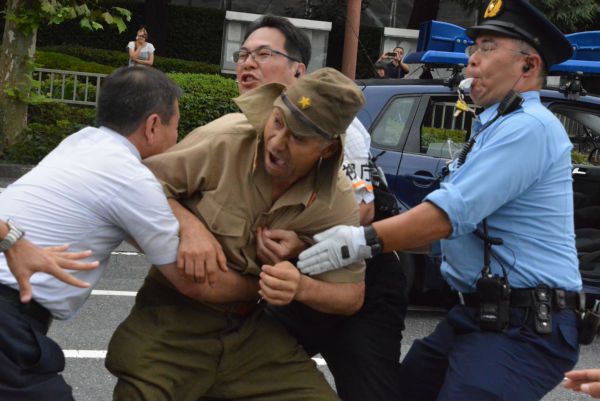
It is unclear to me if this was a co-ordinated action between several groups or individuals, but online reports claim that the racist hate group Zaitokukai was the main organiser. The perpetrators of the attack seemed to attempt to surround the tents with flags and banners. The hot summer day then quickly became more heated as supporters rallied to protect the tents, and police struggled to keep the two groups on opposing sides of the street while vehicles decorated with nationalist slogans drove into the fray. The anti-tent demonstrators included at least one man wearing a war-time military costume, just as can always be seen at Yasukuni on August 15th.
Japan’s far Right has diversified in recent years, now encompassing netizens who vent nationalist anger online (the so-called netto uyoku), hate speech groups like Zaitokukai who particularly target Korean communities, and sundry protestors who march against the recent territorial incursions by China and Japan’s other neighhours. The customary black vans of the traditional uyoku are no longer the only icons of rightist groups, nor does this emerging demographic necessarily belong to the New Right or minzoku-ha that developed out of the student movement. (In fact, elements of the New Right and other nationalists also added their voices to the anti-nuclear power movement.) The hate groups and xenophobic activists view any kind of leftist, liberal or anti-government movement as an enemy of Japan, hence they have attacked protests against nuclear power or the state security bills. Shall we call it the New New Right?
The incident comes at time of renewed tensions between the state and citizens due to the ongoing clashes at Takae in Okinawa over helipad construction, which has seen hundreds of riot police despatched from the mainland to maintain order among local and visiting protestors. While the scale of that movement is still relatively small, the situation is not dissimilar to what happened during the construction of Narita Airport in the 1960s and 1970s.
This is far from the first time the tents have attracted far-right attention, including hate activists like Shusei Sakurda. Rightists damaged and attempted to disrupt the tents as earlier as 2011, which has led the anti-nuclear protestors to develop a network of supporters that can be mobilised to guard and protect the tents. As can see from the video, this is very successful as a defence strategy. The attack on August 14th was met by a vigorous counter-protest of self-professed “anti-fascists” from the movement which has also become a prominent feature of protest culture in Japan over the past few years in response to the way the ultra-nationalists have evolved. These counter-protestors strive to outnumber and drown out the noise of right-wing or hate groups’ street actions, and do not shy away from engaging directly in physical confrontations. The activists are at times as aggressive as the hate groups and others they picket, prompting a greater police presence to keep the two sides apart.
This video was made by Rio Akiyama, a freelance photographer and film-maker who spends his days crisscrossing the country to cover counter-protests and other social movements. The work of Akiyama is mirrored by that of Rody Shimazaki, a punk-turned-photographer who has also documented the 2015 security bills protests and the hate speech counter-protests. Both Shimazaki and Akiyama have published photo-books in recent months, adding to the post-Fukushima discourse with (carefully curated) versions of the protest movements.
The protest tents were first erected on September 11th, 2011, shortly after the much-publicised hunger strike at Kasumigaseki, and around the time that the anti-nuclear power movement really began to pick up momentum. The organisers themselves use the name “Tento Hiroba” (Tent Plaza), and in English “Anti-Nuclear Occupy Tent”. It has been called the Occupy Tents, or the “tent village”. The concurrent timing is coincidental, but we might dare to christen it “Occupy Kasumigaseki”, though the contexts and aims of the tents are far removed from what went on at Wall Street in those heady anti-capitalist days of late 2011.
What is the significance of the Occupy Tents? The motley structures function as a listening post; a gathering place for demonstrators, talks, music, video screenings, and information exchange. One of the tents is now a free art museum featuring work by the likes of 281_Anti Nuke. The corner where they stand is one of the symbols of the movement, along with the art of Yoshitomo Nara that was used prolifically on placards at the major rallies.

The tents have also become a kind of protest commons: a shared place for various stakeholders in the diverse anti-nuclear power protest movement to come together and exchange views. It occupies land that is public yet also government (not mutually exclusive concepts), and forces the issue of Fukushima and nuclear power to stay in the public domain even as the the Friday night vigils in front of the Kantei (prime minister’s official residence) have dwindled. That is not to say they have stopped: they continue resiliently every week, though the numbers of participants are far lower than their remarkable peak in 2012. But Tent Plaza is certainly the most materially resonant site of the movement, since the Friday night vigils are by their nature transient and shifting in scale and exact location.
In this way, the tents form a permanent platform for discourse, a “plaza” in a very real sense — a rare thing in Japan, where public land is often tightly controlled and managed. Kasumigaseki, in particular, is not amenable to assemblies, where demonstrators are not allowed to occupy the roads and are forced to gather on the snaking pavements in the district. Tent Plaza repudiates this topographical restraint and replaces it with a micro Tokyo version of Speakers’ Corner.
In addition to the ongoing crusade against nuclear power, the tents have also served as a locus for other anti-government causes, such as the protests against the state security bills last year. In one memorable episode, Buddhist monks gathered at the tents in 2015 to pray for the so-called “war bills” to be rejected.
If the unquestionably partisan Japan Atomic Industrial Forum is to believed, “members of a shadowy coalition of primarily far-left groups have continuously occupied [the tents], displaying signs criticising national nuclear policy and proclaiming the site a symbol of the anti-nuclear movement”. “Shadowy” or not, the people associated with the tents are not simply drawn from the rank’s of Japan’s far Left. There are indeed activists with long experience in radical groups. (For example, Shinzaburō Iwamoto is one of the people involved and this seems to be the same person who was part of a faction of Chūkaku-ha forced out in 2006.) But the nature of the protest is much more genial than the dogmatic tactics of the far Left, and, as we saw, a lot of its grassroots support now comes from the younger hate speech counter-protestors as opposed to the more established radical Left.
Here is someone explaining how she got involved in helping at the tents, as recorded by the Voices of Protest Japan project.
I wanted to do something as one who lives in metropolitan area. Though I did not participate from the beginning, I participated in Fukushima women’s group and did a sit-in. Also I started to visit here two or three days when I heard that Fukushima women were coming after the hunger strike done by five young people in front of METI. Then Japan’s women group continued the movement for ten more days. I didn’t participate for the whole thing but little bit. After that, the men at the first tent built the second tent when a hundred of Fukushima women were coming to the tent. But because of lack of participants after this movement, the tent was always closed when I came. In the same year, March of 2012, I started to come when I heard that they needed member for Saturday shift. So I started to go to that shift and also began to come for Thursday. Then I came for every other week rotating with another person. And now, I come for Thursday shift.
Just as the Wall Street occupiers were hounded out of Zuccotti Park, so too does the Japanese state want these pesky Kasumigaseki squatters gone. METI has been attempting to have the tents forcibly removed since 2014, though the orders have been challenged by protestors in the courts. Amidst the anti-nuke paraphernalia, the tents are also ostensibly fenced off by railings hung with signs informing the world that this is state land. In late July, the Supreme Court upheld an earlier ruling the the tents must be removed and the occupiers pay a vast sum for “using” public land (around ¥20,000 for every day the tents have been there). The tents are effectively on borrowed (and expensive) time, though the state knows that any clumsy eviction could result in violence.
On September 11th, the tents are celebrating their anniversary with a “9.11 Anger Festival”. The fury of Fukushima lives on in Kasumigaseki.
WILLIAM ANDREWS
State funds planned for cleaning heavily contaminated zones in Fukushima
Privatized profit, socialized risk and clean up
The government plans to use state funds to finance the radiation cleanup in the areas most seriously contaminated by the Fukushima disaster in 2011, government sources said Friday.
It is the first plan to decontaminate the “difficult to return to” zones, including a large portion of the two towns hosting the crippled Fukushima No. 1 nuclear power plant and parts of other nearby municipalities in the prefecture.
The move is intended to expedite the cleanup process but may draw criticism because it will effectively reduce the financial burden on Tokyo Electric Power Company Holdings Inc., the utility responsible for the world’s worst nuclear crisis since Chernobyl.
Under the current legal framework, the decontamination costs are first shouldered by the state, with Tepco told to reimburse the expenses over time. But since the costs are expected to far exceed the ¥2.5 trillion estimated earlier, the utility has requested more financial support.
The government plans to conduct decontamination in the difficult-to-return-to zones, which comprise about 337 sq. km of land where around 24,000 people used to live, the sources said.
The work within the designated “reconstruction bases” will include removing buildings, replacing soil and paving roads.
Tepco will only be asked to shoulder the costs of cleaning existing facilities and infrastructure that will continue to be used within the reconstruction bases.
The government hopes to officially endorse the plan this month, the sources said.
The Fukushima disaster, triggered by a huge earthquake and tsunami in March 2011, prompted the government to issue evacuation orders to 11 municipalities near the plant.
The areas have been reclassified into three categories based on radiation level — a zone where evacuation orders are ready to be lifted, a zone where human habitation is restricted, and a zone where residents will have difficulty coming back to for a long time.
The areas subject to evacuation are gradually being reduced, with the government setting a goal of lifting all the remaining orders apart from the difficult-to-return-to zones by next March.
In the heavily contaminated zones, the government plans to conduct costly and intensive radiation cleanup efforts that will allow it to lift the evacuation orders in five years’ time.
‘99% effective’ Fukushima ice wall fails to seal off crippled nuclear plant
« TEPCO has been repeatedly facing criticism for handling of the Fukushima crisis which occurred after a massive earthquake and subsequent tsunami led to a meltdown of reactors at the facility in March 2011.
The company has admitted that it did not act properly during the disaster, confessing in February that it announced the nuclear meltdowns far too late. It also stated in a 2012 report that it downplayed safety risks caused by the incident, out of fear that additional measures would lead to a shutdown of the plant and further fuel public anxiety and anti-nuclear campaigns. »
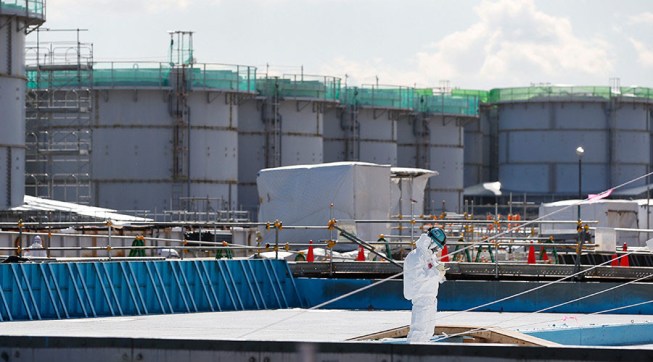
An “almost” watertight ice wall built around the Fukushima nuclear plant in a bid to prevent groundwater from entering the site has, quite predictably, proven to be not good enough, with Japan’s nuclear watchdog now urging TEPCO to find a better solution.
An expert panel with the Japanese Nuclear Regulation Authority examined the latest TEPCO report this week to assess how far and how successfully the project had been implemented, Japanese newspaper Asahi Shimbun reports. The members of the panel concluded that the ice wall was not working and a new plan was necessary to prevent groundwater getting mixed up with radioactive substances.
“The plan to block groundwater with a frozen wall of earth is failing,” said Yoshinori Kitsutaka, a panel member and a professor of engineering at Tokyo Metropolitan University.
“They need to come up with another solution, even if they keep going forward with the plan.”
In March, construction company Kajima Corp. began building the frozen wall of earth around the four damaged nuclear reactors and has completed most of the 1.5-km (1 mile) barrier. TEPCO hoped that the frozen earth barrier would thwart most of the groundwater from reaching the plant and divert it into the ocean instead. However, little or no success was recorded in the wall’s ability to block the groundwater during the five-month-period. The amount of groundwater reaching the plant has not changed after the wall was built, experts said.
The problem is said to lie in the wall’s gaps, or parts where the barrier is not frozen. According to TEPCO, 99 percent of their thermometer readings showed that the wall’s temperatures are at or below the freezing point, meaning the wall is mostly solid. However, a remaining one percent of the readings showed temperatures above the freezing point, which means the wall is not solid at those parts.
Those constitute a mere one percent of the 820-meter-long barrier, but these sections, where the earth is not frozen, are enough to ruin the entire project as they were found in areas with high levels of groundwater concentration.
TEPCO however believes that the unfrozen sections can be fixed if coated with concrete.
In April a chief architect of the project said that gaps in the wall and rainfall will still allow for water to creep into the facility and reach the damaged nuclear reactors, which will in turn create as much as 50 tons of contaminated water each day.
“It’s not zero,” Yuichi Okamura, a general manager at Tokyo Electric Power Co. (TEPCO) said referring to the amount of groundwater flowing into the plant. “It’s a vicious cycle, like a cat-and-mouse game…we have come up against many unexpected problems.”
Fukushima ice wall won’t stop radioactive groundwater from seeping out – chief architect https://t.co/57C1J48VHOpic.twitter.com/em5d53Cbtr
— RT (@RT_com) April 29, 2016
TEPCO has been repeatedly facing criticism for handling of the Fukushima crisis which occurred after a massive earthquake and subsequent tsunami led to a meltdown of reactors at the facility in March 2011.
The company has admitted that it did not act properly during the disaster, confessing in February that it announced the nuclear meltdowns far too late. It also stated in a 2012 report that it downplayed safety risks caused by the incident, out of fear that additional measures would lead to a shutdown of the plant and further fuel public anxiety and anti-nuclear campaigns.
Despite the ongoing problems encountered following the meltdowns, TEPCO has set 2020 as the goal for ending the plant’s water problem – an aim which critics say is far too optimistic. The problem of water contamination is just one of many surrounding the dismantling and containing of the Fukushima plant debris which is estimated to take at least 40 years.
Worker’s leukemia deemed result of his work at Fukushima Daiichi Nuclear plant granted compensation
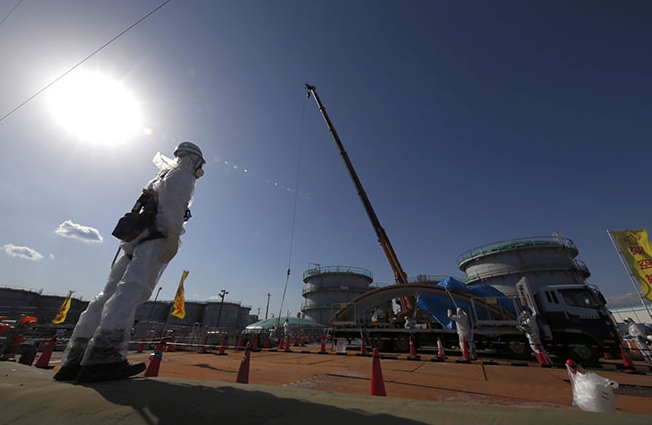
Workers in protective gear at the Fukushima No. 1 nuclear power plant in February
Man’s leukemia deemed result of his work at Fukushima plant
The labor ministry said a man who developed leukemia by helping in clean-up efforts at the crippled Fukushima No. 1 nuclear power plant is entitled to work-related compensation.
It marks the second such case since the 2011 nuclear disaster.
The Ministry of Health, Labor and Welfare recognized that the cancer was due to exposure to radiation at the facility and said the government will cover his medical expenses.
The ministry said Aug. 19 that the man, who is in his 50s, was involved in removing debris and repairing machinery that handled radioactive water at the plant between April 2011, a month after the triple meltdown triggered by the earthquake and tsunami disaster, and January 2015.
His accumulative radiation exposure was 54.4 millisieverts.
The man worked for a contractor with Tokyo Electric Power Co., the operator of the nuclear complex.
He was diagnosed with leukemia in January 2015, and filed application for worker’s accident compensation at the Fukushima Labor Standards Inspection Office, a regional branch of the ministry.
Under the ministry’s guidelines, eligibility for work-related compensation in such cases is granted if leukemia is diagnosed after the person worked for more than a year in an assignment which resulted in an annual dose of more than 5 millisieverts.
The ministry’s decision to grant compensation in this case came after a panel of experts offered their opinions on the matter.
The ministry is scrutinizing the cases of five other former workers at the plant who have applied for compensation.
Compensation in such cases was first granted last October after a man in his early 40s was diagnosed with leukemia in January 2014. He was exposed to 16 millisieverts of radiation while he worked at the plant between 2012 and 2013.
Applications for the work-related compensation as a result of the Fukushima disaster are expected to increase in coming years, experts say.
According to TEPCO, those who had annual does of more than 5 millisieverts of radiation during fiscal 2015 numbered 4,952.
http://www.asahi.com/ajw/articles/AJ201608200036.html
Fukushima worker with cancer granted compensation
Japan’s labor ministry has certified that a former worker at the Fukushima Daiichi nuclear plant is eligible for compensation for developing leukemia.
The man in his 50s had worked at the plant for nearly 4 years since April 2011, soon after the compound suffered a meltdown.
The ministry says the man was in charge of mechanical repairs at the plant. It says he developed leukemia in January last year, and applied for workers’ compensation.
Ministry officials say the man’s radiation exposure has reached 54.4 millisieverts, and that they found no other plausible causes except his work.
He is the 2nd person to be awarded compensation in connection with the accident, following a case last October involving another man with leukemia.
In all, 14 nuclear plant workers in Japan have been granted compensation for work-related cancer.
About 47,000 people have worked at the Fukushima plant in the 5 years since the accident.
Panel: TEPCO’s ‘ice wall’ failing at Fukushima nuclear plant
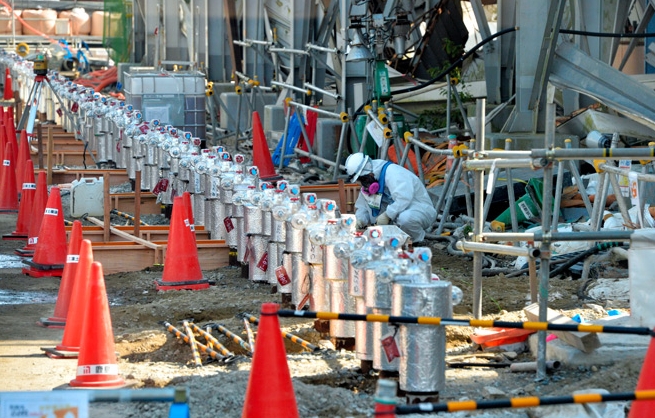
Devices to freeze the earth are set up on the southern side of the No. 4 reactor building at Tokyo Electric Power Co.’s Fukushima No. 1 nuclear power plant in Fukushima Prefecture in 2014.
Tokyo Electric Power Co.’s “frozen wall of earth” has failed to prevent groundwater from entering the crippled Fukushima No. 1 nuclear plant, and the utility needs a new plan to address the problem, experts said.
An expert panel with the Nuclear Regulation Authority received a report from TEPCO on the current state of the project on Aug. 18. The experts said the ice wall project, almost in its fifth month, has shown little or no success.
“The plan to block groundwater with a frozen wall of earth is failing,” said panel member Yoshinori Kitsutaka, a professor of engineering at Tokyo Metropolitan University. “They need to come up with another solution, even if they keep going forward with the plan.”
One big problem hampering work at the nuclear plant, which was hit by the Great East Japan Earthquake and tsunami in 2011, has been the tons of groundwater entering the buildings housing the No. 1 through No. 4 reactors every day.
The water becomes contaminated with radioactive materials within the reactor buildings.
TEPCO’s plan was to create a frozen wall of earth around the reactor buildings to divert the groundwater away from the plant and into the ocean.
The company started freezing the ground on March 31, and the project’s budget was 34.5 billion yen ($344 million) in taxpayer money as of the end of May.
But the amount of groundwater pumped from the ocean side of the frozen wall has shown little change from when there was no icy earth wall.
TEPCO’s report said 99 percent of thermometer readings on the 820-meter-long stretch showed temperatures of freezing or lower, suggesting the underground wall was frozen solid at those points.
However, the remaining 1 percent of the readings above freezing were in areas with high levels of groundwater concentration.
A 99-percent success rate may sound impressive, but much like dams, airlocks and Tupperware, TEPCO’s ice wall is failing if it is not 100-percent watertight.
The utility said the unfrozen sections could be reinforced with an injection of concrete.
The panel asked the utility submit calculations estimating the amount of groundwater that can be blocked if water is pumped before it reaches the frozen wall.
Tokyo 2020 Games prep beset with problems
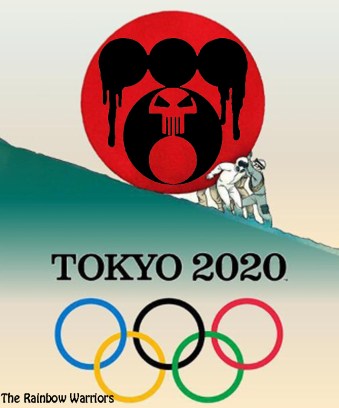
“Some officials even suggested they were hoping Fukushima prefecture could host the first rounds of softball and baseball, which have been added to the program for the 2020 Olympics.
The northeastern prefecture hosts the Fukushima Daiichi nuclear power station which suffered a triple meltdown in March 2011 after it was hit by an earthquake and resulting tsunami.
About 100,000 residents have still been unable to return home because of radioactive contamination near the complex.”
Tokyo’s preparations for the 2020 Games have been beset by problems from soaring costs to a stadium designed without the Olympic cauldron.
In less than four years, the final torch bearer will light the cauldron in the opening ceremony to start the 2020 Tokyo Olympic Games.
But where was the cauldron in the newly selected design for the Olympic main stadium, Japanese officials asked in March.
It was just the latest in a series of controversies involving Tokyo’s second Olympics.
Tokyo organising committee president Yoshiro Mori blamed the new main stadium operator, the Japan Sports Council, and then-sports minister Hiroshi Hase for the missing cauldron.
“It would make no sense not to think about the cauldron if the stadium was getting built for the Olympic Games,” Mori said.
Japanese architect Kengo Kuma, whose proposal was picked in December as the new design for the venue, said the placement of the cauldron was not even on the agenda during the bidding.
His design has spectators’ stands covered by wooden materials, therefore there are concerns that a cauldron in the stadium could infringe the country’s Fire Service Act.
But Kuma has tried to allay such concerns, saying there’s no need to worry as he is considering various methods to install it.
Kuma’s design was adopted after Prime Minister Shinzo Abe decided in July 2015 to abandon the initial design by late Iraqi-British architect Zaha Hadid amid a public outcry over its surging cost.
The Japanese architect’s plan indicates a total construction cost of Y149 billion ($A1.94 billion), far below the estimated Y252 billion for the controversial scrapped design by Hadid, which almost doubled from an initially projected Y130 billion.
Kuma’s office says the construction will start in December and it will be completed in November 2019, two months earlier than the deadline imposed by the International Olympic Committee, seven months before the opening of the 32nd Olympics.
The changes, however, will make it impossible to use the new stadium for the rugby World Cup in the (northern) autumn of 2019 as scheduled.
Japan also withdrew its original Tokyo Olympics logo a year ago after its designer Kenjiro Sano was accused of copying it.
A Belgian designer sued the IOC, saying the logo was similar to one of his works produced for a theatre in Belgium.
The new official emblem was picked in April.
More than three years ago, then-candidate city Tokyo promised a compact Olympics with most venues close to the centre of the Japanese capital. That was a main selling point to win the bid to host the 2020 Games against Istanbul and Madrid.
Tokyo, however, backed down on such promises as some venues have moved out of the Japanese capital.
Some officials even suggested they were hoping Fukushima prefecture could host the first rounds of softball and baseball, which have been added to the program for the 2020 Olympics.
The northeastern prefecture hosts the Fukushima Daiichi nuclear power station which suffered a triple meltdown in March 2011 after it was hit by an earthquake and resulting tsunami.
About 100,000 residents have still been unable to return home because of radioactive contamination near the complex.
The organising committee has been criticised for soaring costs.
Former defence minister Yuriko Koike became governor of Tokyo in a landslide victory in late July, the first woman to head the Japanese capital. A ruling Liberal Democratic Party MP who speaks fluent Arabic and English, she has pledged to review the ballooning costs of the 2020 Games.
Koike is in Rio de Janeiro to attend the closing ceremony to accept the Olympic flag as a representative of the next host city.
https://www.sbs.com.au/news/article/2016/08/19/tokyo-2020-games-prep-beset-problems
‘Hibakusha’ talks scrapped after Nagasaki bomb threat
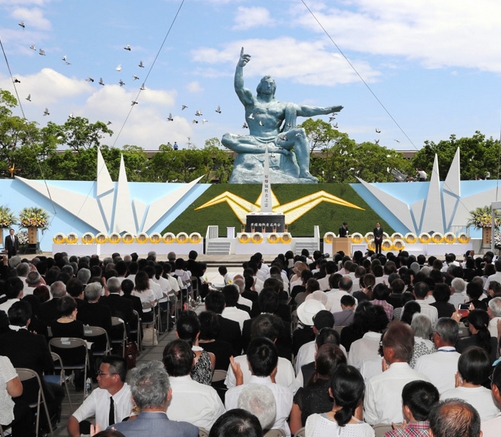
NAGASAKI–A bomb threat against schools in Nagasaki Prefecture prompted the cancellation of peace-promotion events featuring “hibakusha” atomic bomb survivors sharing their horrific experiences in World War II.
“We decided to call off an event, giving top priority to the safety of participants,” said an official with the Kita-Kyushu municipal government in Fukuoka Prefecture, also on the southern main island of Kyushu.
An e-mail sent in late July to the Nagasaki prefectural government said elementary and junior high schools would be blown up on Aug. 10 or Aug. 11. No reason was given for the threat.
The Kita-Kyushu government had organized a one-day bus tour to Nagasaki for 270 elementary and junior high school students, as well as their parents, as part of a peace-promotion program.
The initial itinerary included a visit to Shiroyama Elementary School to listen to the accounts of hibakusha on Aug. 9, the 71st anniversary of the atomic bombing of the city.
The school is near ground zero, and many of its students and teachers were killed in the blast on Aug. 9, 1945.
But tour organizers dropped the visit to the school from the schedule after Shiroyama Elementary School had informed them of the bomb threat.
The scrapped visit to the school gave the tour participants more time to spend at the Nagasaki Atomic Bomb Museum and the site of the hypocenter. In the morning, they visited a civic hall in Nagasaki to watch a live broadcast of a ceremony for atomic bomb victims held at Nagasaki Peace Park.
A group of 15 students ranging from elementary to high school age, also from Kita-Kyushu, canceled an event to hear the atomic bomb survivors’ accounts scheduled for Aug. 10 at Shiroyama Elementary School and elsewhere in light of the bomb threat.
The group visited Nagasaki from Aug. 8 to take part in a peace forum for young people.
The Nagasaki prefectural board of education had urged elementary and junior high schools to refrain from activities on Aug. 10-11. Those days passed without incident in the city.
Promoted Fukushima Tourism Booming
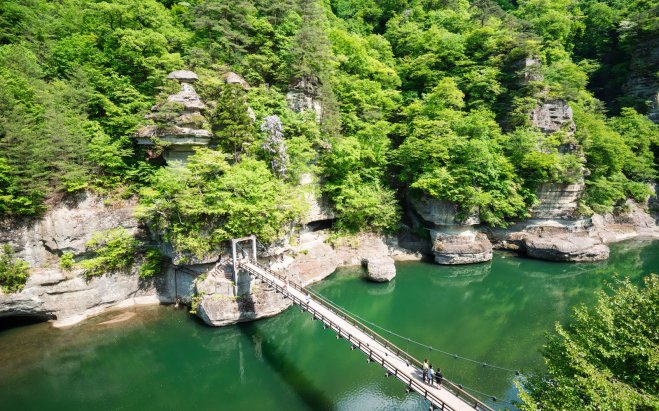
Fukushima Attracts 50 Million Tourists Annually for the First Time Since the Nuclear Disaster
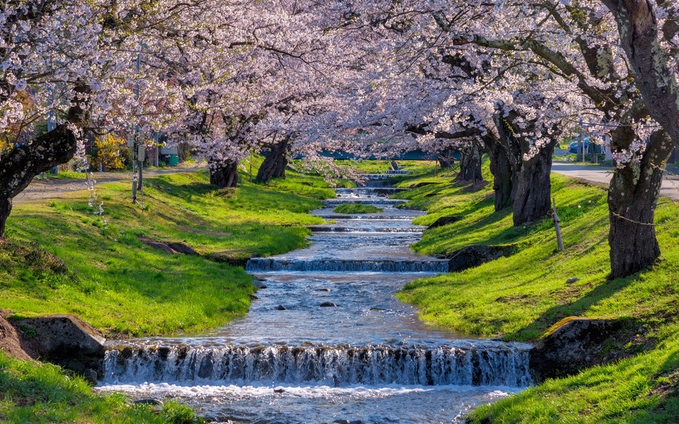
Japan’s Fukushima Prefecture has hit a tourism milestone, drawing in more than 50 million visitors in the past year, according to data released by the Fukushima Prefectural Government.
The prefecture drew in a total of 50.31 million tourists, making it the first time this annual threshold has been achieved since the nuclear disaster of 2011.
According to the The Japan Times, the area has seen a recovery of close to 90 percent since then, which officials in the region contribute to several factors.
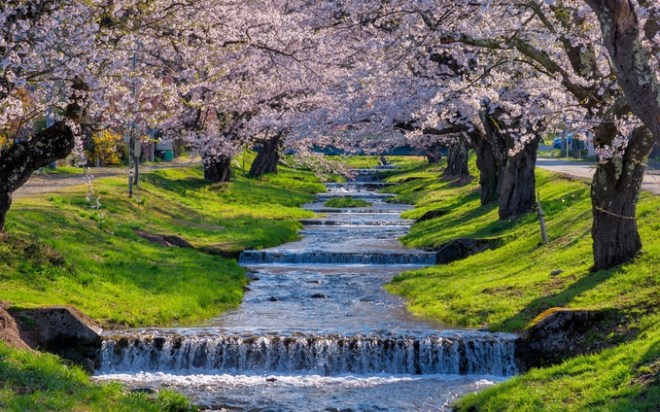
Last year, Fukushima officials launched the “Fukushima Destination Campaign,” tapping into the country’s transportation resources to offering railway deals and promotions.
Officials pointed to the opening of the section between the Tomioka and Namie interchanges on the Jōban Expressway last March as a key player in the surge of visitors in eastern Fukushima last year, which was up 59.9 percent from 2014.
The opening of new leisure facilities and a re-emergence of the area’s famous hot springs is also helping draw in visitors.
Above all, the data found that travelers were most drawn to the prefecture’s natural sights, with destinations like the Bandai-kogen highlands drawing in a total of 2.18 million visitors last year.
http://www.travelandleisure.com/trip-ideas/nature-travel/fukushima-tourism-rebound
Footholds Should Be Built in Fukushima No-Go Zone: LDP Team
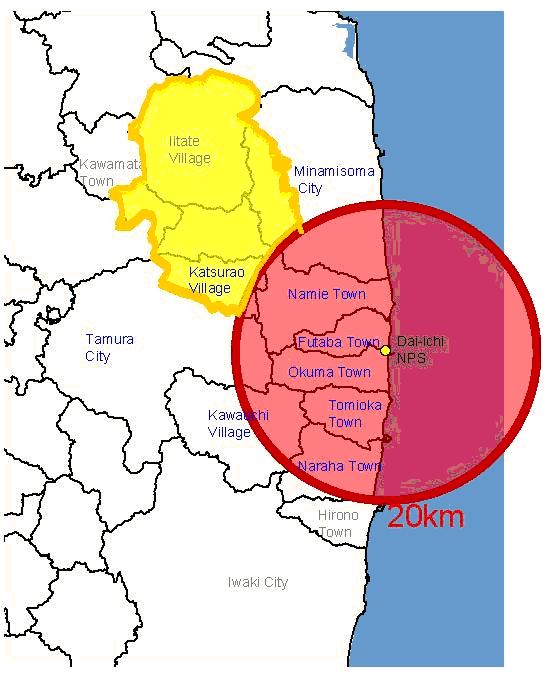
Tokyo, Aug. 17 (Jiji Press)–Reconstruction footholds should be set up in the no-go zone heavily contaminated by the 2011 nuclear accident in Fukushima Prefecture in northeastern Japan, a Liberal Democratic Party team proposed Wednesday.
The footholds should be used for decontamination work and infrastructure development so that evacuation orders for residents of the zone will be lifted in around five years, said the ruling party’s Headquarters for Accelerating Reconstruction after the Great East Japan Earthquake.
At a general meeting, the headquarters broadly agreed on a draft outline of the party’s planned sixth reconstruction proposal for areas damaged by the March 2011 earthquake and tsunami and the subsequent reactor meltdowns at Tokyo Electric Power Company Holdings Inc.’s Fukushima No. 1 nuclear power plant.
The government plans to remove all evacuation advisories in municipalities affected by the nuclear accident by the end of March 2017, excluding in the no-go zone where radiation levels are still too high for local residents to return home anytime soon.
The LDP will submit the proposal to Prime Minister Shinzo Abe later this month, after finalizing it through discussions with its coalition partner, Komeito.
Why Japan? The racism of the Hiroshima and Nagasaki bombings
“Were he alive today, Dr. King would still be using the ‘unarmed truth’ to warn that we stand at the very precipice of the hell of thermonuclear self-immolation … We must transform the world power struggle from the nuclear arms race to a creative contest to harness man’s genius for the purpose of making peace and prosperity a reality for all.”
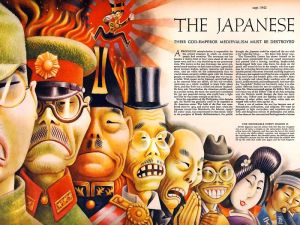
How the US saw the Japanese people in 1942
As we remember the bombing of Hiroshima and Nagasaki this month 71 years ago, we have largely forgotten the racist propaganda that made it possible, writes LINDA PENZ GUNTER. We have likewise sanitised history to exclude the voices of African Americans who loudly protested the use of nuclear weapons, connecting them to American colonialism abroad and racism at home.
This month 71 years ago, the US cropped nuclear bombs on Hiroshima and Nagasaki, on August 6 and 9 respectively.
‘Racism’ is probably not the first word that springs to mind as we reflect on these terrible events, and their immediate and ongoign aftermath.
But according to a fascinating book by Vincent J. Intondi, published last year and entitled African Americans Against the Bomb, it was the recognition of those bombings as an act of racism that drew African Americans into the nuclear disarmament movement and future wars that kept them there.
As Intondi explains in his introduction, “Black activists’ fear that race played a role in the decision to use atomic bombs only increased when the United States threatened to use nuclear weapons in Korea in the 1950s and in Vietnam a decade later.”
This singling out of non-white enemies for the use or threat of atomic weapons drew African Americans not only into the nuclear abolition movement, Intondi contends, but into a form of social activism that connected many issues of civil and human rights on a global, rather than national scale.
The black anti-nuclear campaign: airbrushed out of history
“Since 1945, black activists had made the case that nuclear weapons, colonialism, and the black freedom struggle were connected”, writes Intondi.
African Americans recognized colonialism “From the United States’ obtaining uranium from the Belgian-controlled Congo to France’s testing a nuclear weapon in the Sahara”, Intondi writes. It was the use and continued testing of the atomic bomb, “that motivated many in the black community to continue to fight for peace and equality as part of a global struggle for human rights.”
Those who joined the struggle against nuclear weapons included Martin Luther King, Jr., of course, but also W.E.B. Du Bois, Paul Robeson, Marian Anderson and many others. Yet it is rarely their faces that are evoked when there is discussion of the Ban the Bomb marches or, later, the rise of SANE/Freeze.
Perhaps no one better embodied that clear understanding of the link between the struggle for peace and justice and the arms race than Bayard Rustin, posthumously awarded the Presidential Medal of Freedom in 2013 by President Obama.
Yet despite Rustin’s outspoken role for peace and disarmament, the word ‘nuclear’ never appears in his Wikipedia biography. Rustin’s leadership in the anti-nuclear movement, like that of many of his fellow African Americans, has vanished from the history books. But not from Intondi’s.
Dehumanising an entire people
The debate about whether the US was justified in dropping atomic bombs on Hiroshima and Nagasaki persists today. The most widely accepted – but ferociously challenged – argument in favor is that it was necessary to force the surrender of Japan and thus end World War II.
But the underpinnings of racism are glaringly obvious. Intondi quotes poet Langston Hughes asking the question voiced by many others; why did the United States not drop the atomic bomb on Germany or Italy?
The answer can be found in the appalling and vitriolic anti-Japanese sentiment Intondi cites, whipped up to dehumanize an entire population. This includes the illustrious Time magazine which declared that “The ordinary unreasoning Jap is ignorant. Perhaps he is human. Nothing … indicates it.”
Clearly, these were slurs with which the African American community were all too familiar. It enabled them to empathize with the innocent victims of Hiroshima and Nagasaki, and, more broadly, with those around the world oppressed by colonialism.
Consequently, according to Intondi, the dropping of atomic bombs on Japan was viewed through a very different lens by the African American community than by white America. Du Bois recognized immediately what the legacy of Hiroshima and Nagaski would be. It would lead, he warned, to a corporate conspiracy of profiteering that would impact the working people of the US the most severely.
“Big business wants war to keep your mind off social reform”, Intondi quotes Du Bois as saying at a 1950 Harlem press conference. “It would rather spend your taxes for atom bombs than for schools because in this way it makes more money.”
All we are saying, is give peace a chance
Today, the US is still spending far more on atomic weapons than schools. The Obama administration announced a $1 trillion spending plan over the next 30 years to “upgrade and refurbish” nuclear weapons. (Recently, an Obama spokesman hinted that the president may seek to considerably reduce that bill before leaving office.)
But the voices of African Americans like Robeson, Du Bois, Dorothy Height, Dick Gregory and others are no longer leading the nuclear disarmament movement. Today’s nuclear abolition crowd is largely white, progressive and almost entirely grey-haired.
Why did they disappear? Many African Americans in the anti-nuclear movement of the 1950s and ’60s were firmly on the Left, some members of, or fellow travelers with, the Communist Party. The McCarthy witch hunts and general Red baiting, forced a retreat on all fronts, including among some African Americans, Intondi suggests.
Some hung on for a while. Twenty years after King’s “I Have a Dream” speech, at an August 1983 anniversary march, the official platform still proclaimed the importance of nuclear disarmament, as Intondi quotes in his book:
“Were he alive today, Dr. King would still be using the ‘unarmed truth’ to warn that we stand at the very precipice of the hell of thermonuclear self-immolation … We must transform the dynamics of the world power struggle from the nuclear arms race to a creative contest to harness man’s genius for the purpose of making peace and prosperity a reality for all … We call upon the American public to turn the arms race into a ‘peace race’ utilizing the existent and evolving movements in the United States as its foundations.”
Black lives matter!
But the peace was never run. Prosperity did not come for many, especially in the African American community. Anti-nuclear activism did finally persuade President Reagan to change course, but nuclear weapons were not abolished in the US or in any country that already possessed them. Others like Israel, India and Pakistan, developed them.
The notion that nuclear weapons were ‘necessary’, or a ‘deterrent’, despite the protests and all evidence to the contrary, held sway then and continues to do so today.
Many others have abandoned the cause as well. Hiroshima and Nagasaki are now 71 years in the past, and even though we face the ever-present threat of instant annihilation by the accidental or deliberate use of nuclear weapons, the sense and understanding of this persistent threat has subsided.
For the African American community, priorities changed. Although segregation came off the statute books, it persisted. Opportunities for African Americans grew, but not enough, and for too few. Huge swaths of the population continued to languish in ghettoized neglect. There were periodic explosions – the riots of Watts, Newark, Washington – but not enough action to bring the community fully out of poverty and discrimination.
A fundamental grasp of the depths of racism by the non-black community in the US was never achieved. This led to the misunderstanding of meaning and intent behind the Black Lives Matter movement, the absence of that tiny word ‘also’ leading to criticism, amendment and even hostility.
Recognising the contribution of African Americans
The bombing of Hiroshima and Nagasaki was a decision that could be made because the US government and its propaganda team seared into the collective American psyche the idea that the Japanese people were, as US General Joseph Stilwell said at the time and most vilely, “bowlegged cockroaches”. The US press, as we have seen from the Time quote, were right behind him.
Then the photos began to emerge – of burned children with their skin hanging off; of bodies charred or even vaporized; of the agonizing deaths from radiation sickness. And there was Sadaki Sasaki and the 1,000 origami peace cranes she folded before her death at 12 from leukemia ten years after the bomb was dropped on her hometown of Hiroshima.
Those images galvanized a movement. But they also evoked recognition and empathy among thousands of African Americans who saw the racism for what it was and provided the motivation for their substantial but largely unheralded contribution to the nuclear abolition movement.
Linda Pentz Gunter is the international specialist at Beyond Nuclear, a Takoma Park, MD environmental advocacy group.
Former town mayor recalls town referendum that booted plans for nuclear plant
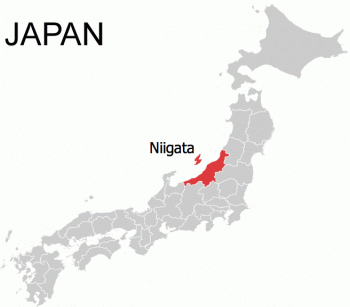
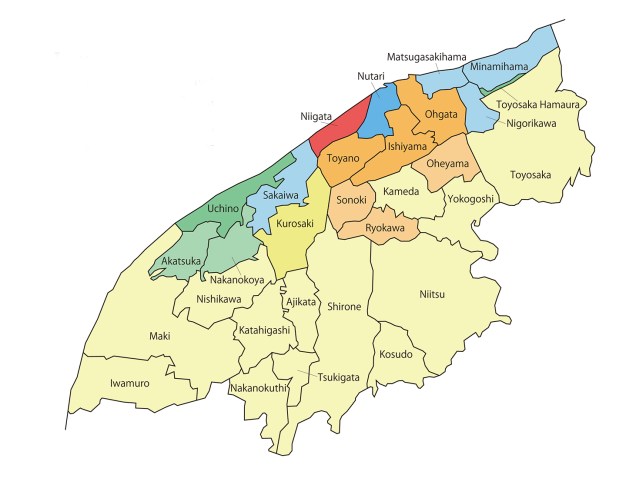
NIIGATA – Residents of the town of Maki, Niigata Prefecture, made the right decision 20 years ago, according to Takaaki Sasaguchi.
The town was Japan’s first ever to hold a referendum over a plan to build a nuclear power plant and firmly knocked it down.
“I’m proud that we opened our future through the referendum,” the former town mayor, 68, said in an interview. “Our choice not to allow a nuclear plant to be built in our town was not wrong.”
Maki no longer exists as a discrete entity as it has since been absorbed into the city of Niigata.
But memories run strong of what people power achieved, and in light of the Fukushima disaster what it may have prevented.
In 1971, Tohoku Electric Power Co. unveiled plans to construct a nuclear plant in the town. The facility was to generate electricity from a central 825,000-kw reactor of boiling-water design.
But as land appropriation and other work got underway, opposition strengthened.
Sasaguchi and his colleagues set up a group aimed at holding a referendum so that residents could decide for themselves.
He was elected mayor in January 1996, and the Maki government then established a municipal ordinance for a referendum.
Referendum day was Aug. 4 that year, and 12,478 residents voted against the plan. Those in favor totaled 7,904.
Voter turnout was 88.29 percent in Japan’s first local referendum over a nuclear power station.
Following the result, Mayor Sasaguchi decided to reject the nuclear plant construction, and a plot of land that the town owned within the proposed site was sold off to residents who had opposed the plans.
Those in favor of the plant sued, but in December 2003 they lost the case and later that month Tohoku Electric threw in the towel.
Sasaguchi accuses Japan’s government of not encouraging respect for local voices back then.
A pro-nuclear push made it difficult for Maki residents to speak up.
“The most important thing in the referendum was that residents showed their intentions and made a choice,” Sasaguchi recalls.
The referendum result drew heavy media coverage, and the town was praised for choosing the democratic process.
Sasaguchi says it also brought the town together.
“I think Maki residents probably wanted to bring their town, which had been upset by the nuclear project, back to being a normal community,” he said.
The town was merged into the city of Niigata in 2005, and the referendum began to be forgotten.
However, the March 2011 nuclear crisis in neighboring Fukushima Prefecture reminded ex-Maki residents of the significance of their vote back in 2006.
They told Sasaguchi the same tragedy could have happened to them if they had allowed a nuclear plant to be built.
Meanwhile, Sasaguchi notes that Tokyo Electric Power Co. has filed for Nuclear Regulation Authority safety checks for two of the seven reactors at its Kashiwazaki-Kariwa nuclear power station in Niigata Prefecture.
“Even if the NRA endorses the safety, the issue of the nuclear waste disposal site remains unresolved,” he said.
The central government still has not identified a long-term disposal site for high-level waste.
“The Japanese government should put into force a policy that doesn’t depend on nuclear power plants as soon as possible,” he said.
Tokyo Electric Power Co.’s “frozen wall of earth” failing at Fukushima
 http://www.asahi.com/ajw/articles/AJ201608190060.html By KOHEI TOMITA/ Staff Writer August 19, 2016 Tokyo Electric Power Co.’s “frozen wall of earth” has failed to prevent groundwater from entering the crippled Fukushima No. 1 nuclear plant, and the utility needs a new plan to address the problem, experts said.
An expert panel with the Nuclear Regulation Authority received a report from TEPCO on the current state of the project on Aug. 18. The experts said the ice wall project, almost in its fifth month, has shown little or no success.
“The plan to block groundwater with a frozen wall of earth is failing,” said panel member Yoshinori Kitsutaka, a professor of engineering at Tokyo Metropolitan University. “They need to come up with another solution, even if they keep going forward with the plan.”
One big problem hampering work at the nuclear plant, which was hit by the Great East Japan Earthquake and tsunami in 2011, has been the tons of groundwater entering the buildings housing the No. 1 through No. 4 reactors every day.
The water becomes contaminated with radioactive materials within the reactor buildings.
TEPCO’s plan was to create a frozen wall of earth around the reactor buildings to divert the groundwater away from the plant and into the ocean.
The company started freezing the ground on March 31, and the project’s budget was 34.5 billion yen ($344 million) in taxpayer money as of the end of May.
But the amount of groundwater pumped from the ocean side of the frozen wall has shown little change from when there was no icy earth wall. TEPCO’s report said 99 percent of thermometer readings on the 820-meter-long stretch showed temperatures of freezing or lower, suggesting the underground wall was frozen solid at those points.
However, the remaining 1 percent of the readings above freezing were in areas with high levels of groundwater concentration.
A 99-percent success rate may sound impressive, but much like dams, airlocks and Tupperware, TEPCO’s ice wall is failing if it is not 100-percent watertight.
The utility said the unfrozen sections could be reinforced with an injection of concrete.
The panel asked the utility submit calculations estimating the amount of groundwater that can be blocked if water is pumped before it reaches the frozen wall.
Perception that China is not to be trusted is hampering its nuclear marketing ambitions
 Going Out’ to Hinkley Point? China’s Uncertain Future in International Energy China’s ambition to become a global energy power will have to overcome geopolitical hurdles, The Diplomat By Mykael Goodsell-SooTho August 18, 2016 “…….Recently, China has faced a number of setbacks which demonstrate several countries’ apprehension at the prospect of Chinese involvement in their energy infrastructure. Last week, the Australian government threw a wrench into the plans of China’s State Grid Corporation and Hong Kong’s Cheung Kong Infrastructure Holdings by preliminarily barring their bids for a controlling stake in Ausgrid, the country’s largest electricity network. This came just weeks after a similar decision by the U.K. government to postpone approval of the Hinkley Point C nuclear reactor project pending a comprehensive review of the plans. In both instances, officials have cited security concerns surrounding Chinese involvement in British and Australian energy infrastructure as primary reasons for the countries’ hesitance to conclude the deals. Whether or not these worries are well-founded, they constitute a significant obstacle to Chinese energy companies’ international ambitions.
1 This Month





PLEASE OPPOSE HR 8255 AND S.3639 – bills would accelerate satellite deployment, with no environmental review or safeguards – https://ncstd5li.quorum.us/campaign/169331/
To see nuclear-related stories in greater depth and intensity – go to https://nuclearinformation.wordpress.com
-
Archives
- October 2026 (39)
- September 2026 (339)
- August 2026 (330)
- July 2026 (355)
- June 2026 (287)
- May 2026 (306)
- April 2026 (356)
- March 2026 (251)
- February 2026 (267)
- January 2026 (308)
- December 2025 (358)
- November 2025 (359)
-
Categories
- 1
- 1 NUCLEAR ISSUES
- business and costs
- climate change
- culture and arts
- ENERGY
- environment
- health
- history
- indigenous issues
- Legal
- marketing of nuclear
- media
- opposition to nuclear
- PERSONAL STORIES
- politics
- politics international
- Religion and ethics
- safety
- secrets,lies and civil liberties
- spinbuster
- technology
- Uranium
- wastes
- weapons and war
- Women
- 2 WORLD
- ACTION
- AFRICA
- Atrocities
- AUSTRALIA
- Christina's notes
- Christina's themes
- culture and arts
- Events
- Fuk 2022
- Fuk 2023
- Fukushima 2017
- Fukushima 2018
- fukushima 2019
- Fukushima 2020
- Fukushima 2021
- general
- global warming
- Humour (God we need it)
- Nuclear
- RARE EARTHS
- Reference
- resources – print
- Resources -audiovicual
- Weekly Newsletter
- World
- World Nuclear
- YouTube
-
RSS
Entries RSS
Comments RSS

