Taiwan protests at Public Hearings about Japanese food & Citizen Group Radiation Measuring
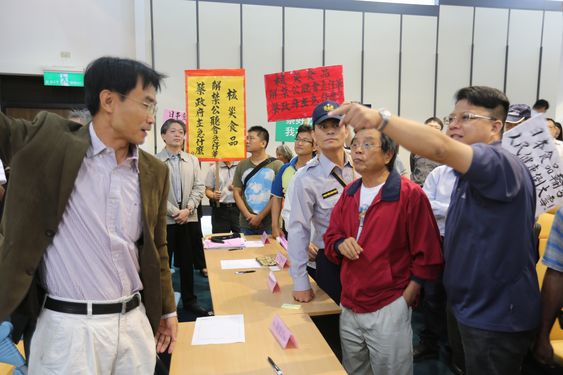
Public hearings on Japanese food in Tainan ends in rowdy protests
Taipei, Nov. 12 (CNA) A melee broke out at a public hearing in Tainan on lifting the ban on imports of currently banned Japanese food from radiation-affected prefectures when protesters clashed with government officials Saturday.
A total of 10 public hearings are scheduled from Nov. 12-14 in the northern, central, southern and eastern parts of Taiwan, as part of a government move widely seen as paving the way for its impending lifting of a five-year ban on Japanese produce from the prefectures affected by radiation following the Fukushima nuclear disaster in 2011.
The public hearing in Tainan was the first of the 10, and was presided over by Chen Chun-yen (陳俊言), head of the department of international cooperation under the Council of Agriculture. Also on hand were Chen Chi-chung (陳吉仲) , deputy director of the Council of Agriculture, and officials from the Office of Food Safety under the Executive Yuan, the Ministry of Health and Welfare and the Atomic Energy Council.
But shortly after the opening of the public hearing, Tsai Yu-hui(蔡育輝), a caucus whip of the opposition Kuomintang at the Tainan City Council, and City councilor Lu Kun-fu (盧崑福), led around two dozen protesters into the venue, demanding that the public hearing be suspended.
They lashed out at the central government for its “sneaky” way of holding the public hearing. Lu said that, as a Tainan city Councilor, he only learned about the public hearing Friday evening.
An agitated Lu later twice pushed and shoved Chen Chun-yen during the protest. Tsai and Lu presented a signature book to show that only one citizen attended the public hearing, shouting “is this the one-man public hearing?”
They questioned if this was really a public hearing with only government officials, protesters and policemen attending. The protesters also dashed to the chairman’s table and hoisting protest cards, with some smashing the papers on the chairman’s table and spilliing his cup of water, shouting angrily that “the food that even Japanese would not eat are going to be exported to Taiwan. Are (our) children worth nothing?”
A larger contingent of police force was sent in to help maintain order, and the public hearing was interrupted for nearly one hour.
When it reopened, the protesters said the procedure was a gross violation of regulations, noting that a public hearing should be announced 10 days before it is held. “This public hearing doesn’t count, as the Executive Yuan has grossly violated the law,” a protester said.
Chen Chun-yen said that the COA will review the procedural issue.
About 10 minutes before the forum ended, the chairman’s table was overturned. Chen Chun-yen then called an end to the forum after the scheduled two-hour period for the forum had expired. Both COA officials left the venue under police escort.
A similar public hearing was held in Chiayi Saturday morning in which participants said the government’s responsibility is to protect the people and ensure food safety.
They asked why the government wants to import risky food from Japan. Chen Chi-chung has said that a partial reopening of currently banned Japanese products could come next year, but would not include items from Fukushima.
In an interview with CNA on Thursday, he said Japan will still be required to produce certificates of radiation inspection and certificates of origin with each shipment, and Taiwan will also inspect imports shipment by shipment at its border.
Food imports from the Japanese prefectures of Fukushima, Ibaraki, Tochigi, Gunma and Chiba have been suspended in Taiwan since March 25, 2011 because of fears of radioactive contamination in those areas from a meltdown at the Fukushima Daiichi Nuclear Power Plant.
The nuclear disaster was triggered by a massive earthquake and tsunamis on March 11, 2011.
Since May 15, 2015, importers of Japanese food products have been required to present certificates of origin to prove that their items do not originate from any of the five prefectures.
For some imports such as tea, baby food, dairy and aquatic products, radiation inspection certificates are also required.
Various Japanese groups have reportedly asked Taiwan to lift the ban since President Tsai Ing-wen (蔡英文) assumed office in May. Her administration is keen to build stronger ties with Japan.
http://focustaiwan.tw/news/asoc/201611120005.aspx
Group to measure Japan radiation
A civic group opposed to the government’s plan to lift a ban on food and agricultural produce from five prefectures in Japan is to travel to Japan later this month to measure radiation levels.
Green Consumers’ Foundation chairman Jay Fang (方儉) said that while a government team went to Japan in August, it did not have its own radiation detection equipment.
The team relied entirely on data provided by Japan, and the report provided was very “rough,” he said.
Fang said he and three others would head to 25 locations in six prefectures — Chiba, Fukushima, Gunma, Tochigi, Ibaraki and Yamanashi — to check radiation levels in the food and the environment for themselves on Nov. 22.
Taiwan suspended food imports from the Japanese prefectures of Fukushima, Ibaraki, Tochigi, Gunma and Chiba following the 2011 Fukushima Dai-ichi nuclear power plant disaster.
The Executive Yuan on Thursday evening announced that 10 public hearings would be held nationwide from yesterday to tomorrow on the issue, amid reports that it will soon lift the ban on imported food items from the prefectures.
Fang said that he has two-and-a-half years of experience working in a laboratory and that his companions also have similar experience.
He said that they are “qualified personnel” and that their equipment meets International Atomic Energy Agency standards.
The inspections will be streamed live on his Facebook page, he said, welcoming the government to follow them online.
http://www.taipeitimes.com/News/taiwan/archives/2016/11/13/2003659171
Project ETHOS: Living in the Nuclear Garden, a Crime Against Humanity(Part I)

In the words of a recent opinion column, * the planners for mutilated life (life also called half-life **) claim that contamination dangerous in principle, would turn into harmless in real life. This is a lie of extreme violence, an insult to the relatives of victims and survivors, in order to restrict evacuations and protection measures, thus exposing people affected with terrible health damage. It’s a crime.
So it is to stem the horror of the effects of contamination by camouflaging it, by pretending that we can escape danger by confronting it, by managing our fear.
Because in effect it is indeed to block any heresy attempt questioning the religion of the atom, and for that to discreetly fill hospital with patients and cemeteries with victims, rather than to evacuate and to treat populations of lands which became uninhabitable. Therefore no question to recognize the inhumanity and the terrible dangers of the atom.
In what follows we will see how and why everything is done to hide an atomic crime and what it costs to the affected populations, with great responsibility of the French nucleocracy and especially of two of its main representatives Jacques Lochard and Gilles Hériard Dubreuil.
*Tribune libre collective de : Cécile Asanuma-Brice, Jean-Jacques Delfour, Kolin Kobayashi, Nadine Ribault et Thierry Ribault.
http://sciences-critiques.fr/tchernobyl-fukushima-les-amenageurs-de-la-vie-mutilee/
**Michael Ferrier, « Fukushima – Récit d’un désastre » 2012.
Children are particularly affected by nuclear disasters, only one treatment is available : pectin.
Growing children are particularly vulnerable facing contamination by radionuclides dispersed in the environment whether by atomic disaster until thousands of kilometers, or by the multiple incidents that dot the operation of nuclear facilities. What to do to protect the multitude of sick or weakened children living in contaminated territories? Principal victims, their situation worsens from year to year, depending on the content of Césium137 and Strontium 90 in their bodies. It is cesium that lodges itself in all organs (a bit like potassium) which is easier to measure in order to assess the need for treatment. Only pectin, known to enable the removal of heavy metals including these radionuclides, can relieve these young people.
Experience in Belarus show that cures of three weeks of vitamin apple pectin can reduce the cesium, therefore reducing the damages. Those cures can be renewed every three months and must be accompanied by safeguards in the selection and preparation of food.

But the nuclear lobby has blocked the spread of pectin cures.
Incredible as it may seem, apple pectin is a true opponent of nuclear lobby. It is the only explanation for the war the nuclear lobby is conducting against apple pectin. In fact those who are responsible for ensuring protection against the effects of nuclear, claim that the patients are only victims of stress and irrational fears which annihilate the immune system. For the ICRP * and the CEPN ** to recognize that pectin cure, known for its ability to remove cesium and strontium, is effective in improving the health of children, is to recognize that they are contaminated. Thus in the name of the nuclear religion hundreds of thousands of young people are condemned to an amputated life .
It is criminal on the part of our state agencies to propose to Belarus and Japan who are only asking for that, the application of Ethos-Core program which role is to stifle the effects of radioactivity, to save the image of the nuclear industry and of the country, and that to the expense of victims abandoned to their fate. And we can be sure, it will be the same in our home country in case of nuclear disaster, everything will be done to downplay the effects, to hide the reality of the risks and human damages, the goal being to save the nuclear industry regardless of the price, in the name of the identity and the “greatness” of France. …
Let us demand that pectin be provided to second generation children of Chernobyl, almost all sick, and to the first generation children of Fukushima. In view of the nuclear catastrophe that threatens us more and more, also demand that pectin be available for distribution in France, such as iodine for the thyroid.
It is through studies conducted within the framework of the Ethos and Core projects that the strategy of the nuclear lobby has been defined, we must explain what it is so as to understand what is happening in Belarus, in Japan and what is planned for us ….
The Franco-European Ethos project : The ETHOS project was implemented by a research team involving four scientific organizations:
CEPN is a a non-profit organisation created in 1976 to establish a research and development centre in the fields of optimisation of radiological protection and comparison of health and environmental risks associated with energy systems. This program was initially strongly focused on the development and application of the principle of optimization of radiological protection. Over the past few years, however, the group’s research programme has also been directed towards the involvement of stakeholders in radiological risk assessment and management, and spreading the radiological protection culture. The studies are undertaken by a group of around fifteen engineers and economists. The research programme is evaluated by a Scientific Council. The association currently has four members: the French public electricity generating utility (EDF), the Institute of Radiological Protection and Nuclear Safety (IRSN), the French Alternatives Energies and Atomic Energy Commission (CEA) and AREVA.
Agro ParisTech (officially French Institut des sciences et industries du vivant et de l’environnement, or Paris Institute of Technology for Life, Food and Environmental Sciences) is a French university-level institution, also known as a “Grande Ecole“. It was founded on January 1, 2007, by the merger of three life sciences grandes écoles. AgroParisTech is the merger of three graduate institutes of science and engineering located around Paris. https://en.wikipedia.org/wiki/Agro_ParisTech
The University of Technology of Compiègne (French: Université de Technologie de Compiègne), or UTC is a public research university located in Compiegne, France. It was founded in 1972 by Guy Deniélou and is described as the first experimental technological university in France. https://en.wikipedia.org/wiki/University_of_Technology_of_Compi%C3%A8gne
Mutadis that coordinates, was founded in 1990, Mutadis is a multidisciplinary research and intervention team specialised in sustainable development issues and governance of high-risk activities to society at territorial, national and international levels. http://www.mutadis.org/en/
Ethos Project was presented as to sustainably improve the living conditions of people affected by the long-term presence of radioactive contamination following the Chernobyl accident. This is actually several successive programs, always financed by Europe and France, Ethos 1 and 2, Core, Sage (hereinafter called the “Ethos Project” or even “Ethos” for short). They have been tested on populations living in contaminated territories in Chernobyl, in villages located southeast of Belarus, about 200 km from Chernobyl.
The official purpose was to study how to help people living in territories contaminated by radioactivity. The real purpose is to pretend that we can live there, when observing basic precautions, especially as everything is done to convince that there is little contamination, and can adapt. These campaigns are supported by french “experts” (Gilles Hériard Dubreuil, Jacques Lochard) and international experts, members of organizations responsible for the safety of nuclear power.
These intervenors deny the reality of dangerous contamination. Their criminal strategy will even announce that the damages suffered by the inhabitants are not due to radioactivity, but to the fear and phobia of nuclear power that make them weak and sick. So any therapy such as distribution of pectin, has no place to be … All suiting well the government of that country eager to get rid of this sordid affair.
And it is the same in Japan where Jacques Lochard prevails there to promote the revival of nuclear power under French tutelage in needs of this valued customer…
It will be the same for us after a disaster, it is planned to evacuate the least possible of inhabitants, and to persuade those who remain that it is without risk… For that even to impose a very large received dose standard: In France, the current standard is 1 mSv / year, but if there is an accident, it will be 20 mSv / year and if you are unfortunate enough to live too close to the disaster, it will be 100 mSv / year. Food contamination threshold is also expected to be multiplied in all European countries so as not to hinder trade and exports (business as usual).
The epidemic of fatal or disabling diseases that develop later with pain does not matter to our leaders, health and genetic damages are deferred in time, the crime of the approach will be diluted, especially as the inhabitants will be held responsible for the effects of the disaster of which they are nevertheless victims…
Does not the Ethos project constitute a crime against humanity, to which the responsible are the International Commission on Radiological Protection (ICRP) and the CEPN?
Some figures to clearly see the issues: (see press release of the Criirad of 10.03.2016). Under normal circumstances, the maximum dose limit applicable to the public is 1 mSv / year and this amount is already at a high level of risk… if 66 million French received a dose of 1 mSv, this exposure would cause indeed ultimately probably more than 22,000 radiation-induced cancers, not counting all non-cancer diseases, malformations and genetic diseases. If we multiply these numbers by 20 or 100, the risk levels identified by the authorities are staggering.
It also underlines the very high number of those who will be exposed to lower doses, but which are nonetheless unacceptable: infants, children, teens could receive quite legally dose of 10 mSv / year, that is to say doses that can only be considered for nuclear workers.
More reference levels are high and more the costs of protective measures for people and compensations for damages are alleviated. The choice of the authorities is quite coherent, indeed the nuclear industry is exempt from the application of the polluter-pays principle: for the most part, the health and economic consequences of the disaster will be borne by the victims and the State. The decision to set such high dose thresholds is the result of 20 years of efforts of the nuclear lobby, and more specifically of the French nuclear lobby (CEPN). Rather than offering compensation to start a new life in a healthy environment, they direct the victims to be resilient and adapt to the new reality: that of a contaminated environment. This is obviously all to benefit the nuclear industry. The major nuclear accidents are not disasters anymore but manageable risks.
To be convinced of the crime of applying the ethos program, see these documents:
– Tribune libre collective de : Cécile Asanuma-Brice, Jean-Jacques Delfour, Kolin Kobayashi, Nadine Ribault et Thierry Ribault http://sciences-critiques.fr/tchernobyl-fukushima-les-amenageurs-de-la-vie-mutilee/
And the video (30 min) ‘Save Japan Kids’, a presentation about Ethos Fukushima subtitled in French by Japanese freelance journalist Mari Takenouchi, struggling with Japan Justice for her questioning of the ETHOS project, aiming to maintain and to bring back the people of Fukushima in contaminated areas.http://www.youtube.com/watch?v=ccYPtQwPx78
Notes:
* -The International Commission on Radiological Protection (ICRP) is an NGO that makes recommendations on the safety measures to be taken on sensitive installations. It bases its recommendations on the basis of the information provided by the United Nations Scientific Committee on the Effects of Atomic Radiation, UNSCEAR. The mandate of UNSCEAR is to report to the Member States of the United Nations on the effects and dangers of radiation in the environment. It is within this body that the official doctrine is developed without any scientific criticism or questioning, the WHO (World Health Organization) having abdicated all competence in the field of radioactivity.
Almost all international regulations, standards and national regulations are based on recommendations aimed above all at not hindering the atomic industry.
* -The CEPN, Center for the Study of the Evaluation of Nuclear Protection, represents the French nuclear lobby. The CEPN is a “false nose” of the CEA where it has its headquarters (in Fontenay aux Roses near Paris), it is an association that brings together: EDF, AREVA, CEA, IRSN!
The members of these structures are all from the same mold, co-opted or appointed out of any democratic process, They are interchangeable. Jacques Lochard is director of the CEPN and vice-president of the ICRP.
Translated from French by Hervé Courtois (Dun Renard)
Vivre dans le jardin nucléaire avec Ethos, un crime contre l’humanité.
Nuclear pact’s future could emerge in Abe-Trump talks, arms remarks to complicate talks on U.S.-Japan deal ending in ’18
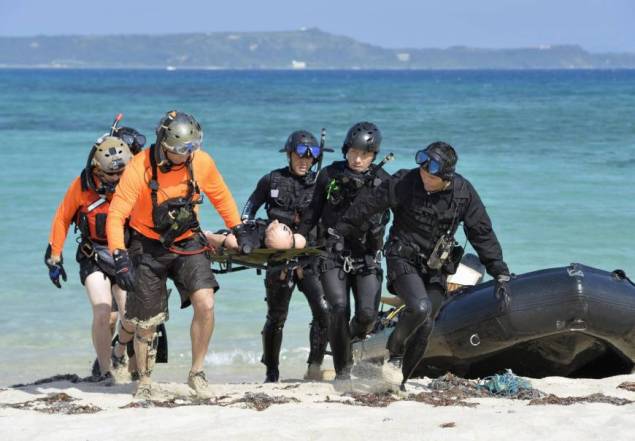
Troops from the Self-Defense Forces and the U.S. military carry out a joint exercise on Ukibaru Island, Okinawa Prefecture, on Monday.
OSAKA – When Prime Minister Shinzo Abe meets with U.S. President-elect Donald Trump in New York next week, both men will size up each other and discuss the bilateral relationship and the challenges that lie ahead.
One challenge, whether it’s on the agenda or not, will be the future direction of Japan’s nuclear power program.
With a key 1988 bilateral agreement on the peaceful use of nuclear power due to expire in July 2018, Tokyo and Washington next year will have to begin addressing the question of what, exactly, Japan’s nuclear policy should be.
Renegotiating the treaty is also sure to raise questions about the possibility of Japan using nuclear materials for military purposes, especially as Trump made contradictory statements about the possibility of arming Japan with nuclear weapons.
In an April TV interview, he suggested that Japan might defend itself from North Korea’s nuclear weapons by way of a nuclear arsenal of its own. That comment came a few weeks after another television interview in which he said that it is time to reconsider America’s policy of not allowing Japan to arm itself with nuclear weapons because it is going to happen anyway, and is only a question of time.
Trump later claimed that his opponents were misrepresenting his position. In the weeks before Tuesday’s election, he toned down his rhetoric on nuclear weapons use in general.
Japan’s reply to Trump was that it would continue to maintain its three non-nuclear principles of not manufacturing, possessing, or introducing nuclear weapons.
Now, with the agreement’s extension soon to become an issue in the bilateral relationship, experts are wondering how Trump, when he is president, will handle negotiations.
“I have absolutely no idea what position the Trump administration will adopt. It’s pretty clear their issues team hasn’t thought through things like this,” says James Acton, co-director of the Nuclear Policy Program and senior associate at the Carnegie Endowment for International Peace.
The U.S. has a long-standing policy against the accumulation of plutonium, but Japan already has about 48 tons stockpiled domestically and in Europe, and how it will consume or disposed of it remains uncertain.
“Japan has plans to produce more plutonium in the Rokkasho Reprocessing Plant. Given how few MOX-burning reactors will be operating in the foreseeable future, there is a very serious risk of a large imbalance between plutonium supply and demand,” Acton said, using the acronym for mixed uranium-plutonium oxide fuel. “I suspect the U.S. will use the occasion of the agreement’s renewal to try and address this problem.”
The Rokkasho plant is in Rokkasho, Aomori Prefecture.
Shaun Burnie, a senior nuclear specialist at Greenpeace Germany, says Trump has created an unprecedented degree of uncertainty in Japan about nuclear cooperation in general.
“Regardless of what position the new U.S. administration takes with regard to renewing the 1988 agreement, it is Japan, with its 48 tons of separated plutonium and no peaceful use plans, together with the nations of East Asia, that need to take a leadership role in reducing the risks from nuclear power. That includes terminating Rokkasho,” Burnie said.
The 1988 agreement came about after concerns in the U.S. that Japan was pursuing a plutonium program that could lead to proliferation issues, and a desire by Japan to make it easier to obtain U.S. approval for nuclear material shipments to Japan from Europe, as required by a previous agreement. In turn, the U.S. got more say in the inspection and security requirements for nuclear facilities in Japan.
The agreement also clearly emphasized it was only for the peaceful uses of power.
Article 8 of the agreement specifically bans the transfer of nuclear material to Japan (or from Japan to the U.S.) for use in nuclear explosive devices, for research specifically on, or development of, nuclear devices, and for military purposes.
“The U.S. does not think that Japan is looking to possess nuclear weapons. But holding so much plutonium, like Japan does, sets a very bad example for other countries and creates great concerns in the U.S. about the problem of nuclear terrorism,” wrote Tetsuya Endo, former deputy chairman of the Japan Atomic Energy Commission in a March article for the Tokyo-based Institute for Peace Policies.
The Minamisoma Whistleblowers, Fukushima
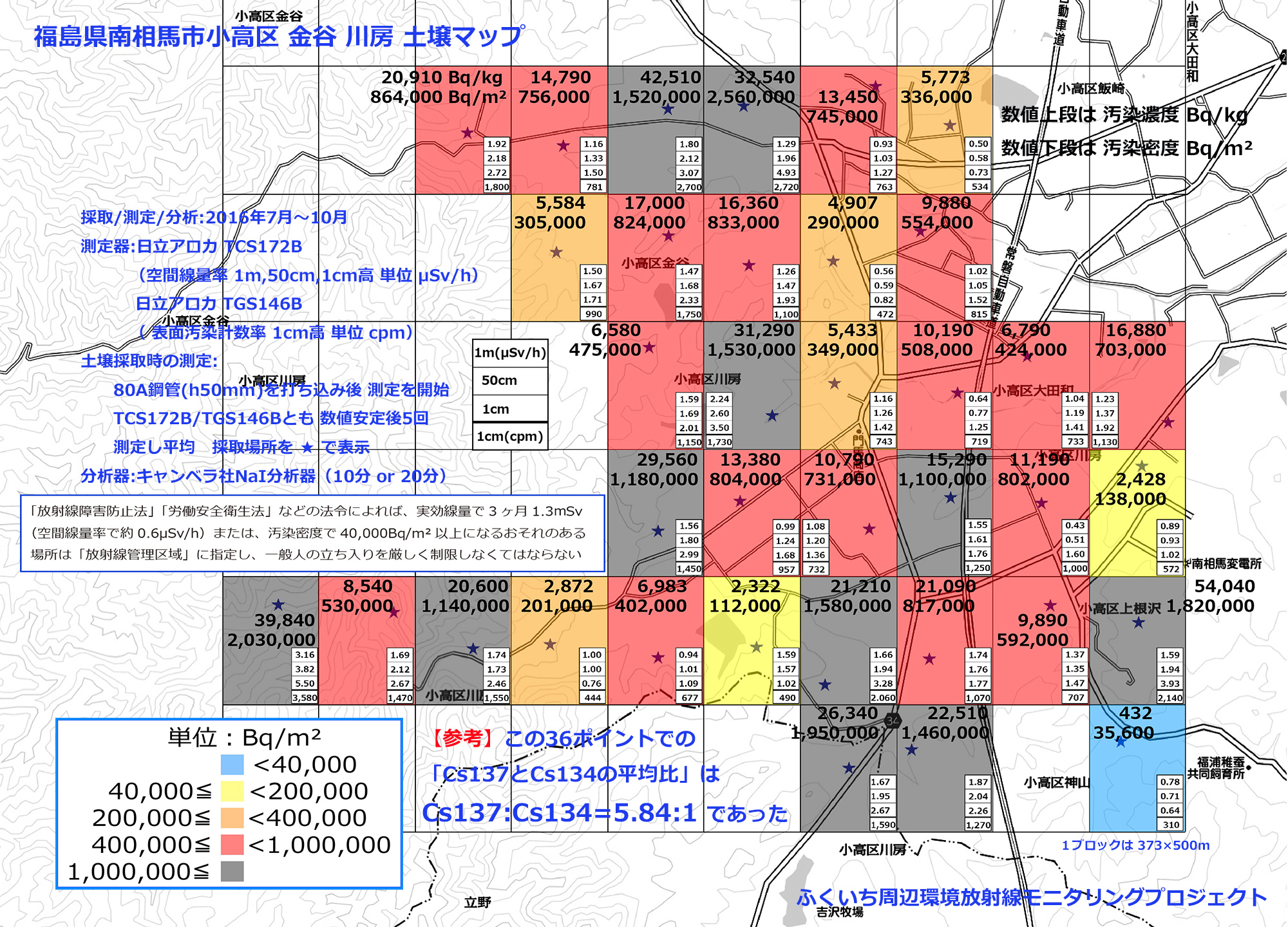
A few days ago Pierre Fetet learned of a map which immediately called his attention.
That map displays at the same time precise and unsettling measurements. Not knowing Japanese, Pierre Fetet asked Kurumi Sugita, the president of Nos voisins lointains 3.11 association, to translate for him the text. She immediately accepted and explained to him what it was:
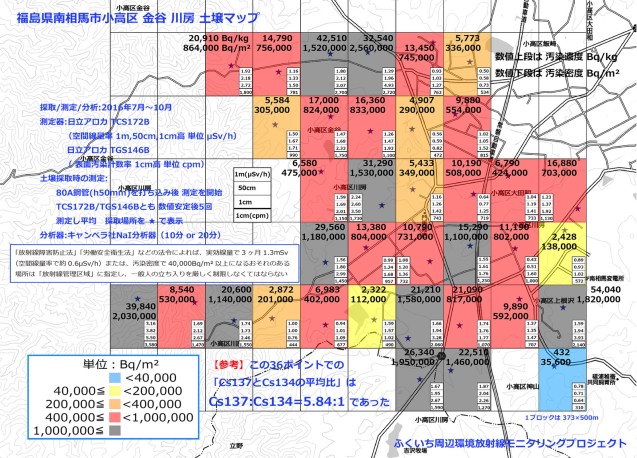
“The project to measure environmental radioactivity around the Fukushima Daiichi nuclear power plant (“Fukuichi Area Environmental Radiation Monitoring Project“) is conducted by a team of relatively old volunteers (who are less radiosensitive than youth) to perform radioactivity measurements with a tight mesh size of 75 x 100 m for radioactivity in air and 375 x 500 m for soil contamination. Measurements of ambient radioactivity and soil radioactivity are carried out mainly in the city of Minamisōma and its surroundings. They try to make detailed measurements so as to show the inhabitants the real conditions of their lives, and also to accumulate data for the analysis of long-term health and environmental damages.”
Thanks to the Kurumi Sugita’s translation and with the agreement of Mr. Ozawa, author of the document, Pierre Fetet was able to make a French version of this map, which I translated into english here below:
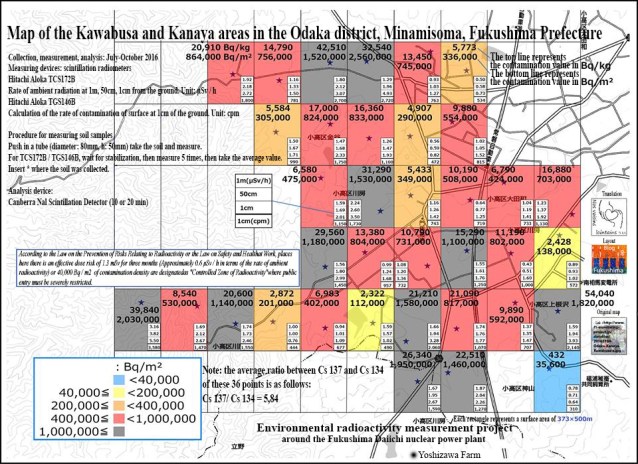
Map of Mr. Ozawa’s team,“Fukuichi Area Environmental Radiation Monitoring Project” (translation first by Kurumi Sugita, then by Hervé Courtois)
In the context of the normalization of contaminated areas into habitable areas, the evacuation order of the Odaka district of the city of Minamisōma was lifted on 12 July 2016, except the area bordering Namie (Hamlet of Ohatake where a single household lives) classified as a “difficult return” area.
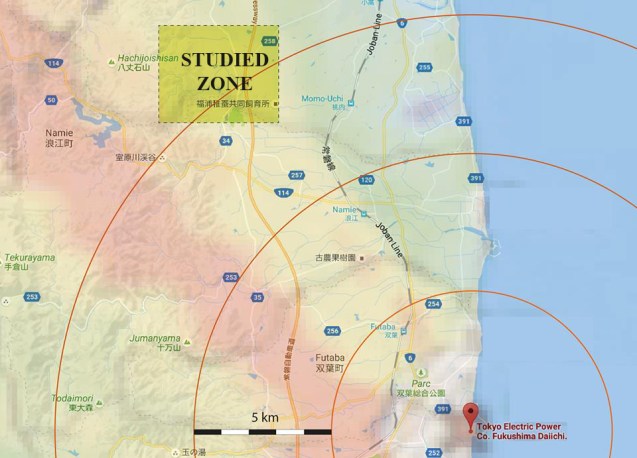
Situation of the study area
The contamination map examines the Kanaya and Kawabusa areas of the Odaka district, about fifteen kilometers from the former Fukushima Daiichi nuclear power plant. Mr. Ozawa, the engineer who launched this investigation, has chosen the precision of the measurements, that is to say laboratory scintillation radiometers are used to measure radioactivity: Hitachi Aloka TCS172B, Hitachi Aloka TGS146B and Canberra NaI Scintillation Detector.
The originality of this map is due as much to the quality of its realization as to the abundance of its informations: it can be read, for each of the 36 samples taken, measurements in Bq / m², in Bq / kg, in μSv / h at three different soil heights (1 m, 50 cm, 1 cm) And in cpm (counts per minute) at the height of 1 cm. For those who know a little about radioactivity, these informations are very valuable informations. Usually, measurements are given in either unit, but never simultaneously with 4 units. Official organizations should learn this way of working.
The measures revealed by the map are very disturbing. They show that the earth has a level of contamination that would make it a radioactive waste in any uncontaminated country. As Mr. Ozawa writes, these lands should be considered a “controlled zone”, that is to say a secure space, as in nuclear power plants, where the doses received must be constantly checked. In fact, it is worse than inside of a nuclear power plant because in Japan the inhabitants evacuated since five and a half years are now asked to return home, whereas it is known that they will be irradiated (Up to 20 mSv / year) and contaminated (by inhalation and ingestion).
This citizen research is remarkable in more ways than one:
- It is independent of any organization. There is no lobby to alter or play down this or that measure. These are just raw data, taken by honest people, in search of truth.
- It respects a scientific protocol, explained on the map. There will always be people to criticize this or that aspect of the process, But this one is rigorous and objective.
- It takes measurements 1 m from the ground but also 1 cm from the ground. This approach is more logical because until now men are walking on the ground no? The contamination maps of Japan often show measurements at 1 m from the ground, Which does not reflect reality and seems to be done to minimize the facts. Indeed, the measurement is often twice as high at 1 cm from the ground as at 1 m.
- It acts as a revealing map. Mr. Ozawa and his team are whistleblowers. Their maps say: Watch out ! Laws contradict each other in Japan. What the government claims, namely that a dose of 20 mSv / year will not produce any health effect, is not necessarily the truth. If you come back, you are going to be irradiated and contaminated.
France is preparing for the same forfeiture, namely that ‘it is transposing into national law the provisions of Directive 2013/59 / Euratom: the French authorities retained the upper limit of the interval: 100 mSv for the emergency phase and 20 mSv for the following 12 months (And for the following years there is no guarantee that this reference level will not be renewed). These values apply to all, including infants, children and pregnant women! ” (source Criirad)
The Japanese government is asking residents to return home and abolishing compensation for evacuees. The Olympics are coming, Fukushima must be perceived as “normal” so that the athletes and supporters of the whole world won’t be afraid, even if it means sacrificing the health of the local population. It is therefore necessary to make known the map of Mr. Ozawa so that future advertising campaigns do not stifle the reality of the facts.
Pierre Fetet
Data on measurements at Minamisōma
http://www.f1-monitoring-project.jp/open_deta.html
Website of the measuring team: “Fukuichi Area Environmental Radiation Monitoring Project“
http://www.f1-monitoring-project.jp/index.html
Address of the original map (HD)
http://www.f1-monitoring-project.jp/dirtsfiles/20161104-Odaka-Kanaya-Kawabusa-s.jpg
Source : Article of Pierre Fetet
http://www.fukushima-blog.com/2016/11/alerte-a-minamisoma.html
(Translation Hervé Courtois)
India providing a lifeline to Japan’s desperate nuclear industry
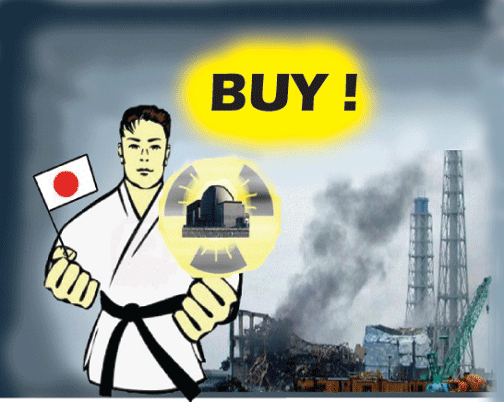 Japan’s Nuclear Industry Finds a Lifeline in India After Foundering Elsewhere, NYT, NOV. 11, 2016 TOKYO — Despite objections from antinuclear campaigners, Japan’s government cleared the way on Friday for companies that build nuclear power plants to sell their technology to India — one of the few nations planning big expansions in atomic energy — by signing a cooperation agreement with the South Asian country.
The deal is a lifeline for the Japanese nuclear power industry, which has been foundering since meltdowns at the Fukushima Daiichi power plant in northeastern Japan in 2011. Plans to build a dozen new reactors in Japan were canceled after that, a gut punch for some of the country’s biggest industrial conglomerates, including Toshiba and Hitachi.With the domestic market moribund, Japanese companies had been pursuing deals abroad, but success was elusive.
Japan-India nuclear cooperation agreement signed, Japan to supply India with nuclear power equipment, technology
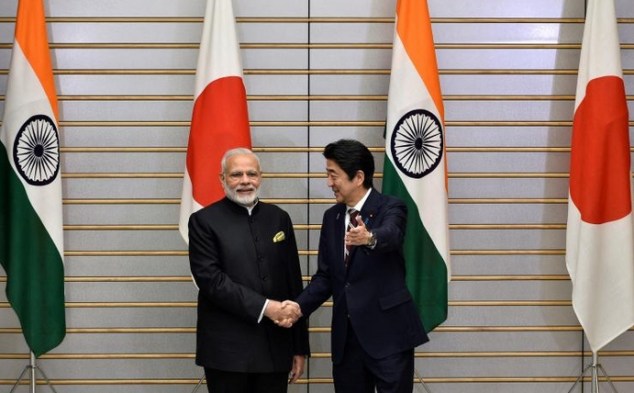
Indian Prime Minister Narendra Modi (L) is greeted by Japan’s Prime Minister Shinzo Abe at the start of their meeting at Abe’s official residence in Tokyo, Japan November 11, 2016.
Japan to supply India with nuclear power equipment, technology
Japan and India signed a civilian nuclear accord on Friday, opening the door for Tokyo to supply New Delhi with fuel, equipment and technology for nuclear power production, as India looks to atomic energy to sustain its rapid economic growth.
It was the first time Japan, the only country to have suffered a nuclear attack, had concluded such a pact with a country that is not a signatory to the Nuclear Non-proliferation Treaty (NPT).
“Today’s signing … marks a historic step in our engagement to build a clean energy partnership,” Indian Prime Minister Narendra Modi told a joint news conference with his Japanese counterpart Shinzo Abe.
The accord stipulates that the nuclear fuel and equipment provided can only be used for peaceful purposes, and a separate document signed in parallel has a clause allowing Japan to terminate the pact if India conducts a nuclear test.
“As a sole nation to have been nuclear-bombed, we bear the responsibility for leading the international community towards the realization of a world without nuclear weapons,” Abe told the same news conference.
“The agreement is a legal framework to ensure that India will act responsibly for the peaceful uses of nuclear energy. It will also lead us to having India participate practically in the international non-proliferation regime.”
India says the NPT is discriminatory and that it has concerns about its two nuclear-armed neighbors, China and Pakistan.
India is already in advanced negotiations to have U.S.-based Westinghouse Electric, owned by Japan’s Toshiba Corp, build six nuclear reactors in southern India, part of New Delhi’s plan to ramp up nuclear capacity more than 10 times by 2032.
Japanese nuclear plant makers such as Toshiba and Mitsubishi Heavy Industries Ltd are desperate to expand their business overseas as the 2011 Fukushima nuclear disaster chilled domestic demand for new nuclear plants.
The agreement with Japan follows a similar one with the United States in 2008, which gave India access to nuclear technology after decades of isolation.
That step was seen as the first big move to build India into a regional counterweight to China.
On India’s infrastructure development, Abe said that construction of a high-speed railway connecting Mumbai and Ahmedabad, which will be based on Japan’s “Shinkansen” bullet train technology, was scheduled to start in 2018, with commercial operation slated for 2023.
“In Japan, the era of high economic growth began when Shinkansen started its service in 1964. I hope the advent of high-speed railway will trigger fresh economic growth in India as well,” Abe said.
Modi earlier on Friday praised the “growing convergence” of views between his nation and Japan, saying strong ties would enable them to play a stabilizing role in Asia and the world.
http://www.reuters.com/article/us-japan-india-nuclear-idUSKBN1360YL?il=0
Japan-India nuclear cooperation agreement signed
The prime ministers of India and Japan have welcomed the signature today of a nuclear cooperation agreement between the two countries. Narendra Modi and Shinzo Abe said the agreement reflects a new level of mutual confidence and strategic partnership for clean energy, economic development and a peaceful and secure world.
The agreement between the two countries was signed during a visit by the Indian prime minister to Japan and has taken six years of negotiations. Its signature follows the signing of a memorandum on cooperation by the two leaders in December 2015. It will open the door for India to import Japanese nuclear technology. India has been largely excluded from international trade in nuclear plant and materials for over three decades because of its position outside the comprehensive safeguards regime of the Nuclear Non-proliferation Treaty (NPT).
Modi said signing of the Agreement for Cooperation in the Peaceful Uses of Nuclear Energy marked a “historic step in our engagement to build a clean energy partnership”, adding that their cooperation would help “combat the challenge of climate change”.
In a joint statement, the two prime ministers also reaffirmed their commitment to work together for India to become a full member of the international Nuclear Suppliers Group (NSG), as well as of the Wassenaar Arrangement and the Australia Group, with the aim of strengthening international non-proliferation efforts.
In a separate statement, Modi thanked Abe for his support for India’s membership of the NSG. Membership of the NSG, which seeks to prevent nuclear proliferation by controlling the export of materials, equipment and technology that could potentially be used to manufacture nuclear weapons, has up to now been limited to NPT signatories. Following the approval of an India-specific safeguards agreement by the International Atomic Energy Agency, an exception under NSG rules and bilateral nuclear cooperation deals, India formally applied to become a member of the NSG in May.
http://www.world-nuclear-news.org/NP-Japan-India-nuclear-cooperation-agreement-signed-1111168.html
Southeast Asia now a disappointment to the global nuclear marketing drive
 despite the news here and there about the conclusions of new nuclear cooperation agreements by ASEAN nations, it is very difficult to conceive that a nuclear power plant will actually be built in one of these countries
Nuclear Energy in Southeast Asia: A Bridge Too Far?
Hopes for a nuclear renaissance in Southeast Asia have proven overly ambitious. The Diplomat By Viet Phuong Nguyen November 09, 2016 In the late 2000s, energy forecasts began to use the term “nuclear renaissance” to refer to the fast-growing nuclear power program of China, and to the emergence of the so-called “nuclear aspirants” embarking on their first nuclear power projects. Many among these newcomers are members of the Association of Southeast Asian Nations (ASEAN). For this reason, nuclear suppliers like the United States, Russia, Japan, and South Korea have been particularly active in signing cooperation agreements with ASEAN nations or supporting these countries to explore the feasibility of nuclear energy.
Vietnam rejects nuclear power
Vietnam ditches nuclear power plans, DW, 10 Nov 16
Vietnam has decided to scrap plans to build two nuclear power plants, which would have been the first in southeast Asia. Hydropower and coal are set to remain dominant in the fast-industrializing country. Vietnam’s ruling communist party decided Thursday that two planned plants in the southern region of Ninh Thuan will not feature in the country’s future energy mix, state-controlled media reported.
MP Duong Quang Thanh, chairman of the Electricity Committee in the National Assembly, confirmed that no budget for the plants – which were approved in 2008 with a combined capacity of 4,000 megawatts (MW) – had been included in a long-term energy plan approved by Prime Minister Nguyen Xuan Phuc, the DTI news website reported.
Le Hong Tinh, vice chairman of the National Assembly’s Science, Technology and Environment Committee, said a key reason for the government’s decision was that the price for the plants had doubled to $18 billion (about 16.5 billion euros)…….. http://www.dw.com/en/vietnam-ditches-nuclear-power-plans/a-36338419
Fukushima women invite India’s Prime Minister Modi to visit the nuclear destruction
Please sign and share widely
To the Honorable Prime Minister Narendra Modi,
We are women living in Fukushima prefecture, where a massive accident unparalleled in history occurred on March 11, 2011, at Tokyo Electric Power Company’s Fukushima Daiichi Nuclear Power Station.
As a result of this accident our lives changed dramatically. Among us, there are those who lost their homes, those who lost their jobs, those who lost their hometowns and friends, those who lost their future, those who lost their joy in life, and those who lost their very lives. All of this was taken by the nuclear accident.
Even now, some five and a half years after this accident, the accident is still unresolved. We live surrounded by radioactive debris which emanated from the reactor. Even as our government pushes us to return to our homelands, many people think of their children’s health, and they feel that they cannot return to their original homes. At the current stage, in Fukushima prefecture alone, some 174 children have been found to have contracted thyroid cancer. We are deeply worried about the wide-ranging health hazards that will appear in the years to come.
Presently court proceedings to determine legal responsibility for the nuclear accident itself have not yet been opened, and the accident’s cause, the question of human error, the question of whether the accident was handled appropriately, have not yet been clarified. Now, the problem of restarting nuclear power plants across Japan has surfaced, and battles are being fought through the courts to keep these plants from restarting. As with Takahama Nuclear Power Station, some nuclear plants’ operation has been suspended.
Under these circumstances, the fact that Japan is attempting to sell nuclear power plants to other countries, is embarrassing and most unfortunate. When we consider that a similar type accident might happen at one of India’s nuclear power plants, we are filled with concern. That is, as women who experienced firsthand the suffering that the Fukushima accident has brought, we do not wish anyone in the world to have the same experience we did.
Mr. Modi, for the Indian people and the future of India, please do not sign the India-Japan Nuclear Cooperation Agreement. We beseech you to make a wise judgment.
Fukushima Women Against Nukes
Fukushima Women Against Nukes is a network of women that started in September 2012, using various direct actions such as sit-ins, demonstrations as well as petitioning TEPCO and others to demand justice for everything that the Fukushima Daiichi disaster has taken away from them. They are also strongly opposed to restarting any of Japan’s nuclear reactors and are working for a nuclear free world (website: http://onna100nin.seesaa.net)
Message from Lalita Ramdas, Coalition for Nuclear Disarmament and Peace
Dear friends,
I have just read this deeply moving and passionate appeal written by the women of Fukushima, clearly calling the attention of the world, especially the people of Asia, and particularly our Prime Minister as he prepares to visit Japan later this week, and according to media reports, sign the India-Japan Nuclear Agreement.
I was in Fukushima earlier this year. It was one of the most educative experiences of my life. We visited shattered homes and families, were witness to miles of devastated landscape, thousands and thousands of black bags containing radioactive materials where there should have been fields and crops. I met and spoke to many of the women who have signed on to this letter ……women and mothers deeply impacted and anxious on behalf of the kind of future this scenario offers for their children and grandchildren.
As the women who wrote this letter urge, before our Prime Minister signs the nuclear deal with Japan, he also needs to see this reality, to talk with the people who are still suffering from the devastation and see the human and economic costs of the accident at the Fukushima Daiichi nuclear power plant in 2011, in order to understand exactly what could happen to his own people if he moves ahead with his nuclear program.
The message from the people of Fukushima is powerful, one which none of us, especially our government, can afford to ignore. I hope that the Indian media publicizes it widely.
Yours Sincerely,
Lalita Ramdas
Nuclear non-proliferation is undermined by India-Japan deal
Deal with India undermines nuclear nonproliferation, Editorial Asahi Shimbun, November 9, 2016 Indian Prime Minister Narendra Modi is scheduled to arrive in Japan on Nov. 10 for a summit with Prime Minister Shinzo Abe to sign a bilateral deal that will open the way for Japan’s nuclear reactor exports to India.
When the two prime ministers reached a basic agreement on this deal in December last year, we expressed our opposition. We now renew our objection and strongly urge the Japanese government to reconsider.
India became a nuclear power without becoming a signatory to the Nuclear Nonproliferation Treaty (NPT). To provide nuclear technology to such a nation flatly contradicts Japan’s traditional calls for nuclear disarmament and the elimination of nuclear weapons.
Naturally, objections to the Japan-India treaty have been raised, not only by Hiroshima and Nagasaki atomic bomb survivors but also by citizens of many countries demanding the abolition of nuclear weapons.
The NPT recognizes only five nuclear powers–the United States, Britain, France, China and Russia–while promoting nuclear disarmament. The treaty also guarantees all other nations their right to peaceful use of nuclear power, such as operating nuclear reactors, provided they refrain from developing nuclear weapons.
In essence, the NPT prevents nations of the world from competing to develop nuclear weapons.
India has remained a nonsignatory to the NPT, objecting to the treaty’s unequal treatment of the nuclear powers and the rest of the world. But India has proceeded with nuclear development in the meantime on the pretext that this is for “peaceful purposes.”
We must say India has trampled on the very spirit of nuclear nonproliferation……..
India’s freeze on nuclear tests is merely voluntary, and the country has not even signed the Comprehensive Nuclear-Test-Ban Treaty (CTBT).
The Japanese government appears to be hoping to include in the bilateral agreement a clause to the effect that Japan will withdraw cooperation if India conducts a nuclear test.
But is there any guarantee that India will never extract plutonium from spent nuclear fuel from reactors made with Japanese technology and use the plutonium to build nuclear weapons?
When the United Nations adopted a resolution late last month to start negotiations on the Nuclear Weapons Convention, Japan opposed the resolution, saying it could undermine the NPT and the existing nuclear disarmament negotiations.
But the Japan-India nuclear deal may further weaken and even destroy the NPT.
Come to think of it, is it really appropriate for Japan, which caused the nuclear disaster at Fukushima, to export nuclear reactors to India?
We can never condone the folly of only seeking immediate commercial gains in selling nuclear reactors to a country that is turning its back on nuclear nonproliferation. http://www.asahi.com/ajw/articles/AJ201611090023.html
India’s Defence Minister Manohar Parrikar makes bizarre nuclear statement
Manohar Parrikar makes bizarre nuclear statement, his ministry says personal opinion Defence Minister Manohar Parrikar today wondered why India cannot say “we are a responsible nuclear power and I will not use it irresponsibly” instead of affirming a “no first use policy”, remarks he said were personal in nature. IndiaToday.in New Delhi, November 10, 2016 Defence Minister Manohar Parrikar today spoke about India’s no first use nuclear policy at the book launch of (Retd.) Brig Gurmeet Kanwal’s ‘The New Arthashastra: A security strategy for India’.
Dwindling future prospects for Japanese nuclear companies
Even as they face a shrinking domestic market amid slow restarts of nuclear plants shut down following the 2011 Fukushima disaster, Hitachi, Mitsubishi Heavy Industries and Toshiba are far apart on the integration plan, let alone acting on the recent suggestion that they consolidate their entire reactor businesses.
In a news conference on Oct. 27, Hitachi President and CEO Toshiaki Higashihara said, “Eventually there will be a time when you have to think about the entire picture, not just the fuel business.”………..
In Japan, there are only three reactors currently operating — Kyushu Electric Power‘s Sendai nuclear power station’s unit Nos. 1 and 2 in Kagoshima Prefecture and Shikoku Electric Power‘s Ikata nuclear power station’s unit No. 3 in Ehime Prefecture.
Prospects for getting more operating remain unclear, especially after a court issued an injunction blocking the restart of reactors at the Takahama nuclear plant in Fukui Prefecture.
Under the circumstances, the idea of building a new reactor in Japan is seen as nearly impossible, as distant as a “dream that was dreamed in a dream,” said a Mitsubishi Heavy official.
Myriad roadblocks
While the companies managed to start talks on integrating their fuel businesses, differences in designs present an even higher hurdle for integrating reactor businesses.
Mitsubishi Heavy has focused on pressurized water reactors, which account for 70% of the world’s operating nuclear reactors. However, boiling water reactors are the mainstay of Hitachi’s and Toshiba’s nuclear technology.
Related companies
Hitachi Ltd., Mitsubishi Heavy Industries, Ltd., Toshiba Corp., Kyushu Electric Power Co., Inc., Shikoku Electric Power Co., Inc., ITOCHU Corp. http://asia.nikkei.com/Business/Companies/Japan-companies-face-obstacles-to-consolidate-nuclear-business
Japanese government’s underhand scheme to subsidise nuclear power
Ministry devises crafty finance scheme favoring nuclear power http://www.asahi.com/ajw/articles/AJ201611080049.html The Asahi Shimbun, Nov. 8 The industry ministry, the supposed champion of electricity market deregulation, is making a move that runs counter to the principles of reform by giving preferential treatment to nuclear power.
A proposal by the Ministry of Economy, Trade and Industry would force new electricity suppliers that have entered the market in response to its liberalization to shoulder part of the costs of decommissioning the crippled Fukushima No. 1 nuclear power plant.
The plan was submitted to an expert council discussing the issue.
The ministry, which regulates the power industry, has already presented a plan to make such new utilities bear part of the costs of decommissioning aging reactors at other nuclear power plants.
The power market reform, which was expanded this spring to cover retail electricity sales as well, is designed to abolish the regional monopolies of established utilities, thereby encouraging new entries into the market.
It is also aimed at lowering electricity rates by separating the operations of power plants and transmission grids to promote fair competition.
The ministry cannot claim it is working for fair competition if it is now creating rules that force new electricity providers that have nothing to do with any nuclear power plant or the 2011 Fukushima nuclear disaster to pay part of the decommissioning bills.
In its attempt to get new utilities involved in the financing plan, the ministry is targeting the fees they pay to use the power transmission lines operated by established utilities.
The total cost of decommissioning the stricken Fukushima nuclear plant is estimated at several trillion yen.
The ministry has stressed its intention to protect the public from the huge financial burden. It has promised to make Tokyo Electric Power Co., operator of the Fukushima plant, pay for the work by saving necessary funds through streamlining its operations.
But the ministry has proposed a new system to use the money saved from more efficient power grid operations primarily to cover decommissioning costs.
The current rule requires major utilities to lower the charges they impose on smaller power suppliers using their transmission lines when higher efficiency lifts their profits. But the proposed system would exempt the big power companies from the rule when they spend the money saved on decommissioning reactors.
The ministry seems to be trying to convince the public that this approach would not increase the financial burden on consumers because it doesn’t involve price hikes.
But this idea raises some questions that cannot be overlooked.
The costs of decommissioning reactors are by nature expenses related to power generation. But the ministry’s proposal would transfer part of the expenses to the operations of transmission lines.
As a result, new power suppliers using TEPCO’s transmission cables would have to pay higher fees.
Subscribers to such new utilities would also have to shoulder part of the burden. In particular, the envisioned system would be totally unacceptable for consumers who have switched to new power providers to avoid using electricity generated by nuclear plants.
The ministry appears to be targeting an “easy source” of revenue. The charges on using transmission lines are not highly visible to general consumers. The ministry’s plan to use power transmission charges as a source of funds to decommission reactors is a crafty scheme to give preferential treatment to nuclear power. Its aim is to ensure nuclear plants will not lose their cost competitiveness against other electricity sources like thermal power generation.
For many years, both the government and established utilities have been emphasizing that atomic energy is a low-cost source of electricity.
They are grossly irresponsible and insincere if they are trying to impose part of the inevitable cost burden of decommissioning reactors on competitors.
The ministry should rethink the idea from the viewpoint of the basic principles of market deregulation
Renowned Indian film-maker makes his first international film – “Nuclear”
RAM GOPAL VARMA ANNOUNCES HIS FIRST INTERNATIONAL PROJECT ‘NUCLEAR’ http://mumbaimirror.indiatimes.com/entertainment/bollywood/Ram-Gopal-Varma-announces-his-first-international-project-Nuclear/articleshow/55288938.cms Think about films with harsh realities, and the first name that pops up in your mind is none other than Ram Gopal Varma. The director, popularly known as RGV, has always managed to be in the news. A no-nonsense man, RGV shared details about his first international project, titled Nuclear, on his social media handle.
He wrote, “My first international film to be made at a cost of 340 crore is NUCLEAR.” He further added that the film will be shot in America, China, Russia, Yemen and India with American, Chinese, Russian and Indian actors.”
Varma has mostly delved into real-life incidents in his films. Shifting his focus to the global concern of terrorism, the director has raised many questions about possible nuclear attacks. In a note, RGV said, “I have been an avid and voracious reader of both fiction and non-fiction but never in my life until now, have I come across a subject matter like NUCLEAR. Yes it’s going to be much more costlier than the most expensive film ever made in India and the reason for that is because the subject matter truly demands that it is filmed on a scale never before seen.”
Raising his concern about terrorism, RGV wrote, “The only thing which can be more terrifying than that is, if that explosion happens now in our times. It is because of this fear that America acted against Iraq. If an act based on mere suspicion that someone could be in possession of a nuclear bomb bring in so much of hate and divide between the countries of the world resulting in regime collapses, friendly countries becoming sworn enemies, rise of ISIS etc., then it’s obvious that an actual nuclear explosion in a big city like Mumbai can easily trigger WORLD WAR III and thus end the WORLD.”
Ram Gopal Varma will be starting Nuclear after he wraps up Sarkar 3 starring Amitabh Bachchan.
State-controlled China General Nuclear Power Group (CGN) building floating nuclear reactor
China starts to build its first floating nuclear power reactor for deployment off coast, Times of India, Reuters | Updated: Nov 7, 2016, BEIJING: China has started to build its first floating nuclear power reactor, which it plans to deploy off its coast by the end of the decade.
State-controlled China General Nuclear Power Group (CGN) has begun construction of the ACPR50S reactor, and will acquire the reactor pressure vessel that encloses the reactor core from Dongfang Electric, CGN said in a statement on Friday.
The 200-megawatt reactor will help power offshore facilities in China’s open sea and island reefs, CGN said, adding that offshore energy supply is an issue that China has to overcome in order to become a naval power…….http://timesofindia.indiatimes.com/world/china/China-starts-to-build-its-first-floating-nuclear-power-reactor-for-deployment-off-coast/articleshow/55298242.cms
1 This Month





PLEASE OPPOSE HR 8255 AND S.3639 – bills would accelerate satellite deployment, with no environmental review or safeguards – https://ncstd5li.quorum.us/campaign/169331/
To see nuclear-related stories in greater depth and intensity – go to https://nuclearinformation.wordpress.com
-
Archives
- October 2026 (19)
- September 2026 (339)
- August 2026 (330)
- July 2026 (355)
- June 2026 (287)
- May 2026 (306)
- April 2026 (356)
- March 2026 (251)
- February 2026 (267)
- January 2026 (308)
- December 2025 (358)
- November 2025 (359)
-
Categories
- 1
- 1 NUCLEAR ISSUES
- business and costs
- climate change
- culture and arts
- ENERGY
- environment
- health
- history
- indigenous issues
- Legal
- marketing of nuclear
- media
- opposition to nuclear
- PERSONAL STORIES
- politics
- politics international
- Religion and ethics
- safety
- secrets,lies and civil liberties
- spinbuster
- technology
- Uranium
- wastes
- weapons and war
- Women
- 2 WORLD
- ACTION
- AFRICA
- Atrocities
- AUSTRALIA
- Christina's notes
- Christina's themes
- culture and arts
- Events
- Fuk 2022
- Fuk 2023
- Fukushima 2017
- Fukushima 2018
- fukushima 2019
- Fukushima 2020
- Fukushima 2021
- general
- global warming
- Humour (God we need it)
- Nuclear
- RARE EARTHS
- Reference
- resources – print
- Resources -audiovicual
- Weekly Newsletter
- World
- World Nuclear
- YouTube
-
RSS
Entries RSS
Comments RSS