India made no additional concessions to Japan in nuclear deal. Still-confusion over ‘termination’ clause
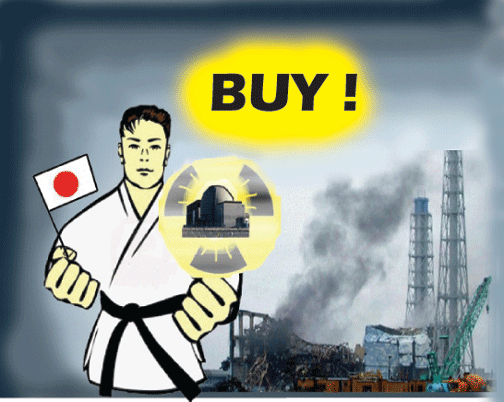 India made no additional commitments to Japan for nuclear deal: MEA, DNA, 18 Nov 2016 , New Delhi , PTI
Vikas Swarup clarifies that India made no additional concessions. India on Thursday asserted that the termination clause in the Nuclear Cooperation Agreement (NCA) with Japan was nothing “new” and that New Delhi had made no additional commitments to clinch the deal other than what it had committed itself to while declaring a unilateral moratorium on testing nuclear weapons in 2008.
He also insisted that all clauses in the NCA were binding on the two parties. However, the circumstances of termination, by their very nature, are not specifiable in the NCA and a comprehensive reading of the entirety of the provision to understand the hypothetical possibilities as well as the mitigating circumstances and consequences was required, External Affairs Ministry Spokesperson Vikas Sawrup said. “India appreciates the special sensitivities of Japan on nuclear issues. It was felt that a note on views expressed by the Japanese side in the above context could be recorded.
Such a record, to be balanced, also needed an accurate depiction of India s position. “The ‘Note on Views and Understanding’ reiterates the commitments that India made in September 2008. No change is envisaged from those commitments and no additional commitments have been made by India,” Swarup added. He was asked about the termination clause in the Indo- Japan NCA and if India had made any exemptions while inking the deal. The NCA was signed during Prime Minister Narendra Modi’s visit to Japan last week.
“The NCA, in fact, has a specific article (No. 14) devoted to termination and cessation of cooperation in certain circumstances. This is not new and is similar, in fact almost identical, to the provision in the US Agreement. “Any suggestion that the termination clause in the NCA is not binding on India is factually incorrect. All clauses of the NCA are binding on both parties,” Swarup said…….http://www.dnaindia.com/india/report-india-made-no-additional-commitments-to-japan-for-nuclear-deal-mea-2274393
TEPCO may struggle to find partners due to Fukushima decommissioning costs
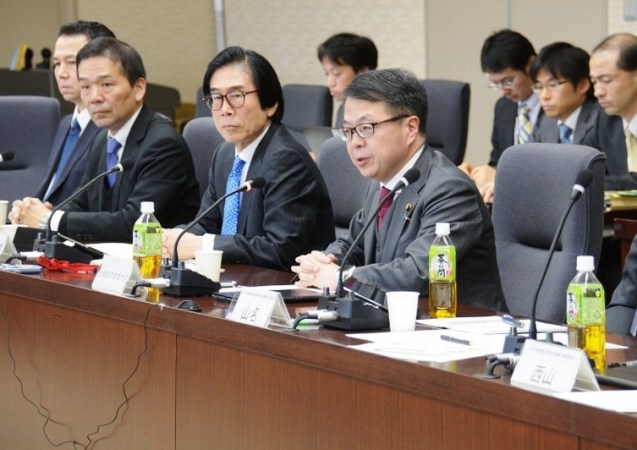
Economy, Trade and Industry Minister Hiroshige Seko, right front, speaks at a meeting of the ministry’s expert panel on reform of TEPCO and issues related to the crippled Fukushima No. 1 nuclear power plant on Nov. 15, 2016.
Naomi Hirose, president of Tokyo Electric Power Company Holdings Inc. (TEPCO), presented a proposal to reform the operator of the crippled Fukushima No. 1 Nuclear Power Plant to the Economy, Trade and Industry Ministry’s expert panel on Nov. 15.
Under the proposal submitted by Hirose on the reform of TEPCO and issues related to the crippled Fukushima nuclear power plant, TEPCO is to collaborate with other power companies in the areas of nuclear power generation and energy transmission and distribution in an effort to boost its earning power. But if other major utilities were to work with TEPCO on a nuclear power project, questions would be raised about how to split risks such as decommissioning costs for the crippled Fukushima plant among companies concerned. Such being the case, TEPCO will likely have difficulty finding partners.
Hirose attended the closed-door expert committee meeting as an observer. Committee chairman Kunio Ito (specially-appointed professor at Hitotsubashi University) and a senior industry ministry official revealed the details of Hirose’s reform proposal at a news conference after the panel meeting.
According to details revealed at the news conference, Hirose proposed to step up TEPCO’s cooperation with other power companies on its nuclear power business including the areas of safety measures, joint technological development and overseas business operations. The industry ministry had already proposed at an expert panel meeting that TEPCO spin off its nuclear business into a subsidiary and collaborate with other utilities, among other moves. TEPCO is expected to incorporate these plans into the “New Comprehensive Special Business Plan” that is set to be revised early next year in line with discussions at expert panel meetings.
Under the current New Comprehensive Special Business Plan, TEPCO assumes reactivation of its Kashiwazaki-Kariwa Nuclear Power Plant as a source of earnings to be used to rebuild itself. But there are no prospects of the power plant being reactivated as the governor of Niigata Prefecture, which hosts the nuclear facility, is taking a cautious stance toward reactivation. The industry ministry wants to secure understanding of a plan to reactivate the nuclear power plant by improving the creditworthiness of TEPCO’s nuclear business through collaboration with other utilities. But because there is a possibility of other power companies being forced to shoulder the costs of decommissioning the crippled Fukushima plant, it remains unclear whether TEPCO will be able to cooperate with those utilities as envisioned.
A member of the expert panel was quoted as saying at the meeting, “A proper alliance cannot be formed unless ways of shutting off the risks (for possible alliance partners) are considered. Hirose also proposed that TEPCO work with other firms in the area of power generation and transmission, as well as jointly procure materials with other firms.
As for the costs of decommissioning the Fukushima No. 1 nuclear plant, which are expected to exceed the initial estimate by several trillion yen, and expenses for paying compensation to nuclear disaster victims, the expert panel confirmed plans for TEPCO to minimize financial burdens on the public through management efforts. An expert panel member was quoted as saying at the Nov. 15 meeting, “If TEPCO’s liability is defined as limited, the general public will see the move as relief measures for TEPCO. We should carefully consider public opinion.”
http://mainichi.jp/english/articles/20161116/p2a/00m/0na/008000c
Another operation approval of aging nuclear reactor contradicts 40-year rule
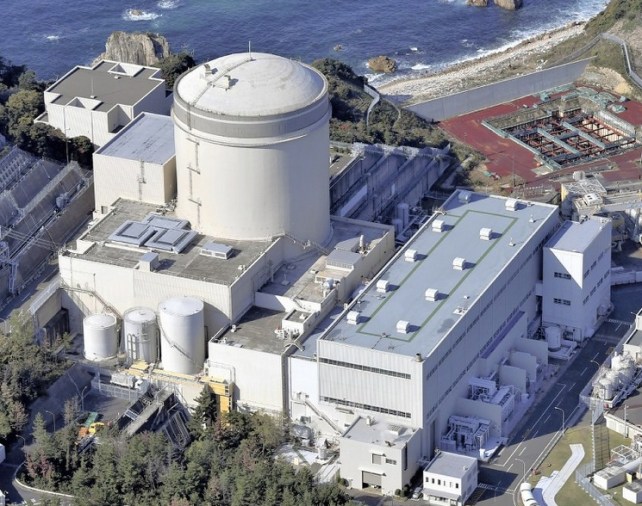
The No. 3 reactor of the Mihama Nuclear Power Station in Mihama, Fukui Prefecture, is pictured in this photo taken from a Mainichi Shimbun helicopter on Nov. 12, 2016.
Another operation approval of aging nuclear reactor contradicts 40-year rule
The Nuclear Regulation Authority (NRA) has allowed Kansai Electric Power Co. to continue running the No. 3 reactor at its Mihama Nuclear Power Station in Fukui Prefecture beyond the 40-year limit.
This is the third nuclear reactor in the country that will have been allowed to continue to operate beyond the 40-year limit — following the No. 1 and 2 reactors at the Takahama plant also in Fukui Prefecture.
The move contradicts rules stipulating that nuclear reactors should be decommissioned after being operated for 40 years, in principle.
It had been viewed as extremely difficult to extend the lifespan of Mihama’s No. 3 reactor because of its old design and difficulties in improving the reactor’s quake resistance as the plant operator is required to largely increase the estimate of the scale of the maximum earthquake that could hit the plant.
As such, the NRA once hinted that it would discontinue examinations of the reactor to see if it meets the new regulatory standards.
However, Kansai Electric Power spent 165 billion yen on measures to enhance the safety of the reactor. The NRA increased its personnel to accelerate the examination of the plant, and managed to approve the continuation of its operation by the deadline.
Six aging nuclear reactors across the country are set to be shut down and decommissioned. Their operators voluntarily decided to decommission these reactors, whose outputs are small, considering the units’ cost-benefit performance.
However, if power companies apply for permission to extend the lifespan of nuclear reactors, the NRA will almost certainly grant permission.
The rules limiting the operation of a nuclear reactor to 40 years, in principle, was established with the aim of reducing Japan’s reliance on atomic power stations following the outbreak of the Fukushima nuclear crisis in March 2011. Both the NRA and power companies should go back to the fundamentals of the rules.
http://mainichi.jp/english/articles/20161116/p2a/00m/0na/019000c
Operation extension approved for Mihama reactor
Japan’s nuclear regulator has said an aging reactor will be allowed to operate beyond its 40-year maximum life span.
The No.3 reactor at the Mihama nuclear power plant, on the Sea of Japan coast, has been given a 20-year extension. The Nuclear Regulation Authority made the unanimous decision on Wednesday.
The reactor, in Fukui Prefecture, went offline in March 2011 for a regular checkup and has not been restarted.
The Mihama reactor turns 40 years old later this year, and it will now be permitted to run until November 2036.
The Nuclear Regulation Authority heard evidence on Wednesday that the reactor’s pipes and electric cables are expected to meet required standards for up to 60 years since operations began in 1976.
Some members referred to a 2004 accident at the reactor in which 5 workers were killed after high-temperature steam leaked from a damaged pipe. They urged the operator, Kansai Electric Power Company, to keep checking for possible decay to the facility.
The reactor is the third in Japan to be granted an extension, after 2 reactors at the nearby Takahama plant were approved for restarts in June.
Kansai Electric said it will not restart operations until additional safety work has been completed, by March 2020 at the earliest. It said it believes the restart will be economically practical.
Fukushima boy mocked as ‘germ’ releases notes about bullying

A note written by the 13-year-old boy who was bullied after transferring from a school in Fukushima Prefecture to one in Yokohama is seen. Parts of the note are blacked out for privacy reasons.
Fukushima boy mocked as ‘germ’ releases notes about bullying
YOKOHAMA–Notes written by a boy from disaster-hit Fukushima Prefecture reveal the relentless bullying he faced and his sense of hopelessness, but they also show a positive attitude that kept his suicidal thoughts at bay.
Reports of classmates’ cruelty toward the boy, including payments of money, after he transferred to a Yokohama elementary school have again put bullying in the national spotlight.
The boy wrote the notes in July 2015, when he was a sixth-grader at the public elementary school. His family had moved to the city from Fukushima Prefecture five months after the disaster at the Fukushima No. 1 nuclear power plant unfolded in March 2011.
The notes were released on Nov. 15 through Tomohiro Kurosawa, a lawyer representing the boy.
In his notes, the boy wrote that he “thought many times about dying” to escape his predicament.
But he did not want to become another victim of the Great East Japan Earthquake and tsunami that caused the triple meltdown at the plant.
He wrote that he decided to live because “so many people had to die” in the quake and tsunami.
The home of the boy’s family was outside the evacuation zone designated by the central government, but his parents decided to move the family partly over fears of possible health damage from the radiation.
After his transfer to the school in Yokohama, some classmates attached “kin,” which means “germ,” to his name, suggesting that he was contaminated. It became his nickname.
“I found it heartbreaking because, every day, I was treated as if I were a germ or radiation,” he wrote. “I believe that people from Fukushima have become the targets of bullying. I could offer no resistance (to the bullying).”
In May 2014, when he was in the fifth grade, he started going to game arcades and amusement parks with 10 or so classmates, according to an investigative panel at the Yokohama municipal board of education. His tormentors made him cover the costs of those outings, saying the boy’s family was being well-compensated for the nuclear accident.
The boy apparently stole cash from his parents to pay for nearly 10 such outings, ranging from 50,000 yen ($463) to 100,000 yen each time, including meals and travel expenses.
He even bought air guns for two other children so that they could play together.
The total amount he paid for those occasions was 1.5 million yen, according to Kurosawa.
“I was deeply frustrated and upset when they told me to bring the money, but I could not do anything, feeling just fearful, because I was afraid they would bully me again if I resist,” the boy said in the notes. “I was angered when they told me that I have compensation money (for the nuclear disaster), and I find it vexing that I could not resist.”
The bullying came to the attention of parents of other children in May 2014, and they informed school officials that the boy was paying money to his classmates.
The same month, the boy’s parents asked the school about their son’s missing cap, saying somebody might have hidden it.
The school began looking into the boy’s case, but he had already lost confidence in the teachers.
“I told (my teachers) all I had experienced, but nobody believed me,” the boy wrote.
Yuko Okada, superintendent of the city education board, acknowledged that school officials failed to respond appropriately to the boy’s case.
“The boy did not attend school for more than a month, and there was a report suggesting that the boy paid money,” Okada said of the boy’s absence from school, which began in late May 2014. “The school should have considered it a grave case as of June 2014, when he was in the fifth grade.”
According to Kurosawa, school officials interviewed the bullies, who insisted that the boy paid the money “out of his own will.” The school concluded this was not a case of bullying.
The school officials did not interview the boy.
Sachiko Takeda, an education critic well versed in the bullying issue, criticized the school officials for lacking the sense to protect children from potential bullying.
“It was essential for officials to have looked at the issue from his perspective, that the bullying could stop once he gives them money,” she said. “The officials should have paid extra attention to children from Fukushima Prefecture because there were already reports across the country that they tend to become targets of bullying.”
In addition, Takeda said adults should do some soul-searching because they pass on to children the mistaken perception that “radiation is contagious” and that evacuees who fled on their own “receive a large amount of money in compensation for the nuclear disaster.”
The boy graduated from the elementary school and is now attending a free school for absentee students, according to Kurosawa.
The boy said he decided to make his notes public in hopes that “bullying will disappear” after hearing a flurry of media reports about deaths of bullied children.
“I am also hoping that my notes can comfort, even slightly, many children (in a similar situation),” he said.
http://www.asahi.com/ajw/articles/AJ201611160066.html
Note written by Fukushima evacuee bullied at new school released
YOKOHAMA — A 13-year-old boy who had been bullied after transferring to an elementary school here from Fukushima Prefecture due to the nuclear disaster wrote that he “thought about dying many times” in a note revealed on Nov. 15 by an attorney representing the boy and his family.
The attorney released a statement by the boy’s parents along with the three-page note their son wrote in July last year, when he was a sixth grader. The boy stated in the note that his new classmates in Yokohama demanded money, saying that he must have received compensation because his family had fled their hometown in Fukushima Prefecture after the nuclear meltdowns in 2011. It also said he was called a “germ,” and that he was worried the name-calling was prompted by radiation associated with the nuclear disaster. The bullying reportedly continued for three years, from second to fifth grades, and he was unable to attend classes as a result.
The boy wrote, “I thought about dying many times, but I decided to live, even though it is painful, because a lot of people died in the disaster.”
According to the attorney, the boy decided to disclose his notes in hopes of encouraging fellow bullying victims. He wrote about the time his classmates demanded money, saying, “It makes me mad that they told me I have compensation money, and it’s also frustrating that I could not fight back,” adding, “I couldn’t do anything because I was scared of being bullied again.” The boy also wrote about his feelings when he was called a “germ,” saying, “It was painful because I thought it was because of radiation. I realized that people from Fukushima would be bullied (because of the disaster).”
The boy wrote in the notes that the school did not believe him even though he told teachers about the bullying, and that they ignored him when he tried to consult them.
Meanwhile, the boy’s parents criticized the school in their statement, saying that staff did not contact them even when they knew that some students at the school were demanding money from their son. In addition, they touched on the report released by a third-party investigative committee set up by the Yokohama Municipal Board of Education, saying it was unfortunate that many parts explaining what kind of bullying took place were redacted even after they told the board that they wanted details to be made public.
Municipal education board superintendent Yuko Okada held a separate news conference on Nov. 15 and said, “We feel sorry that the school and the education board were unable to respond to the matter in a coordinated manner.” She added, “I was not under the impression that we were asked to reveal everything that was in the report.” The education board is set to interview relevant persons once again.
http://mainichi.jp/english/articles/20161116/p2a/00m/0na/015000c
Probe ordered into Fukushima boy bullying
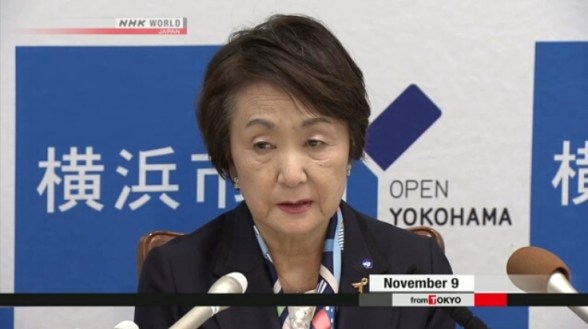
The mayor of Yokohama City has ordered its education board to look into why it failed to respond quickly to the bullying of a student who had evacuated due to the 2011 Fukushima nuclear accident.
A third-party panel of the board determined that the boy was bullied after entering an elementary school in Yokohama. The panel said school staff and education authorities responded slowly to the problem.
Mayor Fumiko Hayashi told reporters on Wednesday that city officials failed to make good use of an anti-bullying law enacted after a spate of serious cases across the nation.
Hayashi also referred to a note in which the boy said he thought of suicide many times.
She said she sensed his pain from the note and was heartbroken over his experience.
Hayashi said she wonders why the school and the board failed to help him much earlier.
‘Forgery’ suit filed against minister
TRUTHFUL? The Green Consumers’ Foundation claims that a Ministry of Health and Welfare report on Japanese food imports contains false and inaccurate information
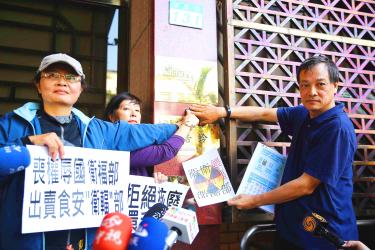
Green Consumers’ Foundation chairman Jay Fang, right, presses the doorbell of the Taipei District Prosecutors’ Office yesterday to file a lawsuit against Minister of Health and Welfare Lin Tzou-yien following the release of a ministry report on food imports from Japan.
Green Consumers’ Foundation chairman Jay Fang (方儉) yesterday filed a lawsuit against Minister of Health and Welfare Lin Tzou-yien (林奏延) at the Taipei District Prosecutors’ Office accusing the minister of “forgery,” claiming that the ministry’s Food and Drug Administration (FDA) used false data in its report on easing restrictions on Japanese food imports from the five prefectures closest to the Fukushima Dai-ichi nuclear power plant, which suffered a meltdown in March 2011.
Fang said that the government’s report provided at the weekend at public hearings on lifting the ban on imports of Japanese food items from the five prefectures contained false data that could mislead the public.
He said the report claims that “only China and Taiwan still impose a total ban on food imports from the five prefectures closest to Fukushima [Dai-ichi],” but the US FDA had issued an alert last month stating that the coast guard “may detain, without physical examination,” certain specified products from firms in 14 prefectures near Fukushima Dai-ichi.
The report also claims that “the standard [for acceptable radiation levels in food] in Taiwan is the same as other nations,” but Taiwan has looser standards than many nations, he added.
He said the government in January established 100 becquerel per kilogram (Bq/kg) as the standard radiation limit for food, but another 100Bq/kg was set as the standard radiation limit for iodine-131, meaning the total limit is 200Bq/kg.
“Is the Ministry of Health and Welfare protecting the public’s health or is it protecting radiation-contaminated food and feeding it to us?” Fan asked, urging the government to provide truthful data to the public.
In response, FDA Deputy Director Lin Ching-fu (林金富) said the ministry regrets that Fan has misread its data and that the ministry had not forged any data, adding that Fan, having filed a lawsuit, should be held to the equivalent legal liability.
FDA Division of Food Safety official Cheng Wei-chih (鄭維智) said safety standard for general food items is 100Bq/kg for “iodine-131” and 100Bq/kg for “cesium-134 and cesium-137,” and that the radioisotopes are examined separately.
http://www.taipeitimes.com/News/taiwan/archives/2016/11/15/2003659308
Work Starts in Fukushima on Intermediate Waste Facility
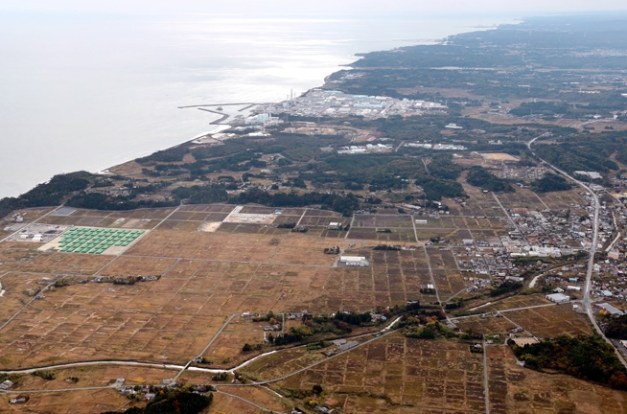
The planned site for an intermediate storage facility of radiation-contaminated waste spans the towns of Futaba and Okuma and surround the crippled Fukushima No. 1 nuclear power plant in Fukushima Prefecture.
The Environment Ministry on Nov. 15 started building a facility in Fukushima Prefecture that will store radiation-contaminated debris for up to 30 years, despite obtaining permission for only 11 percent of the site.
The 16-square-kilometer storage facility is expected to hold up to 22 million cubic meters of materials contaminated by radioactive fallout from the disaster at the Fukushima No. 1 nuclear power plant in March 2011.
“I hope that you take pride in this project and cooperate to construct the facility,” Tadahiko Ito, a vice environment minister, told workers.
The facility, which will span the towns of Futaba and Okuma, is expected to start accepting, sorting and storing the debris in autumn 2017 at the earliest, more than two-and-a-half years later than the initial schedule of January 2015.
The project has been delayed because the ministry has faced difficulties buying or borrowing land for the project.
In fact, only 445 of the 2,360 landowners of plots at the site have agreed to sell or lend their properties to the ministry for the storage facility as of the end of October.
Many of the reluctant landowners, who possess 89 percent of the land, fear the contaminated waste will remain at the facility well beyond 30 years.
The government has worked out a bill stipulating that contaminated materials kept in the intermediate storage facility will be moved out of Fukushima Prefecture in 2045. However, the government has yet to decide on the location of the final disposal site.
A huge cleanup operation after the triple meltdown at the Fukushima nuclear plant collected tons of radioactive soil and debris.
In March 2015, the ministry borrowed land and created a “temporary storage place” within a 16-square-km site on an experimental basis.
However, only about 70,000 cubic meters of the waste has been taken to the temporary storage site as of the end of October. The remaining waste, exceeding 10 million cubic meters, is being tentatively stored at about 150,000 locations in the prefecture.
“If the transportation of contaminated materials to the intermediate storage facility proceeds, the waste currently stored in residential areas and at company compounds will be transported there,” said an official of the Fukushima prefectural government’s section in charge of decontamination.
http://www.asahi.com/ajw/articles/AJ201611150040.html
Work begins on Fukushima nuclear waste site
Construction work has begun in Fukushima Prefecture on intermediate storage facilities for contaminated soil and waste materials from the 2011 nuclear disaster.
Groundbreaking ceremonies were held in the towns of Futaba and Okuma on Tuesday.
Two facilities will be built in a 16-square-kilometer area that straddles in the towns. One will be used to sort nuclear waste by size and level of contamination, and the other will store the sorted soil.
State Minister for the Environment Tadahiko Ito encouraged workers, saying they should be proud to be working for the region’s revival.
In the first day of work on Tuesday, workers removed contaminated soil from the surface of the site. Full-fledged construction work is to begin in January.
Waste from the Fukushima Daiichi nuclear plant and soil that has been removed in decontamination operations will be stored at the intermediate storage site before it is ultimately disposed of.
The contaminated soil and waste have been kept at temporary sites throughout Fukushima Prefecture longer than the 3 years the government had initially promised local communities. This is because construction of the intermediate storage site was delayed due to a lack of progress in acquiring the land.
The Environment Ministry plans to begin operating the intermediate storage facilities in about a year. It plans to enlarge the site after acquiring more land.
Japan’s nuclear regulator further weakens safety rules enforcement
The No. 3 unit at Kansai Electric Power Co.’s Mihama plant in Fukui Prefecture is the latest reactor allowed to continue in service beyond the limit following two such units at the utility’s Takahama complex, also in Fukui.
The Mihama No. 3 unit, which began commercial operation in December 1976, went offline in May 2011 for a regular checkup and has not been restarted, undergoing inspections to meet tougher safety requirements introduced after the Fukushima disaster.
Kansai Electric plans to spend about 165 billion yen ($1.5 billion) to upgrade the facilities at the reactor with a capacity of 826,000 kilowatts to meet the new regulations, which reflect the lessons learned from the Fukushima Daiichi nuclear power plant disaster……..
ニュースサイトで読む: http://mainichi.jp/english/articles/20161116/p2g/00m/0dm/047000c#csidxb563f34546d48c0a1d99f038e34023d 
Campaign by India’s People’s Movement Against Nuclear Energy (PMANE) to alert young people
Signature campaign against nuclear energy http://www.thehindu.com/todays-paper/tp-national/tp-tamilnadu/signature-campaign-against-nuclear-energy/article9342726.ece C. JAISANKAR, 15 Nov 16 The People’s Movement Against Nuclear Energy (PMANE) on Sunday called upon the youngsters to speak up against nuclear energy.
Speaking at an awareness programme after launching the signature campaign against nuclear energy here, Suba. Udayakumar, PMANE coordinator, said that several countries including the United States, France and Japan had given up the policy of installing new nuclear plants several years ago following Chernobyl and Fukushima nuclear disasters.
They had realised the dangers of nuclear plants to humans and environment.
However, the Central government was continuing to promote nuclear energy. It has planned to set up more nuclear plants at Kudankulam without addressing the apprehensions of people. It showed that the government was not bothered to listen to the genuine grievances of people, he said.
Sundarrajan, coordinator, Poovulagin Nanbargal, said that the government had not come out with a proper plan to dispose the waste being generated from nuclear plants. It was high time to create awareness among the people on the ill effects of nuclear plants. The people, particularly youngsters, should come forward to join the movement against nuclear energy, he added.
A dangerous nuclear deal – Japan and India
A questionable nuclear deal, Japan Times NOV 15, 2016
In recent years, Japan has concluded a series of civilian nuclear cooperation pacts with such countries as Vietnam, Jordan and Turkey in an effort to export its nuclear power plant technology and equipment. But the latest deal with India carries different ramifications. It marks a deviation from Japan’s emphasis on the NPT regime as the international framework for nuclear nonproliferation and disarmament, which is already threatened by North Korea’s repeated nuclear weapons tests.
Japanese businesses involved in nuclear power meanwhile see promising markets overseas for export of their technology and equipment since the Fukushima disaster made it difficult for utilities to build new nuclear plants in Japan and the restart of idled plants remains slow. These strategic and business considerations were prioritized as Tokyo pushed for the nuclear deal, which also authorizes India to reprocess spent nuclear fuel to extract plutonium. Japan is reported to have compromised on its earlier demand that the pact include an explicit provision that cooperation would be halted if India resumed nuclear weapons tests. …..http://www.japantimes.co.jp/opinion/2016/11/15/editorials/questionable-nuclear-deal/#.WCtw59J97Gg
About the Incineration of Fukushima Decontaminated Soil and Debris
From 2011 to 2014, decontaminated soil and debris were incinerated all over Japan. Informations about the quantity incinerated nationwide during those years in various locations are hard to get. As of today incineration is still ongoing in Eastern Japan, but we do no know if it is still ongoing or not in other parts of Japan as somehow nothing is being published about it.
Incineration is never a solution for radiation contaminated waste, it reduces the volume of the contaminated waste but at the same time redistributes its contained radionuclides into the nearby environment, thus endangering the health of the people living there.
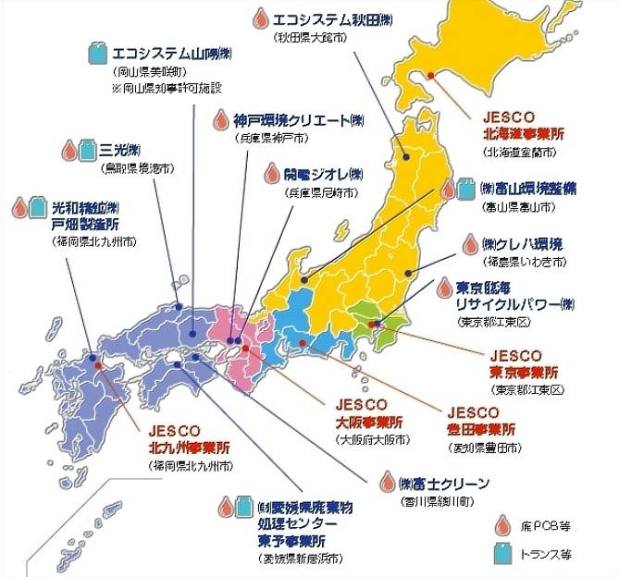
However, this article from September 2014 gives a list of the incineratition locations and of the disposal companies involved, among those Japan Environmental Safety Corporation (JESCO) was the most prominent, as JESCO was the company already handling most of the PCB waste disposal.
JESCO Hokkaido Office (Muroran City) JESCO北海道事業所(室蘭市)
Ecosystem Akita (Odate city) エコシステム秋田(大館市)
Kureha environment (Iwaki City, Fukushima prefecture) クレハ環境(福島県いわき市)
Tokyo Seaside Recycle Power (Koto Ward) 東京臨海リサイクルパワー(江東区)
JESCO Tokyo Office (Koto Ward) JESCO東京事業所(江東区)
Toyama Environment Improvement (Toyama City) 富山環境整備(富山市)
JESCO Toyota Plant (Toyota City, Aichi) JESCO豊田事業所(愛知県豊田市)
JESCO Osaka Plant (Osaka City) JESCO大阪事業所(大阪市)
KEIO GEORE (Amagasaki City, Hyogo) 関電ジオレ(兵庫県尼崎市)
Kobe Environment Creation (Kobe City) 神戸環境クリエート(神戸市)
Ecosystem Sanyo (Misaki Town, Okayama Prefecture) エコシステム山陽(岡山県美咲町)
Sanko (Sakaiminato City, Tottori Prefecture) 三光(鳥取県境港市)
Fuji Clean (Ayagawa Town, Aya Gun, Kagawa Prefecture) 富士クリーン(香川県綾歌群綾川町)
Ehime Prefecture Waste Treatment Center Toyo Works (Niihama City) 愛媛県廃棄物処理センター東予事業所(新居浜市)
Lightwork refining tobata manufacturing plant (Kitakyushu city, Fukuoka prefecture) 光和精鉱戸畑製造所(福岡県北九州市)
JESCO Kitakyushu Office$ JESCO北九州事業所
Anti-nuclear scientist group aims to boost influence amid growing defense research fears

Japanese scientists are trying to make Pugwash Japan, the domestic arm of the Pugwash Conferences on Science and World Affairs — an international organization working toward the abolition of nuclear arms and war — more active and influential amid concerns that the defense industry and scientific community are growing increasingly closer.
The Pugwash Conferences on Science and World Affairs held its first world meeting in the small fishing village of Pugwash, Canada, in 1957 during the nuclear arms race of the Cold War, and has since worked on and advocated for the elimination of nuclear arms and weapons of mass destruction. Japanese physicist and 1949 Nobel Prize laureate Hideki Yukawa had actively participated in Pugwash meetings, including the first session, and Japan has hosted international Pugwash conferences, but the number of Japanese scientists involved in the movement has been dropping in recent years.
Since individual scientists join the conference based on their own qualifications, Japanese scientists who took part in past international meetings launched Pugwash Japan to spread the message. The Japan group decided in September to relaunch a better-organized Pugwash Japan with a code of conduct and membership system after an international Pugwash general conference was held in the city of Nagasaki in November last year. The group’s aim is to open the door wider to those who are interested in the group’s activities and strengthen its influence in policy making.
The newly reformed Pugwash Japan, headed by nuclear engineering professor Tatsujiro Suzuki at Nagasaki University, will hold its first general meeting in Tokyo on Nov. 27. It will have some 40 members, with Keio University professor emeritus Michiji Konuma — who worked with Yukawa — on the steering committee, and 16 advisers such as engineer Hiroyuki Yoshikawa, a special adviser to the Japan Science and Technology Agency and former chairman of the Science Council of Japan, and University of Tokyo professor emeritus Seigo Hirowatari.
Member scientists are set to discuss concerns regarding defense research in Japan and the challenges to nuclear disarmament that remain following U.S. President Barack Obama’s historic visit to Hiroshima. To ensure unrestrained discussion, the meeting will be closed to the public, but results of the debate will be incorporated into the statements it releases to the public. The organization is also considering holding symposiums for the general public.
Pugwash Japan chairman Suzuki said he hopes that the group provides scientists with an opportunity for open-minded discussion based on the two pillars of the Pugwash Conference — social responsibility of scientists and dialogue across divides. He added, “We’re concerned about the current tendency for everything to lean toward national security and hope that our discussions that will lead to policy proposals.”
http://mainichi.jp/english/articles/20161113/p2a/00m/0na/004000c
VOX POPULI: Nuclear disaster surely taught us not to export this technology
The town of Futaba, which co-hosts the crippled Fukushima No. 1 nuclear power plant, used to boast signage promoting nuclear power generation.
One sign proclaimed, “Genshiryoku–Akarui Mirai no Enerugii,” which translates literally as “Nuclear power: The energy of a bright future.”
This and other signs were removed in the aftermath of the March 2011 nuclear disaster. They were relocated last month to the Fukushima Museum in the city of Aizuwakamatsu, according to the Fukushima edition of The Asahi Shimbun.
The museum is said to be considering an eventual exhibition of these acquisitions, which include a panel bearing the slogan, “Genshiryoku Tadashii Rikai de Yutakana Kurashi” (Proper understanding of nuclear energy enriches life).
These upbeat messages convey the hope, once held by the town of Futaba, that hosting the nuclear power plant will bring prosperity to the community.
But now, the reality gap is all too stark. Completely evacuated in the aftermath of the disaster, Futaba remains a dead town.
Is nuclear power still “the energy of a bright future”?
Prime Minister Shinzo Abe signed a Japan-India nuclear deal on Nov. 11 during his summit with Indian Prime Minister Narendra Modi, opening the way for Japan to export nuclear reactors to India.
This bilateral treaty came about at India’s request for Japanese technological cooperation.
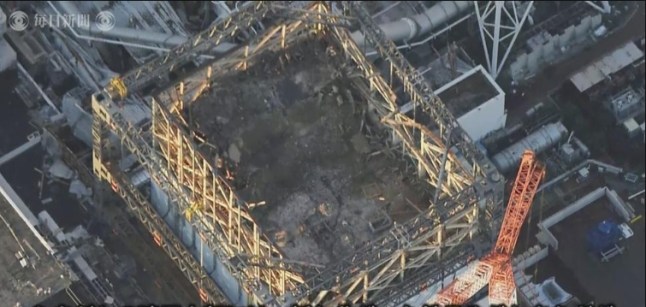
In the vicinity of the stricken Fukushima No. 1 nuclear power plant, more than 50,000 citizens are still living as forced evacuees, while work continues on the dismantling of the plant’s disabled reactors.
How could any country that let this happen have no qualms about providing its nuclear technology to another country? This is simply beyond comprehension.
While campaigning for India’s general election two years ago, Modi stressed that the nation could not hope for industrial or agricultural progress without electricity.
Of India’s population of 1.3 billion, about 300 million are still living without electricity. Correcting this power deficiency is obviously an urgent task, but is providing nuclear technology to India the only help that Japan can offer?
With evacuation orders still in effect for Futaba citizens, there is still nothing to indicate that the town will be habitable again.
And we, the Japanese people, know at first hand how difficult it is to rebuild people’s lives that were destroyed by a nuclear accident.
http://www.asahi.com/ajw/articles/AJ201611120023.html
India does not regard the “Termination” clause as binding – nuclear deal with Japan

 Termination clause in nuclear deal with Japan not binding
on India, insists govt, First Post, 13 Nov 16 New Delhi: The just-signed historic civil nuclear deal with Japan has a “termination” clause which the government here insists is not binding on India but merely records the “views” of the Japanese side considering its “special sensitivities”.
The government insisted that India has made “no additional commitments” over the similar agreements signed with the US and other countries.
In the Nuclear Cooperation Agreement, signed in the presence of Prime Minister Narendra Modi and his Japanese counterpart Shinzo Abe in Tokyo on Friday, there is a note on ‘Views and Understanding’ wherein the Japanese side has cited India’s September 2008 declaration of unilateral moratorium on atomic tests and said if this commitment is violated, the deal will terminate.
Indian government holds that this is merely recording of the views of the two sides.
“The termination clause is there in other NCAs (nuclear cooperation agreements) we have signed, including with the US (Article 14). However the circumstances triggering a possible termination are never sharply defined. Consideration also has to be given to mitigating factors,” a source here said.
“That note is simply a record by the negotiators of respective views on certain issues. It is not the NCA which is what is binding,” the source said.
The sources added that given Japan’s special sensitivities as the only nation to have suffered a nuclear attack, “it was felt that their views should be recorded in a separate Note. The Note is a record by the negotiators of respective views on certain issues.
“The termination clause is there in other NCAs (nuclear cooperation agreements) we have signed, including with the US (Article 14). However the circumstances triggering a possible termination are never sharply defined. Consideration also has to be given to mitigating factors,” a source here said.
“That note is simply a record by the negotiators of respective views on certain issues. It is not the NCA which is what is binding,” the source said.
The sources added that given Japan’s special sensitivities as the only nation to have suffered a nuclear attack, “it was felt that their views should be recorded in a separate Note. The Note is a record by the negotiators of respective views on certain issues………
Japan has made a major exception by signing the atomic cooperation agreement with India, despite it being non-signatory to the Nuclear Non-Proliferation Treaty (NPT)…….. http://www.firstpost.com/india/termination-clause-in-nuclear-deal-with-japan-not-binding-on-india-insists-govt-3103404.html
Massive safety exercises as Japanese nuclear plants, in volcanic and earthquake areas
 Japanese nuclear plant holds tsunami & meltdown drills Rt.com 13 Nov, 2016 A major anti-disaster drill has been held at a nuclear plant in Hokkaido, the northernmost of Japan’s main islands. The exercise followed a similar drill in Shikoku, and was based on the scenario of a powerful earthquake and tsunami striking the region.
Hokkaido is the second largest island of Japan which is home to the Tomari Nuclear Power Plant Unit 3 reactor. Due to over a dozen volcanoes it is prone to seismic activity. …… in Hokkaido, local residents joined officials from 40 organizations, including central and local governments to polish their emergency response.
In particular, the training trained people in how to reach safety should the main roads around Tomari be affected by a tsunami.
The drill even rehearsed the erection of an emergency response center some ten kilometers from the power station.
Meanwhile, locals practiced survival mode skills at a local school in case they are faced with a radiation leak situation. A massive evacuation of civilians using buses has also been organized. READ MORE: Volcano near Japanese nuclear plant to see major eruption within 25 years, scientists warn
A similar drill was held at the Ikata plant in Ehime Prefecture on Friday, and involved about 23,000 people. There, local residents joined officials from 90 organizations in a massive exercise organized by the Shikoku Electric Power Company. https://www.rt.com/news/366726-japan-nuclear-tsunami-drills/
Pugwash Japan – anti-nuclear science group strengthens its efforts
Anti-nuclear scientist group aims to boost influence amid growing defense research fears http://mainichi.jp/english/articles/20161113/p2a/00m/0na/004000c November 13, 2016 (Mainichi Japan) Japanese scientists are trying to make Pugwash Japan, the domestic arm of the Pugwash Conferences on Science and World Affairs — an international organization working toward the abolition of nuclear arms and war — more active and influential amid concerns that the defense industry and scientific community are growing increasingly closer.
Since individual scientists join the conference based on their own qualifications, Japanese scientists who took part in past international meetings launched Pugwash Japan to spread the message. The Japan group decided in September to relaunch a better-organized Pugwash Japan with a code of conduct and membership system after an international Pugwash general conference was held in the city of Nagasaki in November last year. The group’s aim is to open the door wider to those who are interested in the group’s activities and strengthen its influence in policy making.
The newly reformed Pugwash Japan, headed by nuclear engineering professor Tatsujiro Suzuki at Nagasaki University, will hold its first general meeting in Tokyo on Nov. 27. It will have some 40 members, with Keio University professor emeritus Michiji Konuma — who worked with Yukawa — on the steering committee, and 16 advisers such as engineer Hiroyuki Yoshikawa, a special adviser to the Japan Science and Technology Agency and former chairman of the Science Council of Japan, and University of Tokyo professor emeritus Seigo Hirowatari.
Member scientists are set to discuss concerns regarding defense research in Japan and the challenges to nuclear disarmament that remain following U.S. President Barack Obama’s historic visit to Hiroshima. To ensure unrestrained discussion, the meeting will be closed to the public, but results of the debate will be incorporated into the statements it releases to the public. The organization is also considering holding symposiums for the general public.
Pugwash Japan chairman Suzuki said he hopes that the group provides scientists with an opportunity for open-minded discussion based on the two pillars of the Pugwash Conference — social responsibility of scientists and dialogue across divides. He added, “We’re concerned about the current tendency for everything to lean toward national security and hope that our discussions that will lead to policy proposals.”
1 This Month





PLEASE OPPOSE HR 8255 AND S.3639 – bills would accelerate satellite deployment, with no environmental review or safeguards – https://ncstd5li.quorum.us/campaign/169331/
To see nuclear-related stories in greater depth and intensity – go to https://nuclearinformation.wordpress.com
-
Archives
- October 2026 (19)
- September 2026 (339)
- August 2026 (330)
- July 2026 (355)
- June 2026 (287)
- May 2026 (306)
- April 2026 (356)
- March 2026 (251)
- February 2026 (267)
- January 2026 (308)
- December 2025 (358)
- November 2025 (359)
-
Categories
- 1
- 1 NUCLEAR ISSUES
- business and costs
- climate change
- culture and arts
- ENERGY
- environment
- health
- history
- indigenous issues
- Legal
- marketing of nuclear
- media
- opposition to nuclear
- PERSONAL STORIES
- politics
- politics international
- Religion and ethics
- safety
- secrets,lies and civil liberties
- spinbuster
- technology
- Uranium
- wastes
- weapons and war
- Women
- 2 WORLD
- ACTION
- AFRICA
- Atrocities
- AUSTRALIA
- Christina's notes
- Christina's themes
- culture and arts
- Events
- Fuk 2022
- Fuk 2023
- Fukushima 2017
- Fukushima 2018
- fukushima 2019
- Fukushima 2020
- Fukushima 2021
- general
- global warming
- Humour (God we need it)
- Nuclear
- RARE EARTHS
- Reference
- resources – print
- Resources -audiovicual
- Weekly Newsletter
- World
- World Nuclear
- YouTube
-
RSS
Entries RSS
Comments RSS

