Massive radioactive water collection grows, Japan’s government paralysed on this issue
Tepco has yet to decide how to dispose of the contaminated water, spokeswoman Mayumi Yoshida said. But before it can act it will need approval from the government, residents and fishermen, who are already suspicious of the company’s motives.
Fukushima’s toxic water pool grows as Tepco dithers http://www.smh.com.au/world/fukushimas-toxic-water-pool-grows-as-tepco-dithers-20130830-2svvn.html#ixzz2dncD1B4t August 31, 2013 Yuriy Humber The Tokyo Electric Power Company is trying to decide what to do with the largest pool of radioactive water in the history of nuclear accidents. It can either dump it in the ocean, let it evaporate into the air, or both.
The more than 330,000 tonnes of water with varying levels of toxicity is stored in pits, basements and hundreds of tanks at the wrecked Fukushima nuclear plant.
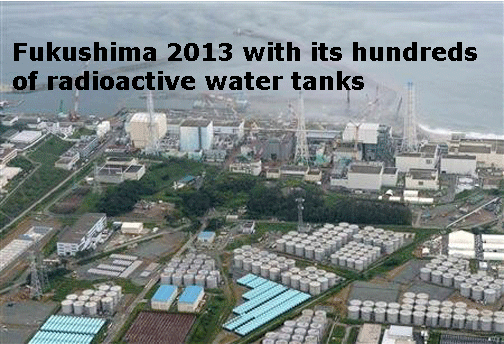
The government said this week it would take a bigger role in trying to staunch the toxic outflow that has grown to 40 times the volume accumulated in the atomic disaster at Three Mile Island in the US.
Processing and disposing of the water – enough to fill a large crude oil tanker or 132 Olympic-size swimming pools – is presenting one of the most challenging engineering tasks of our generation, former nuclear engineer Michael Friedlander said. Continue reading
Shutdown of nuclear reactor leaves Japan with only one functioning nuclear reactor

 Japan shuts down nuclear reactor for inspections , channel news Asia, 2 Sept 13,
Workers will switch off one of Japan’s two working reactors Monday, with the other set for shutdown later this month and no restarts in sight amid continued public hostility to nuclear power. TOKYO: Workers will switch off one of Japan’s two working reactors Monday, with the other set for shutdown later this month and no restarts in sight amid continued public hostility to nuclear power.
Kansai Electric Power will start reducing generating power at its Unit No 3 at the Oi plant, Fukui prefecture, western Japan, shortly before 5:00 pm (0800 GMT), a company spokesman said.
The reactor will be fully shut down by early Tuesday in readiness for inspections legally mandated within 13 months of the start of commercial operations, he said.
The reactor is one of the only two still generating power in Japan. The other one, Unit No 4 at Oi, is to be switched off on September 15.
It is not known when they will resume operations because they will be assessed under a set of guidelines recently drawn up by the nuclear watchdog, according to Kansai Electric.
The two reactors were restarted — despite public opposition — in July last year after passing safety tests, ending a brief period in which no atomic power was generated in Japan.
They were the only units to be brought back online after undergoing such tests in the aftermath of the disaster in March 2011 at Fukushima……. The company said Sunday it had found highly radioactive water dripping from a pipe connecting two coolant tanks at one of four radiation hotspots http://www.channelnewsasia.com/news/asiapacific/japan-shuts-down-nuclear/798834.html
Japan could face legal action by other countries, due to Fukushima radiation
Japan Official: Fukushima contamination “increasingly seen as international problem… lawsuits may be filed overseas” — “Gov’t should take preventive actions based on a worst-case scenario” says S. Korea newspaper http://enenews.com/japan-official-lashes-out-fukushima-contamination-is-increasingly-seen-as-an-international-problem-lawsuits-may-be-filed-overseas-govt-should-take-preventive-actions-based-on-a-wors
Title: Government under fire for slow response to Fukushima leak
Source: Asahi Shimbun
Date: Aug. 30, 2013
[…] In a meeting at the ruling Liberal Democratic Party headquarters on Aug. 29, party lawmaker Yasuhisa Shiozaki lashed out at the Abe administration […]
“The issue of radioactive water is increasingly seen as an international problem, and lawsuits may be filed overseas,” said Shiozaki, acting chairman of the LDP Policy Research Council and a former chief Cabinet secretary.
Shiozaki’s anger can be seen as the first explicit criticism of the government from the ruling party since the LDP returned to power in December. […]
The Chosun Ilbo newspaper said [on August 26], “The South Korean government should take preventive actions based on a worst-case scenario, without relying only on information from the Japanese government and TEPCO.” […]
See also: Korea Times: Quarter-billion liters of Fukushima contaminated water flowed into Pacific — Japan cover-up could violate international law — Hid global issue of environmental concern?
Fukushima has new radiation hot spots
 New radiation hotspots found at Fukushima nuclear plant ABC News, North Asia correspondent Mark Willacy, wires 1 Sept 13, The operator of Japan’s crippled Fukushima nuclear plant says it has found new radiation hotspots, one with levels so high it could kill a person within a few hours. TEPCO has long struggled to deal with the growing volume of contaminated water it has used to cool reactors that went into meltdown after being struck by an earthquake and tsunami in 2011.
The company says workers have discovered high levels of radioactivity on three tanks and one pipe at the Fukushima plant.
It says one reading was 1,800 millisieverts per hour – a level that can kill a person in four hours.
Although no change in water level was detected in the tanks, TEPCO does believe that new leaks could be possible……. http://www.abc.net.au/news/2013-09-01/an-new-radiation-hotspots-found-at-fukushima/4927684
Fukushima radiation levels vastly higher than previously thought
Fukushima radiation levels 18 times higher than previously thought, Justin McCurry in Tokyo theguardian.com, Sunday 1 September 2013 Operator of Japanese nuclear power plant claims there has been no leak but has yet to discover cause of radiation spike Radiation levels 18 times higher than previously reported have been found near a water storage tank at the Fukushima Daiichi nuclear power plant, causing fresh concern about the safety of the wrecked facility.
The plant’s operator, Tokyo Electric Power (Tepco), said radiation near the bottom of the tank measured 1,800 millisieverts an hour – high enough to kill an exposed person in four hours. Tepco said water levels inside the tank had not changed, indicating there had not been a leak. But the company said it had yet to discover the cause of the radiation spike.
Last month Tepco said another storage tank – of the same design as the container causing concern at the weekend – had leaked 300 tonnes of radioactive water, possibly into the sea.
Japan‘s nuclear watchdog confirmed last week it had raised the severity of that leak from level 1, an “anomaly”, to level 3, a “serious incident”, on an eight-point scale used by the International Atomic Energy Agency for radiological releases.
Earlier, the utility belatedly confirmed reports that a toxic mixture of groundwater and water being used to cool melted fuel lying deep inside the damaged reactors was seeping into the sea at a rate of about 300 tonnes a day.
Experts said those leaks, which are separate from the most recent incidents, may have started soon after the plant was struck by a powerful tsunami on 11 March 2011……… http://www.theguardian.com/environment/2013/sep/01/fukushima-radiation-levels-higher-japan
Japan’s offical cover-up of how bad things really are at Fukushima
 Professor: Fukushima disaster “beyond a cover-up” — Japan gov’t thinks they can get away with tricking masses about extent of problem — Officials and Tepco cannot be trusted, they are lying to the camera http://enenews.com/professor-fukushima-disaster-beyond-a-cover-up-japan-govt-thinks-they-can-get-away-with-tricking-the-masses-about-extent-of-problem-officials-and-tepco-cannot-be-trusted
Title: Are the Japanese government lying about the fallout from Fukushima?
Source: Newstalk 106 FM
Author: Raf Diallo
Date: 29 August 2013
Alexis Dudden (SOURCE: University of Connecticut)
[…] Alexis Dudden, a Professor of History at the University of Connecticut and a regular visitor to Japan [who was recently in Fukushima Prefecture] spoke to me about events in the country and why the Japanese government nor the Tokyo Electrical Power Company (TEPCO) can be trusted regarding the nuclear issue.Two years ago she told me that the way the Fukushima disaster was handled was beyond a cover-up and her opinion has not changed.
“There is a willful determination that (the government) can get away with it, that they can get away with tricking the masses about the extent of the problem. [Japan’s] former ambassador to Switzerland wrote a letter to the International Olympic Committee, saying that the government lied,” says Dudden of a situation she believes is just as bad as Chernobyl in relation to its long-term impact. […]
“They blamed TEPCO for the last two years but they haven’t moved to disband the organization. Shares in TEPCO were doing well until recently so the people in charge profited in the interim. They are lying to the camera,” says Dudden. […]
She believes that hundreds of thousands of people should have been evacuated from the affected area immediately after the disaster to reduce pain and suffering and it is a view backed up by the head of Japan’s Medical Association who also happens to be from Fukushima. […]
See also: Korea Times: Japan cover-up could violate international law — Hid global issue of environmental concern?
Mysterious white spots on Fukushima cows – ignored by government
TV: Mystery spots on Fukushima cows ignored by gov’t — Veterinarian: It’s extremely important, Japan has to think of what to do with this problem (VIDEO) http://enenews.com/tv-mysterious-white-spots-on-fukushima-cows-ignored-by-govt-officials-veterinarian-its-extremely-important-japan-has-to-think-of-what-to-do-with-this-problem-video
Title: “White spots” on Fukushima cattle ignored by Japanese officials
Source: Channel NewsAsia
Reporter: Makiko Segawa
Date: Aug. 29, 2013
h/t Anonymous tip Channel News Asia: […] radiation exposure can cause DNA and immunological changes in living organisms. […] Farmer Masami Yoshizawa kept his cattle alive to monitor changes due to prolonged radiation exposure. Now, mysterious white spots on the fur and skin are appearing on ten […] so far, nothing has been said about the issue.

SOURCE: Farm Sanctuary
Makiko Segawa, Reporter: When you visited in December 2012 do you remember? Did youu see these white spotted cows?
Kazuo Suzuki, Ministry of Agriculture official: No, I do not remember them […]
Segawa: Could you please test these cows next time you visit?
Suzuki: As I explained before it’s not my duty. They should go to the nearby Livestock Hygiene Service. […]
Channel News Asia: Local farmers disagree, saying they were told by the Fukushima prefectural officials that all such investigations do actually fall under the Ministry of Agriculture’s authority […] Beef from Fukushima [Prefecture] was still the 5th most traded and shipped [in 2012] at Japan’s biggest beef market in Tokyo. […]
Toshimitsu Matsubara, veterinarian and president of the BBB Beef Association: “What is happening [to these cows] now is extremely important. Japan has to think of what to do with this problem.” […]
More photos of Yoshizawa’s affected cattle
Watch the Channel News Asia broadcast
Land is now “mushy” under Fukushima nuclear reactors
 “Big Problem”: Cracked floors in Fukushima reactors leaking into groundwater that’s rising and rising and rising due to Tepco wall — “Can no longer be stopped from getting in ocean” — “Worse than that… buildings now on mushy land” (AUDIO)
Title: Breaking News: Entergy pulling the plug on Vermont Yankee
Source: Fairewinds Energy Education
Host: Nathaniel White-Joyal
Date: Aug 27, 2013
Arnie Gundersen, Fairewinds chief engineer:: The big problem is the nuclear reactors themselves have cracked floors. The buildings in those reactor buildings have cracked floors. And groundwater is getting into those buildings, and becoming contaminated, and then leaking out. So, in addition to what’s in those tanks, the physical plant itself is contaminating the groundwater as well.
So what Tepco tried to do is to build a wall along the water. They injected basically a concrete type of a compound and made the ground less porous. That’s not a good idea — it’s a poor idea — because what happened is the mountain that’s behind Fukushima continues to pour the water into the ground. Now it’s got no place to go. So now the groundwater’s rising and rising and rising and likely over-topping this wall, certainly going around it on the sides. So we’ve got radioactive water that can no longer be stopped from getting in the ocean.
It’s worse than that though. The radioactive water has made the site seismic response different. The buildings that were on dry land are now on mushy land. So that if there were to be another earthquake, the seismic response of these buildings — which was already marginal — is further compromised because the ground that they are now on is wet soggy soil, when before it had been firm.
Follow ENENews on Twitter for latest updates
Fukushima’s fishermen form a serious obstacle to TEPCO’s plans to release water into the Pacific
Fishing culture has deep historical roots in Japan. The country imports more seafood than any other
“If you run roughshod over the fishermen” it will backfire when Abe asks the public for support of his economic agenda and nuclear restarts,”
Fukushima Fishermen Ruined by Tepco Now Key in Radiation Fight, Bloomberg, By Yuriy Humber, Chisaki Watanabe & Masumi Suga – Aug 29, 2013 ”……… Japan’s government promised “to take drastic measures to the maximum extent possible” to contain the radiated water leaks. That has so far amounted to Prime Minister Shinzo Abe and the ruling Liberal Democrats instructing Tepco to win over the fishermen before proceeding.
Tepco, Optics
“Despite its support for nuclear power, the Cabinet and LDP politicians know that the public dislikes atomic power and holds Tepco in contempt,” Robert Dujarric, director of the Institute of Contemporary Asian Studies at Temple University, said by e-mail. “They realise that the ‘optics’ of going over the objections of the fishermen would be very bad.” Continue reading
TEPCO’s plan for diverting Fukushima water into Pacific Ocean
Fukushima Fishermen Ruined by Tepco Now Key in Radiation Fight, Bloomberg, By Yuriy Humber, Chisaki Watanabe & Masumi Suga – Aug 29, 2013
Tokyo Electric Power Co. (9501) ruined the livelihoods of the commercial fishermen that trawled the seas off Fukushima prefecture when its leaking reactors poisoned the fishing grounds. The utility now needs their help.
At issue is a series of wells and pipes built by Tokyo Electric to alter the course of groundwater flowing from the hills behind the wrecked Fukushima Dai-Ichi nuclear station. The bypass, which is ready to operate, will divert water away from the plant’s damaged reactors and into the Pacific, thus reducing contamination, Tokyo Electric says. The utility must first get the approval of the 1,500 members of Fukushima’s fishing cooperative and others in the area to begin using the bypass. With Tokyo Electric’s history of falsifying safety reports, hiding accidents and ignoring warnings, fisherman aren’t convinced the system is safe.
“We have yet to reach a conclusion” on whether the cooperative will agree to Tokyo Electric’s bypass plan, Tetsu Nozaki, chairman of the Fukushima Prefectural Federation of Fisheries Co-operative Associations, said yesterday in Tokyo. “We will make a cool-headed decision.”
The three-month impasse has implications beyond Fukushima and Japan because it’s holding up the bid to reduce the 300 metric tons of radioactive water gushing into the Pacific each day.
More than 330,000 tons of water with varying levels of toxicity is stored in pits, basements and hundreds of tanks at the Fukushima nuclear plant 220 kilometers (137 miles) northeast of Tokyo. The water is the result of efforts to keep the reactor cores from overheating and groundwater pouring into the facility, wrecked by the March 2011 earthquake and tsunami.
Consensus Sought
Some of those tanks are vulnerable to leaks, Tokyo Electric, or Tepco, said last week. Moreover, the groundwater seeping into the Fukushima plant is mixing with radioactive water, getting contaminated.
Estimates say about 400 tons of groundwater flows down the hillside each day. The bypass would reduce that by about 25 percent, piping the water from the plant and into the ocean before it gets contaminated.
“We want to reach a consensus soon,” Yoshihisa Komatsu, an official at the Fukushima fishing cooperative, said by phone Aug. 28 in reference to the bypass talks. “But some members oppose it so we are caught in the middle.”…… .http://www.bloomberg.com/news/2013-08-29/fukushima-fishermen-ruined-by-tepco-now-key-in-radiation-fight.html
Foundations of Fukushima’s nuclear reactors now becoming unstable?
 Warning that foundations of Fukushima reactor chambers have been “compromised” — Groundwater rising fast, now just 10 inches from surface http://enenews.com/warning-that-foundations-of-fukushima-reactor-chambers-are-compromised-underground-water-now-just-10-inches-from-surface
Source: The Daily Telegraph (UK)
Author: Julian Ryall, Tokyo
Date: Aug. 26, 2013
Speaking after being shown around the site, [Toshimitsu Motegi, the minister of trade and industry] said, “The urgency of the situation is very high. From here on, the government will take charge.” […]
As well as leaks of water contaminated with radiation, work to bring the damaged reactors under control has been making painfully slow progress. Radiation levels in three of the reactor buildings are so high that it is impossible for workers to spend more than a couple of minutes inside at one time.
The true state of the reactor chambers remains unclear and there are suggestions that the tons of water that are being sprayed on the reactor vessels to keep them at a stable temperature has compromised the foundations of the structures.
Experts have also warned that the effort to gain control of the reactors – which is likely to take an estimated three decades – could be for naught if another major earthquake or tsunami strikes north-east Japan. […]
See also: Expert: Land under Fukushima reactor buildings at risk of turning into liquid — Area near sea could become like mud
Tepco Handouts (Fukushima Diary: “Groundwater level at one of the borings has been jumping up since 8/20/2013 for some reason. There was no rainfall in this term according to Tepco. […] This time, the groundwater level came up to 25cm to the surface of the ground.) Most Recent English Version (Aug. 22, 2013)
Strontium 90, another radioactive element discharging from Fukushima nuclear mess
Since June 2011 there have been further large discharges of strontium from Fukushima that have not been measured with precision.
Along with caesium-137, Sr-90 is one of the most important artificial radioactive isotopes released into the environment, with a half-life of 30 years. Strontium’s chemical behaviour is similar to that of calcium, and it can accumulate in organisms, especially in bone.
Fukushima accident raised levels of radioactive strontium off the east coast of Japan by up to a hundred times : http://phys.org/news/2013-06-fukushima-accident-radioactive-strontium-east.html#jCp Researchers from the Institute for Environmental Science and Technology (ICTA) and the Department of Physics of the Universitat Autònoma de Barcelona (UAB) have studied the spread of radioactive strontium in the coastal waters of eastern Japan during the three months following the Fukushima nuclear accident, which happened in March, 2011. The samples analysed show the impact of the direct release of radioactive materials into the Pacific Ocean, and indicate that the amount of strontium-90 discharged into the sea during those three months was between 90 and 900 Tbq (terabecquerels), raising levels by up to two orders of magnitude. The highest concentrations were found to the north of the Kuroshio current, which acts as a barrier preventing radioactive material from being carried to lower latitudes. Continue reading
Japan has to take back radiation-contaminated containers sent to Taiwan
 Taiwan returns radiation-contaminated containers to Japan Global Post 28 Aug 13 Fifteen radiation-contaminated containers from Japan have been sent back since Japan’s earthquake, tsunami and the nuclear meltdowns at the Fukushima Daiichi power plant in March 2011, Taiwan’s Atomic Energy Council told Kyodo News on Wednesday.
The council said once a container is detected contaminated with radiation at Kaohsiung port, the importer is given a choice to either clean the container if it wishes to see the container enter Taiwan or not clean the container, which will then be sent back to where it came.
The Liberty Times reported in its Wednesday issue that Kaohsiung Customs has detected 226 containers contaminated with radiation coming from or routed through Japan since March 2011.
Kaohsiung Customs are the island’s only seaport equipped with radiation detection monitors that screen more than 95 percent of all container traffic…… http://www.globalpost.com/dispatch/news/kyodo-news-international/130828/taiwan-returns-radiation-contaminated-containers-japan
Huge radiation: Estimated 276 quadrillion Bq of Cs-137 entered Fukushima basements
Water with nuclear fuel coming up from ocean floor off Fukushima coast? Tokyo Professor: 156 quadrillion Bq of Cs-137 once in basements — Double Chernobyl; Getting close to total fallout from every atomic bomb test in history — May be outputting from seeps in seafloor, I don’t know (VIDEO) http://enenews.com/water-with-pieces-of-nuclear-fuel-coming-up-from-ocean-floor-off-fukushima-coast-tokyo-professor-156-quadrillion-bq-of-cs-137-in-basements-getting-close-to-fallout-total-from-every-atomic-bombs-t
Title: Long-term Sources: To what extent are marine sediments, coastal groundwater, and rivers a source of ongoing contamination?
Source: Science Symposium at University of Tokyo
Date: Nov. 13, 2012
Professor Jota Kanda, Tokyo University of Marine Science and Technology:
Jota Kanda Highlight – Science Symposium at University of Tokyo
In the basement of the reactor housings […] they used to have 156 petabecquerels of Cs-137 […]
156 is a huge amount. Double the amount released from Chernobyl, even getting close to the value released from global fallout from bomb testing. […
The volume remains about the same, presumably because of the inflow of groundwater into the basement.
If there is inputting of groundwater, there might be outputting of groundwater, I don’t know.
The possible groundwater seepage from near by seafloor — that’s something I think. However we have no data indicative of this seep from the seafloor.
Watch Kanda’s presentation here
See also:
- Kanda: There may be other sources of contamination stored up inside Fukushima plant’s infrastructure — If it gets into the ocean it will have “devastating impact“
- Tokyo Professor: Cesium hot spots almost 100 times greater than surrounding area in seabed soil a mile offshore Fukushima plant
- Japan Expert: Contamination from Fukushima flowing beneath seafloor? “Could spring up outside the port“
- Nuclear Expert: Fukushima melted fuel is drifting in ocean and onto land, lacking any containment — It ends up on coastline and blows into communities — People get an exceptional dose — Health harm will go on for thousands, if not tens of thousands of years (AUDIO)
- Nuclear Engineer: Estimated 276 quadrillion Bq of Cs-137 entered Fukushima basements — Triple Chernobyl total release — A portion “has already made its way to aquifer, whence it can easily flow into sea”
Fukushima’s most dangerous problem is ignored by mainstream media
Glowing Green with Outrage By Adam Smith OpEdNews Op Eds 8/27/2013 ”………Unfortunately the reality has been that the media have simply not been doing their job. The Tokyo Electric Power Company (Tepco) has been allowed to dictate the narrative of what is occurring with basically no oversight. It turns out that the site was never actually contained and radioactive water has been leaking with “no accurate figures for radiation levels.” You may say that since this issue is being reported by all major news organizations now, the media is doing their job albeit in a very tardy fashion.
However, that would be missing the reality that this leaking radiation water is the least of our worries vis-a-vis the plant. Much less reported by the media is what will be required by the clean-up crew to end this whole saga. Reliable old Reuters often provides the on-the-ground breaking scoops that our local media then report to us. Despite their well-deserved reputation, it seems that most media organizations have chosen to ignore their recent scoop about the dangers involved in the clean-up process.
 Essentially, Tepco needs to remove 1300 spent fuel rods, containing 14,000 times the amount of radiation dropped onto Japan in WWII, from a dilapidated, flooding, and collapsing power plant that still sits in an earthquake-prone location. The whole process will take about 40 years and cost about eleven billion dollars. Each rod weighs 660 pounds, is 15 feet long, and cannot get too close to each other or will trigger a chain-reaction. If exposed to air, they may also trigger a chain-reaction. Usually, when these rods are moved as part of normal operations, a sophisticated robot is used to guide the work and ensure accuracy down to millimeters. Due to the damage caused by the earthquake/tsunami, this is not possible and the cranes will be operated in a poisonously radioactive area by scared human hands with all of their limitations. These rods will be removed individually, one at a time, and a mistake on any of them could trigger an unstoppable chain-reaction…….. http://www.opednews.com/articles/Glowing-Green-with-Outrage-by-Adam-Smith-Cancer_Energy_Energy_Energy-130827-96.html
1 This Month





PLEASE OPPOSE HR 8255 AND S.3639 – bills would accelerate satellite deployment, with no environmental review or safeguards – https://ncstd5li.quorum.us/campaign/169331/
To see nuclear-related stories in greater depth and intensity – go to https://nuclearinformation.wordpress.com
-
Archives
- October 2026 (67)
- September 2026 (339)
- August 2026 (330)
- July 2026 (355)
- June 2026 (287)
- May 2026 (306)
- April 2026 (356)
- March 2026 (251)
- February 2026 (267)
- January 2026 (308)
- December 2025 (358)
- November 2025 (359)
-
Categories
- 1
- 1 NUCLEAR ISSUES
- business and costs
- climate change
- culture and arts
- ENERGY
- environment
- health
- history
- indigenous issues
- Legal
- marketing of nuclear
- media
- opposition to nuclear
- PERSONAL STORIES
- politics
- politics international
- Religion and ethics
- safety
- secrets,lies and civil liberties
- spinbuster
- technology
- Uranium
- wastes
- weapons and war
- Women
- 2 WORLD
- ACTION
- AFRICA
- Atrocities
- AUSTRALIA
- Christina's notes
- Christina's themes
- culture and arts
- Events
- Fuk 2022
- Fuk 2023
- Fukushima 2017
- Fukushima 2018
- fukushima 2019
- Fukushima 2020
- Fukushima 2021
- general
- global warming
- Humour (God we need it)
- Nuclear
- RARE EARTHS
- Reference
- resources – print
- Resources -audiovicual
- Weekly Newsletter
- World
- World Nuclear
- YouTube
-
RSS
Entries RSS
Comments RSS

