Strontium 90, another radioactive element discharging from Fukushima nuclear mess
Since June 2011 there have been further large discharges of strontium from Fukushima that have not been measured with precision.
Along with caesium-137, Sr-90 is one of the most important artificial radioactive isotopes released into the environment, with a half-life of 30 years. Strontium’s chemical behaviour is similar to that of calcium, and it can accumulate in organisms, especially in bone.
Fukushima accident raised levels of radioactive strontium off the east coast of Japan by up to a hundred times : http://phys.org/news/2013-06-fukushima-accident-radioactive-strontium-east.html#jCp Researchers from the Institute for Environmental Science and Technology (ICTA) and the Department of Physics of the Universitat Autònoma de Barcelona (UAB) have studied the spread of radioactive strontium in the coastal waters of eastern Japan during the three months following the Fukushima nuclear accident, which happened in March, 2011. The samples analysed show the impact of the direct release of radioactive materials into the Pacific Ocean, and indicate that the amount of strontium-90 discharged into the sea during those three months was between 90 and 900 Tbq (terabecquerels), raising levels by up to two orders of magnitude. The highest concentrations were found to the north of the Kuroshio current, which acts as a barrier preventing radioactive material from being carried to lower latitudes. Continue reading
Japan has to take back radiation-contaminated containers sent to Taiwan
 Taiwan returns radiation-contaminated containers to Japan Global Post 28 Aug 13 Fifteen radiation-contaminated containers from Japan have been sent back since Japan’s earthquake, tsunami and the nuclear meltdowns at the Fukushima Daiichi power plant in March 2011, Taiwan’s Atomic Energy Council told Kyodo News on Wednesday.
The council said once a container is detected contaminated with radiation at Kaohsiung port, the importer is given a choice to either clean the container if it wishes to see the container enter Taiwan or not clean the container, which will then be sent back to where it came.
The Liberty Times reported in its Wednesday issue that Kaohsiung Customs has detected 226 containers contaminated with radiation coming from or routed through Japan since March 2011.
Kaohsiung Customs are the island’s only seaport equipped with radiation detection monitors that screen more than 95 percent of all container traffic…… http://www.globalpost.com/dispatch/news/kyodo-news-international/130828/taiwan-returns-radiation-contaminated-containers-japan
Huge radiation: Estimated 276 quadrillion Bq of Cs-137 entered Fukushima basements
Water with nuclear fuel coming up from ocean floor off Fukushima coast? Tokyo Professor: 156 quadrillion Bq of Cs-137 once in basements — Double Chernobyl; Getting close to total fallout from every atomic bomb test in history — May be outputting from seeps in seafloor, I don’t know (VIDEO) http://enenews.com/water-with-pieces-of-nuclear-fuel-coming-up-from-ocean-floor-off-fukushima-coast-tokyo-professor-156-quadrillion-bq-of-cs-137-in-basements-getting-close-to-fallout-total-from-every-atomic-bombs-t
Title: Long-term Sources: To what extent are marine sediments, coastal groundwater, and rivers a source of ongoing contamination?
Source: Science Symposium at University of Tokyo
Date: Nov. 13, 2012
Professor Jota Kanda, Tokyo University of Marine Science and Technology:
Jota Kanda Highlight – Science Symposium at University of Tokyo
In the basement of the reactor housings […] they used to have 156 petabecquerels of Cs-137 […]
156 is a huge amount. Double the amount released from Chernobyl, even getting close to the value released from global fallout from bomb testing. […
The volume remains about the same, presumably because of the inflow of groundwater into the basement.
If there is inputting of groundwater, there might be outputting of groundwater, I don’t know.
The possible groundwater seepage from near by seafloor — that’s something I think. However we have no data indicative of this seep from the seafloor.
Watch Kanda’s presentation here
See also:
- Kanda: There may be other sources of contamination stored up inside Fukushima plant’s infrastructure — If it gets into the ocean it will have “devastating impact“
- Tokyo Professor: Cesium hot spots almost 100 times greater than surrounding area in seabed soil a mile offshore Fukushima plant
- Japan Expert: Contamination from Fukushima flowing beneath seafloor? “Could spring up outside the port“
- Nuclear Expert: Fukushima melted fuel is drifting in ocean and onto land, lacking any containment — It ends up on coastline and blows into communities — People get an exceptional dose — Health harm will go on for thousands, if not tens of thousands of years (AUDIO)
- Nuclear Engineer: Estimated 276 quadrillion Bq of Cs-137 entered Fukushima basements — Triple Chernobyl total release — A portion “has already made its way to aquifer, whence it can easily flow into sea”
Fukushima’s most dangerous problem is ignored by mainstream media
Glowing Green with Outrage By Adam Smith OpEdNews Op Eds 8/27/2013 ”………Unfortunately the reality has been that the media have simply not been doing their job. The Tokyo Electric Power Company (Tepco) has been allowed to dictate the narrative of what is occurring with basically no oversight. It turns out that the site was never actually contained and radioactive water has been leaking with “no accurate figures for radiation levels.” You may say that since this issue is being reported by all major news organizations now, the media is doing their job albeit in a very tardy fashion.
However, that would be missing the reality that this leaking radiation water is the least of our worries vis-a-vis the plant. Much less reported by the media is what will be required by the clean-up crew to end this whole saga. Reliable old Reuters often provides the on-the-ground breaking scoops that our local media then report to us. Despite their well-deserved reputation, it seems that most media organizations have chosen to ignore their recent scoop about the dangers involved in the clean-up process.
 Essentially, Tepco needs to remove 1300 spent fuel rods, containing 14,000 times the amount of radiation dropped onto Japan in WWII, from a dilapidated, flooding, and collapsing power plant that still sits in an earthquake-prone location. The whole process will take about 40 years and cost about eleven billion dollars. Each rod weighs 660 pounds, is 15 feet long, and cannot get too close to each other or will trigger a chain-reaction. If exposed to air, they may also trigger a chain-reaction. Usually, when these rods are moved as part of normal operations, a sophisticated robot is used to guide the work and ensure accuracy down to millimeters. Due to the damage caused by the earthquake/tsunami, this is not possible and the cranes will be operated in a poisonously radioactive area by scared human hands with all of their limitations. These rods will be removed individually, one at a time, and a mistake on any of them could trigger an unstoppable chain-reaction…….. http://www.opednews.com/articles/Glowing-Green-with-Outrage-by-Adam-Smith-Cancer_Energy_Energy_Energy-130827-96.html
Tepco’s tricks for not revealing the true state of Fukushima’s nuclear reactors
There’s another cause that Tepco has not mentioned – It’s the direct leakage from the reactor turbine buildings.
This means the coolant water is directly leaking to the ground and the sea. This is way more serious
we need to suspect the direct leakage of the coolant water from reactor1 and 4. Especially about reactor1, the water that actually touched the fuel may be flowing to the sea. When Tepco officially admits it, everything would be already too late.
 Tepco may be hiding the possible direct leakage of coolant water – Press should demand disclosure http://fukushima-diary.com/2013/08/column-tepco-may-be-hiding-the-possible-direct-leakage-of-coolant-water-press-should-demand-disclosure/ by Mochizuki on August 26th, 2013
It’s because the reports are based on Tepco and the government’s release. I’ve been following them long enough to know their trick.
They have us focus on the least serious matters to blind us from what really matters.
I’m telling this because since July, they’ve been focusing on the groundwater (contamination and the increasing volume) issue just on the seaside of reactor2.
I pretty much know this is the minimum problem, am trying to smell where is the real matter.
We need to separate the journalists and the media companies.
Actually (some Japanese) journalists are ferociously biting Tepco, but their reports are manipulated by the editors.
In order to stop the journalists from reaching the bigger matter, also Tepco uses another trick. Continue reading
Fukushima people in a massive non-consensual experiment on radiation exposure
TV: “The Japanese are part of a massive non-consensual experiment on radiation exposure” — “Everywhere now is radioactive, we can’t escape it,” say Fukushima locals at beach (VIDEO) http://enenews.com/tv-japanese-are-part-of-a-massive-non-consensual-experiment-on-radiation-exposure-everywhere-now-is-radioactive-we-cant-escape-it-say-fukushima-locals-at-beach-video
Title: Concern over Fukushima leaks persists
Source: Al Jazeera
Date: August 25, 2013
Concern over Fukushima leaks persists
Anita McNaught, Reporter: At the local beach, despite news that highly radioactive water’s leaching into the sea, locals are cooling off. They told us they were philosophical — Everywhere now is radioactive, they can’t escape it.
The stricken Daiichi nuclear plant is 35 kilometers up the coast that way.
This beach only opened to the public in July. Back then authorities said that radiation in the seawater had fallen to acceptably low levels.
But when Yoshiro Watanabe took sand samples for analysis, he found levels there were far higher.
No one here knows what a safe background level is anymore — The Japanese are part of a massive non-consensual experiment on radiation exposure. Watch the broadcast here
China calls Fukushima radiation a serious international environmental issue
 Official Chinese Press: Fukushima contamination is “serious international environmental issue” — Crisis concerns the core interests of people who share the planet http://enenews.com/commentary-fukushima-contamination-is-international-environmental-issue-govt-must-address-global-anxiety-crisis-concerns-the-core-interests-of-people-who-share-planet
Source: Xinhua (China’s official press agency)
Authors: Liu Tian, Zhang Cheng
Date: Aug 23, 2013
[…] it is the time for the Japanese government to shoulder more responsibilities to address the global concerns. […]
Studies showed that radioactive substances have spread into high sea from the crippled nuclear plant, proving that the tragedy has no longer a national problem, but a serious international environmental issue that needs stronger efforts to deal with. […]
A priority for the Japanese government to relieve the global anxiety is to make the accident relevant information more transparent to the international community so as to precisely assess the graveness of the entire accident and its aftermath.
It is hoped that the Japanese government would not keep the information for its own political interests as the issue concerns not only the core interests of the Japanese people, but also people who share the planet. […]
Lawmakers urge PM Abe to stay in Japan, declare State of Emergency
 Lawmaker: Declare ‘State of Emergency’ right away and intervene at Fukushima — Japan Professor: Issue S.O.S. now, it’s really an emergency… Gov’t is utterly lost, international help is needed http://enenews.com/lawmaker-japan-should-declare-state-of-emergency-right-now-and-intervene-at-fukushima-kyoto-professor-govt-should-issue-s-o-s-its-really-an-emergency-they-are-utterly-lost-internati New York Times,s, August 23, 2013: Opposition lawmakers here have demanded that [Prime Minister Shinzo] Abe stay home and declare a state of emergency. “The nuclear crisis is real and ongoing, yet the government continues to look the other way,” said Yoshiko Kira of the opposition Japan Communist Party, which made significant gains in parliamentary elections last month. “The government should declare a state of emergency right now, and intervene to stop the outflow of contaminated water,” Ms. Kira said at an anti-nuclear rally outside Mr. Abe’s office in Tokyo. Mr. Abe remains popular, and it is uncertain how large a liability the crisis at the Fukushima plant will become for him. But it has become increasingly clear that the latest problems may be too large for the plant’s operator, the Tokyo Electric Power Company, or Tepco, to handle. Radio Free Europe, Aug 24, 2013: Komei Hosokawa, professor of environmental sociology at Kyoto Seika University in Japan, says that international assistance will be needed to deal with the mounting issues. “TEPCO hasn’t been working very [well] to handle the situation, and the Japanese government is sort of utterly lost,” he says. “The government at the moment is very reluctant to issue an SOS, but I think we should. It’s really an emergency going on.” See also: Asahi: Japan officially in “state of nuclear emergency” still — Clearly shows Fukushima disaster on going — Crisis far from over… gov’t far too late, commitment far too weak
Russia repeats offer to help Japan in the international crisis of Fukushima radiation
The idea of pumping water for cooling was never going to be anything but a “machine for generating radioactive water,”

 Russia Offers Fukushima Cleanup Help as Tepco Reaches Out By Yuriy Humber & Jacob Adelman – Aug 25, 2013 Russia repeated an offer first made two years ago to help Japan clean up its accident-ravaged Fukushima nuclear station, welcoming Tokyo Electric Power Co. (9501)’s decision to seek outside help.

As Tokyo Electric pumps thousands of metric tons of water through the wrecked Fukushima station to cool its melted cores, the tainted run-off was found to be leaking into groundwater and the ocean. The approach to cooling and decommissioning the station will need to change and include technologies developed outside of Japan if the cleanup is to succeed, said Vladimir Asmolov, first deputy director general of Rosenergoatom, the state-owned Russian nuclear utility.
“In our globalized nuclear industry we don’t have national accidents, they are all international,” Asmolov said. Since Japan’s new government took over in December, talks on cooperating between the two countries on the Fukushima cleanup have turned “positive” and Russia is ready to offer its assistance, he said by phone from Moscow last week. Continue reading
AUDIO: Mark Willacy reports on the gloom of Fukushima fishermen

there’s a sense of hopelessness and pessimism that they’ll ever be able to go out and catch fish again.
Fishing ban reinstated as Fukushima nuclear leaks affect marine life http://www.abc.net.au/am/content/2013/s3833333.htm Mark Willacy reported this story on Monday, August 26, 2013 TONY EASTLEY: With the Fukushima nuclear plant leaking hundreds of tonnes of radioactive water into the Pacific every day, fishing has once again been banned off the coast.
While scientists say it’s too early to tell how the contamination will affect marine life, test catches have shown that some fish – especially bottom-feeding species, have been affected.
The ABC’s North Asia correspondent Mark Willacy has managed to get a berth on a boat which is catching fish for testing off the coast.
I spoke to him via satellite phone a short time ago. …….. Continue reading
What do we tell the younger generation about what happened to our ocean?
TV: We’re talking about generations being affected by Fukushima, and also their future healthcare… How are those in charge getting away with this, time after time by just saying sorry? — What do we tell the younger generation about what happened to our ocean? (VIDEOS) http://enenews.com/tv-were-talking-about-generations-of-people-being-affected-by-fukushima-and-also-their-healthcare-into-the-future-how-are-those-in-charge-getting-away-with-this-time-after-time-
Asia Today, , Aug 23, 2013 – James Chau, Anchor (At 2:30 in): How is this one company been able to get away with this time after time, and just coming up with a sorry? Because we’re talking about generations involved here — and also their healthcare into the future.
Watch the Asia Today broadcast here
CNTV, Aug. 23, 2013 – Tomioka Residents (At 1:00 in): “What can we tell the younger generation about what happened to our ocean?” “It is not acceptable to say the water has accumulated and unfortunately some of them slipped into the sea.” Residents fear the situation may be uncontrollable. “It is no longer a matter for the Tokyo Electric. It is becoming an international matter and I want the government to take  the initiative to prevent these occurrences.”
Fukushima: 2 water tanks to be drained
TEPCO to drain two tanks at Fukushima nuclear plant Phys Org 25 Aug 13, Fukushima operator Tokyo Electric Power Co (TEPCO) said Saturday it would empty two more coolant tanks that hold radioactive water over fears of fresh leaks at the crippled nuclear plant. Earlier this week, TEPCO said around 300 tonnes of radioactive liquid was believed to have escaped from one of the hundreds of tanks used to cool the broken reactors.
The episode was dubbed the most serious since the plant went into meltdown in 2011 after being hit by a quake and tsunami.
TEPCO said Saturday that the affected tank was one of three to have been relocated from their original zone because of ground subsidence in the area.
TEPCO has not yet pinpointed the source of the leak in the first tank but there are fears the relocation may have been connected with the incident.
Accordingly, the firm has decided to pump out water from the other two starting on Sunday, a company official said.
Nuclear watchdog inspectors who toured Japan’s crippled Fukushima plant following the discovery of a huge radioactive leak declared Friday that water storage at the site was “sloppy”……. http://phys.org/news/2013-08-tepco-tanks-fukushima-nuclear.html#jCp
Fukushima catastrophe might well measure 21 on International Nuclear Event Scale
TV: Isn’t Fukushima Daiichi at least a 21 on International Nuclear Event Scale, equal to 3 Level 7′s? “Global catastrophe… Disaster of unimaginable proportions” (VIDEO) http://enenews.com/tv-isnt-fukushima-daiichi-at-least-a-21-on-international-nuclear-event-scale-global-catastrophe-disaster-of-unimaginable-proportions-video
Title: Interview with Kevin Kamps Source: The Thom Hartmann Program Date: Aug 21, 2013
Kevin Kamps, Beyond Nuclear7 is the highest rung on this [INES] ladder which is global catastrophe, in my words.
Only Chernobyl and Fukushima Daiichi have reached the seventh rung on this scale.
Fukushima is 1,000x’s worse than we thought!
But as a colleague John Laforge with Nuke Watch in Wisconsin put it back at the time 2 ½ years ago, while there where 3 meltdowns and 4 explosions at Fukushima Daiich, isn’t that at least a 3 times 7, or a 21 on the scale? […] The ocean’s just getting hammered at Fukushima Daiichi.
Thom Hartmann, Host: A disaster of unimaginable proportions […] Watch the broadcast here
Fukushima nuclear plant built on site of a diverted river
 Wall St. Journal: They don’t know where Fukushima’s melted fuel cores are, or in what state — Expert: “It’s important to think of worst-case scenario”… Even greater levels of contamination may be on the way — Plant “built on a river” http://enenews.com/wsj-they-dont-know-where-fukushimas-melted-fuel-cores-are-or-in-what-state-expert-its-important-to-think-of-worst-case-scenario-might-be-even-more-heavily-contaminated-water-coming-th
Title: Japan Races to Contain Worst Fukushima Spill Since Meltdown
Source: Wall St Journal
Author: Phred Dvorak
Date: Aug 22, 2013
[…] Tepco said it doesn’t think that water has flowed into the sea but can’t say for sure. Some of the flooded reactor basements are similarly too hot to approach, and it is still not clear where the melted fuel cores are, or in what state.
“In the future there might be even more heavily contaminated water coming through,” said Atsunao Marui, head of the groundwater research group at Japan’s National Institute of Advanced Industrial Science and Technology and a member of a blue-ribbon panel set up in May to figure out ways of managing the radioactive water. “It’s important to think of the worst-case scenario.”
Mr. Marui and others say the biggest reason for the scramble now is that Tepco—and the government bodies that oversee it—weren’t planning far enough ahead and waited too long to respond to problems they should have seen coming long ago.
Fukushima Daiichi was built some 40 years ago on the site of a river that was diverted in order to situate the plant, Mr. Marui says. It should have been clear that lots of groundwater would be rushing through the site, he says, and that any walls or barriers built on the seaward side would soon be overwhelmed—something that, indeed, has happened in recent weeks. […]
Radioactive water leaking from Fukushima’s tanks, basements, cracks
BBC: Fukushima “much worse than we’ve been led to believe, much worse” says nuclear expert — Contaminated water is leaking out all over site http://enenews.com/bbc-fukushima-much-worse-than-we-have-been-led-to-believe-much-worse-says-nuclear-expert-its-leaking-out-from-cracks-all-over-the-place
Title: BBC News – Fukushima leak is ‘much worse than we were led to believe’
Source: BBC News
Author: Matt McGrath Environment correspondent
Date: Aug 22, 2013
A nuclear expert has told the BBC that he believes the current water leaks at Fukushima are much worse than the authorities have stated.
He says water is leaking out all over the site and there are no accurate figures for radiation levels. […] “The quantities of water they are dealing with are absolutely gigantic,” said Mycle Schneider, who has consulted widely for a variety of organisations and countries [France, Germany] on nuclear issues.
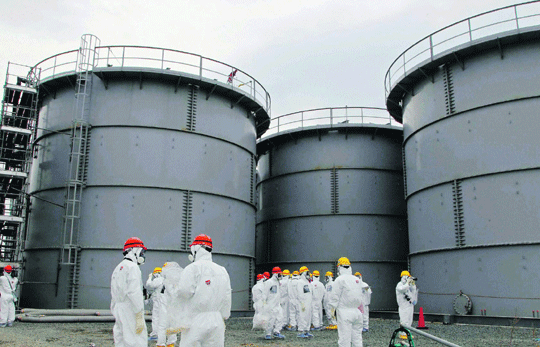
“What is the worse is the water leakage everywhere else – not just from the tanks. It is leaking out from the basements, it is leaking out from the cracks all over the place. Nobody can measure that. […]
“It is much worse than we have been led to believe, much worse,” said Mr Schneider, who is lead author for the World Nuclear Industry status reports. […] Full BBC report here
1 This Month

Read the Public Inquiry Report, the Commissioners’ report, Surrendering Australia: The AUKUS Deception is available to download for free at aukuspublicinquiry.com. Or just watch the replay of the National Press Club Luncheon.


19 November – Webinar – The Reality of Reprocessing
Time: 11:00 AM Pacific Time (US & Canada) / 2:00 PM Eastern / 7:00 PM UK / 8:00 PM CET
Register for the Zoom Event Here



Shut down the radiation-damaged Heysham nuclear reactors now
To see nuclear-related stories in greater depth and intensity – go to https://nuclearinformation.wordpress.com

Say No to NASA’s Reckless Nuclear Reactor on the Moon
Say No to NASA’s Reckless Nuclear Reactor on the Moon
-
Archives
- November 2026 (103)
- October 2026 (302)
- September 2026 (339)
- August 2026 (330)
- July 2026 (355)
- June 2026 (287)
- May 2026 (306)
- April 2026 (356)
- March 2026 (251)
- February 2026 (267)
- January 2026 (308)
- December 2025 (358)
-
Categories
- 1
- 1 NUCLEAR ISSUES
- business and costs
- climate change
- culture and arts
- ENERGY
- environment
- health
- history
- indigenous issues
- Legal
- marketing of nuclear
- media
- opposition to nuclear
- PERSONAL STORIES
- politics
- politics international
- Religion and ethics
- safety
- secrets,lies and civil liberties
- spinbuster
- technology
- Uranium
- wastes
- weapons and war
- Women
- 2 WORLD
- ACTION
- AFRICA
- Atrocities
- AUSTRALIA
- Christina's notes
- Christina's themes
- culture and arts
- Events
- Fuk 2022
- Fuk 2023
- Fukushima 2017
- Fukushima 2018
- fukushima 2019
- Fukushima 2020
- Fukushima 2021
- general
- global warming
- Humour (God we need it)
- Nuclear
- RARE EARTHS
- Reference
- resources – print
- Resources -audiovicual
- Weekly Newsletter
- World
- World Nuclear
- YouTube
-
RSS
Entries RSS
Comments RSS

