Could the Fukushima Ice Wall melt?
Nuke Fatigue & the 2020 Tokyo Olympics EE Times, Junko Yoshida, Chief International Correspondent, 6 Sept 13, “…………So far, I’ve heard no skeptics in Japan questioning the science and long-term viability of the technology behind the proposed ice wall — especially on NHK, Japan’s public broadcaster.
To hear the argument against it, I had to turn to Tuesday’s edition of the PBS Newshour, whose link my former colleague and science writer George Leopold sent via e-mail.
‘Risky experiment’
In the program, Arjun Makhijani, an engineer specializing in nuclear fusion and president of the Institute for Energy and Environmental Research, called the proposed ice wall scheme “a risky experiment.”
Looking at Risks if the Fukushima Ice Wall Defrosts
Makhijani explained that the Japanese “hope to freeze the soil, basically, with a giant freezing machine, just like your freezer at home, [to] put cooling coils in the soil, lots and lots of them.” He pointed out that this scheme “takes an enormous amount of electricity.” That is just what the Fujushima nuclear plant can’t do.
The biggest worry is potential power failures. Makhijani said:
…if the power fails, you know, just like if your — when the power goes out with your refrigerator, everything will de-freeze in — defrost in the freezer. Even though ice wall technology had been used frequently to stabilize the ground in big construction projects, like the Big Dig highway project in Boston, The New York Times pointed out that some critics are dubious.
They argue that it’s a costly technology “that would be vulnerable at the blackout-prone plant because it relies on electricity the way a freezer does, and even more so because it has never been tried on the vast scale that Japan is envisioning and was always considered a temporary measure, while at Fukushima it would have to endure possibly for decades.” http://www.eetimes.com/author.asp?section_id=36&_mc=SM_EET&itc=eetimes_sitedefault&doc_id=1319412&page_number=2
TEPCO continues to put out unreliable data on Fukushima radiation
Regulator Raps Fukushima Operator Over ‘Unreliable’ Data VOA, Reuters September 05, 2013 TOKYO — Tokyo Electric Power Co. [Tepco], the operator of the stricken Fukushima nuclear plant, is still putting out questionable data on radiation leaks, causing confusion and a heightened sense of crisis, according to Japan’s nuclear regulator.
 The stakes have been raised as Japan makes a final pitch for Tokyo to host the 2020 Olympic Games, while a steady stream of bad news from Fukushima, the site of the worst atomic disaster in a quarter of a century, leaves officials frustrated by Tepco’s missteps and miscalculations.
“As I’ve said before, Tokyo Electric has not been properly disclosing the situation about the contamination and the levels of contamination,” said Shunichi Tanaka, chairman of the Nuclear Regulation Authority [NRA]. “This has caused confusion domestically and internationally. Because of that, the Japanese government has a sense of crisis and I, personally, feel a little angry about it.”
“I wouldn’t go as far as to say Japan’s reputation has been made worse, but releasing incorrect information about the radiated water problem has created trouble around the world,” said Tanaka…… Officials have been keen to assure the world that Tokyo will be safe during the Olympics in seven years, if chosen. Prime Minister Shinzo Abe flies to Buenos Aires later on Thursday from a Group of 20 meeting in St. Petersburg to lead Tokyo’s final pitch before the Olympic committee. Madrid and Istanbul are the other contenders.
“We would like to host the 2020 Olympic and Paralympic Games here in Tokyo and welcome athletes, people affiliated with the events and visitors from all over the world,” said Chief Cabinet Secretary Yoshihide Suga, adding that food and water in Japan is safe….. http://www.voanews.com/content/reu-japan-regulator-raps-fukushima-operator-over-unreliable-data/1743815.html
Japanese people ‘in denial’ about Fukushima radiation – suffering ‘nuclear fatigue’?
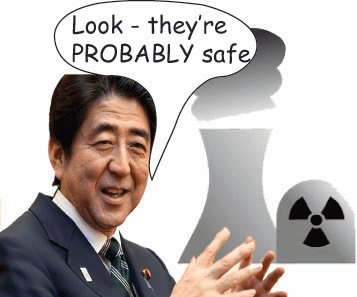
 Nuke Fatigue & the 2020 Tokyo Olympics, EE Times, Junko Yoshida, Chief International Correspondent 9/5/2013“………..What’s unacceptable to me, though, when I come back here, is to witness firsthand how Japan is handling the persistent radioactive leakage problem at the nuclear power plant in Fukushima. The people, the government, and the entire nation seem to be living in total denial.
Hitomi Nakayama, a lawyer and a long-time friend of mine since college days, calls it “nuclear fatigue.” She laments the fundamentally stoic nature of people in the stricken region of Tohoku. Some who lived in villages in Fukushima, heavily nuked as a result of the meltdown at the power plant, still harbor dreams of returning to their homes. Many have never even considered suing the plant’s operator, Tokyo Electric Power Company (Tepco). Instead, with a shrug, they say they’re thankful for Tepco’s contribution to economic growth in the region, Nakayama explained.
People and the media in Japan would rather talk about something else, like the 2020 Tokyo Olympics, as they look past the still unfolding nuclear crisis in Fukushima.
I’m sure I’m not alone in feeling troubled by the supine media here — who are insanely obsessed with the pending vote by the chronically corrupt International Olympic Committee. Japanese newspapers and TV are clearly dancing to the tune of those who badly want Tokyo to host the 2020 Summer Olympic Games.
In contrast, there is little public debate about the worst atomic horror in Japan since Nagasaki……
Cataracts in the eyes of birds in Chernobyl and Fukushima
the key factor determining the presence of the disease was the intensity of local radiation, with cataract scores of over one proving to be far more common in areas that were above ten microseiverts per hour
Birds live with cataracts in Chernobyl The Economist, Sep 7th 2013 CATARACTS are relatively common in people who live to a ripe old age. They are sometimes seen in animals that live in zoos as well, but in the wild they are almost unheard of. The reason is simple. Losing eyesight is in effect a death sentence for a wild animal that must find its own food and, should that animal live long enough to develop the disease, starvation or predation would quickly follow|cataracts unrelated to age are surprisingly common in birds living near the site of the Chernobyl nuclear disaster in 1986.
This is revealed in a new study by a pair of ornithologists, Timothy Mousseau of the University of South Carolina and Anders Moller of the University of Paris-Sud, which is published in the Public Library of Science. That cataracts and ionising radiation are related is well known. As high energy ions, usually produced by the sun’s rays, slam into the water found next to the lenses of the eyes, free radicals are created that damage DNA and cause errors to develop in the formation of proteins that make up the lenses, resulting in cataracts.
This led the researchers to suspect that cataracts in birds might be common in areas where there are high levels of ionising radiation, and they turned to Chernobyl as a study area. Continue reading
Japan Olympic Committee desperately spinning Tokyo’s safety from Fukushima radiation
Japan Olympic Committee delegates in radiation spin control Media trip up team while it tried to put best foot forward Japan Times, BY DAVE HUESTON, 5 Sept 13 KYODO, AP BUENOS AIRES – What should have been a resounding kickoff for the Tokyo 2020 bid with the International Olympic Committee’s vote coming Saturday turned into a fencing match as bid chief Tsunekazu Takeda tried to parry questions from the media about the Fukushima nuclear crisis.
Takeda, who is president of the Japanese Olympic Committee, and Fujio Cho, president of the Japan Sports Association and honorary chairman of Toyota Motor Corp., held a media event Wednesday in Buenos Aires to pitch Tokyo’s proposed marketing program and emphasize the capital’s certainty to deliver the games in first-class style……..
Death within hours – if you get close to Fukushima reactor’s radioactive areas

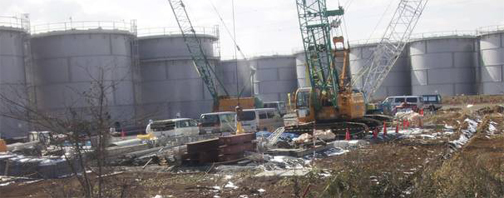 Nuclear disaster: Radiation levels at Fukushima would now be fatal within hours Raw Story, By Justin McCurry, The Guardian, September 4, 2013 The crippled Fukushima Daiichi nuclear power plant has radiation leaks strong enough to deliver a fatal dose within hours, Japanese authorities have revealed, as the government prepares to step in to help contain leaks of highly toxic water at the site.
On Wednesday the country’s nuclear regulation authority said radiation readings near water storage tanks at the Fukushima Daiichi nuclear power plant have increased to a new high, with emissions above the ground near one group of tanks were as high as 2,200 millisieverts [mSv] per hour – a rise of 20% from the previous high.
Earlier this week the plant’s operator, Tepco, said workers had measured radiation at 1,800 mSv an hour near a storage tank. That was the previous highest reading since Tepco began installing tanks to store huge quantities of contaminated water that have built up at the plant.
An unprotected person standing close to the contaminated areas would, within hours, receive a deadly radiation dose. The nuclear regulation authority said the radiation comprised mostly beta rays that could be blocked by aluminium foil, unlike more penetrative gamma rays…… http://www.rawstory.com/rs/2013/09/04/nuclear-disaster-radiation-levels-at-fukushima-would-now-be-fatal-within-hours/
Fukushima radiation exposure will later bring cancer death toll
 Nuclear Engineer on Radio: Unfortunately, the truth is there will be a large death toll from Fukushima — Damages to be seen “over the next century” — Disaster at plant is unprecedented in magnitude (AUDIO) http://enenews.com/radio-interview-nuclear-engineer-truth-death-toll-fukushima-will-be-large-hazard-will-remain-many-decades-disaster-plant-site-unprecedented-magnitude-audio
Title: Interview with Dave Lochbaum
Source: Linda Moulton Howe
Date: Aug. 29, 2013
Dave Lochbaum, Nuclear engineer, former Nuclear Regulatory Commission  instructor, current director of Union of Concerned Scientists’ Nuclear Safety Project: The Fukushima site is unprecedented in the magnitude — 3 reactor cores have melted down, 4 spent fuel pools that are in jeopardy, 3 buildings that exploded — so, they have a lot of problems. […]
Linda Moulton Howe, Emmy-nominated journalist: And Fukushima, the reality, without any sugar-coating is, that in the next 18 to 19 years, there will be a death toll from radiation exposure in Japan that will be large.
Lochbaum: Yes, that is unfortunately the truth. Plant operated for 40 years and will remain a hazard to people living around it for decades longer. Politicians and society will have to determine whether the benefits derived from those 40 years offset the damages done over the next century.
More from this interview on Linda Moulton Howe’s website here
Full broadcast here (subscribers only) — Interview currently available on YouTube here
Fukushima radiation spreads under pacific Ocean seabed
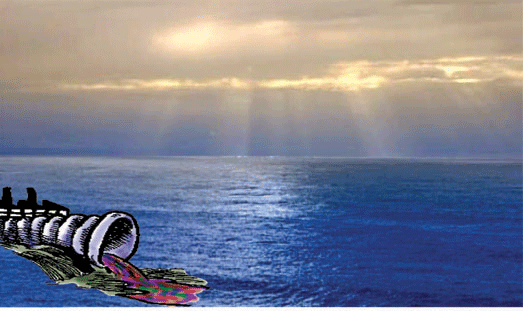 Japan Expert: Contamination from Fukushima is traveling “under the seabed” and spreading further out in Pacific Ocean — Measures needed to stop flow http://enenews.com/japan-expert-contamination-fukushima-traveling-seabed-spreading-further-pacific-ocean-measures-needed-stop-flow
Source: Associated Press
Author: MARI YAMAGUCHI
Date: Sept. 3, 2013
Atsunao Marui, an underground water expert at the National Institute of Advanced Industrial Science and Technology, said a frozen wall could be water-tight but is normally intended for use for a couple of years and is not proven for long-term use as planned in the outline. The decommissioning process is expected to take about 40 years.
“We still need a few layers of safety backups in case it fails,” Marui told the Associated Press. “Plus the frozen wall won’t be ready for another two years, which means contaminated water would continue to leak out.”
Marui said additional measures should be taken to stop contaminated water from keep traveling under the seabed during that time and leak further out in the sea.
See also: Japan Expert: Contamination from Fukushima flowing beneath seafloor? “Could spring up outside the port”
Wall of ice planned, to go underneath Fukushima nuclear plant
 Japan to build $470M ice wall to prevent nuclear leaks http://www.cbsnews.com/8301-202_162-57601127/japan-to-build-$470m-ice-wall-to-prevent-nuclear-leaks/ 4 Sept 13, The Japanese government announced Tuesday that it will spend $470 million on a subterranean ice wall and other steps in a desperate bid to stop leaks of radioactive water from the crippled Fukushima nuclear plant after repeated failures by the plant’s operator.
The decision is widely seen as an attempt to show that the nuclear accident won’t be a safety concern just days before the International Olympic Committee chooses among Tokyo, Istanbul and Madrid as the host of the 2020 Olympics.
The Fukushima Dai-ichi plant has been leaking hundreds of tons of contaminated underground water into the sea since shortly after a massive 2011 earthquake and tsunami damaged the complex. Several leaks from tanks storing radioactive water in recent weeks have heightened the sense of crisis that the plant’s owner, Tokyo Electric Power Co., isn’t able to contain the problem. Continue reading
Japan’s radioactive leaks to Pacific Ocean make it imperative to get international help
Nuclear error Japan should bring in international help to study and mitigate the Fukushima crisis. Nature, 03 September 2013 The radioactive water leaking from the site of the wrecked Fukushima Daiichi nuclear power plant in Japan is a stern reminder that we have not seen the end of the world’s largest nuclear crisis since the Chernobyl meltdown in Ukraine in 1986……..
The most important impacts of the leaks will be those on the sea off Fukushima and the larger Pacific Ocean, which must be closely monitored. After assessments by US and Japanese scientists in 2011 and 2012, two major questions remain unanswered. How much radioactivity is still entering the sea? And, given the high levels of radioactivity that have been measured in some species long after the accident, when will fish and seafood from the region be safe to consume? The leaks make it more urgent to find answers to these questions.
To make reliable assessments of any environmental effects, scientists need to be able to collect data on contamination of marine food webs with all long-lived radionuclides, and particularly with caesium-137, strontium-90 and plutonium-239. They also need to know the sources of contamination, and to study the transport of radionuclides in groundwater, sediments and ocean currents. Current Japanese Prime Minister Shinzo Abe and his government have promised to boost science; they should encourage and support researchers from around the world in collecting and sharing information. Chernobyl was a missed opportunity for post-accident research — in that sense at least, Fukushima could do much better. http://www.nature.com/news/nuclear-error-1.13667
More leaks found at Fukushima nuclear plant
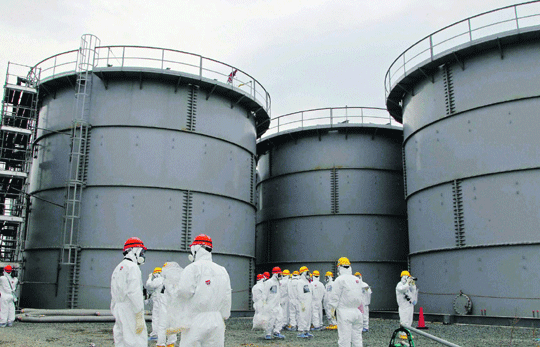 Fukushima Leaks: More Tank Leaks Found At Crippled Japanese Nuclear Plant HUFFINGTON POST, By MARI YAMAGUCHI 09/02/13 “……On Monday, Japan’s top nuclear regulator raised safety concerns about the hastily built storage tanks and their foundations after signs of new leaks.
One was found over the weekend in a connecting pipe, and plant operator, Tokyo Electric Power Co., said it suspects three storage tanks where elevated radioactivity was detected also have had leaks.
Nuclear Regulation Authority Chairman Shunichi Tanaka told a news conference that the small leak and possible other leaks have added to concerns about the plant’s stability.
They follow a major leak two weeks ago. TEPCO reported a loss of 300 tons of highly radioactive water from a steel tank on Aug. 19, saying most of it is believed to have seeped underground but some might have escaped into the sea. The company has yet to determine the cause or exactly where the water went.
More than 300 tanks there are of a similar type. About 1,000 tanks hold 330,000 tons of contaminated water at the plant, and the amount grows by 400 tons daily. The water is part of the makeshift system to keep the radioactive material at the plant stable. TEPCO also said it overlooked several signs of leaks – increases of radioactivity near the tanks and higher exposure levels for workers – for more than a month. http://www.huffingtonpost.com/2013/09/02/fukushima-leaks_n_3855621.html?ir=World
Spread of high radiation at Fukushima nuclear plant
High radiation spreads at ruined Fukushima plant, Japan vows aid SMH, September 3, 2013 – Tokyo: High radiation levels are spreading at the ruined Fukushima nuclear plant, its operator said on Monday, and the Japanese government prepared to offer more funding and oversight to try to contain the crisis. Japanese authorities were seeking to address criticism that Tokyo Electric Power Co has bungled the response to the world’s worst nuclear accident since Chernobyl.
Japanese officials fear the Fukushima crisis could threaten Tokyo’s bid to host the 2020 Olympics
“Tokyo Electric has been playing a game of whack-a-mole with problems at the site,” Trade and Economy Minister Toshimitsu Motegi said in a televised interview.
Prime Minister Shinzo Abe vowed to “step forward and implement all necessary policies” to deal with the flood of radioactive waste building up at Fukushima since the March 2011 reactor meltdown at Fukushima……….
Olympic Bid At Stake
Japan’s nuclear industry, which once provided a third of its energy, has ground nearly to a halt since the earthquake, causing reactor meltdowns. Restarting Japan’s idled reactors, and reducing its reliance on foreign energy supplies, is a central element of Abe’s economic growth plans.
Japanese officials also fear that international attention to the Fukushima crisis could threaten Tokyo’s bid to host the 2020 Olympics, a decision set to be made by the International Olympic Committee on Saturday in Buenos Aires.
Yasuhisa Shiozaki, deputy policy chief of the ruling Liberal Democratic Party and head of its project team on nuclear regulation, called for the creation of a “decommissioning agency” that could resemble Britain’s National Decommissioning Authority, a public body charged with managing the dismantling of the nation’s atomic power and research stations. http://www.smh.com.au/world/high-radiation-spreads-at-ruined-fukushima-plant-japan-vows-aid-20130903-2t1jf.html#ixzz2dssfzv3V
Out of control: Fukushima will finish off the nuclear industry
Professor Busby believes the situation is clearly out of control and that no one can go anywhere near it. “Nobody can go in to measure where these leaks are or do anything about them, because anybody who is to approach that sort of area would be dead quite quickly. They would be seriously harmed”
 What happens next is anyone’s guess,
This will have a domino impact on all nuclear reactors in my opinion. The cost of keeping those still operating will have to go up, and as the cost of decommissioning them becomes clearly extraordinary, often more than double the cost of building them, and sometimes, like Sellafield, orders of magnitude more, and in a climate of disappearing liquidity……… nobody will be able to afford to build any nukes. There simply won’t be the funds, as all the money that could have been used disappears down the blackhole of decommissionings.
The last nail in the Nuclear Coffin….http://damnthematrix.wordpress.com/2013/09/02/the-last-nail-in-the-nuclear-coffin/ 2 Sept 13, Things have been looking grim at Fukushima. First, they realised that for some time they had been using a radiation meter that could not read beyond 100 milli Sieverts and believed that this was the actual radiation level there…. only to find out with another instrument that levels were in fact much higher, and that hundreds of tonnes of highly radioactive water were leaking into the Pacific Ocean daily for…. well no one knows.
Then it was decided (as I recently reported) that fuel rods lying perilously in a damaged above ground leaking pool that keeps those rods from melting down and causing an actual out of control nuclear reactor (read explosion + mushroom cloud…) were going to be moved, by hand… because? Well the cranes that normally do this have been destroyed by the earthquake, presumably ably assisted by the tsunami.
At the time I commented “what could go wrong?”……..
Well…. things have actually taken a turn for the worse, even before the attempt to move the rods. Continue reading
Pacific Ocean – a handy drain for Fukushma’s radioactive trash
Use sea as nuclear sink, says Tokyo http://www.theaustralian.com.au/news/world/use-sea-as-nuclear-sink-says-tokyo/story-fnb1brze-1226709319491 BY:RICK WALLACE, TOKYO CORRESPONDENT September 03, 2013 THE head of Japan’s nuclear watchdog has flagged dumping contaminated water from the Fukushima Daiichi nuclear power plant into the Pacific Ocean amid mounting woes over storage and seepage of radioactive water.
But Nuclear Regulation Authority chairman Shunichi Tanaka said any water released would be treated to an extent that the level of contaminants was well below international limits.
“If (the situation) becomes more severe, and some water falls below regulatory limits, it might have to be discharged into the ocean,” he said yesterday in a speech to the Foreign Correspondents’ Club of Japan in Tokyo.
“I know this (previously) created a great stir in some circles. However, I will absolutely not support the dumping of water where the level of contamination is above the limits.”
Mr Tanaka said properly functioning nuclear plants dumped contaminated water into the ocean as part of normal operations, provided it met the limits.
But any discharge of water – irrespective of the level of decontamination carried out – is likely to spark outrage from environmentalists, fishing operators and neighbouring countries. Continue reading
India, Japan, negotiating purchase of nuclear reactors
 India, Japan to restart nuclear talks today NEW DELHI, DHNS: Sep 3, 2013 India will continue to stonewall pressure from Japan to convert its unilateral moratorium on nuclear tests into a bilateral commitment, even as the two countries are set to restart negotiations on a proposed agreement for cooperation in civilian use of atomic energy on Tuesday.
Over two years after the accident at its Fukushima Daiichi nuclear plant prompted Japan to pause talks with India for a bilateral civil nuclear cooperation agreement, the process is now set to resume. The negotiations, however, are likely to be tough, as New Delhi will resist Tokyo’s pressure to add a clause to the agreement providing for termination of bilateral cooperation in the event of a nuclear test conducted by India.
Sources told Deccan Herald that India would also insist on protecting its right to reprocess the fuel spent on nuclear reactors to be procured under the agreement with Japan.
Two officials of the Ministry of External Affairs—Joint Secretary (East Asia) Gautam Bambawale and Joint Secretary (Disarmament) Bala Venkatesh Varma—are in Tokyo to restart the talks……. http://www.deccanherald.com/content/354971/india-japan-restart-nuclear-talks.html
1 This Month





PLEASE OPPOSE HR 8255 AND S.3639 – bills would accelerate satellite deployment, with no environmental review or safeguards – https://ncstd5li.quorum.us/campaign/169331/
To see nuclear-related stories in greater depth and intensity – go to https://nuclearinformation.wordpress.com
-
Archives
- October 2026 (67)
- September 2026 (339)
- August 2026 (330)
- July 2026 (355)
- June 2026 (287)
- May 2026 (306)
- April 2026 (356)
- March 2026 (251)
- February 2026 (267)
- January 2026 (308)
- December 2025 (358)
- November 2025 (359)
-
Categories
- 1
- 1 NUCLEAR ISSUES
- business and costs
- climate change
- culture and arts
- ENERGY
- environment
- health
- history
- indigenous issues
- Legal
- marketing of nuclear
- media
- opposition to nuclear
- PERSONAL STORIES
- politics
- politics international
- Religion and ethics
- safety
- secrets,lies and civil liberties
- spinbuster
- technology
- Uranium
- wastes
- weapons and war
- Women
- 2 WORLD
- ACTION
- AFRICA
- Atrocities
- AUSTRALIA
- Christina's notes
- Christina's themes
- culture and arts
- Events
- Fuk 2022
- Fuk 2023
- Fukushima 2017
- Fukushima 2018
- fukushima 2019
- Fukushima 2020
- Fukushima 2021
- general
- global warming
- Humour (God we need it)
- Nuclear
- RARE EARTHS
- Reference
- resources – print
- Resources -audiovicual
- Weekly Newsletter
- World
- World Nuclear
- YouTube
-
RSS
Entries RSS
Comments RSS

