TEPCO has been lying for 2 years, about radiation levels at Fukushima
 Tepco admits to reporting false radiation levels for nearly 2 years at Fukushima http://enenews.com/tepco-admits-to-reporting-false-radiation-levels-for-past-2-years-at-fukushima
KBS, Sept. 14, 2013: Japanese media say the Tokyo Electric Power Company (TEPCO) reported lower than actual levels of radioactivity in waters around the Fukushima Daiichi nuclear plant for nearly two years. […] TEPCO said the inaccurate measurements were taken from July 2011 until May this year, resulting in concentration levels of radioactive cesium being reported some becquerels lower than the actual level. It said the measurements were taken one-point-three kilometers south of the nuclear plant. […]
NHK, Sept 14, 2013: TEPCO under-reported cesium measurements […] After being notified of the error by the Nuclear Regulation Authority, TEPCO discovered that its previous per-liter measurements were several becquerels lower than actual figures. TEPCO says the error was due to the wrong assessment of the impact of radiation in the surrounding area. […] Experts at the meeting criticized what they called an elementary mistake. They also said the matter should not be left to TEPCO alone and called for the Authority’s involvement.
The perilous state of Fukushima nuclear buildings Nos 1 to 4
Endless Fukushima catastrophe: 2020 Olympics under contamination threat Dr Helen Caldicott RT.com: September 15, 2013“…….The levels of radiation in buildings 1, 2 and 3 are now so high that no human can enter or get close to the molten cores. It will therefore be impossible to remove these cores for hundreds of years if ever
Buildings 1, 2 & 3
If one of these buildings collapses, the targeted flow of cooling water to the pools and cores would cease, the cores would become red hot and possibly ignite releasing massive amounts of radiation into the air and water and the fuel in the cooling pools could ignite. It is strange that neither the US government in particular nor the global community seem to be concerned about these imminent possibilities and exhibit no urge to avert catastrophe.
Similarly the global media is strangely disconnected with the ongoing crisis. Most importantly, the Japanese government until very recently has obstinately refused to invite and collaborate with foreign experts from nuclear engineering companies and/or governments.
Building 4
This structure was severely damaged during the initial quake, its walls are bulging, and it sank 31 inches (79cm) into the ground. On the roof sits a cooling pool containing about 250 tons of hot fuel rods, most of which had just been removed from the reactor core days before the earthquake struck. This particular core did not melt because TEPCO was able maintain a continuous flow of cooling water, so the rods and their holding racks are still intact, but geometrically deformed due to the force of the hydrogen explosion.
The cooling pool contains 8,800 pounds of plutonium plus over 100 other highly radioactive isotopes. Instead of this core melting into a larval mass like the other three cores, it sits exposed to the air atop the shaky building. A large earthquake could disrupt the integrity of the building, causing it to collapse and taking the hot fuel rods with it. The cooling water would evaporate and the intrinsic heat of the radioactive rods would ignite a fire as the zirconium cladding reacted with air, releasing the radioactive equivalent of 14,000 Hiroshima-sized bombs and 10 times more cesium than Chernobyl……..http://rt.com/op-edge/fukushima-catastrophe-nuclear-olympics-883/
Costly clean-up not likely to make Fukushima area habitable again
 Return to the radiation zone: Fukushima clean-up operation mired in fear and misinformation Two years after Japan’s nuclear power plant disaster nobody knows for certain how dangerous the contamination
  is THE INDEPENDENT DAVID MCNEILL
  , MIGUEL QUINTANA FUKUSHIMA WEDNESDAY 11 SEPTEMBER 2013″……..Nobody knows for certain how dangerous the radiation is. Japan’s central government refined its policy in December 2011, defining evacuation zones as “areas where cumulative dose levels might reach 20 millisieverts per year [20 mSv/yr],” the typical worldwide limit for nuclear power plant engineers and other radiation workers.
The worst radiation is supposed to be confined to the 20km exclusion zone, but it spread unevenly: less than 5km north of the Daiichi plant, our Geiger counter shows less than 5 millisieverts a year; 40km north west, in parts of Iitate village, it is well over 120 millisieverts. Those 160,000 refugees have not returned and are scattered throughout Japan. The nuclear diaspora is swelled by thousands of voluntary refugees who, unlike the Saitos, have not returned. Local governments are spending millions of dollars to persuade them back. Continue reading
Formal complaint from Japan, over French cartoons about Tokyo Olympic Games
Japan voices anger over French cartoons that use Fukushima disaster to mock Olympics decision ABC News, By North Asia correspondent Mark Willacy, wires 12 Sep 2013 ,Japan says it will lodge a formal complaint with France over newspaper cartoons that poked fun at the decision to award the 2020 Olympics to Tokyo despite the ongoing Fukushima nuclear crisis.
Satirical weekly Le Canard Enchaine has published a cartoon depicting two sumo wrestlers, each with an extra leg or arm, facing off with the crippled Fukushima nuclear plant in the background.
In the foreground an announcer says: “Thanks to Fukushima, sumo is now an Olympic sport.”
Another cartoon shows two people standing in front of a pool of water while wearing nuclear protection suits and holding a Geiger counter, saying water sport facilities had already been built at Fukushima………
“This kind of journalism gives the wrong impression about the waste water problem.” [ -Japanese government spokesman Yoshihide Suga]
The government has repeatedly claimed the accident and its waste water problem are under control and should not affect the Olympics.
Mr Suga says Japan will formally complain to the French embassy in Tokyo……….. http://www.abc.net.au/news/2013-09-12/japan-protests-french-fukushima-cartoons/4954462
Appeal to United Nations to awaken the world to the Fukushima nuclear crisis
Help Educate Decision Makers About Fukushima Risks! http://salsa.democracyinaction.org/o/568/p/dia/action/public/?action_KEY=10780
Dear Mr. Secretary-General, I am extremely worried about the lack of the sense of crisis in Japan and abroad,as regards the worsening situation at the Fukushima Daiichi.
The international community is required to prevent the Fukushima accident from developing into the ultimate catastrophe of the world, a possibility the collapse of the Unit 4 by a mega earthquake could turn into a reality. It could happen at any moment! Faced with this unprecedented crisis, the mobilization of human wisdom is required on the widest possible scale. The full assumption of responsibilities by the Japanese Government is urgently needed.
The present abnormal lack of the sense of crisis is due to the fact that inconvenient truth is not disclosed. The international community has the duty, for example, to grasp correctly the precise volume of the continuous release of radiation from Fukushima.
In this connection, the official numbers published by Tepco, 10milliom BQ/H, unchanged for the last year and half, could hardly be trusted. They remain unchanged even after the revelation by Tepco that, since the accident in 2011, 400 tons of contaminated water daily leaked into the sea. Now the Government admits that 300 tons daily [60,000 gallons] flow into the sea.
The situation is worsening. And no solution in sight !
The so called international strategy to consider that Fukushima accident did not happen, as some papers writes, is doomed to failure. This strategy is evidenced by the continued promotion of nuclear reactors worldwide, and their restarting and exporting by Japan..Even if it succeeds to hide the head, it cannot hide the tail that is the contamination of the ocean on a planetary scale.
Conscientious citizens are now calling for the withdrawal of the invitation for Olympic games by Japan. Allow me to count on your understanding and support.Yours truly,
Mitsuhei Murata
Former Japanese Ambassador to Switzerland
Japan desperate to sell nuclear reactors overseas
 Reactor makers look abroad as home market fizzles , Japan Times, BY KAZUAKI NAGATA 10 Sept 13, The Fukushima meltdowns and the continuing radiation crisis may have turned the public off of atomic energy at home, but it’s full steam ahead for Prime Minister Shinzo Abe and Japan’s heavy industries when it comes to exporting that technology to power-hungry economies abroad.
The marketing push being led by Abe and his Liberal Democratic Party, which brought Japan into the nuclear age, has angered nuclear protest groups, which, like many members of the public, blame the party’s cozy ties with big business for setting the stage for the Fukushima meltdown debacle.
Here are some questions and answers about Japan’s nuclear technology exports: How does the process of exporting nuclear plants work? Continue reading
Hilariously, Tokyo’s Olympic Games are being billed the “Safe Games” of 2020.
 As Fukushima radiation rages, Tokyo awarded bid to host 2020 Summer Olympics, hilariously named the ‘Safe Games’ September 08, 2013 by Mike Adams (NaturalNews) Despite the fact that Fukushima is already the worst radiological disaster in human history — and worsening by the day — Japan has been chosen as the host nation for the 2020 Summer Olympics.
Hilariously, the event is being billed the “Safe Games” of 2020.
How, exactly, is it safe to host the Olympics in a nation which absolutely no workable evacuation routes from a nuclear facility on the verge of collapsing into another deadly radiation release? The answer to that question is provided by Japan’s Prime Minister Abe. He claims that Fukushima is no problem whatsoever, that no one has ever been harmed by it, and that it is fully under control! (A trifecta, he thinks…)……..
Japan cannot be evacuated
The fact that the Olympic committee chose Japan even while Fukushima rages on, just one earthquake away from a catastrophic collapse and unprecedented release of deadly radiation, tells you just how incredibly stupid the Olympics decision makers really are. (Or how paid off they are, as bribes and corruption have been well documented throughout the history of the Olympics).
Do these people not grasp even the most fundamental concepts of physics? Why would any sane organization vote to host a global event that brings hundreds of thousands of people to a location just a short distance away from a collapsing nuclear power plant that is utterly and completely out of control with no end in sight?
Furthermore, Japan has no workable evacuation plan if Fukushima’s reactor #4 does experience a structural collapse followed by a catastrophic release of radiation. There is no evacuation plan because Japan cannot be evacuated, period. Thus, the strategy of the Japanese government has become one of D-E-N-I-A-L instead of problem solving.
Let’s all pretend radiation is no longer a problem, shall we? Japan is pretending. The U.S. is pretending, and now the Olympic committee is pretending, too.
As long as they’re pretending, why not host the Olympics at the Fukushima Dai-Ichi nuclear power facility? It’s available, after all. And the rent is dirt cheap.
Learn more: http://www.naturalnews.com/041964_Olympics_Tokyo_Fukushima_radiation.html#ixzz2eQZtdf5O
Things at Fukushima are going badly – it’s a war-like situation

 Japan Media: “Things are going badly” — Fukushima “the same as war” says military officer in charge of forces at plant — Concern “workers on-site do not consent to join battle” — Crime skyrocketing, “people were held hostage” — Unprecedented ocean contamination and leaks are out of control http://enenews.com/japan-media-things-are-going-badly-fukushima-same-as-war-says-military-officer-in-charge-of-forces-at-plant-concern-workers-on-site-do-not-consent-to-join-battle-crime-skyrocketi
Jiji Press, , Sept. 6, 2013: Crime up among No. 1 plant staff […] In the first eight months of this year, 74 such workers were charged with crimes such as theft and fights resulting in injury. The figure is already close to three times the 2012 total of 26. The police reported only one such suspect in 2011 […] They were mostly suspected of theft […] or of harming others during brawls in their lodgings or bars. In one extreme case, people were held hostage as a result of a disagreement over hiring practices. […]
Mainichi, Sept. 2, 2013: Things are going badly. There’s radioactive water leaking, and it can’t be controlled. […] if the workers on-site do not consent to join battle, if they cannot muster the courage to keep up the fight, then we cannot expect real progress. At least, that’s the impression I got after talking with one of those workers […] I cannot write the worker’s name, or age, or job description here. But I can say that he is not an agitator […] he is a completely average employee [… “]we’re not getting any extra staff. The management says ‘do this’ and ‘do that,’ but I don’t think they really consider the workers’ radiation exposure doses at all. “Recently, some government minister came here (to the plant) and ran his mouth, right? When I see stuff like that, I think, ‘Gimme a break! What the hell do you know about anything?’” […] I’ve heard the officer in charge of the Self-Defense Forces efforts at the Fukushima plant describe the situation as being “the same as war.” […] The workers at the Fukushima plant deeply distrust those in Tokyo […] The waters next to the plant have been subject to unprecedented nuclear contamination […] After so much continuous failure, we must repair the damage done to Japan’s international reputation.
See also:
AP: Fukushima Daiichi workers could try to sabotage plant, warns their doctor
Bribery and corruption in Olympic Games Tokyo choice?

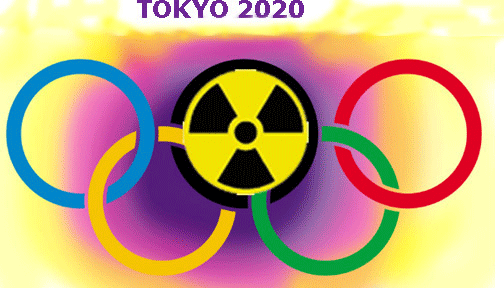 Boycott The Radioactive 2020 Olympics . http://www.rense.com/general96/boycott.html rense.com By Yoichi Shimatsu 9-8-13 It does not take 20/20 vision to realize that the corrupt Japanese government has bribed the International Olympic Committee to make the suicidal decision to send young athletes into the radioactive fallout from Fukushima. The decision in Buenos Aires to award Tokyo as host city of the 2020 Games did not arise from a lack of choices between Istanbul and Madrid, but was a knowing decision that is incomprehensible except for the factor of bribery. To risk the lives of young people and their supporters is more than an ethical lapse, it is a crime of manslaughter to the cruelest degree.
The bidding for the Games were rigged from the start by a quintet of disreputable character and dubious association, including former capital governor Shintaro Ishihara, Prime Minister Shinzo Abe, Education Minister Hakubun Shimomura and Japan Olympic Chairman Tsunekazu Takeda, scion and successor to a heinous war criminal. Their industrial partner, is Fujio Cho, honorary chairman of Toyota Motor Company and chief of the Japan Sports Association
During their promotion campaign for the Games of Death, these five Japanese officials spun outright lies claiming that there are zero leaks of radioactive water from the Fukushima nuclear plant. Continue reading
Fukushima’s spiking radiation requires international help, not just Japan’s short term fix
Readings just above the ground near a set of tanks at the plant showed radiation as high as 2,200 millisieverts (mSv), Japan’s Nuclear Regulation Authority (NRA) said Wednesday. The previous high in areas holding the tanks was the 1,800 mSv recorded Saturday.
Both levels would be enough to kill an unprotected person within hours.
The measures do not address the full problem of water management at the plant or the bigger issue of decommissioning.
Critics said the government was mainly trying to cool down international media coverage ahead of the Olympics decision. A more sustainable option, he said, would be to seek global support to confront Fukushima’s unprecedented challenges
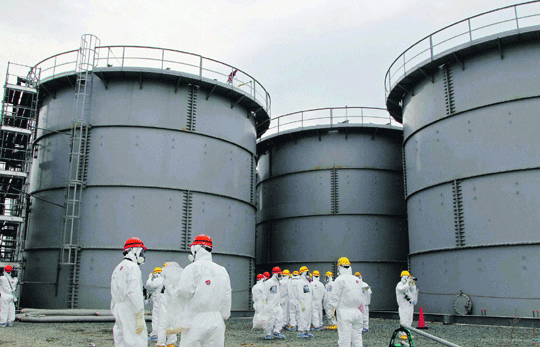 Fukushima radiation readings spike to highest levels Aljazeera September 4, 2013 The readings have jumped by more than a fifth Radiation readings around tanks holding contaminated water at the crippled Fukushima Daiichi nuclear plant have spiked by more than a fifth to their highest levels, Japan’s nuclear regulator said Wednesday, heightening concerns about the cleanup of the worst atomic disaster in almost three decades.
Radiation hot spots have spread to three holding areas for hundreds of hastily built tanks storing water contaminated by being flushed over three reactors that melted down at the Fukushima Daiichi plant in March 2011.
The rising radiation levels and leaks at the plant further inflamed international alarm, one day after the Japanese government said that it would step in with almost $500 million of funding to fix the growing levels of contaminated water at the plant. Continue reading
The shady Fukushima deniers behind Tokyo’s Olympic Games bid
Boycott The Radioactive 2020 Olympics Of Death http://www.rense.com/general96/boycott.html rense.com By Yoichi Shimatsu 9 Sept 13, ……The modern Olympics are dominated openly and secretly by the fraternity of noblemen, who provide camouflage for their financiers from organized crime and the arms industry……….
Contamination and Filth A quick look at each of these Olympic fixers and Fukushima deniers is in order, beginning with former Tokyo Governor Shintaro Ishihara. Long before the wheeling and dealing in Buenos Aires, Tokyo’s bid was tarnished by media allegations that Shintaro Ishihara has siphoned off Olympic-bid donations to finance his boat trips to the disputed Senkaku-Diaoyu islands for planned construction of helipads and a dock for warships. His deep pockets, filled by notorious elements in the Ginza nightlife district (who also provide the manpower for his foreign-policy adventurism) has meant immunity from Tokyo prosecutors, police and fellow politicians. Donations for Olympic, in short, were used by the far right to foment yet another war of aggression by Japan against China.
The world wills crutinise the costs and hazards of Tokyo’s Olympic Games plan
Some have questioned the merits of embarking on such a costly exercise before Japan has addressed its huge public debt – now more than twice the size of its gross national product – and when so little progress has been made toward rebuilding its tsunami-hit northeast coast and decommissioning Fukushima Daiichi.
Having intervened to calm fears about radiation levels in Tokyo, Abe appears to recognize that, for the next seven years, the world will be scrutinizing his response to the nuclear plant’s myriad challenges even more closely than before.
Tokyo 2020: No nuclear worries for IOC, Christan Science Monitor, Tokyo was awarded the 2020 summer Olympics, with the International Olympic Committee convinced that continued leaks from a nuclear power plant in Fukushima are no threat to safety. By Justin McCurry / September 8, 2013 “………..It took an intervention by Japan’s prime minister, Shinzo Abe, who left the G20 summit in Russia early to attend the vote in Buenos Aires, to offer the strongest assurance yet that Tokyo is safe. The situation at the plant was “under control,” he said.
“It has never done and will never do any damage to Tokyo,” he added. “There are no health-related problems until now, and nor will there be in the future. I say this to you in the most emphatic and unequivocal way.”
Leaking concerns Continue reading
Tokyo the “safe choice” for 2030 Olympics?
For 2020 Olympics, I.O.C. Picks Tokyo, Considered Safe Choice, NYT By JERÉ LONGMAN and MARTIN FACKLER September 7, 2013 “……….As Tokyo made its final presentation, Abe, Japan’s prime minister, addressed the issue of the crippled Fukushima nuclear power plant, which is about 155 miles from Tokyo. The nuclear disaster there is considered the worst since Chernobyl’s in 1986, and problems have plagued the cleanup and control efforts.
“Let me assure you that the situation is under control,” Abe said. “It has never done and will never do any damage to Tokyo.”
Gerhard Heiberg, an I.O.C. delegate from Norway, asked Abe how he could make such guarantees. Abe replied that there were no health-related problems related to the nuclear disaster, “nor will there be in the future.”
The Japanese government has pledged nearly $500 million to try to stabilize the nuclear plant, including the building of a frozen wall to curb the flow of groundwater into the contaminated buildings at the reactor site.
Some critics have accused Japanese leaders of being misleading or in denial about the severity of the radiation problem. South Korea, for instance, has banned fish imports from the Fukushima area. But Olympic delegates were sufficiently convinced that the nuclear disaster would not hinder the 2020 Games.
“A lot of folks have been reading in the media that hundreds of tons of radioactive water are being fed into the Pacific every day,” Pound said.
Abe seemed to be saying, “I’m satisfied on that so that nothing will happen,” according to Pound, who added, “If there’s another earthquake or something like that, that’s not something you can blame the prime minister for.”……. http://www.nytimes.com/2013/09/08/sports/olympics/tokyo-wins-bid-for-2020-olympics.html?pagewanted=all&_r=0
Fukushima nuclear reactor No 4 – a dangerous global worry
NYTimes: Countries increasingly worried about Fukushima Unit 4 spent fuel — Experts: Concern over potential cracks in pool walls — Professors: “In deteriorating condition”; “This is a critical global issue”; “Could have fatal consequences for Japan”http://enenews.com/spent-fuel-pool-4
New York Times, Sept. 3, 2013: […] thousands of workers and a small fleet of cranes are preparing for one of the latest efforts to avoid a deepening environmental disaster that has China and other neighbors increasingly worried: removing spent fuel rods from the damaged No. 4 reactor building and storing them in a safer place. […]
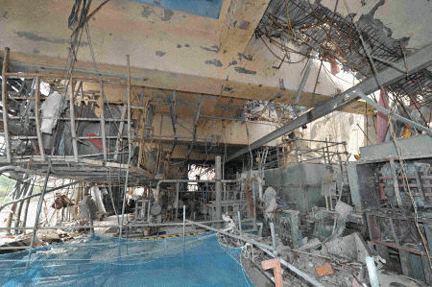
Xinhua, Sept. 4: […] Mitsuhei Murata, a former Japanese ambassador to Switzerland has officially called for the withdrawal of Tokyo’s Olympic bid, due to the worsening crisis at Fukushima, which experts believe is not limited to storage tanks, but also potential cracks in the walls of the spent nuclear fuel pools. […]
Telegraph,Sept 4, 2013: […] Tom Snitch, a senior professor at the University of Maryland and with more than 30 years’ experience in nuclear issues, said “[Japan officials] need to address the real problems, the spent fuel rods in Unit 4 and the leaking pressure vessels,” he said. “There has been too much work done wiping down walls and duct work in the reactors for any other reason then to do something. […] This is a critical global issue and Japan must step up.”
Japan Focus, Sept. 2, 2013: […] from November, TEPCO plans to begin the delicate operation of removing spent fuel from Reactor No. 4 fuel pool. […] The spent-fuel pool […] was damaged by the earthquake and tsunami, and is in a deteriorating condition. It remains vulnerable to any further shocks, and is also at risk from ground liquefaction. […] If a fuel rod is dropped, breaks or becomes entangled while being removed, possible worst case scenarios include a big explosion, a meltdown in the pool, or a large fire. […] This is literally a matter of national security – another mistake by TEPCO could have incredibly costly, even fatal, consequences for Japan. […]
Concrete burial a better option for Fukushima- but not good for PR?
Japan Expert: Covering Fukushima reactors in concrete like at Chernobyl should be considered — Nuclear Official: If we just buried them, no one would want to look at another nuke plant http://enenews.com/japan-expert-covering-fukushima-reactors-concrete-like-chernobyl-be-considered-nuclear-official-buried-one-look-another-nuke-plant-years
Title: Errors Cast Doubt on Japan’s Cleanup of Nuclear Accident Site
Source: New York Times
Author: Martin Fackler
Date: Sept. 3, 2013
[…] some experts dismiss the current cleanup plans as just a way of defending the status quo by convincing the public that the damage can be undone […]
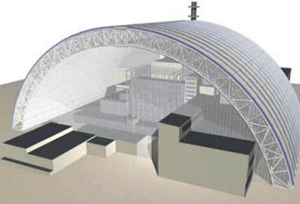 Harutoshi Funabashi, a sociologist at Hosei University who led a critical examination of the recovery efforts by the Science Council of Japan […] and other critics say Japan should consider other options, including the tactic adopted by the former Soviet Union at Chernobyl of essentially capping the shattered reactors in concrete and declaring the most contaminated towns off limits for a generation.
Japanese officials said the large amounts of groundwater under the plant mean that just covering the reactors with concrete would fail to contain the spread of radiation. They also said giving up on a large portion of Fukushima was not an option in a densely populated country where land remains a scarce commodity.
But they also suggested that the reason for eschewing a Soviet-style option may be the fear that failure could turn a wary public even more decisively against Japan’s nuclear industry.
“If we just buried the reactors, no one would want to see the face of another nuclear power plant for years,” said Shunsuke Kondo, chairman of the Atomic Energy Commission, an advisory body in the Cabinet Office. […]
See also: Bloomberg: Tepco now in talks to cover Fukushima reactors with concrete for next 75 years — Officials reviewing plan in U.S.
1 This Month





PLEASE OPPOSE HR 8255 AND S.3639 – bills would accelerate satellite deployment, with no environmental review or safeguards – https://ncstd5li.quorum.us/campaign/169331/
To see nuclear-related stories in greater depth and intensity – go to https://nuclearinformation.wordpress.com
-
Archives
- October 2026 (67)
- September 2026 (339)
- August 2026 (330)
- July 2026 (355)
- June 2026 (287)
- May 2026 (306)
- April 2026 (356)
- March 2026 (251)
- February 2026 (267)
- January 2026 (308)
- December 2025 (358)
- November 2025 (359)
-
Categories
- 1
- 1 NUCLEAR ISSUES
- business and costs
- climate change
- culture and arts
- ENERGY
- environment
- health
- history
- indigenous issues
- Legal
- marketing of nuclear
- media
- opposition to nuclear
- PERSONAL STORIES
- politics
- politics international
- Religion and ethics
- safety
- secrets,lies and civil liberties
- spinbuster
- technology
- Uranium
- wastes
- weapons and war
- Women
- 2 WORLD
- ACTION
- AFRICA
- Atrocities
- AUSTRALIA
- Christina's notes
- Christina's themes
- culture and arts
- Events
- Fuk 2022
- Fuk 2023
- Fukushima 2017
- Fukushima 2018
- fukushima 2019
- Fukushima 2020
- Fukushima 2021
- general
- global warming
- Humour (God we need it)
- Nuclear
- RARE EARTHS
- Reference
- resources – print
- Resources -audiovicual
- Weekly Newsletter
- World
- World Nuclear
- YouTube
-
RSS
Entries RSS
Comments RSS

