The world wills crutinise the costs and hazards of Tokyo’s Olympic Games plan
Some have questioned the merits of embarking on such a costly exercise before Japan has addressed its huge public debt – now more than twice the size of its gross national product – and when so little progress has been made toward rebuilding its tsunami-hit northeast coast and decommissioning Fukushima Daiichi.
Having intervened to calm fears about radiation levels in Tokyo, Abe appears to recognize that, for the next seven years, the world will be scrutinizing his response to the nuclear plant’s myriad challenges even more closely than before.
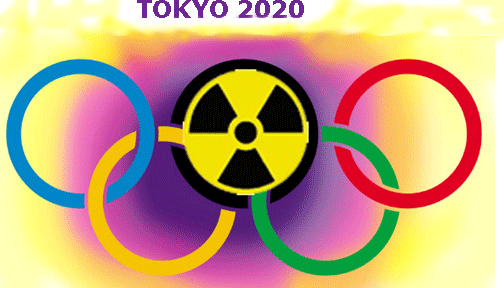 Tokyo 2020: No nuclear worries for IOC, Christan Science Monitor, Tokyo was awarded the 2020 summer Olympics, with the International Olympic Committee convinced that continued leaks from a nuclear power plant in Fukushima are no threat to safety. By Justin McCurry / September 8, 2013 “………..It took an intervention by Japan’s prime minister, Shinzo Abe, who left the G20 summit in Russia early to attend the vote in Buenos Aires, to offer the strongest assurance yet that Tokyo is safe. The situation at the plant was “under control,” he said.
“It has never done and will never do any damage to Tokyo,” he added. “There are no health-related problems until now, and nor will there be in the future. I say this to you in the most emphatic and unequivocal way.”
Leaking concerns
Abe’s optimism surprised many, coming so soon after the plant’s operator Tokyo Electric Power (Tepco) belatedly admitted last month that about 300 tonnes of contaminated groundwater is leaking into the Pacific Ocean every day. That was followed by reports of leaks from poorly monitored water tanks and the use of substandard equipment to measure radiation levels.
Abe’s repeated attempts to play down radiation fears in Tokyo were far from reassuring, said one woman among the 160,000 Fukushima residents who had to flee their homes after the March 2011 tsunami on Japan’s northeast coast caused a triple meltdown at the nuclear plant.
Instead, they “only serve to show that the situation in Fukushima is serious,” she told the Mainichi Shimbun shortly before the IOC decision. The Tokyo Olympics will make use of refurbished existing venues and several new sports arenas. Along with infrastructure projects, the cost of hosting has been estimated at just under $8 billion, more than half of which is already in the bank.
The centerpiece will be a futuristic, 80,000-seat main stadium shaped like an aerodynamic bicycle helmet. Organizers claim the games will be the most compact in Olympic history, with 85 percent of the venues within five miles of the athletes’ village.
Hosting the games could produce economic effects of more than US$40 billion and create more than 150,000 jobs, according to an estimate by SMBC Nikko Securities.
Japan’s economy will benefit from rising demand in the construction sector, the report said, along with an expected boom in sales of Olympic-related goods and consumer electronics. The government hopes to attract 8.5 million tourists during the event.
Tokyo’s victory would “cheer up the Japanese people, and above all, bring courage and hope to those in areas affected” by the earthquake, Hiromasa Yonekura, head of the Japan Business Federation, said in a statement. The momentum generated by Olympic redevelopment in Tokyo, increased tourism and investment in infrastructure would drive Japan’s economic recovery, he added.
Some have questioned the merits of embarking on such a costly exercise before Japan has addressed its huge public debt – now more than twice the size of its gross national product – and when so little progress has been made toward rebuilding its tsunami-hit northeast coast and decommissioning Fukushima Daiichi.
Having intervened to calm fears about radiation levels in Tokyo, Abe appears to recognize that, for the next seven years, the world will be scrutinizing his response to the nuclear plant’s myriad challenges even more closely than before.
“We have made promises,” he said after the vote. “Now we have a responsibility to meet those expectations.” http://www.csmonitor.com/World/Asia-Pacific/2013/0908/Tokyo-2020-No-nuclear-worries-for-IOC
No comments yet.
1 This Month
23-25 October – on Zoom – World BEYOND War’s annual global conferenc

To see nuclear-related stories in greater depth and intensity – go to https://nuclearinformation.wordpress.com

Say No to NASA’s Reckless Nuclear Reactor on the Moon
Say No to NASA’s Reckless Nuclear Reactor on the Moon
-
Archives
- October 2026 (149)
- September 2026 (339)
- August 2026 (330)
- July 2026 (355)
- June 2026 (287)
- May 2026 (306)
- April 2026 (356)
- March 2026 (251)
- February 2026 (267)
- January 2026 (308)
- December 2025 (358)
- November 2025 (359)
-
Categories
- 1
- 1 NUCLEAR ISSUES
- business and costs
- climate change
- culture and arts
- ENERGY
- environment
- health
- history
- indigenous issues
- Legal
- marketing of nuclear
- media
- opposition to nuclear
- PERSONAL STORIES
- politics
- politics international
- Religion and ethics
- safety
- secrets,lies and civil liberties
- spinbuster
- technology
- Uranium
- wastes
- weapons and war
- Women
- 2 WORLD
- ACTION
- AFRICA
- Atrocities
- AUSTRALIA
- Christina's notes
- Christina's themes
- culture and arts
- Events
- Fuk 2022
- Fuk 2023
- Fukushima 2017
- Fukushima 2018
- fukushima 2019
- Fukushima 2020
- Fukushima 2021
- general
- global warming
- Humour (God we need it)
- Nuclear
- RARE EARTHS
- Reference
- resources – print
- Resources -audiovicual
- Weekly Newsletter
- World
- World Nuclear
- YouTube
-
RSS
Entries RSS
Comments RSS


Leave a Reply