Fukushima children and adolescents have unusually high rates of thyroid cancer
 Thyroid Cancer Detection by Ultrasound Among Residents Ages 18 Years and Younger in Fukushima, Japan: 2011 to 2014. http://journals.lww.com/epidem/Abstract/publishahead/Thyroid_Cancer_Detection_by_Ultrasound_Among.99115.aspx by Tsuda, Toshihide; Tokinobu, Akiko; Yamamoto,
 Eiji; Suzuki, Etsuji Epidemiology: Post Author Corrections: October 5, 2015 Open Access Published Ahead-of-Print
Methods: After the release, Fukushima Prefecture performed ultrasound thyroid screening on all residents ages <=18 years. The first round of screening included 298,577 examinees, and a second round began in April 2014. We analyzed the prefecture results from the first and second round up to December 31, 2014, in comparison with the Japanese annual incidence and the incidence within a reference area in Fukushima Prefecture.
Results: The highest incidence rate ratio, using a latency period of 4 years, was observed in the central middle district of the prefecture compared with the Japanese annual incidence (incidence rate ratio = 50; 95% confidence interval [CI] = 25, 90). The prevalence of thyroid cancer was 605 per million examinees (95% CI = 302, 1,082) and the prevalence odds ratio compared with the reference district in Fukushima Prefecture was 2.6 (95% CI = 0.99, 7.0). In the second screening round, even under the assumption that the rest of examinees were disease free, an incidence rate ratio of 12 has already been observed (95% CI = 5.1, 23).
Conclusions: An excess of thyroid cancer has been detected by ultrasound among children and adolescents in Fukushima Prefecture within 4 years of the release, and is unlikely to be explained by a screening surge.
This is an open-access article distributed under the terms of the Creative Commons Attribution-Non Commercial-No Derivatives License 4.0 (CCBY-NC-ND), where it is permissible to download and share the work provided it is properly cited. The work cannot be changed in any way or used commercially.
Fiftyfold increase in child thyroid cancers in Fukushima residents
Child cancers up fiftyfold after Fukushima disaster The Times, Richard Lloyd Parry Tokyo, October 8 2015 Cases of thyroid cancer among children living close to the Fukushima nuclear power plant have increased fiftyfold since the meltdown in 2011, according to Japanese scientists.
Residents of Fukushima prefecture in northeast Japan should be monitored in the same way as survivors of the atomic bombings of Hiroshima and Nagasaki, say the researchers, who offer one of the most pessimistic assessments so far of the health implications of the world’s second worst nuclear disaster……..http://www.thetimes.co.uk/tto/news/world/asia/article4579144.ece
Pediatric Thyroid Cancer after the Fukushima Accident
Press Conference: Toshihide Tsuda, Professor of Okayama Univeristy, October 08, 2015, “Pediatric Thyroid Cancer after the Fukushima Accident”
Toshihide Tsuda
Professor, Graduate School of
Environmental and Life Science, Okayama University
Language: The speech and Q & A will be in Japanese with English interpretation
Almost five years after the triple meltdown at the Fukushima Daiichi nuclear power plant, attention is turning to the possible long-term health effects radiation exposure has had on local people, particularly children.
A large-scale thyroid ultrasound screening examination is underway in Fukushima Prefecture, covering about 370,000 children who were 18 or younger at the time of the accident.
Despite evidence of much higher rates of juvenile thyroid cancer in the prefecture compared with the pre-accident incidence rate, local medical authorities and the central government claim that the Fukushima disaster is not the cause.
They point to the evacuation of tens of thousands of people in the immediate aftermath, and the ban on the sale of locally produced milk and other produce. The authorities, backed by prominent international experts, claim the increased rate of thyroid cancer is due to the highly sensitive ultrasound equipment being used to test Fukushima children.
But in a significant challenge to that thesis, Toshihide Tsuda, professor of environmental epidemiology at Okayama University, believes the excess occurrence of juvenile thyroid cancer is not due merely to the screening effect, but is the consequence of exposure to radiation. http://www.fccj.or.jp/events-calendar/press-events/icalrepeat.detail/2015/10/08/3459/30/press-conference-toshihide-tsuda-professor-of-okayama-univeristy.html
France hoping to get Japan to help save failed nuclear company AREVA
 Nuclear energy on agenda during French PM’s trip to Japan French Prime Minister Manuel Valls rounded off a three-day visit to Japan with bilateral talks on the nuclear sector.
It follows an announcement in September by Japan’s Mitsubishi Heavy Industries stating it was considering taking a stake in Areva NP, the reactor-making subsidiary of French nuclear company Areva. In July, French energy giant EDF agreed to buy between 51 and 75 percent of the subsidiary. At the time it announced it would be looking for partners to take a minority stake.
Valls formally asked his counterpart Shinzo Abe for Japan’s help in reorganising France’s nuclear sector……http://www.euronews.com/2015/10/06/nuclear-energy-on-agenda-during-french-pm-s-trip-to-japan/
Radiation danger forces delay to inspection of Fukushima Unit 2 Containment

 Fukushima Unit 2 Containment Inspection Delayed To January, Simply Info, October 2nd, 2015 TEPCO announced that the problems created by the stuck shielding blocks and high radiation in the work area will require the containment inspection to be delayed until January 2016. Rusted shielding blocks caused ongoing delays as they tried to determine a way to remove them. The area also has radiation levels as high as 1 sievert/hour. This has prevented workers from being in the area for any extended time………..The long delay is due to the need to decontaminate the work area before human workers can enter. ……http://www.fukuleaks.org/web/?p=15080
Nuclear contamination case against TEPCO is sent by police to prosecutors
 Fukushima police sends nuclear contamination case against TEPCO execs to prosecutors, Rt.com 3 Oct, 2015 Fukushima police have finally reacted to a criminal complaint filed against TEPCO and 32 of its top officials two years ago over the contamination caused by the 2011 nuclear disaster. They have referred the case to prosecutors.
The criminal complaint alleges that the company and its executives failed to manage storage tanks of contaminated water or build underground walls to block the flow of radioactive material into the sea at the Fukushima Daiichi nuclear power plant. Notable people on the list include TEPCO’s President Naomi Hirose, former Chairman Tsunehisa Katsumata and former President Masataka Shimizu.
Police have reviewed claims filed by local residents after 300 tons of highly radioactive water had leaked from TEPCO tanks……..https://www.rt.com/news/317474-fukushima-tepco-contamination-prosecution/
Japn’s PM Abe keen to sell nuclear technology to India
 Japan eyes nuclear deal with India October 5, 2015 Clearing the way for exports Nikkei Asian Review,
TOKYO –– Japanese Prime Minister Shinzo Abe is expected to visit India around the end of this year to sign an atomic energy agreement with counterpart Narendra Modi, laying the groundwork for exports by Japanese corporations in that field.
India holds nuclear weapons but is not a signatory of the Nuclear Nonproliferation Treaty (NPT), so a focal point of negotiations between Japan and India was how to prevent the spread of nuclear technologies. The two sides are expected to agree on tight management of nuclear technologies on a par with the NPT.
Another obstacle to an agreement had been Indian laws that hold nuclear plant manufacturers partly liable in the event of nuclear accidents. In January, the U.S. and India agreed that an insurance framework created by India would cover damages related to accidents. Japan and India are seen reaching an agreement with conditions similar to the deal that Washington signed for such matters as the management of nuclear technologies and liability for damages………http://asia.nikkei.com/Politics-Economy/International-Relations/Japan-eyes-nuclear-deal-with-India
Critical problem of Fukushima nuclear reactor No2 – where is molten core?
 “Long-lived radionuclides such as Cesium-137 are something new to us as a species. They did not exist on Earth in any appreciable quantities during the entire evolution of complex life. Although they are invisible to our senses they are millions of times more poisonous than most of the common poisons we are familiar with. They cause cancer, leukemia, genetic mutations, birth defects, malformations, and abortions at concentrations almost below human recognition and comprehension. They are lethal at the atomic or molecular level,”
Fukushima: The World’s Never Seen Anything Like This Popular Resistance By Robert Hunziker, www.counterpunch.org October 2nd, 2015 The Fukushima Daiichi Nuclear Power Plant No. 2 nuclear reactor fuel is missing from the core containment vessel. (Source: Up to 100% of No. 2 Reactor Fuel May Have Melted, NHK World News, Sept. 25, 2015.)
Where did it go? Nobody knows.
Not only that but the “learning curve” for a nuclear meltdown is as fresh as the event itself because “the world has never seen anything like this,” never.
Utilizing cosmic ray muon radiography with nuclear emulsion, researchers from Nagoya University peered inside the reactors at Fukushima. The nuclear fuel in reactor core No. 5 was clearly visible via the muon process. However, at No. 2 reactor, which released a very large amount of radioactive substances coincident with the 2011 explosion, little, if any, signs of nuclear fuel appear in the containment vessel. A serious meltdown is underway.
“The researchers say further analyses are needed to determine whether molten fuel penetrated the reactor and fell down,” Ibid. In short, researchers do not yet know if the molten hot stuff has penetrated the steel/concrete base beyond the containment vessel, thus entering Mother Earth.
The Nagoya University research team, in coordination with Toshiba Corporation, reported their findings at a meeting of the Physical Society of Japan on Sept. 26th.
Thus, therefore, and furthermore, it is advisable to review what’s at stake:
 “High-level nuclear waste is almost unimaginably poisonous. Take for example cesium-137, with a half-life of 30 years, which makes up the largest fraction of long-lived radionuclides residing in spent nuclear fuel. One gram of radioactive cesium-137 (about half the size of a dime) contains 88 Curies of radioactivity. 104 Curies of radioactive cesium-137, spread evenly over one square mile of land, will make it uninhabitable for more than a century,” Comments on Draft of Nuclear Waste Administration Act of 2013, Physicians for Social Responsibility, May 23, 2013.
As for example, there are 1,090 square miles of land surrounding the destroyed Chernobyl reactor that Ukraine classifies as an uninhabitable radioactive exclusion zone because radioactive fallout left more than 104 Curies of cesium- 137 per square mile on the land that makes up the zone. Scientists believe it will be 180 to 320 years before Cesium-137 around Chernobyl disappears from the environment.
Here’s the big, or rather biggest, problem: Cesium is water-soluble and makes its way into soils and waters as it quickly becomes ubiquitous in a contaminated ecosystem…… Continue reading
Pt. 2 – Fukushima Contamination – Dr. Tim Mousseau
“Bio-Impacts of Chernobyl & Fukushima”
Evolutionary biologist Dr. Tim Mousseau shares findings from his unique research on the biological effects of radiation exposure to wildlife from the nuclear disasters at Chernobyl & Fukushima.
This is part 2 of a 3-part series of presentations on Fukushima contamination by independent research scientists Ken Buesseler, of Woods Hole Oceanographic Institution, and Tim Mousseau, Department of Biological Sciences, University of South Carolina.
Fukushima police to send toxic water case against TEPCO, execs to prosecutors
FUKUSHIMA — Police here will refer Tokyo Electric Power Co. (TEPCO) and 32 current and former TEPCO executives to prosecutors in connection with leaks of toxic water into the Pacific in the aftermath of the 2011 Fukushima nuclear disaster, investigative sources say.
The police will send papers on the case to the Fukushima District Public Prosecutors’ Office on suspicion TEPCO and the executives violated the environmental pollution offense law.
Among the 32 individuals are TEPCO President Naomi Hirose, former Chairman Tsunehisa Katsumata and former President Masataka Shimizu. They are suspected of being negligent in their duties and releasing radioactively contaminated water into the ocean from the crippled Fukushima No. 1 Nuclear Power Plant.
An initial criminal complaint accusing TEPCO executives of professional negligence resulting in injury or death was filed jointly by individuals and representatives of a citizens’ group. In September 2013, the same complainants filed with the Fukushima police against the TEPCO executives on suspicion of violating the environmental pollution offense law.
The complaint says the central government ordered TEPCO to build underground walls to prevent leaks of contaminated groundwater, but that TEPCO postponed taking the measure, citing costs and other reasons. Furthermore, the complaint accuses TEPCO of using weak water storage tanks resulting in the leak of some 300 metric tons of contaminated water, and of insufficient monitoring measures that led to the delayed discovery of the leak and increasing the volume of water that escaped.
Source: Mainichi
http://mainichi.jp/english/english/newsselect/news/20151002p2a00m0na016000c.html
Fukushima contamination in drinking water
A recent Health Ministry report showed that a number of Japanese cities were still finding traces of Fukushima related contamination in their drinking water. The amounts found were low but they did include cesium 134, the shorter lived contaminant from Fukushima Daiichi. A strontium 90 test was not conducted on these samples.
These cities had traces found in their drinking water:
Morioka-Shi, Iwate
Sendai city, Miyagi Prefecture
Fukushima city, Fukushima Prefecture
Ibaraki city
Utsunomiya-Shi, Tochigi
Maebashi city, Gunma prefecture
Shinjuku-ku, Tokyo
Chigasaki-Shi, Kanagawa
Niigata City, Niigata Prefecture
Afraid about radiation, but afraid to speak out: Fukushima mothers
 Reluctant to speak, Fukushima moms admit fear of radiation, pressure from families, Japan Times, BY MEGAN GREEN, 29 Sept 15 STAFF WRITER To stay or to flee. Mothers in Fukushima Prefecture had to make harsh decisions for their families after the nuclear disaster of March 2011. More than four years on, they still have to.
Those who remain there live in constant fear for their children’s health. But choosing to flee opened them to accusations of being bad wives who abandoned their relatives, community and husbands tied to jobs.
It is a no-win situation for those who face the decision to stay or go, because they may be unable to live up to the ideal of a ryosai kenbo (good wife, wise mother).
“Consciously or subconsciously, women are aware of the role we are expected to play in a family. After the earthquake and nuclear disaster, however, everything changed,” said Yukiko (not her real name), a mother and voluntary evacuee in her 30s. “I can’t live up to those expectations any more, and society judges me.”
All women interviewed for this story spoke on condition of anonymity.
As the crisis at the Fukushima No. 1 nuclear power plant began to play out, Tokyo Electric Power Co. established a 20-km no-go zone around the site, outside of which the government said conditions were safe. Many did not believe the assertion.
Yuriko, a woman in her 70s who lives in the city of Minamisoma, Fukushima Prefecture, believes the zone restrictions divided the community.
“Some people trusted the government’s word and continued to live here, but others couldn’t stand living every day in fear and moved out,” Yuriko said. “Nobody knew what to believe and communities have fallen apart.”
The fear of radiation, rumors and media reports about the safety of local food prompted many mothers just outside the no-go zone to evacuate voluntarily for the sake of their children’s health. Some moved to neighboring prefectures, including Iwate and Miyagi, and others made the great leap south to Tokyo.
“To be honest, I didn’t have much knowledge about the nuclear reactors in Fukushima. But I did know how deadly high exposures of radiation could be,” said Yuko, in her 30s, who has a 6-year-old daughter. “I evacuated to Tokyo within a week of the disaster. My husband stayed in Fukushima, but I was determined to leave to prioritize the safety of my daughter.”
In many cases, voluntary evacuees like Yuko are mothers who fled with their children while their husbands remained in Fukushima to work………….. http://www.japantimes.co.jp/news/2015/09/29/national/social-issues/reluctant-speak-fukushima-moms-admit-fear-radiation-pressure-families/#.VgsUZOyqpHx
Japan’s coastal population: risks from radiation ignored by govt and IAEA
UK research clearly shows that coastal zone populations are exposed to doses of marine radioactivity under the following set of environmental parameters:
- resident in coastal zones up to at least 200kms downstream of a source of liquid radioactive discharges to sea
- resident in coastal zones adjacent to coastal waters with high suspended sediment loadings
- resident in coastal zones adjacent to extensive fine sediment inter tidal/sub tidal sediment deposits (salt marsh, mud flats etc)
- resident in coastal zones subject to prevailing onshore winds and storm or tidal conditions generating marine aerosols, sea spray and coastal inundation
- resident in coastal zones where such parameters (A to D above) have, elsewhere, been shown to enable/facilitate the penetration of marine radioactivity for across the shoreline and up to 10 miles inland from the coast.
Fukushima: Japanese government and IAEA ignore radiation risks to coastal population http://www.theecologist.org/News/news_analysis/2985454/fukushima_japanese_government_and_iaea_ignore_radiation_risks_to_coastal_population.html Tim 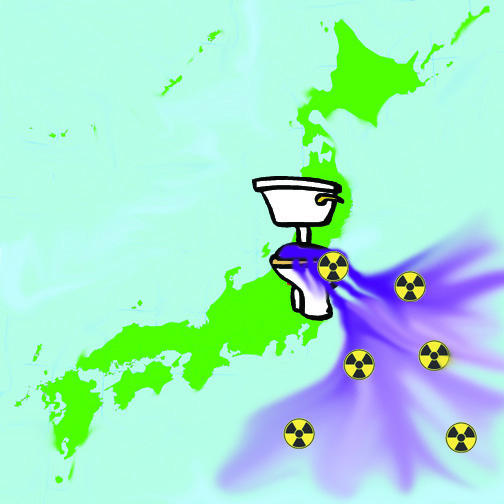 Deere-Jones 28th September 2015
Radiation can be carried long distances by marine currents, concentrated in sediments, and carried in sea spray 16km or more inland, writes Tim Deere-Jones. So Fukushima poses a hazard to coastal populations and any who eat produce from their farms. So what are the Japanese Government and IAEA doing? Ignoring the problem, and failing to gather data.
Review of the official Japanese marine monitoring programme reveals that the Japanese government is turning a blind eye to the risks of marine radiation from the stricken Fukushima site.
The strategy it has adopted, with the support of the IAEA, consistently ignores the latest evidence about the way marine radioactivity behaves in inshore marine environments and the potential radiological risks to coastal populations.
This strategy is based on a flawed hypothesis, developed by the nuclear industry through the late 1940s and early 1950s, when both oceanography and the study of the behaviour and fate of radioactivity in marine environments were in their absolute infancy.
As a result, the principal conclusions on the marine impact of the Fukushima event put forward in recent reports from the IAEA, the Government of Japan and it’s relevant agencies, minimise the environmental and public health negatives and emphasise a range of hypothetical ‘positives’.
This is a major flaw because the empirical evidence from ‘non-aligned’ research in the UK is that coastal communities are subjected to highly enriched doses of marine radioactivity through pathways of exposure, and from environmental parameters, which will not be analysed and researched under current Fukushima monitoring plans.
As a result, significant public health impacts of the event will not be documented, nor will important data about the way Fukushima marine radioactivity behaves at the coastline.
Failing to gather the evidence of coastal radiation Continue reading
Death of heroic anti war photographer Kikujiro Fukushima
Renowned Anti-War Japanese Photographer Kikujiro Fukushima Dies at 94, Peta Pixel, September 28, 2015 by Michael Zhang Acclaimed Japanese photojournalist Kikujiro Fukushima passed away on September 24th, 2015, after suffering a stroke at the age of 94. Fukushima was known for his criticism of Japan’s decision to go to war in World War II, and he spent decades documenting both the war and the aftermath of it in his homeland.
In the early years of his career, Fukushima pointed his camera at survivors of the atomic bombs dropped on Japan. The work was published in an award-winning 1961 photo book titled “Pika Don: Aru Genbaku Hisaisha no Kiroku” (which translates to “Atomic bomb: Records of one atomic bomb survivor”).
He went on to create projects, books, and exhibitions about subjects that were off the beaten path: Japanese military secrets, social injustices, feminist movements, industrial pollution, the fight against nuclear power plants, and more.
Fukushima is the only photographer who documented the aftermaths of both the nuclear bomb dropped on Hiroshima in 1945 and the Fukushima nuclear disaster in 2011.
Both are nuclear crises but different kinds,” Fukushima told the New York Times in an interview published last year. “Hiroshima’s crisis was caused by the bomb dropped by the enemy during the war. Fukushima’s crisis, though initially triggered by the earthquake and tsunami, was not really natural. It was caused by Japan’s nuclear industry whose interests more lie in their financial gain rather than the safety of the public.”
“In Hiroshima, I photographed people who were dying. In Fukushima, it looked normal but nobody knows what is going to happen in long term. I didn’t know where to begin.”……..http://petapixel.com/2015/09/28/renowned-anti-war-japanese-photographer-kikujiro-fukushima-dies-at-94/
Fukushima’s Unit no.5 nuclear reactor was gravely endangered, IAEA finally admits
IAEA Report Admits Fukushima Unit 5 Worse Than Previously Stated, Simply Info, September 28th, 2015 | Details found in the recent IAEA report on the Fukushima disaster admitted some key information about the events at unit 5. These details show that the events at unit 5 were much more dire than the impression given to the public.
During the initial disaster little was mentioned about unit 5 as other units spiraled into catastrophic meltdowns. TEPCO’s reporting was limited, purposely avoids key events and obfuscates others. The Japanese government official report did provide more detail but it used carefully crafted language to downplay and avoid admitting the real risks unfolding at this unit…….http://www.fukuleaks.org/web/?p=15022
1 This Month




PLEASE OPPOSE HR 8255 AND S.3639 – bills would accelerate satellite deployment, with no environmental review or safeguards – https://ncstd5li.quorum.us/campaign/169331/
To see nuclear-related stories in greater depth and intensity – go to https://nuclearinformation.wordpress.com
-
Archives
- September 2026 (339)
- August 2026 (330)
- July 2026 (355)
- June 2026 (287)
- May 2026 (306)
- April 2026 (356)
- March 2026 (251)
- February 2026 (267)
- January 2026 (308)
- December 2025 (358)
- November 2025 (359)
- October 2025 (375)
-
Categories
- 1
- 1 NUCLEAR ISSUES
- business and costs
- climate change
- culture and arts
- ENERGY
- environment
- health
- history
- indigenous issues
- Legal
- marketing of nuclear
- media
- opposition to nuclear
- PERSONAL STORIES
- politics
- politics international
- Religion and ethics
- safety
- secrets,lies and civil liberties
- spinbuster
- technology
- Uranium
- wastes
- weapons and war
- Women
- 2 WORLD
- ACTION
- AFRICA
- Atrocities
- AUSTRALIA
- Christina's notes
- Christina's themes
- culture and arts
- Events
- Fuk 2022
- Fuk 2023
- Fukushima 2017
- Fukushima 2018
- fukushima 2019
- Fukushima 2020
- Fukushima 2021
- general
- global warming
- Humour (God we need it)
- Nuclear
- RARE EARTHS
- Reference
- resources – print
- Resources -audiovicual
- Weekly Newsletter
- World
- World Nuclear
- YouTube
-
RSS
Entries RSS
Comments RSS

