Japan keen to sell nuclear reactors to Kazakhstan
 Japan to construct nuclear power plant in Kazakhstan, Tengri News, 27 Oct 15
For more information see:http://en.tengrinews.kz/politics_sub/Japan-to-construct-nuclear-power-plant-in-Kazakhstan-262718/
Use of the Tengrinews English materials must be accompanied by a hyperlink to en.Tengrinews.kz
October 23 Tengrinews.kz reported, citing the country’s Vice Minister of Energy Bakhytzhan Dzhaksaliyev, that Kazakhstan was to decide within the following 2-3 years on the location and strategic partner for its first nuclear power station.
January 23,2015 Tengrinews.kz reported that Kazakhstan had started talks with Toshiba, owner of Westinghouse, to construct its first nuclear power plant. The sides were to sign an agreement on supplying a $3.7 billion reactor capable of 1 gigawatt, according to Russia’s Kommersant daily.
Early 2014 the country’s President Nursultan Nazarbayev commissioned the Government to decide before the end of the Q1 2014 on the location, sources of investments and timing of constructing a nuclear power plant in Kazakhstan.
In his Address to the Nation at the start of 2014, President Nursultan Nazarbayev elaborated why Kazakhstan needs to construct a nuclear power plant.
He emphasized that the future lies with nuclear power……… “The actual need for a nuclear power plant will be felt around 2025 given the current power generation and consumption figures”, he elaborated.
For more information see:http://en.tengrinews.kz/politics_sub/Japan-to-construct-nuclear-power-plant-in-Kazakhstan-262718/
Japanese Prefecture Kyoto moves to replace nuclear with gas and renewables, in pact with Alaska
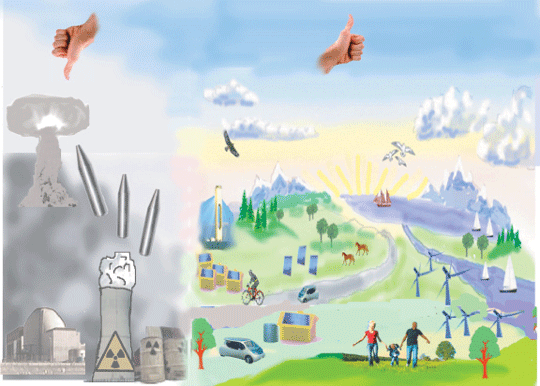
 Kyoto advances nuclear-free agenda with Alaska LNG pact, Japan Times, BY ERIC JOHNSTON KYOTO, 25 OCT 15, – The Kyoto Prefectural Government signed an agreement with Alaska last month to explore the possibility of importing liquid natural gas from the state to Maizuru, a port city on the Sea of Japan.
While daunting financial and bureaucratic challenges mean it will still be a while before Alaskan LNG flows to Kyoto, the agreement represents a step forward for Kyoto to achieve a larger goal: ending prefectural dependence on nuclear power by 2040.
The strategy, as outlined by Kyoto Gov. Keiji Yamada, calls for building up LNG facilities at Maizuru and installing new LNG pipelines in the Kansai region. The prefecture envisions Maizuru supplying not only Kyoto, but other prefectures in the region with gas to replace Fukui Prefecture’s nuclear power plants as a major source of electricity.
Kyoto is not alone in seeking to replace atomic power with a combination of LNG imports and renewable energy. As of the end of 2014, more than 600 local governments nationwide had declared their intent to be nuclear-free, although not all of have set specific dates like Kyoto, and many lack a strategic plan for achieving that goal.
Yamada listed several reasons why the prefecture needs to end its usage of nuclear power, which comes mostly from 11 Kansai Electric Power Co. reactors in neighboring Fukui……..
Kyoto and Hyogo, along with Osaka Gas, Kepco, and the Ministry of Economy, Trade and Industry, agreed in early September to formally research the cost of building an LNG pipeline from Maizuru to Sanda, Hyogo Prefecture, that could then supply other parts of Kansai and likely lead to other localities needing less nuclear power. http://www.japantimes.co.jp/news/2015/10/25/national/kyoto-advances-nuclear-free-agenda-alaska-lng-pact/#.Vi0_ztIrLGh
Many radiation related cancers to come, as Japan confirms Fukushima worker’s radiation caused cancer
“Thyroid cancer is commonly developed as a result of acute exposure to radioactive iodine 131, a product of nuclear fission…”
The British journalist also highlighted that the scientists have failed to mention that other radioactive elements emitted in the accident pose even more of a threat to the population’s health (in particular, 17.5 percent Cesium-137 and 38.5 percent Cesium 134).
 Fukushima: Hundreds of Radiation-Related Cancer Cases on the Way in Japan, http://sputniknews.com/asia/20151023/1029014961/fukushima-radiation-cancer-threat-japan.html, 23 Oct 15 The Japanese government has recently admitted that a worker at the Fukushima nuclear plant contracted cancer as a consequence of radiation exposure of 2011, British journalist Oliver Tickell points out, warning that there are many more cases on the way.
 The Japanese government has officially confirmed that a worker at the Fukushima nuclear plant has contracted radiation-related cancer: the man has been diagnosed with acute myelogenous leukaemia.
“But that single ‘official’ cancer case is just the beginning. New scientific research indicates that hundreds more cancers have been and will be contracted in the local population. A 30-fold excess of thyroid cancer has been detected among over 400,000 young people below the age of 18 from the Fukushima area,” British journalist, author and health and environment issue campaigner Oliver Tickell wrote in his article for The Ecologist, citing a report entitled “Thyroid Cancer Detection by Ultrasound Among Residents Ages 18 Years and Younger in Fukushima, Japan: 2011 to 2014.”
The highest incidence rate ratio, using a latency period of 4 years, was observed in the central middle district of the prefecture compared with the Japanese annual incidence (incidence rate ratio = 50; 95% confidence interval [CI] = 25, 90),” the report read.
Tickell noted that during a first screening for thyroid cancer held four years after the Fukushima catastrophe among 298,577 youths, the disease was registered 50 times more frequently among those who lived in the most heavily irradiated zones than among other Japanese youth.
During a second screening carried out in April 2014 among 106,068 young people who lived in less contaminated areas of the Fukushima prefecture, the disease was 12 times more common than for the main population.
“Thyroid cancer is commonly developed as a result of acute exposure to radioactive iodine 131, a product of nuclear fission. Because iodine concentrates in the thyroid gland, thyroid damage including cancer is a characteristic marker of exposure to nuclear fallout,” Tickell elaborated, adding that iodine-131 constituted about 9.1 percent of the radioactive material released during the Fukushima disaster.
Quoting the report, Tickell called attention to the fact that “the incidence of thyroid cancer is high by comparison with the Chernobyl nuclear disaster in 1986,” beating the drums over the possibility of a growing cancer threat in the region in the next four-five years.
That is not all, the British journalist added, emphasizing that the real exposure doses for residents could have been higher than had been reported by the authorities and the World Health Organization.
“We could infer a possibility that exposure doses for residents were higher than the official report or the dose estimation by the World Health Organization, because the number of thyroid cancer cases grew faster than predicted in the World Health Organization’s health assessment report,” the authors of the report underscored, as quoted by Tickell.
The British journalist also highlighted that the scientists have failed to mention that other radioactive elements emitted in the accident pose even more of a threat to the population’s health (in particular, 17.5 percent Cesium-137 and 38.5 percent Cesium 134).
“These longer-lived beta-emitters (30 years and two years respectively) present a major long-term hazard as the element is closely related to potassium and readily absorbed into biomass and food crops,” Tickell stressed.
The author bemoaned the fact the Japanese people also face a danger posed by “long lived alpha emitters like plutonium 239 (which has a half-life of 24,100 years) which is hard to detect.”
“Even tiny nano-scale specks of inhaled plutonium entering the lungs and lymphatic system can cause cancer decades after the event by continuously ‘burning’ surrounding tissues and cells,” Oliver Tickell warned.
Fukushima experiences 5.5 earthquake
5.5 earthquake shakes Japan’s Fukushima & Miyagi regions Rt.com : 21 Oct, 2015 A 5.5-magnitude earthquake has hit near the Fukushima prefecture in Japan, with residents of some 10 other prefectures feeling the tremor.
The quake occurred off the northeast coast of Japan. No tsunami warning has been issued.
The epicenter was near the Fukushima coastline, at a depth of 30 kilometers.
People in affected areas of Japan took to Twitter to say they felt the tremor……..https://www.rt.com/news/319243-japan-earthquake-fukushima-miyagi/
Fukushima worker’s leukaemia confirmed as caused by radiation
Fukushima worker diagnosed with leukaemia after shocking radiation leak at nuclear plant, news.com.au OCTOBER 20, 2015 A FORMER Fukushima nuclear plant worker has been diagnosed with radiation-linked cancer, making him the first such confirmation more than four years after the worst atomic accident in a generation.
An official with the health ministry said the ex-employee, who was in his thirties while working at the plant following the 2011 crisis, has developed leukaemia. He is now 41 years old, local media reported.
“The case has met the criteria” to link his illness to the accident, the official told a Tokyo press briefing on condition of anonymity, adding that other possible causes have been ruled out.
“This person went to see a doctor because was not feeling well. That was when he was diagnosed with leukaemia.” The ministry revealed few details about the man, but said he had worked at a destroyed building that housed one of the crippled reactors.
The man, who wore protective equipment during more than a year spent at Fukushima, will be awarded compensation to pay for his medical costs and lost income, the official said, without elaborating on the amount.
Three similar cases of cancer in plant workers are still awaiting confirmation of a link to the accident…….
The announcement Tuesday will likely further inflame widespread public opposition to nuclear power……..
The case was likely to deal another blow to Prime Minister Shinzo Abe’s unpopular attempt to switch on Japan’s stable of atomic reactors………http://www.news.com.au/world/asia/fukushima-worker-diagnosed-with-leukaemia-after-shocking-radiation-leak-at-nuclear-plant/story-fnh81fz8-1227576166328
The public recognition of a radiation-cancer threat may lead to high compensation payments
Japan Acknowledges First Possible Radiation Casualty at Fukushima Nuclear Plant The public recognition of a radiation-cancer threat may lead to high compensation payments TOKYO, Oct 20 (Reuters) – Japan on Tuesday acknowledged the first possible casualty from radiation at the wrecked Fukushima nuclear power plant, a worker who was diagnosed with cancer after the crisis broke out in 2011.
The health ministry’s recognition of radiation as a possible cause may set back efforts to recover from the disaster, as the government and the nuclear industry have been at pains to say that the health effects from radiation have been minimal.
It may also add to compensation payments that had reached more than 7 trillion yen ($59 billion) by July this year…….
The male worker in his 30s, who was employed by a construction contractor, worked at Tokyo Electric Power Co’s Fukushima Daiichi plant and other nuclear facilities, a health ministry official said.
Of total radiation exposure of 19.8 millisieverts (mSv), the worker received a dose of 15.7 (mSv) between October 2012 and December 2013 working at Fukushima, said the official.
While the exposure amount was lower than the annual 50 mSv limit for nuclear industry workers, the government had decided it cannot be ruled out that the worker’s leukaemia was a result of radiation, the official said.
Tokyo Electric is also facing a string of legal cases seeking compensation over the disaster.
Inside the plant, Tepco has struggled to bring the situation under control. It is estimated removing the melted fuel from the wrecked reactors and cleaning up the site will cost tens of billions of dollars and take decades to complete. ($1 = 119.4200 yen) (Reporting by Kiyoshi Takenaka; Writing by Aaron Sheldrick; Editing by Nick Macfie) http://www.scientificamerican.com/article/japan-acknowledges-first-possible-radiation-casualty-at-fukushima-nuclear-plant/
Fukushima insect study shows there is no safe low level of ionising radiation
 The researchers found that caterpillars that ate radioactive leaves pupated into mutated butterflies that did not live as long, compared with caterpillars that ate non-radioactive leaves. These mutations and increased mortality were seen even in butterflies that consumed only very small doses of radioactive cesium.
Deaths and mutations spike around Fukushima; no safety threshold for radioactive cesium exposure http://theunhivedmind.com/wordpress3/deaths-and-mutations-spike-around-fukushima-no-safety-threshold-for-radioactive-cesium-exposure/October 16, 2015 theunhivedmind Deaths and mutations spike around Fukushima; October 16, 2015 by: David Gutierrez, staff writer
http://www.naturalnews.com/051581_fukushima_radiation_nuclear_power.html
Plants in the area around Fukushima, Japan are widely contaminated with radioactive cesium, which is 
producing mutation and death in local butterflies, according to a study conducted by researchers from the University of the Ryukyus, Okinawa and published in the journal Scientific Reports.
The butterflies were found to experience severe negative effects at all detectable radiation levels, even very low ones.
“We conclude that the risk of ingesting a polluted diet is realistic, at least for this butterfly, and likely for certain other organisms living in the polluted area,” the researchers wrote.
Insects hard hit
The researchers note that although the 2011 meltdown of the Fukushima Daiichi Nuclear Power Plant released “a massive amount of radioactive materials … into the environment,” few studies have looked at the biological effects of this disaster. Researchers have, however, measured elevated radiation levels in the polluted area, and have chronicled the accumulation of radioactive material in both wild and domestic plant and animal life in the region.
Studies have also suggested that insects may be particularly hard-hit by the increased radiation. One study found an increase in morphological abnormalities (physical deformities) in gall-forming aphids. Another found that insect abundance has decreased in the affected region, particularly butterfly abundance. Continue reading
Concerns over Japan’s huge stockpile of weapons grade nuclear material
 China calls on Japan to address world concerns on excessive nuclear stocks http://news.xinhuanet.com/english/2015-10/15/c_134717556.htm BEIJING, Oct. 15 (Xinhua) — China on Thursday called for action from Japan to defuse concerns over its excess of nuclear materials as both Chinese and U.S. think tanks expressed worry in recent reports.
“The international community has always been concerned about Japan’s stockpile of enriched uranium and the risks relating to nuclear proliferation and safety,” Foreign Ministry spokesperson Hua Chunying said.
“The reports suggest there are ways to resolve the surplus nuclear material issue,” she said at a regular news briefing, calling on Japan to be responsible and act to address the international community’s concerns.
The stockpile puts Japan, its neighbors and the world at risk, a joint study by China Arms Control and Disarmament Association and the China Institute of Nuclear Information and Economics said on Friday.
“If, in future, a different country started to stockpile — could be enriched uranium, it could be plutonium — that country could cite Japan as a precedent,” said James Acton, author of a new report on Japan’s reprocessing policy at the Carnegie Endowment for International Peace think tank.
The Chinese study suggests Japan should make a rational plan for its nuclear consumption and address the imbalance, while ensuring the safety and security of these materials.
Citing the latest data from the Japanese government submitted to the International Atomic Energy Agency (IAEA), the Chinese study found Japan has 47.8 tonnes of highly sensitive separated plutonium, 10.8 tonnes of which are stored in Japan, enough to make 1,350 nuclear warheads.
No evacuation plan, yet PM Abe restarts another Sendai nuclear reactor
Last year, Prime Minister Shinzo Abe said he would not allow a reactor startup unless its safety is completely confirmed. But the process of approving reactor restarts at the Sendai nuclear power plant has not been in line with his pledge at all
 Safety put on the back burner as another nuclear reactor is restarted, Asahi Shimbun, 14 Oct 15 Kyushu Electric Power Co. is set to restart the No. 2 reactor at its Sendai nuclear power plant in Satsuma-Sendai, Kagoshima Prefecture, on Oct. 15. In August, the plant’s No. 1 reactor became the first to resume operations under new safety regulations that went into force in July 2013.
Some areas near the plant may not even have a dependable evacuation route in the event of a disaster. Furthermore, no evacuation drills for residents have been undertaken.
The electric utility’s plan to restart the idled reactor was given the green light by the Nuclear Regulation Authority. The nuclear watchdog body has no authority, however, to examine evacuation plans.
A reactor should not be restarted under such circumstances. Continue reading
Second nuclear reactor started at Sendai, despite public opposition
 Japan restarts second nuclear reactor despite public opposition, Guardian, 15 Oct 15
Number-two reactor at Sendai has gone on line more than four years after a quake-sparked tsunami swamped a plant at Fukushima. Japan on Thursday restarted a second nuclear reactor after a shutdown triggered by the 2011 Fukushima crisis, as the government pushes to return to a cheaper energy source despite widespread public opposition.
Utility Kyushu Electric Power said it restarted the number-two reactor at Sendai, about 1,000 kilometres (620 miles) southwest of Tokyo at 10.30am (0130 GMT).
The same power plant’s number-one reactor was restarted in August, ending a two-year nuclear power hiatus. Engineers will now spend several days bringing the newly restarted reactor up to operational level before running it commercially from November…….
But the public is largely opposed to atomic energy after the Fukushima crisis sent radiation over a wide area and forced tens of thousands from their homes – many of whom will likely never return – in the worst nuclear accident since Chernobyl in 1986…….http://www.theguardian.com/world/2015/oct/15/japan-restarts-second-nuclear-reactor-despite-public-opposition
Continuing struggle to rid Okinawa of USA military bases
Struggle against U.S. bases continues in Okinawa http://happening-here.blogspot.com.au/ The elected governor of the Japanese-controlled island of Okinawa has said no, again, to further construction of a new U.S. base. Okinawans have been trying to reclaim their territory for decades. The island is part of the Ryukyu archipelago which the U.S. conquered at the end of World War II. Japan recovered sovereignty, but although since 1945 Japan has been ostensibly a nuke-free zone, the U.S. has been allowed to bring nuclear armed vessels to Okinawa if not the Japanese mainland.
The 1.3 million Okinawans have repeatedly elected officials who promise to oust the U.S. military. These local officials have then been overruled from Tokoyo repeatedly.
The U.S. Marines are not considered good neighbors on the island: they are seen as the source of drunken louts and rapists who usually enjoy impunity from the local justice system.
Okinawans are Japan’s largest minority group.
I have written previously about Okinawa’s special place and its irritants to the U.S. empire here and here.
Anxious about 2020 Olympics, Tepco to hasten ice wall project at Fukushima nuclear station
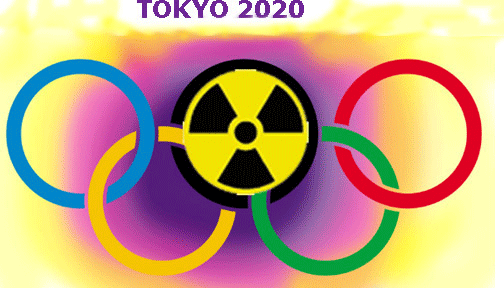 Tepco Expects to Begin Freezing Fukushima Ice Wall by Year End http://www.bloomberg.com/news/articles/2015-10-10/tepco-expects-to-begin-freezing-fukushima-ice-wall-by-year-end Stephen Stapczynski October 10, 2015
-
Aim to resolve contaminated water issue by 2020 Olympics
-
About 300 tons of water a day flow into radioactive reactor
-
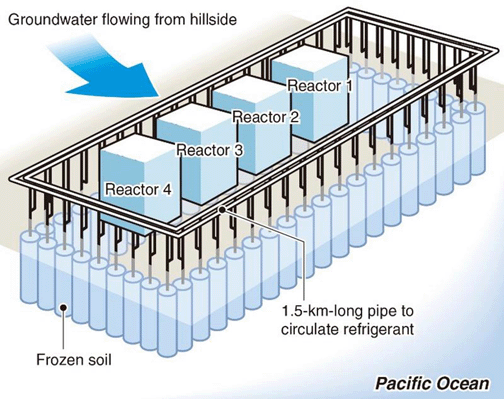
Tokyo Electric Power Co. expects to begin freezing a soil barrier by the end of the year to stop a torrent of water entering the wrecked Fukushima nuclear facility, moving a step closer to fulfilling a promise the Japanese government made to the international community more than two years ago.
“In the last half-year we have made significant progress in water treatment,” Akira Ono, chief of the Fukushima Dai-Ichi plant, said Friday during a tour of the facility north of Tokyo. The frozen wall, along with other measures, “should be able to resolve the contaminated water issues before the Olympic games.”
Solving the water management problems would be a major milestone, but Tokyo Electric is still faced with a number of challenges at the site. The company must still remove highly radioactive debris from inside three wrecked reactors, a task for which no applicable technology exists. The entire facility must eventually be dismantled.
- Currently, about 300 metric tons of water flow into the reactor building daily from the nearby hills. Tepco, as the nation’s biggest utility is called, has struggled to decommission the reactors while also grappling with the buildup of contaminated water.
Even four years after the meltdown and despite promises from policymakers, water management remains one of Tepco’s biggest challenges in coping with the fallout of Japan’s worst nuclear disaster.
The purpose of the ice wall — a barrier of soil 30 meters (98 feet) deep and 1,500 meters long which is frozen to -30 Celsius (-22 Fahrenheit) — is to prevent groundwater from flooding reactor basements and becoming contaminated.
-
Public Trust Needed
“As the radiation levels decrease via natural decay, water management becomes the main issue,” Dale Klein, an independent adviser for Tepco and a former chairman of the U.S. Nuclear Regulatory Commission, said by e-mail. “It is a very important issue for the public, and good water management is needed for Tepco to restore the public’s trust.”
- Tepco is currently testing the freezing system, aiming to have the fence fully operational by the end of December, company spokesman Yuichi Okamura said.
At the moment, the deluge of groundwater entering the reactor buildings is purified, lowering its radioactive content. The water is then stored in one of numerous barrels at the site, each of which can hold 1,000 tons of water.
To make room for the 1,000 or so barrels required to hold the water, Tepco flattened a 500 square meter (5,382 square foot) bird sanctuary on the outskirts of the facility. The company doesn’t have government approval to release the water into the ocean, and there’s no clear plan for its disposal, Tepco’s Okamura said.
- Prime Minister Shinzo Abe promised in 2013 that the government would take the lead in resolving the water management issues at the Fukushima site ahead of the 2020 Tokyo Olympics. Two years later, hundreds of tons of water continue to pour into the reactor building, while tainted water at other parts of the site overflows into the ocean.
Water Overflow
Since January, slightly tainted water has spilled from a drainage system into the ocean on nine occasions, according to company spokeswoman Yukako Handa.
The company aims to end these leaks by reconfiguring a drainage system and building a wall running 30 meters into the seabed. The drainage work will be completed next year, and the sea wall will be completed this month.
The proposed ice wall has never been done on such a scale, and there could be operational issues due to the complicated nature of the project, according to Lake Barrett, former head of the U.S. Department of Energy’s Office of Civilian Nuclear Waste Management.
“Some of these areas may have different freezing and sealing capabilities,” he said by e-mail. “These types of problems were encountered when Tepco tried and failed to seal the seawater trenches by freezing.”
Surge in thyroid cancers in Fukushima
 UPI: ‘Skyrocketing’ cancer cases in Fukushima — AP: ‘Alarming’ cancer rates after nuclear disaster — Times: Child cancers up 5,000% — Radiation doses may be “considerably higher” than estimated — Expert: Cancer outbreak shows officials must now prepare for onset of leukemia, other diseases (VIDEO) http://enenews.com/times-child-cancers-5000-after-fukushima-disaster?utm_source=feedburner&utm_medium=email&utm_campaign=Feed%3A+ENENews+%28Energy+News%29
The Times, Oct 8 2015 (emphasis added): Child cancers up fiftyfold after Fukushima disaster— Cases of thyroid cancer among children living close to the Fukushima nuclear power plant have increased fiftyfold since the meltdown in 2011, according to Japanese scientists… in one of the most pessimistic assessments of the health implications of the world’s second-worst nuclear disaster. He urged the Japanese authorities to stop quibbling over the interpretation of cancer statistics, and to muster medical resources. “We need to prepare for leukaemia, breast cancer and (remainder of article only available to subscribers)… Photo Caption: 104 cases of thyroid cancer have been identified, a far higher rate than the national average
AP, Oct 9, 2015: Study shows alarming thyroid cancer rates in children living near Fukushima… “This is more than expected and emerging faster than expected,” lead author Toshihide Tsuda said…
UPI, Oct 8, 2015: Fukushima radiation has been linked to a surge in thyroid cancer among children near the disaster area… A team of Japanese researchers led by Toshihide Tsuda, a professor of environmental epidemiology at Okayama University, said cases of thyroid cancer in Fukushima Prefecture have skyrocketed since March 2011… and the culprit was increased radiation exposure since the Fukushima nuclear disaster…
T. Tsuda, A. Tokinobu, E. Suzuki, E. Yamamoto (Okayama Univ.), Oct 5, 2015:
- Thyroid Cancer Detection by Ultrasound Among Residents Ages 18 Years and Younger in Fukushima… 2011 to 2014
- The highest incidence rate ratio… was observed in the central middle district of the prefecture… incidence rate ratio = 50…
- … estimated doses ranged from 119 to 432 mSv among mothers and from 330 to 1,190 mSv in their infants for those living 45 to 220 km south or southwest, including Iwaki City in the Fukushima Prefecture, Ibaragi Prefecture, and Chiba Prefecture.
- … we could infer that the incidence of thyroid cancer in Fukushima rose more rapidly than expected… as estimated by the World Health Organization.
- The radiation burden to the thyroid in Fukushima Prefecture might have been considerably higher than estimated…
- The minimum empirical induction time for thyroid cancer is 2.5 years for adults and 1 year for children, according to the [CDC]. Therefore, we considered it possible to detect thyroid cancer… even within the 2011 fiscal year.
- In Chernobyl, excesses of thyroid cancer became more remarkable 4 or 5 years after… the observed excess alerts us to prepare for more potential cases.
Japan Moving People Back to Fukushima Restricted Zones
Radiation Impact Studies: Chernobyl and Fukushima, Dissident Voice, by Robert Hunziker / September 23rd, 2015 “…….Japan’s Abe government has started moving people back into former restricted zones surrounding the Fukushima Daiichi Nuclear Power Station even though it is an on-going major nuclear meltdown that is totally out of control.
Accordingly, Greenpeace Japan conducted a radiation survey and sampling program in Iitate, a village in Fukushima Prefecture. Even after decontamination, radiation dose rates measured ten times (10xs) the maximum allowed to the general public.
According to Greenpeace Japan:
The Japanese government plans to lift restrictions in all of Area 2 [2], including Iitate, where people could receive radiation doses of up to 20mSV each year and in subsequent years. International radiation protection standards recommend public exposure should be 1mSv/year or less in non-post accident situations. The radiation limit that excluded people from living in the 30km zone around the Chernobyl nuclear plant exclusion zone was set at 5mSV/year, five years after the nuclear accident. Over 100,000 people were evacuated from within the zone and will never return.2
http://dissidentvoice.org/2015/09/radiation-impact-studies-chernobyl-and-fukushima/
Contradictions in Japanese govt’s nuclear planning
 Government Fails to Address Contradictions Over Japan’s Nuclear Future, nippon.com Kikkawa Takeo [2015.10.08] The August 2015 restart of the Sendai Nuclear Power Plant in Kyūshū ended a two-year shutdown of all nuclear reactors in Japan. As commentators debate whether this will prompt other plants around the country to come back online, the current administration appears unwilling to take responsibility for dealing with contradictions between the need to shut down aging facilities and the nation’s continued reliance on nuclear power……
Many Japanese news organizations predicted at the beginning of 2015 that nuclear energy would make a full-fledged comeback during the year, with operations resuming at Sendai and other nuclear plants one after another. The projections appear to have been slightly too hasty, however, as restarting reactors has proved to be more difficult than anticipated…….
The 2012 revisions to the Act on the Regulation of Nuclear Source Material, Nuclear Fuel Material, and Reactors require all nuclear power plants to be taken out of service after 40 years, with a one-time-only, 20-year extension being granted in exceptional cases when certain conditions are met. The maximum number of years that a plant can remain in operation is thus 60 years. Of the 48 reactors in Japan as of January 2015, only 18 will be under 40 years old at the end of December 2030. If the revisions are strictly enforced, 30 reactors will need to be decommissioned by then. Two reactors are currently under construction—Unit 3 of Chūgoku Electric Power’s Shimane Nuclear Power Plant and Electric Power Development’s Ōma Nuclear Power Plant—but even if they come online, that would still mean just 20 reactors as of the end of 2030. Assuming that these 20 units operate at 70% capacity (which was roughly the average prior to the Fukushima accident), they would only be able to generate 15% of the nearly 1 trillion kWh projected to be required in 2030.
If the 40-year rule is applied strictly, nuclear power will meet just 15% of the nation’s energy needs in 2030. The additional 5%–7% needed to meet METI’s 20%–22% outlook is thus premised on either building new reactors or extending the life of existing ones beyond 40 years. Since the administration has announced that it has no plans now to build additional reactors, one can then conclude that it intends to cover the 5%–7% shortfall by extending the life of existing plants…….
The resumption of operations at Kyūshū Electric’s Sendai plant thus will not trigger a spate of restarts at other plants, and 2015 is hardly likely to mark the full-fledged return of nuclear power in Japan.
(Originally written in Japanese and published on September 22, 2015 http://www.nippon.com/en/currents/d00196/
1 This Month




PLEASE OPPOSE HR 8255 AND S.3639 – bills would accelerate satellite deployment, with no environmental review or safeguards – https://ncstd5li.quorum.us/campaign/169331/
To see nuclear-related stories in greater depth and intensity – go to https://nuclearinformation.wordpress.com
-
Archives
- September 2026 (339)
- August 2026 (330)
- July 2026 (355)
- June 2026 (287)
- May 2026 (306)
- April 2026 (356)
- March 2026 (251)
- February 2026 (267)
- January 2026 (308)
- December 2025 (358)
- November 2025 (359)
- October 2025 (375)
-
Categories
- 1
- 1 NUCLEAR ISSUES
- business and costs
- climate change
- culture and arts
- ENERGY
- environment
- health
- history
- indigenous issues
- Legal
- marketing of nuclear
- media
- opposition to nuclear
- PERSONAL STORIES
- politics
- politics international
- Religion and ethics
- safety
- secrets,lies and civil liberties
- spinbuster
- technology
- Uranium
- wastes
- weapons and war
- Women
- 2 WORLD
- ACTION
- AFRICA
- Atrocities
- AUSTRALIA
- Christina's notes
- Christina's themes
- culture and arts
- Events
- Fuk 2022
- Fuk 2023
- Fukushima 2017
- Fukushima 2018
- fukushima 2019
- Fukushima 2020
- Fukushima 2021
- general
- global warming
- Humour (God we need it)
- Nuclear
- RARE EARTHS
- Reference
- resources – print
- Resources -audiovicual
- Weekly Newsletter
- World
- World Nuclear
- YouTube
-
RSS
Entries RSS
Comments RSS

