Up to 100% of No. 2 reactor fuel may have melted
First it was cold shutdown, then it became meltdown, what if most of it had been expelled in the skies, and if so how long it will take for them to finally admit it to the world…
A group of researchers says it is highly likely that 70 to 100 percent of fuel has melted at one of the damaged reactors at the Fukushima Daiichi nuclear power plant.
The group includes researchers from Nagoya University. It has been probing the plant’s No. 2 reactor since April of last year, using a device that uses elementary particles called muons to see into its interior.
The researchers say the results of their study show few signs of nuclear fuel at the reactor core, in contrast to the No. 5 reactor where fuel was clearly visible at its core.
This led them to believe that 70 to 100 percent of fuel at the reactor has likely melted.
The researchers say further analyses are needed to determine whether molten fuel penetrated the reactor and fell down.
The No.2 reactor is said to have released large amounts of radioactive substances following the March 2011 accident.
Tokyo Electric Power Company, the plant’s operator, has estimated that part of nuclear fuel at the reactor remains at its core.
The locations of nuclear fuel will have a significant impact on the process to remove it from the damaged reactors, the most difficult step of the decommissioning work.
The Japanese government and TEPCO plan to scan the No. 2 reactor once again using a different device.
They are also preparing to use robots around the reactor.
The group will announce the results of its study at a meeting of the Physical Society of Japan in Osaka on Saturday.
Source : NHK
Fukushima reactor could have suffered total meltdown – report
Fukushima’s reactor No.2 could have suffered a complete meltdown according to Japanese researchers. They have been monitoring the Daiichi nuclear power plant since April, but say they have found few signs of nuclear fuel at the reactor’s core.
The scientists from Nagoya University had been using a device that uses elementary particles, which are called muons. These are used to give a better picture of the inside of the reactor as the levels of radioactivity at the core mean it is impossible for any human to go anywhere near it.
However, the results have not been promising. The study shows very few signs of any nuclear fuel in reactor No. 2. This is in sharp contrast to reactor No.5, where the fuel is clearly visible at the core, the Japanese broadcaster NHK reports.
The team believes that 70 to 100 percent of the fuel has melted, though they did add that further research was needed to see whether any fuel had managed to penetrate the reactor
A report in May by the Tokyo Electric Power Company (TEPCO), which is the plant’s operator, said that a failure in reactor No.2’s pressure relief systems was one of the causes of the disaster. The team used a robot, which ventured into the building and measured radiation levels at various places, while also studying how much leakage had occurred from the control systems.
TEPCO has used 16 robots to explore the crippled plant to date, from military models to radiation-resistant multi-segmented snake-like devices that can fit through a small pipe.
However, even the toughest models are having trouble weathering the deadly radiation levels: as one robot sent into reactor No.1 broke down three hours into its planned 10-hour foray.
Despite TEPCO’s best efforts, the company has been accused of a number of mishaps and a lack of proper contingency measures to deal with the cleanup operation, after the power plant suffered a meltdown, following an earthquake and subsequent tsunami in 2011.
Recent flooding caused by Tropical Typhoon Etau swept 82 bags, believed to contain contaminated materials that had been collected from the crippled site, out to sea.
“On September 9th and 11th, due to typhoon no.18 (Etau), heavy rain caused Fukushima Daiichi K drainage rainwater to overflow to the sea,” TEPCO said in a statement, adding that the samples taken “show safe, low levels” of radiation.
“From the sampling result of the 9th, TEPCO concluded that slightly tainted rainwater had overflowed to the sea; however, the new sampling measurement results show no impact to the ocean,” it continued.
A recent study by the University of Southern California said the Fukushima disaster could have been prevented. One of the main faults cited was the decision to install critical backup generators in low-lying areas, as this was the first place the 2011 tsunami would strike, following the massive earthquake.
LISTEN MORE:https://soundcloud.com/rttv/fukushima-research
Source: RT
http://www.rt.com/news/316593-fukushima-reactor-meltdown-study/
Fukushima dairy farmers to restart shipments
FUKUSHIMA – Dairy farmers who were forced to suspend business following the 2011 nuclear accident at Tokyo Electric Power Co.’s Fukushima No. 1 power plant plan to restart milk shipments as early as this year, with a new large-scale stock farm completed in the city of Fukushima on Friday.
Fully supported by the government and the prefectural dairy cooperative association, the stock farm, with 580 cows, is expected to become a foothold for rebuilding the prefecture’s dairy industry, hit hard by business closures and radiation-related rumors.
The farm is operated by a company established jointly by five dairy farmers from Minamisoma, Namie and Iitate. Kazumasa Tanaka, 44, from Iitate, has been appointed president of the company.
The company aims to produce 5,000 tons of raw milk annually under a computer-based control system on the 3.6-hectare (8.9-acre) farm.
“I have chosen to do this because of a sense of responsibility for the rebuilding of the dairy industry in Fukushima,” Tanaka said at a completion ceremony. “It will be the happiest thing to cheer up our peers by our stock farm getting on a growth path.”
Following the triple meltdown at the nuclear plant triggered by the massive earthquake and tsunami in March 2011, 76 dairy farmers had to evacuate and suspend their operations. Among them, only 13 farmers have restarted their businesses.
In the prefecture, annual production of raw milk remains sluggish at around 80,000 tons, down 20 percent from before the disaster.
The new stock farm was developed and is owned by the prefectural dairy cooperative, which is subsidized by the central and prefectural governments.
Source: Japan Times
TEPCO rejected requests for anti-tsunami steps before nuclear crisis
Tokyo Electric Power Co turned down requests in 2009 by the nuclear safety agency to consider concrete steps against tsunami waves at the Fukushima Daiichi nuclear plant, which suffered a tsunami-triggered disaster two years later, government documents showed Friday.
“Do you think you can stop the reactors?” a TEPCO official was quoted as telling Shigeki Nagura of the now-defunct Nuclear and Industrial Safety Agency, who was then assigned to review the plant’s safety, in response to one of his requests.
The detailed exchanges between the plant operator and regulator came to light through the latest disclosure of government records on its investigation into the nuclear crisis, adding to evidence that TEPCO failed to take proper safety steps ahead of the world’s worst nuclear accident since the 1986 Chernobyl disaster.
According to records of Nagura’s accounts, Nagura heard TEPCO’s explanations of its tsunami estimates at the agency office in Tokyo in August and September 2009 as it was becoming clear that the coastal areas of Fukushima and Miyagi prefectures were hit by massive tsunami in an 869 earthquake.
TEPCO said the height of waves was estimated to be around 8 meters above sea level and will not reach the plant site located at a height of 10 meters, they show.
But Nagura said he remembered thinking pumps with key cooling functions, which are located on the ground at a height of 4 meters, “will not make it” and told TEPCO, “If this is the outcome, you better consider concrete responses.”
In refusing to immediately act, TEPCO said it would wait for related studies to be carried out by the academic society of civil engineers, which it had requested to be done by March 2012.
Nagura also proposed placing the pumps inside buildings to protect them from being exposed to water, but a TEPCO official told him, “Our company cannot make a decision without seeing the results of the (studies by the) society of civil engineers.”
Then another TEPCO official told Nagura, “Do you think you can stop the reactors?” according to the government documents.
Nagura recalled in the documents, “I wondered why I had to be told such a thing.” But he also admitted that, after all, he only encouraged TEPCO to “consider” tsunami countermeasures and did not request that it “take” specific measures.
The Fukushima crisis has revealed how Japan, which had boasted of possessing the world’s safest nuclear power plants, was ill-prepared against a severe nuclear accident. Three reactors suffered core meltdowns after they lost their key cooling functions amid a loss of all electrical power following a huge earthquake and tsunami in March 2011.
The government-appointed nuclear accident investigation panel has already issued a final report, and the government is now gradually disclosing the records of hearings conducted to people involved.
Source: Japan Today
Still 0.88 MBq/km2 of Cs-134/137 falls in Tokyo monthly

According to NRA (Nuclear Regulation Authority), Tokyo still has fallout from Fukushima nuclear plant.
From their report released on 8/31/2015, 0.88 MBq/km2 of Cs-134/137 falls onto Tokyo this July. The sampling location was Shinjuku.
The comparable data on Fukushima prefecture is not listed on the same report for some reason.
However the reading of Tokyo includes Cesium-134 at the significant level to prove this is from Fukushima plant.
In Miyagi prefecture, where is in the North of Fukushima prefecture, the fallout level is 0.55 MBq/km2. The fallout density in Tokyo is higher than Miyagi prefecture.
Other nuclide density is not reported.
http://radioactivity.nsr.go.jp/en/contents/11000/10193/24/195_20150831.pdf
Source: Fukushima Diary
‘Japanese govt creates illusion of normality at Fukushima’
Japanese authorities made a troubling decision to let people to return to their houses in the zone of the Fukushima disaster as there is still much radioactive contamination in the region, Kevin Kamps of Beyond Nuclear told RT.
RT: Would you approve of the decision of the Japanese authorities to let people return to their houses in the zone of the Fukushima disaster?
Kevin Kamps: It is a very troubling decision, because there is radioactive contamination still throughout the countryside. In fact they just announced this time to move back to Naraha under threat of cutting people off from their compensation payments from Tokyo Electric Power Company [TEPCO]. Ironically, just days later, Typhoon Etau which had with it record breaking floods redistributed the radioactivity. Not only did bags of radioactive waste wash out the sea and down rivers, but the entire landscape- areas that had not been decontaminated – that contamination then floated with the water down mountain sides, downhill into areas that had been contaminated like Naraha, but also into areas that had not been contaminated before. So this radioactivity, as we saw, as we still see with the Chernobyl nuclear catastrophe – the radioactivity from Fukushima is moving in the environment. So it is a very troubling decision by the Japanese government to try to create the illusion of normality when there is so much radioactive contamination still in the environment.
RT: How long-lasting would the effect of the disaster be?
KK: It depends on the radioactive poison that you’re speaking about specifically. So, for example, radioactive Cesium-137 has a half-life of 30 years. You have to multiply it by 10 or 20 to get the hazardous persistence. So that is 300 to 600 years of hazard with radioactive Cesium-137. Strontium-90 is about the same – 300 to 600 years of radioactive hazard. And then you have radioactive poisons that are deadly virtually forever more into the future. For example, Plutonium-239 a half-life of 24,000 years – that is a radioactive hazard of 240,000 if not 480,000 years into the future.
RT: How dangerous is the area right now?
KK: Unfortunately we don’t have much information yet after these record breaking floods just last week, which in a very big way has moved radioactivity to new places in the environment, or has re-contaminated places previously decontaminated supposedly. So there is so much that we don’t know. Certainly there have to be very careful steps taken to measure the radioactivity in the environment. Any pronouncements by local mayors or even the Japanese government that they are only detecting so much radioactivity one meter above the ground – it misses the point in a very big way. Radioactive cesium, strontium, tritium, and other radioactive poisons can enter the food supply, and people can eat the radioactivity or drink it in their drinking water. Very careful measures to guard against the contamination of the food supply and the drinking water supply have to be taken. And I don’t know if that is happening in all places right now.
RT: There are claims that TEPCO is still concealing some important information about the Fukushima tragedy. Would you say that this could be true?
KK: Absolutely, TEPCO has been caught so many times even before this catastrophe began, but certainly after the catastrophe. Just to give one example: this past February, 2015 Tokyo Electric finally announced, let the public know, that every time it rained at the site- and they had some major typhoons hit that site in the last four and a half years – the radioactivity levels in the ditches went up very significantly. Very high level radioactive water was flowing down these ditches. It turned out that there was a very badly contaminated spot on top of the Unit 2 reactor building, which suffered very large scale radioactivity releases during the catastrophe. They were simply letting this water flow down the ditches and into the ocean. They kept that quiet not for days, or for weeks, or for months, but for years. Unfortunately, TEPCO controls a lot of the information coming out of the Fukushima Daiichi Nuclear Power Plant Station. Of course it would be in their interest to try to keep things quiet that are bad for their public relations. Fortunately, this truth finally came out. But you have to wonder – how many more things are they hiding.
‘Disaster by design’
The nuclear plant was doomed from the very beginning for a number of reasons, including TEPCO’s underestimation of the possibility of a tsunami in the area, says Costas Synolakis of the Tsunami Research Center, University of Southern California.
There were two major failures of TEPCO which eventually led to the disaster, he told RT.
“First of all, it starts back when the plant was built in the 1960’s. If you can believe it – there was a coastal cliff at that location. They took it down (it was 30 meters high) to minus 4 meters, so that… it would be easier to put the foundation for the nuclear power plant plus also to save on cost. Obviously back in the 1960’s they didn’t think about tsunamis even though tsunamis happened in Japan all the time…So number two – they didn’t consider the historic reports [about tsunamis],” he said.
“TEPCO had clear chances all along the way; they were warned by Japanese seismologists and Japanese scientists that there was evidence of big tsunamis in the area… What is very serious, from my point of view, is the rationalizations that TEPCO tried to do in the beginning. At one point they were writing in one report that their analysis was conservative. Conservative means that they had overestimated the tsunami – in fact they had underestimated the tsunami. A very famous social scientist in the US – his name is Dennis Mileti, would call this ‘disaster by design’, meaning that it was just there waiting to happen.”
LISTEN MORE:https://soundcloud.com/rttv/fukushima-research
Source: RT
http://www.rt.com/op-edge/316311-fukushima-nuclear-disaster-japan/
TEPCO to sign cooperation pact with France’s CEA
NHK has learned that the operator of the crippled nuclear plant in Fukushima plans to sign an agreement with a French organization to obtain the necessary technology to decommission the facilities.
Tokyo Electric Power Company, or TEPCO, will initially focus on decontaminating the areas around the reactor containment vessels.
The removal of molten nuclear fuel will be the toughest challenge in the decontamination process because of the extremely high radiation levels.
TEPCO plans to obtain technical knowhow from the Alternative Energies and Atomic Energy Commission, or CEA, which is funded by the French government. The French organization has expertise in dismantling aged nuclear reactors and fuel-reprocessing facilities.
Sources say that under the agreement, the CEA will help TEPCO to develop remote-controlled robots that can withstand high radiation levels.
The CEA will also help with training workers and TEPCO will provide data for the decommissioning process.
This will be TEPCO’s second agreement with a foreign organization. Last year, it signed a pact with a British company to address the buildup of contaminated water.
Source: NHK
http://www3.nhk.or.jp/nhkworld/english/news/20150923_08.html
Japan’s draconian new secrecy laws linked to Fukushima and nuclear radiation
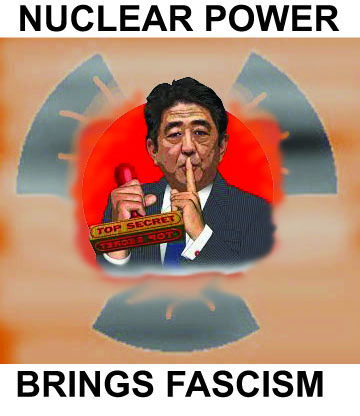 Fukushima Disaster Aftermath: Japanese Government Has Something to Hide. Sputnik News 24 Sept 15 Commenting on the aftermath of Fukushima disaster, US climate journalist Robert Hunziker suggests that the Japanese government has something to hide; “it must be really big,” the journalist notes, referring to the hard-hitting new secrecy law Tokyo has adopted.
Temporary waste sites to be returned to owners
 As of the end of June, there were 1,134 temporary storage sites in Fukushima Prefecture, storing a total of 6.4 million cubic meters of contaminated waste — equal to filling Tokyo Dome five times over. However, due to a chronic shortage of temporary storage sites, about 1.8 million cubic meters of contaminated waste and soil have been kept at decontamination sites as it is impossible to transport them anywhere else.
The Minami-Soma municipal government in Fukushima Prefecture plans to return to landowners part of the private land used for the temporary storage of radioactive contaminated waste, marking the first time a municipal government has decided not to renew a land lease for a temporary storage site.
The construction of an interim storage facility (see below) has been delayed and three-year land leases for temporary storage sites in the prefecture have been expiring one after another since early this year. As the municipal government feels there are no prospects for gaining the understanding of landowners, it has decided to make the move with six months left on the existing lease.
Temporary storage sites were set up to store radioactive contaminated waste and soil collected during decontamination work following the nuclear crisis at Tokyo Electric Power Co.’s Fukushima No. 1 nuclear power plant. At other locations, there have been many cases in which landowners and nearby residents have shown reluctance to have their lands continue to be used as temporary storage sites, due to concerns over radioactive materials.
Under such circumstances, it is more likely that a plan for the disposal of radioactive contaminated waste, which has been promoted by the Environment Ministry, could be stalled.
Temporary storage sites were set up to store contaminated waste and soil until it becomes possible to bring the contaminated materials to an interim storage facility. To secure land for such sites, the central government signed leases with landowners in designated evacuation zones. In other areas, relevant municipal governments signed such leases.
As of the end of June, there were 1,134 temporary storage sites in Fukushima Prefecture, storing a total of 6.4 million cubic meters of contaminated waste — equal to filling Tokyo Dome five times over. However, due to a chronic shortage of temporary storage sites, about 1.8 million cubic meters of contaminated waste and soil have been kept at decontamination sites as it is impossible to transport them anywhere else.
 Minami-Soma has decided to return to landowners a temporary storage site in the Baba area of the city. It is the second largest such site in the city, set up in March 2013 by the Minami-Soma municipal government, which leased about 12 hectares of paddy fields from 41 landowners.
In October 2011, while announcing the construction plan for the interim storage facility, the Environment Ministry stated that contaminated waste and soil should be stored for three years at temporary storage sites. With this in mind, the Minami-Soma municipal government signed a three-year land lease with individual landowners, thinking that it would be possible to move contaminated waste out of the temporary storage sites in March 2016. Currently, bags filled with contaminated waste are piled up at these temporary storage sites. The amount of waste stored in the bags totals about 65,000 cubic meters, equal to filling 120 25-meter swimming pools.
However, there has been little progress in the construction of the interim storage facility due to difficulties in acquiring the necessary land. The landowners of the temporary storage site in the Baba area plan to readjust their paddy fields from around 2018, and the municipal government has considered it difficult to extend the land lease with no prospect of when contaminated waste can be removed. The municipal government has not yet found another site to store the contaminated waste after the current temporary storage site is returned to landowners.
■ Interim storage facility
An interim storage facility is planned to be built in an area covering 16 square kilometers in a difficult-to-return zone straddling the Fukushima Prefecture towns of Okuma and Futaba, site of the crippled Fukushima No. 1 nuclear power plant. The envisaged facility is intended to be able to store up to 22 million cubic meters of contaminated waste and soil generated by decontamination work. In March this year, a small amount of contaminated waste was transported to the facility site on a trial basis. The law stipulates that contaminated waste should be transported outside the prefecture within 30 years after it is first stored at the interim storage facility.
Source: Yomiuri
Radiation Impact Studies: Chernobyl and Fukushima
 “Chernobyl and Fukushima Studies Show that Radiation Reduces Animal and Plant Numbers, Fertility, Brain Size and Diversity… and Increases Deformities and Abnormalities”
Some nuclear advocates suggest that wildlife thrives in the highly-radioactive Chernobyl Exclusion Zone, animals like it, and not only that, a little radiation for anybody and everybody is harmless and maybe good, not bad. This may seem like a senseless argument to tackle were it not for the persistence of positive-plus commentary by nuke lovers. The public domain deserves better, more studied, more crucial answers.
Fortunately, as well as unfortunately, the world has two major real life archetypes of radiation’s impact on the ecosystem: Chernobyl and Fukushima. Chernobyl is a sealed-off 30klm restricted zone for the past 30 years because of high radiation levels, whereas PM Abe’s government in Japan has already started returning people to formerly restricted zones surrounding the ongoing Fukushima nuclear melt-down.
The short answer to the supposition that a “little dab of radiation is A-Okay” may be suggested in the title of a Washington Blog d/d March 12, 2014 in an interview of Dr. Timothy Mousseau, the world-renowned expert on radiation effects on living organisms. The hard answer is included further on in this article.
Dr. Mousseau is former Program Director at the National Science Foundation in Population Biology, Panelist for the National Academy of Sciences’ Panels on Analysis of Cancer Risks in Populations Near Nuclear Facilities and GAO Panel on Health and Environmental Effects from Tritium Leaks at Nuclear Power Plants, and a biology professor – and former Dean of the Graduate School, and Chair of the Graduate Program in Ecology – at the University of South Carolina.
The title of the Washington Blog interview is:
“Chernobyl and Fukushima Studies Show that Radiation Reduces Animal and Plant Numbers, Fertility, Brain Size and Diversity… and Increases Deformities and Abnormalities”
Dr. Mousseau made many trips to Chernobyl and Fukushima, making 896 inventories at Chernobyl and 1,100 biotic inventories in Fukushima. His mission was to test the effects of radiation on plants and animals. The title of his interview (above) handily serves to answer the question of whether radiation is positive for animals and plants. Without itemizing reams and reams of study data, the short answer is: Absolutely not! It is not positive for animals and plants, period.
Moreover, low doses of radiation, aka “radiation hormesis”, is not good for humans, as advocated by certain energy-related outlets. Data supporting their theory is extremely shaky and more to the point, flaky.
Furthermore, according to the Cambridge Philosophical Society’s journal Biological Reviews, including reported results by wide-ranging analyses of 46 peer-reviewed studies published over 40 years, low-level natural background radiation was found to have small, but highly statistically significant, negative effects on DNA and several measures of good health.
Dr. Mousseau, with co-author Anders Møller of the University of Paris-Sud, examined more that 5,000 papers involving background radiation in order to narrow their findings to 46 peer-reviewed studies. These studies examined plants and animals with a large preponderance of human subjects.
The scientists reported significant negative effects in a range of categories, including immunology, physiology, mutation and disease occurrence. The frequency of negative effects was beyond that of random chance.
There is no threshold below which there are no effects of radiation.
With the levels of contamination that we have seen as a result of nuclear power plants, especially in the past, and even as a result of Chernobyl and Fukushima and related accidents, there’s an attempt in the industry to downplay the doses that the populations are getting, because maybe it’s only one or two times beyond what is thought to be the natural background level…. But they’re assuming the natural background levels are fine. And the truth is, if we see effects at these low levels, then we have to be thinking differently about how we develop regulations for exposures, and especially intentional exposures to populations, like the emissions from nuclear power plants….
Results of Major Landmark Study on Low Dose Radiation (July 2015)
A consortium of researchers coordinated by the International Agency for Research on Cancer (IARC) in Lyon, France, examined causes of death in a study of more than 300,000 nuclear-industry workers in France, the United States and the United Kingdom, all of whom wore dosimeter badges.1
The workers received on average just 1.1 millisieverts (mSv) per year above background radiation, which itself is about 2–3 mSv per year from sources such as cosmic rays and radon. The study confirmed that the risk of leukemia does rise proportionately with higher doses, but also showed that this linear relationship is present at extremely low levels of radiation.
The study effectively “scuppers the popular idea that there might be a threshold dose below which radiation is harmless.”
Even so, the significant issue regarding radiation exposure for humans is that it is a “silent destroyer” that takes years and only manifests once damage has occurred; for example, 200 American sailors of the USS Reagan have filed a lawsuit against TEPCO et al because of radiation-related illnesses, like leukemia, only four years after radiation exposure from Fukushima.
Japan Moving People Back to Fukushima Restricted Zones
Japan’s Abe government has started moving people back into former restricted zones surrounding the Fukushima Daiichi Nuclear Power Station even though it is an on-going major nuclear meltdown that is totally out of control.
Accordingly, Greenpeace Japan conducted a radiation survey and sampling program in Iitate, a village in Fukushima Prefecture. Even after decontamination, radiation dose rates measured ten times (10xs) the maximum allowed to the general public.
According to Greenpeace Japan:
The Japanese government plans to lift restrictions in all of Area 2 [2], including Iitate, where people could receive radiation doses of up to 20mSV each year and in subsequent years. International radiation protection standards recommend public exposure should be 1mSv/year or less in non-post accident situations. The radiation limit that excluded people from living in the 30km zone around the Chernobyl nuclear plant exclusion zone was set at 5mSV/year, five years after the nuclear accident. Over 100,000 people were evacuated from within the zone and will never return.2
- “Researchers Pin Down Risks of Low-Dose Radiation”, Nature, July 8, 2015.
- Greenpeace Press Release, July 21, 2015
Source: The Dissident
Fukushima Disaster Aftermath: Japanese Government Has Something to Hide
 Commenting on the aftermath of Fukushima disaster, US climate journalist Robert Hunziker suggests that the Japanese government has something to hide; “it must be really big,” the journalist notes, referring to the hard-hitting new secrecy law Tokyo has adopted.
There is something sinister about the Japanese government’s optimistic claims that the notorious Fukushima Prefecture is largely safe for habitation, Los-Angeles based climate journalist Robert Hunziker notes, warning that scientific data published by third-party NGOs shows otherwise.
“The immediate direct exposure of radiation over population centers at Chernobyl was significantly more than Fukushima, where 80% drifted out into the Pacific Ocean. However, that may be slight solace because, horrifyingly, nobody knows where the Fukushima melted cores are located; it’s absolutely true, nobody knows whether the molten cores are within the containment vessels, outside of the vessels, deep in the ground, or cataclysmically traversing towards the water table,” Hunziker elaborated in his article for CounterPunch.
Meanwhile, Japan’s Prime Minister Abe’s government is encouraging people to move back into former restricted zones, claiming that “a whole lot of the mess outside of the immediate meltdown” has already been cleaned up.
Alas, it’s nearly impossible to give such an optimistic signal, since the Fukushima contamination still remains out of control, the journalist emphasized.
Citing nuclear expert Eben Harrell, the journalist underscored that some of the isotopes released during a nuclear catastrophe remain radioactive for tens of thousands of years. Remarkably, when asked in 2011 when the Chernobyl site would be inhabitable again, Igor Gramotkin, General Director of the Chernobyl Nuclear Power Plant, answered laconically: “At least 20,000 years.”
“One of the issues in trying to assess the dangers, as well as timing of recovery, for Fukushima is believability. Who can be trusted? In that regard, the Abe government’s enactment of strict extraordinarily broad secrecy laws, similar to WWII, with the threat of prison sentences up to 10 years for any violators of indeterminately wide-open secrecy laws undermines confidence in believability of the Japanese government, by definition,” Hunziker pointed out.
The journalist called attention to the latest radiation survey carried out by Greenpeace Japan, that has indicated that the Japanese government plans to move people to the areas where they could receive radiation doses of up to 20mSV annually for many years to come.According to international radiation protection standards, the recommended public exposure limit should not exceed 1mSv/year or less in non-post accidental situations.
“The radiation limit that excluded people from living in the 30km zone around the Chernobyl nuclear plant exclusion zone was set at 5mSV/year, five years after the nuclear accident. Over 100,000 people were evacuated from within the zone and will never return,” Greenpeace Japan’s report read.
The question arises why the Japanese government turns a blind eye to the fact that Fukushima residents would be exposed to 20mSV/year of radiation regardless of international norms and practices.
“Continued exposure to low-level radiation, entering the human body on a daily basis through food intake, is of particular consequence,” The Green Cross International 2015 Fukushima Report warned, as quoted by the journalist.
But that is not all, Hunziker stressed, referring to a worrisome report released by the National Institute of Radiological Science/Japan. The scientists are beating the environmental drum over the “strange growth patterns” of fir trees observed in Fukushima.About 98 percent of inspected fir trees within a 3.5 km zone surrounding Fukushima’s damaged nuclear power stations “have severe defects,” the journalist highlighted.
Furthermore, two hundred US sailors of the USS Reagan which participated in Operation Tomodachi (“Friends”), providing assistance to the infamous prefecture when it was struck by the earthquake and tsunami in March 2011, have filed a lawsuit against TEPCO, General Electric, EBASCO, Toshiba and Hitachi.
“The lawsuit includes claims for illnesses such as leukemia, ulcers, gall bladder removals, brain cancer, brain tumors, testicular cancer, dysfunctional uterine bleeding, thyroid illnesses, stomach ailments and a host of other complaints unusual in such young adults,” Hunziker underscored, elaborating that the sailors were most likely affected by radiation.
Inexplicably though, the Fukushima disaster still remains shrouded in secrecy. Moreover, the Abe government’s draconian new secrets law allows Japanese bureaucrats to conceal information from public and imprison journalists for “soliciting information that is classified a secret.”
It is obvious that Tokyo has something to hide and it must be really big, the journalist stressed, asking rhetorically: “Why else adopt a hard-hitting secrecy law on the heels of the worst disaster to hit Japan since America dropped A-bombs on Hiroshima and Nagasaki in 1945?”
Fortum to supply more ion exchange materials for purification of radioactive liquids in Fukushima, Japan –
TEPCO and their contract partners have been fairly secretive about what exactly makes the ALPS system work. While they have provided schematics and some explanation of the systems processes, they have not said what filtration materials are being used in the systems.
Finnish company Fortum has been providing ion exchange materials to Fukushima Daiichi since 2012. In their recent press release they explain what some of those filtration materials used in ALPS are.
A proprietary ion exchange material called Nures® includes three proprietary ion exchange materials
CsTreat® removes cesiums
SrTreat® removes strontium
CoTreat® removes cobalt
FORTUM CORPORATION 22 September 2015 at 10.00 EET
Fortum has received a significant additional order from the American EnergySolutions for ion exchange materials for purification of radioactive waters at the Fukushima Dai-ichi nuclear power plant in Japan. Fortum’s ion exchange materials have been used in the Advanced Liquid Processing System (ALPS) in the power plant area to purify radioactive waters for the past three years. EnergySolutions’s most recent order is one of Fortum’s largest deliveries of Nures® ion exchange materials to date.
“Fortum’s ion exchange materials effectively remove e.g. caesium and strontium from radioactive water. In addition to purification effectiveness, another advantage of the Fortum products is their cost efficiency: the amount of the product needed is very small compared to the volume of liquids to be purified,” says Fortum’s Heikki Andersson, Vice President, Power Solutions.
Fortum’s method significantly reduces the need for intermediate and final disposal repository space for radioactive liquids. Fortum has sold ion exchange materials for some 60 different applications around the world. Fortum has supplied ion exchange materials to Fukushima since spring 2012.
Fortum Corporation
Corporate Communications
Further information:
Heikki Andersson, Vice President, Power Solutions, Fortum, tel. +358 50 453 4092
Nures® product and ion exchange materials
Fortum has over 20 years of experience in treating waste containing radioactive impurities with Nures® products. Fortum initially developed the product for use at its own Loviisa nuclear power plant. The Fortum-developed products are designed to e.g. remove caesium, strontium and cobalt especially from large volumes of liquids that are particularly difficult to treat and which typically are very difficult and expensive to purify. Nures® contains extremely selective ion exchange materials CsTreat®, SrTreat® and CoTreat® to absorb radioactivity. A very small amount of these materials are needed compared to the volume of the liquid to be purified. The purified water doesn’t contain any harmful substances and thus it can be released into a water system. Esko Tusa, who has developed and sold products at Fortum for decades, received the 2015 Finnish Engineering Award for his accomplishments. The award is granted by Tekniikan akateemiset TEK and Tekniska Föreningen i Finland TFiF.
Fortum
Fortum’s purpose is to create energy that improves life for present and future generations. Fortum’s expertise is in CO2-free and efficient electricity and heat production. The company also offers energy-related products and expert services to private and industrial customers and energy producers. Fortum’s main areas of operation are the Nordic and the Baltic countries, Russia and Poland. In 2014, the annual sales (excluding the divested electricity distribution business) totalled EUR 4.1 billion, and comparable operating profit was EUR 1.1 billion. The company employs approximately 8,000 people. Fortum’s share is listed on Nasdaq Helsinki. www.fortum.com
Cs-134/137 measured from Tokyo tap-water

According to MHLH (Ministry of Health, Labour and Welfare), Cs-134/137 has been detected from tap-water of Tokyo since October of 2014. The data is from October 2014 to March 2015. The newer result hasn’t been announced yet.
The sample was collected from the tap of Tokyo Metropolitan Institute of Public Health in Shinjuku.
The density was from 0.00178 to 0.003 Bq/Kg. Cs-134 was detected to prove it is from Fukushima plant.
The analysis was implemented by NRA (Nuclear Regulation Authority).
All the other analyses were carried out by Tokyo Metropolitan Government Bureau of Waterworks or municipal governments and the lowest detectable amount was over 0.5 Bq/kg to show none of the actual readings.

Click to access 0000082427.pdf
Source: Fukushima Daiichi
Survey: 20% of reactor operators inexperienced
NHK has learned that one out of 5 workers who operate reactors at nuclear power plants in Japan has no experience in the work.
NHK surveyed 10 electric power companies to study the impact of suspended operations at their reactors following the 2011 Fukushima Daiichi nuclear accident.
The survey shows that an average of 22 percent of the reactor operators were inexperienced, as of the end of August.
The ratio of such workers was the highest, at about 40 percent, at the Sendai plant in Kagoshima Prefecture, southwestern Japan. One of the plant’s reactors was restarted last month.
This is followed by 37 percent at the Shimane plant, 33 percent at the Ikata plant, and 30 percent at the Genkai plant, all in the country’s west.
The power companies attributed the lack of experienced workers to the increasing number of workers hired after they suspended operations at their reactors.
It is said to take 10 years to become a full-fledged operator, as comprehensive knowledge and experience are needed in such fields as nuclear fuel, radiation, electricity, mechanics and chemistry.
At nuclear plants, teams of about 10 workers operate a reactor in shifts. The survey shows that 2 of these people are inexperienced.
The power companies say they are training newly hired operators at facilities simulating reactor control rooms or at their thermal power plants.
But the companies are facing difficulties educating their operators. Some officials say one reason is that they cannot use actual machines for training.
Source: NHK
http://www3.nhk.or.jp/nhkworld/english/news/20150921_23.html
Radioactivity In Our Ocean: Fukushima & Its Impact On The Pacific
Ken Buesseler, Woods Hole Oceanographic Institution, Sep 14, 2015:
- 1:02:15 — Buesseler: “There have been ongoing releases… being maintained at higher levels… The groundwater is almost impossible to stop, so that will continue for decades… very hard to contain. Ice dams, things you can engineer to stop them, have never been done on this scale before, so it’s hard to predict what’s going to happen.”
- 1:09:30 — Audience Q&A: “Can anyone — scientists, physicists, anyone — really estimate the levels that are coming out of Fukushima on a daily basis? This rain event… how could anyone possibly estimate what is going… it’s disingenuous … to make these kind of assumptions — that it ‘probably’ won’t be a problem in the future. How can anyone say that? It’s never happened before… I don’t know where these predictions can really be nailed down, and was wondering your opinion on that as a couple of ‘good scientists’ (laughs).”
- 1:11:00 — Buesseler: “Fair points. It’s never happened before, it’s somewhat unpredictable and dynamic… There’s certainly not enough information. I was very frustrated after the rain event to find almost no information about the amount and levels that were in the ocean… There are some monitoring sites right in the harbor, and you can actually see the level of cesium go up from 1,000 of my units to 3,000 — so there was an impact. How long that’s going to continue? I can’t tell you… How it’s going to change in the future? We hope it gets back down to the levels that were near zero, but it never will be. It’s going to be — for decades, anyway — a site of continuous release… that’s what keeps me up at night, are continuous leaks that could happen at that site.”
1 This Month




PLEASE OPPOSE HR 8255 AND S.3639 – bills would accelerate satellite deployment, with no environmental review or safeguards – https://ncstd5li.quorum.us/campaign/169331/
To see nuclear-related stories in greater depth and intensity – go to https://nuclearinformation.wordpress.com
-
Archives
- September 2026 (339)
- August 2026 (330)
- July 2026 (355)
- June 2026 (287)
- May 2026 (306)
- April 2026 (356)
- March 2026 (251)
- February 2026 (267)
- January 2026 (308)
- December 2025 (358)
- November 2025 (359)
- October 2025 (375)
-
Categories
- 1
- 1 NUCLEAR ISSUES
- business and costs
- climate change
- culture and arts
- ENERGY
- environment
- health
- history
- indigenous issues
- Legal
- marketing of nuclear
- media
- opposition to nuclear
- PERSONAL STORIES
- politics
- politics international
- Religion and ethics
- safety
- secrets,lies and civil liberties
- spinbuster
- technology
- Uranium
- wastes
- weapons and war
- Women
- 2 WORLD
- ACTION
- AFRICA
- Atrocities
- AUSTRALIA
- Christina's notes
- Christina's themes
- culture and arts
- Events
- Fuk 2022
- Fuk 2023
- Fukushima 2017
- Fukushima 2018
- fukushima 2019
- Fukushima 2020
- Fukushima 2021
- general
- global warming
- Humour (God we need it)
- Nuclear
- RARE EARTHS
- Reference
- resources – print
- Resources -audiovicual
- Weekly Newsletter
- World
- World Nuclear
- YouTube
-
RSS
Entries RSS
Comments RSS

