Fukushima Facility to Become Soccer Training Camp for 2020 Olympics
Tepco to end operations at the J-Village complex by March
Facility to be used as training camp for 2020 Tokyo Olympics
The base for the cleanup of the Fukushima nuclear plant will be returned by March to its original use: the training camp for the Japanese national soccer team.
In a symbolic step in the struggle to contain one of the worst nuclear disasters, Tokyo Electric Power Co. Holdings Inc. will return the J-Village facility — about 20 kilometers (12 miles) from the crippled Dai-Ichi plant and just 7 kilometers from the current exclusion zone — to the prefectural government during the current fiscal year, company spokesman Tatsuhiro Yamagishi said Tuesday. It’s also a boon for soccer players who will use the complex as their training base for the 2020 Tokyo Olympics.
The complex, opened in 1997 and shut down after March 2011 meltdown, will be fully reopened for players of “The Beautiful Game” in April 2019. It boasts 11 soccer pitches, a 1,200 square-meter gymnasium and a four-lane pool.
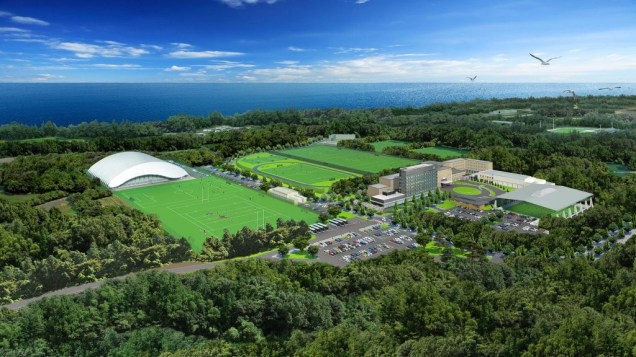
The hand-over is a shot in the arm for Prime Minister Shinzo Abe, who has vowed the nuclear disaster will not impede the nation’s plans to host the 2020 Games. In September, the premier said the situation at Fukushima is “under control” and that there doesn’t need to be a review of measures to prevent contamination.
“This promised handover of J-village would serve as a symbol of progress,” Daniel Aldrich, professor and director of the security and resilience studies program at Northeastern University in Boston, said by e-mail.
“Tepco clearly hopes that this will show the nation that it is on track in the Fukushima accident clean up process,” Aldrich said. “However, a number of obstacles, including expanding costs for decommissioning, a lack of physical control over the contaminated groundwater at the site, and complaints about the decontamination process nearby will no doubt hinder the process.”
As Tepco begins in coming years to remove melted fuel at Fukushima, clean-up costs may rise to several hundred billion yen annually from the current 80 billion yen ($763 million), Japan’s industry ministry said in October. About 300 metric tons of water — partly from the nearby hills — flow into the reactor building daily, mixing with melted fuel and becoming contaminated, according to the company.
The utility used the soccer facility as a make-shift base for tasks from corporate communications to measuring the radiation exposure of employees. It even built temporary dormitories there.
Kawamata evacuation order to be lifted
The evacuation order for the town of Kawamata in Fukushima prefecture will be lifted next March, allowing residents to permanently return to their homes there, Japan’s Ministry of Economy, Trade and Industry (METI) has announced.

The evacuation zone for Kawamata, marked in red, is to be lifted in March 2017. The orange areas are those with restricted access, while entry to the pink area is allowed only in exceptional circumstances
In a 28 October statement, the ministry said the evacuation order for Kawamata would be lifted on 31 March 2017.
The town’s entire population of 15,877 people were evacuated after a large earthquake and tsunami struck the nearby Fukushima Daiichi plant on 11 March 2011. The loss of power at the plant led to core meltdowns at three of the plant’s six units, resulting in the spread of radioactive materials across the area.
Separate from the evacuation area defined by a 20 kilometre radius from Fukushima Daiichi, the area near Kawamata was evacuated once it was known that radioactive particles had been carried by the wind from the damaged power plant.
While limited access to the town had been permitted, METI relaxed controls on entry to most of Kawamata town, northwest of the plant, in August 2013. The redesignation allowed decontamination work to begin and for essential infrastructure and services to be reconstructed. Residents have been able to return at will to visit and work without the use of protective equipment. The only restriction has been that they may not stay overnight.
The radiation dose rate for a person living in Kawamata would be less than 20 millisieverts per year – the government’s benchmark for permanent return – METI said.
As of 1 August 2016, the number of Kawamata residents classed as evacuees totalled 1159, only 46 of which now live outside of Fukushima prefecture, according to figures from the prefectural government.
According to the Japan Atomic Industrial Forum, Kawamata will be the seventh municipality to have its evacuation order lifted. As from April 2017, it says, evacuation orders will remain in effect in parts of five municipalities – the towns of Tomioka, Okuma, Namie and Futaba, as well as part of the village of Iitate.
The government aims to lift all evacuation orders by March 2017, except for certain areas where radiation levels are expected to remain high.
http://www.world-nuclear-news.org/RS-Kawamata-evacuation-order-to-be-lifted-0211164.html
Ice wall at Fukushima plant to be examined

Japanese government officials and the operator of the crippled Fukushima Daiichi nuclear plant say they plan to dig and check the ground around reactors. They want to see if an ice wall installed there is working as intended.
The underground ice wall is meant to prevent groundwater from getting into the damaged reactor buildings and becoming contaminated.
Tokyo Electric Power Company has been creating a 1.5 kilometer-long barrier of frozen earth since March. The ice wall is formed by circulating coolant in pipes buried around the reactor site.
Engineers believe that except for an area on the plant’s hillside, the freezing work has been completed.
Government and TEPCO officials have relied on thermometers in the ground to determine if the soil is frozen. But Japan’s nuclear regulator has urged them to more precisely check the conditions underground and the ice wall’s effectiveness.
This month, workers will dig several meters into the ground south of the Number 4 reactor to directly check the condition of the frozen wall. The area was chosen due to its relatively low radiation level.
Later this month, officials from a government task-force will inspect the site.
TEPCO’s decommissioning roadmap calls for most of the contaminated water to be removed from the reactor buildings in 2018. To achieve this, the ice wall needs to be completed and effectively preventing groundwater from flowing into the reactor buildings.
Gov’t to seek disaster compensation funds from consumers who used nuclear energy

The Ministry of Economy, Trade and Industry is considering making customers of new, smaller power companies who previously used nuclear energy from Tokyo Electric Power Co. (TEPCO) and other utilities shoulder part of the surging compensation costs for the Fukushima nuclear disaster.
Under the Act on Compensation for Nuclear Damage, nuclear power operators must each provide 120 billion yen to be used together with money paid by TEPCO and other major utilities to the Nuclear Damage Compensation and Decommissioning Facilitation Corporation to provide compensation. However, the compensation bill for the Fukushima No. 1 Nuclear Power Plant disaster continues to grow, and the compensation fund is expected to be left trillions of yen short.
The ministry takes the view that major utilities should have gathered more compensation funds from their customers, and it therefore plans to seek compensation funds from those who were previously in contracts with major power companies, using their nuclear energy.
A plan has surfaced to charge small-scale power companies more to deliver electricity through the power grids of major utilities, with the extra costs to be used for compensation. This and other plans will be debated on Nov. 2 at a working group of a ministry committee on energy reform. However, as some customers could face higher bills as a result, the move could trigger a public backlash.
http://mainichi.jp/english/articles/20161102/p2a/00m/0na/004000c
TEPCO Employee Has Overwork Depression, Seeks Compensation

TEPCO employee says he has depression due to overwork, seeks compensation
A 35-year-old employee handling compensation claims relating to the Fukushima nuclear disaster for Tokyo Electric Power Co. (TEPCO) has filed an application with the Tokyo Central Labor Standards Inspection Office seeking workers’ compensation for depression.
Tadafumi Ichii filed the application on Oct. 31, arguing that he started suffering from depression as a result of being forced to work long hours illegally. According to his application and other information, in September 2011 — six months after the outbreak of the nuclear crisis — Ichii transferred to a division tasked with handling complaints from businesses that were not satisfied with the amounts of compensation they were offered for declining sales. In February 2013, he took over the role of giving advice to about 450 TEPCO employees on whether or not to pay damages.
The man clocked 89 hours overtime in March 2013, but he stated, “My overtime working hours, if combined with unpaid overtime and take-home work, stood at 169 hours (in March).” On the morning of June 20, 2013, he could not get out of bed, and failed to show up for work that day. He then transferred to TEPCO’s branch office in Tachikawa, western Tokyo, on July 1, 2013. He frequently started being absent from the office or leaving early, suffering symptoms such as vomiting in the office’s toilet. He was diagnosed on Sept. 3, 2013, as having tendency toward depression and he took a leave of absence from the following day. He was officially diagnosed with depression in April 2014.
The man received a notice from TEPCO in October this year stating that he would be dismissed on Nov. 5 when his recuperation period was due to expire. TEPCO demanded that Ichii submit documents including a doctor’s medical certificate, if he intended to return to work. Ichii says he still suffers symptoms such as insomnia. His doctor, therefore, has judged that he requires further medical treatment, he says.
“I worked hard until I was worn out,” Ichii said at a news conference.
An official with the public relations department at Tokyo Electric Power Company Holdings Inc. commented, “We understand that the labor standards inspection office concerned decides on individual claims for workers’ compensation. We decline to answer questions regarding individual cases.”
According to TEPCO, work to pay compensation to local residents whose livelihoods were lost and companies whose sales dropped due to the nuclear accident started in April 2011 and is ongoing.
As of Oct. 28, there were about 2,691,000 applications and about 6.479 trillion yen had been paid for a total of about 2,515,000 applications that TEPCO had finished screening.
http://mainichi.jp/english/articles/20161101/p2a/00m/0na/017000c
TEPCO worker seeks compensation over Fukushima job
A 35-year-old employee of Tokyo Electric Power Company is seeking insurance benefits, arguing that he developed depression due his work dealing with the aftermath of the Fukushima nuclear accident.
Tadafumi Ichii spoke to reporters on Monday after filing the request for workers’ accident compensation with labor authorities.
Ichii said that, in September of 2011, he was tasked with paying redress to businesses affected by the accident at the Fukushima Daiichi nuclear power plant six months earlier.
He said he was in charge of up to 180 companies and put in nearly 170 hours of overtime a month. He added that he was caught between his bosses and his clients, and mentally driven to the edge.
The utility reportedly plans to dismiss him when his sick leave ends in early November.
Ichii said he sacrificed his health to do the job and that he cannot accept the way his employers are treating him.
Tokyo Electric Power Company said in a statement that the utility will deal with the matter sincerely when it is contacted by labor authorities.
Industry ministry to create new fund to decommission Fukushima No. 1 plant reactors

The Ministry of Economy, Trade and Industry is poised to set up a system under which Tokyo Electric Power Co. (TEPCO) will accumulate the funds necessary to decommission reactors at its crippled Fukushima No. 1 nuclear plant with the help of a government-backed organization, sources close to the ministry said.
Under the system, money that TEPCO accumulates through cost-cutting and other measures will be provided to the Nuclear Damage Compensation and Decommissioning Facilitation Corp. (NDF), which will use the funds when necessary.
The move is aimed at strengthening the central government’s involvement in decommissioning the reactors at the tsunami-ravaged power station and securing as much money as possible to cover the costs.
TEPCO has so far raised a total of 2 trillion yen to decommission reactors at the Fukushima No. 1 complex. However, several trillion yen more is highly likely to be needed to decommission the reactors.
The planned scheme will allow the NDF to manage the decommissioning plan and funds to reduce the financial burden on consumers as much as possible, and stably secure funds for decommissioning the reactors at the plant. TEPCO and its subsidiaries will be required to raise as much money as possible to decommission the reactors.
The ministry is considering a plan to add the costs of dismantling reactors at the crippled Fukushima plant to the fees that new, smaller-scale power companies pay for using TEPCO’s power cables. However, consumers are critical of the plan, which would force them to shoulder an extra burden for the decommissioning of the reactors. As such, the ministry intends to secure as much money as possible for reactor decommissioning by strengthening the national government’s involvement and reforming TEPCO’s management.
Once the estimated costs of scrapping the Fukushima No. 1 plant reactors are finalized, TEPCO will be required to set aside a massive amount of funds for such work, possibly falling in a state of capital deficit in which its liabilities exceed its assets. The ministry will therefore take legal measures to allow TEPCO to post its liabilities in installments.
http://mainichi.jp/english/articles/20161101/p2a/00m/0na/018000c

What about the Fukushima Daiichi Plutonium Release?
Recently I came across this article from Hideo Watanabe, a Japanese blogger, which I find very interesting. It has the merit to raise some questions about the real quantity of Plutonium released in March 2011 during the Fukushima Daiichi nuclear plant catastrophe.
The claim of Hideo Watanabe that there was plutonium stocked in reactor 4 and plumed from it seems highly unlikely, as Bellona were in there and they would have picked up on high readings in the number 4 building if the reactor seals had been damaged like the others. That is why I have left that part out in this blog article.
However, his article has the merit to point out the contradictions between the two studies and that August 2015 IAEA report, report which itself has contradictions in its text, regarding the quantity of plutonium released from Fukushima Daiichi reactors in March 2011.
The issue of Pu release from the other reactors and spent fuel pools is a bigger issue as well as the water contamination issues. The measurements earlier on were in Beta and Alpha and little was mentioned on Pu and Uranium isotopes.. Some info came out about Pu but the data was sparse.. There has been no mention of Uranium isotopes but I think Uranium was likely spread around to some degree,
Anyway the discussion on the missing isotopes is valid and worth reminding people about. The general observations are that Fukushima Daiichi has low amounts of Sr 90 compared to Chernobyl and less Pu on average.. There may be Pu hotspots around but they would be hard to find.
The IAEA would like us to believe that the March 2011 Plutonium release from Fukushima Daiichi reactors was very minimal, though their own August 2015 report shows contradictions. Furthermore two independent studies say otherwise.
Inside 200km zone, 240PU/239PU atoms ratios 0.216 – 0.255
Significantly higher than that of global fallout.

figure 1. (a) Results of 239+240 Pu and 241 Pu activities and 240 Pu/239 Pu atom ratios in surface soil and litter samples collected in the evacuation-prepared area (J-Village) and the deliberate evacuation area (S1, Katsurao Village; S2, Namie Town; and S3, Iitate Village). Data are cited from ref 27. (b) Map showing the locations of marine sediment and seawater sampling sites. Results of 239+240 Pu activity (Bq/kg) and 240Pu/239 Pu atom ratio are shown. Data of sediment samples are cited from ref 37, and seawater samples (FSK1 and FSK 2) are cited from ref 65.
!*!*!*!*!*!*!*!*!*!*!*!*!*!*!*!*!*!*!*!*!*!*!*!*!*!*!*!*!*!*!*!*!*!*!*!*!*!*!*!
By Hideo Watanabe

Here is the Nature report :
Isotopic evidence of plutonium release into the environment from the Fukushima DNPP accident
http://www.nature.com/articles/srep00304


The IAEA, published a comprehensive report of Fukushima in August 2015, the Fukushima Daiichi accident technical volume 1: description and context of the accident
http://www-pub.iaea.org/MTCD/Publications/PDF/AdditionalVolumes/P1710/Pub1710-TV1-Web.pdf
Still, in that IAEA’s report there are some contradictions and weaknesses.

In the 2014 study, some researchers are saying the same thing as the Nature report.

Source: Hideo Watanabe’s blog
Fukushima Cover Up

It is literally impossible for the world community to get a clear understanding of, and truth about, the Fukushima nuclear disaster. This statement is based upon The Feature article in Columbia Journalism Review (“CJR”) d/d October 25, 2016 entitled: “Sinking a Bold Foray Into Watchdog Journalism in Japan” by Martin Fackler.
The scandalous subject matter of the article is frightening to its core. Essentially, it paints a picture of upending and abolishing a 3-year attempt by one of Japan’s oldest and most liberal/intellectual newspapers, The Asahi Shimbun (circ. 6.6 mln) in its effort of “watchdog journalism” of the Fukushima nuclear disaster. In the end, the newspaper’s special watchdog division suffered un-preannounced abrupt closure.
The CJR article, whether intentionally or not, is an indictment of right wing political control of media throughout the world. The story is, moreover, extraordinarily scary and of deepest concern because no sources can be counted on for accurate, truthful reporting of an incident as powerful and deadly dangerous as the nuclear meltdown at Fukushima. Lest anybody in class forgets, three nuclear reactors at Fukushima Diiachi Nuclear Power Plant experienced 100% meltdown, aka The China Syndrome over five years ago.
The molten cores of those reactors melted down to a stage called corium, which is a lumpy hunk of irradiating radionuclides so deadly that robotic cameras are zapped! The radioactivity is powerful, deadly and possessed of frightening longevity, 100s of years. Again for those who missed class, TEPCO (Tokyo Electric Power Company) has no idea where those masses of sizzling hot radioactive goo are today. Did they burrow into the ground? Nobody knows, but it is known that those blobs of radioactivity are extraordinarily dangerous, as in deathly, erratically spewing radioactivity “who knows where”?
Fukushima is a national/worldwide emergency that is the worst kept secret ever because everybody knows it is happening; it is current; it is alive; it is deadly; it has killed (as explained in several prior articles) and will kill many more as well as maim countless people over many decades (a description of radiation’s gruesomeness follows later on in this article).
Yet, the Abe administration is talking to Olympic officials about conducting Olympic events, like baseball, in Fukushima for Tokyo 2020. Are they nuts, going off the deep end, gone mad, out of control? After all, TEPCO readily admits (1) the Fukushima cleanup will take decades to complete, if ever completed, and (2) nobody knows the whereabouts of the worlds most deadly radioactive blobs of sizzling hot masses of death and destruction, begging the question: Why is there a Chernobyl Exclusion Zone of 1,000 square miles after one nuclear meltdown 30 years ago, but yet Fukushima, with three meltdowns, each more severe than Chernobyl, is already being repopulated? It doesn’t compute!
The short answer is the Abe administration claims the radioactivity is being cleaned up. A much longer answer eschews the Abe administration by explaining the near impossibility of cleaning up radioactivity throughout the countryside. There are, after all, independent organizations with boots on the ground in Fukushima (documented in prior articles) that tell the truth, having measured dangerous levels of radiation throughout the region where clean up crews supposedly cleaned up.
The Columbia Journalism Review article, intentionally or not, paints a picture of “journalism by government decree” in Japan, which gainsays any kind of real journalism. It’s faux journalism, kinda like reading The Daily Disneyworld Journal & Times.
Based upon the CJR article: “The hastiness of the Asahi’s retreat raised fresh doubts about whether such watchdog journalism— an inherently risky enterprise that seeks to expose and debunk, and challenge the powerful—is even possible in Japan’s big national media, which are deeply tied to the nation’s political establishment.”
Japan’s journalists belong to “press clubs,” which are exclusively restricted to the big boys (and girls) from major media outlets, where stories are hand-fed according to government officialdom, period. It is the news, period! No questions asked, and this is how Asahi got into trouble. They set up a unit of 30-journalists to tell the truth about Fukushima and along the way won awards for journalism, until it suddenly, abruptly stopped. A big mystery ensues….
According to the CJR article, “The Investigative Reporting Section [Asahi] proved an instant success, winning Japan’s top journalism award two years in a row for its exposure of official cover-ups and shoddy decontamination work around the nuclear plant.”
Furthermore, according to the CJR article: “The abrupt about-face by the Asahi, a 137-year-old newspaper with 2,400 journalists that has been postwar Japan’s liberal media flagship, was an early victory for the administration of Prime Minister Shinzo Abe, which had sought to silence critical voices as it moved to roll back Japan’s postwar pacifism, and restart its nuclear industry.”
And, furthermore, the truth be told: “In Japanese journalism, scoops usually just mean learning from the ministry officials today what they intend to do tomorrow,’ says Makoto Watanabe, a former reporter in the section who quit the Asahi in March because he felt blocked from doing investigative reporting. ‘We came up with different scoops that were unwelcome in the Prime Minister’s Office.”
It comes as no surprise that Reporters Without Borders lowered Japan’s rating from 11th in 2010 (but one has to wonder how they ever got that high) to 72nd in this years annual ranking of global press freedoms, released on April 20, 2016.
Koichi Nakano, a professor of politics at Sophia University in Tokyo, says: “Emasculating the Asahi allowed Abe to impose a grim new conformity on the media world.”
When considering the awards Asahi won during its short foray into investigative journalism, like Japan’s equivalent of the Pulitzer Prize in 2012 for reporting about a gag-order on scientists after the Fukushima disaster and the government’s failure to release information about radiation to evacuating residents, now that Asahi has been forced to put a lid on “investigative journalism” and it must toe the line in “press clubs,” any and all information about the dangers or status of Fukushima are ipso facto suspect!
The world is dead silent on credible information about the world’s biggest disaster! (Which causes one to stop and think… really a lot.)
The evidence is abundantly clear that there is no trustworthy source of information about the world’s biggest nuclear disaster, and likely one of the biggest dangers to the planet in human history. However, time will tell as radiation exposure takes years to show up in the human body. It’s a silent killer but cumulates over time. Fukushima radiation goes on and on, but nobody knows what to do. To say the situation is scandalous is such a gross understatement that it is difficult to take it as seriously as it really should be taken. But, it is scandalous, not just in Japan but for the entire planet.
After all, consider this, 30 years after the fact, horribly deformed Chernobyl Children are found in over 300 asylums in the Belarus backwoods deep in the countryside. Equally as bad but maybe more odious, as of today, Chernobyl radiation (since 1986) is already affecting 2nd generation kids.
According to USA Today, Chernobyl’s Legacy: Kids With Bodies Ravaged by Disaster, April 17, 2016: “There are 2,397,863 people registered with Ukraine’s health ministry to receive ongoing Chernobyl-related health care. Of these, 453,391 are children — none born at the time of the accident. Their parents were children in 1986. These children have a range of illnesses: respiratory, digestive, musculoskeletal, eye diseases, blood diseases, cancer, congenital malformations, genetic abnormalities, trauma.”
It’s taken 30 years for the world, via an article in USA Today, to begin to understand how devastating, over decades, not over a few years, radiation exposure is to people. It is a silent killer that cumulates in the body over time and passes from generation to generation to generation, endless destruction that cannot be stopped!
http://www.counterpunch.org/2016/10/31/fukushima-cover-up/
Fukushima: A Second Chernobyl?
With an introduction by David McNeill
Waiting for the Future in Fukushima
As the sixth anniversary of the Fukushima nuclear disaster approaches, the area around the hulking corpse of the Fukushima Daiichi Nuclear Power Plant continues to exude a horrible fascination. Arkadiusz Podniesinski is one of thousands of photographers and journalists drawn there since the crisis began in March 2011. In 2015 his first photo report from the area attracted millions of views around the world.
Podniesinski brought to Japan his experience of chronicling the aftermath of the world’s worst nuclear accident in Chernobyl, which he first visited in 2008. It was, he noted, people, not technology that was responsible for both disasters. Japanese politicians, he adds, are offended by comparisons with Chernobyl. Still, rarely for a foreign report on Fukushima, his work was picked up by Japanese television (on the liberal channel TBS), suggesting there is a hunger for this comparative perspective.
Podniesinski’s first trip strengthened his belief in the “catastrophic consequences of nuclear disasters.” Apart from the suffering caused by the disruption of so many lives (160,000 people remain homeless or displaced), there is the struggle to return contaminated cities and towns to a state where people can live in them again. Billions of dollars have already been spent on this cleanup and much more is to come: The latest rehabilitation plan by plant operator Tokyo Electric Power Co. puts the total bill for compensation alone at 7.08 trillion yen, or nearly $60 billion.
Thirty years after Chernobyl’s reactor exploded, Ukrainians have long come to terms with the tragedy that befell them, he writes. The dead and injured have been forgotten. A 2-billion-Euro sarcophagus covering the damaged reactor is nearly complete. The media returns to the story only on major anniversaries. What, he wonders, will become of Fukushima? Last year, Naraha became the first town in Fukushima Prefecture to completely lift an evacuation order imposed after the triple meltdown. But despite rebuilding much of the town’s infrastructure and spending millions of dollars to reduce radiation, the local authorities have persuaded only a small number of people to permanently return there.
Radiation is only part of the problem, of course. “The evacuees worry about the lack of schools, hospitals and shops,” says Podniesinski. “About the public infrastructure, which has not been sufficiently rebuilt. It must be adapted to the needs of older people, who, after the departure of so many young people from the zone, will now be the majority. However, the evacuees are most afraid of loneliness, as few of their family members, friends and neighbors have decided to return.”
The sense of life suspended, of waiting for the future to arrive, resonates in Tomioka, once home to nearly 16,000 people, now a ghost town. Podniesinski arrives just as its famous cheery blossoms bloom, but there is nobody to see them. The irony of fate, he writes, means that this Japanese symbol of new, nascent life blooms in contaminated and lifeless streets. “Will the city and its residents be reborn? Undoubtedly, the last word shall belong to them alone.” DM
Fukushima: A Second Chernobyl?
Exactly a year has passed since my first visit to Fukushima. A visit which strengthened my belief of how catastrophic the consequences of nuclear disasters can be. A visit that also highlighted how great the human and financial efforts to return contaminated and destroyed cities to a state suitable for re-habitation can be.
The report on the Fukushima zone through the eyes of a person who knows and regularly visits Chernobyl received a great deal of interest in the international community. Viewed several million times and soon picked up by traditional media around the world, it became for a moment the most important topic on Fukushima. I was most pleased, however, by the news that the coverage also reached Japan, where it not only caused quite a stir (more on that another time) but also made me realise just how miniscule Japanese knowledge about the current situation in Fukushima is.
As a result, over the last year I started to go to Fukushima more often than to Chernobyl. This is hardly surprising for another reason. 30 years have passed since the Chernobyl disaster, so the majority of Ukrainians have long since come to terms with the tragedy. The dead and injured have been forgotten. The same is true for media interest, which is only revived on the occasion of the round, 30th anniversary of the disaster. In addition, after nearly 10 years and 2 billion euros, work on the new sarcophagus is finally coming to an end, and soon a storage site for radioactive waste and a 227-ha radiological biosphere reserve will be established.
Will the decommissioning of the power plant in Fukushima also take 30 years and end with the construction of a sarcophagus? Will the contaminated and deserted towns located around the destroyed Fukushima Daiichi power plant be called ghost towns and resemble Chernobyl’s Pripyat? Finally, will Fukushima become a popular place for dark tourism like Chernobyl and be visited by thousands of tourists every year?
I Never Want to Return Alone
The Japanese, particularly politicians and officials, do not like and are even offended by comparisons between Fukushima and Chernobyl. It is, however, difficult not to do so when analogies are visible everywhere. While the fact that the direct causes of the disasters are different, the result is almost identical. A tragedy for the hundreds of thousands of evacuated residents, hundreds of thousands of hectares of land contaminated, and decades of time and billions of dollars devoted to eliminating the results of the disaster. And the first cases of thyroid cancer.
The situation in Fukushima resembles a fight against time or a test of strength. The government has devoted billions of dollars to decontaminating the area and restoring residents to their homes. They must hurry before the residents completely lose hope or the desire to return. Before the houses collapse or people are too old to return to. In addition, the authorities soon intend to stop the compensation paid to residents, which according to many of them will be an even more effective “encouragement” for them to return. Deprived of financial support, many residents will have no other choice but to return. Many young families are not waiting for any government assistance. They decided long ago to leave in search of a new life free of radioactive isotopes. They will surely never return.
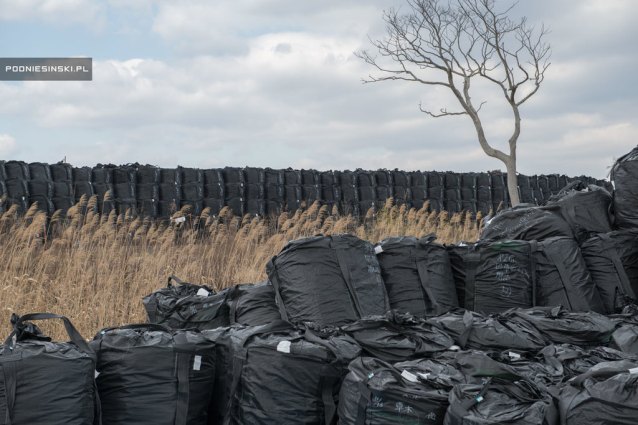
Landfill bags with contaminated soil in Tomioka
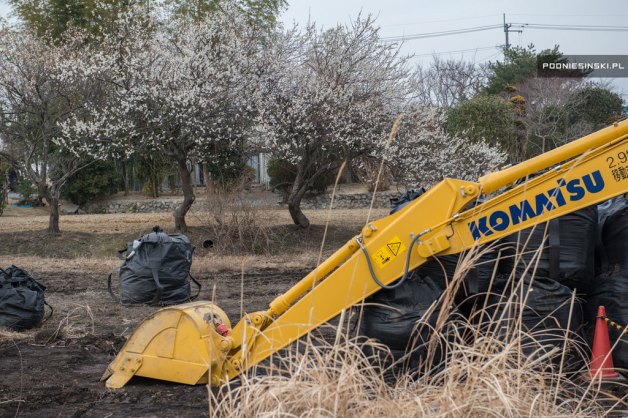
Decontamination of personal possessions
But radiation is not the only problem that the authorities must worry about. The evacuated residents worry about the lack of schools, hospitals and shops. About the public infrastructure, which has not been sufficiently rebuilt. It must be adapted to the needs of older people, who, after the departure of so many young people from the zone, will now be the majority. However, the evacuees are most afraid of loneliness, as few of their family members, friends and neighbours have decided to return.
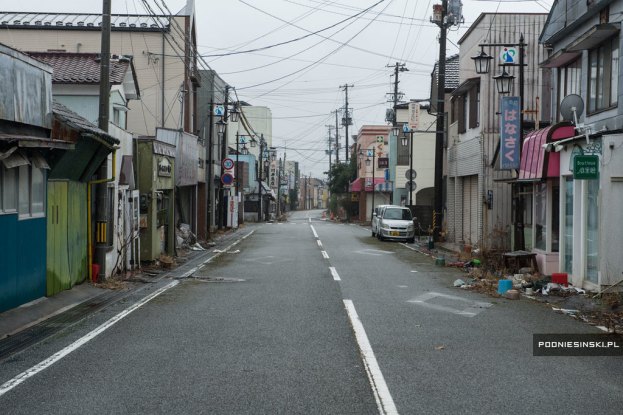
Deserted streets in the town of Okuma, closest to the destroyed power plant
Can the authorities manage to convince the residents to return? Has critical mass been exceeded, after which evacuees will learn from others and return? The authorities are doing everything they can to convince residents that the sites are safe for people. They open towns, roads and railway stations one after another. Unfortunately, despite this, residents still do not want to return. A recent survey confirms that there is a huge gap between the government’s current policies and the will of the affected residents. Only 17.8% want to return, 31.5% are unsure and 48% never intend to return.
It Became Chernobyl Here
During my first visit to Fukushima, I met Naoto Matsumura, who defied official bans and returned to the closed zone to take care of the animals abandoned there by farmers fleeing radiation. Matsumura has taken in hundreds of animals, saving them from inevitable death by starvation or at the hands of the merciless officials forcing farmers to agree to kill them. Thanks to his courage and sacrifice, Matsumura soon became known as the Guardian of Fukushima’s Animals.
Matsumura was not able to help all of the animals, however. According to the farmer, a third of them died of thirst, unable to break free of the metal beams in barns, wooden fences or ordinary kennels. Matsumura took me to one such place.
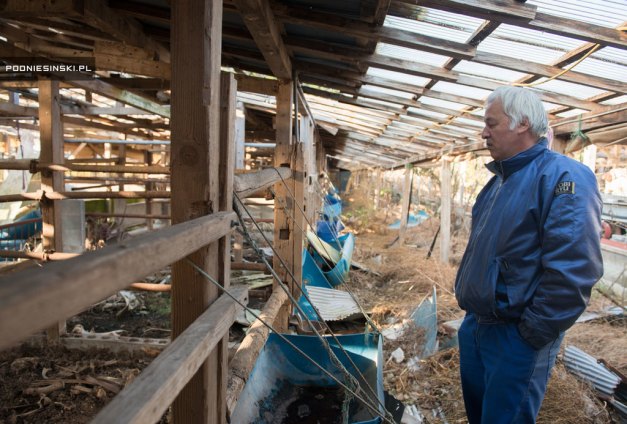
Naoto Matsumura on an abandoned farm
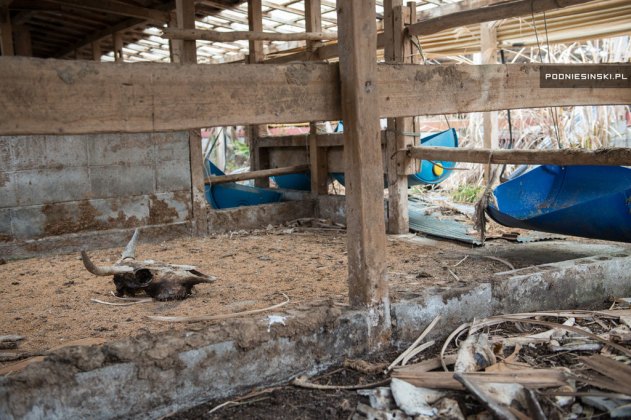
Not all appreciate Matsumura’s sacrifice and courage. Many people believe that helping these animals, which sooner or later would have ended up on a plate, is not worth the risk the farmer is exposing himself to. Matsumura always has the same answer for them – there is a fundamental difference between killing animals for food and killing animals who are no longer needed due to radiation.
Cow Terrorist
I also returned to Masami Yoshizawa, who like Naoto Matsumura decided to illegally return to the closed zone to take care of the abandoned animals. Shortly after the disaster, some of the farmer’s cows began to develop mysterious white spots on their skin. According to Yoshizawa, they are the result of radioactive contamination and the consumption of radioactive feed.
Yoshizawa’s farm is located 14 km from the destroyed power plant. From this distance, the buildings of the plant are not visible, but its chimneys can be seen. And, as Yoshizawa says – one could also see [and hear] explosions in the power plant as well as radioactive clouds that soon pass over his farm. Consequently, nearly half of the nearly 20,000 inhabitants of the town of Namie were evacuated to Tsushima, located high in the nearby mountains. But soon people began to flee from there when it turned out that the wind blowing in that direction contaminated the area even more. As a result of the radioactive contamination in Fukushima, a new generation known as the hibakusha has arisen. Up to now, this name was only given to people who were victims of the atomic bombings of Hiroshima and Nagasaki. Now this concept has also been applied to victims of the Fukushima nuclear disaster. As Yoshizawa says – of the 120 surveyed hibakusha, he ranks third in Namie in terms of the amount of radiation doses received.
Defying the completely ignorant authorities, Yoshizawa quickly became a professional activist and his cows got a new mission – they became protestors. And, soon after, he brought one of them in front of the Ministry of Agriculture’s building, demanding that research be undertaken to explain why white spots have appeared on the animals’ skins after the disaster. Yoshizawa says, “I protested [by] bringing a bit of Fukushima to Tokyo. May the cows and I become living proof of the disaster, and the farm a chronicle telling the story of the Fukushima disaster.”
When protesting against the construction and re-starting of subsequent nuclear power plants, Yoshizawa does not bring his cows along anymore. Instead, he has a car festooned with banners that pulls behind it a small trailer with a metal model of a cow. “I have a strong voice and can scream louder than die-hard right wingers!” explains Yoshizawa. “I’m a cowboy, a cow terrorist, a kamikaze!” he adds in a loud voice, presenting an example of his capabilities. “We are not advocating violence, we don’t kill people, we are not aggressive. We are political terrorists,” he concludes calmly. And after a moment, he invites us to a real protest. The occasion of the planned opening of the railway station is to be attended by Prime Minister Sinzo Abe himself.
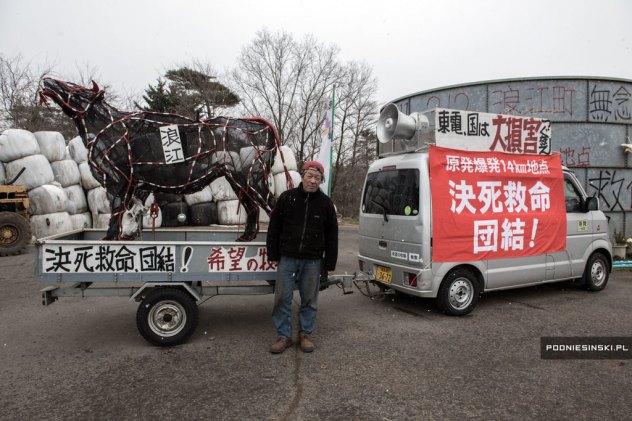
Yoshizawa on his Farm of Hope. The slogans on the auto read “Solidarity and ready to die” and “TEPCO, government: we demand compensation for our injustices!”
The protest goes peacefully indeed. Yoshizawa first drives round the city to which the Prime Minister is soon to arrive. Driving his car, he shouts into the microphone, “When a fire broke out in the reactors, TEPCO employees fled. The fire was extinguished by the young men of the Japanese Self-Defence Forces. Why were you not able to control the power plant you built?” He continued immediately, “Today the Prime Minister is coming here. Let’s get up and greet Abe. Let’s show Abe not only the beautifully prepared railway station, let him also see the dark side of the city. For 40 years, we supplied electricity to Tokyo. Our region only could support Japan’s economic development. And now we suffer. Tales about the safety of nuclear power plants are a thing of the past,” Yoshizawa concludes. When the moment of the Prime Minister’s arrival approaches and the crowds grow larger, policemen and the Prime Minister’s security detail approach the farmer. They order him to take down his banners and leave the site. Yoshizawa obeys, but carries out their commands without haste. As if deliberately trying to prolong their presence, hoping to have time to meet and “greet” the Prime Minister.
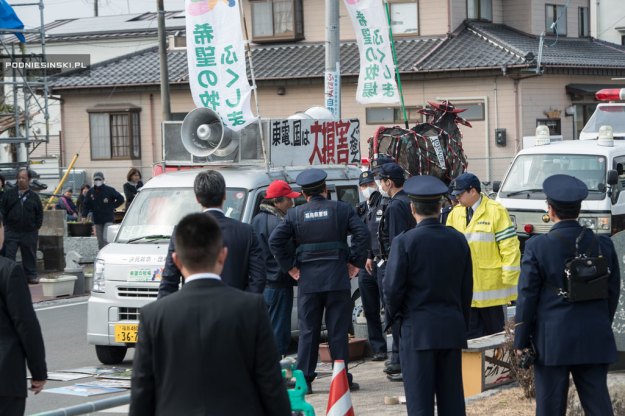
Yoshizawa talks with the police
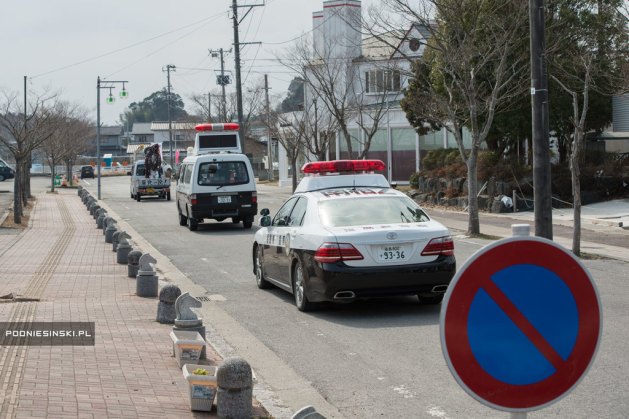
Yoshizawa leaves the square under police escort, which wants to make sure that the farmer will leave the city
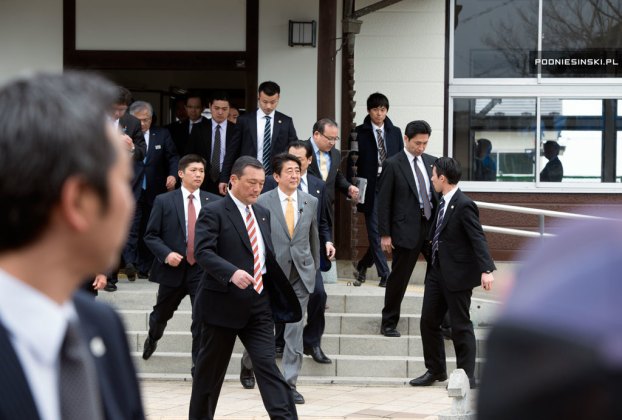
Japanese Prime Minister Shinzo Abe leaving the railway station
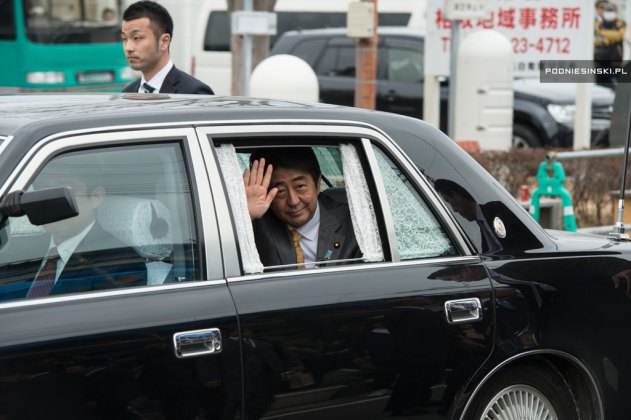
No-go Zones
As always, a major part of my trip to Fukushima is devoted to visits to no-go zones. Obtaining permission to enter and photograph the interior is still difficult and very time-consuming. However, it is nothing compared to the search for owners of the abandoned properties, persuade them to come, show their houses and discuss the tragic past.
Sometimes, however, it’s different. Such as in the case of Tatsuo and Kazue Kogure, who with the help of Japanese television agreed to take me to Tomioka, where they ran a small but popular bar. It was not only a place to eat and drink sake, but also to sing karaoke with the bar’s owners.
Unfortunately the city, and with it the bar, stood in the way of the radioactive cloud and had to be closed. Earlier, I saw many similar bars and restaurants. Overgrown, smelly, full of mould, debris and scattered items. This place, however, is different. It is distinguished by its owners, who despite age and the tragedy they experienced, did not give up and opened a new bar outside the radioactive zone. Mr and Mrs Kogure not only showed me the abandoned bar, but also invited me to their new one.
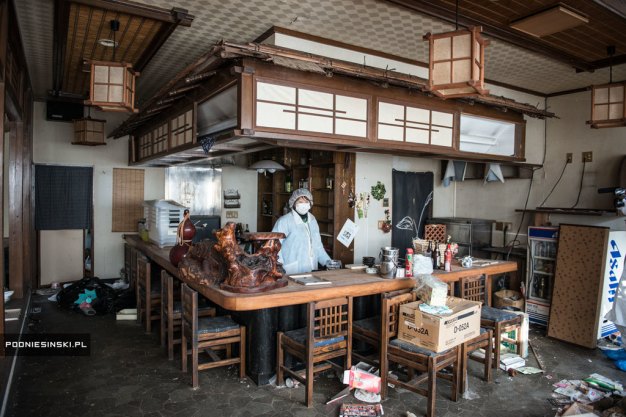
Kazue Kogure inside their abandoned bar in Tomioka
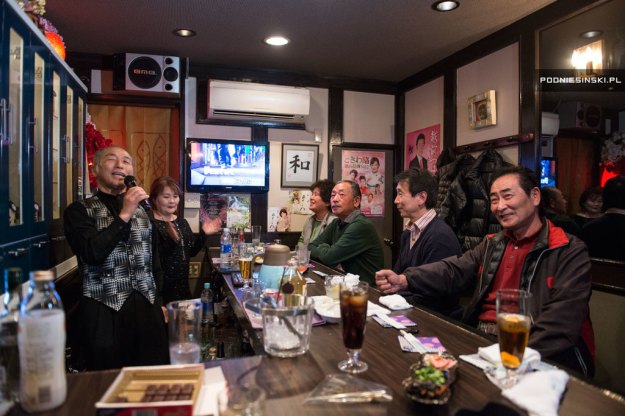
Tatsuo and Kazue Kogure in their new bar in Iwaki
What is unusual and extremely gratifying is the fact that the couple’s efforts to continue the family business are also supported by regular customers from the previous bar. “It’s thanks to their help that we could start all over again,” Kazue Kogure acknowledges. She immediately adds, “By opening the bar again we also wanted to be an example to other evacuated residents. To show that it’s possible.”
The Scale of the Disaster Shocked Us
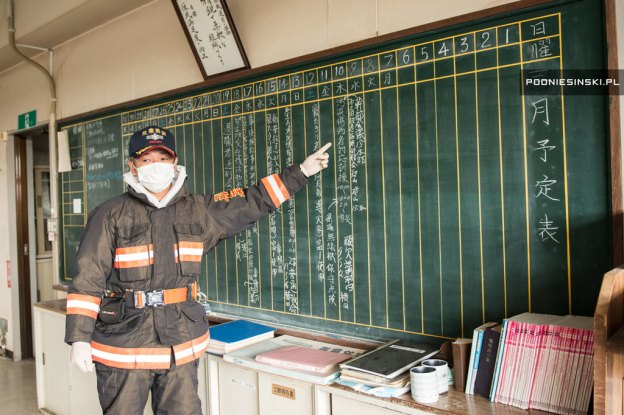
I also visit the former fire station located in the closed zone in Tomioka. Due to the nuclear power plant neighbouring the city, the firefighters working here were regularly trained in case of a variety of emergencies. I am accompanied by Naoto Suzuki, a firefighter who served here before the disaster. In the middle of the firehouse, my attention is drawn to a large blackboard. “That’s the task scheduler for March 2011,” the firefighter explains. “On 11 March, the day of the disaster, we had nothing planned, but,” he adds with an ironic smile, “the day before we had a training session on responding to radioactive contamination. We practised how to save irradiated people and how to use dosimeters and conduct decontamination.”
Unfortunately, the reality shocked even the firefighters, who had to cope with tasks they had never practised. For example, with cooling the reactors. Even the repeatedly practised evacuation procedures for the residents were often ineffective and resulted in the opposite of the desired effect. It turned out that the data from SPEEDI (System for Predicting Environmental Emergency Dose Information), whose tasks included forecasting the spread of radioactive substances, was useless and did not reach the local authorities. As a result, many residents were evacuated for more contaminated sites and unnecessarily endangered by the additional dose of radiation.
The monthly work schedule at the fire station in Tomioka (no-go zone). Firefighter Naoto Suzuki shows the training session on how to help people exposed to radiation planned for the day before the disaster. A committee meeting to provide information in the event of a fire in the nuclear reactors was planned for 14 March.
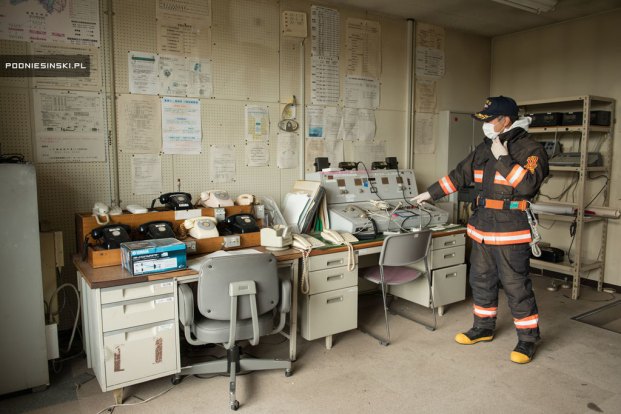
Firefighters’ dispatch. Local firefighting tasks in Tomioka were managed from here.
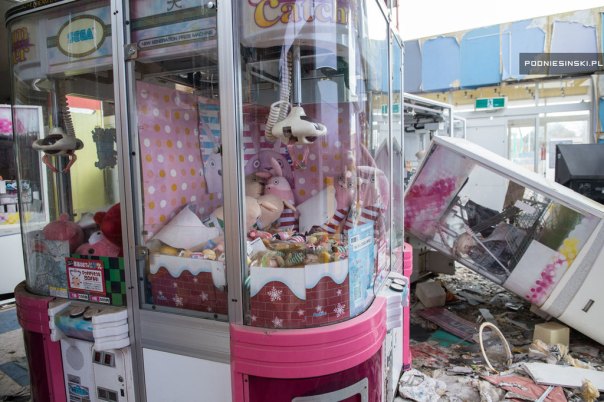
In the spring of this year, thanks to the help and support of many people, particularly the local authorities, evacuated residents and even a monk, I was also able to see many interesting places mostly located in the closed zones in Tomioka, Okuma, Futaba and Namie. Although five years have passed since the disaster, most of them still remain closed and many valuable objects can still be found there. Due to this, I have decided not to publish information that could aid in locating them.
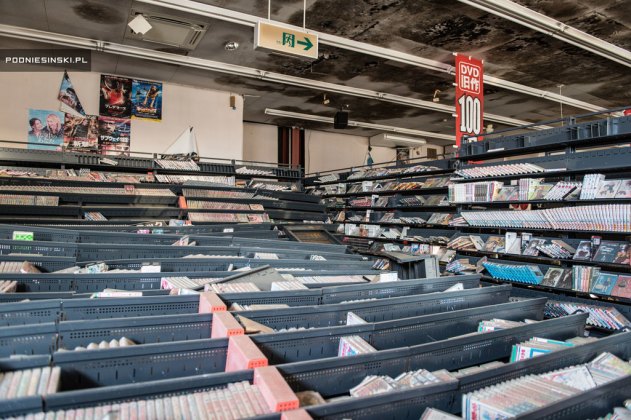
Overturned shelves of rental video shop
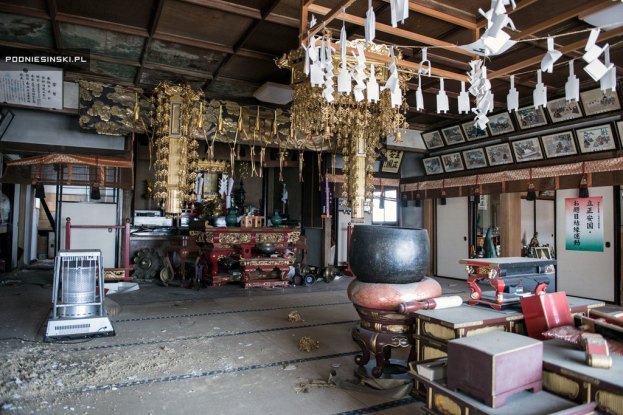
Temple
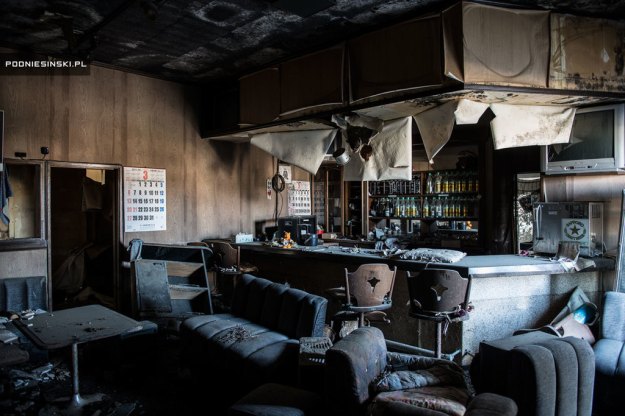
Izakaya Bar
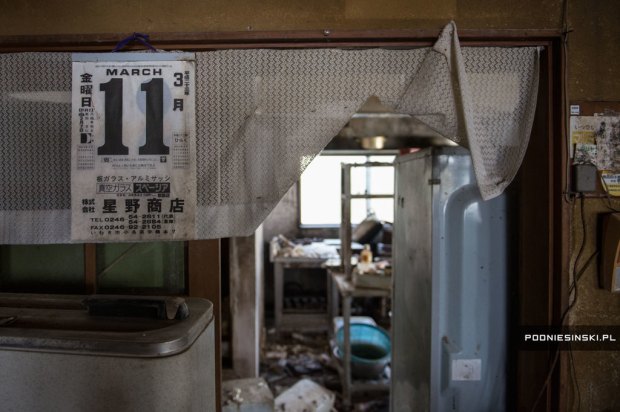
Restaurant
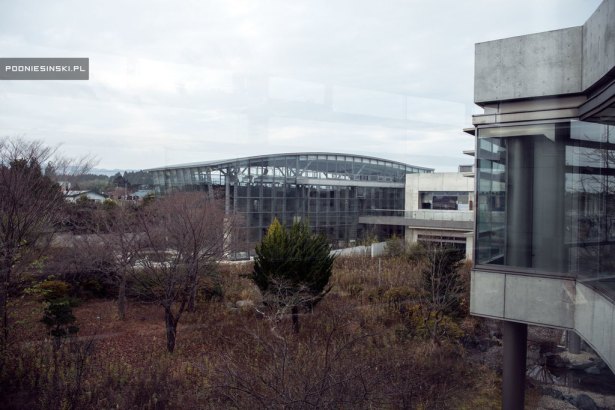
Swimming pool complex
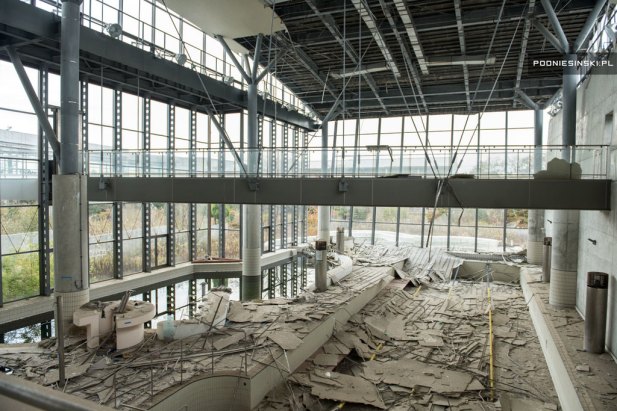
Main pool
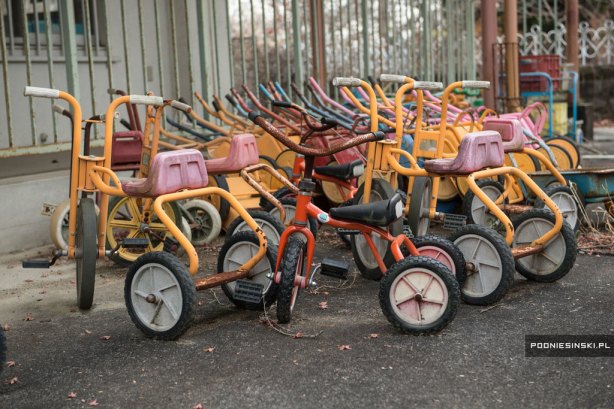
Children’s bikes in the courtyard of the kindergarten
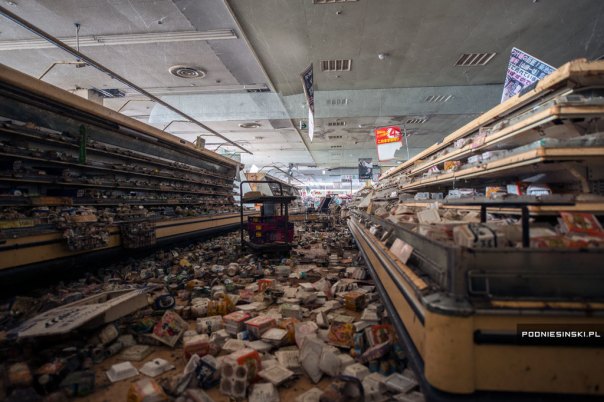
Supermarket
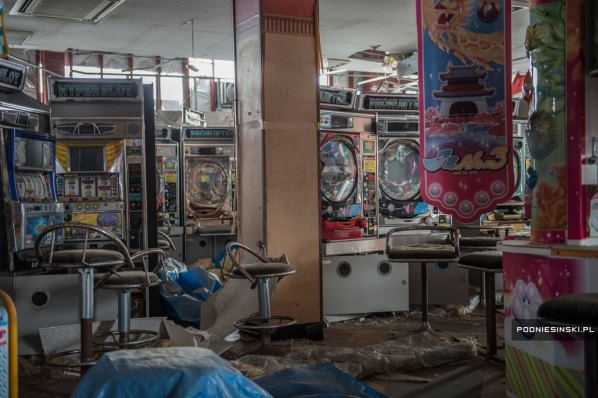
SEGA arcade
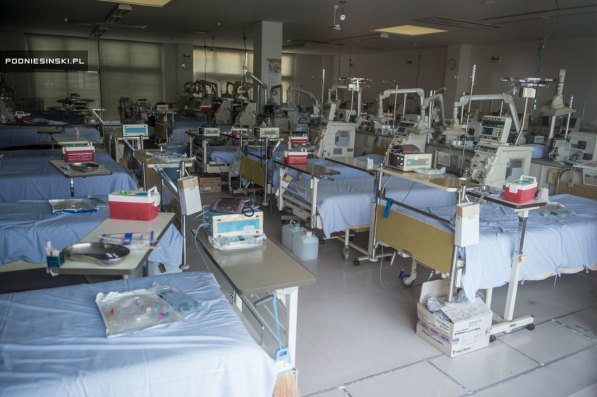
Hospital
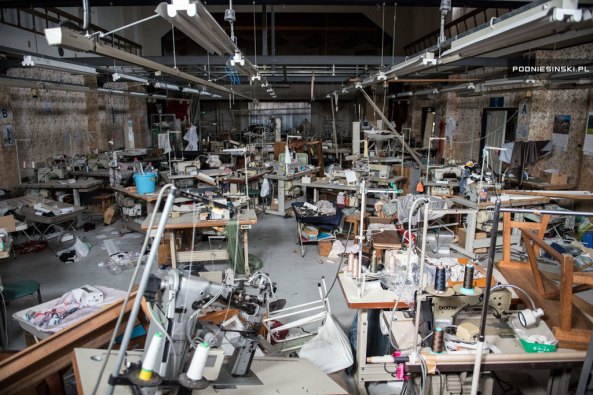
Clothing factory
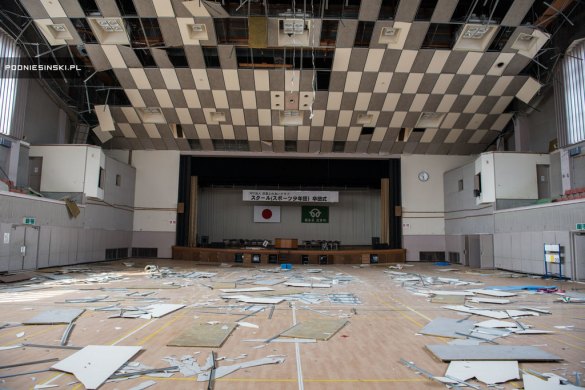
Gym
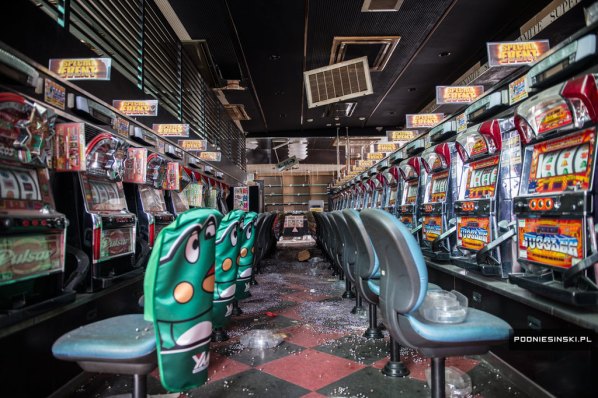
Pachinko arcade
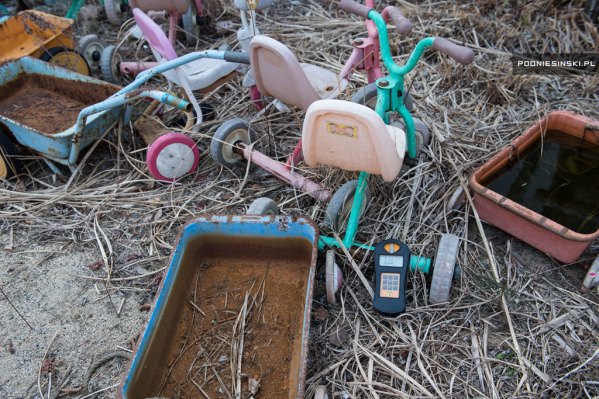
Kindergarten. The dosimeter reading here is 9.3 uSv/h.
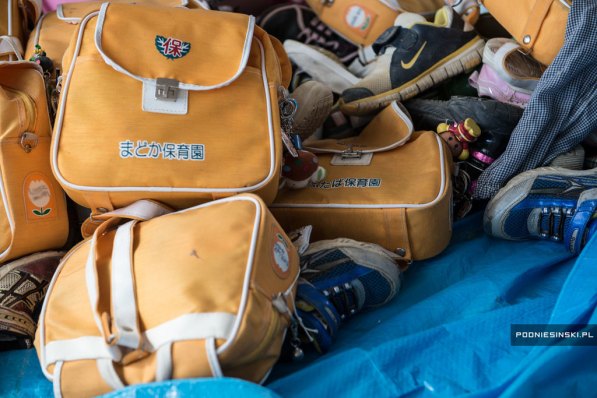
Children’s school bags
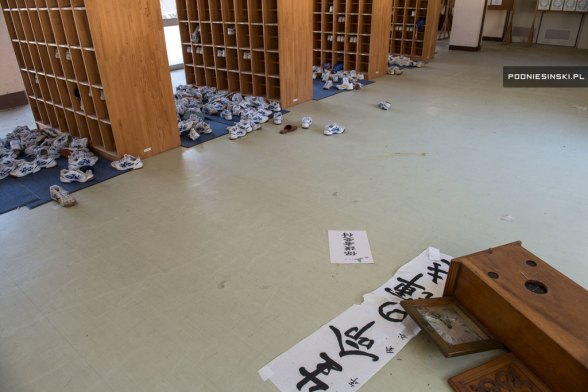
School
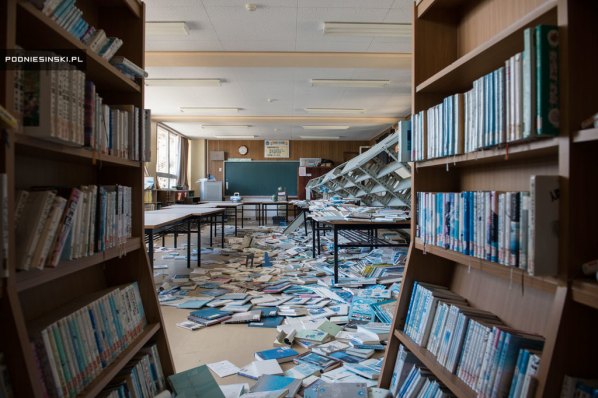
School library
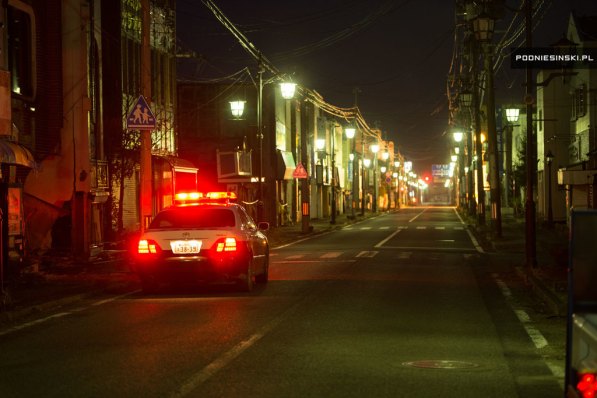
Nighttime police patrol
Hope
Ending my series of travels around Fukushima, I return to Tomioka to see the thing for which the city is most famous and its residents most proud – one of the longest and oldest cherry blossom tunnels in Japan. For the residents of Tomioka, cherry trees have always been something more than just a well-known tourist attraction or the historic symbol of the town. Not only did they admire the aesthetic attributes of the flowers, but they were also part of their lives, organised festivals, meetings and the topic of family conversations.
The natural beauty and powerful symbolism as well as their constant presence in Japanese arts have made cherry trees become an icon of Japanese cultural identity. They signal the arrival of spring, the time for renewal and the emergence of new life. In the spiritual sense, they remind us of how beautiful, yet tragically short and fragile, life is – just like the blooming cherry blossoms that fall from the tree after just a few days.
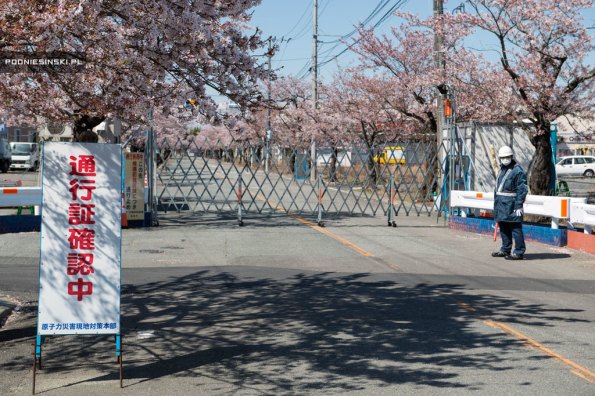
Entrance gate to the closed zone in Tomioka
The nuclear irony of fate meant that this Japanese symbol of new, nascent life today blooms in the contaminated and lifeless streets of Tomioka. Will the city and its residents be reborn, along with the cherry trees blossoming in solitude and silence? Undoubtedly, the last word shall belong to them alone.
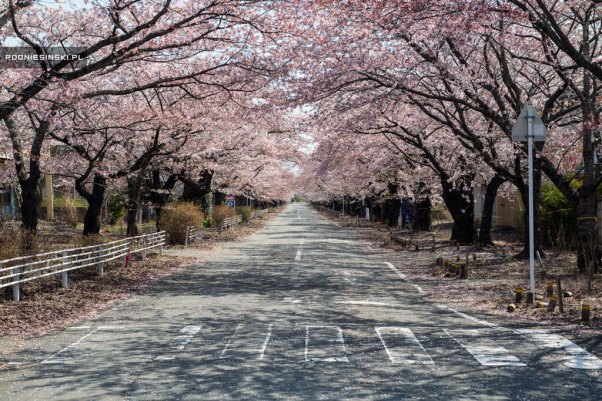
Main street with flowering cherry trees
German firm aims to compactly convert radioactive Fukushima wood into power
Whatever they say, incineration is never a solution as it just redistributes radionuclides into the environment
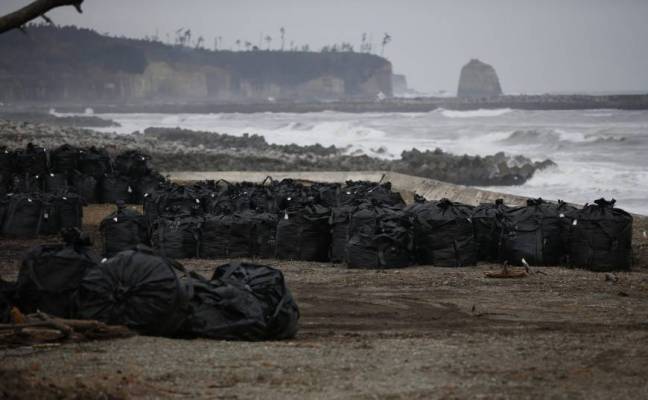 Black plastic bags containing radioactive soil, leaves and debris from decontamination operations are dumped at a seaside spot devastated by the March 2011 earthquake and tsunami in Tomioka, Fukushima Prefecture, near the Fukushima No. 1 nuclear power plant, in February 2015
Japan is turning to a small German company to generate power from timber irradiated by the 2011 Fukushima No. 1 nuclear meltdowns.
Closely held Entrade Energiesysteme AG will sell electricity from 400 of its container-size biomass-to-power machines set up in Fukushima Prefecture, said Julien Uhlig, the Duesseldorf-based company’s chief executive officer. The devices will generate 20 megawatts of power by next year and function like a “biological battery” that kicks in when the sun descends on the region’s solar panels, he said.
Selling green power with Entrade’s mobile units could support Japanese attempts to repopulate a region that’s struggled to restore a degree of normalcy after the March 2011 earthquake and tsunami killed 18,000 people while also triggering the Fukushima nuclear meltdowns that displaced 160,000 others. The prefecture aims to generaJapan is turning to a small German company to generate power from timber irradiated by the 2011 Fukushima No. 1 nuclear meltdowns.
Closely held Entrade Energiesysteme AG will sell electricity from 400 of its container-size biomass-tote 100 percent of its power from renewable energy by 2040.
Entrade’s so-called E4 plants, four of which fit inside a 40-foot (12-meter) container, can reduce the mass of lightly radioactive wood waste by 99.5 percent, according to Uhlig. Shrinking the volume of waste could help Japanese authorities who need to reduce the volume of contaminated materials. Workers around Fukushima have been cleaning by scraping up soil, moss and leaves from contaminated surfaces and sealing them in containers.
“Burning won’t destroy radiation but we can shrink detritus to ash and create a lot of clean power at the same time,” said Uhlig, a former German government employee, in a phone call from Tokyo on Oct. 21. “There’s a lot of excitement about this project but I also detected a high degree of reluctance in Fukushima to talk about radiation.”
The decommissioning of Tokyo Electric Power Company Holdings Inc.’s stricken plant is set to take as long as four decades and the government estimates environmental cleanup costs may balloon to ¥3.3 trillion through March 2018.
Prime Minister Shinzo Abe said in March that Japan cannot forgo nuclear power. His government wants about a fifth of Japan’s power generated by nuclear by 2030, compared with almost 30 percent before three of the six reactors melted down at the aged Fukushima No. 1 plant.
Currently, just two of the nation’s 42 operable commercial reactors are running, which has translated into higher costs for imported fossil fuels as well as more greenhouse gas emissions.
Germany’s Federal Office for Radiation Protection declined comment on the process of burning radioactive waste in Fukushima.
Entrade’s biomass units will be located about 50 km (31 miles) from the Tepco reactors, said Uhlig.
Entrade’s biomass plants, which rely partly on technology developed by Germany’s Fraunhofer Institute, are “compactors” of lightly irradiated waste, said Uhlig. The “all in the box” technology is attractive to environmentally conscious clients who have a steady stream of bio waste but don’t want to invest in a plant, he said.
Uhlig’s company is cooperating with London’s Gatwick Airport to turn food waste from airlines into power. Royal Bank of Scotland financed another project supplying power from 200 units to an industrial estate near Liverpool, in northwest England.
Entrade has experimented with 130 types of biofuel since beginning operation in 2009. The company claims its plants convert biomass to power with 85 percent efficiency.
“It’s a bit like mixing muesli, taking what’s available from clients or the locality and blending it,” said Uhlig.
Entrade is moving its headquarters to Los Angeles to generate investment capital and help meet demand in the U.S. and Caribbean, he said. The company has 250 units in California and can hardly keep up with demand, Uhlig said.
To Censor Fukushima, Japanese Government Emasculated Watchdog Journalism
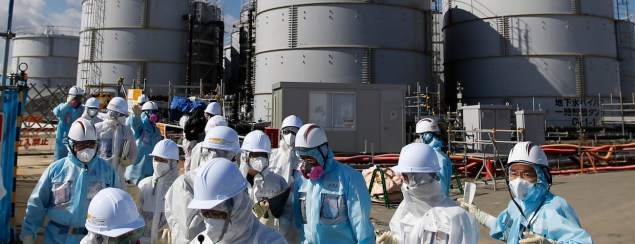
Members of the media, wearing white protective suits and masks, walk after they receive a briefing from Tokyo Electric Power Co. employees during a tour of the tsunami-crippled Fukushima Daiichi nuclear power plant on February 10, 2016.
It seemed like compelling journalism: a major investigative story published by The Asahi Shimbun, Japan’s second largest daily newspaper, about workers fleeing the Fukushima nuclear plant against orders.
It was the work of a special investigative section that had been launched with much fanfare to regain readers’ trust after the triple meltdown at the Fukushima Daiichi nuclear power plant in March 2011, when the Asahi and other media were criticized for initially repeating the official line that the government had everything safely under control.
The team had been producing award winning journalism for three years, but the story on the workers would be the last for some of its ace reporters. And its publication in May 2014 would come to mark the demise of one of the most serious efforts in recent memory by a major Japanese news organization to embrace a more independent approach to journalism.
The hastiness of the Asahi’s retreat raised fresh doubts about whether such watchdog journalism—an inherently risky enterprise that seeks to expose and debunk, and challenge the powerful—is even possible in Japan’s big national media, which are deeply tied to the nation’s political establishment.
The editors at Asahi, considered the “quality paper” favored by intellectuals, knew the culture they were facing, but they saw the public disillusionment in Japan that followed the nuclear plant disaster as the opportunity launch a bold experiment to reframe journalism.
No more pooches
On the sixth floor of its hulking headquarters overlooking Tokyo’s celebrated fish market, the newspaper in October 2011 hand-picked 30 journalists to create a desk dedicated to investigative reporting, something relatively rare in a country whose big national media favor cozy ties with officials via so-called press clubs. The clubs are exclusive groups of journalists, usually restricted to those from major newspapers and broadcasters, who are stationed within government ministries and agencies, ostensibly to keep a close eye on authority. In reality, the clubs end up doing the opposite, turning the journalists into uncritical conduits for information and narratives put forth by government officials, whose mindset the journalists often end up sharing.
The choice to head of the new section was unusual: Takaaki Yorimitsu, a gruff, gravelly-voiced outsider who was not a career employee of the elitist Asahi, and had been head-hunted from a smaller regional newspaper for his investigative prowess. Yorimitsu set an iconoclastic tone by taping a sign to the newsroom door declaring “Datsu Pochi Sengen,” or “No More Pooches Proclamation”—a vow that his reporters would no longer be kept pets of the press clubs, but true journalistic watchdogs.
The Investigative Reporting Section proved an instant success, winning Japan’s top journalism award two years in a row for its exposure of official coverups and shoddy decontamination work around the nuclear plant.
The new section gave reporters a broad mandate to range across the Asahi’s rigid internal silos in search of topics, while also holding to higher journalistic standards, such as requiring using the names of people quoted in stories instead of the pseudonyms common in Japanese journalism.
The Investigative Reporting Section proved an instant success, winning Japan’s top journalism award two years in a row for its exposure of official coverups and shoddy decontamination work around the nuclear plant, which was crippled when a huge earthquake and tsunami knocked out vital cooling systems. The section’s feistier journalism offered hope of attracting younger readers at a time when the 7 million-reader Asahi and Japan’s other national dailies, the world’s largest newspapers by circulation, were starting to feel the pinch from declining sales.
“The Asahi Shimbun believes such investigative reporting is indispensable,” the newspaper’s president at the time, Tadakazu Kimura, declared in an annual report in 2012. The new investigative section “does not rely on information obtained from press clubs, but rather conducts its own steadfast investigations that require real determination.”
That is why it was all the more jarring when, just two years later, the Asahi abruptly retreated from this foray into watchdog reporting. In September 2014, the newspaper retracted the story it had published in May about workers fleeing the Fukushima plant against orders, punishing reporters and editors responsible for the story, slashing the size of the new section’s staff and forcing the resignation of Kimura, who had supported the investigative push.
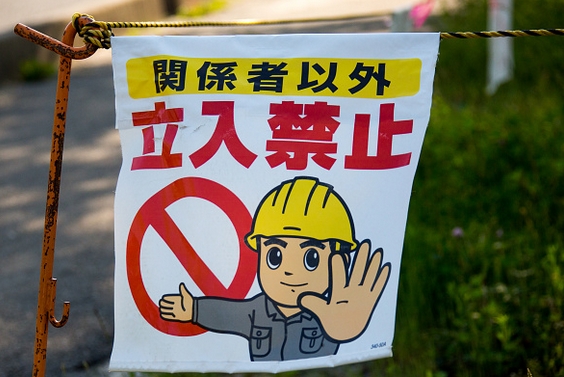
IITATE, JAPAN – MAY 23: No entry sign in the contaminated area after the daiichi nuclear power plant irradiation, fukushima prefecture, iitate, Japan on May 23, 2016 in Iitate, Japan.
A newspaper-appointed committee of outside experts later declared that the article, which the Asahi had trumpeted as a historic scoop, was flawed because journalists had demonstrated “an excessive sense of mission that they ‘must monitor authority.’”
While the section was not closed down altogether, its output of major investigative articles dropped sharply as the remaining journalists were barred from writing about Fukushima.
Emasculating the Asahi
The abrupt about-face by the Asahi, a 137-year-old newspaper with 2,400 journalists that has been postwar Japan’s liberal media flagship, was was an early victory for the administration of Prime Minister Shinzo Abe, which had sought to silence critical voices as it moved to roll back Japan’s postwar pacifism, and restart its nuclear industry.
“In Japanese journalism, scoops usually just mean learning from the ministry officials today what they intend to do tomorrow,” said Makoto Watanabe, a former reporter in the section who quit the Asahi in March because he felt blocked from doing investigative reporting. “We came up with different scoops that were unwelcome in the Prime Minister’s Office.”
Abe and his supporters on the nationalistic right seized on missteps by the Asahi in its coverage of Fukushima and sensitive issues of World War II-era history to launch a withering barrage of criticism that the paper seemed unable to withstand. The taming of the Asahi set off a domino-like series of moves by major newspapers and television networks to remove outspoken commentators and newscasters.
Political interference in the media was one reason cited by Reporters Without Borders in lowering Japan from 11th in 2010 to 72nd out of 180 nations in this year’s annual ranking of global press freedoms, released on April 20, 2016.
“Emasculating the Asahi allowed Abe to impose a grim new conformity on the media world,” said Koichi Nakano, a professor of politics at Sophia University in Tokyo and a leading critic of the administration on press freedom issues. “Other media know that once Asahi gave in, they were exposed and could be next. So they gagged themselves.”
But government pressure fails to fully explain the Asahi’s retreat. Some Asahi reporters and media scholars say the government was able to exploit weaknesses within Japanese journalism itself, particularly its lack of professional solidarity and its emphasis on access-driven reporting. At the Asahi’s weakest moment, other big national newspapers lined up to bash it, essentially doing the administration’s dirty work, while also making blatant efforts to poach readers to shore up their declining circulations.
The knockout blow, however, came from within the Asahi itself, as reporters in other, more established sections turned against the upstart investigative journalists. The new section’s more adversarial approach to journalism had earned it wide resentment for threatening the exclusive access—enjoyed by the Asahi as part of the mainstream media—to the administration and the powerful central ministries that govern Japan.
Media scholars say reporters in elite national newspapers like the Asahi have a weak sense of professional identity; most did not attend journalism school and spend their entire careers within the same company. Until recently, a job at a national daily was seen as a safe career bet rather than a calling, as the Asahi and its competitors offered salaries and lifetime job guarantees similar to banks and automakers.
This result is that many Japanese journalists are unable to resist pressures that officials can put on them via the press clubs. Journalists who are deemed overly critical or who write about unapproved topics can find themselves barred from briefings given to other club members. This is a potent sanction when careers can be broken for missing a scoop that appeared in rival newspapers. This is what some Asahi journalists in the press clubs say happened to them as the Investigative Section angered government officials with its critical stories.
“When the chips were down, they saw themselves as elite company employees, not journalists,” said Yorimitsu, who after the Fukushima article’s retraction was reassigned to a Saturday supplement where he writes entertainment features.
Unable to weather the storm
It was a bitter reversal for a section that had been launched with high expectations just three years before. Yorimitsu described the new section as the newspaper’s first venture into what he called true investigative journalism. He said that while the Asahi had assembled teams in the past that it called “investigative,” this usually meant being freed from the demands of daily reporting to take deeper dives into scandals and social issues. He said the new section was different because his journalists not only gathered facts, they used them to build counter narratives that challenged versions of events put forward by authorities.
“Until 2014, the newspaper was very enthusiastic about giving us the time and freedom to expose the misdeeds in Fukushima, and tell our own stories about what had happened,” recalled Yorimitsu. “We were telling the stories that the authorities didn’t want us to tell.”
Yorimitsu had been hired in 2008 in to take charge of a smaller investigative team that the Asahi had created in 2006, when it was first starting to feel the pinch from the Internet. From a peak of 8.4 million copies sold daily in 1997, the Asahi’s circulation had slipped below 8 million by 2006, according to the Japan Audit Bureau of Circulations. (By late 2015, it had dropped to 6.6 million.) The team of 10 reporters was an experimental effort to win readers. “We realized that in the Net era, independent, investigative journalism was the only way for a newspaper to survive,” said Hidetoshi Sotooka, a former managing editor who created the original team.
However, it was not until Fukushima, Japan’s biggest national trauma since its World War II defeat in 1945, that the newspaper wholeheartedly embraced the effort, tripling the number of journalists and elevating it to a full-fledged section, putting it on par organizationally with other, more established parts of the paper.
Under Yorimitsu, the section’s crowning achievement was an investigative series called “The Promethean Trap,” a play on the atomic industry’s early promise of becoming a second fire from heaven like the one stolen by Prometheus in Greek mythology. The series, which appeared daily beginning in October 2011, won The Japan Newspaper Publishers and Editors Association Prize, Japan’s equivalent of the Pulitzer Prize, in 2012 for its reporting on such provocative topics as a gag-order placed on scientists after the nuclear accident, and the government’s failure to release information about radiation to evacuating residents. The series spawned some larger investigative spin-offs, including an exposé of corner-cutting in Japan’s multi-billion dollar radiation cleanup, which won the prize in 2013.
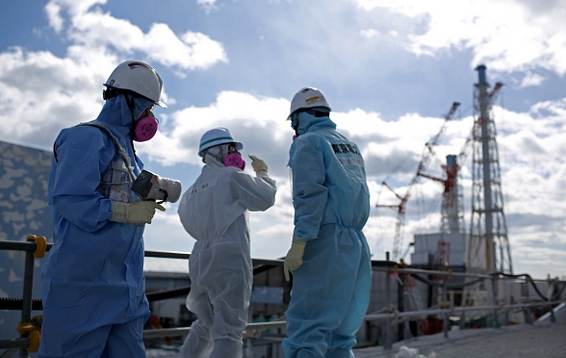
OKUMA, JAPAN – FEBRUARY 25: A TEPCO employee uses a radiation monitor as they show a member of the media a destroyed reactor at Fukushima Daiichi nuclear power plant on February 25, 2016 in Okuma, Japan. Five years on, the decontamination and decommissioning process at the Tokyo Electric Power Co.’s embattled Fukushima Daiichi nuclear power plant continues on February 25, 2016 in Okuma, Japan. March 11, 2016 marks the fifth anniversary of the magnitude 9.0 earthquake and tsunami which claimed the lives of 15,894, and the subsequent damage to the reactors at TEPCO’s Fukushima Daiichi Nuclear Power Plant causing the nuclear disaster which still forces 99,750 people to live as evacuees away from contaminated areas.
These were promising accomplishments for a new section, but they also led to resentment in other parts of the newspaper, where the investigative team was increasingly viewed as prima donnas, and Yorimitsu’s “no more pooches” proclamation as an arrogant dismissal of other sections’ work.
At the same time, the Investigative Section also was making powerful enemies outside the newspaper by exposing problems at Fukushima. This became particularly apparent after the pro-nuclear Abe administration took office in December 2012, when other media started to cut back on articles about the nuclear accident.
“We were being told that the Prime Minister’s Office disliked our stories and wanted them stopped,” Watanabe recalled, “but we thought we could weather the storm.”
They may have been able to if the new section had not given its opponents an opening to strike. But on May 20, 2014, running under the banner headline “Violating Plant Manager Orders, 90 Percent of Workers Evacuated Fukushima Daiichi,” the front-page article made the explosive claim that at the peak of the crisis, workers had fled the nuclear plant in violation of orders to remain from plant manager, Masao Yoshida. The article challenged the dominant narrative of the manager leading a heroic battle to contain the meltdowns and thus save Japan.
The reporters behind the story, Hideaki Kimura and Tomomi Miyazaki, had obtained a transcript of testimony that Yoshida gave to government investigators before his death from cancer in 2013. The 400-plus-page document, drawn from 28 hours of spoken testimony by Yoshida, had been kept secret from the public in the Prime Minister’s Office. Unearthing the testimony was an investigative coup, which the Asahi unabashedly played up in ad campaigns. It might have stayed that way, had not the Asahi opened up the floodgates of public criticism by clumsily setting off a completely unrelated controversy about its past coverage of one of East Asia’s most emotional issues.
That uproar began on Aug. 5, 2014 when the Asahi suddenly announced in a front-page article that it was retracting more than a dozen stories published in the 1980s and early 1990s about “comfort women” forced to work in wartime Japanese military brothels. The newspaper was belatedly admitting what historians knew: that a Japanese war veteran quoted in the articles, Seiji Yoshida, had fabricated his claims of having forcibly rounded up more than 1,000 Korean women.
The comfort women retractions appeared to be an attempt by the Asahi to preempt critics in the administration by coming clean about a decades-old problem. Instead, the move backfired, giving the revisionist right ammunition to attack the Asahi. The public pillorying, led by Abe himself, who said the reporting “has caused great damage to Japan’s image,” grew so intense that the magazine of the Foreign Correspondents Club of Japan ran a cover story: “Sink the Asahi!”
It was at the peak of this maelstrom, when the Asahi was on the ropes, that criticism of its Fukushima scoop erupted. In late August, the Sankei Shimbun and the Yomiuri Shimbun, both pro-Abe newspapers on the right, obtained copies of Yoshida’s secret testimony, and wrote reports challenging the version of events put forth by the Asahi. “Asahi Report of ‘Evacuating Against Orders’ At Odds With Yoshida Testimony,” the Yomiuri, the world’s largest newspaper with 9 million readers, declared in a front-page headline Aug. 30. Other media, including the liberal Mainichi Shimbun, followed with similar efforts to discredit the Asahi.
According to these stories, the Asahi’s epic scoop had gotten it wrong by implying that the plant workers had knowingly ignored Yoshida’s orders. The newly obtained copies of his testimony showed that his orders had failed to reach the workers in the confusion. The other newspapers accused the Asahi of again sullying Japan’s reputation, by inaccurately portraying the brave Fukushima workers as cowards. (Whether the Asahi got the story wrong is debatable, since its article never actually stated that workers knowingly violated Yoshida’s orders; however, it did fail to include the manager’s statement that his orders had not been properly relayed—an omission that could lead readers to draw the wrong conclusion.)
The fact that two pro-Abe newspapers had suddenly and in quick succession obtained copies of the Yoshida transcript led to widespread suspicions, never proven, that the Prime Minister’s Office leaked the documents to use against the Asahi. True or not, the newspapers seemed willing to serve the purposes of the administration, perhaps to improve their access to information, or to avoid suffering a similar fate as the Asahi.
The other papers also saw the Asahi’s woes as a chance to steal readers. The Yomiuri stuffed glossy brochures in the mailboxes of Asahi subscribers, blasting it for tarnishing Japan’s honor, while praising the Yomiuri’s coverage of the comfort women. This attempt to poach readers ultimately backfired as both newspapers lost circulation.
“Rather than stand together to resist government pressure, they allowed themselves to be used as instruments of political pressure,” said Jiro Yamaguchi, a political scientist at Tokyo’s Hosei University.
Despite peer pressure, Asahi journalists say the newspaper initially intended to defend its Fukushima scoop, going so far as to draw up a lengthy rebuttal that was to have run on page one in early September. As late as Sept. 1, Seiichi Ichikawa, the head of the Investigative Section at the time, told his reporters that the newspaper was ready to fight back. “The government is coming after the Special Investigative Section,” Ichikawa said in a pep talk to his team, according to Watanabe and others who were present. “The Asahi will not give in.”
The Asahi’s decision to punish its own journalists will discourage others from taking the same risks inherent in investigative reporting.
The rebuttal was never published. Instead, President Kimura surprised many of his own reporters with a sudden about face, announcing at a press conference on Sept. 11 that he was retracting the Fukushima-Yoshida article. Reporters say the newspaper’s resolve to defend the piece crumbled when journalists within the newspaper began an internal revolt against the article and the section that produced it.
This was compounded by a sense of panic that gripped the newspaper, as declines in readership and advertising accelerated markedly after the scandals. Fearing for the Asahi’s survival, many reporters chose to sacrifice investigative journalism as a means to mollify detractors, say media scholars and some Asahi journalists, including Yorimitsu.
The Asahi’s official line is that the story was too flawed to defend. The paper’s new president, Masataka Watanabe, continues to talk about the importance of investigative journalism, and some current and former Asahi journalists say investigative reporting will make a comeback.
However, scholars and former section reporters say the setback was too severe. They say the Asahi’s decision to punish its own journalists will discourage others from taking the same risks inherent in investigative reporting. Worse, they said the Asahi seemed to lapse back into the old, access-driven ways of Japan’s mainstream journalism. “The Asahi retreated from its experiment in risky, high-quality journalism, back into the safety of the press clubs,” said Tatsuro Hanada, a professor of journalism at Waseda University in Tokyo. Hanada was so dismayed by the Asahi’s retreat that he established Japan’s first university-based center for investigative journalism at Waseda this year. “It makes me think that the days of Japan’s huge national newspapers may be numbered.”
http://www.cjr.org/the_feature/asahi_shimbun_japan_journalism.php
Could nuclear advocacy be Abe’s undoing?

Nuclear foe: Ryuichi Yoneyama (center), a medical doctor who advocates anti-nuclear policies, raises his hands after he was assured of winning the gubernatorial election in Niigata Prefecture on Oct. 16.
Voters have elected anti-nuclear governors in Kagoshima and Niigata prefectures in recent months. These elections can be considered referenda on nuclear power because that issue was the main focus of debate in both campaigns. The results have put Prime Minister Shinzo Abe — and his plans to rev up the country’s fleet of nuclear reactors — behind the eight ball of public opinion and prefectural politics.
There will be a slew of gubernatorial elections in 2017 that will focus on nuclear energy, an issue where the Liberal Democratic Party is vulnerable because it was in charge when all of Japan’s reactors were built and was arguably complicit in the culture of complacency and regulatory capture that compromised public safety. The LDP owns the Fukushima disaster and thus the shambolic cleanup further discredits Abe’s party.
The media portrayed the victory of Ryuichi Yoneyama in Niigata over the “nuclear village” candidate, former construction ministry bureaucrat Tamio Mori as a major upset. Abe endorsed Mori, but his pro-nuclear advocacy proved his undoing. Mori toned down that message toward the end of his campaign but it was too late to fend off Yoneyama, who rode the wave of nuclear anxieties into office. He replaces another anti-nuclear governor who stymied Tepco’s plans to restart reactors in the prefecture in the aftermath of the Fukushima debacle and revelations of slack safety practices.
In 2007, the massive 8-gigawatt Kashiwazaki-Kariwa nuclear power plant, which consists of seven reactors, shut down after a strong earthquake struck Niigata. Local scientists had sued Tokyo Electric Power Co. and the government for selecting a dangerous site for the world’s largest atomic power plant, arguing that it is built on an active fault line, but a judge dismissed their claims as baseless in 2005.
Mother Nature ruled otherwise. The reactors all shut down, but the land subsided, breaking water pipes so that fire-fighting was delayed. More importantly, the manager of the plant said during a subsequent NHK interview that first responders had been very lucky, explaining that he and his staff would have been helpless if anything had gone wrong, as they were all locked out of the command center where the reactor controls are located because the door to the room had jammed shut due to land subsidence. Improvising, they set up whiteboards in the parking lot and relied on their mobile phones, but they had absolutely no means to manage any reactor emergency if there had been one. This story is not forgotten in Niigata.
There is heightened concern among most Japanese about nuclear safety following the three meltdowns at the Fukushima No. 1 nuclear power plant in March 2011. Three major investigations into the nuclear disaster have pinpointed human error as the main cause of the meltdowns, highlighting cozy and collusive relations between Tepco and nuclear watchdogs that compromised safety because regulations were not strictly enforced and regulators averted their eyes from serious breaches. They are also mindful that back in 2002 a whistleblower alerted authorities to Tepco’s systematic falsification of repair and maintenance records for all 17 of its reactors. A coverup failed and the media subsequently revealed that all of the utilities operating nuclear reactors had engaged in similarly shoddy practices, cutting corners to save money.
Have the lessons of Fukushima been learned and led to appropriate countermeasures to upgrade safety? Apparently voters are not convinced by the PR machine that touts stricter safety regulations and hardware upgrades, and they have been finding support among judges who have issued injunctions blocking reactor restarts that have been approved by the Nuclear Regulatory Authority. The NRA is the reincarnation of the Nuclear and Industrial Safety Agency (NISA), which lost all credibility following post-Fukushima meltdown revelations of slipshod oversight. Alas, the Homer Simpsons of NISA now constitute the majority of NRA employees, undermining the credibility of the new nuclear watchdog agency.
The government and utilities are supposed to consult local opinion, but in practice they limit this to communities hosting reactors because these people have a vested interest in rebooting nuclear plants. Nuclear power plants don’t generate revenue and subsidies if idle, while restarting a reactor opens the spigots of cash that these remote communities are dependent on. Now that the evacuation zones have been expanded to 30 kilometers, extending into adjoining towns that shoulder the same risks without the benefits, it would make sense to give these communities a say in restarts. However, the central government opposes that because it fears that locals who have not been co-opted wouldn’t be in favor of restarts, especially since evacuation drills have been chaotic, revealing that the government is advocating restarts before it is properly prepared to deal with a crisis.
Only two of Japan’s 42 reactors are operating and one of them is in Sendai, Kagoshima Prefecture, where another anti-nuclear governor won election. This reactor is not far from where the devastating Kumamoto earthquake struck in April, in a region that also features a number of active volcanoes spewing ash that could block roads and impede an emergency evacuation.
What are the chances of a simultaneous earthquake, typhoon, tsunami and volcanic eruption affecting a nuclear reactor? Probably not that high, but there was such a deadly combination of earthquakes, eruptions, landslide and tsunami with a 100-meter wave recorded in Kyushu in 1791 that killed 15,000 people. But no worries — that was on a different part of the island.
Exit polls from Niigata’s gubernatorial elections found that 73 percent of voters oppose restarting the Niigata plant and only 27 percent are in favor. A mid-October Asahi poll found that 57 percent of Japanese nationwide were opposed to nuclear restarts and only 29 percent were in favor. More importantly, the same poll found that 73 percent of Japanese favor a zero nuclear energy policy in the near future and just 22 percent are opposed to the idea.
What must worry Abe even more is that within the LDP, 45 percent of members oppose nuclear energy while just 42 percent support his nuclear advocacy. Thus former Prime Minister Junichiro Koizumi may be right with his recent assertion that Abe has a nuclear Achilles’ heel that may lead to his downfall.
Japan Nuclear Industry on the Defensive

METI proposed that TEPCO would start a subsidiary to manage all its nuclear plants. Saying it would facilitate restarting the reactors at the Kashiwazaki Kariwa NPP, as since the beginning of the Tepco-owned Fukushima Daiichi nuclear plant disaster the government planned to use profits from the Tepco-owned Kashiwazaki-Kariwa NPP to finance the Fukushima Daiichi disaster costs; and that it would also encourage collaboration among other utilities nuclear power plants, and make merger or sale easier. METI thinks such change would also encourage the public to support nuclear reactors restarting.
As the total decommissionning costs could double, Tepco would also like the rules to be changed so as not take an added large loss on their books.
One day later Hitachi announced that they consider merging their nuclear business with Toshiba and Mistubishi.
These recent new developments show Japan nuclear industry on the defensive, former PM Koizumi warned the Liberal Democratic Party could lose the next election if it focuses on the nuclear power issue.
Industry ministry unveils plan to split nuclear power division from TEPCO
The Implications of The Massive Contamination of Japan With Radioactive Cesium by Steven Starr
Everything You Didn’t Want, Or Do Want To Know About The Dangers Of Nuclear Radiation by Steven Starr, Senior Scientist, Physicians for Social Responsibility
Director, University of Missouri, Clinical Laboratory Science Program
At the Helen Caldicott Foundation Fukushima Symposium, New York Academy of Medicine, 11 March 2013
Japan mulls having new utilities help pay Fukushima victims
“Japan is considering having new electricity suppliers shoulder some of the cost of compensating those affected by the 2011 Fukushima Daiichi meltdown — a first since the market was opened up to companies besides the big regional utilities.”
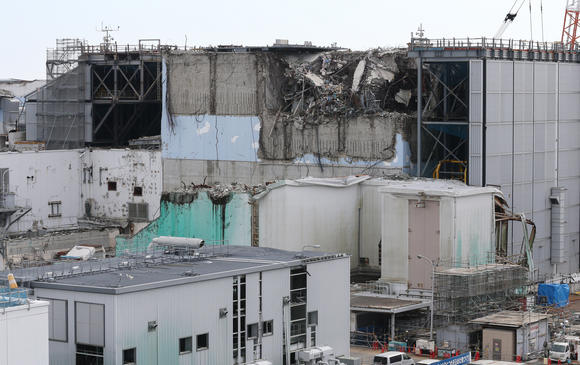
The cost of scrapping Fukushima Daiichi will remain squarely on Tepco’s shoulders.
TOKYO — Japan is considering having new electricity suppliers shoulder some of the cost of compensating those affected by the 2011 Fukushima Daiichi meltdown — a first since the market was opened up to companies besides the big regional utilities.
The expense has been covered by interest-free government loans to Tokyo Electric Power Co. Holdings, which operated the disaster-stricken nuclear plant. This debt is being repaid not only by Tepco, but also other major power companies such as Kansai Electric Power and Chubu Electric Power. Some 6 trillion yen ($57 billion) has already been paid out, more than the 5.4 trillion yen estimated in fiscal 2013, and the total is expected to rise by trillions of yen.
With consumers gradually switching from regional utilities to independent power providers, the Ministry of Economy, Trade and Industry plans to ask these new players to pay a share of the compensation. Details such as how to split the burden between established and new power providers will be worked out going forward. New suppliers’ customers will be asked to contribute as well, on the grounds that they used nuclear power before the market opened up, though this could meet with a backlash from some of the companies affected.
But the cost of scrapping Fukushima Daiichi will remain squarely on Tepco’s shoulders, and the ministry will not approve rate hikes to recoup these expenses. Annual outlays are expected to soar to hundreds of billions of yen, from 80 billion yen now, once Tepco starts extracting melted fuel from the reactors in the 2020s.
The ministry plans to set up a fund to cover decommissioning costs, with the money to come from Tepco’s yearly profits. The utility will be permitted to draw from the fund to cover approved decommissioning plans. Funding gaps will be covered by government loans to be repaid by Tepco.
The company will be exempted for the time being from a requirement to cut electricity transmission charges levied on electricity retailers if profits from power transmission and distribution rise too high. The aim is to avoid placing a further burden on taxpayers while ensuring that decommissioning goes smoothly.
1 This Month
26 September – International Day for the Total Elimination of Nuclear Weapons





PLEASE OPPOSE HR 8255 AND S.3639 – bills would accelerate satellite deployment, with no environmental review or safeguards – https://ncstd5li.quorum.us/campaign/169331/
To see nuclear-related stories in greater depth and intensity – go to https://nuclearinformation.wordpress.com
-
Archives
- September 2026 (305)
- August 2026 (330)
- July 2026 (355)
- June 2026 (287)
- May 2026 (306)
- April 2026 (356)
- March 2026 (251)
- February 2026 (267)
- January 2026 (308)
- December 2025 (358)
- November 2025 (359)
- October 2025 (375)
-
Categories
- 1
- 1 NUCLEAR ISSUES
- business and costs
- climate change
- culture and arts
- ENERGY
- environment
- health
- history
- indigenous issues
- Legal
- marketing of nuclear
- media
- opposition to nuclear
- PERSONAL STORIES
- politics
- politics international
- Religion and ethics
- safety
- secrets,lies and civil liberties
- spinbuster
- technology
- Uranium
- wastes
- weapons and war
- Women
- 2 WORLD
- ACTION
- AFRICA
- Atrocities
- AUSTRALIA
- Christina's notes
- Christina's themes
- culture and arts
- Events
- Fuk 2022
- Fuk 2023
- Fukushima 2017
- Fukushima 2018
- fukushima 2019
- Fukushima 2020
- Fukushima 2021
- general
- global warming
- Humour (God we need it)
- Nuclear
- RARE EARTHS
- Reference
- resources – print
- Resources -audiovicual
- Weekly Newsletter
- World
- World Nuclear
- YouTube
-
RSS
Entries RSS
Comments RSS

