A decade after Niigata’s nuclear close call
Tepco wants to restart reactors in Niigata to help pay for USD190 billion needed for Fukushima follies
 Employees work in the central control room for the No.7 reactor at Tokyo Electric Power Holdings’ Kashiwazaki-Kariwa nuclear plant in Niigata Prefecture in 2009.
On July 16, 2007, a 6.8 magnitude earthquake rattled the world’s largest nuclear power complex at Kashiwazaki-Kariwa in Niigata Prefecture. This was on a site that the government and Tokyo Electric Power Co. had insisted was seismically safe.
Two years earlier, the Tokyo High Court had ruled against local plaintiffs backed by scientists who insisted the authorities were wrong and that there was an active fault line adjacent to the site. In 2007, Mother Nature overruled the judge, raising questions about relying on old evaluations by institutions favoring nuclear energy in assessing site safety, particularly given subsequent advancements in seismic science.
The good news is that the reactors shut down automatically and the plant withstood tectonic shocks way beyond what anyone had anticipated when designing the structures. The bad news trickled slowly out of Tepco, but an NHK special shortly afterwards aired a startling revelation. The plant manager told NHK that it was very lucky that everything worked as planned and that there was no serious accident — especially considering that the door of the control center had been jammed and nobody could get in. This meant that if there had been a crisis, nobody would have been able to manage it because the emergency controls were inaccessible.
The door was stuck because the land subsided due to the earthquake. It is hard to anticipate every contingency, and that is precisely why accidents happen. If the safety systems had not functioned as planned, Kashiwazaki might have spun out of control, but luckily it was just a close call.
Also worrisome was the transformer fire that took an age to put out because the water pipes had ruptured due to the earthquake. And why was there a nine-hour delay in informing local authorities about the situation, including some radiation leaks? Apparently the plant workers were preoccupied with setting up whiteboards in the parking lot as an improvised control center and using their mobile phones to communicate with each other. Tepco also downplayed how much radioactive water had leaked, a spill that Asahi reporters spotted workers mopping up with paper towels.
At Kashiwazaki-Kariwa there are seven reactors with an 8,200 megawatt capacity, enough for 16 million households. This clustering of reactors means that if there was an accident, it could cascade into a major disaster.
The reactors went online between 1985 and 1997 and generated $2 billion in subsidies for the hosting towns, on top of tax revenues and many high-paying jobs. But local enthusiasm has dimmed considerably since then. Back in 2001 Tepco was caught falsifying repair and maintenance data at all of its 17 reactors, suggesting that management did not nurture a culture of safety. Then, in 2005, the International Atomic Energy Agency warned that fire prevention measures at the Niigata plant were inadequate.
Niigata voters have since elected nuclear skeptics for mayor and prefectural governor. In a nationwide poll conducted by the Asahi Shimbun last October, 57 percent of the public opposed restarting nuclear reactors while only 29 percent were in favor. Earlier in 2016, a poll conducted by the pro-nuclear Japan Atomic Energy Relations Organization found that 12 percent of respondents favored maintaining or increasing Japan’s nuclear energy output while nearly 63 percent wanted to end nuclear power in Japan, either by phasing it out (48 percent) or immediately pulling the plug (15 percent).
Public opposition to nuclear power is not only driven by safety concerns and the tragic fate of tens of thousands of nuclear refugees displaced from ancestral homes in Tohoku. The Fukushima disaster is also a financial black hole that will burden taxpayers and ratepayers for decades to come. And there are the high costs of decommissioning many aging reactors and the expense involved in building a site to permanently store radioactive waste.
Niigata Gov. Ryuichi Yoneyama has slowed plans to restart any reactors, calling for a comprehensive safety review, development of an evacuation plan and an assessment of the Fukushima disaster’s public health impact, all of which could take three years. Tepco’s latest rehabilitation plan includes restarting two of the reactors by March 2020, saying the profits would help it pay off the staggering ¥21.5 trillion ($190 billion) bill for Fukushima, an estimate that is likely to keep rising over the next few decades.
The mayor of Kashiwazaki has also weighed in, requesting that Tepco begin decommissioning one reactor before agreeing to restart the two reactors Tepco wants to bring back online. The Nuclear Regulation Authority is currently conducting safety inspections at two of the reactors. The mayor thinks that seven reactors is too much and is worried about the safety of the control center, wondering if it is sufficiently strong to withstand a powerful quake, possibly because Tepco admitted to misleading the NRA in February about just how strong the structure is. He is hopeful that decommissioning will generate jobs and revitalize the local community.
The mayor also expressed concern about the threat of nuclear missiles from North Korea, prompting NRA Chairman Shunichi Tanaka to joke that Tokyo would make a better target. Funny guy.
The Fukushima debacle has already cost in excess of $100 billion and the government estimates that total will skyrocket in coming years. If only Tepco had heeded internal warnings in 2009 about the possibility of a monster tsunami striking the Fukushima No. 1 plant and built a bigger tsunami wall. That would have cost $1 billion, a bargain in retrospect. Will the ongoing trial of three Tepco executives find them responsible for this and other instances of negligence? Probably not.
And now there are five nuclear reactors operating in Japan, and soon two more in Kyushu, due to court rulings favorable to the utilities. The fate of an additional 35 operable reactors is uncertain, but the staggering costs of decommissioning many of these — so far the NRA has approved five decommissioning proposals that will cost about $10 billion — raise questions about the viability of nuclear energy in Japan.
Toshiba, which is selling off its key assets to pay for its purchase of Westinghouse Electric, knows just how risky the nuclear business is, and hopefully Tepco now understands that cutting corners to save money was abysmal risk management.
Many Japanese must envy South Korea, where newly elected Prime Minister Moon Jae-in has vowed to phase out nuclear energy and cancel plans to build new plants and extend the operating life of its 25 aging reactors. In contrast, Prime Minister Shinzo Abe has reinstated nuclear power into the national energy strategy, targeting 20 to 22 percent of the overall mix, demonstrating the resilient influence of Japan’s “nuclear village.”
http://www.japantimes.co.jp/opinion/2017/07/15/commentary/decade-niigatas-nuclear-close-call/#.WWqb53WlXQY.facebook
Japan now hoping to export Renewable Energy Technology
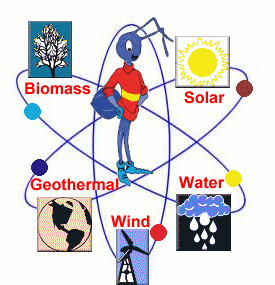 Japan vows to ramp up efforts to export renewable energy technology, July 13, 2017 (Mainichi Japan), TOKYO (Kyodo) — Foreign Minister Fumio Kishida pledged Thursday that Japan will aggressively pursue the export of renewable energy technologies to tap into growth spurred via the worldwide transition to clean energy sources necessitated by the onset of climate change.
Calling climate change a “common challenge worldwide,” Kishida noted that Japan is a signatory to the Paris Agreement, the global effort to reduce greenhouse gas emissions through member nations setting voluntary targets. The accord entered into force in November 2016.
In Fukushima, Japan is currently pursuing the production of hydrogen from renewable sources for use in fuel cells, part of a broader plan to help the prefecture rebuild from the March 2011 quake-tsunami disaster and nuclear accident.
“We will develop Japan’s state-of-the-art technologies in energy-poor countries and regions and contribute to the improvement of energy security,” Kishida added.
However, some analysts have voiced concern that Japan has lagged behind China and the United States in the production of renewable energy, with Prime Minister Shinzo Abe’s government preferring to restart nuclear reactors under pressure from the business sector……https://mainichi.jp/english/articles/20170713/p2g/00m/0bu/078000c
New Tepco chairman wants to hasten release of radioactively polluted water into the sea

 TEPCO chair: Nuclear plant must release contaminated water, FOX Business , By July 13, 2017 TOKYO – The new chairman of Tokyo Electric Power Co. says the utility needs to stop dragging its feet on plans to dump massive amounts of treated but contaminated water into the sea and make more money if it’s ever going to succeed in cleaning up the mess left by meltdowns more than six years ago at the tsunami-hit Fukushima nuclear power plant.
Japan’s Anticonspiracy Law – risk of abuse of power
The revised organized crime punishment law now newly enables authorities to criminalize people planning and preparing to commit acts of terrorism and other serious offenses.
Noting that Japan can ratify the U.N. Convention against Transnational Organized Crime following the enforcement of the law, a senior police official expressed hopes that the country will be able to “cooperate more smoothly with other signatories in criminal investigations and handovers of suspects,” leading to progress in probes into organized crimes.
The official brushed aside concerns over possible abuse of the law by investigative authorities. Any compulsory investigations require search warrants from courts, meaning that such probes are subject to judicial scrutiny, the official noted.
Still, the official said that the application of the law to specific cases will have to be considered carefully, citing parliamentary debates on the legislation during which opposition parties strongly opposed the legislation.
Anticonspiracy Law Comes into Force in Japan
Tokyo, July 11 (Jiji Press)–The anticonspiracy law took effect in Japan on Tuesday, allowing authorities to criminalize planning and preparations to commit serious crimes, including terrorist attacks.
The government now plans to ratify promptly the U.N. Convention against Transnational Organized Crime so that the country can share investigative information about organized crimes with other nations.
Under the law, a group of two or more people can be punished for plotting a crime at the planning stage, or before committing it, if any member starts an act of preparation for the crime.
The Diet, Japan’s parliament, enacted the law last month, with support from the ruling coalition of the Liberal Democratic Party and Komeito, as well as Nippon Ishin no Kai, an opposition party.
During Diet debates on the controversial law, opposition parties expressed concerns that investigative authorities may use the law arbitrarily.
The international nuclear industry in financial meltdown
 Global Meltdown? Nuclear Power’s Annus Horribilis, Jim Green, New Matilda, 9 July 2017 https://newmatilda.com/2017/07/09/global-meltdown-nuclear-powers-annus-horribilis/
This year will go down with 1979 (Three Mile Island), 1986 (Chernobyl) and 2011 (Fukushima) as one of the nuclear industry’s worst ever ‒ and there’s still another six months to go, writes Dr Jim Green.
Two of the industry’s worst-ever years have been in the past decade and there will be many more bad years ahead as the trickle of closures of ageing reactors becomes a flood ‒ the International Energy Agency expects almost 200 reactor closures between 2014 and 2040. The likelihood of reactor start-ups matching closures over that time period has become vanishingly small.
In January, the World Nuclear Association anticipated 18 power reactor start-ups this year. The projection has been revised down to 14 and even that seems more than a stretch. There has only been one reactor start-up in the first half of the year according to the IAEA’s Power Reactor Information System, and two permanent reactor closures.
The number of power reactors under construction is on a downward trajectory ‒ 59 reactors are under construction as of May 2017, the first time since 2010 that the number has fallen below 60.
Pro-nuclear journalist Fred Pearce wrote on May 15: “Is the nuclear power industry in its death throes? Even some nuclear enthusiasts believe so. With the exception of China, most nations are moving away from nuclear ‒ existing power plants across the United States are being shut early; new reactor designs are falling foul of regulators, and public support remains in free fall. Now come the bankruptcies…. The industry is in crisis. It looks ever more like a 20th century industrial dinosaur, unloved by investors, the public, and policymakers alike. The crisis could prove terminal.”
Pro-nuclear lobby groups are warning about nuclear power’s “rapidly accelerating crisis“, a “crisis that threatens the death of nuclear energy in the West“, and noting that “the industry is on life support in the United States and other developed economies“.
United States
The most dramatic story this year has been the bankruptcy protection filing of US nuclear giant Westinghouse onMarch 29. Westinghouse’s parent company Toshiba states that there is “substantial doubt” about Toshiba’s “ability to continue as a going concern”. These nuclear industry giants have been brought to their knees by cost overruns ‒estimated at US$13 billion ‒ building four AP1000 power reactors in the U.S.
The nuclear debate in the US is firmly centred on attempts to extend the lifespan of ageing, uneconomic reactors with state bailouts. Financial bailouts by state governments in New York and Illinois are propping up ageing reactors, but a proposed bailout in Ohio is meeting stiff opposition. The fate of Westinghouse and its partially-built AP1000 reactors are much discussed, but there is no further discussion about new reactors ‒ other than to note that they won’t happen.
Six reactors have been shut down over the past five years in the US, and another handful will likely close in the next five years. How far and fast will nuclear fall? Exelon ‒ the leading nuclear power plant operator in the US ‒ claims that “economic and policy challenges threaten to close about half of America’s reactors” in the next two decades. According to pro-nuclear lobby group ‘Environmental Progress‘, almost one-quarter of US reactors are at high risk of closure by 2030, and almost three-quarters are at medium to high risk. In May, the US Energy Information Administration released an analysis projecting nuclear’s share of the nation’s electricity generating capacity will drop from 20 per cent to 11 per cent by 2050.
There are different views about how far and fast nuclear will fall in the US ‒ but fall it will. And there is no dispute that many plants are losing money. More than half in fact, racking up losses totalling about US$2.9 billion a year according to a recent analysis by Bloomberg New Energy Finance. And a separate Bloomberg report found that expanding state aid to money-losing reactors across the eastern US may leave consumers on the hook for as much as US$3.9 billion a year in higher power bills.
Japan
Fukushima clean-up and compensation cost estimates have doubled and doubled again and now stand at US$191 billion. An analysis by the Japan Institute for Economic Research estimates that the total costs for decommissioning, decontamination and compensation could be far higher at US$443‒620 billion.
Only five reactors are operating in Japan as of July 2017, compared to 54 before the March 2011 Fukushima disaster. The prospects for new reactors are bleak. Japan has given up on its Monju fast breeder reactor ‒ successive governments wasted US$10.6 billion on Monju and decommissioning will cost another US$2.7 billion.
As mentioned, Toshiba is facing an existential crisis due to the crippling debts of its subsidiary Westinghouse. Toshibaannounced on May 15 that it expects to report a consolidated net loss of US$8.4 billion for the 2016‒2017 financial year which ended March 31.
Hitachi is backing away from its plan to build two Advanced Boiling Water Reactors in Wylfa, Wales. Hitachi recentlysaid that if it cannot attract partners to invest in the project before construction is due to start in 2019, the project will be suspended.
Hitachi recently booked a massive loss on a failed investment in laser uranium enrichment technology in the US. A 12 May 2017 statement said the company had posted an impairment loss on affiliated companies’ common stock of US$1.66 billion for the fiscal year ended 31 March 2017, and “the major factor” was Hitachi’s exit from the laser enrichment project. Last year a commentator opined that “the way to make a small fortune in the uranium enrichment business in the US is to start with a large one.”
France
The French nuclear industry is in its “worst situation ever” according to former EDF director Gérard Magnin. France has 58 operable reactors and just one under construction.
French EPR reactors under construction in France and Finland are three times over budget ‒ the combined cost overruns for the two reactors amount to about US$14.5 billion.
Bloomberg noted in April 2015 that Areva’s EPR export ambitions are “in tatters“. Now Areva itself is in tatters and is in the process of a government-led restructure and another taxpayer-funded bailout. On March 1, Areva posted a €665 million net loss for 2016. Losses in the preceding five years exceeded €10 billion.
In February, EDF released its financial figures for 2016: earnings and income fell and EDF’s debt remained steady at €37.4 billion. EDF plans to sell €10 billion of assets by 2020 to rein in its debt, and to sack up to 7,000 staff. The French government provided EDF with €3 billion in extra capital in 2016 and will contribute €3 billion towards a €4 billioncapital raising this year. On March 8, shares in EDF hit an all-time low a day after the €4 billion capital raising was launched; the share price fell to €7.78, less than one-tenth of the high a decade ago.
Costs of between €50 billion and €100 billion will need to be spent by 2030 to meet new safety requirements for reactors in France and to extend their operating lives beyond 40 years.
EDF has set aside €23 billion to cover reactor decommissioning and waste management costs in France ‒ just over half of the €54 billion that EDF estimates will be required. A recent report by the French National Assembly’s Commission for Sustainable Development and Regional Development concluded that there is “obvious under-provisioning” and that decommissioning and waste management will take longer, be more challenging and cost much more than EDF anticipates.
In 2015, concerns about the integrity of some EPR pressure vessels were revealed, prompting investigations that are still ongoing. Last year, the scandal was magnified when the French Nuclear Safety Authority (ASN) announced that Areva had informed it of “irregularities in components produced at its Creusot Forge plant.” The problems concern documents attesting to the quality of parts manufactured at the site. At least 400 of the 10,000 quality documents reviewed by Areva contained anomalies. Work at the Creusot Forge foundry was suspended in the wake of the scandal and Areva is awaiting ASN approval to restart the foundry.
French environment and energy minister Nicolas Hulot said on June 12 that the government plans to close some nuclear reactors to reduce nuclear’s share of the country’s power mix. “We are going to close some nuclear reactors and it won’t be just a symbolic move,” he said.
India
Nuclear power accounts for just 3.4 percent of electricity supply in India and that figure will not rise significantly, if at all. In May, India’s Cabinet approved a plan to build 10 indigenous pressurized heavy water reactors (PHWR). That decision can be read as an acknowledgement that plans for six Westinghouse AP1000 reactors and six French EPR reactors are unlikely to eventuate.
The plan for 10 new PHWRs faces major challenges. Suvrat Raju and M.V. Ramana noted: “[N]uclear power will continue to be an expensive and relatively minor source of electricity for the foreseeable future…. The announcement about building 10 PHWRs fits a pattern, often seen with the current government, where it trumpets a routine decision to bolster its “bold” credentials. Most of the plants that were recently approved have been in the pipeline for years. Nevertheless, there is good reason to be sceptical of these plans given that similar plans to build large numbers of reactors have failed to meet their targets, often falling far short.”
South Africa
An extraordinary High Court judgement on April 26 ruled that much of South Africa’s nuclear new-build program is without legal foundation. The High Court set aside the Ministerial determination that South Africa required 9.6 gigawatts (GW) of new nuclear capacity, and found that numerous bilateral nuclear cooperation agreements were unconstitutional and unlawful. President Jacob Zuma is trying to revive the nuclear program, but it will most likely be shelved when Zuma leaves office in 2019 (if he isn’t removed earlier). Energy Minister Mmamoloko Kubayi said on June 21 that South Africa will review its nuclear plans as part of its response to economic recession.
South Korea
South Korea’s new President Moon Jae-in said on June 19 that his government will halt plans to build new nuclear power plants and will not extend the lifespan of existing plants beyond 40 years. President Moon said: “We will completely re-examine the existing policies on nuclear power. We will scrap the nuclear-centred polices and move toward a nuclear-free era. We will eliminate all plans to build new nuclear plants.”
Since the presidential election on May 9, the ageing Kori-1 reactor has been permanently shut down, work on two partially-built reactors (Shin Kori 5 and 6) has been suspended pending a review, and work on two planned reactors (Shin-Hanul 3 and 4) has been stopped.
Taiwan
Taiwan’s Cabinet reiterated on June 12 the government’s resolve to phase out nuclear power. The government remains committed to the goal of decommissioning the three operational nuclear power plants as scheduled and making Taiwan nuclear-free by 2025, Cabinet spokesperson Hsu Kuo-yung said.
UK
Tim Yeo, a former Conservative politician and now a nuclear industry lobbyist with New Nuclear Watch Europe, saidthe compounding problems facing nuclear developers in the UK “add up to something of a crisis for the UK’s nuclear new-build programme.”
The lobby group noted delays with the EPR reactor in Flamanville, France and the possibility that those delays would flow on to the two planned EPR reactors at Hinkley Point; the lack of investors for the proposed Advanced Boiling Water Reactors at Wylfa; the acknowledgement by the NuGen consortium that the plan for three AP1000 reactors at Moorside faces a “significant funding gap”; and the fact that the Hualong One technology which China General Nuclear Power Corporation hopes to deploy at Bradwell in Essex has yet to undergo its generic design assessment.
The only reactor project with any momentum in the UK is Hinkley Point, based on the French EPR reactor design. The head of one of Britain’s top utilities said on June 19 that Hinkley Point is likely to be the only nuclear project to go ahead in the UK. Alistair Phillips-Davies, chief executive officer of SSE, an energy supplier and former investor in new nuclear plants, said: “The bottom line in nuclear is that it looks like only Hinkley Point will get built and Flamanville needs to go well for that to happen.”
There is growing pressure for the obscenely expensive Hinkley Point project to be cancelled. The UK National Audit Office report released a damning report on June 23. The Audit Office said: “The Department for Business, Energy and Industrial Strategy’s deal for Hinkley Point C has locked consumers into a risky and expensive project with uncertain strategic and economic benefits… Today’s report finds that the Department has not sufficiently considered the costs and risks of its deal for consumers…. Delays have pushed back the nuclear power plant’s construction, and the expected cost of top-up payments under the Hinkley Point C’s contract for difference has increased from £6 billion to £30 billion.”
Writing in the Financial Times on May 26, Neil Collins said: “EDF, of course, is the contractor for that white elephant in the nuclear room, Hinkley Point. If this unproven design ever gets built and produces electricity, the UK consumer will be obliged to pay over twice the current market price for the output…. The UK’s energy market is in an unholy mess… Scrapping Hinkley Point would not solve all of [the problems], but it would be a start.”
And on it goes. Hinkley Point is one of the “great spending dinosaurs of the political dark ages” according to The Guardian. It is a “white elephant” according to an editorial in The Times.
EDF said on June 26 that it is conducting a “full review of the costs and schedule of the Hinkley Point C project” and the results will be disclosed “soon”. On July 3, EDF announced that the estimated cost of the two Hinkley reactors has risen by €2.5 billion (to €23.2 billion, or €30.4 billion including finance costs). In 2007, EDF was boasting that Britons would be using electricity from Hinkley to cook their Christmas turkeys in December 2017. But in its latestannouncement, EDF pushes back the 2025 start-up dates for the two Hinkley reactors by 9‒15 months.
Oliver Tickell and Ian Fairlie wrote an obituary for Britain’s nuclear renaissance in The Ecologist on May 18. Theyconcluded: “[T]he prospects for new nuclear power in the UK have never been gloomier. The only way new nuclear power stations will ever be built in the UK is with massive political and financial commitment from government. That commitment is clearly absent. So yes, this finally looks like the end of the UK’s ‘nuclear renaissance’.”
Switzerland
Voters in Switzerland supported a May 21 referendum on a package of energy policy measures including a ban on new nuclear power reactors. Thus Switzerland has opted for a gradual nuclear phase out and all reactors will probably be closed by the early 2030s, if not earlier.
Germany will close its last reactor much sooner than Switzerland, in 2022.
Sweden
Unit 1 of the Oskarshamn nuclear power plant in Sweden has been permanently shut down. Unit 2 at the same plant was permanently shut down in 2015. Ringhals 1 and 2 are expected to be shut down in 2019‒2020, after which Sweden will have just six operating power reactors. Switzerland, Germany and Taiwan have made deliberate decisions to phase out nuclear power; in Sweden, the phase out will be attritional.
Russia
Rosatom deputy general director Vyacheslav Pershukov said in mid-June that the world market for the construction of new nuclear power plants is shrinking, and the possibilities for building new large reactors abroad are almost exhausted. He said Rosatom expects to be able to find customers for new reactors until 2020‒2025 but “it will be hard to continue.”
China
With 36 power reactors and another 22 under construction, China is the only country with a significant nuclear expansion program. However nuclear growth could take a big hit in the event of economic downturn. And nuclear growth could be derailed by a serious accident, which is all the more likely because of China’s inadequate nuclear safety standards, inadequate regulation, lack of transparency, repression of whistleblowers, world’s worst insurance and liability arrangements, security risks, and widespread corruption.
Dr Jim Green is the national nuclear campaigner with Friends of the Earth, Australia, and editor of the World Information Service on Energy’s Nuclear Monitor newsletter.
Possible safety regulation violations at Ibaraki Pref. nuclear facility led to accident: NRA

In this photo provided by the JAEA, the stainless steel radioactive material container involved in the June 6, 2017 accident is seen soon after the plastic bags inside burst, exposing five workers to powdered plutonium and uranium oxides, at the Oarai Research & Development Center in Oarai, Ibaraki Prefecture.
Staff likely failed to follow safety regulations at a nuclear research facility in Ibaraki Prefecture where five workers were exposed to radioactive materials in June, a Nuclear Regulation Authority (NRA) inquiry has revealed.
While just after the accident the Japan Atomic Energy Agency (JAEA) stated that there was no way that such a serious incident could have been predicted, the NRA’s on-site investigation has revealed that, regardless of whether the accident could have been predicted, the facility staff were working without conducting proper safety procedures.
The accident occurred at the JAEA Oarai Research and Development Center in Oarai, Ibaraki Prefecture, at roughly 11:15 a.m. on June 6, when a worker opened a stainless steel container to inspect the powdered nuclear fuel materials within. The plastic bag inside the container ruptured, exposing the worker and four other staff to plutonium and other radioactive materials. The container had been sealed in 1991, and not opened once since.
“There was no way to know the state of the vessel’s contents, so the work was done extremely carefully,” the JAEA had initially explained. It had also stated that the workers had been aware that the plastic bag around the materials had degraded over the 26 years it was in storage. The JAEA had also been aware since January of a similar case at another facility where the plastic bag in a container had swelled up.
However, the recent inquiry found that the workers at the Ibaraki facility decided that the item on the inspection safety checklist stating “risk of explosion, rupture or dispersal” was non-applicable before beginning their task, which their supervisor also approved. Furthermore, though there were five sealed workstations in the room, the workers chose to open the container at a simple, unsealed workstation instead. No work plan had been put together prior to the task.
“If the workers had used a sealed workstation, it is clear that this accident could have been prevented,” lamented a JAEA representative.
Also, after the accident, it took three hours to set up a temporary decontamination tent for the effected workers. The survey found that the building where the incident occurred was not equipped with the materials necessary to construct the decontamination tent, and no drills for the setup had ever been carried out. In addition, a shower meant to wash away radioactive materials was also found to be broken.
“When handling plutonium, we cannot afford to make inexperienced or groundless decisions,” declared NRA Chairman Shunichi Tanaka at a regular meeting of the authority on July 5. “(The JAEA’s) safety culture is lacking.”
https://mainichi.jp/english/articles/20170707/p2a/00m/0na/013000c
Sixth MOX nuclear shipment leaves France for Japan
 Protesters say the nuclear shipment is too dangerous
A cargo of reprocessed nuclear fuel containing highly radioactive plutonium left the French port of Cherbourg for Japan under heavy security on Wednesday as demonstrators protested against the transport.
The controversial shipment from a plant of the French nuclear group Areva located some 20 kilometres (12 miles) away arrived at the port before dawn aboard two trucks escorted by dozens of security vehicles as a helicopter flew overhead.
Around 20 Greenpeace activists carried protest banners and threw smoke bombs at the convoy shortly before it arrived at the port.
It is the sixth shipment of mixed oxide (MOX), a blend of plutonium and uranium, from France to Japan since 1999.
“We are warning of how dangerous this shipment is and especially the risk of nuclear proliferation and the possible diversion for military purposes,” Greenpeace France activist Yannick Rousselet told AFP.
Areva spokesman Alexandre Marinot described the cargo as being of “a maximum safety level.”
Uranium reactors produce a mixture of depleted uranium and plutonium as a by-product of fission. These can be re-processed into MOX fuel, which can then be used in other reactors to generate more power.
Japan has few energy resources of its own and relied on nuclear power for nearly one-third of its domestic electricity needs until the 2011 meltdowns at the tsunami-crippled Fukushima plant.
On Tuesday, the Reseau Sortir du Nucleaire (Nuclear Phase-Out) said in a statement: “Areva profits from selling this dangerous fuel to a country devastated by a nuclear accident to supply reactors whose resumption the Japanese people reject.”
There are currently five reactors in operation in Japan compared with 54 before the Fukushima accident.
https://m.phys.org/news/2017-07-sixth-mox-nuclear-shipment-france.html?utm_source=nwletter&utm_medium=email&utm_campaign=daily-nwletter
Rotten resin gas ‘most likely’ cause of Ibaraki nuclear accident
 The fuel research building of the Japan Atomic Energy Agency’s Oarai Research and Development Center in Oarai, Ibaraki Prefecture, where the accident occurred June 6
The Japan Atomic Energy Agency (JAEA) now considers the most likely cause of last month’s nuclear contamination accident at its Oarai research center to be gas produced by decomposing resin containing plutonium and other radioactive substances.
The June 6 incident at the facility in Ibaraki Prefecture, northeast of Tokyo, exposed five workers to plutonium when they handled 26-year-old radioactive waste stored there.
Resin was used to stick the radioactive waste on an aluminum sheet and stored in a tightly sealed polyethylene container, which was wrapped in plastic bags and placed in a stainless steel container.
The accident occurred when the workers opened the steel container and were exposed to radioactive particles that seeped out of the polyethylene container in gas that ruptured the plastic coverings and escaped into the room they were in.
“Decomposition of resin by a radioactive substance is considered as the most likely cause of the gas’s formation,” said Toshio Kodama, JAEA president, at a July 3 meeting with the science and technology ministry’s special investigation team that was set up to determine the cause of the accident.
JAEA found that the polyethylene container inside the plastic bags contained powdered plutonium set in pieces of epoxy resin.
The agency is looking at other possibilities, but now considers decomposition of the resin as the most likely cause.
On the same day, the National Institute of Radiological Sciences in Chiba announced that three of the five workers have been admitted to its facility for the third time to receive medication via an intravenous drip that speeds the excretion of radioactive substances from their bodies as urine.
The health of the five workers has not changed, according to NIRS.
Utilities reject shareholders’ calls for nuclear power phase-out
 Anti-nuclear demonstrators gather in front of the venue hosting Kansai Electric Power Co.’s annual meeting as shareholders of the company head to the site in Kobe’s Chuo Ward on June 28.
Japan’s eight major nuclear power plant operators rejected all proposals from their shareholders to abolish nuclear reactors at their annual meetings on June 28.
The heads of each utilities company emphasized the need for nuclear power generation as a vital energy source, citing the regional nuclear facilities which have gradually resumed operations after their shutdown in the aftermath of the nuclear disaster in 2011.
At Kansai Electric Power Co.’s general meeting, the utility dismissed anti-nuclear proposals by major shareholders, including the Osaka and Kyoto city governments.
Kansai Electric brought its Takahama No. 3 and No. 4 reactors in Fukui Prefecture back online in May and June.
“Electric power distribution systems which aren’t dependent on nuclear energy should be established,” Kyoto Mayor Daisaku Kadokawa urged.
But Kansai Electric President Shigeki Iwane shot back, “Nuclear power plants are essential in terms of environmental issues as well (as financial).”
“We will reduce electric rates in August and raise our corporate value, too,” Iwane added.
Meanwhile, one of Kyushu Electric Power Co.’s shareholders asked the company at its meeting whether it plans to pursue either nuclear energy or renewable energy.
A company executive shied away from answering directly and only replied: “Nuclear power generation is a vital electricity source. We would also like to consider renewable energy as a growing business.”
Utilities executives painted a positive picture at the other general shareholders’ meetings.
One from Hokkaido Electric Power Co. said, “As the deregulation of the electric power industry moves forward, it is necessary to resume operations of nuclear power plants as soon as possible to succeed in a competitive industry.”
A Chubu Electric Power Co. executive also said, “Even if safety measures incur costs, they can be recovered once nuclear power plants resume operations.”
Shareholders’ proposals to end nuclear power generation at Tokyo Electric Power Co. Holdings Inc. (TEPCO) were also rejected at its annual general shareholders’ meeting on June 23.
Costs of building Rokkasho nuclear fuel reprocessing plant now 4 times greater
Cost of building nuclear fuel reprocessing plant up 4-fold, THE ASAHI SHIMBUN, July 4, 2017 Construction costs for the long-delayed spent nuclear fuel reprocessing plant in Rokkasho, Aomori Prefecture, are likely to rise to 2.9 trillion yen ($25.67 billion), about four times the initial estimate, Japan Nuclear Fuel Ltd. (JNFL) has disclosed.
The company attributes the latest cost estimate increase of 750 billion yen, revealed July 3, to the necessity of meeting more stringent safety standards introduced after the 2011 nuclear crisis in Fukushima Prefecture.
Estimated construction costs previously stood at 2.193 trillion yen as of 2005.
The total cost of the project, including operating the plant for 40 years and then decommissioning it, was initially estimated at 12.6 trillion yen.
However, it is expected to rise to 13.9 trillion due to the increase in maintenance and personnel costs.
The major electric power companies that jointly set up JNFL have to cover those costs, but ultimately consumers will shoulder the burden in the form of electricity rates.
JNFL is constructing the plant in the village of Rokkasho, with the Nuclear Reprocessing Organization of Japan (NURO) contracted to handle the fuel reprocessing…….. Even if the NRA approves the new safety measures in the screening, the approval is expected to be made this autumn at the earliest, meaning the latest completion target of September 2018 is likely to be missed. http://www.asahi.com/ajw/articles/AJ201707040050.html
Cause of Japan’s Oarai research center nuclear accident is thought to be decomposing resin
Rotten resin gas ‘most likely’ cause of Ibaraki nuclear accident http://www.asahi.com/ajw/articles/AJ201707040020.html July 4, 2017 The Japan Atomic Energy Agency (JAEA) now considers the most likely cause of last month’s nuclear contamination accident at its Oarai research center to be gas produced by decomposing resin containing plutonium and other radioactive substances.
The June 6 incident at the facility in Ibaraki Prefecture, northeast of Tokyo, exposed five workers to plutonium when they handled 26-year-old radioactive waste stored there.
Resin was used to stick the radioactive waste on an aluminum sheet and stored in a tightly sealed polyethylene container, which was wrapped in plastic bags and placed in a stainless steel container.
The accident occurred when the workers opened the steel container and were exposed to radioactive particles that seeped out of the polyethylene container in gas that ruptured the plastic coverings and escaped into the room they were in.
“Decomposition of resin by a radioactive substance is considered as the most likely cause of the gas’s formation,” said Toshio Kodama, JAEA president, at a July 3 meeting with the science and technology ministry’s special investigation team that was set up to determine the cause of the accident.
JAEA found that the polyethylene container inside the plastic bags contained powdered plutonium set in pieces of epoxy resin.
The agency is looking at other possibilities, but now considers decomposition of the resin as the most likely cause.
On the same day, the National Institute of Radiological Sciences in Chiba announced that three of the five workers have been admitted to its facility for the third time to receive medication via an intravenous drip that speeds the excretion of radioactive substances from their bodies as urine.
The health of the five workers has not changed, according to NIRS.
Scrapping Tokai facility will cost 1 trillion yen and take 70 years
 The Tokai reprocessing site in Tokai village, Ibaraki Prefecture
The planned decommissioning of the Tokai spent nuclear fuel reprocessing plant in Ibaraki Prefecture will take 70 years and cost taxpayers about 1 trillion yen ($8.9 billion), according to the Japan Atomic Energy Agency.
The JAEA submitted its estimate to the Nuclear Regulation Authority on June 30 for approval.
By any measure, it will be a Herculean task to dismantle the facilities in the village of Tokai. Whether it will be possible to remove the high-level radioactive waste liquids and materials according to schedule is by no means certain.
Under the JAEA plan, the immediate task will be to assess the level of on-site contamination, decontaminate facilities and implement measures to secure safety of the site and workers, including enhancing earthquake-resistance of the facilities. That alone would take 10 years.
At the same time, the agency said it would start work to vitrify about 400 cubic meters of high-level radioactive waste liquids, a by-product of the reprocessing process.
Total costs during the first 10 years were calculated to come to 217 billion yen. Over the subsequent 60 years, the JAEA said it planned to demolish the facilities and decontaminate buildings at a total estimated cost of 770 billion yen.
That figure was broken down as follows: 250 billion yen to process the radioactive waste materials; 380 billion yen to dispose of the waste; and 140 billion yen to dismantle the facilities.
The NRA will first check safety and other issues before reaching a decision. If it gives the nod, the JAEA will start the project.
France is among countries that already have experience with dismantling reprocessing facilities, but it would be the first time to do it in Japan.
The Tokai reprocessing facilities were constructed at a total cost of 190 billion yen. It started full-scale operations in 1981, and has reprocessed 1,140 tons of spent nuclear fuel since then.
In 1997, the plant was rocked by an explosion at its bituminization facility to solidify waste.
Decommissioning of the Tokai plant was decided in 2014.
http://www.asahi.com/ajw/articles/AJ201707010038.html
16 Assemblies of Mox to be shipped to Japan from France

As a reminder a transport of 16 assemblies of MOX (between 8 and 10 tons) is being prepared.
This MOX is destined for the nuclear reactor of Takahama n ° 4.
The Pacific Egret and the Pacific Heron, “armed to the teeth” are on the departure of Barrow-In-Furness in England to come to Cherbourg.
The transfer of brand new trucks (equipped with shielding type protection) loaded with MOX will take place late on Tuesday evening.
The loading will take place on Wednesday 5th (as I had announced a few weeks ago at the meeting of the CLI Areva de La Hague) in the morning at the Quai des Mielles and the boats should leave the port of Cherbourg in the evening.
Source: Yannick Rousselet – Greenpeace France

Governor states firm opposition to Hamaoka plant restart
THE ASAHI SHIMBUN June 29, 2017 SHIZUOKA–The re-elected governor here has given an emphatic “No” to the question of whether the Hamaoka nuclear power plant, often described as the most dangerous facility of its kind in Japan, should be restarted.
Heita Kawakatsu declared his opposition to the planned restart at a news conference June 27, two days after he was re-elected for a third term as governor……
At his own news conference, Kawakatsu said there are no signs that the Hamaoka plant will resume operations during the coming four years of his term in office. “I will definitely oppose the restart if there is any move to bring it online,” he said.
He cited danger in the event of an accident and the utility’s limited reliance on nuclear power generation as reasons for his objection. ….
The Hamaoka plant has been described as the most dangerous nuclear plant in Japan because of its proximity to a long-anticipated huge earthquake under the Nankai Trough off the prefecture. http://www.asahi.com/ajw/articles/AJ201706290045.html
New Tepco chief reaffirms Fukushima commitment, but underscored need for plant restarts
 Tomoaki Kobayakawa
Dealing with the aftermath of nuclear disaster at Fukushima No.1 power plant remains the most important mission for Tokyo Electric Power Company Holdings Inc., Tomoaki Kobayakawa, Tepco’s new president, said Friday, but he also stressed the need to restart nuclear plants for the sake of continuing the utility’s business.
“To fulfill responsibilities over (disaster in) Fukushima is the fundamental (policy) for our company, and that will never change at all,” Kobayakawa, the former chief of the Tepco’s electricity retail arm, said at a news conference at the firm’s headquarters in Tokyo.
Kobayakawa officially took the helm as head of the ailing power giant after the reshuffle of top management was approved at a shareholder’s meeting earlier on Friday.
Struggling financially amid ballooning costs for dealing with the aftermath of the nuclear accident caused by the devastating earthquake and tsunami in 2011, Tepco is effectively under control of the state with the state-backed Nuclear Damage Compensation and Decommissioning Facilitation Corp. holding the majority of its shares.
Ten of 13 board directors were replaced with new members, including honorary chairman of Hitachi Ltd. Takashi Kawamura. Kawamura was appointed the new chairman to back Kobayakawa.
Under the new board, Tepco will proceed with the new revitalization program it mapped out in May. The plan includes reactivating Kashiwazaki-Kariwa nuclear power plant in Niigata Prefecture, so as to make up for the estimated ¥22 trillion cost of dealing with damage, including decommissioning of Fukushima No.1 and compensation for disaster-hit areas.
“I believe securing safety and gaining the understanding of local people are our utmost priorities” in order to reactivate the nuclear plant, Kobayakawa said.
In October 2016 in the Niigata gubernatorial election, voters elected doctor and lawyer Ryuichi Yoneyama, whose anti-nuclear stance is firmly against any restart of Kashiwazaki-Kariwa plant, over a pro-nuclear candidate from the Liberal Democratic Party.
At the shareholder’s meeting in Tokyo’s Shibuya Ward earlier Friday, which was attended by about 1,200 people, some expressed diverse opinions on the company’s intention to restart nuclear power plants.
One suggested that restarting a nuclear power plant could be a “ray of hope” that stands as the symbol of recovery from the disaster, while another claimed Tepco’s financial recovery will “never be possible” without reactivating ceased plants.
Others were concerned about the firm’s plan to continue its nuclear power business.
One shareholder called the proposed restart of the Kashiwazaki-Kariwa plant as “a long-shot gamble” repeatedly saying that the Niigata plant is “good-for-nothing”, and that it has only caused the utility to incur costs of ¥680 billion for safety measures.
Another shareholder urged the utility to abandon its plan to reactivate Fukushima No.2 and Kariyazaki-Kariwa, and open them for engineers worldwide to use as research centers for decommissioning technologies.
These proposals were turned down at the end of the three-hour meeting after facing opposition from board members.
http://www.japantimes.co.jp/news/2017/06/23/business/corporate-business/new-tepco-chief-reaffirms-fukushima-commitment-underscored-need-plant-restarts/
1 This Month
26 September – International Day for the Total Elimination of Nuclear Weapons





PLEASE OPPOSE HR 8255 AND S.3639 – bills would accelerate satellite deployment, with no environmental review or safeguards – https://ncstd5li.quorum.us/campaign/169331/
To see nuclear-related stories in greater depth and intensity – go to https://nuclearinformation.wordpress.com
-
Archives
- September 2026 (291)
- August 2026 (330)
- July 2026 (355)
- June 2026 (287)
- May 2026 (306)
- April 2026 (356)
- March 2026 (251)
- February 2026 (267)
- January 2026 (308)
- December 2025 (358)
- November 2025 (359)
- October 2025 (375)
-
Categories
- 1
- 1 NUCLEAR ISSUES
- business and costs
- climate change
- culture and arts
- ENERGY
- environment
- health
- history
- indigenous issues
- Legal
- marketing of nuclear
- media
- opposition to nuclear
- PERSONAL STORIES
- politics
- politics international
- Religion and ethics
- safety
- secrets,lies and civil liberties
- spinbuster
- technology
- Uranium
- wastes
- weapons and war
- Women
- 2 WORLD
- ACTION
- AFRICA
- Atrocities
- AUSTRALIA
- Christina's notes
- Christina's themes
- culture and arts
- Events
- Fuk 2022
- Fuk 2023
- Fukushima 2017
- Fukushima 2018
- fukushima 2019
- Fukushima 2020
- Fukushima 2021
- general
- global warming
- Humour (God we need it)
- Nuclear
- RARE EARTHS
- Reference
- resources – print
- Resources -audiovicual
- Weekly Newsletter
- World
- World Nuclear
- YouTube
-
RSS
Entries RSS
Comments RSS

