Japan’s government selects hundreds of coastal sites as potentially suitable for radioactive trash dumps
 METI maps out suitable nuclear waste disposal sites, Japan Times, 28 July 17 KYODO The government on Friday unveiled a nationwide map of potential disposal sites for high-level nuclear waste that identifies coastal areas as “favorable” and those near active faults as unsuitable.
Based on the map, the government is expected to ask the municipalities involved to let researchers study whether sites on their land can host atomic waste disposal sites.
The map, illustrated in four colors indicating the suitability of geological conditions, was posted on the website of the Ministry of Economy, Trade and Industry…..
To permanently dispose of high-level nuclear waste, it must be stored at a repository more than 300 meters underground so it cannot harm human life or the environment.
The map identifies about 70 percent of Japan as suitable for hosting nuclear dumps. Up to 900 municipalities, or half of the nation’s total, encompass coastal areas deemed favorable for permanent waste storage.
Areas near active faults, volcanoes and oil fields, which are potential drilling sites, are deemed unsuitable because of “presumed unfavorable characteristics,” and hence colored in orange and silver on the map.
The other areas are classified as possessing “relatively high potential” and colored in light green.
Among the potential areas, zones that are within 20 km (12 miles) of the coastline are deemed especially favorable in terms of waste transportation and colored in green. The ministry formulated the classification standards in April.

Parts of giant Fukushima Prefecture, where decontamination and recovery efforts remain underway from the mega-quake, tsunami and triple core meltdown of March 2011, are also suitable, according to the map. But Seko said the government has no plans at this stage to impose an additional burden on the prefecture.
Seko also signaled that Aomori Prefecture, which hosts a nuclear fuel reprocessing facility, is exempt from the hunt because the prefectural government and the state have agreed not to build a nuclear waste disposal facility there.
Japan, like many other countries with nuclear power plants, is struggling to find a permanent geological site suitable for hosting a disposal repository. Finland and Sweden are the only countries worldwide to have picked final disposal sites. http://www.japantimes.co.jp/news/2017/07/28/national/meti-posts-map-potential-nuclear-waste-disposal-sites/#.WXuyKhWGPGg
Toshiba to pay $2.2 billion to get out of SCANA’s troubled South Carolina nuclear project
 Toshiba reaches $2.2 billion deal over SCANA’s South Carolina nuclear project http://www.reuters.com/article/us-toshiba-accounting-westinghouse-scana-idUSKBN1AC3DN (Reuters) – Toshiba Corp has agreed to pay $2.168 billion to walk away from two unfinished nuclear reactors in South Carolina being built by its Westinghouse subsidiary, according to a statement by the owners of project.
SCANA Corp (SCG.N) and its partner, state-owned utility Santee Cooper, said Toshiba will make the payments in installments beginning in October and ending in September 2022.
Toshiba’s Westinghouse Electric Co filed for bankruptcy in March, overwhelmed by the cost overruns at the VC Summer plant in South Carolina and a similar unfinished nuclear project known as Vogtle in Georgia. The projects are years behind schedule.
The agreement allows Toshiba and its Westinghouse unit to exit the nuclear construction business and caps Toshiba’s liability for guaranteeing that Westinghouse complete the VC Summer contract.
Toshiba reached a similar agreement for $3.7 billion in June with the utilities, led by a unit of Southern Co (SO.N), that own the Vogtle project.
Toshiba has warned that losses from Westinghouse threaten its future and it is considering bids for its flash memory chip unit, worth around $18 billion, to raise capital.
The owners of the VC Summer project said on Thursday they expect the cost of completing the project will “materially exceed” Westinghouse’s estimates and the payments due from Toshiba. They said they hope to decide soon whether they will continue with the two projects, modify them or abandon them.
Westinghouse is expected to deliver this week a five-year business plan to its lender, an affiliate of Apollo Global Management (APO.N). That plan will help shape bids for Westinghouse, which has attracted the interest of U.S. private equity firms.
As part of that plan, Westinghouse is expected to reach an agreement with SCANA under which it will continue to provide engineering and other services. Westinghouse has a similar agreement in place with the owners of the Vogtle plant.
Westinghouse asked the U.S. Bankruptcy Court in Manhattan, New York, on Wednesday to give it until Dec. 6 to file a plan of reorganization. The company said it needed more time in part due to talks with SCANA.
The request will be heard by the court on Sept. 7.
The Georgia and South Carolina plants were the first new nuclear power projects in the United States in three decades.
However, the projects have been dogged by design problems, disagreements with regulators and poor quality work by Westinghouse’s partners.
Mayor: TEPCO’s Niigata plant must close 5 reactors
 Kashiwazaki Mayor Masahiro Sakurai, left, explains the city’s conditions for the restart of the Kashiwazaki-Kariwa nuclear plant at a meeting with Tokyo Electric Power Company Holdings Inc. President Tomoaki Kobayakawa at the city hall in Kashiwazaki, Niigata Prefecture, on July 25.
KASHIWAZAKI, Niigata Prefecture–Tokyo Electric Power Company Holdings Inc.’s hopes of a phased restart of all of the reactors at its nuclear power plant here to save on fuel costs faces a new obstacle in the form of the local mayor.
Mayor Masahiro Sakurai said July 25 he will agree to the restart of two reactors at the Kashiwazaki-Kariwa nuclear plant, but on the condition that TEPCO “presents a plan to decommission the remaining five in two years.”
The demand was made in the mayor’s first meeting with TEPCO’s new president, Tomoaki Kobayakawa. Sakurai handed over a document listing the city’s conditions for a restart.
In response, Kobayakawa merely said, “We should exchange opinions further.”
The plant, which is located in Kashiwazaki and neighboring Kariwa, is one of the world’s largest nuclear power stations, with seven nuclear reactors.
All the reactors are offline now.
But TEPCO plans to reactivate the No. 6 and No. 7 reactors, the two newest units, as early as fiscal 2019 after they are certified by the Nuclear Regulation Authority as meeting more stringent safety regulations put in place after the 2011 Fukushima disaster. The company wants to restart the rest in stages.
Restarting the facility is crucial to the company’s bottom line as it needs to secure a treasure chest to finance the enormous cost of decommissioning the crippled Fukushima No. 1 nuclear plant and paying compensation to victims.
At the meeting, Sakurai expressed “strong doubts about the corporate culture that governs TEPCO.”
He referred to revelations that surfaced in February about the poor quake-resistance of an emergency response center at the Kashiwazaki-Kariwa plant. It emerged that the center was capable of withstanding less than half of the strongest shaking of a very major earthquake projected to strike the facility.
The company became aware of the startling finding when it reassessed the fitness of the emergency response center in 2014, but it did not report the matter to the NRA.
The emergency response center was completed in 2009 after the Niigata Chuetsu-oki Earthquake of 2007, in which the Kashiwazaki-Kariwa plant was damaged.
“Considering the risks, operating seven reactors in one place is too many,” Sakurai said.
Sakurai was elected mayor for the first time in November 2016 after running on a platform of agreeing to restarts with conditions.
He envisages that the decommissioning of even one of the oldest five reactors will lead to job opportunities for local workers and promotion of local industry.
The No. 1 through No. 5 reactors went into service between 1985 and 1994.
After the meeting, the mayor told reporters that his demand for closing down the old reactors is reasonable.
“The No. 1 to No. 5 reactors are old, and some of them have remained offline since the Niigata Chuetsu-oki Earthquake,” he said. “The utility will need sufficient funds to safeguard such reactors if they are reactivated. I believe it can show us a plan for decommissioning within two years.”
Niigata Governor Ryuichi Yoneyama could prove a more formidable obstacle to the plant operator.
The governor met with Kobayakawa and TEPCO’s new chairman, Takashi Kawamura, on the same day for the first time, reiterating his strong opposition to restarts.
“We cannot start discussing the restart of the plant unless a review of the safety of the plant is completed,” Yoneyama said.
Although governors do not have the legal authority to stop reactor restarts, it has been a protocol to reactivate a plant after gaining their consent.
Nuclear power: not compatible with human rights in Japan’s Constitution
Is nuclear power compatible with human rights in Constitution? Asahi Shimbun July 24, 2017 One year has passed since an evacuation order was lifted on July 12, 2016, for most parts of the Odaka district of Minami-Soma, Fukushima Prefecture, which lies within a 20-kilometer radius of the crippled Fukushima No. 1 nuclear power plant.
Stores and schools in the district are gradually being reopened. Voices of high school students are heard echoing through the streets at times of the day when they go to school and return home. At the same time, though, many stores remain shuttered and grass is running wild in the yards of many houses.
City government figures show that Odaka was home to only 2,046 residents as of July 12, less than one-sixth of the corresponding figure at the time of the 2011 disaster at the nuclear plant, which is operated by Tokyo Electric Power Co. (TEPCO).
The nuclear disaster, triggered by the Great East Japan Earthquake and tsunami, deprived many people of their “lives as usual,” which should have been guaranteed under the Constitution of Japan.
DISASTER HIGHLIGHTED ESSENTIALS OF CONSTITUTION
Katsuaki Shiga, a 68-year-old fisherman, has given up hope of returning to Odaka.
His home, which he had just built near the coastline, was inundated by the tsunami. The home went dilapidated while he was banned entry to the premises in the wake of the nuclear disaster, and Shiga had no choice but to have it dismantled.
“(The disaster) changed not just my life but also the lives of all people in our community,” Shiga said. “That made me think about the essentials of the Constitution, such as the right to life and fundamental human rights.”
The government of Minami-Soma in May last year distributed a brochure containing the entire text of the Constitution to all households in the city.
Yasuzo Suzuki (1904-1983), a scholar of constitutional law who hailed from Odaka, included an explicit mention of the right to life in a draft outline of Japan’s Constitution, which he worked out immediately after World War II ended in 1945.
“The people shall have the right to maintain wholesome and cultured living standards,” the draft said, in a prelude to Article 25 of the current Constitution.
Katsunobu Sakurai, mayor of Minami-Soma, wanted the city’s residents to cast their minds back to a starting point at a time when life had taken a sudden turn for the worse for many of them.
Several tens of thousands of inhabitants of Fukushima Prefecture remain evacuated either within or outside the prefecture’s borders. Countless people have lost their longtime livelihoods or dwellings, which means their freedom to choose and change their residences and to choose their occupations (Article 22), along with their right to own or hold property (Article 29), were severely violated.
Many children were no longer able to attend schools in their hometowns, which means their right to an education (Article 26) was also compromised.
And most importantly, the tragedy drove many people into “disaster-related deaths.”
“The nuclear disaster has made it impossible to maintain the sort of life that is described in the Constitution,” Sakurai said emphatically. “That is unconstitutional, isn’t it?”
CONSTITUTION AS PILLAR AND POST
The Fukui District Court in May 2014 issued an injunction against the planned restart of reactors at Kansai Electric Power Co.’s Oi nuclear plant in a lawsuit filed by residents living near the power-generating facility in Fukui Prefecture.
“The use of nuclear energy is meant to fulfill the socially important functions of generating electric power, but that is inferior in standing to the core part of personal rights in light of the Constitution,” the court said in its decision.
Akiko Morimatsu said she was given hope by that court decision, which based itself on the Constitution. The 43-year-old heads a group of plaintiffs from the Kansai region in a group lawsuit filed by evacuees from the nuclear disaster, who are demanding compensation from the central government and TEPCO.
Worried about her two young children’s exposure to radiation, Morimatsu fled to Osaka from Koriyama, Fukushima Prefecture, although the area she was from was not under an evacuation order.
Voluntary evacuees like her, who constitute a minority, have had to face unfriendly eyes both in and outside of Fukushima Prefecture, and have received little help from administrative organs and scanty damage payments from TEPCO.
She said she wondered if she had made the right choice, and she took a fresh look at the Constitution, which she had studied in her student years. She thereupon found such statements as “all peoples of the world have the right to live in peace, free from fear and want” (preamble) and “all of the people shall be respected as individuals” (Article 13).
“This should be the pillar and post for me,” Morimatsu said she thought.
She argued that it is up to individual freedom to choose between evacuating and staying, and that all individuals, no matter which option they have chosen, should be granted assistance that allows them to realize the sort of life that is guaranteed under the Constitution.
Seventy years after the Constitution came into force, people are still turning to the supreme law of Japan as a weapon in their fight to win back their “lives as usual.” That reality should not be forgotten and should be taken seriously…… http://www.asahi.com/ajw/articles/AJ201707240022.html
The enormity of decommissioning of the Fukushima Reactor No.1 shown by images of melted nuclear fuel
 Melted nuke fuel images show struggle facing Fukushima plant http://www.asahi.com/ajw/articles/AJ201707230012.html, By KOHEI TOMIDA/ Staff Writer, July 23, 2017 Images captured on July 22 of solidified nuclear fuel debris at the bottom of a containment vessel of the crippled Fukushima No. 1 nuclear power plant show the enormity of decommissioning of the facility.
Plant operator Tokyo Electric Power Co. said it will closely study the images from the No. 3 reactor’s containment vessel to determine the spread and amount of nuclear fuel debris.
After analysis, TEPCO will decide on a policy to retrieve the fuel debris. The government and TEPCO plan to start the retrieval process in one of the three crippled reactors at the plant from 2021. It will be a formidable task, given that a method of recovering debris that is stuck to the floor has yet to be considered.
The recent images were taken by a submersible robot, which was sent into the containment vessel on July 19, 21 and 22.The No. 3 reactor’s containment vessel is filled with water to a depth of 6.4 meters. On the final day, the remote-controlled robot was dispatched to the deepest part of the containment vessel.
The images showed that pieces that fell from the structure and deposited material accumulated to a height of about 1 meters at the bottom of the containment vessel.
In particular, what is believed to be nuclear fuel debris is scattered in the form of rocks in the area directly beneath the pressure vessel.
The latest investigation has confirmed TEPCO’s assumption made through analyses that most of the reactor’s nuclear fuel melted through the pressure vessel and accumulated at the bottom of the containment vessel. It also discovered that the nuclear fuel debris has spread throughout the containment vessel. The images marked the first confirmation through a robot probe of a large amount of nuclear debris in any of the embattled No. 1 through No. 3 reactors.
Memoirs of 1945 photographer of the devastated city of Hiroshima
FULL VERSION OF HIROSHIMA AND NAGASAKI FILM THEY DIDN’T WANT US TO SEE 34962,
(this is not the same as the film discussed below)
Memos found from man who shot Hiroshima ‘phantom film’, Asahi Shimbun , By GEN OKAMOTO/ Staff Writer, July 23, 2017 SAGAMIHARA, Kanagawa Prefecture--Memos written by a photographer who documented the damage inflicted on Hiroshima after the atomic bombing and his personal feelings have been discovered by his grandson and will be displayed in Tokyo next month.
Kiyoji Suzuki took the notes with sketches when a documentary team, in which he was a member, roamed the flattened city between September and October 1945.
The documentary, “Effects of the Atomic Bomb on Hiroshima and Nagasaki,” was undertaken by a Japanese film company to scientifically record the extent of the damage done to both cities, including footage of destroyed cityscapes, injured people and the existence of vegetation.
The shooting of Nagasaki ran into difficulties as the U.S. military meddled in the project. But the crew managed to continue with their work after being commissioned by the U.S. military.
Although the documentary was completed in 1946, the U.S. military confiscated the film and didn’t return it to Japan until 1967. The footage became known as the “phantom film” on the atomic bombings.
Hiroshi Nose, also a photographer who lives in Sagamihara, found his grandfather’s memos at his home in 2013.
Suzuki’s entries began on Sept. 18, 1945, when he was living in Tokyo and assigned to the film project in Hiroshima.
His memos show sketches of a “shadow” of a person or object etched on a nearby building by the bomb’s thermal flash and of a deformed leaf of a plant.
Suzuki also mentioned which lenses he used for filming and the weather that day.
Although many of the memos concern objective data, others appeared to reveal his personal feelings in the midst of the devastation…….
Nose completed a 28-minute documentary film last fall, titled “Hiroshima Bomb, Illusive Photography Memos,” after visiting places in Hiroshima that were associated with Suzuki’s memos.
The documentary compared footage of Hiroshima today and that of the city 72 years ago shot by his grandfather.
The memos will be displayed for the first time to the public at Art Gallery 884 in Tokyo’s Bunkyo Ward on Aug. 5-9. http://www.asahi.com/ajw/articles/AJ201707230019.html
Tepco not likely to meet the estimated $192.5 Billion of the Fukushima nuclear clean-up
The Total Fukushima Cost is now estimated at $21.5 trillion Yen ($192.5 Billion Dollars) by the Japanese Government, https://www.linkedin.com/pulse/total-fukushima-cost-now-estimated-215-trillion-yen-1925-maxwell July 22, 2017, Keith Jason Maxwell
The Japanese government said in December that it expects total costs including compensation, decommissioning and decontamination to reach 21.5 trillion yen ($192.5 billion) in a process likely to take at least four decades as highradiation levels slow operations.
The new CEO of TEPCO has recently stated that unless TEPCO can increase its cash flow and profit margin (e.g. rate increases) the company will not be able to continue, or ultimately finish the recovery. In this scenario, the Japanese government will then be responsible for the cost of the recovery.
The Conscience of Fukushima” — M. Murata – warns on the Olympic Games and the influence of the nuclear industry
 Urgent Messages from Murata-San http://www.opensourcetruth.com/urgent-messages-from-murata-san/ JULY 22, 2017 As has been our practice, we are providing here to the public the recent urgent messages from “The Conscience of Fukushima” — M. Murata, former Japanese Ambassador to Switzerland, and one of the most prominent of the Japanese to be calling for “honorable retreat” from the 2020 Olympics, currently scheduled to be held in Japan near the Fukushima disaster zone.
Murata-san has these messages for us:
[1] Message to International Olympic Committee [20 July 2017]
[2] Fukushima Radiation Water Dumping into the Pacific Ocean [16 July 2017]
[3] Retreating from the Tokyo Olympic Games [17 June 2017]
———-
Subject: Message to International Olympic Committee President Bach
Date: 08:56 AM EDT, 07/20/17
From: “mitsu”
Dear Friends,
I am sending you my message addressed to President Thomas Bach of the IOC.
With warmest and highest regards,

From: mitsu
Sent: Thursday, July 20, 2017 9:44 PM
Dear President Thomas Bach,
Please allow me to transmit this extremely alarming mail that may interest you.
It has been sent to me from an American friend.
The widening gap between the promoters and the opponents of the of the Tokyo Olympic Games could not be left unattended.
“Former nuclear industry senior vice president Arnie Gunderson, who managed and coordinated projects at 70 U.S. atomic power plants, is appalled at how the Japanese government is handling the Fukushima nuclear crisis.
“The inhumanity of the Japanese government toward the Fukushima disaster refugees is appalling,” Gunderson, a licensed reactor operator with 45 years of nuclear power engineering experience and the author of a bestselling book in Japan about the Fukushima Daiichi disaster, told Truthout.”
He explains that both the Japanese government and the atomic power industry are trying to force almost all of the people who evacuated their homes in the wake of the Fukushima nuclear disaster to return “home” before the 2020 Tokyo Olympics.
With highest regards,
Received: 09:20 PM EDT, 07/16/2017
From: “mitsu”
Subject: Fukushima Radiation Water and the Pacific Ocean
Dear Friends,
At the Fukushima Daiichi, the volume of contaminated water amounts to one million tons contained in 1000 tanks.
On July13, the new Chairman of TEPCO announced in an interview that the massive radioactive contaminated water containing unremovable tritium would be released into the sea, as recommended by the Nuclear Regulatory Authority. It is well known that tritium is a deadly poison. 2 milligram of it is lethal.
The future of the Pacific Ocean is threatened. The reaction of the international community can easily be foreseen.
Recent publications containing anti-Tokyo Olympic Games assertions are noteworthy. Mr.Takao Saito, renowned journalist, published last month a book entitled “How to educate the people” in which he reviews all the violations of the initial official commitments of the Tokyo Olympic Games. Mr.Makoto Sadaka, famous critic, has recently published an article in which he criticizes Dentsu as playing a central role in suspected corruption cases regarding nuclear reactors and the Tokyo Olympic Games.
Fukushima and the 2020 Tokyo Olympic Games are closely related.
The former helps to play down the consequences of the latter, preventing Japan from consecrating maximum efforts to bring Fukushima under control. It is simply scandelous to organize Olympic baseball and football games in Fukushima without reassuring its safety as required by civil society. The IOC is increasingly criticized for this.
The Olympic Games seems to stand at crossroads. Rome, Boston Hamburg and Bulgaria have withdrawn candidature for the 2024 Olympic Games. Paris and Los Angeles are retained for 2024 and 2028.In addition to enormous financial burden, immigrants and terrorism remain serious discouraging problems for the two cities.
The large scale cyber attack that took place in Europe on June 27 damaged the automatic radiation surveillance system of Chernobyl nuclear reactors in Ukraine. The world is thus seriously warned against the vulnerability of nuclear reactors.
The world is yet to learn the destructive power of nuclear energy in all directions (states,companies,organizations, individuals).
The pitiful downfall of TOSHIBA undeniably symbolizes the beginning of the end of the peaceful use of nuclear energy. The mainstream of the world still permits and promotes the existence of more than 440 nuclear reactors, now considered as the most serious threat to security.
This mainstream undeniably needs a change.
It is the law of history.
—————————————
Subject: Retreating from the Tokyo Olympic Games
Date: 05:23 AM EDT, 06/17/17
From: “mitsu”
Dear Friends,
The results of the nation-wide referendum among the listeners
conducted on 17 June by the Hiroshi Kume’s wide-show program entitled
“Should we retreat from the the Tokyo Olympic Games 2010 ?”
are extremely impressive.
All age categories except “under 19 years old” have overwhelmingly
supported the retreat from the 2020 Olympic Games.
The results could not but have a far reaching impact on this vital issue.
The future of Fukushima depends on it.
This development coincides with another significant one.
In a surprise move, the International Olympic Committee announced on 16 June
that it was ending its Olympic sponsorship deal with McDonald.
The fast-food giant pulled out of its current, estimated £40-million-a-year, deal with
the International Olympic Committee more than three years early,
citing a “focus on different priorities”,severing a relationship that dated to 1976.
A new page is being opened as regards the Olympic Games 2020.
Nuclear fuel debris hangs like icicles in Fukushima reactor No 3
The objects look like icicles hanging around a control rod drive attached to the bottom of the pressure vessel, which holds the core, Tokyo Electric Power Company Holdings Inc. said at an evening news conference.
The robot also captured images of lumps of material that appear to have melted and resolidified near the wall of the pedestal, a concrete structure that supports the pressure vessel.
“From the pictures taken today, it is obvious that some melted objects came out of the reactor. This means something of high temperature melted some structural objects and came out. So it is natural to think that melted fuel rods are mixed with them,” said Takahiro Kimoto, a Tepco spokesman.
“In that sense, it is possible that the melted objects found this time are melted fuel debris or probably around it,” he said, saying the utility will think about how they can be analyzed to determine if they are the former fuel rods.
This is the first time Tepco has found something likely to be melted fuel. When the utility sent a different robot into reactor 2 in January, it found black lumps sticking to the grating in the primary containment vessel but said they were difficult to identify.
The utility began probing reactor 3 on Wednesday. Since the PCV has 6 meters of water in it, which is higher than in reactors 1 and 2, the 30-cm robot will have to go deep under water.
The robot has two cameras — one on the front that can pivot 180 degrees vertically, and another on its back.
Tepco will continue the probe on Saturday.
Nuclear industry wins court battle over Ehime nuclear reactor, but plaintiffs will appeal
Residents fail in court battle to halt Ehime nuclear reactor http://www.asahi.com/ajw/articles/AJ201707210051.html, THE ASAHI SHIMBUN, July 21, 2017 MATSUYAMA–Eleven local residents have lost their court bid to shut down the Ikata nuclear power plant’s No. 3 reactor, which was restarted in August 2016.
The Matsuyama District Court on July 21 turned down the request for a temporary injunction to halt operations.
The court said there is nothing unreasonable in the new safety standards introduced by the Nuclear Regulation Authority (NRA) after the 2011 Fukushima nuclear disaster and in the safety measures taken by the plant’s operator, Shikoku Electric Power Co.
The residents intend to appeal to a higher court.
The nuclear power plant in Ikata, Ehime Prefecture, is located near the “median tectonic line fault zone,” one of the largest active fault lines in Japan.
It is also at risk if a large tsunami is caused by a powerful earthquake along the Nankai Trough off the coast of western Japan.
After the powerful quakes that hit Kumamoto Prefecture in April 2016, the Ehime residents filed an injunction with the court in May the same year, three months before the restart of the No. 3 reactor.
They said that as earthquakes could also occur around Ikata, it was necessary to continue the suspension of operations.
Since then, the residents have battled with Shikoku Electric Power at five hearings and through the exchange of documents.
The points of dispute were whether the NRA’s new safety standards are reasonable and whether the biggest tremors assumed by Shikoku Electric Power are of the appropriate level.
As for injunctions against nuclear power plants, the Fukui District Court decided in April 2015 to suspend operations of the No. 3 and the No. 4 reactors at the Takahama nuclear power plant in Fukui Prefecture. The Otsu District Court in the neighboring prefecture of Shiga also made a similar decision about the reactors in March 2016.
However, those decisions were nullified in subsequent rulings.
(This article was written by Yosuke Okawa and Yoshitaka Unezawa.)
Japan’s local authorities want security measures: nuclear reactors a target for military or terrorists
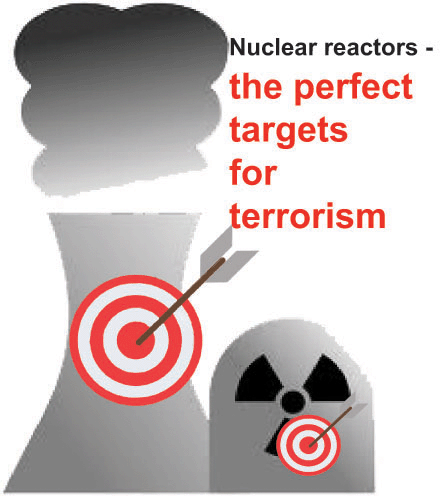 Fukui governor and mayors ask Inada for added protection for reactors against North Korea attacks, Japan Times BY ERIC JOHNSTON OSAKA – Fukui Gov. Issei Nishikawa and the mayors of six towns and villages in the prefecture hosting nuclear power plants have called on Defense Minister Tomomi Inada to dispatch Self-Defense Forces personnel to the prefecture to guard Fukui’s 15 reactors (including those being decommissioned) against a possible attack by North Korea…….
“In order to deter a missile attack, and in order to secure peace of mind of local residents, we ask that Self-Defense Forces be dispatched to the southern part of the prefecture,” the request stated.
In a 2013 report on the nation’s mid-term defense posture for 2014-2018, the Defense Ministry said it will strengthen cooperation with local governments hosting nuclear power plants and take necessary measures to protect them.
Nishikawa also called on the ministry to establish a landing area for helicopters that could be used if a large-scale evacuation of residents in towns near the nuclear power plants would be necessary in the event of damage at a reactor……http://www.japantimes.co.jp/news/2017/07/20/national/politics-diplomacy/fukui-governor-mayors-ask-inada-added-protection-reactors-north-korea-attacks/#.WXE0fRWGPGg
Japan planning to export nuclear technology to India
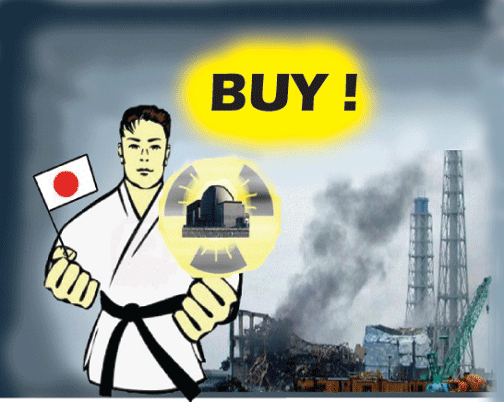 All approvals in place, Japan nuclear deal comes into force http://economictimes.indiatimes.com/news/economy/policy/all-approvals-in-place-japan-nuclear-deal-comes-into-force/articleshow/59690053.cms, By Dipanjan Roy Chaudhury, ET Bureau| Jul 21, 2017 NEW DELHI: The landmark Indo-Japanese civil nuclear deal signed in November 2016 came into force from Thursday that would enable Japan to export nuclear power plant technology as well as provide finance for nuclear power plants in India.
Japanese PM Shinzo Abe is expected to visit India this September and growing civil nuclear ties will be highlighted as one of the key elements of Indo-Japan strategic partnership.
Last November India and Japan signed a landmark civil nuclear cooperation deal — upgrading MoU at the 2015 Annual summit. Subsequently, the Japanese government got approval from the Diet for the nuclear deal with India. The two countries had reached a broad agreement for cooperation in civil nuclear energy sector during Abe’s visit to India in December 2015. Hitachi, also from Japan, has stakes in GE, which has also proposed to set reactors in India.
India is the only non-NPT signatory with which Japan has entered into a civil nuclear deal in what can be described as a recognition for Delhi’s impeccable non-proliferation record, said a person familiar with the matter. American nuclear major
Gas may have ruptured bag at Japan’s nuclear facility
In the bag was a plastic container that stored nuclear fuel materials. The materials were held together by an adhesive agent to make it easier to use in experiments.
A report compiled by the agency says gas is believed to have been generated when radioactive rays disintegrated the adhesive agent, the polyethylene container, and the molecules of water in the bag.
The agency plans to submit a report to the Nuclear Regulation Authority as early as Friday. It will also conduct further analyses to determine the amount of the adhesive agent and the condition of the nuclear fuel materials when they were inside the container.
Japan map showing potential nuclear waste disposal sites to be released

Japan’s government planning protection in fear of radioactive terrorism at 2020 Olympics
 Japan taps tech to foil nuclear terrorism ahead of Tokyo Olympics, Japan Times, KYODO
At a meeting of the Education, Culture, Sports, Science and Technology Ministry in December, Mitsuru Uesaka, president of the Atomic Energy Society of Japan and a professor at the University of Tokyo, said it was important to “enhance nuclear security” ahead of the games.
There have been numerous incidents overseas involving attempts to smuggle nuclear materials……
There are also fears that the radical militant group Islamic State might have made a “dirty bomb” capable of scattering radioactive materials. Unlike nuclear weapons, such devices can be made relatively cheaply without advanced skills.
To stop nuclear materials from entering Japan through airports, the agency developed a device to detect very small amounts of uranium concealed in luggage by irradiating luggage with a beam of neutrons. The result is available in less than a second.
Baggage screening at domestic airports usually uses X-rays, but an expert at the agency said conventional screening is not effective in detecting nuclear materials…..
As of the end of 2015, there were 454 confirmed incidents around the world involving unauthorized possession of nuclear materials and related criminal activities, 762 incidents involving reported theft or loss of such materials, and 1,622 incidents involving other unauthorized activities and events related to such materials, according to an International Atomic Energy Agency report. http://www.japantimes.co.jp/news/2017/07/19/national/japan-taps-tech-foil-nuclear-terrorism-ahead-tokyo-olympics/#.WW8OgBWGPGg
1 This Month
26 September – International Day for the Total Elimination of Nuclear Weapons





PLEASE OPPOSE HR 8255 AND S.3639 – bills would accelerate satellite deployment, with no environmental review or safeguards – https://ncstd5li.quorum.us/campaign/169331/
To see nuclear-related stories in greater depth and intensity – go to https://nuclearinformation.wordpress.com
-
Archives
- September 2026 (291)
- August 2026 (330)
- July 2026 (355)
- June 2026 (287)
- May 2026 (306)
- April 2026 (356)
- March 2026 (251)
- February 2026 (267)
- January 2026 (308)
- December 2025 (358)
- November 2025 (359)
- October 2025 (375)
-
Categories
- 1
- 1 NUCLEAR ISSUES
- business and costs
- climate change
- culture and arts
- ENERGY
- environment
- health
- history
- indigenous issues
- Legal
- marketing of nuclear
- media
- opposition to nuclear
- PERSONAL STORIES
- politics
- politics international
- Religion and ethics
- safety
- secrets,lies and civil liberties
- spinbuster
- technology
- Uranium
- wastes
- weapons and war
- Women
- 2 WORLD
- ACTION
- AFRICA
- Atrocities
- AUSTRALIA
- Christina's notes
- Christina's themes
- culture and arts
- Events
- Fuk 2022
- Fuk 2023
- Fukushima 2017
- Fukushima 2018
- fukushima 2019
- Fukushima 2020
- Fukushima 2021
- general
- global warming
- Humour (God we need it)
- Nuclear
- RARE EARTHS
- Reference
- resources – print
- Resources -audiovicual
- Weekly Newsletter
- World
- World Nuclear
- YouTube
-
RSS
Entries RSS
Comments RSS

