Students and researchers at research reactors should have background checks, warns Japan’s nuclear regulator

 NRA urging background checks on students using Japan’s research reactors, Japan Times, 23 June 17 KYODO Japan’s nuclear regulator has urged universities to conduct background checks on students and researchers working at research reactors, as a step to ensure the proper handling of nuclear materials and prevent terrorism, a source said Thursday.
The check items include mental disorder and criminal records and those who have access to strictly controlled nuclear material storage areas at research reactors owned by universities will be subject to the new rule.
But the decision will likely raise concerns about privacy and human rights, legal experts say. University officials are concerned that the inquiries could also discourage students from becoming researchers in the nuclear industry.
The Nuclear Regulation Authority’s request comes after the International Atomic Energy Agency recommended the Japanese government conduct background checks on workers at nuclear power plants and those involved in decommissioning work at the Fukushima No. 1 nuclear power plant, crippled by the 2011 earthquake and tsunami.
Based on the recommendation, the nuclear safety watchdog decided last year to conduct background checks on workers at nuclear plants. Plant operators plan to start the checks as early as this fall.
A total of 17 check items also include students’ and researchers’ names, nationalities, employment history and addiction to alcohol, the source said……..http://www.japantimes.co.jp/news/2017/06/23/national/nra-urging-background-checks-students-using-japans-research-reactors/#.WU14LpKGPGg
Plutonium in Workers’ Urine
The Asahi Shimbun is reporting that, contrary to the reassurances made a few days ago by the Japan Atomic Energy Agency (see here), workers at JAEA’s Oarai Research and Development Center, WERE internally contaminated by Plutonium:
Plutonium found in urine of 5 workers in Ibaraki accident. THE ASAHI SHIMBUN, June 20, 2017 http://www.asahi.com/ajw/articles/AJ201706200039.html
Minute amounts of plutonium have been detected in the urine samples of all five workers who were accidentally exposed to radioactive plutonium at Japan Atomic Energy Agency (JAEA)’s Oarai Research and Development Center in Oarai, Ibaraki Prefecture, on June 6…. While maintaining the level of exposure the five workers experienced “would not have immediate effect on their health for a few months,” Akashi said their internal exposure levels are “relatively high for cases occurring in Japan as far as I know.”…
…In urine testing, NIRS said it can detect smaller amounts of plutonium as the measurement time is much longer, while the smallest radiation doses the dosimeter for lungs can detect is between 5,000 and 10,000 bequerels.
I shouldn’t be too critical of these oscillating reports given the US won’t even admit when its workers are contaminated with Plutonium, as the recent tunnel collapse at Hanford reminds us:
Tia Ghose. May 10, 2017. Hanford Disaster: What Happens to Someone Who’s Exposed to Plutonium? Live Science, https://www.livescience.com/59042-how-does-plutonium-damage-the-body.html
Workers at a nuclear-waste site in Washington state were recently told to hunker down in place after a tunnel in the nuclear finishing plant collapsed, news sources reported yesterday (May 9)…
The tunnel was part of the plutonium and uranium extraction facility (PUREX) said to be holding a lot of radioactive waste, including railway cars used to carry spent nuclear fuel rods, news agency AFP reported. At least some of the radioactive waste at the Hanford facility contains radioactive plutonium and uranium, according to the DOE, although at least some of it is also radioactive “sludge” composed of a mixture of radioactive substances. Right now, authorities have not revealed whether radioactive substances have been released or whether people have been exposed any of these contaminants
Governments don’t want to talk too much to the public about plutonium. Every dimension of knowledge about this element seems to be weaponized. Despite the desire for secrecy, plutonium always seems to be out of bounds, contaminating some people or environment, or perhaps all people, especially men’s testes (see here).
Plutonium’s astonishing level of chemical toxicity and atomic instability are fetishized by the atomic priesthood, but the priesthood cannot control their Frankensteinan creation, as these stories and ongoing atmospheric emissions at Fukushima Daiichi demonstrate:


http://majiasblog.blogspot.fr/2017/06/plutonium-in-workers-urine.html
Plutonium in workers’ urine at Oarai Research and Development Center

Traces of plutonium in workers’ urine
Doctors say extremely small quantities of radioactive substances have been detected in the urine of 5 workers who were accidentally exposed to the materials early this month at a research facility north of Tokyo.
The incident took place on June 6th at a facility of the Japan Atomic Energy Agency in Oarai Town, Ibaraki Prefecture. The workers were inspecting a nuclear fuel container when a bag inside suddenly burst, expelling radioactive powder.
The agency initially said as much as 22,000 becquerels of plutonium-239 were detected in the lungs of one of the workers. But they were discharged from hospital by Tuesday of last week after repeated examinations at the National Institute of Radiological Sciences detected no plutonium in their lungs.
On Monday, the institute said checks of the 5 workers’ urine later revealed extremely small amounts of plutonium and other radioactive materials.
It says the workers have so far suffered no damage to their health, but that they have reentered hospital to take medicines that will purge the plutonium from their bodies. They will take the drug for 5 days, after which doctors will decide if further medication is necessary.
An official related to the institute says the radioactive materials in the workers’ bodies are at levels that will not immediately affect their health.
Meanwhile, the Japan Atomic Energy Agency, which employs the 5 workers, on Monday submitted to the country’s nuclear regulator an interim report on how the accident unfolded.
The agency’s president, Toshio Kodama, told reporters that he apologizes to the public for the incident. Kodama added that his organization may have problems sensing and foreseeing risks.
Kodama said the agency has to work on organizational issues, including worker awareness.
The agency says it plans to conduct a detailed investigation into the cause of the accident. It says it will consider measures to prevent recurrences and report to the regulator.
https://www3.nhk.or.jp/nhkworld/en/news/20170619_27/
Tokyo, June 19 (Jiji Press)–Trace amounts of plutonium have been detected in the urine of all five workers exposed to radioactive materials at a nuclear research facility in eastern Japan earlier this month, a radiological research center treating them said Monday.
The radioactive substances detected in the urine were plutonium-239, plutonium-238 and americium-241, the National Institute of Radiological Sciences, or NIRS, said.
The results showed that the workers at the Japan Atomic Energy Agency’s Oarai Research and Development Center in Ibaraki Prefecture, northeast of Tokyo, suffered internal radiation exposure, the NIRS said.
The NIRS plans to continue examining the five workers for about a month to estimate levels of exposure.
The exposure is unlikely to reach levels that cause symptoms, said Makoto Akashi, a senior official at the National Institutes for Quantum and Radiological Science and Technology, which oversees the NIRS.
http://jen.jiji.com/jc/eng?g=eco&k=2017061901238
Plutonium found in urine of 5 workers in Ibaraki accident
Minute amounts of plutonium have been detected in the urine samples of all five workers who were accidentally exposed to radioactive plutonium at Japan Atomic Energy Agency (JAEA)’s Oarai Research and Development Center in Oarai, Ibaraki Prefecture, on June 6.
The test results were announced June 19 at a news conference by the National Institute of Radiological Sciences (NIRS) within National Institutes for Quantum and Radiological Science and Technology (QST).
The revelation marks the latest twist in the changing assessment of severity of the health risks in the accident. Initially JAEA announced on June 7 that one of the five workers had suffered an internal exposure of 22,000 bequerels during an inspection at the nuclear energy research center. On June 9, JAEA said no plutonium was detected in any of the five workers’ lungs in further testing by NIRS.
Makoto Akashi, an executive of QST, said at the news conference the latest finding confirmed that the workers did “suffer an internal exposure.”
While maintaining the level of exposure the five workers experienced “would not have immediate effect on their health for a few months,” Akashi said their internal exposure levels are “relatively high for cases occurring in Japan as far as I know.”
He also added that long-term observation may be necessary depending on the level of internal exposure.
JAEA’s initial “internal exposure of 22,000 bequerels” assessment was hastily done on the night of the accident on June 6. The five workers were examined using a dosimeter that can detect small traces of X-rays emitted by plutonium particles inhaled into the lungs.
However, the next day, NIRS staff discovered that four of the workers did not have all the plutonium on their bodies completely removed. After thorough decontamination efforts, they were retested for plutonium in the lungs, which was “not detected.”
It is believed the initial assessment came back with a high reading, as the dosimeter also picked up the radiation from the plutonium residue on their bodies.
In urine testing, NIRS said it can detect smaller amounts of plutonium as the measurement time is much longer, while the smallest radiation doses the dosimeter for lungs can detect is between 5,000 and 10,000 bequerels.
The latest test result suggests the possibility that some plutonium particles inhaled into the workers’ lungs have been absorbed into the bloodstream, then discharged into the urine.
The five workers had been discharged and are in stable condition, but were readmitted to the institution for further treatment on June 18. They started receiving medication via intravenous drip injections to speed the excretion of radioactive substances in their bodies from June 19, according to NIRS.
It is the second time they have received this medication. NIRS confirmed the treatment’s effectiveness as the amount of plutonium in their urine increased after the first round of injections compared to the amount found prior to receiving the drug.
Plutonium found in urine of 5 workers exposed to radiation

TOKYO (Kyodo) — A small amount of plutonium was found in the urine of five workers exposed to radiation in an accident earlier this month at a nuclear research facility in Ibaraki Prefecture, a hospital operator said Monday.
The result shows that the five workers have suffered internal radiation exposure following the June 6 accident at the Japan Atomic Energy Agency’s Oarai Research & Development Center in the coastal town of Oarai.
They had been receiving medication to facilitate the discharge of radioactive materials from their bodies since the accident and will continue to do so, said the National Institutes for Quantum and Radiological Science and Technology, the operator of the hospital.
The five, although showing no signs of deterioration or notable change in their health, were hospitalized again from Sunday for the treatment.
In the accident, radioactive materials were released into the air in the room where the five were working when one opened a metal container holding plutonium and uranium powder samples and a plastic bag containing the samples inside suddenly ruptured.
Initially, the agency said up to 22,000 becquerels of plutonium-239 were found in the lungs of one of the five workers, while up to 5,600 to 14,000 becquerels of the radioactive substance were found in the lungs of three other workers. It said at the time that the four had suffered internal radiation exposure.
But the facility operator has since said a subsequent check by the National Institute of Radiological Sciences has found no plutonium in the lungs of any of the five workers. It has not ruled out the possibility that what was actually detected was radioactive substance left on the workers’ bodies after decontamination.
Also on Monday, JAEA President Toshio Kodama again apologized over the accident, saying at a press conference, “The agency as a whole had problems in the prediction of risks.”
He said he has no intention of resigning for now but will take “appropriate” responsibility depending on the cause of the accident.
The agency submitted a report compiling the causes of the accident and measures to be taken to prevent a recurrence to the Nuclear Regulation Authority, the state’s nuclear safety watchdog.
https://mainichi.jp/english/articles/20170619/p2g/00m/0dm/074000c
Radiation research foundation to apologize for studying but not treating hibakusha

Radiation Effects Research Foundation (RERF) Chairman Ohtsura Niwa
HIROSHIMA — The chairman of a joint Japan-U.S. research organization studying the long-term effects of radiation exposure on humans is expected to apologize to hibakusha — survivors of the 1945 U.S. atomic bombings of Hiroshima and Nagasaki — who were studied but generally not treated by the organization’s American predecessor, it has been learned.
Radiation Effects Research Foundation (RERF) Chairman Ohtsura Niwa will give his apology at a June 19 ceremony here commemorating the 70th anniversary of the organization’s establishment, to which hibakusha will be invited.
It is believed that this will mark the first time for a top RERF official to offer a direct, public apology to its subjects and those of its predecessor. “There’s an ironclad rule that one must develop relationships with human research subjects,” Niwa says. “But that sort of thinking didn’t exist in the 20th century. We must improve our relationships with hibakusha.”
Established in 1947 under the orders of U.S. President Harry Truman, the RERF’s predecessor, the Atomic Bomb Casualty Commission (ABCC), began to collect data on hibakusha in Hiroshima. The ABCC began similar studies on hibakusha in Nagasaki the following year. In both cities, subjects, as a rule, went untreated. Japanese authorities also took part in the research, following up on hibakusha years after they were exposed to the bombs. In 1975, the ABCC was reorganized into the bi-national RERF.
Hibakusha have said that the ABCC forcibly took them to research facilities where they were stripped to have their photos taken. Many have been angry with the ABCC for treating them like guinea pigs and violating their human rights, and the organization has long been criticized for gathering data from hibakusha but not treating them.
“Officially, the ABCC did not provide treatment, and instead ran tests on hibakusha and sent them home. It’s only natural that hibakusha harbor negative feelings toward the organization, and that they have had such feelings has been made clear from various records,” RERF Chairman Niwa told the Mainichi Shimbun. “I must apologize.”
There are no records of the organization’s past chairmen or other top officials directly apologizing to hibakusha, and the RERF says it is highly likely that Niwa’s apology will be the first.
In a speech at the outset of the upcoming ceremony, Niwa is expected to say something about the ample criticism and protest against the fact that researchers from the very country that dropped the atomic bombs had collected data from hibakusha, and that he is sorry that such an unfortunate period existed. Content similar to that of the planned speech was included in an RERF pamphlet published in 1995, but few people know about it.
As for hibakusha being stripped naked for tests and bereaved families being asked to donate the bodies of family members who died from radiation exposure, Niwa says, “The U.S. side was not knowledgeable about Japanese culture and traditions, so there was cultural friction. But such steps were necessary for the sake of science.”
Satoru Ubuki, a member of a committee for the preservation of historical records at the RERF, a former Hiroshima Jogakuin University professor, and an expert on the history of atomic bombing, said of the upcoming apology, “The RERF probably determined that to continue conducting research on second- and third-generation hibakusha, it will be more likely to gain their cooperation if the organization apologizes.”
Meanwhile, Nagoya University researcher Hiroko Takahashi, who is well-versed in the ABCC, says, “While there is significance to reflecting on and offering regret for the past, the remarks (Niwa makes) must not justify all research carried out by the RERF. The organization receives funding from the U.S. Department of Energy, and just as the ABCC had military objectives, that fundamental characteristic of the organization remained even after the RERF succeeded the ABCC. Among the data that was sent to the U.S. military in the early days of the RERF are many whose purpose remains unclear, so studies conducted at the time should be verified with the participation of a third party.
https://mainichi.jp/english/articles/20170617/p2a/00m/0na/016000c
A-bomb survivors submit petition for nuclear ban
Representatives of Japanese atomic bomb survivors have compiled a petition of nearly 3 million signatures calling for a nuclear weapons ban treaty. The group handed the document to the chair of the ongoing UN meeting on the convention.
The second round of negotiations aimed at concluding the world’s first-ever nuclear weapons ban treaty started on Thursday at UN headquarters in New York.
On the second day of talks on Friday, representatives of atomic bomb survivors in Hiroshima and Nagasaki, Toshiyuki Mimaki and Masako Wada presented the petition to the chair of the meeting, Costa Rica’s envoy Elayne Whyte. They say their groups collected 2.96 million signatures over just more than a year since last April.
Wada handed the petition over along with a paper crane, a symbol of peace. She said the signatures represent the voices of atomic bomb survivors and citizens, and thanked the chair for her leadership.
Whyte responded that the main purpose of the treaty is to eliminate the suffering caused by nuclear weapons. The representatives applauded her when she said the signatures are very important for the negotiators.
After the handover, Wada observed that the draft treaty incorporates the Japanese word “hibakusha,” meaning atomic bombing survivor. She said she believes this shows the delegates have recognized the group’s long years of anti-nuclear activities.
Also in New York, atomic bomb survivor Masao Tomonaga from Nagasaki met Japan’s UN Ambassador Koro Bessho to relay a message from the Nagasaki mayor, Tomihisa Taue.
The message described a feeling of disappointment that is spreading among Nagasaki citizens over Japan’s absence from the negotiations.
Tomonaga said Bessho told him he understands their feeling, but Japan cannot decide on its own to leave the nuclear umbrella, and has had to make a difficult choice regarding the ongoing talks.
Hibakusha were not treated for radiation damage: finally Radiation research foundation to apologize
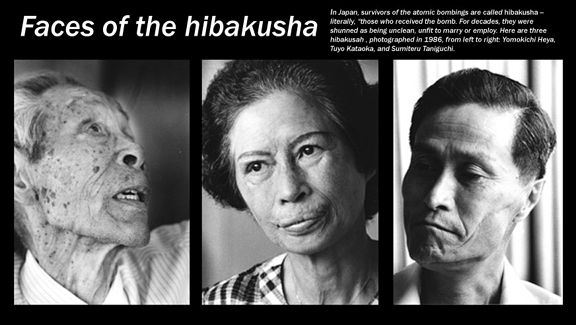 Radiation research foundation to apologize for studying but not treating hibakusha https://mainichi.jp/english/articles/20170617/p2a/00m/0na/016000c June 17, 2017 (Mainichi Japan)HIROSHIMA –– The chairman of a joint Japan-U.S. research organization studying the long-term effects of radiation exposure on humans is expected to apologize to hibakusha — survivors of the 1945 U.S. atomic bombings of Hiroshima and Nagasaki — who were studied but generally not treated by the organization’s American predecessor, it has been learned.
It is believed that this will mark the first time for a top RERF official to offer a direct, public apology to its subjects and those of its predecessor. “There’s an ironclad rule that one must develop relationships with human research subjects,” Niwa says. “But that sort of thinking didn’t exist in the 20th century. We must improve our relationships with hibakusha.”
Established in 1947 under the orders of U.S. President Harry Truman, the RERF’s predecessor, the Atomic Bomb Casualty Commission (ABCC), began to collect data on hibakusha in Hiroshima. The ABCC began similar studies on hibakusha in Nagasaki the following year. In both cities, subjects, as a rule, went untreated. Japanese authorities also took part in the research, following up on hibakusha years after they were exposed to the bombs. In 1975, the ABCC was reorganized into the bi-national RERF.
Hibakusha have said that the ABCC forcibly took them to research facilities where they were stripped to have their photos taken. Many have been angry with the ABCC for treating them like guinea pigs and violating their human rights, and the organization has long been criticized for gathering data from hibakusha but not treating them.
“Officially, the ABCC did not provide treatment, and instead ran tests on hibakusha and sent them home. It’s only natural that hibakusha harbor negative feelings toward the organization, and that they have had such feelings has been made clear from various records,” RERF Chairman Niwa told the Mainichi Shimbun. “I must apologize.”
There are no records of the organization’s past chairmen or other top officials directly apologizing to hibakusha, and the RERF says it is highly likely that Niwa’s apology will be the first.
In a speech at the outset of the upcoming ceremony, Niwa is expected to say something about the ample criticism and protest against the fact that researchers from the very country that dropped the atomic bombs had collected data from hibakusha, and that he is sorry that such an unfortunate period existed. Content similar to that of the planned speech was included in an RERF pamphlet published in 1995, but few people know about it.
As for hibakusha being stripped naked for tests and bereaved families being asked to donate the bodies of family members who died from radiation exposure, Niwa says, “The U.S. side was not knowledgeable about Japanese culture and traditions, so there was cultural friction. But such steps were necessary for the sake of science.”
Satoru Ubuki, a member of a committee for the preservation of historical records at the RERF, a former Hiroshima Jogakuin University professor, and an expert on the history of atomic bombing, said of the upcoming apology, “The RERF probably determined that to continue conducting research on second- and third-generation hibakusha, it will be more likely to gain their cooperation if the organization apologizes.”
Meanwhile, Nagoya University researcher Hiroko Takahashi, who is well-versed in the ABCC, says, “While there is significance to reflecting on and offering regret for the past, the remarks (Niwa makes) must not justify all research carried out by the RERF. The organization receives funding from the U.S. Department of Energy, and just as the ABCC had military objectives, that fundamental characteristic of the organization remained even after the RERF succeeded the ABCC. Among the data that was sent to the U.S. military in the early days of the RERF are many whose purpose remains unclear, so studies conducted at the time should be verified with the participation of a third party.
Security fears for Fukushima residents returning to deserted towns
For Fukushima returnees, security a growing concern in deserted towns, Japan Times, FUKUSHIMA MINPO, 18 June 17 “….. According to town officials, only about 300 residents have come back so far.
Many of the houses in Sato’s neighborhood remain uninhabited. So when he spots a car parked in the dark, it frightens him.
“If safety and security aren’t ensured, there won’t be more people coming back,” Sato said.
Sparked by returnees’ concerns about security, many recovering municipalities have set up neighborhood watch groups, installed security cameras and taken other measures to increase safety…..
The number of police officers brought in from outside Fukushima to help patrol the no-go zone has been reduced to 192, or about 150 fewer than five years ago. The police presence is expected to decline further as decontamination progresses, raising concerns on how to ensure security there in the future.
Many municipalities have been funding security costs with central government subsidies, but it is unclear whether that will continue after fiscal 2020, when the state-designated reconstruction and revitalization period is scheduled to end. The Reconstruction Agency is also slated to be dissolved by then.
A top Reconstruction Agency official would only say it will “consider the issue in the future.”
For its part, the town of Namie is expected to spend about ¥700 million in fiscal 2017 to fund the neighborhood watch teams and surveillance systems. But town officials are worried whether they’ll be able to afford the systems once the subsidies dry up.
Reconstruction minister Masayoshi Yoshino, a Lower House politician representing the Fukushima No. 5 district, said in April that he will consider creating a new government entity to take over the work of the Reconstruction Agency.
“I want the government to tell us that it will continue to fund” such projects, said Namie Deputy Mayor Katsumi Miyaguchi. http://www.japantimes.co.jp/news/2017/06/18/national/fukushima-returnees-security-growing-concern-deserted-towns/#.WUb79JKGPGg
Incoming Tepco chief vows decision on whether to scrap Fukushima No. 2

The incoming president of Tokyo Electric Power Company Holdings Inc. has expressed eagerness to accelerate moves for tie-ups with other companies in an effort to revive its business following the meltdowns at its Fukushima No. 1 nuclear complex in 2011.
“Capital strength is important to seriously embark on growth businesses,” Tomoaki Kobayakawa, the head of Tokyo Energy Partner Inc., Tepco’s electricity retail arm, said in a recent interview. The 53-year-old is set to assume the post of president on June 23.
His remarks were in line with Tepco’s new business turnaround plan announced on March 22, in which it said it aims to realign and integrate its nuclear and power transmission and distribution businesses with other utilities to improve profitability.
The company, burdened with massive costs stemming from the Fukushima disaster, was placed under effective state control in exchange for a ¥1 trillion ($9 billion) capital injection in 2012.
Compensation and disaster cleanup costs have continued to rise, with the latest estimate reaching ¥22 trillion — twice the sum expected earlier.
Kobayakawa said JERA Co., a joint venture of a Tepco unit and Chubu Electric Power Co. in the area of coal power generation, is a “good example” of a tie-up, as enlarged capital has allowed it “to move powerfully.”
He said the power transmission and distribution businesses will also “produce outcomes if we can (align with other companies) and cover a wide network.”
“I want to make more and more proposals,” he said, pointing to the possibility of forming alliances with businesses overseas, given that domestic demand for electricity is on the decline.
On the resumption of nuclear power generation, Kobayakawa expressed his intention to respect the view of local municipalities in restarting reactors 6 and 7 at the Kashiwazaki-Kariwa plant in Niigata Prefecture on the Sea of Japan coast.
Masahiro Sakurai, the mayor of Kashiwazaki, the city that hosts the nuclear plant along with the neighboring town of Kariwa, has said that the decommissioning of one of reactors 1 to 5 at the Kashiwazaki-Kariwa plant would be a condition for the restart of reactors 6 and 7.
“I haven’t met (the mayor) in person. I would like to confirm his intention,” Kobayakawa said.
Kobayakawa also reiterated the company’s position that it will decide “comprehensively” on whether the Fukushima No. 2 nuclear power plant, located around 12 km south of the crippled Fukushima No. 1, would be scrapped as the prefectural government has urged the decommissioning of the plant.
Court dismisses request to halt restart of Saga reactors

People stage a protest rally in front of Kyushu Electric Power Co.’s office in the city of Saga on Tuesday after a district court rejected an injunction request to halt the restart of two reactors at the utility’s Genkai power plant.
SAGA – A district court on Tuesday dismissed a request from about 230 local residents for an injunction to stop the restart of two reactors at Kyushu Electric Power Co.’s Genkai nuclear power plant in Saga Prefecture over safety concerns.
The Saga District Court handed down the ruling concerning reactors 3 and 4 at the complex as the utility prepares for their restart this summer or later, having secured the necessary consent of the governor of Saga and the mayor of Genkai. The town hosts the four-reactor power station.
Reactors 3 and 4 have cleared Nuclear Regulation Authority screenings that were based on safety standards revamped after the Fukushima nuclear disaster triggered by the March 2011 earthquake and tsunami.
In Tuesday’s decision, presiding Judge Takeshi Tachikawa said the new safety standards are “reasonable.” The court has found no issues with earthquake resistance or steps taken against serious accidents and does not see any specific danger of radiation exposure at the plant, he added.
The focus of the lawsuit, filed by the residents in July 2011, was whether the operator has adequate measures in place against earthquakes. The plaintiffs argued that serious accidents could occur due to degradation in piping.
“The court is supposed to help the weak, but the ruling is based on economics and politics,” said Hatsumi Ishimaru, 65, who leads the group of residents. “We will continue to fight until we stop the nuclear plant.”
The plaintiffs said they will immediately appeal the decision to the Fukuoka High Court.
Kyushu Electric said in a statement it considers the latest decision “appropriate” and will continue to try to ensure safety at the plant.
The ruling may inject momentum into the government’s policy to restart nuclear plants that have fulfilled the new safety standards.
While declining to comment on the court decision itself, Chief Cabinet Secretary Yoshihide Suga said the government respects the Nuclear Regulation Authority’s judgment that the reactors meet the new safety standards.
Tuesday’s ruling followed a series of court decisions rejecting similar suits seeking to halt the operations of nuclear power plants.
In March, the Osaka High Court overturned a lower court order to halt two nuclear reactors at the Takahama plant in Fukui Prefecture, while in the same month the Hiroshima District Court dismissed a request by local residents to order the halt of a nuclear reactor that was restarted last year at the Ikata plant in Ehime Prefecture.
Of the more than 40 commercial reactors nationwide, five are currently in operation. At the Genkai plant, the No. 1 unit is set to be decommissioned due to aging.
http://www.japantimes.co.jp/news/2017/06/13/national/crime-legal/court-nixes-request-halt-restart-saga-reactors/#.WUDy_jekLrc
Underwater robot to probe damage at Fukushima Dai-Ichi nuclear plant
Swimming robot to probe damage at Japan nuclear plant, abc news, By MARI YAMAGUCHI, ASSOCIATED PRESS A Japanese industrial group unveiled Thursday a robot designed for underwater probes of damage from meltdowns at the Fukushima Dai-Ichi nuclear plant after the March 2011 earthquake and tsunami.
Review of safety of Kashiwazaki-Kariwa nuclear plant will mean along delay in restart
Reuters 14th June 2017, Tokyo Electric Power Co will work with local government to review the
safety of its Kashiwazaki-Kariwa nuclear plant, which could mean a later
restart date than planned originally, the company’s incoming CEO said.
The Kashiwazaki-Kariwa plant, the world’s biggest nuclear power plant, has been
completely offline since 2012 while its safety procedures are reviewed.
Ryuichi Yoneyama, the governor of Niigata prefecture in north west Japan
where the plant is located, has said he will not discuss the restart until
the review is completed. This includes a review of the plant’s safety,
evacuation plans, plus the impact on health of the radiation released from
Fukushima, which could take until 2020 at the earliest. https://www.reuters.com/article/us-japan-tepco-idUSKBN1952HU
Court rejects citizen group submission, allows restart of Genkai nuclear plant
Court rejects citizens’ plea to delay restart of Genkai plant http://www.asahi.com/ajw/articles/AJ201706130012.html, THE ASAHI SHIMBUN June 13, 2017 SAGA–The Saga District Court on June 13 rejected a class action request for an injunction to delay the restart of the Genkai nuclear power plant.
A citizens group had submitted the request for the temporary injunction on the No. 3 and No. 4 reactors at the Genkai plant, operated by Kyushu Electric Power Co., in Saga Prefecture. The group will appeal the decision to the Fukuoka High Court.
Concerns about the safety of the plant led a total of 202 plaintiffs living in 17 prefectures, including Saga and Fukuoka, to join the court action.
With the Saga prefectural governor and Genkai mayor already giving the green light to resume operations, the plant could be restarted as early as this autumn.
Japan’s struggle to decommission Fukushima nuclear reactors
The passage route to the first reactor was flanked by gigantic storage tanks that hold contaminated water.
Reactors still showing skeletal steel frames and roof debris remind a 17-meter-high tsunami which flooded the facility on March 11 in 2011 and caused a hydrogen explosion, bringing the plant to a complete standstill.
Tokyo Electric Power Co. (Tepco), the operator of the plant, has deployed 7,000 workers including its own staff to the site. Their first priority is to tackle the influx of contaminated groundwater. Workers erected a cutoff wall and pumped out upstream groundwater, but still, about 100 to 150 tons of contaminated water is generated every day, according to Tepco. The amount of the contaminated water in storage tanks reaches nearly 1 million tons. It has not yet been decided how to treat the water.
The operation for complete decommissioning is a long way to go. It will take 30 years to finish the job, including the treatment of contaminated water, said Yuichi Okamura, Tepco communication manager.
The Japanese government is going all out to develop advanced robot and drone technology to accurately grasp the internal situation of the reactors to support decommissioning.
1 This Month
26 September – International Day for the Total Elimination of Nuclear Weapons





PLEASE OPPOSE HR 8255 AND S.3639 – bills would accelerate satellite deployment, with no environmental review or safeguards – https://ncstd5li.quorum.us/campaign/169331/
To see nuclear-related stories in greater depth and intensity – go to https://nuclearinformation.wordpress.com
-
Archives
- September 2026 (291)
- August 2026 (330)
- July 2026 (355)
- June 2026 (287)
- May 2026 (306)
- April 2026 (356)
- March 2026 (251)
- February 2026 (267)
- January 2026 (308)
- December 2025 (358)
- November 2025 (359)
- October 2025 (375)
-
Categories
- 1
- 1 NUCLEAR ISSUES
- business and costs
- climate change
- culture and arts
- ENERGY
- environment
- health
- history
- indigenous issues
- Legal
- marketing of nuclear
- media
- opposition to nuclear
- PERSONAL STORIES
- politics
- politics international
- Religion and ethics
- safety
- secrets,lies and civil liberties
- spinbuster
- technology
- Uranium
- wastes
- weapons and war
- Women
- 2 WORLD
- ACTION
- AFRICA
- Atrocities
- AUSTRALIA
- Christina's notes
- Christina's themes
- culture and arts
- Events
- Fuk 2022
- Fuk 2023
- Fukushima 2017
- Fukushima 2018
- fukushima 2019
- Fukushima 2020
- Fukushima 2021
- general
- global warming
- Humour (God we need it)
- Nuclear
- RARE EARTHS
- Reference
- resources – print
- Resources -audiovicual
- Weekly Newsletter
- World
- World Nuclear
- YouTube
-
RSS
Entries RSS
Comments RSS

