Insuring Small Modular Nuclear Reactors.

Deploying the next generation of nuclear technologies is likely to present a number of novel challenges, notably securing appropriate insurance coverage for both property and liability. Without early engagement developers could face significant obstacles to commercial roll-out.
Nuclear Engineering International, By Ron Rispoli, Senior Vice President, Energy Group, Stephens Insurance, LLCJuly 9, 2026
s small modular reactors (SMRs) move from concept to commercialisation, one of the least visible yet most critical enablers of deployment is insurance. Property and liability coverage for nuclear are not only a financial safeguard, they are also a regulatory requirement. However, nuclear insurance is highly specialised, capacity constrained, and dependent on early engagement with underwriters.
Insurance requirements for SMRs and microreactors may vary based on reactor size, design, fuel forms, coolant types, and power levels. Existing regulatory frameworks establish baseline liability and financial protection requirements, but these were developed for large, traditional light water reactors. As a result, regulators and insurers may apply a more risk-informed approach when determining appropriate insurance levels for smaller or non-traditional designs.
The US liability insurance framework
In the United States, nuclear liability insurance is governed by the Price-Anderson Act, a federal programme designed to ensure compensation to the public following a nuclear incident. The Act establishes a two-tier structure………
In addition to the Price-Anderson Act, Nuclear Regulatory Commission (NRC) regulations in 10 CFR Part 140 establish detailed financial protection requirements based on reactor size and operating status. These regulations differentiate between nuclear power plants with a rated capacity of 100 MWe or greater and those with lower electrical output, a distinction that is particularly relevant for small modular reactors (SMRs) and microreactors. For smaller units, required liability coverage may be reduced or determined on a case-specific basis, reflecting their lower potential risk profile. The regulations also include provisions for multiple reactors located at a single site. This allows the NRC to evaluate financial protection requirements on a site-specific basis. This introduces additional flexibility for SMR deployments but also creates complexity in structuring appropriate liability coverage for multi-unit configurations.
…..In the United States, reactor licensees are generally required to maintain approximately $1.06bn in onsite property insurance per reactor site. ….
Globally, nuclear liability is governed by a set of international conventions, including the Convention on Supplementary Compensation for Nuclear Damage (CSC), the Paris Convention and Brussels Supplementary Convention, and the Vienna Convention and Joint Protocol. While implementation varies by jurisdiction, these frameworks share core principles: liability is channelled exclusively to the operator, with liability caps supplemented by public funds.
For SMR developers pursuing international deployment, this creates a jurisdiction-by-jurisdiction insurance strategy that often requires coordination across multiple national insurance regimes…………
A constrained market and specialised brokerage
Existing insurance frameworks were developed for large, traditional reactors, creating added complexity for SMR deployment. Unlike conventional insurance markets, nuclear insurance is provided by a small number of highly specialised pools and mutual insurers. Global underwriting capacity is limited, and participation is tightly controlled.
This dynamic is particularly relevant for SMRs, as developers may pursue multi-unit deployments, novel reactor designs, or non-traditional ownership structures – all of which introduce new risks from an underwriting perspective. In practice, access to insurance capacity – not reactor design – may become a gating factor for deployment. Given the complexity of the nuclear insurance market, engaging a broker with demonstrated experience in nuclear insurance is essential. Nuclear insurance is not transacted in a broad, competitive marketplace; rather, it is concentrated among a small number of insurers each with distinct underwriting requirements and processes…….
Emerging technologies, multi-unit deployment strategies, and evolving regulatory frameworks introduce uncertainties that must be translated into insurable risk. Without specialised expertise, projects may face delays, higher costs, or challenges in securing adequate coverage.
Insurance cannot be treated as an afterthought…..Delayed engagement with insurance markets can expose developers to significant risks, including coverage exclusions, insufficient limits, or, in extreme cases, an inability to secure required insurance. Coverage is not guaranteed to be available in the necessary amount, form, or timeframe. As the SMR market grows, competition for limited insurance capacity is likely to intensify….https://www.neimagazine.com/analysis/smrs-advanced-reactors/insuring-smrs/?cf-view
The global small nuclear reactor bandwagon is led by Britain. It ought to fail, but will it?

14 July 2026 Noel Wauchope, https://theaimn.net/the-global-small-nuclear-reactor-bandwagon-is-led-by-britain-it-ought-to-fail-but-will-it/
Why on Earth does the Small Nuclear Reactor media bandwagon exist?
That’s a fair question, because it has been shown time and time again that small modular nuclear reactors (SMRs) are not an economically viable way to provide electricity.
I can only conclude that there are other reasons for the present juggernaut of promotion of SMRs.
You may not have noticed the blithering onslaught of media promotion of SMRs going on over the past weeks, (interestingly, in conjunction with the political demise of Sir Keir Starmer). With the dramatic events in the Persian Gulf, and in climate extremities, dominating the media, a fuss about SMRs seems a small matter.
But it is not a small matter.
The global media juggernaut for SMRs is potentially essential for the survival of the global nuclear industry. If one nation sets up a multitude of, or even a few, small nuclear reactors, that will provide the necessary respectability for the industry – to be accepted as cheap. clean. safe, and embraced by local communities.
Hooray – Britain to the rescue!.
Now, there’s extraordinary excitement in both the British and overseas media. A current example:
The High Value Manufacturing (HVM) Catapult has launched a national consultation, to help UK industry capture the economic and industrial benefits of more than £100bn of expected investment in the country’s civil and defence nuclear programmes over the next decade. Industry, government, academia and regional partners are invited to contribute to the consultation through written submissions, stakeholder workshops and a programme of regional engagement running throughout 2026.
HVM Catapult doesn’t specifically state SMRs, but that’s where the UK media fervour is at. In a previous article, I have mentioned The Times, Telegraph, PR Newswire, Energy Live, Business Green, among the British enthusiasts. Internationally, there’s Construction News, Global Banking and Finance Review, World Nuclear News, Indux, and more.
What is new and remarkable about this UK SMR media fervour?
Well, there are two things. One is that it is all pitching the UK as the leader for the new nuclear renaissance. The other is that this will be a privately-led renaissance. Hence the importance of the “private” SGE £35bn plan for a fleet of SMRs across Britain, rather than the government supported Rolls Royce plan.
I digress here to point out that three nations have tried and failed to set up small nuclear reactors. Russia and China have each managed to develop one actually functioning small nuclear reactor. – in both cases – that took decades, and neither is working out very successfully – Russia – (Akademik Lomonosov floating NPP) and China (HTR-PM high temperature gas cooled reactor). The USA nearly got one happening – The Rise and Fall of NuScale: a nuclear cautionary tale.
So – at last it’s all going to happen ! And the UK is the leader – hip hip hooray! Except that the UK’s biggest SMR promoter, PM Keir Starmer is about to bow out at any moment. The policies of the heir apparent, Andy Burnham, are curiously unknown. He’s got a respectably Leftie background in supporting nuclear veterans, but I couldn’t find anything on his nuclear industry views. And, I’m inclined to think that he, or any new UK Prime Minister, would not be able to withstand the pressure of the cavalcade of vested interests in the nuclear industry. Those vested interests include not only all the UK and global stakeholders in the industry’s supply chain, but the fawning corporate media and the financially dependent universities.
There are some strong voices that speak out against this smr folly. Phil Johnstone and Andy Stirling of the University of Sussex have given a powerful condemnation of this SMR push – The hidden military pressures behind the new push for small nuclear reactors.
The nuclear industry was inaugurated in the early 1940s, specifically for creating an atomic bomb. That has continued to be its purpose for nearly a century, and it its sole real purpose today. Commercial “peaceful” nuclear power was set up as a temporarily successful fig leaf over that truly inhuman purpose. Temporarily successful, because it did provide efficient and seemingly cheap, seemingly clean, seemingly safe electricity for millions of people. We now know that not only are there long term costs – financial, environmental, health and safety costs – but that new big nuclear reactors are monumentally unaffordable.
In this 21st Century – how to make this industry look peaceful, clean, safe, and attractive to bright young career-oriented people? Well if that’s now an impossible task for dirty great Big nuclear reactors, how about a plethora of Small fig-leaves – Small Modular Nuclear Reactors.?
There may be a continued media deluge about UK’s golden SMR future, as promised by the dear soon-to- be-departed Starmer. But I doubt that there will be a deluge of investors keen to get on board the juggernaut. One saving grace of our capitalist society is that our financial writers tend to tell the truth about investment prospects. They might save the UK from this SMR folly. Then the nuclear lobby will have to really ramp up the war-mongering fever that already exists.
The hidden military pressures behind the new push for small nuclear reactors
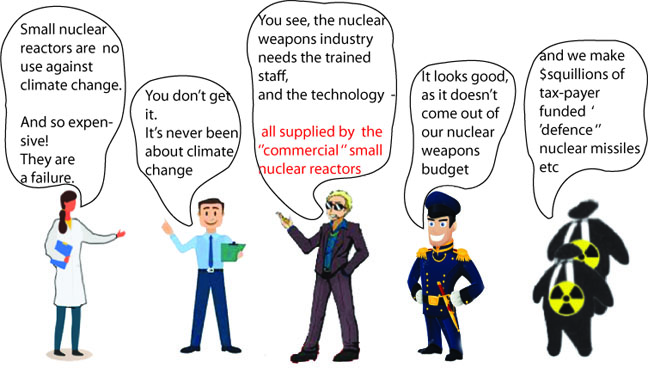
The neglected factor is the military dependence on civil nuclear industries.
By funding civil nuclear projects, taxpayers and consumers cover military uses of nuclear power in subsidies and higher bills – without the added spending appearing in defence budgets
October 28, 2025, Phil Johnstone, Visiting Fellow, School of Global Studies, University of Sussex; University of Tartu; Utrecht University, Andy Stirling, Professor of Science & Technology Policy, SPRU, University of Sussex Business School, University of Sussex, https://theconversation.com/the-hidden-military-pressures-behind-the-new-push-for-small-nuclear-reactors-266301
Donald Trump’s recent visit to the UK saw a so-called “landmark partnership” on nuclear energy. London and Washington announced plans to build 20 small modular reactors and also develop microreactor technology – despite the fact no such plants have yet been built commercially anywhere in the world.
The UK prime minister, Keir Starmer, promised these plans will deliver a “golden age” of nuclear energy that will also “drive down bills”. Yet the history of nuclear power has been decades of overhype, soaring costs and constant delays. Around the world, the trends point the wrong way.
So why the renewed excitement about going nuclear? The real reasons have less to do with energy security, or climate change – and far more to do with military power.
At first sight, the case may seem obvious. Nuclear supporters frame small modular reactors, or SMRs, as vital for cutting emissions, meeting rising demand for electricity from cars and data centres. With large nuclear plants now prohibitively expensive, smaller reactors are billed as an exciting new alternative.
But these days even the most optimistic industry analyses concede that nuclear – even SMRs – is unlikely to compete with renewables. One analysis in New Civil Engineer published earlier this year concluded that SMRs are “the most expensive source per kilowatt of electricity generated when compared with natural gas, traditional nuclear and renewables”.
Independent assessments – for instance by the formerly pro-nuclear Royal Society – find that 100% renewable systems outperform any energy system including nuclear on cost, flexibility and security. This helps explain why worldwide statistical analysis shows nuclear power is not generally linked to carbon emissions reductions, while renewables are.
Partly, the enthusiasm for SMRs can be explained by the loudest institutional voices tending to have formal pro-nuclear remits or interests: they include the industry itself and its suppliers, nuclear agencies, and governments with entrenched military nuclear programmes. For these interests, the only question is which kinds of nuclear reactors to develop, and how fast. They don’t wonder if we should build reactors in the first place: the need is seen as self-evident.
At least big nuclear reactors have benefited from economies of scale and decades of technological optimisation. Many SMR designs are just “powerpoint reactors”, existing only in slides and feasibility studies. Claims these unbuilt designs “will cost less” are speculative at best.
Investment markets know this. While financiers see SMR hype as a way to profit from billions in government subsidies, their own analyses are less enthusiastic about the technology itself.
So why then, all this attention to nuclear in general and smaller reactors in particular? There is clearly more to this than meets the eye.
The hidden link
The neglected factor is the military dependence on civil nuclear industries. Maintaining a nuclear armed navy or weapons programme requires constant access to generic reactor technologies, skilled workers and special materials. Without a civilian nuclear industry, military nuclear capabilities are significantly more challenging and costly to sustain.
Nuclear submarines are especially important here as they would very likely require national reactor industries and their supply chains even if there was no civil nuclear power. Barely affordable even vessel by vessel, nuclear submarines become even more expensive when the costs of this “submarine industrial base” is factored in.
Rolls-Royce is an important link here, as it already builds the UK’s submarine reactors and is set to build the newly announced civil SMRs. The company said openly in 2017 that a civil SMR programme would “relieve the Ministry of Defence of the burden of developing and retaining skills and capability”.
Here, as emphasised by Nuclear Intelligence Weekly in 2020, the Rolls-Royce SMR programme has an important “symbiosis with UK military needs”. It is this dependency that allows military costs (in the words of a former executive with submarine builders BAE Systems), to be “masked” behind civilian programmes.
By funding civil nuclear projects, taxpayers and consumers cover military uses of nuclear power in subsidies and higher bills – without the added spending appearing in defence budgets.
When the UK government funded us to investigate the value of this transfer, we put it at around £5 billion per year in the UK alone. These costs are masked from public view, covered by revenues from higher electricity prices and the budgets of supposedly civilian government agencies.
This is not a conspiracy but a kind of political gravitational field. Once governments see nuclear weapons as a marker of global status, the funding and political support becomes self-perpetuating.
The result is a strange sort of circularity: nuclear power is justified by energy security and cost arguments that don’t stand up, but is in reality sustained for strategic reasons that remain unacknowledged.
A global pattern
The UK is not unique, though other nuclear powers are much more candid. US energy secretary Chris Wright described the US-UK nuclear deal as important for “securing nuclear supply chains across the Atlantic”. Around US$25 billion a year (£18.7 billion) flows from civil to military nuclear activity in the US.
Russia and China are both quite open about their own inseparable civil-military links. French president Emmanuel Macron put it clearly: “Without civilian nuclear, no military nuclear, without military nuclear, no civilian nuclear.”
Across these states, military nuclear capabilities are seen as a way to stay at the world’s “top table”. An end to their civilian programme would threaten not just jobs and energy, but their great power status.
The next frontier
Beyond submarines, the development of “microreactors” is opening up new military uses for nuclear power. Microreactors are even smaller and more experimental than SMRs. Though they can make profits by milking military procurement budgets, they make no sense from a commercial energy standpoint.
However, microreactors are seen as essential in US plans for battlefield power, space infrastructure and new “high energy” anti-drone and missile weaponry. Prepare to see them become ever more prominent in “civil” debates – precisely because they serve military goals.
Whatever view is taken of these military developments, it makes no sense to pretend they are unrelated to the civil nuclear sector. The real drivers of the recent US-UK nuclear agreement lie in military projection of force, not civilian power production. Yet this remains absent from most discussions of energy policy.
It is a crucial matter of democracy that there be honesty about what is really going on.
Eight NATO allies to create new satellite mega-constellation
The network will involve Denmark, Canada, Finland, Germany, Norway, the Netherlands, Sweden and Turkey.
Breakig Defense, By Theresa Hitchens on July 08,
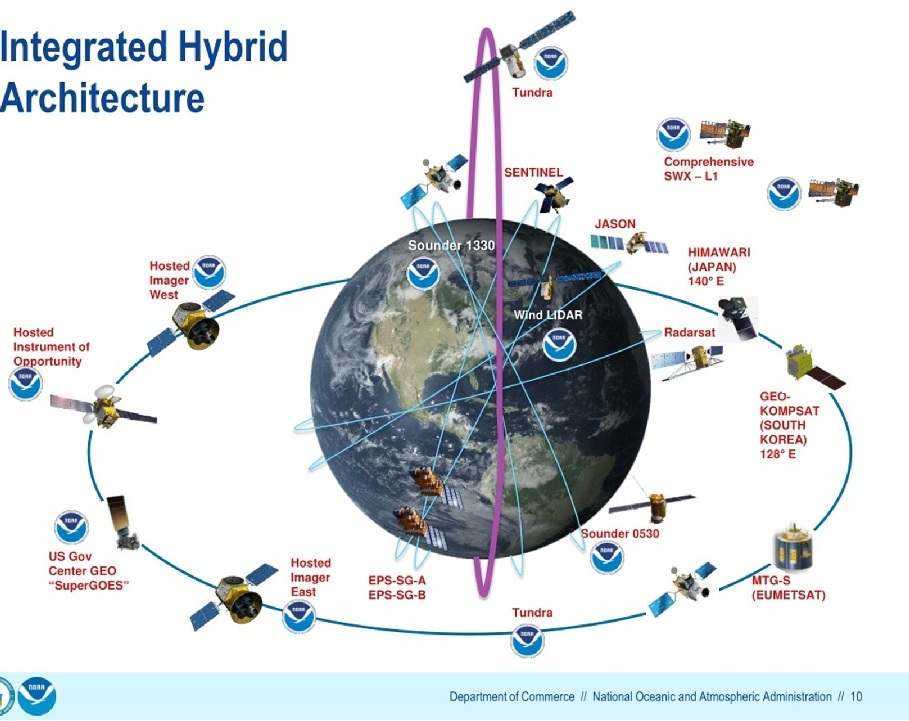
WASHINGTON ― Eight NATO countries plan to link their military satellites into a “mega-constellation” to enable “high-speed communications, intelligence and missile tracking,” the alliance announced on Tuesday at its Summit Defence Industry Forum in Ankara, in a move that joins a number of other a new initiatives aimed at improving NATO space capabilities.
Connecting multiple national satellites will “overcome the cost, time and coverage limitations of single-nation satellite fleets,” a NATO press release said.
The new network, called the Hybrid Alliance Layered Operations in Space (HALO), initially will involve Denmark, Canada, Finland, Germany, Norway, the Netherlands, Sweden and Turkey, a NATO official told Breaking Defense today.
“But we expect more to come,” the official added, explaining that NATO is “in the early stages of the initiative.”………………………………………………………………….
APSS, created in 2023 and formally integrated into NATO in 2024, includes a”virtual” intelligence, surveillance and reconnaissance (ISR) constellation, called Aquila that initially involved 17 allies. Member nations also have pledged to jointly fund commercial imagery and ISR products such as 3D maps.
APSS is supported by the NATO Communications and Information Agency (NCIA), which provides program management, digital infrastructure, data integration and a user interface for allies. Data collected from the network further is funneled into NATO Headquarters via the NATO Intelligence Enterprise. APSS achieved initial operational capability last December…………………………………
Finally, the NATO press release stated that Canada became the 15th member of NATO’s Starlift multinational initiative, “which explores ways to develop a network of launch capabilities that will help Allies launch assets at short notice from spaceports across the Alliance. This will boost NATO’s ability to react more quickly to threats from space.”
Starlift was launched in October 2024 by 14 allies: Belgium, Finland, France, Germany, Hungary, Italy, Luxembourg, the Netherlands, Norway, Spain, Sweden, Turkey, the United Kingdom and the United States. https://breakingdefense.com/2026/07/eight-nato-allies-to-create-new-satellite-mega-constellation/
The UK’s countryside could be filled with small nuclear reactors after billionaire announces £35bn new investment

techradar pro7 July 26, By Rahim Ami
- Polish billionaire Michał Sołowow’s SGE announces £35bn plan to build 14 GE Vernova Hitachi BWRX-300 reactors across three UK sites
- The project aims to deliver 4.2GW of power starting in 2034, effectively powering 8m homes for over 60 years
- The project is looking to secure government backing, with guaranteed prices intended to be locked in for the power producer before it would be offered to investors
…………. Poland-based SGE (Synthos Green Energy) is looking to build up to 14 reactors across three locations in the UK, with six at its primary site and four each at its two secondary sites.
With an estimated build-out cost of £35 billion ($46.5 billion), the project, if approved, is expected to be one of the biggest SMR projects the UK government signs on to as part of its Advanced Nuclear Framework, unveiled earlier this year, to support the development of privately funded projects.
………….. The first disclosed site for SME’s project, Oldbury in South Gloucestershire, is a former Magnox nuclear station that generated up to 434MW of power, is now expected to be home to as many as six 300W SMRs, according to SGE’s plans
While the other two sites are not yet publicly named, they are expected to have a 4+4 reactor split, bringing the total to 14 reactors.
Part of the reason the UK government is interested in outsourcing power generation, even nuclear, to private equity is that it expects a spike in power demand from AI datacenters over the next few years, even as the nation’s overall power needs increase.
This is also why Google Cloud, a key AI data center player, has joined in on SME’s project as a strategic partner that could, as per Michał Sołowow, invest as much as £4.5 billion in data centers in the country to make use of some of the added capacity.
Given that both SMRs (including the proposed GE Vernova Hitachi BWRX-300) and data centers require access to water and space for construction, one can assume that both will prefer cheap, easily accessible coastal, estuarine, or riverside land, which means that the UK’s countryside could soon see certain areas change meaningfully in terms of aesthetics at the very least.
Smaller rivers, however, might not cut it, as SMRs also require the water bodies they use to act as ‘heatsinks’ for their operation, and 6 or 4 in the same location might overwhelm them, limiting the number of areas that are viable for such buildouts, which means that SME’s proposed project might set the baseline for how privatized nuclear power will shape the UK countryside in the days to come even as AI data center demand is expected to increase pressure on the national grid.
For now, SME’s proposal has yet to be approved by the government, making the £35 billion figure an estimate that may or may not apply, given that it still needs to secure financing and lock in government guarantees on pricing before it moves meaningfully towards construction. https://www.techradar.com/pro/the-uks-countryside-could-be-filled-with-small-nuclear-reactors-after-billionaire-announces-gbp35bn-new-investment
Great British Energy appoints Amentum and Cavendish in £360M SMR deal
06 Jul, 2026 By Gavin Pearson, https://www.newcivilengineer.com/latest/great-british-energy-appoints-amentum-and-cavendish-in-360m-smr-deal-06-07-2026/
Great British Energy – Nuclear (GBE‑N) has awarded a long-term Owner’s Engineer (OE) contract worth up to £300M to two contractors.
Amentum Clean Energy and Cavendish Nuclear were signed to the role in a 14‑year contract which formally runs from 23 April 2026 to 23 April 2040.
The contract notice also states the possibility for an extension that could take it to October 2041.
The total value for the contract including VAT is listed as £360M and £300M without VAT, although GBE‑N said the contract’s final value is uncertain and depends on how the project progresses.
This will include timetables and milestones agreed with the SMR technology partner but the procurement notice envisages the OE supporting the client up to the completion of the first fuel cycle for the initial reactor.
The OE role will provide independent technical assurance and oversight to GBE‑N’s “Intelligent Customer” and “Intelligent Client” teams as the SMR programme moves through design stages and towards a final investment decision.
Responsibilities will include specification, audit, review and advice on design, scope, budgets, risk, delivery and contract compliance and acting as a subject matter expert delivering “Line of Defence 2” assurance on major design and build contracts.
Amentum and Cavendish are both established contractors in energy and nuclear services. Cavendish Nuclear is part of Babcock International Group, known for nuclear construction and engineering work in the UK and Amentum is an international engineering and technical services company.
The contract includes monthly reporting against key performance indicators such as deliverable quality, core team availability and social value measures, including targets for female apprenticeships.
Stirling nuclear site plan mooted in new report as politicians hit out

A report from Great British Energy Nuclear has highlighted a number of potential sites in Scotland which could host a nuclear power station – with a location in Stirling among them.
Stuart McFarlane, 07 Jul 2026, https://www.dailyrecord.co.uk/news/local-news/stirling-nuclear-site-plan-mooted-37398446
A report identifying Stirling as a possible location for a future nuclear power station has been met with criticism.
The report was penned by Great British Energy Nuclear on behalf of UK Government Energy Secretary Ed Miliband amid a possible push into increasing the capacity of nuclear power across the UK.
As part of the document, a number of potential sites across Scotland are put in the spotlight for being host sites if the Scottish Government’s opposition to hosting nuclear sites was to change in the future.
Among the six locations of interest is the south bank of the River Forth in Stirling.
The experts commissioned for the report state: “Parts of the south bank of the River Forth meet key siting criteria, offering flat land, access to transport networks and proximity to an established energy producing region.
“Cooling water availability is likely to be a limiting factor, with reliance on river abstraction and no supporting flow data currently available.
“The inland nature of the area suggests smaller scale reactors and cooling units may be more appropriate than large GW-scale deployment. Flood risk, interaction with other river users and nearby COMAH sites require further assessment.”
Stirling is mentioned alongside Torness in East Lothian, the land around the existing nuclear site at Dounreay in Caithness, Hunterston in North Ayrshire, the north shore of the Firth of Forth Estuary and the coastline of Angus and Aberdeenshire as possible locations.
But Mid Scotland and Fife Green MSP Mark Ruskell hit out at UK Government ministers and energy chiefs for the report.
Mr Ruskell said: “Labour’s obsession with forcing a new generation of nuclear power on Scotland rides roughshod over devolution and ignores the will of the Scottish Parliament.
“It is also a costly and counterproductive distraction from the real energy priorities facing Scotland.
“It’s an absurd suggestion from the Labour Westminster Government that there could be a nuclear power station in the Stirling area.
“We generate far more energy than we need locally, with wind farms and hydro power schemes benefiting the climate, energy security and local communities. We can’t let this Westminster Government impose a toxic legacy on Scotland. Folks in Stirling do not want to be part of this costly nuclear power experiment.
“Instead of pouring money into expensive nuclear projects, the UK Government should be backing renewable energy that can create jobs, cut bills and strengthen energy security at a fraction of the cost.
“Our priority should be creating clean, green, secure jobs that support nuclear workers into new industries while revitalising communities across Scotland
The opposition was echoed by Stirling MSP Alyn Smith, who posted on his Facebook page: “This very odd paper just published by Labour’s GB Energy Nuclear has identified Stirling as a suitable site for a nuclear plant, but also seemingly dismissed it, read for yourself.
“The paper also recognises that Scotland’s government will block any new nuclear, and quite right too because we don’t need this old expensive tech when Scotland has won the energy lottery with renewables.”
Great British Energy – Nuclear offers £1bn contract for SMR partner
The company is seeking aid in delivering its programme of building a power plant by the 2030s.
Energy Voice July 7th 2026,
Great British Energy – Nuclear is seeking a delivery partner for its small modular reactor (SMR) programme in a £1.08 billion procurement contract.
The successful applicant will support the state-backed company deliver its programme by providing expertise across programme management, infrastructure delivery, commercial management, engineering support, and risk management.
Working alongside GB Energy – Nuclear, the company will help drive collaboration across suppliers, support effective programme delivery, and ensure value for money over the lifetime of the programme
The procurement process will include an initial selection stage, followed by tender. evaluation, dialogue, due diligence and a final selection stage before the appointment of a preferred bidder. Tenders must be submitted by 6 August 2026.
The long-term deal has the possibility of running until 2046.
Great British Energy – Nuclear interim chief commercial officer Beverley Grey said. “The appointment of a delivery partner will help ensure we have the capability, expertise and capacity needed to support the successful development and delivery of our Small Modular Reactor programme.
“This is a significant long-term procurement which will bring together technical, commercial and project delivery expertise to help us achieve our objectives and support the delivery of new nuclear capacity in the UK.”
GB Energy – Nuclear has £2.6bn to spend on its SMR programme and previously brought in Rolls‑Royce to provide the design the reactors………………………..
The government-run scheme aims to deliver a new nuclear power plant using SMRs by the mid-2030s, helping the UK seize part of a market estimated to be worth £500bn by 2050. https://www.energyvoice.com/renewables-energy-transition/nuclear/600336/gb-energy-nuclear-smr-partner/
Agreement could see Odin prototype microreactor built at Berkeley

Chiltern Vital Group has signed a letter of intent with Cambridge Atomworks to consider the construction of the prototype Odin microreactor on the Berkeley Green Science and Technology Park in Gloucestershire, England.
In September last year, a planning application was submitted for a new nuclear energy-focused facility on a brownfield site that was once part of the Berkeley nuclear power plant in south-west England. Planning and development consultancy Turley submitted the outline planning application for the proposal, which would feature nuclear and clean energy research and development facilities, on behalf of Chiltern Vital Berkeley (CVB), part of Chiltern Vital Group (CVG).
The site comprises a parcel of previously developed land which formed part of the wider Berkeley nuclear power station. It is currently occupied by the Gloucestershire Science and Technology Park, acquired by CVB in 2024, and has an established history for nuclear, employment and education uses. If approved, the development will offer up to 600,000 square feet (5.6 hectares) of new R&D, laboratory, office, manufacturing, and education facilities, creating up to 1,000 jobs.
CVB says it is in final-stage negotiations with multiple nuclear and energy technology companies wishing to locate on the Berkeley Green site.
Cambridge Atomworks has now announced that it has signed a letter of intent with CVG on building its prototype Odin microreactor on the site.
The Odin microreactor is described as “a low-pressure, molten-salt-cooled, solid-fuel fission reactor integrated with power conversion and heat rejection systems, enabling substantial and compact, standalone electricity supply without external connections”. Cambridge Atomworks plans to have an operational prototype by 2030………………………………………………………………………………………………………………………………
https://www.world-nuclear-news.org/articles/agreement-could-see-prototype-microreactor-built-at-berkeley
Last Energy nabs $40M to realize vision of super-small nuclear reactors


These investors are joining the wave in public and private financing of nuclear energy that has swelled to $14 billion so far this year — double last year’s total, according to Axios. Investment in new fission technologies, such as microreactors, has increased tenfold from 2023.
The startup wants to mass-manufacture 20MW nuclear reactors that can be built and shipped within 24 months. It’s looking to get its first reactor online in Europe.
By Eric Wesoff, 29 August 2024
A startup looking to build really small nuclear reactors just announced a big new funding round.
Last Energy, a Washington, D.C.–based next-generation nuclear company, announced that it closed a $40 million Series B funding round, a move that will add more financial and human capital to the reinvigorated nuclear sector.
The startup aims to eventually deploy thousands of its modular microreactors, though to date it has not brought any online. The first reactor might appear in Europe as soon as 2026, assuming Last Energy manages to meet its extremely aggressive construction, financial, and regulatory timelines — not a common occurrence in the nuclear industry. Venture capital heavyweight Gigafund led the round, which closed early this year but was revealed only today. The startup has raised a total of $64 million since its 2019 founding.
Last Energy is part of a cohort of companies betting that small, replicable, and mass-produced reactors will overcome the economic challenges associated with building emissions-free baseload nuclear power — and restore the moribund U.S. nuclear industry to its former glory. But the microreactor dream has yet to be realized; few of these small modular reactors (SMRs) have been built worldwide. None have been completed in the U.S., though one design from long-in-the-tooth startup NuScale Power has gotten regulatory approval.
The 20-megawatt size of Last Energy’s microreactor stands in stark contrast to that of a conventional nuclear reactor like the recently commissioned Vogtle units in Georgia, which each generate about 1,100 megawatts. A Last Energy microreactor, the size of about 75 shipping containers, might power a small factory, while a Vogtle unit can power a city.
Instead of the cathedral-style stick-built construction of modern large reactors, SMRs and microreactors are meant to be manufactured at scale in factories, transported to the site, and assembled on location. Rather than develop an advanced reactor design with exotic fuels — an approach taken by other SMR hopefuls, including the Bill Gates–backed TerraPower — Last Energy chose to scale down the well-established light-water reactor technology that powers America’s 94 existing nuclear reactors.
“We came to the conclusion that using the existing, off-the-shelf technology was the way to scale,” CEO Bret Kugelmass said in a 2022 interview with Canary Media. “We don’t innovate at all when it comes to the nuclear process or components — we do systems integration and business-model innovation.”
The startup claims that its microreactor is designed to be fabricated, transported, and built within 24 months, and is the right size to serve industrial clients. Under its business model, Last Energy aims to build, own, and operate its power plant at the customer’s site, avoiding the yearslong wait times to plug a new generation project into the power grid.
Like an independent power producer, Last Energy doesn’t sell power plants; instead, it sells electricity to customers through long-term power-purchase contracts.
“Data centers and heavy industry are trying to grapple with a very complex set of energy challenges, and Last Energy has seen them realize that micro-nuclear is the only capable solution,” said Kugelmass, who claims in today’s press release that the startup has inked commercial agreements for 80 units — with 39 of those units destined to serve power-hungry data center customers.
Last Energy isn’t the only microreactor company attracting venture funding. There are several other examples from this month alone: Aalo Atomics raised $27 million from 50Y, Valor Equity Partners, Harpoon Ventures, Crosscut, SNR, Alumni Ventures, Preston Werner, Earth Venture, Garage Capital, Wayfinder, Jeff Dean, and Nucleation Capital to scale up a 85-kilowatt design from the U.S. Department of Energy’s MARVEL program. While Deep Fission, a startup aiming to bury arrays of microreactors 1 mile underground, just raised $4 million led by 8VC, a venture firm founded by Joe Lonsdale.
These investors are joining the wave in public and private financing of nuclear energy that has swelled to $14 billion so far this year — double last year’s total, according to Axios. Investment in new fission technologies, such as microreactors, has increased tenfold from 2023.
Investors happen to be backing startups in a heavily subsidized market. Tens of billions of dollars from the Bipartisan Infrastructure Law, the U.S. DOE’s Loan Programs Office, and the Inflation Reduction Act support the development of a non-Russian supply of enriched uranium; the IRA also introduced a ridiculously generous $15-per-megawatt-hour production tax credit, meant to keep today’s existing nuclear fleet competitive with gas and renewables, as well as a similarly charitable investment tax credit to incentivize new plant construction.
The flood of funding comes as nuclear power enjoys the most public support it has had in years. Nuclear now has a favorable public opinion, with the majority of Americans supporting atomic energy and its record of safety and performance. And nuclear energy is one of the few topics that Democrat and Republican politicians have been able to agree on in recent memory.
Still, despite the rising financial, political, and public support, the U.S. nuclear industry remains frozen, plagued by a legacy of cost and timeline overruns for conventional reactors and regulatory challenges around new designs. It’s unclear when the country will get another nuclear reactor online — as of last year, the leading contender was an SMR project from NuScale, but that fell apart due to cost. In all likelihood, the next reactor to plug into the grid will be the mothballed Palisades nuclear plant in Michigan, which won government support for an unprecedented effort to recommission the plant by the end of next year.
For its part, Last Energy is not banking on the U.S. to lead the charge; it’s targeting industrial customers in Poland, Romania, and the U.K. for its initial sites, in the hopes that it will find a more favorable regulatory and financial environment.
Ryan McEntush of investment firm a16z suggests in an essay that “the success of nuclear power is much more about project management, financing, and policy than it is cutting-edge engineering or safety.”
That’s Last Energy’s philosophy too — and it’s going to need more money and more years to prove it’s the right one.
We condemn the attempted offshore rocket launch by the military, Hanwha, and the Jeju Provincial Government!
Gangjeong Villagers’ Association Against the Naval Base, Gangjeong Daily Resistance Action, Gangjeong Friends, People Making Jeju a Demilitarized Peace Island, People Opposing Space Militarization and Rocket Launches, Justice Party Jeju Provincial Chapter, Jeju Green Party, Islands’ Solidarity for a Sea of Peace, HotPinkDolphins
On June 30, the military and Hanwha attempted to conduct the fourth test of a solid-propellant space launch vehicle off the coast of Seogwipo, Jeju, but were ultimately forced to cancel it [mainly due to technical reasons]. This occurred less than a month after the explosion at Hanwha Aerospace in Daejeon.
An investigation into the cause of the explosion at Hanwha Aerospace in Daejeon has revealed some facts. Hanwha has consistently ignored workers’ requests to improve their working conditions. Furthermore, Building 56—the explosives cleaning facility where the tragedy occurred—was an unlicensed structure.
At Hanwha Aerospace’s Daejeon plant, at least 13 workers lost their lives in explosions in 2018, 2019, and 2026. The company even went so far as to cover up the 2016 accident. At a time when all efforts should be focused on a thorough investigation of the facts and holding those responsible to account, we are outraged that Hanwha has gone ahead with a sea-based launch off the coast of Jeju.
Hanwha’s anti-human rights and anti-life practices, which disregard workers’ human rights and lives, are clearly evident in the Jeju offshore launch as well. In Gangjeong and Daepo Villages—where the sea launch took place—most residents, with the exception of fishing cooperatives that had to suspend operations, did not receive proper advance notice. The residents were not even aware that the object floating in the sea was a launch pad. In the case of Daepo Village, residents were preparing to operate their yachts and boats even on the very day of the launch. The villagers’ right to know about their own living environment and their right to safety were completely disregarded. The Jeju Provincial Government also bears significant responsibility for aiding and abetting the Jeju offshore launch by collaborating with the military and Hanwha.
For this fourth launch of the military’s solid-propellant space launch vehicle, Hanwha Aerospace is providing the launch vehicle, Hanwha Systems is providing the reconnaissance satellite, and Hanwha Ocean is providing the launch pad platform. In other words, this launch—which brings together all three of Hanwha’s major subsidiaries—is entirely for military purposes. On the one hand, this experiment marks the full-scale beginning of efforts to upgrade the military’s satellite network, a long-standing ambition; on the other hand, it serves to conceal even more lethal missile launch tests. Furthermore, the development of solid propellants—which caused the explosion at Hanwha Aerospace in Daejeon—could lead to the development of intercontinental ballistic missiles. This means that Hanwha will continue to generate profits in collaboration with military capabilities, leveraging the military infrastructure provided by the Jeju Naval Base.
On May 6, three major Hanwha subsidiaries met with former Pacific Command Commander Harry Harris and others to emphasize that the ROK-U.S. alliance is the cornerstone of Hanwha’s defense industry. However, the Jeju Space Center, which Hanwha constructed last December in the Jeju mid-mountain Groundwater Special Management Zone, is depleting and polluting the drinking and agricultural water that is the lifeblood of Jeju residents. The planned solid- and liquid-fuel engine test facilities on the site cannot rule out the possibility of explosions similar to those in Daejeon. The adjacent river in the Absolute Conservation Area will no longer serve as a lifeline for the island’s residents. The numerous debris and chemicals, such as hydrochloric acid, generated during sea-based launches will affect areas hundreds of kilometers away from the launch site, causing suffering and even death to many non-human beings, including endangered marine species. If sea-based launches continue in this manner, the sea—which sustains the people of Jeju and countless marine beings—will soon become a sea of death. The Jeju Provincial Government deserves to be condemned for turning a blind eye to the violation and exploitation of the groundwater and the sea—which are vital to the lives of Jeju residents—for the sake of the military interest and weapons manufacturers’ profits.
On June 29, civic groups in Daejeon and Jeju who had gathered 306 signatures from individuals and organizations nationwide delivered them respectively to Daejeon Mayor-elect Heo Tae-jeong, and Jeju Governor-elect Wi Seong-gon, urging the central and local governments to conduct a comprehensive review of the space and defense industries that threaten life and peace. Governor-elect Wi Seong-gon, who has pledged to carry on the legacy of Governor Oh Young-hoon’s administration and make the space industry a core industry for Jeju, must heed the anger and warnings of citizens, including the people of Jeju. Stop the offshore launch in Jeju. We condemn the plan for an offshore launch in Jeju. Halt the space industry, which is turning our shared living environment into ruins.
We want life and peace, not warships and rockets! We are absolutely opposed to sea-based rocket launches!
We are absolutely opposed to sea-based rocket launches which threaten the survival of Jeju’s marine life!
Stop the Hawon Techno Campus project, which is polluting Jeju’s groundwater and soil and threatening the survival of the local community!
Stop the Hawon Techno Campus Project, which is procedurally unjust and will further militarize Jeju!
A boon for the military, but poison for the people—Stop the space industry cluster!
For more photos, see. https://cafe.daum.net/space4peaceK/bs4u/44
CNBC Helps SpaceX Pull Off Trillion-Dollar Pump-and-Dump

SpaceX’s public offering has all of the hallmarks of a pump-and-dump scheme, using a “staggered lock-up” schedule that allows insiders to sell off shares much earlier than most other publicly traded firms—enabling them to cash out while the stock is still grossly overvalued. This gambit is also called a “bagholder” scheme, as retail investors are left holding a rapidly depreciating asset.
Wilson Korik, FAIR, July 3, 2026
Elon Musk became—at least temporarily—the world’s first trillionaire on June 12 after his space, telecommunications and AI company SpaceX had the largest initial public offering in history. Initially priced at $135 per share for a valuation around $1.77 trillion, shares opened at $150 and peaked on June 16 at $225.64 (a valuation of nearly $3 trillion). The price spiked after Musk announced, before markets reopened on June 15, that he believes “SpaceX might be able to reach approximately $1T revenue in 2030” (CNBC, 6/15/26).
Since its June 16 peak, however, SpaceX’s share price has fallen, steadily declining until June 22 and settling around $160 since. Markets closed on Thursday, July 2, with a share price of $162.00.
SpaceX’s big slump coincided with a mass tech sell-off last week, prompted by mounting concerns that tech firms cannot generate the returns necessary to pay off the colossal debts financing massive AI infrastructure buildouts, especially as companies are beginning to rein in their spending on AI (404 Media, 6/24/26; TechCrunch, 6/24/26).
That was likely a surprise to viewers of CNBC, whose full-day IPO coverage pumped the stock by inviting sources with vested interests to celebrate Musk’s cult of personality and obfuscate the magical thinking behind the company’s projections.
All in on business-facing Grok
According to its own S-1 filing with the SEC, SpaceX anticipates that its greatest earnings potential does not come from the rocket business for which it is famous, but from selling AI to other businesses. The breathless CNBC discussions entirely omitted the dubious origins of SpaceX’s gargantuan estimate of its maximum potential revenue—a key investor metric known as total addressable market (TAM).
In its S-1 prospectus, SpaceX claims a TAM of $28.5 trillion, larger than the entire GDP of China.
The document separates this figure into SpaceX’s three sectors: space, connectivity and AI. Although the filing argues that space “represents the largest economic frontier in human history,” space makes up just $370 billion, or 1.3%, of SpaceX’s supposed TAM. Meanwhile, AI makes up $26.5 trillion, or 93%, the vast majority of which is for “enterprise applications.”
Enterprise AI is a broad category of business-oriented applications for firms looking to simplify and accelerate workflows, like converting text files into presentation formats, writing and debugging string code, and automating some sales, marketing, HR and IT functions. The most popular AI assistant by far is OpenAI’s ChatGPT, followed by Google’s Google Gemini and Anthropic’s Claude (TechCrunch, 6/16/26).
A closer reading of SpaceX’s S-1 filing reveals that its $22.7 trillion estimate for enterprise AI applications does not actually represent the TAM of the company’s enterprise AI, but is instead an estimate of the size of the entire digital economy—posing a hypothetical wherein xAI’s Grok Business and Grok Enterprise monopolize all digital commerce. It’s worth noting that xAI currently has extremely limited enterprise AI market share, with a March Enterprise Technology Research survey finding that just 7% of respondents use Grok (Wall Street Journal, 5/11/26).
Note also that subscriptions to xAI‘s consumer AI, SuperGrok, on X (labeled “consumer subscriptions” in the chart) alone make up $760 billion, or 2.7% of SpaceX’s TAM. That’s calculated
based on the global population of individuals aged 10 and over in 2025 … multiplied by the weighted average monthly subscription revenue of $12, resulting in an annualized market opportunity of approximately $760 billion.
So if every person on the planet over the age of 9 sends SpaceX $12 every month to use Grok, the X chatbot that spent four days last year calling itself MechaHitler and promoting the Great Replacement Theory, SpaceX will take in $760 billion per year. Sounds like a business plan!
SpaceX’s public offering has all of the hallmarks of a pump-and-dump scheme, using a “staggered lock-up” schedule that allows insiders to sell off shares much earlier than most other publicly traded firms—enabling them to cash out while the stock is still grossly overvalued. This gambit is also called a “bagholder” scheme, as retail investors are left holding a rapidly depreciating asset.
While most IPOs prevent insiders from selling shares for the first 180 days of public trading, SpaceX uses an expedited schedule that allows most insiders to sell much sooner—selling off overvalued shares to retail customers.
While this pump-and-dump began with retail consumers who bought shares on the first day of public trading, these massive wealth transfers are being thrust upon working people whether they like them or not, as Musk successfully negotiated new rules that fast-track SpaceX’s inclusion in major index funds, including the Russell 1000 and NASDAQ funds—transferring rapidly devaluing stock from SpaceX insiders to working people’s retirement accounts.
But none of this was explored on CNBC the day of the SpaceX IPO launch. FAIR could find not a single guest or anchor that mentioned that “Elon Musk’s rocket company” valued the potential for SuperGrok X subscriptions at more than twice the total projected TAM for the space industry, nor that SpaceX’s TAM is based on a scenario in which business-facing Grok controls all e-commerce—and certainly not that the IPO would essentially serve as a massive wealth transfer from retail investors to SpaceX insiders.
‘You should have bought as much as you could’
Instead, in the hours leading up to SpaceX’s first trade, CNBC viewers were primed by Squawk Box co-host Joe Kernen (6/12/26) lamenting that orders were being snatched up by large institutional investors, and hoping that trades would begin at under $300 per share. He assured viewers that, although he’s nervous, “whenever we’ve worried about any of these great tech companies…wherever it was on opening day, you should have bought them as much as you could.”
The rest of the influential three-hour morning program was as much of a commercial for SpaceX as this opening scene. Squawk Box‘s guests included SpaceX COO Gwynne Shotwell (interviewed by Morning Call host Morgan Brennan), Elon Musk biographer Walter Isaacson, long-time Musk investor David George, head of financial technology research at Citizens Bank Devin Ryan, and venture capitalist and investor Ben Narasin.
All but one of these guests have vested interests or are members of Musk’s inner circle, and used their airtime to generate excitement around the stock by focusing on Musk as a visionary key man. Kernen, co-host Andrew Ross Sorkin and guest host Melissa Lee offered no pushback………………………………………………………………………………………………………………………………………………………………………………….
‘A number so large it destroys your credibility’
This isn’t to say that CNBC’s coverage of SpaceX’s IPO was completely without critical perspectives: Squawk on the Street’s David Faber (6/12/26) spent much of his onscreen time grilling insider guests on whether they’ll sell early, and pushing back on vague, aspirational framing around the AI and space industries.
Faber repeatedly reminded his audience that the S-1 prospectus specifically sees most of SpaceX’s potential in enterprise AI. He skeptically took the projected $22.7 trillion TAM for enterprise AI as given, but pointed out that “it’s not clear” how SpaceX’s Grok could compete with other enterprise AI products:
It’s interesting, as much as we talk about SpaceX, as much as we hear Musk talking about space and then Starlink, the real opportunity in terms of addressing this enormous number is actually still the same opportunity that’s being sought after by Anthropic, and OpenAI, and Alphabet and others.
Squawk on the Street also featured the most critical guest by far, NYU business school professor Aswath Damodaran, who came closest to questioning the origin of the TAM of any host or guest on any of the programs:
When I read [the S-1], I thought Grok had written the prospectus, because we know AI is subject to hallucinations…. I don’t know if it’s a banker who wrote it, I would be embarrassed to even put that number out. I mean, it’s a big market. Why do you need to make up a number, a number so large it destroys your credibility?
But even in scrutinizing SpaceX’s prospects, or the true size of the enterprise AI market, Squawk on the Street’s criticism missed the bigger picture: SpaceX’s record-setting IPO is a pump-and-dump, and retail investments provide the exit liquidity for insiders looking to get out of a failing AI company.
Every day, dozens of guests representing various companies advertise their stock on CNBC for retail consumers, who trust the judgment of their favorite program hosts to give completely uncontentious interviews, essentially constituting a series of infomercials, rather than actual financial journalism. FAIR (3/18/09, 2/3/20) has criticized CNBC on this basis for decades.
So when CNBC invites SpaceX insiders with vested interests to pump the valuation of their stock on the air shortly before dumping it on retail consumers, it seems obvious why even the most critical host cannot alert his viewers to what is really going on: because CNBC’s reporting exists to boost stock, rather than protect consumers. https://fair.org/home/cnbc-helps-spacex-pull-off-trillion-dollar-pump-and-dump/
AI is changing biological and nuclear risks; governance must change accordingly

Bulletin, By Stephen Herzog, Allison Berke, Yanliang Pan, William C. Potter, Douglas B. Shaw June 18, 2026
On April 7th, Anthropic announced that it was restricting public access to its most advanced artificial intelligence (AI) model, Claude Mythos Preview, because the system could discover and exploit unknown security vulnerabilities in software. The developer is far from alone in these concerns; such risks extend well beyond hacking and digital security.
A major industry safety report from 2026 found that several frontier AI labs have recently added restrictions to their systems since they could not rule out that their models might assist novices in developing chemical or biological weapons. AI companies usually become aware of serious risks long before governments and international organizations can respond, making their involvement in shaping oversight rules critical from the start. But when it comes to restricting their own commercially valuable AI models, the industry has often stopped short. Moving beyond ad hoc restraint requires a standing forum where AI developers and outside security experts can jointly determine which emerging capabilities warrant closer scrutiny or limits.
Against that backdrop, the James Martin Center for Nonproliferation Studies convened a host of experts on April 8 and 9 at California’s Asilomar Conference Grounds. The setting was fitting, as Asilomar has long been associated with landmark efforts to govern transformative technologies. More than 100 experts gathered to discuss how AI may affect nuclear and biological weapons. Participants included representatives from universities, think tanks, research institutions, the national laboratories, governments, and crucially, the AI industry. The meeting launched a new Asilomar Process to develop practical safeguards for AI-related nuclear and biological risks as the technology continues to advance.
AI will affect nuclear and biological threats in different ways, but those ways connect to common governance problems…………………………………………………………………………………………………………………………………………………………………………………………………………………………….
Governments have begun to acknowledge these nuclear dangers. In December 2025, the UN General Assembly adopted a resolution on risks from AI in nuclear command, control, and communications. Likewise, while AI may improve monitoring and verification, recent research also warns that it may eventually help potential proliferators overcome bottlenecks to building the bomb. AI could also expose nuclear personnel and facilities to combined cyber, physical, and information attacks. Yet, at the 2026 Nuclear Non-Proliferation Treaty Review Conference, specific language on AI-related nuclear risks was removed from the final draft outcome document.
Taken together, the nuclear and biological cases reveal a fundamental gap in international AI governance. ……………………….
Following the Asilomar meeting and subsequent deliberations, the conference Secretariat adopted seven principles for governing AI applications in nuclear and biological security. The novelty of these principles lies in trying to build a bridge between the AI industry, which may encounter new capabilities first, and the experts and regimes trying to prevent the spread of nuclear and biological weapons. As the first public statement of the new Asilomar Process, they are reproduced below in full.
The Asilomar principles for governing AI applications in nuclear and biological security. These principles are intended to recognize AI’s potential contributions to human safety, as well as its capacity to create or amplify global catastrophic risks. As the first statement of an ongoing Asilomar Process, the principles aim to set an agenda for further research and implementation work, while remaining open to refinement as experience and capabilities evolve.
AI must protect human survival. AI systems must reinforce—and never erode—barriers against the use of nuclear and biological weapons. These armaments pose extinction risks to humanity that predate the development of AI. Such risks must not be accelerated or exacerbated by AI systems. The protection of human survival should therefore be the first priority in the deployment of AI tools affecting these domains.
Nuclear weapons use decisions must remain under meaningful human control. AI systems must not initiate, authorize, or otherwise cause the use of nuclear weapons. Human decision-makers must retain the ability to review and override AI outputs, even under severe time pressure and in circumstances where automation bias may distort judgment. Any AI system involved in nuclear-decision support must accordingly be auditable in both data and logic—by civilian and military authorities—in peacetime and in crises. New intelligence, surveillance, and reconnaissance (ISR) systems and nuclear command, control, and communications (NC3) architectures should be deployed only when they are shown to decrease the risk of nuclear weapons use.
AI governance must strengthen nonproliferation and strategic stability. Nuclear and biological research activities must be made safer, more secure, and more proliferation-resistant in light of AI’s disruptive potential. Existing practices of restraint must evolve to address new risks introduced by AI, including through commitments that reduce the dangers of AI-enabled escalation, miscalculation, or proliferation. Behavioral arms control and confidence-building measures should be pursued alongside the responsible use of AI tools to improve crisis communication.
AI-enhanced monitoring and verification must be responsible and ethical. AI systems may significantly improve the monitoring and verification of peaceful nuclear and biological activities, as well as efforts to detect diversion in support of weapons of mass destruction programs. Because these judgments carry high stakes, the use of AI must not weaken established standards for explainability, objectivity, validity, data provenance, and ultimate human accountability. AI should be used in ways that protect privacy and personal safety, while also guarding against the disclosure of sensitive nuclear or biological information that could aid malicious actors or undermine strategic stability. AI models used for monitoring and verification must themselves be protected, so that they do not become tools for helping proliferators evade detection.
AI governance must be globally inclusive. International collaboration—aligned with frameworks such as the Treaty on the Non-Proliferation of Nuclear Weapons (NPT) and the Biological Weapons Convention (BWC)—should ensure that the benefits of AI accrue to all humanity without deepening security or development divides. This work should cultivate shared strategic understanding, reducing rather than compounding the risks of nuclear proliferation, nuclear escalation, war, and catastrophic biological events. Measures that restrict access to dangerous capabilities should therefore be paired with efforts to reduce the incentives that drive states or other actors to acquire them.
AI must not enable disinformation or attacks on nuclear and biological facilities. False or manipulated information concerning the use or development of nuclear and biological weapons can be highly damaging. Safeguards should be established to prevent actors from using AI to create or disseminate highly realistic falsehoods in these domains. Active resilience must also be developed against AI-enhanced physical and cyberattacks on nuclear and biological facilities, including attacks intended to enable material theft or sabotage. These measures should address both crisis decision-making and public perceptions of nuclear and biological threats. The societal, economic, and psychological effects of information warfare may be difficult to reverse.
From principles to practice. Moving forward, the Asilomar Process should create a collaborative environment for developing thresholds about when emerging AI capabilities present serious concerns. In nuclear security, this means asking whether an AI system changes crisis stability dynamics or proliferation risks. In biological security, this means assessing whether a model materially shortens the path to producing a pathogen capable of causing an outbreak. Such judgments cannot remain informal or hidden behind commercial secrecy. Clearer evaluation protocols should guide risk mitigation measures so that developers and governments can act before dangerous capabilities spread.
Ultimately, this work should inform national authorities and the international institutions charged with reducing nuclear and biological threats to humanity. The Nuclear Non-Proliferation Treaty and the Biological Weapons Convention are at the heart of this governance architecture. But neither was designed for a world in which commercial AI capabilities may reshape security risks faster than multilateral processes can respond. The Asilomar Process is intended to connect technical evaluations of emerging AI capabilities to the policy choices that governments make under these regimes. Without that bridge, states may confront AI-enabled nuclear or biological catastrophe only after the most important decisions have already been made. https://thebulletin.org/2026/06/ai-is-changing-biological-and-nuclear-risks-governance-must-change-accordingly/
Gaza: How We’re Learning to see the AI-Driven Genocide
“Indeed, this is the first genocide in history where artificial intelligence has been deployed as a primary tool for slaughter and devastation. Furthermore, this genocide is backed by a dedicated propaganda apparatus designed to instantly rationalize every atrocity.“
June 28, 2026, https://scheerpost.com/2026/06/28/gaza-how-were-learning-to-see-the-ai-driven-genocide/
People can be consciously aware of atrocities without experiencing the moral outrage those horrors warrant. This emotional detachment is particularly pronounced when atrocities target “those who are different,” occur in seemingly “remote” lands, or repeat so frequently that they dissolve into a familiar, predictable monotony. Psychological frameworks explain this affective insularity through cognitive biases like the “just-world fallacy,” which blocks empathy in otherwise deserving cases to protect one’s own psychological comfort. Alternatively, it manifests as victim-blaming to rationalize aligning with the oppressor, or as compliance with propaganda narratives designed to dehumanize victims and render them unworthy of concern.
The rendering of atrocities into something ordinary through repetitive exposure systematically erodes the human capacity for a fittingly shocked response. This was vividly demonstrated as Israeli forces systematically targeted hospitals across the Gaza Strip one after another, until such strikes became routine footnotes in daily news cycles. A similar desensitization occurred regarding the targeted attacks on United Nations facilities. Once an initial war crime is permitted to pass, its predictable repetition fosters a form of emotional conditioning among the public—even alongside the abstract knowledge that a grave violation is occurring. The global public has grown accustomed to watching high-rise residential blocks collapse in seconds under Israeli bombardment. Consequently, this recurring crime no longer registers as an anomaly, so long as it remains confined to Gaza.
This shift can be measured by comparing the fierce global condemnation that followed the May 15, 2021, destruction of Gaza City’s 11-story al-Jalaa Tower with the relative apathy with which the systematic destruction of Gaza’s remaining residential high-rises through a series of Israeli airstrikes was met in September 2025. Breaking free from this paralyzing sense of desensitisation is a profound challenge if our world is to avoid acclimatizing to atrocities in the twenty-first century.
Another critical dilemma is that our perception of the gravity of such brutality can be disrupted when they are executed through modern, highly sophisticated tools.
“Human horror is easily triggered by the primal image of a vicious killer in ragged clothes holding a blood-dripping blade over a helpless victim. Yet, that killer becomes entirely invisible when stationed in a distant control room, calmly orchestrating mass slaughter against innocent civilians in Gaza by pressing glowing buttons while sipping American coffee in front of a screen—a method inherently more efficient than a primitive blade.“
This dilemma deepens when the act of killing is fully outsourced to technology, such as unmanned drones or autonomous AI-driven targeting systems, both of which the Israeli occupation military relied upon to perpetrate genocidal atrocities in Gaza. While this modern machinery is faster, deadlier, and vastly more devastating than primitive butchery, it acts as a powerful buffer, inducing a profound emotional numbness toward the horrors being inflicted.
Modern brutality often wears friendly masks that shield the observer from immediate shock or revulsion. It does not slit children’s throats with knives; instead, it obliterates their bodies entirely. At times, children literally vaporize under the impact of advanced, multi-ton munitions dropped onto impoverished refugee camps. The viewer is ultimately presented with nothing but a massive crater, concealing the gruesome details of mass slaughter and vast destruction. Despite this, numerous Israeli officers and soldiers have refused to suppress their appetite for hunting humans, abusing captives, and indulging in primal cruelties—frequently filming their actions to boast about them on social media.
It is vital to recognize how this genocide has operated on a scale that completely caught contemporary generations off guard. Many believed that such staggering atrocities belonged strictly to a black-and-white past, assuming that fascism and war crimes would only reappear alongside the vintage, recognizable imagery of defunct regimes. The human psyche was unprepared to comprehend that a twenty-first-century genocide could be so highly organized, technologically advanced, and meticulously targeted.
“Indeed, this is the first genocide in history where artificial intelligence has been deployed as a primary tool for slaughter and devastation. Furthermore, this genocide is backed by a dedicated propaganda apparatus designed to instantly rationalize every atrocity.“
It deploys tightly woven narratives delivered by leaders, spokespersons, and commentators skilled in rhetorical evasion and body language, all working in tandem to divert global attention away from the killing fields of the Gaza Strip.
Awakening the human conscience to the reality of the horrific genocide perpetrated in the Gaza Strip for at least two years demands an unrelenting effort to expose its chapters, re-open its cases, and launch intensive, coordinated initiatives. These efforts must elevate field testimonies and documented facts from independent international reports into the active domain of human awareness. It is only fair to acknowledge that significant journalistic, creative, and grassroots efforts have been made worldwide in this regard, but the sheer duration of this genocide demands increasingly creative and unyielding approaches.
Consider the profound impact of reimagining the scenes of genocide, ethnic cleansing, total destruction, and manufactured starvation through diverse literary, artistic, and cinematic works. Such creative interventions can produce world-class, brilliant pieces, even if Hollywood and mainstream institutions maintain their traditional indifference toward Palestine. Imagine visual works depicting this modern genocide in stark black-and-white, a stylistic choice that emotionally and intellectually links Gaza to past mass killings and crimes against humanity already solidified in the global conscience. This framing positions Gaza’s horrors as a logical continuation of historical brutality, which they undeniably are. This approach has already been successfully championed by highly conscious grassroots movements. For instance, in the Basque Region of Spain, highly artistic public demonstrations have repeatedly linked the atrocities in Gaza to the horrors of Guernica, famously immortalized by Pablo Picasso in 1937. Such initiatives are indispensable to confronting and exposing the deep-seated tendency of genocide denial pushed by prominent global leaders and elites.
“Humanizing the victims is an indispensable entry point; they must be given recognizable faces, familiar names, and stories to be told. This begins by invoking individuals like the child Hind Rajab, the academic and poet Refaat Alareer, or the abducted physician Hussam Abu Safiye, among countl“
We must unearth the latent human symbolism embedded within this landscape of tragedy and profound moral fortitude. We also need the symbolism of the place itself. The crowded sites of destruction and resilience throughout Gaza must move the human conscience through uncovering of stories currently buried beneath the rubble.”
Presenting these faces, names, and details with the dignity they deserve is capable of stirring a global sense of shared humanity and moral alignment with those targeted by this genocide—an atrocity the world has watched live on mobile screens for at least two full years. We must collectively internalize that the displaced, starving child is everyone’s child. The grandmother whose frail body was crushed beneath collapsing walls, left trapped until her final breath, is everyone’s grandmother. The same holds true for the mothers, the sick, and the disabled. It is no exaggeration to recognize that the victims are us. An assault on them is an assault on the very fabric of human life and dignity. The dismantling of international law and universal values means that every one of us is directly affected by these horrific violations, regardless of how they are spun by sophisticated propaganda or sustained through international complicity. Transforming an overwhelming statistical body of victims into deeply personal stories and recognizable symbols is an urgent necessity if we are to escape the trap of statistical reductionism, which reduces human beings to mere numbers devoid of feeling.
Awakening this human consciousness is the ultimate key to compelling individuals worldwide to honour their ethical commitments, translating empty slogans into concrete action. It is the catalyst needed to pressure the enablers of genocide and challenge those political discourses that insult public intelligence and moral decency. When these deeper human impulses are awakened, people will naturally discover their roles in confronting this pervasive injustice and aggression. This emotional awakening will pave the way for sustained mobilization, converting raw sentiment into tangible pressure, accountability, and justice—ensuring that the horrific genocide against the Palestinian people in Gaza remains at the centre of global consciousness for generations to come.
The emerging AI battlespace: Counter-AI threats to AI-powered satellite remote sensing analysis
Meanwhile, it is crucial to foster a culture of skepticism toward AI. The success of generative AI models such as ChatGPT and DeepSeek has led to the misguided belief that AI understands the world similarly to humans and can make superior and quicker decisions based on logical reasoning. This notion is unfounded:
Bulletin, By Jingjie He | May 13, 2026
mote sensing is a data collection technique that enables the detection and monitoring of physical characteristics of target objects or areas. It is achieved by measuring reflected and emitted radiation from the targets, using optical, radar, light detection and ranging (LiDAR), thermal, multispectral, or hyperspectral sensors deployed on various platforms, including satellites, aircraft, and unmanned aerial vehicles, among others. The acquired data is generally visualized as imagery from an overhead perspective (Campbell, Wynne, and Thomas 2022, 3-23).
Advances in satellite remote sensing and the deployment of satellite constellations have enabled near-persistent Earth observation, which has allowed for significant applications in international security, particularly in arms control and nonproliferation. But challenges remain in processing and analyzing the vast volumes of remote sensing data, primarily due to the reliance on manual analysis by highly trained experts.
Manual analysis faces three key limitations. First, organizations often lack the manpower required to provide comprehensive analytical coverage of remote sensing data. Analyzing satellite imagery requires technical expertise and practical experience, making real-time analysis of large datasets impractical. Second, human analysts may struggle to identify subtle patterns or anomalies, especially in low-resolution images. Even in high-resolution imagery, cognitive biases and target insensitivity may cause analysts to overlook critical information. Third, remote sensing analysis can be serendipitous, with analysts reviewing imagery without a clear sense of what to look for, potentially missing important details.
To address these limitations, researchers have turned to artificial intelligence (AI) and machine learning to analyze satellite imagery at scale. These technologies enable finer granularity, greater accuracy, higher efficiency, and better coverage. But the integration of AI and geospatial science also introduces new challenges, as AI systems can be vulnerable to manipulation through counter-AI techniques.
This article identifies emerging counter-AI threats to satellite imagery analysis and proposes a comprehensive defense framework. It also argues that arms control and nonproliferation missions are not solitary pursuits for seekers but rather dynamic hider-seeker games, where AI functions as both a force and threat multiplier. Adversarial AI attacks—leveraging both digital and physical-world tactics—can be strategically employed to achieve counter-AI objectives, undermining the reliability of AI-driven satellite imagery analyses.
To mitigate these risks, a robust defense framework should encompass five core components: stringent access and quality control for data and models, the integration of robustness into AI frameworks, enhancements to system monitoring capabilities, strengthening cross-sectoral knowledge sharing and threat awareness, and incorporating adaptability and resilience into risk management strategies.
The AI-driven satellite remote sensing revolution
Satellite remote sensing is a powerful tool that can identify objects, detect changes (e.g., facility construction or destruction), and track moving objects (e.g., wartime maneuvers and delivery systems) (Patton et al. 2016). The integration of computer vision, which employs AI to acquire, process, and analyze digital visual data, is revolutionizing the way remote sensing data is interpreted and used.
In particular, AI-driven satellite remote sensing is transforming arms control, nonproliferation, and peacekeeping missions. For example, Amnesty International, in collaboration with Element AI and 28,600 volunteers, developed tools to automatically analyze satellite imagery for monitoring conflicts in Darfur (Cornebise et al. 2018). Palantir Technologies has created MetaConstellation, an AI-powered software for satellite imagery analysis, which has enabled the United States and its allies to automate port monitoring and global submarine deployment tracking (Palantir n.d.). In a joint project with the defense intelligence provider Jane’s, Stanford University, and BlackSky, a satellite imagery provider, the space data analysis company Orbital Insight applied machine learning to assist in the identification of a potential centrifuge assembly facility under construction in Iran (Janes 2021). The US Oak Ridge National Laboratory (2023) also employs AI for applications such as image de-hazing, object counting, and facility function classification. With the precipitous growth of geospatial data, the AI-driven revolution in satellite remote sensing is poised for further acceleration.
Typology of counter-AI attacks
The increasing use of AI-powered satellite remote sensing presents significant security risks. Four primary categories of counter-AI attacks to satellite imagery analysis require attention: data poisoning, model evasion, data inference, and model extraction (see Table 1 below on original).
Data poisoning. Data poisoning attacks aim to contaminate AI models during their training phases by modifying training data. Adversarial artifacts are injected into the data used to train machine learning models, leading to the creation of contaminated models that yield false classifications………………………………………………….
Model Evasion. Model evasion threats are designed to confuse or evade well-trained models by inserting adversarial perturbations—that is, small changes that humans may not be able to perceive—in data that is to be evaluated via machine learning……………………………………………………………………………………..
The potential military applications of adversarial camouflages have attracted considerable interest from researchers. However, the security implications of this technology in satellite remote sensing still require thorough investigation. In addition to evading models designed for satellite imagery analysis, adversarial camouflage could theoretically create decoys, resulting in false alarms that may overwhelm remote sensing systems, particularly when tracking moving objects.
Data Inference. Data inference threats involve attempts to unveil and steal the training data used by an ML model, which can lead to leakage of sensitive information and intelligence……………………………………………………………….
Model Extraction. Model extraction attacks aim at duplicating the functionality of a victim model. In this type of attack, a malicious actor seeks to infer the architecture and parameters of the victim model and subsequently trains a surrogate model using a dataset comprised of inputs and outputs obtained from repeated queries to the victim model. Unlike other types of counter-AI attacks, model extraction specifically targets black-box ML models, whose internal workings are not interpretable by humans…………………………………………………………………….
Prospects for a defense framework
The development of effective countermeasures against counter-AI attacks in satellite imagery analysis is of critical importance. A five-dimensional defense framework could effectively manage and mitigate counter-AI threats…………………………………………………………………………………………………………………………………………………………………………………
Meanwhile, it is crucial to foster a culture of skepticism toward AI. The success of generative AI models such as ChatGPT and DeepSeek has led to the misguided belief that AI understands the world similarly to humans and can make superior and quicker decisions based on logical reasoning. This notion is unfounded: The apparent reasoning of machines is at this point not genuine or reliable; instead, it is based on probabilistic pattern matching derived from extensive training data (Jiang et al., 2024; Mirzadeh et al., 2024; Shi et al., 2023). Consequently, humanizing AI can be detrimental, as it limits our ability to think critically and challenge the models when human judgment diverges from machine conclusions. It is essential to promote knowledge about machine learning’s limitations and to foster a culture of skepticism towards AI………………………………………………………………………………………………………………………………………………………………………………………………. https://thebulletin.org/premium/2026-05/the-emerging-ai-battlespace-counter-ai-threats-to-ai-powered-satellite-remote-sensing-analysis/?utm_source=ActiveCampaign&utm_medium=email&utm_content=The%20emerging%20AI%20battlespace&utm_campaign=20260702%20Thursday%20Newsletter
1 This Month



Shut down the radiation-damaged Heysham nuclear reactors now
To see nuclear-related stories in greater depth and intensity – go to https://nuclearinformation.wordpress.com

Say No to NASA’s Reckless Nuclear Reactor on the Moon
Say No to NASA’s Reckless Nuclear Reactor on the Moon
-
Archives
- October 2026 (256)
- September 2026 (339)
- August 2026 (330)
- July 2026 (355)
- June 2026 (287)
- May 2026 (306)
- April 2026 (356)
- March 2026 (251)
- February 2026 (267)
- January 2026 (308)
- December 2025 (358)
- November 2025 (359)
-
Categories
- 1
- 1 NUCLEAR ISSUES
- business and costs
- climate change
- culture and arts
- ENERGY
- environment
- health
- history
- indigenous issues
- Legal
- marketing of nuclear
- media
- opposition to nuclear
- PERSONAL STORIES
- politics
- politics international
- Religion and ethics
- safety
- secrets,lies and civil liberties
- spinbuster
- technology
- Uranium
- wastes
- weapons and war
- Women
- 2 WORLD
- ACTION
- AFRICA
- Atrocities
- AUSTRALIA
- Christina's notes
- Christina's themes
- culture and arts
- Events
- Fuk 2022
- Fuk 2023
- Fukushima 2017
- Fukushima 2018
- fukushima 2019
- Fukushima 2020
- Fukushima 2021
- general
- global warming
- Humour (God we need it)
- Nuclear
- RARE EARTHS
- Reference
- resources – print
- Resources -audiovicual
- Weekly Newsletter
- World
- World Nuclear
- YouTube
-
RSS
Entries RSS
Comments RSS

