The nasty truth about Small Nuclear Reactors’ toxic fuel and toxic wastes
27 July 2026, https://theaimn.net/the-nasty-truth-about-small-nuclear-reactors-toxic-fuel-and-toxic-wastes/
A lot of enthusiastic guff goes on about the joys of Small Modular Nuclear Reactors (SMRs). They don’t say much about the fuels that SMRs require. So – just for fun, let’s take a look at that. Let’s pretend, for the moment, that SMRs actually exist, and that they are privately funded, cheap, clean, safe, and welcomed by local communities. So – that’s all good.
Now – what about their fuel?
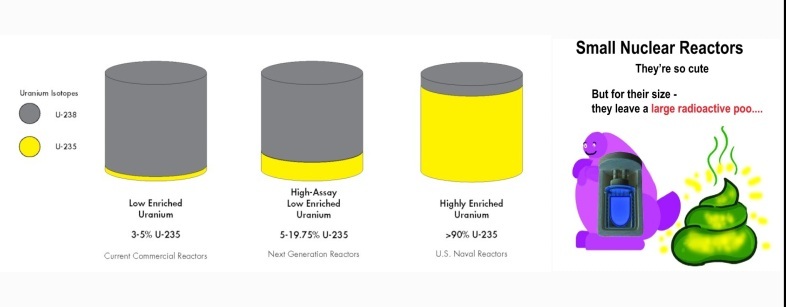
They don’t need as much, or perhaps ANY dirty uranium mining. Ain’t that great? Well some designs (eg, the Westinghouse evinci micro reactor) do use low-enriched uranium (LEU) which contains less than 20% of uranium-235 (U-235). Such LEU SMRs have a shorter expected life, and because of their graphite content have a high volume of wastes. So now the emphasis is on a new kind of fuel – high-assay low-enriched uranium (HALEU): 5–20% U-235 and/or plutonium.
For a non-physicist such as myself, trying to navigate the labyrinth of information on nuclear fuels is a daunting task. And I’m sure that the nuclear lobby intends to keep it that way. They’ve traded for decades on the principle that the great unwashed cannot and should not understand nuclear power, and that only nuclear physicists are qualified to have an opinion on this. (No wonder they vilified Dr Helen Caldicott, who described nuclear power as “an expensive way to boil water”).
What makes it all more complicated is the variety of SMR designs, and of the fuel types now being planned, generally to use the HALEU or mixed uranium-plutonium. This means that the SMR company has to get these advanced fuels from somewhere more special than the conventional uranium fuel train. But who supplies the world’s highly enriched uranium? Omigawd – it’s Russia! So that fact has caused a bit of a panic. The U.S, government’s Department of Energy has now selected 11 advanced reactor designs under its Reactor Pilot Program, most of them to. run on HALEU. As Peter McKillop of the Energy Mix says:
“… here lies the problem. By embracing HALEU, the DOE is effectively jump‑starting an international HALEU market and expanding the global circulation of material that can shorten the path to a bomb.”
The required plutonium has to come from recycling the spent nuclear fuel from large nuclear reactors. Of course the nuke lobby boasts that this solves the nuclear waste problem – what was previously called “trash” now becomes a “resource” and a nuclear waste solution. More about that later on.
The fuel needs of SMRs raise not only the weapons proliferation problem: they bring the risks of radiation-releasing accidents, theft, terrorism, and consequently the need for extra security and extra costs.
What about the radioactive wastes?
The nuclear lobby is rather coy on this subject. When their propagandists are talking to us, the great unwashed, they tell a comforting and optimistic story. You see, SMRs produce a very small volume of radioactive wastes, and even that can be recycled to be used again, leaving an even smaller volume. So SMRs are not only themselves clean, but they are a benefit to humanity, solving the existing nuclear waste problem.
SMR propagandists don’t bother our poor little heads with the technical details. That’s because the technical details tell quite a different story. Stanford-led research finds small modular reactors will exacerbate challengesof highly radioactive nuclear waste. Proceedings of the National Academy of Sciences “Our results show that most small modular reactor designs will actually increase the volume of nuclear waste in need of management and disposal, by factors of 2 to 30.
SMRs will produce more voluminous and chemically/physically reactive waste than LWRs, which will impact options for the management and disposal of this waste. The very high toxicity of these wastes mean that the spent fuel pellets will require a larger area in deep disposal than those from conventional reactors. SMR waste streams will bear significant (radio)chemical differences from those of existing reactors. “Molten salt and sodium-cooled SMRs will use highly corrosive and pyrophoric fuels and coolants that, following irradiation, will become highly radioactive.”
No wonder the current push for SMRs does not emphasise that fraudulent story about wastes. For ordinary people it is probably the really ugliest and most off-putting aspect of any presentation of the wonders of small modular nuclear reactors.
No comments yet.
1 This Month
26 September – International Day for the Total Elimination of Nuclear Weapons





PLEASE OPPOSE HR 8255 AND S.3639 – bills would accelerate satellite deployment, with no environmental review or safeguards – https://ncstd5li.quorum.us/campaign/169331/
To see nuclear-related stories in greater depth and intensity – go to https://nuclearinformation.wordpress.com
-
Archives
- September 2026 (313)
- August 2026 (330)
- July 2026 (355)
- June 2026 (287)
- May 2026 (306)
- April 2026 (356)
- March 2026 (251)
- February 2026 (267)
- January 2026 (308)
- December 2025 (358)
- November 2025 (359)
- October 2025 (375)
-
Categories
- 1
- 1 NUCLEAR ISSUES
- business and costs
- climate change
- culture and arts
- ENERGY
- environment
- health
- history
- indigenous issues
- Legal
- marketing of nuclear
- media
- opposition to nuclear
- PERSONAL STORIES
- politics
- politics international
- Religion and ethics
- safety
- secrets,lies and civil liberties
- spinbuster
- technology
- Uranium
- wastes
- weapons and war
- Women
- 2 WORLD
- ACTION
- AFRICA
- Atrocities
- AUSTRALIA
- Christina's notes
- Christina's themes
- culture and arts
- Events
- Fuk 2022
- Fuk 2023
- Fukushima 2017
- Fukushima 2018
- fukushima 2019
- Fukushima 2020
- Fukushima 2021
- general
- global warming
- Humour (God we need it)
- Nuclear
- RARE EARTHS
- Reference
- resources – print
- Resources -audiovicual
- Weekly Newsletter
- World
- World Nuclear
- YouTube
-
RSS
Entries RSS
Comments RSS


Leave a comment