A Kansas Town Is Split Over Plans to Bury a Nuclear Reactor a Mile Underground.
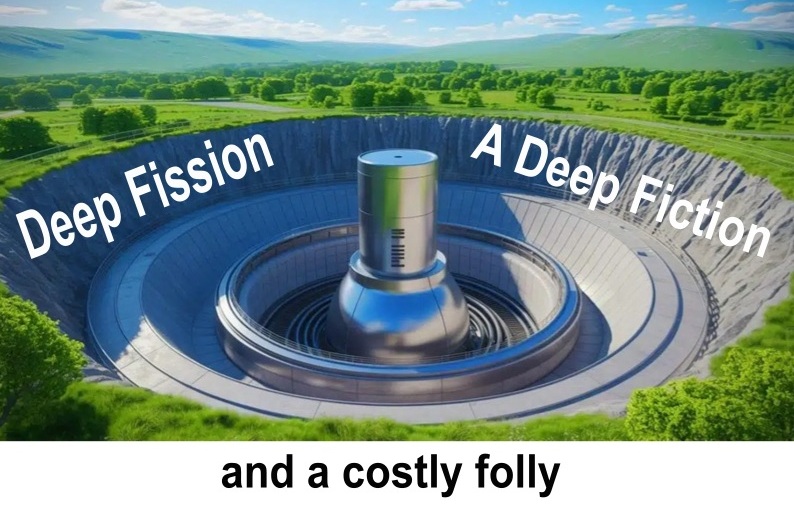
“This is a nuclear experiment,” Reynolds said. She questions how the company will perform maintenance so far underground, why drillers are operating under oil-and-gas regulations rather than nuclear-specific rules, and what happens to the site if Deep Fission goes out of business.
026-07-30, https://finance.biggo.com/news/1fb78f6c-786f-4381-be62-937bfa684157
Deep Fission, a California startup, plans to operate the first commercial nuclear reactor a mile underground in Parsons, Kansas, by 2027 or 2028. The project has raised $150 million and is part of a DOE pilot program to fast-track advanced reactors amid surging AI-driven electricity demand. The company says deep burial eliminates the need for costly containment buildings, with each 15-megawatt reactor powering 12,000 homes. However, the plan has sharply divided the town of 9,600. Opponents, including local group Prairie Dog Alliance and watchdog Beyond Nuclear, warn of environmental risks and insufficient oversight, while supporters view it as a vital economic spark for the struggling rural community. The project faces regulatory hurdles and broader questions about nuclear waste storage underground.
An ambitious plan to bury a commercial nuclear reactor a mile beneath a small Kansas town is pitting residents who see a coming economic renaissance against those who fear their community is being turned into a testing ground for an unproven experiment. The project, spearheaded by a California startup founded by a father-daughter team, would be the first time a commercial reactor has ever been operated so far underground.
Deep Fission, the company behind the so-called Gravity Reactor, has already drilled one test hole on the outskirts of Parsons—a rural community of 9,600 people roughly midway between Kansas City and Tulsa, Oklahoma. The firm, founded by Chief Executive Liz Muller and her father Richard Muller, an emeritus professor of physics at University of California, Berkeley, has raised roughly $150 million in the past year, with $40 million of that earmarked for the Parsons work. The startup plans to send a canister loaded with nuclear fuel into a third borehole to heat water deep underground and generate electricity on the surface as early as 2027 or 2028, a timeline that is remarkably short by industry standards.
“It’s allowing us to develop a first reactor within a time frame that had been unthinkable previously,” Liz Muller told The Wall Street Journal.
The reactor design relies on well-established pressurized water technology, but its innovation lies in its location. By operating a mile underground, Deep Fission argues it can eliminate some of the most expensive components of conventional nuclear plants. The immense pressure from rock and water at that depth would replace costly safety structures like massive containment buildings and complex cooling systems. Each reactor would generate 15 megawatts of electricity from inside a 30-inch borehole, enough to power roughly 12,000 homes. However, Muller’s long-term vision is far larger: an array of 100 or more reactors providing over a gigawatt of power, enough to supply a major data center.
Federal push meets local pushback
The Parsons project is one of 11 in a U.S. Department of Energy (DOE) pilot program designed to accelerate the development and testing of small, advanced reactors. Participating companies can fast-track environmental review procedures and construct reactors outside of traditional national laboratory settings. The initiative is part of a broader push by the Trump administration to spur a “nuclear renaissance,” aiming to quadruple America’s nuclear-power generation by 2050 amid skyrocketing electricity demand driven largely by data centers for artificial intelligence.
But the expedited process has drawn sharp criticism from nuclear watchdogs and local advocacy groups. Earlier this year, a coalition of state attorneys general challenged the DOE’s new categorical exclusion for advanced nuclear reactors, arguing it bypasses rigorous environmental review and weakens public safety protections.
“It’s simply unacceptable to even consider exempting Deep Fission from a peer-reviewed environmental impact statement on the generation of high-level nuclear waste under Parsons,” said Paul Gunter of Beyond Nuclear, a group that opposes nuclear power and weapons.
The Energy Department has stated that the administration remains focused on safety and security.
In Parsons, the divide is stark. When Deep Fission broke ground in December at the Great Plains Industrial Park, a decommissioned U.S. Army ammunition base, many residents were caught off guard by the lack of public discussion. Marjorie Reynolds, a pediatric nurse and seventh-generation Kansan, quickly formed a nonprofit called the Prairie Dog Alliance to oppose the project. Its logo features a prairie dog inside a black-and-yellow nuclear symbol.
“This is a nuclear experiment,” Reynolds said. She questions how the company will perform maintenance so far underground, why drillers are operating under oil-and-gas regulations rather than nuclear-specific rules, and what happens to the site if Deep Fission goes out of business.
Jerel Johnson, an IT professional who had planned to retire in Parsons, voiced a similar frustration. “I put $125,000 into my house, and now a nuclear reactor is coming to town. I can’t think of a worse idea.”
Liz Muller has pushed back against the environmental concerns, stating that the reactor is far too deep to affect underground aquifers and that the company will follow all nuclear and oil-and-gas regulations. Because the reactors are expected to last six to seven years with few moving parts, she added, the likelihood of requiring maintenance is low. “We have simplified our reactor quite extensively,” she said. The company also plans to open a local office where residents can ask questions, emphasizing that the project “needs to be done in partnership with the community.”
Economic hopes in a struggling farm town
For others in Parsons, a 19th-century boomtown that has long sought a new economic spark, the potential payoff is worth the risk. The town was once home to one of the largest rail yards west of the Mississippi, but recent victories have been small—attracting a Taco Bell or saving a local furniture store.
Verlyn Bolinger, an insurance agent and city commissioner whose great-great-grandfather also served on the commission, captured the conflicted mood. “Any time you’re putting a nuclear reactor in a hole, it’s kind of scary,” he said. “It’s great that it’s here. It’s kind of bad that we’re the guinea pigs.”
Robert Spinks, Parsons’ police chief, is more optimistic. He views the reactor as a potential catalyst that could draw manufacturers and data centers to the region. “It’s a proven technology, just in a new application,” Spinks said. “And if that is a trigger which draws in other manufacturing and brings in living-wage jobs, I think that’s a win.”
Wayne Gilmore, an optometrist who owns the local radio station, echoed that sentiment, arguing that rural communities cannot build their futures by rejecting new technology before it is fully evaluated.
Deep Fission’s plan to store spent nuclear fuel underground is also drawing scrutiny. The company says it could eventually seal the waste in place or move it to another site. Liz Muller and her father previously founded Deep Isolation, a firm that designs underground disposal systems for nuclear waste. Still, the Nuclear Regulatory Commission will need to approve any commercial licensing before electricity from the reactor can be sold. Dozens of companies are designing smaller reactors, but none yet operate commercially in the United States, and Deep Fission must still prove it can meet its aggressive timelines and contain costs in an industry notorious for overruns.
No comments yet.
1 This Month
23-25 October – on Zoom – World BEYOND War’s annual global conferenc


Shut down the radiation-damaged Heysham nuclear reactors now
To see nuclear-related stories in greater depth and intensity – go to https://nuclearinformation.wordpress.com

Say No to NASA’s Reckless Nuclear Reactor on the Moon
Say No to NASA’s Reckless Nuclear Reactor on the Moon

-
Archives
- October 2026 (219)
- September 2026 (339)
- August 2026 (330)
- July 2026 (355)
- June 2026 (287)
- May 2026 (306)
- April 2026 (356)
- March 2026 (251)
- February 2026 (267)
- January 2026 (308)
- December 2025 (358)
- November 2025 (359)
-
Categories
- 1
- 1 NUCLEAR ISSUES
- business and costs
- climate change
- culture and arts
- ENERGY
- environment
- health
- history
- indigenous issues
- Legal
- marketing of nuclear
- media
- opposition to nuclear
- PERSONAL STORIES
- politics
- politics international
- Religion and ethics
- safety
- secrets,lies and civil liberties
- spinbuster
- technology
- Uranium
- wastes
- weapons and war
- Women
- 2 WORLD
- ACTION
- AFRICA
- Atrocities
- AUSTRALIA
- Christina's notes
- Christina's themes
- culture and arts
- Events
- Fuk 2022
- Fuk 2023
- Fukushima 2017
- Fukushima 2018
- fukushima 2019
- Fukushima 2020
- Fukushima 2021
- general
- global warming
- Humour (God we need it)
- Nuclear
- RARE EARTHS
- Reference
- resources – print
- Resources -audiovicual
- Weekly Newsletter
- World
- World Nuclear
- YouTube
-
RSS
Entries RSS
Comments RSS


Leave a Reply