Liberal and PC parties in Ontario have expensive expansive nuclear power plans

 Anti-nuclear advocates, Federal Court trouble Ontario Liberal and PC energy plans rabble.ca BY STEVE CORNWELLMAY 30, 2014 “……..the court’s decision does seem to enhance the credibility of the Ontario New Democrats’ (ONDP) energy platform, while troubling those of the Liberals and Conservatives.
Dating back to Howard Hampton’s leadership, the ONDP has remained opposed to building new reactors in Ontario. The ONDP’s election platform highlights a pledge for a solar panel and energy efficiency fund to help homeowners produce clean electricity and consume less power.
In response to a recent Ontario Clean Air Alliance questionnaire, the ONDP was very critical of the Liberals’ plan to rebuild nuclear units in the province. The ONDP indicated that they would support cost-effective conservation and efficiency measures before spending tax and rate-payer dollars on rebuilding reactors.
They added, “hundreds of millions of dollars have been wasted through the cancellation of gas and nuclear plants…Signing contracts for nuclear refurbishment without knowing the final price tag or seeing the business case will only push costs even higher for consumers. That’s just not acceptable.”
Both the Liberals and PCs have placed nuclear expansion and or revitalization as large tenants of their projected energy plans.
The Liberal spokesperson interviewed for this piece condemned the PCs plan, saying “Tim Hudak wants to build $15 billion worth of new nuclear we don’t need and cancel existing clean energy contracts, putting ratepayers on the hook for up to $20 billion.”
While Liberals did not include new nuclear in their Long Term Energy Plan, Energy Minister Bob Chiarelli also suggested that “sometime in the future, we might be looking at it.”
Lefty voters being wooed by the latest Liberal attempt to position themselves as the more progressive and reasonable choice to slay the Conservatives should note that the Grits and PCs are mostly identical on nuclear power.
In addition to both the PCs and Liberals openness to spending billions and testing the risks of new nuclear in the province, each party’s energy stance includes a commitment to rebuilding existing reactors at Darlington and Bruce Stations.
Following the ruling striping approval of new reactors at Darlington, a decision Greenpeace’s Stensil called “a firewall from a really bad political decision,” he wants the debate during the rest of the election to focus on plans to rebuild existing nuclear units. “I’d hope that it allows us to focus on the current plan to spend billions of dollars rebuilding Ontario’s ten remaining reactors.”
Plans to rebuild reactors at Darlington have already passed through an expedited assessment.
Cost analyses on rebuilding the reactors vary wildly, but if the difficulties of refurbishing units in Pickering and other Canadian jurisdictions are any indication, Ontarians might be in for some pocketbook punishment if the Liberal or PCs implement their plans.
“The Liberal government has given the ok to rebuild reactors at the Darlington and Bruce nuclear stations without a cost estimate or a public review. The gas plant scandal has gotten lots of attention since the last election, but it’ll end up being small change compared to the nuclear fiascos coming our way.”
Steve Cornwell is an MA candidate at York University. He is interested in the interactions of social movements, science and technology. Steve has worked on energy issues with Greenpeace Canada, Environmental Defense, and Safe and Green Energy Peterborough. Follow Steve Cornwell on Twitter @steve_cornwell http://rabble.ca/news/2014/05/anti-nuclear-advocates-federal-court-trouble-ontario-liberal-and-pc-energy-plans
Urge Obama to support his NRC chair, appoint strong safety advocates to NRC.
 The Nuclear Regulatory Commission has again sided with the nuclear power industry (where have you heard that one before?) and rejected efforts by environmental/clean energy groups and five U.S. Senators to move high-level
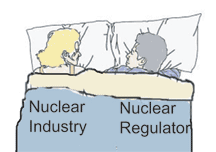 radioactive waste out of overcrowded, dangerous and poorly-protected fuel pools as soon as it is cool enough to be placed in dry casks.
Not only did the NRC Commissioners take this unconscionable vote, they said this was their last word on the subject and they would refuse to ever again consider the issue.
But the vote wasn’t unanimous: NRC Chair Allison Macfarlane, who has spent her career studying radioactive waste issues, issued a strong dissent to the decision, essentially arguing that the NRC staff hasn’t done its homework.
Japan about to extract the teeth from its Nuclear safety Watchdog?
 The government should not be allowed to make the nuclear watchdog toothless by nominating experts who are convenient to it and the industry.
EDITORIAL: Nuclear watchdog must not be made toothless –The Asahi Shimbun, May 29 Prime Minister Shinzo Abe has a habit of trying to promote policy changes through political appointments. His administration seems to have employed this political ploy to achieve its goals in the area of nuclear safety inspections.
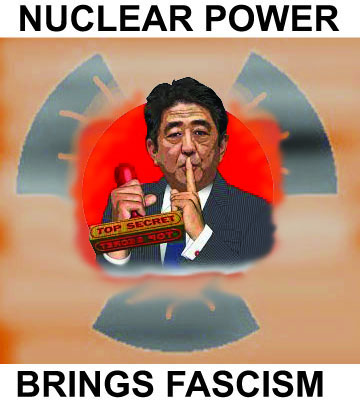
This is the only possible way to put proposed replacements for two outgoing commissioners of the Nuclear Regulation Authority (NRA) into perspective. Continue reading
Japan’s Abe govt determined to bring back nuclear, but the impediments are strong
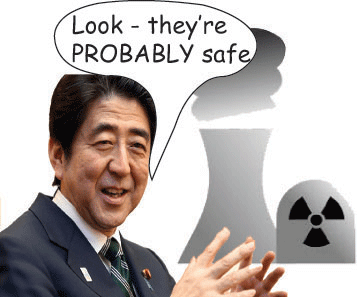 Abe and Kepco Push Nuclear Restart The government and nuclear companies maneuver to restart Japan’s reactors, as nearby cities dig in. The Diplomat, By Clint Richards May 29, 2014 As The Diplomat noted last week, Japan’s nuclear energy providers are struggling to remain profitable with all the country’s nuclear reactors currently offline. The government is highly aware of its struggling nuclear power sector, and the threat of another summer where Japan’s energy grid is stretched to the limit, and energy imports soar. With both of these problems in mind, three news items highlight the direction both the government and nuclear companies may take to avoid another summer energy crunch.
The Fukui District Court ruling would allow people living within 250 km of the plant the right to sue to have the plant closed. According to a separate Japan Times article, “The entire Kansai region, most of Chubu, including Nagoya, much of Chugoku, including Hiroshima, and roughly a third of Shikoku lies within 250 km of the Oi plant.”
Despite strong local opposition, Abe’s government is determined to bring back online as many nuclear reactors as logistically possible. On Wednesday, an NRA official told AFP that Abe’s government wants to replace two of five commissioners serving on the NRA when their terms expire. One of the commissioners Abe reportedly most wants to replace is Kunihiko Shimizu, who has been criticized for saying that at least two reactors sit on active fault lines………
Local governments and their constituencies are determined to keep the tragedy of Fukushima as far from their own doorstep as possible. The inability of Tepco to adequately address the continued problems at the Daiichi power plant only further reinforces the fear of people who live near existing reactors. Despite Abe’s insistence, local populations are likely to keep the number of reactors that come back online much lower than the government wants, at least in the near future, as long as the central government and energy providers give them veto power. http://thediplomat.com/2014/05/abe-and-kepco-push-nuclear-restart/
With new Indian government a slowdown in nuclear power expansion looks likely
 Narendra Modi government may go slow on nuclear energy expansion: PwC, The Economic Times, May 27, 2014, MUMBAI: The new government may put on the back-burner a plan to install 20 gigawatts of nuclear power capacity in the country by 2020 and instead focus on wind and solar to achieve energy security, says PwC……….
Rather than nuclear, the Modi government may focus on increasing wind and solar power capacity, especially when these models worked successfully in Gujarat, Mohapatra said.
The power, coal, and new and renewable energy portfolios in the Modi Cabinet are held by Piyush Goyal, who is from Maharashtra, where BJP ally Shiv Sena was opposing the 9,900 MW Jaitapur nuclear project……..An industry expert from KPMG, who did not want to be identified, said that before the new government takes any decision on nuclear power, it will first have to tackle issues of supply chain, safety and acceptance from locals. http://articles.economictimes.indiatimes.com/2014-05-27/news/50122504_1_energy-security-power-capacity-nuclear-power
Pro nuclear expert replaces safety conscious seismic expert on Japan’s Nuclear Safety Agency
Pro-nuclear expert replacing NRA commissioner who raised flag on quake risk THE ASAHI SHIMBUN 29 May 14, http://ajw.asahi.com/article/behind_news/politics/AJ201405280023 Replacements for two outgoing commissioners of the Nuclear Regulation Authority suggest the Abe administration will find it easier to gain approval for restarts of the nation’s nuclear reactors.Few people in government circles and the nuclear industry will be sorry to see Kunihiko Shimazaki go. His successor is expected to more quickly give the green light to reactivate nuclear power plants.
Shimazaki, who is 68 and a professor of seismology, proved to be a thorn in the side of electric power companies with his calls for a reassessment of the force with which seismic waves and tsunami could pummel nuclear plants being considered for restarts. Kenzo Oshima, 71, a former undersecretary-general at the United Nations, is also stepping down. Both men are leaving because their terms expire in September.
USA Congress Bill to take money from nuclear weapons, and to care of veterans
House Bill Would Tap Into Nuclear Weapons Fund to Aid Veterans National Journal, By Douglas P. Guarino 23 May 14 The version of the fiscal 2015 defense authorization bill that the House approved Thursday would cut some controversial nuclear weapons spending in a bid to help veterans. Continue reading
Problems in nuclear reactor decommissioning thrashed out in US Senate hearing
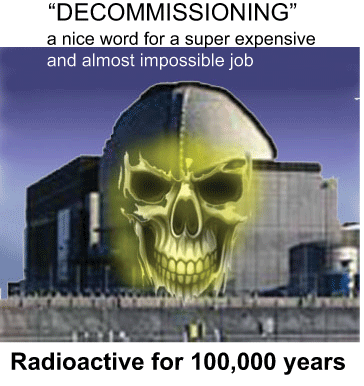 Senate Hearing on Nuclear Reactor Decommissioning Challenges Energy Collective May 22, 2014 Bemnet Alemayehu, Project Scientist, Nuclear Program, Washington, D.C.
U.S. Senator Barbara Boxer’s Environment & Public Works Committee held a hearing on Wednesday, May 14th, 2014 to assess the challenges of nuclear reactor decommissioning nationwide. Panelists called to testify at Wednesday’s senate hearing included Christopher Recchia, Public Service Department Commissioner of Vermont, Geoffrey Fettus, Senior attorney of NRDC, Donald Mosier, Council Member of the City of Del Mar, Michael Weber, Deputy Executive Director for Compliance Programs of NRC and Marvin Fertel, President & Chief Executive Officer of NEI.
Christopher Recchia’s testimony to the senate opposed a request by operators of the Vermont Yankee nuclear power plant to discontinue off-site emergency planning after the reactor shuts down. He argued that the off-site emergency planning should continue after the reactor shuts down until all of the plant’s spent fuel rods are removed from pools and placed in dry cask storage. ……… Continue reading
Politicians oppose nuclear power in seismic zone in India
Left parties turns up heat on Kovvada nuclear plant, The Hindu NATIONAL » ANDHRA PRADESH SRIKAKULAM, May 23, 2014 Setting up the plant in seismic zone a threat to people, they say. CITU leader D. Govinda Rao said that workers, residents of Ranasthalam would launch massive agitations soon to oppose the construction activity in Kovvada.
The Left parties have turned the heat on the construction of a nuclear power project in Kovvada of Ranasthalam mandal again after mild tremor rattles the district on Wednesday saying that the project site comes under highly seismic zone and it would be dangerous for the people.
 Representatives of the Left Parties have asked the government to reconsider its decision over the establishment of the nuclear plant in the district. Senior CPI (M) leader V.G.K. Murthy said that the government should clarify over the dangers posed with the setting up the nuclear plant in a seismic zone. “The Nuclear Power Corporation of India officials always say that adequate precautions would be taken up to avoid disasters during natural calamities. We feel that such disasters can’t be avoided even in highly advanced countries. So, the government should come up with scientific data to clear the doubts of people,” he added.
CITU leader D. Govinda Rao said that workers, residents of Ranasthalam would launch massive agitations soon to oppose the construction activity in Kovvada. He said that several nuclear experts including Surendra Gadekar had already expressed doubts over the safety of the project. Mr. Surendra Gadekar on Sunday cautioned that Srikakulam town would be affected badly with the establishment of nuclear power plant at Kovvada, which is 35 km away from the district headquarters.
According him, Srikakulam, which is very close to Kovvada, would face radiation problem with the establishment of the nuclear power plant with an installed capacity of 10,000 Megawatts…..http://www.thehindu.com/news/national/andhra-pradesh/left-parties-turns-up-heat-on-kovvada-nuclear-plant/article6037482.ece
Environmental law puts a stumbling block in front of nuclear power for Poland
Poland’s nuclear energy programme stumbles again: Has PGE lost control of its sub-contractors? Greenpeace, Jan Haverkamp – May 22, 2014 In late February, during one of our regular strolls through the Lubiatowo dunes where the Polish government and the utility PGE are planning to build 3,000 MW of nuclear capacity, we found something peculiar. Bright orange sticks – exactly on the locations where the PGE subcontractor, Worley Parsons, wants to drill 20- to 200-meter-deep holes for their site assessment. Such drilling directly next to two Natura2000 areas, in a unique dune landscape with wet valleys, could easily cause irreversible damage to this home of red deer, white-tailed and lesser spotted eagles. The EU Habitat Directive and the Aarhus Convention do not leave much space for interpretation: when irreversible damage to Natura2000 sites is possible, an environmental impact assessment has to be made with full public participation.
Taiwan’s nuclear dilemma – a return to authoritarian past?
 Taiwan’s Nuclear Future and Authoritarian Past The intense debate in Taiwan over nuclear power has echoes of a less democratic past. The Diplomat, By Brent Crane May 21, 2014 Last August, chaos erupted in Taiwanese parliament. Opposing lawmakers thrust hard-clenched fists at one another while fervent activists tossed opened water-bottles from the stands like Molotov cocktails. Politicians and otherwise civilized men wrestled like teenage boys on the floor amid shouts, screams and camera flashes.
The Legislative Yuan had initially assembled to discuss the conditions of a national referendum deciding the fate of Taiwan’s fourth nuclear power plant in Gongliao, New Taipei City. The controversial plant, known ominously throughout the country as Nuke 4, remains a rallying cry for opponents of one of Taiwan’s most charged political subjects: nuclear power. The debate has been energized in recent weeks after former opposition party leader and staunch nuclear energy opponent Lin Yi-hsiung went on hunger-strike in protest of the government’s unwillingness to make concessions with Taiwan’s antinuclear lobby. On the surface, the conflict appears rather black-and-white: it’s the safety-conscious, environmentalists and academics versus the pragmatic economists and government bureaucrats. But the nuclear power debate in Taiwan is about much more than just safety and economics. It’s about reconciling Taiwan’s autocratic past with its democratic present……….
On the Taiwanese political front today, only reunification is as hotly debated as nuclear energy. The antinuclear camp, which polls suggest finds support from up to 70 percent of the 23 million Taiwanese, advocates full denuclearization of the island. Simply put, their biggest beef with nuclear power in Taiwan is that it poses too great a safety risk. The disaster at Japan’s Fukushima Daiichi Nuclear Power Plant in 2011 represents the type of nightmare scenario that antinuclear activists conjure up when they denounce the energy source. After all, Taiwan is highly prone to typhoons, tsunamis and earthquakes. In late September 1999, for instance, a 7.9 magnitude earthquake killed 2,415 people in central Taiwan, injuring more then 11,000. Last September, Typhoon Usagi left Taiwan with 35 dead and with more than $4.33 billion in damages. The list goes on. And Taiwan’s compact size ensures that any plant destruction or malfunction on the scale of the Fukushima fiasco would be disastrous for the island, whose densely packed urban centers are never too far from any of the country’s four plants.
Yet despite the risks, the ruling KMT party remains firmly pro-nuclear, and has proven resilient in weathering the antinuclear storm. ……In true Jeffersonian fashion, the electorate, though hollering at an often unresponsive government, are demanding that their voices be heard. And with the ebb and flow of the youth-led Sunflower Movement, a government accountability project akin to Occupy Wall Street, Taiwan’s political atmosphere has been particularly energized lately………
Opposition to Nuke 4 has galvanized tens of thousands of Taiwanese to hold demonstrations throughout the country in recent years. Clearly, the anti-nuclear camp is no longer a fringe element. On the contrary, opposition to nuclear power has become a household inclination, with some studies showing 55 percent to 70 percent of the population anti-nuclear………
Of course, shifting an entire country from autocracy to democracy is no easy task. But Taiwan’s nuclear energy debate is a reminder that its transition isn’t yet wholly complete. http://thediplomat.com/2014/05/taiwans-nuclear-future-and-authoritarian-past/
NextGen Climate, – a progressive, pro-environment counterbalance to the wealthy oil and gas industry
 Green billionaire prepares to attack ‘anti-science’ Republicans By Peter Hamby, CNN National Political Reporter May 22, 2014 Washington An environmental advocacy group backed by hedge fund tycoon Tom Steyer is set to unleash a seven-state, $100 million offensive against Republican “science deniers” this year, a no-holds-barred campaign-style push from the green billionaire that could help decide which party controls the Senate and key statehouses come November.
The Steyer-backed outside group, NextGen Climate, has billed itself as a progressive, pro-environment counterbalance to the wealthy oil and gas industry — as well as the primary foil to the pro-business Koch brothers and their well-funded conservative donor network.
The outfit, launched last year by the San Francisco billionaire, has already pledged to spend heavily this midterm year in Iowa to assist the Democratic Senate nominee Bruce Braley, and in Florida, where Gov. Rick Scott is facing a difficult re-election fight against Democrat Charlie Crist……….
GOP candidates in the NextGen cross hairs — Scott in Florida, Terri Lynn Land in Michigan, Scott Brown in New Hampshire and Cory Gardner in Colorado — hew closely to the “Republican troglodyte brand,” Lehane argued.
“They are anti-immigrant, anti-women, anti-science,” he said. “It’s a tough brand to win elections around.”
The group said that climate can be successfully used as a wedge issue — Lehane framed it as a moral clash between “right and wrong” — to boost turnout among Democratic voting groups that tend not to show up in midterm election years, specifically young voters, Hispanics and African-Americans……….
he primary difference between Steyer and conservative mega-donors, Lehane said, is that Steyer is not personally profiting from his political efforts. “He is giving all the money away,” he said. “He doesn’t have stand to gain some economic benefit by spending money that translates into his own personal economics.”
Lehane added, “We are spending a drop in the big oil bucket as compared to the fossil fuel industry, especially the Koch brothers. All Tom is trying to do is try to balance and level the playing field. We are never going to have as much money as the other side.” http://edition.cnn.com/2014/05/22/politics/steyer-climate-change-campaign/
German government will not pay costs of burying dead reactors
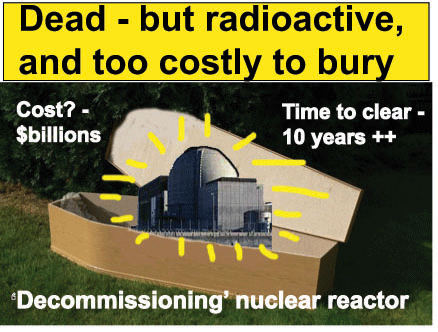 Germany’s Gabriel says state won’t pay for nuclear decommissioning http://uk.reuters.com/article/2014/05/18/uk-germany-energy-nuclear-idUKKBN0DY0EM20140518 BERLIN Sun May 18, (Reuters) – Germany‘s economy minister has joined Angela Merkel in rejecting talk that utilities might hand over responsibility for decommissioning Germany’s nuclear powerplants to a new public entity, as the projected costs of decommissioning rise.
“It should not be tax payers who pay for the clean-up of atomic waste but rather those who made money for decades through running nuclear power stations,” Sigmar Gabriel told the newspaper Bild am Sonntag in an interview published on Sunday.
Two sources told Reuters last weekend that utilities were in talks with the government about setting up a “bad bank” for nuclear plants, in response to Chancellor Angela Merkel’s decision to close them all by 2022 after the Fukushima disaster.
The foundation would use provisions earmarked by the nuclear plant operators but would also take on the risk of unforeseen extra costs, effectively capping the utilities’ liability.
The Environment Ministry said last week the utilities bore full responsibility for safely decommissioning and dismantling the nine nuclear power plants still on the grid.
One of the sources had told Reuters that if the state takes over responsibility for the decommissioning, the utilities might be willing to drop their legal claims against the government for compensation for having to shut the plants. The four operators of nuclear plants in Germany – the German companies E.ON (EONGn.DE), RWE (RWEG.DE) and EnBW (EBKG.DE) and Sweden’s Vattenfall VATN.UL – have set aside total provisions of around 36 billion euros (29.3 billion pounds) for dismantling the plants and disposing of nuclear waste.
Germany’s Spiegel magazine reported on Sunday that government experts predicted a possible shortfall of 3.5 billion euros for the clean up, as costs had risen sharply. (Reporting by Alexandra Hudson; Editing by Larry King)
Nigeria to get nuclear power plant. Is this a GOOD idea?
Nigeria to get $6bn nuclear plant in 2022 – commission PUNCH, MAY 15, 2014 BY OLUSOLA FABIYI The Nigeria Atomic Energy Commission has revealed that the country will get a nuclear plant in 2022 at a cost of $6b dollars.
The Director, Human Resources of the commission, Professor Simon Mallam, who stated this on Thursday when he appeared before the national conference committee on Energy, also urged the Federal government to explore and develop all sources of energy available in the country…..Mallam further advised that although the country wasted a little time in the nuclear arena, it would still be able to deliver nuclear power by 2022 if the enabling environment and support could be given….http://www.punchng.com/news/nigeria-to-get-6bn-nuclear-plant-in-2022-commission/
Lawmakers press for stronger safety regulations for spent nuclear fuel rods
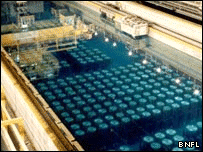 Bills would beef up safety regs for spent nuclear fuel http://thehill.com/regulation/205962-bills-would-beef-up-safety-regs-for-spent-nuclear-fuel By Benjamin Goad – 05/13/14 Lawmakers are pressing to bolster regulations for spent nuclear fuel, contending that pools left to languish for decades at decommissioning plants could prove disastrous in the event of an accident or terrorist attack.
Sens. Barbara Boxer (D-Calif.), Ed Markey (D-Mass.) and Bernie Sanders (I-Vt.) on Tuesday introduced a trio of bills meant to tighten safety and security at plants winding down operations around the country.
“Experts agree that a spent fuel pool accident could have consequences that are every bit as bad as an accident at an operating reactor,” Markey said.
Spent fuel can produce heat and radiation threats long after it is removed from a nuclear reactor’s electricity generating operation. Too dangerous to ship away from the plant altogether for as long as seven years, the spent fuel is left in pools at the plants.
A leak — whether due to accident or attack — could lead to fire and widespread contamination, the lawmakers said, citing various reports. Yet current Nuclear Regulatory Commission (NRC) rules allow for spent fuel to remain in the pools until the reactor completes decommissioning, which can take as long as 60 years, they said.
The Safe and Secure Decommissioning Act of 2014 would bar the NRC from exempting reactor licensees from any safety or security requirements at decommissioning plants until all fuel stored at the site is transferred into safer dry casks.
The lawmakers contend that the NRC has granted every exemption request it has ever received from decommissioning reactors, despite the agency’s own determination that an earthquake could result in a devastating breach. The Dry Cask Storage Act of 2014 is designed to force nuclear reactor operators to adhere to an NRC-approved plan for the transfer of spent fuel to dry cask storage within 7 years of the time the plant’s decommissioning plan is submitted.
Under the lawmakers’ Nuclear Plant Decommissioning Act of 2014, states and local communities would be guaranteed a meaningful role in the preparation of decommissioning plans for retired nuclear plants.
The legislation would require the NRC to publicly approve or reject every proposed decommissioning plan.
“Every state with a nuclear power plant has a strong interest in how that plant is decommissioned,” Sanders said. “This is about making sure that states and local communities can play a meaningful role in a decision.”
1 This Month
23-25 October – on Zoom – World BEYOND War’s annual global conferenc


Shut down the radiation-damaged Heysham nuclear reactors now
To see nuclear-related stories in greater depth and intensity – go to https://nuclearinformation.wordpress.com

Say No to NASA’s Reckless Nuclear Reactor on the Moon
Say No to NASA’s Reckless Nuclear Reactor on the Moon
-
Archives
- October 2026 (170)
- September 2026 (339)
- August 2026 (330)
- July 2026 (355)
- June 2026 (287)
- May 2026 (306)
- April 2026 (356)
- March 2026 (251)
- February 2026 (267)
- January 2026 (308)
- December 2025 (358)
- November 2025 (359)
-
Categories
- 1
- 1 NUCLEAR ISSUES
- business and costs
- climate change
- culture and arts
- ENERGY
- environment
- health
- history
- indigenous issues
- Legal
- marketing of nuclear
- media
- opposition to nuclear
- PERSONAL STORIES
- politics
- politics international
- Religion and ethics
- safety
- secrets,lies and civil liberties
- spinbuster
- technology
- Uranium
- wastes
- weapons and war
- Women
- 2 WORLD
- ACTION
- AFRICA
- Atrocities
- AUSTRALIA
- Christina's notes
- Christina's themes
- culture and arts
- Events
- Fuk 2022
- Fuk 2023
- Fukushima 2017
- Fukushima 2018
- fukushima 2019
- Fukushima 2020
- Fukushima 2021
- general
- global warming
- Humour (God we need it)
- Nuclear
- RARE EARTHS
- Reference
- resources – print
- Resources -audiovicual
- Weekly Newsletter
- World
- World Nuclear
- YouTube
-
RSS
Entries RSS
Comments RSS

