Michigan Senate unanimously rejects nuclear waste dumping near lake huron
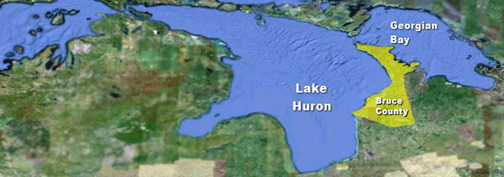 Michigan Senate unanimously passes legislation opposing Canadian nuclear waste dump June 13, 2014 By Jim Bloch Voice Reporter The Michigan Senate has unanimously passed a bill and a series of resolutions that effectively call for a halt to the nuclear waste dump proposed for Kincardine, Ontario, less than a mile from Lake Huron, about 100 miles north-northwest of Port Huron.
German government to stop giving credit guarantees for exports of nuclear equipment
 Germany says no more credit guarantees for nuclear exports BERLIN, June 12 (Reuters) – Germany’s government has decided to stop issuing credit guarantees for exports of equipment used for nuclear power generation because the risks to public safety are too great, the Economy Ministry said on Thursday.
The guarantees offer security to exporters and banks who do business in emerging markets where there is a risk of non-payment.
For years, critics have called for a halt to Germany’s so-called Hermes guarantees for nuclear exports, such as those used in atomic plants in Brazil. China and India also want new nuclear plants to help fulfil their energy needs.
“Germany has moved away from nuclear energy because it is linked to significant, uncontrollable risks. These risks exist in equal measure abroad,” Economy Minister Sigmar Gabriel said…….
Credit guarantees will continue to be available for the decommissioning or tearing-down of nuclear plants as well as for research. Guarantees already issued will not be affected. http://www.reuters.com/article/2014/06/12/germany-exports-nuclear-idUSL5N0OT41420140612
Pro nuclear commissioner to replace safety conscious one in Japan’s Nuclear Regulatory Agency
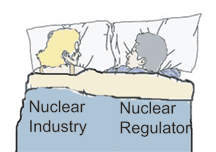 Independence of Japan’s nuclear regulator questioned after shakeup BY MARI SAITO AND KENTARO HAMADA TOKYO Tue Jun 10, 2014 (Reuters) – Japanese legislators approved a reshuffle at the nuclear safety regulator including appointing a commissioner who has received nearly $100,000 from nuclear-related entities over the past decade to fund his academic research.
Among the two commissioners stepping down from the five-member panel at the Nuclear Regulation Authority (NRA), one is a fierce critic of safety practices in the industry.
 Opponents said the changes, which were approved on Tuesday, undermined Prime Minister Shinzo Abe’s commitment to an independent watchdog at a time when utilities are pushing to restart their idled reactors.
The NRA’s independence is under scrutiny as it reviews applications to restart reactors, all 48 of which were shut in the wake of the 2011 Fukushima disaster…….Japan’s lower house of parliament, where Abe has a majority, approved his government’s nomination of Satoru Tanaka, a nuclear engineering professor at the University of Tokyo and a proponent of nuclear power……
“Bringing someone like (Tanaka) on as a regulator changes the fundamental role of the NRA,” said Tomoko Abe, an independent anti-nuclear lawmaker not related to the prime minister.
“This nomination could undermine the very role of the regulator.”……..
Eight months after Fukushima, Tanaka was one of the first experts to say it may be safe to consider atomic energy again, according to remarks he made to a government panel on energy.
Between the 2004 and 2010 fiscal years, Tanaka received 6 million yen ($58,500 at current exchange rates) for research from three firms according to disclosures made by Tokyo University in response to a public information request from Reuters: Electric Power Development Co Ltd, known as J-Power, which is building a nuclear plant in northern Japan; reactor maker Hitachi Ltd’s nuclear division; and Hitachi GE Nuclear Energy Ltd.
Japan’s Jiji news service said Tanaka also received around 3 million yen over five years to March 31, 2012 from the Tepco Memorial Foundation, an organisation set up by the predecessor company to Fukushima operator Tokyo Electric Power, or Tepco. A foundation spokesman said Tanaka had been paid for judging research grants but declined to give an amount…….
None of the original NRA commissioners received funds from a utility or nuclear plant operator for their research in the three years leading up to their appointment, according to disclosures made when the NRA was set up……
CRITICAL VOICE The NRA’s most critical voice, seismologist Kazuhiko Shimazaki, will retire in September after two years as its deputy, a period in which he angered the industry with safety demands that in one case effectively scuttled a reactor restart………
“The main objective of this shuffle is to remove commissioner Shimazaki,” said Tetsunari Iida, executive director of Japan’s Institute for Sustainable Energy Policies, an anti-nuclear group. “The industry would never be satisfied if he wasn’t replaced.”…….http://uk.reuters.com/article/2014/06/10/uk-japan-nuclear-regulator-idUKKBN0EL0K020140610
Birth and death of the Global Nuclear Energy Partnership
Failed Nuclear Weapons Recycling Program Could Put Us All in Danger io9, Mark Strauss, 7 June 14 “……..Thinking outside the MOX
When George W. Bush arrived in the White House, his administration had an ambitious plan to revive the nuclear power industry in the U.S. while limiting the proliferation of nuclear weapons abroad.
It was called the Global Nuclear Energy Partnership (GNEP). The plan envisioned an international nuclear cartel in which the United States and other fuel supplier nations—such as Russia, Britain, France, and Japan—would operate a fuel-leasing program. These supplier nations would provide fresh fuel to conventional nuclear plants in return for user nations agreeing to forego building their own fuel production facilities—which could also be used to make weapons-grade material.
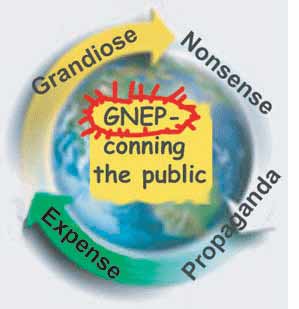
A central component of the GNEP proposal would be the construction of breeder reactors in the United States. Like the Russians, the Bush administration now wanted to use MOX as feedstock. The White House promised, however, that America’s breeder reactors would not produce plutonium that could be used for nukes. These reactors would use a new, super-awesome process to produce plutonium that could only be used as fuel. The process had been successfully tested on a laboratory scale, and the White House had confidence that it could be made to work in the real world. It just needed further development, at the cost of $1.06 billion.
Meanwhile, Russia—which the Bush administration envisioned as part of the GNEP cartel—was having second thoughts about its 2000 agreement with the United States. An investigative report published by the Center for Public Integrity describes what happened next:
………..Moscow wanted the Russian MOX plant, financed by Washington, to make fuel not for standard reactors, but for a full-scale breeder program…The Bush administration agreed— with little public notice— to let Russia renege on its original promise and burn its plutonium in two breeders—breeders that could produce more plutonium.
In November 2007, the U.S. and Russia signed a revised pact, which the Department of Energyextolled as “measurable progress towards disposing of a significant amount of weapon-grade plutonium in Russia.”
At around the same time, construction of the MOX facility began at the Savannah River Site.
And GNEP? An increasingly skeptical Congress cut its funding, especially after nuclear energy experts warned that the final price tag could climb as high as $100 billion. The program was declared dead in 2009…….. http://io9.com/failed-nuclear-weapons-recycling-program-could-put-us-a-1586851270
Big contributions to George W Bush and Rick Perry got WIPP nuke waste facility happening
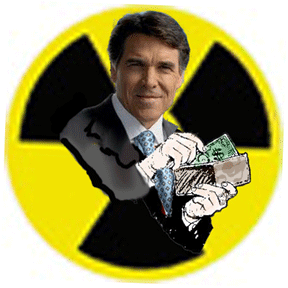 Breaking Bad: A Nuclear Waste Disaster By Joseph Trento, DC Bureau, June 5th, 2014″…….. Former President George W. Bush and Texas Governor Rick Perry’s single largest political contributor, the late Texas billionaire Harold C. Simmons, founded Waste Control Specialists and used his political influence to get the West Texas nuclear disposal site approved by state and federal licensing officials. The political efforts used to secure the licensing caused years of controversy in Texas. Environmentalists opposed the site because it is on an important aquifer in Texas. Another reason is that one of Simmons’s companies had operated a lead incinerator in Dallas that became an EPA Superfund Site.
Despite this environmental pedigree, LANL and DOE officials chose Waste Control Specialists to administrator their alternative nuclear waste storage site. While technically the company has licenses only for low-level nuclear waste, under its Texas permit, Waste Control can accept certified waste from federal agencies.
DOE officials said the Waste Control site is just a temporary alternative to the disabled WIPP. That is not true. Los Alamos and other national laboratories with high-level nuclear waste have been planning to use the Texas site for years, well before is licenses had been approved. The political promises that were made that it would be only for low-level waste were a ruse. As long as four years ago, during a Savannah River Site Citizens Advisory Board meeting in Aiken, South Carolina, DOE officials and SRS contractors talked openly about using the Texas site to offload uranium waste from SRS.
In late May, DOE investigators became so concerned about the Los Alamos containers being stores in what amounts to an open pit, they halted the shipments to Waste Control. The 112 canisters already at Waste Control were ordered to be isolated and surrounded by large concrete containers as well monitored by television camera. As of May 28, seventy-three Los Alamos containers have been segregated and covered with the cement and gravel-filled barriers.
Harold Simmons’s team lobbied hard to get only the second license in U.S. history from DOE for a private nuclear dump. They got the licensing in the last days of the Bush administration. Prior to the LANL decision to ship containers of transuranic waste to the site, there were warnings to Waste Control that it had already been accepting waste it was not permitted to receive.
Pressure has been building for years for DOE to stabilize and isolate its growing high-level nuclear waste stream. After the WIPP explosion, the DOE suddenly concluded that the thousands of feet below earth in salt beds were no longer needed to store the most deadly radioactive material on earth. Open trenches in the West Texas desert would be good enough. On April 2, tractor trailers hauled the first of the Los Alamos casks of radioactive high-level waste to the Andrews County dump before the WIPP investigation team succeeded in halting the shipments……”.http://www.dcbureau.org/201406059835/natural-resources-news-service/breaking-bad-nuclear-waste-disaster.html
Finland’s Green Party in government firmly against new nuclear power
 Greens meet to strategise, remain cold on new nuclear power, http://yle.fi/uutiset/greens_meet_to_strategise_remain_cold_on_new_nuclear_power/7284419 UUTISET, 6 June 14 Delegates from Finland’s Green League are gathered at an annual party congress in Jämsä, central Finland to hammer out a campaign platform ahead of parliamentary elections due next year. Green party chair Ville Niinistö said although the party wants to stay in governmen it’s holding its ground on its opposition to new nuclear power in Finland.
 One thing became clear from the start of this year’s three-day Green League party congress: the Greens want to stay in government. Green party chair and Environment Minister Ville Niinistö pointed to the party’s recent achievement in orchestrating government agreement on a proposal for climate change legislation.
However, the party is not prepared to give way on its opposition to new nuclear power facilities in Finland. It intends to hold fast to the current government programme, which stipulates that no new decisions-in-principle on nuclear energy should go before the parliament…….
The party has hinted that it is prepared to leave the government if a revised permit for the proposed Fennovoima nuclear power plant returns to parliament for consideration.
Niinistö added that nuclear power contractors are now experiencing great difficulties.
Nuclear power “not rational” for Finland
“The question is, at what stage will the parties admit their mistake, which is that holding on to nuclear power no matter what at the taxpayers’ expense isn’t rational for the Finnish economy, for our jobs, our business community, or for us to develop domestic forms of renewable energy,” Niinistö
Political donations got the Texas Waste Control site going
 Breaking Bad: A Nuclear Waste Disaster By Joseph Trento, DC Bureau, June 5th, 2014 “………Former President George W. Bush and Texas Governor Rick Perry’s single largest political contributor, the late Texas billionaire Harold C. Simmons, founded Waste Control Specialists and used his political influence to get the West Texas nuclear disposal site approved by state and federal licensing officials. The political efforts used to secure the licensing caused years of controversy in Texas. Environmentalists opposed the site because it is on an important aquifer in Texas. Another reason is that one of Simmons’s companies had operated a lead incinerator in Dallas that became an EPA Superfund Site.
Despite this environmental pedigree, LANL and DOE officials chose Waste Control Specialists to administrator their alternative nuclear waste storage site. While technically the company has licenses only for low-level nuclear waste, under its Texas permit, Waste Control can accept certified waste from federal agencies.
DOE officials said the Waste Control site is just a temporary alternative to the disabled WIPP. That is not true. Los Alamos and other national laboratories with high-level nuclear waste have been planning to use the Texas site for years, well before is licenses had been approved. The political promises that were made that it would be only for low-level waste were a ruse. As long as four years ago, during a Savannah River Site Citizens Advisory Board meeting in Aiken, South Carolina, DOE officials and SRS contractors talked openly about using the Texas site to offload uranium waste from SRS.
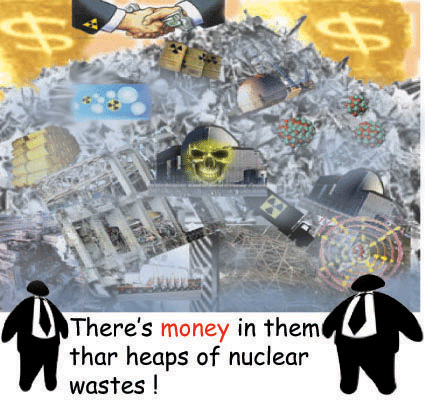
In late May, DOE investigators became so concerned about the Los Alamos containers being stores in what amounts to an open pit, they halted the shipments to Waste Control. The 112 canisters already at Waste Control were ordered to be isolated and surrounded by large concrete containers as well monitored by television camera. As of May 28, seventy-three Los Alamos containers have been segregated and covered with the cement and gravel-filled barriers.
Harold Simmons’s team lobbied hard to get only the second license in U.S. history from DOE for a private nuclear dump. They got the licensing in the last days of the Bush administration. Prior to the LANL decision to ship containers of transuranic waste to the site, there were warnings to Waste Control that it had already been accepting waste it was not permitted to receive.
Pressure has been building for years for DOE to stabilize and isolate its growing high-level nuclear waste stream. After the WIPP explosion, the DOE suddenly concluded that the thousands of feet below earth in salt beds were no longer needed to store the most deadly radioactive material on earth. Open trenches in the West Texas desert would be good enough. On April 2, tractor trailers hauled the first of the Los Alamos casks of radioactive high-level waste to the Andrews County dump before the WIPP investigation team succeeded in halting the shipments……….http://www.dcbureau.org/201406059835/natural-resources-news-service/breaking-bad-nuclear-waste-disaster.html
$1billion Liability Limit for Canada’s Nuclear Industry

 Canadian Nuclear Industry Accepts $1 Billion Liability Limit OTTAWA, June 5, 2014 /CNW/ – The Canadian nuclear industry told a parliamentary committee today that it accepts a proposed $1 billion liability limit for nuclear accidents.
“The $1 billion limit balances the nuclear industry’s operational needs and the public’s need for an effective liability regime,” Dr. John Barrett, the President and CEO of the Canadian Nuclear Association, told the Commons Standing Committee on Natural Resources.
The $1 billion limit would take effect if Bill C-22, the proposed Energy Safety and Security Act, becomes law. The bill would replace the 1976 Nuclear Liability Act (NLA) with a Nuclear Liability and Compensation Act, and ratify an international treaty providing additional coverage for foreign damage caused by Canadian nuclear operators…
….. the bill’s treaty provisions would enable industry members to operate in other countries, and increase the industry’s economic contributions to Canada…… f Parliament passes Bill C-22, the nuclear industry would encourage the government to increase the number of insurance companies eligible to provide nuclear liability insurance.
Bill C-22 would allow nuclear operators to provide insurance alternatives for up to 50 per cent of their liability. http://www.newswire.ca/en/story/1368049/canadian-nuclear-industry-accepts-1-billion-liability-limit
Clean Technica refutes the sales pitch of nuclear salesman Rod Adams
 Renewable Energy Growth Greater Than Nuclear Decline in Germany http://cleantechnica.com/2014/06/03/renewable-energy-growth-germany-nuclear-decline/ Energiewende Germany wrote this on Twitter:
Renewables have grown more than nuclear been shut down. Coal? In decline again.
Rod Adams, who tries to delay deployment of renewable energy since he rightly perceives it as dangerous competition to his preferred nuclear option, challenged that:
@EnergiewendeGER Do you have credible sources for that assertion?
This is a good occasion to have a new look at the figures. The renewable side of the statistics is best documented in this PDF published by Bernard Chabot at RenewablesInternational a couple of days ago, based on data released by the German Ministry of Economy in this report (in German language).
But first we need to get data for the nuclear decline, so as to find a suitable time frame for measuring the renewable growth.
The mid-term decline of nuclear in Germany is easily documented by looking at the figures released by Arbeitsgemeinschaft Energiebilanzen.
Nuclear peaked in 2001 at 171.3 TWh. It has been relatively stable for the five years until 2006, where it scored 167,4 TWh. From there on it’s a rapid decline. 148,8 TWh in 2008. 140,6 TWh in 2010. 108,0 TWh in 2011. 99,5 TWh in 2012. And 97,3 TWh in 2013.
That’s a decline of 74 TWh in the 12 years since 2001, and a decline of 42.9 TWh since 2010 (the last year before the Fukushima accident).
So has renewable grown more than that in those years?
Renewable scored around 36 TWh in 2001 and 152.6 TWh in 2013. That’s an increase of 116.6 TWh, which beats the nuclear decline since 2001 by a large margin.
The figure for renewable energy in 2010 was 104.8 TWh, which means an increase of 47.8 TWh, again beating the nuclear decline since 2010, though the margin is smaller in this case.
So, to answer Rod Adams’ question, there are reliable sources for the assertion that nuclear decline has not been able to keep up with renewable growth in Germany.
I am not sure if the opposite result would be worth much as a pro-nuclear argument, since it would mean that nuclear is declining even faster than it already is. That’s not a competition you really want to win if you are pro nuclear energy.
While I’m at it, there are some other interesting points found in the report by Bernard Chabot.
For one, Germany is well on track to reach the target of 35% renewable energy electricity generation in 2020. The figure for 2013 was already at 25.4%.
Solar capacity was at 35.9 GW at the end of last year, beating wind with 34.7 GW. That solar capacity figure is way ahead of the national renewable energy action plan Germany filed with the EU in 2010 (Table 10 at page 116), where the government expected only 27.3 GW in 2013. The number for wind is only slightly higher than expectations (33 GW).
Nuclear company Exelon spends $millions buying support in Washington
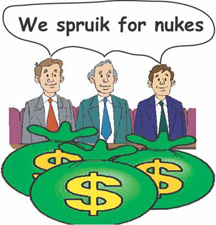 Nuclear Giant Exelon Launches Front Group to Cover Its Assets Elliott Negin HUFFINGTON POST 2 June 14,
“……..Exelon Already Holds Sway in Washington
Nuclear Matters is just the latest gambit of a very powerful political player. Over the last five years, Exelon has spent millions on political candidates and tens of millions on lobbying, and has taken advantage of its close ties with the Obama administration to weaken or stymie stronger nuclear plant safeguards.
According to the nonpartisan Center for Responsive Politics, Exelon has spent nearly $8 million on political campaigns since 2008, more than any other private electric utility. Over that same time period, Exelon also spent $34.6 million on lobbying, putting it in the top 10 among electric utilities. In addition, Exelon is one of the biggest corporate donors to trade associations, pro-business alliances and other politically active nonprofits, according to a January report by the Center for Public Integrity. In 2012, Exelon gave $13.6 million to approximately two dozen nonprofits, the second-largest amount voluntarily disclosed among the Fortune 300 companies CPI reviewed.
Exelon’s lobbyists also have enjoyed unparalleled access to the Obama administration, according to an August 2012 New York Times exposé. The Times provided several examples of how the company exerted its influence, including delaying and weakening a proposed EPA rule to prevent power plant water intake systems from killing fish and other aquatic life.
The Times also reported that Exelon joined with NEI and other plant owners to challenge the NRC’s post-Fukushima safety recommendations. Specifically, they opposed a proposed requirement that they install filters on hardened vents at 31 boiling water reactors to help prevent radiation discharges into the environment in the event of an accident. Those reactors are similar in design to the six at the Fukushima facility.
Filtered vents are now required in Japan and much of Europe, and the Nuclear Regulatory Commission technical staff recommended they be installed here. But Exelon and the rest of the U.S. nuclear industry, loathe to spend hundreds of millions of dollars on filters, insist there are other ways to achieve the same result and lobbied hard to avoid the upgrade.
In early 2013, more than 50 of the industry’s friends in Congress sent letters to the NRC requesting that the commissioners reject the filtered vent recommendation and slow down the implementation of other post-Fukushima safety reforms. A number of the signatories have reactors in or near their districts, and most have received sizeable campaign contributions from the nuclear industry. Two sign-on letters, for example, came from House members, one from 21 Republicans and the other from 26 Democrats. Since 2008, the nuclear industry gave more than $3.32 million to the 41 of the letters’ 47 signatories. Roughly 30 percent of that funding came from Exelon.
The industry prevailed — for the time being. Despite the fact that the NRC technical staff provided ample evidence that filtered vents are a sensible, cost-effective measure that would protect nearby communities, NRC commissioners issued an order requiring owners of the 31 reactors to upgrade their hardened vents that stopped short of requiring filters. Instead, the commissioners gave their staff two years to review all the options for reducing radiation releases. The NRC will then open the proposed rule to public comment and finalize it by the end of 2017…… http://www.huffingtonpost.com/elliott-negin/nuclear-giant-exelon-laun_b_5428994.html
US tax-payer is propping up the uranium industry
THE GOVERNMENT IS PROPPING UP THE URANIUM INDUSTRY AND WE’RE PAYING FOR IT http://www.esquire.com/blogs/politics/white-mesa-uranium-mill-lawsuit-053014 The Department of Energy is promoting uranium mining at places like the White Mesa Mill and is tasked with the pricey cleanup. By Leslie Macmillan on May 30, 2014
The Grand Canyon Trust, an environmental group, has sued the operator of America’s last conventional uranium processing mill, saying its vast piles of spent ore and radioactive waste emit dangerous levels of radon and other toxins that violate the Clean Air Act.
The group and other critics of the White Mesa Mill near Blanding, Utah say it is a poorly disguised nuclear waste dump that would have gone out of business long ago were it not propped up by a lucrative federal contracts.
 The uranium market has declined in the wake of the Fukushima meltdown. To stay alive in a depressed market, Energy Fuels Resources, the mill’s operator, recycles mine tailings and radioactive waste — known as “alternate feed” — from Superfund sites around the country. The mill extracts any remnants of uranium from the waste then sells the concentrated, purified uranium, called yellowcake, to its customers, some of which are government-owned utilities obligated to buy White Mesa yellowcake at prices far higher than the $35 a pound it is currently fetching on the spot market. The leftover waste, a toxic stew of industrial chemicals, is stored in open pits called impoundments.
Energy Fuels spokesperson Curtis Moore said the issues raised in the lawsuit “are either inaccurate or have already been addressed through the proper regulatory channels.”
Taylor McKinnon of the Grand Canyon Trust says he hopes the lawsuit will “rip the mill from the rat’s nest of bureaucrats who have been protecting the status quo.”
The mill, he and other critics contend that uranium mining, milling and cleanup has become a virtual cottage industry — one orchestrated largely by the federal government.
During the Cold War period of 1940s through the 1980s, uranium was mined extensively in the Colorado Plateau to supply critical materials for the nation’s nuclear weapons program. The U.S. Department of Energy manages the nation’s surplus uranium and much of the cleanup of old processing mills.
Travis Stills, an energy and conservation law attorney, argues that the DOE’s mandate to “provide a domestic supply of uranium” is outdated and wreaks havoc on environmental and human health. He also says it’s unnecessary. The DOE already owns a uranium stockpile worth $7 to $8 billion.
The DOE doesn’t want to sell off the stockpile, Stills argues, because that would drive uranium prices down. Instead, the government artificially inflates prices to keep the industry going, he says.
Energy Fuels also operates several mines at the Grand Canyon, despite the federal ban on uranium mining there, because it possesses old mining claims that were “grandfathered in.” The company said in December it planned to shutter its Pinenut Mine there as well as the White Mesa Mill in 2014 and potentially reopen them in 2015. It reversed that decision last month and announced it would continue mining, but stockpile the ore pending better market conditions.
Cleaning up uranium is not cheap. The DOE is spending a billion dollars to dispose of tailings at an enormous site near Moab — a cost “born by the taxpayer,” the Trust’s lawsuit points out. On the Navajo reservation alone, there are 500 abandoned uranium mines. The EPA estimates the cleanup cost would be in the hundreds of millions. An $18 million bond has been posted for cleaning up White Mesa Mill when it stops processing uranium — not nearly enough, Stills argues. He says the federal government — and the taxpayer — will be left holding the bag for that cleanup too.
Indeed, the DOE is slated to inherit White Mesa Mill for cleanup. Stills says that the department’s mission, to at once promote uranium mining and oversee its cleanup, is contradictory but that it keeps the agency employed. “It’s bureaucratic make-work,” he says. “As long as they keep making a mess, they’ll need to keep cleaning it up.”
Ontario’s politicians coy about their $25 billion plans for nuclear power expansion
 Why no one is talking nuclear on the election trail Despite tens of billions of dollars of nuclear projects in the pipeline, nuclear policy is a no-go area in the Ontario election The Star, By: John Spears Business reporter, on Fri May 30 2014 Nuclear energy policy has been almost a no-go area in Ontario’s election campaign.
The sector is on the verge of spending $25 billion or more on two massive projects, and constructing a nuclear-waste site that must last for millennia to come.
But while voters will ultimately pay for the projects through their hydro bills, the nuclear issue has barely raised a ripple in the current election campaign. In fact, it doesn’t even rate a mention in the New Democratic Party’s election platform.
Mid-life overhauls of two nuclear stations – Bruce and Darlington – are on the table. The price tag for Darlington’s four reactors alone is currently estimated at $10 billion in 2013 dollars – or $12.9 billion if interest and contingencies are included.
The price tag at privately operated Bruce Power – where six reactors will undergo mid-life refits – comes in at $2 billion per reactor, but with associated work over the next 15 years, spending will total $15 billion, company officials said earlier this year.
In addition to the nuclear overhauls, Ontario Power Generation proposes to construct a permanent disposal site for low and intermediate level nuclear waste at the Bruce.
But the mega-projects have raised scarcely a ripple on the hustings……..
it’s a lot of money – even if the projects stay within budget.
And staying within budget is not something that nuclear projects have been prone to in Ontario. The unpopular debt retirement charge – an extra 0.7 cents a kwh that’s finally due to expire at the end of 2015 – was levied to pay for past nuclear project cost over-runs.
The Liberal and Conservative platforms clearly support the nuclear overhauls.
“We will invest in the refurbishment of 10 nuclear units and Darlington and Bruce over 16 years, creating and sustaining 25,000 high-wage jobs,” the Liberal platform pledges.
The Conservatives go even further.
They note that Pickering with its eight reactors is due to close.
“We must build new ones and refurbish others,” they say in their Paths to Prosperitypolicy paper, released prior to the election.
The price tag on new reactors of unknown size and design is unclear, but would be multiple billions. Building them would be further complicated by a federal court ruling that told OPG it can’t build new reactors, in part because there are no firm plans for handling waste that will remain dangerously radioactive for hundreds of thousand of years.
The same environmental groups who won that decision are seeking a similar ruling on the Darlington refurbishment.
The New Democratic Party is more skeptical of the nuclear overhauls, according to energy critic Peter Tabuns.
“We haven’t seen a business case that supports refurbishment and we won’t make a decision on this until we do see a business case,” he said in an interview.
The NDP unequivocally opposes building new reactors, he said.
The Liberals have suspended any consideration of new reactors, declaring last December that they are “not needed at this time,” though keeping the option open for the future.
The one issue none of the parties address in their formal platforms is OPG’s proposal to entomb low- and intermediate-level radioactive waste in a limestone formation 680 metres below ground on the shore of Lake Huron.
A federal review panel is currently examining the proposal, but since OPG is owned by the province, the ultimate decision to proceed with the billion-dollar-plus proposal will lie at Queen’s Park.
The proposal took a new twist in February when a similar waste storage facility in Carlsbad, New Mexico leaked radiation……..
Various local, state and federal politicians in Michigan have expressed alarm at OPG’s proposed nuclear waste site.
The latest is Michigan state senator Phil Pavlov, who has called the waste site a “critical threat to the health of the Great Lakes.”
(Michigan’s federal senators Debbie Stabenow and Carl Levin have also expressed stiff opposition to the site.)
Pavlov has introduced resolutions calling on the president or Congress to submit the project to the International Joint Commission, which deals with cross-border issues on the lakes.
“I talk to people every day that can’t understand the rationale behind this,” Pavlov said in an interview.
“The fact that we’re even considering something this close to the lake needs to be challenged,” he said……..
The Liberals say they’re waiting on the federal panel to report before taking a final position on the waste site.
The panel has extended its hearings to gather information on the New Mexico incident, but no dates have been announced……. http://www.thestar.com/business/economy/2014/05/30/why_no_one_is_talking_nuclear_on_the_election_trail.html
With Allison MacFarlane and Gregory Jaczko. USA’s nuclear power plans could be very different
 NRC rejects effort to move radwaste from pools; Macfarlane issues strong dissent Michael Mariotte, Green World, 30 May 14,
“……….Back to the composition of the NRC. If Greg Jaczko, who  voted against licenses for the Vogtle and Summer reactors and since leaving the Commission has recommended phase-out of U.S. reactors, were still chair, Allison Macfarlane would almost certainly have still been President Obama’s next Democratic nominee (the NRC is required to have no more than three of its five members from the same political party). And there are two Democratic seats up this year: Commissioner Magwood is leaving the agency soon to head up Europe’s Nuclear Energy Agency, which exists not to regulate, but promote nuclear power (a position that raises the issue of whether it was a conflict-of-interest for Magwood to have taken this vote, and for that matter any other vote at this point) and Commissioner Apostolakis’ five-year term ends next month. He has not announced publicly whether he wants a second term, but the President is certainly under no obligation to re-appoint him even if he does.
We would have a very different Commission then. But we still could. Now, President Obama is in a position to act to fundamentally change the NRC and support his chosen chair. And, as this vote makes clear, to support his chosen NRC chair Macfarlane, he mustuse this opportunity to appoint such advocates to the NRC. Otherwise, he will be simply hanging her out to dry.
For that reason, NIRS has begun an e-mail campaign to urge the President to appoint such people to the Commission now. You can make your voice heard here. And NIRS and other groups will be making this point as forcefully as possible in other venues in the coming weeks as well. http://safeenergy.org/2014/05/29/nrc-rejects-effort-to-move-radwaste-from-pools/
Ontario Liberal and PC parties not winning hearts, minds or judges with their pro nuclear agenda
 Anti-nuclear advocates, Federal Court trouble Ontario Liberal and PC energy plans rabble.ca BY STEVE CORNWELL
MAY 30, 2014 Falling demand for electricity, sky-high cost projections, a catastrophic meltdown in Japan and a dedicated resistance to nuclear expansion have contributed to tough times for advocates of new and rebuilt nuclear reactors in Ontario.
 The latest punch in the gut for nuclear proponents in the province comes from a May 14 Federal Court decision to nullify the approval of up to four new reactors at Darlington Station, about 60km east of Toronto.
Among other issues, the presiding Justice James Russell cited inadequate planning for both nuclear waste storage and a catastrophic accident as reasons to revoke the project’s license, which was originally secured following a multi-year environmental assessment (EA). Justice Russell found that the EA failed to adhere to the Canadian Environmental Assessment Act.
The Federal Court review of the EA was initiated by environmental groups Canadian Environmental Law Association (CELA), Greenpeace Canada, Lake Ontario Waterkeeper (LOW) and Northwatch with lawyers from Ecojustice and CELA representing the application in court.
In a press release following the decision, the environmental groups called the Federal Court’s ruling “common sense.”
Justin Duncan, Staff Lawyer for Ecojustice and co-counsel for groups, said “the court’s ruling means that federal authorities can no longer take shortcuts when assessing nuclear projects.” “The federal government must protect Canadians from energy projects that may harm the health of the environment. Because the panel failed to assess certain environmental effects, the court revoked the project’s licence.”
Ontario Power Generation (OPG), who was ordered by the McGuinty Liberals in 2006 to start the process for new reactors at Darlington, still has options towards building the new reactors.
Rick Lindgren of CELA, who presented the case alongside Duncan said, “we do not yet know if the decision will be appealed, or if the EA process will be restarted to address the various deficiencies identified by the Federal Court.”
While Lindgren strikes a cautious note regarding OPG’s intentions going forward, he’s much more optimistic about the message that the decision sends.
“The decision sends a strong signal to other proponents and federal authorities that environmentally significant projects must be subject to a robust EA process that satisfies the legal requirements of the Canadian Environmental Assessment Act.”
And it seems the call for more robust environmental regulation is gaining traction in the host community. In an editorial following the decision, a local paper called on OPG to “accept the ruling and work quickly to address the gaps Justice Russell has identified in the existing environmental assessment.”
Greenpeace’s Nuclear Analyst, Shawn-Patrick Stensil thinks that receiving an endorsement from media around Darlington Station is telling.
“Durham Region is always being portrayed as uniformly supportive [of nuclear] by OPG. But many locals seem to think it’s fair for OPG to not to have a blank cheque, and do due diligence. But will OPG be willing to openly discuss the risks its reactors pose?”
Nukes on the campaign trail…… http://rabble.ca/news/2014/05/anti-nuclear-advocates-federal-court-trouble-ontario-liberal-and-pc-energy-plans
Barack Obama takes action on climate change
 Obama to unveil historic climate change plan to cut US carbon pollution
• Proposed regulations could cut carbon pollution by up to 25%
• President still faces potential opposition from Republicans
• Q&A: why the carbon proposal could make climate history
Suzanne Goldenberg, US environment correspondent theguardian.com, Friday 30 May 2014 President Barack Obama will unveil a plan on Monday that will cut carbon pollution from power plants and promote cap-and-trade, undertaking the most significant action on climate change in American history.
The proposed regulations Obama will launch at the White House on Monday could cut carbon pollution by as much as 25% from about 1,600 power plants in operation today, according to those claiming familiarity with the plan.
Power plants are the country’s single biggest source of carbon pollution – responsible for up to 40% of the country’s emissions.
The rules, which were drafted by the Environmental Protection Agency and are under review by the White House, are expected to do more than Obama, or any other president, has done so far to reduce the carbon dioxide emissions responsible for climate change.
They will put America on course to meet its international climate goal, and put US diplomats in a better position to leverage climate commitments from big polluters such as China and India, Obama said in a speech to West Point graduates this week.
“I intend to make sure America is out front in a global framework to preserve our planet,” he said. “American influence is always stronger when we lead by example. We can not exempt ourselves from the rules that apply to everyone else.”
It won’t be without a fight. Obama went on in his remarks at West Point to take a shot at Republicans who deny climate change is occurring, and the White House press secretary, Jay Carney, on Thursday accused critics of making “doomsday claims” about the costs of cutting carbon…….
Obama had originally hoped to cut carbon pollution by moving a bill through Congress. Four years after that effort fell apart, campaigners say the EPA rules could deliver significant emissions cuts – near the 17% Obama proposed at the Copenhagen climate summit – and the cap-and-trade programmes that were so reviled by Republicans.
The EPA, using its authority under the Clean Air Act, proposed the first rule phase, covering future power plants, last September.
In this the more politically contentious phase of the plan, it is widely believed the EPA will depart from the “inside the fence-line” convention of earlier environmental regulations for mercury and other pollutants, which focused on emissions-scrubbing on specific power plants.
The EPA administrator, Gina McCarthy, is seeking steep reductions – as much as 25% – but she has hinted repeatedly that she will allow states latitude in how they reach those targets.
The plan would allow electricity companies to reduce pollution by shutting down the oldest and most polluting coal plants. They can install carbon-sucking retrofits. They can expand wind and solar energy, upgrade the electrical grid, encourage customers to update to more efficient heating and cooling systems, or more efficient appliances and lightbulbs.
“They have recognised huge emissions reductions opportunities are often cheaper than trying to do it all inside the plant,” said David Doniger, who heads the climate programme at the NRDC. “If you want to get substantial reductions and you want to get it economically, you have to take into account a system-wide approach.”…….http://www.theguardian.com/environment/2014/may/29/obama-unveil-historic-climate-plan-carbon-pollution
1 This Month
23-25 October – on Zoom – World BEYOND War’s annual global conferenc


Shut down the radiation-damaged Heysham nuclear reactors now
To see nuclear-related stories in greater depth and intensity – go to https://nuclearinformation.wordpress.com

Say No to NASA’s Reckless Nuclear Reactor on the Moon
Say No to NASA’s Reckless Nuclear Reactor on the Moon
-
Archives
- October 2026 (170)
- September 2026 (339)
- August 2026 (330)
- July 2026 (355)
- June 2026 (287)
- May 2026 (306)
- April 2026 (356)
- March 2026 (251)
- February 2026 (267)
- January 2026 (308)
- December 2025 (358)
- November 2025 (359)
-
Categories
- 1
- 1 NUCLEAR ISSUES
- business and costs
- climate change
- culture and arts
- ENERGY
- environment
- health
- history
- indigenous issues
- Legal
- marketing of nuclear
- media
- opposition to nuclear
- PERSONAL STORIES
- politics
- politics international
- Religion and ethics
- safety
- secrets,lies and civil liberties
- spinbuster
- technology
- Uranium
- wastes
- weapons and war
- Women
- 2 WORLD
- ACTION
- AFRICA
- Atrocities
- AUSTRALIA
- Christina's notes
- Christina's themes
- culture and arts
- Events
- Fuk 2022
- Fuk 2023
- Fukushima 2017
- Fukushima 2018
- fukushima 2019
- Fukushima 2020
- Fukushima 2021
- general
- global warming
- Humour (God we need it)
- Nuclear
- RARE EARTHS
- Reference
- resources – print
- Resources -audiovicual
- Weekly Newsletter
- World
- World Nuclear
- YouTube
-
RSS
Entries RSS
Comments RSS

