Taiwan officials brush off worries about nuclear power plant flaws
 Officials downplay nuclear plant flaws GLOSSING OVER FAULTS:A ‘Liberty Times’ report said a Taipower employee alleged that a report on the safety of the Fourth Nuclear Power Plant omitted the plant’s flaws Taipei Times By Lee I-chia / Staff reporter, with CNA 12 May 14, Officials yesterday sought to play down leaked test results indicating possible flaws in a containment structure of the Fourth Nuclear Power Plant, saying the problem will be fixed as part of ongoing tests and inspections.
Taiwan Power Co (Tai-power, 台電) chairman Hwang Jung-chiou (黃重球) said that finding and sealing leaks in the primary containment structure of the plant’s first reactor were normal steps in safety inspection procedures.
Hwang said similar leaks were discovered during inspections carried out on the nation’s first, second and third nuclear power plants, all of which are operated by the state-run Taipower.
The company is also responsible for the nearly completed Fourth Nuclear Power Plant in New Taipei City’s Gongliao District (貢寮).
Answering questions at a meeting of the legislature’s Education and Culture Committee, Atomic Energy Council (AEC) Minister Tsai Chuen-horng (蔡春鴻) said the council would strictly review Taipower’s safety reports on the plant to ensure the leakage rates of the reactor containment building are within safety standards.
Tsai’s remarks came in response to a report by the Chinese-language Liberty Times (the Taipei Times’ sister newspaper) yesterday which said it received an anonymous report from a person who identified himself as a worker at the plant saying that during the integrated leak rate test (ILRT) and structure integral test (SIT) conducted at the plant’s No. 1 reactor from Feb. 26 through March 5, leakage rates were found to be too high.
The company had reported them as normal.
Meanwhile, outside the committee meeting room, Green Citizen Action Alliance deputy secretary-general Hung Shen-han (洪申翰) criticized Taipower for claiming that the structure had no problems in its publicized safety test report on its Web site last month.
He alleged that the company only reported the good parts, but not flaws, which he said should be considered lying to the public…….http://www.taipeitimes.com/News/front/archives/2014/05/13/2003590217
Conservative financier stresses energy security importance of renewable energy
 Guy Hands: Ukraine crisis underlines importance of UK renewable energy http://www.theguardian.com/environment/2014/may/12/guy-hands-calls-for-government-action-on-renewable-energy
 Guy Hands, one of the City’s most flamboyant deal-makers, warns on Monday that the Ukraine crisis has underlined the importance of the UK’s renewable energy sector, and attacks those wanting to phase out onshore wind subsidies.
The financier, who has close links to the Conservative party, says energy security cannot be achieved by markets alone and that the government needs to play a decisive role. “We should be grateful to President Putin for bringing energy security back to the top of the political agenda inEurope. But it is up to us to ensure we understand and act on the long-term threat. And that is certainly not by turning our backs on renewable energy, no matter how persistent or loud the voices against it,” Hands argues in an article on the Guardian website.
The intervention by Hands, who runs the Terra Firma private equity firm, comes at a time when instability in Crimea has been used as a major argument in favour of shale gas – most notably by a House of Lords committee last week.
Hands, whose best man at his wedding was the foreign secretary, William Hague, expresses astonishment that there has been speculation the Tory election manifesto could contain a commitment to end financial help for onshore wind, given it is the “most affordable” of all green power technologies.
Hands’s Terra Firma invests in onshore wind but also landfill gas and other green schemes through a business called Infinis. The financier said Vladimir Putin’s actions in Crimea had done Britain an indirect favour by putting energy security at the top of the agenda. “We have a large industry of successful and enterprising renewable energy businesses which are ready to rise to the challenge of powering homes and businesses from clean and sustainable sources. But politicians are being pressed by a coalition of opponents of renewable energy to ignore this potential.”
He argues that the subsidy debate has been dominated by those who believe energy is a market like any other, and that all efforts should be focused on prices.
“This is nonsense. Energy is not just another commodity but the lifeblood of an economy. No responsible government can step away from a market which is at the heart of a nation’s security and prosperity. Security of supply as well as affordability are critical. So too are environmental impact and public acceptance.”
Germany’s nuclear industry fights to make tax-payers pay for cleanup
 German utilities and government clash over nuclear ‘bad bank’ By Jeevan Vasagar in Berlin http://www.ft.com/intl/cms/s/0/49c5b222-d926-11e3-837f-00144feabdc0.html#axzz31XFPjIHH 11 May 14,
Germany’s nuclear industry is fighting Berlin over a plan to transfer the risks of shutting down facilities to a publicly owned foundation that would act as a “bad bank”.
 The power companies are engaged in a decommissioning exercise with an estimated cost of more than €30bn after Berlin announced an accelerated exit from nuclear energy following the Fukushima disaster in 2011. The work includes demolishing nuclear plants and disposing of radioactive waste.
German utilities Eon, RWE and EnBW have discussed the creation of a state-owned foundation to oversee the decommissioning process. Under their plan, the utilities would transfer to the foundation billions of euros in reserves that they have built up to pay for demolition and disposal. In return, the German government would shoulder the risk for any cost overruns.
But that proposal, first reported in Der Spiegel on Sunday, was rejected by German environment minister Barbara Hendricks. She said: “The full responsibility for the safe phasing out, closure, decommissioning and interim storage of nuclear waste lies with the energy companies.”
One German energy executive said on Sunday that while the idea had been discussed, there were no concrete plans. Eon, RWE and EnBW all declined to comment.
The proposal is the latest sign of strain between Berlin and utilities, which have clashed in the courts over the closure of nuclear plants and the validity of a nuclear fuel tax.
The fight comes at a time when German power companies are struggling because the favourable treatment given to renewable energy has battered the profitability of their conventional electricity plants.
The country’s seven oldest nuclear plants were all taken offline immediately after the Japanese disaster, while an eighth plant that was offline at the time stayed shut: the remaining nine are to be closed down by 2022.
Eon said in March that it intended to shut the Grafenrheinfeld nuclear plant in Bavaria seven months before schedule because of its lack of profitability.
That plant, in a state that is home to some of Germany’s most successful manufacturers, will now close in May 2015.
Berlin’s abrupt decision to phase out nuclear energy represented a U-turn on a 2010 deal to extend the lives of nuclear plants. The companies agreed, in that deal, to a tax on nuclear fuel, which was introduced at the start of 2011 – and remains in place, despite the change of policy.
A court in Hamburg ruled in April that the German state should repay more than €2.2bn in nuclear fuel taxes to the utilities.
However, this decision is not legally binding and the case has been referred to the European Court of Justice.
RWE is pursuing a civil claim for damages over the decision by the state government of Hesse to order the closure of the Biblis nuclear power plant after Fukushima.
Hawkish orders from Iran’s Supreme Leader Ayatollah Ali Khamenei
 Nuclear talks in jeopardy: Khamenei orders Rev Guards to mass-produce missiles – regardless DEBKAfile Special Report May 11, 2014, Iran’s Supreme Leader Ayatollah Ali Khamenei threw a large spanner in the works of nuclear diplomacy Sunday, May 11. Less than a week before the next round of talks with the six powers, he said: “The Revolutionary Guards should definitely… not be satisfied with the present level [of missile production]. They should mass produce.”
Referring to Western concerns that Iran is designing missiles able to carry nuclear warheads, Khamenei said: “They [the West] expect us to limit our missile program while they constantly threaten Iran with military action. So this is a stupid, idiotic expectation.”
Khamenei spoke during a visit to the aeronautics fair organized by the Revolutionary Guards (IRGC), which are responsible for Iran’s missile and nuclear programs………
President Rouhani calls for more clarity in the nuclear debate
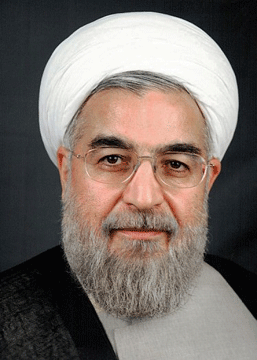 Iranian president calls for more open, better-informed nuclear debate https://au.news.yahoo.com/world/a/23426769/iranian-president-calls-for-more-open-better-informed-nuclear-debate/ May 11, 2014, By Michelle Moghtader and Mehrdad Balali DUBAI (Reuters) – President Hassan Rouhani said on Sunday he wanted Iran to do a better job of explaining its nuclear programme to prevent “evil-minded” people misleading world opinion, two days before Tehran resumes talks with world powers on its disputed atomic activity.
Iran and the United States, France, Germany, Britain, China and Russia will reconvene in Vienna to try to iron out differences over how to end a long standoff over suspicions that Tehran has sought the means to develop nuclear weapons.
Western powers have long demanded greater openness from Iran to address those concerns and head off the risk of a downward spiral towards a new Middle East war, with Israel threatening to attack its arch-foe if diplomacy does not rein it in.
“What we can offer the world is greater transparency,” Rouhani, a relative moderate who replaced a conservative hardliner who antagonised the West – said in a speech at a ceremony celebrating Iran’s scientific achievements.
In his remarks, Rouhani reiterated that Iran was not seeking nuclear weapons and would never halt its atomic programme, which was for peaceful purposes. He also repeated a denial of Western charges that Iran has carried out any secret nuclear bomb work.But along with achieving scientific progress, Rouhani added, Iran ought to develop its abilities in the legal, political and information realms to prevent “the enemy” making problems for its nuclear developments.
“If one engages in a technological endeavour but is not doing good legal and political work, then the enemy might come up with a fictional excuse to cause trouble for you,” he said.
The Islamic Republic’s leaders normally use the term “the enemy” to refer to the United States and Israel.
“If you don’t have good public relations and are not able to communicate well, then you might find other evil-minded people misleading world public opinion,” Rouhani said.
“So our effort today is to even out our efforts on multiple levels … We don’t want to retreat one step from our pursuit of technology, but we want to take a step forward on the political front.”
His comments appeared to be a criticism of hostile statements from within the hardline conservative establishment, including his predecessor Mahmoud Ahmadinejad, who called U.N. resolutions against Iran on the nuclear dispute a “worthless piece of paper”………..
“RIGHT DIRECTION”
Ahmadinejad’s strident rhetoric during his eight years in office on issues like the Holocaust and Israel served to shore up international resolve to curb Iran’s nuclear programme.
Iran in January halted its most sensitive nuclear operations under a preliminary deal with world powers, winning some relief from painful economic sanctions that have damaged its oil-dependent economy by forcing a sharp reduction in crude exports.
Rouhani said Iran if it so chose could resume enrichment of uranium gas to a fissile purity of 20 percent – its most sensitive nuclear activity because it is a relatively short technical step away from the level required for nuclear weapons.
“We wanted to tell the world that our activities are moving in the right direction: If we say we can enrich to 3.5 percent, we can do it. If necessary we will do (it to) 20 percent,” he said.
Iran agreed under its Nov. 24 deal to shelve enrichment to 20 percent. It has since diluted some of its 20 percent-enriched stockpile to a lower concentration and converted some into an oxide less suited to processing into bomb-grade material.
Iran has justified its 20 percent enrichment drive by saying it was meant to replenish the fuel supply of a Tehran medical research reactor. But Western officials are sceptical, saying Iran had refined far more than it required for such a purpose.
While Iran stopped 20 percent enrichment in January, it is allowed under the November pact to keep producing uranium refined to up to 5 percent, the level required for fuelling civilian nuclear power stations.
Sweden turning against nuclear power
 Support for nuclear power falls in Sweden, survey says http://www.alaskadispatch.com/article/20140509/sweden-hydropower-station-challenged-nuclear-energy-loses-favor
Swedes are becoming increasingly skeptical of nuclear power with a new survey showing 50 percent of respondents want the controversial power source phased out.
The report from the SOM Institute at the University of Gothenburg found support falling for nuclear power since a meltdown at Japanese power plant. With other European nations moveing away from nuclear power, Swedes are also growing leery.
“The fact that Germany, Switzerland, Italy and several other countries have begun to phase out nuclear power, it’s likely that nowadays it might happen in Sweden, too,” Sören Holmberg, a political science professor at Gothenburg University, told Swedish Radio News.
Before the nuclear accident at Fukushima in Japan, Swedes were generally positive toward building new reactors with 44 percent supporting the measure and 39 percent opposing it. After the disaster in 2011, 44 percent said they were against nuclear power and now half of respondents are anti-nuclear.
As before, support for new nuclear plants is strongest on the right of the political spectrum and the greatest resistance is from the left. Men and white collar workers are also more positive than women and laborers.
This story is posted on Alaska Dispatch as part of Eye on the Arctic, a collaborative partnership between public and private circumpolar media organizations.
Green Party a powerful presence in UK’s Shroud District a powerful force for Green
Stroud District Green Party 8 May 14 Stroud District Green Party is active in the Stroud and Cotswold District Council areas and parliamentary constituencies. Werepresent Stroud on the County Council and five wards on Stroud District Council. A majority of Stroud Town Councillors are Greens and we are represented on several other Town and Parish Councils.
The Green Party is about more than just the environment: we believe that social justice and environmental responsibility are fundamentally linked. Find out more about our policies.
Stroud District is one of the country’s greenest communities and we are an active local party with a solid membership base. If you agree with our core values, please consider joining, donating or otherwise getting involved……..http://www.stroud.greenparty.org.uk/
Obama launches renewable energy actions, aided by corporations
 With corporate help, Obama announces actions on renewable energy http://af.reuters.com/article/energyOilNews/idAFL2N0NU2OG20140509 WASHINGTON May 9 (Reuters) – President Barack Obama on Friday will announce executive orders to increase the use of solar panels, boost energy efficiency in federal buildings and train more people to work in the renewable energy field, the White House said.
The president, who will make the announcement during a visit to Wal-Mart in Mountain View, California, will also highlight commitments by corporations to lift solar generation at their facilities. Wal-Mart, Apple Inc, Yahoo Inc, Google Inc and Ikea were among the companies making such commitments.
Several financial institutions, including Citigroup Inc and Goldman Sachs Group Inc, were announcing new plans for “large scale investment and innovative programs” to develop solar and renewable energy installations, the White House said.
Obama’s executive actions would support efforts at community colleges so that 50,000 workers would join the solar industry by 2020, it said.
Another initiative would press for $2 billion in energy efficiency upgrades for federal buildings over the next three years, building on another $2 billion commitment from 2011.
Actions to strengthen building codes were also part of the mix. “Investing in solar and efficiency makes sense to reduce our carbon emissions, but also for our pocketbooks and for our economy,” said Dan Utech, an energy adviser to Obama, during a conference call on Thursday to preview Obama’s announcement.
He said the U.S. solar energy industry had expanded dramatically under Obama’s watch, with installations increasing to an amount enough to power more than 2 million homes.
“So momentum is increasing,” Utech said. “Since President Obama took office we’ve increased production from U.S. solar electricity more than tenfold, and in the last year, U.S. production of electricity from solar energy was double what it was just two years ago.”
An Obama spokesman also announced the completion of a project to install solar panels at the White House itself. The panels were American-made and part of an energy “retrofit” for the building that would improve its energy efficiency.
“The project, which helps demonstrate that historic buildings can incorporate solar energy and energy efficiency upgrades, is estimated to pay for itself in energy savings over the next eight years,” spokesman Matt Lehrich said. (Reporting by Jeff Mason; Editing by Cynthia Osterman)
Two ex-PMs launch Japan Assembly for Nuclear Free Renewable Energy
 Japan’s ex-PMs team up for anti-nuclear drive, Channel News Asia, 8 May 14 Two former Japanese prime ministers — Morihiro Hosokawa and Junichiro Koizumi — have teamed up to increase the pressure on incumbent Prime Minister Shinzo Abe to stop the resumption of nuclear power in the country. TOKYO: Two former Japanese prime ministers — Morihiro Hosokawa and Junichiro Koizumi — have teamed up to increase the pressure on incumbent Prime Minister Shinzo Abe to stop the resumption of nuclear power in the country.
A new organisation, called the “Japan Assembly for Nuclear Free Renewable Energy”, has been launched with the main objective of calling for a nuclear free Japan, and promoting the development and use of renewable energy — and it has been getting a lot of media attention………Heading the group is Mr Hosokawa, who recently ran for Tokyo governor on an anti-nuclear platform.
He was backed by another former Prime Minister Junichiro Koizumi, who also plays an important role in the organisation.

“First, we are against the restart of Japan’s nuclear reactors. We want to transfer nuclear power to natural energy, build an economy that can capitalise on it and build a society where we do not have to worry about radiation,” he said.
Mr Koizumi said: “All nuclear plants have stopped, not only for 3 months, or 6 months, but for almost a year. Has Japan been unable to survive without nuclear power? We have prevailed.
“People may say I am a person of the past. But I will, with the generation of the future, work towards creating a country without nuclear power.”
Joining them in the anti-nuclear drive is a long list of celebrities, including actors, authors, people from the music industry and local authorities……the group said it plans to hold regular meetings and forums, to generate momentum and pressure the government to stop the generation of nuclear energy in Japan.
Dead nuclear reactors are still very dangerous: US Senators call to Nuclear Regulatory Commission
 SENATORS TO NRC: DO NOT EXEMPT DECOMMISSIONING NUCLEAR REACTORS FROM EMERGENCY RESPONSE AND SECURITY MEASURES NEWS RELEASE — SEN. PATRICK LEAHY, SEN. BERNIE SANDERS
 May 2, 2014
Contact:
Mike Briggs (Sanders) 202-224-5141
David Carle (Leahy) 224-3693
Washington (May 2, 2014) – In a letter sent today to Nuclear Regulatory Commission (NRC) Chairman Allison Macfarlane, Senator Edward J. Markey (D-Mass.), Senate Environment and Public Works Committee Chairman Barbara Boxer (D-Calif.), and Senators Bernard Sanders (I-Vt.), Patrick Leahy (D-Vt.) and Kirsten Gillibrand (D-N.Y.) called on the agency to stop the “unwise policy” of issuing exemptions for emergency response regulations to decommissioning nuclear reactors which house decades-worth of spent nuclear fuel.
Exemptions for compliance with the emergency response regulations – such as those that require evacuation zones and siren systems to warn of problems – have been granted to all of the ten reactor licensees that have requested them in the past. Moreover, the licensees of reactors that are or will soon begin the decommissioning process (including San Onofre in California and Vermont Yankee) have already submitted a wide range of exemption requests from emergency response, security and other regulations to the NRC.
The NRC is currently in the process of finalizing its finding that spent nuclear fuel can be stored safely for at least 60 years beyond the licensed life of a nuclear power plant, and based this determination in part on the assertion that emergency preparedness and security regulations remain in place during decommissioning. Accidents or attacks on spent fuel pools would put neighboring communities at great risk of experiencing radioactive releases, fires, and widespread contamination.
Full text of the letter is attached with appendices and below.
May 2, 2014
The Honorable Allison M. Macfarlane
Chairman
Nuclear Regulatory Commission
Rockville, MD 20852
Dear Chairman Macfarlane:
We write to request that the Nuclear Regulatory Commission (NRC) cease exempting licensees of decommissioning nuclear reactors from its emergency response and security regulations. NRC repeatedly cites these regulations to demonstrate the long-term safety and security of spent nuclear fuel. Yet it has granted each and every one of the ten requests for exemptions from emergency response requirements that it has received from reactors that have permanently shut down, generally within 2 years of the reactors’ closure and without regard to how much spent fuel is still stored in spent fuel pools. ……….
NRC is currently in the process of finalizing its Waste Confidence decision that spent nuclear fuel can be stored safely for at least 60 years beyond the licensed life of a nuclear power plant, and based this determination in part on the assertion that emergency preparedness and security regulations remain in place during decommissioning.The Commission is also voting on whether there is a benefit to accelerating the transfer of spent nuclear fuel to dry casks, and the document being voted on assumes the continued application of emergency response and security requirements.
What the NRC failed to state in its court and other filings was that licensees of decommissioning reactors are almost always exempted from the regulatory requirements NRC based its findings on within two years of the reactors’ shut-down. This is unacceptable. We urge you to announce your intent to reverse this unwise policy. http://vtdigger.org/2014/05/02/senators-nrc-exempt-decommissioning-nuclear-reactors-emergency-response-security-measures/
TEPCO makes $4.3 Billion Profit
 Fukushima Nuclear Plant Operator Tepco Books $4.3 Billion Profit http://www.thejakartaglobe.com/business/fukushima-nuclear-plant-operator-tepco-books-4-3-billion-profit/ By Agence France-Presse Apr 30, 2014 The operator of Japan’s crippled Fukushima nuclear plant said on Wednesday it booked a $4.3 billion annual net profit owing to an electricity rate hike and a massive government bailout following the 2011 disaster.
Tokyo Electric Power (Tepco) was teetering on the brink as cleanup and
 compensation costs stoked huge losses and threatened to collapse the sprawling utility until Tokyo stepped with a multi-billion dollar rescue.
The company at the center of the worst nuclear accident in a generation said it earned 438.65 billion yen ($4.3 billion) in the fiscal year to March, compared with a net loss of 685.3 billion yen in the same period a year earlier.
Sales rose 11.0 percent to 6.63 trillion yen, it said.
The company’s results got a boost from a rate hike, and helped offset a decline in the amount of electricity Tepco sold owing to warmer-than-usual winter weather, it said.
It also booked a special gain of 1.8 trillion yen based on funds the company received from a government-backed bailout fund as well as asset sales.
But it added that rising fossil fuel costs after Japan switched off its nuclear reactors were pressuring its bottom line.
“The business environment that surrounds us remains very serious,” Tepco president Naomi Hirose told a news conference.
The Fukushima plant’s cooling systems were swamped by the 2011 tsunami, sparking reactor meltdowns and radiation leaks.
Tens of thousands of people were evacuated from around the plant with decommissioning of the site expected to take decades.
France’s nuclear dilemma
France caught between nuclear cliff and investment wall BY MICHEL ROSEPARIS Wed Apr 30, 2014 (Reuters) – France must decide in the next few years whether it wants to continue its nuclear-driven energy policy at a cost of up to 300 billion euros (246.8 billion pounds) or if it wants to embark on an equally costly route towards using other fuels.
Most of the country’s 58 nuclear reactors were built during a short period in the 1980s, and about half will reach their designed age limits of 40 in the 2020s, pushing France towards what industry calls “the nuclear cliff.”
Public support in France for nuclear power has traditionally been strong but is looking shakier since the 2011 nuclear reactor meltdown at Japan‘s Fukushima facility following a massive earthquake and tsunami. And French President Francois Hollande has said he wanted to cut the share of atomic energy in France’s electricity mix to 50 percent from 75 percent by 2025, reduce oil and gas consumption and boost renewable energy.
A replacement of the nuclear plants run by state-controled utility EDF (EDF.PA), or a switch towards alternative sources would cost huge amounts of money.
“There’s a problem, which is decision-making. Are we going towards a new nuclear fleet or not? This needs preparation,” Jacques Repussard, the head of state-funded nuclear advising institute IRSN told Reuters in an interview. EDF has advocated an extension of the reactors’ lifespan to 50 or even 60 years, arguing that they were modelled on similar reactors in the United States which have been granted 60-year licences.
But French nuclear watchdog ASN, the only authority allowed to grant this extension, has so far repeated that the utility should not take this extension for granted and would only give a first opinion next year and a final one in 2018-2019………..
On the one hand, EDF wants to cash in on its nuclear know-how through exporting its technology and services, including to Britain’s nuclear investment power programme.
Yet EDF also faces a 55 billion euro upgrade of its existing reactors by 2025 and will have to decide on how to finance their ultimate replacement, at a potential cost of up to 240 billion euros, about six times EDF’s existing debt pile.
“If you close down all nuclear reactors when they reach 30 or 40 however, you will need to build a huge new fleet, that would be a massive challenge not only from a financial point of view but also from a project management point of view,” said Laszlo Lavro, head of the International Energy Agency’s Gas, Coal and Power division.
Within the government, ministers have voiced contradicting views on nuclear energy, even though the departure of the Green party from the government has made the pro-nuclear case stronger.
An energy transition bill now slated for July has been repeatedly delayed, with Paris naming its fourth energy minister in less than two years earlier this month.
Newly appointed energy minister Segolene Royal, a powerful voice in the new government, has skirted questions on nuclear policy at a news conference earlier this week……….
Decisions cannot be delayed indefinitely as building new energy infrastructure, especiallynuclear power plants, takes time.
Construction of France’s pilot new generation reactor in Flamanville, which started in 2007, has seen repeated delays and cost overruns and is currently expected to be finished in 2016……http://uk.reuters.com/article/2014/04/30/uk-france-nuclear-analysis-idUKKBN0DG0KC20140430
Secretive TPP distrusted by both Left and Right – says Ralph Nader
 Ralph Nader on TPP, GM Recall, Nuclear Power & the “Unstoppable” Left-Right Anti-Corporate Movement, Democracy Now, 28 April 14 Former presidential candidate and longtime consumer advocate Ralph Nader joins us to discuss his latest book, “Unstoppable: The Emerging Left-Right Alliance to Dismantle the Corporate State.” Nader highlights the common concerns shared by a wide swath of the American public, regardless of political orientation, including mass government surveillance, opposing nebulous free trade agreements, reforming the criminal justice system, and punishing criminal behavior on Wall Street. Nader also discusses the U.S. push for the sweeping Trans-Pacific Partnership trade pact, General Motors’ new bid to escape liability for its deadly ignition defect, the revived nuclear era under President Obama, and challenging U.S. militarism through the defense budget.

TRANSCRIPT
This is a rush transcript. Copy may not be in its final form
AMY GOODMAN “……….Now, he’s out with a new book; it is called Unstoppable: The Emerging Left-Right Alliance to Dismantle the Corporate State. It highlights the common concerns shared by a wide swath of the American public, regardless of political orientation. These concerns include resisting mass surveillance, opposing nebulous free trade agreements, and punishing criminal behavior on Wall Street. Throughout, Ralph Nader argues in favor of transcending divisive partisan labels and instead working in concert to pursue shared interests, all the while offering practical solutions rooted in collective organizing………
AMY GOODMAN: Ralph Nader, I want to go to this global issue of the TPP, because over the weekend President Obama spoke to young leaders during this town hall-style meeting at the University of Malaya in Kuala Lumpur, Malaysia. His talk was briefly disrupted by peaceful protesters holding up signs denouncing a sweeping new trade deal, the Trans-Pacific Partnership—the TPPoften referred to by critics as NAFTA on steroids, as you were talking about, establishing a free-trade zone that would stretch from Vietnam to Chile, encompass 800 million people, about a third of world trade, nearly 40 percent of the global economy. Obama defended the TPP………
AMY GOODMAN: That’s President Obama in Malaysia. Who is advising President Obama on TPP? The unions? Environmental organizations? Ralph Nader.
RALPH NADER: Well, they can’t get back through the secrecy of these negotiations in these drafts. As Lori Wallach of Global Trade Watch has pointed out repeatedly, even members of Congress couldn’t get the draft negotiations from the TPP, although the corporate lobbyists have access to these drafts. But it’s quite clear that the TPP is nothing more than an extension of NAFTA and the World Trade Organization on steroids.
And here’s where we have a left-right alliance, each one with their reason. On the left, they’re opposed to these agreements because they’re bad for workers; they’re bad for the price of medicines being affordable, under the intellectual property rules that are being negotiated; they’re bad for open government; and they’re bad for the environment. On the right, they don’t like these trade agreements because they shred our sovereignty. I happen to agree with that, too. All international treaties reduce sovereignties, by definition. But this one, these trade agreements are the greatest usurpers of local, state and national sovereignty in American history. And so, we have this growing alliance. And, by the way, it goes back to documents like the 2002 Texas Republican state platform, that was dead set against these trade agreements on sovereignty issues……..http://www.democracynow.org/2014/4/28/ralph_nader_on_tpp_gm_recall
Iranian public ready to back a fair nuclear deal
| Iran FM says people would support fair nuclear deal, The Daily Star, Lebanon News, |
| April 27, 2014 TEHRAN: Foreign Minister Mohammad Javad Zarif said Sunday that the majority of Iranians would support a comprehensive nuclear deal that “respects Iran’s rights and the demands of the people.”
“That would be the only agreement that myself and President (Hassan) Rouhani will agree (to),” Zarif said during a joint news conference in Tehran with his Austrian counterpart Sebastian Kurz. When asked whether hardliners could derail the nuclear talks, Zarif said: ” Iran is not a monolith … we will have those who will not favour an agreement, but at the end of the day what will count is the view of the majority of the Iranian people.” In November, Iran clinched a deal with world powers under which it froze some nuclear activities in return for limited relief from crippling international sanctions. Tehran has been engaged in negotiations with the P5+1 — Britain, China, France, Russia and the United States, plus Germany — aimed at reaching a lasting accord on its nuclear ambitions……. http://www.dailystar.com.lb/News/Middle-East/2014/Apr-27/254561-iran-fm-says-people-would-support-fair-nuclear-deal.ashx#ixzz30DTTdBDN |
Koch brothers wage war on solar energy
 Koch Brothers And ALEC Expand Fight On Clean Energy Users CLIMATE PROGRESS, BY ARI PHILLIPS
 APRIL 25, 2014 THE RIGHT-WING AMERICAN LEGISLATIVE EXCHANGE COUNCIL (ALEC), AN INFLUENTIAL LOBBYING GROUP COMPOSED OF REPUBLICAN POLITICIANS AND BIG BUSINESSES, IS IN THE MIDDLE OF THE STATE- AND LOCAL-LEVEL CLEAN ENERGY DISPUTES THAT ARE CURRENTLY EVOLVING ALMOST AS QUICKLY AS THE SOLAR AND WIND TECHNOLOGIES THEMSELVES. ALEC, KNOWN FOR ADVANCING CORPORATE INTERESTS, IS ALIGNED WITH THE KOCH BROTHERS IN THE CURRENT HEATED EXCHANGE — HOW TO MAKE DISTRIBUTED SOLAR POWER LOOK BAD.
Solar power is growing rapidly across the U.S., with capacity up an astounding418 percent in the last four years alone. This has given rise to two primary policy-level debates: how much renewable power utilities are required to use, known as Renewable Portfolio Standards (RPS), and figuring out the logistics of net metering, which guarantees homeowners or businesses with solar panels on their roofs the right to sell any excess electricity back into the power grid.
The Los Angeles times has recently been reporting out a story about how the Koch brothers are trying to roll back these solar initiatives across the country:
“The Koch brothers, anti-tax activist Grover Norquist and some of the nation’s largest power companies have backed efforts in recent months to roll back state policies that favor green energy. The conservative luminaries have pushed campaigns in Kansas, North Carolina and Arizona, with the battle rapidly spreading to other states.”
ALEC, which has referred to homeowners with their own solar panels as “freeriders on the system,” is deeply involved in both combating renewable energy mandates and modeling legislation that targets net metering…………
While ALEC might be doing the dirty work on clean energy, the fossil fuel industry is the one calling the shots, and filling the coffers. This is what makes it so cynical for ALEC to claim to be defending the free market while at the same time trying to punish solar users who have found a way to economically generate clean energy and provide some of it back to the market…..http://tinyurl.com/p868jlb
1 This Month
23-25 October – on Zoom – World BEYOND War’s annual global conferenc


Shut down the radiation-damaged Heysham nuclear reactors now
To see nuclear-related stories in greater depth and intensity – go to https://nuclearinformation.wordpress.com

Say No to NASA’s Reckless Nuclear Reactor on the Moon
Say No to NASA’s Reckless Nuclear Reactor on the Moon
-
Archives
- October 2026 (180)
- September 2026 (339)
- August 2026 (330)
- July 2026 (355)
- June 2026 (287)
- May 2026 (306)
- April 2026 (356)
- March 2026 (251)
- February 2026 (267)
- January 2026 (308)
- December 2025 (358)
- November 2025 (359)
-
Categories
- 1
- 1 NUCLEAR ISSUES
- business and costs
- climate change
- culture and arts
- ENERGY
- environment
- health
- history
- indigenous issues
- Legal
- marketing of nuclear
- media
- opposition to nuclear
- PERSONAL STORIES
- politics
- politics international
- Religion and ethics
- safety
- secrets,lies and civil liberties
- spinbuster
- technology
- Uranium
- wastes
- weapons and war
- Women
- 2 WORLD
- ACTION
- AFRICA
- Atrocities
- AUSTRALIA
- Christina's notes
- Christina's themes
- culture and arts
- Events
- Fuk 2022
- Fuk 2023
- Fukushima 2017
- Fukushima 2018
- fukushima 2019
- Fukushima 2020
- Fukushima 2021
- general
- global warming
- Humour (God we need it)
- Nuclear
- RARE EARTHS
- Reference
- resources – print
- Resources -audiovicual
- Weekly Newsletter
- World
- World Nuclear
- YouTube
-
RSS
Entries RSS
Comments RSS

