Trump lands in Beijing with over a dozen western moguls in tow ahead of high-stakes talks with Xi
Elon Musk, Tim Cook, and top executives from Nvidia, Qualcomm, BlackRock, Goldman Sachs, Mastercard, Visa, Boeing, and Meta joined the US president
The Cradle, MAY 13, 2026
US President Donald Trump landed in Beijing on 13 May for a crucial meeting with Chinese President Xi Jinping to address trade, technology, Taiwan, the war against Iran, and the Strait of Hormuz.
Met with red-carpet treatment in the Chinese capital, Trump was joined by a retinue of more than a dozen billionaires whose companies span major sectors of the US and global economies.
A total of 16 high-profile business leaders accompanied the US president, including Tesla and SpaceX CEO Elon Musk and Apple CEO Tim Cook, as well as CEOs from Nvidia, Qualcomm, BlackRock, Goldman Sachs, Citigroup, Mastercard, Visa, Boeing, and Meta Platforms President and Vice Chair Dina Powell McCormick.
Trump is scheduled to meet Xi after his first night in Beijing, with the visit centered on what both sides agree to be a crucial moment for the world’s two largest economies.
The US-Israeli war on Iran and the resulting global energy crisis are expected to weigh heavily on the talks.
The US President is expected to urge his Chinese counterpart to pressure Tehran to reopen the Strait of Hormuz and move toward a peace deal, as China depends heavily on crude oil shipments through the waterway.
The talks are also expected to cover Taiwan, artificial intelligence, advanced chip exports, trade, and fentanyl, with both sides seeking concessions on long-running disputes that have strained relations between Washington and Beijing……………………………………………………………………………………………………………….
The meeting also comes as Washington imposes new sanctions on a China–Iran oil network ahead of Trump’s Beijing visit, tightening efforts to choke off Tehran’s oil revenue while the US–Israeli war on the Islamic Republic and the Hormuz crisis strain global energy markets. https://thecradle.co/articles/trump-lands-in-beijing-with-over-a-dozen-western-moguls-in-tow-ahead-of-high-stakes-talks-with-xi
All of the world’s 50 hottest cities in late April were in one country: India

For one day in late April, all of the world’s 50 hottest cities were in
India as the country experienced an extraordinarily severe heatwave.
Air-quality monitoring platform AQI said that there was “no modern
precedent” for this occurrence and that it was “not normal”. “This
is not a normal April,” the platform said. “And it demands a serious,
data-grounded reckoning.”
Independent 13th May 2026.
https://www.independent.co.uk/climate-change/news/india-heatwave-50-hottest-cities-aqi-temperatures-b2974927.html
US-China Summit: A strategic moment for stabilizing bilateral relations
14 May 2026 AIMN Editorial , By Chen Ziqi, https://theaimn.net/us-china-summit-a-strategic-moment-for-stabilizing-bilateral-relations/
US President Donald Trump arrived in Beijing on Wednesday for a new round of face-to-face talks with Chinese President Xi Jinping from May 14 to 15, a meeting arriving at a particularly delicate moment in global politics and the international economy.
It marks the first in-person meeting between the two leaders since the Busan agreement last October, where both sides agreed to suspend further escalation of the US–China trade war for one year.
While a flare-up in the Middle East delayed this meeting by a month, the cooling of tensions with Iran has finally cleared the flight path for what many view as the most consequential diplomatic inflection point of 2026.
Amid a fragile global recovery and uncertainty in international markets, the Beijing meeting is being closely watched for whether both powers can move from “crisis management” to a more sustainable form of strategic equilibrium, with implications for broader global economic stability.
At their first meeting on Thursday morning, President Xi congratulated the United States on its 250th anniversary, while President Trump praised Xi as “a great leader,” setting a warm and friendly tone for the opening of the summit.
President Xi noted that China and the US should be partners, not rivals, empathizing the relationship between the two countries would have implications not only for their peoples, but also for the future of the world. President Trump addressed this is going to be the biggest summit, as top business delegation was with him.
A US official said the two sides are expected to continue discussions on establishing new mechanisms for trade and investment coordination, with cooperation in agriculture, aerospace, and energy also likely to feature prominently.
Beijing, meanwhile, has framed the visit as an opportunity to stabilize bilateral ties amid growing global uncertainty. In remarks on Monday, China’s Foreign Ministry emphasized the need to expand mutually beneficial cooperation, manage differences, and “inject greater stability and certainty into a turbulent and changing world.”
Guidance from strategic analysts
Beijing, meanwhile, has framed the visit as an opportunity to stabilize bilateral ties amid growing global uncertainty. In remarks on Monday, China’s Foreign Ministry emphasized the need to expand mutually beneficial cooperation, manage differences, and “inject greater stability and certainty into a turbulent and changing world.”
Analysts broadly agree that the summit reflects a shared near-term interest in stabilizing China–US relations, even as deeper strategic tensions remain unresolved.
Zhao Hai, director of the International Politics Program at the National Institute for Global Strategy, points out that the primary “product” of this summit needs to be predictability. For the private sector, the specific policy is often less damaging than the volatility of not knowing what the policy will be tomorrow.
This mirrors the “managed strategic competition” framework championed by former Australian Prime Minister Kevin Rudd. The goal in Beijing is not necessarily to bridge a decade-long trust deficit in a three-day summit, but to prevent further accidental escalation. He said that careful coordination and transparent dialogue are essential to maintaining stability over the long term.
Economic frictions and business impacts
While Chinese state media frame economic relations as both a stabilizing foundation and a key driver of broader China–US ties, US tariff policy continues to sit at the center of bilateral disagreement.
While Beijing views these measures as “unreasonable restrictions,” the Trump administration continues to utilize them as its primary tool of economic leverage.
John McLean, chairman of the China–UK Business Development Centre, noted that shifting US tariff policies are creating deep uncertainty, prompting many companies to delay or reconsider long-term investment plans.
The economic data, however, tells a more nuanced story of self-inflicted wounds. A recent study by the Kiel Institute, a leading German economic research body, found that foreign exporters absorb only about 4% of the tariff burden, with the remaining 96% falling on US business and consumers.
These findings underscore that while tariffs are often framed as protecting American industries, their indirect effects are influencing pricing, supply chains, and investment decisions.
For small and medium-sized enterprises, the consequences are particularly acute. Philip Crawley, who operates a laser equipment import business in California, reported that tariffs imposed last year cost his company millions, forcing it to slow operations, reduce employee pay, and postpone hiring plans.
Glen Calder, president of Calder Brothers in South Carolina, said his steel costs increased by 25% even before US tariffs took effect, as markets anticipated higher trade barriers.
Strategic competition may be conducted at the state level, but its economic consequences are frequently absorbed by businesses, workers, and consumers navigating unpredictable policy environments.
Continued investment interest in China
Perhaps the most surprising element of the current climate is the resilience of corporate interest. Despite these challenges, many US businesses continue to view China as a critical market.
According to the American Chamber of Commerce in China, around 60% of American companies still plan to invest in the Chinese market, reflecting enduring confidence in China’s economic opportunities.
The rationale is clear: China accounts for roughly 17% of global GDP, contributes about 30% of global economic growth, with a and is projected to export nearly $4 trillion in exports in 2025.
Its sheer economic scale and growth make it important for companies to overlook, providing strong incentives to maintain or expand investment even amid uncertainty.
Looking ahead: Cooperation and strategic stability
President Xi noted in today’s meeting that success in one is an opportunity for the other. China has maintained a relatively consistent stance toward Washington, rooted in the idea that the Pacific is large enough for both powers. This summit offers a rare window to clarify intentions and move beyond the zero-sum rhetoric that has dominated the 2020s.
Reducing uncertainty in trade, investment, and technology will benefit businesses and global markets alike, reinforcing long-term stability, which is a shared asset, not a concession. Reducing the “noise” in trade and technology isn’t just a win for diplomats. It’s the oxygen required for global markets to breathe again.
Chen Ziqi is a reporter from CGTN
Russian ship that sank near Spain in 2024 may have carried nuclear reactor parts
By ASSOCIATED PRESS, , 13 May 2026, https://www.dailymail.com/wires/ap/article-15814163/Russian-ship-sank-near-Spain-carried-nuclear-reactor-parts.html
BARCELONA, Spain (AP) – A Russian ship that sank in the Mediterranean over a year ago after its engine room exploded may have been carrying pieces for nuclear reactors used in submarines, a Spanish government document shows.
The Ursa Major sank on Dec. 23, 2024, between Spain and Algeria while allegedly on a journey from St. Petersburg to Russia’s eastern port of Vladivostok. Two crew members were lost while 14 other people were saved by Spanish rescue craft.
In a written response to opposition lawmakers, the Spanish government wrote that the ship´s captain “confessed” that the ship was carrying “components for two nuclear reactors similar to those used in submarines.”
The response was included in a document registered by the Spanish parliament on Feb. 23 and was first reported by CNN on Tuesday. The document has been seen by The Associated Press.
At the time of the sinking, the Russian state-owned ship owner, Oboronlogistika, said that the Ursa Major was sabotaged. It said three powerful explosions damaged the boat just above the water line in what the company described as a “terrorist attack.”
Oboronlogistika was established under Russia´s defense ministry and placed under U.S. and European Union sanctions for its ties to Russia´s military.
According to the document, the boat’s manifest said the boat was carrying 129 containers, two large cranes and “two well covers.”
Officials said that when questioned upon rescue by the Harbor Master in Cartagena, Spain, the boat captain revealed that the well covers were nuclear components. He added that the boat was not carrying nuclear fuel.
Spanish authorities said they were not able to search the ship to confirm the information during the rescue operation which focused on saving the crew and searching for the two missing members. The wreck rests at 2,500 meters (8,200 feet) deep.
Kremlin spokesman Dmitry Peskov told a conference call with reporters on Wednesday that he hasn´t seen the reports regarding the ship´s cargo while adding: “there is nothing for us to comment on here.”
From “Mission Accomplished” to Missile Shortages: The Iran War Narrative Unravels.
May 12, 2026, Joshua Scheer, https://scheerpost.com/2026/05/12/from-mission-accomplished-to-missile-shortages-the-iran-war-narrative-unravels/
Ben Norton dismantles the triumphalist rhetoric surrounding the U.S. war on Iran in this blistering breakdown of a conflict that appears far more costly — and far less successful — than Washington admits. Drawing on reporting from CNN, The Washington Post, The New York Times, NBC News, and Fortune, Norton argues that despite Donald Trump’s repeated claims of “victory,” Iran has inflicted extensive damage on U.S. military infrastructure across West Asia while preserving much of its missile capability. The video traces the widening economic, military, and geopolitical fallout of a war that critics say is enriching defense contractors while pushing the region — and the global economy — toward catastrophe.
Rather than a show of overwhelming American dominance, Norton presents the war as a warning sign of imperial overreach: damaged U.S. bases, depleted missile stockpiles, fractured alliances, and mounting costs projected to surpass $1 trillion. He also examines how Gulf monarchies once marketed as “safe havens” are now facing infrastructure destruction, economic instability, and growing fears of becoming permanent targets in a spiraling regional conflict.
While Donald Trump continues declaring Iran “militarily defeated,” a growing body of mainstream reporting paints a very different picture — one Ben Norton argues reveals the limits of American military power in the region.
In a sweeping analysis for Geopolitical Economy Report, Norton dismantles what he calls the propaganda surrounding Washington’s war on Iran, citing investigations from CNN, NBC News, The Washington Post, and The New York Times showing that Iranian strikes have heavily damaged U.S. military installations throughout West Asia.
According to Norton, the contradiction is becoming impossible to ignore: while the White House insists the war is a success, leaked intelligence assessments and major media investigations describe destroyed radar systems, damaged aircraft, emptied bases, and U.S. troops relocated out of range of Iranian fire.
“The war is not going swimmingly,” Norton argues. “The evidence shows the exact opposite.”
“Many Bases Are All But Uninhabitable”
One of the video’s most explosive sections centers on reports that Iranian missile strikes have rendered major U.S. facilities across the Persian Gulf region severely damaged or unusable. Norton cites reports claiming at least 16 American military sites were hit, with more than 228 structures or pieces of equipment reportedly damaged.
He highlights descriptions from mainstream outlets detailing destroyed hangars, communications systems, barracks, fuel depots, and air-defense infrastructure — damage so extensive that some bases were allegedly evacuated or partially abandoned.
Norton also points to reports that thousands of U.S. personnel have been relocated to Europe or moved into temporary facilities as Iranian strikes continue targeting American positions throughout the region.
A Trillion-Dollar War
The economic cost, Norton warns, could become staggering.
Referencing reporting from Fortune and estimates from analysts at Harvard Kennedy School, he argues the war’s total cost could exceed $1 trillion once infrastructure losses, weapons depletion, reconstruction, and long-term veteran care are fully accounted for.
Meanwhile, he notes, the Pentagon is reportedly burning through advanced missile systems at alarming rates. Norton cites figures claiming the U.S. has already used roughly half its stockpiles of several key interceptor and precision-strike systems — a depletion that could take years to replace.
For Norton, the contradiction is politically devastating: endless funding for war while healthcare, housing, and social programs continue facing austerity at home.
He highlights a recent Fortune report, Harvard policy expert Linda Bilmes — who previously exposed how the Iraq and Afghanistan wars cost trillions more than official government estimates — warned she is “certain” the true price tag of the Iran war will exceed $1 trillion for U.S. taxpayers once long-term military care, destroyed infrastructure, weapons depletion, and regional fallout are fully accounted for. The warning lands as the Pentagon reportedly burns through advanced missile stockpiles while Americans continue hearing there is “no money” for healthcare, childcare, housing, or social programs at home.
That constant cry that “there’s no money” comes from the fool at the top — and it should be challenged in every discussion about war. War costs money. Endless war drains societies dry while those in power pretend basic human needs are somehow unaffordable. Look at America’s so-called adversaries: many invest in infrastructure, innovation, science, and long-term development, while the U.S. continues pouring trillions into destruction. We behave like a civilization trapped in permanent attack mode, reacting with brute force instead of evolving beyond it.
Pete Hegseth LIVE: Pentagon admits Iran war cost hits $25 billion after explosive hearing testimony – https://www.youtube.com/watch?v=gFGiQPlwQX4
At the same time, War God Pete Hegseth claims far less money has been spent than critics and economists say is actually being burned through in the conflict. As the war on Iran enters its third month, Hegseth is facing growing backlash on Capitol Hill over the true cost of the war — and how much the Pentagon may be hiding from the public. During a tense House Armed Services Committee hearing, Pentagon officials claimed the U.S. has spent roughly $25 billion so far, largely on missiles, munitions, and military maintenance. But lawmakers and economists warn the real cost could be vastly higher once rising fuel prices, damaged military infrastructure, supply chain disruptions, and long-term economic fallout are fully counted. Rather than seriously addressing those concerns, Hegseth lashed out at critics, accusing skeptical lawmakers of being “reckless,” “feckless,” and “defeatist” for questioning Donald Trump’s handling of the war — a response critics say reflects growing panic inside an administration struggling to defend an increasingly costly, destabilizing, and unpopular conflict.
“Iran Is Not Iraq”
A recurring theme is that Iran has proven far more resilient than U.S. planners anticipated.
Washington expected a rapid collapse through “decapitation strikes” and economic pressure. Instead, he says, Iran maintained much of its missile arsenal, reopened underground facilities, and strengthened internal political cohesion in the face of external attack.
With intelligence assessments reportedly concluding Iran still possesses roughly 70–75% of its missile stockpile and launcher capacity despite weeks of bombardment.
Despite repeated claims from Donald Trump and the Pentagon that Iran’s military capabilities have been “crippled,” recent U.S. intelligence assessments reportedly conclude that Iran still maintains a significant portion of its missile-launching infrastructure. According to CNN, roughly half of Iran’s missile launchers remain intact — including underground systems hidden in tunnels and caves — while thousands of drones and major coastal defense capabilities are still operational, raising fears that Tehran retains the ability to inflict major damage across the region.
With the result clearly being not regime change — but deterrence.
Gulf Monarchies Feeling the Blowback
The video explores the growing panic spreading through the Gulf monarchies that have long hosted U.S. military power in the region. Ben Norton argues that Saudi Arabia’s hesitation to fully back further escalation reflects a deepening fear that the war with Iran is no longer controllable. In a parallel conversation with Danny Haiphong, Mohammad Marandi says Gulf states like Saudi Arabia and the UAE are beginning to realize that Washington’s military presence is not shielding them from catastrophe — it is making them targets. As energy infrastructure comes under threat, tourism declines, deficits soar, and oil-dependent economies face mounting instability, the illusion that the Gulf could remain insulated from regional war is rapidly collapsing. Reports that some Gulf governments restricted U.S. military access during the failed “Project Freedom” operation in the Strait of Hormuz only fueled perceptions that cracks are forming within America’s regional alliance system. “The U.S. isn’t protecting these countries,” Norton argues. “It’s turning them into targets.”
The Larger Warning
The war as part of a larger crisis of American empire: a military superpower capable of unleashing enormous destruction, yet increasingly unable to achieve its political goals.
For critics of the war, it becomes less about whether Iran is “winning” and more about whether Washington’s model of endless militarized dominance is beginning to fracture under its own contradictions.
And as the costs rise — economically, politically, and morally — Norton argues the gap between official rhetoric and reality is becoming harder to conceal.
A nation that claims there is “no money” for healthcare, housing, education, or childcare somehow always finds trillions for bombs, bases, sanctions, and endless war. Yet despite the overwhelming firepower, the destruction, and the propaganda, Washington still appears unable to impose the political outcomes it demands. Instead, the war is exposing weakened alliances, destabilizing the global economy, draining military stockpiles, and turning America’s closest regional partners into potential targets. The question is no longer whether this conflict is sustainable — but how much damage will be done before the political class admits the project itself is collapsing.
Nuclear winter: Why study it now?

A weeklong series on the catastrophic realities of nuclear war
By François Diaz-Maurin, 12 May 26– https://thebulletin.org/2026/05/nuclear-winter-why-study-it-now/?utm_source=ActiveCampaign&utm_medium=email&utm_content=Nuclear%20winter%3A%20Why%20study%20it%20now%3F&utm_campaign=20260514%20Thursday%20Newsletter
Against a backdrop of increased tension among the world’s major powers, the risks and effects of nuclear war have received growing interest in recent years. These topics were discussed at the highest political and scientific levels during the Cold War. They are now back front and center, even though the world and the type of nuclear risks it faces have changed in many ways since.
Last year, the US National Academies of Sciences, Engineering, and Medicine published its long-awaited report on the environmental impacts of nuclear war. The last time it did such a comprehensive study was in … 1985. Also, an independent scientific panel mandated by the United Nations is preparing to submit a report on the effects of nuclear war to the UN General Assembly next year. The UN never had a scientific panel dedicated to the issue. Meanwhile, new research based on the most advanced climate models is bringing new insights into the understanding of the global effects of nuclear war. And nuclear war scenarios are evolving, beyond the all-out nuclear exchange between the two Cold War superpowers to include more complex scenarios of limited nuclear exchange involving smaller arsenals—but with the inherent risk of escalation.
These recent developments raise uncomfortable questions: Are scenarios of limited nuclear exchange—scenarios that might not trigger irreversible nuclear winter—making the use of nuclear weapons more likely? Is it morally acceptable for scientists to work on scenarios of nuclear war below the “threshold” for nuclear winter? And do such scenarios even exist, given the irreducible risk of escalation and uncertainty in human behavior involved?
To address these questions, the Bulletin asked experts in nuclear winter and associated scientific areas about what they know of the global effects of nuclear war and what decision-makers should do to reduce the risk of self-destruction.
In the first piece of the series, atmospheric chemist John W. Birks tells the fascinating yet little-known history of how he and his colleague Paul Crutzen first discovered the global climatic effect of nuclear war, later known as “nuclear winter.”
In an interview, Earth scientists Brian Toon and Alan Robock discuss their latest book, Earth in Flames (Oxford University Press, 2025), which draws parallels between the extinction of dinosaurs and potential human extinction from nuclear war. Nuclear war is much more unpredictable than asteroids, but, Toon and Robock emphasize, unlike the dinosaurs of 66 million years ago, humans can avoid causing their own extinction.
In a second interview, atmospheric chemist and climate scientist Susan Solomon describes her role as a co-author of the study, published last summer by the National Academies of Sciences, Engineering, and Medicine, on the environmental impacts of nuclear war. Solomon explains how the study made her realize the importance of the science of rising smoke and fuel loads at nuclear detonation sites in nuclear winter scenarios and discusses a major limitation of the study: not including the radiation fallout effects.
Finally, in the last piece of the series, food security expert Florian Ulrich Jehn explains how nuclear war would impact the global food trade, arguing that it is not morally misplaced for countries that do not possess nuclear weapons—and therefore have no say on whether they will ever be used—to prepare for the possibility of a nuclear winter.
Iran’s positions at the Non Proliferation Treaty Review Conference are rational – Ignoring them would weaken the treaty

By Syed Ali Zia Jaffery | Analysis | May 12, 2026, https://thebulletin.org/2026/05/irans-positions-at-the-npt-review-conference-are-rational-ignoring-them-would-weaken-the-treaty/?utm_source=ActiveCampaign&utm_medium=email&utm_content=Nuclear%20winter%3A%20Why%20study%20it%20now%3F&utm_campaign=20260514%20Thursday%20Newsletter
In a working paper submitted to the ongoing Review Conference of the Nuclear Non-Proliferation Treaty (NPT), Iran mentioned the US-Israeli attacks on its safeguarded nuclear facilities, calling for not only the unequivocal condemnation of such attacks but also legal accountability of the violators.
Iran submitted other working papers outlining its positions on the provision of negative security assurances, nuclear disarmament, establishment of a nuclear-weapon-free zone in the Middle East, and the inalienable right to use nuclear energy for peaceful purposes. These documents show that Tehran’s priorities within the NPT Review Process have, by and large, remained consistent. This consistency is justified, not least because each one of these issues is integral to the success of the treaty’s review process.
Attacks on safeguarded nuclear facilities. After bombing Iran’s safeguarded nuclear facilities in Natanz, Fordow, and Isfahan in June 2025, the United States and Israel again struck these and other sites in March and April of 2026, including near the Bushehr nuclear power plant. Although the plant itself was not damaged and the perpetrator of the attack has not been confirmed, it is widely interpreted as an escalatory and illegal action. The fact that Israel—a non-NPT nuclear-armed state, in concert with the United States, an NPT nuclear-weapon state—brazenly attacked nuclear facilities of an NPT non-nuclear-weapon state significantly undermines the credibility of the treaty. Tehran might conclude that its NPT membership could not protect its nuclear installations from attacks by both a non-NPT malign actor and a nuclear-weapon state.
In addition, Iran could rightly refer to the treaty’s preamble, which underscores the need to ease tensions and improve international security. Tehran could also remind the world that Israel’s military actions against its nuclear sites are an anathema to the final documents of the 2000 and 2010 review conferences. The 2010 final document, in particular, was clear: “Attacks or threats of attack on nuclear facilities devoted to peaceful purposes jeopardize nuclear safety, have dangerous political, economic and environmental implications and raise serious concerns regarding the application of international law on the use of force in such cases, which could warrant appropriate action in accordance with the provisions of the Charter of the United Nations.”
More importantly, the targeted nuclear facilities in Isfahan, Natanz, Fordow, and Bushehr are all under the safeguards of the International Atomic Energy Agency (IAEA), which are central to the success of the NPT. IAEA safeguards are the only mechanism through which the agency can verify that states parties comply with the NPT. Military strikes on such facilities, especially by non-NPT nuclear-armed states, severely erode the legitimacy of the treaty’s Article III on safeguards.
Iran concluded a comprehensive safeguards agreement with the IAEA in 1974, and it also implemented the Additional Protocol voluntarily between 2003 and 2006. Iran also applied and remained compliant with the 2015 Joint Comprehensive Plan of Action (JCPOA) until 2021, long after the first Trump administration unilaterally withdrew from the agreement in 2018 with no justification.
Negative security assurances and a nuclear-weapon-free zone. As an NPT state party being the target of nuclear-laden threats, Iran has rightly stressed the need for codifying and legalizing negative security assurances—the commitment that a nuclear-weapon state will not use or threaten to use nuclear weapons against a non-nuclear-weapon state. It has long been argued that, pending complete, universal disarmament, non-nuclear-weapon states should be given legally-binding negative security assurances.
The Non-Aligned Movement (NAM), the largest coalition of states within the NPT, also supports the provision of unconditional, irrevocable, and universal negative security assurances. However, the United States has balked at removing conditions and caveats while issuing such assurances. With nuclear risks increasing—including due to miscalculations—these incentives to remain nuclear-use-free must be unequivocal. To assuage concerns, the language must become firmer and stricter; words like “irrevocable” and “unconditional” must be made an integral part of all conversations on security assurances during the NPT review process.
Iran has also remained a leading advocate for a Nuclear-Weapon Free Zone in the Middle East. Through its working papers, statements, and other engagements, Tehran lamented the disregard for the 1995 resolution, which reaffirmed the need for establishing internationally recognized nuclear-weapon-free zones, and the 2010 final document. However, it is encouraging to note that NAM has supported calls for the establishment of these zones, including one in the Middle East. NAM has also expressed its wholehearted support for the first two sessions of the conference on the establishment of a Middle East zone free of nuclear weapons and other weapons of mass destruction. Although these are welcome developments, the inability to bring Israel into the fold of the NPT will continue to militate against the possibility of establishing such a zone in the Middle East. Consequently, the non-adherence to the 1995 resolution will deal a severe blow to the already bruised treaty.
Inalienable right to use nuclear technology. As an NPT state party, Iran is well within its rights to use nuclear energy and other nuclear technology for peaceful purposes. This “inalienable right,” as mentioned in the treaty’s Article IV, does not preclude uranium enrichment or the reprocessing of plutonium for non-military reasons.
Alluding to its rights under the treaty, Iran has not only refused to dismantle its nuclear program or halt uranium enrichment, as the United States has asked repeatedly. Iran has remained firm on its indisputable, inalienable right to enrich, but has expressed willingness to negotiate on the level of enrichment. In a working paper on the issue, Iran has stressed the need for refraining from pursuing any action that impedes the development of a full nuclear fuel cycle for peaceful purposes.
Although this has been Tehran’s stance for a long time, it will become a bigger sticking point as the United States doubles down on seeking to stop Iran’s uranium enrichment. The resulting deadlock will only exacerbate differences between nuclear-weapon and non-nuclear-weapon states, with the latter losing confidence in the treaty’s capacity to ensure uninterrupted, non-discriminatory access to nuclear technology.
Iran’s core positions are not repugnant to the NPT, a treaty Tehran has not withdrawn from and continues to abide by. Tehran should be engaged with on these issues, not bombed and threatened with annihilation.
Jeffrey Sachs: New European Military Bloc for War Against Russia
May 13, 2026 , Joshua Scheer, https://scheerpost.com/2026/05/13/jeffrey-sachs-new-european-military-bloc-for-war-against-russia/
Europe’s political class is sleepwalking into a catastrophe of its own design. In a sweeping, blistering conversation with Glenn Diesen, economist and diplomat Jeffrey Sachs lays out how the continent—once poised to build a “common European home” with Russia—is instead resurrecting the most dangerous instincts of the 20th century. What began as NATO expansion for “security” has metastasized into a new, explicitly European military bloc built not with Russia, but against it, and without the American umbrella that once restrained escalation.
Sachs argues that this isn’t strategy—it’s madness: a lethal mix of Eastern European Russophobia, German political amnesia, British imperial nostalgia, and Washington’s long project of hegemony. The result is a Europe preparing for a war it cannot win, against a nuclear superpower, over a security architecture that could have been inclusive, stable, and peaceful.
Highlights “NATO would not move one inch eastward.” Sachs cites the explicit 1990 U.S.–German promise to Gorbachev—now erased from Western memory—as the original betrayal that set today’s crisis in motion.
The rejected alternative: a “common European home.” Gorbachev offered a demilitarized, inclusive security system “from Rotterdam to Vladivostok.” Europe and the U.S. chose bloc politics instead.
NATO expansion wasn’t about defense—it was about hegemony. Sachs: U.S. strategists like Brzezinski saw NATO as the military arm of a unipolar world, with Ukraine as the “geopolitical pivot” to keep Russia permanently weak.
Germany broke its own word—and its own strategic brain. Sachs argues that German leaders—from Merkel’s capitulation in 2008 to Mertz’s open militarism today—abandoned the country’s historic role as Europe’s peace‑anchor.
Eastern Europe’s “visceral Russophobia” is steering the EU. The Baltics and Poland, shaped by Cold War trauma, now drive Brussels’ most aggressive policies—while Western Europe follows to preserve EU unity.
The 2008 Bucharest Summit was the point of no return. Merkel knew NATO’s pledge to bring in Ukraine and Georgia was a casus belli—and folded anyway. Sachs calls this the moment “Europe lost it.”
The Maidan coup as the hinge moment. Sachs describes the 2014 U.S.-backed overthrow as the event that finally installed a government willing to pursue NATO membership despite prior Ukrainian neutrality.
Europe is now preparing for war—without the U.S. shield. Sachs: A new European military bloc including Ukraine “just means war with Russia. It’s nuts.”
Australians continue Gaza aid mission despite recent kidnappings, beatings
15 May 2026 AIMN Editorial, https://theaimn.net/australians-continue-gaza-aid-mission-despite-recent-kidnappings-beatings/
11 Australians departed from Türkiye on Thursday night (Australian time) in the final phase of the Global Sumud Flotilla mission to deliver humanitarian aid to Gaza and break Israel’s illegal naval blockade. They are joined by around 500 participants from almost 50 countries.
Organisers say interception remains a significant risk from Friday night onwards as vessels sail through international waters toward Gaza.
Five of the 11 Australians currently sailing were illegally intercepted by the Israeli navy two weeks ago while traveling from Italy to Greece. 22 flotilla vessels were intercepted and destroyed, and crew members were abducted and held on board an Israeli prison ship for almost two days at sea, reporting violence, abuse and theft of their passports.
Following their release to Greek authorities in Crete, activists have vowed to continue the mission.
The 11 Australians sailing from Türkiye to Gaza are:
● Juliet Lamont
● Isla Lamont
● Anny Mokotow
● Sam Woripa Watson
● Zack Schofield
● Dr Bianca Pullman Webb
● Neve O’Connor
● Surya McEwan
● Helen O’Sullivan
● Violet Coco
● Gemma O’Toole
● Cameron Tribe
Medical professional Dr Bianca Pullman Webb reports that:
“The siege hasn’t ended, the genocide hasn’t ended and Israel continues its crimes with impunity. Breaking the siege is more important than ever. Challenging the siege is the least I can do as a person of conscience. Palestinians, including my medical colleagues, deserve to live and work in safety and freedom.
“I’m tired of the genocide and international inaction. The community on the flotilla and what we’re doing gives me hope.”
Nakba Day and National Solidarity Rallies
The flotilla’s departure coincides with Nakba remembrance events. Large rallies are planned across Australia this weekend, connecting the maritime mission with broader public calls for humanitarian access and justice for Palestinians.
About the Global Sumud Flotilla
The Global Sumud Flotilla is a civilian-led international initiative bringing together activists, medical professionals and humanitarian advocates to deliver aid to Gaza and draw attention to the ongoing blockade and humanitarian crisis.
Social media video of Australians speaking to why they are sailing
SMRs Aren’t Losing on Technology- They’re Losing on Economics

To put it bluntly: SMRs compete in an economy that no longer exists. Renewables and storage are not just low-carbon. They are modular economic units that can be deployed incrementally, financed through asset-level debt, and brought online quickly enough to generate early revenues. SMRs can generate low-carbon electricity. But they cannot generate early cash flows.
Oil Price, By Leon Stille – May 11, 2026,
- Small Modular Reactors (SMRs) are still unlikely to drive the energy transition because renewables, batteries, and grid flexibility attract far more investment, scale faster, and generate quicker returns.
- The main barrier is no longer just technology or timelines, but economics.
- While SMRs may find niche uses in industrial clusters or remote grids, offshore wind, solar, storage, and transmission upgrades are already delivering emissions cuts and energy security today
Small Modular Reactors still won’t shift the Energy Transition, but for a different reason
Last year, I argued that small modular reactors will not save the energy transition. The core reasoning was simple: timelines were too long, costs too uncertain, and grid issues too persistent for SMRs to meaningfully scale in the critical decade ahead. Today, as the UK’s flagship SMR programme unfolds and European policymakers cast fresh doubt on offshore wind targets by pointing to Rolls-Royce’s design, one thing is clear: SMRs remain promised, not delivered. But the missing piece in the debate is no longer just timing, it is market prioritisation and capital competition.
The energy transition is in a race against time. Technologies compete not only to be clean, but to be investable, scalable and system-relevant within the lifespan of existing assets. In that competition, SMRs face structural disadvantages that go far beyond technology readiness.
Why SMRs Compete in the Wrong Economy
In the early rhetoric around SMRs, the narrative was framed as a simple trade-off: renewables bring intermittency and grid stress, nuclear brings dispatchability and firm power. This framing obscured a deeper point. Energy systems are not zero-sum puzzles where one technology simply replaces another. They are investment ecosystems where capital flows to where returns are fastest, risks are lowest and policy support is stable.
Today, that ecosystem overwhelmingly favours renewables, storage and flexibility solutions. Wind and solar are not just cheaper on a levelised cost basis; they integrate more naturally with digital grids, modular financing, and hybrid infrastructure strategies that combine solar, wind, batteries, demand response and interconnection. SMRs, by contrast, are large engineering builds with long lead times and high upfront capital requirements.
The UK’s own SMR timeline underscores this mismatch. The first unit is now expected to be ready for testing around 2030–2032. That means commercial deployment could be a decade after that. In the same period, offshore wind capacity alone in Europe is projected to grow to tens of gigawatts, not hundreds, but enough to reshape grid dynamics, storage markets and decarbonisation pathways well before SMRs arrive.
When capital is scarce, investors do not wait for future returns; they bet on near-term cash flows. This helps explain why renewable projects, battery factories, transmission upgrades and hydrogen early markets are attracting orders of magnitude more private investment than SMRs. The market has already judged where returns are likeliest in the 2020s and early 2030s.
The Myth of Dispatchable Value
Proponents of SMRs argue that dispatchable power is valuable. This is true, but the value is context-dependent. The grid of 2026 already recognises firm capacity mainly through metrics tied to flexibility, not base load. Batteries, demand response, grid balancing markets and sector coupling (including green hydrogen and power-to-x) are all mechanisms that provide firm contribution without nuclear scale and risk.
More importantly, the value of dispatchable nuclear is increasingly decoupled from peak system needs. Today’s grids prioritise fast response, fine-grained balancing rather than slow, heavy baseload adjustments. In that environment, SMRs structurally deliver late, heavy, and rigid capacity rather than fast, flexible, adaptive capacity.
When the UK and other European governments talk about SMRs, the discussion often centres on engineering and regulation. But the real barrier is economics. Nuclear economics are borne from a model built in an age of fully centralised grids and cost-plus financing. That model is misaligned with today’s competitive power markets, where value is increasingly derived from short-duration flexibility, spot pricing, and hybrid energy packages.
SMRs and Industrial Strategy
This is not to say SMRs have no future. In specific industrial contexts, heavy industrial clusters, remote non-interconnected grids, certain process heat applications, SMRs could be a useful tool. But that does not make them central to decarbonisation at scale.
Europe’s energy transition is not only about electricity. It is about electrification of heat, transport and industry, grid flexibility, and system integration. Offshore wind, for all its critics, delivers carbon-free electrons today. It creates entire industrial supply chains, workforce development pathways and export sectors. SMRs create jobs too, but only after a decade of development, regulation, licensing and capital deployment.
This mismatch is not trivial. Public budgets and political capital are finite. When policymakers debate whether to prioritise a gigawatt of wind or invest in a nuclear unit that might deliver in the next decade, the choice reflects not only technology readiness but opportunity cost.
Timelines Are Only the Surface Issue
Critics of SMRs often focus on schedule slippage. That is a real issue. But it is a symptom, not the fundamental problem. The deeper reality is that the global energy transition prioritises technologies that can deliver measurable impact within this decade. Market forces, investor preferences and policy frameworks all align with that priority. Expecting SMRs to become a backbone of the system …………………………………………………………………………………………………………………….https://oilprice.com/Alternative-Energy/Nuclear-Power/SMRs-Arent-Losing-on-Technology-Theyre-Losing-on-Economics.html
Ed Milliband urged to give certainty on nuclear waste plan
by Gareth Cavanagh, Data Reporter, 13 May 26
WHITEHALL ministers have been urged not to ‘kick the can down the road’ and give Cumbria clarity on its future regarding the storage of the UK’s radioactive waste, as the nuclear sector awaits a Government decision on how to move forward with the plans.
https://www.whitehavennews.co.uk/news/26097757.ed-milliband-urged-give-certainty-nuclear-waste-plan/
Trump says 20-year nuclear programme suspension by Iran would be enough

Robert Greenall, 16 May 26. https://www.bbc.com/news/articles/cgkpnnen5dzo
US President Donald Trump has said he would accept a 20-year suspension by Iran of its nuclear programme, in what appears to be confirmation of a shift in position away from a demand for a total end to it.
Trump said it had to be a “real 20 years”. Previously he has called on Iran to permanently cease enriching uranium – a stage in making a weapon – and to be prevented from ever acquiring nuclear weapons.
But he also said his patience with Iran was running out, with no sign of a breakthrough in talks.
Israeli and US forces began massive air strikes on Iran on 28 February. A ceasefire in place since last month meant to facilitate talks has been largely observed, despite some exchanges of fire.
Pakistan has been playing the role of mediator.
However, both sides appear to be far apart, having rejected each other’s most recent proposals to end the war.
Iranian media said Tehran’s proposal had included an immediate end to the war on all fronts – an apparent reference to Israeli attacks against its Shia ally Hezbollah in Lebanon – a halt to the US naval blockade of Iranian ports and guarantees of no further attacks on Iran.
Speaking to reporters on Air Force One after talks in Beijing with Chinese President Xi Jinping, Trump said the two sides had agreed Tehran could not be allowed to have a nuclear weapon and must reopen the Strait of Hormuz, which it is currently blocking, prompting a rise in world oil prices.
When a reporter suggested that a 20-year suspension of Iran’s nuclear programme was not enough, he replied: “Twenty years is enough, but the level of guarantee from them, in other words it’s got to be a real 20 years.” He did no elaborate.
US media reported in April that during a session of talks in the Pakistani capital, Islamabad, Vice-President JD Vance had responded to an Iranian proposal to cease enrichment for five years by insisting on a minimum of 20 years.
However, this is thought to be the first time Trump himself has mentioned a 20-year timeframe.
In his first term as president, he withdrew from a 2015 nuclear agreement reached with Iran by the Obama administration. One of the reasons given was opposition to so-called “sunset clauses” that would have allowed some restrictions on Iran to expire over time.
Israel has so far not reacted to Trump’s remarks. Prime Minister Benjamin Netanyahu has said that Iran’s stockpile of enriched uranium must be “taken out” before the war against Iran can be considered over.
Netanyahu vehemently opposed the 2015 nuclear deal, partly on the grounds that the sunset clauses would leave open the possibility of Iran obtaining nuclear weapons and continuing to present a grave threat to Israel.
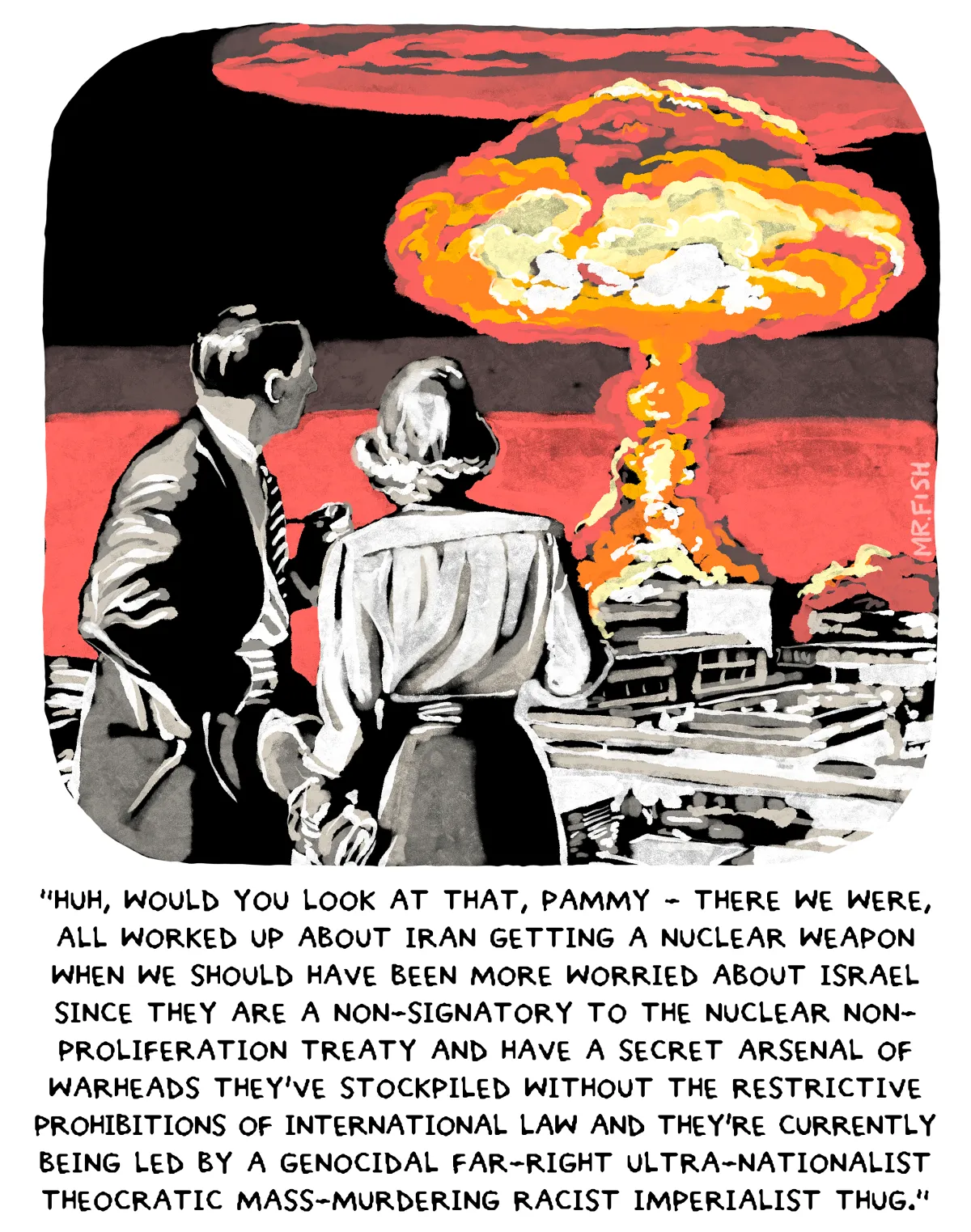
We Can’t Curb Nuclear Proliferation If We Don’t Acknowledge Israel’s Nukes.

This letter is a rare and important challenge to one of the most entrenched taboos in U.S. foreign policy: acknowledging that Israel has an undeclared nuclear arsenal for decades and that Washington has largely complied with Israel’s desire to maintain silence around it
The goal of nonproliferation cannot be credible if it is selective. Israel is not a signatory to the Nuclear Non-Proliferation Treaty, while Iran is.
There is no credible nonproliferation policy that begins by pretending not to see the bombs your ally already has.
Etan Mabourakh , Truthout, May 12, 2026, https://truthout.org/articles/we-cant-curb-nuclear-proliferation-if-we-dont-acknowledge-israels-nukes/?utm_source=Truthout&utm_campaign=603e7eec49-EMAIL_CAMPAIGN_2026_05_12_09_25&utm_medium=email&utm_term=0_bbb541a1db-603e7eec49-650192793
Thirty House Democrats, led by Rep. Joaquin Castro, publicly asked Secretary of State Marco Rubio on May 4 to end the long-standing U.S. policy of ambiguity around Israel’s nuclear capabilities. In a letter, the group asked for answers on detailed questions about Israel’s warheads, delivery systems, fissile material production, and nuclear doctrine. They argue that Congress has a constitutional responsibility to understand the nuclear balance in the Middle East and warn that official silence makes coherent nonproliferation policy impossible.
Lawmakers tied their demand for transparency directly to the current U.S.-Israeli war on Iran, warning that fighting alongside a state whose nuclear posture remains officially unacknowledged heightens the risks of miscalculation and escalation. It also makes the United States out to be hypocritical — citing the nonexistent threat of an Iranian nuclear weapon yet to be built, which Iran had forsworn, while simultaneously ignoring Israel’s secret, unmonitored, undiscussed nuclear weapons arsenal.
If the United States claims to be deeply concerned about nuclear proliferation in the region, the government has a responsibility to stop ignoring facts that make the entirety of U.S. foreign policy on proliferation look completely disingenuous. The U.S. cannot keep sending billions in weapons unconditionally to a nuclear-armed state while treating open discussion of that reality as impermissible.
This letter is a rare and important challenge to one of the most entrenched taboos in U.S. foreign policy: acknowledging that Israel has an undeclared nuclear arsenal for decades and that Washington has largely complied with Israel’s desire to maintain silence around it. That posture goes all the way back to a secret 1969 understanding that allowed the issue to remain publicly unspoken even as it has shaped regional calculations. For decades, Washington would not acknowledge Israel’s nuclear capability, and Israel would not confirm it. But declassified National Security Archive material suggests that by 1969, U.S. agencies had already accumulated enough sensitive evidence to treat the issue as a serious intelligence matter, while also deciding that political and foreign policy costs outweighed the benefits of pressing it openly. The result was an unofficial understanding that helped lock the subject inside a veil of deniability, even as internal investigations, wiretaps, and intelligence briefings continued behind the scenes.
If the formal public stance of the U.S. is to not support the existence of nuclear weapons in the Middle East — whether in Iran or Israel — then the foreign policy objective should be to advocate for a Middle East free of weapons of mass destruction. This would require acknowledging that war has utterly failed as a strategy to prevent that goal, especially when the fake threat of an active nuclear weapons program is used to justify military action — as has been the case in costly, useless U.S. wars in Iraq and now in Iran.
The goal of nonproliferation cannot be credible if it is selective. Israel is not a signatory to the Nuclear Non-Proliferation Treaty, while Iran is. Simply acknowledging that fact does not require putting full trust in Tehran to abide by the treaty — indeed, that’s why Iran has been subjected to countless inspection regimes; it simply means that any honest regional nonproliferation framework has to begin with the facts as they are, not as Washington prefers to describe them.
Those facts and suspicions have been a matter of public record for decades, even if U.S. officials have often refused to address them publicly. As far back as 1965, the U.S. government knew that over 200 pounds of highly enriched, weapons-grade uranium had gone missing from the Nuclear Materials and Equipment Corporation (NUMEC) plant in Pennsylvania — triggering enduring investigations and allegations by the CIA and other agencies that the material was clandestinely diverted to the Israeli nuclear program.
Decades later, in 1986, former Dimona technician Mordechai Vanunu leaked photographs and data to the Sunday Times that exposed the full scale of Israel’s covert weapons program. These facts have long been known and reported on by countless media outlets and scholars, even if they were officially evaded by the U.S. government.
That is why the Castro letter deserves attention beyond the news cycle. The lawmakers wrote that ambiguity about Israel’s program makes coherent nonproliferation policy impossible not only for Iran, but for Saudi Arabia, the United Arab Emirates and every other state making decisions based on the capabilities of its neighbors. These 30 Democrats are right to express this concern, and the principle involved is larger than one conflict: There’s no such thing as a rules-based order built on exceptions for allies and punishment for adversaries.
We will not be able to resolve complex issues of nuclear proliferation if we cannot even share a basic reality. The Orwellian “ceasefires” in Gaza, Lebanon, and Iran illustrate this clearly. The U.S. government and its allies lie, and then expect the other side to not just accept their terms, but also their version of the truth — a recipe for perpetual conflict.
Ironically, tragic and repeated U.S. failures of diplomacy have strengthened the most conservative forces inside Iran, who benefit most from isolation, siege, and perpetual confrontation. If U.S. officials profess to care about the Iranian people, regional peace, and genuine nonproliferation, they should be building diplomatic pathways that reduce incentives for weaponization, not destroying the possibility of trust altogether.
The United States should state openly what it knows, demand transparency from all regional actors, and return to the hard work of diplomacy. The rest of Congress should insist on answers to the questions raised in the Castro letter, not bury them. And anyone serious about preventing nuclear catastrophe should be willing to say a simple thing out loud: There is no credible nonproliferation policy that begins by pretending not to see the bombs your ally already has.
The risk of relying on EDF to deliver Europe’s nuclear renaissance
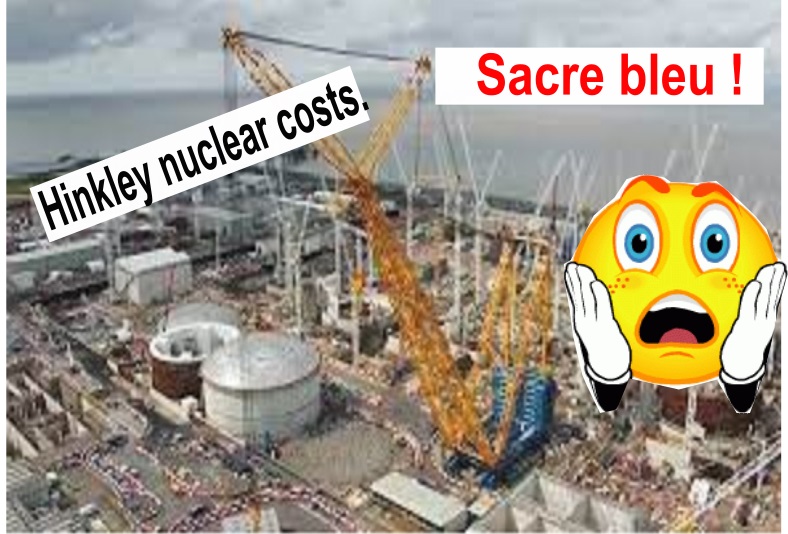
The group needs to cut costs and rejuvenate its reactor-building expertise. In
mid-March, France’s President Emmanuel Macron visited Penly in Normandy,
the site of two nuclear reactors due to start generating electricity from
2038. Donning a hi-vis coat and a white helmet, he hailed the “works of
the century”, saying France would “do for its children what our parents
did for us”.
Some 225km to the west, another nuclear power development
demonstrates how enormous that undertaking will be. Last December, the
Flamanville 3 reactor reached full power, 12 years after its scheduled
start-up date and costing seven times its original budget.
New reactors in
the UK have also been beset by delays and budget increases. EDF, the
state-owned company responsible for these projects, is Europe’s leading
nuclear power generator and, for many French, a potent symbol of the
country’s industrial and technological prowess. “There’s pride in the
industry, linked to nostalgia for a winning version of France,” says HEC
Paris professor François Gemenne.
But in the decades since France
commissioned its previous generation of reactors, EDF has mutated into a
sprawling, bureaucratic organisation. Its large workforce wields
considerable political influence. It often finds itself torn between its
own competing priorities and changing injunctions from a government that
has veered between cooling on nuclear and doubling down on it.
This backdrop makes the challenge of controlling costs and refining new
technology, while completing six new reactor units in France, plus four in
the UK over the next decade, all the more daunting. In an era of renewed
energy supply disruptions, EDF’s nuclear reactors are central to energy
security in France and, increasingly, across Europe.
As prices rise again
following the war in Iran, the task of renewing that fleet, and securing
nuclear’s place in a pan-European, low-carbon energy system, has taken on
even more importance. EDF has a lot to prove. The group has pinned its
fortunes on its own design for a water-pressurised reactor, but early
iterations in Finland and France came on stream more than a decade late and
more recent projects in the UK are also delayed.
EDF is also developing a
design for smaller reactors that might one day power data centres and
factories, although it faces competition from both established names such
as Rolls-Royce and Westinghouse and relatively new companies. The most
immediate test of EDF’s newer working methods will be the two reactors at
Sizewell C in the UK. These are supposed to be exact replicas of the
Hinkley Point C reactors in Somerset, which are currently due to enter
service in 2030.
FT 14th May 2026,
https://www.ft.com/content/4c48679b-edc3-4f81-b5be-9768fa2e63e5
Now You See Them… Now You Don’t – Trumpland Is a Man’s World

Focusing on Noem and Bondi, however, misses the larger point. This first year of Trump 2.0 has seen women, one after another, summarily gone from their posts (some fired, some resigning) as part of a larger DEI purge. As I pointed out in a TomDispatch piece in January, the military has led the way with a full-scale attack on women. And that trend started on the administration’s very first day in office when Trump removed Linda Fagan, the first female commandant of the Coast Guard.
Fagan was, in fact, the first woman ever to serve as a military service chief and, among other things, she had exposed “Operation Fouled Anchor,” a previously covered-up investigation into sexual harassment and assault in the Coast Guard. Admiral Lisa Franchetti, the first woman to lead the Navy, was fired as well. Both have now — no surprise — been replaced by men.
Women Leaders and Trump 2.0
Karen J. Greenberg Tom Dispatch, May 10, 2026, https://tomdispatch.com/now-you-see-them-now-you-dont/
It’s been a tough couple of months for women officials in Washington — or, more accurately, in Trumpland. In early March (Women’s History Month, by the way), in a Truth Social post, the president fired Secretary of Homeland Security Kristi Noem, the second woman ever to hold that title. Weeks later, also in a social media post, he fired Attorney General Pam Bondi, the third woman ever to serve as head of the Department of Justice.
While in the first year of his first presidency, Trump 1.0 had fired numerous officials, this time around, Bondi and Noem, who ran the two largest law enforcement agencies in the country, were the first cabinet officials to be dismissed. Both — no surprise — were replaced by men. And just as I was writing this piece, Trump removed another female cabinet official, Secretary of Labor Lori Chavez-DeRemer. Meanwhile, speculation lingers about the possible firing of a fourth female cabinet member, Director of National Intelligence Tulsi Gabbard, the second woman to hold that job. And whether or not Gabbard is formally dismissed, she has recently been effectively sidelined, as her absence from White House meetings on the war in Iran suggests.
Notably, Noem, Bondi, Chavez-DeRemer, and Gabbard are, of course, all women. As Jasmine Crockett, a Democratic House of Representatives member from Texas, recently tweeted, “Well… first it was Kristi Noem, now it’s Pam Bondi… it would be too much like right that Pete [Hegseth] be next. I see a theme. He [Trump] will throw the incompetent women under the bus a lot faster than the incompetent men.”
Equal Opportunity Failure
Crockett has a point. Pete Hegseth’s leadership at the Department of Defense (now all too appropriately retitled the Department of War) has erased time-honored rules and norms in staggering ways. He has, for instance, drastically reduced media access to the Pentagon, purged employees who disagreed with him, as well as those he deemed to be DEI (diversity, equity, and inclusion) appointees, and is now exerting his leadership in a war against Iran for which the exit strategy seems elusive at best, despite his assurance that, as the Guardian reported, “the U.S. would not get bogged down in the conflict.” The U.S. operation, he insisted, was not a “democracy-building exercise,” adding that ‘this is not Iraq. This is not endless.’”
Hegseth’s behavior has led Arizona Democratic Representative Yassamin Ansari to file articles of impeachment against him on six charges. They include the commission of war crimes, especially the killing of at least 165 people, including many children, at a girls’ primary school in Iran hit by a U.S. missile; negligence with sensitive information; and conducting an unauthorized war without congressional approval. In the Senate, Massachusetts Democrat Elizabeth Warren has followed up with a letter to U.S. Securities and Exchange Commission Chairman Paul Atkins asking for an investigation into whether Hegseth attempted to profit from his financial investments in the run-up to the war in Iran.
Crockett might just as easily have highlighted the wayward behavior of FBI Director Kash Patel, recently exposed in a piece in The Atlantic describing “excessive drinking” that interfered with his job (an article over which Patel immediately filed suit for $250 million in damages), or the trashing of health standards by Health and Human Resources Secretary Robert F. Kennedy, Jr.
But whatever the future of those reprehensible men in cabinet positions, it’s unfortunately difficult to defend either Bondi or Noem for their actions while in office. Like their male counterparts, both defiantly tossed professionalism and decency to the winds. Under Noem, with U.S. Immigration and Customs Enforcement (ICE) leading the way, the Department of Homeland Security (DHS) was weaponized and transformed into President Trump’s version of a homeland militia. It’s hardly a stretch to make the comparison to Hitler’s Brownshirts.
So far, in Trump’s second term in office, ICE has terrorized schools and businesses, while cruelly imprisoning migrants without due process of any sort. It has held children in detention centers under abhorrent conditions, attacked peaceful protesters, and killed citizens on the streets of America. Worse yet, Noem appropriated tens of millions of dollars to cover the costs of a pro-ICE ad featuring herself riding a horse in front of Mount Rushmore saying, “Break Our Laws, We’ll Punish You.” (Nor should we imagine that things will get any better without her.)
Bondi’s ouster followed failures of a different order — namely, her stumbling, wildly inept efforts to fulfill Trump’s agenda. She proved unable even to make the case of Trump pal Jeffrey Epstein go away, while what she had to say when releasing documents related to him led to accusations that her statements were riddled with falsehoods. Meanwhile, prosecutions under her watch of New York State Attorney General Letitia James and former FBI Director James Comey, high-priority items for the president, fell apart.
And when called before Congress to explain herself, her rank lack of civility resembled the behavior of a spoiled teenager berating her teacher, knowing that, since her parents wielded power over the school, she should fear no reprisals. Under Bondi, the sacrosanct mission of the Department of Justice as an agency independent of the White House was summarily tossed aside (as the roof-to-ground-floor Trump banner that hung from its office building demonstrated).
Female Purges
Focusing on Noem and Bondi, however, misses the larger point. This first year of Trump 2.0 has seen women, one after another, summarily gone from their posts (some fired, some resigning) as part of a larger DEI purge. As I pointed out in a TomDispatch piece in January, the military has led the way with a full-scale attack on women. And that trend started on the administration’s very first day in office when Trump removed Linda Fagan, the first female commandant of the Coast Guard.
Fagan was, in fact, the first woman ever to serve as a military service chief and, among other things, she had exposed “Operation Fouled Anchor,” a previously covered-up investigation into sexual harassment and assault in the Coast Guard. Admiral Lisa Franchetti, the first woman to lead the Navy, was fired as well. Both have now — no surprise — been replaced by men. As it stands, there are no longer any four-star women generals in the military. And only this month, we learned that Secretary of War Hegseth had reportedly removed two women from a promotion list to become one-star Army generals.
Outside of the Department of Defense, the resignations or firings of women in leadership positions have abounded across agencies ranging from the National Labor Relations Board to the Federal Trade Commission and the CDC.
This widespread purge of women stands in stark contrast to their presence in office during the Biden years. Under President Joe Biden, women held just under 50% of all cabinet or cabinet-level positions. And let’s not forget Kamala Harris, the first female vice-president in American history. It’s worth noting as well that, under Biden, the Deputy Attorney General and the Deputy Secretary of Defense were both women.
Trump is not unmindful of those statistics. Last year, he boasted about the presence of eight women among his 24 cabinet officers, or a third of his cabinet. As Business Insider reports, he was “thrilled to say that we have more women in our Cabinet than any Republican president in the history of our country.” Following the removal of Noem, Bondi, and Chavez-DeRemer, however, women occupy just over one-fifth of the cabinet positions — admittedly an improvement on his first term when, after two years of resignations and firings, women held only 13% of all cabinet-level positions.)
Project 2025
It’s worth noting that the path to the current backlash against women, including all the purges and punishments we’re now witnessing in real time, didn’t come about by mere happenstance. In the run-up to the 2024 election, the conservative think tank the Heritage Foundation published a Project 2025 report entitled Mandate for Leadership: The Conservative Promise, a 900-plus page blueprint for overhauling the federal bureaucracy. It called for gutting DEI programs, eliminating and reducing the size of any offices that didn’t serve a conservative agenda, and enhancing the powers of the president. Among its many recommendations, Project 2025 touted an anti-female message, including removing “gender equality” language from government websites, emphasizing “family planning,” and recommending limitations on access to contraception and cuts to federal funding for abortions.
Although Trump repeatedly distanced himself from Project 2025, many of its recommended policies have indeed become our new reality, including matters affecting women. In the first months of Trump’s second term, images of women, as well as persons of color and LGBTQ+ individuals, were systematically erased from government websites. So, too, protections for women’s health were tossed to the winds. As the abortion rights group Reproductive Freedom for All has reported, as of January 2026, “53% of [Project 2025’s] policies attacking reproductive freedom are completed or in progress.”
And now, there is a brand-new Heritage Foundation report devoted to the need to counter the declining birth rate and the fragility of the American family. “Saving America by Saving the Family: A Foundation for the Next 20 Years” calls for the restructuring of incentives to promote childbearing and “revive the institution of marriage.” Signaling its message, the report makes the case for privileging marriage and children over career advancement and less traditional family arrangements caused by divorce and single-parenthood. While the report underscores the family roles incumbent upon both men and women, the fact is that reforms aimed at incentivizing childbearing will fall primarily on women, while those aimed at privileging childrearing over career choices would likely fall most heavily on women as well.
MS NOW’s Ali Velshi and “Velshi” Segment Producer Amel Ahmed summed up the report well, pointing out that its overall takeaway is: “the freedoms fought [for] and won by America’s women aren’t progress; they are the problem.”
Of course, in the era of Donald Trump, none of this should come as a surprise, not when you consider the histories of the men who are now running the show: a president who, in addition to once touting the fact that he could “grab them by the pussy,” has been convicted in E. Jean Carroll’s civil suit over accusations of sexual abuse and defamation to the tune of $83.3 million in damages, a decision upheld by an appellate court. And let’s not forget that Trump’s first nominee for Attorney General, Matt Gaetz, withdrew his name from consideration under a cloud of accusations of wrongful behavior, including sexual misconduct. Not to mention the shadow cast by the number of individuals within the current administration whose names are said to appear in the Epstein files. While no formal charges of sexual misconduct have been issued against them, Commerce Secretary Howard Lutnick is reportedly being pressured to resign over his alleged ties to Epstein.
A Future Government Without Women?
It’s hard to predict which women will come under the axe from Trump and crew in the coming months. But the onslaught has understandably led women from both sides of the political spectrum to sound the alarm. Months before she announced her resignation from Congress, former Trump supporter Marjorie Taylor Greene had already expressed her own misgivings about the misogyny of the Republican leaders in Congress.
When Trump rescinded New York Congresswoman Elise Stefanik’s nomination to be the U.S. Representative to the United Nations and replaced her with Michael Waltz (who had embarrassed himself by adding a reporter to a private Signal chat about possible future strikes against the Houthis in Yemen), Greene saw it as a sign of a general trend of sidelining women. She summed it up as a case where Stefanik “gets shafted,” while Waltz “gets rewarded.” For Greene, it was proof of an overwhelming Trump administration mood of: “She’s a woman, so it was OK to do that to her somehow.”
Greene’s dissatisfaction wasn’t just over Stefanik but over the general trend that has led to only one Republican woman chairing a committee in Congress. Notably, alongside Greene, Republican representatives Nancy Mace and Laurent Boebert signed a petition pressuring the Department of Justice to release information on the Epstein files.
The signs are everywhere. Expectations are disappearing that women will hold leadership positions inside the Trump administration or in the halls of Congress (unless the Democrats win decisively in November). If you didn’t realize it before, you really can’t hide from it now. The attack on diversity in government has become pervasive and (at least as yet) is undeterred, targeting with abandon females, as well as people of color, immigrants, and critics of the president. In other words, the fate of women leaders should provide us with an insight, however dispiriting, into just how quickly the values and assumptions that guided this nation’s progress in matters of race, gender, and ethnicity for decades have disappeared.
What once amounted to progress is indeed now seen as the problem. Nowhere is this more apparent than in the exorcising of women from the halls of government.
Karen J. Greenberg is a future studies fellow at New America, a non-resident research fellow at the NYU Reiss Center for Law and Security, and co-host of the SpyTalk podcast. She is the author of many books, including Subtle Tools: The Dismantling of American Democracy from the War on Terror to Donald Trump.
1 This Month
1 June Webinar – The High Cost of Nuclear Power – Register

6 June – WEBINAR- Get Inspired by Protests Against Military Bases!


Cuba Is Not a Failed State – It Is a Besieged State
PETITION: “Global Appeal to Endorse Palestinian Right of Return of Refugees”


of the week– Nuclear Reactor Information Task Force
To see nuclear-related stories in greater depth and intensity – go to https://nuclearinformation.wordpress.com
-
Archives
- June 2026 (27)
- May 2026 (306)
- April 2026 (356)
- March 2026 (251)
- February 2026 (268)
- January 2026 (308)
- December 2025 (358)
- November 2025 (359)
- October 2025 (376)
- September 2025 (257)
- August 2025 (319)
- July 2025 (230)
-
Categories
- 1
- 1 NUCLEAR ISSUES
- business and costs
- climate change
- culture and arts
- ENERGY
- environment
- health
- history
- indigenous issues
- Legal
- marketing of nuclear
- media
- opposition to nuclear
- PERSONAL STORIES
- politics
- politics international
- Religion and ethics
- safety
- secrets,lies and civil liberties
- spinbuster
- technology
- Uranium
- wastes
- weapons and war
- Women
- 2 WORLD
- ACTION
- AFRICA
- Atrocities
- AUSTRALIA
- Christina's notes
- Christina's themes
- culture and arts
- Events
- Fuk 2022
- Fuk 2023
- Fukushima 2017
- Fukushima 2018
- fukushima 2019
- Fukushima 2020
- Fukushima 2021
- general
- global warming
- Humour (God we need it)
- Nuclear
- RARE EARTHS
- Reference
- resources – print
- Resources -audiovicual
- Weekly Newsletter
- World
- World Nuclear
- YouTube
-
RSS
Entries RSS
Comments RSS
 nuclear-news