nuclear-news

The News That Matters about the Nuclear Industry Fukushima Chernobyl Mayak Three Mile Island Atomic Testing Radiation Isotope

New Discovery At Fukushima Unit 3 Provides Clues To Meltdown Severity, Environmental Releases

u3_explosion_web.jpg

May 3, 2019
TEPCO recently published a video of the work to remove spent fuel from the unit 3 fuel pool. In this video was an unexpected finding with serious implications.
In the video of the fuel assembly removal from a fuel rack inside the spent fuel pool, was a tell tale sign of something significant. Prior to the effort to remove fuel from the pool, the pool underwent significant cleaning work. This included removing most of the debris that fell into the pool along with use of a vacuum to remove small pieces of broken concrete and dust.
What remains adhered to the side of the fuel rack appears to be the same thick white substances found inside the reactor containment of unit 3 and in the pedestal below the reactor vessel. These substances also have the same appearance as those inside containment. They are stuck to both vertical and horizontal surfaces as if they splattered then stuck to where they landed. What these may be and how they managed to end up on the fuel racks is explained further in this report.
Read more:
Simply Info

New Discovery At Fukushima Unit 3 Provides Clues To Meltdown Severity, Environmental Releases

May 8, 2019 Posted by | fukushima 2019 | , , | Leave a comment

Novellas express anger after Fukushima disaster
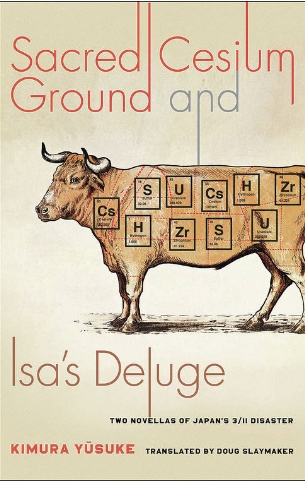
sacred cesium and isa's deluge“Sacred Cesium Ground and Isa’s Deluge: Two Novellas of Japan’s 3/11 Disaster,” by Yusuke Kimura, translated by Doug Slaymaker (Columbia University Press, 2019, 176 pages, $60 hardcover, $20 paperback)

May 2, 2019
TOKYO >> An anger directed toward Tokyo underlies Yusuke Kimura’s two novellas, “Sacred Cesium Ground” and “Isa’s Deluge.” Born from a keen sense of abandonment felt by the Tohoku region in the aftermath of the catastrophic earthquake and tsunami on March 11, 2011, and the subsequent nuclear accident at the Fukushima Daiichi Nuclear Power Plant, this anger plays out across stories exploring the post-disaster relationships between humans and animals.
The protagonist in “Sacred Cesium Ground” is a woman who travels to Fukushima Prefecture to volunteer at the Fortress of Hope, a farm where cattle irradiated by the Fukushima No. 1 power plant meltdown are tended to despite a government order to kill them.
Based on the story of a real post-Fukushima ranch, the novella carries with it a weight of research born from the author’s own volunteering, though it proves ultimately unsatisfying, never quite reaching the moment of reinvention that the lead character hints at throughout.
“Isa’s Deluge” is the more readable of the two, with a flow and pacing that draws in the reader. Shortlisted for the Mishima Yukio Prize after it was first published in 2012, it follows a family of fishermen who relate the story of their uncle Isa and his “deluge” of pain and depression, an allegory of the 3/11 tsunami.
Both novellas highlight peripheral voices in the post-3/11 period and ultimately return time and again to that tension between a “sacrificial” Tohoku and an all-powerful capital. These perspectives are those not frequently heard and challenge the widespread narrative of an ever-dominant Tokyo.
https://www.staradvertiser.com/2019/05/02/news/novellas-express-anger-after-fukushima-disaster/?fbclid=IwAR362Oqn0duTDDCRh0Ta6AIklIq8ippMFC1PbBVUp2bN2v4NupNVg1YS_9I

May 8, 2019 Posted by | fukushima 2019 | , , , | Leave a comment

Japan’s nuclear horror relived as people return to Fukushima’s ghost towns

safe_image.php.jpg
April 29, 2019
More than 200,000 inhabitants within a 20km radius were forced to evacuate, after the Fukushima Daiichi nuclear power plant was damaged by the Japan Tsunami in 2011
Wide streets still lie empty, scavenging boar and monkeys the only signs of life.
Only wild animals, and the 6ft weeds, which have rampaged through deserted homes and businesses, suffocating once-chatty barbers shops and bustling grocery stores; strangling playgrounds and their rusting rides which lie empty and eerily still.
Laundry hangs where it was pegged out to dry, clock faces are frozen in time, traffic lights flash through their colours to empty roads, meals laid out on tables in family homes, remain uneaten.
Once unextraordinary, mundane symbols of everyday lives have taken on the appearance of a horror film set in these areas closest to the Fukushima Daiichi nuclear power station on the coast of north-east Japan, eight years after the devastating tsunami which caused a meltdown at three of the plant’s reactors, forcing tens of thousands to flee.
The earthquake on March 11, 2011, claimed 19,000 lives, and triggered the world’s largest nuclear disaster since Chernobyl.
Radiation leaking in fatal quantities forced 160,000 people to evacuate immediately, and most to this day have not returned to their toxic towns and villages.
Yet there are now areas, ever closer to the plant, beginning to show signs of awakening.
The government is keen residents return as soon as it is safe, and this month around 40% of the town of Okuma, which sits just west of the plant, was declared safe for habitation thanks to ongoing decontamination efforts carried out on an superhuman scale.
The official mandatory evacuation order was lifted, and while reports reveal just 367 residents of Okuma’s original population of 10,341 have so far made the decision to return, and most of the town remains off-limits, the Japanese government is keen this be seen as a positive start to re-building this devastated area.
“This is a major milestone for the town,” Toshitsuna Watanabe, mayor of Okuma, told Japanese news outlets, as six pensioners locally dubbed ‘The Old Man Squad’, who had taken it upon themselves to defy advice and keep their town secure, finally ceased their patrols.
“It has taken many years to get to where we are now, but I am happy that we made it.”
The Japanese Prime Minister, Shinzo Abe, visited to mark the milestone.
The government is particularly keen to show progress before the 2020 Olympic Games in Tokyo.
Six Olympic softball games and a baseball game will be staged in Fukushima, the capital of this prefecture, which is free of radiation.
The torch relay will even begin at J Village, which was once the base for the crisis response team. Hearteningly, it is now back to its original function, a football training centre.
But the truth is, it is mainly older residents who have decided to return to their homes.
Seimei Sasaki, 93, explained his family have roots here stretching back 500 years.
His neighbourhood in Odaka district now only contains 23 of its original 230.
“I can’t imagine what this village’s future looks like,” he admitted.
Young families are few and far between – these areas are still a terrifying prospect for parents.
But the re-built schools are slowly filling a handful of classroom seats.
Namie Sosei primary and middle school, less then three miles from the plant, has seven pupils.
One teacher said: “The most frustrating thing for them is that they can’t play team sports.”
A sad irony as the Olympics approach.
And with so many residents still fearful, so the deadly clean-up operation continues.
Work to make the rest of Okuma safe is predicted to take until 2022. The area which was its centre is still a no-go zone.
In the years following the disaster, 70,000 workers removed topsoil, tree branches, grass and other contaminated material from areas near homes, schools and public buildings.
A staggering £21billion has been spent in order to make homes safe.
Millions of cubic metres of radioactive soil has been packed into bags.
By 2021 it is predicted 14million cubic metres will have been generated.
The mass scale operation uses thousands of workers. Drivers are making 1,600 return trips a day.
But residents understandably want it moved out of Fukushima for good.
As yet, no permanent location has agreed to take it, but the government has pledged it will be gone by 2045.
At Daiichi itself, the decontamination teams are battling with the build up of 1m tonnes of radioactive water.
The operator has also finally begun removing fuel from a cooling pool at one of three reactors that melted down in the 2011 disaster.
Decommissioning the plant entirely is expected to take at least four decades.
The efforts to return this area to its former glory are mammoth, and even if they ever fully succeed, it will surely take many more years until most former residents and their descendants gain enough trust to return.

May 1, 2019 Posted by | fukushima 2019 | , , | Leave a comment

Japan insists on pushing its contaminated seafood to South Korea, despite WTO ruling!

20228976_1330173750369215_4944234602815822616_n.jpg
Japan denounces WTO ruling in favor of South Korean ban on some Japanese seafood
GENEVA – Tokyo on Friday denounced a recent World Trade Organization ruling that supported a South Korean ban on imports of some Japanese fishery products introduced in the wake of the 2011 Fukushima nuclear disaster.
“Japan is deeply concerned that the appellate body report dismissed the panel’s findings founded on solid scientific evidence,” Junichi Ihara, Japan’s representative in Geneva, said at a meeting of the global trade watchdog’s dispute settlement body.
The WTO’s appellate body for dispute settlement on April 11 ruled in favor of South Korea’s import ban on fishery products from Fukushima and seven other prefectures, reversing an earlier decision.
It said the initial decision “erred in its interpretation and application” of WTO rules on food safety, but did not look at details related to the amount of radioactive contaminants in Japanese food products or the level of protection South Korean consumers should have.
Calling the appellate body’s judgment “extremely regrettable,” Ihara argued that it “could have a negative impact on perceptions of the safety of Japanese foods and on those seeking to export their products to countries such as Korea.”
The ruling is final, as the appellate body is the highest authority in the WTO’s dispute-settlement mechanism.

May 1, 2019 Posted by | fukushima 2019 | , , | Leave a comment

Japan needs thousands of foreign workers to decommission Fukushima plant, prompting backlash from anti-nuke campaigners and rights activists

Activists are not convinced working at the site is safe for anyone and they fear foreign workers will feel ‘pressured’ to ignore risks if jobs are at risk
Towns and villages around the plant are still out of bounds because radiation levels are dangerously high
e7281c2a-672a-11e9-a2c3-042d2f2c8874_image_hires_123125.JPG
Workers move waste containing radiated soil, leaves and debris from the decontamination operation at a storage site in Naraha town.
26 Apr, 2019
Anti-nuclear campaigners have teamed up with human rights activists in Japan to condemn plans by the operator of the crippled Fukushima Daiichi nuclear plant to hire foreign workers to help decommission the facility.
Tokyo Electric Power Co (TEPCO) has announced it will take advantage of the government’s new working visa scheme, which was introduced on April 1 and permits thousands of foreign workers to come to Japan to meet soaring demand for labourers. The company has informed subcontractors overseas nationals will be eligible to work cleaning up the site and providing food services.
About 4,000 people work at the plant each day as experts attempt to decommission three reactors that melted down in the aftermath of the March 2011 Great East Japan Earthquake and the huge tsunami it triggered. Towns and villages around the plant are still out of bounds because radiation levels are dangerously high.
TEPCO has stated foreign workers employed at the site must have Japanese language skills sufficient for them to understand instructions and the risks they face. Workers will also be required to carry dosimeters to monitor their exposure to radiation.
Activists are far from convinced working at the site is safe for anyone and they fear foreign workers will feel “pressured” to ignore the risks if their jobs are at risk.
“We are strongly opposed to the plan because we have already seen that workers at the plant are being exposed to high levels of radiation and there have been numerous breaches of labour standards regulations,” said Hajime Matsukubo, secretary general of the Tokyo-based Citizens’ Nuclear Information Centre. “Conditions for foreign workers at many companies across Japan are already bad but it will almost certainly be worse if they are required to work decontaminating a nuclear accident site.”
Companies are desperately short of labourers, in part because of the construction work connected to Tokyo hosting the 2020 Olympic Games, while TEPCO is further hampered because any worker who has been exposed to 50 millisieverts of radiation in a single year or 100 millisieverts over five years is not permitted to remain at the plant. Those limits mean the company must find labourers from a shrinking pool.
In February, the Tokyo branch of Human Rights Now submitted a statement to the UN Human Rights Council in Geneva demanding action be taken to help and protect people with homes near the plant and workers at the site.
“It has been reported that vulnerable people have been illegally deceived by decontamination contractors into conducting decontamination work without their informed consent, threatening their lives, including asylum seekers under false promises and homeless people working below minimum wage,” the statement said. “Much clean-up depends on inexperienced subcontractors with little scrutiny as the government rushes decontamination for the Olympic Games.”
Cade Moseley, an official of the organisation, said there are “very clear, very definite concerns”.
“There is evidence that foreign workers in Japan have already felt under pressure to do work that is unsafe and where they do not fully understand the risks involved simply because they are worried they will lose their working visas if they refuse,” he said.
In an editorial published on Wednesday, the Mainichi newspaper also raised concerns about the use of semi-skilled foreign labourers at the site.
“There is a real risk of radiation exposure at the Daiichi plant and the terminology used on-site is highly technical, making for a difficult environment,” the paper said. “TEPCO and its partners must not treat the new foreign worker system as an employee pool that they can simply dip into.”
The paper pointed out that it may be difficult to accurately determine foreign employees’ radiation levels if they have been working in the nuclear industry before coming to Japan, while they may also confront problems in the event of an accident and they need to apply for workers’ accident compensation. TEPCO has played down the concerns.
“About 4,000 Japanese workers are already working on the decommissioning and clean-up work at Fukushima Dai-ichi,” the company said. “The amendment to the regulations on workers from overseas is a measure that creates more employment opportunities, including for foreign nationals with specific skills.
“In March, TEPCO explained the new regulations to its contractor companies involved in the clean-up work at Fukushima Dai-ichi and we have also confirmed that those companies will be in compliance with the regulations covering the safety of workers.”

May 1, 2019 Posted by | fukushima 2019 | , | Leave a comment

Counterterrorism requirement puts financial strain on nuclear power plant operators
safe_image.php.jpg
April 24, 2019
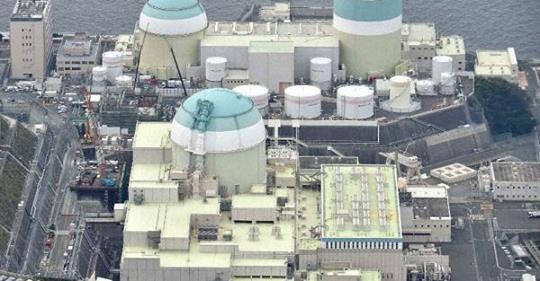
TOKYO — Nine nuclear reactors at five plants in Japan are expected to start going offline in succession from March 2020 because their operators cannot meet deadlines for implementing counterterrorism measures set by Japan’s nuclear regulator.
The five plants are operated by Kyushu Electric Power Co., Shikoku Electric Power Co., and Kansai Electric Power Co. They stand one to three years behind their respective deadlines for implementing counterterrorism measures set under a new policy of the Nuclear Regulation Authority (NRA). The situation is likely to disrupt the power companies’ plans to win customers by lowering their fees through the operation of nuclear reactors.
“If things continue like this, we’ll have to stop operating the Sendai Nuclear Power Plant in about one year. From a management perspective it’s tough,” one Kyushu Electric official lamented.
According to the three companies, when one plant stops operating, fuel costs for operating thermal power plants to make up for the electricity supply increase by between 3.5 billion yen and 6.5 billion yen a month. Kansai Electric and Kyushu Electric, which have multiple reactors in operation, could see their operating costs balloon by around 100 billion yen a year as a result.
Amid intense competition with Osaka Gas and other new electricity retailers, it is not viable for the power companies to ask customers to pay more for electricity.
Shikoku Electric in western Japan has already decided to decommission the No. 1 and No. 2 reactors at its Ikata Nuclear Power Plant in Ehime Prefecture, and operation of the plant’s No. 3 reactor, the sole remaining one, was viewed as a major premise for establishing stable financial management.
In light of the situation, the power companies’ sale of electricity to other firms is set to decrease, which is certain to hit power companies in the pocket — highlighting the risks of relying on nuclear power.
The nuclear regulator’s move is also likely to significantly affect Japan Atomic Power Co.’s plans to restart its Tokai No. 2 Power Station in Ibaraki Prefecture, northeast of Tokyo. In November last year, the power plant passed screening by the NRA to enable its reactivation, and received permission to keep operating for another 20 years. However, it has not even compiled an estimate for the cost of building a facility required under the counterterrorism guidelines.
Under NRA rules, nuclear plant operators are required to build facilities at least 100 meters away from reactor buildings that are able to remotely prevent meltdowns if the units come under terrorist attacks such as planes being flown into them. The facilities must be built within five years of the NRA approving plant construction plans.
A Ministry of Economy, Trade and Industry official observed, “This could be described as a birth pang in the process of boosting safety, but it’s an unfavorable wind in the short term.” Meanwhile, Tadashi Narabayashi, a specially appointed professor at Tokyo Institute of Technology, commented, “Power companies were hoping that things would go easy for them, but the NRA should have made it clear from the outset that they were not going to allow any extensions beyond the 5-year limit. The responsibility for the confusion lies on both sides.”

May 1, 2019 Posted by | Japan | , | Leave a comment

Safety, language measures needed for foreigners to work at Fukushima plant

afp-20170223-japan-fukushima_838FD18EE55D4E3098C81EBBCE08E8D5.jpg
April 24, 2019
Tokyo Electric Power Co. (TEPCO) is preparing to bring in
foreign workers with special technical skills to join decommissioning work on the disaster-stricken Fukushima Daiichi nuclear plant.
At present, an average of 4,000 employees of TEPCO and cooperating firms work at the facility every day. Laws and regulations stipulate that workers’ radiation exposure must be limited to 50 millisieverts in a single year, and 100 millisieverts over five years. No one is allowed to stay at the plant once they hit one of these caps, so waves of new employees must be brought in to maintain worker numbers.
Decommissioning the Daiichi plant, which suffered a triple core meltdown in the wake of the March 2011 Great East Japan Earthquake and tsunami, is expected to take 30 to 40 years. Whether the companies involved can sustain sufficient staffing levels will be one factor that determines the success or failure of the project.
When it comes to tapping foreign labor to make up the required numbers, the Justice Ministry — which has jurisdiction over Japan’s immigration system — has already declined to approve sending foreign technical intern trainees to work at the plant. One of the core tenets of the foreign technical trainee program is that the job placements must provide the trainees with skills they can use in their home countries, and working to decommission a devastated nuclear plant did not fit the bill.
TEPCO is now turning its eyes to foreign workers with Category 1 work visas, one of the new residency statuses launched on April 1 and aimed at those with certain skills and experience. Technical trainees with three years’ experience in Japan can obtain this visa without a skills exam.
However, there is a real risk of radiation exposure at the Daiichi plant, and the terminology used on-site is highly technical, making for a difficult environment. TEPCO and its partners must not treat the new foreign worker system as an employee pool they can simply dip into.
The workers’ Japanese level is particularly a cause for worry. To obtain a Category 1 visa, applicants must speak Japanese at only a “daily conversational” level. However, anyone working at the Daiichi site must understand a slew of technical terms related to radiation and other facets of the decommissioning process, meaning a very high level of Japanese is absolutely indispensable. If foreign employees begin working there without having learned the necessary terminology, we believe there is a real risk they could be ordered to do jobs that exposed them to radiation.
TEPCO has said it is up to its project partners whether they employ Category 1 foreign workers. In fact, the majority of people at Fukushima Daiichi are employed by one of the firms that make up the layers upon layers of subcontractors working on the decommissioning. Nevertheless, as the company heading the project, TECPO has a responsibility to oversee the conditions of every worker, right down to the bottom of the pyramid.
Furthermore, if a foreign worker has been exposed to radiation overseas, that dose must be added to their sievert count at the plant. However, it is up to the worker to report any previous radiation exposure, which can make it difficult to properly track and manage their doses.
If a worker develops a radiation-related illness after returning to their home country, will they be able to smoothly apply for workers’ accident compensation? This is also a serious worry.
If Japan is to accept foreign workers to help decommission the Fukushima Daiichi plant, it is absolutely essential to create the appropriate environment, including measures to boost their Japanese skills and strengthen radiation exposure management.

May 1, 2019 Posted by | fukushima 2019 | , | Leave a comment

Japan to shut down nuclear plants if counterterror steps not taken in time
n-nuclear-a-20190425-200x200.jpg
April 24, 2019
Japan’s nuclear regulator decided Wednesday not to let power companies operate reactors if they fail to install sufficient counterterrorism measures by specified deadlines.
The decision by the Nuclear Regulation Authority came after three utilities that operate five nuclear plants in western and southwestern Japan requested that their deadlines be extended as they expect delays in completing counterterrorism steps required under stricter regulations introduced in 2013 following the Fukushima nuclear crisis.
Kyushu Electric Power Co., Kansai Electric Power Co. and Shikoku Electric Power Co. had sought to postpone their five-year deadlines by one to three years, citing reasons such as the need to carry out massive construction work.
The three companies told the NRA that the measures would not be on time at 10 of their reactors, according to documents published on the regulator’s website.
But the regulator has declined their requests for extensions.
The power plant operators are required to build facilities that can keep reactors cool via remote control and prevent the massive release of radioactive materials if the units are the target of a terrorist attack, such as from planes being flown into them.
Nuclear plant operators need to set up such facilities within five years of the nuclear safety watchdog approving detailed construction plans for the plants.
But several firms have warned they will not meet these criteria. The NRA said after a meeting earlier Wednesday it would no longer push back the deadline as it has done in the past.
“There is no need to extend the deadline, and nuclear facilities have to stop operations if the operators fail to meet it,” an NRA official said.
He added that several other reactors were also at risk of being shut down.
A reactor at the Sendai power plant in Kyushu could be the first to be suspended if Kyushu Electric Power fails to finish work by the deadline next March.
Following the No. 1 reactor at the Sendai plant, the No. 2 reactor at the complex is facing a deadline in May 2020. The deadline for the No. 3 reactor at the Takahama plant in Fukui Prefecture operated by Kansai Electric is August 2020.
At an NRA meeting Wednesday, one of the commissioners said, “The construction work did not fall behind schedule because of natural disaster,” expressing the view that there is no need to extend the deadlines.
“We cannot overlook the operations of nuclear facilities when they become incompatible with meeting standards,” NRA Chairman Toyoshi Fuketa said.
Before the Fukushima disaster, Japan relied on nuclear power for roughly 30 percent of its electricity. But this declined to less than 2 percent after the crisis as reactors were suspended for emergency safety checks, with many unable to resume operations under the stricter rules. The ratio has since recovered somewhat, but it remains below 10 percent due to a protracted process of stringent safety checks by the regulator.
Shares of all three companies tumbled on the news. Kansai Electric ended down 7.8 percent, Kyushu Electric fell 5.3 percent and Shikoku Electric dropped 5 percent.
A draft by the industry ministry said nuclear should account for 20 to 22 percent of power supply in 2030 and renewables 22 to 24 percent, in line with the trade ministry’s goals set in 2015.
But many experts view the nuclear target as difficult to achieve in the wake of the 2011 Fukushima crisis, which led to a big shift in public opinion after it exposed industrial and regulatory failings and led to the shutdown of all the country’s reactors.

May 1, 2019 Posted by | Japan | , | Leave a comment

TEPCO transfers some fuel from Fukushima plant No. 3 unit pool
reactor 3 fuel removal 23 april 2019 3.jpg
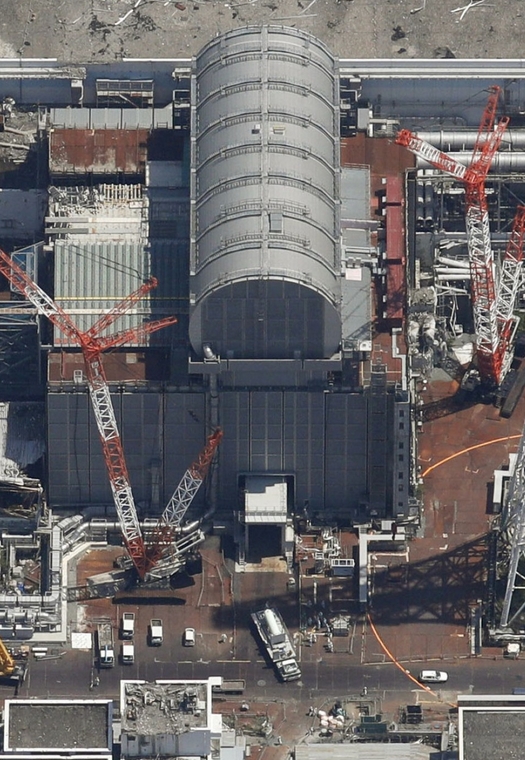
This photo taken from a Kyodo News helicopter shows a trailer (bottom center) thought to be carrying nuclear fuel from one of the reactor buildings at the Fukushima Daiichi Nuclear Power Plant.
April 23, 2019
FUKUSHIMA, Japan(Kyodo) — The operator of the crippled Fukushima Daiichi Nuclear Power Plant said Tuesday it has transferred some nuclear fuel from one of the reactor buildings damaged by hydrogen explosions in the 2011 disaster to another location for safer storage and management.
It was the first removal of such fuel from storage pools of the Nos. 1 to 3 units, which suffered meltdowns after losing power in the crisis triggered by a massive earthquake and tsunami.
Seven unspent fuel rod assemblies were transferred Tuesday to a common pool about 100 meters away, according to Tokyo Electric Power Company Holdings Inc.
The transfer of nuclear fuel, which emits high levels of radiation, from the No. 3 unit pool is expected to lower the risk of the decommissioning work. The utility began the process of removing fuel there on April 15.
At around 11:15 a.m. Tuesday, a trailer began relocating the fuel assemblies, placed in a cylinder-shaped cask, to the common pool. The task was completed in about 20 minutes, carried out by about a dozen workers donning protective gear.
Since the common pool undergoes regular checkups required by law, the fuel transfer will be suspended possibly until July, the operator said.
TEPCO aims to transfer all of the remaining 559 spent and unspent fuel assemblies in the No. 3 unit storage pool to the common pool by March 2021.
The fuel removal at the No. 3 unit was originally scheduled to start in late 2014, but was pushed back multiple times as high levels of radiation, among other factors, caused delays in preparation of fuel transfer.
In fiscal 2023, the utility aims to start the task of removing fuel at the storage pools of the Nos. 1-2 units and has been assessing their surroundings.
Even if the fuel removal work progresses smoothly, TEPCO still faces the biggest challenge involved in the decommissioning of the crippled plant — retrieval of melted fuel that has dripped down in the containment vessels — at the Nos. 1-3 units.

April 23, 2019 Posted by | fukushima 2019 | , , , | Leave a comment

Despite WTO ruling Japan still insists on pushing its Fukushima seafood to South Korea

There is one word in Japanese to describe such disgusting behavior: “shitsukoi”
Like when one man insists on pushing himself on a woman who isn’t at all interested!

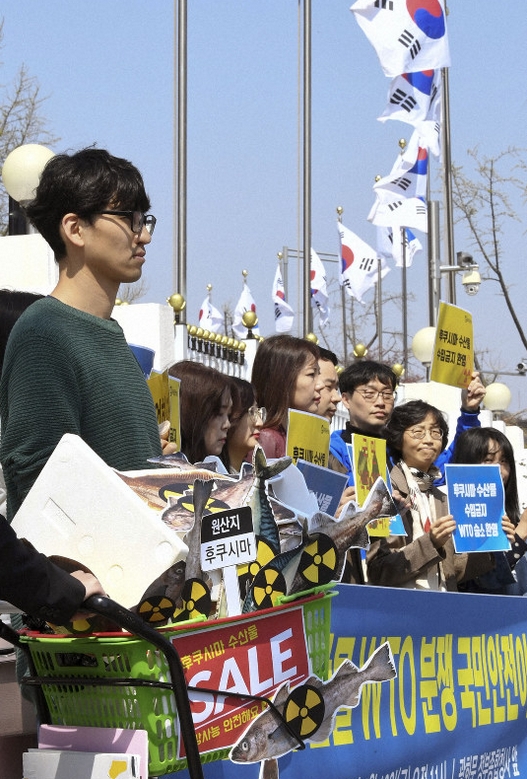
Japan asks S. Korea to lift Fukushima seafood ban despite WTO ruling
gjkllm.jpg
Members of a civic group celebrate in Seoul on April 12, 2019, after the World Trade Organization ruled the previous day in favor of the country’s ban on imports of some Japanese fishery products introduced in the wake of the 2011 Fukushima nuclear disaster, reversing an earlier decision against the restrictions.
April 23, 2019
TOKYO(Kyodo) — Japan on Tuesday urged South Korea to lift import restrictions on Japanese seafood introduced in the wake of the 2011 Fukushima nuclear disaster, even after the World Trade Organization ruled in favor of Seoul over the issue.
Kenji Kanasugi, head of the Japanese Foreign Ministry’s Asian and Oceanian Affairs Bureau, told his South Korean counterpart Kim Yong Kil in Tokyo that Japanese seafood is free of radioactive contamination and safe to eat, according to Japanese sources familiar with the matter.
During the talks, the South Korean Foreign Ministry insisted the restrictions are legitimate due to it wishing to prioritize the “health and safety” of the people.
Seoul imposed a ban on some types of seafood products from eight prefectures, including Aomori, Fukushima, and Chiba, in the wake of the 2011 reactor core meltdowns at the Fukushima Daiichi nuclear power plant triggered by a powerful earthquake and tsunami.
It expanded the ban in September 2013 to include all seafood products from the eight prefectures, and added a requirement that Japanese companies attach safety certificates when any traces of radiation are found in seafood from other regions.
In August 2015, Tokyo filed a complaint with the WTO against the restrictions, which it considers unfair discrimination, and an initial ruling by a dispute settlement panel sided with Japan. South Korea appealed the decision, however, and the WTO’s appellate body, the highest judicial entity of its dispute settlement mechanism, ultimately ruled in Seoul’s favor on April 11.
During Tuesday’s meeting, Kanasugi and Kim also made no progress towards a resolution in the dispute concerning recent South Korean top court rulings ordering Japanese companies to pay compensation for wartime forced labor.
Japan maintains that the issue has been resolved “finally and completely” under a 1965 accord between the two countries to settle property claims signed alongside the Japan-South Korea treaty that established diplomatic ties.
Kanasugi reiterated Japan’s call to open consultations between the governments based on the accord and asked South Korea to take measures to protect Japanese companies from facing any economic damage stemming from the rulings.
But Kim neither accepted nor refused the request, according to the sources.

April 23, 2019 Posted by | Uncategorized | , , | Leave a comment

Fukushima exports beef to the U.S. ?

I am sure that some of our american friends will be interested to know that there is not enough beef in the U.S., that U.S. needs to import Fukushima beef!!!

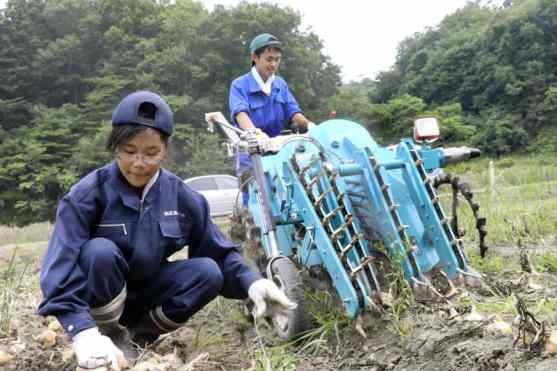
Fukushima agricultural exports bounce back from nuclear disaster to hit record high
b-fukushima-a-20190424-870x580.jpg
Farmers harvest onions in Minamisoma, Fukushima Prefecture.
April 23, 2019
FUKUSHIMA – Exports of agricultural products produced in Fukushima Prefecture rose about 2 percent in fiscal 2018 to a record 217.8 tons, according to the prefectural government.
Fukushima’s agricultural exports suffered a long slump due to the 2011 nuclear crisis.
But exports hit a record high for the second straight year, backed by an expansion in rice exports to Malaysia in fiscal 2017 and in exports of Japanese pears and other items to Vietnam and Thailand in fiscal 2018.
In fiscal 2018, which ended last month, exports of peaches and Japanese persimmons were sluggish due in part to unfavorable weather.
Shipments of rice to Malaysia, at about 115 tons, led the total exports, as in fiscal 2017. Exports of apples to Thailand and beef to the United States also grew.
Following the disaster at the Fukushima No. 1 nuclear plant, the prefecture’s agricultural exports plunged due to import restrictions by countries concerned about radioactive contamination, falling to 2.4 tons in fiscal 2012.
The prefectural government has strengthened efforts to boost exports to Southeast Asian countries since the restrictions were scrapped.
In fiscal 2017, Fukushima’s agricultural exports came to 213.3 tons, exceeding the then-record of 152.9 tons in fiscal 2010, helped by about 101 tons of rice shipments to Malaysia.

April 23, 2019 Posted by | fukushima 2019 | , , | Leave a comment

Fukushima soccer facility, repurposed after 3/11 disaster, fully reopens

The madmen’s denial continues, pretending that it is all clean and safe. Like if nothing ever happened. Children’s future sacrificed in the name of politicians’ holy economics.
n-jvillage-a-20190421-870x585.jpg
Children exercise at the J-Village national soccer training center in the town of Naraha, Fukushima Prefecture, on Saturday after it resumed full operations.
April 20, 2019
FUKUSHIMA – The J-Village national soccer training center in Fukushima Prefecture resumed full operation Saturday, eight years after it was converted into an operational base to cope with the nuclear disaster that hit the prefecture in 2011.
The facility, established in 1997, has already been selected as the starting point for the Japan leg of the 2020 Tokyo Olympic torch relay, a move aimed at highlighting the country’s efforts to recover from the devastating earthquake and tsunami on March 11, 2011, that triggered the meltdown at the Fukushima No. 1 nuclear plant.
The torch relay will start at the facility in March 2020.
Until March 2017, the training center was used as a logistics hub and a lodging facility for workers involved in the cleanup and other disaster response operations at the crippled facility located some 20 kilometers to the north. The operational base function has been moved to the power plant.
The training complex has been renovated, and an indoor practice field and hotel with conference rooms have been added.
A large part of the complex had already resumed operations by July 2018, with the exception of two playing fields.
Also on Saturday, East Japan Railway Co. opened a new station near the J-Village.
“I hope (the full reopening) will contribute to Fukushima’s revival,” said a 42-year-old woman arriving at the station on Saturday morning.
The woman, who lives in the prefecture, was planning to visit the J-Village site.

April 23, 2019 Posted by | fukushima 2019 | , | Leave a comment

Ministry limits foreigners doing Fukushima cleanup

foreign workers ruled out 19 april 2019.jpg
April 19, 2019
Japanese Justice Minister Takashi Yamashita has outlined a restriction pertaining to the country’s new visa program. He said foreign nationals won’t be allowed to work in Japan if their main task is to do decontamination work at the crippled Fukushima Daiichi nuclear power plant.
 
Yamashita’s remark on Friday follows the plant operator’s statement that it will accept foreign workers hired under the new visa program to help decommission the facility.
 
Tokyo Electric Power Company says that construction, industrial machinery and automobile maintenance will be relevant to the decommissioning. The utility told the contractors to make sure they hire foreign workers legally.
 
TEPCO also says it’s not aware of a shortage of workers in the decommissioning process, but that it is up to the contractors to decide whether to hire foreigners under the new visa category.
 
Yamashita said that the Justice Ministry and other relevant ministries will ensure that foreigners in the program are eligible for the jobs they are hired to do.
 
Yamashita said foreigners coming to work in the construction sector must not be hired if their main job is decontamination work.
 
Chief Cabinet Secretary Yoshihide Suga said the industry ministry will supervise TEPCO to make sure the utility’s operations are legal and that the plant’s reactors are decommissioned safely and stably.
 
A revised immigration law that took effect on April 1 allows foreign nationals with certain vocational skills to work in a range of sectors under a new visa category.
 

April 23, 2019 Posted by | fukushima 2019 | , | Leave a comment

TEPCO plans to use new foreign workers at Fukushima plant
jhkl.jpg
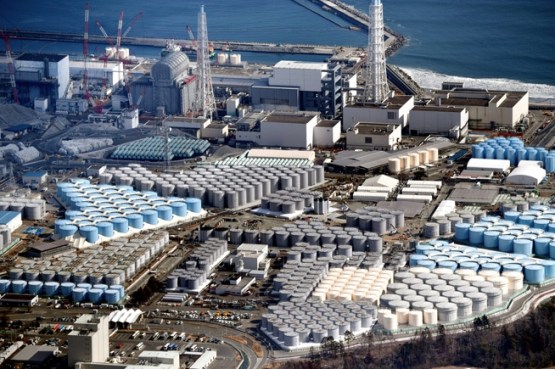
Rows of storage tanks hold radiation-contaminated water on the grounds of the Fukushima No. 1 nuclear power plant.
April 18, 2019
Tokyo Electric Power Co. plans to use the new visa program to deploy foreign workers to its crippled Fukushima No. 1 nuclear plant, sparking concerns that language barriers could cause safety hazards and accidents.
The specified skills visa program started in April to alleviate labor shortages in 14 different industrial sectors. TEPCO says it has long lacked enough workers for decommissioning work at the Fukushima nuclear plant.
At a March 28 meeting, the utility explained its plan to hire foreign workers to dozens of construction and other companies that have been contracted for decommissioning work.
TEPCO officials asked the companies to be aware that workers sent to radiation monitoring zones must wear dosimeters and receive special education about the dangers they will face.
The new work visa program requires the foreign workers to have a minimum level of Japanese language ability needed for daily life.
But TEPCO officials reminded the company representatives that Japanese language skills would be even more important at the Fukushima plant because of the need to accurately understand radiation levels and follow instructions by superiors and colleagues regarding work safety.
TEPCO officials said they would ask the contracting companies to check on the Japanese language skills of prospective foreign workers.
But at least one construction company has already decided not to hire any foreign workers.
“The work rules at the No. 1 plant are very complicated,” said a construction company employee who has worked at the Fukushima plant. “I am also worried about whether thorough education can be conducted on radiation matters. It would be frightening if an accident occurred due to a failure of communication.”
According to TEPCO officials, an average of about 4,000 people work at the nuclear plant each day, mostly in zones where radiation levels must be constantly monitored.
To stay within the legal limits on exposure levels, workers often have to be replaced, leading to difficulties for TEPCO in gathering the needed number of workers.
Between April 2018 and February this year, 11,109 people worked at the Fukushima plant. Of that number, 763 were found to have levels of radiation exposure between 10 and 20 millisieverts, while 888 had levels between 5 and 10 millisieverts.
The legal limit for radiation exposure for workers at nuclear plants is 50 millisieverts a year, and 100 millisieverts over a five-year period.
The Justice Ministry has disciplined companies that used technical intern trainees for decontamination work without adequately informing them of the dangers. The ministry has also clearly stated that such trainees are prohibited from doing decommissioning work at the Fukushima plant.
However, Justice Ministry officials told TEPCO that foreigners with the new visa status could work alongside Japanese staff at the nuclear plant.
Although their numbers are small, foreign workers and engineers have been accepted at the Fukushima plant. As of February, 29 foreigners had been registered as workers engaged in jobs that expose them to radiation.
A construction company official said such foreign workers were hired after their Japanese language ability was confirmed.
But concerns remains on whether the new foreign workers will be able to properly understand how much radiation exposure they have experienced.
“Even Japanese workers are not sure about how to apply for workers’ compensation due to radiation exposure,” said Minoru Ikeda, 66, who has published a book about his experiences in decommissioning work at the Fukushima plant until 2015. “The problem would only be exacerbated for foreign workers.”
Kazumi Takagi, a sociology professor at Gifu University, has conducted interviews with nuclear plant workers.
Noting the need for special protective gear to work at the Fukushima site, Takagi said: “Unless workers can instantly understand the language when minor mistakes or sudden problems occur, it could lead to a major accident. That, in turn, could cause major delays in the work.”

April 23, 2019 Posted by | fukushima 2019 | , , | 1 Comment

Japan Atomic Power considers launching unit that specializes in scrapping nuclear plants
n-jpatomic-a-20190417-870x619
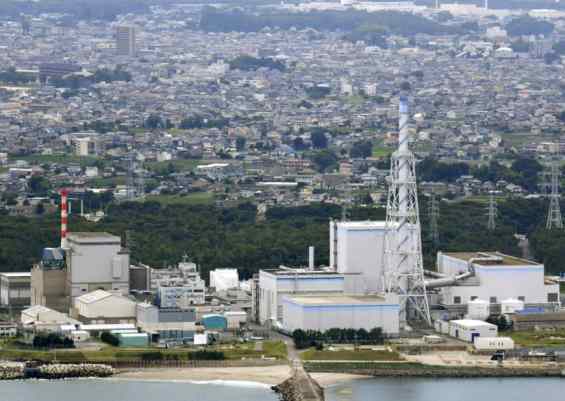
The Tokai No. 2 plant (right) operated by Japan Atomic Power Co. in Ibaraki Prefecture, is seen in this photo taken last July.
April 16, 2019
Japan Atomic Power Co. is considering setting up a subsidiary specializing in the scrapping of retired nuclear reactors at domestic power plants, sources close to the matter said Tuesday.
Japan Atomic Power, a wholesaler of electricity generated at its nuclear plants, is planning to have U.S. nuclear waste firm EnergySolutions Inc. invest in the reactor decommissioning service unit, which would be the first of its kind in Japan, the sources said.
The Tokyo-based electricity wholesaler, whose shareholders are major domestic power companies, will make a final decision by the end of this year, they said.
The plan is to support power companies’ scrapping of retired reactors using Japan Atomic Power’s expertise in decontaminating and dismantling work, in which it has been engaged in since before the 2011 nuclear disaster at Tokyo Electric Power Company Holdings Inc.’s Fukushima No. 1 complex, according to the sources.
The plan comes as a series of nuclear reactor decommissioning is expected at power companies in the country. Since stringent safety rules were introduced after the Fukushima disaster, 11 reactors, excluding those at the two Fukushima plants of Tepco, are slated to be scrapped.
Nuclear reactors are allowed to run for 40 years in Japan. Their operation can be extended for 20 years, but operators will need costly safety enhancement measures to clear the Nuclear Regulation Authority’s screening.
Decommissioning a reactor with an output capacity of 1 million kilowatts is said to take about 30 years and cost around ¥50 billion. Typically, some 500,000 tons of waste result from scrapping such a reactor, and 2 percent of the waste is radioactive.
Japan Atomic Power first engaged in decommissioning a commercial reactor in 2001 at its Tokai plant in eastern Japan. It has been conducting decommissioning work at its Tsuruga nuclear power plant in western Japan since 2017.
It is also providing support to Tepco for the decommissioning of reactors at the Fukushima No. 1 plant.
EnergySolutions, founded in 2006, has engaged in scrapping five reactors in the United States.
Japan Atomic Energy and EnergySolutions have had previous business ties, and the Japanese company has sent some employees to the Zion nuclear station in Illinois, where the U.S. partner has been conducting decommissioning work since 2010.

April 23, 2019 Posted by | Japan | , | Leave a comment

