Japan govt to offer 30b yen in subisidies for 300b yen project
Renewable energy to be supplied to Tokyo and surrounding areas
Japan is pursuing a 300 billion ($2.75 billion) yen project to transform disaster-struck Fukushima prefecture into a clean-energy hub, with the development’s first solar farm scheduled to start in January.
Building wind and solar farms on agricultural land tainted by radiation from the 2011 Dai-Ichi plant meltdown will help rejuvenate the area, which also suffered earthquake and tsunami damage, Masashi Takeuchi, the head of the energy division at the Fukushima prefectural government, said Monday.
The venture includes plans for 11 solar farms and 10 wind farms with total capacity of 600 megawatts and is scheduled for completion by March 2024. The government plans to contribute 30 billion yen of subsidies and the Nikkei reported earlier the Development Bank of Japan and Mizuho Bank are among the institutions planning to provide financing.
The first solar farm will probably be a 20 megawatt project in Minamisoma city in the northern part of Fukushima prefecture, according to Takeuchi. Fukushima, which provided nuclear power to Tokyo prior to the disaster, is transforming its energy policy as Tepco scraps reactors amid public concern about their safety.
November 19, 2019
Posted by dunrenard |
fukushima 2019 | Fukushima Prefecture, Renewable |
Leave a comment
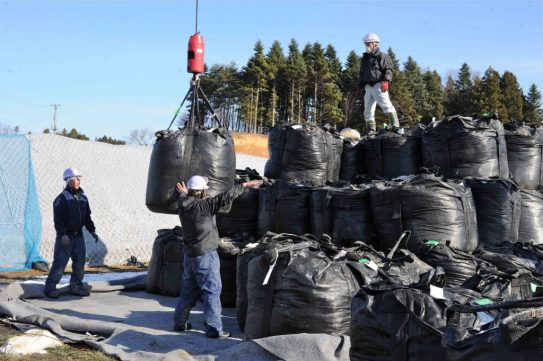
Workers stack bags of soil collected during Fukushima decontamination and cleanup operations, 2011.
November 11, 2019
After more than eight years, Japan is still struggling with aftermath of the 2011 Fukushima nuclear disaster. The Japanese government and nuclear industry have not solved the many technical, economic, and socio-political challenges brought on by the accident. More worrying, they continue to put special interests ahead of the public interest, exacerbating the challenges and squandering public trust. The longer these issues remain unsolved, the more difficult it will be to restore this trust.
Technical challenges. The most difficult challenge is, of course, the decommissioning of the Fukushima Daiichi reactors. It would take too long to describe all of the technical challenges of the decommissioning operations, but two recent events are instructive of the overall difficulties.
The first is the dismantlement of the joint exhaust stack for units one and two. This stack stands 120 meters tall and is at risk of collapse because of fractures in its pillars. It was also heavily contaminated by the venting of radioactive gases during the accident. So the stack must come down, and the operation to deconstruct it must be done remotely from the stack itself to avoid exposing workers to dangerous radiation. According to the Tokyo Electric Power Company (TEPCO), the operation was supposed to be simple: cut down the top of the tower using special remote-controlled equipment, slicing pieces from the top of the chimney one by one and guiding them down by crane. Originally, the operation was supposed to start in March 2019, but TEPCO deployed an operation tower that was about three meters too short for the task, meaning it needed to rebuild the tower before starting. The cutting operation began on August 1, but the project has already faced numerous additional delays because of technical difficulties that include malfunctions of the crane, the camera on the cutting machine (which is needed to monitor the operation), the saws of the cutting machine, and both the main generator and sub-generators. The operation was supposed to finish by the end of 2019 but will now drag on until at least March 2020.
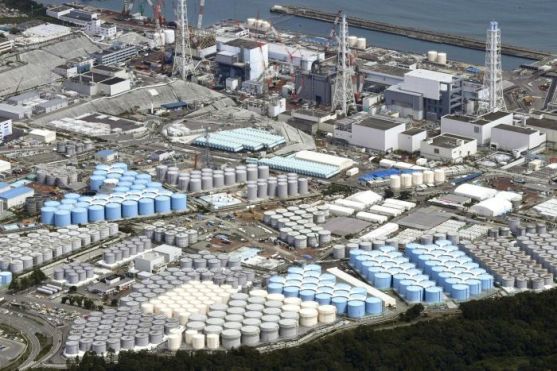
The second technical problem, which is much more serious than the first, is the management of contaminated water. The water is continuously injected into the reactors to cool the fuel debris, and then treated to remove most—though not all—of the radioactive materials. The so-called “treated water” is being stored on site and amounts to about 1.1 million tons, with several hundred tons being added every day. According to TEPCO, the total tank capacity to store treated water will be approximately 1.37 million tons by the end of 2020, but the volume of treated water will exceed storage capacity by 2022. A subcommittee of the Ministry of Economy, Trade, and Industry recommended that the treated water, which still contains tritium, should be released into the sea once the radioactive concentration is below the standard agreed beforehand. The agreed standard between TEPCO and the local fishing industry association is 1,500 becquerels per liter (Bq/l), which is far below the drinking water standard for tritium water of 10,000 Bq/l set by the World Health Organization. An additional condition of release, however, is that all other radioactive substances besides tritium must be removed below a detectable limit or in line with regulatory standards. Unfortunately, in August 2019 news outlets reported that some radioactive materials such as iodine 129 were not completely removed and that their concentration levels were above the regulatory standards.
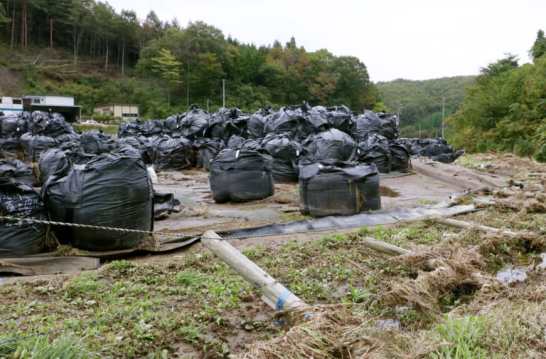
Most recently, the super typhoon Hagibis hit the eastern part of Japan, which includes Fukushima prefecture and the area affected by the nuclear accident. TEPCO reported irregular readings from sensors monitoring water at the Fukushima Daiichi plant but did not confirm whether any radioactive water leaked into the sea. In addition, according to the Tamura city government, some bulk bags filled with soil collected from decontamination operations were swept into a river during the typhoon on October 12. The bags were among 2,667 that have been temporarily stored at a site in the city. The Ministry of the Environment later confirmed that total of 11 bags were swept away and found downstream. Thankfully, there was no evidence that any of the contaminated soil leaked out. But this wasn’t the first time an incident like this has happened. In September 2015, several hundred bags were swept downstream during flooding caused by tropical storm Etau. The recurring close calls reveal the ongoing vulnerabilities of the Fukushima and associated sites. The contaminated soil will need to be stored for at least 30 years, and the risk of possible leakage remains if a larger and stronger typhoon, or a tsunami, hits the region again.
Economic challenges. In December 2016, the Ministry of Trade, Economy, and Industry’s committee for reforming TEPCO published its latest estimate for total accident costs, including decommissioning the reactors, compensation, and decontamination of the land. The total cost was estimated at almost 22 trillion yen ($188 billion), which was twice as much as the previous estimate of 11 trillion yen ($96 billion). More recent estimates have put the figure even higher—up to 80 trillion yen ($736 billion) over 40 years.
According to the legal scheme established by the ministry, TEPCO and other nuclear utilities will pay about 20 trillion yen of the total accident costs. But now the rest (2 trillion yen) will be footed by Japanese taxpayers. The 2016 report was the first time that the Japanese government admitted that tax money would be spent for the Fukushima accident costs.
The government’s lack of transparency in agreeing to this scheme is a source of ongoing concern, not least because the taxpayer burden could balloon if total costs go up, or if the nuclear utilities cannot pay off the debt. The government has given no clear explanation why and how much tax money will be spent to cover the total accident costs. To make matters worse, the power utilities are passing on part of the accident cleanup costs to customers by increasing their electricity rates, but without disclosing the amount.
This exceptionally high cost may have influenced the future economic competitiveness of nuclear power. At present, no utility has announced plans to build new reactors or to replace existing reactors.
Socio-political challenges. On September 19, 2019, three former top executives of TEPCO were found not guilty of criminal negligence for their roles in the disaster, which resulted in the death of 44 and the injury of 13 others. The Tokyo district court ruled that it was not realistic for the former executives to have prevented the triple core meltdown because they were not able to predict all possible tsunami scenarios. This was the only criminal case so far involving TEPCO officials and, although they were found not guilty, the case revealed new facts regarding the tsunami predictions. A 2008 TEPCO internal study, based on a 2002 report by a government panel, concluded that a wave of up to 15.7 meters could hit the plant after a magnitude 8.3 earthquake, overwhelming the Fukushima site, which sits 10 meters above sea level. The findings were reported to the TEPCO executives, but they did not act to take measures against such high-tsunami scenarios. The court decision was totally unsatisfactory to the public, especially for the victims in Fukushima who were forced to leave their homes. For them, it is now clear that the accident was preventable and that no one at TEPCO will be held accountable for their lack of action to prevent it.
Although the criminal case was highly symbolic, it is not the only legal one involving TEPCO and Fukushima. More than 100,000 evacuees have filed about 30 different civil lawsuits seeking compensation from TEPCO and the government. Several district courts have ruled that TEPCO could have predicted and prevented the nuclear crisis and have awarded millions of dollars in damages to the evacuees.
TEPCO isn’t the only utility with a public relations problem. On September 27, 2019, the Kansai Electric Power Company held a press conference to disclose that 20 of its employees, including top executives, received inappropriate payments and gifts worth a total of $2.9 million from a senior local government official in Takahama, a town that hosts one of the company’s four nuclear power plants. This has become the biggest scandal since the 2011 Fukushima accident and has exposed the collusive relationship between the utility companies and local public officials as well as the connection between the utilities and local construction companies, which may have benefited from favorable contracts for necessary safety upgrades at the nuclear plants. In October, the chairman, executive vice president, and three executive directors resigned, while the president of the company stepped down from his position as the head of the powerful Federation of Electric Power Companies of Japan. Although Kansai Electric Power Company planned to restart units one and two of its Takahama nuclear plant earlier this year, that plan is now on hold indefinitely.
These two recent events show that social and political problems persist even eight years after the Fukushima accident. According to the latest public polling conducted in 2018 by Japan Atomic Energy Relations Organization, a utility-sponsored pro-nuclear organization, only 6.7 percent of the public think nuclear industry organizations are trustworthy or somewhat trustworthy (a decline from 7 percent in 2017), and only 7.9 percent of the public think the government is trustworthy or somewhat trustworthy (a decline from 9.2 percent in 2017).
Lessons not learned. The ongoing technical, economic, and socio-political problems demonstrate that the nuclear power industry and the Japanese government haven’t learned their lesson from the Fukushima accident, which is that transparency is the key to public trust. It is true that the quantity of information about cleanup has increased substantially over the years. But transparency means that the utilities and the government need to disclose information that the public needs, even when it is not favorable to them. One solution, which they have so far been unwilling to accept, would be to establish a truly independent third party to oversee their activities. Lack of such an independent oversight organization is one of the main causes for not taking alternative and possibly better, more appropriate measures over the last eight years.
https://thebulletin.org/2019/11/an-update-from-fukushima-and-the-challenges-that-remain-there/#
November 19, 2019
Posted by dunrenard |
fukushima 2019 | Fukushima Disaster, Update |
Leave a comment
Dozens of cracks have been found in facilities built to contain radiation at Japan’s Fukushima nuclear plant. Tokyo-based Yomiuri Shimbun reported Sunday that 41 cracks were found in the plant’s concrete floor. It says Tokyo Electric Power Company appears to have neglected the facilities,… with inspectors having discovered weeds growing through the concrete. They believe there’s a danger that radioactive substances may have seeped through the cracks… and into the groundwater. Inspectors have raised the issue with the power company,… requesting maintenance work.
November 19, 2019
Posted by dunrenard |
fukushima 2019 | Cracks, Fukushima Daiichi |
Leave a comment
Solar, wind, hydro, geothermal and biomass combined to provide Japan’s Fukushima prefecture with almost 1.5 GW of power in 2018
The wheels are in motion to breathe new life into the energy production of Fukushima, the Japanese prefecture that was devastated by the 2011 tsunami and nuclear meltdown. As reported by Tokyo-based newspaper Nikkei Asian Review, plans are afoot to transform the area into a renewable energy hub, with the power it generates to be fed into national grid for use in the country’s capital.
The government of Fukushima has actually been ramping up the region’s renewable energy production since the 2011 accident, which was triggered by a magnitude-9.0 earthquake that resulted in the plant being swamped by seawater and caused the worst nuclear disaster since Chernobyl.
Working towards an objective of powering the entire region with 100 percent renewable energy by 2040, wind, solar, hydro, geothermal and biomass combined to provide the Fukushima with almost 1.5 GW of electricity in 2018. This was up from around 1 GW in 2016 and around 400 MW in 2012.
The new construction project will add 11 new solar plants and 10 wind power plants to the mix, which will be constructed on unused farmlands and hilly terrain, according to Nikkei Asian Review. With a total cost of around US$2.75 billion over the coming five years, the new plants are expected to add a further 600 MW to Fukushima’s energy output.
A new 80-km (50-mi) grid is also in the works, which will feed this power into the metropolitan area of Tokyo. The Fukishima government expects renewables to provide 13 to 14 percent of Japan’s national energy mix by 2030.
Sources: Government of Fukushima, Nikkei Asian Review
November 19, 2019
Posted by dunrenard |
Japan | Fukushima Prefecture, Renewable |
Leave a comment
The No. 3 reactor, right, and No. 2 reactor, left, are seen in this photo of work at the Fukushima Daiichi Nuclear Power Station in November 2018, provided by Tokyo Electric Power Co.
TOKYO — Decommissioning efforts following the disaster at the Fukushima Daiichi Nuclear Power Station have been hit by delays and a series of mistakes contravening safety rules relating to the operation of nuclear facilities.
In response to the issues, the Nuclear Regulation Authority (NRA) is carrying out a survey into whether operator Tokyo Electric Power Co. (TEPCO) has sufficient staffing numbers working on the project, and is seeking to have TEPCO’s board improve its preparations.
According to the secretariat of the NRA, this summer there were errors in the wiring of electrical cables to the No. 5 and 6 reactors, which caused problems when smoke started to emerge from equipment attached to the reactors.
Furthermore, drinking facilities are being continually installed in controlled zones with high levels of radioactivity where they are forbidden from being built, and it has emerged that workers have drunk water from those areas. In October, the NRA identified both incidents as contravening safety regulations.
Elsewhere, the continuation of work to remove spent nuclear fuel from storage pools at the No. 3 reactor has been delayed. NRA Chairman Toyoshi Fuketa said, “It appears the absolute number of such workers (who manage the work at the power station) is insufficient. If small mistakes continue, it creates the danger of leading to big mistakes.”
Ryusuke Kobayashi, head of the Fukushima Daiichi NRA Regional Office, attended a regular meeting of the NRA on Nov. 6. Regarding the situation at the power station, he said, “There’s a strong focus on cost-cutting at the site. It has an atmosphere which makes it difficult to speak out and say there are too few people working there.” At a press conference after the meeting, chairman Fuketa stressed that it was essential for more staff to be secured.
In response to the NRA, a representative at TEPCO said, “It’s believed an easing of vigilance at the site has been one reason (for the mistakes). The number of human errors has stayed at between 100 and 200 each year for the last five years. We want to proceed with a plan to resolve this considering the specific characteristics of the working environment at the site.”
(Japanese original by Yuka Saito and Suzuko Araki, Science & Environment News Department)
November 19, 2019
Posted by dunrenard |
fukushima 2019 | Cost-cutting culture, Fukushima Daiichi, NRA, Tepco |
Leave a comment
SEOUL, Nov. 8 (Yonhap) — South Korea and Russia have agreed to put radiation detectors on the passenger ships that ply between the countries, Seoul’s foreign ministry said Friday, an apparent move to enhance their watch against Japan’s planned release of radiation-contaminated water into the Pacific Ocean.
The agreement came at the 14th meeting of the South Korea-Russia Joint Committee on Environment Cooperation held in Seoul on Thursday.
“It is aimed at enhancing the countries’ monitoring of radioactive materials,” the ministry said.
The move comes as Japan is widely expected to soon begin dumping waste water from its nuclear power plant in Fukushima, whose reactors experienced catastrophic meltdown in 2011.
Tokyo claims the radiation-contaminated water will have little or no effect on the environment as it will be discharged after being thoroughly treated.
Seoul has strongly opposed the plan, insisting it may destroy the entire ecosystem in the region.
South Korea currently bans any fishery and agricultural products from Fukushima and adjacent areas, and is checking nearly all food imports from Japan for radiation.
As of end-August, about 5 tons of Japanese food imports have been rejected or destroyed due to possible radiation contamination, the government said earlier.
November 19, 2019
Posted by dunrenard |
fukushima 2019 | Fukushima Radiation, Radiation Monitoring, Russia, South Korea |
Leave a comment
TOKYO (Jiji Press) — A series of human errors found at Tokyo Electric Power Company Holdings Inc.’s tsunami-stricken Fukushima No. 1 nuclear plant may have been caused by a labor shortage, the Nuclear Regulation Authority has suggested.
At a regular meeting on Wednesday, the NRA received a local report on the current situation of decommissioning work at the plant, the site of the triple meltdown accident in March 2011.
Mistakes have been found frequently as a result of TEPCO’s insufficient understanding of the situation and the overburdening of plant workers, according to the report from the NRA office at the plant site.
“I guess manpower is lacking,” NRA Chairman Toyoshi Fuketa said at a news conference after the meeting, indicating his willingness to interview TEPCO executives.
In July, an operational error caused smoke to rise from an electricity transmission cable at the Fukushima plant.
Some such mistakes can be attributed to TEPCO’s poor supervision and insufficient information on the plant site. Some drawings of the site were not accurate, according to the office.
TEPCO “is not supervising the site properly,” Ryusuke Kobayashi, head of the regional office said.
According to Kobayashi, one TEPCO plant worker said there is no time to pause and think backward.
Another worker finds it difficult to point out the lack of human resources at a time when the company is working to reduce costs, Kobayashi said.
“I believe that the quality of the decommissioning work has deteriorated,” he said.
November 19, 2019
Posted by dunrenard |
fukushima 2019 | Fukushima Daiichi, Human errors, NRA |
Leave a comment
COVER?Tokyo Electric Power Co has said new storage tanks could be built to hold radioactive water at its stricken plant, a Greenpeace Germany member said
The Japanese government’s claim that it will run out of room to store radiation-contaminated water at the Fukushima Dai-ichi nuclear power plant in two years is not true, and is simply an attempt to justify discharging polluted water into the Pacific Ocean, a Greenpeace International member said yesterday.
Shaun Burnie, senior nuclear specialist at Greenpeace Germany who has conducted long-term surveys in Japan, was invited by Greenpeace Taiwan to talk about the issue at a news conference in Taipei.
An earthquake and a tsunami in March 2011 caused the plant’s reactor fuel rods to melt and large amounts of radioactive-contaminated water was released into the Pacific.
As of Oct. 22, more than 1 million cubic meters of processed polluted water was stored at the treated water storage tank, while the current storage capacity is nearly 1.1 million cubic meters, Burnie said.
Tokyo Electric Power Co in August said the tank would reach full capacity by the summer of 2022 and that there is no room for expansion at the site, he said.
However, the company in a meeting in September said that land is available to build additional tanks, Burnie added.
The claim of insufficient capacity is just an excuse to cover the Japanese government’s political agenda, Burnie said, adding that Tokyo has the option of storing contaminated water for a longer period.
If Japan approves the discharge, radioactive tritium and other radionuclides in the water will likely enter the East China Sea, and eventually the waters surrounding Taiwan through the subtropical gyre, he said.
However, even if the Japanese government decides to discharge polluted water into the ocean, it would not be able to carry out the plan immediately, as it might take years to build outflow pipelines, he said.
In addition to protests from local fishers, especially those living along Japan’s Tohoku coast, the Japanese government would face strong pressure from the international community for discharging polluted water, he said, adding that it is a long-term problem that should be approached more cautiously.
The Fukushima Dai-ichi disaster has led to catastrophic results, and the Taiwanese government should be lauded for making the “brave and correct” decision to phase out nuclear power plants, Burnie said.
Taiwan should call on the Japanese government, via diplomatic or non-governmental channels, to shoulder its responsibility as a Pacific nation and not discharge radiation-contaminated water into the sea, National Nuclear Phase-out Action Platform spokesperson Tsuei Su-hsin (崔愫欣) said.
As Taiwan generates less than 10 percent of its electricity from nuclear power — much lower than the ratio in Japan before the 2011 disaster, it should persist in its goal of phasing out all nuclear power plants by 2025, Tsuei said.
November 19, 2019
Posted by dunrenard |
fukushima 2019 | Fukushima Daiichi, Radioactive Water |
Leave a comment
Fans cheer during a Rugby World Cup match at Kamaishi Recovery Memorial Stadium in Kamaishi, Iwate Prefecture, on Sept. 25. The government is looking to extend the term of the Reconstruction Agency for 10 more years.
Japan’s Reconstruction Agency to get 10 more years to aid Fukushima nuclear disaster recovery
The government on Thursday proposed extending the term of the Reconstruction Agency, due to expire at the end of fiscal 2020, by 10 years to facilitate recovery in areas affected by the Great East Japan Earthquake and the resulting nuclear crisis in Fukushima.
Under the plan, the agency will continue to provide aid for the next five years to areas affected by the magnitude 9.0 earthquake and tsunami on March 11, 2011.
The special budget for rebuilding, which is separate from the regular account, and special tax grants for the financial support of affected municipalities will also be maintained.
The plan was proposed to a panel on reconstruction comprising experts and the governors of Iwate, Miyagi and Fukushima prefectures. The region suffered extensive damage from the earthquake and tsunami, in addition to the core meltdowns at the Fukushima No. 1 nuclear power plant.
The plan is expected to be approved at a Cabinet meeting within this year and be submitted to the Diet next year.
“We have shown our basic view on finances and the legal framework,” Kazunori Tanaka, reconstruction minister, said at the panel meeting. “Based on various opinions from the panel members, we will continue to work toward realizing the plan.”
Fukushima Gov. Masao Uchibori expressed satisfaction with the plan, saying it “reflects the reality of our prefecture” as the government is continuing to lead efforts to address problems in connection with the nuclear crisis.
But Miyagi Gov. Yoshihiro Murai said the ending of aid for areas damaged by the quake and tsunami in five years is “too harsh.”
Iwate Gov. Takuya Tasso shared the concern, saying, “I hope it will not be a strict deadline after which everything will be stopped.”
The Reconstruction Agency was established in February 2012 as the central control point for efforts to rebuild from the disaster.
During the proposed extended period, the agency will continue working on a variety of tasks including the decommissioning of the Fukushima plant, combating radiation-tainted water and helping residents return.
It will also provide psychological support to people affected by the earthquake and tsunami, and review the progress in reconstruction efforts in fiscal 2025.
The plan is mostly in line with a recommendation the ruling coalition submitted to the government in August. The coalition said the Reconstruction Agency should remain under the direct control of the prime minister and the oversight of a full-time Cabinet minister.
The ruling bloc also called for preserving the agency’s function as a one-stop source to coordinate planning for reconstruction policies and to respond to the needs of affected communities.
A Japanese Reconstruction Agency official, left, explains Japan’s efforts to rebuild areas hit by the March 2011 disaster to a foreign journalist at Intex Osaka, the venue for the Group of 20 summit, on June 28, 2019.
Japan gov’t may keep Reconstruction Agency for 10 more years
TOKYO (Kyodo) — The government on Thursday proposed postponing the planned disbandment of the Reconstruction Agency for 10 years until March 2031 to facilitate recovery in areas affected by the Fukushima nuclear crisis.
Under the plan, the agency will also continue to provide aid for five more years to areas affected by the magnitude-9.0 earthquake and ensuing tsunami on March 11, 2011, which triggered core meltdowns at the Fukushima Daiichi nuclear power plant.
The plan was proposed to a panel on reconstruction comprised of experts and the governors of the three hardest-hit prefectures of Iwate, Miyagi and Fukushima. It is expected to be approved by the Cabinet of Prime Minister Shinzo Abe within the year and be submitted to the Diet next year.
“We have shown our basic view on finances and the legal framework,” said reconstruction minister Kazunori Tanaka. “Based on various opinions from the panel members, we will continue to work toward realizing the plan.”
Fukushima Gov. Masao Uchibori expressed satisfaction with the plan, saying it “reflects the reality of our prefecture” as the government is continuing to lead efforts to address problems in connection with the nuclear crisis.
But Miyagi Gov. Yoshihiro Murai said the ending of aid for areas damaged by the quake and tsunami in five years is “too harsh.”
Iwate Gov. Takuya Tasso shared the concern, saying, “I hope it will not be a strict deadline after which everything will be stopped.”
The Reconstruction Agency was established in February 2012 as the central control point for efforts to rebuild from the triple disasters and had been scheduled to disband at the end of fiscal 2020.
During the proposed extended period, the agency will continue working on a variety of tasks including decommissioning of the Fukushima plant, combating radiation-tainted water and helping residents return.
It will also provide psychological support to people affected by the earthquake and tsunami and review the progress in reconstruction efforts after five years.
The special budget for rebuilding, which is separate from the regular account, and subsidies for helping affected municipalities will be maintained.
The central government spent 25.5 trillion yen ($234 billion) for reconstruction in the first five-year period through fiscal 2015, while securing 6.5 trillion yen for another five years with part of the costs shouldered by relevant municipalities.
As of early October, there were still about 49,000 people who remain displaced from their hometowns as a result of the earthquake, tsunami and nuclear crisis, compared with 470,000 estimated shortly after the triple disaster occurred.
November 19, 2019
Posted by dunrenard |
fukushima 2019 | Fukushima Prefecture, Reconstruction Agency |
Leave a comment
 President of Korean Sports and Olympic Committee Lee Kee-heung
November 5, 2019
Chefs and food ingredients will accompany the South Korean team and delegation traveling to the 2020 Tokyo Olympics next year. The chefs will prepare food for the South Koreans using homegrown ingredients for the duration of the Games.
Korean Sports and Olympic Committee (KSOC) President Lee Kee-heung, also a member of the International Olympic Committee, unveiled the measures to allay fears over food safety which were raised after Japan announced it would use food products from Fukushima, a region hit hard by a 2011 tsunami and an ensuing meltdown at the nuclear power plant there.
“The KSOC is planning to expand the meal station for Korean athletes during the games to address the food safety issue,” he wrote in a recent written interview with The Korea Times. “Korean food has superb nutritional value and we believe it will help the athletes perform at their best. We will also deliver lunch boxes to the stadiums so our athletes can focus on getting medals,” Lee said.
Earlier, the Japanese Olympic Committee said it would serve athletes food made using ingredients from Fukushima, a region in which water and soil are feared to remain contaminated with radioactivity following the meltdown. South Korea banned rice and vegetable imports from the region immediately after the incident.
The Tokyo Olympics is not the first international sports event where the KSOC has dispatched chefs to prepare meals for athletes. During the 2012 London Olympics, the KSOC sent chefs and nutritionists from the national training center to cook for Korean athletes and staff who craved food from home.
Food safety is among other touchy issues at the Olympics.
The “Rising Sun” flag, a symbol for many in Asia of Japanese colonialism, is another pre-Olympics issue that some South Koreans find concerning. The issue has been raised by Seoul since September after relations with Japan deteriorated following it imposing trade restrictions on certain exports to Korea. In response, Japan said use of the flag does not violate the Japanese Constitution.
Lee said the KSOC has been working to make an Asian alliance to push Japan to not fly it.
“During the 24th Association of the National Olympic Committee (ANOC) General Assembly in Qatar earlier this year, I met with other Asian state representatives and discussed ways to address the issue together. On this issue, our effort to change Japan’s policy will continue and with the support of the government,” he said. ANOC has an annual meeting, and this year’s congress took place in Doha.
Joint Korea team
Lee said he was cautiously optimistic about fielding a joint team between the two Koreas for the Tokyo Olympics, saying the KSOC has continued to talk with the North.
However, another high-level official, who didn’t want to disclose his name because of the sensitivity of the issue, said a joint team may be a distant dream. “Considering what’s going on in inter-Korean relations, it’s difficult to move on a joint team,” he said. He had taken part in negotiations with the North in the past.
A joint team for the 2020 Olympics was agreed in November 2018 at inter-Korean talks held in Gaesong in the North. That year, President Moon Jae-in and North Korean leader Kim Jong-un held three summits.
The governments of the two Koreas agreed to form unified teams in female basketball, female hockey, judo and rowing. “The IOC approved this under one condition ― that is the unified teams would start from qualifying matches,” the anonymous official said.
For all sports but basketball, qualifying matches are already underway. “Basketball qualifying matches will begin at the end of the year. Yet, if things go the way it goes now, unifying a basketball team will be out of the question,” he said. But, he added hopes remain in judo. “In judo, individual athletes compete for qualification. We can consider making a joint team with qualified athletes.”
However, the political situation will hold full sway over the joint team and the current circumstances are not very promising.
Last week, North Korean leader Kim Jong-un ordered the removal of all South Korean-built facilities at Mount Geumgang, including a hotel. North Korea’s aggressive treatment of South Korean football players during their World Cup qualifying game also cast a shadow on the prospects for a joint team.
Despite this, there is still hope for a possible peace gesture during the Olympics.
The official said a joint march at the opening ceremony could still happen. “This has been done several times now, so we could continue to do it.”
North and South Korean athletes have marched together at international sports events 11 times so far. The most recent being the 2018 PyeongChang Winter Olympics in South Korea ― the Koreas also fielded a joint women’s ice hockey team.
In addition to creating the joint team, the two Koreas also agreed to submit a joint bid to co-host the 2032 Summer Olympics, and President Lee said they have a very good chance.
“The Korean Peninsula can be a symbol of peace which will be something we can take advantage of in our campaign for the Olympics,” Lee said, noting that South Korea will host the next ANOC General Assembly. “This will be also a good opportunity to show the sports community that the Koreas are qualified to host the Olympics.”
As an IOC member representing Korea, Lee is at the center of sports diplomacy.
“Now, Korea has two IOC representatives, which has elevated its standing in global sports.” Korea’s sports diplomacy had its heyday in the 2000s when it had three IOC representatives, but in 2017, the number went down to one, raising concern that its standing had weakened.”
Lee viewed the PyeongChang Winter Olympics as demonstrating Korea’s success in sports diplomacy. “This helped Korea get two IOC representatives.”
100th National Sports Festival
With regard to the centennial of the National Sports Festival, Lee said he was saddened by the decreasing public interest. “It will be my job to revamp the festival so that it will recover its lost popularity with bigger public interest and participation.”
The festival started out as an act of resistance to colonial Japan in 1920. In the first year, only baseball was played but other sports were added over the century. This year saw 47 sports including trials of two new ones.
Over the century, the festival served as an incubator for world-class athletes. Figure-skater Kim Yu-na competed in the festival as did Swimmer Park Tae-hwan. The festival has also contributed to developing the infrastructure for Korean sports.
Born in 1955, Lee’s background has been in business, not sports. His first step into the world of sports was with the Federation of the Modern Pentathlon where he served as vice president in 2000. Between 2004 and 2009, he was the president of the Korea Canoe Federation, followed by the Korea Swimming Federation between 2010 and 2016..
He headed the athlete’s team in the 2010 Asian Games in Guangzhou in China and 2012 London Summer Olympics.
http://www.koreatimes.co.kr/www/sports/2019/11/663_277969.html?fbclid=IwAR3ix0GrN24HHf7-EtLYzv2xjqBqrdyA5WgmWGZVuCRW9W8maIKubeG-bgQ
November 19, 2019
Posted by dunrenard |
Japan | radiation, South Korea, Tokyo Olympics |
Leave a comment
Bags containing radioactive waste are seen in Tamura, Fukushima Prefecture, in this photo taken Oct. 14 after Typhoon Hagibis struck the region earlier in the month.
TAMURA, FUKUSHIMA PREF. – Dozens of bags containing waste polluted with radioactive substances are still missing in Fukushima Prefecture, three weeks after they were swept away from storage areas in floods triggered by Typhoon Hagibis.
Of the 90 bags originally lost, 36 remain missing. The Environment Ministry, prefectural officials and others are conducting extensive searches but so far they have not had much luck.
In many municipalities in the prefecture, a lot of radioactive waste, including soil, was generated through decontamination work after the 2011 nuclear disaster at Tokyo Electric Power Company Holdings Inc.’s Fukushima No. 1 power plant. Numerous bags containing the waste are kept outdoors in temporary storage areas around the prefecture.
Heavy rains from the 19th typhoon of the year flooded storage space in many locations, sweeping away 44 bags in Kawauchi, 30 in Tamura, 15 in Nihonmatsu and one in Iitate.
By the end of October, 50 bags had been recovered. The contents had leaked from half of them. “We had far heavier rains than we expected. We did not cover bags of radioactive waste,” said an official of the Tamura Municipal Government.
The ministry and other organizations have mobilized 20 to 30 workers to look for the missing bags, wading into rivers when necessary and using drones to search areas that cannot physically be entered.
An aerial survey was conducted by helicopter on Oct. 23. On Friday, 29 workers searched the Furumichi River and areas along it in Tamura. Four bags were collected, but their contents had been lost.
“There has been no confirmation of any environmental impact due to the loss of the bags,” a ministry official said.
“We’ll continue searching in cooperation with local municipalities.”
November 19, 2019
Posted by dunrenard |
fukushima 2019 | Fukushima Prefecture, Typhoon Hagibis |
Leave a comment
 The cover of “Citizens’ Radiation Data Map of Japan” (Provided by Minna-No Data Site)
November 3, 2019
FUKUSHIMA—A citizens’ group here has released an English radiation-level map for eastern Japan created with input from 4,000 volunteers in response to requests from abroad ahead of the Tokyo Olympics.
“We want people outside Japan to understand the reality of radioactive contamination following the nuclear accident,” said Nahoko Nakamura, a representative of Minna-No Data Site (Everyone’s Data Site), which published the map.
The Fukushima No. 1 nuclear power plant experienced a triple meltdown in March 2011 after a tsunami knocked out its cooling systems during the Great East Japan Earthquake.
Titled “Citizens’ Radiation Data Map of Japan,” the 16-page booklet summarizes the content of the original Japanese map, released in November last year. It also shows projected declines in radiation levels by 2041.
The Japanese version was based on results of land contamination surveys conducted over three years at the request of Everyone’s Data Site.
About 4,000 volunteers took soil samples at 3,400 locations in 17 prefectures in eastern Japan, including Fukushima and Tokyo, and measured radiation levels. The map was compiled with advice from experts.
The group raised 6.23 million yen ($57,500) from 1,288 individuals through a crowdfunding campaign. So far, 15,000 copies have been sold.
Nakamura said the group decided to produce an English version after it received inquiries about the Japanese map from researchers and others overseas in the run-up to the Tokyo Olympics.
Everyone’s Data Site spent about four months creating the English map, working through e-mail and online chats with five volunteer translators overseas, including an American and a Canadian.
The English edition sells for 500 yen, excluding tax. For more information, contact Everyone’s Data Site at (minnanods@gmail.com).
http://www.asahi.com/ajw/articles/AJ201911030001.html
November 4, 2019
Posted by dunrenard |
fukushima 2019 | Book, Contamination, Fukushima Radiation, Mapping, Minna-No Data |
Leave a comment
To try making us believe that only 91 bags were swept into rivers during the typhoon Hagibis floodings, out of Fukushima prefecture’s 17 million tons, is just ludicrous, totally unbelievable.
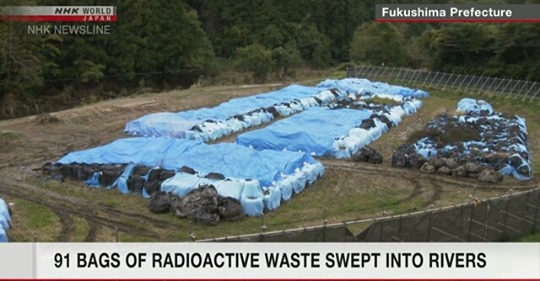
Japan’s Environment Ministry says dozens of bags containing radioactive soil were swept into rivers following a powerful typhoon last month. The dangerous waste was produced as a result of the 2011 nuclear disaster.
The waste has been stockpiled at temporary storage sites in Fukushima and neighboring prefectures.
Officials say they have confirmed that 90 bags in Fukushima and one in Tochigi Prefecture were swept away by Typhoon Hagibis after inspecting all the storage sites.
They say at least 25 of the bags were found empty, meaning that the tainted soil was carried away in floodwaters.
But the officials add that radiation levels around the sites remain unchanged.
They plan to install barriers around the storage sites to prevent further such incidents in addition to looking into what caused the problem.
November 4, 2019
Posted by dunrenard |
fukushima 2019 | Flooding, Fukushima Prefecture, Radioactive waste, Typhoon Hagibis |
Leave a comment
Japan Atomic Power Co.’s Tokai No. 2 nuclear power plant in Ibaraki Prefecture
Tokyo Electric Power Co. Holdings Inc. (TEPCO) decided on Oct. 28 to provide financial support to Japan Atomic Power Co., the operator of the aging Tokai No. 2 nuclear power plant.
TEPCO will provide support to help Japan Atomic Power finance the work to implement legally required safety measures at the plant in the form of advance payments for the electricity it plans to buy from the company in the future.
Japan Atomic Power is seeking to restart the currently offline plant in Ibaraki Prefecture.
TEPCO says it made the decision because the plant is expected to serve again as “a source of power that helps provide inexpensive and stable electricity that emits less carbon dioxide to customers.”
At a news conference to announce the decision, however, the utility did not disclose the amount it will provide, although it is estimated to exceed 220 billion yen ($2.02 billion).
The company also refused to reveal the price at which it will buy electricity generated at the plant, failing to back up its claim that the power will be “inexpensive.”
TEPCO even kept mum about an outline of its planned financial aid that can be easily guessed by other electric utilities or experts, saying providing such information would “put us at a disadvantage in competition with other companies.”
TEPCO, the operator of the crippled Fukushima No. 1 nuclear power plant, has been put under effective state control so that it can pay huge amounts in compensation to victims of the 2011 nuclear disaster and also finance the colossal cost of decommissioning the reactors destroyed by the core meltdowns.
TEPCO is coming to the rescue of another financially struggling company while being kept alive with taxpayer money. But it does not offer detailed information about its rescue plan or convincing reasons for the action.
How can the utility expect to win public support for the plan?
TEPCO says the money it will provide to Japan Atomic Power will not be “support” but a form of “cooperation” and create a “win-win” situation for both sides.
But strong opposition to a restart of the Tokai No. 2 nuclear plant, which began operations in 1978, will make it a tough challenge, to say the least, to win the support of the local communities.
TEPCO’s decision is based on highly uncertain assumptions.
The plan to rebuild TEPCO, developed jointly with the central government, calls on the utility to fulfill its responsibility as the operator of the disaster-stricken nuclear plant by making a profit from nuclear power generation.
But there seems to be no prospect of an early resumption of the operation of its own Kashiwazaki-Kariwa nuclear plant in Niigata Prefecture. The gloomy outlook of its nuclear power operations has probably prompted TEPCO to make the seemingly premature decision, which raises serious doubt.
If the reactor at the Tokai No. 2 plant cannot be restarted, TEPCO will only suffer massive additional losses instead of earning profits.
Japan Atomic Power’s two reactors–the other in Fukui Prefecture–have remained offline since the 2011 earthquake and tsunami that triggered the Fukushima nuclear disaster.
Even so, major electric utilities under contracts to buy electricity from Japan Atomic Power have paid some 1 trillion yen in total as basic fees for the contracts. It has been also revealed that these utilities all plan to provide financial support to help Japan Atomic Power restart the Tokai No. 2 plant.
Since these utilities also have stakes in Japan Atomic Power, the firm’s failure would cause hefty losses to them.
They seem determined to keep supporting the embattled nuclear power supplier to avoid such losses. But there are clearly limits to what such stopgap measures can do.
Commenting on TEPCO’s decision to provide financial support to Japan Atomic Power, Hiroshi Kajiyama, the industry minister, who is in charge of the power industry, said such “specific management decisions should be made at the discretion of the management team” unless they could disrupt efforts to pay compensation to victims of the nuclear disaster, decommission disabled reactors or ensure a stable power supply.
Kajiyama’s comment signals a noncommittal stance toward TEPCO’s decision although his ministry can effectively control the company’s management.
The government, which has been promoting nuclear power generation as a national policy, has a duty to tackle basic questions related to the matter, such as what to do with reactors that are difficult to resume operations and Japan Atomic Power, which only operates nuclear plants and is therefore facing bleak future prospects.
The government should play an active role in dealing with these and other questions instead of leaving the industry to do so and fulfill its responsibility to explain its related policies and agendas.
November 4, 2019
Posted by dunrenard |
Japan | Tepco, Tokai NPP |
Leave a comment
Japan’s nuclear regulators plan to look into work management at the crippled Fukushima Daiichi nuclear plant, which is being decommissioned following the 2011 accident.
The move follows a series of mistakes and violations. In June this year, smoke came out when workers misconnected power lines at the No.5 and No.6 reactors.
It has also come to light that water servers were placed for the past four years in restricted areas where radioactive materials are stored.
The commissioners at the Nuclear Regulation Authority on Wednesday certified both incidents as safety violations.
In addition, work to remove nuclear fuel from the No.3 reactor’s storage pool has been delayed due to repeated mechanical problems.
The commissioners also decided to request a report from their inspectors stationed in Fukushima Prefecture on whether the plant’s operator, Tokyo Electric Power Company, is conducting its work properly. The regulators also plan to directly question TEPCO officials.
Authority chairman Toyoshi Fuketa told reporters that simple procedural errors raise concern as to whether TEPCO has enough electricians and quality managers at the site.
He said the regulating body will make sure that small mistakes don’t lead to big ones.
November 4, 2019
Posted by dunrenard |
fukushima 2019 | Fukushima Daiichi, NRA |
Leave a comment








 nuclear-news