Many Fukushima evacuees die away from home
September 9, 2020
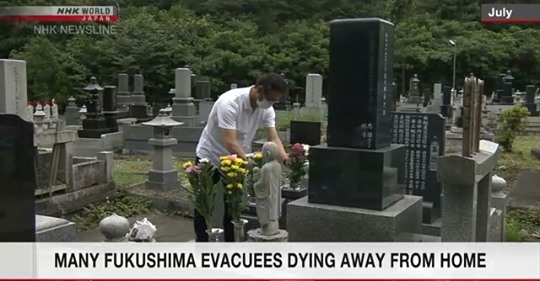
NHK has learned that more than 2,600 people have died over the ensuing years after being evacuated from their hometowns following the meltdowns at the Fukushima Daiichi nuclear power plant in March 2011.
NHK contacted local governments in Fukushima Prefecture and found that at least 2,670 people, about 10 percent of the original population, had died as of August. More than 26,500 people lived in seven municipalities near the plant. Where they lived have been designated no-entry zones for nearly nine and a half years because radiation levels remain high.
By municipality, 895 people from Okuma Town have died, 792 from Futaba Town, 576 from Namie Town, 362 from Tomioka Town, 32 from Iitate Village, 12 from Katsurao Village, and one from Minamisoma City.
The Japanese government is conducting decontamination work and rebuilding infrastructure in some areas with the aim to allow residents to return in two or three years.
But there is no concrete plan to make other parts, or 92 percent of the no-entry zone, habitable again, despite the strong hope of residents to return home.
Tokyo Olympics must be held at ‘any cost’, says Japanese minister
Seiko Hashimoto says country is planning for event next year even though a widely available vaccine is unlikely
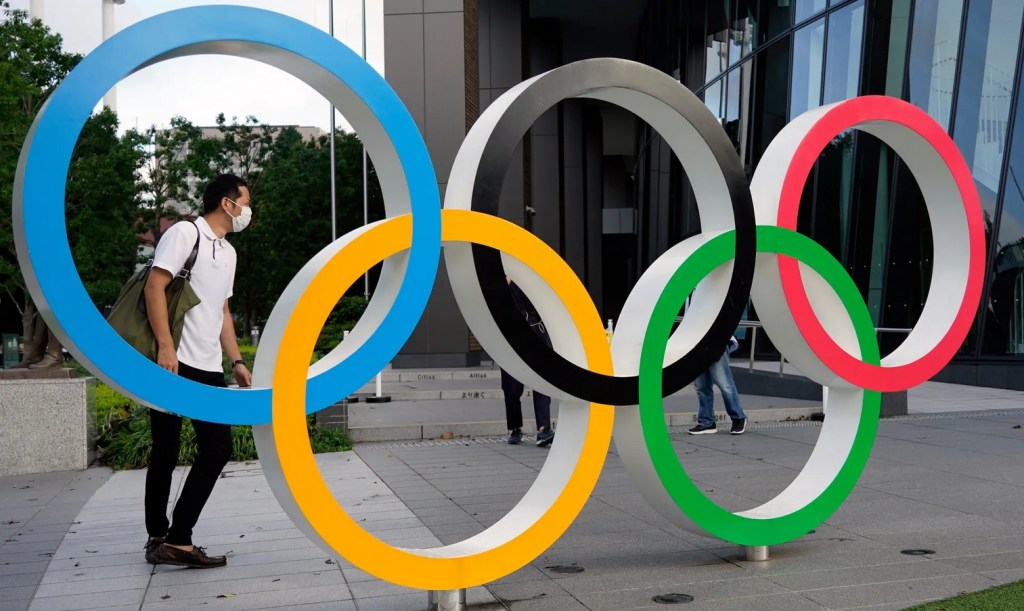
A man wearing a protective face mask walks past an Olympic Rings monument near the national stadium, the main venue of the Tokyo Olympics and Paralympics.
September 8, 2020
The Tokyo Olympics must be held “at any cost”, Japan’s Games minister, Seiko Hashimoto, has said, as organisers continue to weigh up options for staging a “post-pandemic” celebration of sport in the city next summer.
“Everyone involved with the Games is working together to prepare, and the athletes are also making considerable efforts towards next year,” Hashimoto told reporters on Tuesday.
The former Olympian suggested the priority had shifted from planning for the “complete Games” once favoured by the outgoing prime minister, Shinzo Abe, towards an event that would enable athletes to compete regardless of the status of the Covid-19 pandemic.
“I think we have to hold the Games at any cost,” she said. “I want to concentrate all our efforts on measures against the coronavirus.”
There is also a growing belief within national olympic committees that the Games will go ahead following lengthy discussions over the summer about how they can be staged safely. The Guardian understands that proposals under discussion include:
- Potentially keeping athletes in preparation camps for longer before they move into the Olympic village, enabling them to be tested regularly for Covid-19 and cleared before competing.
- Asking athletes to leave the athletes’ village immediately after they have competed, rather than stay until after the closing ceremony as is traditional.
- Having reduced capacities in stadiums observing social distancing rules.
However, suggestions that there could be a downsized Olympics, with fewer athletes and staff, are being downplayed by senior sources.
The 2020 Tokyo Olympics were postponed in March as the coronavirus began its rampage through Europe, the US, Brazil, India and other parts of the world.
With health experts warning that a vaccine is unlikely to be widely available by the time the opening ceremony is due to take place on 23 July 2021, a task force of organisers, national and local government officials and health experts met for the first time last week to consider anti-virus measures.
The group, which is expected to release an interim report at the end of the year, is sifting through more than 200 proposals on how best to prevent an Olympic-related outbreak while enabling around 11,000 athletes from more than 200 countries to travel to Japan.
“While living with the coronavirus, we need to make sure that athletes can perform at their best and audiences enjoy the Games safely,” the deputy chief cabinet secretary, Kazuhiro Sugita, said at the meeting. “To achieve that, we will adjust border controls, testing and medical systems and the operations of the venues.”
Last week, the Tokyo chief executive, Toshiro Muto, insisted the Games could be held even if a vaccine was not available.
“It’s not a prerequisite,” he said. “It’s not a condition for the delivery of the Tokyo 2020 Games. A vaccine is not a requirement. Of course, if vaccines are developed, we’ll really appreciate it. And for Tokyo 2020 that would be great.”
While the delayed start of domestic and international sports competitions show it is possible to reduce the risks to athletes, it will be harder to ensure the safety of huge numbers of spectators from overseas.
“As far as spectators, we don’t have any conditions yet, but we’d like to avoid no spectators,” Muto said.
The comments from Hashimoto, who represented her country in speed skating and track cycling, echo those made on Monday by John Coates, vice president of the International Olympic Committee [IOC]. He said the event would go ahead next summer “with or without Covid”.
“The Games were going to be … the ‘reconstruction Games’ after the devastation of the tsunami,” Coates said, referring to the disaster that struck north-east Japan in 2011.
“Now very much these will be the Games that conquered Covid, the light at the end of the tunnel.”
Public support is waning in Japan, however, with two-thirds of respondents to a poll in July saying they would prefer the Olympics to be postponed a second time – an option organisers and the IOC have ruled out – or cancelled.
Organisers said they had been encouraged to see international sports events such as the US Open tennis and the Tour de France go ahead in the midst of the pandemic, and by reports that Japan’s government is considering allowing more fans into stadiums to watch domestic baseball and football matches.
“This has been a big, big encouragement for the staff at Tokyo 2020,” organising committee spokesman Masa Takaya told reporters on Tuesday. “We feel that is another step towards seeing sports in action in our society.”
IOC Vice President Says 2021 Tokyo Olympics Will Happen
September 7, 2020
The Tokyo Summer Olympics are taking place next year regardless of the coronavirus pandemic, according to International Olympic Committee Vice President John Coates.
“It will take place with or without COVID. The Games will start on July 23 next year,” Coates told news agency AFP on Monday, according to multiple outlets.
“The Games were going to be, their theme, the Reconstruction Games after the devastation of the tsunami,” he added, referring to the devastating earthquake and tsunami that struck Japan in 2011. “Now very much these will be the Games that conquered COVID, the light at the end of the tunnel.”
In late March, the International Olympic Committee (IOC) announced that the Summer Games would be rescheduled for the same time slot next year due to the ongoing COVID-19 crisis.
The Olympics will now be held from July 23 through August 8, 2021.
There is still much uncertainty regarding the games, however. In June, various Japanese media sources published stories indicating that the Olympics will be “downsized,” “simplified” or “very different.”
Officials have not yet announced any specific modifications, but the reports indicated that athletes may face quarantines and coronavirus testing and seating could be reduced.
Following the published reports, Tokyo Olympics spokesman Masa Takaya appeared in an online news conference but did not confirm any of the leaked information about downsizing.
He did, however, address concerns about reducing the amount of seating, as millions of tickets have already been sold. “We want to brush away these concerns,” Takaya said, speaking to ticket holders.
“We understand that countermeasures for COVID-19 next year, particularly during games time, is one of the biggest things to address in preparing for the games next year,” he added. “But once again these countermeasures will be discussed in more depth from this autumn onward.”
Adam Rippon Says 2020 Winter Olympians Are ‘Grieving’ Amid Postponement
Figure skater Adam Rippon won a bronze medal in the 2018 Olympics in PyeongChang
Olympic Minister Seiko Hashimoto said that costs must be cut for the rescheduled games, but added that ensuring athletes’ safety may lead to higher expenses.
“Unless safety and security are ensured, there will be uncertainty for the athletes-first point of view,” she said, according to the Associated Press. “We must study measures including virus testing in order to ensure safety and security.”
The delay marks only the fourth time in modern Olympic history that the games have been disrupted.
https://www.yahoo.com/entertainment/ioc-vice-president-says-2021-155509392.html
2011 Fukushima nuclear disaster museum to open in Futaba town
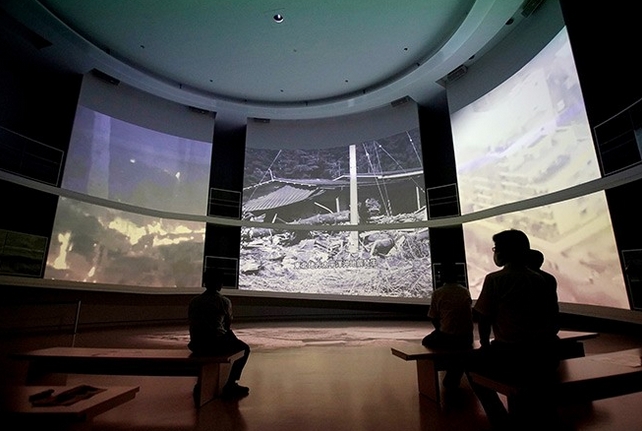
A theater at the museum of Great East Japan Earthquake and nuclear disaster that will open to the public on Sept. 20 in Futaba, Fukushima Prefecture
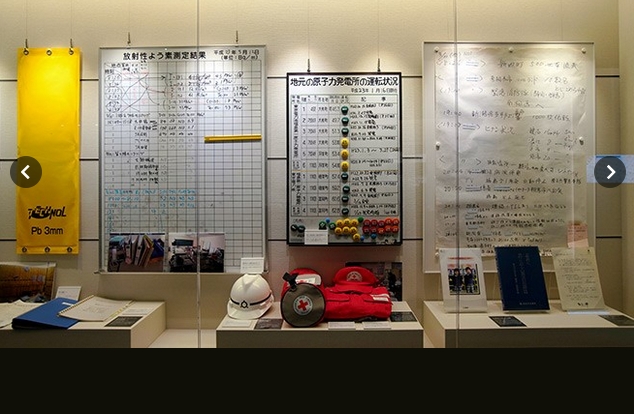
Whiteboards and other items that reveal the tense post-accident situation are on display at the new museum of the Great East Japan Earthquake and nuclear disaster in Futaba, Fukushima Prefecture.
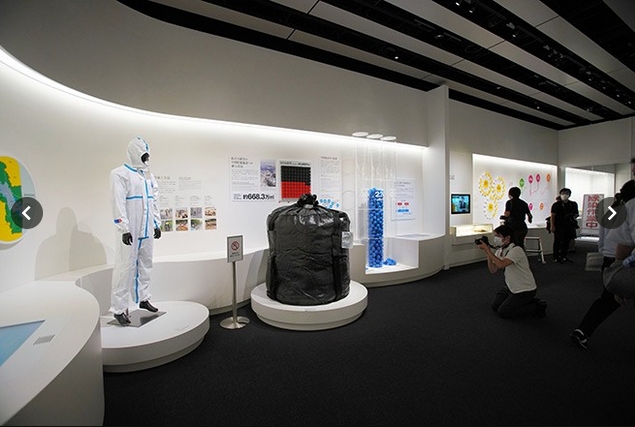
An exhibit about decontamination work after the 2011 accident at the new museum of the Great East Japan Earthquake and nuclear disaster in Futaba, Fukushima Prefecture
September 7, 2020
FUTABA, Fukushima Prefecture–A new 5.3 billion yen ($50 million) museum here is entrusted with the mission of keeping lessons from one of the world’s worst nuclear disasters alive.
The museum of the Great East Japan Earthquake and nuclear disaster in Futaba, Fukushima Prefecture, which co-hosts the crippled Fukushima No. 1 nuclear plant, is now complete and waiting to welcome visitors on Sept. 20.
It will feature firsthand accounts from survivors of the massive earthquake, tsunami and nuclear power plant accident, which devastated areas of Japan’s Tohoku region in March 2011, and an array of artifacts reflecting the events.
The museum’s collection includes roughly 150 items selected from the 240,000 items that the prefectural government collected after the triple disaster.
Exhibition floors are divided into six zones by themes such as “responses to the nuclear accident” and “challenges for reconstruction.”
A video detailing the natural disaster and subsequent meltdown at the Fukushima No. 1 nuclear power plant, operated by Tokyo Electric Power Co., will be shown on a giant screen.
Toshiyuki Nishida, an actor from the prefecture, narrates the video, in which he encourages viewers to reflect on lessons from the disaster.
Items left abandoned at a local elementary school after residents evacuated are on display, including a bookbag, a glove and a folding umbrella.
Another item, a can of food left behind at a deserted house, conveys just how dire the post-disaster situation was: a wild boar seeking sustenance tore it open.
A large photo of a now infamous signboard that used to be on display in the center of Futaba town to promote the safety myth of nuclear power is also among the exhibited items.
Twenty-nine people who survived the disaster in and out of the prefecture are scheduled to share their experiences with visitors at the museum.
The central government, in principle, was responsible for financing the museum’s construction, including funds spent on collecting items and curating materials.
Akira Imai, a former public policy professor at Fukushima University, lamented something missing from the museum.
“It seems there are not many exhibits focusing on the lack of preparedness before the nuclear accident,” he said.
In order to carry out its mission, “the museum should enhance its investigative and research division and reflect the cautionary tale of the accident in its exhibits,” Imai said.
(This article was written by Shoko Rikimaru and Shinichi Sekine.)
Fukushima Prefecture Announces New “High-Quality” Rice, Branding
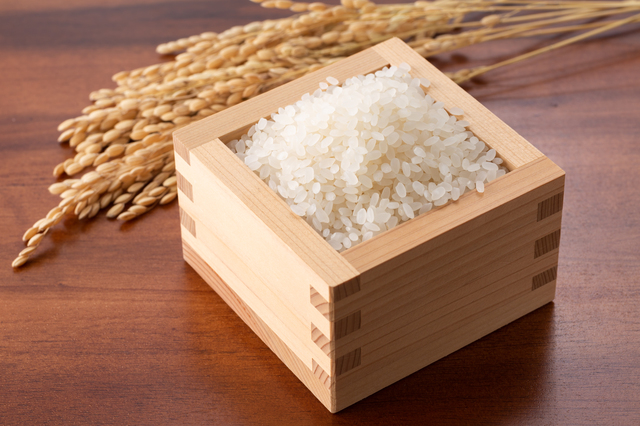
September 4, 2020
With the announcement of a new variety of top-tier rice, Fukushima hopes to further unravel the unfair stigma of the 2011 tsunami.
On Monday, Fukushima Prefectural Governor Uchibori Masao stood before the gathered press and held aloft an indigo-blue print. The painterly, dark-blue brushstrokes depicted rice fields, mountains, and farmers planting and harvesting grains. Below, in the same vibrant indigo, were the words 「福、笑い」: Fuku, Warai, or “Luck, Laugh.” This was the just-announced official design for Fukushima Prefecture’s new high-quality rice cultivar. Fittingly for Fukushima (福島, literally “Lucky Island”), the brand would bear that same “lucky” kanji in its name.
The global image of Fukushima, of course, is not one most would describe as “lucky.” Indeed, the vast prefecture – Japan’s third-largest by area – is often intrinsically associated with the 3/11/2011 nuclear catastrophe at the Fukushima Daiichi nuclear power plant. Infamously, the disaster resulted in a zone of exclusion which forced 165,000 residents from their homes. Early government mismanagement of the crisis resulted in a Japanese populace who often distrusted official statements about local food safety. With the name “Fukushima” appended to the plant, the reputation of the entire prefecture and its people suffered.
This was doubly true for those who worked in Fukushima’s vaunted agricultural sector.
A Prefecture Recovering, an Industry Besmirched
Nearly a decade on from the disaster, the zone of exclusion has shrunk dramatically. Villages, once ghost towns, are reopening. Less than 3% of the prefecture remains off-limits. (In fact, at its greatest extent, the ZOE covered less than 6% of the prefecture.) Years of stringent testing have long proven Fukushima-grown produce to be safe. Yet, still, the stigma lingers. The South Korea Olympic Committee announced last year that it planned to bring radiation detectors and Korean-produced food to the (now-postponed) 2020 Tokyo Olympics. They aimed to avoid athletes consuming any Fukushima products.
Such fear-mongering has been especially difficult for farmers in Fukushima. This is in part because the prefecture was actually famous for its high-quality produce previous to the disaster, Fukushima produced 20.6% of the country’s peaches and 8.7% of its cucumbers. The prefecture’s real agricultural showstopper, however, is its rice.
Lucky Island, Lucky Rice
Fukushima is a mountainous land. In particular, parts of the western Aizu region have nary a flat plain in sight. Here, snowmelt from the mountain peaks runs down into regional rice paddies. This pure water helps to give Fukushima rice its high-quality flavor.
The soil, too, assists in producing good rice, as do the prefecture’s hot days and cold nights. Popular rice cultivars like Koshihikari and Hitomebore are grown, as well as numerous sake rice varieties. Fukushima rice is of such high-quality that it famously trades off taking first place with neighboring Niigata in national rice flavor competitions most years. Recently, Fukushima rice was honored three years running. The Japan Grain Inspection Association Rice Taste Rankings awarded multiple Fukushima rice brands its “Special A-Class,” leading the prefecture to take first place in 2017 through 2019.
The high-grade rice also yields high-quality sake (日本酒; nihonshu). The perfect combination of rice and water, paired with breweries with long years of experience, has resulted in some of the country’s best rice wines. Subterranean rivers flowing from Mt. Bandai; water sourced from the Abukuma-do cave; Aizu snowmelt; all these waters serve to help make Fukushima’s sake special. In 2018, Fukushima sake won the coveted National Research Institute of Brewing title for an unprecedented sixth year in a row. Breweries like Suehiro, Okunomatsu, and Kokken are just a few of its renowned sake producers.
Yet the perception of Fukushima rice – even that produced in Aizu, more distant from the nuclear disaster than parts of other prefectures – as being potentially contaminated continues to damage the Fukushima agricultural industry. Governor Uchibori almost certainly had this in mind as he sought to create excitement around Fukushima products with the announcement of the prefecture’s new cultivar.
The Birth of Fuku, Warai
Despite the timeliness of its announcement, the prefecture in fact first began designing this new rice strain 16 years ago. According to the rice brand’s official website, “Niigata no.88, descendant of Koshihikari, is its mother; prefectural cultivation-type Gunkei 627, descendant of Hitomebore, is its father.” Quality and taste-testing repeated since 2006. In 2019, the prefecture official decided to promote the rice. After the rice was announced, 6,234 Fuksuhimans submitted possible names for the cultivar; the government chose “Fuku, Warai” so that it might “bring a smile to the faces of those who produce it, those who eat it, and make them all happy.”
More than that, the prefecture announced an even loftier accomplishment. “Through these 14 months and years, we’ve put our all into creating the ideal rice. We’ve arrived at a new rice, brimming with “Fukushima Pride.”
In a promotional video produced by the prefecture, Sakuma Hideaki, head of the horticulture department of the Fukushima Agricultural Research Center, had the following to say regarding the new rice strain: In terms of its flavor, the grain is quite large and possesses a sweet quality. It has a distinct aroma. You could say it has a soft texture as well. These are special qualities that distinguish this rice from previous Fukushima Prefecture original products up until now.
Ritzy Rice
The new cultivar is being produced as a premium rice, meant to compete with the most luxurious rice strains in Japan. The aim is to have the rice on specialty store shelfs by next fall, following a special preview harvest conducted on 6/6 hectares by 13 specially-picked rice producers.
The new packaging announced on Monday was illustrated by Yorifuji Bunpei (寄藤文平), well-known for his “please do it at home” public service posters on the Tokyo metro. Koriyama-native Yanai Michihiko handled the art direction. Regarding the design, Governor Uchibori said, おいしさや魅力がより伝わるよう、関係者と力を合わせてプロモーションに取り組む。 We’ve put together this promotion by joining with those involved in order to properly convey [the rice’s] deliciousness and value.
With any luck, Fuku, Warai will help with the continued rehabilitation of Fukushima’s impressive agricultural industries. Better yet, it may indeed serve as yet another point of pride for the people of Fukushima.
Sources
(2020年09月01日). 福島県オリジナル米「福、笑い」パッケージ青基調 先行販売へ。Fukushima-Minyu Newspaper.
Official Fukushima Prefectural Fuku, Wari Website.
Sternsdorff-Cisterna, N. (2015). Food after Fukushima: Risk and Scientific Citizenship in Japan. AMERICAN ANTHROPOLOGIST, Vol. 117, No. 3, pp. 455–467,
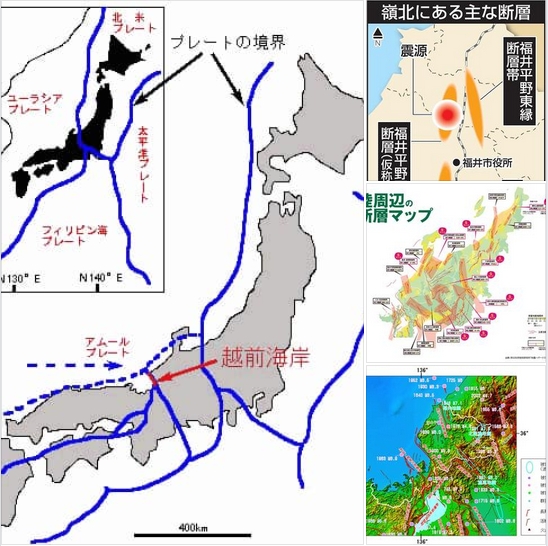
There are 15 nuclear power plants in Fukui Prefecture.
By Akihiko Tamai
Fukui SEISMIC INTENSITY 5 weak epicenter, fault expert, chain warning ′′ it can be connected to a big earthquake ′′
According to Professor Taku Okamoto (Earthquake) of fukui college of technology, there is a fault in the hirano part of the epicenter of the earthquake that observed the maximum SEISMIC INTENSITY OF 5 in Fukui Prefecture on the morning of September 4th It was possible to wake up In the future, if the earthquake of magnitude (M) 5 0 class is frequent, it is a chain with the surrounding fault, and it is pointed out that ′′ it can be connected to a big earthquake like the kumamoto earthquake 5
According to Professor Okamoto, the next wave that does not appear if it is not a fault-specific structure near the epicenter of this time is observed in the past earthquake, and in the west rim of fukui hirano, it is a fault that penetrates the confluence of the kuzuryu and hinogawa to the north It is said that there is a.
According to the Japan Meteorological Agency, this earthquake is a ′′ reverse fault type ′′ that is pushed from both sides and moves in the upper and lower direction. Professor Okamoto points out that the fault of the fukui hirano west rim may have caused the fault of the estimated fault and epicenter.
The Epicenter of this time is about 5 km away from the fukui hirano fault belt, which caused the fukui earthquake on June 28, 1948, and it is not directly related. Also, the earthquake of 4 or more seismic intensity that epicenter the north of the north of the north of the north of the north of the north of the north of the
The current situation is close to the earthquake of the shaking aftershocks, but in the future, if there is a similar earthquake as this time, there is a sabae fault in the south, so it is pointed out that ′′ chain leads to a big earthquake On Top of that, ′′ I need to carefully look at the progression of aftershocks activities for 1 OR 2 weeks
The earthquake is also called ′′ emergency earthquake breaking news is not in time In the future of aftershocks, I’m calling ′′ if you feel the tremor, I want you to lower your posture and take action to protect your head (Fukui Shimbun September 5)
Tokyo Olympics will be most costly Summer Games, Oxford study shows

In this June 3, the Olympic rings float in the water at sunset in the Odaiba section in Tokyo.
September 4, 2020
TOKYO
The Tokyo Olympics are already the most expensive Summer Games on record with costs set to go higher, a wide-ranging study from Britain’s University of Oxford indicates.
The Tokyo cost overrun already exceeds 200%, lead author Bent Flyvbjerg explained in an interview with The Associated Press. This is even before several billion more dollars are added on from the one-year delay from the COVID-19 pandemic.
Flyvbjerg is an economist at Oxford’s Said Business School. His entire study is available here, and it’s set to be published on Sept. 15 in the journal “Environment and Planning A: Economy and Space.” It’s titled “Regression to the Tail: Why the Olympics Blow Up.”
Tokyo, postponed until July 23, 2021, is only a small part of the focus. The study — the third in a series following editions 2012 and 2016 — looks at Olympic costs since 1960 and finds they keep increasing despite claims by the International Olympic Committee that costs are being cut.
Flyvbjerg cites many reasons for the rising costs and cost overruns, and offers solutions for the IOC. The vast majority of costs are picked up by governments with the IOC contributing only a small portion.
“The Olympics offer the highest level of risk a city can take on,” Flyvbjerg told AP. “The trend cannot continue. No city will want to do this because it’s just too expensive, putting themselves into a debt that most cities cannot afford.”
In his paper, Flyvbjerg cites Los Angeles Mayor Eric Garcetti, whose city is to hold the 2028 Olympics following Paris in 2024.
“Most cities, unless you have a government that’s willing to go into debt or pay the subsidy of what this costs, most cities will never say ‘yes’ to the Olympics again unless they find the right model,” he quotes Garcetti as saying.
By the right model, Garcetti means lower costs.
Tracking Olympic costs is difficult, a dense maze of overlap and debate. Politicians and organizers always argue over what are — and what are not — Olympic expenses.
Flyvbjerg writes: “Unfortunately, Olympics officials and hosts often misinform about the costs and cost overruns of the Games. … We therefore cannot count on organizers, the IOC, and governments to provide us with reliable information about the real costs, cost overruns, and cost risks of the Olympic Games.”
Flyvbjerg looks only at costs to operate the games — the operating costs and capital costs — the cost to build sports venues. He leaves out a third category, which is usually many times larger: renovating roads, building airports, and what he calls “sprucing up projects,” which also fall to taxpayers.
“Our estimates are conservative because there are lots of costs that are hidden that we can’t get into,” Flyvbjerg said. “And there are lots of costs we decided not to include because it’s too complex. We include the things we can get the most reliable numbers for and we do it in the same way for each city that we study.”
He also excludes the cost of debt, and the future cost of running sports venues after the Olympics leave, and inflation.
According to the Oxford numbers. Tokyo’s spending is at $15.84 billion, already surpassing the 2012 London Olympics, which were the most expensive summer games to date at $14.95 billion. He expects several billion more from the cost of the one-year delay.
Tokyo organizers say officially they are spending $12.6 billion. However, a national auditor says the actual costs are twice that high, made up of some expenses that the Oxford study omits because they are not constant between different Olympics.
Tokyo said the cost would be $7.3 billion when it won the bid in 2013.
“They (IOC) obviously don’t like our results, but it’s very difficult to counter a piece of rigorous research like this,” Flyvbjerg said. “And they haven’t done that, and they can’t do that. Our research is a problem for them.”
In an email to Associated Press, the IOC said it had not seen the latest Oxford study and declined to comment.It referenced another study by Mainz and Sorbonne universities.
This study also found Olympic cost overruns but said they were in line with other large-scale projects. Flyvbjerg’s study finds they are not.
Flyvbjerg said he has been in touch on and off with the IOC and had sent a colleague to an IOC workshop. He said a major reason for the rising costs is that the IOC does not pay for them. He also cited rising security costs, and moving the games around the world. He calls this the “Eternal Beginner Syndrome” with new host cities starting basically from scratch.
He’s said the IOC has tried recently to rein in costs, but the effort is “too little, too late.”
“They (IOC) define the specs but don’t pay for them,”Flyvbjerg said. “This is pretty similar to you and I giving the specs for a house that we are going to live in, but we don’t have to pay for it. How do you think we’d spend? We’d gold-plate it. This is what has happened over time.”
Flyvbjerg said he’s relish a chance to sit and talk with IOC President Thomas Bach. He calls himself a fan of the Olympics.
“It’s not that the IOC hasn’t been willing to talk, or I am not willing to talk,”he said. “We certainly are. We have communicated in writing to keep the IOC informed. But yes, we would like to sit down with Thomas Bach.”
https://japantoday.com/category/sports/oxford-study-tokyo-olympics-are-most-costly-summer-games
Video analysis prompts new theory on Fukushima explosion
Septembre 4, 2020
Experts revise their theory surrounding a hydrogen explosion at Fukushima Daiichi nuclear power plant in March 2011 based on Nippon TV’s reprocessing of footage an affiliate took of the event.
“KURENAI”Written by KUNIHIRO SUZUKI
Foreword
On March 11, 2011, a magnitude-9 earthquake and subsequent tsunami hit the Eastern Coast of Japan, which triggered the nuclear core meltdown of the Fukushima Daiichi Nuclear Power Plant. This is known as the Triple Disasters of 3.11. Even now, nine years later, the damaged power plants are continually releasing massive amounts of radioactive materials.
The Japanese government has changed the radiation safety standards. Restrictions of radiation exposure to residence was loosened to 20 times than before the disaster. The government has forcefully carried out repatriation policies for us to return home despite high levels of radiation contamination in the area. Few people have returned home. Once lively towns are now silent.
Inconsistency in evacuation policy after the nuclear disaster has left many local communities divided. In the name of the Olympic games, the government placed numerous policies in arbitrary manner, and as a result the people of Fukushima are left in pieces.
Overflowing memories were fiddled bluntly and drifting apart with nowhere to go

Only people continue on as if nothing happened

Convenient excuses alone cannot refill abandoned houses

Beautiful flowers painfully contrast with flexible container bags*, echoing hollowness
*Flexible container bags contain contaminated materials

Exposed to Mushubutsu*, what have the Seven Gods of Fortune witnessed, and what have they pondered?
*TEPCO claims that fallen-out radioactive materials belong to no one (Mushubutsu) and thus they are not responsible for it.
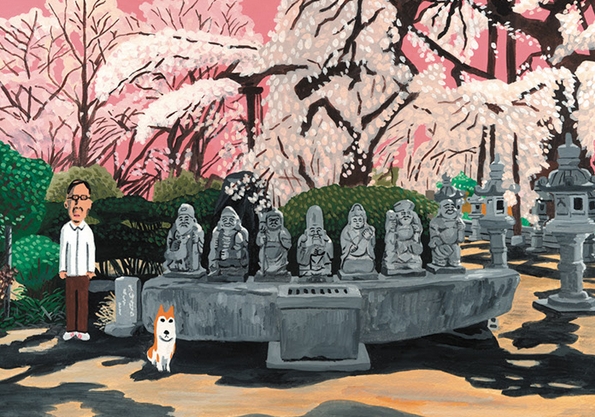
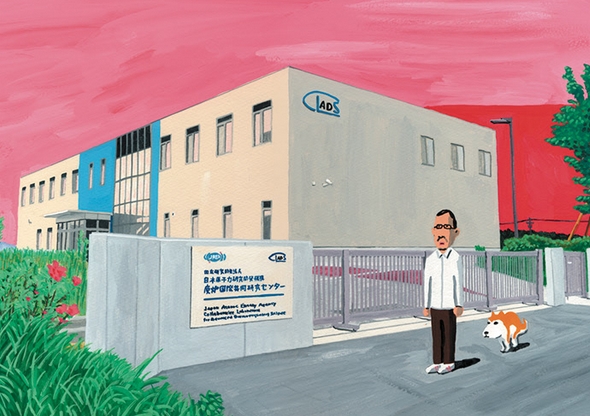
Evacuation orders have been lifted, and new nuclear facilities appear
Cherry blossom festivals bring momentary liveliness
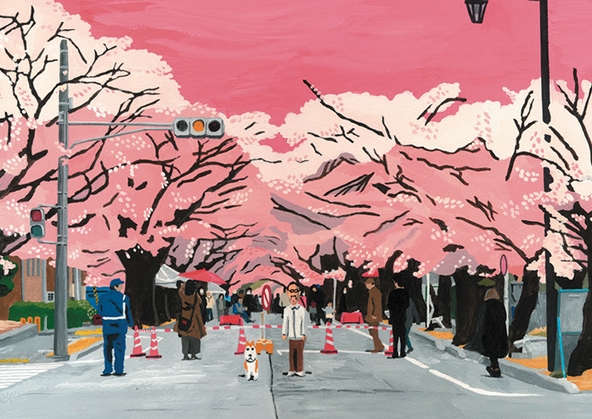
While childless villages are left to decay
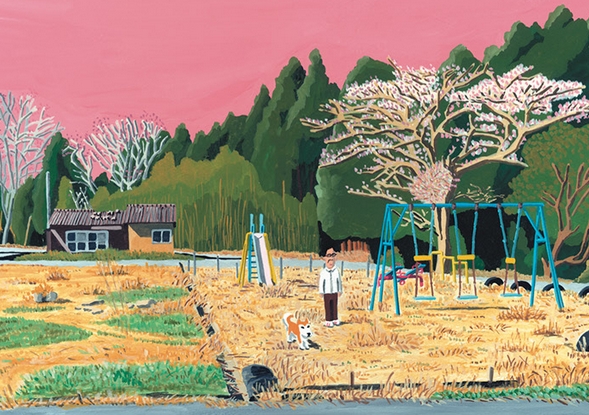
Under a clear blue sky, flowers flourish, birds squeal, wild animals and insects rejoice freedom
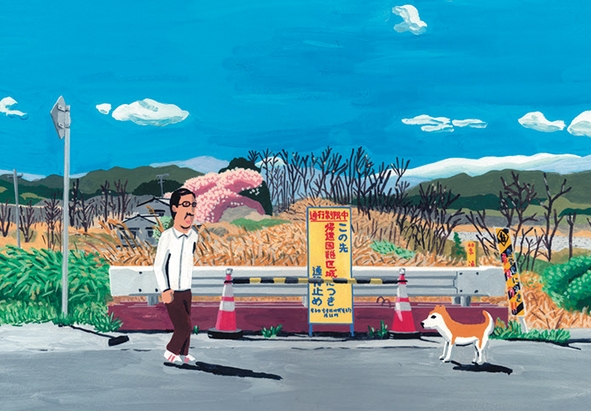
Because Mushubutsu is invisible, Because Mushubutsu is odorless
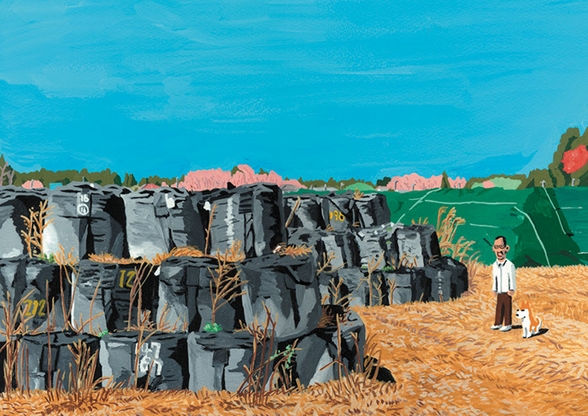
Villages with no more people, Villages with no sound, Villages left to decay, Villages to be abandoned
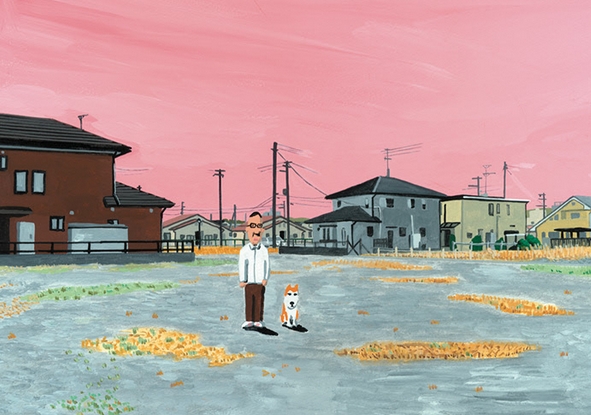
Is this heaven or hell? Mountains, rivers, grass and trees
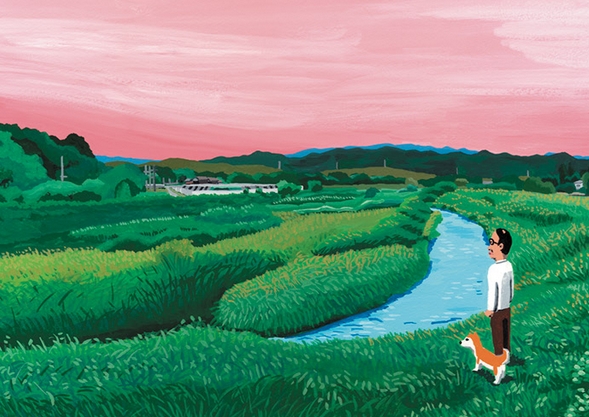
Only people are missing here

The broken nuclear plants that once tore so many hearts, continue puffing out fumes

Will it continue to tear us apart?

Please, no more.
Afterword
I got the idea of this book in April 2019, when I was on my way to a cherry blossom festival in Tomioka Town, Fukushima. The airborne radiation level of a street was 0.2~0.7 μSv, and the next street was 1.0μSv. The barricade divided the cherry blossom street. There were young children and elderly couples, families with their pets, full of smiles and happiness. But at the same time, there were those who worryingly gazed out beyond the barricade.
There were many street vendors lined up in the nearby middle school playground for the festival. There was even an informational booth from the Japan Atomic Energy Agency (JAEA). Next to the ground, there was a gymnasium. The gymnasium was left there as if frozen in time, in preparation for the graduation ceremony right before the earthquake hit. As I was walking through this chaotic town alone, I thought to myself, “I wish the sky would turn red.”
The 2020 Tokyo Olympics and Paralympics have also been called the “Recovery Olympics.” The governor of Fukushima has asserted that he will show the world “the light and the darkness” of Fukushima. But how is the “dark” side of Fukushima going to be revealed? To name one, the route of the torch relay seems to imply otherwise.
While chanting such optimistic terms like “ties” (kizuna), “Cheer up!” (ganbarou), “I’m doing well” (genkidesu), aren’t we trying to look away from tens of thousands of evacuees or those who have returned only to face a life of sorrow and pain?
As many people have begun to forget about the “darkness” in Fukushima, I feel obliged to keep drawing about it. Perhaps, the decommissioning of the reactors won’t be completed in my life time.
Nuclear waste disposal is a matter of environmental concern
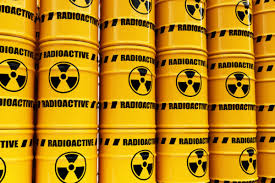
Aug 31, 2020
It has been reported that the town of Suttsu in Hokkaido is considering applying for a two-year “literature research” into the possibility of storing high-level radioactive nuclear waste. A maximum of ¥2 billion in subsidies will be granted by the central government.
“The future of the town is financially precarious,” said Haruo Kataoka, the mayor of Suttsu, in an interview.
But the money that is thought to revive the town cannot reverse what the nuclear waste is likely to cause.
It is, in my opinion, never a financial issue, but a matter of environmental concern.
What is in question here is high-level radioactive nuclear waste, which can be dangerous for at least 200,000 years and therefore must be handled with the utmost care. It is indeed a problem that any country with nuclear power plants needs to address, however thorny it is. Any indiscreet decision is deemed extremely irresponsible and profoundly unethical.
“Financially precarious,” I must stress, is by no means comparable to environmentally threatening. Besides, it is specifically stated in a Hokkaido ordinance that nuclear waste is hardly acceptable in the prefecture.
Before a final disposal site is selected, or even before an application for research is submitted, the scientific facts ought to be thoroughly understood and the residents properly informed.
The span of recorded history is merely 5,000 years, while 200,000 years is far beyond human experience and comprehension. We certainly cannot live to see what is going to become of the nuclear waste, but I believe that we do not want to leave the thorny problem unaddressed to haunt our future generations.
Jive Sun
Sapporo
Low Dose Ionizing Radiation Shown to Cause Cancer in Review of 26 Studies
These results contradict the claims of the Japanese authorities who keep repeating that there is no impact observed below a dose of 100 mSv.
The US National Cancer Institute has dedicated an entire volume of its scientific journal, Journal of the National Cancer Institute Monographs, to the impact of low doses of radiation on cancers. The articles are open access.

July 13, 2020
An international team of experts in the study of cancer risks associated with low-dose ionizing radiation published the monograph, “Epidemiological studies of low-dose ionizing radiation and cancer: Summary bias assessment and meta-analysis,” in the Journal of the National Cancer Institute on July 13, 2020.
It is well established that ionizing radiation causes cancer through direct DNA damage. The general public are exposed to low doses of ionizing radiation from medical exposures like computed tomography (CT) scans, naturally occurring radiation (emitted from bedrock with the earth’s crust and cosmic rays emitted by the sun), and occupational exposures to medical, aircrew and nuclear workers. A key question for low-dose exposures is how much of the damage can be repaired and whether other mechanisms, including inflammation, also play a role. This critical question has been long debated for radiation protection standards.
After combing data from 26 epidemiological studies the authors found clear evidence of excess cancer risk from low dose ionizing radiation: 17 of 22 studies showed risk for solid cancers and 17 of 20 studies showed risk for leukemia. The summary risk estimates were statistically significant and the magnitude of risk (per unit dose) was consistent with studies of populations exposed to higher doses.
A novel feature of the research effort was the investigators’ use of epidemiological and statistical techniques to identify and evaluate possible sources of bias in the observational data, for example confounding, errors in doses, and misclassification of outcomes. After a thorough and systematic review, they concluded that most did not suffer from major biases.
The authors concluded that although for the most part, absolute risk of cancer will be small, the data reinforce the radiation safety principle to ensure that doses are “as low as reasonably achievable” (ALARA).
Additional research is needed to explore risks for cardiovascular disease (CVD) at low doses. Because CVD is a very common disease, even small risks at low doses could have important implications for radiation protection and public health.
The 26 epidemiological studies were published between 2006 and 2017 and included a total of 91,000 solid cancers and 13,000 leukemias. Studies were eligible if the mean dose was <100 mGy. The study populations had environmental radiation exposure from accidents, like Chernobyl, and natural background radiation, medical radiation exposure like CT scans and occupational exposure including nuclear workers and medical radiation workers.
Reference:
“Epidemiological studies of low-dose ionizing radiation and cancer: Summary bias assessment and meta-analysisExit Disclaimer,” JNCI Monographs. Volume 2020. Issue 56. July 2020.
https://academic.oup.com/jncimono/issue/2020/56
https://dceg.cancer.gov/news-events/news/2020/low-dose-monograph
Evacuation orders for Fukushima radioactive areas to be lifted without decontamination
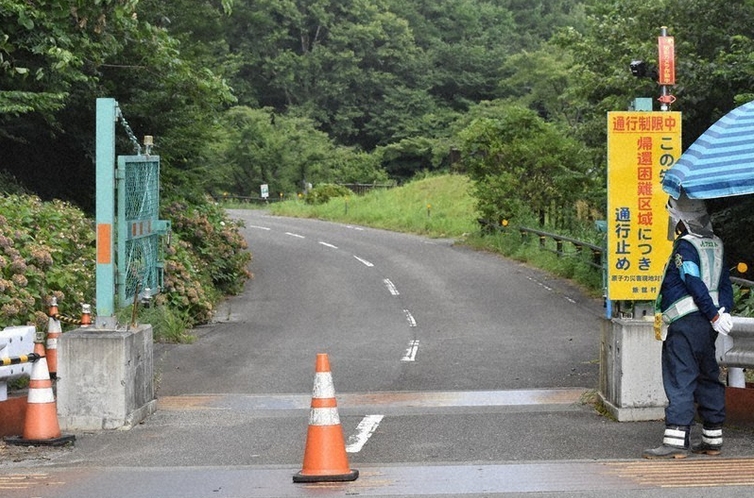 A gate to the Nagadoro district of the village of Iitate, Fukushima Prefecture, is seen in this picture taken on Aug. 24, 2020. The district was designated as a “difficult-to-return” zone in the wake of the Fukushima nuclear disaster.
August 27, 2020
TOKYO — The Japanese government is set to allow the lifting of evacuation orders for highly radioactive areas near the disaster-stricken Fukushima Daiichi Nuclear Power Station without decontamination work on condition that residents will not resettle there.
The government on Aug. 26 disclosed the policy to the Nuclear Regulation Authority (NRA) for the so-called “difficult-to-return” zones where residents have remained evacuated since the onset of the Fukushima nuclear disaster in 2011 due to high radiation doses in those areas in northeastern Japan. The NRA gave its consent to the government policy, paving the way for residents to enter areas outside the specified disaster reconstruction and revitalization base zones.
The government has heretofore made it a condition for lifting the evacuation orders that: the radiation exposure doses will not exceed 20 millisieverts per year; infrastructure necessary for daily lives is developed and sufficient decontamination work is performed; and consultations are held with local bodies and residents. The government previously designated parts of the difficult-to-return zones as disaster recovery bases, which mainly lie in areas where local residents lived, and planned to lift the evacuation orders by 2023 after decontamination work and infrastructure development.
Meanwhile, upon receiving a request from the village of Iitate in Fukushima Prefecture, the government has also been examining under which situations the evacuation directives can be lifted in areas outside the disaster recovery base areas.
At a regular meeting on Aug. 26, the government explained its line of thinking that the evacuation orders can be lifted on conditions including: the annual radiation exposure doses are confirmed to be no more than 20 millisieverts; residents’ radiation exposure doses are controlled by using personal dosimeters; and information to curb radiation exposure is provided. The government then sought the NRA’s opinion on the matter.
In response, the nuclear watchdog body evaluated the government’s new policy and offered a view that “it is in essence the same” as the current conditions for lifting the nuclear evacuation orders.
Upon receiving the NRA’s stamp of approval, the government is set to hold a meeting of the Nuclear Emergency Response Headquarters and formally decide on the prerequisites for removing the evacuation orders in areas outside the disaster recovery bases. Following the decision, municipal governments will look into whether to lift their evacuation orders for their local areas.
In Iitate village, the Nagadoro district has been designated as a difficult-to-return zone, dividing the village into a disaster recovery base and an area not designated as such. The Iitate Municipal Government is planning to develop a disaster restoration park in parts of a roughly 9-square-kilometer area that had few residents and falls outside the disaster recovery base, and requested the central government to allow the village to lift the evacuation order for the area at the same time as for the disaster recovery base.
https://mainichi.jp/english/articles/20200827/p2a/00m/0na/005000c
Japan should leave radioactive water in current storage tanks
Hajime Matsukubo, general-secretary of the Citizens’ Nuclear Information Center, says an ocean dump doesn’t make sense
 Hajime Matsukubo, general secretary of the Citizens’ Nuclear Information Center (CNIC)
Aug.17,2020
What’s the most practical and safest way to handle the radioactive water being stored at Fukushima? According to Hajime Matsukubo, general-secretary of the Citizens’ Nuclear Information Center (CNIC), the contaminated water should be left in the aboveground tanks where it’s currently being stored. In a recent email interview with the Hankyoreh, Matsukubo said it doesn’t make sense to release the water into the ocean just because the tanks are running low on space.
The CNIC is a Japanese NGO that was set up in 1975 under nuclear physicist Jinzaburo Takagi, a leading figure in the campaign against nuclear power in Japan. Matsukubo is an active researcher, lecturer, and publisher of materials related to the anti-nuclear movement. The interview is presented below.
Hankyoreh (Hani): When do you think the final decision will be made about dumping the contaminated water at Fukushima into the ocean?
Hajime Matsukubo: TEPCO [Tokyo Electric Power Company] says it will dilute the contaminated water before dumping it into the ocean, which means that a dilution facility would have to be built. Given the time required to get a building permit, I think the final decision will be made this summer or fall.
Japan wants an ocean dump because it’s the cheapest option
Hani: Why do you think the Japanese government is pushing so hard to dump the water into the ocean?
Matsukubo: Not only Japan but all countries that operate nuclear reactors end up with tritium as a byproduct, which they then release into the ocean or the atmosphere. I see this decision as an extension of that. Another factor is that releasing the water into the ocean is the cheapest option.
Hani: There seems to be considerable opposition to the plan in Japan as well.
Matsukubo: Many citizens are opposed to it. Pushback has been particularly strong from fishermen, who are likely to be harmed by the rumors [about the danger of the radioactive matter being released, which could cause people not to visit or eat food from Fukushima]. Lawmakers at city councils in Fukushima Prefecture have adopted a series of resolutions voicing concerns about releasing the contaminated water.
Hani: Do you think that negative public opinion in Japan is capable of changing government policy?
Matsukubo: Since the fishermen are direct stakeholders, I think their opposition will have a big impact. TEPCO has promised not to release the water without the consent of local communities in Fukushima. I think the key is opposing voices in Japan and increasing pressure from overseas.
Hani: Do South Korea or environmental groups in other countries have any way to sanction Japan for releasing contaminated water into the ocean?
Matsukubo: They could consider filing a lawsuit based on the UN Convention on the Law of the Sea. But a large amount of tritium is already being released from Korea’s nuclear plants, especially the Wolseong plant. It would be rather difficult to prove that contaminated water released from Fukushima Daiichi [No. 1] is having an impact.
There’s plenty of land that could be used for additional storage
Hani: What’s the most practical and safest way to deal with the contaminated water?
Matsukubo: The contaminated water at Fukushima should be left in the aboveground tanks where it’s currently being stored. [The government] says there’s no more room at Fukushima Daiichi, but there is. There’s a huge amount of land that could be used to store the radioactive wastewater. While the Ministry of Economy, Trade, and Industry says that land can’t be appropriated for other uses, the government [could and] should negotiate with the landowners. It’s absurd to dump radioactive water into the ocean because there’s not enough storage space in the tanks. Japanese NGOs are suggesting that the government continue storing the water in the aboveground tanks and seal them off with concrete. They’re warning the government that releasing the water into the ocean would create international problems.
S. Korea, Japan both need to reassess their reprocessing plans
Hani: Do you have a message for South Korea’s civic society?
Matsukubo: The Japanese government is pursuing a policy of creating a nuclear fuel cycle that would recycle plutonium and uranium from the spent nuclear fuel produced by reactors. This policy requires reprocessing plants that are currently under construction at Rokkasho, in Aomori Prefecture, which are supposed to begin operations in 2021. These plants will release a large amount of radioactive matter into the ocean and the atmosphere. In terms of tritium alone, the amount released will be 10 times worse than the contaminated water at Fukushima Daiichi. That’s a very serious problem, just as releasing the contaminated water would be.
In South Korea, the Korea Atomic Energy Research Institute is taking the lead in R&D projects related to reprocessing spent nuclear fuel. The problems with reprocessing plants don’t end here. Plutonium can be used as a raw material for making nuclear weapons. I think that South Korea and Japanese citizens need to join forces to shut down both countries’ reprocessing plans.
By Kim So-youn, staff reporter
http://english.hani.co.kr/arti/english_edition/e_international/958103.html
Japan pushes forward with plans to dump radioactive water into ocean, despite public opposition
Tokyo may dump contaminated water as early as September
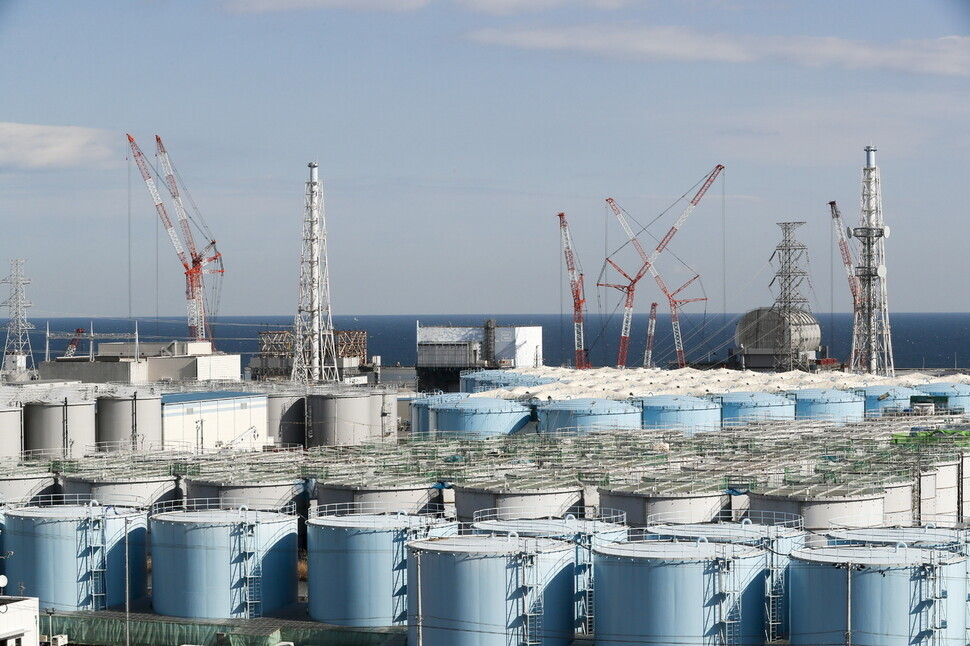 Storage tanks for water contaminated with radioactive matter from the Fukushima Daiichi Nuclear Power Plant.
Aug.17,2020
During the past three months, while the international community was focused on the COVID-19 pandemic, the Japanese government has held five public hearings as it moves forward with its decision to dump radioactive water from the Fukushima nuclear disaster into the ocean. After analyzing the transcripts and videos from the hearings, the Hankyoreh has concluded that the Japanese government will probably decide to dump the water as early as September or October, despite overwhelming public opposition to the plan, even in Japan. Since a study has found that the contaminated water could reach the eastern coast of South Korea within a year of being dumped, international groups focusing on the environment and experts in international law are calling for the South Korean government to take preemptive action in the area of international law.
Following an explosion during the 2011 Tohoku earthquake, the Fukushima Daiichi nuclear power plant was closed and is being decommissioned, a process that has taken nine years so far. But debate continues about how to deal with the growing volume of water contaminated with radioactivity, including the water used to cool the nuclear fuel and rainwater and groundwater that have seeped into the buildings. The contaminated water is currently being stored in tanks, but by the summer of 2022, the Japanese government says, the tanks will run out of space, necessitating the water’s release into the ocean.
The Japanese government, under Prime Minister Shinzo Abe, held video hearings about how to deal with the contaminated water on Apr. 6, Apr. 13, May 11, June 30, and July 17. These hearings were attended not only by representatives from the fishing, agriculture, and hospitality businesses and community leaders from Fukushima Prefecture but also the national tourist council and groups representing businesses and consumers. The government was represented by officials from 10 or so ministries, including the Ministry of Economy, Trade, and Industry, the Ministry of the Environment, and the Ministry of Foreign Affairs.
Radioactive matter detected in water even after decontamination
While reviewing the hearings, the Hankyoreh learned that radioactive matter has been detected even following decontamination efforts, that releasing the water would likely cement Fukushima’s stigma as an area tainted with radioactivity and have a serious impact on the fishing industry, and that there was widespread opposition to the idea among hearing attendees, who argued that the final decision shouldn’t be made until public opinion has been canvassed.
An August 2019 report by international environmental group Greenpeace about the contaminated water at Fukushima found that the water, once released, would flow through the East China Sea and be brought via the Kuroshio Current and the Tsushima Current to South Korea’s eastern shore within a year. Disregarding the concerns of the international community, the Japanese government released a draft of a plan this past March to dump the contaminated water at Fukushima into the ocean over the course of 30 years. Given the plan’s schedule, which involves the construction of a facility to dilute the contaminated water, its decision will likely be made by this October. Abe told the press in an interview in March that he wants to finalize a plan as quickly as possible.
The Japanese government intends to make its final decision after canvassing the opinions of Fukushima residents, related organizations, and ordinary citizens. But even in the Japanese public, there’s fierce opposition to dumping the contaminated water. The Hankyoreh’s analysis of the transcripts and videos from the five hearings show that most of the 37 participants were concerned about the plan to release the water.
“It’s human nature to avoid radioactive materials. It’s a serious problem that there’s still radioactivity even in the decontaminated water, which contradicts what TEPCO [Tokyo Electric Power Company] initially said,” said Hidenori Koito, the director of a trade association for the hospitality industry in Fukushima Prefecture.
80% of water contains radioactive matter beyond permissible levels
TEPCO claimed to have filtered out 62 kinds of radioactive material through the Advanced Liquid Processing System (ALPS) and all that’s left is tritium, which is technically difficult to remove from the contaminated water in the tanks. But a 2018 study found that 80% of the water processed using ALPS still contained more than the permitted level of radioactive matter that is deadly to the human body, including cesium, strontium, and iodine. While TEPCO has emphasized that it would decontaminate the water once more to ensure its safety prior to release, distrust has already surged.
Another criticism is that dumping the water would spoil the nine-year campaign by Fukushima residents to repair the area’s reputation. “If the contaminated water is released into the ocean, people will inevitably think there’s another radiation leak at Fukushima, given the nuclear accident that occurred there,” said Kimio Akimoto, president of a coalition of forestry associations in the prefecture.
Vehement opposition from fishermen
An even sterner stance was taken by fishermen, who depend upon the ocean for their livelihood. “It’s unacceptable for radioactive matter to be deliberately pumped into the ocean,” said Tetsu Nozaki, president of a coalition of fishery cooperatives in Fukushima Prefecture. The national coalition of fishery cooperatives voted on July 23 to “oppose” the planned release of contaminated water.
There are also concerns that the government is rushing the plan. “The Japanese public doesn’t know the details about the contaminated water yet. The final decision shouldn’t be made until people understand what it means to dump contaminated water into the ocean,” said Yuki Urago, secretary-general of a national coalition of consumers’ associations.
“Right now, the Japanese public is focused on COVID-19. It’s doubtful whether the issue of contaminated water at Fukushima can provoke a national debate in this situation,” said Yuko Endo, mayor of Kawauchi, a village in Fukushima Prefecture.
Japan took an unusually long opinion canvassing period
Before deciding on important policies, the Japanese government has a practice of canvassing opinions, a process known as the “public comment” period. The relevant ministry here, the Ministry of Economy, Trade, and Industry, began collecting comments on Apr. 6 and took the unusual step of extending that period three times, only wrapping it up at the end of last month. One reason the government may have extended the comment period is because of the overwhelming opposition to releasing the contaminated water into the ocean.
Last month, the UN Human Rights Council released a statement expressing “deep concerns” about “a report indicating that the Japanese government is accelerating its timeframe for releasing water contaminated with radioactivity at Fukushima.” South Korea, given its proximity to Japan and the ocean, has set up a government-wide task force under the Office of the Prime Minister to keep tabs on the Japanese government’s actions.
“We’re asking Japan to share adequate information while it’s processing the contaminated water at the Fukushima nuclear plant. We’re monitoring the situation from various angles to see what impact this will have on us,” explained an official from South Korea’s Ministry of Foreign Affairs.
By Kim So-youn, staff reporter
http://english.hani.co.kr/arti/english_edition/e_international/958099.html
ICAN chief: Japan sabotaging nuclear disarmament
 Beatrice Fihn, Executive Director of the International Campaign to Abolish Nuclear Weapons, or ICAN, spoke to NHK about the possible game changers in the drive to get rid of the weapons of mass destruction.
Aug. 15, 2020
Hiroshima and Nagasaki in southwestern Japan are the only two cities to have suffered attacks using nuclear weapons. For people around the country, the anniversary month of August is a time to remember the tens of thousands of lives erased in the twin flashes in 1945, as well as the countless others affected by the subsequent radiation.
Fihn’s organization won the Nobel Peace Prize in 2017 for its efforts to bring people to the negotiating table to pledge to work toward nuclear disarmament. The adoption of the Treaty on the Prohibition of Nuclear Weapons at the United Nations was a step forward, in which ICAN played a major role.
Fihn says the next few months are crucial, as her team has given itself until the end of the year to get enough signatures to put the treaty into effect. Just this month, Ireland, Nigeria, Niue, and Saint Kitts and Nevis have signed up, bringing the total number on board to 44.
“We always aimed that we would be getting 50 in 2020.” She says. “And obviously COVID-19 has slowed down some processes, but we still think that there’s a really good chance that we can get the 50 ratifications needed this year. So we’re working very very hard on this.”
What about Japan?
But Japan remains one of the countries that’s yet to sign the treaty. Prime Minister Abe Shinzo has said every year at the memorial ceremonies that it’s Japan’s mission to, “realize a world without nuclear weapons.”
But Fihn wonders why the commitment hasn’t been backed up by action. “There is no leadership right now on nuclear disarmament from Japan’s side — rather the opposite,” she says. “Japan is going backwards as well and undermining its own resolutions that it’s supported for a long time ago, weakening language and documents.”
 Japanese Prime Minister Abe Shinzo made another pledge this year that the country would commit to achieving a world without nuclear weapons.
“That’s very serious. And I think that’s an insult to the survivors — to the hibakusha,” Fihn says. “We really know the Japanese people want the government to sign the treaty.”
“It’s very often that we look at nuclear armed states as the problem, but we have to recognize that the nuclear-allied states, like Japan for example, are protecting them. They are standing in a circle around them and protecting nuclear weapons. Until those countries stop doing that, it’s going to be very hard to convince the nuclear armed states.”
“How am I going to convince North Korea, the United States and Russia to disarm, if Japan cannot say that nuclear weapons should be illegal?”
Nuclear war ‘like the coronavirus’
Fihn says the coronavirus pandemic is proof that a global emergency could happen anytime. “Health experts have warned about this, and they have been preparing, thinking about it,” she says. “Yet people have been surprised that it happened. It’s the same thing with nuclear weapons. We don’t know when, we don’t know how exactly, but experts say it’s going to happen.”
She warns that nuclear weapons will be far more lethal than the coronavirus. “What we have to do with nuclear weapons — there’s no mitigating it once it happens.” she says. “When we feel the consequences, when the bombs are starting to fall on cities again, then it’s going to be too late to prevent it.”
Nuclear weapons don’t protect us
Fihn says the ongoing pandemic further highlights why governments should be investing in people, not weapons. “This pandemic has shown us where the threats to our security are and how we can’t absorb these things with nuclear weapons,” she says. “Nuclear armed states spend 73 billion dollars on nuclear weapons. Just imagine how many ventilators, doctors, nurses ICU, beds we can have… how many vaccinations we could develop.”
Listen to the hibakusha
She credits atomic bomb survivors for helping spread the message of a nuclear-free world. But she says their time is running out: “Given that it’s probably one of the last milestones where we will still have survivors who are able to speak about it in the first person. I really do think that it’s up to us to use this moment as much as possible to share their stories.”
For the first time, ICAN organized online tours of the Hiroshima and Nagasaki atomic bomb museums this year.
Fihn ended our interview with a message for the hibakusha. “Thank you for doing the incredibly difficult work of sharing your very traumatic experiences so that we can survive, and we can prevent it from happening again,” she says. “ICAN and the millions of people that support us are pledging to take action. We are going to honor the hibakusha, not through words, but through action to eliminate nuclear weapons.”
1 This Month

of the week – Shut Down Drone Warfare!


Tell the Ukrainian Government to Drop Prosecution of Peace Activist Yurii Sheliazhenko

Petition to revoke the licensing of the Near Surface Nuclear Disposal Facility (NSDF) at Chalk River. https://www.ourcommons.ca/petitions/en/Petition/Details?Petition=e-7247
To see nuclear-related stories in greater depth and intensity – go to https://nuclearinformation.wordpress.com
-
Archives
- April 2026 (34)
- March 2026 (251)
- February 2026 (268)
- January 2026 (308)
- December 2025 (358)
- November 2025 (359)
- October 2025 (376)
- September 2025 (257)
- August 2025 (319)
- July 2025 (230)
- June 2025 (348)
- May 2025 (261)
-
Categories
- 1
- 1 NUCLEAR ISSUES
- business and costs
- climate change
- culture and arts
- ENERGY
- environment
- health
- history
- indigenous issues
- Legal
- marketing of nuclear
- media
- opposition to nuclear
- PERSONAL STORIES
- politics
- politics international
- Religion and ethics
- safety
- secrets,lies and civil liberties
- spinbuster
- technology
- Uranium
- wastes
- weapons and war
- Women
- 2 WORLD
- ACTION
- AFRICA
- Atrocities
- AUSTRALIA
- Christina's notes
- Christina's themes
- culture and arts
- Events
- Fuk 2022
- Fuk 2023
- Fukushima 2017
- Fukushima 2018
- fukushima 2019
- Fukushima 2020
- Fukushima 2021
- general
- global warming
- Humour (God we need it)
- Nuclear
- RARE EARTHS
- Reference
- resources – print
- Resources -audiovicual
- Weekly Newsletter
- World
- World Nuclear
- YouTube
-
RSS
Entries RSS
Comments RSS
 nuclear-news