Decision looms for Japan on dumping Fukushima wastewater into sea
Water with traces of radiation has been stored on-site, but capacity running out

Some 1,000 tanks store the tainted water at the site of the 2011 nuclear accident.
October 9, 2020
TOKYO — Japan will soon have to decide whether to release radioactive wastewater stored at the site of the 2011 Fukushima nuclear accident into the ocean.
Treated but still-radioactive water is stored in tanks on the site of Tokyo Electric Power’s Fukushima Daiichi plant, but spare capacity is expected to run out as early as October 2022. Preparations to release the water are said to require two years.
Talks with local governments and businesses have been held since April. The Ministry of Economy, Trade and Industry finished the seventh meeting Thursday and has been receiving feedback from such groups as JF Zengyoren, the federation of fisheries cooperatives.
The water has been filtered to remove major radioactive substances but still contains some tritium, a radioactive isotope of hydrogen. Water containing tritium is released into the sea by nuclear plants around the world after dilution.
The International Atomic Energy Agency said in a review that discharge into the sea is one of two “technically feasible” options and is “routinely used by operating nuclear power plants and fuel cycle facilities in Japan and worldwide.”
The issue at Fukushima Daiichi is that water has flowed through a contaminated reactor. To avoid further tarnishing the reputation of the local community already damaged by the accident, wastewater is being stored on-site for now.
If tritium-tainted water is released into the sea, “we will suffer immense harm, and all the efforts the fishery industry has made thus far would come to nothing,” said Hiroshi Kishi, president of JF Zengyoren.
Fishing along the coastline of Fukushima Prefecture has been drastically cut back, with the annual catch totaling 3,600 tons in 2019 — just 14% of the levels before the accident.
The Fukushima Prefectural Federation of Fisheries Cooperative Associations seeks to restart full-scale operations in April 2021.
Another option is to evaporate wastewater into the air.
Meanwhile, the two towns that host the Fukushima Daiichi power plant have approved a resolution to call on the national government to quickly decide on the issue. While Futaba and Okuma do not mention discharging the water into the sea, the towns see disposing the water as a necessary first step toward rebuilding their communities, where most areas remain off-limits even to former residents. Fukushima Gov. Masao Uchibori has not touched on the issue.
About 1.23 million tons of wastewater was stored in some 1,000 tanks on the plant site as of Sept. 17. The addition of more tanks this year will increase the capacity to 1.37 million tons.
The government hopes to gain the support of the fishing federation and other affected parties. “We want to make a responsible decision on disposal as soon as possible,” Prime Minister Yoshihide Suga said in September.
Japan is also crafting plans for compensation for reputational harm. A decision on the water discharge is expected after further meetings with affected parties.
Japan fishermen oppose Fukushima Daiichi’s radioactive water release into ocean

A Tokyo Electric Power Co (TEPCO) employee uses a geiger counter at the company’s tsunami-crippled Fukushima nuclear plant
Japan fishermen oppose ‘catastrophic’ release of Fukushima water to ocean
October 8, 2020
TOKYO (Reuters) – Japanese fish industry representatives on Thursday urged the government not to allow the release at sea of tonnes of contaminated water from the Fukushima nuclear plant, saying it would undo years of work to restore their reputation.
Tokyo Electric has collected more than a million tonnes of contaminated water since the plant was crippled by an earthquake and tsunami in 2011.
The water is stored in huge tanks that crowd the site and it says it will run out of storage room by 2022.
“We are dead against a release of contaminated water to the ocean as it could have a catastrophic impact on the future of Japan’s fishing industry,” Hiroshi Kishi, president of JF Zengyoren, told a meeting with government officials.
JF Zengyoren is a nationwide federation of Japan’s fisheries cooperatives.
Early this year, a panel of experts advising Japan’s government on the disposal of radioactive water from the destroyed Fukushima plant, recommended releasing it into the ocean.
Japan’s industry ministry, which has been hearing views since April, invited fishery representatives to a seventh round of such hearings.
“We vigorously oppose a release of contaminated water into the ocean as it will clearly cause reputational damage,” said Toshihito Ono, the head of fish wholesalers and processors in Fukushima prefecture.
Any release could prompt other countries to reinforce restrictions on imports of Japanese fishery products, reversing a recent trend toward easing, JF Zengyoren’s Kishi said.
Both representatives did not put forward alternatives, but Kishi asked the government to consider further and get as much information as possible before making its decision.
Kiyoshi Ejima, state minister of economy, trade and industry, said the government would take their views into account and make a responsible decision.
“We need to make a decision as soon as possible since this is a top priority issue,” he told reporters after the meeting, but gave no timeframe.
https://news.yahoo.com/japan-fishermen-oppose-catastrophic-release-111310587.html

Fisheries oppose plan to release radioactive water
Oct. 8, 2020
A nationwide group of Japanese fisheries has opposed releasing diluted radioactive wastewater from the crippled Fukushima Daiichi nuclear plant into the sea.
The group’s president, Kishi Hiroshi, spoke at the 7th government hearing in Tokyo on Thursday.
At issue is the ever-increasing amount of wastewater stockpiled in tanks at the Fukushima plant. The water, after treatment, still contains tritium and some other radioactive substances.
The government has been seeking feedback from locals and relevant groups over a report compiled in February that said diluting the water to below government-set levels and releasing it into the sea or air is a realistic option.
Kishi said releasing the water into the sea will inevitably cause detrimental rumors, undoing years of efforts by fisheries and dealing a devastating blow to the nation’s fishing industry. Kishi said he is absolutely opposed to the plan.
Ono Toshihito, head of a seafood processing federation in Fukushima Prefecture, said he and his colleagues have toiled on the frontline of fighting rumors for nine years.
Ono said he is opposed to the plan, but at the same time he knows something needs to be done about the water. He said he has been in a dilemma because he also wants the crippled reactors dismantled as soon as possible.
Ono called on the government to expedite its efforts to enable people to return to normal economic activity.
Government officials say they hope to make a decision as soon as possible over how to deal with the water.
Ikata nuclear reactor to be shut down – 40 year decommissioning process
Regulator approves Ikata 2 decommissioning plan
Japan’s Nuclear Regulation Authority (NRA) today approved Shikoku Electric Power Company’s decommissioning plan for unit 2 of its Ikata nuclear power plant in Ehime prefecture. Decommissioning of the unit is expected to be completed by 2059.

07 October 2020
Ikata 2 is a 538 MWe pressurised water reactor that began operating in March 1988. It was taken offline in January 2012 for periodic inspections. Shikoku announced in March 2018 that it did not plan to restart the reactor. It said the cost and scale of modifications required to upgrade the 40-year-old unit to meet the country’s revised safety standards made it uneconomical to restart it.
The utility submitted an outline of its plans for decommissioning the unit to the NRA on 10 October, 2018. Shikoku also submitted requests to Ehime prefecture and the municipality of Ikata, as specified under nuclear safety agreements concluded with those authorities.
Following a review, which included a total of seven public meetings, the NRA has today approved the decommissioning plan for Ikata 2.
According to the plan, decommissioning of the unit will take about 40 years and will be carried out in four stages. The first stage, lasting about 10 years, will involve preparing the reactor for dismantling (including the removal of all fuel and surveying radioactive contamination), while the second, lasting 15 years, will be to dismantle peripheral equipment from the reactor and other major equipment. The third stage, taking about eight years, will involve the demolition of the reactor itself, while the fourth stage, taking about seven years, will see the demolition of all remaining buildings and the release of land for other uses.
During the first stage, all fuel is to be removed from the unit. This includes 316 used fuel assemblies that will be sent for reprocessing and 102 fresh fuel assemblies that will be returned to the fuel fabricator.
“In the future, we will obtain the consent of Ikata Town and Ehime Prefecture, based on the safety agreement,” Shikoku said.
Shikoku decided in March 2016 to decommission unit 1 of the Ikata plant, also a 538 MWe PWR, which began commercial operation in September 1977. That unit had been taken offline in September 2011 for periodic inspections. Upgrades costing more than JPY170 billion (USD1.5 billion) would have been needed at the unit in order for it to operate beyond 40 years. The NRA approved Shikoku’s decommissioning plan for Ikata 1 in June 2017. That plan also sees the unit being decommissioned in four stages over a 40-year period.
The utility said, “As with unit 1, we will steadily proceed with the decommissioning of unit 2 with the highest priority given to ensuring safety.”
https://www.world-nuclear-news.org/Articles/Regulator-approves-Ikata-2-decommissioning-plan
Rice harvested in ‘Fukushima’s tsunami-hit area’
Mind you, in this title they call it ‘Fukushima’s tsunami-hit area’ and not Fukushima Daiichi’s nuclear disaster-hit area”, the usual subtle propaganda from the Japanese media’s spin doctors denying the existing resulting radiation and contamination…

October 3, 2020
Rice was harvested in the coastal areas of Namie Town, Fukushima Prefecture for the first time since the 2011 earthquake and tsunami disaster.
Rice farming resumed in the town’s inland areas after the evacuation order following the nuclear accident was lifted three years ago, but it only partially resumed this year in the coastal area where fields were hit by the tsunami and needed to be restored.
Personnel of an agricultural company that is leasing rice fields from farmers and about 30 students from Tokyo University of Agriculture, which has an alliance with the town, harvested golden rice plants on Saturday.
The rice will be sold at local roadside stands and at the university shop.
Shikoda Yuji, representative of Fukushima Stage Farm says, although the work to remove debris was painstaking, he was deeply moved to see rice being harvested in the tsunami-hit area for the first time in 10 years.
A student of the university says restarting of rice harvesting makes him feel that reconstruction is progressing, and that he is looking forward to tasting the rice.
“Take Science Seriously and Value Ethics Greatly”: Health Effects of Fukushima Nuclear Disaster

Interview with Hisako Sakiyama, M.D. & Ph.D.
by Katsuya Hirano & Hirotaka Kasai
Translated by Akiko Anson
October 1, 2020
Introduction
Hisako Sakiyama has a PhD in Medicine and is a Member of the Takagi School of Alternative Scientists, a Japanese NGO established in 1998 to study the environment, nuclear issues, human rights, and other issues in modern society from the perspective of citizens. The School seeks to create ways that scientists and prospective scientists can link their specialized expertise and capabilities with citizen movements. She has been a Research Associate at MIT and worked on cancer cell biology as Former Senior Researcher at the National Institute of Radiological Sciences (NIRS) in Japan. Sakiyama served as a member of the Fukushima Nuclear Accident Independent Investigation Commission (NAIIC), a commission established by the Japanese Diet in 2011. She subsequently co-established the 3.11 Fund for Children with Thyroid Cancer with Ruiko Muto in 2016. As a former member of the Fukushima Nuclear Accident Independent Investigative Commission, Dr Sakiyama continues to be active in sharing her findings, which often contradict those of the Japanese government and its associated scientists’ in terms of their evalution of the health effects of the nuclear disaster, with media and citizens around the world (K.H.).
The interview was held on June 3rd, 2018 and updated on August 13, 2020.
Health Effects of Fukushima Nuclear Disaster
Hirano: Seven years have passed since the Fukushima nuclear power plant accident. Do you think that the effects of radiation on the human body have decreased since then?
Sakiyama: Although radiation has gone down significantly, there are still many radiation hotspots, such as forests, rivers and riverbeds, and satoyama1, where decontamination is not possible.
The health impact of radiation adds up over time, so long-term exposure certainly becomes a health concern. The risk is determined by how long you live in a contaminated area. The risk in a given locality may diminish, but the effects of cumulative radiation exposure will gradually increase over time. Sensitivity to radiation differs among individuals, but the risks for children are generally greater than for adults.
You inherit two sets of genes, one from each parent. Cells have DNA repair enzymes that correct any physical damage of DNA — including that caused by exposure to radiation. If you inherit a mutated gene of a repair enzyme, however, the repair mechanism becomes less effective. With even a little radiation, there is a likelihood that cancerous tumors can grow. As time goes by, we will see more cancer cases among the people exposed to radiation in Fukushima, since it may take years for cancer to develop. In fact, childhood thyroid cancer cases have already increased.
Hirano: Despite such scientific data, the Japanese government continues to maintain a safety standard of up to 20 mSv/yr – which is twenty times the usual limit. This applies only in Fukushima. as part of a policy to encourage residents to return home. Using this standard, the government has been telling people to go back home, and compensation payments for evacuees were cut off in March 2017.
Sakiyama: Exactly. Just think about it. The government used the threshold of a 20 mSv radiation dose as the basis for evacuation orders soon after the accident, so residents in the applicable areas were forced to leave everything and flee their hometown in order to evacuate to areas where the radiation level was below 1 mSv/yr.
Now, the government is trying to bring people back to hometowns which are still contaminated with radiation levels of up to 20 mSv/yr, claiming that decontamination efforts have made it safe to return. It just does not make any sense at all.
Another problem related to the decontamination effort is that there are now about 10 million bags of decontamination waste from all over Fukushima prefecture. Without knowing what to do with all that contaminated soil and materials, the government decided to open up the bulk bags, sift through them, and reuse the contaminated soil below 8000 Bq/kg in public construction projects. How can they proceed with such a ridiculous plan? It’s unthinkable.2
Going back to the subject of age-dependent radiation risks, there is a report from the American Academy of Sciences called BEIR-VII (Committee on the Biological Effects of Ionizing Radiation). I made a graph using the data and submitted it when the NAIIC (National Diet of Japan Fukushima Nuclear Accident Independent Investigation Commission) met (see Figure 1). This data was included in NAIIC’s report. It’s easy to see that children are particularly vulnerable. Under the government return policy, children, including infants, are encouraged to return to places with 20mSv. You can see how terrible the government policy is. The recommended dose limit for adults employed in radiation work is 20 mSv/yr. Minors under the age 18 are usually prohibited from entering places like that.
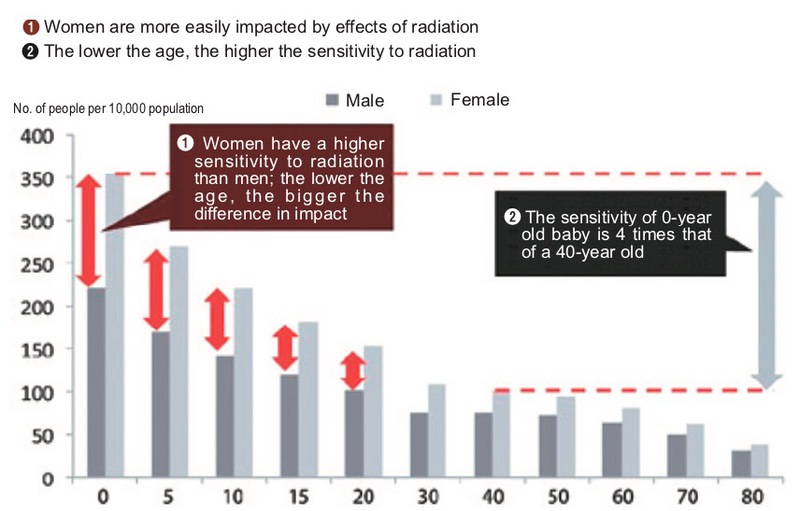
Fig 1. Sensitivity to radiation by age, gender (no. of incidences of cancer among population of 100,000 people) (NAIIC Report)
Hirano: I’ve heard a lot of concerns regarding the 20mSv standard itself, but I understand that it’s also dangerous to apply the standard in a uniform way regardless of differences in age and gender — particularly to children and those who are pregnant.
Sakiyama: That’s true. I believe the standard should be lowered from 20 to at most 1 mSv for women, anyone who may become pregnant. Of course, the lower the better.
Hirano: In Japan, is the limit of radiation exposure differentiated by age or sex?
Sakiyama: In general, yes. Those under 18 years old are not allowed to enter radiation-controlled areas.
Hirano: I see. But when it comes to the return policy, I take it there is no differentiation, is there?
Sakiyama: Exactly. None at all. It’s what we call ‘Fukushima discrimination’. Considering the radiation level, I believe some parts of Fukushima prefecture should really be treated as a radiation-controlled areas. Such areas are usually identified and fenced off. As Dr. Koide Hiroaki has also stated, simply staying overnight, let alone living a regular lifestyle is impossible in such a dangerous environment.3
Hirano: Obviously, the central government does not acknowledge the risks associated with its return policy, does it? So far 199 children and young adults have been diagnosed with thyroid cancer or suspected malignancy, haven’t they?
Sakiyama: That’s right. Among them, 162 have been already confirmed as malignant, and one of these was diagnosed as benign after operation. (As of June 15th 2020, 195 people received definitive diagnosis of thyroid cancers after undergoing surgery. See the Table below).

Fukushima Medical University examined thyroids of children in Fukushima who were 18 years old and younger at the time of accident. Examinations will be carried out every two years until they are 20 years old, and every 5 years after that. The screening flow chart is shown in Fig.2.
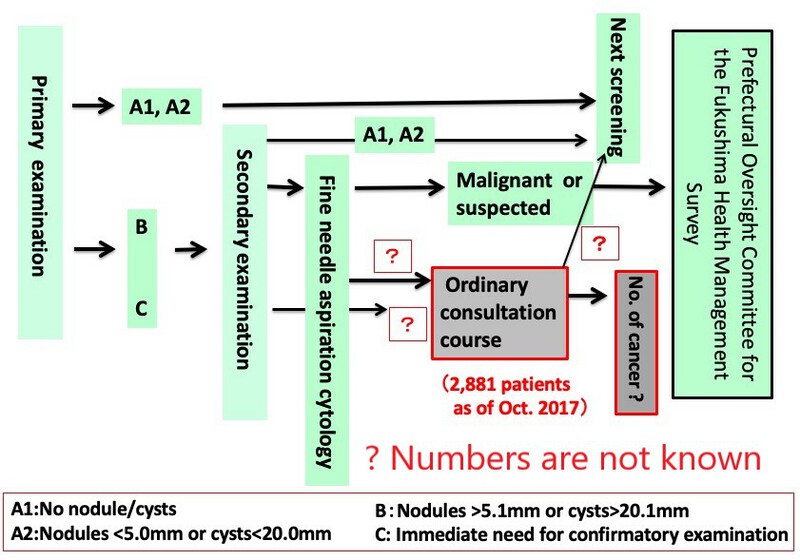
Fig 2. Thyroid screening flow chart. The ordinary consultation course (the surveillance course) was not made public until March 2017 when the 3.11 Fund for Children with Thyroid Cancer announced that a boy who was 4 years old at the time of the accident had been operated on at Fukushima Medical University. His case had not been reported to the oversight committee. As of October 2017, there were 2,881 patients who underwent this ordinary consultation course, but they were neither covered by the Fukushima Health Management Survey, nor reported to the oversight committee even after being diagnosed as malignant as a result of surgery.
Hirano: Early on there were some scholars who disputed those findings. They claimed that more cases are cropping up simply because of more aggressive screening with ultrasonic examinations, so that the high numbers are driven by new screening technology, and are unrelated to radiation exposure from the nuclear disaster. Please tell me your thoughts on this.
Sakiyama: In the first round of screening, a total of 116 children, out of roughly 300,000 children tested, were suspected of having thyroid cancer. That is a thyroid cancer rate dozens of times higher than usual over a 2-year period. Yet, these scholars still dismiss the link between this unusually high occurrence of childhood thyroid cancer and radiation exposure, and insist that it was the result of “mass screening.”
In fact, by that time just 10% of the first round of screening had been completed, Dr. Yamashita Shunichi had already noticed that cancer rates had spiked, with 3 confirmed and 10 suspected cases. So he had to come up with some explanation for the findings. He announced that it was due to the “effect of mass screening” and not an epidemic. I believe the announcement was actually made right on March 11th, 2013, at an annual meeting of the NRC (U.S. Nuclear Regulatory Commission) in the US.
Hirano: Which means that Dr. Yamashita and his colleagues were working from the beginning to establish a discourse, even in international spaces, that the Fukushima disaster had done nothing harmful to the human body.
Sakiyama: Exactly. It was a discussion with a foregone conclusion. The decision had already been made before the screenings had even begun. Even after it became clear that thyroid cancer incidence rates in the affected areas were several tens of times greater than the national average, they insisted that it was due to the effects of mass screening.
However, during the second round of screening, they began seeing some results that were not normal, and could not be explained by the mass screening effect. At this point some of these medical experts started voicing concerns about the possibility of “over-diagnosis.” By “over-diagnosis” they mean that they examine cases that would not otherwise cause symptoms or death during a patient’s ordinarily expected lifetime. But, these concerns weren’t coming from clinicians – they were from epidemiologists such as Dr. Tsugane Shoichiro, the director of Research Center for Cancer Prevention and Screening, National Cancer Center Japan, and Dr. Shibuya Kenji, the Visiting Professor of the Department of Global Health Policy, Graduate School of Medicine, the University of Tokyo.
Dr. Tsugane said that in general, thyroid cancer has an appropriate prognosis, but by over-diagnosing children, they might be subjected to unnecessary surgeries. This would eventually give them not only scars on their necks, but also the stigma that they had developed cancer due to radiation exposure. He warned that it would probably affect their eligibility for cancer insurance, and they might face discrimination in marriage or other contexts for having been exposed to radiation. He argued that there is little merit in examining children, and suggested reducing the thyroid cancer screenings in Fukushima. Actually, it is official policy that is now moving in this direction with scaling down thyroid screening all together.
On the other hand, Dr. Suzuki Shinichi, professor of thyroid surgery at Fukushima Medical University, who has operated on most thyroid cancer patients at the university, refuted the charge of over-diagnosis. He presented evidence at the Japanese Society of Thyroid Surgery that among 145 patients who were operated on, about 78% had lymph node metastasis, and about 45% showed invasive growth. Based on these facts, he said that over-diagnosis is unlikely.
Hirano: It sounds like they are appropriating a discourse about discrimination and prejudice in order to confuse the issue of radiation and cancer, and sweep everything under the rug.
Sakiyama: Exactly. As you know, Dr. Yamashita is unfortunately an influential figure in the Thyroid Association. At first, he used to say that it was necessary to conduct thyroid cancer screenings, but now he has become one of the loudest voices advocating scaling down the program.
There was an International Experts Meeting last year in Fukushima, and after the meeting Dr. Yamashita and Dr. Niwa, the Chairman of the Radiation Effects Research Foundation, made a recommendation to the governor of Fukushima Prefecture. In their interim report Dr. Yamashita and Dr. Niwa stated that it was difficult to find a link between the cancers found through the screenings, and radiation exposure. They suggested curtailing the screenings, not stopping them altogether but making participation “voluntary.”
One justification for this was the so-called theory of fetal thyroid cell carcinogenesis that was introduced by Dr. Takano Tōru of Osaka University. According to him, young children develop a higher risk of thyroid cancer because thyroid tumor cells are derived directly from thyroid fetal cells, which exist only in fetuses and young children, and the fetal cells possess cancerous characteristics; however, the tumors from these immature fetal cells in the young diminish during infancy and stop growing altogether after middle age. Therefore the prognosis is excellent and the process does not progress to cause cancer deaths.
On the contrary, he continued, if you develop thyroid cancer in the middle or old age, the tumor cells undergo sudden proliferation, which can lead to cancer death. Therefore, he concludes that thyroid cancer in young children should be left undiagnosed.
I did not know much about thyroid cancer, but since Dr. Takano talked about his new theory so confidently, I studied it quite a bit. What I learned was that Dr. Takano is the only person who actually advocates this fetal thyroid cell carcinogenesis theory. Yet he has not published any paper on the isolation and characterization of the fetal thyroid cells.
Kasai: You mean he is the only one in the entire world?
Sakiyama: Yes, but he is so self-confident in his theory that he claims that the problem is that everyone has fallen behind his new scientific findings. If you propose this theory, however, you should first find a fetal cell, and then characterize it. That is the path a researcher should take, but he does not seem to be doing this. I have been checking his papers, and they seem to all be hypothetical. If we imagine that there is such-and-such, one can then imagine that there is so-and-so, and therefore fetal thyroid cell carcinogenesis exists. There is no experimental evidence.
Hirano: Do you mean that without any experimental evidence, he has been arguing thyroid exams, which have a crucial role in monitoring children’s health, should be scaled down?
Sakiyama: Exactly. And a person like him was appointed as a member of the Prefectural Oversight Committee for the Fukushima Health Management Survey.
I am sure you heard about Dr. Yamashita telling Fukushima residents to smile and relax at a public meeting right after the nuclear accident. He said to his audience, “Radiation does not affect people who are happy and smiling. The effects of radiation come to you if you worry about it. This theory has been proven by experiments on animals.”4
Hirano: Yes, I know he was criticized in the media for being flippant. Such a dismissive remark was beyond acceptable, they said.
Sakiyama: That is right. Unfortunately, it did not end there. Just recently Dr. Takano gave a lecture in Osaka, and it was uploaded to YouTube, so I watched it. You wouldn’t believe what I heard in the video. At the beginning of the lecture, Dr. Takano mentioned Dr. Yamashita’s remark and praised him for it. “Professor Yamashita really knows what to say.” 5 When I heard this, I was at a loss for words.
I heard that knowledge of Dr. Yamashita’s remark spread all over Japan but also overseas. Someone actually made it into a cartoon.6
Kasai: A satirical cartoon.
Sakiyama: Yes! How can Dr. Takano possibly say, “Dr. Yamashita really knows what to say?” It is beyond my comprehension.
Hirano: What has always seemed strange to me is that Dr. Yamashita visited Chernobyl more than 100 times and has been deeply involved in medical aid projects there, well before the Fukushima nuclear disaster. As you mentioned, he is considered Japan’s number one authority on radiation health. It is hard to comprehend that a person like him, who has seen the health effects of the Chernobyl incident first-hand, has been so active in trying to cover up the health risks associated with radiation exposure.
Even in Chernobyl, early on there was a cover up of the effects on human health, and some used the idea of over-diagnosis to downplay the risks. He would have witnessed it all.
Sakiyama: Exactly.
Hirano: He must have seen that there was a large increase in the cases of thyroid cancer after the disaster, and that the governments of the Ukraine and nearby countries were forced to admit the various health problems stemming from the accident. When it comes to Fukushima, however, Dr. Yamashita is using the same methods used by the Soviet Union to continue to hide those problems. What do you think of this from a scientist’s perspective?
Sakiyama: I don’t think he is taking a stance as a scientist. I feel that he has abandoned science. So many people ask me why Dr. Yamashita acts the way he does and what his intentions are, but I tell them that people who take science seriously and value ethics have no answer for that question.
I remember, however, that he said once that he has a hard time saying ‘No’ to whatever the central government wants.
Hirano: Oh, I also remember that. He said something like, “As a Japanese, I cannot say no (to the government).”
Sakiyama: That’s probably a reason why he sticks with the central government. He has told his audiences that absolute truth lies with the government. He is now serving as vice president of Fukushima Prefectural Medical University, so it seems likely that he will keep covering up one thing after another and just go along with what the government says.
Kasai: So I believe you are saying that some kind of hypothesis, or a pseudo-hypothesis, about how thyroid cancer develops has appeared that deviates from the fundamental methods of science and medicine, and is being disseminated to society in a way that deviates from the normal rules? Furthermore, you’re also saying that this discussion seems to have taken on a political dimension.
Sakiyama: Right. It has been exploited for political gain.
Kasai: Yet, when they give explanations to the general public, they make use of their statures as an expert in medical science.
Sakiyama: That’s right.
Kasai: So, ordinary citizens like us, are told through the media that experts in this field are saying this or that and come to think ‘oh, radiation has been scientifically proven to be safe, or not dangerous’ and ‘20 mSv/yr is not something to worry about.’ That’s how we have been producing a social consensus about radiation risk.
Sakiyama: Absolutely. I just don’t understand why they are doing it and what their motivations are. Dr. Yamashita already had plenty of social status as vice president at Nagasaki University. But it was obvious that he lied about a 4-year-old boy who had developed thyroid cancer. He at first decided not to make the case public, but when we announced it, he finally came clean.
In fact, one journalist interviewed him and asked why he wanted to hide the case,. Dr. Yamashita answered, “I am not able to say anything unless it is announced officially.” But even as he said that, he had officially announced that there were no cancer cases among children 5 years and under.
Hirano: He obviously contradicted himself.
Sakiyama: It is ridiculous, isn’t it? By the time the interim report was being compiled, it had become clear that there was an incident of thyroid cancer in a 5-year-old child immediately following the accident. He ignored that case, however, and decided to announce that there were no cancer cases in children ages 5 or younger. He used that claim as the basis on which to dismiss the link between thyroid cancer and radiation to other experts. .
Hirano: I see. You mentioned earlier that 162 children (as of June 15th, 2020, 195 children) have been confirmed to have contracted thyroid cancer, but how well known is this in Japan?
Sakiyama: Well, this might sound strange, but not many people even in Fukushima are aware of this.
Hirano: People in Fukushima do not know?
Sakiyama: No, they don’t. I visited a recuperation center last year, and met about 10 mothers there. You may assume that these families, who sent their children to a place like this, are likely to be particularly concerned about radiation, but surprisingly, none of the mothers knew about the high prevalence of childhood thyroid cancer. I was just shocked.
I was trying to understand why, and I realized that people in Fukushima get their information mainly from local news sources, such as Fukushima Minpō (福島民報) and Fukushima Minyū (福島民友) newspapers, and Fukushima TV or other local television channels.These do not take up this news as major stories.
Hirano: The local media don’t report such facts?
Sakiyama: Right. These mothers also shared with me that they kept it secret from neighbors and even relatives that they were sending their children to a recuperation facility. They were afraid that they might be criticized or labeled as oversensitive about radiation exposure, so they just told people that they were going on vacation, not mentioning recuperation at all.
I was also surprised when we went to Koriyama City Hall to see if our organization, 3.11 Fund for Children with Thyroid Cancer,7 could leave some application forms at the front desk. As a matter of of fact, the city of Koriyama has the highest incidents of childhood thyroid cancer, along with places like Iwaki. But the Koriyama city officials had no idea. When we told them about the rising number of cancer cases, they were shocked, and even panicked.8
Kasai: In other words, even in this region where the cases of childhood thyroid cancer are actually occurring, the people in charge of the local government are not aware of the facts.
Sakiyama: Exactly. This is happening in Fukushima, so in other prefectures they know even less.
Hirano: Were the children who developed thyroid cancer living in the so-called evacuation areas at the time of the nuclear accident? Were they exposed to the meltdown for some period of time before they were able to evacuate?
Sakiyama: There is geographic variation in cancer rates. Professor Tsuda Toshihide of Okayama University divided the prefecture into 9 areas, and that division reflects the external radiation dose to some extent, Based on his findings, radiation exposure as a factor behind the rise in thyroid cancer.
On the other hand, there is a paper written by Dr. Suzuki Shinichi and Dr. Ohira Tetsuya, who compared childhood thyroid cancer prevalence in three regions, and argued that those regions did not reflect a correlation between radiation dosage and thyroid cancer. However, their method didn’t pay attention to a variation that existed between high and low dose areas. It won’t tell you anything about geographic variation in radiation dosage. Therefore, the thyroid cancer prevalence appeared random, and they then concluded that there was no significant correlation between location and thyroid cancer.
Kasai: Do you think Dr. Suzuki and Ohira’s research was intentionally designed to draw that conclusion?
Sakiyama: I am not positive, but I feel that this was the case. In the second round of screening results you can see an extremely clear differences across 4 geographical regions in the prefecture: Hamadori, Nakadori, Aizu, and the evacuation zone. This was also discussed at the review committee meeting, and the regional differences became even clearer as more data analysis was done by age and sex. So I don’t think we can deny the effects of radiation exposure.
Hirano: There are also radiation hotspots outside of Fukushima prefecture, including in Chiba, Ibaraki, Tochigi, Gunma, Iwate, and Miyagi. Do you think people, especially parents of small children, should be concerned about the risk of radiation exposure? The government did not take any measurements to protect them, did they?
Sakiyama: No, they didn’t. They focused exclusively on Fukushima and left all the other prefectures on their own.
Within a year of the accident, prefectures such as Gunma, Ibaraki, Iwate, and Tochigi convened an advisory council. Each prefecture summoned experts and let them discuss whether they also should administer thyroid cancer screenings. But these experts came to the conclusion that testing was not necessary, and their decision was reported to the Ministry of the Environment. The final decision was made at the so-called ‘Expert Conference’ held under the aegis of the Ministry of Environment, chaired by Dr. Nagataki Shigenobu, Professor Emeritus of Nagasaki University.9
There were many worried mothers in small communities in those prefectures, however, so some municipal governments have given support for screening sessions. That there are only a handful of such places. Most screenings are conducted by volunteers from NPOs and NGOs with help from concerned doctors, but what they’re doing is just a small-scale thyroid examination program.
They have found one person with thyroid cancer in Ibaraki prefecture.
Hirano: It was in the northern part of Ibaraki near Fukushima, wasn’t it?
Sakiyama: Yes, it was in the north. I believe it was a young child.
As of October 2017 there were 2881 individual screenings conducted which were being observed closely, but it has not been confirmed whether they are thyroid cancer (see Figure 2). We don’t know how many cases have been confirmed as malignant among them. In fact, Fukushima Prefectural Medical University is supposed to be investigating this, but they only count the cases that have been operated at their hospital. Anyone who was operated on elsewhere won’t be counted. Therefore, nobody knows the actual number of thyroid cancer cases in Fukushima.
Even then, they said it would take 2 years to calculate the final number of cancer cases. I don’t understand that because Fukushima Prefectural Medical University has a comprehensive database, and they should know the number right away. But they said they would spend 2 years finding out. The thing is that none of the oversight committee members have complained about this at all.
When the case of thyroid cancer in the 4-year-old was confirmed, the oversight committee must have realized that the data they received from Fukushima Prefectural Medical University did not reflect reality. They found out about the 4-year-old’s cancer case at the oversight committee’s 28th meeting. They met once every three or four months, but they obviously were not notified about this. If I were one of the committee members, I would be furious that such things were being kept secret, and I would start to feel suspicious. I would wonder what the purpose of all 27 meetings had even been. But none of them got angry.
When I heard the news about the case of the 4-year-old, I thought at least some committee members would yell at the government and call the whole thing a sham, or even storm out of the meeting room and quit altogether, but no one seemed to be upset, and they continued to meet as if nothing had happened. I was in total despair.
3.11 Fund for Children with Thyroid Cancer
Hirano: So you witnessed the repeated cover-ups and realized the incompetence of the government in terms of helping the victims. Did you launch the ‘3.11 Fund for Children with Thyroid Cancer,’ out of a sense of urgency about the crisis?
Sakiyama: Yes.
Hirano: Another thing you mentioned earlier that sticks out in my mind was how radiation exposure has become a target of stigma in the public mind, which forces people in Fukushima to be silent about their health concerns. This kind of social pressure is creating a situation where they have to keep going to recuperation centers secret, and they even hesitate to have cancer screenings.
My understanding is that you wanted to relieve some of that pressure for people who are worried about their health and cancer treatment, by providing financial support through the ‘3.11 Fund for Children,’ which is an independent, not-for-profit organization, for people to actually get access to screening. Is that right?
Sakiyama: That’s right. We have held many meetings and lectures, but we noticed that we tended to get the same audience at these kinds of events. Then we started to look for a way to reach out to those in need of help, and we realized that children with thyroid cancer and their families have often been isolated by not knowing where to go and how to get help. They are also burdened by the medical expense of repeated examinations and hospital visits, and some patients will require a lifetime of medical care. We all agreed that these are the people we really want to help and we were looking for a way to reach them.
We felt that meetings and lectures weren’t getting us anywhere, so we talked with several people and came up with the idea of giving money. At first, we felt uneasy about giving support in the form of money, but it is the only option to help those who tend to be isolated.
Hirano: You have said that there are actually eight more cases of pediatric thyroid cancer apart from the 199 children and young adults who have officially been diagnosed with thyroid cancer or suspected malignancy. Did those people contact the organization by themselves to ask for support after hearing about the ‘3.11 Fund for Children’?
Sakiyama: I believe so. We posted a full-page advertisement about ‘3.11 Fund for Children with Thyroid Cancer’ in the Fukushima Minpō (福島民報) newspaper, which cost nearly one million yen. People contacted us then, and since that time NHK has been following our activities. Every time we hold a news conference, they broadcast it nationwide, so we have received a lot of inquiries and applications as a result of media coverage. For example, a grandmother was watching NHK news and applied to the fund for her grandchild who had developed thyroid cancer.
By the way, people who have come to mistrust Fukushima Medical University don’t want to get their screening there, so of course they won’t be counted in official statistics. So even if Fukushima Medical University publishes the number of cancer cases they see, we still do not have the real count.
Hirano: Could you explain to readers what internal radiation exposure is and how it occurs, since it is understood to be the cause of cancer?
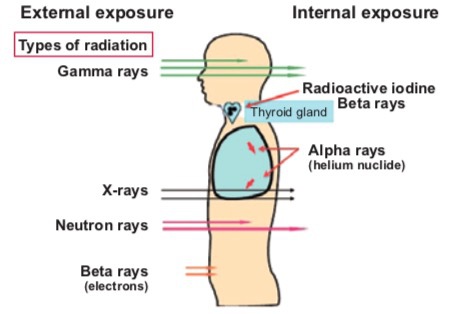
Fig.3. External and internal exposure.
Sakiyama: Internal radiation exposure occurs when radioactive material gets inside your body and irradiates you from the inside, This may happen through the air while there was a plume of radioactive material, or by consuming contaminated food and water. External radiation exposure takes place when radioactive substances are outside of the body (see Fig. 3).
In general, external radiation exposure does not occur with alpha and beta rays because their tracks of radiation are very short (alpha ray: about 4μm, beta ray: several mm) and are not likely to pass through the skin. For example, even if there were plutonium emitting alpha radiation in front of me right now, I wouldn’t be exposed to radiation.
Once radioactive materials emitting alpha or beta rays get inside the body, however, they stay there for a long period of time, which increases the chance of DNA damages and cell death, because inside the body cells and tissues are next to the radiation and are exposed directly to alpha or beta rays.
As far as the relative biological effectiveness (RBE), the ratio between the dose and the ultimate biological effects, alpha radiation is about 20 times more damaging than beta, gamma, and X-rays. Furthermore, the half-life of plutonium is 24,000 years, and it’s insoluble in water. Therefore, if plutonium gets inside your body, you will be irradiated for the rest of your life.
In order to assess health hazards to the human body caused by both internal and external radiation exposure, we measure in mSv (millisieverts). We assumed that radioactive materials are spread inside the body fairly uniformly when we try to calculate the damage. That’s why it is very difficult to figure out the actual health effects.
For example, tritium emits very weak beta rays, which do not have enough energy to travel very far in the air and to penetrate the skin, so it is believed not to be dangerous externally. But tritium is a radioactive form of hydrogen and can become incorporated into DNA. When that tritium decays into helium, it causes the DNA strand to break.
Tritium exposure used to be considered a low, or level 1 risk, due to its weak beta radiation energy, but now some scientists argue that the risk could be 6 times higher than was originally thought.
So, the issues remain contested. But some reputable researchers claim that internal exposure poses a significant health risk.
According to Dr. John William Gofman, a renowned physician and nuclear/physical chemist, there is not much difference in terms of health effects on humans between internal and external exposure, given the same radiation doses. I agree. But the problem is that we don’t know exactly whether the dose coefficient of radioactive substances that we use to convert a unit of pure radioactivity (becquerel: Bq) to a medically effective dose (sievert: Sv) is right or not. For instance, the dose coefficient used to calculate Sv equivalent to 1Bq of Cesium 137 is based on the assumption that Cesium 137 is distributed evenly in the human body as in the case of water. However, when Cesium 137 becomes particulates, this assumption breaks down because they are insoluble. Then dose coefficient itself may not be accurate.
Hirano: What about the campaign to get people to buy and eat food from Fukushima? It’s been going on for a long time as an expression of moral and economic support, with slogans like “Let’s Help Fukushima” and “Hang in There Fukushima!” (ganbare Fukushima!). The discussions have been carried on in the context of the possibility of internal radiation exposure, and also involve the issue of economic damage caused by harmful rumors (風評被害) about the dangers of Fukushima food.
As a medical scientist, what position do you take on Fukushima produce? Do you think people should avoid eating it as much as possible? Do you think it is okay to consume as long as each item is inspected?
Sakiyama: This is a major question. Fukushima prefecture does conduct repeated inspections and testing on all their foods more thoroughly than surrounding prefectures such as Ibaraki, Tochigi, and Gunma. So, I hope that most of the Fukushima products sold on the market do not exceed the standard limit of 100 Bq/kg. But that still means foods with dozens of becquerel have been going into the market. Recently a group held a conference on the level of food contamination. They concluded that there are essentially no items from the prefecture that exceed 100 Bq/kg, and the highest is around 50 to 60 Bq/kg. Despite the fact that they are inspecting their foods, that fact makes me feel very uneasy . For example, it takes about 120 days for Cesium-137 inhaled or ingested by an adult to reduce the biological half-life. If someone takes 10 Bq/kg into the body everyday, it amounts to about 1400 Bq in a year. If 40 Bq/kg, it will be 5600 Bq. This is a very high number that might cause a serious health issue like cancer. That’s why I have suggested to officials in Fukushima that they lower the cesium contamination limit to 20 Bq/kg from 100 Bq/kg. However, they are unwilling to do so.
Hirano: Is it because in reality, a great deal of Fukushima produce exceeds 20 Bq/kg, so they might not be able to sell anything if they set 20 as the new standard?
Sakiyama: It could be, but I don’t think they would have nothing to sell if the limit were 20Bq/kg. Because Fukushima prefecture has been saying that their food is safe, I said that if the government standard is 100 Bq/kg, surely they can do even better with 20. But they did not go for it.
Once I really upset officials with that suggestion. There was a conference where a Fukushima official was coming to give a talk. I wanted to get some information from him, so I attended the lecture and asked about the possibility of lowering the standard. Of course, I had no intention to offend him, but he got so upset with my suggestion that he told the organizer that the prefecture would no longer send anyone to lecture to that group. (laughs)
Kasai: What do you think is the reason those people from the government found your suggestion so offensive?
Sakiyama: The group that invited the official from Fukushima prefecture is called “Skilled Veteran Corps for Fukushima.” They are older volunteers, age 60 and up, who are retired workers from Fukushima, including engineers and technicians who formerly worked in the nuclear power industry. They have signed up to help clean up the contaminated Fukushima plant in order to protect and replace younger workers, since they are not as concerned about exposure to radiation.
I think that the officials had trust in that group and were willing to come to talk to them. Maybe they did not expect to be questioned about their policy, particularly by an outsider like me. But anyway, they became upset and told the group that the prefecture would not send anyone anymore. I feel bad for that volunteer group!
Hirano: But I think it is true that we, consumers, have concerns about the safety of Fukushima produce. Any food under 100 Bq/kg are considered to be safe, and sold in stores, right?
Sakiyama: Exactly.
Hirano: Whenever I go to a supermarket in my hometown, Ibaraki, there is a special section with fresh produce from Fukushima. Every single package of fruits and vegetables has a sticker on it, which says ‘inspected.’ These products actually look very good, but often are left unsold. I think that consumers are not quite convinced of their safety and they hesitate to buy them.
I believe that a sense of distrust towards the government is still there in the consumers’ minds, and that it has something to do with the safety standard for radiation in food. There is a big difference between 20Bq/kg and 100Bq/kg.
Sakiyama: I agree. There are many independent, citizen-run food testing labs, such as COOP’s ‘pal system’ and ‘seikatsu club.’10 I heard that certain food items, particularly shiitake mushrooms, continue to contain at least 4 or 5 Bq/kg, so the ‘pal system’ decided to stop carrying wild shiitake mushrooms altogether.
Also, some farmers treat their contaminated soil with fertilizers based on potassium chloride in order to prevent their crops from absorbing cesium, but that does not prevent farmers from being exposed to radioactive material while working in the field. You would expect farmers to carry a dosimeter, but they don’t have dosimeters at all.
In fact, I feel the risk to farmers and decontamination workers is likely greater than for those working at the site of the nuclear power plants. They inhale dust with radioactive materials, and that puts them at risk for both internal and external radiation exposure. But they don’t even measure radiation doses.
When I think about the impact of radiation on human health, I feel that Fukushima is going to face a very tough future.
Cover-up Culture and Social Pressure
Hirano: I see. There are two things to note here; one is the systematic cover-up practices of the government, and the other is the so-called social pressure that makes victims unwilling to talk about radiation concerns in public. When you think of Fukushima’s current situation and the possible health consequences of the incident, which of those do you think poses a more serious problem to society?
In other words, is it more important to build a society where people can say well, I may be seen as strange for this, but I am worried about my child’s health, so they can be open about discussing ways to protect children’s health? Or is it more crucial to try to change the cover-up practices of the government — which, honestly, I don’t really know is possible? Of course, both of these things should change.
Which change should come first in your opinion?
Sakiyama: Well, it is citizens who can change the government. For example, the Education Ministry initially did not even acknowledge the recuperation program for children in Fukushima, but as more private individuals got involved through NGOs and other means, and people in Fukushima petitioned for financial assistance, the government finally had no choice but to agree to fund the program.
There is no way that the Education Ministry would have changed right away without pressure from citizens. And there is no way that the Ministry of the Environment will change without pressure from citizens. We need to make it happen. We are the ones who elect public officials.
So, I think that citizens will have to change and initiate movement in politics and government. I agree with you that change will not start with the government; it will not abandon the cover-up by itself. For example, can you even imagine the possibility of the International Nuclear Power Village (changing its course?) Maybe if they were broken there may be a change, but I don’t think it’s possible considering how powerful the organization is.11 The only possibility left is that we, citizens, change politics through our own actions.
The Japanese public now favors phasing out nuclear power. And Japan’s renewable energy industry has been growing rapidly.
Have you heard about an organization called Genjiren (原自連)? It’s an antinuclear, pro-natural energy confederation. The ‘ji’ 自actually refers to natural energy (自然エネルギー).
Kasai: It must be named to contrast with Denjiren (電事連), the Federation of Electric Power Companies of Japan.
Sakiyama: Exactly. Genjiren is headed by Mr. Kawai Hiroyuki, a lawyer; former Prime Minister Koizumi Junichiro; and Mr. Yoshiwara Tsuyoshi, a former president of Jonan Shinkin Bank. Indeed, the renewable energy market in Japan has been growing very vigorously over the past decade.
There are various sites throughout Japan that generate electricity on a small scale. I heard that altogether there are more than 500 of these nationwide. If we continue to promote and invest in renewable energy, there is a chance to create a largely non-nuclear and fossil fuel-free future.
Running nuclear energy is almost too expensive considering capital costs for building nuclear plants, the challenges of disposal of nuclear waste, and the risk of meltdown. So we have to keep spending money in order to sustain nuclear power, not to mention the cost of decontamination after the accident. It would be a disaster to discontinue the decontamination work due to lack of money. It’s time to just end the whole nuclear business – you know, like they say, “when poverty knocks at the door, love flies out of the window.” (laughs)
Right now the government seems to have money and keeps throwing it at general contractors. The thing is, though, these construction companies have made so much profit building the nuclear power plants, and after the accident they have made huge profit through decontamination work. How terrible is that?
Hirano: I agree. In English, it is called Disaster Capitalism.
Kasai: It is 災害便乗資本主義 (saigai binjō shihonshugi) in Japanese.
Sakiyama: That’s right. Exactly.
Hirano: They can fail and still make a profit.
Sakiyama: Actually, I believe that it is badly poisoning Fukushima. The decontamination work keeps some tiny share of money flowing into the prefecture, and it also provides employment opportunities for those who are over 18 years old. Considering how scarce jobs are in that area, the decontamination work has been giving them plenty of steady job opportunities.
A friend who is a physician told me once that young people, after graduating from high school, come to her clinic seeking health screening. They want documentation to prove they are healthy enough to work at the decontamination sites. My friend tells them that it’s a bad idea, but they say there’s no work, so they end up working there anyway.
Scientists and Civic Engagement
Hirano: I would like to move on to the next question. What kind of role do you think a scientist with specialized knowledge should play in civil society? This has to do with what you have been doing through the Takagi School.12
Mr. Kasai and I were talking about this before this interview – until recently neither of us have read through scientific journals. At first, they seemed to be rather difficult for people like us, with so little science background. But after the nuclear disaster, it seems that some scientists who have strong social and civic consciousness started to publish very accessible papers in science-related journals. As we moved forward with this Fukushima interview project, we came to realize how important the role of these scientists has been in providing their knowledge to the general public in order to build a democratic civil society going forward. What kind of social role do you think those who have expertise in medicine and science should play in the future?
Sakiyama: The most important thing for us, in my opinion, is education. Education is the top priority. However, the Education Ministry is in charge of education, and they promote myths about nuclear power safety right from elementary school. We really need to figure out how to deal with that.
The anti-nuclear movement has simply have not been involved in doing something about education. There are a few teachers who are interested in nuclear energy education, but they are an absolute minority. Still, we decided to team up with some educators and formed an organization called the Committee for Nuclear Power Education 原子力教育を考える会, and in around 2005 we created a website “Understanding Nuclear Power”「よくわかる原子力」.
The Takagi School hosted some public lectures about nuclear energy and environmental education, and teachers from all over the country made presentations. We decided to form a group, the Committee for Nuclear Power Education.
We wanted to counter the Ministry of Education, for example by writing our own textbook, but then we realized that we didn’t have enough financial resources to do so successfully. It can get very expensive when we consider the expenses associated with publishing textbooks, such as printing costs and so on.
Then we agreed that the best way would be to create our own webpage, and, actually, my daughter helped get it started.
We also needed to figure out a way to make our information available for lessons at school, so I gave some suggestions to teachers as to what information we’d like them to introduce in classrooms. But they said that they couldn’t use it, since what they can teach during lessons is pretty restricted due to educational guidelines, and they know those restrictions very well.
They are required to write lesson plans, and they said their principals would not approve the plans if the teachers put it in the plans, so the only way to get our information or messages across for them is to walk that fine line somehow.
Then we decided to produce a set of educational DVDs called “What’s REAL about Radiation” (放射線のホントのこと) for classroom use for junior high and high school students. The first volume, ‘What is Radiation?’ covers the scientific aspects, including what exactly happened in Fukushima, how radioactive materials spread in the air, what kinds of effects radiation can cause to living things, and what we should do to protect ourselves from radiation exposure.
The second volume, ‘What is going on in Fukushima now?’ focuses more on social consequences of the disaster in local communities and social issues faced in Fukushima. In order to introduce ‘real voices’ from Fukushima, we visited various places throughout the prefecture, conducted interviews, and compiled them, along with some photos of the current situation in the evacuation areas, as well as of the millions of bulk bags full of radioactive soil stacked in huge piles.
As you know, even seven years after the Fukushima disaster, people are still being exposed to radiation from radioactive fallout. The victims are still suffering, but these struggles have been largely neglected. We have less and less media coverage on Fukushima. So, it is our hope that the DVDs will give children a chance to learn about not only what has happened and what is happening in Fukushima, but also what radiation really is and what they should and can do to protect themselves.
Children don’t know about these things. In order for teachers to use these DVDs in the classroom, we managed to make each of them about 20 minutes long. They come with supplemental worksheets that help teachers give more detailed explanations and encourage classroom discussions. But the reality is that very few teachers use them in the classroom.
The video created by the Education Ministry is up online, so anyone can watch it. Have you seen it? It’s awful. I have to question if it is even okay to teach the things it claims.
One member of the Committee for Nuclear Power Education had an opportunity to visit Belarus and learn about how children learn about radiation after Chernobyl. I believe the school he visited was one of the more liberal institutions, but according to him, preschoolers were taught through a kind of a fairy tale.
The story goes like this. There was a castle. One day the fireplace at the castle was broken and a radiation queen popped up and ran outside of the castle. Her henchmen also got out and are hiding inside food. So do not eat such food. Or wash the food before eating it, or cook the food before eating it.
That’s how they teach small children to protect themselves from radiation. They seem to focus on training children from a young age to be able to protect themselves without parental help and give them the knowledge they need to keep healthy.
When I went to Ukraine as a member of the National Diet of Japan Fukushima Nuclear Accident Independent Investigation Commission, I noticed that they don’t really treat radiation as something special. Instead, they talk about radiation along with other dangers in daily life. What do you do if there is a burglar, or what do you do if there is a car accident, and, right along with that, what do you do about radiation. They teach it as a normal part of protecting your body.
From that perspective Japanese children are totally vulnerable when it comes to protecting themselves. All they have heard about radiation is that no one can avoid it since radiation is everywhere, and is useful in various fields including industries and medicine. They are also taught that the risk of radiation less than 100mSv is equivalent to lack of vegetables or exercise — without showing any evidence for such claims. The message is that a low dose is okay and there is no need to worry about radiation anymore.
Have you heard about a new information and learning facility, called “Comyutan Fukushima” コミュタン福島? The Fukushima prefectural government opened it in Miharu town as a part of the Center for Environmental Creation in 2016.
They claim that the facility teaches visitors about radiation and Fukushima’s environmental restoration activities through interactive fun activities, such as games, crafts, and a simple science experimenta.
In my opinion, however, what they are trying to do is to instill inaccurate knowledge about radiation. Their main message is that we are all surrounded by naturally occurring radioactive materials on a daily basis, and we are also exposed to man-made radiation such as X-rays; therefore, there is no need to worry about what happened in Fukushima. This is nothing but brainwashing, which is making people, especially children and young people, defenseless against radiation. It is very dangerous. The young will not know how to protect themselves from radiation, and in the end, they will suffer health effects if something happens.
Hirano: It sounds as if safety is being abandoned to a myth of safety. This has to be the most serious adverse effect of the safety myth on individuals.
Sakiyama: Absolutely.
Hirano: So, contrary to Comyutan Fukushima, Belarus has successfully created an educational program that teaches children the risks of radiation very clearly, so they will learn how to protect their own safety.
Sakiyama: Yes.
Hirano: Where do you think such differences are coming from?
I don’t want to draw a conclusion just on the basis of cultural comparison. But as you mentioned earlier, in Japan, in particular among mothers with young children, it has become almost taboo to talk about concerns about the effect of radiation on their children’s health.13 I have to wonder why this kind of social phenomenon is happening.
Do you think it has something to do with a low level of awareness of rights to wellbeing in Japan? In other words, do you think the problem comes from a lack of public awareness that we have right in order to protect our livelihood or ourselves?
Sakiyama: I think so. In general, Japanese people have a low awareness of human rights.
Kasai: I agree. It’s indicated just in the word itself, Okami お上,14 we are not used to critically examining what the authorities say and then making our own judgments. That is one thing that is lacking in our education system. This has been a problem in Japan even before the nuclear power accident. I feel that more people ought to be angry with the current political situation in Japan. You know, if a burglar broke into your house and stole things, you’d be upset, wouldn’t you? But even though it’s widely discussed that the taxes you paid have been misused, a lot of people are not upset about it. In some sense, I feel that people’s engagement with public affairs is weak. So it seems to me, as you pointed out earlier, that this is the result of something that has been perpetuated in society through our education over the years, rather than coming from some essentialist notion about Japanese culture.
When we asked earlier what kind of role scientists should play in civil society, you answered that it should be in education. As an educator myself, I totally agree. I feel that the problem is serious and there is a need for change.
Sakiyama: By and large the people who have been diagnosed with thyroid cancer do not seem to be angry with the central government or TEPCO, who are responsible for the nuclear disaster. Instead, they have been trying to hide from the public.
The other day some members of FOE (Friends of the Earth International) from Germany came to visit us, so I asked what they thought of this. They said if it were in Germany, the thyroid cancer patients would be very angry for sure, and file a suit to get compensation.
I would really like to tell them that they are the victims, and that they should not feel ashamed at all for having gotten thyroid cancer. It is the central government and TEPCO that should be ashamed and held accountable. Unfortunately, it’s the opposite of that, since most victims are still living in the shadow of the nuclear disaster.
Hirano: That is what I have been very concerned about. Really, society should be supporting these socially vulnerable people, but that is not the society we have in Japan. Instead, they have to face the stigma attached to radiation exposure, and the victims fear becoming the targets of social opprobrium if they speak out. This is causing them to suffer from fear and psychological trauma. All these factors have led to a situation where the victims are pushed into a corner and forced into hiding. That’s what most worries me.
These massive cover-ups from the government are not new or uncommon, especially as relates to nuclear power, even outside Japan. But the fact that citizens are creating social pressure against the victims means that citizens are taking the side of the government without even realizing it, and is building a structure of discrimination and oppression.
Kasai: As you mentioned earlier about Ukraine and Belarus, we should have a more active debate regarding both social issues and scientific subjects such as radiation. We only have one interpretation that is widely circulated and shared. What we need, at a minimum, is to introduce other views on the same footing, and then listen to and discuss them thoroughly before making a judgment.
If we don’t exercise a process like that, we won’t be able to break our patterns of uncritically accepting whatever teachers say, or whatever the government or other authorities say, and we’ll have no other recourse even if we think something is troubling. I think this is a very important issue we Japanese face.
Sakiyama: I agree with you. In that sense, it is imperative that scientists work very hard not to just get on the good side of the government and authorities, but to convey scientific facts and disseminate truth to citizens.
Hirano & Kasai: Thank you very much for speaking with us today.
Notes
1
In Satoyama (里山), mountain woodlands surrounding people’s homes, radiation levels have remained high since the current decontamination process has been mainly limited to residential and farm areas people use on a daily basis. Satoyama is considered a place where nature and people exist in harmony and has been a key part of Japanese village life for centuries.
2
Dr. Sakiyama told us on August 13, 2020 that she had discovered an ongoing experiment to grow crops in one of the most contaminated regions, Warabidaira in Iitate village.
3
See Koide Hiroaki’s point in our interview with him. Koide makes it clear that there is no absolute standard that guarantees “safe” exposure to radiation. Any radioactive exposure, especially internal exposure, poses some risk. It is best to minimize exposure. It is also clear that infants, young people, and pregnant women are particularly vulnerable to radioactive exposure. The Japanese government’s evacuation plans never took this factor into consideration. It is worth noting that in the vicinity of Chernobyl, 20mSv would still be enough to declare a “no-go zone.” The Japanese government has never rescinded the Declaration of a Nuclear Emergency Situation (原子力緊急事態宣言)clause of a law enacted in 1999. This law reflected ICRP (International Commission on Radiological Protection) “post-accident” period standards and took the upper end of that and seemingly made it applicable indefinitely. I thank Norma Field for providing this important perspective on ICRP.
4
Dr. Yamashita made this remark in a lecture held on March 21st, 2011 in Fukushima City. On January 28, 2019, however, Tokyo Shimbun (東京新聞) published an article which revealed that Dr.Yamashita expressed concern to Dr. Yasuda Hiroshi, a researcher at the National Institute of Radiological Science stationed at the off-site emergency response center, stating on the day of the lecture that “there is a possibility that the risk of pediatric thyroid cancer due to the radiation exposure could reach a serious level”. This was recorded by Dr. Yasuda and kept at the National Institute of Radiological Sciences in Chiba City. Tokyo Shimbun obtained the documentation per a request for disclosure of information.
Responding to Tokyo Shimbun in writing, Dr. Yamashita admitted the meeting with Dr. Yasuda on that day and said, “I simply expressed my view that radiation exposure within the exclusion zones immediately after the nuclear accident was very worrisome, and the influence caused by radioactive iodine on children should be most considered.” As for the comment telling Fukushima residents to smile and be happy, Dr. Yamashita explained that it was “a comment made for residents in Fukushima City. No explosion occurred there and no serious situation was anticipated in that city located far away from the nuclear power plant.” He explained that his views regarding the exclusion zones and Fukushima City, outside of the zones, differed. (Reported by Tokyo Shimbun’s morning edition on January 28, 2019)
5
The lecture titled “Ethical problems of thyroid screening test in Fukushima prefectural health survey” was given on April 14th, 2018 in Osaka
6
Witch Doctor Yamashita Shunichi to Head Fukushima Health Study; onlyinamericablogging.blogspot.com
7
The 3.11 Fund for Children with Thyroid Cancer has provided medical expenses to a total of 120 from December of 2016 to March of 2018 with the amonunt of 100,000 yen for each case and additional 100,000 yen for relatively serious patients who underwent reoperative surgery. It also offers an additional 100,000 yen to the people who received RI treatment. The Fund can be used for any puroposes that concern children with thyroid cancer.
8
The city of Koriyama, located at the center of Fukushima prefecture and 43 miles (70km) west of the nuclear power plant, is well outside the area where tens of thousands of people were ordered to evacuate.
9
The Ministry of Environment’s Experts’ Meeting regarding the Issues of Health Management of Residents Due to the Fukushima Daiichi Nuclear Power Plant Accident, chaired by Dr. Nagataki Shigenobu, published its Interim Report on December 2014, and it stated that the higher risks of cancer due to the Fukushima Daiichi Nuclear Accident “cannot be statistically proven.” It also denied the need for thyroid screenings outside of Fukushima by stating that “it is quite unlikely that people who reside in the prefectures surrounding Fukushima have been exposed to more radiation dose than the people who lived in the evacuation areas and such in Fukushima prefecture.” In acknowledging the mounting concern and anxiety regarding thyroid cancer from residents outside of Fukushima, the report concluded that “we first need to take a wait and see stance and see how the Fukushima Health Management Survey ‘Thyroid Ultrasound Examination’ makes progress. Careful explanation of the information gained through individual health consultation, and risk communication, etc. for residents with anxiety about thyroid cancer, are also important.” See the complete Interim Report here.
10
‘Pal System’ and ‘Seikatsu Club’ are both food delivery co-ops that established their own stricter guidelines around food, as well as stricter testing procedures than supermarkets following government standards. These food supplies are well supported by those individuals who feel skeptical about the government doing enough to minimize the risk of radiation to children’s health and distrust in the government’s ability to deal with radiation risk.
11
“International nuclear village” is the term commonly used in Japan to refer to the international network of pro-nuclear advocates who comprise International Atomic Energy Agency, governments, banks, investors, media and academia.
12
Takagi School (高木学校) was founded by a Japanese scientist, Takagi Jinzaburo (高木仁三郎), an internationally renowned critic of the nuclear industry. After graduating in 1961 from the University of Tokyo, he worked for a private nuclear firm and the nuclear institute at University of Tokyo. In his next post, as associate professor of nuclear chemistry at Tokyo Metropolitan University, he started a career of nuclear activism. Leaving the post in 1975, he joined with a group of colleagues to create the Citizen’s Nuclear Information Center (CNIC), a network of antinuclear groups across the nation, and became its head. Takagi conducted numerous research projects and published many books and articles on nuclear issues. His extensive scientific analytical work has contributed greatly to educating the public, media and officials on the threat of nuclear waste, and on environmental protection. In 1997, he received the prestigious Right Livelihood Award, jointly with his colleague Mycle Schneider, for contributions to resolving issues facing mankind, for his work informing the world of the risks and the environment implications of plutonium. In 1998, with the prize money, Dr. Takagi started Takagi School to educate people who aim to be “citizen/alternative scientists” who share concerns held by citizens about the environment, nuclear weapons, human rights and other issues facing the contemporary world. Dr. Takagi passed away in 2000.
13
Concerned mothers, who left contaminated areas, have often been labeled as “radiophobic” or “neurotic” and have suffered ridicule and derision from their relatives as well as their communities for leaving. This phenomenon has led these women to feel isolated and depressed. Moreover, with the layers of stress associated with the nuclear crisis, and disagreements over radiation safety among married couples, a lot of women separated from their husbands, which has led to a trend called “atomic divorce” (Genpatsu rikon) in not only Fukushima but also outside the region. The reality is that, with the loss of essential financial support from the government for evacuees, these mothers and their children have faced severe economic disadvantage.
14
The meaning for O お(御)is honorable, and kami 上means above. Okami generally refers to the Emperor, authorities and government.
Court rules Fukushima nuclear disaster preventable, increases liabilities
Fukushima nuclear disaster preventable, court rules, with more damages claims likely
Government and company Tepco ordered to pay some damages for 2011 event, but ruling could spur further claims
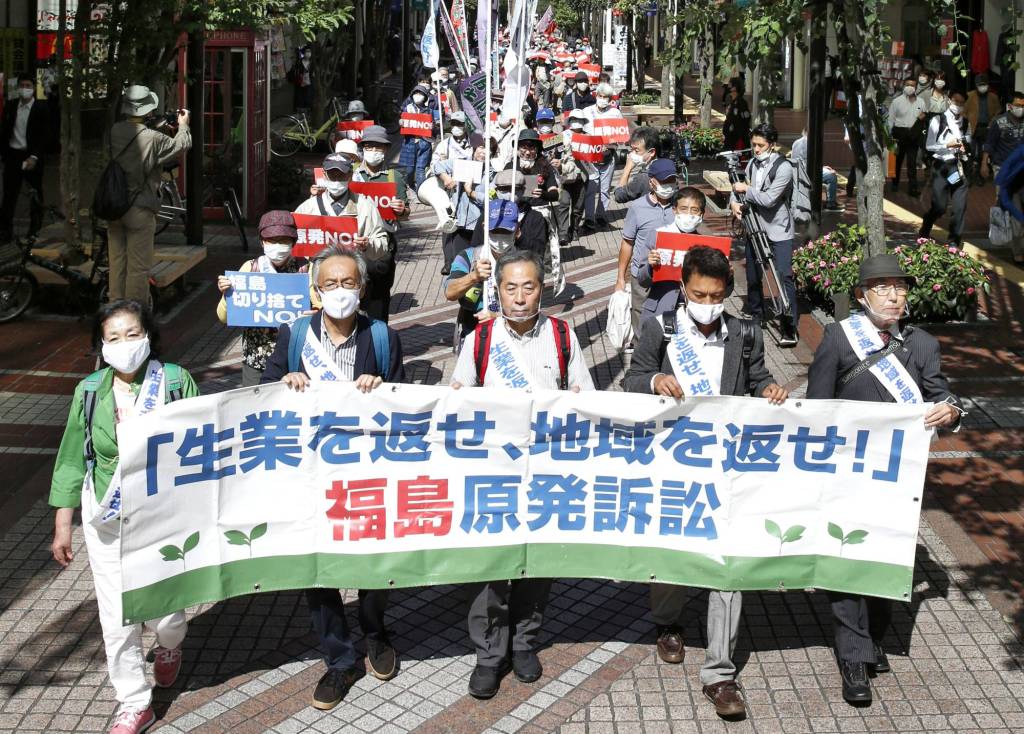
Plaintiffs and their supporters march in Japan ahead of the court ruling in Sendai on the tsunami-crippled Fukushima Daiichi nuclear power plant disaster on Wednesday.
Oct 1, 2020
A Japanese court has found the government and Tepco, the operator of the wrecked Fukushima nuclear plant, negligent for failing to take measures to prevent the 2011 nuclear disaster, and ordered them to pay 1bn yen ($9.5m) in damages to thousands of residents for their lost livelihoods.
The ruling on Wednesday by Sendai high court could open up the government to further damage claims because thousands of other residents evacuated as reactors at the coastal power station overheated and released a radioactive cloud, following the devastating tsunami. While some people have returned home, areas close to the plant are still off limits.
The plaintiffs had sought monthly compensation of about 50,000 yen ($470) per person until radiation levels subside to pre-disaster levels, seeking a total of 28bn yen ($265m).
The plaintiffs’ head lawyer, Izutaro Managi, hailed the ruling as a major victory, saying: “We ask the government to extend relief measures as soon as possible, not only for the plaintiffs but for all victims based on the damage they suffered.”
The latest ruling follows 13 lower court decisions, which were divided over government responsibility in the disaster. The latest ruling doubles the amount of damages against Tepco ordered by a lower court in 2017
In 2011, 3,550 plaintiffs were forced to flee their homes after a magnitude-9 earthquake triggered a tsunami that devastated the country’s north-east and crippled the Fukushima nuclear plant, known as the triple disaster.

Decommissioning work is underway at the Fukushima Daiichi nuclear power plant in Okuma town, north-eastern Japan.
Radiation that spewed from the plant’s melted reactors contaminated the surrounding areas, forcing about 160,000 residents to evacuate at one point. More than 50,000 are still displaced because of lingering safety concerns. The plant is being decommissioned, a process expected to take decades.
The court said that the government could have taken measures to protect the site, based on expert assessments available in 2002 that indicated the possibility of a tsunami of more than 15 metres, reported public broadcaster NHK, which aired footage of the plaintiffs celebrating outside the court after the ruling.
The government has yet to say whether it will appeal in the supreme court against the decision. “We will consider the ruling and take appropriate action,” chief cabinet secretary Katsunobu Kato said after the ruling.
Officials at Tepco were unavailable when Reuters tried to reach them outside regular business hours.
In court, the government argued it was impossible to predict the tsunami or prevent the subsequent disaster. Tepco said it had fulfilled its compensation responsibility under government guidelines.
Plaintiffs said the ruling brought some justice, but that their lives could never return to normal and their struggle was far from over.
“For more than nine years, I have planted seeds on the contaminated soil and grown vegetables, always worrying about the effects of radiation,” plaintiff Kazuya Tarukawa, a farmer from Sukagawa in Fukushima, said at a meeting after the ruling. “Our contaminated land will never be the same.”
Court increases state liability, compensation for nuclear disaster

Plaintiffs hold up signs in front of the Sendai High Court on Sept. 30 stating victory in their lawsuit against the central government and Tokyo Electric Power Co.
October 1, 2020
SENDAI—A high court here on Sept. 30 more than doubled the amount of compensation awarded to victims of the Fukushima nuclear disaster and issued a scathing critique against the central government for its inaction.
The Sendai High Court found the central government equally at fault as plant operator Tokyo Electric Power Co. for failing to take anti-tsunami measures and ordered the defendants to pay a total of about 1.01 billion yen ($9.6 million) to around 3,550 evacuees and residents living in Fukushima Prefecture and elsewhere.
It was the first high court ruling in various lawsuits seeking compensation from TEPCO and the central government for the triple meltdown at the Fukushima No. 1 nuclear power plant caused by a quake-triggered tsunami in March 2011.
In October 2017, the Fukushima District Court ordered the defendants to pay about 500 million yen to about 2,900 evacuees. That decision was appealed to the Sendai High Court, which increased both the compensation amount and the number of recipients.
“We won a total victory over the central government and TEPCO,” Izutaro Managi, a lawyer for the plaintiffs, said. “The effect on the various lawsuits to be decided in the future will be huge.”
A major point of contention in the case was a long-term assessment of the probability of major earthquakes released by the science ministry’s Headquarters for Earthquake Research Promotion in 2002. The report pointed out that Fukushima Prefecture could be hit by a major tsunami.
The high court found the assessment to be a “scientific finding that had a considerable level of objective and rational basis,” making it an important perspective that differed greatly from various views presented by individual scholars or private-sector organizations.
The court ruled that if the economy minister at the time had immediately ordered TEPCO to calculate the height of a possible tsunami, a forecast could have been made of the likelihood of a tsunami striking the nuclear plant.
But the ruling said, “The regulatory authority did not fulfill the role that was expected of it” and that “not exercising regulatory powers was a violation of the law regarding state compensation.”
The Fukushima District Court found that the central government only had a secondary responsibility to oversee the utility.
The high court, however, ruled that the government had the same level of responsibility. It said both the central government and TEPCO avoided making tsunami calculations because they feared the effects that would arise if the urgent measures were taken.
The high court ruling also expanded the range of plaintiffs who could receive compensation to people living in the Aizu district of Fukushima Prefecture as well as Miyagi and Tochigi prefectures where evacuation orders were not issued.
Experts said the high court ruling is a game-changer because of the positive assessment given to the long-term evaluation about possible tsunami.
Other district courts have ruled that the central government was not responsible because even if it had ordered measures to be taken, there would not have been enough time to complete such steps to prevent damage from the tsunami.
“Plaintiffs in the other lawsuits have provided testimony at a similar level so this could turn the tide in the recent trend of plaintiffs losing their cases,” said Masafumi Yokemoto, a professor of environmental policy at Osaka City University who is knowledgeable about nuclear plant issues.
Yotaro Hatamura, a professor emeritus of engineering at the University of Tokyo who headed the government panel that investigated the Fukushima nuclear accident, said, “This was an unprecedented ruling that pointed out in a rational manner the stance of both the central government and TEPCO of not looking at data that they did not want to see.”
Chief Cabinet Secretary Katsunobu Kato said at his Sept. 30 news conference that the central government would carefully go over the court ruling before making a decision on whether to appeal.
TEPCO also issued a statement with similar wording.
Japanese Government Is Ordered to Pay Damages Over Fukushima Disaster
The Sendai High Court said the state and the plant’s operator must pay $9.5 million to survivors of the 2011 nuclear accident. They have until mid-October to appeal to the country’s Supreme Court.

A damaged reactor building at the Fukushima Daiichi nuclear power plant in Japan in 2011.
September 30, 2020
TOKYO — A high court in Japan on Wednesday became the first at that level to hold the government responsible for the 2011 Fukushima nuclear disaster, saying in a ruling that the state and the plant’s operator must pay about $9.5 million in damages to survivors.
The overpowering earthquake and tsunami that ripped through northern Japan in March 2011 caused a triple meltdown at the Fukushima Daiichi plant, leading to the worst nuclear crisis since Chernobyl.
Under Wednesday’s ruling by the Sendai High Court, the government and the Tokyo Electric Power Company, known as Tepco, must compensate 3,550 plaintiffs, the Kyodo news agency reported. The plaintiffs had sought monthly compensation payments of about $475 per person until radiation at their homes returns to pre-crisis levels.
In 2017, a lower court had ordered the government and Tepco to pay about half that amount to about 2,900 plaintiffs. But the ruling by Sendai’s high court, one of eight such courts in Japan, is significant because it could set a legal precedent for dozens of similar lawsuits that have been filed across the country.
The government has long argued that it could not have prevented the tsunami or the nuclear accident, while Tepco says it has already paid any compensation that was ordered by the government. Last year, a Japanese court acquitted three former Tepco executives who had been accused of criminal negligence over their roles in the accident.
Hiroshi Kikuchi, a lawyer for the plaintiffs, called Wednesday’s decision “groundbreaking.”
“The court carefully collected facts for this judgment,” Mr. Kikuchi said at a news conference. “We feel now it will largely impact on other actions nationwide.”

Workers removing the top soil from a garden in Naraha, inside Fukushima’s evacuation zone, in 2013.
Izutaro Managi, another lawyer on the team, said in a brief interview that if the government and Tokyo Electric Power appeal the decision, he expects it to go to the country’s Supreme Court. The deadline for filing that appeal is Oct. 14.
Tepco said in a statement on Wednesday that it would examine the judgment before responding to it.
“We again apologize from our heart for giving troubles and concerns to people in Fukushima as well as in the society largely caused by our nuclear power plant’s accident,” the statement said.
Toyoshi Fuketa, the chairman of the Nuclear Regulation Authority, an agency that was created after the Fukushima accident, said on Wednesday that he would not comment until the details of the judgment were released.
“The Nuclear Regulation Authority was set up based on reflection over, and anger against, the nuclear accident in Fukushima,” Mr. Fuketa added. “I would like to advance strict rules on nuclear power so that a nuclear accident will never happen again.”
Takashi Nakajima, one of the plaintiffs in the case, told reporters that the ruling was a reminder that the consequences of the Fukushima disaster were still real, even if many people in Japan were starting to forget about it.
“Some people say that I’m damaging Fukushima’s reputation,” Mr. Nakajima said. “But now I think we are encouraged by the court to say what we think.”
Another plaintiff, Kazuya Tarukawa, said in a tearful statement that he had been tilling contaminated soil in the area for nearly a decade, and waiting for the government and the plant’s operator to take responsibility.
He said the money was beside the point, and that the ruling raised a larger question about the long-term risks of nuclear energy.
“What will come of Japan if there is another nuclear disaster like that?” he asked.

A roadblock in a contaminated area northwest of the nuclear plant in 2013.
Sendai court upholds ruling that state and Tepco must pay Fukushima evacuees
A group of plaintiffs demanding compensation for the Fukushima No. 1 nuclear plant disaster rally in Sendai on Wednesday prior to the high court’s ruling that held the state and Tepco responsible.
September 30, 2020
Sendai – The Sendai High Court on Wednesday ordered the state and the operator of the crippled Fukushima No. 1 nuclear plant to pay ¥1 billion ($9.5 million) in damages to residents over the 2011 earthquake- and tsunami-triggered disaster.
It was the first time a high court has acknowledged the state’s responsibility for the incident in about 30 similar lawsuits filed nationwide.
The Sendai court told the government and Tokyo Electric Power Company Holdings Inc. to pay about ¥1.01 billion to 3,550 out of some 3,650 plaintiffs, up from the sum of ¥500 million that a lower court ordered them to pay to around 2,900 plaintiffs in an October 2017 ruling.
In line with the 2017 ruling by the Fukushima District Court, the high court made its decision based on three points in dispute, including whether a major tsunami could have been foreseen.
The two other points were whether countermeasures could have been implemented to prevent a disaster, and whether the compensation levels outlined by the government were sufficient.
The plaintiffs had sought monthly compensation payments of around ¥50,000 per person until radiation at their residences returns to the pre-crisis level, bringing their total final demand to approximately ¥28 billion.
The state, meanwhile, argued it was impossible to predict the tsunami and prevent the subsequent disaster. Tepco claimed it had already paid compensation in accordance with government guidelines.
In the district court ruling, the government and Tepco were both blamed for failing to take steps to counter the huge tsunami.
It ruled that the two should have been able to foresee the risks of a maximum 15.7-meter-high wave, based on a quake assessment issued in 2002, and that the disaster could have been prevented if the state had instructed the operator to implement measures that year.
The magnitude 9.0 earthquake and ensuing tsunami struck Tohoku on March 11, 2011, causing multiple meltdowns and hydrogen blasts at the nuclear power plant.
Around 55,000 people remained evacuated both within and outside Fukushima Prefecture as of the end of August.
The Nuclear Regulation Authority issued a comment that said, “We will consider appropriate ways to respond while closely examining the ruling and consulting with relevant authorities.”
Tepco said in a statement, “We deeply apologize again for causing great trouble and worries to the people of Fukushima Prefecture and the whole of society because of the nuclear power plant accident. We will closely examine the ruling by the Sendai High Court and consider ways to respond.”
TEPCO: 11m seawall completed at Fukushima plant
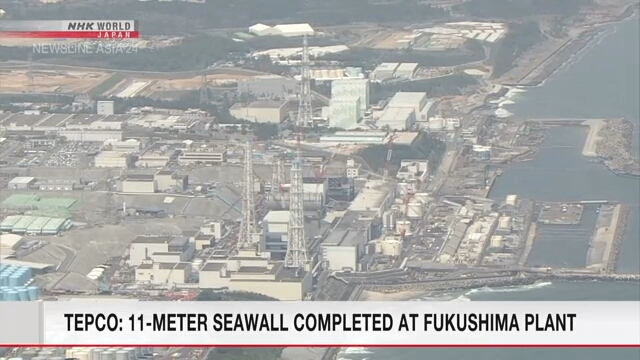
September 29, 2020
The operator of the damaged Fukushima Daiichi nuclear power plant says it has completed an 11-meter-high seawall to protect the facility from tsunami waves.
Tokyo Electric Power Company, or TEPCO, erected the barrier based on a government panel warning three years ago. It said that a mega-quake along the Chishima Trench, beneath the sea near northern Japan, could cause a tsunami to hit the compound.
TEPCO announced that a 1.7-meter-high concrete wall was built atop elevated ground stretching 600 meters on the sea side of the No.1 to No.4 reactors.
The firm says the barrier stands 11 meters above sea level and it was completed on Friday.
TEPCO next plans to build another seawall measuring up to 16 meters high, based on a new projection made by a government panel in April.
The projection says if a mega-quake were to occur along the Japan Trench off the northeastern coast, a tsunami could be higher than the newly-built seawalls.
TEPCO says it aims to complete the taller seawall by fiscal 2023.
In Rural Fukushima, ‘The Border Between Monkeys And Humans Has Blurred’
Shuichi Kanno, 79, walks in front of his home at dusk. Kanno has been dealing with hordes of macaque monkeys in his neighborhood in Japan. They frequently wake him up as they climb over his roof in the early morning hours.
September 10, 2020
Shuichi Kanno rips tape off the top of a large cardboard box at his house in the mountains in Fukushima prefecture in Japan. He opens the box and rustles around to pull out pack after pack of long, thin Roman candle fireworks. The words “Animal Exterminating Firework” are written in Japanese on the side of each canister.
Kanno has been battling hordes of macaque monkeys that have encroached upon his neighborhood in a rural area of Minamisoma. These fireworks are his main deterrent — not to cause the monkeys any physical harm, but to scare them away with a loud bang. That is, until they regain their confidence and come back a few days later, which they do like clockwork, Kanno says.

Kanno stacks fireworks on his coffee table to distribute to neighbors. The fireworks make a loud noise meant to scare, not injure, the monkeys.
“In the early morning while I’m sleeping, just when I’m about to wake up, I hear the noise,” the 79-year-old says in Japanese as he stacks the fireworks on his living room table. “The sound of the monkeys running around on the roof, getting into the gardens, eating all my food. I have to fight them.”
Hundreds of thousands of people evacuated this area nine years ago, fleeing plumes of radioactive material after three reactors exploded at the Daiichi nuclear power plant, one of the most serious nuclear disasters in history. Whole towns and neighborhoods like Kanno’s were left empty of human life for years — and, much like Chernobyl, nature started to reclaim the space. Plants poke through sidewalks and buildings, while wild boar, raccoons and foxes roam the streets. But in recent years, many evacuation orders have lifted and people have started to return, meaning humans and animals are having to figure out new ways to coexist — or not.

A macaque monkey in a tree in Fukushima prefecture. After the 2011 nuclear disaster, towns and neighborhoods in Fukushima were left devoid of humans for years, and nature started to reclaim the space.
“The monkeys never used to come here, but after the disaster, the border between monkeys and humans has blurred,” Kanno explains. “The houses were empty, but the gardens were still growing — plums, pears, chestnuts, persimmons. It was a wonderland for monkeys, an all-you-can-eat buffet. And they remembered that.”
His neighborhood is on the very edge of the evacuation area, relatively far from Daiichi. People stayed away for only a few years, but by the time they came back, the monkeys had become comfortable. And, Kanno points out, half the houses are still empty and only older people came back. They just don’t have the numbers they need to win the battle against the monkeys without backup.

From left: Shuichi Kanno, Shigeko Hoshino, Hiroyuki Shima and Hachiro Endo are neighbors who moved back to Fukushima after the nuclear disaster and who get regular visits from monkeys that eat fruits and vegetables from their gardens.
That is where the fireworks come in, subsidized by the local government after residents complained. The governments here have provided several different kinds of tools, such as wild boar traps and electric fences for farmers, to help communities with animal problems.
Yuriko Kanno, 75, Shuichi’s wife, comes into the living room, looks at the pile of fireworks and laughs. “I’ve been worried that this village is going to become like that movie, the monkey planet one,” she says, referring to Planet of the Apes. “I’ve seen it — it could happen!”
She walks away giggling. Shuichi Kanno is laughing too. The monkeys are annoying, yes, but they’re also a source of entertainment for the aging residents, he concedes.
Yuriko Kanno, 75, is amused by the battle between her husband and the monkeys.
“Look, I think they’re cute. I would absolutely never hurt them,” he says. “None of this is their fault. It’s nuclear power’s fault. It’s the fault of humans.”
Shuichi Kanno is a leader in the neighborhood, and he’s in charge of distributing the fireworks to any of his neighbors who want them. The neighbors all have to sign an agreement saying they understand the dangers and — most importantly, he says — that they will not hurt any animals.
He loads the fireworks into the trunk of his car and drives down forest roads from house to house, dropping off packs of fireworks at every stop. As he drives, he points to all the natural beauty in the area. The nuclear disaster didn’t just change his relationship with monkeys, he says.
“I loved hiking, and foraging for wild vegetables, finding wild mushrooms. But now it’s so dangerous,” Kanno explains, referring to the high levels of radioactive cesium still present in the dense forests here. “We can’t have a relationship with nature anymore. It’s gone.”

Kanno drives his truck down a main road in his neighborhood, chasing monkeys that he saw scampering around his house not long ago.
He pulls up to the house of Hachiro Endo, 77, whose family has been in the area for generations. The home has a beautiful garden in front and long strands of drying persimmons hanging in the garage.
Endo is delighted by the delivery. He has gone through his entire stockpile protecting his garden. “I’m alert all the time,” Endo sighs. “The monkeys, they’ve taken over my life.”
He says he remembers a time when he was little and his grandfather tried to lure the monkeys down from the mountains into the village, hoping to boost tourism to the area by becoming a monkey town. He was never successful — the macaques were too afraid of humans to come down and stay.
“If only he could see it now,” he says with a laugh.

A troop of monkeys scampers across a road in Fukushima prefecture.
A few days later, Kanno is out on monkey patrol. He has just seen a troop of monkeys running from his house out into the neighborhood. He’s wearing knee-high rubber boots, a bright orange jacket and a baseball cap while clutching a firework in one hand and the steering wheel of his pickup truck in the other.
He drives slowly, leaning forward to scan the hills as he goes. And then suddenly, he slams on his brakes.
“There they are!” he shouts, pointing behind a shed. Dozens of monkeys are jumping toward the forest, scrambling up trees and crawling up the hillside.
He jumps out of the truck and pulls the firework from underneath his jacket, loading it onto a kind of stick so he can hold it far away. He lights the fuse and smiles, pointing it toward the hill.
Kanno grins after shooting off a firework to scare off monkeys that were roaming through the neighborhood.
Three loud booms echo through the trees. The monkeys scatter. Kanno bursts into a grin, giggling. Then he runs to every house nearby, making sure his neighbors know that he just saved their gardens from almost certain devastation.
“They won’t be back tomorrow!” Kanno calls, waving the spent firework, giddy with excitement. “I won today!”
But even as he says that he loads a fresh firework and tucks it into his coat. The monkeys will be back, and the battle will continue.
Tokyo Olympic torch relay to start on March 25, 2021 in Fukushima
Same time same place next year …The relay will start from the J-Village soccer training center and last for 121 days while traversing all of Japan’s 47 prefectures. The previous schedule for each region was maintained aside from a one-day adjustment to fit next year’s calendar.

September 28, 2020
The Tokyo Olympic torch relay will start on March 25 in Fukushima Prefecture, Tokyo Games organizers said Monday, in keeping with the plan that was developed prior to the games’ one-year postponement due to the coronavirus pandemic.
The relay will start from the J-Village soccer training center and last for 121 days while traversing all of Japan’s 47 prefectures. The previous schedule for each region was maintained aside from a one-day adjustment to fit next year’s calendar.
The Olympics are slated to open on July 23 next summer followed by the Paralympics on Aug. 24.
Approximately 10,000 runners who had already been selected will be given priority for the nationwide relay. Organizers said they will stick with the local routes and events that were already planned in principle but may make future adjustments according to the status of each region.
The Paralympic torch relay will be held in August.
Athens Olympics women’s marathon gold medalist Mizuki Noguchi (L) receives the Tokyo Olympics flame from first runner Anna Korakaki, the 2016 Rio Games shooting gold medalist, in the torch relay in Olympia, Greece, on March 12, 2020.
Organizers had been seeking to shorten the torch relay schedule in order to reduce swelling costs caused by the games’ delay but abandoned the idea after receiving strong disapproval from local governments already banking on the event.
As a result, only reducing the size of the vehicle convoys, staff and pageantry of some of the events connected to the relay are under review as potential areas for cost cutting and streamlining the games.
The Olympic flame was lit earlier this year at the site of ancient Olympia in Greece and arrived in Japan four days before the games were postponed on March 24.
The flame has remained in the host country since and is currently on public display at the Japan Olympic Museum near the main stadium for the games in central Tokyo until Nov. 1.
Prime Minister Suga Visits Fukushima Daiichi Nuclear Plant

Prime Minister Yoshihide Suga visits the disaster-stricken Fukushima No. 1 nuclear power plant on Saturday.
Suga visits disaster-hit Fukushima nuclear power plant
September 26, 2020
FUKUSHIMA – Prime Minister Yoshihide Suga on Saturday visited the disaster-stricken Fukushima No. 1 nuclear power plant, where decommissioning work is taking place.
The day trip is Suga’s first since he replaced former leader Shinzo Abe, who stepped down for health reasons, and is aimed at demonstrating the government’s continued commitment to rebuilding areas of Tohoku affected by the massive March 2011 earthquake and tsunami and ensuing nuclear crisis.
While the Abe administration’s set of basic policies included the pillar of disaster recovery from its inception in 2012, Suga’s Cabinet platform, adopted at its first meeting on Sept. 16, made no mention of the disasters that left nearly 15,900 people dead and more than 2,500 unaccounted for.
Suga said during a Friday meeting on the rebuilding of the region that he will “inherit the policy” from the previous administration and keep pushing reconstruction forward.
His trip also includes a visit to a museum on the disaster and a meeting with students from local junior and senior high schools.
Japan PM Suga visits disaster-hit Fukushima nuclear power plant
FUKUSHIMA, Japan (Kyodo) — Prime Minister Yoshihide Suga vowed Saturday to press forward with reconstruction efforts for areas devastated by the 2011 earthquake and tsunami, as he visited the Fukushima nuclear power plant crippled by the disasters.
He made the comment after there was no mention of the disasters, or rebuilding work for the northeastern Tohoku region, in his Cabinet’s basic policies adopted at its first meeting last week.
Suga told reporters during his first official trip since he took office to succeed Shinzo Abe on Sept. 16 that when he formed the new Cabinet, he wrote of the need to continue reconstruction efforts in instructions handed out to all the Cabinet members.
“There is no recovery of Tohoku, without recovery of Fukushima, and there is no revival of Japan without recovery of Tohoku. This is a basic policy of my Cabinet,” he said.
Fukushima is one of three prefectures in northeastern Japan hit hardest by the disasters that left nearly 15,900 people dead and more than 2,500 unaccounted for, and triggered the world’s worst nuclear crisis since the 1986 Chernobyl accident.
The Abe administration’s set of basic policies included the pillar of disaster recovery from its inception in 2012. Suga said Friday during a meeting on the rebuilding of the devastated areas that he will “inherit the policy” from the previous administration.
“We want to make a decision as soon as possible” on radioactive water now being stored at the Fukushima Daiichi nuclear power station, he said.
The government and the plant owner, Tokyo Electric Power Company Holdings Inc., are considering how to dispose of the water, which has been contaminated with radioactive materials after being used to cool the melted fuel cores at the plant.
They are looking at options such as releasing it into the Pacific Ocean or evaporation but local fishermen have voiced opposition due to fears consumers would shun seafood caught nearby.
The water is being treated using an advanced liquid processing system, or ALPS, to remove most contaminants other than the relatively nontoxic tritium. It is being stored in tanks on the facility’s premises but space is expected to run out by the summer of 2022.
Suga also visited a museum on the disasters and met with students from local junior and senior high schools as part of the official trip.
https://mainichi.jp/english/articles/20200926/p2g/00m/0na/078000c
Fukushima and freedom of expression
September 23, 2020
According to Asahi, guides welcoming visitors to the disaster museum, which opened on September 20 in Futaba, have no right to criticize either TEPCo or the government. The 29 guides are victims of the disaster or trained people. Each guided tour lasts one hour and is paid 3,500 yen.
During the trainings that took place this summer, the distributed manual stated that one should avoid “criticizing or defaming certain organizations, people or other facilities”. And if a visitor asks the guide about their feelings about TEPCo’s responsibility, the answer should be evasive and the visitor referred to museum staff. Each guide must also put his words in writing and submit it to the museum management who corrects it. And if they ever criticize an organization, their presentation will be immediately stopped and they will never be able to be a guide in that museum again.
Some guides took offense: as victims, they should be able to criticize TEPCo and the government, which are responsible for the nuclear disaster. Another guide saw their script corrected after mentioning this responsibility. Yet official investigative reports pointed to the responsibility of TEPCo and the government. Not being able to mention it in a museum dedicated to the nuclear disaster is scandalous.
Ironically, Le Canard Enchaîné published an article that same day on the dismissal of an IRSN researcher who was working on the consequences of the Fukushima disaster and who did not agree to have her work censored by his hierarchy. In response, ACRO left the Research Orientation Committee (COR) of this Institute. The resignation letter is on the association’s website and reproduced below.
According to Le Canard Enchaîné, the direct superior of Christine Fassert, the licensed researcher, “wanted to impose changes, even censor words and sentences [of] an article,” in order to “avoid criticism of post-management. accident of the Japanese government, and the civilian nuclear sector in general “, and” to minimize and relativize the risk related to radiation exposure “.
This event is very disturbing because it shows that IRSN is unwilling to accept research results that challenge its prejudices. And when you’re in charge of nuclear safety, it’s particularly serious. He is not the only person to have suffered the rigidity of this institute, but it is the first time that it has led to a dismissal, which is scandalous.
We have already emphasized, twice, in July 2018 and March 2019, the originality of the work of Christine Fassert, socio-anthropologist, risk specialist at IRSN, who worked on trust, as part of the Shinrai project. in partnership with Sciences Po and Tôkyô Tech University. In Japan, as in France, she went, with her Japanese colleagues, to meet all the protagonists and interviewed both officials and independent experts, as can be seen in this presentation (copy).
At IRSN, we prefer to focus on people who show that it is possible to live in contaminated areas. And the dominant paradigm is that we must avoid evacuating and bringing evacuees back as quickly as possible, bypassing the UN directives on internally displaced persons which guarantee them protection, the right to choose between return and resettlement, as well as their full participation in decisions (see our 2016 report: Fukushima, return to abnormal?). It is also obvious in the European research programs in which IRSN participates, where the reduction of uncertainties in the modeling of radioactive fallout should make it possible to avoid unnecessary evacuation of populations (see page 58 of this presentation, for example) , while the faults in the modeling in Fukushima also led to not evacuating people who should have been! This is the case for the contaminated territories which extend up to forty kilometers to the Northwest. The evacuation order did not arrive until April 22, 2011, when the disaster began on March 11, 2011.
In practice, IRSN did not hesitate to work on and highlight an unscrupulous researcher, as we reported in January 2019, but who said what the institute wanted to hear. This is also the object of the Fukushima “dialogues” supported by IRSN shown in the web documentary “Kotoba” (which means “word” and not “dialogue”): no radioactive waste, no sick, no residents who don’t want to come in… Just a few small worries, but in twelve “dialogues”, everything is settled! The results of these dialogues by IRSN are a distressing list of banalities. This is worrying for post-accident management in the event of an accident in France.
Christine Fassert, for her part, also went to meet people who have left and who do not want to return, giving visibility to a category of populations that everyone wants to ignore, although it is the most numerous. The project also examined the pitfalls of an essentially “reassuring” communication on radiological risk, the difficulty of the role of radiation protection experts in direct contact with the public, the tension between a government policy of evacuations and returns devised by Tokoite elites and the implementation of these directives by the mayors in the region of Fukushima… Only subjects which did not fall within the narrow framework of what was expected. So, it was the frame or her!
Resignation message sent on September 18, 2020 to COR members:
Madame President,
Following the dismissal of an IRSN researcher, I would like to resign from COR. If the IRSN is not able to accept unique voices internally, it cannot open up to society.
In its opinion on the post-accident, the COR stressed, for the “populations and governance” section: “The WG thinks that it would be important to conduct research on this subject taking into account the opinions of all categories. population. Self-evacuees escape official monitoring in Japan and most of the studies and research in which IRSN participates. The experience feedback cannot be limited to the population who wish to remain in place or return, which is not very representative of all the populations affected by a serious nuclear accident. IRSN would benefit from broadening the scope of its studies and research or from moving closer to other programs involving all the people affected by the disaster, including those who do not wish to stay or return. “
In the event of a nuclear accident in France, IRSN will not be able to choose from among the affected populations. The participation of all stakeholders will be necessary. The licensed researcher is precisely the only person at the institute who was interested in all categories of the population, the “dialogues” program having selected only people in agreement with the dominant paradigm at IRSN.
I have already had the opportunity several times, within the COR, to question and alert IRSN researchers on the freedom to publish and communicate, to no avail. The COR has never agreed to discuss it.
Since the beginning of COR, I have worked for more openness and to take into account the demands of society. I have participated in almost all GTs and chaired two of them. But I fear that all this work has been in vain and that IRSN is not ready to open up sincerely. Under these conditions, I see no other solution than to resign from COR.
Yours truly,
David Boilley
TEPCO’s fitness to operate nuke reactors still open to question
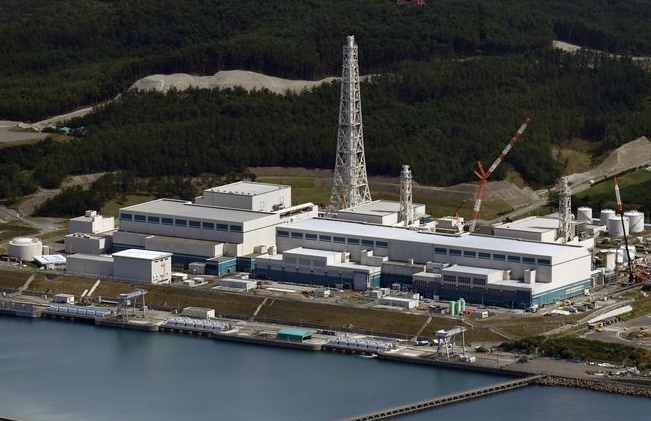
From left, the No. 5 to No. 7 reactors of the Kashiwazaki-Kariwa nuclear power plant in Niigata Prefecture
September 24, 2020
The Nuclear Regulation Authority has effectively endorsed Tokyo Electric Power Co.’s fitness to operate nuclear reactors in its safety screening of the utility’s plans to restart the No. 6 and No. 7 reactors at the Kashiwazaki-Kariwa nuclear power plant in Niigata Prefecture.
The nuclear watchdog’s endorsement, based on new legally binding safety rules the utility drafted and pledged to follow, has opened the door for the operator of the crippled Fukushima No. 1 nuclear power plant to start running reactors again.
But TEPCO’s actions concerning safety, the decommissioning of the destroyed Fukushima reactors and compensation for victims of the catastrophic accident have created a deep sense of distrust that is hard to brush off. The NRA’s decision is open to question.
Three years ago, when it cleared the No. 6 and No. 7 reactors under the tougher new reactor safety standards established in response to the Fukushima disaster, the NRA placed great importance on TEPCO’s “fitness” to run reactors.
This has led the utility to incorporate seven new principles into its safety code. They include the company’s commitment to carry through the decommissioning of the Fukushima No. 1 nuclear plant and hold its president responsible for reactor safety as well as its pledge not to put economic efficiency before safety.
The safety code is legally binding, with a violation potentially provoking an order to suspend operations.
This time, the NRA has examined TEPCO’s seven commitments and acknowledged that they are specific enough to allow the watchdog to identify and punish any violations.
But the seven principles still contain vague elements. It is difficult not to wonder whether they will effectively enable the NRA to monitor and check TEPCO’s operations for violations.
TEPCO, for example, has promised to follow through with the payment of compensation to victims of the Fukushima calamity. In fact, however, the company has rejected many proposed compensation agreements with local residents.
As for decommissioning the stricken plant, the company has left entirely to the government the vital challenge of disposing of radiation-contaminated water being generated by the plant.
These actions of the firm appear to be at odds with the safety code. What does the NRA think about them?
The real question is whether TEPCO’s basic attitude has really changed.
Asahi Shimbun editorials have questioned the company’s reliability to operate nuclear plants safely because it has failed to demonstrate the safety awareness and commitment required for the operator of a nuclear power plant.
TEPCO, for example, failed to report accurately the fact that an important facility at the Kashiwazaki-Kariwa plant does not have sufficient earthquake resistance.
It also avoided publishing voluntarily the fact that contaminated water from the Fukushima plant contains various radioactive materials whose levels are well above the safety standards after treatment. All these facts raised doubts about the firm’s ethical integrity.
Unless the utility changes its culture and behavior, it will be unable to win local support for its plans to restart the reactors.
TEPCO, as the operator of the Fukushima plant, has the responsibility to put the priority on decommissioning the reactors and paying compensation to people who have suffered from the accident.
It is doubtful whether the company will be able to operate reactors safely while grappling with the colossal challenge of decommissioning the plant, a process that will continue for decades.
There are legitimate concerns that the company could be unable to secure sufficient human and other resources for its efforts to ensure the safety of the Kashiwazaki-Kariwa plant.
Instead of sticking to its business strategy, which is focused on restoring its financial health by restarting the reactors at the plant in Niigata Prefecture so that it can bear the huge cost of decommissioning and compensation payments, TEPCO should start exploring carving out a viable future without nuclear power generation for itself.
As the utility’s virtual leading shareholder, the government should urge the firm to reconsider its business strategy.
Japan Struggles to Secure Radioactive Nuclear Waste Dump Sites
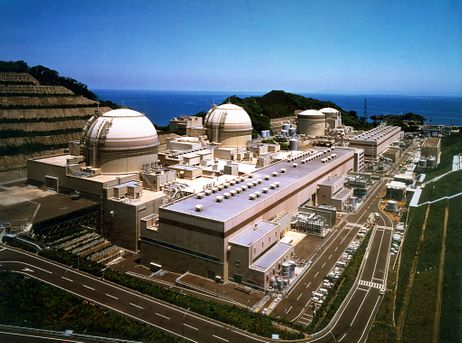
A small, aging town grapples with the financial lure of storing radioactive waste underground.
Japan’s worsening depopulation crisis is crippling the public finances of regional towns. Now one small town has made national headlines after expressing interest in storing radioactive nuclear waste underground in a last ditch effort to save itself from impending bankruptcy.
The small town of Suttsu in Hokkaido, the northernmost main island of Japan, has a population of just under 3,000 people. It’s the first local municipality to volunteer for the permanent storage site of highly radioactive nuclear waste and nuclear spent fuel. Suttsu Mayor Kataoka Haruo says the town has no more than 10 years left to find new sources of income after struggling with a slump in sales of seafood due to the global coronavirus pandemic.
Kataoka says there is an impending sense of crisis unless an urgent financial boost in the form of a government grant can be secured. He has called on local residents not to dismiss the idea of applying for the phase one “literature survey” without weighing the ways the grant could be spent — in contrast to the harsh reality of town funds running dry in 10 years’ time.
In Japan there are more than 2,500 containers of nuclear waste being stored in limbo without a permanent disposal site. Currently, the waste is stored temporarily in Aomori prefecture in northwest Japan at the Japan Nuclear Waste Storage Management Center. According to the Ministry of Economy, Trade, and Industry there are also approximately 19,000 tons of spent nuclear fuel stored at each nuclear power plant.
Nuclear waste projects immense heat and it needs to be cooled through exposure to air for between 30 to 50 years before it can be transferred and stored underground. However, it takes roughly 1,000 years to 100,000 years for radiation intensity to drop to safe levels.
The 2011 Fukushima nuclear disaster left long-lasting trauma further exasperating Japan’s already vexed relationship with nuclear energy as a resource deficient nation. The aftermath of the disaster and the slow road to recovery prompted many people to object to nuclear waste storage not only on geographic grounds but also out of strong emotional opposition.
Hokkaido has built a global reputation for its high quality dairy, agricultural products, and seafood. Nuclear waste storage, and the negative publicity that would follow, could jeopardize those industries.
With the proposal, local residents in Sutsu have been placed in a difficult situation, weighing up the health of their children and future generations against the town’s financial prospects and viable funding opportunities.
In August, Kataoka said he would not apply for phase one without the understanding of the general public. Last week, Kataoka held a local briefing session aiming to deepen local understanding and consent. But after discussing the damage to the town’s reputation and the possible conflict with a previous ordinance against accepting nuclear waste set by a radioactive waste research facility created in Hokkaido in 2000, Kataoka indicated the application for phase one would likely be delayed.
In 2000 the government enacted the Final Disposal Law, which outlined criteria for electing a permanent storage site. A three-stage investigation process sets out excavation to be deeper than 300 meters below ground and in doing so a survey of volcanoes, active fault lines, and underground rock must be performed in addition to installing an underground survey facility. It’s estimated that steps one through to three will take approximately 20 years in total.
In 2017 the government released a scientific map of Japan, pinpointing towns with suitable geographic conditions to host final disposal sites. If the application and survey are approved successfully, towns are eligible for grants up to 2 billion yen (around $19 million at current exchange rates) from the central government and another 7 billion yen if stage two goes ahead. In 2002 The Nuclear Waste Management of Japan (NUMO) launched an open call for local municipalities to consider applying for an initial investigation stage without success. Three years after the release of the map, NUMO has attempted to garner public support by hosting over 100 local discussion meetings all over Japan. Suttsu was the first town to express interest in phase one out of 900 local municipalities.
The final nuclear waste site is expected to make room underground for 40,000 barrels requiring six to 10 square kilometers — the equivalent of 214 Tokyo Dome Stadiums — to a tune of 3.9 trillion yen.
The government is currently formulating a “nuclear fuel cycle policy,” which aims to reduce the amount of nuclear waste generated by encouraging the recycling and reuse of spent fuel. But one major criticism of Japan’s nuclear power policy is the lack of a comprehensive strategy. The two year period for a “literature survey” has been touted as an opportunity for Japan to seriously consider the cleanup of nuclear power.
1 This Month

of the week – Shut Down Drone Warfare!


Tell the Ukrainian Government to Drop Prosecution of Peace Activist Yurii Sheliazhenko

Petition to revoke the licensing of the Near Surface Nuclear Disposal Facility (NSDF) at Chalk River. https://www.ourcommons.ca/petitions/en/Petition/Details?Petition=e-7247
To see nuclear-related stories in greater depth and intensity – go to https://nuclearinformation.wordpress.com
-
Archives
- April 2026 (34)
- March 2026 (251)
- February 2026 (268)
- January 2026 (308)
- December 2025 (358)
- November 2025 (359)
- October 2025 (376)
- September 2025 (257)
- August 2025 (319)
- July 2025 (230)
- June 2025 (348)
- May 2025 (261)
-
Categories
- 1
- 1 NUCLEAR ISSUES
- business and costs
- climate change
- culture and arts
- ENERGY
- environment
- health
- history
- indigenous issues
- Legal
- marketing of nuclear
- media
- opposition to nuclear
- PERSONAL STORIES
- politics
- politics international
- Religion and ethics
- safety
- secrets,lies and civil liberties
- spinbuster
- technology
- Uranium
- wastes
- weapons and war
- Women
- 2 WORLD
- ACTION
- AFRICA
- Atrocities
- AUSTRALIA
- Christina's notes
- Christina's themes
- culture and arts
- Events
- Fuk 2022
- Fuk 2023
- Fukushima 2017
- Fukushima 2018
- fukushima 2019
- Fukushima 2020
- Fukushima 2021
- general
- global warming
- Humour (God we need it)
- Nuclear
- RARE EARTHS
- Reference
- resources – print
- Resources -audiovicual
- Weekly Newsletter
- World
- World Nuclear
- YouTube
-
RSS
Entries RSS
Comments RSS
 nuclear-news