LDP policy chief calls for decommissioning of Monju reactor

Toshimitsu Motegi, chairman of the ruling Liberal Democratic Party’s Policy Research Council, on Friday called for decommissioning the Monju prototype fast-breeder nuclear reactor in central Japan as a cost-effective step for the troubled facility.
In an interview, Motegi said that he cannot think of any option other than decommissioning for the reactor in Tsuruga in Fukui Prefecture, which is operated by the Japan Atomic Energy Agency.
“Now is the time to make a decision,” Motegi said.
The Monju reactor, which reached criticality for the first time in 1994, has been in operation only for 250 days so far, while more than ¥1 trillion has been spent on the reactor, a core facility for Japan’s nuclear fuel cycle policy.
He also cited a failure to find a new operator of the reactor to replace the JAEA, though the Nuclear Regulation Authority urged the education and science minister to take such a step in November last year.
The JAEA is effectively banned from restarting the reactor following a series of problems, including its failure to conduct maintenance checks properly.
Motegi said hundreds of billions of yen more would be necessary for the reactor to meet the current stricter reactor safety standards for restart.
Also in the interview, Motegi said that the LDP will start discussions Tuesday on whether to extend the maximum term of office for the LDP president.
The LDP will revise its rules at a party convention next year if it reaches a conclusion on the issue by year-end at its headquarters for political system reforms, he said.
The LDP currently sets the maximum term of its president at two consecutive three-year terms. Some party members have called for allowing Abe to serve another three years to allow him to remain prime minister when Tokyo hosts the 2020 Olympic and Paralympic Games.
1.5 trillion yen spent last year on costs related to reactors
Only three of Japan’s 42 operable reactors are running
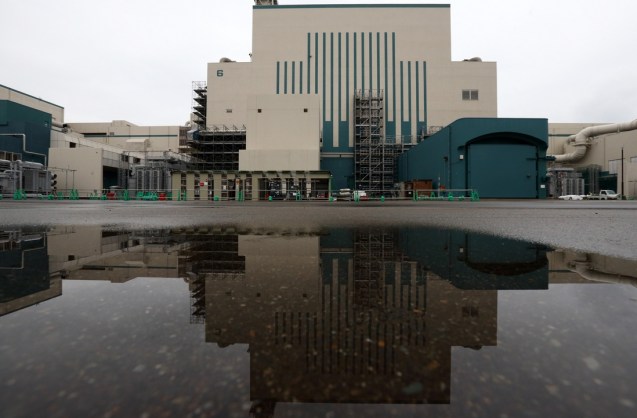
The Unit 6 reactor of the Kashiwazaki Kariwa nuclear plant.
More than 6,000 workers cycle through the world’s biggest nuclear plant every day to operate and maintain a facility that hasn’t sold a kilowatt of electricity in more than four years.
The buzz at Tokyo Electric Power Co. Holdings Inc.’s Kashiwazaki-Kariwa plant plays out daily across Japan, where utilities employ thousands of workers and spend billions of dollars awaiting the green light to restart commercial operations. With only three of the country’s 42 operable reactors running, they’re betting a national government committed to nuclear power will win over local officials and a wary public who don’t believe enough has been done to guarantee safety since the worst meltdown since Chernobyl.
“Even though operating expenses of non-generating reactors remain high, utilities would prefer to keep them open while there is any chance they can restart,” said James Taverner, a Tokyo-based analyst at IHS Markit Ltd. “Utilities have already committed significant expenditure for plants to meet new safety standards, and decommissioning costs are considerable.”
The nine biggest regional utilities spent more than 1.5 trillion yen ($14.6 billion) on their nuclear plants during the year to March, according to Bloomberg calculations based on the latest earnings reports. Over that same period, those plants accounted for just 1.1 percent of the nation’s electricity.
Nuclear-related costs accounted for 9 percent of all operating expenses at the utilities in the previous fiscal year, according to the calculations. That includes personnel and maintenance, as well as waste disposal and contributions to the nation’s nuclear damage compensation system.
The burden of paying for nuclear facilities producing little electricity has been softened by price declines in recent years for coal, natural gas and oil, which are also used as fuels for power generation. Tepco sees itself swinging to a net loss as fossil fuel prices recover, making the restart of Kashiwazaki-Kariwa key to profitability, Naomi Hirose, the company’s president, said in an interview earlier this year.
Emergency Drills
Costs for operating the country’s nuclear facilities were slightly higher before the March 2011 Fukushima disaster, at about 1.7 trillion yen a year, when atomic energy accounted for nearly 30 percent of Japan’s electricity mix. Tokyo Electric, also known as Tepco, estimates that restarting one of the newest reactors at Kashiwazaki-Kariwa — known as KK — would boost net income by as much as 10 billion yen a month.
The plant, the world’s biggest with generating capacity of about 8.2 gigawatts, has seven reactors at a facility spread across more than 1,000 acres and located about 135 miles (217 kilometers) northwest of Tokyo in the prefecture of Niigata.
Workers clad in jumpsuits and loaded down with manuals convene daily in a mock-up of the reactor control room, preparing for the restart of the plant under new safety guidelines imposed after the Fukushima meltdown.
“Everyday, this room is full of workers, from fresh employees to old veterans, sharpening their skills,” Noboyuki Suzuki, a deputy manager in the company’s human resources development group, said at the KK plant last month. “Operators at this facility are required to go through training here on a regular schedule.”
About three-fourths of the Tepco employees and contract workers at the plant are from the prefecture housing the facility, making it one of the area’s biggest economic drivers.
The reactor is an economic windfall for the region, employing thousands of local workers and supporting restaurants, shops and even taxi companies, according to Kariwa village official Masayoshi Oota. “If the reactor were to disappear, then so would the economic benefit,” he said.
Japan’s nuclear energy industry employs more than 80,000 engineers, construction workers and operators, according to a report published by the Ministry of Economy, Trade and Industry last year.
To boost confidence in its facility’s safety, Tokyo-based Tepco has spent 470 billion yen on flood barriers, a 15-meter seawall and a reservoir the size of 30 Olympic-sized swimming pools to supply water in the event a reactor pump fails.
Kansai Electric Power Co. may spend 1.26 trillion yen on construction costs related to nuclear safety measures, while Chubu Electric Power Co. is estimated to spend 640 billion yen, according to a Sept. 14 report by Mitsubishi UFJ Morgan Stanley Securities Co.
KK’s restart is far from assured. The plant was forced to shut for 21 months following an earthquake in July 2007. Though some units eventually restarted, all were shuttered again after the March 2011 Fukushima accident for safety checks.
Public Opposition
There is skepticism among the Japanese public. The restart of nuclear reactors is opposed by 53 percent of Japanese and supported by just 30 percent, according to a nationwide poll conducted earlier this year by the Mainichi newspaper.
Local courts and governments have been some of the biggest roadblocks to restarting more reactors, crimping Prime Minister Shinzo Abe’s goal of deriving as much as 22 percent of the nation’s energy needs from nuclear by 2030. Goldman Sachs Group Inc. lowered its price target on six Japanese power utilities this month on risk of delays in restarting operations or renewed shutdowns.
Tepco shares in Tokyo on Thursday closed unchanged at 404 yen, while rivals Kansai Electric declined 3.1 percent and Chubu Electric slipped 0.3 percent. The Topix Electric Power & Gas Index has dropped 25 percent this year, weighed down primarily by Japan’s utilities.
Should KK clear the necessary regulatory, legal and political hurdles and resume operations, Tepco plans to maintain the facility’s workforce at current levels, a reflection of how many workers are needed even during a period called cold-shutdown.
“Right now we are focused on the nation’s regulatory review of the plant,” said Chikashi Shitara, facility chief at KK. “Even though the plant isn’t running, there is still a lot we must do.”
Five-and-a-Half Years After Fukushima, 3 of Japan’s 54 Nuclear Reactors Are Operating
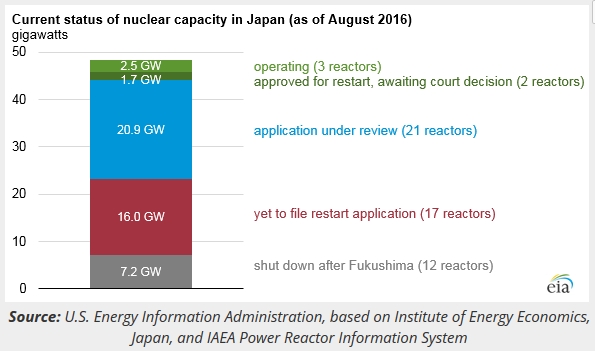
Since the accident at Fukushima Daiichi in March 2011 and the subsequent shutdown of nuclear reactors in Japan, five reactors have received approval to restart operations under the new safety standards imposed by Japan’s Nuclear Regulation Authority (NRA). Only three of those reactors are currently operating. Applications for the restart of 21 other reactors, including 1 under construction, are under review by the NRA. Some reactors that meet the new NRA safety standards and have been approved to restart continue to face legal or political opposition that may delay or forestall their restart.
After the Fukushima accident, all 54 of Japan’s reactors were shut down. Twelve reactors totaling 7.2 gigawatts (GW) were permanently closed. Restart applications for 20 previously operating reactors (totaling 19.5 GW) and 1 new reactor under construction (the 1.4 GW Oma Nuclear Power Station) have been filed with the NRA. The remaining 17 reactors (16 GW) have yet to submit restart applications. There is still uncertainty about whether some of these reactors can meet the new NRA safety regulations, particularly regulations regarding the ability to withstand severe earthquakes.
In addition to NRA approval, the restart of Japan’s nuclear reactors requires the approval of the central government and the consent of local governments or prefectures where the power plants are located. Opposition to reactor restarts has been primarily related to public concerns about seismic risks, the adequacy of NRA regulations, and evacuation plans in the event of an accident.
The five reactors approved by the NRA to restart total nearly 4.2 GW. Three reactors are operating, while two remain idle pending the outcome of legal challenges:
- Kyushu Electric Power Company’s Sendai Units 1 and 2 (1.7 GW combined) are located in the Kagoshima prefecture and received NRA approval to restart in May 2015, slightly less than two years after submitting applications to restart. In August 2015, Sendai Unit 1 was the first reactor to be restarted under the NRA’s new safety regulations, with Sendai Unit 2 following in October. The reactors are scheduled to shut down for periodic inspection and maintenance in October and December 2016, and post-outage restarts may be delayed in light of the recent call by the newly elected prefectural governors for the temporary suspension of operations at Sendai.
- Kansai Electric Power Company’s Takahama Units 3 and 4 (1.7 GW combined) in the Fukui prefecture received NRA restart approval in February 2015. Although the reactors briefly restarted in early 2016, a district court in the neighboring Shiga prefecture issued an injunction in March to shut down the two reactors. That court’s decision was reaffirmed in June and again in July following challenges by Kansai Electric. Kansai Electric filed an appeal with the Osaka High Court in late July seeking to lift the injunction.
- Shikoku Electric Power Company’s Ikata Unit 3 (0.8 GW) is located in the Ehime prefecture. The NRA approved restart in August 2016. The reactor began generating electricity in August 2016 and is expected to resume commercial operation in September.
In July 2016, Japan’s Institute of Energy Economics (IEEJ) analyzed low, reference, and high reactor restart scenarios for fiscal years 2016 (ending March 2017) and 2017 (ending March 2018). The High case envisions that as many as 25 reactors may restart by March 2018, compared with 12 in the Low case. The continued uncertainty related to the length of the NRA review process, the difficulty in getting local consent, and the potential for protracted court proceedings can all affect both the actual level and timing of nuclear capacity
Burning debris from Fukushima
Local government officials, rather than objectively scientifically determine whether it was safe or not for the people just accepted the central government political decision to have debris from Fukushima brought and burned in many municipalities and prefectures throughout Japan.
As a result not only the Fukushima people have inhaled radioactive nanoparticles, but also many other people in other locations.
The map below, from year 2012, shows locations where Fukushima debris was burned then, it was really spread all over Japan during the first 3 years, 2011, 2012, 2013.

Today incineration of Fukushima debris continues in 19 locations in Fukushima prefecture…

… and some of the Eastern Japan prefectures.
http://blog.goo.ne.jp/flyhigh_2012/e/1c0f117cf0b30ab535f2e74a4534ee3d
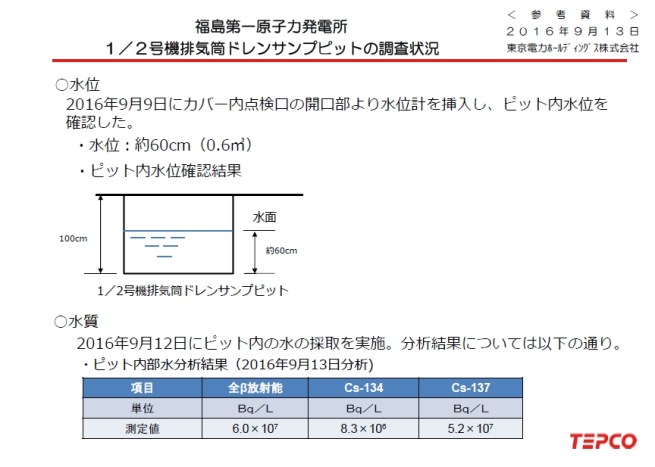
Fukushima Daiichi Unit 1-2 Vent Tower Sump Drain Sample Tested
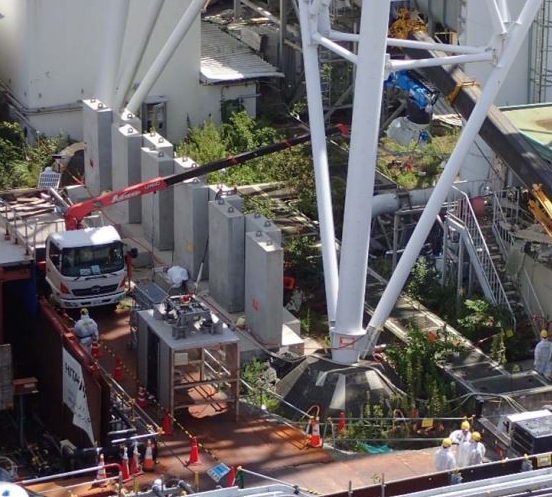
Tepco collected a sample from the sump drain connected to the Unit 1-2 vent tower.
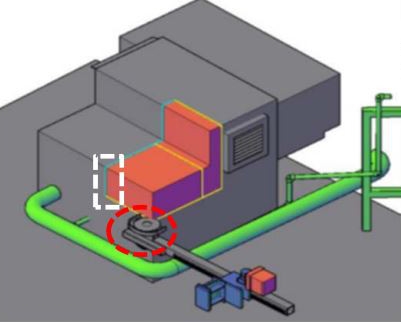
They found 60cm of water in the 100 cm deep container.
The water sample tested as follows:
beta radiation: 60,000,000 bq/liter
Cesium 134: 8,300,000 bq/liter
Cesium 137: 52,000,000 bq/liter
These readings are among the higher ranges of contaminated water found around the plant.
Radioactive Food And Water The New Normal In Japan
“We forget that the water cycle and the life cycle are one.” — Jacques Cousteau
“When drinking water, remember its source.” — Chinese proverb
“Ye shall know them by their fruits. Do men gather grapes of thorns, or figs of thistles?
Even so every good tree bringeth forth good fruit; but a corrupt tree bringeth forth evil fruit.
A good tree cannot bring forth evil fruit, neither can a corrupt tree bring forth good fruit.
Every tree that bringeth not forth good fruit is hewn down, and cast into the fire.
Wherefore by their fruits ye shall know them.” — Matthew 7:16-20, Holy Bible
Japan has an amazing food culture thanks in part to the rich volcanic soil and ample rainfall, despite the lack of spacious farms. As it stands, Japan can feed approximately one third of its population from domestic production.
If you watch Japanese TV from time to time, you will see a bizarre and disturbing fetishization of food that borders on the insane. The media and in turn consumers are obsessed with food as not only a source of nutrition and social cohesion (all for the good), but as art, fashion and status symbol, a celebration of gluttony and greed; an infantile obsession with eating for self satisfaction.
I love good and healthy food and appreciate Asian cuisine, but we eat to live, not live to eat. This social pathology affects other cultures as well as seen by increasing rates of extreme obesity especially in Western countries due to the proliferation of shopping malls, junk food and high fructose corn syrup.
How ironic then that a “high food” society like Japan would have to suffer the insult of radioactive contamination. This is not a tuna melt sandwich but a nuclear melt-down sundae.
The long-term consequences of the Fukushima nuclear disaster continue to linger years after the event. Anyone who studies Chernobyl will know that even after three decades radioactive contamination persists. Although a different type of accident occurred there, in the case of Fukushima it was three reactors that had meltdowns instead of one, and even possibly “melt throughs” referring to corium penetrating the reactor buildings in lateral and vertical outward paths.
In the days and months that followed the Fukushima disaster in March of 2011, many people became very worried about radioactive contamination of the food and water supply, especially from short-lived iodine isotopes, followed by the more persistent and harmful cesium, strontium and plutonium. There was much testing by both the government and independent researchers and organizations. Despite the best efforts of the Japanese government, nuclear industry and mainstream media to downplay the crisis, social media proved helpful in educating the public about how to reduce consumer risks.
The worst contamination occurred nearest the disaster site of the Fukushima No. 1 nuclear power station (Dai-ichi) which is located about half way up the east coast in Fukushima prefecture.
When I visited Hirano town with my colleague Yoichi Shimatsu in 2013, we traveled on foot within a few kilometers of the site. We observed abnormally high levels of radiation making it unfit for long-term habitation. Decontamination has taken place there but it is not a thorough removal method and basically shifts radiation from one spot to another in the environment.
Today, if you visit the Japanese government website of the Nuclear Regulation Authority (1) you can find a variety reports on radiation levels with most reports citing very low levels of radiation. How the government arrives at such measurements is not clearly explained at the website. Are their measurements reliable or being taken in a selective manner?
The government hopes to normalize the former evacuation zone by allowing and encouraging residents to move back as soon as possible, despite their reluctance to do so.
Only 28% of Fukushima children returning to former schools….
The majority of schoolboys and girls are opting to stay out of their hometowns due to anxiety over radiation exposure and resettlement at evacuation sites (2).
The problem of radioactive contamination is not unique to Fukushima but to the entire region including Tokyo, home of millions. Recall that 60 million people were originally exposed to radioactive fallout from the accident. Japan was actually lucky because the majority of radiation blew out to sea away from Honshu, not back over the population.
While the government moves to allow wide-scale fishing off the coast of Fukushima (3), and the NRA reports minimal levels of radiation leaking from the plant into the ocean, this confidence in a safe environment is undermined by a report from Greenpeace which found “[r]adiation along Fukushima rivers up to 200 times higher than Pacific Ocean seabed.”
Riverbank sediment samples taken along the Niida River in Minami Soma, measured as high as 29,800 Bq/kg for radiocaesium (Cs-134 and 137). The Niida samples were taken where there are no restrictions on people living, as were other river samples. At the estuary of the Abukuma River in Miyagi prefecture, which lies more than 90km north of the Fukushima Daiichi plant, levels measured in sediment samples were as high as 6,500 Bq/kg (4).
The rivers and ocean are connected and one wonders why the media does not report on these worrying hotspots. These dangerously high levels are indicative of the widely scattered hotspots in the region. In contrast, I could find no reports on the radiation levels at river banks and lake beds at the NRA website, only some reports on radiation found in dust, seawater and so on.
For example, one 2014 report states:
Air dose rates in both “Road and its adjacent area” and “Vacant land lot” have decreased more rapidly than we expected considering the physical half-life of radionuclide in 32 months after the accident. Air dose rates in “Road and its adjacent area” have decreased more rapidly than “Vacant land lot” in 32 months after the accident (5).
The Culture Of Cover Up: Spiked!
A few months ago I was shopping at my health food store in central Tokyo when I was asked by the clerk if I would like to be interviewed by a TV reporter from the Asahi News. I said “sure why not.” Japanese TV often has “man on the street” types of interviews and if you put the shop in a good light, you might appear in a news “infomercial.”
The reporter asked me various questions about why I buy organic food and I spoke proficiently in Japanese about the positive benefits of eating organic food including its superior nutrition and flavor, and because it contributes to the local farm economy.
But I shocked the guy at this point when I bluntly stated that due to the radioactive contamination from Fukushima nuclear disaster, I prefer to buy food produced from as far away as possible, never from the northeast or Tokyo regions of Japan. Food from the west and far southwest of Japan has substantially less radioactive contamination.
I’m not sure if the reporter was even aware of the issue, being a “news reporter” you think he might have been. But it was clear from his reaction that this was a one hundred percent taboo topic. Perhaps because I was a foreigner I was perceived as rude and barbaric for raising it, and I knew ahead of time that by mentioning this my interviewed would not be aired, and it wasn’t.
In fact, after the 3/11 accident my regular health food shop very noticeably shifted the origin of their produce away from the northeast and Tokyo and toward the west, southwest of Japan due to consumer concerns. As for the Asahi News who are an arm of the Abe Propaganda Establishment (APE), Fukushima must only be presented to the public as a pristine location whose products are reliable and safe. A recent study reported:
According to the agriculture ministry, 260,538 food items were inspected in fiscal 2015, and 99 percent of farm products had cesium of less than 25 becquerels per kilogram. The tests showed that 264 items, or 0.1 percent of the total, had cesium exceeding the upper limit. Of these, 259 — or 98 percent — were wild mushrooms, game meat, freshwater fish and other so-called “hard-to-control items” (6).
According to this official data, small numbers of becquerels could be – probably are – routinely entering the general food supply, not to mention the issue of Tokyo’s persistently contaminated water supply which contains minute amounts of cesium.
Radiation is the new normal.
Although the majority of food is under 25 bq per kg of contamination, we don’t know the exact amount. If you multiply that small amount by the number of items consumed daily the danger to health grows exponentially over time.
It is good that Japan has strict standards on radioactive food products — the US allows 1,500 becquerels per kilogram versus Japan’s 100 — but the ubiquitous and long-term aspect of the problem is an ongoing concern.
Richard Wilcox is a contributing editor and writer for the book: Fukushima: Dispossession or Denuclearization? (2014) and a Tokyo-based teacher and writer who holds a PhD in environmental studies. He is gratefully a periodic contributor to Activist Post.
References
1 – Nuclear Regulation Authority
http://radioactivity.nsr.go.jp/en/
2 – Only 28% of Fukushima children returning to former schools
http://mainichi.jp/english/articles/20160910/p2a/00m/0na/001000c
3 – 83 species now eligible for test fishing off coast of Fukushima
http://www.asahi.com/ajw/articles/AJ201609110002.html
4 – Radiation along Fukushima rivers up to 200 times higher than Pacific Ocean seabed – Greenpeace
http://www.greenpeace.org/international/en/press/releases/2016/Radiation-along-Fukushima-rivers-up-to-200-times-higher-than-Pacific-Ocean-seabed—Greenpeace/
5 – Monitoring air dose rates in road/its adjacent area and vacant land lot from a series of surveys by car-borne radiation detectors and survey meters after the Fukushima Daiichi NPS accident
https://www.nsr.go.jp/data/000067236.pdf
6 – 0.1% of food items exceed radiation limit 5 1/2 years after nuke disaster
http://mainichi.jp/english/articles/20160909/p2a/00m/0na/023000c
http://www.activistpost.com/2016/09/radioactive-food-water-new-normal-japan.html
Carlsbad, CA News Conference on the US sailors’ lawsuit against TEPCO
In March of 2011 as the still-ongoing Fukushima nuclear disaster began, the US Navy sent a fleet of ships led by the aircraft carrier USS Ronald Reagan to participate in an humanitarian earthquake and tsunami relief effort called Operation Tomadachi (‘friendship’ in Japanese).
Fleet commanders were not informed by either TEPCO, the nuclear plant operator, or by the Japanese government about the plume of radioactive fallout being blown out to sea from what was eventually admitted to be a triple meltdown.
US navel personnel and their ships and aircraft were repeatedly doused with radiation from the rapidly shifting plume, which contaminated equipment, the ships’ air & ventilation systems, as well as drinking and bathing water.
Today, over 400 of those irradiated personnel have joined in a lawsuit against TEPCO seeking medical costs and compensation for the serious health effects they are experiencing, including cancers, miscarriages and loss of multiple bodily functions. At least 7 so far have died of their radiation-induced illnesses.
The suit, filed in the US court in California by attorneys Charles and Cabral Bonner and Paul Garner, charges that TEPCO withheld information from the Navy that would have prevented the mass radiation exposure and is therefore responsible to pay reparations.
TEPCO’s army of high-priced lawyers have been fighting to block the suit for over 5 years, and the merits of the case have yet to be addressed by the court as plaintiffs continue to die.
Last May, when former Japanese Prime Minister heard of the sailors’ plight, he insisted on coming to the US to interview some of the victims himself.
After several days of face-to-face private conversations with a sampling of suit’s plaintiffs and their affected family members, Mr. Koizumi held a news conference announcing his support of the lawsuit. Fighting back tears, he described what he had learned in the interviews, and stated his intention to establish a fund to help with the plaintiffs’ medical expenses.
Pt. 1 Mr. Koizumi’s Statement
This is the first of three segments of a May 17, 2016 news conference held in Carlsbad, CA by Former Japanese Prime Minister Junichiro Koizumi on the US sailors’ lawsuit against TEPCO.
Pt. 2 – Q&A
This is the second of three segments of a May 17, 2016 news conference held in Carlsbad, CA by Former Japanese Prime Minister Junichiro Koizumi on the US sailors’ lawsuit against TEPCO.
Pt. 3 – A soldiers story – This is the third of three segments of a May 17, 2016 news conference held in Carlsbad, CA by Former Japanese Prime Minister Junichiro Koizumi on the US sailors’ lawsuit against TEPCO.
Fukushima Daiichi Reactor 1 Spraying & Cover Removal
Spraying of anti-scattering agent before taking down the wall panels of Unit 1 building cover at Fukushima Daiichi Nuclear Power Station.
Video taken on: August 4 and September 3, 2016
Produced by: TEPCO Holdings, Inc.
Japanese steel in French nuclear facilities found to have high impurity level
The concentration of impurity in steel a Japanese manufacturer supplied to nuclear facilities in France exceeded the standards set by the European country, Japan’s nuclear watchdog said Wednesday, meaning the steel could be weaker than expected.
Briefed recently by French regulators about the finding, the Nuclear Regulation Authority is looking into allegations regarding the products provided by the Kitakyushu-based firm under scrutiny, Japan Casting & Forging Corp.
The NRA said it needs to carry out tests to evaluate whether the steel is in fact lacking in strength.
The French regulators said in June they found steel containing larger-than-expected amounts of impure substances in facilities such as reactor pressure vessels at 18 reactors operating in France and are investigating the matter. The steel products in question were made by Japan Casting & Forging and Creusot Forge, a subsidiary of France’s Areva SA.
In August, the NRA ordered local utilities hosting nuclear power plants in Japan to examine reactors and other major parts at the plants. The utilities have been asked to report the results to the NRA by the end of October.
Japan Casting & Forging is also under scrutiny in Japan as it is responsible for the construction of reactor pressure vessels in 13 Japanese nuclear reactors including the Sendai Nos. 1 and 2 reactors operated by Kyushu Electric Power Co. in Kagoshima Prefecture.
Currently, the two Sendai reactors are operating in Japan after passing stricter safety checks in the wake of the 2011 nuclear crisis that crippled the Fukushima No. 1 nuclear power plant in Fukushima Prefecture.
Japan Casting & Forging had said earlier it has removed the impurities from its steel as instructed by its clients.
The NRA said the standard for carbon content in metals — a gauge of impurity — is below 0.22 percent in France, while the figure in Japan is below 0.25 percent.
But in some products provided by the Japanese firm in some nuclear facilities, carbon content in steel was over 0.3 percent.
Fan club formed to promote Fukushima produce
Nearly 5½ years after the 2011 Great East Japan Earthquake, a fan club was launched last week with an ambitious membership goal: gain 200,000 members by 2020 and boost the region’s products in the process.
Called Team Fukushima Pride, the project’s fans aren’t devoted to a pop idol group, but instead the local specialties of Fukushima Prefecture.
Already it has the support of organizations such as Yahoo Japan Corp. and Synergy Marketing Inc., which runs the fan club for professional baseball team Tokyo Yakult Swallows.
“Many people want to support Fukushima products but don’t know how to purchase them. I would like to organize a community for them and increase fans,” reconstruction minister Hiroaki Nagasawa, whose ministry spearheads the project, said.
At the heart of the project is a website that sells local products.
Hayato Ogasawara, spokesman for Fukushima Challenge Hajimeppe, an organization tasked with running the fan club and website, said the time of begging people to buy Fukushima products is over. Instead, the focus is to make Fukushima a brand of high-quality farm and marine produce.
“Rather than stressing the safety of the products, we want to inform people simply how great producers and products” in Fukushima are, said Ogasawara.
He said since the disaster the prefecture has been working to assure the safety of its local produce.
“We don’t conduct our own (radiation) checks on the products, but if asked we would explain the efforts of the prefecture,” he said.
Although many people supported Fukushima products in 2011 in the wake of the quake and tsunami, and subsequent radiation crisis at Tokyo Electric Power Company Holdings Inc.’s Fukushima No. 1 nuclear power plant, Ogasawara said sales figures have declined as a result of what he describes as the spread of misinformation about food safety, and due to diminished public focus on the area.
The Fukushima Prefectural Government continues to monitor radiation levels of the prefecture’s food products, ranging from vegetables and fruit to seafood. Among the 9,445 samples of 374 food items checked between April 1 and Aug. 31, just three samples were found to contain radioactive cesium exceeding the government limit of 100 becquerels per kilogram, according to the prefecture. The items that exceeded the limit were banned from distribution.
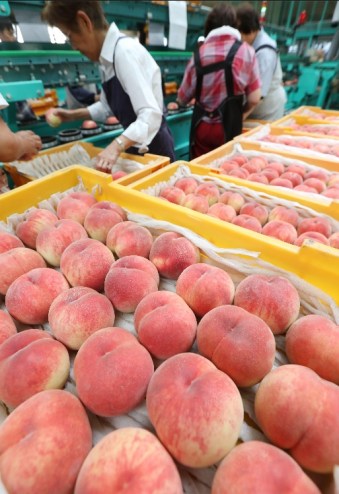
“The market value of peaches grown in Fukushima is roughly 80 percent of the price levels before the disaster,” Ogasawara said.
“It’s easy to beat the price down if the product is made in Fukushima. Our mission is to bring the price up and eventually develop fan bases for each producer there.”
Available for purchase are fruit, vegetables, sake and traditional crafts produced in the prefecture.
While the website allows anyone to make purchases, fan club members also have access to exclusive items.
Admission is free, and members are also offered opportunities to interact with Fukushima farmers through a special Facebook group and harvesting tours.
“After the disaster, I felt what we farmers could do by ourselves (was) very limited,” said Emi Kato, 35, a rice farmer in the city of Fukushima, who is involved in the project.
“But now there is a platform, which connects farmers and consumers. I’d like to keep on promoting the charm of Fukushima products.”
Mutational signatures of ionizing radiation in second malignancies
This article is important, and should be seen by as many people as possible, as this scientific study will impact greatly the future of our anti-nuclear cause.
By establishing the genetic signatures of any cancer caused by ionizing radiation, any future denial from the nuclear lobby is now impossible. Those scientifically established signatures will also be extremely helpful in court for any future suit from radiation victims.
Abstract
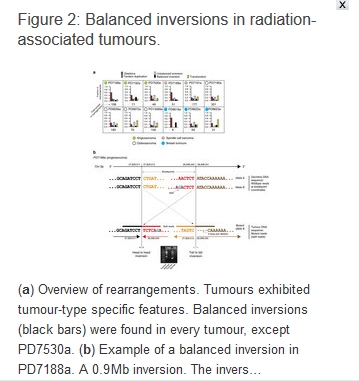
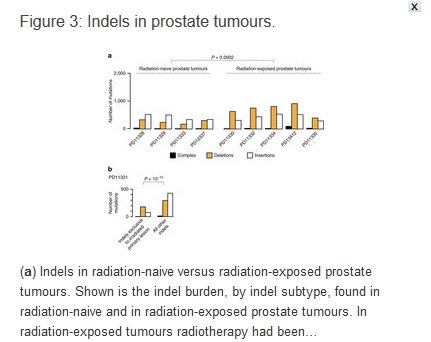
Ionizing radiation is a potent carcinogen, inducing cancer through DNA damage. The signatures of mutations arising in human tissues following in vivo exposure to ionizing radiation have not been documented. Here, we searched for signatures of ionizing radiation in 12 radiation-associated second malignancies of different tumour types. Two signatures of somatic mutation characterize ionizing radiation exposure irrespective of tumour type. Compared with 319 radiation-naive tumours, radiation-associated tumours carry a median extra 201 deletions genome-wide, sized 1–100 base pairs often with microhomology at the junction. Unlike deletions of radiation-naive tumours, these show no variation in density across the genome or correlation with sequence context, replication timing or chromatin structure. Furthermore, we observe a significant increase in balanced inversions in radiation-associated tumours. Both small deletions and inversions generate driver mutations. Thus, ionizing radiation generates distinctive mutational signatures that explain its carcinogenic potential.
Introduction
Exposure to ionizing radiation increases the risk of subsequent cancer. This risk exhibits a strong dose–response relationship, and there appear to be no safe limits for radiation exposure1. This association was first noted by March who observed an increased incidence of leukaemia amongst radiologists2. A leading cause of radiation-induced cancers appears to be exposure to medical radiation, either in the form of radiotherapy for an unrelated malignancy3 or diagnostic radiography4, 5. These iatrogenic tumours arise as de novo neoplasms in a field of therapeutic radiation after a latency period that can span decades6, and are not recurrences of the original cancer7.
Many, but not all, environmental carcinogens induce cancer by increasing the rate of mutation in somatic cells. The physicochemical properties of a given carcinogen govern its interaction with DNA, leading to recurrent ‘signatures’ or patterns of mutations in the genome. These can be reconstructed either from experimental model systems8, 9 or from statistical analyses of cancer genomes in exposed patients10, 11, 12. Ionizing radiation directly damages DNA, and can generate lesions on single bases, single-stranded nicks in the DNA backbone, clustered lesions at several nearby sites and double-stranded DNA breaks13. In experimental systems exposed to radiation, including the murine germline and Arabidopsis thaliana cells, ionizing radiation can cause all classes of mutations, with possible enrichment of indels14, 15, 16, 17, 18, 19, 20, 21, 22. Targeted gene screens in radiation-induced sarcoma have indicated an increased burden of deletions and substitutions with frequent inactivation of TP53 and RB1 (refs 23, 24, 25). In addition, a transcriptome profile that represents a state of chronic oxidative stress has been proposed to be specific to radiation-associated sarcoma26.
We studied the genomes of 12 radiation-associated second malignancies of four different tumour types: osteosarcoma; spindle cell sarcoma; angiosarcoma; breast cancer. These were secondary tumours that arose within a field of therapeutic ionizing radiation and were not thought to be recurrences of the original malignancy treated with radiation. We chose this experimental design for several reasons: the tumours are classic radiotherapy-induced cancers with high attributable risks for the radiation exposure; the radiation exposure occurs over a short time period relative to the evolution of the cancer; and the mutational signatures of sporadic breast cancers and sarcomas have been well documented10, 27, 28, 29. It should be noted that in the absence of biomarkers, a diagnosis of a tumour being radiation-induced cannot be definitively made (see Supplementary Note 1 for clinical details and further discussion).
We subjected these 12 tumours, along with normal tissues from the same patients, to whole-genome sequencing and obtained catalogues of somatic mutations. We compared our findings to 319 radiation-naive breast cancers and sarcomas processed by the same sequencing and bioinformatics pipeline: 251 breast tumours; 33 breast tumours with pathogenic BRCA1 or BRCA2 germline mutations; 35 osteosarcomas (see Methods for cohort details). In addition, we validated our findings in a published series of radiation-naïve and radiation-exposed prostate tumours from ten patients30.
The main aim of our analyses was to search for tumour-type independent, overarching signatures of ionizing radiation. Overall we identified two such signatures in radiation-associative second malignancies, an excess of balanced inversions and of small deletions.
To read more :
http://www.nature.com/ncomms/2016/160907/ncomms12605/full/ncomms12605.html
In Fukushima, a Determination to Move Past Nuclear Power
Local governments are making progress on their goal of generating all of the prefecture’s power from renewable sources by 2040
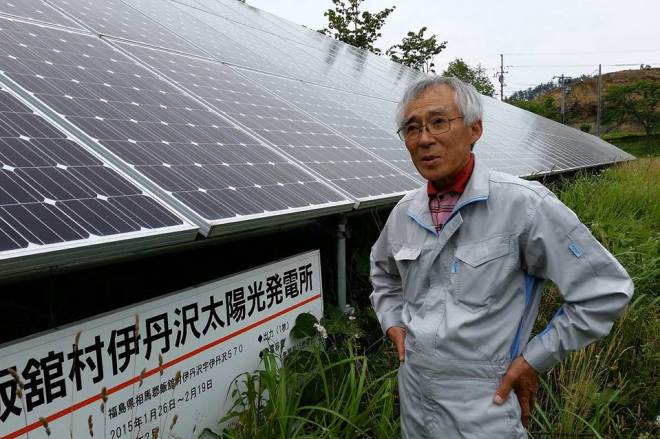
Cattle farmer Minoru Kobayashi has built solar arrays on land that can’t be used for farming
IITATE, Japan—Many residents of Fukushima prefecture are still angry about the nuclear disaster five years ago that contaminated towns, farm fields and forests. But as the cleanup continues, local governments and some business owners here are channeling their frustration into something positive: clean-energy development.
Fukushima prefecture, about 150 miles (240 kilometers) north of Tokyo and roughly the size of Connecticut, was the site of the devastating meltdown of the Daiichi nuclear-power plant following an earthquake and tsunami in March 2011. Since then, most of Japan’s 50-plus nuclear plants, which were shut down after the accident for a safety review, have remained off line.
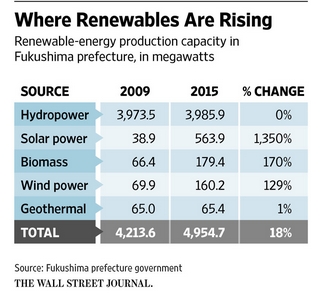
Determined to move away from nuclear energy permanently, local governments in Fukushima, as well as some local entrepreneurs, have taken advantage of national subsidies and embraced solar and wind power. Even as Japan’s overall move toward renewables appears to be stalling amid resistance from utilities and cheap fossil-fuel imports, the prefecture has made progress on its goal of generating 100% of the power its residents use from green sources by 2040.
New solar, wind and geothermal power generators, combined with Fukushima’s already abundant supply of hydropower, have boosted the share of renewable energy in the prefecture’s total power supply to more than one-quarter from one-fifth in 2009. By comparison, renewables made up just 14% of Japan’s overall energy production in the year ended in March.
Fukushima wants a “zero nuclear” power supply, says government spokesman Norihiro Nagao.
Among the business owners who have jumped into the fray is Minoru Kobayashi, 64, who ran a cattle farm about 25 miles inland from the Daiichi plant before the accident. Radioactive contamination forced him and his family to evacuate, along with their cattle, and the government tore down the family’s home and everything else within a 20-meter radius of the house.
Left with fields that couldn’t be used for farming, Mr. Kobayashi, along with a group of local farmers and investors, built four 50-kilowatt solar arrays on their land and plan to build 12 more by the end of next year. The group is selling power to the local utility at prices set by the government and expects to turn a profit by the end of this year. (The company signed power contracts with the local utility when prices were between 27 and 32 yen (26 to 31 cents) a kilowatt-hour. The current rate is 24 yen a kilowatt-hour.)
Mr. Kobayashi says solar power represents more than just a business opportunity to him and his partners. “We welcome renewable energy as a protest to the nuclear power plant,” says Mr. Kobayashi.
Elsewhere, Yauemon Sato, who ran his family’s 226-year-old sake brewery for more than two decades, started the solar-power developer Aizu Electric Power Co. in Fukushima in 2013 with a group of friends and local business associates. The company has built 21 small and medium-size solar arrays and a one-megawatt solar farm in northern Fukushima. He says the new clean-energy businesses will create jobs and boost the economy.
“We started this company as part of a social-justice movement,” Mr. Sato says.
Some business owners are even hoping renewable energy will become a tourist attraction.
In Tsuchiyu Onsen, a resort area known for its natural hot springs and proximity to national parks, local hotel owners joined forces to build a 400-kilowatt geothermal power generator and a small hydroelectric generator.
It has become a new selling point for the resort area, says Katsuichi Kato, 68, president of Genki Up Tsuchiyu Co. “There are many other hot springs towns,” he says. “We had to create a new industry: renewable energy tourism.”
http://www.wsj.com/articles/in-fukushima-a-determination-to-move-past-nuclear-power-1473818580
Snowman Pear from Fukushima
Farmers are surprised to find this snow man shaped pear.
It’s about 3 cm diameter, and leaves are growing from the hollow.
“It’s not possible to have leaves on a fruit. I wonder why…” said Mr. Sato who found this pear.
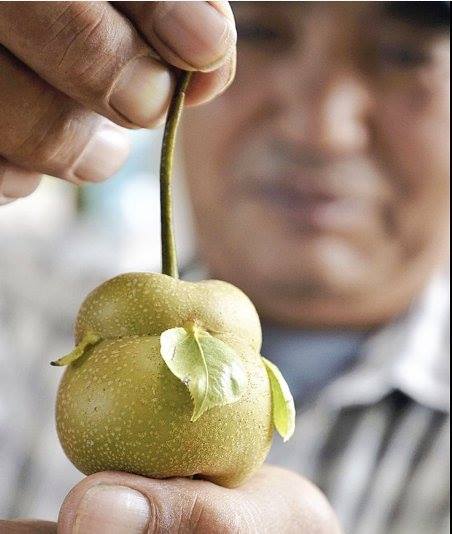
福島市笹谷の佐藤恒男さん(68)のナシ畑で、だるまのような形をしたナシが収穫され、近隣の農家から驚きの声が上がっている。
ナシは直径3センチほど。実の中ほどがくぼんでおり、くぼみから葉が生えている。
佐藤さんによると「実から葉が出ることは普通はあり得ない。なぜこんな実ができたのか不思議」と話した。
DNA damage, cancer caused by ionizing radiation identified
This UPI article was published on Sept. 13, 2016.
I added below the source of that UPI article, the study published on the sciences website “Nature” on Sept. 12, 2016.
This article is important, and should be seen by as many people as possible, as this scientific study will impact greatly the future of our anti-nuclear cause.
By establishing the genetic signatures of any cancer caused by ionizing radiation, any future denial from the nuclear lobby is now impossible. Those scientifically established signatures will also be extremely helpful in court for any future suit from radiation victims.
Researchers found mutational signatures left by radiation-caused changes to DNA, which may lead to better treatment of cancers.
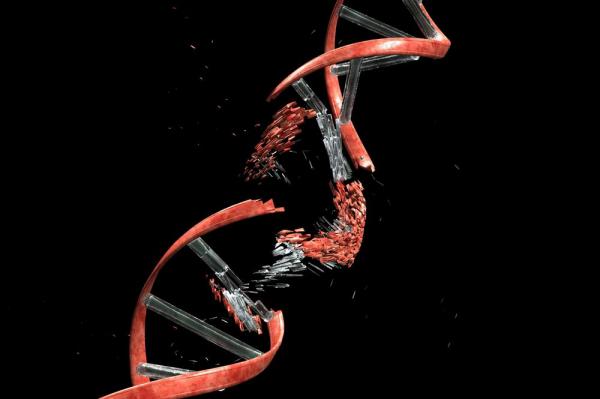
Researchers found mutational signatures which appear to indicate changes to DNA caused by exposure to ionizing radiation, which may allow doctors to better treat cancer caused by non-spontaneous mutations.
LONDON, Sept. 13 (UPI) — Though scientists have suspected ionizing radiation can cause cancer, experiments conducted in England are the first to show the damage it inflicts on DNA and may allow doctors to identify tumors caused by radiation.
In a study published in the journal Nature Communications, scientists showed the effects of gamma rays, X-rays and radioactive particles on DNA, deciphering patterns they think will help differentiate between spontaneous and radiation-caused tumors, allowing for better cancer treatment.
“To find out how radiation could cause cancer, we studied the genomes of cancers caused by radiation in comparison to tumors that arose spontaneously,” Dr. Peter Campbell, a researchers at the Wellcome Trust Sanger Institute, said in a press release. “By comparing the DNA sequences we found two mutational signatures for radiation damage that were independent of cancer type. We then checked the findings with prostate cancers that had or had not been exposed to radiation, and found the same two signatures again. These mutational signatures help us explain how high-energy radiation damages DNA.”
For the study, the researchers looked for mutational signatures in 12 cancer patients with radiation-associated second malignancies, and compared their tumors to 319 from patients not exposed to radiation.
The researchers found two mutational signatures they link to radiation. While one causes small deletions of DNA bases, the other — called a balanced inversion — includes two cuts to DNA, with the middle piece spinning around and rejoining in the opposite direction.
These mutations, especially balanced inversions, which do not happen naturally in the body, increase the potential for cancer to develop, the researchers say.
“This is the first time that scientists have been able to define the damage caused to DNA by ionising radiation,” said Adrienne Flanagan, a professor at the University College London Cancer Institute. “These mutational signatures could be a diagnosis tool for both individual cases, and for groups of cancers, and could help us find out which cancers are caused by radiation. Once we have better understanding of this, we can study whether they should be treated the same or differently to other cancers.”
Mutational signatures of ionizing radiation in second malignancies
« Ionizing radiation is a potent carcinogen, inducing cancer through DNA damage. The signatures of mutations arising in human tissues following in vivo exposure to ionizing radiation have not been documented. Here, we searched for signatures of ionizing radiation in 12 radiation-associated second malignancies of different tumour types. Two signatures of somatic mutation characterize ionizing radiation exposure irrespective of tumour type. Compared with 319 radiation-naive tumours, radiation-associated tumours carry a median extra 201 deletions genome-wide, sized 1–100 base pairs often with microhomology at the junction. Unlike deletions of radiation-naive tumours, these show no variation in density across the genome or correlation with sequence context, replication timing or chromatin structure. Furthermore, we observe a significant increase in balanced inversions in radiation-associated tumours. Both small deletions and inversions generate driver mutations. Thus, ionizing radiation generates distinctive mutational signatures that explain its carcinogenic potential. »
http://www.nature.com/ncomms/2016/160907/ncomms12605/full/ncomms12605.html
Japan’s lurch away from nuclear hasn’t caused fossil fuels to boom
The emergency shutdown of nuclear reactors hasn’t been an emissions disaster.
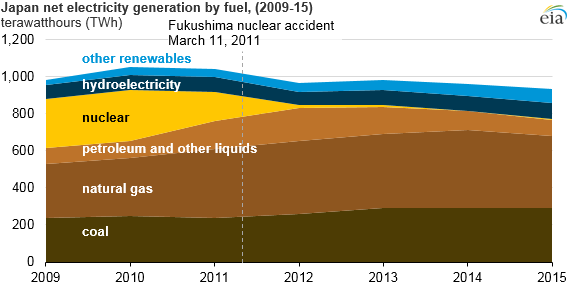
In the wake of the meltdown of the Fukushima Daiichi nuclear reactors, Japan shut down its entire nuclear fleet in order to develop more rigorous safety standards and inspect the remaining plants. As of now, plants are only beginning to come back online.
Given that Japan had recently relied on nuclear for over a quarter of its electricity, the expectation is that emissions would rise dramatically. But that hasn’t turned out to be the case. While coal use has gone up, it hasn’t risen by more than 10 percent. And a heavy dose of conservation has cut Japan’s total electricity use to below where it was at the end of last decade.
Based on the graph, it appears that nuclear was playing a decreasing role in Japan’s energy mix even prior to Fukushima, being displaced in part by natural gas and in part by petroleum. But that may be an artifact of the chart, given that nuclear was shut down entirely immediately after Fukushima, but the chart shows it persisting. In either case, post-Fukushima conservation efforts dropped Japan’s electricity use below a PetaWatt-hour, and further efforts have turned the drop in electricity use into an ongoing trend.
Fossil fuel use has gone up, but not by as much as might be expected. Coal rose by eight percent, and natural gas (transported in its liquefied form) rose by nine percent. These have largely reversed the expansion of petroleum use that began prior to the meltdown at Fukushima. Non-hydro renewables have also more than doubled their electrical production since that time. Combined with hydroelectric plants, they now provide more electricity than petroleum.
The net result of all of this? Carbon emissions have been relatively flat and have not exceeded the nation’s record year back in 2007. Thus, if nuclear plants are brought back online in significant numbers, Japan’s emissions should begin to drop considerably. If the growth of renewables and general conservation continue as well, Japan should see the drop in emissions accelerate.
And that’s going to be needed, given that Japan has pledged to drop its carbon emissions significantly from their recent peak.
1 This Month





PLEASE OPPOSE HR 8255 AND S.3639 – bills would accelerate satellite deployment, with no environmental review or safeguards – https://ncstd5li.quorum.us/campaign/169331/
To see nuclear-related stories in greater depth and intensity – go to https://nuclearinformation.wordpress.com
-
Archives
- October 2026 (81)
- September 2026 (339)
- August 2026 (330)
- July 2026 (355)
- June 2026 (287)
- May 2026 (306)
- April 2026 (356)
- March 2026 (251)
- February 2026 (267)
- January 2026 (308)
- December 2025 (358)
- November 2025 (359)
-
Categories
- 1
- 1 NUCLEAR ISSUES
- business and costs
- climate change
- culture and arts
- ENERGY
- environment
- health
- history
- indigenous issues
- Legal
- marketing of nuclear
- media
- opposition to nuclear
- PERSONAL STORIES
- politics
- politics international
- Religion and ethics
- safety
- secrets,lies and civil liberties
- spinbuster
- technology
- Uranium
- wastes
- weapons and war
- Women
- 2 WORLD
- ACTION
- AFRICA
- Atrocities
- AUSTRALIA
- Christina's notes
- Christina's themes
- culture and arts
- Events
- Fuk 2022
- Fuk 2023
- Fukushima 2017
- Fukushima 2018
- fukushima 2019
- Fukushima 2020
- Fukushima 2021
- general
- global warming
- Humour (God we need it)
- Nuclear
- RARE EARTHS
- Reference
- resources – print
- Resources -audiovicual
- Weekly Newsletter
- World
- World Nuclear
- YouTube
-
RSS
Entries RSS
Comments RSS

