Tragic death in a fire of its only full-time doctor at Hirono, Fukushima hospital. Volunteer doctors sought.
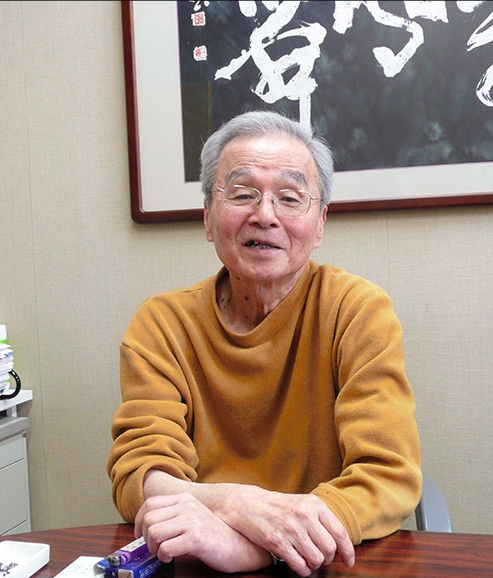
Hideo Takano, doctor and director of Takano Hospital
Lone doctor who stayed in town after Fukushima crisis dies in fire
HIRONO, Fukushima Prefecture–The tragic death in a fire of its only full-time doctor at a hospital here has dealt another crisis to this tiny community, which is still struggling to rebuild from the Fukushima nuclear disaster.
Hideo Takano, 81, director of Takano Hospital, died on Dec. 30, threatening the future of the hospital and possibly the community of 2,800 residents.
Hirono Mayor Satoshi Endo on Jan. 3 stepped up his pleas for assistance from the central and prefectural governments.
“We would like to prevent the collapse of local medical services,” Endo said at a news conference. “We, as a local government, need to respond to the dedication of Takano.”
Under the law, a private medical facility must have at least one full-time doctor on staff.
Takano’s one-story wooden house, on the same site as the hospital, caught fire on the night of Dec. 30. Police found his body inside the home.
Takano and another doctor at the hospital had treated inpatients as full-time physicians before the triple meltdown in March 2011, which was triggered by the Great East Japan Earthquake and tsunami on March 11 the same year.
The hospital is situated around 20 kilometers from the crippled Fukushima No. 1 nuclear power plant. It offers the only medical inpatient facility in Futaba county, which, alongside Hirono, includes towns co-hosting the Fukushima No. 1 plant and damaged Fukushima No. 2 nuclear plant.
When the town government ordered all its residents to evacuate on March 13, 2011, Takano and many of his staff chose to remain to treat inpatients at the hospital. They deemed it too risky to transport aged and frail patients elsewhere when the entire prefecture was in disarray.
Most of the inpatients at the hospital are senior citizens from Hirono, and many of them were bed-ridden.
Hirono had a population of slightly more than 5,000 before the nuclear disaster. But only a little more than half of the residents have returned to live in the town after the evacuation order was lifted a year later.
As of the end of last December, there were 102 inpatients at Takano Hospital, although the size of the staff shrank to about one-third of the pre-disaster level. Part-time doctors have joined Takano in treating patients after the disaster, but he was the only full-time physician on staff there.
“Takano used to say nothing makes him happier than treating patients,” said one of the hospital staff, describing his commitment.
According to the Hirono officials, part-time doctors continued seeing patients at the hospital until Jan. 3 after Takano’s death.
The town managed to secure temporary doctors for the hospital after that date through cooperation from Minami-Soma, a city about 60 km to the north.
Physicians from the municipal Minami-Soma General Hospital also have pitched in and formed a group to assist Takano Hospital. More than 20 doctors have signed up to provide volunteer services, including those from Chiba, Shizuoka and Nagano prefectures.
Although there is a medical clinic in Hirono, some residents say it is not sufficient to meet the health-care needs of residents in the town on its own.
http://www.asahi.com/ajw/articles/AJ201701040034.html
Volunteer doctors to be sought for Fukushima hospital after director dies in fire
HIRONO, Fukushima — The body of a man found in a home here after a fire was identified as that of a doctor who continued to treat patients in an area affected by the Fukushima nuclear disaster, local police announced on Jan. 3. The doctor’s death prompted the local town to seek volunteer doctors from across the country.
Hideo Takano, 81 — who was head of Takano Hospital in the town of Hirono in Fukushima Prefecture — died as a result of the fire which partially burned his home on Dec. 30. The corpse was confirmed to be that of Takano by Futaba Police Station, following DNA testing.
The doctor was particularly noted for his bravery following the Fukushima No. 1 nuclear power plant meltdowns in March 2011 — because he decided not to flee, and continued to attend to his patients’ needs at the only hospital close to the power plant, within Futaba county, that remained operational after the accident.
Currently, Takano Hospital treats patients who have returned to the area, as well as people involved in nuclear reactor decommissioning work, but the hospital now faces a staff shortage problem following the death of Dr. Takano, who was the only full-time doctor at the institution.
With this in mind, the Hirono Municipal Government announced on Jan. 3 that it will bring in doctors until Jan. 9 from nearby medical institutions such as Minamisoma City General Hospital, also in Fukushima Prefecture. The doctors will help treat approximately 100 inpatients, in addition to providing outpatient care. Furthermore, a group to support the hospital, called “Takano Byoin o shiensuru kai,” has been set up by voluntary doctors at the hospital, and there have also been appeals on Facebook, asking for support from doctors.
The Hirono Municipal Government plans to recruit volunteer doctors from across Japan — in an attempt to maintain the town’s medical care system — and has offered incentives such as free accommodation and travel. A representative at the town hall stated that, “Takano Hospital patients reside far and wide across Futaba,” and that the town will request support from both the Fukushima Prefectural Government and the central government.
Takano Hospital has set up a commemorative page on its website in memory of Dr. Takano — who devoted his life to medical care in the region — stating that it plans to “carry on the will of Dr. Takano and continue to provide medical care in the region.”
The Facebook page of “Takano Byoin o shiensuru kai,” or a group to support Takano Hospital:
https://www.facebook.com/savepatientakano/
http://mainichi.jp/english/articles/20170104/p2a/00m/0na/004000c
Gun control heartburn: Radioactive boars are amok in Fukushima

The “most adaptable animals that you’ll ever find” are running rampant across parts of rural Japan in the wake of the 2011 nuclear catastrophe and strict gun laws aren’t helping.
The Fukushima Daiichi nuclear disaster, in which a boiling water reactor nuclear power plant largely went Chernobyl after a tsunami knocked it offline has left Japan with a host of problems to include radiation-induced health impacts, some 200,000 displaced locals and possible exposure of groundwater to melted down nuclear fuel for decades to come.
Oh yeah, and the wild hogs.
According to an article in The Washington Post last April, the boar population, lacking natural predators is booming. Worse, thousands of the animals roam an area where highly radioactive caesium-137, which has a half-life of 30 years, has been confirmed.
Most agree that the best way to eradicate the rapid population of would-be Orcs is through hunting, but in gun control-friendly Japan, that is easier said than done.
“Something that complicates wild boar management in Japan is the exceptionally restrictive ownership, use, and access to firearms,” says Dr. Mark Smith, a forestry and wildlife professor at Auburn University, told Outside online. “This includes not only the general populace, but also with researchers, wildlife biologists, and natural resource managers.”
According to the Australian-based Small Arms Survey, the rate of private gun ownership in Japan is 0.6 per 100 people with only 77 handguns in circulation and just 0.8 percent of Japanese households containing one or more legal guns, most often shotguns.
Smith went to Japan to study the problem in 2013.
“Although [recreational] hunting does occur in Japan, it is very limited,” says Smith, “and hunter numbers are declining by the year, so there are fewer and fewer hunters out there harvesting wild boar.”
Plus there is the problem with the meat. In short, there is no good way to make caesium-137 infused pork a balanced part of your complete meal without the diner glowing in the dark, no matter how much BBQ sauce you use.
In Japan, they have to incinerate the carcasses (at 1,771 degrees Fahrenheit) then obliterate the fragments left over with hammers and box them up. Carefully.
Furthermore, the animals are very smart.
“They are the most adaptable animals that you’ll ever find: we call them the ‘opportunistic omnivore,’” says Smith.
http://www.guns.com/2017/01/03/gun-control-heartburn-radioactive-boars-are-amok-in-fukushima/
Contaminated Glove, Jacket, pants worn by a Fukushima Daiichi worker
By Marco Kaltofen
Activity is 0.7 to 240 kBq/kg, surface rad to 59 uR/hr.
http://bostonchemicaldata.com/data.html

35.5 kBq/kg

0.11 to 0.24 kBq/kg

ND (<0.01) to 17.1 kBq/kg
Landscapes I saw

A short poem at the beginning of the year.
Accumulated dust can make mountains.

Here are the pictures that show reality.
Taken on January 2nd 2017.

These black bags are full of soil and fallen leaves gathered in the course of the decontamination work.
These bags last from 3 to 5 years.
What do we do now?

Over the mountain of black bags lies Odaka station.
Now anybody can get on and off the train.

Source: Akiyoshi Imazeki, Odaka Station, Minamisoma-shi, Fukushima Prefecture
Gov’t mulls ’roundtable’ meetings to spur power industry reorganization

The Economy, Trade and Industry Ministry is considering holding “roundtable” discussions with top executives of major power companies on measures to restructure their business ties with beleaguered Tokyo Electric Power Co. (TEPCO) and set up operations overseas, it has been learned.
The industry ministry wants to help pave the way for the power industry to restructure and consolidate by setting up a forum in which major utilities can exchange views on the realities of domestic and overseas markets as well as management reforms. The move will effectively have the government play mediator in the reorganization of the power industry.
The move comes after a ministry expert committee on reforming TEPCO and issues related to the tsunami-hit Fukushima No. 1 nuclear plant proposed on Dec. 20 that the government play a “catalytic” role in the realignment of the power industry. In response, TEPCO plans to hash out a new management restructuring plan this month or later. The roundtable is expected to be set up around the time that TEPCO comes up with its new restructuring scheme.
One of the expert panel’s proposals is for TEPCO to establish a “consortium” with other utilities on its power transmission and nuclear power projects at an early date. The proposal is intended to facilitate the realignment and consolidation of the power industry as part of moves to rationalize TEPCO’s measures to cover the costs of dealing with the Fukushima nuclear accident. The expert panel projected that these costs would swell to 21.5 trillion yen from an earlier estimate of 11 trillion yen. The proposal also draws on TEPCO’s plan to move its thermal power business to JERA Co., a joint venture with Chubu Electric Power Co.
The industry ministry is considering plans including publicly soliciting prospective partners for TEPCO. However, major power companies remain cautious, with a senior official at one major utility saying, “Our own company’s profits will be used to deal with the nuclear accident.” The utility roundtable meeting is the industry ministry’s attempt to help resolve this and other issue. The roundtable idea is also in line with the TEPCO’s opinion that “as long as TEPCO is aiming to reorganize at a national level, we want to have an opportunity for all companies to meet and discuss things,” as a TEPCO executive said.
While domestic power demand has stagnated due to energy-saving efforts and the declining birthrate, the industry is faced with a shifting market overseas, where demand continues to rise. According to an International Energy Agency (IEA) forecast, while Japan’s domestic electricity consumption will rise only slightly from 950 billion kilowatt-hours in 2014 to 980 billion kilowatt-hours in 2030, overall global consumption will rise from 19.8 trillion kilowatt-hours to 27.9 trillion kilowatt-hours.
Through the roundtable, the industry ministry is keen to help boost utilities’ entry into overseas markets by facilitating industry rationalization to strengthen their businesses at home. However, as the power industry may not respond well to having reorganization foisted on it by the government, the ministry plans to flesh out the scheme carefully. As a senior utility official said, “It is essential to set up a contact point for private entities first and leave the matter to them thereafter.”
http://mainichi.jp/english/articles/20170103/p2a/00m/0na/012000c

Fate of Fukushima No. 2 nuclear plant remains unknown

The government is struggling to decide the future of Tepco’s Fukushima No. 2 nuclear power plant, which has been suspended since the March 2011 disaster.
There have been increasing calls for decommissioning the power plant located just a few kilometers south of the wrecked Fukushima No. 1 installation.
The government has been finding it difficult to reach a clear conclusion on Fukushima No. 2’s fate, as it and Tokyo Electric Power Company Holdings have been busy dealing with its older counterpart that suffered three reactor meltdowns following the March 2011 earthquake and tsunami.
On Dec. 21, the Fukushima Prefectural Assembly voted unanimously to adopt a resolution calling on the central government to decommission the No. 2 plant “at an early date,” arguing that the facility is an obstacle to the prefecture’s recovery from the 3/11 disasters.
A temporary halt to the cooling system for a spent fuel pool at the No. 2 plant caused by an earthquake in November rekindled fears of another meltdown crisis.
In 2011, the prefectural assembly adopted a petition calling for decommissioning all reactors in Fukushima.
The assembly has also adopted a series of written opinions demanding the decommissioning of the No. 2 plant, which is located in the towns of Naraha and Tomioka.
Demands from local communities “have been ignored by the central government,” one person said.
The central government’s official position is that whether to decommission the plant is up to Tepco.
As the government has already lifted the state of emergency for the No. 2 plant, it has no authority to decide the decommissioning under current regulations.
If an exception were made, the central government could receive a barrage of requests for decommissioning reactors all over the country, sources familiar with the situation said.
“Such a situation would destroy Japan’s whole nuclear policy,” a senior official at the Ministry of Economy, Trade and Industry said.
Some people have called for creating a special law on decommissioning Fukushima No. 2, but others have raised concerns that such a step could infringe on Tepco’s property rights, the sources said.
Some officials in the central government have said that no one believes the No. 2 plant can continue to exist.
Prime Minister Shinzo Abe and his Cabinet have left room for making a political decision on dismantling the facility, saying that the plant can’t be treated in the same way as other nuclear plants due to fear among Fukushima residents of another nuclear accident.
Since the government effectively holds a stake of more than 50 percent in Tepco, it can influence the company’s policy as a major shareholder.
But Tepco now needs to focus on dealing with the No. 1 plant. A senior company official said that it “cannot afford to decide on decommissioning, which would require a huge workforce.”
The main opposition Democratic Party plans to pursue a suprapartisan law that would urge Tepco to decide to decommission the plant at an early date.
“While understanding calls for early decommissioning, we have no choice but to wait for the No. 2 plant’s four reactors to reach the end of their 40-year lifetimes,” a lawmaker of the ruling Liberal Democratic Party said.
The four reactors launched operations between April 1982 and August 1987.
Ex-Leader of Japan Turns Nuclear Foe

TOKYO–William Zeller, a petty officer second class in the U.S. Navy, was one of hundreds of sailors who rushed to provide assistance to Japan after a giant earthquake and tsunami set off a triple meltdown at the Fukushima Daiichi nuclear power plant in 2011. Not long after returning home, he began to feel sick.
Today, he has nerve damage and abnormal bone growths, and blames exposure to radiation during the humanitarian operation conducted by crew members of the aircraft carrier Ronald Reagan. Neither his doctors nor the U.S. government has endorsed his claim or those of about 400 other sailors who attribute ailments including leukemia and thyroid disease to Fukushima and are suing Tokyo Electric, the operator of the plant.
But one prominent figure is supporting the U.S. sailors: Junichiro Koizumi, former prime minister of Japan.
Koizumi, 74, visited a group of the sailors, including Zeller, in San Diego in May, breaking down in tears at a news conference. Over the past several months, he has barnstormed Japan to raise money to help defray some of their medical costs.
The unusual campaign is just the latest example of Koizumi’s transformation in retirement into Japan’s most outspoken opponent of nuclear power. Though he supported nuclear power when he served as prime minister from 2001-06, he is now dead set against it and calling for the permanent shutdown of all 54 of Japan’s nuclear reactors, which were taken offline after the Fukushima disaster.
“I want to work hard toward my goal that there will be zero nuclear power generation,” Koizumi said in an interview in a Tokyo conference room.
The reversal means going up against his old colleagues in the governing Liberal Democratic Party as well as Prime Minister Shinzo Abe, who are pushing to get Japan, once dependent for about one third of its energy on nuclear plants, back into the nuclear power business.
That Koizumi would take a contrarian view is perhaps not surprising. He was once known as “the Destroyer” because he tangled with his own party to push through difficult policy proposals like privatization of the national postal service.
Koizumi first declared his about-face on nuclear power three years ago, calling for Japan to switch to renewable sources of energy like solar power and arguing that “there is nothing more costly than nuclear power.”
After spending the first few years of his retirement out of the public eye, in recent months Koizumi has become much more vocal about his shift, saying he was moved to do more by the emotional appeal of the sailors he met in San Diego.
Scientists are divided about whether radiation exposure contributed to the sailors’ illnesses. The Defense Department, in a report commissioned by Congress, concluded that it was “implausible” that the service members’ ailments were related to radiation exposure from Fukushima.
To many political observers, Koizumi’s cause in retirement is in keeping with his unorthodox approach in office, when he captivated Japanese and international audiences with his blunt talk, opposition to the entrenched bureaucracy and passion for Elvis Presley.
Some wonder how much traction he can get with his anti-nuclear campaign, given the Abe administration’s determination to restart the atomic plants and the Liberal Democratic Party’s commanding majority in parliament.
Two reactors are back online; to meet Abe’s goal of producing one-fifth of the country’s electricity from nuclear power within the next 15 years, about 30 of the existing 43 reactors would need to restart. (Eleven reactors have been permanently decommissioned.)
A year after the Fukushima disaster, anti-nuclear fervor led tens of thousands of demonstrators to take to the streets of Tokyo near the prime minister’s residence to register their anger at the government’s decision to restart the Ohi power station in western Japan. Public activism has dissipated since then, though polls consistently show that about 60 percent of Japanese voters oppose restarting the plants.
“The average Japanese is not that interested in issues of energy,” said Daniel P. Aldrich, professor of political science at Northeastern University. “They are anti-nuclear, but they are not willing to vote the LDP out of office because of its pronuclear stance.”
Sustained political protest is rare in Japan, but some analysts say that does not mean the anti-nuclear movement is doomed to wither.
“People have to carry on with their lives, so only so much direct action can take place,” said Koichi Nakano, a political scientist at Sophia University in Tokyo.
Anti-nuclear activism “may look dormant from appearances, but it’s there, like magma,” he said. “It’s still brewing, and the next trigger might be another big protest or political change.”
Some recent signs suggest the movement has gone local. In October, Ryuichi Yoneyama was elected governor in Niigata, the prefecture in central Japan that is home to the world’s largest nuclear plant, after campaigning on a promise to fight efforts by Tokyo Electric to restart reactors there.
Like Koizumi, he is an example of how the anti-nuclear movement has blurred political allegiances in Japan. Before running for governor, Yoneyama had run as a Liberal Democratic candidate for parliament.
Koizumi, a conservative and former leader of the Liberal Democrats, may have led the way.
“Originally, the nuclear issue was a point of dispute between conservatives and liberals,” said Yuichi Kaido, a lawyer and leading anti-nuclear activist. “But after Mr. Koizumi showed up and said he opposed nuclear power, other conservatives realized they could be against nuclear power.”
Since he visited the sailors in San Diego, Koizumi has traveled around Japan in hopes of raising about $1 million for a foundation he established with another former prime minister, Morihiro Hosokawa, an independent who has previously been backed by the opposition Democratic Party, to help pay some of the sailors’ medical costs.
Koizumi is not involved in the sailors’ lawsuit, now before the 9th U.S. Circuit Court of Appeals in San Francisco. Tokyo Electric is working to have the case moved to Japan.
Aimee L. Tsujimoto, a Japanese-American freelance journalist, and her husband, Brian Victoria, an American Buddhist priest now living in Kyoto, introduced Koizumi to the plaintiffs. Zeller, who said he took painkillers and had tried acupuncture and lymph node massages to treat his conditions, said the meeting with Koizumi was the first time that someone in power had listened to him.
“This is a man where I saw emotion in his face that I have not seen from my own doctors or staff that I work with, or from my own personal government,” said Zeller, who works at the Naval Medical Center in San Diego. “Nobody has put the amount of attention that I saw in his eyes listening to each word, not just from me, but from the other sailors who have gone through such severe things healthwise.”
Koizumi, whose signature leonine hairstyle has gone white since his retirement, said that after meeting the sailors in San Diego, he had become convinced of a connection between their health problems and the radiation exposure.
“These sailors are supposed to be very healthy,” he said. “It’s not a normal situation. It is unbelievable that just in four or five years that these healthy sailors would become so sick.”
“I think that both the U.S. and Japanese government have something to hide,” he added.
Many engineers, who argue that Japan needs to reboot its nuclear power network to lower carbon emissions and reduce the country’s dependence on foreign fossil fuels, say Koizumi’s position is not based on science.
“He is a very dramatic person,” said Takao Kashiwagi, a professor at the International Research Center for Advanced Energy Systems for Sustainability at the Tokyo Institute of Technology. “He does not have so much basic knowledge about nuclear power, only feelings.”
That emotion is evident when Koizumi speaks about the sailors. Wearing a pale blue gabardine jacket despite Japan’s black-and-gray suit culture, he choked up as he recounted how they had told him that they loved Japan despite what they had gone through since leaving.
“They gave their utmost efforts to help the Japanese people,” he said, pausing to take a deep breath as tears filled his eyes. “I am no longer in government, but I couldn’t just let nothing be done.”
Debris Removal at Reactor # 3 Delayed, but Arrival of the First Elements of the New Building for its Spent Fuel Removal
Transportation of the supporting part of a new roof for the Unit 3 fuel removal at Fukushima Daiichi Nuclear Power Station
The clearing of debris from reactor # 3 is delayed, delaying the construction of the new building to remove spent fuel from the pool. The debris removal was to be done in order to build a new workshop to remove the fuels from the pool.
The removal of the spent fuel should have started in January 2018. In the beginning, TEPCo was to start in 2015. We do not know their new schedule yet.
On the other hand, TEPCO communicated on the arrival of the first elements of the new building, with photos and video.

The dose rates on the site are here. There is up to 2.6 mSv / h in the vicinity of reactor No.3.

Links from TEPCO:
Photos of the new building
Click to access handouts_161220_01-e.pdf
Video
http://photo.tepco.co.jp/en/date/2016/201612-e/161220-01e.html
Dose rates in Reactor 3 vicinity
http://www.tepco.co.jp/en/nu/fukushima-np/f1/surveymap/images/f1-sv-20161219-e.pdf
2.46μSv/h Hot Spot in Misato, Saitama Prefecture, at Tokyo’s door

Hot Spot (2.46μSv/h at ground level, 0.64μSv/h at 50cm from the ground) in Misato, Saitama Prefecture.


The sign says in Japanese “We will keep the river clean”.
Misato, Saitama Prefecture is at 32km from Tokyo’s center and 223km from Fukushima Daiichi.

Misato, Saitama Prefecture is at 223km from Fukushima Daiichi.

Misato, Saitama Prefecture is at 32km from Tokyo’s center
Source: Sugar Nat https://www.facebook.com/shinpei.tn
0.72μSv in Nasunagahara Park, Nasu, Tochigi Prefecture
People when thinking about the nuclear disaster of Tepco’s Fukushima Daiichi often are misled by the mainstream media to think that only Fukushima Prefecture is affected by the radiation. That is so untrue.
Actually the Fukushima Daiichi ‘s radioactive plume has contaminated many other prefectures of Eastern Japan, prefectures of Tohoku region and prefectures of Kanto region (Tokyo area), radiation having being spread unevenly as a leopard skin, with hot spots everywhere, needing to be identified, indicated for public protection, and decontaminated..

This measurement was taken in the public park of Nasu, Tochigi Prefecture, 122km from Fukushima Daiichi and 188km from Tokyo.

Nasu, Tochigi Prefecture, 122km from Fukushima Daiichi

Nasu, Tochigi Prefecture, 188km from Tokyo
The children playing there will be exposed to radiation if it is not decontaminated nor indicated by a warning sign.

Source: http://ameblo.jp/kienaiyoru/entry-12234453760.html
Bullying of evacuated children
Recently, the Japanese mass media are busy reporting on the bullying of evacuated children at school. As a matter of fact, this kind of bullying has existed for quite a while. However, after a long silence, the mass media have suddenly started reporting about it. Often, it tends to be reduced to the common bullying found in the education system without reference to the particular environmental hazards caused by the nuclear accident. Akiko MORIMATSU analyzes the bullying from the viewpoint of the nuclear disaster evacuees. She was interviewed in “Minna no News Wonder” at Kansai TV on December 5th 2016.
【3.11 evacuees’ voices】
“The courage to escape” and “the power to ask for help”
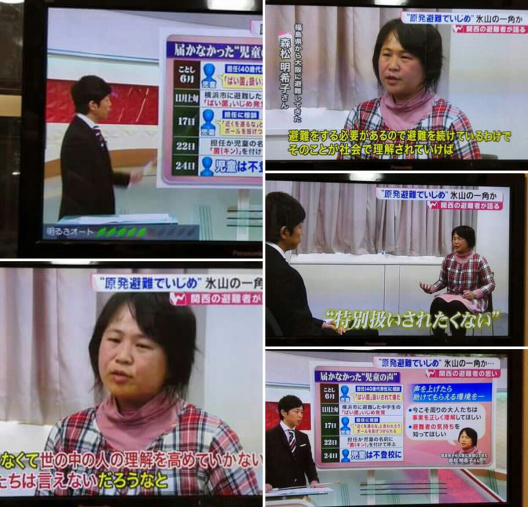
I am worried about what children will learn when they face a society incapable of helping people who have fled from calamity and are asking for aid.
I think that when society does not show how it is possible to help, children won’t be able to have the “courage to escape” or to deploy the power to “ask for help” at school.
I’ve noticed the following through my exerience with the nuclear disaster. We accept too easily that people facing danger will be able to escape without difficulty, and that it is natural to do so.
However, it is possible to create social situations which won’t allow for people to escape from danger, which won’t let them flee, or which pose such big obstacles that people can’t escape even when they are told that they are allowed to do so. This has indeed been our situation for the last 5 years and 8 months. I feel this way as an internal nuclear refugee.
This is how adult society is. In this society in which our evasion is not fully accepted, children are exposed to the risk of bullying, which can happen anywhere unfortunately, amplified by incomprehension, indifference, prejudice and discrimination of the society. I must say that they are facing even greater risks in response to the recent reporting by mass media.
At anytime, evacuee children are facing “the risk which is present here and now”.
This may be true for any children in this country.
And the “bullying” is not limited to children’s society.
It can be certainly said that there are second and third levels (TN 1) of damage from the nuclear disaster.
This is why society as a whole should accept the real situation of the nuclear disaster and set our eyes more directly on the truth.
The evacuees and evacuee children really exist all over Japan.
“They continue being evacuees because it is necessary to evacuate (TN2)”.
That is the truth and reality.
The only thing which counts is to start from this fact and decide how society should deal with it.
(Akiko MORIMATSU evacuated with two children from Fukushima to Osaka)
Broadcasted by Kansai TV on December 5th 2016
Sources: 東日本大震災避難者の会 Thanks & Dream
森松明希子さんのfacebookページ
Facebook of Akiko MORIMATU
(TN 1) For example, psychological, familial or social levels.
(TN2) because the environment is contaminated
https://fukushima311voices.wordpress.com/2017/01/01/bullying-of-evacuated-children/
Seaborne Fukushima Radiation Plume Hit West Coast, Corporate Media Reported It Dangerously
(EnviroNews DC News Bureau) — “It is not a question any more: radiation produces cancer, and the evidence is good all the way down to the lowest doses,” says the late Dr. John Gofman, Professor Emeritus at the University of California, Berkley, in his book Nuclear Witnesses: Insiders Speak Out.
On December 12, 2016, EnviroNews USA‘s own Editor-in-Chief Emerson Urry touched off a firestorm with his news article titled, “It’s Finally Here: Radioactive Plume From Fukushima Makes Landfall on America’s West Coast,” which claimed “medical science and epidemiological studies have demonstrated time and again that there is no safe amount of radiation for a living organism to be subjected to — period.”
In his piece, Urry also exposed other news agencies like NBC, the New York Post, USA Today and The Inquisitr, catching them with their pants down, in the act of repeating the false assertions of the U.S. and Canadian researchers, telling people not to worry about the recently detected low amounts of cesium 134 found in salmon, and that the levels were within “safe” or “accepted” thresholds for human health. [EDITOR’S NOTE: Emerson Urry recused himself from all editorial duties on this news story.]
Thom Hartmann picked up the article by Urry and read it on his show. Then Hartmann offered up his own journalistic explanation on how radiation works, and addressed the problem with the proclamation that there is a “safe” level of radiation to consume or be exposed to.
“As the element is decaying it is throwing off radiation, and the radiation, if it hits the DNA in the nucleolus and the nucleus of a cell, can alter that DNA in ways that can produce things like cancer,” Hartmann said. “Now it can also cause simply the cell to die or it can mutate the cell in all kinds of other weird ways, and so it’s kind of a numbers game. If you irradiate a million cells… you might get two or three that become cancerous. That’s all it takes, right? You’ve got cancer,” Hartmann continued in his video report. “The cesium could cause no cancer, or it could cause cancer in the first cell it irradiates. To say that there is a safe level of radiation is frankly wrong. It’s just wrong.”
Urry said later in a statement, “It’s one thing for the media to regurgitate trivial facts on trivial matters, but to blindly repeat that consuming low levels of radiation is ‘safe,’ is irresponsible reporting and borders on dangerous. News editors should take care to do their due diligence on a matter as serious as leading readers to believe consuming any amount of radiation is ‘safe’ when medical science and epidemiology, dating back 50 years to the present, have demonstrated repeatedly that that’s just not true. Even the smallest exposures increase the risk of cancer to the subject.”
According to the Agency for Toxic Substances and Disease Registry’s (ATSDR) report titled, “Public Health Statement for Cesium” from 2004, “stable and radioactive cesium can enter your body from the food you eat or the water you drink, from the air you breathe, or from contact with your skin. When you eat, drink, breathe, or touch things containing cesium compounds that can easily be dissolved in water, cesium enters your blood and is carried to all parts of your body… No known taste or odor is associated with cesium compounds.”
Cesium is similar enough to potassium that it can fool the body. This results in its bioaccumulation. When cesium enters the biological system of a fish, which is then eaten by a larger fish, the larger fish becomes contaminated. As the larger fish eats more, it becomes more contaminated. The cesium accumulates in its body. When a person eats that fish, he or she also ingests the cesium that hasn’t decayed or been excreted. The more seafood that person eats, the more radioactive material he or she will be exposed to.
The researchers who discovered the cesium recently also made the mistake of equating the dangers of consuming seaborne isotopes to that of receiving an x-ray, missing the point entirely that ingested or inhaled “internal particle emitters” are known to be especially hazardous.
“Consuming food containing radionuclides is particularly dangerous. If an individual ingests or inhales a radioactive particle, it continues to irradiate the body as long as it remains radioactive and stays in the body,” said Dr. Alan Lockwood, MD in an article on Fox News Health.
“Children are much more susceptible to the effects of radiation and stand a much greater chance of developing cancer than adults,” said Andrew Kanter, MD, President of the Board for Physicians for Social Responsibility (PSR) in that same Fox News Health article. “So it is particularly dangerous when they consume radioactive food or water.”
Those who might expect the government to protect them from contamination by radiation have only to look at the downwinder situation in Utah or the consequences of Gofman’s research in the late 1960s. According to Gofman’s obituary in the L.A. Times, “Gofman and his colleague at Lawrence Livermore National Laboratory, Arthur R. Tamplin, developed data in 1969 showing that the risk from low doses of radiation was 20 times higher than stated by the government. Their publication of the data, despite strong efforts to censor it, led them to lose virtually all of their research funding and, eventually, their positions at the government laboratory.” Their conclusions were for the most part, later validated.
“There is no safe level of radionuclide exposure, whether from food, water or other sources, period,” said Jeff Patterson, DO, immediate past President of PSR, in late March of 2011 in the immediate aftermath of the meltdowns. “Exposure to radionuclides, such as iodine 131 and cesium 137, increases the incidence of cancer. For this reason, every effort must be taken to minimize the radionuclide content in food and water.”
“There is no safe dose of radiation,” says Prof. Edward P. Radford, Physician and Epidemiologist as quoted by GreenMedInfo.
In an email to EnviroNews, nuclear expert Arnie Gundersen said Japan had raised the maximum allowable exposure by 20 times the previous number for civilians to be able to return to their homes. The U.S. and the EPA have considered such plans in the case of a nuclear accident. In food, the U.S. has an allowable dosage of radiation that is 12 times what Japan allows.
“Corporations get the benefit, civilians take the risk,” Gundersen wrote.
While Urry and Hartmann have sounded the alarm, there remain unanswered questions that desperately need to be resolved. Who will clean up the contamination in the food chain? How much radiation exposure will governments continue to say is safe in spite of the medical research? How can people trust what’s on their plate and in their corporate owned media?
Doctor who stayed in Fukushima after meltdowns thought to have died in fire
HIRONO, Fukushima — A doctor who chose to stay in an area affected by the Fukushima nuclear crisis and continued to provide medical services may have died in a fire at his home here, police said.
At around 10:30 p.m. on Dec. 30, a fire broke out at the home of Hideo Takano, 81, director of Takano Hospital in Hirono, Fukushima Prefecture. Part of the wooden structure was destroyed in the blaze, local police said.
The body of a man was found in one of the rooms. Investigators believe the corpse is that of Takano, whom they have been unable to contact, and are trying to confirm the identity of the body.
A security guard at the hospital, located on the same grounds as Takano’s home, noticed smoke coming out of the home and alerted a local fire station. Takano had lived alone at the address.
A hospital official told the Mainichi Shimbun that until recently, Takano had treated patients as usual.
Takano Hospital is situated about 22 kilometers south of the crippled Fukushima No. 1 Nuclear Power Plant. Takano chose to stay home and continued to treat inpatients at his hospital even after the town of Hirono was designated as a zone in which residents were urged to prepare for evacuation following the outbreak of the nuclear disaster. He also examined local residents and those engaged in the decommissioning of the nuclear plant.
http://mainichi.jp/english/articles/20161231/p2a/00m/0na/011000c
Court denies disclosure of Tepco officials’ testimony about Fukushima disaster

The Tokyo District Court has dismissed an appeal by Tepco shareholders calling for disclosure of a government panel’s records of questioning of executives over the March 2011 crisis at the Fukushima No. 1 nuclear power plant.
“The decision accepted all of what the government claimed and therefore is regrettable,” the shareholders said in a statement following the ruling Tuesday. They said they would file an immediate appeal.
The Fukushima Nuclear Accident Independent Investigation Commission was formed in 2011 to investigate the causes of the nuclear disaster by questioning executives of the utility, now called Tokyo Electric Power Company Holdings Inc., including Tsunehisa Katsumata, former chairman of the utility, and others.
The questioning was conducted on condition that it would not be used to assign blame.
Only the records of the interviews of those who agreed that their answers would be made public have been disclosed, including Masao Yoshida, the late former chief of Fukushima No. 1.
The shareholders are seeking disclosure of the records on 11 Tepco officials and three officials of the now-defunct Nuclear and Industrial Safety Agency.
“If the records are disclosed, it would be extremely difficult to gain cooperation from related parties in future investigations,” presiding Judge Akihiko Otake said, deciding that the disclosure could disrupt the execution of official duties.
The court also concluded that the undisclosed portion of the records that was not revealed in previous disclosures should be kept confidential.
Initially, the records of questioning of some 770 Tepco and government officials in 2011 and 2012 were all kept under wraps. But following media reports on the Yoshida interview, the government decided to change its policy and disclose them with interviewees’ consent.
Since September 2014, the government has disclosed the records of some 240 interviewees.
Tepco customers have paid 20.5 billion U.S. dollars to cover nuclear power-related costs since 2012 rate hike
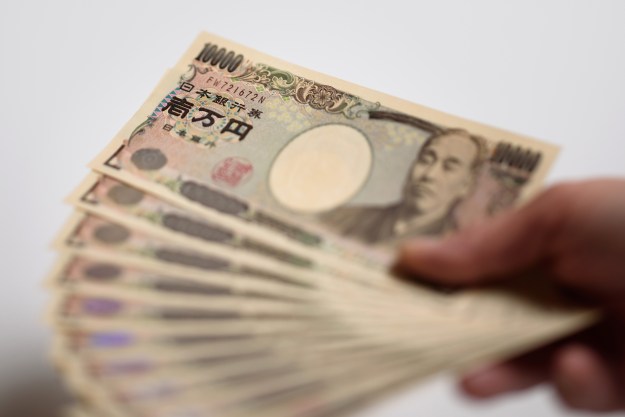
Customers of Tokyo Electric have paid over ¥2.4 trillion to cover nuclear-related costs since the beleaguered utility hiked electricity prices in September 2012, it has been learned.
The amount covers the costs of clerical work for processing applications for compensation related to the Fukushima disaster, totaling ¥25.9 billion, as well as ¥56.7 billion set aside as resources to repay the government for compensation paid on its behalf, and ¥41.4 billion in depreciation costs for two reactors at Fukushima No. 1 that were decommissioned, and for all four reactors at the Fukushima No. 2 plant, which Fukushima Prefecture and others want decommissioned.
The costs also include those to maintain its nuclear plants and to deal with the March 2011 triple meltdown at the Fukushima No. 1 plant.
According to materials held by Tokyo Electric Power Company Holdings Inc., the utility counted ¥601.4 billion in annual nuclear-related expenses as part of its overall costs when it raised electricity prices.
The expenses for nuclear power operations include ¥47.2 billion for measures related to Fukushima No. 1, including outsourcing radiation control-related work and inspecting and maintaining equipment to handle radioactive water.
The nuclear-related costs are expected to keep growing because Tokyo Electric has been unable to restart any reactors. When it raised prices in September 2012, the utility assumed that the ratio of nuclear power to its overall electricity supply would fall to 7 percent from 22 percent.
Tepco plans to restart two reactors at its Kashiwazaki-Kariwa nuclear plant in Niigata Prefecture, but this plan also may fail because Niigata’s new governor, elected in October, opposes restarts.
The Ministry of Economy Trade and Industry plans to have Tepco customers who have since switched to other utilities shoulder part of Tepco’s nuclear-related costs starting as early as fiscal 2020.
1 This Month





PLEASE OPPOSE HR 8255 AND S.3639 – bills would accelerate satellite deployment, with no environmental review or safeguards – https://ncstd5li.quorum.us/campaign/169331/
To see nuclear-related stories in greater depth and intensity – go to https://nuclearinformation.wordpress.com
-
Archives
- October 2026 (67)
- September 2026 (339)
- August 2026 (330)
- July 2026 (355)
- June 2026 (287)
- May 2026 (306)
- April 2026 (356)
- March 2026 (251)
- February 2026 (267)
- January 2026 (308)
- December 2025 (358)
- November 2025 (359)
-
Categories
- 1
- 1 NUCLEAR ISSUES
- business and costs
- climate change
- culture and arts
- ENERGY
- environment
- health
- history
- indigenous issues
- Legal
- marketing of nuclear
- media
- opposition to nuclear
- PERSONAL STORIES
- politics
- politics international
- Religion and ethics
- safety
- secrets,lies and civil liberties
- spinbuster
- technology
- Uranium
- wastes
- weapons and war
- Women
- 2 WORLD
- ACTION
- AFRICA
- Atrocities
- AUSTRALIA
- Christina's notes
- Christina's themes
- culture and arts
- Events
- Fuk 2022
- Fuk 2023
- Fukushima 2017
- Fukushima 2018
- fukushima 2019
- Fukushima 2020
- Fukushima 2021
- general
- global warming
- Humour (God we need it)
- Nuclear
- RARE EARTHS
- Reference
- resources – print
- Resources -audiovicual
- Weekly Newsletter
- World
- World Nuclear
- YouTube
-
RSS
Entries RSS
Comments RSS

