What Was Dumped in and Cemented West of Reactor #1?

Citizen scientists at work! This is what we can all do to ensure the truth remains clear, in spite of the barrage of corporate propaganda. Thanks Ray Masalas
Ray Masalas found this early picture in his files {May 8th 2011 still a road west of reactor #1} and of course the later {Late July 2011} below picture showing the huge concrete pour west of reactor #1.
You can guess what got dumped in there and cemented over? No wonder the aquifer is hot. Anyway, at least we have a timeline on the mysterious boat shaped, concrete pour. By Aug. 2011 it became covered with sand and they pretended they were just regrading the road.
Ray Masalas guesses the blob from the north wall of reactor #4 and a pile of blown out fuel rod chunks went in there. He really wishes he had a picture of how deep they dug it but we know how the Japanese media release only films where Tepco lets them. If he didn’t go frame by frame we never even would have had this. You know how they like to swing the camera past the important stuff.
And in both pics you can see the 45 degree angle of the roof of Reactor #1 collapsing from south to north after the blast. It’s sitting on the fuel pool. No one has been in there since they put the tent over it in Oct 2011. Maybe some poor slob has to go check the hoses in the fuel pool but the reactor core is long gone. This one was blown by the earthquake {Shhh big secret} and might have been in meltdown before the tsunami hit, an hour and a half later.
Special credits and thanks to Ray Masalas.
Stricken village holds 1st event for ‘new’ adults since disaster

Young people in colorful kimono and other attire pose for a commemorative photo after being reunited with an elementary school teacher during Coming-of-Age Day event on Jan. 8 in Iitate, Fukushima Prefecture.
IITATE, Fukushima Prefecture–Young people dressed to the nines to celebrate Coming-of-Age Day on Jan. 8, the first time the ceremony has been held here since the Fukushima nuclear accident in 2011.
For many, the public holiday was an opportunity to reunite with old friends also reaching the age of majority, 20 years old, during the year ending in March.
Iitate remains one of the most heavily contaminated areas where evacuation orders still remain in effect because of the triple meltdown at the Fukushima No. 1 nuclear power plant triggered by the earthquake and tsunami disaster.
Despite the catastrophe, the village went ahead with the ceremony in light of the government’s decision to lift the evacuation orders in the most of the village at the end of March.
“With its abundant nature, Iitate is our home and where our lives are rooted,” said Keita Matsushita, a sophomore at the Miyagi University of Education in Sendai, during his speech at the ceremony he delivered on behalf of 61 “shin-seijin,” literally new adults.
“I am grateful for those who are committing themselves to the rebuilding of Iitate,” he said.
Matsushita, who was a second-year junior high school student when the 2011 disaster struck, expressed delight at running in to old friends again and catching up on their lives.
He also expressed concern about the future of the village.
“I am not sure whether the dose of radiation in the village is at a safe limit yet,” Matsushita said.
“The infrastructure has not been rebuilt yet, so I won’t be going back.”
Thirty-nine municipalities in Fukushima Prefecture held Coming-of-Age Day ceremonies.
For areas where evacuation orders still remain in effect–Okuma, Namie, Tomioka—the ceremonies were held outside the towns.
http://www.asahi.com/ajw/articles/AJ201701090038.html
Young people in colorful kimono and other attire pose for a commemorative photo after being reunited with an elementary school teacher during Coming-of-Age Day event on Jan. 8 in Iitate, Fukushima Prefecture.
Futaba daruma a symbol of hope, nostalgia for Fukushima

Many people visited a daruma fair to buy Futaba darumas in Iwaki, Fukushima Prefecture, on Jan. 7.
Daruma dolls, traditional round-shaped representations of the Indian priest Bodhidharma used as charms for the fulfillment of special wishes, are typically painted red, the color of his religious vestment, and have black eyebrows and a wispy beard painted on a white face.
But Futaba daruma, produced in Futaba, Fukushima Prefecture, feature blue-rimmed faces. The blue represents the Pacific Ocean, which stretches to the east of the town.
On the New Year’s Day, many of the townsfolk would go to the seaside to watch the first sunrise of the year turning the vast expanse of water into a sea of shiny gold.
But the 2011 Great East Japan Earthquake, which generated massive tsunami and the catastrophic accident at the nuclear power plant partly located in the town, drastically changed the fate of Futaba.
All of the residents were evacuated. Even now, 6,000 or so townsfolk live in 38 prefectures across the nation.
When I asked evacuees what they missed about life in the town before the nuclear disaster, they cited tea they would drink together with other members of the community after farm work, the local Bon Festival dance and local “kagura,” or sacred Shinto music and dancing. They also talked nostalgically about the rice and vegetable fields which they took great care of, the croaking of frogs, flying fireflies and the sweet taste of freshly picked tomatoes.
What was lost is the richness of life that cannot be bought.
Kaori Araki, who has just celebrated reaching adulthood, cited the smell of the sea. “But what I miss most is my relationships with people,” she added.
After leaving Futaba, Araki lived in Tokyo and Fukui, Saitama and Kanagawa prefectures before settling down in the city of Iwaki, Fukushima Prefecture. Her current residence is her seventh since she left an evacuation center.
On that day in March 2011, Araki, then a second-year junior high school student, escaped the tsunami with a friend. At a Coming-of-Age ceremony on Jan. 3, she met the friend, who also ended up living in a remote community, for the first time in about six years.
The government plans to ensure that some areas in Futaba will be inhabitable in five years. The municipal government has estimated that the town’s population a decade from now will be between 2,000 and 3,000.
In a survey of heads of families from Futaba conducted last fall, however, only 13 percent of the respondents said they wanted to return to the town.
A daruma fair to sell Futaba daruma started in front of temporary housing in Iwaki on Jan. 7.
The fair has been organized by volunteers since 2012 to keep this local New Year tradition alive. On Jan. 8, special buses brought people to the event from various locations both inside and outside the prefecture. There must have been many emotional reunions at the fair.
There were some green-colored daruma dolls sold at the fair as well. Green is the color of the school emblem of Futaba High School, which is to be closed at the end of March.
I hope that the daruma sold at the fair will help the purchasers fulfill their respective wishes.
http://www.asahi.com/ajw/articles/AJ201701090024.html
NPO members donate 12 million yen in taxes to anti-nuclear city

Tamotsu Sugenami, left, a staff member of the office for JBC CSR Fund, hands over a list of donation to Imari Mayor Yoshikazu Tsukabe in the Imari city government office in Saga Prefecture on Jan. 6.
IMARI, Saga Prefecture–In seeking something scholarship recipients can sink their teeth into, five staff members of a nonprofit organization in Tokyo searched for a worthy recipient of their tax payments.
Impressed with the Imari mayor’s anti-nuclear stance, the staffers contributed 12 million yen (about $102,600) of their tax money to the city government here.
In return, they’ll receive about 380 kilograms of delicious Imari beef to distribute to scholarship winners, including many affected by the Kumamoto earthquakes.
The five used the “Furusato nozei” (Hometown tax) system, which allows people to divert part of their local tax payments to their favorite local governments. In return, many of those governments send local specialties to donors.
The NPO, named JBC CSR Fund, a scholarship organization, plans to distribute the meat to 223 high school students, including 129 impacted by the powerful earthquakes in Kumamoto last April.
The NPO gives scholarships to high school students who have academic capabilities but are in financial difficulties due to their family circumstances.
The organization considered presenting the beef it would receive to scholarship recipients by utilizing the Furusato nozei system. In consideration, it chose Imari, a production center of the brand beef.
The NPO decided on the city as its mayor, Yoshikazu Tsukabe, expressed opposition to the restart of the Genkai nuclear power plant in Genkai, Saga Prefecture, in 2016. Imari is located within a 30-kilometer radius of the nuclear plant.
On Jan. 6, Tamotsu Sugenami, a staff member of the office for the fund, visited the Imari government and handed over the documentation for the donation to Tsukabe.
While referring to an interview that ran in the Jan. 3 Asahi Shimbun in which Tsukabe expressed his opposition to the restart, Sugenami complimented the mayor, saying, “We quickly became fans of Imari.”
In response, Tsukabe said, “I was encouraged, although I tend to be isolated (due to my opposition to the nuclear plant).”
The mayor also said, “Once the nuclear power plant is restarted, it will be difficult to stop again. As the plant’s operations are suspended now, it is time to switch to anti-nuclear policies.”
He added, “I will deliver delicious Imari beef to high school students (through the NPO).”
Each of the 223 students will be able to enjoy about 1.7 kilograms of beef.
http://www.asahi.com/ajw/articles/AJ201701080018.html
Since November 1 Swarms of Quakes Offshore Fukushima prefecture
Since November 1 recent swarms of quakes > M4 offshore Fukushima prefecture in 2D map and 3D representations

Right off Tomioka, location of the Fukushima Dai-ichi Nuclear Power Plant triple meltdown disaster


http://ds.iris.edu/ieb/urls/gokey.php?key=faa0-779a-0986… Earthquake Browser – Near East Coast of Honshu
Evacuated Fukushima town planning for residents’ return in fall 2017
Okuma, is one of the two evacuated towns, with Futaba, nearest to Fukushima Daiichi nuclear plant.

FUKUSHIMA — A prefectural town that has been entirely evacuated since the March 2011 Fukushima No. 1 nuclear plant meltdowns is aiming to have some areas reopened to residents in autumn this year, town officials have told the Mainichi Shimbun.
Okuma, Fukushima Prefecture, is currently covered by three classes of evacuation order. The town’s eastern region and much of the northern region are designated as “difficult to return zones,” while the southwestern and western regions are categorized as “restricted residency” and “evacuation order cancellation preparation” zones, respectively. Okuma officials are aiming to have the latter two designations rescinded, opening the way for residents to move back in. If successful, Okuma would be the first of the two municipalities hosting the plant (the other is the town of Futaba) to allow residents back.
Okuma is also planning to designate one small area as the town’s “recovery base,” and build a new municipal office in fiscal 2019.
According to Okuma officials, they intend to allow residents back into the evacuation zones to sleep in their homes as early as August. However, the program will not be implemented in the “difficult to return zone.”
Most of the area covered by the two other evacuation order types are mountain wilderness, with just 384 registered residents — 3.6 percent of Okuma’s population — in the districts of Ogawara and Nakayashiki. Decontamination work in both districts was completed in March 2014, and basic services including water and electricity have been restored. The Okuma Municipal Government is set to discuss the exact date when residents will be allowed back with central government officials and the town assembly.
Okuma is planning to build its new town hall, a seniors’ home, and public housing for some 3,000 residents and Fukushima nuclear plant decommissioning workers, among other facilities, in its some 40-hectare “recovery base” in the town’s Ogawara district. Municipal government staff began working weekdays at a contact office there in April 2016. Meanwhile, large solar power installations as well as dormitories for Tokyo Electric Power Co. employees have already been built around the planned “recovery base” area.
http://mainichi.jp/english/articles/20170107/p2a/00m/0na/008000c
Death of doctor in Fukushima disaster zone hospital throws patients’ futures into question

A photo from the website of Takano Hospital shows its building in the town of Hirono, Fukushima Prefecture.
A 120-bed hospital in the town of Hirono, Fukushima Prefecture, which has been on the frontline of efforts to restore communities annihilated by the March 2011 quake, tsunami and nuclear calamity, has been thrown into crisis following the unexpected death last week of its aging and sole full-time doctor.

Dr. Hideo Takano, 81-year-old director of the privately run Takano Hospital, died from burns after a fire broke out at his home on the hospital grounds on the night of Dec. 30. The police are investigating the cause of the fire, but it is being treated as an accident.
Hirono Mayor Satoshi Endo told The Japan Times on Friday that the town is doing its best to keep the hospital and its 100 inpatients — about 50 bed-ridden elderly patients and 50 people in its psychiatric ward — alive.
The town plans to pay for the accommodation and transportation costs of volunteer doctors who will fill Takano’s shifts through the end of January. After that, the hospital’s fate is uncertain.
Set up in 1980 originally as a psychiatric hospital some 20 km south of the crippled Fukushima No. 1 nuclear power plant, the facility has played a central role in maintaining the welfare of residents not only in town, but across the Futaba region as the only hospital operating since the nuclear disaster.
The crisis prompted many of the town’s residents and even its government to evacuate. Hirono’s evacuation orders were lifted in September 2011 and residents have been slowly making their way back, but the town’s population — currently about 3,000 — remains less than 60 percent of pre-3/11 levels. The population is expected to climb back to 4,000 by April, Endo said.
In the more than five years since the disaster began, Takano Hospital didn’t close for a single day because the late director decided its frail inpatients could not be evacuated.
Because the other five hospitals in the region shut down, Takano Hospital is the only institution providing medical care not only to its residents, but also to 3,500 or so workers residing there for decontamination and decommissioning work related to the core meltdowns.
Mayor Endo stressed that the hospital needs to survive as it is part of the town’s basic infrastructure and will be necessary if residents are to return.
“The hospital has played a huge role in the community by ceaselessly providing care,” Endo said. “If it goes, these patients will have no other place to go.”
Takano, who was a psychiatrist, had been a “super-human” figure, tirelessly tending to the needs of patients despite his advanced age, said Akihiko Ozaki, a 31-year-old surgeon at Minamisoma Municipal General Hospital some 60 km north.
Ozaki is spearheading a drive to save Takano Hospital, and thanks to the efforts of him and others, the hospital has secured about 25 doctors from across the country to work as unpaid volunteers through the end of the month.
But the hospital still urgently needs a permanent full-time doctor to fill Takano’s shoes, Ozaki said.
“Technically speaking, a hospital operating without a director is illegal,” Ozaki said. “Patients will suffer, as a system based on various different doctors coming and going is incapable of providing continuous care. We need a new full-time doctor as soon as possible.”
But it will be no easy task to find a replacement, Ozaki said, adding that the hospital was barely afloat under Takano, who worked for little pay and had next to no time off.
Mio Takano, his daughter and head manager of the hospital, said the facility has struggled financially since 3/11. She said government officials have long spurned her calls for help on the grounds that taxpayer money cannot be used by a private hospital.
Takano said that the quake changed everything and that the hospital’s running costs have surged because it needs to hire more staffers to maintain the same quality of care.
Before the quake, many nurses could ask parents or in-laws to take care of their children, she explained. But the disaster forced many families to separate and workers with children can no longer rely on elderly family members, she said, noting that the hospital thus needs to hire more people to work night and weekend shifts.
“Such lifestyle changes have meant it is more costly to keep the same level of care,” she said.
Takano added that, nearly six years on, the nuclear disaster is far from over.
“This is not a problem of an aging doctor dying in an accident, throwing a hospital into crisis. Situations like ours could happen to any other hospitals in areas that host nuclear power plants.”
Tepco to name underwriters this month for landmark bond sale: DealWatch

Tokyo Electric Power Co (9501.T) will select underwriters this month for its first bond sale since the 2011 Fukushima nuclear reactor disaster, people close to the deal told Thomson Reuters DealWatch.
The issue is expected to be worth at least $1 billion according to one of the people.
The deal is being closely watched by Japan’s corporate bond market, which Tepco dominated before the March 2011 earthquake and tsunami triggered the world’s worst nuclear accident since Chernobyl in 1986, bringing the company to its knees.
Tepco has been gauging demand for the landmark bond offering, as once-skeptical investors become more comfortable with the utility’s outlook after the government provided more details on decommissioning and compensation costs, sources said last week.
Tepco, which is looking to sell the bond by the end of March, will hold meetings next week with several brokerages, who will make pitches to the company for a mandate to sell the bonds, said the people close to the deal, who asked not to be identified because the discussions are private.
A Tepco spokesman on Friday said there was no change to the utility company’s previously announced plans to sell the bond by the end of March but that he was unaware of any plans to meet brokers next week.
The utility, once Asia’s largest, was essentially nationalized after Fukushima. It has struggled to contain radiation at the site and compensate victims of the accident while preparing to decommission the crippled power station.
The meeting will discuss investor demand, the likely size of the issue, the premium over government-bond yields Tepco will need to pay and the feasibility of selling the bond by Tepco’s target date, they said.
Tepco is considering a multi-tranche issue with maturities of three-, five- and 10-years, they said.
“At the very least, it will be worth 100 billion yen,” said one source. In the year leading up to the Fukushima disaster, Tepco sold 235 billion yen of bonds.
Sources have said Tepco will likely need to pay investors about 1 percentage point above the corresponding Japanese government bonds yields. This would be a rich premium considering other electric utilities pay about a third of that spread for their debt funding.
The government also owns 50.1 percent of the company following its bailout, seen by some investors as an implicit state guarantee on the company.
There are, however, some potential snags to Tepco’s plans to issue by the end of March. According to one person familiar with the government’s thinking, the government wants Tepco to delay the bond sale until after April, when legal changes allowing more financial support to the utility are enacted.
Voluntary nuclear evacuees to face housing assistance gap

Nine of Japan’s 47 prefectures are planning to provide financial and other support to voluntary evacuees from the Fukushima nuclear disaster as Fukushima Prefecture is set to terminate its free housing services to them at the end of March, the Mainichi Shimbun has learned.
Fukushima Prefecture’s move will affect more than 10,000 households that voluntarily evacuated within and outside Fukushima Prefecture in the wake of the Fukushima No. 1 Nuclear Power Plant meltdowns in March 2011. As many prefectures other than those nine prefectures are set to provide less generous assistance, voluntary evacuees will face a housing assistance gap depending on where they live or will live hereafter.
As of the end of October last year, there were 26,601 people in 10,524 households who were receiving Fukushima Prefecture’s free housing services after they voluntarily evacuated from the nuclear disaster, according to the Fukushima Prefectural Government. Of them, 13,844 people in 5,230 households were living outside Fukushima Prefecture.
Those voluntary evacuees have received full rent subsidies from Fukushima Prefecture for public and private housing units they live in under the Disaster Relief Act after fleeing from the city of Fukushima and other areas that lie outside the nuclear evacuation zone. While that has effectively been the only public assistance they receive, Fukushima Prefecture announced in June 2015 that it will terminate the service in March this year on the grounds that “decontamination work and infrastructure recovery have been set.”
In a nationwide survey conducted by the Mainichi Shimbun after October last year, Tottori, Hokkaido and four other prefectures said they will provide housing units for free to those voluntary evacuees, while three other prefectures said they will provide rent and other subsidies to them. Fukushima Prefecture was not covered in the survey.
Many of the other prefectures said they will provide assistance based no more than on the central government’s request that the conditions for accommodating voluntary evacuees into public housing be relaxed.
The Tottori Prefectural Government will provide prefecture-run housing units to voluntary evacuees for free and will also subsidize all of the rent for private rental housing. The measures will be applied to not only those who already live in Tottori but to also those who will move into the prefecture.
Yamagata Prefecture will provide housing for prefectural employees for free to low-income evacuees, while Hokkaido, Nara and Ehime prefectures will waiver the rent for evacuee households living in prefecture-run housing units. Kyoto Prefecture will exempt the rent for prefecture-run housing units up to six years after move-in, and will allow evacuees to continue living in such units after April this year until contract expiration. Niigata Prefecture will provide 10,000 yen a month to low-income evacuees living in private rental housing in order to prevent their children from having to change schools.
“Evacuees have been feeling anxiety about their housing. (As a local government plagued by aging and the declining population) we also expect them to live in our prefecture permanently,” the Tottori Prefectural Government stated in its response to the survey.
Most of the other prefectures will set up a priority quota for accommodating voluntary evacuees into public housing units, but they will face severe requirements, such as the need to move out after some time.
“The central government should consider responses in a unified manner,” noted the Iwate Prefecture Government in the survey.
http://mainichi.jp/english/articles/20170106/p2a/00m/0na/007000c
Soil Freezing Around Reactors Not As Effective As expected

This was to be the ultimate solution for controlling groundwater infiltration in the basement of damaged reactors where it mixes with highly contaminated cooling water. With a total cost of 34.5 billion yen (298 million dollars) paid by Japanese taxpayers, this unprecedented government project was to confirm the Prime Minister’s assertions to the Olympic Committee in 2013 that the situation ” Is under control “.
Begun in June 2016, soil freezing around the four damaged reactors was expected to limit groundwater infiltration and leakage of contaminated water. Since the areas with the strongest phreatic currents did not freeze, TEPCO had to pour concrete in certain areas. But the results have been slow and TEPCO was always demanding more time for the project to prove itself. According to the Asahi, the Nuclear Regulatory Authority, the NRA, seriously doubts the effectiveness of this technique, which it now considers as secondary. Media actions are not enough.
Indeed, according to the NRA, despite the low rainfall, the amount of water pumped in the basements of the reactors and in the contaminated groundwater around the wall does not drop enough. It therefore considers that the solution goes through pumping, not the wall. In response, TEPCO is committed to doubling its pumping capacity to 800 m3 per day in groundwater in the fall.
The NRA also authorized complete soil freeze upstream of the reactors, although it did not block downstream flows.
According to the soil temperature maps published by TEPCO beginning December (www.tepco.co.jp/en/nu/fukushima-np/handouts/2016/images/handouts_161208_01-e.pdf) or more recently (www.tepco.co.jp/en/nu/fukushima-np/handouts/2016/images/handouts_161222_02-e.pdf) some portions were still not frozen upstream. According to the latter document, TEPCO always injects chemicals into the soil where it does not freeze. It also gives the planning of future work. It will be necessary to wait until February 2017 to obtain the complete freezing upstream.
Soil freezing over such a distance for years is a very complex technology to implement. TEPCO reported a leak of the coolant discovered last December 19th without the cause being known. (www.tepco.co.jp/en/nu/fukushima-np/handouts/2016/images/handouts_161222_02-e.pdf)
As the company recalls, the primary purpose of these operations is to reduce groundwater infiltration in order to slow down the increase in the stock of contaminated water in tanks at the site.
According to the Asahi, before the soil was frozen, TEPCO pumped on average 300 m3 per day of contaminated water in the basements of the reactors in addition to the water injected for cooling. This became now 130 m3 per day, which is still more than the 70 m3 per day targeted.
The latest data published by TEPCO show an increase to 176 m3 per day at the end of December, to which must be added the too contaminated or salt groundwater to be treated directly and which is therefore mixed with the water in the basements. The latter is down to 58 m3 per day. The total reached 234 m3 / day. The impact of soil freezing is not obvious on this graph. (www.tepco.co.jp/en/nu/fukushima-np/handouts/2016/images/handouts_161226_01-e.pdf)
It should be noted that TEPCO injects a hundred cubic meters of water into each of the three accidented reactors daily to cool the fuel. And this water, very contaminated, leaks to the basements. TEPCO’s latest report shows a partially treated contaminated water stock of almost one million cubic meters, to which 60,000 m3 of reactors and 9,156 m3 of liquid waste are added. (www.tepco.co.jp/en/press/corp-com/release/betu16_e/images/161226e0201.pdf)
In addition, TEPCO has installed sensors at the port exit in front of the rugged power station to continuously measure the concentration of cesium and total beta in seawater.(http://www.tepco.co.jp/en/nu/fukushima-np/f1/seawater/index-e.html)
Translated from french by Dun Renard (Hervé Courtois)
http://fukushima.eu.org/le-gel-du-sol-autour-des-reacteurs-pas-aussi-efficace-que-prevu/
Government inquiry into nuclear accident: some testimonies will remain secret

The commission of inquiry set up by the government after the nuclear disaster at the Fukusima dai-ichi plant has recorded some 770 testimonies. 240 have been made public since, with the agreement of the interviewees, including that of the former director of the plant, Masao Yoshida, now deceased.
TEPCO shareholders filed a lawsuit for the publication of the testimonies from 11 executives of TEPCO and 3 executives of NISA, which was the regulator at the time. They have just been dismissed.
Justice considered that if these documents were disclosed, it would be difficult to obtain the cooperation of the concerned persons in the future. The same applies to the secret portions of partially published testimonies.
A pair of earthquakes of M5.3 and M5.8 struck Fukushima and Ibaraki prefectures early Thursday
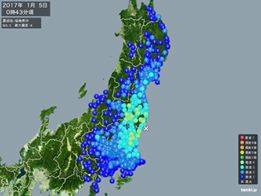
Strong quakes jolt eastern Japan
TOKYO (Kyodo) — A pair of earthquakes with a preliminary magnitude of 5.3 and 5.8 struck Fukushima and Ibaraki prefectures in eastern Japan early Thursday, the Japan Meteorological Agency said. No tsunami warning was issued.
The temblors occurred at around 12:44 a.m. and 2:53 a.m., originating at depths of about 60 and 30 kilometers off the coast of Fukushima. They measured up to 4 on the Japanese seismic scale of 7 in southern Fukushima and northern Ibaraki.
After the quakes, no abnormalities were detected at two nuclear power plants — the crippled Fukushima Daiichi and idled Fukushima Daini, according to the operator, Tokyo Electric Power Company Holdings Inc.
Fukushima was hard hit by the March 11, 2011 earthquake-tsunami and nuclear crisis.
http://mainichi.jp/english/articles/20170105/p2g/00m/0dm/001000c
Pair of strong late-night quakes jolt Fukushima, Ibaraki
A magnitude-5.3 earthquake and another of magnitude-5.8 struck Fukushima and Ibaraki prefectures early Thursday, the Meteorological Agency said. No tsunami warning was issued.
The earthquakes occurred at 12:44 a.m. and 2:53 a.m., originating at depths of about 60 km and 30 km off the coast of Fukushima, respectively. They measured up to 4 on the Japanese seismic scale to 7 in southern Fukushima and northern Ibaraki.
After the quakes, no abnormalities were detected at the crippled Fukushima No. 1 nuclear plant and the nearby idled Fukushima No. 2 plant, according to Tokyo Electric Power Company Holdings Inc.
Fukushima was hit hard by the March 11, 2011, earthquake-tsunami and nuclear crisis.
Niigata governor rejects restarts in 1st meet with TEPCO execs
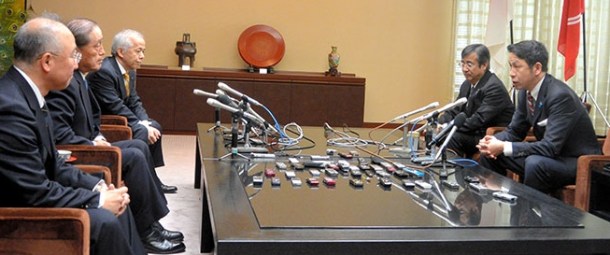
Niigata Governor Ryuichi Yoneyama, far right, holds talks with executives of Tokyo Electric Power Co. in the Niigata prefectural government office on Jan. 5.
Niigata governor rejects restarts in 1st meet with TEPCO execs
NIIGATA–Niigata Governor Ryuichi Yoneyama met Jan. 5 with top executives of Tokyo Electric Power Co. (TEPCO) for the first time, reiterating his opposition to restarting the Kashiwazaki-Kariwa nuclear power plant.
“It will be difficult to approve the restart as long as (the causes of) the accident at the Fukushima No. 1 nuclear power plant are not verified. In the present circumstances, I cannot accept the restart,” Yoneyama told Fumio Sudo, chairman of Tokyo Electric Power Co. Holdings Inc., and Naomi Hirose, president of the company.
It was the first time for Yoneyama to meet with TEPCO executives since he assumed the post of Niigata governor last October. The talks were held in the Niigata prefectural government office.
Yoneyama, noting that it will take several years for the Niigata prefectural government to verify the causes of the 2011 nuclear disaster, asked the TEPCO executives to provide more information and other forms of cooperation.
In response, Sudo said, “The priority is to hear voices of local residents.”
This seemed to suggest that TEPCO will not restart the Kashiwazaki-Kariwa nuclear power plant as long as the Niigata governor continues to resist the move.
A council of experts of the Ministry of Economy, Trade and Industry announced late last year that the costs for dealing with the aftermath of the Fukushima nuclear disaster will almost double to 21.5 trillion yen ($185 billion) from 11 trillion yen initially estimated in 2013.
To help cover the amount, TEPCO planned to restart two reactors at the Kashiwazaki-Kariwa to generate 100 billion yen in annual profits. But that now looks difficult, given Yoneyama’s firm stance on the issue of restarts.
http://www.asahi.com/ajw/articles/AJ201701050067.html
Gov. says restart of nuclear plant in Niigata to take “several years”
The restart of a nuclear power plant operated by Tokyo Electric Power Company Holdings Inc. on the Sea of Japan coast will likely take “several years,” the governor of Niigata Prefecture said Thursday, highlighting the difficulty in concluding post-2011 nuclear disaster reviews.
The utility known as TEPCO has been seeking to reactivate the Kashiwazaki-Kariwa nuclear plant, the world’s largest by generation capacity, as soon as possible to boost revenue, as it grapples with ballooning costs stemming from the 2011 nuclear disaster in Japan’s northeast.
“There can be no discussions about a restart without reviewing” factors including the cause of the Fukushima nuclear accident and evacuation plans for residents, Niigata Gov. Ryuichi Yoneyama said in his first talks with TEPCO executives since assuming office in October.
http://english.kyodonews.jp/news/2017/01/452300.html
Japan governor tells Tepco bosses nuclear plant to stay shut
The governor of Japan’s Niigata prefecture reiterated his opposition to the restart of Tokyo Electric Power’s (Tepco) Kashiwazaki-Kariwa nuclear plant, adding it may take a few years to review the pre-conditions for restart.
During a meeting on Thursday with Tepco Chairman Fumio Sudo and President Naomi Hirose, Governor Ryuichi Yoneyama, who was elected in October on his anti-nuclear platform, repeated his pledge to keep the plant shut unless a fuller explanation of the 2011 Fukushima nuclear disaster was provided.
He also said that evacuation plans for people in Niigata in case of a nuclear accident and the health impacts that the Fukushima accident have had would need to be reviewed before discussing the nuclear plant’s restart.
The restart of the Kashiwazaki-Kariwa plant, the world’s largest, is key to helping Tepco rebound from the aftermath of the 2011 disaster at its Fukushima-Daiichi plant.
The Japanese government last month nearly doubled its projections for costs related to the disaster to 21.5 trillion yen ($185 billion), increasing the pressure on Tepco to step up reform and improve its performance.
Many of Japan’s reactors are still going through a relicensing process by a new regulator set up after the Fukushima disaster, the world’s worst since Chernobyl in 1986.
Shutting the Kashiwazaki-Kariwa plant for additional years would mean that the company would have to continue relying heavily on fossil fuel-fired power generation such as natural gas.
Governors do not have the legal authority to prevent restarts but their agreement is usually required before a plant can resume operations.
Three reactors at Tepco’s Fukushima-Daiichi nuclear plant melted down after a magnitude 9 earthquake struck Japan in March 2011, triggering a tsunami that devastated a swathe of Japan’s northeastern coastline and killed more than 15,000 people.
http://www.reuters.com/article/us-japan-tepco-idUSKBN14P0IK?il=0
Environment Ministry deleted some of its remarks from minutes on contaminated soil meet
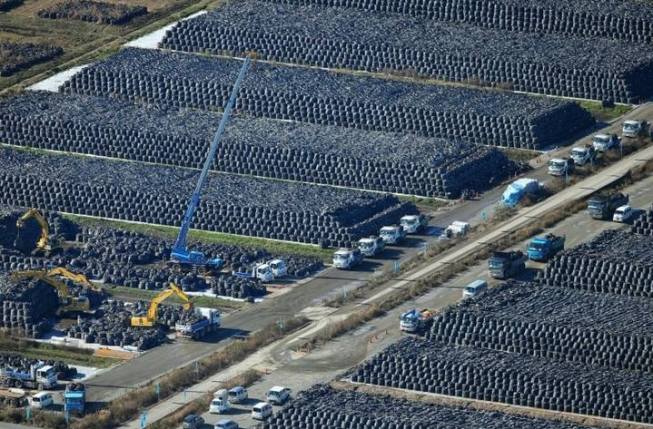
The Ministry of the Environment deleted some of its remarks made in closed-door meetings on reuse of contaminated soil stemming from the Fukushima nuclear disaster from the minutes of the meetings, it has been learned.
When the ministry posted the minutes on its website, it said it had “fully disclosed” them. The deleted remarks could be taken to mean that the ministry induced the discussions. The remarks led the meetings to decide on a policy of reusing contaminated soil containing up to 8,000 becquerels of radioactive cesium per kilogram. An expert on information disclosure lashed out at the ministry’s handling of the minutes, saying, “It is extremely heinous because it constitutes the concealment of the decision-making process.”
The meetings were called the “working group to discuss safety assessments of impacts of radiation.” The meetings were attended by about 20 people, including radiation experts, officials of the Environment Ministry and the Japan Atomic Energy Agency (JAEA) and others. The meetings were held six times from January to May in 2016.
The meetings discussed the reuse of radioactively contaminated soil generated when areas affected by the Fukushima nuclear crisis were decontaminated.
Initially, the meetings themselves were unpublicized. But because requests for information disclosure on the meetings were filed one after another, the Environment Ministry posted the minutes and relevant data on its website in August. As a matter of clerical procedures, the ministry said at that time that everything was disclosed.
The minutes that were disclosed contain “draft minutes” that were prepared before becoming official documents, but the Mainichi Shimbun obtained an “original draft” that was prepared even before then. Comparing the disclosed minutes with the original draft, the Mainichi found multiple cases of remarks being deleted or changed. According to the original draft, an Environment Ministry official said at the fourth meeting on Feb. 24, “With the assessments of soil with 8,000 becquerels, there have been cases in which the annual radiation dose slightly exceeds 1 millisievert in times of disasters and the like. But it will be good if it stays within 1 millisievert.” But the remark was deleted from the disclosed minutes.
Soil contaminated with radiation exceeding 8,000 becquerels is handled as “designated waste,” but discussions were held on reusing of contaminated soil containing 8,000 becquerels of radioactive cesium per kilogram during a series of meetings. In the Feb. 24 meeting, the JAEA showed an estimate that workers engaged in recovery work on a breakwater made of contaminated soil of 8,000 becquerels that has collapsed in a disaster would be exposed to radiation exceeding 1 millisievert per year — the maximum dose allowed for ordinary people. Based on the estimate, there was a possibility of the upper limit for reusing contaminated soil being lowered, but the Environment Ministry official’s remark promoted experts and others to call for s review to make a new estimate, with one attendee saying, “If it collapses, it will be mixed with other soil and diluted.”
A fresh estimate that the annual radiation dose will stay at 1 millisievert or lower was later officially presented, and the Environment Ministry officially decided in June on a policy of reusing contaminated soil containing up to 8,000 becquerels of radioactive cesium per kilogram.
http://mainichi.jp/english/articles/20170105/p2a/00m/0na/007000c
Disparities may arise in evacuee support / Fukushima Pref. to trim housing funds
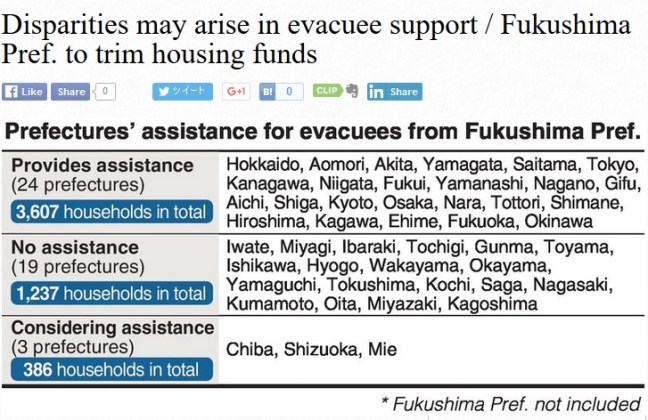
Starting in spring, housing assistance for residents of Fukushima Prefecture who evacuated to other prefectures voluntarily due to the 2011 nuclear accident will vary from prefecture to prefecture and certain disparities will occur, The Yomiuri Shimbun has learned.
The Fukushima prefectural government has so far been providing free-of-charge housing unconditionally and uniformly. However, it will terminate the provision at the end of March. Accordingly, 19 other prefectures will terminate their own initiatives to provide evacuees with free housing, while 24 prefectures will continue to provide housing free of charge and other services.
Although nearly six years have passed since the Fukushima No. 1 nuclear plant accident, many evacuees are still reluctant to return to their homes, and each prefecture that has accepted evacuees is responding to this situation in its own way.
After the accident, the Fukushima prefectural government treated voluntary evacuees — those who evacuated from areas that were not subject to evacuation orders — as equal to those who were instructed by the central government to evacuate. Abiding by the Disaster Relief Law, the prefecture has been shouldering rental fees for apartments or public housing facilities using funds from the state budget and other financial resources. The maximum rent for housing to be provided free of charge to voluntary evacuees is set at ¥60,000 per month in principle.
As of October 2016, the number of voluntary evacuees stood at 10,524 households or 26,601 individuals. Of these, 5,230 households or 13,844 individuals have relocated to areas outside of Fukushima Prefecture. In contrast to those who lived in areas subject to the evacuation order, voluntary evacuees are not eligible for regular compensation payments from Tokyo Electric Power Company Holdings, Inc. Therefore, the provision of free housing has been the main pillar of public support for voluntary evacuees.
Fukushima Prefecture decided in June 2015 to stop providing housing free of charge at the end of March 2017, judging that living conditions were changing for the better as the decontamination of residential areas progressed.
However, many evacuees responded to this by complaining that they did not want to be moved from places they were getting accustomed to. Accordingly, 24 prefectural governments other than Fukushima have decided to take the matter into their own hands by applying the law on public housing facilities and preferential measures by ordinances to compile their own budgets to extend the provision of free housing, give priority to evacuees in providing public housing for a fee or take other steps. A total of 3,607 households have evacuated on a voluntary basis to the 24 prefectures.
Several municipalities have also taken steps to provide public housing facilities free of charge.
Hokkaido, to which 229 households have voluntarily evacuated, has decided to extend provision of free housing for a year for 34 households. The prefectural government explained that it wants to help evacuees put their lives back in order by alleviating the concerns they may have about where to live.
Meanwhile, Hyogo Prefecture has decided to discontinue its support for the 44 households it accommodates. The spokesperson for the prefectural government said it would not take steps to keep the evacuees in the prefecture, which would be incompatible with policies of the Fukushima prefectural government aiming to bring them home.
Upon discontinuing the provision of free housing, Fukushima has procured 170 prefectural housing facilities for a fee to be provided preferentially to evacuees. The prefectural government is also planning to pay ¥100,000 to every household that moves back from outside the prefecture. Single-person households will receive ¥50,000. Residents who have evacuated to areas inside the prefecture will also receive a partial payment.
http://www.the-japan-news.com/news/article/0003439790
1 This Month





PLEASE OPPOSE HR 8255 AND S.3639 – bills would accelerate satellite deployment, with no environmental review or safeguards – https://ncstd5li.quorum.us/campaign/169331/
To see nuclear-related stories in greater depth and intensity – go to https://nuclearinformation.wordpress.com
-
Archives
- October 2026 (67)
- September 2026 (339)
- August 2026 (330)
- July 2026 (355)
- June 2026 (287)
- May 2026 (306)
- April 2026 (356)
- March 2026 (251)
- February 2026 (267)
- January 2026 (308)
- December 2025 (358)
- November 2025 (359)
-
Categories
- 1
- 1 NUCLEAR ISSUES
- business and costs
- climate change
- culture and arts
- ENERGY
- environment
- health
- history
- indigenous issues
- Legal
- marketing of nuclear
- media
- opposition to nuclear
- PERSONAL STORIES
- politics
- politics international
- Religion and ethics
- safety
- secrets,lies and civil liberties
- spinbuster
- technology
- Uranium
- wastes
- weapons and war
- Women
- 2 WORLD
- ACTION
- AFRICA
- Atrocities
- AUSTRALIA
- Christina's notes
- Christina's themes
- culture and arts
- Events
- Fuk 2022
- Fuk 2023
- Fukushima 2017
- Fukushima 2018
- fukushima 2019
- Fukushima 2020
- Fukushima 2021
- general
- global warming
- Humour (God we need it)
- Nuclear
- RARE EARTHS
- Reference
- resources – print
- Resources -audiovicual
- Weekly Newsletter
- World
- World Nuclear
- YouTube
-
RSS
Entries RSS
Comments RSS

