All Fukushima seafood samples pass safety tests for radioactivity
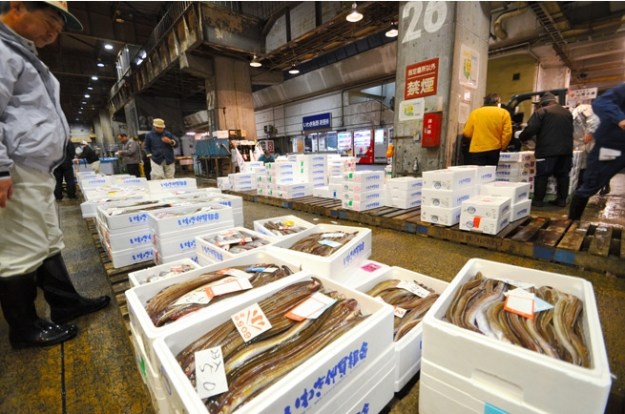
Fish caught during test fishing operations are sold at the Iwaki City Central Wholesale Market on Jan. 13. (Kazumasa Sugimura)
IWAKI, Fukushima Prefecture–For the first time, radioactivity levels were lower than the government’s safety limit in every seafood sample caught off Fukushima Prefecture for an entire year, officials said.
The Fukushima Prefectural Fisheries Experimental Station said 8,502 fish and shellfish samples were tested in 2016, and all recorded radioactivity readings under the safety standard of 100 becquerels per kilogram.
Ninety-five percent of them tested below the detection limit of around 15 becquerels per kilogram.
It was also the first time more than 90 percent of samples were below the detection threshold since the disaster at the Fukushima No. 1 nuclear plant started in March 2011, according to the officials.
People in the local fishing industry hope the numbers will help lead to a return to normal operations, although they say it is difficult to gauge the impact of harmful rumors about Fukushima seafood because prices depend on multiple factors, including quantity and quality.
“Test fishing is, after all, test fishing,” said Yuji Kanari, a managing director with seafood wholesaler Iwaki Gyorui KK. “Turning that into full fishing operations like before (the disaster) will emerge as a major challenge this year.
“I hope that local consumption of locally produced goods that was disrupted by the nuclear disaster will soon be back.”
The hauls from test fishing, which began in June 2012, have grown from year to year.
Preliminary figures show last year’s catch at 2,072 tons, up 560 tons from 2015, but still only 7.9 percent of the annual catch of 26,050 tons averaged over the decade preceding the 2011 disaster.
Ninety-four species are eligible for this year’s test fishing, which the Soma-Futaba fisheries cooperative association started on Jan. 10 and the Iwaki city fisheries cooperative association began on Jan. 12.
http://www.asahi.com/ajw/articles/AJ201702030003.html

Gov’t plan to cut back radiation tests on produce draws mixed reactions

The national government suggested it would scale back radiation tests on produce from Tokyo and 16 other prefectures affected by the Fukushima nuclear disaster, at a citizen-oriented event in Tokyo on Feb. 2, drawing mixed reactions from those in attendance.
A draft policy was put together by government bodies including the Ministry of Agriculture, Forestry and Fisheries and the Consumer Affairs Agency and calls for allowing reduction of the tests from the 2017 fiscal year. The plan was influenced by the fact that there are now almost no cases of agricultural products that exceed the regulatory limit for radioactive cesium of 100 becquerels per kilogram. Under the draft policy, the Tokyo Metropolitan Government or any of the affected prefectural governments whose agricultural products were at half or less of the limit for the past three years could choose to scale back their tests.
Representatives from consumer groups and Fukushima producers were present at the Feb. 2 meeting. There were many voices of opposition against the draft policy, saying it was too early to cut back the tests, or that the requirement for scaling them back should be stricter than half or less of the regulatory limit. On the other hand, another attendee said that over the last five years the tests had cost around 4 billion yen and the money should “be spent toward more meaningful goals.”
According to the testing results from fiscal 2011 through fiscal 2015, during the first two years the percentage of products like vegetables, fruits, tubers and meats from these areas with radioactive cesium in excess of the regulatory limit was between 0.1 percent and 5.9 percent, but since 2013 no excessive radiation has been detected.
The central government plans to hold an event to exchange ideas on the matter on Feb. 17 and get a better understanding of public opinion, before deciding on whether to actually downsize the testing.
http://mainichi.jp/english/articles/20170203/p2a/00m/0na/004000c
Fukushima radiation levels at highest level since 2011
Fukushima radiation levels at highest level since 2011 meltdown
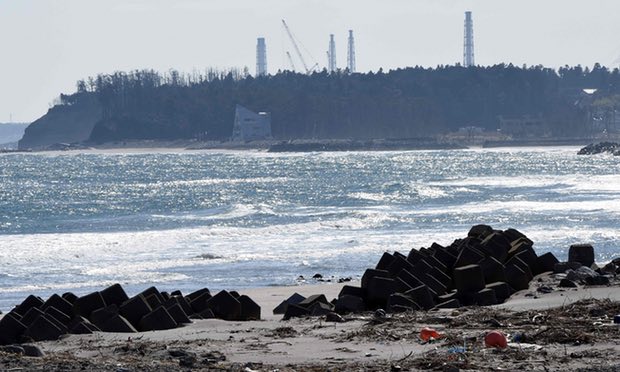
Cranes over the Fukushima Daiichi plant in February 2016. The decommissioning process is expected to take about four decades
Extraordinary readings pile pressure on operator Tepco in its efforts to decommission nuclear power station
Radiation levels inside a damaged reactor at the Fukushima Daiichi nuclear power station are at their highest since the plant suffered a triple meltdown almost six years ago.
The facility’s operator, Tokyo Electric Power (Tepco), said atmospheric readings as high as 530 sieverts an hour had been recorded inside the containment vessel of reactor No 2, one of three reactors that experienced a meltdown when the plant was crippled by a huge tsunami that struck the north-east coast of Japan in March 2011.
The extraordinary radiation readings highlight the scale of the task confronting thousands of workers, as pressure builds on Tepco to begin decommissioning the plant – a process that is expected to take about four decades.
The recent reading, described by some experts as “unimaginable”, is far higher than the previous record of 73 sieverts an hour in that part of the reactor.
A single dose of one sievert is enough to cause radiation sickness and nausea; 5 sieverts would kill half those exposed to it within a month, and a single dose of 10 sieverts would prove fatal within weeks.
Tepco also said image analysis had revealed a hole in metal grating beneath the same reactor’s pressure vessel. The one-metre-wide hole was probably created by nuclear fuel that melted and then penetrated the vessel after the tsunami knocked out Fukushima Daiichi’s back-up cooling system.
“It may have been caused by nuclear fuel that would have melted and made a hole in the vessel, but it is only a hypothesis at this stage,” Tepco’s spokesman Tatsuhiro Yamagishi told AFP.
“We believe the captured images offer very useful information, but we still need to investigate given that it is very difficult to assume the actual condition inside.”
The presence of dangerously high radiation will complicate efforts to safely dismantle the plant.
A remote-controlled robot that Tepco intends to send into the No 2 reactor’s containment vessel is designed to withstand exposure to a total of 1,000 sieverts, meaning it would survive for less than two hours before malfunctioning.
The firm said radiation was not leaking outside the reactor, adding that the robot would still prove useful since it would move from one spot to the other and encounter radiation of varying levels.
Tepco and its network of partner companies at Fukushima Daiichi have yet to identify the location and condition of melted fuel in the three most seriously damaged reactors. Removing it safely represents a challenge unprecedented in the history of nuclear power.
Quantities of melted fuel are believed to have accumulated at the bottom of the damaged reactors’ containment vessels, but dangerously high radiation has prevented engineers from accurately gauging the state of the fuel deposits.
Earlier this week, the utility released images of dark lumps found beneath reactor No 2 that it believes could be melted uranium fuel rods – the first such discovery since the disaster.
In December, the government said the estimated cost of decommissioning the plant and decontaminating the surrounding area, as well as paying compensation and storing radioactive waste, had risen to 21.5tn yen (£150bn), nearly double an estimate released in 2013.
Radiation level in Fukushima reactor could kill within a minute
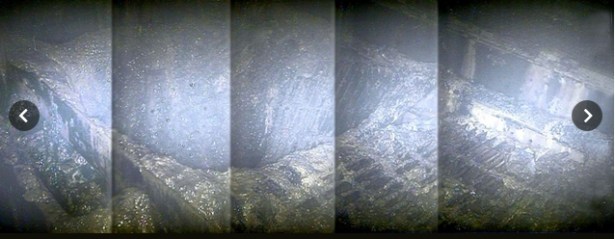
Images show black lumps on grating for maintenance work below the No. 2 reactor’s pressure vessel at the Fukushima No. 1 nuclear power plant. TEPCO says melted fuel likely caused at least two holes in the metal grating, including an opening measuring 1 meter by 1 meter. (Provided by Tokyo Electric Power Co.)
Radiation levels that can kill a person in a minute and holes created by melted nuclear fuel could further delay decommissioning operations at the No. 2 reactor of the Fukushima No. 1 nuclear plant.
Tokyo Electric Power Co., operator of the crippled plant, said Feb. 2 that the maximum estimated radiation level near what is believed to be melted fuel in the reactor was 530 sieverts per hour, the highest so far since the triple meltdown in 2011.
In its investigation into the interior of the No. 2 reactor, TEPCO also confirmed at least two holes on grating for maintenance work below the bottom of the reactor’s pressure vessel.

The images show the area at the bottom of the No. 2 reactor’s pressure vessel to the metal grating below.
“The holes were likely made when the melted nuclear fuel fell from the pressure vessel and melted the grating,” a TEPCO official said.
The findings were made by studying images taken from a video camera attached to a pipe that was inserted into the reactor on Jan. 30.
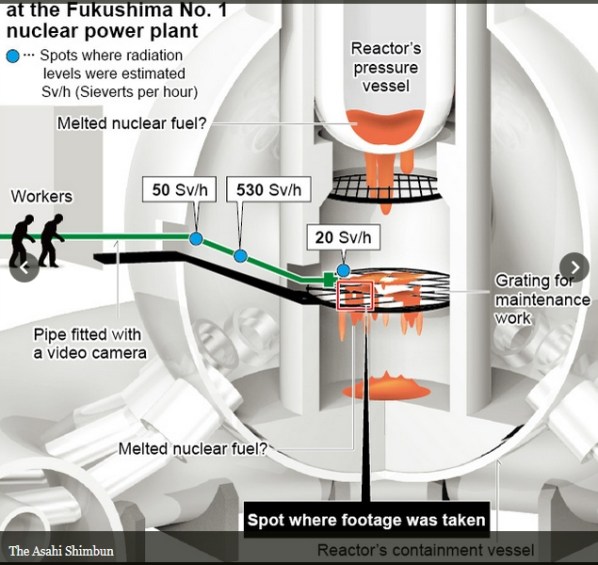
Radiation levels were estimated at 20 sieverts per hour, 50 sieverts per hour and 530 sieverts per hour at three spots inside the reactor’s containment vessel.
The company estimated the doses from the extent of disturbances in the images caused by radiation.
Although a TEPCO official said “there is a margin of error because radiation levels were not measured directly,” the company believes the scattered melted nuclear fuel inside the containment vessel was emitting high levels of radiation.
After a number of failed attempts, the remote-controlled camera took the first pictures of possible melted fuel at the plant.
However, closer inspection of the images have revealed additional problems for TEPCO, which had believed most of the melted fuel had remained inside the reactor’s pressure vessel.
TEPCO plans to send an investigative robot, called Sasori (scorpion), into the containment vessel this month to more accurately measure radiation doses at various spots and take additional footage of the scattered nuclear fuel.
The utility plans to use the data to determine a fuel-removal method.
But the robot was expected to use the circular grating, measuring 5 meters in diameter, to move around. One of the holes is 1 meter by 1 meter, a potential pitfall for the robot, which is 59 centimeters long and 9 cm high.
TEPCO said it will consider a different route for the robot in its survey.
Fumiya Tanabe, an expert on nuclear safety who analyzed the 1979 Three Mile Island nuclear accident in the United States, said the findings show that both the preparation for and the actual decommissioning process at the plant will likely prove much more difficult than expected.
“We have few clues on the exact locations, the sizes and the shapes of the nuclear fuel debris,” he said. “The planned investigation by the robot needs a rethink. Work to decommission the plant will require even more time.”
TEPCO said it will need 30 to 40 years to complete the decommissioning process. The utility plans to start work to remove the melted nuclear fuel at the No. 2 and two other stricken reactors in 2021 after deciding on a removal method in fiscal 2018.
TEPCO has yet to determine the location and the condition of the melted fuel in the other two reactors.
TEPCO to probe Fukushima reactor again to confirm nuclear debris

An executive of the operator of the crippled Fukushima Daiichi nuclear complex said Friday the company plans to probe inside the plant’s No. 2 reactor by the end of February to confirm whether the black mass spotted in a recent survey was nuclear debris.
Naohiro Masuda, the chief decommissioning officer at Tokyo Electric Power Company Holdings Inc. told Kyodo News it is “possible” to conduct the probe using a robot, the day after the operator announced it had detected extraordinarily high radiation levels inside the reactor.
The operator will be able to tell whether the deposits are nuclear debris from the March 2011 meltdown if new images and data such as the radiation levels and temperatures are obtained in the upcoming robot survey, he said.
Radiation in Fukushima reactor containment vessel at deadly level: TEPCO
Radiation inside the containment vessel of the No. 2 reactor at the Fukushima No. 1 nuclear plant measures as high as a deadly 530 sieverts per hour, the highest since the 2011 disaster, plant operator Tokyo Electric Power Co. (TEPCO) announced on Feb. 2.
TEPCO calculated the radiation dose from video noise on footage it took inside the containment vessel in late January, when a camera was inserted to examine conditions inside and scout a route for a scorpion-like observation robot scheduled to go into the vessel later this month.
Deployment of the robot is also being reconsidered after two gaping holes were found along the robot’s planned path over a 5-meter-wide circular walkway inside the containment vessel, close to where the 530-sievert radiation dose was detected.

A scorpion-like observation robot scheduled to go into the containment vessel of the No. 2 reactor at the Fukushima No. 1 nuclear plant.
The holes in the metal grate walkway — one of unknown size and the other measuring about 1 meter square — make both routes considered for the robot impassable.
“We will consider re-evaluating what observations we can take with the robot,” Yuichi Okamura, an acting general manager with TEPCO’s on-site nuclear power division, told reporters at a Feb. 2 news conference.
Piles of a black and dark brown substance several centimeters thick and thought to be melted nuclear fuel were also observed on the walkway, creating a further possible obstruction to the robot. Meanwhile, examination of the 1-meter-square hole suggests the walkway was struck with tremendous force, hinting that there may be a large amount of melted fuel below.
“It is possible that the nuclear fuel rods melted onto the control rods and then dripped down,” Tokyo Institute of Technology professor of nuclear engineering Yoshinao Kobayashi told the Mainichi Shimbun. “It’s highly likely that part of the bottom of the pressure vessel broke and the melted fuel flowed down (onto the walkway), and then the grating warped and gave way due to the fuel’s heat.”
http://mainichi.jp/english/articles/20170203/p2a/00m/0na/005000c
Hitachi to take a 70 billion yen hit after U.S nuclear project fails
The nuke biz is going down like dominoes. Hitachi announces a nearly $6.2 billion loss on its U.S. uranium enrichment joint effort with GE.

Electronics giant Hitachi Ltd. is set to lose tens of billions of yen this fiscal year due to the withdrawal from a project to develop a new method of uranium enrichment by a joint venture in the United States.
The loss, forecast by Hitachi on Feb. 1, was disclosed shortly after Toshiba Corp. made a similar announcement last month of deficits brought on by its nuclear power business.
Hitachi is expected to report a 70 billion yen ($620 million) non-operating loss by the time books are closed for fiscal 2016 at the end of March, said Mitsuaki Nishiyama, a senior vice president of the Tokyo-based conglomerate, in a news conference on the company’s performance through the third quarter.
The deficit is largely attributed to the joint venture GE Hitachi Nuclear Energy Inc. withdrawing from the uranium enrichment project. Due to this decision, Hitachi no longer expects any profits from the North Carolina-based company, of which it owns 40 percent and the rest by General Electric.
After allocating the losses, the value of Hitachi’s share of the joint venture comes to only about 11 billion yen.
Despite the gloomy news, Nishiyama said that “there are no more large deficit risks.”
Hitachi and GE were expecting more nuclear power plants to be built when they launched the joint fuel enrichment business, but orders have been sluggish across the globe, forcing the project to be shelved.
Nevertheless, Hitachi will be sticking with its nuclear power business. The company said that it plans to proceed with its project to build a plant in Britain by ensuring costs are thoroughly managed.
Cameco to lose $1.3bn as Japan’s TEPCO cancels uranium contract
The writing is on the wall. Ban uranium mining now: “Tepco’s termination of the contract would affect about 9.3 million pounds of uranium deliveries through 2028, worth about $1.3 billion in revenue.”
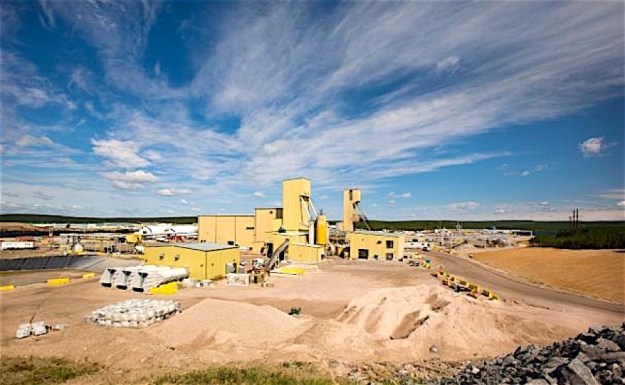
Cigar Lake, in northern Saskatchewan, Canada, is the world’s highest-grade uranium mine.
Uranium miner Cameco (TSX:CCO; NYSE:CCJ) is weighing its options after a key Japanese customer attempted to cancel its contract, which would mean $1.3 billion in lost revenue for the Canadian company.
Tokyo Electric Power Company Holdings (TEPCO), the operator of Japan’s wrecked Fukushima nuclear plant, issued a termination notice for a uranium supply contract on Jan. 24 and, earlier this week, it said it would not accept a delivery that was scheduled for Feb.1.
Such contract cancellation would affect about 9.3 million pounds of uranium deliveries through 2028, including about 855,000 pounds annually in 2017, 2018 and 2019, Cameco said.
Shares collapsed on the news. They were trading down 12.5% to Cdn$14.50 in Toronto at 1:00 pm, and 13.3% down in New York to $11.06 at 1:26 pm ET.
Cameco said the Japanese power company has cited forces beyond its control — specifically government regulations arising from the 2011 Fukushima nuclear accident — that have prevented the operation of its nuclear plants.
The Canadian firm insisted that there’s no basis for terminating the contract and considers TEPCO to be in default. It said it will pursue its rights — including binding arbitration.
“We are surprised and disappointed that TEPCO is seeking to terminate its contract given all the past productive discussions we have had to date,” Cameco’s president and CEO Tim Gitzel said in the statement.
The company noted it has sufficient financial capacity to manage any loss of revenue in 2017 as a result of the dispute.
Including income coming from TEPCO, Cameco expects 2017 earnings will range between $2.1 billion to $2.2 billion. More information on the uranium miner’s financial position will be released next week.
http://www.mining.com/cameco-to-lose-1-3bn-as-japans-tepco-cancels-uranium-contract/
Japan’s post-tsunami recovery plan: tomatoes, fish and hula-dancing
Six years after the Fukushima disaster, local government is working with private firms in one Japanese city to rebuild its economy

Tomatoes growing in Japan’s Wonder Farm as part of Iwaki City’s reconstruction efforts after the 2011 earthquake and tsunami.
It’s a cold January day in Iwaki City, 211km north of Tokyo. But here, in a balmy glasshouse, light and sunny, pop music is being piped in, and tonnes of tomatoes are ripening and being picked.
They’re not in the ground; they’re being grown from waist-high pots of coconut matting. These are no ordinary tomatoes. They are growing on Wonder Farm, an “integrated agricultural theme park”, run by Tomato Land Iwaki, which is part-funded by the local city council and the Fukushima prefecture.
But another of the Wonder Farm partners is train firm Japan Rail East, which sells the tomatoes via its own restaurants. Because these small red fruits are part of plans by the local city government and local businesses to reinvigorate the local Iwaki economy after the devastating impact of the March 2011 earthquake, tsunami and nuclear disaster at the Fukushima Daiichi reactor, a mere 50km up the coast.
After such a cataclysmic series of events, rebuilding an economy based on fishing, agriculture and tourism is not easy. It requires some innovative thinking. Luckily, that’s something with which this area is already familiar. Fifty years ago, another of its industries, coal mining, faced decline. Here in Iwaki City, the Joban coal mining company came up with a novel idea. It retrained coal miners’ daughters as hula dancers and created the Spa Resort Hawaiians, Japan’s first theme park, which from its opening in 1966 until the events of March 2011, attracted thousands of visitors a year to its array of pleasures, including golf, a huge swimming pool and hot springs centre, and, of course, hula dancing and fire knife displays.
“We were driven by the need to survive,” explains Yukio Sakamoto, a director at the Joban coal mining company. “Yes, it was a radical change, but it was a success because everyone in the company focused on the plan. It wasn’t about knowledge or expertise, but mindset.” The idea faced considerable opposition: “People said coal miners should just dig coal. But we trained the daughters of coal miners as professional dancers.”
That kind of ingenuity has been called for even more since 2011 in this part of Japan. It’s been hard work for everyone involved to try and get visitors back to the region and to restart the market for local food and produce. The city government has worked with regional and national bodies to measure radioactivity levels in local produce, and the figures are publicly available. But rebuilding trust that food from Fukushima is safe has been slow. The local fish market may be open, but almost all its stock is from elsewhere in the country.
Still, at least it is open and Senzaka Yoshio, one of the officers at the La Mew Mew fish market, which was badly damaged by the earthquake and tsunami, says visitor levels are now back up to 80% of the pre-disaster days.
Further along the quay from the fish market are more fish. Live ones, this time, in the spacious tanks of the Fukushima Aquarium. When the tsunami hit, this aquarium lost 90% of its creatures. It reopened just four months later, in July 2011, a feat possible, according to executive director Yoshitaka Abe, due to teamwork, local leadership and co-operation with other aquarium authorities, who sent specialists and volunteers to help with the reconstruction work.

The Fukushima aquarium, which reopened just four months after the tsunami of March 2011.
For Sakamoto, at the Spa Resort Hawaiians, overcoming the 2011 disaster has been about local people. The resort has brought more than 9,500 jobs to the area. On the day of the earthquake, there were 617 guests in the hotel. All got safely home. But many employees lost family members and homes. “We continue our operation thinking about the people who suffered,” he says. “Our main idea was not to fire people because of the difficulty in the business, but to redeploy them.”
Fukushima nuclear disaster: Worker sues Tepco over cancer

The plaintiff helped build scaffolding to repair the damaged No 4 reactor at the Fukushima plant
A Japanese court has begun hearing the case of a man who developed leukaemia after working as a welder at the damaged Fukushima nuclear site.
The plaintiff, 42, is the first person to be recognised by labour authorities as having an illness linked to clean-up work at the plant.
He is suing Tokyo Electric Power Company, which operates the complex.
The nuclear site was hit by the earthquake and tsunami in 2011, causing a triple meltdown.
It was the world’s worst nuclear disaster since Chernobyl in 1986. An exclusion zone remains in place around the site as thousands of workers continue clean-up efforts.
‘Expendable labourer’
The man, from Japan’s Fukuoka prefecture, was a welder for a sub-contractor.
He spent six months working at Genkai and Fukushima No 2 nuclear plants before moving to the quake-hit Fukushima No 1 plant, where he build scaffolding for repair work at the No 4 reactor building. His cumulative radiation exposure was 19.78 millisieverts.
This is lower than official limits – Japan currently allows workers at the damaged plant to accumulate a maximum of 100 millisieverts over five years. A dose of 100 millisieverts over a year is seen as enough to raise the risk of cancer.
But in October 2015, a health ministry panel ruled that the man’s illness was workplace-related and that he was eligible for compensation.
“While the causal link between his exposure to radiation and his illness is unclear, we certified him from the standpoint of worker compensation,” a health ministry official said at the time.

There has been heated debate about the dangers of radiation from the plant
The man is now suing Tepco and the Kyushu Electric Power Company, which operated the Genkai plant, for JPY59m ($526,000, £417,000).
“I worked there [Fukushima No 1 plant] because of my ardent desire to help bring the disaster under control but I was treated as if I was a mere expendable labourer,” Kyodo news agency quoted him as saying.
“I want Tokyo Electric to thoroughly face up to its responsibility.”
When he filed the suit late last year, his lawyers said he had been “forced to undergo unnecessary radiation exposure because of the utilities’ slipshod on-site radiation management”.
Tepco and Kyushu Electric have asked the court to reject the suit, questioning the link between his radiation exposure and leukaemia, Kyodo reported.
Tens of thousands of workers have been employed at the Fukushima site since the disaster in March 2011. Late last year the government said estimates of clean-up costs had doubled to JPY21.5 trillion ($188bn, £150bn).
http://www.bbc.com/news/world-asia-38843691
Ex-worker during Fukushima disaster sues Tepco, Kyushu Electric over leukemia
A former nuclear worker who developed leukemia after combating the 2011 Fukushima nuclear crisis demanded ¥59 million (around $524,000) in damages from two utilities Thursday at his first trial hearing at the Tokyo District Court.
The 42-year-old man from Fukuoka Prefecture is the first person to be recognized by labor authorities as having an illness linked to workplace radiation exposure since the triple core meltdown at the Fukushima No. 1 nuclear power plant.
The man-made disaster was triggered by the huge earthquake and tsunami on March 11, 2011.
“I worked there because of my ardent desire to help bring the disaster under control but I was treated as if I was a mere expendable laborer,” the plaintiff said.
“I want Tokyo Electric to thoroughly face up to its responsibility,” he said.
The defendants, Tokyo Electric Power Company Holdings Inc., which runs Fukushima No. 1, and Kyushu Electric Power Co., whose Genkai nuclear plant also employed the plaintiff, asked the court to reject the claim, questioning the connection between his radiation exposure and leukemia.
The man was engaged in welding operations at the Fukushima Nos. 1 and 2 plants and the Genkai complex in Saga Prefecture from October 2011 to December 2013. His exposure in operations subcontracted by the utilities consisted of at least 19.8 millisieverts, according to his written complaint.
The man was diagnosed with acute myeloid leukemia in January 2014 and later went into depression. Both ailments are recognized as work-related illnesses by the Health, Labor and Welfare Ministry.
He said he has been unable to go back to work and is therefore seeking compensation from the utilities.
Record high fatal radiation levels, hole in reactor 2 detected

Deadly radiation estimated inside reactor vessel
The operator of the crippled Fukushima Daiichi nuclear plant says its latest estimation of the radiation level inside one of the reactors was extremely high and had the potential to be lethal to a human within a short period of time.
Tokyo Electric Power Company conducted an inspection inside the containment vessel of the plant’s No.2 reactor last month using a remote-controlled camera, as part of a survey to scrap the reactor.
An analysis of the images found that the radiation was up to 530 sieverts per hour at a concrete cylinder supporting the reactor.
The level is enough to be lethal to a human within a short period of time, despite a possible error margin of up to 30 percent.
A survey conducted 1 year after the nuclear accident at a different part inside the same containment vessel logged 73 sieverts per hour.
In the latest estimation inside the vessel, the area near its opening logged 50 sieverts per hour at maximum.
The operator officials say that there are no leaks of gas with radioactive substances from the containment vessel.
Officials suspect that fuel debris; a mixture of nuclear fuel and melted parts of the reactor’s facility, may be emitting strong radiation inside the vessel.
Some molten fuel penetrated the reactor’s bottom and has reached the containment vessel as fuel debris.
The company plans conduct further inspections with a robot. There is a risk that some parts of the grating where the robot will be moving may be damaged by the high heat of the molten fuel.
https://www3.nhk.or.jp/nhkworld/en/news/20170202_31/
Record high fatal radiation levels, hole in reactor detected at crippled Fukushima nuclear facility
Record high radiation levels that’s lethal even after brief exposure have been detected at a damaged reactor at the Fukushima power plant in Japan. Specialists also found a hole, likely caused by melted nuclear fuel.
Radiation levels of up to 530 Sieverts per hour were detected inside an inactive Reactor 2 at the Fukushima Daiichi nuclear complex damaged during the 2011 earthquake and tsunami catastrophe, Japanese media reported on Thursday citing the plant operator, Tokyo Electric Power Company (TEPCO).
A dose of about 8 Sieverts is considered incurable and fatal.
A hole of no less than one square meter in size has also been discovered beneath the reactor’s pressure vessel, TEPCO said. According to researchers, the apparent opening in the metal grating of one of three reactors that had melted down in 2011, is believed to be have been caused by melted nuclear fuel that fell through the vessel.
The iron scaffolding has a melting point of 1500 degrees, TEPCO said, explaining that there is a possibility the fuel debris has fallen onto it and burnt the hole. Such fuel debris have been discovered on equipment at the bottom of the pressure vessel just above the hole, it added.
The latest findings were released after a recent camera probe inside the reactor, TEPCO said. Using a remote-controlled camera fitted on a long pipe, scientists managed to get images of hard-to-reach places where residual nuclear material remained. The substance there is so toxic that even specially-made robots designed to probe the underwater depths beneath the power plant have previously crumbled and shut down.
However, TEPCO still plans to launch further more detailed assessments at the damaged nuclear facility with the help of self-propelled robots.
Earlier this week, hopes for a more efficient cleanup at Fukushima were high, as the plant operator announced a portion of nuclear fuel debris responsible for a lot of the lingering contamination from six years ago may have finally been found.
https://www.rt.com/news/376107-fukushima-record-radiation-level/
Up to 4.20µSv near the Fukushima Tetsuzan water dam
This short article is dedicated to a pro-nuke troll, whose alias is Octo.
Octo, should I indulge the reader, is usually present at the chat of the “Fukushima Diary” blog. He enjoys pushing his propaganda of how nuke is safe.
How Tepco is doing a terrific job at Fukushima Daiichi and is in total safety control of everything.
How radiation is now very low in Fukushima How the fish and seafood is now safe etc.
Everyone is believing his crap *cough*, but he, like all of the other bewildered, confused and baffled Japanese *experts? never gives up.
Watching this video, I am thinking about him and his continuous lies, and also all those other Japanese pro-nuke trolls that I encountered on internet in the past few years.
This video was shot last November 2016 South of Soma, it is the mountain trail to reach the Tetsuzan dam, a place approximately 20km from the Fukushima Daiichi nuclear plant.
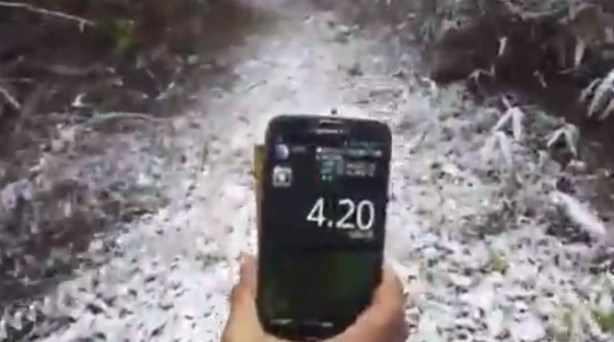
I think all those disinformation spinners paid by Tepco, Dentsu or Government, whose job is to spread lies about the Fukushima disaster on blogs, forums and Facebook, should all go living up there, as they claim it is now completely safe.
They should breath the good air from Fukushima, eat everyday very safe Fukushima rice and vegetables, and of course eat also plenty of safe fish and seafood, and drink plenty Fukushima safe water.
I would give them only one word of advice :
“Don’t forget to smile,
Smile a lot everywhere and everyday, so that the radiation won’t affect you.”
Special credit to the Fukuichi Citizen Radiation Monitoring Project
Radiation level at Fukushima reactor highest since 2011 disaster; grating hole found

TOKYO (Kyodo) — The radiation level inside the containment vessel of the No. 2 reactor at the crippled Fukushima Daiichi nuclear complex stood at 530 sieverts per hour at a maximum, the highest since the 2011 disaster, the plant operator said Thursday.
Tokyo Electric Power Company Holdings Inc. also announced that based on image analysis, a hole measuring 2 meters in diameter has been found on a metal grating beneath the pressure vessel inside the containment vessel and a portion of the grating was distorted.

According to TEPCO, the extremely high radiation level was found near the entrance area in the space just below the pressure vessel. The previously highest radiation level monitored in the interior of the reactor was 73 sieverts per hour.
The hole could have been caused by nuclear fuel that penetrated the reactor vessel as it overheated and melted due to the loss of reactor cooling functions in the days after a powerful earthquake and tsunami on March 11, 2011 hit northeastern Japan.
According to the image analysis, about 1 square meter of the grating was missing.
The plant operator plans to deploy a robot at the bottom of the reactor containment vessel, which houses the reactor pressure vessel, to check the conditions there.
The analysis follows TEPCO’s discovery Monday of a black mass deposited on the grating directly beneath the pressure vessel, possibly melted fuel after the unit suffered a meltdown along with two other Fukushima Daiichi reactors.
Images captured using a camera attached to a telescopic arm on Monday also showed part of the grating has gone. A further analysis of the images found a 2-meter hole in an area beyond the missing section on the structure.
If the deposits are confirmed as fuel debris, it would be the first time the utility has found any at the three units that suffered meltdowns.
Following one of the world’s worst nuclear disasters since the 1986 Chernobyl catastrophe, the No. 1 to 3 reactors suffered fuel meltdowns.
Portions of the fuel in the reactors are believed to have melted through the pressure vessels and accumulated at the bottom of the containment vessels.
The actual condition of the melted fuel has remained unknown due to high radiation levels.
http://mainichi.jp/english/articles/20170202/p2g/00m/0dm/087000c
http://mainichi.jp/articles/20170203/k00/00m/040/079000c

Convenient Acccounts of Fukushima Radiation Exposure Ignore Glaring Issue

Every time I read something about the Fukushima disaster my blood pressure rises.
For example, recent efforts to represent (hypothesized) remnants of melted fuel rods in unit 2 as evidence of containment is revealed as misleading when one considers the size of the reactor (larger than a bus) and the amount of fuel contained within unit 2’s:
Justin McCurry January 30, 2017, Possible nuclear fuel find raises hopes of Fukushima plant breakthrough. The Guardian, https://www.theguardian.com/environment/2017/jan/31/possible-nuclear-fuel-find-fukushima-plant
Operator says it has seen what may be fuel debris beneath badly damaged No 2 reactor, destroyed six years ago in triple meltdown
Hopes have been raised for a breakthrough in the decommissioning of the wrecked Fukushima Daiichi nuclear plant after its operator said it may have discovered melted fuel beneath a reactor, almost six years after the plant suffered a triple meltdown.
Tokyo Electric Power (Tepco) said on Monday that a remote camera appeared to have found the debris beneath the badly damaged No 2 reactor, where radiation levels remain dangerously high. Locating the fuel is the first step towards removing it. The operator said more analysis would be needed before it could confirm that the images were of melted uranium fuel rods, but confirmed that the lumps were not there before Fukushima Daiichi was hit by a powerful earthquake and tsunami on 11 March 2011.
The amount of fuel contained of fuel in those reactors was substantial. If TEPCO had found all, or most, of the melted reactor fuel they would know it.
According to a November 16 report by Tepco titled, ‘Integrity Inspection of Dry Storage Casks and Spent Fuel at Fukushima Daiichi Nuclear Power Station,’[i] as of March 2010 the Daini site held 1,060 tons of spent uranium fuel. The total spent uranium fuel inventory at Daiichi in March 2010 was reported as 1,760 tons. The 2010 report asserts that approximately 700 spent fuel assemblies are generated every year.[ii] The report specifies that Daiichi’s 3,450 assemblies are stored in each of the six reactor’s spent fuel pools. The common spent fuel pool contains 6291 assemblies. The amount of MOX fuel stored at the plant has not been reported.
I suspect that TEPCO knows that most of the fuel is gone from unit 2’s reactor containment and that what remains is a fraction of the total load, which was either dispersed in the explosions or has left the building.
But what bothers me even more than obfuscation around missing fuel are misleading accounts of radiation exposure.
Case in point: The article published in CNBC below last week alleges that Fukushima radiation exposure was “far lower” than previously found:
Robert Ferris. Jan 24, 2017. Fukushima radiation levels far lower than previously thought, study finds. CNBC.Com, http://www.cnbc.com/2017/01/24/fukushima-radiation-levels-far-lower-than-previously-thought-study-finds.html
Radiation levels remaining from the 2011 disaster at Japan’s Fukushima Daiichi nuclear plant appear to be a small fraction of what previous measurements suggested, according to a recently published study that followed levels in tens of thousands of people living near the site of the accident.
Science magazine highlighted the research Monday, calling it the first study to measure individual radiation levels in locals following a major nuclear disaster. The study was published in the peer reviewed Journal of Radiological Protection in December.
I’ve seen this type of headline before so I was immediately suspicious. I pulled up the journal article and found a glaring issue that problematizes the validity of this conclusion that radiation levels were lower than previously calculated.
Here is the glaring issue ignored in the CNBC’s optimistic headline: The radiation monitoring badges were provided to residents in August of 2011. The disaster and radiation exposure began March 11, 2011.
Consequently, RESIDENTS WERE NOT GIVEN BADGES TO MEASURE EXPOSURE UNTIL FULLY 5 MONTHS AFTER exposure, a fact that is acknowledged in the title of the research article but ignored in the news coverage:
Makoto Miyazaki and Ryugo Hayano. 2017. Individual external dose monitoring of alltizens of Date City by passive dosimeter 5 to 51 months after the FukushimaNPP accident (series): 1. Comparison of individual dose with ambient dose rate monitored by aircraft surveys. J. Radiol. Prot. 37 1(http://iopscience.iop.org/0952-4746/37/1/1) http://iopscience.iop.org/article/10.1088/1361-6498/37/1/1/pdf
For the measurement of individual external doses, Date City distributed individual dosim-eters (radio-photoluminescence (RPL) glass dosimeters: Glass Badge) to kindergarten-, elementary- and junior high school-children in August 2011. The target group was subsequently enlarged as the production capacity of the supplier increased, and the measurements are still ongoing
How is it possible to conclude that exposure was lower than previously thought when the evidence for that claim is generated from a study that excludes the first 5 months of exposure?
Truth has an especially slippery feel when it comes to Fukushima….
????????????????????????????????????????????????????????????
REFERENCES
[i] It is worth noting that although this report was produced on 10/26/2010, the file properties indicate the document was modified on 3/13/2011: Integrity Inspection of Dry Storage Casks and Spent Fuels at Fukushima Daiichi Nuclear Power Station (16 November 2010), http://www.nirs.org/reactorwatch/accidents/6-1_powerpoint.pdf
[ii] Integrity Inspection of Dry Storage Cask.
http://majiasblog.blogspot.fr/2017/02/convenient-acccounts-of-fukushima.html
Tepco’s termination of supply contract contested by Canada-based uranium producer Cameco
Cameco to contest Tepco’s termination of supply contract
Cameco announced today that Tokyo Electric Power Company Holdings (Tepco) has issued a termination notice for a uranium supply contract with Cameco Inc that it does not accept. “Cameco Inc sees no basis for terminating the contract, considers Tepco to be in default, and will pursue all its legal rights and remedies,” the Saskatchewan, Canada-based uranium producer said.
The Japanese utility confirmed yesterday it would not accept a uranium delivery scheduled for 1 February and would not withdraw the contract termination notice it provided to Cameco on 24 January, according to Cameco’s statement. Tepco alleges that an event of ‘force majeure’ has occurred because it has been unable to operate its nuclear generating plants for 18 consecutive months due to government regulations arising from the Fukushima nuclear accident in March 2011.
“We are surprised and disappointed that Tepco is seeking to terminate its contract given all the past productive discussions we have had to date,” said Tim Gitzel, president and CEO of Cameco. “For the past six years we have worked in good faith with Tepco to restructure this contract, and would continue to do so if there was any basis for a commercial resolution. During the past week we tried to engage Tepco to obtain clarification given conflicting information we had received previously from them and only received confirmation of their intent to terminate the contract yesterday.”
Cameco will “vigorously pursue” remedies to recover value for its shareholders and other stakeholders, Gitzel added.
Under the contract, Tepco has already received and paid for 2.2 million pounds of uranium since 2014. The termination would affect about 9.3 million pounds of uranium deliveries through 2028, worth about $1.3 billion in revenue to Cameco, including about $126 million in each of 2017, 2018 and 2019 based on 855,000 pounds of deliveries in each of those years. In 2017, Cameco’s consolidated revenue, including the Tepco volume, is expected to range between $2.1 billion to $2.2 billion.
Cameco said it will be “moving expeditiously” to enforce its rights under the uranium supply contract to recover losses arising from Tepco’s actions.
“As with any commercial dispute, it will take some time for a resolution to be achieved, particularly if it proceeds all the way to arbitration,” Cameco said.
The company, which is scheduled to release its annual results after markets close on 9 February, said it has “sufficient financial capacity” to manage any loss of revenue in 2017 as a result of the dispute.
A spokesman for Tepco said: “We have terminated the uranium concentrate supply agreement with Cameco by giving written notice to Cameco in accordance with the terms and conditions of the agreement. We are aware that Cameco is showing their objection to our assertion of termination. However, our notice complies with the agreement and we will take appropriate action.”
http://www.freep.com/story/news/2017/02/01/trump–nuclear-waste-lake-huron/97346178
Tepco scraps uranium supply contract with Canada’s Cameco
Feb 1 Canadian uranium producer Cameco Corp said on Wednesday that Tokyo Electric Power (Tepco) , the operator of Japan’s wrecked Fukushima nuclear plant, had scrapped its uranium supply contract with the company.
Shares of Cameco slid 12.2 percent to C$14.55 in early trading on Wednesday.
The company, one of the world’s largest uranium producers, said it considered Tepco’s move to terminate the contract unfair and that it would pursue legal action.
Cameco said Tepco cited a force majeure for ending the contract as it had been unable to operate its nuclear plants for 18 straight months due to Japanese regulations arising from the 2011 Fukushima nuclear accident.
The company said it was notified of the contract termination by Tepco last week.
Tepco’s termination of the contract would affect about 9.3 million pounds of uranium deliveries through 2028, worth about C$1.3 billion ($995.41 million) in revenue to Cameco, the Saskatoon, Canada-based company said.
Cameco’s earnings before interest, taxes, depreciation and amortization could take a 10-15 percent hit in the near-term as a result of the Tepco dispute, said Edward Sterck, an analyst at BMO Capital Markets.
Tepco’s move comes amid a fall in demand for uranium that is largely a result of the Fukushima nuclear plant meltdown, which led to shutdowns of all of Japan’s nuclear reactors.
Some reactors have since come back online, but global inventories of the radioactive metal remain high.
Cameco warned late last year that the uranium market would remain depressed until Japan’s nuclear reactors were restarted and excess supply was depleted.
Cameco also said it expected 2017 revenue of C$2.1 billion to C$2.2 billion, inclusive of Tepco’s volume, adding that it could withstand any potential loss of revenue this year from the dispute.
http://www.reuters.com/article/cameco-contract-tep-hldg-idUSL4N1FM35I
Images indicate bigger challenge for TEPCO at Fukushima plant
A video taken on Jan. 30 shows the bottom of the No. 2 reactor’s pressure vessel at the Fukushima No. 1 nuclear power plant. Water used to cool the nuclear fuel is dripping, and possible melted fuel is seen strewn on grating for maintenance work. (Provided by Tokyo Electric Power Co.)
If confirmed, the first images of melted nuclear fuel at the Fukushima No. 1 nuclear plant show that Tokyo Electric Power Co. will have a much more difficult time decommissioning the battered facility.
The condition of what is believed to be melted fuel inside the No. 2 reactor at the plant appears far worse than previously thought.
Before the pictures were taken by a remote-controlled video camera on Jan. 30, TEPCO presumed that most of the nuclear fuel at the No. 2 reactor had remained within the reactor’s pressure vessel. That presumption was based on findings of a study conducted last year involving cosmic rays.
As a result, TEPCO did not expect the camera to detect possible nuclear fuel debris below the pressure vessel.

But the images showed black lumps scattered on a wire-mesh grating in the lower part of the containment vessel, which encloses the pressure vessel. This indicates that the fuel melted through bottom of the pressure vessel, spilled through the grating and fell on the floor of the containment vessel.

This image of the area below the No. 2 reactor’s pressure vessel at the Fukushima No. 1 nuclear power plant was taken on Jan. 30. Experts believe nuclear fuel melted the paint and components of equipment nearby and has hardened. (Provided by Tokyo Electric Power Co.)
The grating, which was used by maintenance workers before the disaster, was partially bent.
The images could show only part of the melted fuel in the No. 2 reactor. And there is still no indication on how widespread the black lumps were strewn, their volume and state.
TEPCO and government authorities in fiscal 2018 plan to decide on a method to retrieve the melted fuel from each of the three crippled reactors and start the removal work in 2021.
But a number questions remain unanswered, such as how to reduce workers’ radiation exposure, where the removed fuel will be kept, and when it will be disposed of.
The pictures raise another question: How will workers cut out the wire-mesh grating embedded with lumps of melted fuel?
The images were the first of possible nuclear fuel debris at the nuclear plant since the Great East Japan Earthquake and tsunami caused the triple meltdown there in March 2011.

Sasori (Scorpion), an investigative robot, is expected to be sent in the containment vessel of the No. 2 reactor of the Fukushima No. 1 nuclear power plant in February.
High radiation levels have prevented workers from entering the No. 2 reactor, as well as the No. 1 and No. 3 reactors at the plant.
A number of problems have hampered investigations by robots into the location of melted fuel at the No. 1 and No. 3 reactors.
http://www.asahi.com/ajw/articles/AJ201701310073.html
1 This Month





PLEASE OPPOSE HR 8255 AND S.3639 – bills would accelerate satellite deployment, with no environmental review or safeguards – https://ncstd5li.quorum.us/campaign/169331/
To see nuclear-related stories in greater depth and intensity – go to https://nuclearinformation.wordpress.com
-
Archives
- October 2026 (67)
- September 2026 (339)
- August 2026 (330)
- July 2026 (355)
- June 2026 (287)
- May 2026 (306)
- April 2026 (356)
- March 2026 (251)
- February 2026 (267)
- January 2026 (308)
- December 2025 (358)
- November 2025 (359)
-
Categories
- 1
- 1 NUCLEAR ISSUES
- business and costs
- climate change
- culture and arts
- ENERGY
- environment
- health
- history
- indigenous issues
- Legal
- marketing of nuclear
- media
- opposition to nuclear
- PERSONAL STORIES
- politics
- politics international
- Religion and ethics
- safety
- secrets,lies and civil liberties
- spinbuster
- technology
- Uranium
- wastes
- weapons and war
- Women
- 2 WORLD
- ACTION
- AFRICA
- Atrocities
- AUSTRALIA
- Christina's notes
- Christina's themes
- culture and arts
- Events
- Fuk 2022
- Fuk 2023
- Fukushima 2017
- Fukushima 2018
- fukushima 2019
- Fukushima 2020
- Fukushima 2021
- general
- global warming
- Humour (God we need it)
- Nuclear
- RARE EARTHS
- Reference
- resources – print
- Resources -audiovicual
- Weekly Newsletter
- World
- World Nuclear
- YouTube
-
RSS
Entries RSS
Comments RSS

