The government on Feb. 7 submitted a legal revision bill to the Diet to stabilize funding for the decommissioning of the Fukushima No. 1 nuclear plant.
The subject of the revisions is the law establishing the Nuclear Damage Compensation and Decommissioning Facilitation Corp. (NDF), which manages the flow of funds to nuclear accident victims and the long process of dismantling the disaster-stricken Fukushima No. 1 plant.
The revisions will require plant operator Tokyo Electric Power Co. (TEPCO) to set aside funds secured through corporate restructuring with the NDF. The revisions will also give the Ministry of Economy, Trade and Industry the right to perform spot inspections of TEPCO offices to make sure the utility is making appropriate deposits.
Furthermore, the revision bill states that TEPCO must submit a reactor decommissioning plan and a financing scheme to fund that plan to the industry ministry every fiscal year. The NDF and the industry ministry will examine the utility’s decommissioning project structure, and judge if it is being properly implemented.
The government is looking to have the revisions enter force within the year, with TEPCO capital transfers to the NDF to commence as early as next fiscal year, which starts on April 1, 2017.
Last year, the industry ministry increased the total estimated cost for Fukushima No. 1 plant decommissioning from 2 trillion yen to 8 trillion yen, in preparation for the difficult work of removing the melted fuel from three of the power station’s reactors.
TEPCO’s annual revenues currently stand at about 400 billion yen, while reactor decommissioning alone is expected to cost some 300 billion yen per year. Nevertheless, the industry ministry believes the utility should be able to cover its obligations if it can improve its earning power through management restructuring and the restart of the Kashiwazaki-Kariwa Nuclear Power Plant in Niigata Prefecture.
However, the governor of Niigata Prefecture has been reluctant to green-light the restart of the Kashiwazaki-Kariwa reactors, and there is no projected schedule to bring the plant back on line. In addition, it is possible that the cost of decommissioning the Fukushima No. 1 plant reactors will continue to swell.
Japan’s regulator says 10 of the country’s nuclear power plants and other facilities have yet to complete work to prevent massive inflows of rainwater into buildings in the event of torrential rain.
The Nuclear Regulation Authority has called on operators to finish the work within a year.
The NRA urged them to take the steps after rainwater got into the Shika nuclear plant in central Japan and short-circuited a distribution switchboard last September.
At a meeting on Wednesday, NRA officials said 10 plants and facilities have yet to finish waterproofing areas of buildings where pipes enter from the outside.
New regulations established after the 2011 Fukushima Daiichi accident require operators to protect plants’ power sources and reactor-cooling systems from inflows of rainwater and tsunami.
Some of the 10 plants and facilities are equipped with a drainage system for rainwater. But the regulator is urging the additional measures for greater safety.
Work has yet to be completed at: the Onagawa plant in Miyagi Prefecture, the Fukushima Daini plant in Fukushima Prefecture, the Kashiwazaki-Kariwa plant in Niigata Prefecture, the Hamaoka plant in Shizuoka Prefecture, the Shika plant in Ishikawa Prefecture, the Tsuruga plant in Fukui Prefecture and the Shimane plant in Shimane Prefecture.
Others are nuclear fuel reprocessing plants in Aomori and Ibaraki prefectures, and the Monju fast-breeder reactor in Fukui.
Officials say such measures are already in place at the restarted plants in Kagoshima and Ehime prefectures.
Namie Junior High School, Namie, Futaba, Fukushima prefecture.
Measures taken on February 5, 2017, on March 31, 2017 the japanese government will lift the evacuation order in Namie, for its inhabitants to return….
There are many shoes still to drop at Fukushima Daiichi, said Kevin Kamps, radioactive waste monitor at Beyond Nuclear. If something goes wrong with the radioactive waste storage pools, there could be a release of high-level radioactivity into the air, he added.
Radiation at Fukushima’s nuclear power plant is at its highest level since the tsunami-triggered meltdown nearly six years ago. Tokyo Electric Power Company (TEPCO) is reporting atmospheric readings inside Daiichi’s reactor No.2 are as high as 530 sieverts an hour, while a human exposed to a single dose of 10 sieverts would die in a couple of weeks.
RT: Can you explain what is likely going on here?
Kevin Kamps: This catastrophe that is ongoing is nearly six years old at this point. The fuel, the melted cores have been missing an action. TEPCO doesn’t know where they are; the Japanese government doesn’t know where they are; nobody knows where they are. What could have happened is these probes, these cameras, these robots, these radiation monitors that are being sent in by TEPCO to try to figure out what is going on, may have encountered the closest they have come yet to these melted cores. They may even have come upon melted fuel that is not under water, and water serves as a radiation shielding. So if this is an open area and there is no water – that could explain.
But what you’ve got are melted reactor cores. Of course, human beings can’t be in operating atomic reactors. They also can’t be in this area where there is a meltdown. There is also imagery – it looks like a melt through of a metal grade. It all stands to reason that the cores melted through the reactor pressure vessels and down into the containment structures right through that metal grating.
It is not unexpected, but we still don’t know where the cores are. There are claims that “it’s all contained, don’t worry about it.” It is indisputable that there is a daily flow of radioactively contaminated groundwater into the ocean. The figures something like 80,000 gallons per day of relatively low-level radioactive waste water. Then you’ve got those storage tanks – we’re talking 800,000 tons of highly radioactive water stored in tanks. Every day they pour a hundred tons of water on each of these three melted down cores. Sometimes they lose those tanks. They leak, they overflow – it is an ongoing catastrophe.
RT: So the contamination, in this case, could leak out, couldn’t it?
KK: There is some leakage on a daily basis. Then they try to capture as much as they can and contain it in the storage tanks, which they sometimes lose, whether during a typhoon or through human error – they have had overflows. So many shoes can still drop at Fukushima Daiichi. One of the ones is the high radioactive waste storage pools that aren’t even inside radiological containment. They don’t have all of that spent nuclear fuel transferred to a safer location in a couple of the units still. If something were to go wrong with that – those would be open air releases of very high-level radioactivity.
The prime minister at the time the catastrophe began, [Naoto] Kan, had a contingency plan to evacuate all of North-East Japan – up to 50 million people. It was predominantly because of those storage pools. We’re still in that predicament- if one of those pools were to go up in flames. As Tokyo plans to host the 2020 Olympics and bring in many millions of extra people into this already densely populated area -it is not a good idea.
RT: Going back to this specific leak: how does this complicate the cleanup efforts there? Is it possible even to get something in there right now to examine what is going on?
KK: State of the art robotic technology – Japan is a leader in robotics – can only last so long, because the electronics get fried by the gamma radiation, and probably neutron radiation that is in there. That is the situation deep in there. They are already saying it will take 40 years to so-called decommission this, but that may be optimistic.
RT:Also in December the government said it is going to take twice as much money – nearly twice as much as they originally thought – to decommission that. Does this make matters ever worse – this leak? Or is this just kind of the situation to expect at this point?
KK: It just shows how dire the situation is. The figures of $150 billion to decommission – I have seen figures from a think tank in Japan sided by Green Peace Japan up to $600 billion. If you do full cost accounting: where is this high-level radioactive waste going to go? It is going to need a deep geological depository. You have to build that and operate it. That costs a hundred billion or more. So when you do full cost accounting, this catastrophe could cost hundreds of billions of dollars to recover from. We’re just in the beginning.
The news headlines concerning Fukushima Daiichi over the last week have been rather confusing because some seem to imply that radiation levels have risen, as illustrated in this article by The Guardian:
I have not interpreted the latest news from TEPCO as indicating that radiation levels have risen.
Rather, I interpret the latest news as indicating that TEPCO was successful in getting a robot into an existing high-radiation area in the plant, under the reactor-pressure vessel of unit 2, as explained in this excerpt from an article published in The Japan Times:
The radiation level in the containment vessel of reactor 2 at the crippled Fukushima No. 1 power plant has reached a maximum of 530 sieverts per hour, the highest since the triple core meltdown in March 2011, Tokyo Electric Power Co. Holdings Inc. said.
Tepco said on Thursday that the blazing radiation reading was taken near the entrance to the space just below the pressure vessel, which contains the reactor core…
Tepco also announced that, based on its analysis of images taken by a remote-controlled camera, that there is a 2-meter hole in the metal grating under the pressure vessel in the reactor’s primary containment vessel. It also thinks part of the grating is warped.
As the article observes, the hole was probably made when the fuel “escaped the pressure vessel after the mega-quake and massive tsunami triggered a station blackout.”
Simply Info, an excellent source of information and technical analysis about Fukushima, offers this summary analysis of the origins of the hole:
This large but concentrated hole appears to be the failure point for the unit 2 reactor pressure vessel (RPV). Melted fuel (corium) likely flowed through this hole and collected into the sump in the containment structure floor. The slow failure and small opening melted through the RPV likely allowed the molten fuel to burn down as it collected in the sump. This new visual evidence shows conditions that could have led to the molten fuel burning down into the reactor building concrete basemat. Without sufficient cooling, it could have potentially burned down through the basemat.
Simply Info has a follow up article where Nancy Foust offers her analysis. Here is her hypothesis concerning what happened to the fuel in reactor 2 after the earthquake 3/11:
What has been found seems to track with the theory of a slow failure and melt out that may have burned down into the concrete basemat rather than flowed out across the containment floor.
These reports beg the question as to where the reactor fuel from unit 2 is now located. Is it under the site? Is it in the basement? How structurally intact is the basement? TEPCO stated several years ago that water in the basement of unit 2 was encountering melted fuel and that this contaminated water was not entirely contained by the building (I have this documented in my published work on Fukushima).
And what are the conditions of reactors 1 and 3? These reactors remain too hot for robots.
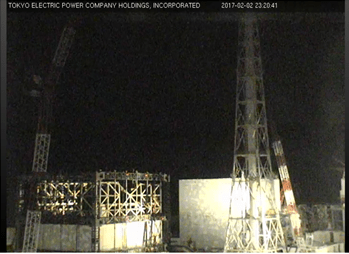
There is a near continuous stream of atmospheric emissions that can be seen nightly on the webcam around unit 3. I always presumed that the MOX remains of unit 3 reactor’s fuel were responsible for that stream of visible heat/steam.
Could slumped fuel from unit 2 have ended up moving toward unit 3?
Here is a screenshot from today of the emission stream:
Well, no way to know for sure but I do feel safe concluding that Daiichi’s mysterious missing fuel is probably dispersing in ground water, ocean, earth, and atmosphere….
Dec 18, 2015 – As I’ve mentioned previously on my blog, there was no word on the fuel … are in danger of collapse due to an earthquake or liquefaction of the …
Sep 28, 2012 – Majia here: When I listened to Arnie Gundersen’s recent interview and … 2012, the loose soil under Fukushima underwent liquefaction during a …
Jan 11, 2014 – Majia here: Ok so strontium levels in the ground water and in ocean … This explains why site liquefaction is occurring at the Daiichi site. So, we …
Jan 29, 2017 – The New York Times has a poignant article about the plight of US service men who were required to clean up Enewetak atoll, part of the …
Aug 28, 2016 – Liquefaction has been a risk for years now at the plant. It is amazing (what’s left of) the buildings are still standing…. Posted by Majia’s Blog at …
Mar 30, 2016 – [xv] Water saturation from the underground river and TEPCO’s injections contribute to ground liquefaction, which poses direct risks to the …
Feb 22, 2014 – The ground water saturation is contributing to ground liquefaction, which poses direct risks to the reactor buildings and common spent fuel pool …
Video footage of the inside of the No. 2 reactor at the Fukushima No. 1 Nuclear Power Plant has proved that it is more difficult than initially believed to decommission the tsunami-ravaged plant. The camera that was inserted into an area below the reactor’s pressure vessel shows a deposited substance near a foothold in the area. The substance is highly likely to be melted nuclear fuel.
Nearly six years have passed since the March 2011 Great East Japan Earthquake and tsunami that triggered the nuclear crisis. The fact that the condition of the inside of the reactor has been confirmed represents a step forward. However, analysis conducted by Tokyo Electric Power Co. (TEPCO), the operator of the crippled power station, shows that the levels of radiation in the reactor building are so high that someone would die within less than a minute if they were exposed to radiation inside the facility. The footage shows that the deposited substances are scattered around in a wide area of the structure. TEPCO had planned to introduce a robot equipped with a camera into the reactor building possibly by the end of this month to fully probe the condition inside, but the footage has forced the utility to reconsider the plan.
If the situation is left as it is, the time required to decommission and dismantle the power station, which is believed to take 30 to 40 years, could be prolonged and the estimated costs of decommissioning the plant, which has already been revised upward from the initial 2 trillion yen to 8 trillion yen, could further rise. TEPCO is required to foot the costs of decommissioning the Fukushima plant, but the expenses will be passed on to consumers who pay electric power charges.
The government and TEPCO should fundamentally review their responses to the nuclear disaster, such as the development of technologies necessary to decommission the plant and ways to reduce decommissioning costs.
Meltdowns occurred in the cores of the No. 1 to 3 reactors at the Fukushima No. 1 Nuclear Power Plant in the accident. According to the road map toward decommissioning the plant, drawn up by the government and TEPCO, the utility is supposed to determine a method to remove melted fuel at one of the reactors by the end of fiscal 2018 and begin work within 2021.
To do so, it is necessary to ascertain where and how deposits of melted fuel are scattered, but this remains unclear.
TEPCO hit a snag at the beginning of the recent survey on the No. 2 reactor. Still, the condition of the reactor is far better than those of the No. 1 and 3 reactors — which were badly damaged in hydrogen explosions, obstructing surveys of their interiors.
Reactor core meltdowns occurred in an accident at a nuclear plant on Three Mile Island in the United States in 1979. Work to remove melted fuel commenced six years after the outbreak of the disaster and was completed 11 years after the accident. Workers remotely controlled a device to remove melted fuel from the pressure vessel while filling the vessel with water to block radiation.
Work at the Fukushima plant is far more difficult than at the Three Mile power station because nuclear fuel has melted and leaked out of the pressure vessels of the No. 1 to 3 reactors. How and where the melted fuel will be stored has not been decided yet. The government and TEPCO should obtain knowledge both from Japan and overseas to develop technologies to store melted fuel.
In considering the road map toward decommissioning the plant, it should be kept in mind that the degree of progress in the work will affect the restoration of areas hit by the nuclear disaster and the prospects for evacuated residents to return to their homes. However, if an unreasonably tight schedule is created, it could increase the risks of worker accidents and exposure to radiation.
Although it is a difficult task, the government and TEPCO are required to ensure transparency and steadily overcome obstacles to decommission the crippled power station.
Some pages and websites choose to publish sensationalism about Fukushima, as a mean to draw big numbers of visitors, like flies on the sh@t, hooking the adrenaline kick hungry crowd to get there their daily junk dose of B.S.
Fukushima is a serious catastrophe, after almost 6 years it’s only at its beginning and will not be resolved after 100 years, the technology needed to clean-up 3 reactors’ meltdowns has not yet been invented.
The mainstream media are minimizing the scale of that still ongoing catastrophe, gagged by governments having their own economic and political priorities.
Those reactors are opened belly up and still spitting nonstop radioactive nanoparticles into our skies and environment, contaminating the food chain with many consequences not yet well known, being not properly studied, identified and quantified.
The nuclear lobby and their accomplices, are muzzling in many ways the scientific community, and there is no funding to be found for those studies to be made.
We have only few dedicated straight scientists, such as Tim Mousseau, Chris Busby and a few others who still believe science as being more important than their personal career and moneyed interests, who are not selling out to pressure and personal rewards. They do work hard to bring us the real facts, the hard facts, and with very little means. As an example the biologist Tim Mousseau has been the scientist making the highest number of field trips to Chernobyl and Fukushima to research the effects of radiation on the wild life there, always on a shoe string budget.
We also have many Japanese citizen-scientists on location in Fukushima, who betrayed by their government and the Japanese scientific community, are organizing themselves to measure radiation in their environment and in their food so as to protect themselves and their families.
Those are the people we must look up to, the people who dig for the facts and fight for the real facts to be known.
I refuse to deal in sensationalism, we will stick to facts, time passing by only facts can and will prevail.
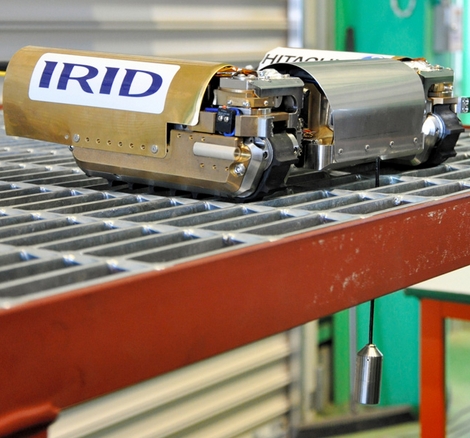
A new investigative robot, equipped with a censoring unit hanging through metal grating, is scheduled to be send into the No. 1 reactor at the Fukushima No. 1 nuclear power plant in the coming months. (Kohei Tomida)
HITACHI, Ibaraki Prefecture–Another robot has been developed for the elusive goal of locating melted fuel and surveying the interior of the No. 1 reactor at the Fukushima No. 1 nuclear plant.
A team of engineers and researchers from Hitachi-GE Nuclear Energy Ltd. and the International Research Institute for Nuclear Decommissioning revealed the robot on Feb. 3.
Tokyo Electric Power Co., operator of the plant, plans to deploy the robot into the No. 1 reactor before the end of March.
The robot will be fitted with a censoring unit mounted with a camera, dosimeter and lighting. Its purpose is to give TEPCO an idea of the location and condition of the melted nuclear fuel in the reactor.
Most of the melted fuel is believed to have fallen through the reactor’s pressure vessel, landed on the bottom of the surrounding containment vessel, and is soaking in cooling water about 2 meters deep.
The new robot will maneuver around metal grating originally set up for maintenance work about 3.5 meters above the bottom of the containment vessel.
At each of five survey points, the robot will lower the censoring unit through the grating. The unit can operate in water.
In April 2015, TEPCO sent two robots into the No. 1 reactor, but they could not locate the melted fuel.
One of them became stuck, and high radiation levels disabled the camera on the other. TEPCO abandoned the machines in the reactor.
On Jan. 30, a remote controlled video camera sent into the No. 2 reactor took what are believed to be the first images of melted fuel at the plant.
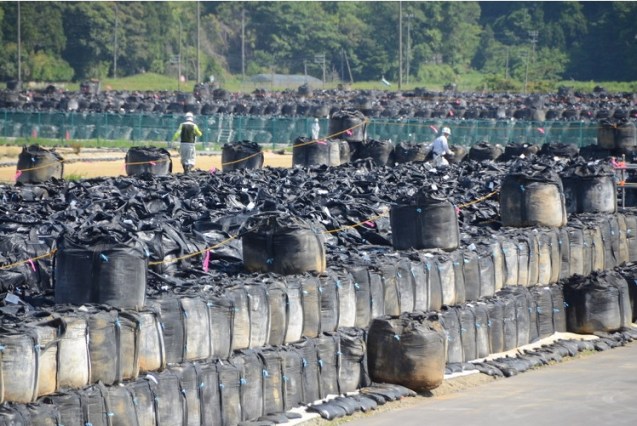
Black bags containing radioactively contaminated soil are seen piled up at a temporary storage site in Minamisoma, Fukushima Prefecture, in this June 2016 file photo. (Mainichi)
The radiation limit for soil contaminated by the Fukushima nuclear disaster in an experiment to reuse it in construction was lowered from 8,000 becquerels per kilogram to 3,000 becquerels per kilogram after strong opposition from a local mayor, it has been learned.
The experiment is to be carried out at a temporary storage site in Minamisoma, Fukushima Prefecture, where around 1,000 bags of contaminated soil will be opened, made into construction foundations, and their radiation levels measured. The experiment will be done to check, among other things, whether the radiation exposure dose remains at the yearly limit of 1 millisievert or less. The experiment will cost around 500 million yen. The results are expected to be put together next fiscal year or later.
From soon after the Great East Japan Earthquake in 2011, municipalities including Minamisoma asked the national government to separate out lower-radiation level concrete and other debris for reuse in things like groundwork for coastal forests used to defend against tsunami. At first, the Ministry of the Environment was negative about this, but in December 2011 the ministry allowed such reuse for debris with a limit of 3,000 becquerels per kilogram. According to documents released in response to a release of information request made by the Mainichi Shimbun, some 350,000 metric tons of this kind of debris have been used in Minamisoma and the towns of Namie and Naraha in projects such as groundwork for coastal forests.
Then in June last year, the Ministry of the Environment decided on a policy of reusing contaminated soil with 8,000 becquerels or less per kilogram in structures such as soil foundations for public works projects.
The same month, Minamisoma’s Mayor Katsunobu Sakurai visited then vice-minister of the environment Soichiro Seki, where he questioned Seki about the 3,000 becquerel limit that had been used until being replaced by the 8,000 becquerel limit. Sakurai reportedly called for the 3,000 becquerel limit to be used in the upcoming experiment in Minamisoma.
Sakurai says, “If they don’t use the 3,000 becquerel limit it is inconsistent. It doesn’t make sense for a ministry that is supposed to protect the environment to relax the standards it has set.”
The ministry confirmed to the Mainichi Shimbun that the experiment will only use soil up to the 3,000 becquerel limit, and said that the soil used will on average contain about 2,000 becquerels per kilogram.
In Mali Martha Lightfoot’s own words: ” The measuring capacity is just getting better and they are reaching parts of the containment they were unable to monitor before. I think it’s important not to confuse more accurate readings with the misconception that they indicate that the levels are rising. It is shocking enough to get an indication of how high the levels still are. And we may find, as technology improves, that parts of the containment are higher still. But, that still does not indicate that the levels are rising, just that our ability to design monitoring devices is getting better. “
As Majia Nadesan is saying in her own blog article : “A separate article published in The Asahi Shimbun notes that radiation levels in units 1 and 3 remain so high (higher than unit 2) that TEPCO is unable to investigate conditions in there: If confirmed, the first images of melted nuclear fuel at the Fukushima No. 1 nuclear plant show that Tokyo Electric Power Co. will have a much more difficult time decommissioning the battered facility. The condition of what is believed to be melted fuel inside the No. 2 reactor at the plant appears far worse than previously thought. …High radiation levels have prevented workers from entering the No. 2 reactor, as well as the No. 1 and No. 3 reactors at the plant. MASANOBU HIGASHIYAMA (January 31, 2017) Images indicate bigger challenge for TEPCO at Fukushima plant. The Asahi Shimbun, http://www.asahi.com/ajw/articles/AJ201701310073.html
If radiation levels are at 530 sieverts an hour inside unit 2, I wonder what conditions are like in the 1 and 3 reactors, which are described as even hotter? I can tell you from watching the reactors on the webcams for 5 plus years that atmospheric emissions from unit 3 have never ceased (as illustrated below far right side of screenshot)”. http://majiasblog.blogspot.fr/2017/02/fukushima-daiichi-unit-2-measures-530.html
Anyway in the meantime those 3 reactors are still belly button opened up spitting high radiation into our skies and environment, the reactor 1 and 3 even higher radiation than reactor 2.
“Radiation brain” was a pun that made the social media circuit after March 11, 2011, deriding people whose brains (nō) had become unduly contaminated with fears about radiation after the disaster at Tokyo Electric Power Company Holdings Inc.’s Fukushima No. 1 nuclear power plant. They had, people claimed, “radiation brains” (hoshanō), a kind of soft-minded hysteria that made them figures of fun but also figures of potential danger to society and the economy. Their lack of confidence in government regulation of foodstuffs, people argued, became the source of harmful rumors that hurt farmers and dairy producers in disaster-affected areas. Such citizens, usually mothers in charge of providing meals for their children, were reckless in their caution.
Aya Hirata Kimura, a sociologist and professor of women’s studies at the University of Hawaii at Manoa, presents case studies of mothers with such anxieties and examines citizens grappling with post-Fukushima food safety concerns in “Radiation Brain Moms and Citizen Scientists: The Gender Politics of Food Contamination After Fukushima.” Kimura does not make claims about the extent of actual dangers to the food supply, but she does argue that the reality of the post-disaster threat is far from certain. The government, in other words, may be right about the limited health risks posed by irradiated produce, dairy, and meat; but skepticism on the part of citizens is a rational, rather than a hysterical, response. She also examines the various constraints that made many citizens — mothers, in particular — turn to scientific activities such as running citizen radiation-measuring organizations rather than engaging in out-and-out criticism of government and industry responses to safety concerns.
Immediately after the disaster, many expected a surge of specifically anti-nuclear political activism in Japan, and indeed protests and demonstrations flourished in the spring and summer of 2011. However, just five years on from the worst nuclear disaster in decades, political activism remains a fringe activity. Part of what interested Kimura was why citizens seemed to be “more concerned than outraged.” As she noted recently, “so many seem to be perplexed why Japan, after the major nuclear accident, has not seen transformative politics.” Her book offers some answers to that question.
Kimura makes the point that avoiding confrontational politics and direct dissent is not, as is often claimed, a characteristic particular to Japanese culture. It’s a characteristic particular to neoliberalism. Neoliberalism is one of the key concepts that guides Kimura’s analysis, and she traces how the neoliberal shift to limited government, rule of the free market, and individualism has determined what kinds of demands citizens in post-Fukushima Japan can make of their government. In a neoliberal society, the government is no longer responsible for ensuring citizens’ rights to safety, economic factors rule in cost-benefit analyses and the good neoliberal citizen is willing to take on individual risk and make individual choices, while they are less willing to act collectively.
Alongside neoliberalism, Kimura introduces us to the concepts of scientism and post-feminism. Scientism indicates a tendency in which science holds authority in society to determine the “reality” of controversial and uncertain situations, although culture and society influence the creation and application of science itself. Post-feminism is the idea that systematic oppression of women has been eliminated and collective feminist activism is no longer necessary, since motivated individual women can empower themselves.
An example of how these three larger forces of neoliberalism, scientism and post-feminism play out in post-3/11 society and constrain citizen activism is the case of fūryōhigai, or harmful rumors. The term “fūryōhigai” apparently originated in the 1980s, and indicated a decline in seafood sales because of nuclear reactor accidents. After agricultural producers in areas near the distressed Fukushima No. 1 plant suffered economic losses, the term gained new currency and shifted blame onto concerned consumers, particularly “radiation brain” moms, and away from government and business interests. The prioritization of economic recovery and the individual consumer’s responsibility to participate in this effort reflected neoliberal priorities. The view of scientism insisted on the scientific authority of nuclear experts, although many of those experts had an interest in promoting nuclear power, and the science of post-Fukushima health impacts remains contested. Contradictory demands placed women at the center of controversies about food safety as mothers responsible for the health of their families but also as targets of gendered stereotypes of women as particularly unscientific and irrational, while the post-feminist social context deterred them from making collective political demands of the powers that be.
The role these three ideologies play in Kimura’s analysis might put off a nonacademic reader, but Kimura employs them to make the power dynamics to which we are all subject visible, much as her citizen scientists labor to make the invisible threat of radiation visible. Speaking about her book, Kimura noted that “all these ‘-isms’ tend to be normalized and taken for granted.” So scientism, for example, makes science’s objective authority something that is taken for granted in spite of the fact that science is shaped by social forces. Kimura works to make the ideologies of neoliberalism, scientism and post-feminism visible, because “invisibility is at the crux of their power. The more they are named, the less they can masquerade as apolitical.” Just because we cannot see these forces does not mean that they do not impact our world, and they are very real in their consequences for potential political activism.
Radiation Brain Moms and Citizen Scientists, by Aya Hirata Kimura. 224 pages Duke University Press.
Concerns raised by the Nuclear Regulation Authority (NRA) on how radioactive soil from the Fukushima nuclear disaster would be reused were omitted from the minutes of closed-door meetings on the issue, the Mainichi Shimbun has learned.
It has already come to light that comments from the Ministry of the Environment that could be interpreted as attempting to manipulate the conclusions of the meetings were left out when the minutes were publicly released. The latest revelation means yet another important part of the minutes is missing.
The meetings were held by the Ministry of the Environment between January and May last year with various radiation experts in attendance. In June, the experts decided to manage and reuse contaminated soil with levels of radioactivity under 8,000 becquerels of cesium per kilogram in public construction projects.
Related legislation reads “When deciding on technical standards to prevent radiation-related health problems, the Radiation Council must be consulted.” The publicly released meeting minutes quote an Environment Ministry representative as saying, “We need to think about the consultations with the council. When we discussed the issue with the NRA, it placed importance on our management (of the reused soil).” The quote shows that the ministry had talked to the NRA, which has jurisdiction over the council, about consultations with the body.
However, a source has disclosed that even though the ministry representative mentioned specific concerns brought up by the NRA, saying, “The Nuclear Regulation Authority was most concerned about where the soil will be used, and whether it might be used in the yards of regular households,” this comment was omitted from the minutes.
Furthermore, in a rough draft of the minutes obtained by the Mainichi Shimbun, during the fourth round of Environment Ministry meetings in February last year, an official stated, “Afterwards we will ask all committee members to review the meeting minutes. After that, during next fiscal year, we are thinking of receiving your support in dealing with the Nuclear Regulation Authority.” However, these words were deleted from the publicly released minutes.
The ministry was unable to give a satisfactory explanation for the concerns raised by the NRA, and so there has been no consultation with the Radiation Council to set health standards. However, according to both the ministry and the NRA, they have discussed the issue of consultations with the committee and agree they are not yet necessary.
According to internal rules created by the authority in December 2013, the Radiation Council only needs to be consulted when setting standards by law or relevant regulations. The standards decided through the ministry meetings are only “basic ideas” before they are set by law or regulations.
The ministry plans to reuse contaminated soil on an experimental basis. An NRA representative commented, “Once the plans for the experiment are in place, we understand that they will discuss the issue with us again.”
Even the existence of the closed-door meetings was originally not announced, but after repeated requests for information disclosure, the ministry revealed the meeting minutes in August last year. While the release was called a “full release,” comments including ones that could be taken as attempting to manipulate the discussion toward a conclusion of using 8,000 becquerels per kilogram as an upper limit when reusing soil were deleted from the records. After this came to light, Environment Minister Koichi Yamamoto said the minutes were “meeting summaries that only included the points of what was said.”
TEPCO is reporting measuring radiation levels of 530 SIEVERTS AN HOUR (10 will kill you dead pretty quickly) and has discovered a 2-meter hole in the grating beneath the reactor pressure vessel (1 meter-square hole found in grating):
TOKYO (Kyodo) — The radiation level inside the containment vessel of the No. 2 reactor at the crippled Fukushima Daiichi nuclear complex stood at 530 sieverts per hour at a maximum, the highest since the 2011 disaster, the plant operator said Thursday.
Tokyo Electric Power Company Holdings Inc. also announced that based on image analysis, a hole measuring 2 meters in diameter has been found on a metal grating beneath the pressure vessel inside the containment vessel and a portion of the grating was distorted.
…The hole could have been caused by nuclear fuel that penetrated the reactor vessel as it overheated and melted due to the loss of reactor cooling functions in the days after a powerful earthquake and tsunami on March 11, 2011 hit northeastern Japan.
According to the image analysis, about 1 square meter of the grating was missing.
…Images captured using a camera attached to a telescopic arm on Monday also showed part of the grating has gone. A further analysis of the images found a 2-meter hole in an area beyond the missing section on the structure.
A separate article published in The Asahi Shimbun notes that radiation levels in units 1 and 3 remain so high (higher than unit 2) that TEPCO is unable to investigate conditions in there:
If confirmed, the first images of melted nuclear fuel at the Fukushima No. 1 nuclear plant show that Tokyo Electric Power Co. will have a much more difficult time decommissioning the battered facility.
The condition of what is believed to be melted fuel inside the No. 2 reactor at the plant appears far worse than previously thought.
…High radiation levels have prevented workers from entering the No. 2 reactor, as well as the No. 1 and No. 3 reactors at the plant.
If radiation levels are at 530 sieverts an hour inside unit 2, I wonder what conditions are like in the 1 and 3 reactors, which are described as even hotter?
I can tell you from watching the reactors on the webcams for 5 plus years that atmospheric emissions from unit 3 have never ceased (as illustrated below far right side of screenshot):
There is some dispute about the recent high level of radiation measured inside the Fukushima Daiichi reactor 2, thanks to the Japan Times unprecise english translation of the Kyodo News Japanese language article.
They have been able to measure these highest radiation levels only now because they couldn’t get as close to where they think the melted fuel may be with monitors before. Not the highest levels ever present at the site. That would have been around the time of the accident, or soon after. The radiation levels at the site do not appear to be rising, they are just now able to get deeper inside the reactor containment before the monitors fail, and so they get better readings.
The Japan Times article’s title is ok: “Highest radiation reading since 3/11 detected at Fukushima No. 1 reactor”. Yes, it is the highest radiation reading found since 3/11 because since 3/11 Tepco had not been able to reach such deep place to measure the radiation there. So this recent reading is the highest found since 3/11.
The Japan Times article in itself does not mention directly any radiation increase or “spike. But their wording “has reached” in “The radiation level in the containment vessel of reactor 2 at the crippled Fukushima No. 1 power plant has reached a maximum of 530 sieverts per hour, the highest since the triple core meltdown in March 2011, Tokyo Electric Power Co. Holdings Inc. said” could be misconstrued as meaning that the high level recently found is resulting from an increase of radiation, when compared to the lower level previously found . Which is not the case. Their previous reading was lower because they had not been able to go that deep before to monitor radiation there.
The Japan Times article then misled some western media, such as the Guardian, Popular Mechanic and others to themselves publish misconstrued articles based on the Japan Times article as their source.
The Popular Mechanics article’s title was ok: “Highest Radiation Levels Since Meltdown Recorded at Fukushima” but their subtitle is entirely wrong and misleading: “Levels haven’t been this high since the actual meltdown in 2011.” That subtitle is wrong, the levels were maybe that high or even higher, but Tepco had not been able to reach there before to find out, to take such measure in that place, at that deep level. That subtitle is wrong, suggesting that there is an increase. Popular Mechanics misconstrued the article of Japan Times and drawed the wrong conclusion. http://www.popularmechanics.com/technology/infrastructure/a25034/radiation-spikes-fukushima-possible-breach/
The Guardian ‘s article title is in itself misleading: ” Fukushima nuclear reactor radiation at highest level since 2011 meltdown”. A title such as “Fukushima nuclear reactor radiation highest level to date found since 2011 meltdown” would have been better and more accurate. The added words “to date found” would clarify that it was maybe already there before but that it had not been found yet, because they had not been able to reach that place and that deep before to take such measure. In its text it fails to mention the real reason why the measure recently found is higher than the previous measure. This all results in the Guardian article saying that this highest recent measure compared to the lower previous one is due to an increase of radiation. This is absolutely wrong, a complete misconstruction of the real facts. https://www.theguardian.com/environment/2017/feb/03/fukushima-daiichi-radiation-levels-highest-since-2011-meltdown?CMP=share_btn_fb
And many other western media and websites went along and repeated the same blind misconstruction.
Thanks heavens there were two websites who noticed the error made by those mainstream media and many other websites. They stepped in trying to correct that misconstruction and to re-establish the true facts. The Simply Info Fukuleaks website and the Safecast website, thanks to both websites’ bloggers team for their vigilance and their efforts in keeping the facts straight.
We can’t say that there has been an increase in radiation because we do not know that. To know that we would need to have a previous measure at the same deep at the same place to compare both measures. But such previous measure that deep at that place we do not have, so it is impossible to draw any conclusion at this stage, only that it is very high.
Now what we really need is a second probe at the same deep at the same place, to confirm the first probe readings, but also to compare the recent readings and the next readings so as to assess if the radiation levels there are stable or not, if there will be an increase of radiation between the two probes or not…Until such second probing takes place, at this stage no one can say anything about any occuring increase…