NIRS Telebriefing: Arnie discusses Nuclear Disasters
Spring: The Season of Nuclear Disaster – Three Mile Island, Chernobyl, Fukushima Daiichi was the title of the April 4, 2017 tele-briefing hosted by the Nuclear Information and Resource Service (NIRS) and guest speaker Fairewinds’ Chief Engineer Arnie Gundersen. Hosted by Tim Judson, NIRS executive director, Arnie discusses the myths of atomic energy, the ins and outs of each disaster, and his own personal experiences with assessing the industry failures and magnitude of each disaster. At the end of his presentation, Arnie and Tim also answered questions from listeners in this enlightening segment.
Japan to scrap 5 more nuclear reactors
String of facilities approaching maximum life span
 Workers take apart a pump at Chubu Electric Power’s Hamaoka nuclear plant.
TOKYO — Five nuclear reactors in Japan were approved for decommissioning on Wednesday, pushing utilities and other companies to join hands to tackle both the great business opportunities and daunting technical problems involved with the process.
Two reactors at Kansai Electric Power‘s Mihama plant, as well as one each at Japan Atomic Power’s Tsuruga plant, Chugoku Electric Power‘s Shimane plant and Kyushu Electric Power‘s Genkai facility received the green light from Japan’s Nuclear Regulation Authority. The safety updates needed to keep them running beyond their mandated 40-year life span were deemed too costly.
Japan had 54 nuclear reactors before the 2011 meltdown at the Fukushima Daiichi nuclear plant. A total of 15, including the six at Fukushima Daiichi, are now set to be taken out of service. Another one or two will be brushing up against the 40-year limit every year, unless one-time, 20-year extensions are sought and granted.
Companies now face a pressing need to acquire expertise on dismantling reactors and disposing of radioactive materials. No commercial nuclear reactor has ever been decommissioned in Japan before, and utilities are looking for partners with the necessary capabilities.
Kansai Electric is seeking help from France’s Areva and Japan’s Mitsubishi Heavy Industries in decommissioning the Nos. 1 and 2 reactors at Mihama, particularly in decontaminating pipes and equipment. Japan Atomic Power and U.S.-based EnergySolutions signed an agreement last spring to cooperate on the former’s Tsuruga plant.
Japanese utilities are also beginning to work with each other. Kansai Electric entered a partnership last year with Kyushu Electric, Chugoku Electric and Shikoku Electric Power. The four plan to cut decommissioning costs by jointly procuring materials and sharing technology and staffers.
Other players are also angling for a piece of the pie. Two years ago, Mitsubishi Heavy set up a department specializing in dismantling nuclear reactors. The company was a key player in building the Mihama and Genkai reactors, and wants a lead role in taking them apart. Japanese general contractor Shimizu also signed a technical cooperation agreement with U.K.-based Cavendish Nuclear.
Utilities have increased their rates in order to raise the necessary funds to decommission the five newly approved reactors. They have already come up with about 160 billion yen ($1.47 billion) of the estimated 180 billion yen total. But the process will likely take two or three decades, and costs could easily grow.
The utilities may also face significant challenges to disposing of the roughly 27,000 tons of contaminated waste the five reactors are expected to generate. For example, Japan Atomic Power wants to bury less radioactive materials at the site of the Tokai nuclear plant, one of the earlier plants approved for decommissioning, but faces strong local opposition.
Relevant legislation has not been finalized either. Highly contaminated materials are supposed to be buried more than 70 meters below ground. But the Nuclear Regulation Authority has only just begun debating exactly how they should be buried.
http://asia.nikkei.com/Politics-Economy/Policy-Politics/Japan-to-scrap-5-more-nuclear-reactors
5 Reactors Decommissioning Approved

Decommissioning plans for 5 reactors approved
Japan’s nuclear regulator has approved plans submitted by operators of 4 power plants to decommission 5 aging nuclear reactors. The reactors are to be scrapped in a process lasting up to nearly 30 years.
The Nuclear Regulation Authority approved the plans at a meeting on Wednesday.
Under a government policy introduced after the 2011 nuclear accident at the Fukushima Daiichi plant, reactor lifespan was limited to 40 years in principle.
In 2015, utility companies decided to dismantle the 5 reactors. The 5 include 2 reactors at the Mihama plant and one at the Tsuruga plant, both in Fukui Prefecture, one at the Shimane plant in Shimane Prefecture and one at the Genkai plant in Saga Prefecture.
The plans call for first decontaminating pipes and dismantling facilities that are free of radioactive contamination.
The operators assume that the reactors and their buildings will be taken down and removed by fiscal 2045 at the latest.
At issue is where to put control rods, reactor parts and other radioactive waste. No site for a final disposal facility has been designated.
The regulator is checking another decommissioning plan for a reactor at the Ikata plant in Ehime Prefecture. The facility’s operator decided last year to dismantle it.
https://www3.nhk.or.jp/nhkworld/en/news/20170419_18/
Nuclear authority approves decommissioning plans for 5 aging reactors
TOKYO (Kyodo) — Japan’s nuclear authority approved decommissioning plans for five aging reactors at four power plants on Wednesday, the first such approvals since a government regulation was implemented after the 2011 Fukushima disaster to stop the operation of reactors beyond 40 years.
The five reactors are the Nos. 1 and 2 units at Kansai Electric Power Co.’s Mihama plant in Fukui Prefecture, the No. 1 unit at Japan Atomic Power Co.’s Tsuruga plant in Fukui Prefecture, the No. 1 unit at Chugoku Electric Power Co.’s Shimane plant in Shimane Prefecture and the No. 1 unit at Kyushu Electric Power Co.’s Genkai plant in Saga Prefecture.
While the utilities indicated it will take about 30 years to complete the decommissioning of each reactor, the disposal sites for the radioactive waste from the facilities have yet to be determined.
The decommissioning work will involve removing spent fuel from pools, dismantling reactors and demolishing surrounding facilities.
The regulation brought in following the 2011 disaster at Tokyo Electric Power Co.’s Fukushima Daiichi plant prohibits nuclear reactors from operating for over 40 years in principle, but the Nuclear Regulation Authority can approve the operation of a unit for up to 20 more years if the operator makes safety upgrades and the unit passes screening.
It was decided in March 2015 to scrap the five reactors, mainly due to profitability, as huge amounts of additional investment would be needed to meet the new safety requirements to keep the reactors operating beyond 40 years.
Meanwhile, the authority has given approval for the extended operation of the No. 3 unit at Kansai Electric’s Mihama plant as well as the Nos. 1 and 2 units at its Takahama plant in Fukui Prefecture, which are also around 40 years old.
The authority is currently examining Shikoku Electric Power Co.’s decommissioning plan for the No. 1 unit at the Ikata plant in Ehime Prefecture, after the utility decided in March 2016 to scrap the reactor.
In Wednesday’s meeting, the authority also decided that Japan Nuclear Fuel Ltd.’s uranium enrichment facility in the village of Rokkasho, Aomori Prefecture, satisfies regulatory requirements, virtually giving a green light for its operation. The decision will become official after consultation with the industry minister.
It will become the second fuel plant to clear new regulatory requirements after Global Nuclear Fuel-Japan Co.’s plant in Kanagawa Prefecture.
http://mainichi.jp/english/articles/20170419/p2g/00m/0dm/079000c
TEPCO Restaurant Opened to Public in Nuclear No-Go Zone

Okuma, Fukushima Pref., April 17 (Jiji Press)–A restaurant of a Tokyo Electric Power Company Holdings Inc. employee dormitory in an Fukushima Prefecture exclusion zone designated after the March 2011 nuclear accident was opened Monday to local residents who make temporary visits to their homes.
It is the first restaurant that can be used by residents of the town of Okuma, one of the host municipalities of TEPCO’s disaster-stricken Fukushima No. 1 nuclear plant, since the accident at the plant forced a blanket evacuation.
The staff restaurant, Okuma Shokudo, has about 240 seats and is open to the general public from 11:30 a.m. to 2 p.m., except on weekends and national holidays. It offers 21 menu items at the prices for TEPCO employees.
The restaurant operator, Torifuji Honten, is now based in the Fukushima city of Iwaki after evacuating from its head office in the town of Tomioka, also in the northeastern prefecture.
“We hope to contribute to disaster reconstruction if only a little bit,” said Takanobu Mori, 49-year-old manager of the TEPCO staff restaurant.
http://jen.jiji.com/jc/eng?g=eco&k=2017041700795
Children must learn respect for Fukushima evacuees

Many children of families who have fled Fukushima Prefecture after the 2011 nuclear disaster have become targets of bullying at school.
The education ministry said on April 11 that a total of 129 cases of school bullying in which children from Fukushima were victims have been confirmed over the past fiscal year.
Only four have been formally recognized as cases linked directly to the Great East Japan Earthquake and tsunami and the consequent catastrophic accident at the Fukushima No. 1 nuclear power plant. But the ministry said it has not tracked down all bullying cases involving Fukushima evacuees.
The confirmed cases are, of course, the tip of the iceberg.
In some past cases, the victims suffered various forms of verbal abuse.
“The nuclear plant exploded because of people like you,” is one example of verbal harassment hurled at a bullying victim. “Don’t come close to me. I don’t want to get contaminated with radiation,” is another.
These harrowing stories of bullying are reminiscent of the high-profile harassment case involving a boy who moved from Fukushima to Yokohama with his family after the accident. In that case, which made headlines in the media last autumn, the boy stopped attending classes.
“Behind the problem is a lack of understanding about radiation and the situations of evacuees,” said education minister Hirokazu Matsuno.
Children tend to be influenced by the words and attitudes of adults around them. The problem of rampant bullying of Fukushima evacuees reflects a lack of understanding among adults about the plight of these people.
But some Cabinet members have also made remarks that hurt the feelings of people in Fukushima Prefecture.
Masahiro Imamura, the minister in charge of rebuilding areas affected by the nuclear accident, for example, recently said so-called “voluntary evacuees,” or people who have fled areas not subject to evacuation orders, are “responsible for their lives.”
Nobuteru Ishihara, speaking about where to store contaminated soil from the crippled nuclear plant, said, “In the end, it will come down to money.”
Tamayo Marukawa, while voicing skepticism about the government’s goal for lowering radiation levels around the plant, said, “There are people who express anxiety no matter how much (radiation levels) are lowered, people who can be called the ‘anti-radiation’ crowd, if I may use an unusual term.”
Both made these remarks while serving as environment minister.
The government seems to be betting that an increase in the number of Fukushima evacuees who return home will help the reconstruction of the prefecture make progress, or at least make it look as if progress is being made.
The government’s desire and efforts to see that happen may be making Fukushima evacuees not returning home feel small.
If a lack of understanding is the cause of bullying of children from Fukushima, adults have the responsibility to give children opportunities to learn and think about the reality.
Collections of materials for ethics education compiled by the Fukushima prefectural board of education may help. Different versions designed for classes at elementary, junior and senior high schools are now available and can be obtained from the education board’s website.
The collections include materials based on real stories concerning such serious topics as the feelings of local residents who were forced to leave their homes, discrimination driven by fears of radiation and unfounded prejudice against agricultural products grown in Fukushima.
Reports and documentaries describing the lives of evacuees and the realities of Fukushima can also be used as teaching materials.
These topics and issues can also be dealt with along with those related to radiation in comprehensive learning or contemporary social studies classes.
People in Fukushima have made different decisions on such vital questions as whether they should leave their communities or stay and whether they should return home to make a fresh start or rebuild their lives where they are living now. That’s because there is no simple answer to these questions.
“We hope children will have honest discussions, recognize that they may disagree on some issues and learn to get along while respecting one another,” says a Fukushima prefectural board of education member.
The problem of bullying of Fukushima evacuees should be taken as a good opportunity for educators to tackle the challenge of offering classes designed to encourage children to think on their own instead of instilling ideas and views into them.
http://www.asahi.com/ajw/articles/AJ201704170027.html
Saga Assembly OKs Restart of 2 Genkai N-Plant Reactors, 2,000 Active Faults Beneath the Japanese Archipelago

Saga Assembly OKs Restart of 2 Genkai N-Plant Reactors
Saga, April 13 (Jiji Press)–The Saga prefectural assembly on Thursday voted to accept the restart of the No. 3 and No. 4 reactors at Kyushu Electric Power Co.’s Genkai nuclear power station in the southwestern Japan prefecture.
Following the decision by majority vote, Saga Governor Yoshinori Yamaguchi said he will make his final judgment as early as this month on whether his prefecture should approve the restart.
The mayor and the town assembly of Genkai, the host municipality of the power plant, have already given the green light. Local government procedures needed for reactivating the reactors will finish if the governor approves.
The resolution to accept the Genkai reactor restart was introduced mainly by members of the Liberal Democratic Party, which holds a majority in the assembly.
Two other assembly groups, including members of the Japanese Communist Party, submitted a resolution to call on Yamaguchi not to jump to a hasty decision.
http://jen.jiji.com/jc/eng?g=eco&k=2017041300725
One year after Kyushu quake, and 2,000 active faults beneath us
Novelist Michiko Ishimure, 90, was in Kumamoto when a megaquake jolted the southwestern region exactly one year ago.
“It felt as if my legs had been ripped off from the knees and I was being dragged over a grassy field. The excruciating pain was something I’d never experienced before,” she wrote for the Seibu edition of The Asahi Shimbun for the Kyushu region.
Ishimure blacked out while trying to make an escape after grabbing some food and a ream of writing paper.
Her injury was minor. But when the “main shock” of the 2016 Kumamoto Earthquake struck more than 24 hours after the initial jolt, she was taken to a hospital.
Upon discharge, she returned to the nursing home for the elderly where she was a resident. But her sense of alienation deepened.
“I’d never felt I really belonged there, to begin with,” she explained. “I think this feeling intensified–along with a sense of emptiness–after being shunted around because of the quakes.”
April 14 marks the first anniversary of the massive Kumamoto Earthquake. Many citizens are still unable to return to their prequake lives and are experiencing inconveniences of all sorts. More than 40,000 people are still living in emergency shelters and temporary housing.
A poem by Jun Tsukamoto depicts the plight of survivors fearing aftershocks and sleeping in their cars: “Unable to sleep and wide awake/ Night after night/ Parked cars cover the ground.”
Last summer, “Gendai Tanka” (Contemporary “tanka” poetry) magazine featured verse about the Kumamoto disaster. The pieces reveal the hardships of evacuees, as does this one by Rika Hamana: “My father starts shuffling his feet along a street at night/ The lavatory he is headed to is far away in the driving rain.”
The Kumamoto Earthquake claimed 50 lives. Another 170 died later and their deaths were ruled to have been quake related.
Even after the jolts subsided, survivors were still fighting in the midst of a long battle. How difficult it is to continue providing them the care they need to ensure they don’t feel alone and helpless.
About 2,000 active faults run beneath the Japanese archipelago. I try to imagine what it will be like to have my life completely disrupted and changed, even tomorrow. And I think about what I should do to ensure my own survival.
http://www.asahi.com/ajw/articles/AJ201704140015.html
“Fukushima, the Silent Voices”, a documentary with the Japanese culture in the background through the lens of a disaster
Lucas Rue has been working in the cinema industry for 15 years. He studied at the Ecole Supérieure de Réalisation Audiovisuelle in Paris. With multiple talents he worked on 60 films as assistant director, director, cameraman. Lucas has also been an actors coach for 10 years.
Lucas Rue and Chiho Sato met in 2010 on a shooting. Their passion for the 7th art unites them in filming and in life since they married in 2013.

Chiho worked for an audiovisual company after studying at an art university in Tokyo and living in Japan, she came to France in 2010. She studied French in Paris and then in Nice, then worked freelance on coordinating Japanese TV crews coming to France. She was assistant photographer, then assistant camera and has always been attracted by the cinema. Through her projects, Chiho aimed to bring another perspective on Japan, to have a more international vision. She wanted to see Japan from the outside, to look back at Japanese culture from a distance.
Lucas and Chiho speak passionately about their documentary “Fukushima, the Silent Voices“, a documentary born out of Chiho’s desire to talk about this event through the eyes of her parents, her parents very discreet on this subject. They hesitate to talk about this disaster even they are living next door.
Lucas explains that this documentary is not an anti-nuclear film. They do not try to prove this or that. Japanese culture is the backdrop of this film through the prism of this catastrophe, with the difficulties encountered in expressing personal thoughts and emotions in Japan. The team of this documentary is composed of enthusiasts around Lucas Rue and Chiho Sato.
Despite some difficulties and obstacles encountered in terms of production and filming, the reception of the public was more than warm. People have been touched and the film has achieved its objective since the public after watching their film comes out with more questions about that disaster and also thoughts about if it would happen to them.

This very personal film is the 2017 Gold Winner of the International Independent Film Awards festival which recently took place in California USA, and has been currently officially selected at two Canadian festivals.
In their upcoming projects, Chiho and Lucas have two scenarios for full length films pending production. I wish them all the best for the future.
Tepco’s latest plan for Kawashiwazaki-Kariwa plant envisions restart in 2019

Tokyo Electric is now aiming to restart the Kawashiwazaki-Kariwa nuclear plant in Niigata Prefecture in April 2019, sources say.
The company plans to include the goal in its financial outlook under a reconstruction program, the sources said Friday.
Restarting the giant plant is considered important to Tokyo Electric Power Company Holdings Inc.’s ability to recover from the triple meltdown at the Fukushima No. 1 nuclear plant in March 2011.
But the prospects for rebooting the plant are dim because it is opposed by Niigata Gov. Ryuichi Yoneyama.
The reconstruction plan is also expected to include Tepco’s commitment to pursuing integration with other companies in some areas.
Tepco is expected to draw up the new plan and file for government approval as early as this month.
Six years after Fukushima – women and children still suffer most
The Japanese government is trying to get back to normality after the Fukushima nuclear disaster, but the crisis is far from over for women and children, says Greenpeace. Thousands of mothers have sued the authorities.

Six years ago, the triple disaster – earthquake, tsunami and meltdown at the Fukushima Daiichi power plant – took the lives of almost 20,000 people and displaced more than 160,000 people from their homes. More than 80,000 people are still living in temporary accommodation.
The disaster had an enormous impact on all members of the affected communities, but to this day it is women and children who “have borne the brunt of human rights violations resulting from it,” according to a report by Greenpeace.
While some injustices faced by women and children were caused by policy failures in the immediate aftermath of the disaster, other women’s and children’s rights violations are a direct result of the current government’s plans to resettle residents to “heavily contaminated ares in Fukushima,” says Greenpeace.
In an effort to get back to normality as quickly as possible, the Japanese government is set to lift evacuation orders at the end of March and allow evacuated residents to return to areas close to the Fukushima power plant.
 Employees clean an elementary school in Fukushima. It’s scheduled to re-open in April.
Greenpeace warned, however, that radiation levels are still dangerously high and called on the government not to “pressure” residents to return to their contaminated homes, under threat of losing financial support. A year after an area is declared safe, the government will stop paying compensation to evacuees.
In March, Japan will also cut housing support for people who decided to move out although they were not under a government evacuation order.
“Cutting off housing support for self-evacuees threatens more than 10,000 households, potentially forcing many people back to contaminated areas against their will,” says Kendra Ulrich, Global Energy Campaigner with Greenpeace Japan. Ending compensation payments “even though radiation levels far exceed the long-term targets in many areas […] amounts to economic coercion and is a deliberate violation of the law and survivors’ human rights.”
“Atomic divorce”
The resettlement plans create a dilemma for those who refuse to go back to their former homes but are dependent on financial support, especially single mums. After the disaster, a lot of women separated from or even divorced their husbands, who chose to stay in contaminated regions because of their work, and evacuated with their children.
There are no official numbers on how many families split as a result of the disaster. But the phenomenon is common enough to have a name, “genpatsu rikon” – literally meaning “atomic divorce”.
 These mothers evacuated with their children from Fukushima prefecture.
Mothers are now faced with the choice between losing housing support or moving back to unsafe areas. In order to speed up the return of evacuees, the government decontaminated corridors and islands instead of entire areas, effectivley creating “an invisible, open-air prison for citizens to return to,” says Greenpeace.
Decontaminated zones often consist of 20 meter strips along roads, around houses and agricultural fields. This poses a health threat as the returnees would be surrounded by contamination.
Mothers are worried about their health and the development of their children. Noriko Kubota, a professor of clinical psychology at Iwaki Meisei University, believes that living in “safe zones” could have a long-lasting negative impact on kids.
“If children need to stay inside and cannot run around outside freely, that would impact their psychological development, more specifically their skills of interacting with each other and controlling their emotions among others,” Kubota told DW.
Mothers sue government
Women are, however, not only silent victims in this disaster. Thousands of mothers have together filed lawsuits against the Japanese government to fight for the continuation of housing support and fair compensation. They also demand accountability for the disaster from the government and Tokyo Electric Power Co. (TEPCO), the company running the Fukushima Daiichi plant.
 Ms Horie is sueing the government for fair compensation.
“I never imagined becoming a plaintiff myself. I’m going to court now for my children and for the next generation,” Ms Horie told Greenpeace. She moved with her children from Fukushima to Kyoto, where she filed a class action suit together with other mums. “Back then, they said on TV that the accident wouldn’t affect our health immediately, but it might affect my kids in the future. That’s why I decided to evacuate.”
Women who left contaminated areas have been “labeled as neurotic or irrational,” says Greenpeace. Their concerns were dismissed both by their partners and the government. The lawsuit is not only about financial compensation but also for moral satisfaction.
“I want to stand in court, knowing that I am right to evacuate my child,” says Ms Sonoda, who moved with her child from Fukushima to England. “We are right.”
http://www.dw.com/en/six-years-after-fukushima-women-and-children-still-suffer-most/a-37871135
As I See It: Support for ‘voluntary evacuees’ insufficient but not too late to start
Kurumi Sugita: “I do not agree with the following part of the article.
“Radiation levels in Fukushima Prefecture dropped significantly shortly after the outbreak of the disaster, and in some areas, radiation levels are not much different from those in the Kansai region, where I live. “
There exists at least three problems which are related to each other:
1) you shouldn’t base your judgement only on airborne radiation measurements. We should look at the soil radio contamination density which is more reliable.
2) the official figures of airborne radiation measurements are average figures, which annihilates the problem of hotspots.
3) the governments do not acknowledge the risk of internal radiation and its health hazards.
All in all, the so-called “voluntary” evacuees have good reasons to keep evacuated and it is their basic human right.”

Friends help an evacuee (foreground) move in Osaka’s Suminoe Ward, ahead of the cutoff date for free housing, on March 18, 2017.
As I See It: Support for ‘voluntary evacuees’ insufficient but not too late to start
So-called “voluntary evacuees” who fled Fukushima Prefecture due to the ongoing nuclear crisis were cut off from free housing services at the end of March.
Since last fall, I have been reporting on the issue of termination of free housing for “voluntary evacuees” — those who evacuated from Fukushima Prefecture out of radiation concerns, even though their places of residence did not come under the government’s evacuation orders — and have met many evacuees who faced termination amid straitened circumstances and with no prospects of living independently.
Six years have passed since the outbreak of the nuclear disaster, and I believe that insufficient assistance provided by the central government, the Fukushima Prefectural Government, and the municipalities to which Fukushima Prefecture residents evacuated led to the current state of affairs.
Following the onset of the nuclear crisis at Fukushima No. 1 Nuclear Power Plant in March 2011, some Fukushima Prefecture residents who did not live in areas designated by the central government as no-go zones “voluntarily” evacuated to other areas of Fukushima Prefecture and beyond. The Fukushima Prefectural Government regarded the homes such evacuees chose to live in as “temporary housing” provided to victims of disasters, and covered their rent. Unlike evacuees from areas designated as no-go zones, most “voluntary evacuees” have not been eligible for compensation from Tokyo Electric Power Co. (TEPCO), the operator of the stricken Fukushima nuclear plant, leaving payment for housing from the Fukushima Prefectural Government as the only assistance such evacuees received. In June of 2015, however, the prefectural government announced that it would be terminating such assistance at the end of March 2017, saying that “an environment for leading everyday life in Fukushima is in the process of coming together.”
Radiation levels in Fukushima Prefecture dropped significantly shortly after the outbreak of the disaster, and in some areas, radiation levels are not much different from those in the Kansai region, where I live. However, many former Fukushima prefectural residents are still concerned with radiation, and among some families, children do not want to move back to Fukushima because they’ve made friends where they live now. As of October 2016, there were approximately 10,000 households of “voluntary evacuees” from Fukushima Prefecture. This spring, many of those households were faced with the difficult question of whether to move back to their hometowns, or pay out of pocket in order to continue life where they are.
What I took from reporting on the issue is the polarization of “voluntary evacuees.” Those who have been able to adapt to life where they’ve evacuated to and rebuild their lives said they wanted to leave behind their status as “evacuees.” Some even said they’d become leaders of neighborhood community associations.
Meanwhile, others said they couldn’t sleep at night because they were unable to find affordable housing, or that they didn’t have the funds to move. Among the latter were those with family members who have disabilities, or members who are from other countries and do not speak Japanese well — in other words, families who were vulnerable even before the outbreak of the nuclear disaster. I learned of cases in which people’s lives turned for the worse after they evacuated. For example, there have been cases of divorce that resulted after mothers evacuated with their children, leaving the father behind. Meanwhile, other evacuees developed mental illness or suffered strokes. Such evacuees needed assistance that was finely tuned to their individual needs in the areas of employment, medical care and education. However, there were many instances in which I felt they were not receiving sufficient care.
A 57-year-old man who “voluntarily” evacuated from the city of Fukushima to an Osaka municipal residence, remained isolated in a corner of the massive city for 4 1/2 years after the outbreak of the disaster. The man has a visual impairment that has qualified him for level-1 physical disability certification. He is not completely blind, but to read documents, he must step out onto the veranda for natural light and use a magnifying glass. With his disability, it is nerve-racking for him to go out alone in an unfamiliar city. His South Korean-born wife, 62, who helps him with his everyday life, does not read or write Japanese well. Because of this, he rarely obtained information from documents that were delivered to him from administrative offices or support organizations.
He thus remained unable to receive assistance, and was bogged down by debt that he incurred from moving and purchasing household furnishings. He didn’t even learn about the termination of free housing until six months after the Fukushima Prefectural Government made the announcement. Subsequently, based on the advice of a supporter who visited him at his home, he transferred his residency registration to the city of Osaka, and began receiving the city’s support services. However, he still has mixed feelings toward administrative agencies. “They had to have known about my visual disability. Whether it be the Fukushima Municipal Government or the Osaka Municipal Government, if someone had made the effort to inform me, I wouldn’t have had to suffer as much as I did,” he said.
In fiscal 2016, the Fukushima Prefectural Government and the municipalities to which Fukushima prefectural residents evacuated made individual visits to “voluntary evacuees.” They should have made the visits an opportunity not only to listen to residents’ concerns about housing after they were cut off, but also to help map out plans for households under straitened circumstances to become independent. But that was not necessarily the case.
A woman in her 50s who, with her child, evacuated from the Fukushima Prefecture city of Koriyama to a Tokyo public housing complex, was emotionally beaten down after constantly being reminded by housing management that she and her child were to leave by the end of the 2016 fiscal year. The woman said that she was even told that she could be hit with a lawsuit if she did not move out of the building.
The dedication with which local governments took the effort to visit evacuees differed from municipality to municipality, and at least one municipal government did not send staff to visit evacuees until three months before the free housing service was brought to an end. To make matters worse, many municipal governments were sending staff not from their welfare departments, but from their public housing departments to make the visits. Under such circumstances, criticism against municipal governments for lacking a commitment to provide comprehensive support to evacuees is hard to refute.
Another thing that caught my attention as I covered this issue is that a large number of evacuees are apprehensive about going on public assistance. A mother and child who evacuated to the city of Osaka declined advice to apply for welfare. They said they did not want to become a burden to the state, and eked out a living on an 80,000-yen monthly income. However, public assistance exists precisely for people like this family. Municipalities that have dispatched staff to make individual visits to evacuee households, and are abreast of which households are in dire straits, should actively try to dispel misperceptions and prejudice about welfare, and help those people receive the assistance they need.
I believe that the evacuees’ original municipalities of residence and the municipalities to which they evacuated are both responsible for the fact that they were unable to receive sufficient support before free housing was shut down. The Fukushima Prefectural Government assumed that the provision of housing assistance would suffice, while municipalities to which the residents evacuated had a latent notion that the evacuees weren’t “real” residents of the municipality.
It’s not too late, though. Both parties should collaborate and commit to closely assisting those facing grave hardships achieve self-reliance.
http://mainichi.jp/english/articles/20170413/p2a/00m/0na/012000c
The Fukushima Evacuees Future
End of March 2017 the Japanese government pretends that the Fukushima disaster is over, ending the compensation and housing programs, forcing the evacuees to return to the contaminated towns close to the Fukushima Daiichi nuclear disaster site.
Masahiro Imamura, the reconstruction minister, while asked multiple questions about the plight of those classified as voluntary evacuees did expose the government opinion about the disaster’s victims, shocking all the journalists by his insensitivity. During that interview the reconstruction minister got angry with a reporter, ordering him to get out and to never come there again.
The government is encountered wide criticism for its handling of evacuees issue. To raise the radiation exposure limits for all people included children to that of nuclear plant workers has been condemned worldwide.
Those classified as voluntary evacuees are the people who evacuated from the regions of Fukushima that were not under official evacuation orders. Plus as more towns are now reopened, their evacuation orders lifted, those people who do not return are now becoming considered voluntary evacuees as well. The government provided housing assistance for voluntary evacuees ended in March. Asked about the government position on evacuees choosing to not return home Imamura sais that if they chose to not return to their home town they should take full responsibility for their own actions.
Japan’s government has done everything possible to remove all possible other options for evacuees, to force the evacuees to return to live in their contaminated towns. Compensation was ended for many. Housing programs have also ended, and temporary housing units are scheduled for closure, while at the same time many of the reopened towns lack sufficient services and many homes are heavily damaged, abandoned as they were since 2011.
Decontamination efforts to reduce radiation levels have not been very successful. With maybe a low radiation level only in the town center, with a radiation monitor set on concrete, but around town still many locations with unsafe levels. Many of those towns close to Fukushima Daiichi nuclear plant still have no evacuation plan in case of further events.
The nuclear plant site remains a considerable risk. Work to dismantle sections of the damaged reactor buildings can release radioactive dust to the wind. Risks of hydrogen explosions, radiation releases or criticalities will remain as long as the site exists in its current state or has highly radioactive materials on site. To force the people back to live in close proximity to the site just puts them at further risk.
Imamura faced with a petition calling for his resignation tried to apologized in a more nuanced tone but the government policy remains. Prime Minister Abe dismissed calls for Imamura to resign.
https://www3.nhk.or.jp/nhkworld/nhknewsline/quotesoftheday/20170405/
IAEA chief urges global support for decommissioning Fukushima plant
“Efforts to scrap the nuclear plant “extremely difficult” an understatement for yet impossible.
This is an admission . After 6 years wasted in lies and obfuscation, they finally admit that the Fukushima Daiichi nuclear disaster is not resolved, far from being resolved, that they can’t handle it on their own, and need all the help they can get from the international community to find solutions to contain this major nuclear disaster.

International Atomic Energy Agency chief Yukiya Amano has called for international cooperation in the decommissioning of the crippled Fukushima No. 1 nuclear complex.
“It is important to gather as much knowledge as possible from around the world and engage in the (decommissioning) with the cooperation of the global community,” Amano said at a news conference in Tokyo on Tuesday, calling efforts to scrap the nuclear plant “extremely difficult.”
While reiterating his agency’s support for dealing with the Fukushima plant, he said getting the international community to work together will serve as a good “reference” in the event other countries carry out their own decommissioning work.
The Fukushima crisis, the world’s worst nuclear disaster since the 1986 Chernobyl disaster, resulted in meltdowns at three reactors after a powerful earthquake and tsunami on March 11, 2011.
Decommissioning the crippled reactors is expected to take 30 to 40 years and the total cost has been estimated by the Japan Center for Economic Research, a private think tank, at ¥11 trillion ($98.9 billion), while a government panel estimated the total cost at ¥8 trillion.
Amano also expressed concern over the threat to regional security posed by North Korea’s repeated nuclear tests and missile launches, saying the IAEA was ready to immediately send inspectors to North Korea, even for a brief period.
In 2009, North Korea kicked out the IAEA’s monitoring staff from its Yongbyon nuclear facility. Last year alone, North Korea conducted two nuclear tests and test-fired more than 20 ballistic missiles.
Show 10 – Fukushima 311 Watchdogs – Fukushima Disaster
Sorry folks for my thick french accent in this interview, but most important is the message itself, not the bearer. Plus this is quite new to me…

Link to the podcast show : http://ahk42.com/podcast/show-10-fukushima-311-watchdogs-fukushima-disaster/
About Herve Courtois:-
Because my 30-year-old Japanese daughter was living in Iwaki city, Fukushima Prefecture, on March 11 2011, the Fukushima Daiichi Nuclear plant disaster abruptly awoke me to the dangers of nuclear and also to the omnipresent omerta in the mainstream media exerted by the powerful international nuclear lobby and various governments.
Visiting my daughter in Iwaki just 3 months after the start of the catastrophe, I was surprised by how the people on location were kept ignorant about what was really taking place, about the gravity of the dangers they faced, and about the possible protective measures they should take to minimize the risks to their life.
After a one-month visit, returning home to France, I looked for information and knowledge on the Internet and on the social networks, then became active myself in sharing that information and knowledge with others, and active in the French and International Anti-Nuclear movements. 3 and a half years later, the Fukushima catastrophe is still ongoing, and its cover-up has been partly exposed, but we still have to struggle to make the truth prevail over their many lies. 3 years later I am still here sharing information.
From June 2011 to July 2012, I was the main administrator of the Fukushima 311 Watchdog FB group, its FB page and its first blog. In July 2012, after a very intensely active first year, I burned-out, so I closed the FB group and its Internet blog, keeping only its FB page going up to the present:
In August 2012 I founded a new group, The Rainbow Warriors FB group which is still active:
I chose the alias of D’un Renard (“from a fox” in French) so as to not be identified by the Japanese government for my anti-nuclear activities, and eventually blacklisted as an undesirable alien, which would prevent me from entering Japan and continuing to visit my daughter.
I believe it is time for me to open again a new Fukushima 311 Watchdogs blog now, as the Fukushima catastrophe still goes on, to reach more people with our information, for people to learn about Fukushima and its continued spitting of contamination into our environment worldwide through the Jet Stream, the constant dumping of radioactive contaminated water into the Pacific Ocean, and its contamination of our food chain, with all the health consequences that we may predict.
Governments are unwilling to learn the lessons from Chernobyl, Three Mile Island, and Fukushima. The people’s lives are always secondary to government priorities, economics and political expediency. People must learn to protect themselves as no one informs them of the true facts nor protects them.
Fukushima is here with us.
The Rainbow Warriors group on Facebook
The Fukushima 311 Watchdogs page on Facebook
Media for the show:-
The Facebook page about the documentary film Les voix silencieuses (The silent voices) they have 3 versions, one in Japanese, one in french, one in English. LINK
Silent Voices Website LINK
About the documentary film “Fukushima the silent voices” LINK
http://ahk42.com/upcoming-guest-fukushima-311-watchdogs-herve-courtois/
Fukushima’s Upcoming Olympics

Japan will hold soccer and baseball events in Fukushima Prefecture for the Tokyo 2020 Olympics. This is not a spoof. Effective March 2017, the Japan Football Association displaces Tokyo Electric Power Company’s emergency operations center at J-Village, the national soccer training center before the nuclear meltdown occurred.
To naysayers that say this is a joke, the answer is ‘no this is not a joke’. It is absolutely true Olympic events will be held in Fukushima Prefecture, thereby casting aside any and all concerns about the ongoing nuclear meltdown; after all that’s history.
Or, is it?
Here is the announcement as carried in The Japan Times some months ago: “The men’s and women’s national soccer teams for the 2020 Tokyo Olympics will use the J-Village national soccer training center, currently serving as Tokyo Electric Power Co.’s forward base in dealing with the Fukushima nuclear crisis, as their training base, the Japan Football Association revealed Saturday.”
For those who missed the past few classes, Fukushima is home to the worst industrial accident in human history as three nuclear reactors experienced 100% meltdown, the dreaded “China Syndrome.” Molten core, or corium, in all of the reactors, highly radioactive and deadly, frizzles robots. Tokyo Electric Power Company (TEPCO) says it may take 40 years to clean up the disaster zone, but that is a wild guess.
Nobody on planet Earth has any idea where the radioactive molten cores are, within the reactor containment vessels or burrowed into the earth, and/or what happens next, e.g., there’s speculation that Unit #2 is rickety and could collapse from another big earthquake (Japan is riddled with earthquake zones, experiencing an earthquake on average every day) thus collapsing, which leads to an untold, massive disaster, rendering the city of Tokyo uninhabitable.
According to Dr. Shuzo Takemoto, Engr. / Kyoto University, February 2017: “The Fukushima nuclear facility is a global threat on level of a major catastrophe… The problem of Unit 2… If it should encounter a big earth tremor, it will be destroyed and scatter the remaining nuclear fuel and its debris, making the Tokyo metropolitan area uninhabitable.”
Numerous efforts by TEPCO to locate the melted cores have been useless. As of recently: “Some Nuclear Regulation Authority members are skeptical of continuing to send robots into reactors in the crippled Fukushima No. 1 plant to collect vital data on the locations of melted nuclear fuel and radiation levels… investigations utilizing robots controlled remotely generated few findings and were quickly terminated” (Source: Nuke Watchdog Critical as Robot Failures Mount at Fukushima Plant, The Asahi Shimbun, March 24, 2017).
All of which inescapably brings to mind the following question: How could anybody possibly have the audacity to bring Olympic events to the backyard of the worst nuclear meltdown in history whilst it remains totally 100% out of control?
Answer: Japan’s PM Shinzō Abe and the International Olympic Committee (IOC).
According to Naohiro Masuda, the head of decommissioning, TEPCO does not know how to decommission the nuclear facilities. Meanwhile, ongoing radiation is a constant threat to air, soil, food, and water, e.g., state inspectors have discovered deadly high levels of cesium pooling at the base of Fukushima’s 10 big dams that serve as water reservoirs (drinking water and agriculture). For example, Ganbe Dam 27,533 Bq/kg and Mano Dam at 26,859 Bq/kg whereas Japan’s Environment Ministry’s safe limit for “designated waste” is set at 8,000 Bq/kg. That limit is for “waste,” not drinking water. (Source: High Levels of Radioactive Cesium Pooling at Dams Near Fukushima Nuke Plant, The Mainichi – Japan’s National Daily Since 1922, September 26, 2016.)
Japanese officials are ignoring the extraordinarily high levels of cesium at the bottom of the dam reservoirs because the top water levels do meet drinking water standards. The prescribed safe limit of radioactive cesium for drinking water is 200 Bq/kg. A Becquerel (“Bq”) is a gauge of strength of radioactivity in materials such as Iodine-131 and Cesium-137. As it happens, Cesium-137 is one of the most poisonous substances on the face of the planet.
Additionally, open storage and incineration of toxic and radioactive rubble is ongoing throughout the prefecture. In fact, the entire prefecture is a toxic warehouse of radioactive isotopes, especially with 70% of Fukushima consisting of forests never decontaminated, yet the Abe administration is moving people back to restricted zones that Greenpeace Japan says contain radioactive hot spots.
According to Greenpeace Japan, which has conducted 25 extensive surveys for radiation throughout Fukushima Prefecture since 2011: “Unfortunately, the crux of the nuclear contamination issue – from Kyshtym to Chernobyl to Fukushima- is this: When a major radiological disaster happens and impacts vast tracts of land, it cannot be ‘cleaned up’ or ‘fixed’.” (Source: Hanis Maketab, Environmental Impacts of Fukushima Nuclear Disaster Will Last ‘decades to centuries’ – Greenpeace, Asia Correspondent, March 4, 2016).
With the onset of the Fukushima Diiachi meltdown, the Japanese government increased the International Commission on Radiological Protection guidelines for radiation exposure of people from 1 millisievert (mSv) per year up to 20 mSv/yr. As such, according to the standards set by the International Commission on Radiological Protection, ICRP Publication 111, Japan’s Olympics will expose Olympians and visitors to higher than publicly acceptable levels of radiation. After all, the emergency guideline of 20 mSv/yr was never meant to be a long-term solution.
With the onset of Olympic venues in Fukushima, maybe that will open the way for the 2024 Olympics in Chernobyl. But, on second thought that will not work. Chernobyl’s Exclusion Zone is 1,000 square miles (off limits for hundreds, maybe thousands, of years) because of an explosion in one nuclear power plant that is now under control whereas Fukushima has three nuclear meltdowns that remain, to this day and into the unforeseeable future, radically out of control and extremely hazardous.
Mystifying and Confusing?
Yes, it’s mystifying and confusing, but the games go on.
http://www.counterpunch.org/2017/04/12/fukushimas-upcoming-olympics/
Fukushima’s Ice-wall Blossoming or Not?

Following the Fukushima nuclear disaster of 2011, it was rapidly discovered that owing to the unfortunate location of the plant and its construction, its buildings’ basements had become flooded by groundwater ingress, which subsequently became highly contaminated. In order to avoid reverse diffusion of the contaminated water into the environment, those managing the site were compelled to continually pump out and treat the contaminated water, at a rate commensurate with its inflow. It was anticipated or perhaps it would be better stated as ‘earnestly hoped’, that by keeping the water level in the flooded building basement below ground water levels that contamination would not defuse out of the flooded basement. Naturally as a consequence TEPCO are accumulating and endeavouring to store and decontaminate the net amount of water ingress each day.
To facilitate containment necessary for the safe decommissioning of the immediately contaminated reactor buildings in September 2013 TEPCO commissioned the construction of their controversial ‘ice-wall’.[1] Installation of the facilities to create the ice-wall commenced in June 2014 and was completed on February 9, 2016 at an estimated to cost some ¥34.5 billion (circa $339 million). Activation was on March 31, 2016, with commencement of the freezing of the seaward side wall. Freezing of the land-side wall commenced on June 6, 2016, with the secondary phase of sealing the last openings in the land side wall commencing on December 2, 2016. At this point we should note that the ice-wall in not penetrating to the depth of the aquifer, has no base to its containment, thus the wall is little more than a skirt, with water free to percolate in and out from below the contaminated site.
We now find ourselves in the spring of 2017, with the ice-wall’s chillier plant having run flat out for a year with seemingly little net impact on water ingress. Frustrated by this apparent lack of progress, on December 26, 2016 the Japanese Nuclear Regulatory Authority (NRA) citing “limited, if any effects,” advised TEPCO that the “frozen soil wall” should be relegated to a secondary role in reducing contaminated groundwater at the Fukushima No. 1 nuclear plant.[2] Yet TEPCO still persisted in asserting that the ice-wall was effective stating “We are seeing certain results.” Which begs the questions: What results were they seeing and as TEPCO’s response would suggest, have the NRA been too presumptive in dismissing the ice-wall’s impact and groundwater ingress? Or perhaps TEPCO’s engineers, being so bought into their radical ice-wall concept they don’t want to ‘lose face’ or perhaps they have simply lost the plot?
In a bid to head of criticising of their activities for being less than transparent and tardy in properly advising the public, TEPCO have conveniently put certain of their findings into the public domain, in the form of press releases.[3] From this data, it’s possible to get a rudimentary grasp of what’s going on beneath TEPCO’s ice-wall. Regular updates on volumes of contaminated waters pumped from drainage wells and the reactor buildings’ basement, along with local rainfall have been regularly published. These indicated the seasonal cycle of rainfall in the Fukushima area and further show a relationship between local rainfall and the volumes of water, (Figure 1).
Figure 1

Working on the basis of the limited available data and an anticipated lag between rain falling and its impact on groundwater, and assuming a direct relationship between water ingress and the total amount of water transferred or pumped out of the system, we can drive a relationship between the averaged daily water transfer (a measure of approximate water ingress) and the rainfall total for the prior month, (Figure 2). These criteria show very plausible cause effect linear correlation (i.e. of the type, y = mx + c), (Figure 3). Thus, we can envisage the contributions to groundwater flow within the aquifer beneath Fukushima being comprised of two portions (a) a large steady flow arising from rainfall which may have fallen years to decades ago on the mountains to the west of the site and equating to the linear equation’s constant and (b) a highly variable amount of flow arising from recent rainfall, predominantly within the last month.
Figure 2

Figure 3

Whilst the linear relationship between the phenomena is simplistic, on the available data application of 2nd or 3rd order polynomial curve fitting does not give any significant improved correlation coefficient (R). Given we have identified the correlation and observe seasonality, we can factor out the seasonality and project rolling annualised rainfall and water transfer (Figure 4).
Figure 4
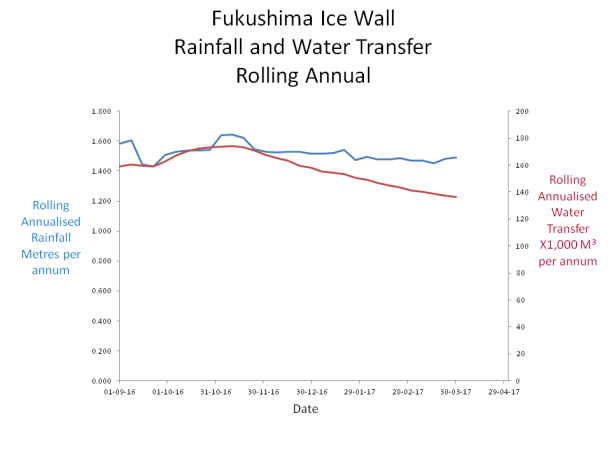
Within the scope of natural variance, the annualised rainfall at Fukushima shows no significant long term trend, being flat and circa 1.5 metres per year. The water transfer level does show some improvement and notwithstanding the slightly higher than average autumnal rains in 2016, water transfer levels are on the decline. Alas given the magnitude of that decline in relation to that hoped for by the ice-wall’s advocates to 50 tonnes per day, it was understandable that the NRA were rather less than impressed.
We also have to consider that our original correlation between rainfall and implied water ingress was conducted on all available data. The reality is several operational events were being executed over the period, such as the commencement of 24 hour pumping from inland relief wells with the aim of reducing groundwater around the stricken buildings, as well as the phased installation of the ice-wall itself. Thus our initial correlation is a composite of parallel events. If we reapply our linear relationship model on a rolling 12 monthly period, to exclude any rainfall seasonality, we see some interesting features, (Figure 5).
Figure 5

Had the ice-wall achieve a positive effect we should observed both a reduction in total amount of water transferred (y) being made up by a reduction in the overall basal flow (c) and of course a reduction in the recent rainfall component as reflected in a reduction of its independent variable (m). We see a reduction in apparent basal flow. As this reduction has occurred in isolation with the independent variable increasing over time, we can attribute reduction in ‘c’ in good measure to the impact relief wells. However, the overall amount of water being pumped out of the stricken buildings has remained high and it has done so because the aquifer has become more susceptible to the impact of recent rainfall. This suggests that the aquifer adjacent the site has become more porous and not less porous over the last few years. Had the ice-wall had a positive effect, a decline in the independent variable ‘m’ over time should be observed.
I would conjecture that if such is the case what could have caused this effect. It is possible that the installation of the coolant pipe-work has caused significant sub-soil disturbance, coupled with the degradation of the substrate rock texture by ground heave. The above should effectively have been self repaired when the ice-barrier froze. However, in this circumstance, owing to the size of the ice-wall and it lack of capacity to freeze the entire depth of the aquifer, it is likely that the aquifer disruption at its margins has resulted in increased porosity in the aquifer directly beneath the wall. Furthermore, given that the wall is incomplete and operating at the extent of its capacity, and that the site is subject to seasonal warming, and has had operational outages it is highly likely that the freeze thaw cycling peripheral to the ice-wall has cause deterioration to the aquifers subsoil texture and cohesion, thereby giving rise to localised increase porosity of the aquifer. As such I am not of the opinion that the installation of the ice-wall has had a ‘limited impact’. I believe it has had a ‘significant and negative impact’ on the porosity of the aquifer local to the site of contamination, and I believe it has added circa 20% to the volume of contaminated water generated since its installation.
But there again, that’s just one persons musings and opinion, and I dare say other will disagree and think I’m writing bollocks. Either way, I would be fascinated to see what “certain results” the TEPCO engineers saw. And if what they saw was good, I’d like a double of whatever they’d been drinking…
Kanpai
[1] 11 July 2016, ‘Fukushima’s Ice-Wall a Fridge Too Far’ Peter J. Hurley, Linkedin.com https://www.linkedin.com/pulse/fukushimas-ice-wall-fridge-too-far-peter-j-hurley
[2] December 27, 2016 Kohei T., The Asahi Shimbun ‘NRA: Ice wall effects ‘limited’ at Fukushima nuclear plant’: http://www.asahi.com/ajw/articles/AJ201612270056.html
[3] http://www.tepco.co.jp/en/nu/fukushima-np/handouts/index-e.html
1 This Month



Shut down the radiation-damaged Heysham nuclear reactors now
To see nuclear-related stories in greater depth and intensity – go to https://nuclearinformation.wordpress.com

Say No to NASA’s Reckless Nuclear Reactor on the Moon
Say No to NASA’s Reckless Nuclear Reactor on the Moon
-
Archives
- October 2026 (256)
- September 2026 (339)
- August 2026 (330)
- July 2026 (355)
- June 2026 (287)
- May 2026 (306)
- April 2026 (356)
- March 2026 (251)
- February 2026 (267)
- January 2026 (308)
- December 2025 (358)
- November 2025 (359)
-
Categories
- 1
- 1 NUCLEAR ISSUES
- business and costs
- climate change
- culture and arts
- ENERGY
- environment
- health
- history
- indigenous issues
- Legal
- marketing of nuclear
- media
- opposition to nuclear
- PERSONAL STORIES
- politics
- politics international
- Religion and ethics
- safety
- secrets,lies and civil liberties
- spinbuster
- technology
- Uranium
- wastes
- weapons and war
- Women
- 2 WORLD
- ACTION
- AFRICA
- Atrocities
- AUSTRALIA
- Christina's notes
- Christina's themes
- culture and arts
- Events
- Fuk 2022
- Fuk 2023
- Fukushima 2017
- Fukushima 2018
- fukushima 2019
- Fukushima 2020
- Fukushima 2021
- general
- global warming
- Humour (God we need it)
- Nuclear
- RARE EARTHS
- Reference
- resources – print
- Resources -audiovicual
- Weekly Newsletter
- World
- World Nuclear
- YouTube
-
RSS
Entries RSS
Comments RSS

