North Korea Vows to Boost Nuclear Program, Saying U.S. Diplomacy Failed
North Korea Vows to Boost Nuclear Program, Saying U.S. Diplomacy Failed In a statement marking the second anniversary of a historic summit meeting between Kim Jong-un and President Trump, the North said its hopes had faded into a “nightmare.” NYT,
By Choe Sang-Hun SEOUL, South Korea — North Korea on Friday said that two years of diplomacy with President Trump had “faded away into a dark nightmare,” and vowed to increase its nuclear weapons capabilities.
“Even a slim ray of optimism for peace and prosperity on the Korean Peninsula has faded away into a dark nightmare,” the country’s foreign minister, Ri Son-gwon, said in a statement on Friday marking the second anniversary of a historic summit meeting between Mr. Trump and the North’s leader, Kim Jong-un……. .https://www.nytimes.com/2020/06/11/world/asia/north-korea-nuclear-trump.html
Nuclear Regulatory Commission will prepare a full environmental impact statement (EIS) on nuclear license renewal for Columbia Fuel Fabrication Facility
Russia: commentary on its nuclear deterrence principles
The only public statement on nuclear deterrence was a standard sentence repeated in Russia’s military doctrine and other documents stating that Russia would only resort to nuclear weapons if it was attacked by weapons of mass destruction, or if an attack threatened the very existence of the state. …..
While the existence of such an ‘escalate to de-escalate’ doctrine and other details on Russia’s potential use of nuclear weapons was contested in the past, the final sentence of Article 4 of the doctrine comes closest to answering this question. It states that, once a war has started, nuclear deterrence policy is to seek to prevent it from escalating further, or from being terminated on terms unfavourable to Moscow. This is a short version of what in Russian military literature is termed ‘escalation control’. Escalation control implies that threats, demonstrations of strike capabilities, and inflicting “calibrated damage” on the enemy (which may, but does not have to, include nuclear weapons) should contain, localise, and if possible terminate a war on Moscow’s terms. …..
Article 19 deliberates on the conditions under which nuclear weapons could be released. It explicitly mentions a ‘launch on warning’ posture. This is a signal to the US that conventional or low-yield re-entry vehicles (the latter are in development) of intercontinental missiles would be treated as a full-scale attack and that Washington should therefore not think of employing them in a tactical or limited attack close to Russia’s borders. ……….
The Russian decree does not contain any detailed provisions on force structure, weapons systems (future or present), force modernisation, or references to other nuclear powers. Much detail is lacking from what one might normally expect to see in a nuclear doctrine. Article 15 states merely that nuclear deterrence needs to be adaptable, and should leave the enemy guessing about the time, scale, and manner of the use of nuclear weapons. It also says that Russia intends to maintain the minimal force required to achieve its tasks………
Taken together, all these provisions seem surprisingly minimalist. It may well be that Russia intends to signal to the United States that, if the American-Chinese arms race takes off, Moscow does not intend to follow suit and “spend itself into oblivion”, as US assistant secretary for terrorist financing in the Treasury, Marshall Billingslea, put it. Russia is hardly likely to publicly admit that in the 21st century it will most probably be a secondary nuclear power. But, in fact, it does seem to be adapting to this role.
Finally, Article 3 notes that Russia’s nuclear deterrence is flanked by other state measures to achieve its goals, including diplomatic and “information policies” (propaganda). The publication of the doctrine and the content of Article 3 effectively represent the firing of the starting pistol on a new ‘information campaign’ in the West: expect to soon see an information operation that aims to inflate the purported capabilities of Russia’s nuclear forces and induce fear (such as the new “Wunderwaffen”, presented in March 2018), and new diplomatic overtures in the fields of arms control, in particular designed to split the alliance. At least on the latter, Putin may get assistance from the White House: Trump’s clumsy and undiplomatic handling of the INF and Open Skies issues provide more opportunities to exploit than any Russian diplomat would have ever dreamed of creating. ……… https://www.ecfr.eu/article/commentary_russias_nuclear_deterrence_principles_what_they_imply_and_what_n
Brazil government approves plan to complete third nuclear plant
|
Brazil government approves plan to complete third nuclear plant BRASILIA, June 10 (Reuters) – Brazil on Wednesday approved a plan to complete its long-delayed third nuclear reactor Angra 3, with or without a partner joining Eletronuclear, the Eletrobras subsidiary that runs two existing two nuclear plants.State-owned Eletrobras needs a private partner to help it finish the 1,400 megawatt reactor started in 2010. Possible candidates include companies in China, Russia, France and South Korea.
The private partner must be a minority stakeholder, said the Investment Partnership Program (PPI) council that gave the approval. So far, 9 billion reais ($1.8 billion) have been spent on the project that stalled in 2015 due to cost overruns and a corruption scandal involving contractors….. https://www.reuters.com/article/brazil-eletrobras-nuclear/update-1-brazil-government-approves-plan-to-complete-third-nuclear-plant-idUSL1N2DN367 |
|
A housewife will run as candidate for Iwaki City Election 2020: “I want to protect Iwaki’s children”
[Iwaki City Election 2020] “I want to protect Iwaki’s children” A housewife who has continued to measure radioactivity decides to run for a bid.
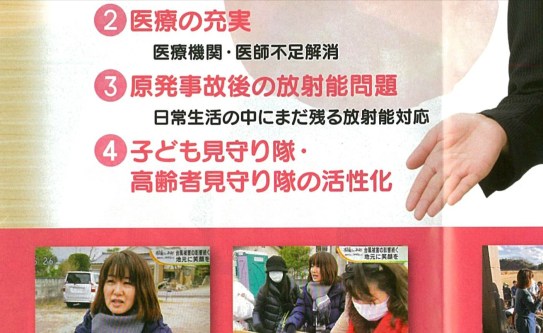
Translated by Hervé Courtois
June 11, 2020
A housewife working on the nuclear accident problem that has been going on since 2011 will run for the Iwaki City election in September. She continues to measure air doses and soil radioactive pollution to protect children from exposure risks, and decided to take the first challenge to reflect the voices of life-saving mothers in municipal administration.
I can’t vote for the nuclear accident, and I can’t do what I want to do in Corona, but I want all of Iwaki’s children to grow healthy and quickly. For that, I must do what I can do now. I am aiming for a win. The voting and voting is September 13th.
[“Pollution is still ongoing”]
Mrs. Saori Suzuki (51) = Hirashita Hirakubo, Iwaki City = is preparing for her candidacy.
Born in Osaka. Lived in Osaka until the age of 2 and moved to Tokyo and Saitama when his father moved. After getting married, she started living in Iwaki. She lives with her husband, a daughter in the second year of college, and a son in the third year of high school. She ‘s been living in Iwaki for more than 20 years.
After all, the turning point was the nuclear accident in March 2011. Until then, she had only served as chairman of the PTA at a school where children attended. Active as a member of “Mothers’ Association Pursuing Initial Exposure to Iwaki”. While running a cram school, she continues to measure air dose and soil pollution density in schools and kindergartens.
“At that time, the children were in the 4th and the 2nd grades of elementary school. According to the location of the school, it could exceed 3μSv/h depending on the location. After continuing the measuring, the nuclear accident was not over, pollution was still continuing. I want all the children in Iwaki City to grow up in good health, not just their own children. It is the foundation of society to grow healthy both physically and mentally. Don’t sacrifice children for the sake of adults.”
In April 2018, when a plan to remove monitoring posts (real-time dosimetry system) installed in front of stations and schools emerged, a request form was submitted to Mayor Toshio Shimizu with the mothers in the city. In the request form, 1) that the residents have the right to decide whether or not the MP are not required 2) Do not remove until the decommissioning work is completed 3) Do not hold future scheduled inhabitants briefings on the premise of removal ─ I asked the mayor of Shimizu to appeal to the government, but the Nuclear Regulatory Commission finally withdrew the blank plan.
9 years have passed since the nuclear accident. Neither the government nor the Fukushima Prefecture will say anything about the exposure risk in areas where evacuation orders were not issued, they were only saying that the air dose had dropped significantly.
However, Mrs. Suzuki says from the experience that she continues to measure, “The air dose and soil pollution are different. Even if the air dose is low, the soil below it is often heavily contaminated with radioactivity. Even if the air dose is low, we cannot rest assured that it is impossible to completely restore the condition before the nuclear accident, but I think adults must continue to make efforts to approach it.” ..
The issue of nuclear accident and radiation exposure risk is said to be “not a vote”, and has not been the issue of elections in Fukushima. “I’m afraid to raise the issue of radioactive pollution and exposure to the front. I think I’m tired of thinking, but I don’t want to ignore that problem,” she said. In the third leaflet, she wrote, “Radioactivity problem after the nuclear accident.”
After the nuclear accident, when Iwaki City, which used rice produced in Hokkaido for school lunch, announced a policy to switch to rice produced in Iwaki, she joined the opposition movement. The LDP-affiliated city council welcomed “Promote rice consumption expansion and local production for local consumption” and “Dispel rumor and save local farmers”, but Suzuki signed the voice of a mother concerned about internal radiation Or submitted a request form to the city. Eventually, she heard a voice saying, “Do you disturb the reconstruction?” It is said that the farmers also strongly blamed her.
“I was asked what would happen to farmers. I was talking about compensation, but… I was accused directly over the phone. I also received an email. I hope you guys leave.”
Still, she did not stop activities to protect children from radioactive materials. She couldn’t stop.
Joined the Constitutional Democratic Party. Run as an official candidate. Although I thought about running as non-affiliated candidate, the winning line in the previous 2016 city council election was 2300 votes. An unnamed newcomer without an organization has high hurdles. “I can’t pursue an ideal society without being elected and not joining parliament,” says Suzuki.
“I think some people have different opinions, but I don’t have experience or an organization. I still need a backup. Local people said, “If you can run from the LDP, you will win easily.” ” If you can not say what you want to say, there is no point in winning.”
There is also a desire to increase the number of women councilorss.
“We also worked hard in last year’s 10/12 flood damage. The whole city was in hell. Many households use septic tanks, and sewage as well as muddy water entered the houses. Moved for the stunned residents. Fortunately, my home was not flooded, so I cleaned the flooded public hall with a high pressure washer. With that as the “support base,” we began distributing relief supplies.”
“It was natural that we needed human resources and supplies, but in fact, it was not the only thing that the victims needed. In cooperation with the government and the Council of Social Welfare, we have established a tea-only corner where you can talk about anything even if you are complaining. It’s important to have a cup of tea and take a break. That’s why I can do my best again. As with the nuclear accident, flood damage has not ended.
▽Is less than 3 months until the notification date. I can’t move as expected due to coronal blight, and I get impatient. If there were no problems with the new coronavirus, we would have held a lot of tea talks and mini gatherings, but… We plan to open an office in July, so I will do my best to prepare.”
━ Can a new wind be blown into Iwaki City Council 10 years after the nuclear accident? The voting and voting is September 13th.
Greenpeace Luxembourg Protests against Belgian Nuclear Waste
Published on Wednesday, 10 Jun 2020
On Wednesday morning, Greenpeace Luxembourg activists held a protest in front of the Belgian Embassy against the disposal of nuclear waste at the Luxembourg border.
The activists demanded concrete measures for the abandonment of nuclear energy production and against the landfill project proposed by ONDRAF (the national body for radioactive waste and enriched fissile materials). This action follows the launch of the cross-border public consultation on the geological disposal of Belgian radioactive waste in the midst of the current health crisis.
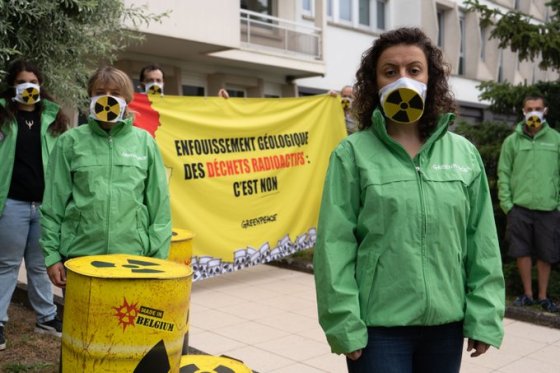
Outside the embassy, six activists displayed a banner with the words “Enfouissement géologique des déchets radioactifs : c’est non” (no to the geological burial of radioactive waste) and symbolically piled up nuclear waste drums.
The protest followed Luxembourg’s Environment Minister Carole Dieschbourg’s announcement last month that the Belgian authorities were planning to dispose of its radioactive waste underground at the Luxembourg border. Greenpeace has maintained that ONDRAF / NIRAS presents this project on the geological disposal of high-level and long-lived radioactive waste without objectively proposing the possible alternatives. The NGO also claimed that there is a lack of information on the feasibility and safety of the proposed geological disposal, as well as on the long-term costs and the environmental impact (including the cross-border impact) of such a project. Greenpeace expressed its concerns in a joint opinion of the National Action Committee against Nuclear Ppwer.
Roger Spautz, Greenpeace Nuclear Campaign Manager, insisted: “The burial of radioactive waste is a dangerous solution. At such a depth, it is impossible to manage a leak of radioactive material. If the Belgian project materialises, an accident of this type could contaminate the Luxembourg water tables and the consequences for our country would be unmanageable”.
Furthermore, Greenpeace has denounced the fact that a possible geological storage site would not be fully operational before 2100. By then, nuclear waste must be stored safely and a “temporary” alternative must be developed as early as possible. According to Roger Spautz, “it is important to develop a solid, transparent and participatory process to achieve this. There is an urgent need to carry out a thorough and independent evaluation of this research work and to discuss the priorities and corresponding budgets for the coming years in order to minimise the burden of this waste for future generations. Currently, dry storage, on the surface or subsurface, is the “least bad” solution. The fact that practically all the countries that produce nuclear waste continue to stockpile it rather indicates that there are practically no alternatives for this hazardous waste”.
The environmental organisation has called on the Luxembourg government to take action against Belgium’s project for the geological disposal of radioactive waste near the Luxembourg border and against extending the life of its reactors.
Article source https://chronicle.lu/category/environment/33038-greenpeace-luxembourg-protests-against-belgian-nuclear-waste-disposal-plans
Australia’s govt rushes nuclear waste Bill through Lower House, but this story is not over.

The federal government’s radioactive waste laws the House of Representatives today, however they failed to win broad support or approval.
Importantly, Labor joined with Greens, Centre Alliance and independents to vote against the contested push to move Australia’s radioactive waste from ANSTO’s secure Lucas Heights facility in southern Sydney to a site near Kimba in regional South Australia.
While accepting the need for improved radioactive waste management, Labor MPs highlighted deep concerns with the government’s approach and called for further detail and review.
Concerns included:
- The double handling of problematic and long-lived Intermediate Level Waste (ILW) through the unnecessary transport from an above-ground extended interim storage facility at ANSTO to an above-ground extended interim storage at a less resourced regional facility.
- The continuing opposition of the region’s Barngarla Traditional Owners.
- The lack of a rationale for a new set of waste laws.
- The government’s decision not to de-couple consideration of the different waste streams (ILW and Low Level Waste). Labor urged the government to allow wider project consideration, including through a current Senate review.
The Greens spoke strongly against the plan – as did Zali Steggall. Andrew Wilkie and Centre Alliance’s Rebekah Sharkie also voted against the legislation – further details in the Hansard transcript and voting record attached fyi
From here – among other things – we need to work to highlight and detail the unresolved concerns via the Senate review (still tracking to report at the end of July) and the subsequent Senate consideration and vote on these laws.
Today the government has had a short-term political win at the expense of building consensus or credibility – we saw a political numbers exercise but we did not see agreement, evidence or responsibility. The government’s plan is deeply deficient and more people are seeing and acknowledging this – this story will grow and change the approach to radioactive waste management.
U.N. experts urge Japan not to rush discharge of radioactive water and not ignore human rights obligations on nuclear waste disposal
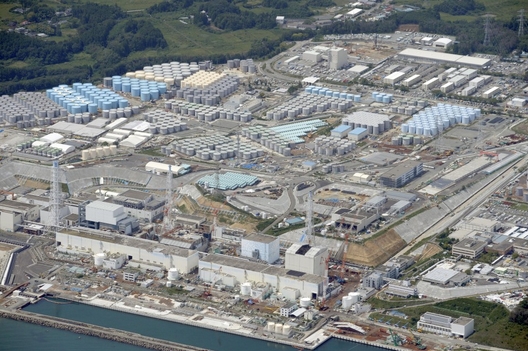
June 9, 2020
U.N. experts urge Japan not to rush discharge of radioactive water
Four United Nations human rights experts on Tuesday urged the Japanese government against rushing to discharge radioactive water from the Fukushima nuclear plant into the sea until consultations are made with affected communities and neighboring countries.
“We are deeply concerned by reports that the Government of Japan has accelerated its timeline for the release of radioactive wastewater into the ocean without time or opportunity for meaningful consultations,” the experts said in a press release.
The experts are imploring the government to delay its decision on releasing the radioactive water until after the coronavirus pandemic has been contained, so proper attention can be dedicated to the issue.
The concern was raised as public consultations on the release of the plant’s wastewater have been accelerated, and opinions will be solicited by next Monday. Such consultations were initially scheduled until after the now-postponed Tokyo Olympic and Paralympic Games.
Japan is considering ways to safely dispose of the water contaminated with radioactive materials, including releasing it into the Pacific Ocean and evaporating it. Tanks used to store the water are expected to be filled by summer 2022.
The experts — U.N. special rapporteurs respectively on hazardous wastes, rights to food, rights to assembly and association, and rights of indigenous people — took note of credible indications that the postponement of the games sped up the government’s decision-making process.
With the pandemic also preventing in-depth consultations with relevant stakeholders, the rapporteurs called on the Japanese government to give “proper space and opportunity for consultations on the disposal of nuclear waste that will likely affect people and peoples both inside and outside of Japan.”
“COVID-19 must be not be used as a sleight of hand to distract from decisions that will have profound implications for people and the planet for generations to come,” they said, raising the alarm that a discharge will pose a grave threat to the livelihoods of local fishermen.
Fukushima: Japan must not ignore human rights obligations on nuclear waste disposal – UN experts
GENEVA (9 June 2020) – UN human rights experts* today urged the Japanese Government to delay any decision on the ocean-dumping of nuclear waste water from the reactors at Fukushima Daiichi until after the COVID-19 crisis has passed and proper international consultations can be held.
“We are deeply concerned by reports that the Government of Japan has accelerated its timeline for the release of radioactive waste water into the ocean without time or opportunity for meaningful consultations,” the independent experts said. Credible sources indicate the postponement of the 2020 Olympics enabled the Government’s new decision-making process for release of the waste.
They said the Government’s short extension for the current public consultation was grossly insufficient while COVID-19 measures limited opportunities for input from all affected communities in Japan, as well as those in neighbouring countries, including indigenous peoples.
“COVID-19 must be not be used as a sleight of hand to distract from decisions that will have profound implications for people and the planet for generations to come,” the experts said. “There will be grave impacts on the livelihood of local Japanese fisher folk, but also the human rights of people and peoples outside of Japan.”
They said there was no need for hasty decisions because adequate space was available for additional storage tanks to increase capacity, and the public consultation originally was not expected to be held until after the 2020 Olympics.
“We call on the government of Japan to give proper space and opportunity for consultations on the disposal of nuclear waste that will likely affect people and peoples both inside and outside of Japan. We further call on the Government of Japan to respect the right of indigenous peoples to free prior and informed consent and to respect their right to assemble and associate to form such a consent.”
The experts have communicated their concerns to the Government of Japan. UN experts have previously raised concerns over the increase of exposure levels to radiation deemed “acceptable” for the general public, and for the use of vulnerable workers in efforts to clean up after the nuclear disaster.
ENDS
*The experts: Mr. Baskut Tuncak, Special Rapporteur on the implications for human rights of the environmentally sound management and disposal of hazardous substances and wastes; Mr. Michael Fakhri, Special Rapporteur on the right to food; Mr. Clément Nyaletsossi Voule, Special Rapporteur on the rights to freedom of peaceful assembly and of association; and Mr. José Francisco Calí Tzay, Special Rapporteur on the rights of indigenous peoples.
https://www.ohchr.org/EN/NewsEvents/Pages/DisplayNews.aspx?NewsID=25940&LangID=E
Tepco and Toshiba join forces to upgrade Kashiwazaki-Kariwa nuclear plant
 Tepco Holdings Corporation and Toshiba Energy Systems Corporation have signed a memorandum of understanding to establish a company to carry out safety upgrade measures at unit 6 of Tepco’s Kashiwazaki-Kariwa nuclear power plant.
In December 2017, Tepco received approval from the Nuclear Regulation Authority (NRA) to change the installation of Kashiwazaki-Kariwa units 6 and 7. It is currently working to obtain approval for the construction plan for unit 7. In parallel with the examination, it is working on preparations for the application for construction plan approval for unit 6.
“Tepco and Toshiba have brought together technologies and knowledge that cross-industry boundaries to jointly establish a company responsible for safety measures for Kashiwazaki-Kariwa Nuclear Power Station 6,” the companies said. “We aim to establish a new company in mid-June and aim to start a full-scale business in July 2020. Going forward, we will aim to improve safety and quality by maximising the synergistic and complementary effects of the two companies toward the completion of safety measures for the Kashiwazaki Kariwa 6.”
The 1356MWe Kashiwazaki Kariwa 6, a boiling water reactor (BWR), began commercial operation in 1996.
The new company, KK6 Safety Measures Joint Venture Co Ltd, has an investment of JPY 300 million ($2.8m) and capital of JPY150 million with Toshiba and Tepco each holding 50%.
Kashiwazaki-Kariwa was unaffected by the 2011 earthquake, although its reactors were all previously offline for up to three years following the 2007 Niigata-Chuetsu earthquake, which caused damage to the site but did not to the reactors. While the units were shut, work was carried out to improve the plant’s earthquake resistance. Currently, Tepco is focusing on units 6 and 7 while it deals with the Fukushima clean-up. The two units have been offline for periodic inspections since March 2012 and August 2011, and restarting them would increase Tepco’s earnings by an estimated JPY100 billion a year.
Units 6 and 7 at Kashiwazaki-Kariwa are the first BWRs to meet Japan’s revised regulatory standards. Tepco expects to complete safety upgrades at the units by December 2020.
In 2017, Tepco received initial approval from NRA to restart Kashiwazaki-Kariwa 6 and 7. The plant’s total capacity of 8,212MWe represents 20% of Japan’s nuclear capacity. Kashiwazaki-Kariwa is Tepco’s only remaining nuclear plant after it announced plans to shut its Fukushima Daini station, near the Fukushima Daichi plant destroyed in the 2011 earthquake and tsunami.
Japan extends 2011 disaster recovery agency’s work by 10 years
June 5, 2020
Japan’s parliament approved Friday a 10-year extension to the lifespan of the government agency overseeing reconstruction of the area devastated by the 2011 earthquake, tsunami and nuclear disaster.
The Reconstruction Agency will now continue to promote recovery in the northeastern prefecture of Fukushima, and provide support to residents there and in other northeastern regions, until March 2031. The agency said there were still more than 46,000 displaced residents as of March 11, the ninth anniversary of the triple disaster.
However, the scope of tax breaks and other special deregulatory measures will be scaled down, and resources allocated more selectively to areas where rebuilding efforts are still under way, and to businesses struggling to overcome public fears and false rumors about radiation.
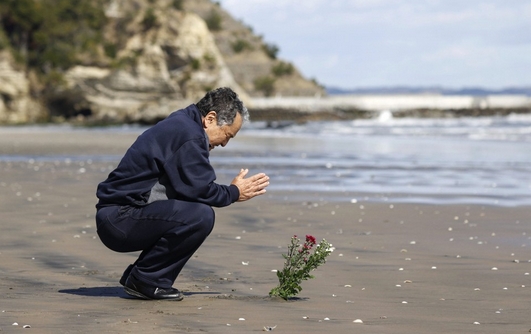 A man prays at a beach in Iwaki, Fukushima Prefecture, on March 11, 2020, the ninth anniversary of the 2011 earthquake-tsunami disaster in northeastern Japan.
Government grants for infrastructure rebuilding will be terminated at the end of the current fiscal year to March 2021, as reconstruction of roads and houses is deemed to be sufficiently complete.
The agency will continue to be headed by a full-time minister, and its budget will remain separate from the general account. Reconstruction bonds, which help finance rebuilding, will continue to be issued by the government.
Under the basic policy on 2011 quake disaster reconstruction, approved by the Cabinet in December, the government aims to complete recovery in hard-hit Fukushima, Iwate, and Miyagi prefectures in northeastern Japan in the five fiscal years through March 2026, while sustaining support for nuclear disaster-stricken areas.
Evacuation orders to be lifted even before radiation purged
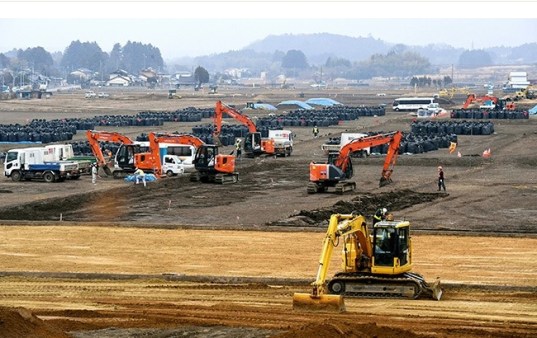 Decontamination work continues in a part of Namie, Fukushima Prefecture, prior to the lifting of an evacuation order in April 2017.
June 3, 2020
The government is planning to create new rules to allow the lifting of evacuation orders in areas affected by the 2011 Fukushima nuclear disaster before they are thoroughly decontaminated, according to sources.
The move comes in response to requests by local municipalities in Fukushima Prefecture. But it also reflects the slow pace of the decontamination process, now in its ninth year following the triple meltdown at the Fukushima No. 1 nuclear power plant.
Evacuation orders were issued for wide areas in the prefecture after the nuclear crisis triggered by the earthquake and tsunami disaster. They remain in place for seven municipalities classified as difficult-to-return zones because radiation levels remain high.
Government officials are still mulling how to best proceed with the new option. Lifting the evacuation orders would come with certain conditions. For example, the area in question would not be used for residential purposes and the municipal government would have to first decide that decontamination is not necessary.
The central government pledged to take responsibility for decontaminating areas before allowing residents to return to their homes.
This new proposal would be the first exception created to the procedures for the lifting of evacuation orders.
Officials from the Ministry of Economy, Trade and Industry, which oversees the nuclear power industry, along with the Environment Ministry and the Reconstruction Agency, have all agreed to allow lifting evacuation orders for areas where decontamination is not complete, the sources said.
The Nuclear Regulation Authority will be tasked with issuing safety recommendations for lifting the orders in areas not yet purged of radioactive materials. The government headquarters that deals with the aftermath of the nuclear disaster is expected to then approve the change as early as this summer.
Evacuation orders were issued for areas where annual airborne radiation readings were higher than 20 millisieverts.
Currently, there are three main conditions that must be met before lifting the orders: annual airborne radiation levels must fall under 20 millisieverts; restoration of social infrastructure, such as the water supply, as well as decontamination, must have progressed to a reasonable degree; and sufficient discussions on the matter with the local municipal government need to have first taken place.
The revision would leave those conditions untouched and introduce a new option to allow for speeding up the process to lift the orders.
New conditions, still being discussed, would be established for areas where natural reductions in radioactive materials led to radiation levels falling under 20 millisieverts.
The evacuation order could be lifted in places not yet fully decontaminated if no residents or workers will live in that area in the future and if the local municipal government requests lifting the order.
Another condition being considered is whether municipal governments have plans for using the area, such as building parks or distribution warehouses.
Under the new proposal, the municipal government would be allowed to decide if it will require full decontamination before the evacuation order is lifted.
The central government began considering the new option after the village of Iitate submitted a request in February.
The village is located about 40 kilometers northwest of the Fukushima No. 1 nuclear plant. The Nagadoro district in the southern part of the village is still classified as a difficult-to-return zone. The village government asked that the evacuation order be lifted for that entire district in 2023.
Under the central government’s plan, 17 percent of that district is designated as a special zone for reconstruction. Decontamination efforts would be concentrated on that zone to allow the evacuation order to be lifted in 2023.
But with more than 80 percent of the district still under an evacuation order, and with no foreseeable date for completing the cleanup of radioactive materials there, village officials worried that partially lifting the order would drive a new wedge into what had long been a single community.
Village government officials want to construct a park in the remaining area to serve as symbol of the community’s unity.
Village officials also confirmed with the 11 households located in the area outside the special zone that they had no intention of returning to their homes, even if the evacuation order is lifted. Central government officials also learned that radiation levels for much of the Nagadoro district have fallen under 20 millisieverts.
Just like Iitate, other municipalities in Fukushima Prefecture will likely also face difficult choices. Like the Nagadoro district, other municipalities have also seen radiation levels fall under 20 millisieverts.
The slow pace of the decontamination process until now has led many evacuees to decide to remain where they are, rather than return to their homes.
Even in areas where evacuation orders have been lifted, only about 20 percent of residents had returned as of April.
Central government officials also acknowledge that the importance of decontamination has waned over the years, since relatively few residents have returned–even after the huge amounts of money spent to make communities habitable again.
About 3 trillion yen ($28 billion) has been spent on decontamination efforts to date.
USA’s reckless nuclear spending as coronovirus hits the nation
 Debating US nuclear spending in the age of the coronavirus, Bulletin of the Atomic Scientists Debating US nuclear spending in the age of the coronavirus, Bulletin of the Atomic Scientists  By Kingston Reif, June 10, 2020 As the novel coronavirus pandemic continues to exact a terrible human and economic toll on the United States, Americans are adjusting how they view national security. There also appears to be agreement, even within the senior leadership of the Defense Department, that the military budget, which has seen significant growth during the Trump administration, is likely to be pared back in the coming years as federal deficits soar. By Kingston Reif, June 10, 2020 As the novel coronavirus pandemic continues to exact a terrible human and economic toll on the United States, Americans are adjusting how they view national security. There also appears to be agreement, even within the senior leadership of the Defense Department, that the military budget, which has seen significant growth during the Trump administration, is likely to be pared back in the coming years as federal deficits soar.
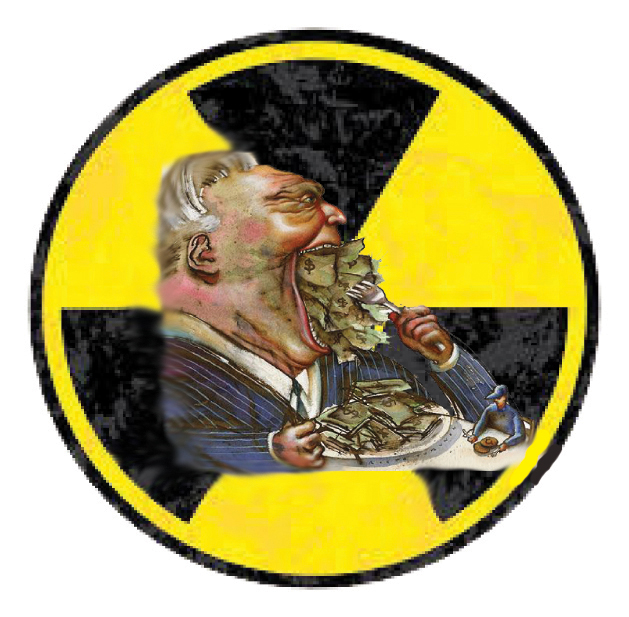
So it should be no surprise that the havoc wrought by the virus has also fanned the flames of an ongoing debate about the Trump administration’s aggressive and costly plans to sustain and upgrade the US nuclear arsenal……. The unsustainable nuclear budget. At the Arms Control Association, where I am the director for disarmament and threat reduction policy, we have long argued that the administration’s approach is unnecessary, unsustainable, and unsafe. The financial and opportunity costs have steadily grown and the biggest nuclear weapons modernization bills are just beginning to arrive. Government officials in charge of the nuclear weapons enterprise warn about the “pervasive and overwhelming risk” facing the current nuclear modernization program………. The danger posed by the plans is on full display in the administration’s fiscal year 2021 budget request. The Defense and Energy Departments are requesting $44.5 billion for next year to sustain and modernize US nuclear delivery systems and warheads and their supporting infrastructure, a larger-than-anticipated increase of about $7.3 billion, or 19 percent, from the fiscal year 2020 level. Meanwhile, the administration is recommending a lower overall national defense budget than Congress provided last year. The combination of a decreased topline budget but an increased nuclear budget means that other defense programs would have to be cut. Some programs on the chopping block include the Navy’s planned second Virginia class submarine, the Energy Department’s efforts to clean up nuclear waste leftover from US nuclear weapons production during the Cold War, and the Pentagon’s Cooperative Threat Reduction program, which supports global efforts to detect and secure dangerous pathogens such as the coronavirus. And this was all before the coronavirus began its deadly march across the country and before Congress spent several trillion dollars trying to save the US economy from complete collapse. Although Pentagon officials insist that nuclear weapons should be shielded from possible future defense budget cuts, the pressure on the federal budget imposed by the response to the virus is likely to exacerbate the affordability and execution challenges confronting the administration’s nuclear spending plans. If great power competition with China is the Pentagon’s top priority, is it prudent to sacrifice a Virginia class submarine every year for the next 10 to 15 years to attempt to keep an excessive and overburdened nuclear modernization effort on track? The answer should be no, especially in light of the quantitative and qualitative superiority of the US nuclear arsenal over China’s. In the view of many, the Trump administration’s proposal to expand spending on nuclear weapons is a sad and dangerous illustration of wildly misplaced federal spending priorities. As it proposed a 19 percent increase for nuclear weapons next year, the White House initially planned to slash the budgets for the Centers for Disease Control by 19 percent and the National Institutes of Health by 7 percent. The Pentagon’s proposal to cut the budget for the Cooperative Threat Reduction program in order to fund weapons modernization amid a global pandemic is shockingly reckless…… Inexplicably, the unprecedented economic crisis facing the nation hasn’t stopped some Trump administration officials from raising the prospect of even greater spending on nuclear weapons above and beyond what is already planned. Marshall Billingslea, President Trump’s special envoy for arms control, said recently that if Russia and China don’t agree to US demands for talks on new trilateral arms control to replace the 2010 New Strategic Arms Reduction Treaty (New START), Washington could win a new arms race if necessary. “We know how to win these races, and we know how to spend the adversary into oblivion,” he said. More US spending on nuclear weapons won’t force the current Russian and Chinese leadership to capitulate and would be fraught with peril. The administration’s desire to pursue a more ambitious arms control agreement is the right goal, but it can’t be achieved before New START is slated to expire next February. A new quantitative arms race that could follow the collapse of New START would further undermine stability between the United States and Russia, the health of the global nonproliferation regime, and the US military’s emphasis on competition with China. Our new post-pandemic reality should make it all the more obvious that the current modernization plans need to be reconsidered in a way that eliminates the most excessive and destabilizing elements, saves taxpayer dollars for other pressing national and health security needs, and is in sync with a revitalized and realistic strategy to cap and reduce global nuclear stockpiles…….. Lisa Gordon Hagerty, head of the National Nuclear Security Administration, was asked to explain the rationale for such a large unplanned increase at a Congressional hearing in March, but her attempt at an answer hardly cleared up the situation. Perhaps there is a clearer explanation for why the agency so badly misjudged its funding needs for 2021, but if so the agency has yet to provide it…. (lengthy rebuttal of Frank Miller’s claims about nuclear weapons spending) ……. https://thebulletin.org/2020/06/debating-us-nuclear-spending-in-the-age-of-the-coronavirus/# |
|
|
USA’s International Development Finance Corp will remove its ban on financing exports of US nuclear technologies.
US agency plans to lift nuclear power plant financing ban: spokeswoman S and P Global Platt’s, Author, Joniel Cha 10 June 20 Washington — International Development Finance Corp., a US federal agency, will end its ban on financing nuclear power plant projects, a spokeswoman said June 10, a move that follows the Trump administration’s support for US reactor exports.
Allen declined to provide a timeline for when she expects DFC could begin financing exports of US nuclear technologies.
Industry sources said in May that DFC lacks the personnel and expertise to properly evaluate the financing of nuclear projects.
DFC was created in 2019 through the consolidation of Overseas Private Investment Corp. and the US Agency for International Development’s Development Credit Authority. DFC has a total investment limit of $60 billion, more than double OPIC’s $29 billion investment cap, according to DFC’s website.
OPIC and USAID both had bans in place prohibiting them from supporting nuclear reactor projects.
To “empower U.S. export competitiveness,” the federal government should “level the playing field versus foreign competitors, expand the arena of competition space, and challenge our rivals,” the Nuclear Fuel Working Group said in an April report.
A White House working group report released April 23 by the Department of Energy recommended the removal of a financing ban on US nuclear energy technologies. The Nuclear Fuel Working Group was formed in July by President Donald Trump to provide recommendations to revive and expand the US nuclear energy sector.
The working group said the US has not sold reactors overseas recently and “is missing out on a nuclear reactor market” the Commerce Department estimates is valued at $500 billion-$740 billion over the next 10 years.
Six US senators wrote the DFC in October, saying the agency should overturn the “categorical prohibition” against supporting civil nuclear energy projects.
ClearPath, a “conservative, clean energy” group, supports lifting the US ban on financing nuclear projects, Rich Powell, executive director, said June 10.
“By lifting the previous restrictions on the U.S. nuclear energy industry to develop internationally, America is taking a huge step to truly offer a competitive product – similar to the incentives China and Russia provide when they approach other countries with offers to develop infrastructure and energy,” Powell said in a statement. https://www.spglobal.com/platts/en/market-insights/podcasts/focus/060520-hydrogen-aviation-future-energy-transportation-decarbonisation
USA offers to build Britain’s nuclear reactors
 US offers to build UK’s 5G and nuclear stations to end ‘coercive’ relationship with China
Mike Pompeo said the United States ‘stands ready to assist our friends in the U.K’ Telegraph UK , By Danielle Sheridan, POLITICAL CORRESPONDENT10 June 2020 • America has offered to build Britain’s 5G and nuclear power stations so that the “coercive and bullying” relationship with China can end, Mike Pompeo has said.
In a statement released yesterday the US Secretary of State said America stood with its “allies and partners against the Chinese Communist Party’s (CCP) coercive bullying tactics”, as he sighted reports that Beijing had threatened to punish HSBC and “break commitments to build nuclear power plants in the United Kingdom unless London allows Huawei to build its 5G network”.
HSBC is understood to have claimed that it could face reprisals in China if Huawei was blocked from selling equipment to the next generation of networks being built by Britain’s mobile operators…. (subscribers only) https://www.telegraph.co.uk/politics/2020/06/10/us-offers-build-uks-5g-nuclear-stations-end-coercive-relationship/
In U.S. Congress, a Bill to prohibit Trump’s possible plan to use nuclear weapons on hurricanes
 Trump’s plans to use nuclear weapons on hurricanes challenged in new Democratic bill, President repeatedly floated ‘really dumb idea’, according to reports, Independent UK, Maddie Stone 10 June 20,
In August, Donald Trump reportedly asked top national security officials to consider using nuclear bombs to weaken or destroy hurricanes. Now, one member of Congress wants to make it illegal for Mr Trump, or any president, to act on this idea, which experts say would be both ineffective and extremely dangerous.
On 1 June, Sylvia Garcia, Democratic representative for Texas, introduced the Climate Change and Hurricane Correlation and Strategy Act, a bill that explicitly prohibits the president, along with any other federal agency or official, from employing a nuclear bomb or other “strategic weapon” with the goal of “altering weather patterns or addressing climate change”.
Ms Garcia said that the bill was drafted as a direct response to last year’s report that Mr Trump has floated the idea of nuking hurricanes. Mr Trump denied ever making such a suggestion in a tweet shortly after Axios published the initial report.
The bill, which has no co-sponsors and no hearing date, appears unlikely to make it out of committee anytime soon. It has been referred to three committees: Armed Services; Energy and Commerce; and Science, Space and Technology.
With no companion bills in the Senate, the chances of it appearing on the president’s desk, much less being signed into law, are slimmer. But after hearing Mr Trump’s alleged comments on nukes and hurricanes and researching the issue further, Ms Garcia felt she had to at least get the idea of a ban on using nuclear weapons to disrupt the weather on the table…….
The bill comes at the start of the 2020 Atlantic hurricane season, which is off to a quick start, with Tropical Storm Cristobal, the earliest-recorded third named-storm of any season, striking Louisiana on Sunday. The season is expected to bring above-average storm activity, with 14 to 19 named-storms, according to the National Oceanic and Atmospheric Administration (NOOA). ……
Climate studies show that warming seas and air temperatures are making hurricanes more damaging by increasing their rainfall output and favouring higher-end, “major” storms of Category 3 intensity or greater. Scientists have also been seeing a small increase in storms that rapidly intensify from weak to major hurricane status, which is enabled by warm sea surface temperatures, among other factors…….
Axios’s report noted that Mr Trump raised the idea not once, but at multiple points in time, including with top national security and intelligence aides.
Kerry Emanuel, a hurricane expert at MIT, sees things a bit differently.
“If we have a leader who would contemplate using a nuclear weapon on a hurricane,” he said, “we have a much more extensive and serious problem than could be covered by a specific bill like this one”. https://www.independent.co.uk/news/world/americas/trump-nuke-hurricane-bill-climate-change-sylvia-garcia-a9555746.html
1 This Month
23 April – WEBINAR – Why new nuclear reactors are the wrong tools for decarbonization Thursday, April 23 • 1 AM – 2 AM AEST
World Nuclear Power. Reactors 1951-2026, 75 Years of Nuclear Power.
Interactive Map– https://dv.worldnuclearreport.org/

Chernobyl: The Lost Tapes – A good documentary on Chernobyl on SBS available On Demand for the next 3 weeks– https://www.sbs.com.au/ondemand/tv-program/chernobyl-the-lost-tapes/2352741955560

of the week–London Campaign for Nuclear Disarmament


Tell the Ukrainian Government to Drop Prosecution of Peace Activist Yurii Sheliazhenko
To see nuclear-related stories in greater depth and intensity – go to https://nuclearinformation.wordpress.com
-
Archives
- April 2026 (231)
- March 2026 (251)
- February 2026 (268)
- January 2026 (308)
- December 2025 (358)
- November 2025 (359)
- October 2025 (376)
- September 2025 (257)
- August 2025 (319)
- July 2025 (230)
- June 2025 (348)
- May 2025 (261)
-
Categories
- 1
- 1 NUCLEAR ISSUES
- business and costs
- climate change
- culture and arts
- ENERGY
- environment
- health
- history
- indigenous issues
- Legal
- marketing of nuclear
- media
- opposition to nuclear
- PERSONAL STORIES
- politics
- politics international
- Religion and ethics
- safety
- secrets,lies and civil liberties
- spinbuster
- technology
- Uranium
- wastes
- weapons and war
- Women
- 2 WORLD
- ACTION
- AFRICA
- Atrocities
- AUSTRALIA
- Christina's notes
- Christina's themes
- culture and arts
- Events
- Fuk 2022
- Fuk 2023
- Fukushima 2017
- Fukushima 2018
- fukushima 2019
- Fukushima 2020
- Fukushima 2021
- general
- global warming
- Humour (God we need it)
- Nuclear
- RARE EARTHS
- Reference
- resources – print
- Resources -audiovicual
- Weekly Newsletter
- World
- World Nuclear
- YouTube
-
RSS
Entries RSS
Comments RSS
 nuclear-news