80 Lawmakers Demand Trump Ditch Any Thought of Resuming ‘Dangerously Provocative’ Nuclear Tests — limitless life

80 Lawmakers Demand Trump Ditch Any Thought of Resuming ‘Dangerously Provocative’ Nuclear Tests “When Americans say that they want and need tests, they weren’t talking about the nuclear kind.” by Andrea Germanos, staff writer 35 Comments An activist with a mask of U.S. President Donald Trump marches with a model of a nuclear rocket during […]
¥10 trillion reserve to combat pandemic branded Abe’s ‘pocket money’ — limitless life

Prime Minister Shinzo Abe Photo: REUTERS file Politics ¥10 trillion reserve to combat pandemic branded Abe’s ‘pocket money’ June 12 03:48 pm JST 28 Comments By Tetsushi Kajimoto and Leika Kihara TOKYO A 10 trillion yen ($94 billion) emergency fund that can be tapped without parliamentary oversight has been branded Japanese Prime Minister Shinzo Abe’s “pocket money” by opposition lawmakers […]
via ¥10 trillion reserve to combat pandemic branded Abe’s ‘pocket money’ — limitless life
Radioactive cloud over Europe in 2017 came from a civilian nuclear reactor

|
Radioactive cloud over Europe had civilian background https://www.eurekalert.org/pub_releases/2020-06/uom-rco061220.phpIsotope measurements on air filters: researchers investigated undeclared nuclear release / Study in “Nature Communications” 14 June 20
UNIVERSITY OF MÜNSTER A mysterious cloud containing radioactive ruthenium-106, which moved across Europe in autumn 2017, is still bothering Europe’s radiation protection entities. Although the activity concentrations were innocuous, they reached up to 100 times the levels of what had been detected over Europe in the aftermath of the Fukushima accident. Since no government has assumed responsibility so far, a military background could not be ruled out. Researchers at the Leibniz University Hannover and the University of Münster (both Germany) now found out that the cloud did not originate from military sources – but rather from civilian nuclear activities. Hence, the release of ruthenium from a reprocessing plant for nuclear fuels is the most conclusive scenario for explaining the incident in autumn 2017. The study has been published in the journal Nature Communications.
Background: It is impossible to make a clear distinction between civilian and military sources solely based on measurements of radioactive isotopes of ruthenium. For the first time, researchers from the Institute of Radioecology and Radiation Protection at Leibniz University of Hannover and the Institute of Planetology at Münster University succeeded in quantifying stable ruthenium isotopes in air filters that were released with the radioactive ruthenium. Within the scope of the study, the team left conventional scientific paths: “We usually measure ruthenium isotopes to study the formation history of Earth”, says Prof. Thorsten Kleine from the University of Münster, adding that the methods originally developed to address research questions in planetology were instrumental in solving this mystery. The fact that the airborne ruthenium stemming from nuclear activities occurred in minuscule amounts and were diluted with natural stable ruthenium presented a significant challenge. Through the clean chemical separation of ruthenium fractions from air filters and subsequent high-precision measurements via mass spectrometry, the researchers determined the ratio of stable ruthenium from the nuclear source. The ruthenium isotopic ratios found in the filter are consistent with the signature of a civilian source, in particular the signature of spent nuclear fuel from a nuclear power plant. A military background (such as the production of weapons-grade plutonium) can be ruled out. Furthermore, high-precision measurements enabled the researchers to draw further conclusions. “The isotope signature discovered in the air filter exhibits no similarities with nuclear fuels of conventional Western pressurised or boiling water reactors. Instead, it is consistent with the isotope signature of a specific type of Russian pressurised water reactors – the VVER series. Worldwide, approximately 20 reactors of this type of VVER are currently operational”, specifies Professor Georg Steinhauser from Leibniz University Hannover. Original publication: T. Hopp et al. (2020): Non-natural ruthenium isotope ratios of the undeclared 2017 atmospheric release consistent with civilian nuclear activities. Nature Communications; DOI: 10.1038/s41467-020-16316-3 |
|
Trump wants costly armed nuclear ice-breakers – where will the money come from ?
U.S. Seeks Armed Nuclear Icebreakers For Arctic Show Of Force, David Hambling
Aerospace & Defense, 14 June 20,
President Trump has called for a ‘ready, capable, and available fleet of polar security icebreakers’ to give America a ‘strong presence’ in the Arctic and Antarctic regions. The call comes in a White House memorandum dated June 9 and envisages armed, nuclear-powered icebreakers engaging in operations for both national security and commercial interests. This is hugely ambitious considering that the U.S. currently has a single, ageing, non-nuclear icebreaker, while Russia is rapidly expanding its huge nuclear icebreaker fleet.
Russia has long seen the waters off their northern coast as a key economic asset, both for oil and gas exploration and as a shipping route, anticipating that the emerging Northern Sea Route will attract trade away from the Suez Canal by trimming 40% off the journey from Europe to Asia. Russia has ramped up its Arctic military presence in recent years with new air bases, ships and land forces to support these interests.
—
India will follow with nuclear weapons testing, if USA resumes testing
If the Donald Trump Resumes U.S. Nuclear Weapons Testing, India Will Follow, Hasan Ehtisham, The National Interest•June 13, 2020
On May 15, according to media reports, the Trump administration conducted serious discussions on whether or not to break the informal ban to carry out a nuclear test explosion. Washington’s intent to resume nuclear testing threatens to elevate already grown strategic tensions with China, Russia, and others. Some analysts comprehended that this is a proper course to influence Russia and China to support Washington’s plan for trilateral talks related to nuclear arms controls and disarmament issues. ……
The head of the Comprehensive Nuclear-Test-Ban Treaty Organisation (CTBTO), Lassina Zerbo, has presaged that any attempt by the United States to recommence nuclear testing would have serious ramifications for global peace and security. While mentioning CTBTO’s close relationship with the U.S. National Laboratories, Zerbo categorically precluded the notion of any requirement for nuclear testing. Chinese Foreign Ministry spokesperson Zhao Lijian has also shown “grave concerns about the report.” He urged the Trump administration to meet its “due obligations and honour its commitment by upholding the purpose and objective of the CTBT.” During the contemporary strategic competition of major powers, an uncertain situation has emerged about any sort of political gains for Washington against Moscow or Shanghai with a nuclear test. The most plausible consequence of a nuclear explosion by the United States at this point will facilitate other countries to resume nuclear testing. Washington will be criticized by other nuclear weapons states for violating the nuclear test moratorium practiced since 1998 by all countries, except North Korea.
Robert Rosner, a professor of physics at the University of Chicago, has evaluated that after the United States others will also resume nuclear testing and “the crucial question is: Who are the others?” In the South Asian strategic scenario, India will be that other country. India, one of the world’s fastest developing nuclear weapons states, has long been waiting for such a mistake, particularly from the United States, so that it could revoke the pledge of nuclear non-testing. It has been unable to do so just because it aspires to become part of the Nuclear Suppliers Group (NSG) and other global regimes. Once the United States resumes nuclear testing, India will find it easier to further demonstrate its nuclear weapon capability.
This latest paradigm shift by the United States allows India to conduct more nuclear testing to assess the design of its thermonuclear weapon which it claimed to have detonated on May 11, 1998, in the Operation Shakti-1. Numerous international experts believe that the results of the thermonuclear test were highly inflated and doubt that the device successfully ignited the second fusion stage of the explosion. The scientist community who coordinated the Operation Shakti-1 in 1998 has concluded that the test was a failure, as the yield of the fusion device never produced the desired results.
Nuclear pundits in India have already materialized a comprehensive and robust nuclear facility to meet any kind of eventuality that could provide India with an opportunity to carry out further nuclear tests. For instance, in 2012, India’s secret nuclear city at Challakere, Karnataka was revealed by independent researchers. Experts have shown apprehensions that the facility will be a major complex of nuclear centrifuges under military control, along with atomic research laboratories, weapons and aircraft testing sites. Once it starts functioning, the facility would enable India to modernize its existing nuclear warheads and the nuclear fuel from domestic reserves will be used for a thermonuclear weapon. India is also working on a uranium enrichment plant from which it will be able to produce about twice as much weapons-grade uranium as New Delhi will need for its operational nuclear weapon programme. That significant excess of the enriched uranium would be used for the development of thermonuclear weapons.
India has already done the necessary homework to manipulate any step the United States may take in the near future. The Defence Research and Development Organisation (DRDO) has signaled the capacity to conduct more nuke tests at short notice. If India alters the status of its moratorium on nuclear testing, then it would not only upset the deterrence balance but most significantly it would start a fresh nuclear arms race in South Asia. Under the pretext of growing Indo-US strategic relations in the region, the U.S. is offering a free ride to India to enhance the nuclear capability by resuming nuclear testing. It is strategically prudent for the U.S. national interest to uphold its commitments regarding the unilateral pledge of nuclear non-testing while ratifying the CTBT. The United States should also press India to continue its moratorium on nuclear weapons testing which was the primary prerequisite for the U.S.-India nuclear deal of 2008. It will reinforce the global standards against nuclear testing and encourage regional stability. https://news.yahoo.com/donald-trump-resumes-u-nuclear-120000804.html
Hasan Ehtisham is the M. Phil Scholar of Defence and Strategic Studies at Quaid-e-Azam University in Islamabad, Pakistan.
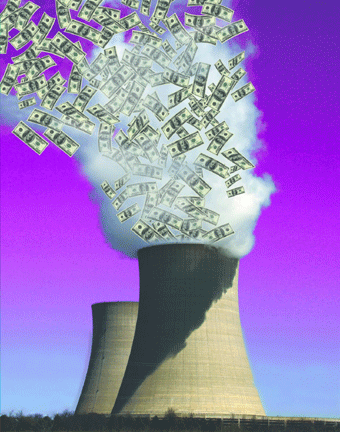
Why doesn’t debt-ridden EDF cut its losses and close its uneconomic UK nuclear reactors
|
Unanswered questions dog UK’s new nuclear plans Climate News Network June 11th, 2020, by Paul Brown A French company has designs on the United Kingdom: new nuclear plans for more reactors, with British consumers footing the bill.
– The French company EDF, a company in a hurry, wants permission to start building two more reactors in the United Kingdom, and it hopes to save money – by arranging for British taxpayers to pay the capital costs of its new nuclear plans. EDF is already building two reactors at Hinkley Point in the West of England, and it is hoping to transfer workers from that site to Suffolk, on the east coast, believing that will help it to save up to 20% of the construction cost of the two planned reactors, because everyone employed there will know already what to do. The catch is that EDF has no money itself to finance the construction and wants the UK government to impose a new tax on British electricity consumers so that they will pay the cost through their electricity bills. The UK has yet to decide whether to go ahead with this tax, euphemistically called a Regulated Asset Base. If adopted, what the scheme means is that the UK consumer will pay EDF’s bills rather than the company having to borrow the money from banks, which are increasingly unlikely to lend money to such expensive schemes because they take so long to build and promise little return. Anxieties abound Meanwhile EDF, which has a Chinese nuclear company as its junior partner, promises to create 25,000 jobs, including 1,000 apprenticeships during construction, and says 900 full-time jobs will be available when Sizewell C, as the station will be called, is complete. If all goes to plan the company hopes to start work in 18 months and says the two reactors will take 10 years to build. It expects them to provide 7% of the UK’s electricity, enough for six million homes. There are many objectors. Some say much of the coastline will be badly affected, including internationally important nature reserves. Others fear the site is highly vulnerable to sea level rise and therefore a danger to the public. Local people also fear that the construction site, with its attendant lorry and commuter traffic, will disrupt their lives for a decade, destroying the important tourist trade. Cheaper options Other more strategic objections, which might weigh heavier with the government, are that nuclear power is very expensive and much cheaper and less controversial alternatives exist, particularly on-shore and off-shore wind and solar power, and biogas. More importantly, a drive for energy efficiency, badly neglected in the UK at present, would render the whole project unnecessary. The problem EDF has is its track record on construction and repairs. The type of reactor it plans to build, the European Pressurised Water Reactor, said by the company to be the most powerful in the world, is proving extremely difficult to build, and till now none has yet been completed outside China. Construction is running more than 10 years late in both Finland and France, and costs continue to escalate.
EDF’s debts are now huge, so big that the French state is working out how to restructure the company by splitting it into a renewables arm (which is profitable) and a nuclear branch. There are serious doubts about the reliability of EDF’s claims and timetables for fixing existing power stations and opening new ones. The company currently owns all of the UK’s operating nuclear reactors, most of which are near the end of their lives, and there are serious doubts about whether they are economic and in some cases even safe. Two reactors at Hunterston in Scotland have serious cracking in the graphite blocks that are part of the control mechanism. The company has spent two years trying to justify continuing to operate the reactors to the Office for Nuclear Regulation (ONR). Similarly, at the other end of the UK, at Dungeness in south-east England, the station is also closed for extensive repairs, an outage that was going to take weeks has now stretched to two years – and the start-up date has just been put back again. Looking on the bright side One of the features of all of EDF’s activities is the extraordinary optimism the company seems to have, particularly about when reactors will be finished or ready to restart after repairs. With the Hunterston reactors restart dates have been announced nine times, only to be postponed each time. This track record led the Climate News Network to ask EDF some searching questions, including why they continued to offer optimistic start-up dates that were repeatedly postponed. We also asked why the company kept the Hunterston and Dungeness stations open at all, since repairing them was costly and they were already near the end of their operating lives. We asked EDF: “At what point do you cut your losses and close the stations permanently?” After five days of pleading for more time to answer, it sent us already published press releases extolling the virtues of the plan to build Sizewell, and several comments. …….HTTPS://CLIMATENEWSNETWORK.NET/UNANSWERED-QUESTIONS-DOG-UKS-NEW-NUCLEAR-PLAN/, l |
|
Plan for USA’s taxpayers to fund nuclear power exports
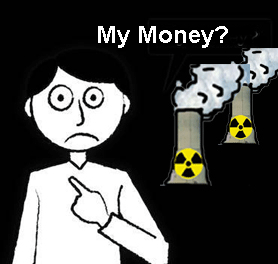 US Agency Proposes Financing of Nuclear Power Exports, VOA, By Reuters June 11, 2020 WASHINGTON – A U.S. development agency proposed lifting restrictions that bar the financing of advanced nuclear energy projects abroad, a move the Trump administration hopes will help the industry compete with state-owned companies in China and Russia. US Agency Proposes Financing of Nuclear Power Exports, VOA, By Reuters June 11, 2020 WASHINGTON – A U.S. development agency proposed lifting restrictions that bar the financing of advanced nuclear energy projects abroad, a move the Trump administration hopes will help the industry compete with state-owned companies in China and Russia.
The U.S. International Development Finance Corp., or DFC, late Wednesday opened a 30-day comment period on the proposal. The idea was included in the Trump administration’s Nuclear Fuel Working Group report, released in April, on ways to modernize nuclear energy policy……. The DFC, which replaced the Overseas Private Investment Corp., launched in January with a $60 billion budget. It is seen by analysts as an attempt by Washington to provide an alternative to Beijing’s sweeping Belt and Road Initiative, which sponsors large-scale infrastructure, like nuclear projects, in developing countries. Russia’s state-owned nuclear energy company, Rosatom, is also looking to sell nuclear technology. Ed Lyman, a nuclear power expert at the Union of Concerned Scientists, said it is “utterly irresponsible for the Trump administration to promote the export of unproven and potentially dangerous nuclear technologies to the developing world.” He said Washington should first work with countries to create independent nuclear regulators. …….. Advanced nuclear power is expected to be less expensive than traditional nuclear stations costing tens of billions of dollars. But nonproliferation experts caution that the plants and their supply chains could become targets of attack. https://www.voanews.com/usa/us-agency-proposes-financing-nuclear-power-exports |
|
Trump’s plan for a nuclear trest – dangerous brinkmanship
 A Nuclear Test Would Blow Up in Trump’s Face
The Trump administration doesn’t understand the brinkmanship concept its nuclear diplomacy is based on. Foreign Policy,
BY SARAH BIDGOOD JUNE 11, 2020,
|
The last 42 months have offered a sobering window into the Trump administration’s philosophy on nuclear arms control. On display is its penchant for withdrawing from agreements rather than engaging in dispute resolution—be they the Joint Comprehensive Plan of Action, the Intermediate-Range Nuclear Forces Treaty, or, most recently, the Open Skies Treaty. While many experts see this approach as ill-conceived and damaging to U.S. national security interests, the administration often frames it as a form of brinkmanship designed to signal resolve in an era of strategic competition. The intended message appears to be that the United States will no longer play ball unless its rivals—Russia and China—agree to abide by Washington’s rules.
The latest example of this tendency comes amid reports that the administration might conduct a “rapid” nuclear test to strengthen its hand in negotiations with China and Russia. Experts around the world have denounced this proposal as dangerous, foolhardy, and “catastrophically stupid.” As they point out, were the United States to test for the first time in nearly three decades, it would open the door for the resumption of widespread explosive testing. At the same time, it would undermine the nuclear taboo, hurt the credibility of the nonproliferation regime, and diminish support for the Comprehensive Nuclear-Test-Ban Treaty (CTBT). While all true, these arguments are unlikely to sway this administration, which has shown little regard for existing norms or the disarmament machinery writ large.
What might give decision-makers pause, though, is the fact that a nuclear test is unlikely to be an effective signal in the current context. It would not help deliver President Donald Trump’s goal of a trilateral arms control agreement, but it would provide ample opportunity for misinterpretation and a response in kind. In the process, it would likely put Washington in a worse negotiating position than when it started, making it not only risky but also pointless to boot………..
In short, if decision-makers in Washington do choose to test, this attempt at brinkmanship will certainly fail to convince Russia or China to sit down at the arms control negotiating table. Instead, it will make it all the more likely that the very outcomes trilateral arms control seems to be intended to prevent come to bear—and soon. The good news, then, is that there is plenty of time to walk this ill-conceived and ineffective plan back from the brink. In this instance, restraint—such as it is—may be the most effective nuclear signal this administration could possibly send. https://foreignpolicy.com/2020/06/11/nuclear-test-arms-control-trump-united-states-brinkmanship/
|
|
Fire on French submarine – luckily its nuclear reactor, nuclear fuel, had been removed for overhaul
 A French Submarine Caught Fire In Drydock. It Could Lead Paris To Rethink Its Nuclear Deterrence Strategy. Forbes, Sebastien Roblin 11 June 20 A fire broke out in the rear section of the French nuclear-powered attack submarine Perle on Friday morning as she lay in drydock in the port of Toulon. White clouds of smoke poured into the sky as firefighters from Toulon and Marseilles rushed to the scene. A French Submarine Caught Fire In Drydock. It Could Lead Paris To Rethink Its Nuclear Deterrence Strategy. Forbes, Sebastien Roblin 11 June 20 A fire broke out in the rear section of the French nuclear-powered attack submarine Perle on Friday morning as she lay in drydock in the port of Toulon. White clouds of smoke poured into the sky as firefighters from Toulon and Marseilles rushed to the scene.
Finally at 9:36 p.m local time the Mediterranean Maritime Prefecture reported that the fire had been brought under control by completely flooding the rear compartments of the boat with foam, further noting that the “reactor rooms remains untouched.”…….. Just as importantly, the ship’s 48 megawatt pressurized water nuclear reactor, nuclear fuel, and (conventional-only) weapons had been removed when the submarine entered the drydock in January 2020 for an overhaul by Naval Group due for completion by February 2021. For that reason, the local maritime prefecture claims there is no possibility of radioactive contamination from the incident.
The firefighting effort reportedly involved 30 specialist naval firefighters with support from a firefighting boat, as well as additional specialists scrambled from Marseilles, 11 specialized ground-based firefighting vehicles, and at least 10 ESNA submariners to advise the firefighters. However, there are growing fear that the Perle may have sustained too much damage to be saved. A veteran submariner told the local paper Var Matin “If the thick hull [made of 80HY high-tensile steel]…is deformed, the boat is screwed.” The cause of the blaze is speculated to possibly be faulty welding or a high-pressure cutting gone awry. France’s Nuclear Submarine Force French periodical LeMonde warned that should the Perle suffer “irremediable damage,” there was the possibility “the entire organization of French nuclear deterrence may have to be rethought. And the Navy may have to give up on certain strategic missions.” The Perle does not actually carry any nuclear weapons. However, one of the primary roles of French attack submarines is protecting the four larger Triomphant-class nuclear-powered ballistic missile submarines (SSBNs) from hostile submarines. Indeed, the SSBN Le Téméraire conducted a test launch of an unarmed M51 nuclear ballistic missile just the day prior. France perceives these submarines as performing a vital role in strategic nuclear deterrence, or “dissuasion” as it’s called in France………. Establishing the cause of the accident that may put out of action a valuable strategic asset will also be a priority for Defense Minister Florence Parley, particularly given how much more serious the incident might have been had weapons, the reactor and/or additional personnel had been onboard. For now the citizens of Toulon can only be thankful that loss of life was averted and that there is no apparent risk of contamination. The French Navy will have to take stock of the damage, adjust its plans for its SSN fleet accordingly—and consider how it can minimize the odds of another such accident occurring. https://www.forbes.com/sites/sebastienroblin/2020/06/12/a-french-submarine-caught-fire-in-drydock-it-could-lead-paris-to-rethink-its-nuclear-deterrence-strategy/#4addae213d05 |
|
|
Global heating to bring more frequent, more extreme, ocean waves
 EXTREME WAVES SET TO BE BIGGER AND MORE FREQUENT
As the planet warms, researchers are warning that the frequency and magnitude of extreme wave events may rise by around 10 per cent by the end of century, increasing flood risks. Pursuit, By Dr Alberto Meucci and Professor Ian Young University of Melbourne, 13 June 20
When most of us think about what climate change will do to our coastlines we tend to focus on how sea-levels are rising as the polar ice caps melt and the oceans warm. But that is only part of the story.
What many don’t realise is that at the same time as sea levels are rising, storms are increasing in magnitude and frequency, resulting in larger ocean waves. These waves increase coastal erosion and the risk of flooding.
Our new research suggests that by the end of the century the magnitude of extreme wave events will have increased by up to 10 per cent over extensive ocean regions, and the frequency of storms that generate extreme waves will have increased by five to 10 per year.
This may not sound like a big increase, but it means that almost 60 per cent of the world’s coastline will experience larger and more frequent extreme waves.
At a time when 290 million people already live below the 100-year flood level (that is, they live below levels where there is at least a one per cent probability of flooding every year), an increase in the risk of extreme wave events may be catastrophic, as larger and more frequent storms will cause more flooding and coastline erosion.
Extremes are defined as unexpected, unusual and sometimes unseasonal events. Like extreme floods, extreme waves are classified by the frequency with which they tend to occur, and this frequency drives the design requirements for ocean structures or coastal defences. For example, defences may be designed to cope with a 100-year wave event.
Extreme ocean waves generated by strong surface winds can reach heights of over 20 meters at the high latitudes of the globe – that’s as high as four double-decker buses stacked on top of each other.
But the surface winds that drive wave heights are in turn driven by the climate system, and so are subject to climate change. A warming planet is causing stronger and more frequent storm winds which in turn trigger larger and more frequent extreme waves, and the 100-year events may begin to occur every 50 or even 20 years.
Estimating the probability of occurrence of extreme waves is challenging, let alone estimating how their frequency and magnitude may change in the future. This is due to the small number of ocean observations available.
The buoys and offshore platforms scientists use to observe ocean movements are sparsely distributed, and satellite measurements are limited in how often they sample a single location.
But advances in computing technology and the modelling of data, allows us to simulate the Earth’s changing climate under different wind conditions, recreating thousands of simulated storms to evaluate the magnitude and frequency of extreme events.
Our research used a unique statistical ensemble approach, where we pooled data from an unprecedented collection of thousands of modelled ocean wave extremes to estimate future extreme events. These extremes were derived from global wave models based on wind forces generated from seven different global climate models.
The vast amount of modelled ocean extremes generated allowed us to apply an ensemble statistical analysis that reduces the uncertainty around the estimation of future projections of extremes. …….. Co-authors of the research are: Dr Mark Hemer, CSIRO, Oceans and Atmosphere, Hobart Australia; Professor Roshanka Ranasinghe, Department of Water Science and Engineering, IHE-Delft, Netherlands; and Ebru Kirezci, University of Melbourne
South African activists threaten to sue over nuclear plan
 South African activists threaten to sue over nuclear plan JOHANNESBURG, June 11 (Reuters) – South African activists have written to the energy minister threatening to take legal action if he moves to build new nuclear power plants without proper consultation.The letter to Gwede Mantashe from Earthlife Africa Johannesburg and the Southern African Faith Communities’ Environment Institute (SAFCEI) comes after energy officials said last month they planned to procure 2,500 megawatts (MW) of new nuclear capacity by 2024. South African activists threaten to sue over nuclear plan JOHANNESBURG, June 11 (Reuters) – South African activists have written to the energy minister threatening to take legal action if he moves to build new nuclear power plants without proper consultation.The letter to Gwede Mantashe from Earthlife Africa Johannesburg and the Southern African Faith Communities’ Environment Institute (SAFCEI) comes after energy officials said last month they planned to procure 2,500 megawatts (MW) of new nuclear capacity by 2024.
The activists said they would go to court if Mantashe tried to procure nuclear power, or seek information about it from vendors, without following proper regulatory processes and seeking public input. Three years ago, the same groups succeeded in persuading a court to block a nuclear power agreement with Russia, signed under then-president Jacob Zuma……. https://www.reuters.com/article/safrica-nuclear/update-1-south-african-activists-threaten-to-sue-over-nuclear-plan-idUSL8N2DO5SN |
|
U.S. nuclear industry looks for salvation to hydrogen production – clutching at straws?
|
Hydrogen May Be a Lifeline for Nuclear—But It Won’t Be Easy, Power, Jun 11, 2020, by Sonal Patel Four U.S. nuclear generators—Energy Harbor, Xcel Energy, Exelon, and Arizona Public Service (APS)—are making headway on projects to demonstrate hydrogen production at nuclear plants, but scaling those efforts up to net new end-users and sources of revenue is still ridden with hurdles, company officials said in a panel discussion at the American Nuclear Society’s (ANS’s) virtual 2020 annual meeting on June 9………
The economics are especially important for Exelon, the nation’s largest nuclear generator, and exploring hydrogen production is a natural evolution to keep its plants financially afloat amid stagnating load growth and challenging economics in competitive energy markets, Greenlee said.
Energy Harbor faces similar predicaments. In 2018, the independent power producer—which was known as FirstEnergy Solutions until Feb. 27, when it completed Chapter 11 restructuring—had planned to shutter Davis-Besse in 2020; along with the twin-unit 1,872-MW Beaver Valley Power Station in Shippingport, Pennsylvania, in 2021; and the Perry Nuclear Power Plant in Perry, Ohio, in 2021. Last year, Energy Harbor pushed for and won nuclear subsidies in Ohio to keep the Davis-Besse and the Perry nuclear plants open through 2027, and this March, it said Beaver Valley would remain open.
Like Energy Harbor, Exelon helped enact the Future Energy Jobs Act in December 2016 (it went into effect in June 2017), to keep Exelon’s Clinton and Quad Cities plants running. Exelon also strongly backed New York’s Clean Energy Standard, a measure that became effective in April 2017, to preserve the at-risk Nine Mile Point, FitzPatrick, and Ginna reactors in upstate New York. And in 2018, New Jersey also enacted zero-emission credits (ZECs) to bolster profitability of the Hope Creek plant, which is owned by PSEG, and Salem, whose output Exelon owns jointly with PSEG.
As Greenlee noted, Exelon has since 2018 been seeking ways to “repurpose” its nuclear plants to make them more viable. The company’s efforts included convening academic experts, former employees, and former federal regulators in a brainstorm session. “And over the last several years, what we have boiled that table down to is, basically, hydrogen,” he said. “Hydrogen is what we want to look at going forward. We think it fits in with potentially a future hydrogen economy.” …….https://www.powermag.com/hydrogen-may-be-a-lifeline-for-nuclear-but-it-wont-be-easy/
|
|
Sellafield waste will stay on site after 2021, Cumbria County Council agrees

The Sellafield atomic fuel reprocessing site, operated by Sellafield Ltd., stands in Seascale, U.K.,
Sellafield waste will stay on site after 2021, Cumbria County Council agrees, In Cumbria, By Liam Waite @imliamwaite 11th June 20 Sellafield can continue to store 11,000 cubic metres of nuclear waste in one of its Seascale buildings, Cumbria County Council has agreed.
Permission was granted in 1992 for Sellafield to store encapsulated intermediate-level waste in a five-storey building on the site but that permission was due to expire at the end of next year due to a planning condition.At a virtual meeting of the council’s development control and regulation committee yesterday, councillors voted unanimously in favour of removing the condition and allowing the waste to continue to be stored there after an application by Sellafield Ltd.
Members were told that there was no permanent alternative available in the absence of the proposed new UK Geological Disposal Facility, the location of which has not yet been decided. …… https://www.in-cumbria.com/news/18506264.sellafield-waste-will-stay-site-2021-cumbria-county-council-agrees/
Canada’s proposed radioactive waste disposal rules are weak and industry-friendly
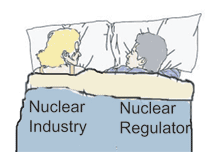 Proposed radioactive waste disposal rules are weak and industry-friendly
Armenia Rejects Russian Funding For Nuclear Plant Upgrade
|
Armenia Rejects Russian Funding For Nuclear Plant Upgrade, https://www.rferl.org/a/armenia-rejects-russian-funding-for-nuclear-plant-upgrade/30667786.html June 12, 2020 By RFE/RL’s Armenian Service
YEREVAN — The Armenian government has announced it has decided to use only 60 percent of a $270 million Russian loan designed to finance the ongoing modernization of its Soviet-era nuclear power plant at Metsamor. The plant’s sole functioning reactor went into service in 1980 and was due to be decommissioned by 2017. However, a previous government in 2014 decided to extend the life of the 420-megawatt reactor by 10 years after failing to attract foreign investment for the construction of a new nuclear plant. In 2015, the Russian government agreed to provide Armenia with a $270 million loan and a $30 million grant to upgrade the Metsamor nuclear power plant. The modernization work, led by Russia’s Rosatom nuclear energy agency, was due to be completed by the end of 2019, but the process fell behind schedule, preventing the full disbursement of the Russian funds. Armenia’s infrastructure minister on June 11 said the country had used only $107 million of the Russian money. Suren Papikian said Moscow had offered to extend the loan agreement by two years under the condition that Armenia agreed to use 80 percent of the money to commission equipment and services from Russian companies. The government of Prime Minister Nikol Pashinian backed Papikian’s proposal to reject the Russian offer and to finance the remaining work through government bond sales. Pashinian’s government said it planned to spend 63 billion drams ($130 million) to upgrade the facility over the next two years. Pashinian said that the government will now be free to select the suppliers for Metsamor, which he said will “substantially” lower the costs. Armenia’s sole nuclear plant, located 35 kilometers west of Yerevan, generates roughly 40 percent of the country’s electricity. The European Union and the United State have long pressed for its closure, saying that it does not meet modern safety standards. |
|
1 This Month
23 April – WEBINAR – Why new nuclear reactors are the wrong tools for decarbonization Thursday, April 23 • 1 AM – 2 AM AEST
World Nuclear Power. Reactors 1951-2026, 75 Years of Nuclear Power.
Interactive Map– https://dv.worldnuclearreport.org/

Chernobyl: The Lost Tapes – A good documentary on Chernobyl on SBS available On Demand for the next 3 weeks– https://www.sbs.com.au/ondemand/tv-program/chernobyl-the-lost-tapes/2352741955560

of the week–London Campaign for Nuclear Disarmament


Tell the Ukrainian Government to Drop Prosecution of Peace Activist Yurii Sheliazhenko
To see nuclear-related stories in greater depth and intensity – go to https://nuclearinformation.wordpress.com
-
Archives
- April 2026 (231)
- March 2026 (251)
- February 2026 (268)
- January 2026 (308)
- December 2025 (358)
- November 2025 (359)
- October 2025 (376)
- September 2025 (257)
- August 2025 (319)
- July 2025 (230)
- June 2025 (348)
- May 2025 (261)
-
Categories
- 1
- 1 NUCLEAR ISSUES
- business and costs
- climate change
- culture and arts
- ENERGY
- environment
- health
- history
- indigenous issues
- Legal
- marketing of nuclear
- media
- opposition to nuclear
- PERSONAL STORIES
- politics
- politics international
- Religion and ethics
- safety
- secrets,lies and civil liberties
- spinbuster
- technology
- Uranium
- wastes
- weapons and war
- Women
- 2 WORLD
- ACTION
- AFRICA
- Atrocities
- AUSTRALIA
- Christina's notes
- Christina's themes
- culture and arts
- Events
- Fuk 2022
- Fuk 2023
- Fukushima 2017
- Fukushima 2018
- fukushima 2019
- Fukushima 2020
- Fukushima 2021
- general
- global warming
- Humour (God we need it)
- Nuclear
- RARE EARTHS
- Reference
- resources – print
- Resources -audiovicual
- Weekly Newsletter
- World
- World Nuclear
- YouTube
-
RSS
Entries RSS
Comments RSS
 nuclear-news