Japan taxpayers foot $100bn bill for Fukushima disaster
The Fukushima nuclear disaster has cost Japanese taxpayers almost $100bn despite government claims Tokyo Electric is footing the bill, according to calculations by the Financial Times.
Almost five years after a huge tsunami caused the meltdown of three Tepco reactors by knocking out their supply of power for cooling, the figure shows how the public have shouldered most of the disaster’s cost.
It highlights the difficulty of holding a private company to account for the immense expense of nuclear accidents — a concern for countries such as the UK that are building new nuclear power stations.
The Financial Times used Ritsumeikan University professor Kenichi Oshima’s estimate that the disaster has cost Y13.3tn ($118bn) to date relative to the loss of equity value for Tepco shareholders.
“The underlying cost is mainly being paid by the public, either through electricity bills or as tax,” said Mr Oshima.
Japan’s government gives no single figure for the cost of the disaster, but Mr Oshima estimates the biggest cost to date is compensation to businesses and evacuees of Y6.2tn, followed by decontamination of the Fukushima area at Y3.5tn, and decommissioning of the reactor site at Y2.2tn.
Cash for compensation and decommissioning comes from Tepco but it gets grants from the government to keep it solvent. In theory, this cash will come back via a levy on Tepco and other nuclear operators — but this is ultimately be paid by electricity users, making it a tax by another name.
There is are also doubts about whether the levy will be sustainable when Japan’s electricity market opens to competition from April 1. In a recent interview, Tepco chief executive Naomi Hirose insisted the company would make enough money to clean up the Fukushima Daiichi plant.
“We have to preserve that earning power,” Mr Hirose said. “Victory for us means having the money to meet our responsibilities in Fukushima. If we can’t, that’s failure.”
But one way to judge Tepco’s contribution is its share price, which should reflect past losses, as well as any levies the market expects in the future. Compared with March 10 2011, the day before the disaster, Tepco’s equity has lost Y2.6tn in value. Debtholders have not suffered losses.
That implies Tepco has borne slightly less than 20 per cent of the total cost, with taxpayers picking up the other Y10.7tn. The figure is rough, and ignores the cost of shutting down all Japan’s nuclear reactors, so it is likely to understate both the total cost and the proportion paid by the public.
Tepco, the finance ministry and the economy ministry declined to comment on the estimate. A government official insisted all costs would ultimately be recouped from Tepco and said it could not pass the burden on to electricity customers. “As a whole, Tepco is paying its own costs,” said the official.
Evacuees are now being allowed to return to some villages near the Fukushima Daiichi plant but decommissioning will take decades, with radiation levels still too high even to evaluate the stricken reactors. The final cost is unknown and Mr Oshima expects his estimate to rise.
“The government’s approach has worked in that Tokyo Electric has not shut down,” said Mr Oshima. “But with the costs increasing to this extent it’s hard to see the purpose of having kept Tepco alive.”
http://www.ft.com/intl/cms/s/0/97c88560-e05b-11e5-8d9b-e88a2a889797.html#axzz428179eA0
Government to spur work to fully reopen Fukushima’s disaster-hit JR Joban Line

The limited express train “Super Hitachi No. 50,” bound for Ueno Station in Tokyo, has remained at Haranomachi Station in Minami-Soma, Fukushima Prefecture, since March 11, 2011, as the JR Joban Line became partly unavailable due to the Great East Japan Earthquake, tsunami and an accident at the Fukushima No. 1 nuclear power plant. East Japan Railway Co. plans to remove the train from the railway in mid-March.
Government to spur work to fully reopen Fukushima’s disaster-hit JR Joban Line
NARAHA, FUKUSHIMA PREF. – Prime Minister Shinzo Abe expressed a willingness Saturday to spur work to fully reopen East Japan Railway Co.’s Joban Line in Fukushima Prefecture, which was partially closed following the March 2011 earthquake and tsunami.
The government is looking at completely reopening the Joban Line in the spring of 2020, ahead of the Tokyo Olympics and Paralympics, informed sources said.
“I’ve instructed the transport minister to promptly indicate the timing (of the reopening),” Abe told reporters during a visit to the Fukushima Prefecture town of Naraha near the disaster-crippled Fukushima No. 1 nuclear plant.
The Joban Line’s operator, also known as JR East, has released a plan to reopen in stages by the end of 2017 all shuttered sections but the Tomioka-Namie segment near the nuclear plant.
The prime minister also said that he will instruct the industry minister to set up a public-private panel to start a detailed study this month on a plan to make Fukushima Prefecture a key region for renewable energy production.
“In Fukushima in 2020, hydrogen fuel for 10,000 fuel cell vehicles will be produced from (the use of) renewable energy,” Abe said.
On Saturday, he visited a stock farm in the city of Fukushima, a restaurant using local ingredients in the town of Hirono, a battery factory in Naraha and other facilities.
“The reconstruction of Tohoku is the Abe administration’s top priority,” the prime minister said ahead of the fifth anniversary on Friday of the massive disaster.
http://www.japantimes.co.jp/news/2016/03/05/national/government-to-spur-work-to-fully-reopen-fukushimas-disaster-hit-jr-joban-line/#.Vtss5ObzN_l
FIVE YEARS AFTER: Joban Line to be fully resumed by spring 2020
Damaged in the 2011 Great East Japan Earthquake and tsunami and disrupted by the nuclear accident, the JR Joban Line, which runs between Tokyo and Miyagi Prefecture, is set to fully resume operation by spring 2020.
On March 5, Prime Minister Shinzo Abe inspected the Joban Line and told reporters, “I instructed the transport minister to set as early as possible the time when train services will be resumed along the entire portion.”
The government is expected to set the target of spring 2020 for the full resumption of service at its Reconstruction Promotion Council meeting on March 10, according to government sources. That will allow railway services to be fully available before the 2020 Tokyo Olympics and Paralympics, to be held in the summer of that year.
At present, services are still unavailable in two sections. One is the 46-kilometer stretch between Tatsuta Station in Naraha, Fukushima Prefecture, and Haranomachi Station in Minami-Soma, also in the prefecture.
The other is the 22.6-km section between Soma Station in Soma, Fukushima Prefecture, and Hamayoshida Station in Watari, Miyagi Prefecture.
Of the 46-km stretch, the 21-km portion between Tomioka Station in Tomioka and Namie Station in Namie is close to the crippled Fukushima No. 1 nuclear power plant, and most of the areas along the route have been designated as “difficult-to-return zones” due to high radiation levels.
In those areas, it is necessary to remove the crossties and gravel that are contaminated with radioactive substances and to lay new ones. The work is expected to continue until fiscal 2019.
Meanwhile, the operation of the remaining sections is scheduled to resume by fiscal 2017
http://ajw.asahi.com/article/0311disaster/recovery/AJ201603060030

Prime Minister Shinzo Abe speaks with local high school students at JR Odaka Station
on the Joban Line in Minamisoma, Fukushima Prefecture,
on Saturday during a visit to the area.
Renewable energy news – more fun, and much more is happening than in the nuclear industry
Journalism highlights of the week :
*Australia’s revolving door – from politician to mining executive and back again: how miners control Australian government policy.
*The horrendous truth about just how big a mess nuclear corporation EDF is in.
 Yes, I do get tired of all the doom and gloom – about the nuclear industry – both in its harmful effects, and in its dismal future prospects.
Meanwhile – when I start looking at renewable energy news – well, there’s miles of it! And, not to be discounted, even where I live, I see new solar panels popping up in the neighbourhood every week!
RENEWABLE ENERGY & ENERGY EFFICIENCY
- Death throes of the nuclear industry as renewables move towards 80 percent penetration in the U.S.
- An unforgettable year for solar power in USA.
- Global Boom in Wind Power, led by China and USA.
- UK govt urged to lower tax on energy efficient homes – report.
- Cornwall, UK, gets wind farm without any govt funding- community energy!
- Solar power powers up; London – with World’s biggest floating solar farm.
- Dramatic improvement in solar cell technology.
- In 10 years – 100% renewable energy is doable.
Climate Change Champion – Leonardo Di Caprio.
USA Design flaws in America’s nuclear reactors: NRC engineers call for shutdown, if not fixed. ‘uncontrollable radioactive flow’ from Indian Point nuclear station into the Hudson River. Radioactive leak just one of many nuclear problems at Indian Point, USA. The end of the nuclear age – foreshadowed as Indian Point nuclear station leaks radioactivity. The danger of flying nuclear materials between UK and USA. Russia & USA Pointing Nuclear Missiles at Asteroids – bonanza for Lockheed Martin etc. High costs and construction delays cast gloom over nuclear industry. The Price of Nuclear Weapons and Nuclear Power
JAPAN – Fukushima. TEPCO Lied To The World About Fukushima Meltdowns. Court case will unveil ‘the hidden truths’ of the Fukushima nuclear meltdown. ‘Keep pro nuclear signs’ as reminder of Fukushima nuclear catastrophe. How solar energy can turn lives around in nuclear-devastatedFukushima. ‘deep freeze’ of soil wall at Fukushima plant. TEPCO now burning thousands of radioactive work clothes. As far away as Tokyo, highly radioactive black sand from Fukushima meltdowns is found. Radioactive contamination still a very real crisis for Fukushima fishermen. Very few return to “re-opened” town in Fukushima.
Strontium 90 – Japanese Preserving Deciduous Teeth Network.
WEAPONS & WAR Huge rally in Britain against Trident nuclear missile system. UK govt to spend £642 million developing new submarines for Trident nuclear missiles. Russia to test launch ballistic missiles from nuclear-powered submarines. Kim Jong-un orders nuclear weapons readied for use ‘at any time’ India about to get a nuclear-armed submarine. New USA nuclear missile test.
FRANCE. The horrendous truth about just how big a mess nuclear corporation EDF is in. Francepromises more compensation to Pacific nuclear test victims. France prepared to extend life of nuclear reactors: energy minister. France sued by Geneva over dangerous and polluting nuclear station. France’s nuclear giant AREVA in deep financial mess – again!
GERMANY‘s nuclear utilities will have to transfer nuclear clean-up cash by 2022.
IRAN Big win for Rouhani and Reform in Iran elections. International Atomic Energy Agency reports that Iran is abiding by nuclear agreement.
Japan’s nuclear industry remains in crisis, as criminal prosecution of Tepco executives proceeds
TEPCO Prosecution: A Sign That Japan’s Nuclear Industry Is in Free Fall http://thediplomat.com/2016/03/tepco-prosecution-a-sign-that-japans-nuclear-industry-is-in-free-fall/ The criminal prosecution of TEPCO is another step in the process to end nuclear power in Japan. By Shaun Burnie March 04, 2016 The decision this week to indict executives of Japan’s largest energy utility, Tokyo Electric Power Company (TEPCO), for their failure to prevent the meltdown of three reactors at Fukushima Daiichi is a major step forward for the people of Japan.
The fact that this criminal prosecution is taking place at all is a vindication for the thousands of citizens andtheir dedicated lawyers who are challenging the nation’s largest power company and the establishment system. It is a devastating blow to the obsessively pro-nuclear Abe government, which is truly fearful of the effects the trial will have on nuclear policy and public opinion over the coming years.
For the eight other nuclear power companies in Japan, including their executives, the signal is clear – ignore nuclear safety and there is every prospect that when the next nuclear accident happens at your plant you will end up in court. For an industry that disregarded safety violations and falsified inspection results through its entire existence, the prosecution of TEPCO will be shocking.
But it would be naive to think that profound behavioral change will inevitably follow. In fact, in the five years after the accident, Japan’s nuclear industry has not just failed to learn the lessons of the accident, it is still actively ignoring them. In the three years since nuclear plant operators applied to restart their shutdown nuclear fleet, the evidence shows that when it comes to nuclear safety the bottom line is not safety, but money.
Leaving aside the inherent risks of another severe nuclear accident, the new safety agency in Japan, the Nuclear Regulation Authority (NRA) is overwhelmed, incapable and inadequate.
Back in 2008, TEPCO produced an internal report that predicted a maximum credible tsunami of 15.7 meters, but continued to insist that it would not reach the nuclear plant at Fukushima, which sits at a height of 10 meters. The cooling pumps for the reactor cores and spent fuel pools were located at just four metres above sea level.
Historical evidence that a major tsunami would impact the eastern Pacific coast of Ibaraki, Fukushima and Miyagi was well known. Modelling suggested that the next major tsunami was overdue and would inundate the coastal plain about 2.5 to 3 km inland. In 2009, Japanese nuclear regulators questioned the vulnerability of the Fukushima Daiichi reactors to a large-scale tsunami and asked TEPCO to “consider” concrete steps against tsunami waves at the plant. TEPCO responded: “Do you think you can stop the reactors?”
This relaxed attitude is not just limited to TEPCO. In recent weeks, Kyushu Electric informed the NRA that the emergency seismic proof isolation building that they committed to build by March of this year would not be built after all, despite being a condition to secure approval to restart the two Sendai reactors. The NRA expressed its disappointment, but the Sendai reactors restarted in August and continue to operate.
At the Takahama nuclear plant, owned by Kansai Electric the NRA admitted in the last month that they do not know if the reactors comply with fire safety regulations requiring essential electric safety cabling to be adequately separated and protected.
The loss of safety cable function sounds mundane, but the risks are considered more severe than all other failures at a nuclear plant combined. Without electricity, vital safety systems do not work and control of the reactor is lost. A severe accident at Takahama would threaten millions of residents of Kyoto, Osaka, Kobe and the wider Kansai region.
Nonetheless, the NRA granted Kansai Electric an exemption to avoid delaying restart. Takahama reactor-3 resumed operation in late January, while Reactor 4 at Takahama resumed operations for less than three days before shutting down again on 29 February due to an electrical failure.
These examples are the tip of the atomic iceberg that threatens the next nuclear disaster in Japan. With three reactors now operating, the industry remains in crisis. Having sat on idle assets for the last few years, the utilities are desperate to resume operations, while the nuclear obsessed Abe government is happy to support them. It’s time to put people first.
Nuclear power is a financial disaster which will only get worse as the electricity market opens to new suppliers and renewable energies out-price them. And the vast majority in Japan realize this: 60 percent of Japanese are opposed to the phase-in of nuclear, and there are more than 300 lawyers fighting reactor by reactor to prevent restart on behalf of citizens. At this rate, the Abe government and the nuclear industry will never see the target of 35 reactors restarted by 2030.
The criminal prosecution of TEPCO, long in coming, is another step in the process to end nuclear power in Japan and for a transformation of its energy system to renewables.
Shaun Burnie is a nuclear specialist at Greenpeace Germany, currently working as part of a Greenpeace radiation survey team in the Pacific Ocean off the coast of Fukushima
Radiation damage – mutations appearing in Fukushima forests

 Mutations, DNA damage seen in Fukushima forests: Greenpeace, Phys Org, March 4, 2016 Conservation group Greenpeace warned on Friday that the environmental impact of the Fukushima nuclear crisis five years ago on nearby forests is just beginning to be seen and will remain a source of contamination for years to come………
As the fifth anniversary of the disaster approaches, Greenpeace said signs of mutations in trees and DNA-damaged worms were beginning to appear, while “vast stocks of radiation” mean that forests cannot be decontaminated………..
In a report, Greenpeace cited “apparent increases in growth mutations of fir trees… heritable mutations in pale blue grass butterfly populations” as well as “DNA-damaged worms in highly contaminated areas”, it said.
The report came as the government intends to lift many evacuation orders in villages around the Fukushima plant by March 2017, if its massive decontamination effort progresses as it hopes.
For now, only residential areas are being cleaned in the short-term, and the worst-hit parts of the countryside are being omitted, a recommendation made by the International Atomic Energy Agency.
But such selective efforts will confine returnees to a relatively small area of their old hometowns, while the strategy could lead to re-contamination as woodlands will act as a radiation reservoir, with pollutants washed out by rains, Greenpeace warned.
The conservation group said its report relies largely on research published in peer-reviewed international journals.
But “most of the findings in it have never been covered outside of the close circles of academia”, report author Kendra Ulrich told AFP.
The Japanese government’s push to resettle contaminated areas and also restart nuclear reactors in Japan that had been shut down in the aftermath of the crisis are a cause for concern, Ulrich said, stressing it and the IAEA are using the opportunity of the anniversary to play down radiation impacts.
“In the interest of human rights—especially for victims of the disaster—it is ever more urgent to ensure accurate and complete information is publicly available and the misleading rhetoric of these entities challenged,” she said.
Scientists, including a researcher who found mutations of Fukushima butterflies, have warned, however, that more data are needed to determine the ultimate impact of the Fukushima accident on animals in general.
Researchers and medical doctors have so far denied that the accident at Fukushima would cause an elevated incidence of cancer or leukaemia, diseases that are often associated with radiation exposure.
But they also noted that long-term medical examination is needed especially due to concerns over thyroid cancer among young people—a particular problem for people following the Chernobyl catastrophe. http://phys.org/news/2016-03-mutations-dna-fukushima-forests-greenpeace.html#jCp
Authorities withheld information on serious incident at Fessenheim nuclear facility in France
Reports: Fessenheim nuclear accident played down by authorities http://www.dw.com/en/reports-fessenheim-nuclear-accident-played-down-by-authorities/a-19093477
An incident at the Fessenheim nuclear facility in France in 2014 was more serious than previously known. German media reports claim the authorities withheld information detailing the gravity of the situation. Both the French nuclear authority, ASN, and the company operating the two Fessenheim nuclear reactors, French energy giant EDF, allegedly did not divulge the gravity of the incident on April 9, 2014, when one of the reactors had to be shut down after water was found leaking from several places.
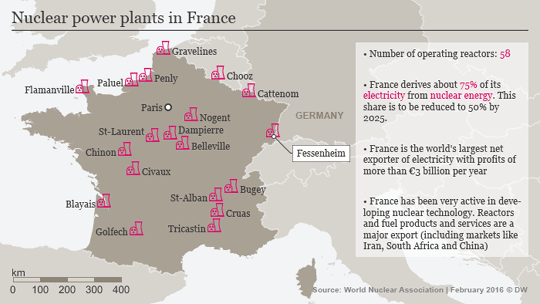
Researchers from German daily “Süddeutsche Zeitung” and public broadcaster WDR claim the incident at Fessenheim, which is in Alsace near the border with Germany, could turn out to be one of “most dramatic nuclear accidents ever in Western Europe.”
They are basing the claim on a document they say they have obtained, sent by ASN to the then-head of the facility on April 24, 2014.
The letter and subsequent reply reveal that the reactor could not be shut down in an ordinary fashion due to control rods being jammed. The reactor had to be shut down by adding boron to the pressure vessel, an unprecedented procedure in Western Europe, according to an expert.
“I don’t know of any reactor here in Western Europe that had to be shut down after an accident by adding boron,” Manfred Mertins, expert and government advisor on nuclear reactor safety, told WDR and Süddeutsche Zeitung.
The reports say the official report ASN released did not contain information on adding boron nor the jammed control rods. It was also not reported in that way to the International Atomic Energy Agency (IAEA).
The Fessenheim reactors went online in 1977 and 1978, making them France’s oldest. The government has repeatedly said it would shut down the facility after fierce criticism from politicians at home, as well as from neighboring Germany and Switzerland.
On Friday, Eveline Lemke, environment minister for the German state of Rhineland-Palatinate, which borders Alsace, called for Fessenheim to be shut down immediately. She said she was “dismayed to hear about yet another incident involving a French reactor,” adding that France’s nuclear watchdog was “evidently failing.”
Germany has also been at loggerheads with Belgium over the country’s Tihange nuclear reactor near their shared border. It was shut down in March 2014, but went back online in December last year, despite concerns over cracks in its pressure vessels.
Nuclear power still provides three-quarters of France’s energy needs, but the government passed legislation last summer to cut the country’s dependence on atomic energy.
Murder of indigenous activist Green Nobel winner Berta Caceres
Environmental activist, Green Nobel winner Berta Caceres killed http://www.theaustralian.com.au/news/world/environmental-activist-green-nobel-winner-berta-caceres-killed/news-story/8399e153bdf91f483868c9e9d63e6dac AFP MARCH 5, 2016 TEGUCIGALPA: Honduran indigenous activist Berta Caceres, an award-winning environmentalist, has been shot and killed in her home, her family labelling her death an assassination.
Ms Caceres won the 2015 Goldman Prize, the world’s top award for grassroots environmental activism, for leading the indigenous Lenca people in a struggle against a hydro-electric dam project that would flood native lands and cut off water supplies to hundreds.
Her mother, Berta Flores, said yesterday police had indicated her daughter was killed in a robbery, “but we all know it was because of her struggle”.
The 43-year-old mother of four, who had received death threats for her activism, was shot dead in the early hours of Thursday at her home in the western town of La Esperanza.
In awarding her the prize, the Goldman organisation commended her for carrying on her campaign despite the threats, writing: “Her murder would not surprise her colleagues, who keep a eulogy — but hope to never have to use it. “Despite these risks, she maintains a public presence in order to continue her work”.
President Juan Orlando Hernandez called the killing “a crime against Honduras” and vowed to bring the perpetrators to justice, and secretary-general of the Organisation of American States Luis Almagro condemned the crime as “horrific.”
As Ms Caceres’s body lay in a hall at a union headquarters in the Honduran capital Tegucigalpa yesterday, supporters outside shouted, “Berta is alive, the fight goes on”. About 3000 students blocked a road elsewhere in Tegucigalpa before police dispersed them with tear gas.
Security Minister Julian Pacheco said a security guard at the complex where Ms Caceres lived and another suspect who was wounded had been arrested.
Ms Caceres had won a ruling by the Inter-American Commission on Human Rights granting her special security measures. Police formerly provided her with an around-the-clock guard, but switched to an occasional security detail at her request, Mr Pacheco said. But the Centre for Justice and International Law denied that Ms Caceres had turned down bodyguards and accused the government of providing “deficient” security.
Mr Pacheco said Ms Caceres had spent the night away from the home that was registered with the authorities. Fellow activists said she had moved to a safe house, fearing for her life. Gustavo Castro, a Mexican activist who was with Ms Caceres at the time of the attack, was grazed with a bullet.
Labor leader Carlos Reyes joined Ms Caceres’s mother in insisting that she was not just another victim of violent crime.“The information from the police is that attackers broke into her home from the back and shot her twice, but we all know it’s a lie, that they killed her because of her struggle,” he said. “It’s a political crime by the government.”
Ms Flores said her daughter had recently had a “very big altercation” with soldiers and representatives of a hydro-electric company during a visit to the Gualcarque River.
Ms Caceres founded the Civic Council of Indigenous and People’s Organisations in 1993 with her then husband Salvador Zuniga. She was best known for her battle to save the Gualcarque River, which earned her the Goldman Prize — dubbed the “Green Nobel” — last year.
On accepting the prize, Ms Caceres linked her environmentalism to her indigenous roots.“In our cosmic vision we are beings born of the Earth, the water and the maize plant. We are the ancestral custodians of the rivers,” she said.
USA’s B-52 nuclear-capable B-52 bombers to Iraq and Syria
US sending nuclear-capable B-52 bombers to ISIS fight http://www.foxnews.com/world/2016/03/04/us-sending-nuclear-capable-b-52-bombers-to-isis-fight.html The United States is sending nuclear-capable B-52 aircraft to drop bombs on the Islamic State terror group, defense officials confirmed to Fox News Friday. 4 Mar 16
The B-52 Stratofortress will start its first bombing campaign against ISIS in April, the Air Force Times reports. It’s not clear how many B-52s or airmen will be involved.
Officials say the aircraft will replace nuclear-capable B-1 Lancers hitting ISIS targets in Iraq and Syria.
The Lancers returned to home bases in the U.S. in January. They flew only 3% of all strike missions against ISIS, but had dropped 40% of the bombs and other munitions. B-1s could loiter over the battlefield for 10 hours, much longer than jet fighters, and also could fly supersonic, reaching targets across Iraq and Syria within minutes.
“The B-1s are rotated out, so they’re not here right now, they’ve gone back to do some upgrades,” Lieutenant General Charles Q. Brown Jr., commander at U.S. Air Forces Central Command, told reporters. Each B-52 can carry up to 70,000 pounds of payload, officials say. The aircraft, sometimes nicknamed the “Big Ugly Fat Fella,” first took to the skies in 1954 and regularly takes part in military exercises around the world.
The B-52s are based in Louisiana and North Dakota.
Fox News’ Lucas Tomlinson contributed to this report.
One day before Washington deadline Workers begin removing nuclear waste from leaking Hanford tank
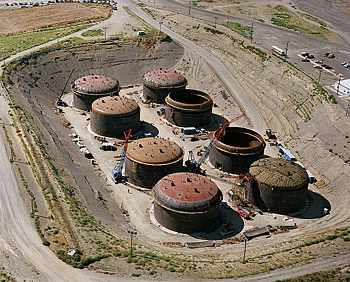 Workers begin removing nuclear waste from leaking Hanford tank http://www.seattletimes.com/seattle-news/workers-begin-removing-nuclear-waste-from-leaking-hanford-tank/ March 4, 2016 Workers have started removing nuclear waste from a leaking tank at the Hanford Site just one day before a state of Washington deadline. By Seattle Times staff The Associated Press KENNEWICK, Wash. — Workers have started removing nuclear waste from a leaking tank at the Hanford Site just one day before a state of Washington deadline.
The Tri-City Herald reports that Hanford workers began pumping waste from the nuclear reservation’s oldest double-shell tank Thursday afternoon.
The tank contains about 150,000 gallons of radioactive sludge covered by about 650,000 gallons of liquid waste. The liquid could be removed by early next week if things go smoothly, but removing the sludge is more complicated.
The Washington Department of Ecology had ordered the U.S. Department of Energy and its contractor Washington River Protection Solutions to begin emptying the waste by March 4 and finish the work within a year.
German Vatican Ambassador: Evil Brain Behind Dumping German Nuclear Waste on Poor in USA, Plagiarized Dissertation on Ethics; Doctorate Revoked

“Der alt böse Feind…Und wenn die Welt voll Teufel wär…” (Martin Luther, 1529)
[The old evil enemy… And when this world with Devils filled…]
“For still our ancient foe, doth seek to work us woe; his craft and power are great, and armed with cruel hate, on earth is not his equal…
Poking fun at PlagiAnette Schavan: Düsseldorf Karneval 2013, by Citanova Düsseldorf, CC-BY-2.0
“And though this world, with devils filled, should threaten to undo us, we will not fear, for God hath willed his truth to triumph through us. The Prince of Darkness grim, we tremble not for him; his rage we can endure, for lo, his doom is sure; one little word shall fell him.” Martin Luther: A Mighty Fortress is Our God, 1529, Frederick Hedge transl, 1852
Who was the evil German person behind asking the treasonous US official, Tom D’Agostino, in February 2012, to…
View original post 1,092 more words
March 4 Energy News

World:
¶ The Canadian province of Ontario will invest $100 million into “green energy” projects in its push to reduce greenhouse gas emissions 37% by 2030. Ontario’s premier said this will help the province cut greenhouse gas emissions while improving local business prospects. [CleanTechnica]
 Ontario wind turbine. Image via Shutterstock
¶ German utility E·ON will partner with Solarwatt GmbH to develop and release modular energy storage systems based on Solarwatt’s MyReserve battery. The first models are expected in the next few months. E·ON’s domestic marketplace has over 1½ million private rooftop PV systems. [CleanTechnica]
¶ India gave a big clue about how serious it is about energy transformation policy when it doubled a national tax on coal. The increase, to ₹400 per tonne ($6/tonne), applies to all domestic and imported coal. The coal tax represents 30% of the wholesale price of domestic coal. [Corporate Knights Magazine
View original post 649 more words
Five Years After Fukushima, ‘No End in Sight’ to Ecological Fallout

An employee uses a a radiation dosage monitor as workers continue the decontamination and reconstruction process.
The environmental impacts of the 2011 Fukushima Daiichi nuclear disaster are already becoming apparent, according to a new analysis from Greenpeace Japan, and for humans and other living things in the region, there is “no end in sight” to the ecological fallout.
The report warns that these impacts—which include mutations in trees, DNA-damaged worms, and radiation-contaminated mountain watersheds—will last “decades to centuries.” The conclusion is culled from a large body of independent scientific research on impacted areas in the Fukushima region, as well as investigations by Greenpeace radiation specialists over the past five years.
“The government’s massive decontamination program will have almost no impact on reducing the ecological threat from the enormous amount of radiation from the Fukushima nuclear disaster,” said Kendra Ulrich, senior nuclear campaigner at Greenpeace Japan. “Already, over 9 million cubic meters of nuclear waste are scattered over at least 113,000 locations across Fukushima prefecture.”
According to Radiation Reloaded: Ecological Impacts of the Fukushima Daiichi Nuclear Accident 5 Years Later, studies have shown:
- High radiation concentrations in new leaves, and at least in the case of cedar, in pollen;
- apparent increases in growth mutations of fir trees with rising radiation levels;
- heritable mutations in pale blue grass butterfly populations and DNA-damaged worms in highly contaminated areas, as well as apparent reduced fertility in barn swallows;
- decreases in the abundance of 57 bird species with higher radiation levels over a four year study; and
- high levels of caesium contamination in commercially important freshwater fish; and radiological contamination of one of the most important ecosystems – coastal estuaries.
The report comes amid a push by the government of Japanese Prime Minister Shinzō Abe to resettle contaminated areas and also restart nuclear reactors in Japan that were shut down in the aftermath of the crisis.
However, Ulrich said, “the Abe government is perpetuating a myth that five years after the start of the nuclear accident the situation is returning to normal. The evidence exposes this as political rhetoric, not scientific fact. And unfortunately for the victims, this means they are being told it is safe to return to environments where radiation levels are often still too high and are surrounded by heavy contamination.”
According to Greenpeace, it’s not only the Abe government that holds “deeply flawed assumptions” about both decontamination and ecosystem risks, but the International Atomic Energy Agency (IAEA), too. Indeed, the failures in the methods used by the IAEA to come to the “baseless conclusion” that there would be no expected ecological impacts from the Fukushima disaster are “readily apparent,” the report claims.
In September, Greenpeace Japan blasted the IAEA for “downplaying” the continuing environmental and health effects of the nuclear meltdown in order to support the Japanese government’s agenda of normalizing the ongoing disaster.
Report on Ecological Impacts of the Fukushima Daiichi Nuclear Accident 5years Later

The report is based on a large body of independent scientific research in impacted areas in the Fukushima region, as well as investigations by Greenpeace radiation specialists over the past five years. It exposes deeply flawed assumptions by the International Atomic Energy Agency and the Abe government in terms of both decontamination and ecosystem risks. It further draws on research on the environmental impact of the 1986 Chernobyl nuclear catastrophe as an indication of the potential future for contaminated areas in Japan.
The environmental impacts of the Fukushima Daiichi nuclear disaster will last decades to centuries, due to man-made, long-lived radioactive elements are absorbed into the living tissues of plants and animals and being recycled through food webs, and carried downstream to the Pacific Ocean by typhoons, snowmelt, and flooding.
Greenpeace has conducted 25 radiological investigations in Fukushima since March 2011. In 2015, it focused on the contamination of forested mountains in Iitate district, northwest of the Fukushima Daiichi nuclear power plant. Both Greenpeace and independent research have shown the movement of radioactivity from contaminated mountain watersheds, which can then enter coastal ecosystems. The Abukuma, one of Japan’s largest rivers which flows largely through Fukushima prefecture, is projected to discharge 111 TBq of 137Cs and 44 TBq of 134Cs, in the 100 years after the accident.
http://www.greenpeace.org/japan/ja/library/publication/20160304_report/
Mutations, DNA damage seen in Fukushima forests, says Greenpeace
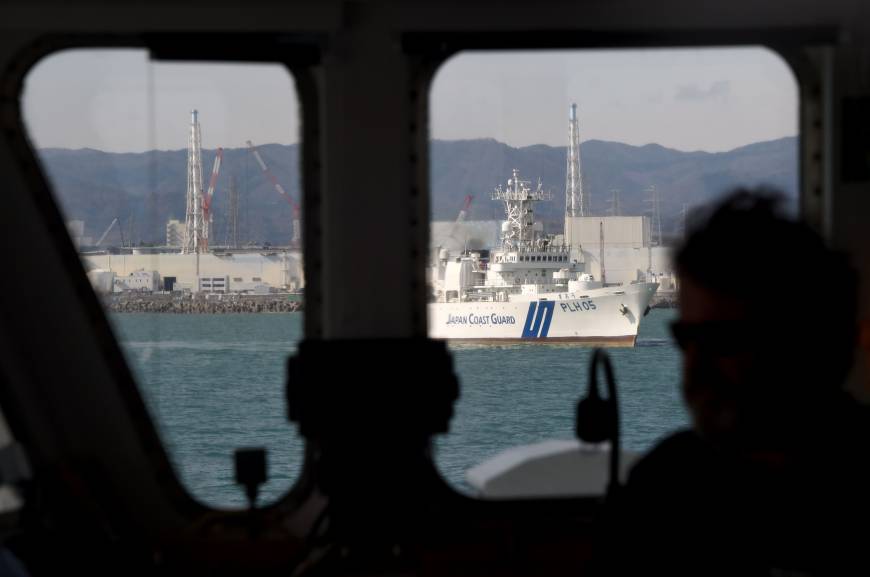
Conservation group Greenpeace warned on Friday that the environmental impact of the Fukushima nuclear crisis five years ago on nearby forests is just beginning to be seen and will remain a source of contamination for years to come.
The March 11, 2011 magnitude-9.0 undersea earthquake off the nation’s northeastern coast sparked a massive tsunami that swamped cooling systems and triggered reactor meltdowns at the Fukushima No. 1 nuclear plant.
Radiation spread over a wide area and forced tens of thousands of people from their homes — many of whom will likely never return — in the worst nuclear accident since Chernobyl in 1986.
As the fifth anniversary of the disaster approaches, Greenpeace said signs of mutations in trees and DNA-damaged worms were beginning to appear, while “vast stocks of radiation” mean that forests cannot be decontaminated.
In a report, Greenpeace cited “apparent increases in growth mutations of fir trees, … heritable mutations in pale blue grass butterfly populations” as well as “DNA-damaged worms in highly contaminated areas.”
The report came as the government intends to lift many evacuation orders in villages around the Fukushima plant by March 2017, if its massive decontamination effort progresses as it hopes.
For now, only residential areas are being cleaned in the short-term, and the worst-hit parts of the countryside are being omitted, a recommendation made by the International Atomic Energy Agency.
But such selective efforts will confine returnees to a relatively small area of their old hometowns, while the strategy could lead to re-contamination as woodlands will act as a radiation reservoir, with pollutants washed out by rains, Greenpeace warned.
The conservation group said its report relies largely on research published in peer-reviewed international journals.
But “most of the findings in it have never been covered outside of the close circles of academia”, report author Kendra Ulrich said.
The government’s push to resettle contaminated areas and also restart nuclear reactors elsewhere around the country that were shut down in the aftermath of the crisis are a cause for concern, Ulrich said, stressing it and the IAEA are using the opportunity of the anniversary to play down the impact of the radiation.
“In the interest of human rights — especially for victims of the disaster — it is ever more urgent to ensure accurate and complete information is publicly available and the misleading rhetoric of these entities challenged,” she said.
Scientists, including a researcher who found mutations of Fukushima butterflies, have warned, however, that more data are needed to determine the ultimate impact of the Fukushima accident on animals in general.
Researchers and medical doctors have so far denied that the accident at Fukushima would cause an elevated incidence of cancer or leukemia, diseases that are often associated with radiation exposure.
But they also noted that long-term medical examination is needed, especially due to concerns over thyroid cancer among young people — a particular problem for people following the Chernobyl catastrophe.
http://www.japantimes.co.jp/news/2016/03/04/national/science-health/mutations-dna-damage-seen-fukushima-forests-greenpeace/#.VtmtlObzN_m
Fukushima Bags of Trouble

Torn bags containing radioactive soil from decontamination work are seen dumped on a beach devastated by the March 11, 2011 tsunami in Naraha, near Tokyo Electric Power Co’s (TEPCO) tsunami-crippled Fukushima Daiichi nuclear power plant in Fukushima Prefecture.
The level of incompetence and irresponsibility displayed by the government is staggeringly awful.
http://www.japantoday.com/category/picture-of-the-day/view/bags-of-trouble
1 This Month
23 April – WEBINAR – Why new nuclear reactors are the wrong tools for decarbonization Thursday, April 23 • 1 AM – 2 AM AEST
World Nuclear Power. Reactors 1951-2026, 75 Years of Nuclear Power.
Interactive Map– https://dv.worldnuclearreport.org/

Chernobyl: The Lost Tapes – A good documentary on Chernobyl on SBS available On Demand for the next 3 weeks– https://www.sbs.com.au/ondemand/tv-program/chernobyl-the-lost-tapes/2352741955560

of the week–London Campaign for Nuclear Disarmament


Tell the Ukrainian Government to Drop Prosecution of Peace Activist Yurii Sheliazhenko
To see nuclear-related stories in greater depth and intensity – go to https://nuclearinformation.wordpress.com
-
Archives
- April 2026 (231)
- March 2026 (251)
- February 2026 (268)
- January 2026 (308)
- December 2025 (358)
- November 2025 (359)
- October 2025 (376)
- September 2025 (257)
- August 2025 (319)
- July 2025 (230)
- June 2025 (348)
- May 2025 (261)
-
Categories
- 1
- 1 NUCLEAR ISSUES
- business and costs
- climate change
- culture and arts
- ENERGY
- environment
- health
- history
- indigenous issues
- Legal
- marketing of nuclear
- media
- opposition to nuclear
- PERSONAL STORIES
- politics
- politics international
- Religion and ethics
- safety
- secrets,lies and civil liberties
- spinbuster
- technology
- Uranium
- wastes
- weapons and war
- Women
- 2 WORLD
- ACTION
- AFRICA
- Atrocities
- AUSTRALIA
- Christina's notes
- Christina's themes
- culture and arts
- Events
- Fuk 2022
- Fuk 2023
- Fukushima 2017
- Fukushima 2018
- fukushima 2019
- Fukushima 2020
- Fukushima 2021
- general
- global warming
- Humour (God we need it)
- Nuclear
- RARE EARTHS
- Reference
- resources – print
- Resources -audiovicual
- Weekly Newsletter
- World
- World Nuclear
- YouTube
-
RSS
Entries RSS
Comments RSS
 nuclear-news