Japan’s nuclear refugees face bleak return five years after Fukushima
Tokuo Hayakawa carries a dosimeter around with him at his 600-year-old temple in Naraha, the first town in the Fukushima “exclusion zone” to fully reopen since Japan’s March 2011 catastrophe. Badges declaring “No to nuclear power” adorn his black Buddhist robe.
(For a video of ‘Fukushima refugees face a bleak return home’ click here)
Hayakawa is one of the few residents to return to this agricultural town since it began welcoming back nuclear refugees five months ago.
The town, at the edge of a 20-km (12.5 mile) evacuation zone around the crippled Fukushima Daiichi plant, was supposed to be a model of reconstruction.
Five years ago, one of the biggest earthquakes in history shook the country’s northeast. The 10-metre (33-foot) tsunami it spawned smashed into the power plant on the Fukushima coastline triggering a meltdown and forcing nearby towns to evacuate. The disaster killed over 19,000 people across Japan and caused an estimated 16.9 trillion yen ($150 billion) in damages.
Only 440 of Naraha’s pre-disaster population 8,042 have returned – nearly 70 percent of them over 60.
“This region will definitely go extinct,” said the 76-year-old Hayakawa.
He says he can’t grow food because he fears the rice paddies are still contaminated. Large plastic bags filled with radioactive topsoil and detritus dot the abandoned fields.
With few rituals to perform at the temple, Hayakawa devotes his energies campaigning against nuclear power in Japan. Its 54 reactors supplied over 30 percent of the nation’s energy needs before the disaster.
Today, only three units are back in operation after a long shutdown following the nuclear meltdown in Fukushima. Others are looking to restart.
“I can’t tell my grandson to be my heir,” said Hayakawa, pointing at a photo of his now-teenaged grandson entering the temple in a full protective suit after the disaster. “Reviving this town is impossible,” he said. “I came back to see it to its death.”
That is bound to disappoint Japan’s Prime Minister Shinzo Abe. Rebuilding Naraha and other towns in the devastated northeast, he says, is crucial to reviving Japan.
Tokyo pledged 26.3 trillion ($232 billion) over five years to rebuild the disaster area and will allocate another 6 trillion for the next five years.
VANISHING TOWN
More than 160,000 people were evacuated from towns around the Daiichi nuclear plant. Around 10 percent still live in temporary housing across Fukushima prefecture. Most have settled outside their hometowns and have begun new lives.
In Naraha, two restaurants, a supermarket and a post office, housed in prefabricated shacks, make up the town’s main shopping center. The restaurants close at 3 p.m.
No children were in sight at Naraha’s main park overlooking the Pacific Ocean on a recent morning. Several elderly residents were at the boardwalk gazing at hundreds of bags stuffed with radioactive waste.
In fact, the bags are a common sight around town: in the woods, by the ocean, on abandoned rice fields.
Little feels normal in Naraha. Many homes damaged in the disaster have been abandoned. Most of the town’s population consists of workers. They are helping to shut down Tokyo Electric Power Co’s (9501.T) Daiichi reactors or working on decontamination projects around town.
Other workers are building a new sea wall, 8.7 meters high, along a nearly 2 km stretch of Naraha’s coast, similar to other sea walls under construction in the northeast.
A local golf course has been turned into dormitories for workers. Some families have rented their houses to workers.
“Naraha is a workers’ town now,” said Kiyoe Matsumoto, 63, a member of the town council, adding that her children and grandchildren have no plans to come home.
RADIATION LEVELS
The town’s future depends on young people returning, residents say. But only 12 below the age of 30 have returned as worries about radiation linger.
Radiation levels in Naraha ranged from 0.07 to 0.49 microsieverts per hour in January, or 0.61-4.3 millisieverts per year. That compares with the government’s goal of one millisievert a year and the 3 millisieverts a year the average person in the United States is exposed to annually from natural background radiation.
The significant drop in atmospheric radiation allowed the government to lift the evacuation order last Sept. 5 – “the clock that had been stopped began ticking again,” Japan’s Reconstruction Agency said on its website.
“It is hoped that the reconstruction of Naraha would be a model case for residents returning to fully evacuated towns,” the agency statement said.
Prime Minister Shinzo Abe visited the town a month after that and repeated one of his favorite slogans: “Without reconstruction of Fukushima, there’s no reconstruction of Japan’s northeast. Without the reconstruction of the northeast, there’s no revival of Japan.”
But with few people coming back, there is little meaning in what the reconstruction department in Naraha does, said one town hall official who requested anonymity. “I don’t know why (Abe) came,” he said.
Back at his Buddhist temple, part of which he has turned into an office for his anti-nuclear campaign, Hayakawa called the idea Naraha could be a model of reconstruction “a big fat lie”.
“There’s no reconstructing and no returning to how it used to be before (March 11). The government knows this, too. A ‘model case’? That’s just words.”
($1 = 113.1100 yen)
http://www.reuters.com/article/us-japan-disaster-return-idUSKCN0W430X
Living in Limbo
Five years after the meltdown in Fukushima, the Japanese government’s effort to reboot its nuclear energy program is still being met with resistance.

The atmosphere in the packed meeting room is tense. It is a Wednesday night in November, and perhaps a hundred people have gathered at a community center in the city of Minamisoma, which begins about six miles north of the decimated Fukushima Daiichi nuclear power plant. At the front of the room sits a phalanx of government officials in dark suits. Facing them are men and women who were forced from their homes in Minamisoma’s Odaka district by nuclear fallout, and who are now being told they might be allowed back by spring. The question on the table is whether that move is premature. Twenty minutes into the discussion, the deep divide between the officials and the residents is clear.
An older man raises his hand. “There’s a tombstone behind my house where the radiation measures 10.5 microsieverts per hour. 10.5!” he says.
Multiplied over a year, the figure is 4.6 times the standard Japan’s government has set for mandatory evacuation, and 92 times the limit the International Commission on Radiological Protection recommends for the general population under normal circumstances. It is also far higher than most measurements taken recently in Odaka, where a massive government-sponsored cleanup – together with natural decay – is steadily lowering radiation levels.
“It’s probably a hotspot,” an environment ministry official says. “We can take care of it for you.”
“I asked the government for data about that spot in August, but I haven’t gotten anything. Why not?” the resident demands.
A woman in the audience shouts out: “Because they’re liars!”
“We think you’re afraid to give us the real data,” the man says.
Another resident speaks up: “The forest surrounding my house has not been decontaminated. Would you live in a place like that? I beg of you, please delay the resettlement!” Applause breaks out in the audience.
I kneel at the back of the crowd, surprised by the depth of the anger and skepticism coursing through the room. The normal tone of public space in Japan is deferential courtesy. That ordinary residents of a provincial town are willing to challenge officials so openly reflects a profound shift brought about by the nuclear disaster.
Simply put, far fewer people trust the government today than they did five years ago. The immediate cause of the disaster was an earthquake and tsunami on March 11, 2011 that deprived the coastal Fukushima plant of its power supply, and hence of its ability to keep reactors and spent fuel cool. A series of explosions and meltdowns followed, which led to the eventual evacuation of 164,000 people. Subsequent investigations soon revealed, however, that poor oversight and cozy ties between government, industry, and academia (the so-called “nuclear village”) laid the groundwork for the disaster. The public also learned that the government bungled the evacuation, causing thousands of people to suffer more radiation exposure than they otherwise would have.
Since then, resistance has extended deep roots. The clearest evidence of that is here in Fukushima, where residents like the ones in this room are fighting to make sure their rights are respected. But far beyond these borders as well, communities are embracing renewable energy and citizens are protesting government abuses of power more loudly than they have in decades. The question that remains after I slip out into the cool night air is how much that resistance is changing policy and politics in Japan.
At times, the answer seems to be: very little. The same political party that enabled the Fukushima disaster through half a century of pro-nuclear policy is back in power, three nuclear reactors are running again despite safety concerns, one more is about to restart, and 20 more are awaiting approval. Meanwhile, Japan played only a minor role at the Paris climate talks in November, and is pouring money into coal plants to compensate for its idled nuclear fleet. In Fukushima, the government remains intent on repopulating the 310-square-mile exclusion zone as quickly as possible.
I have come to Japan on the eve of the disaster’s fifth anniversary to try to make sense of these changes – to weigh hope against cynicism, transformation against retrenchment. What happens here matters globally. Japan is the world’s fifth largest carbon dioxide emitter, is the number-one importer of liquefied natural gas and number-two importer of coal, and a leading exporter of nuclear and “clean coal” technologies. Its domestic energy choices clearly affect the world’s efforts to tackle climate change. But my motivation is also personal. I was living in Japan when the disaster occurred. I witnessed firsthand both its devastating aftermath and the sense of hope for a more sustainable and democratic future that sprang up in its wake. I want to know the fate of that hope.
My host in Minamisoma is a retired postman and lifelong activist from Odaka named Tomio Kokubun. He began protesting nuclear power when he was 20 years old and a new plant – Fukushima Daiichi – was proposed south of his home. Back then, his anti-nuclear activism placed him on the fringe of a community eager to benefit from the jobs the plant brought to the region. Today, he tells me with just a hint of vindication, his neighbors concede he was right to worry.

Long-time anti-nuclear activist and Fukushima native Tomio Kokubun stands next to a sign he wrote and posted near his abandoned house. It reads: “Abe administration, don’t ignore the voice of the people and restart the nuclear reactors.”
I first met Kokubun in 2013 in the snowy mountains west of Fukushima City, where he and his family had been living since they fled the coast after the first explosion at the plant. It was clear that two years of displacement had taken their toll. Kokubun’s ailing mother-in-law and sister-in-law died after a series of evacuation-related moves, and his wife Mieko told me she felt isolated and unhappy in her new surroundings. His grown son, too, talked about how much he wanted his old life back.
Kokubun alone seemed galvanized by the chain of events. He had founded a sprawling association of evacuees and supporters, and was traveling regularly to speak against nuclear power. He was also deeply involved in a class-action lawsuit to gain more compensation from Tepco, the plant operator, for damages caused by the accident. (By 2015, over 10,000 evacuees and nearby residents had filed similar claims.) The stricter safety rules for nuclear plants that the government implemented later that year – including more rigorous backup power requirements – did not placate him. To the contrary, the disaster and its aftermath proved what he had always suspected – that any man-made system contains the potential for failure, and in the case of nuclear power, failure is catastrophic.
Now, two years later, Kokubun was back in Minamisoma, and I had arranged to meet him there the morning of the community meeting. As I looked around the clean, quiet bus stop, I caught sight of him grinning and waving at me from across the street. He was dressed in jeans and a plaid shirt, his snow-white hair poking out from under a tweed hat.
“We’re doing well,” he told me as I climbed into his car. He and Mieko had finally pulled together enough money to start building a new house farther north. In the meantime, they are living in a house in a part of their hometown that was only briefly evacuated. One reason for this move was Mieko’s worsening depression, which Kokubun told me had eased now that she was on familiar ground. The other reason was political.
“I felt strongly that I needed to expand my activism, and I thought if I came back here more people would sympathize with my message,” he said. In July of last year he launched a local organization focused on radiation safety, which so far has attracted around 100 members.
We headed into Odaka where Kokubun’s abandoned house is located. The cleanup was in full swing. Industrious men in masks power-washed sidewalks, dump trucks crowded the streets, and orange placards marked houses for demolition. Everywhere we went we saw squat black bags stuffed with tainted dirt and debris. (Almost 10 million of these bags litter Fukushima, awaiting transportation to a mid-term storage site near Fukushima Daiichi.)
At the community meeting later that night, the mayor of Odaka insisted that all this work was meant only to ensure displaced residents could return if they wanted to – not to force them back.
The dilemma, of course, is that contamination cannot be completely removed from the environment. It will linger in forests and ponds and backyard corners for decades to come, exposing anyone who returns to low but persistent levels of radiation. Science provides no clear answers regarding the potential health risks of that exposure. Above 100 millisieverts (mSv) cancer rates clearly rise; below that level, they may also rise slightly, but the increase is extremely hard to detect in population-level studies.
Following the Fukushima disaster, Japan’s government used the lack of scientific consensus on low-level radiation impacts to justify raising the acceptable level of exposure for the general population from 1 mSv to 20 mSv per year above background levels. (The International Commission on Radiological Protection’s recommended maximum exposure for the general population is 1 mSv under normal circumstances and between 1 mSv and 20 mSv after a nuclear accident.) The decision was, in effect, a pragmatic one. If the government had stuck with the 1 mSv limit, it would have had to evacuate far more people and establish a large, long-term exclusion zone similar to the one around Chernobyl. With the higher limit, bringing nuclear refugees back home became a possibility.
But why the fixation on return? Is it merely that Japan is small, land is precious, and people’s attachment to place fierce? As we drove through the strange landscape of black bags and masked men, Kokubun told me he believes otherwise. “The government is doing this to regain support for nuclear power,” he said. The logic is that if even Fukushima can be “fixed,” people will stop fearing the reopening and operation of other plants.
Kokubun’s response has been to do whatever he can to prevent the illusion of normalcy from seeping in – from dragging Tepco through court to lecturing nationwide about the situation on the ground to hosting visitors who want to see the exclusion zone for themselves. That he is 70 and has been fighting the same fight for 50 years appears not to bother him.
“Right now, the old have to protect the young,” he told me. “We’re the ones who accepted the nuclear plants, who allowed them to be built. The real responsibility lies with us.”
“Do you ever feel like giving up?” I asked.
“I will never give up,” he replied, almost cheerfully. “I will never accept nuclear power.”
A majority of Japanese now share Kokubun’s opinion. Over 70 percent of respondents in recent polls say they want to phase out nuclear power, and 8.5 million have signed a petition calling for renewable energy to replace reactors. Anti-nuclear protests in Tokyo drew hundreds of thousands of ordinary citizens at their peak in 2012. When the Democratic Party of Japan (DPJ) – which briefly held power before and after the disaster – asked for public input on its energy and environment policy in 2012, a record-breaking 89,000 people sent in comments, close to 90 percent of them opposing nuclear power.
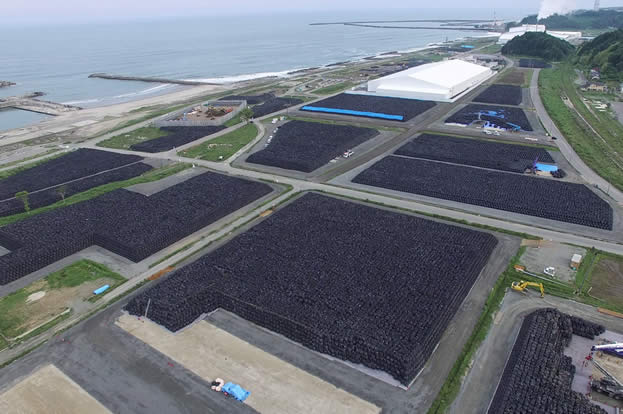
Bags stuffed with tainted dirt and debris stored near the sea. About 10 million of these bags litter Fukushima, awaiting transportation to a mid-term storage site.
The relationship between this surge in anti-nuclear sentiment and Japan’s broader energy policy is complex. The Fukushima disaster occurred just as global concern over climate change was accelerating. In 2009, then-Prime Minister Yukio Hatoyama had committed Japan to lowering carbon emissions a quarter below 1990 levels by 2020 – largely through a plan to increase nuclear power to half of the country’s electricity mix. The meltdowns changed everything.
“With the 3-11 disaster, everyone’s attention turned toward nuclear power. Since then, climate change has fallen more and more off the public’s radar as an important issue,” Takako Momoi told me when I stopped by the Tokyo office of Kiko Network, Japan’s biggest homegrown climate-change NGO, where she works as a manager. A minority of activists even began to spread the message that climate change was a ruse to gain support for nuclear power. In 2013, when the new government traded Hatoyama’s ambitious emissions goal for a 3 percent increase over 1990 levels by 2020, few people protested.
Coal has already seen a major resurgence. Construction of coal-fired power plants had stalled around 2009 due to climate change concerns, but now 48 new plants are planned or under construction, says Momoi. Even with much-touted new “clean coal” technology, she adds, these plants will emit as much carbon dioxide as those that burn oil.
Then there is the fact that even if the public prefers renewables to coal or nuclear, most people still prioritize the economy over the environment in elections. In 2012, voters ousted the DPJ in favor of the pro-nuclear Liberal Democratic Party (LDP), which has monopolized power for most of Japan’s post-war period. The LDP quickly set about formulating its own energy vision. It tossed out the public comments the DPJ had collected, kicked anti-nuclear advisors like those from Momoi’s organization off policy committees, and last summer finalized a long-term energy vision that calls for electricity to come from roughly equal parts nuclear, liquid natural gas, coal, and renewable sources by 2030.
At the local level, however, a more ambitious vision has started to emerge. Many communities are formulating their own renewable energy plans – Minamisoma among them. This March, the city of 63,000 released a “Non-Nuclear Power Declaration” reaffirming an earlier pledge to generate 65 percent of its electricity from renewable sources by 2020, and 100 percent by 2030 (compared to around 10 percent today). Construction is slated to begin this year on a solar farm large enough to power almost all of the city’s households, and four windmills are planned as well. A generous national feed-in tariff program introduced in 2012, which guarantees high prices to individuals and companies selling renewable energy to the grid, has lured corporate investors to these projects.

Cleanup workers power-wash a parking lot in the Odaka district of Minamisoma.
That, together with some smaller subsidy programs, should get the city to its 2020 goal, says Shunichi Shiga, who heads Minamisoma’s newly-established renewable energy division. Reaching 100 percent could be tougher. Power distributors say they’ve already reached the limit of how much renewable energy they can incorporate without major improvements to the grid, and now that the feed-in-tariffs are being ratcheted down, investing in renewable energy is looking riskier. Overcoming these obstacles, Shiga says, will require action at the national level. Momoi concurs. “The [local] movement to increase renewable energy is great, but within the current policy context, it will hit a ceiling,” she says. “There’s a need to think more about the big picture.”
Many people are, in fact, starting to think about what it will take to achieve true change at the national level. One of the most interesting developments set off by the disaster has been the emergence of a strong student movement protesting the government’s disregard for democratic processes. Although its focus is on military policy rather than energy issues, the underlying concern is the same.
Called Students Emergency Action for Liberal Democracy, or SEALDs, this small but vocal group of high school and university students coalesced in mid-2015 against a set of security bills that the LDP ultimately pushed through the Diet (Japanese parliament) in September. Using social media and protests outside the Diet building featuring fierce, smart speeches, the students quickly engaged a broader slice of society than old-school protesters had been able to. It was the most significant student movement since the 1960s.
Koichi Nakano, a political science professor at Tokyo’s Sophia University says SEALDs is a “direct descendant” of the civil-society awakening that followed the nuclear disaster. “They were high school students at the time [of the meltdowns], and for many of them the first experience of protest was those anti-nuclear rallies,” he tells me. “The disaster exposed the myth that was more credible in earlier times about the trustworthiness of ruling elites in Japan.”
Nakano is himself active in an organization opposing the security bills, and has collaborated closely with SEALDs over the past year. He too sees the roots of the nuclear and military issues as intimately linked. “There’s a sense that the 1 percent increasingly control our fate and the 99 percent of us are left out in the dark, uninformed and practically disenfranchised,” he says. “In the case of the security bills, it’s about the ruling elites of Japan in collusion with the American elites changing the interpretation of the constitution to allow Japan to take part in America’s wars even without Japan being attacked. The nuclear power issue is very similar because nuclear power is something that those big powers need to continue on for lucrative reasons. They wouldn’t want to see Japan dropping out from the nuclear power club.”
In spite of this, Nakano believes citizen activists have changed the government’s course, at least on energy. “There was a long period in which even [Prime Minister] Abe couldn’t restart the nuclear reactors. That has only to do with the strength of the opposition,” he tells me. “We are talking about ordinary citizens, without resources, stopping the reactors for many, many months.”
As important as these popular movements may be, the people who will determine Japan’s longer-term energy path are not in the crowds outside the Diet, or even inside its halls. They are in elementary and middle school classrooms across the country. Japan’s education system played a key role in creating the so-called “myth of nuclear safety” – the widespread belief that Japan’s reactors were indestructible – that led towards poor oversight and, ultimately, disaster. Likewise, the lessons children learn now about the Fukushima disaster will shape their views on energy and the environment throughout their lives. So, on my last day in Japan, I take the train back to Fukushima to talk with a professor who has spent the past five years trying to improve radiation education.

The contamination will linger in forests and ponds and backyard corners
for decades to come.
Shinobu Goto is a tall, serious man in his forties who teaches environmental education at Fukushima University. We meet on a Saturday evening in a cluttered university office, where we are joined by two members of the Fukushima teachers’ union, Toshiki Kokubun (no relation to Tomio) and Hiroshi Sato, whose name has been changed to protect his identity. All three were deeply impacted by the disaster.
Goto in particular says the unexpected catastrophe thrust him into a period of intense reflection and regret. He had not previously focused on nuclear education, but now he began to scour official teaching materials on the topic for evidence of bias. He found plenty: elementary-level readers titled Exciting Nuclear Power Land, illustrations of frowning coal plants juxtaposed with friendly nuclear reactors, claims that Japan’s reactors could withstand large earthquakes and tsunamis. Goto was not alone in his critique. The minister of education himself admitted that the pre-disaster texts contained information “contrary to reality,” and soon had them replaced.
Yet the new radiation readers that the ministry published in late 2011 were hardly an improvement. They included just 8 lines about the Fukushima disaster, and instead emphasized how useful and ubiquitous radiation is in daily life. In this, Goto saw the makings of a new myth – not that reactors are infallible, but that the radiation they emit when they do fail is nothing to worry about.
“The concept that the level of radiation we have in Fukushima is safe is being steadily created through education and PR,” he tells me as we sip tea in the quiet research building. He was particularly worried that kids weren’t getting the information they needed to protect their own rights to physical, mental, and social wellbeing. “If you don’t know the exposure limit is 1 or 5 mSv per year in other places, you don’t realize the situation in Fukushima is abnormal,” he says. “Education is empowerment in the sense that it allows you to make those critiques.”
Teachers needed a better option, so in early 2012 he assembled a group of 16 Fukushima University professors, and together they wrote an alternative reader from a human-rights perspective. He also began holding workshops to teach critical thinking skills to public school students, so they could assess government and media claims on their own. At this point, top-level administrators began pressuring him to tone down his activism. The school is the only national university in the prefecture; from the start, its administrators had echoed the government’s emphasis on recovery over risk.

A sign in Fatuba, directly north of the Fukushima Daiichi power plant, reading “Nuclear power, energy for a bright future.” The town is closed off now.
“They told me I had to put a sticker on the reader saying it wasn’t an official publication of the university. I said that’s discriminatory; you don’t do that for other publications,” Goto says. (University representatives tell me they are unable to confirm or deny Goto’s claims, citing personnel changes and a lack of relevant meeting minutes.)
He refused to back down. Ultimately, the reader was published without the sticker, helping to turn national attention on the official curriculum. That attention reverberated to the ministry of education; when the official readers were revised again in 2014, they included more information on the Fukushima disaster, and an acknowledgement that scientists hold “various views” on the impacts of low-level radiation. Still, a startling array of terms were missing: “meltdown,” “Nuclear Accident Child Victim’s Law,” “hotspot,” “thyroid cancer,” and “radioactive waste” among them.
Kokubun and Sato say most teachers in Fukushima don’t venture beyond the official curriculum, which allots just two hours a year for radiation education, partly because they are too busy, and partly because they’re pressured not to.
Sato, an elementary school teacher in Fukushima City, has experienced this pressure directly. “Some high-level board-of-education staff observed one of my classes [on radiation in 2013], and afterwards they said to me, Don’t you think today’s class might worry the children?” The content was purely science based: Sato had shown the kids a graph of the relationship between radiation and cancer, and pointed out that high levels of exposure can be deadly. (In lessons, he also explains that the current degree of contamination in Fukushima City carries a relatively low risk of cancer.)
Fukushima’s Board of Education tells me later that teachers are permitted to share science-based radiation material as long as it is widely accepted. “Our goal,” a staff member writes in an email, “is to teach children to make appropriate decisions based on correct knowledge and understanding of radiation.” However, Sato says he’s been told to avoid the topic by his principal, vice-principal, and other teachers.
Like Goto, he has not bowed to this pressure. Yet both he and Kokubun seem worn down by their lonely struggle. The government defends its interests tenaciously, and the public – with the exception of a determined minority – is all too eager to assist by turning away from the painful past. “People need to be angrier,” Kokubun says. “I’m sad that more people haven’t spoken out with us.”
Outside Goto’s office, the sky is growing dark. Kokubun and Sato need to head home. After they leave, I ask Goto how much hope he has that things will change. He says he feels like he is gasping for breath. The pace of progress is slow, and public interest in the disaster’s ongoing impact is dwindling. Still, he says, he is determined to continue his work.
Later, after he drops me off at the train station, I leaf through some papers he has given me, among them an essay he wrote for his hometown newspaper concluding with the following lines: “They say that history is written by the victors. I will be watching and acting to make sure the lessons of the Fukushima nuclear accident are not written to suit the interests of the perpetrators of this unprecedented man-made disaster.”
In that, and in the commitment of many others to do the same, there lies a glimmer of hope.
http://www.earthisland.org/journal/index.php/eij/article/living_in_limbo/
An unforgettable year for solar power in USA

 Solar energy is poised for an unforgettable year, WP, By Chris Mooney March 2 New statistics just released by the U.S. Energy Information Administration suggest that in the coming year, the booming solar sector will add more new electricity-generating capacity than any other — including natural gas and wind.
EIA reports that planned installations for 2016 include 9.5 gigawatts of utility-scale solar — followed by 8 gigawatts (or 8 billion watts) of natural gas and 6.8 gigawatts of wind. This suggests solar could truly blow out the competition, because the EIA numbers are only for large or utility-scale solar arrays or farms and do not include fast-growing rooftop solar, which will also surely add several additional gigawatts of capacity in 2016.
In other words, U.S. solar seems poised for not just a record year but perhaps a blowout year. Last year, in contrast, solar set a new record with 7.3 gigawatts of total new photovoltaic capacity across residential, commercial, and utility scale installations.
“If actual additions ultimately reflect these plans, 2016 will be the first year in which utility-scale solar additions exceed additions from any other single energy source,” says EIA……….
“2016 is going to be a huge year, and then we’re going to continue to see big years over the next 5,” he [Nathan Serota, a solar industry analyst with Bloomberg New Energy Finance] said. Granted, solar could still face some headwinds, particularly from the competition offered by extremely low natural gas prices.
In the grand scheme, the tax credits for solar, as well as an extension of the production tax credit for wind, could serve as a kind of “bridge” into an era in which the Obama administration’s Clean Power Plan is operating — or at least, so the current administration hopes. Granted, that depends on whether that plan survives its current legal challenges.
A recent report from the National Renewable Energy Laboratory found that due to the tax credit extensions, the U.S. will add 53 additional gigawatts of renewable energy capacity by the year 2020. https://www.washingtonpost.com/news/energy-environment/wp/2016/03/02/solar-energy-is-poised-for-an-unforgettable-year/
Global Boom in Wind Power, led by China and USA
 China, U.S. Lead Global Boom in Wind Power, Climate Central, By Bobby Magill
March 2nd, 2016 Wind power had a big year worldwide in 2015 as China became the leader in wind power production capacity while the U.S. kept its top spot in electricity actually produced from wind turbines, according to new data released by the Global Wind Energy Council.
Low-carbon energy sources such as wind and solar power are critical to countries seeking to meet climate goals set forth in the Paris climate agreement struck in December. The pact aims to keep global warming to below 2°C (3.6°F)……..
“Wind power is leading the charge in the transition away from fossil fuels,” GWEC Secretary General Steve Sawyer said in a statement.
“The Chinese government’s drive for clean energy, supported by continuous policy improvement, is motivated by the need to reduce dependence on coal, which is the main source of the choking smog strangling China’s major cities, as well as growing concern over climate change,” the statement said.
No other country came close to China’s level of wind development growth last year. But while China is seeing the biggest wind turbine building boom, the U.S. is better at actually producing electricity from its turbines, generating more wind power than any other country last year.
The U.S. generated 190 million megawatt-hours of wind power in 2015, powering about 17.5 million homes. China clocked in at 185.1 megawatt hours, followed by Germany at 84.6, according to American Wind Energy Association data released Monday……
AWEA chief Tom Kiernan said the U.S. is on its way to generating 20 percent of its electricity from wind power by 2030. http://www.climatecentral.org/news/china-us-lead-global-wind-power-boom-20089
UK govt urged to lower tax on energy efficient homes – report
 Report calls for lower stamp duty on UK’s energy-efficient homes Tax should be lowered by up to £5,000, according to Policy Exchange report, which says the government is doing far too little to cut energy waste, Guardian, Damian Carrington, 2 Mar 16 The stamp duty paid on energy efficient homes should be up to £5,000 less than on leaky, hard-to-heat homes, according to a new report that says the government is doing far too little to cut energy waste.
The report is from the thinktank Policy Exchange, which is close to the government, and ministers are considering the idea. It estimates the stamp duty change would lead to 270,000 households a year improving their energy efficiency.
“Improving home energy efficiency can save households money, as well as substantially reducing their carbon emissions,” said Richard Howard, author of the report, and a former chief economist for the crown estate. “Policies which link property values more closely to energy performance could kickstart an energy efficiency revolution in this country.”
The report heavily criticises ministers, who have cut back energy efficiency programmes which are widely seen as the cheapest way to cut energy bills and meet carbon targets. “The UK still has amongst the least efficient housing stock and highest rates of fuel poverty in Europe,” it states.
The government aims to improve the insulation of 1m homes this parliament, far fewer than the 4.5m in the last parliament. It has also abandoned the failed green deal programme, which was meant to reach millions of homes with unique loans but only taken up by 16,000 households. “This leaves a major policy gap,” says the report.
The Policy Exchange proposal is to lower the stamp duty on energy efficiency homes while increasing it by the same amount on inefficient homes, meaning the tax taken by the government remains the same overall……
The report says: “There is huge potential to improve domestic energy efficiency. Research shows that a more ambitious approach to energy efficiency could deliver carbon savings of 24m tonnes of carbon dioxide a year by 2030 – equivalent to taking more than 10 million cars off the road – and save households of £8.6bn a year in energy costs.”…….
Another report published on Wednesday indicates that a roll-out of energy storage technology could save energy customers £50 a year, as well as cutting emissions on improving energy security. Energy storage technologies, from liquid air to big batteries, are developing rapidly and can store excess renewable energy and cut the need to build new power stations and lines.
The report was written by the Carbon Trust and Imperial College London and commissioned by Decc and three of the UK’s big six energy energy companies. A spokesman for one, SSE, said: “The report shows that, with the correct market structures, price signals and policy certainty, projects such as SSE’s proposed pumped storage scheme at Coire Glas can make a valuable contribution to society.” http://www.theguardian.com/environment/2016/mar/02/report-calls-for-lower-stamp-duty-on-uks-energy-efficient-homes
Cornwall, UK, gets wind farm without any govt funding- community energy!
 “The benefits of the Big Field wind farm are too great for it not to go ahead just because subsidies are being withdrawn. Being community-owned will ensure that the economic benefit of the wind farm can be retained locally and re-invested in Cornwall.”
Good Energy promises UK’s first subsidy-free  windfarm, http://www.theguardian.com/environment/2016/mar/02/good-energy-promises-uks-first-subsidy-free-windfarm Guardian, Fiona Harvey, 3 Mar 16
Green power company believes it can build onshore windfarm in Cornwall with local people helping finance it, despite government scrapping subsidies. The UK’s first onshore windfarm to be built without government subsidy is now under planning in Cornwall, to be financed in part by the local community.
The Big Field windfarm, near Bude, will consist of 11 turbines, none of more than 125m in height to the tip of the blade, and provide electricity for 22,000 homes. Its backers hope it will point the way to further such projects, after the damages to the onshore wind industry caused by the reversal of policy on government support for clean energy.
Likely to cost about £30m to build and install, Big Field is planned by the green power company Good Energy. While other wind and solar farms have been cancelled or left in limbo by the government’s scrapping of incentives for onshore wind, the company decided instead to try to raise funds locally to support the installation.
An initial application for planning permission for the turbines was filed under the previous subsidy regime. However, that was blocked, and with the withdrawal of government support for onshore wind, the plan looked at an end.
Good Energy revived its prospects with a new project that would use the same number of turbines, of the same size, but with 50% more generation capability, because of changes to the turbine technology.
The revised scheme will only go ahead if planning permission is granted, but the company is hopeful that the support of local residents in agreeing to co-finance the project will help to tip the balance. The inquiry will start in April and, if the green light is given, the windfarm could be operational in 2018.
Bill Andrews, who lives close to the site, said: “This is a very welcome development. A lot of my neighbours already support this wind farm, and giving local people the chance to invest in the project would mean the community will see even more of the benefit.”
The abrupt alterations to government support for wind and solar energy have caused severe disruption in the UK’s renewable energy industries. Thousands of jobs have been lost, companies forced to close, projects mothballed or abandoned, and future developments left in doubt.
Onshore wind technology has tumbled in price in recent years, a factor the government used to justify its withdrawal of support, but the economics of energy generation are complex. Ministers have also introduced new rules to make it more difficult to construct renewable energy projects, and increased subsidies to the fossil fuel industries through the “capacity market”.
Juliet Davenport, chief executive of Good Energy, said: “The benefits of the Big Field wind farm are too great for it not to go ahead just because subsidies are being withdrawn. Being community-owned will ensure that the economic benefit of the wind farm can be retained locally and re-invested in Cornwall.”
Good Energy said it was too early to decide how much of its own money and how much the local community would be expected to put into the project, or what returns investors could expect. However, if successful, it hopes this could provide a new blueprint for small onshore wind farms.
Design flaws in America’s nuclear reactors: NRC engineers call for shutdown, if not fixed

 NRC engineers urge shutdown of nuclear plants if design flaw not fixed, Utility Dive By Robert Walton | March 3, 2016
Dive Brief:
- A group of engineers in the U.S. Nuclear Regulatory Commission say they have identified a design flaw in nearly all nuclear reactors in the country that should result in their mandatory shutdown unless operators fix the problem, Reuters reports.
- In late February, the engineers petitioned the NRC to order immediate enforcement actions to correct the design flaw, which they say could result in damage to cooling systems and ultimately lead to an emergency situation. The filing asks the agency to respond by March 21 and is a part of a standard NRC process, according to the news outlet.
- The filing stems from an incident in January 2012, when Exelon’s Byron 2 unit in Illinois experienced an automatic reactor trip from full power after an undervoltage condition was detected. The unit was shut down for a week, in what is known as an open phase condition created by an unbalanced voltage. The NRC engineers say such an event could cause an electrical short, reducing the abilituy of cooling systems to operate.
Dive Insight:
In a little-noticed public filing, a group engineers from within the NRC are calling for an investigation into the nuclear vulnerability, and why it has not been fixed when the issue has been known since Exelon’s 2012 event.
Union of Concerned Scientists nuclear expert Dave Lochbaum told Reuters the agency “snatched defeat from the jaws of victory,” with its failure to address the issue after it became known in 2012. And the engineers say there has been at least 13 open phase events over the past 14 years.
Lochbaum said it was a positive sign the engineers filed, indicating no fear of reprisals. But the issue means “something is not right with the safety culture at the agency.” ……..http://www.utilitydive.com/news/nrc-engineers-urge-shutdown-of-nuclear-plants-if-design-flaw-not-fixed/414919/#.VthYQXYJX1Y.twitter
TEPCO Lied To The World About Fukushima Meltdowns
 5 Yrs. Later, TEPCO Finally Admits It Lied To The World About Fukushima Meltdowns http://environews.tv/world-news/after-5-yrs-tepco-finally-admits-it-lied-to-the-world-about-fukushima-meltdowns/ — Fukushima Prefecture, Japan — EDITORIAL: THE TRUTH 3 Mar 16 : Tokyo Electric Power Company (TEPCO) knew within hours following the 3/11/11 tsunami that a full-scale, multi-reactor nuclear meltdown was underway. THE LIE: TEPCO waited nearly two months to inform the public. Those were the staggering admissions handed down to the media in a press release published by TEPCO on February 24, 2016. Of course, for many people on the inside track with Fukushima Daiichi news, this came as no surprise at all. TEPCO admitted it was aware of the meltdowns from the inception and apologized, saying a declaration should have been made to the public. Despite the acknowledgement of wrong-doing in the press release, on the other hand, TEPCO says it didn’t break the law, and did what was required when it reported the meltdowns to the Japanese Government within three days. But the company downplayed the severity to the public, allowing people to linger in worry, and to remain ignorant of the fact that dangerous radiation had already been spewed and rained down onto the population. And sadly, the Japanese government didn’t let them know either
Why is it critical for the public to know as soon as humanly possible when a meltdown is underway? For one, so people can get the heck out of there, but secondly, so people can take iodine capsules or other protective supplements in a timely fashion. It has long been encouraged for people living near nuclear reactors to keep iodine supplements on-hand for consumption in the event of a meltdown. The idea is that the non-radioactive iodine supplement will saturate a person’s thyroid gland, so that the incoming radioactive iodine is then treated as excess by the body, not taken up by the thyroid, and excreted through the body’s natural pathways of elimination. The problem is, if these supplements are not administered immediately after a meltdown starts, before the environment and air becomes inundated with radioactive iodine, the pills do nothing to protect a person at all. Noteworthy is the discovery that approximately 48% of the ground-zero children from Fukushima Prefecture are displaying thyroid abnormalities — and that number has been steadily rising.
Journalist, activist and author Harvey Wasserman writes in EcoWatch: Some 39 months after the multiple explosions at Fukushima, thyroid cancer rates among nearby children have skyrocketed to more than forty times (40x) normal. More than 48 percent of some 375,000 young people—nearly 200,000 kids—tested by the Fukushima Medical University near the smoldering reactors now suffer from pre-cancerous thyroid abnormalities, primarily nodules and cysts. The rate is accelerating.
UK govt to spend £642 million developing new submarines for Trident nuclear missiles
 Anger as £642m Trident nuclear submarines investment is confirmed, Herald Scotland, 3 Mar 16 A further £642 million will be invested in developing the new generation of submarines carrying the UK’s nuclear deterrent, Michael Fallon has confirmed.
The defence secretary said the nuclear deterrent “provides the ultimate guarantee of our security” as he announced the extra spending on the boats which will carry the Trident weapons.
But he was condemned by anti-Trident campaigners for making the announcement before MPs have had a chance to give the final go-ahead for the project……… It takes spending on the project’s assessment phase to £3.9 billion……
Kate Hudson, general secretary of the Campaign for Nuclear Disarmament, said: “I ask Michael Fallon, what is the point of a parliamentary vote on Trident if the Government’s going to spend millions on replacement anyway?
“This is completely unacceptable. This is about huge amounts of money being spent on out-of-date technology that will be redundant by the time it is built.
“There is a growing body of evidence which shows that Trident is vulnerable to cyber warfare and attacks by underwater drones.
“The Government appears to be burying its head in the sand – stuck in a 1980s mindset that we are a great power fighting in the Cold War.
“We ask for some objectivity in considering Trident. It is time the Government thought very carefully about the real security threats we face from terrorism, climate change and global pandemics, but also be honest about the very real threat posed by our own nuclear weapons system.”……
the Trident missile system, which was launched in the 1990s as a replacement for the predecessor, Polaris, is due to end its service from 2028. It takes about a decade to build and prepare a new submarine for service. http://www.heraldscotland.com/news/homenews/14319629.Anger_as___642m_Trident_nuclear_submarines_investment_is_confirmed/?ref=rss
Very few return to “re-opened” town in Fukushima
Japan’s nuclear refugees face bleak return five years after Fukushima, Yahoo News, By Minami FunakoshNARAHA (Reuters) 3 Mar 16, – Tokuo Hayakawa carries a dosimeter around with him at his 600-year-old temple in Naraha, the first town in the Fukushima “exclusion zone” to fully reopen since Japan’s March 2011 catastrophe. Badges declaring “No to nuclear power” adorn his black Buddhist robe.
(For a video of ‘Fukushima refugees face a bleak return home’ click http://www.reuters.tv/Bus/2016/03/03/inside-fukushima-s-first-town-to-reopen)
Hayakawa is one of the few residents to return to this agricultural town since it began welcoming back nuclear refugees five months ago.
The town, at the edge of a 20-km (12.5 mile) evacuation zone around the crippled Fukushima Daiichi plant, was supposed to be a model of reconstruction.
Only 440 of Naraha’s pre-disaster population 8,042 have returned – nearly 70 percent of them over 60.
“This region will definitely go extinct,” said the 76-year-old Hayakawa.
He says he can’t grow food because he fears the rice paddies are still contaminated. Large plastic bags filled with radioactive topsoil and detritus dot the abandoned fields.
With few rituals to perform at the temple, Hayakawa devotes his energies campaigning against nuclear power in Japan. Its 54 reactors supplied over 30 percent of the nation’s energy needs before the disaster.
Today, only three units are back in operation after a long shutdown following the nuclear meltdown in Fukushima. Others are looking to restart.
“I can’t tell my grandson to be my heir,” said Hayakawa, pointing at a photo of his now-teenaged grandson entering the temple in a full protective suit after the disaster. “Reviving this town is impossible,” he said. “I came back to see it to its death.”
That is bound to disappoint Japan’s Prime Minister Shinzo Abe. Rebuilding Naraha and other towns in the devastated northeast, he says, is crucial to reviving Japan.
Tokyo pledged 26.3 trillion ($232 billion) over five years to rebuild the disaster area and will allocate another 6 trillion for the next five years.
VANISHING TOWN………
No children were in sight at Naraha’s main park overlooking the Pacific Ocean on a recent morning. Several elderly residents were at the boardwalk gazing at hundreds of bags stuffed with radioactive waste.
In fact, the bags are a common sight around town: in the woods, by the ocean, on abandoned rice fields.
Little feels normal in Naraha. Many homes damaged in the disaster have been abandoned. Most of the town’s population consists of workers. They are helping to shut down Tokyo Electric Power Co’s <9501.T> Daiichi reactors or working on decontamination projects around town.
Other workers are building a new sea wall, 8.7 meters high, along a nearly 2 km stretch of Naraha’s coast, similar to other sea walls under construction in the northeast……..
Back at his Buddhist temple, part of which he has turned into an office for his anti-nuclear campaign, Hayakawa called the idea Naraha could be a model of reconstruction “a big fat lie”.
“There’s no reconstructing and no returning to how it used to be before (March 11). The government knows this, too. A ‘model case’? That’s just words.” http://news.yahoo.com/japans-nuclear-refugees-face-bleak-return-five-years-064635977–finance.html
France sued by Geneva over dangerous and polluting nuclear station


 Geneva sues France over ‘dangerous’ nuclear plant, The Local, 03 Mar 2016 Geneva is taking legal action over a French nuclear reactor for “endangering lives and polluting water”. Some 70 kilometres from Geneva as the crow flies, Bugey, in the Ain department, is one of France’s oldest nuclear power plants, having come into service in 1972.
The site creates about 4.5 percent of France’s electricity using pressurized water reactors that harness water from the nearby Rhône River.
It has been the subject of controversy before, notably in 2013 when Greenpeace activists broke in to the plant to highlight alleged security weaknesses at the facility.
The current Swiss legal action is a joint initiative by Geneva’s city and cantonal authorities, which have teamed up on an issue that has preoccupied the region for some time, reports Swiss daily 24 Heures.
Back in 2012, the canton placed an official objection to French energy company EDF’s authorization to create a nuclear waste depot at the Bugey site, but the complaint was rejected by the French government. In March 2015 the city council engaged Corinne Lepage, environmental law specialist and a former French minister, to devise a legal strategy calling for the plant to be shut down.
This fresh Swiss campaign against Bugey, led by Lepage, comes as Switzerland decides to shut down one of its own nuclear plants, at Mühleberg.
The reactor in the canton of Bern will be disconnected from the Swiss electricity grid in 2019 and will be finally put out of service by September 2020 at the latest, its owner BKW Energy announced to the press on Wednesday.
Like Bugey, Mühleberg also dates from 1972, making it one of the oldest nuclear plants in the world.
No age limits
However, despite the old age of some of Switzerland’s nuclear installations, their lifespan should not be limited by law, the federal government said on Wednesday.
On Wednesday the Swiss parliament voted against a motion to set an age limit for nuclear plants………
Worse than before Fukushima’
Quashing the proposal angered some on the political left, however, including president of the Greens, Adèle Thorens.
Speaking to Le Matin, she said: “Instead of moving away from nuclear power it’s been decided to prolong the life of nuclear plants instead.”
Worse, she said, was the fact that parliament “had refused the recommendations of our own monitoring organization!”
“We are now in a security situation worse than before Fukushima,” she added. “That’s the incredible paradox of our energy strategy.” http://www.thelocal.ch/20160303/geneva-sues-france-over-dangerous-nuclear-plant
Russia to test launch ballistic missiles from nuclear-powered submarines
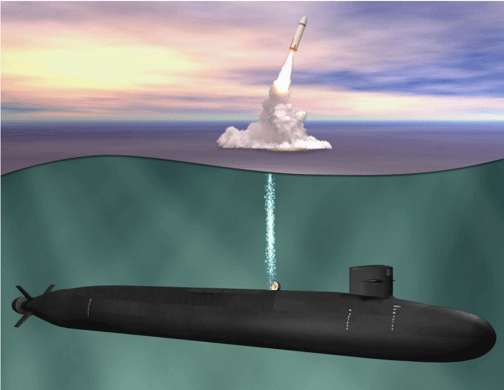 Russia to Launch Massive Ballistic Missile Test From Nuclear Subs
Kim Jong-un orders nuclear weapons readied for use ‘at any time’
North Korea: 
Leader reportedly tells military to adopt ‘pre-emptive’ posture after imposition of toughest UN sanctions to date, Guardian, Justin McCurry. 4 Mar 16, North Korea should be ready to use nuclear weapons “at any time” in the face of a growing threat from its enemies, leader Kim Jong-un has decreed in a further escalation of tensions on the Korean peninsula.
Kim’s warning, issued via state-controlled media on Friday morning, appeared to be an attempt to put pressure on the international community after the UN security council on Wednesday adopted a raft of new sanctions against the regime in response to its recent nuclear test and rocket launch.
Kim, who was supervising the test-firing of newly developed multiple rocket launchers, said North Korea’s situation had become so perilous that it should have the option of launching a “pre-emptive attack” – a departure from previous claims that the North’s nuclear capability was purely a deterrent.
In an apparent threat to neighbouring South Korea, Kim said the new rocket launchers should be “promptly deployed” along with other new weaponry.
He said the regime’s enemies – notably the US – were threatening North Korea’s survival, the state-controlled KCNA news agency reported……
In Beijing, foreign ministry spokesman Hong Lei said China, North Korea’s closest ally, hoped the UN sanctions would be implemented “comprehensively and seriously”, while harm to ordinary North Korean citizens would be avoided…….
While North Korea is believed to possess a small stockpile of nuclear warheads, most experts say the regime has yet to develop the technology to miniaturise them so they can be mounted on a missile…….. http://www.theguardian.com/world/2016/mar/04/north-korea-kim-jong-un-orders-country-to-be-ready-to-use-nuclear-weapons-at-any-time
Court case will unveil ‘the hidden truths’ of the Fukushima nuclear meltdown
 Trial in Japan will delve into ‘the hidden truths’ of the Fukushima nuclear meltdown, LA Times, Jake Adelstein, 29 Feb 16, Three former executives of the Tokyo Electric Power Co. were indicted Monday on charges of failing to take measures to prevent the disaster at the Fukushima Daiichi nuclear power plant in March 2011, the Tokyo prosecutor’s office announced.
The accident resulted in a triple meltdown that displaced more than 100,000 people and raised alarms about nuclear energy around the world. The indictment says it also caused deaths and injuries.
The trial will center on whether key Tokyo Electric Power Co. executives can be held criminally responsible for what the Japanese parliament’s Fukushima Nuclear Accident Independent Investigation Commission called “a man-made disaster.”
Tsunehisa Katsumata, 75, chairman of Tokyo Electric Power Co., or Tepco, at the time of the accident, and two former vice presidents — Sakae Muto, 65, and Ichiro Takekuro, 69 — were indicted on charges of professional negligence resulting in death and injury. A court-approved lawyer will act as the prosecutor in the trial.
The prosecutors office’s announcement noted that the six-reactor plant, located on the Pacific coast, was disabled after tidal waves triggered by the massive earthquake on March 11, 2011, flooded power supply facilities, which were unprotected, and crippled reactor cooling systems.
The Nos. 1 to 3 reactors suffered fuel meltdowns, while hydrogen explosions damaged others.
The indictment blames the three former executives for injuries to more than 10 people from hydrogen explosions at the plant, as well as the deaths of 44 patients forced to evacuate from a nearby hospital.
The indictment does not hold Tepco executives responsible for the deaths of two workers who had rushed to the turbine room of the No. 4 reactor after the earthquake. Autopsies suggested they were killed by the impact of the tsunami.
All of the former executives will probably plead not guilty, Japanese media reported……
The Tepco prosecution has been a long time coming. Last July, the Tokyo Prosecutorial Review Board No. 5 decided to mandate that the three be charged with professional negligence for their handling of the disaster, overturning a 2013 decision by prosecutors not to indict them.
“This trial will take quite a long time but I feel that ultimately they will be found guilty,” lawyer Hiroyuki Kawai, who was instrumental in seeing that Tepco officials faced prosecution, said in an email. “The hidden truths of what really caused the Fukushima nuclear accident keep coming to light, one after another.”……..
Kawai said the Fukushima disaster was a clear demonstration that Japan, which is located in the so-called Ring of Fire, with frequent seismic activity, was unsafe for nuclear power……..http://www.latimes.com/world/asia/la-fg-japan-tepco-fukushima-20160229-story.html
Radioactive fallout a risk factor for hypothyroidism
Elevated airborne beta levels in Pacific/West Coast US States and trends in hypothyroidism among newborns after the Fukushima nuclear meltdown, Scientific Research, Joseph J. Mangano, Janette D. Sherman, 2 March 16
ABSTRACT
Various reports indicate that the incidence of congenital hypothyroidism is increasing in developed nations, and that improved detection and more inclusive criteria for the disease do not explain this trend entirely. One risk factor documented in numerous studies is exposure to radioactive iodine found in nuclear weapons test fallout and nuclear reactor emissions.
Large amounts of fallout disseminated worldwide from the meltdowns in four reactors at the Fukushima-Dai-ichi plant in Japan beginning March 11, 2011 included radioiodine isotopes. Just days after the meltdowns, I-131 concentrations in US precipitation was measured up to 211 times above normal. Highest levels of I-131 and airborne gross beta were documented in the five US States on the Pacific Ocean. The number of congenital hypothyroid cases in these five states from March 17-December 31, 2011 was 16% greater than for the same period in 2010, compared to a 3% decline in 36 other US States (p < 0.03). The greatest divergence in these two groups (+28%) occurred in the period March 17-June 30 (p < 0.04). Further analysis, in the US and in other nations, is needed to better understand any association between iodine exposure from Fukushima-Dai-ichi and congenital hypothyroidism risk…….http://www.scirp.org/journal/PaperInformation.aspx?PaperID=28599
1 This Month
23 April – WEBINAR – Why new nuclear reactors are the wrong tools for decarbonization Thursday, April 23 • 1 AM – 2 AM AEST
World Nuclear Power. Reactors 1951-2026, 75 Years of Nuclear Power.
Interactive Map– https://dv.worldnuclearreport.org/
Chernobyl: The Lost Tapes – A good documentary on Chernobyl on SBS available On Demand for the next 3 weeks– https://www.sbs.com.au/ondemand/tv-program/chernobyl-the-lost-tapes/2352741955560

of the week–London Campaign for Nuclear Disarmament


Tell the Ukrainian Government to Drop Prosecution of Peace Activist Yurii Sheliazhenko
To see nuclear-related stories in greater depth and intensity – go to https://nuclearinformation.wordpress.com
-
Archives
- April 2026 (231)
- March 2026 (251)
- February 2026 (268)
- January 2026 (308)
- December 2025 (358)
- November 2025 (359)
- October 2025 (376)
- September 2025 (257)
- August 2025 (319)
- July 2025 (230)
- June 2025 (348)
- May 2025 (261)
-
Categories
- 1
- 1 NUCLEAR ISSUES
- business and costs
- climate change
- culture and arts
- ENERGY
- environment
- health
- history
- indigenous issues
- Legal
- marketing of nuclear
- media
- opposition to nuclear
- PERSONAL STORIES
- politics
- politics international
- Religion and ethics
- safety
- secrets,lies and civil liberties
- spinbuster
- technology
- Uranium
- wastes
- weapons and war
- Women
- 2 WORLD
- ACTION
- AFRICA
- Atrocities
- AUSTRALIA
- Christina's notes
- Christina's themes
- culture and arts
- Events
- Fuk 2022
- Fuk 2023
- Fukushima 2017
- Fukushima 2018
- fukushima 2019
- Fukushima 2020
- Fukushima 2021
- general
- global warming
- Humour (God we need it)
- Nuclear
- RARE EARTHS
- Reference
- resources – print
- Resources -audiovicual
- Weekly Newsletter
- World
- World Nuclear
- YouTube
-
RSS
Entries RSS
Comments RSS
 nuclear-news