Japan denounces WTO ruling in favor of South Korean ban on some Japanese seafood
GENEVA – Tokyo on Friday denounced a recent World Trade Organization ruling that supported a South Korean ban on imports of some Japanese fishery products introduced in the wake of the 2011 Fukushima nuclear disaster.
“Japan is deeply concerned that the appellate body report dismissed the panel’s findings founded on solid scientific evidence,” Junichi Ihara, Japan’s representative in Geneva, said at a meeting of the global trade watchdog’s dispute settlement body.
The WTO’s appellate body for dispute settlement on April 11 ruled in favor of South Korea’s import ban on fishery products from Fukushima and seven other prefectures, reversing an earlier decision.
It said the initial decision “erred in its interpretation and application” of WTO rules on food safety, but did not look at details related to the amount of radioactive contaminants in Japanese food products or the level of protection South Korean consumers should have.
Calling the appellate body’s judgment “extremely regrettable,” Ihara argued that it “could have a negative impact on perceptions of the safety of Japanese foods and on those seeking to export their products to countries such as Korea.”
The ruling is final, as the appellate body is the highest authority in the WTO’s dispute-settlement mechanism.
There is one word in Japanese to describe such disgusting behavior: “shitsukoi”
Like when one man insists on pushing himself on a woman who isn’t at all interested!
Japan asks S. Korea to lift Fukushima seafood ban despite WTO ruling
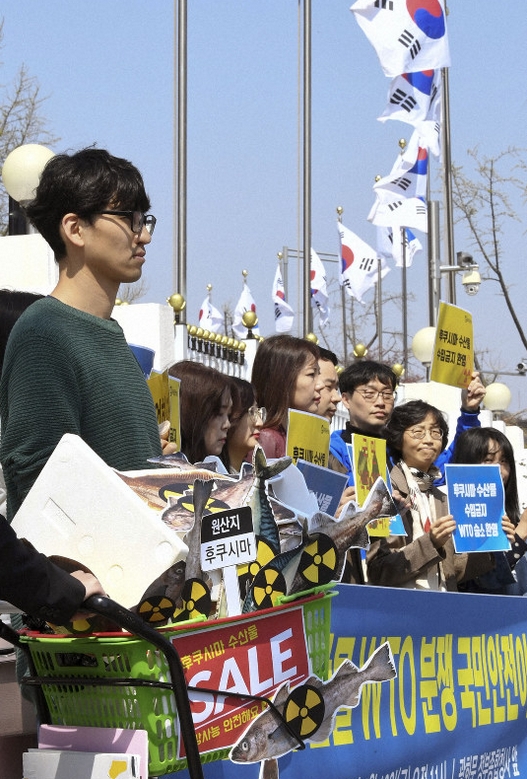
Members of a civic group celebrate in Seoul on April 12, 2019, after the World Trade Organization ruled the previous day in favor of the country’s ban on imports of some Japanese fishery products introduced in the wake of the 2011 Fukushima nuclear disaster, reversing an earlier decision against the restrictions.
April 23, 2019
TOKYO(Kyodo) — Japan on Tuesday urged South Korea to lift import restrictions on Japanese seafood introduced in the wake of the 2011 Fukushima nuclear disaster, even after the World Trade Organization ruled in favor of Seoul over the issue.
Kenji Kanasugi, head of the Japanese Foreign Ministry’s Asian and Oceanian Affairs Bureau, told his South Korean counterpart Kim Yong Kil in Tokyo that Japanese seafood is free of radioactive contamination and safe to eat, according to Japanese sources familiar with the matter.
During the talks, the South Korean Foreign Ministry insisted the restrictions are legitimate due to it wishing to prioritize the “health and safety” of the people.
Seoul imposed a ban on some types of seafood products from eight prefectures, including Aomori, Fukushima, and Chiba, in the wake of the 2011 reactor core meltdowns at the Fukushima Daiichi nuclear power plant triggered by a powerful earthquake and tsunami.
It expanded the ban in September 2013 to include all seafood products from the eight prefectures, and added a requirement that Japanese companies attach safety certificates when any traces of radiation are found in seafood from other regions.
In August 2015, Tokyo filed a complaint with the WTO against the restrictions, which it considers unfair discrimination, and an initial ruling by a dispute settlement panel sided with Japan. South Korea appealed the decision, however, and the WTO’s appellate body, the highest judicial entity of its dispute settlement mechanism, ultimately ruled in Seoul’s favor on April 11.
During Tuesday’s meeting, Kanasugi and Kim also made no progress towards a resolution in the dispute concerning recent South Korean top court rulings ordering Japanese companies to pay compensation for wartime forced labor.
Japan maintains that the issue has been resolved “finally and completely” under a 1965 accord between the two countries to settle property claims signed alongside the Japan-South Korea treaty that established diplomatic ties.
Kanasugi reiterated Japan’s call to open consultations between the governments based on the accord and asked South Korea to take measures to protect Japanese companies from facing any economic damage stemming from the rulings.
But Kim neither accepted nor refused the request, according to the sources.
Japanese seafood from Fukushima is banned in South Korea.
April 12, 2019
April 12 (UPI) — South Korea welcomed — while Japan condemned — a World Trade Organization decision to uphold a South Korea ban on Japanese seafood originating from the Fukushima nuclear disaster zone.
Japan is criticizing the decision despite evidence the product is not widely consumed or avoided entirely by Japanese consumers.
“Even though the ruling did not acknowledge that South Korea’s measures comply with the WTO rules, it is extremely regrettable that Japan’s argument was not approved,” Tokyo’s foreign ministry said Friday, after the WTO’s highest court overturned a judgment from 2018. The verdict is final, according to Kyodo and other Japanese news services.
In Seoul, the ruling Democratic Party welcomed the WTO decision. Party spokesman Lee Hae-sik said in statement the verdict reflects the current administration of South Korean President Moon Jae-in to “actively defend the nation’s health and food safety” and described the outcome as a “diplomatic victory,” South Korean news service News 1 reported Friday.
Lee also said the ban on imports of seafood originating from the eight prefectures of Japan’s Tohoku region, which are “at risk” due to the nuclear accidents at Fukushima plants, will be sustained.
Following the WTO verdict, Japan is turning its attention to the specialized United Nations agency.
Japanese Chief Cabinet Secretary Yoshihide Suga suggested Tokyo will “cooperate closely with the United States” on WTO reform in order to “maintain and strengthen the multilateral trading system.”
But the United States also has partial bans in place against Fukushima products. The U.S. Food and Drug Administration continues to monitor the public health risks due to radionuclide contamination and has placed an “import alert” on select Japanese products.
In Japanese fish markets in Tokyo, products labeled “Fukushima region” do not sell well and frequently at below market prices, South Korea television network MBC reported from Japan.
The seafood is not in demand despite safety screenings, according to the report.
Japan will seek to reassure other countries about the safety of food produced in areas affected by the 2011 Fukushima nuclear crisis, officials said Friday, after the World Trade Organization supported South Korea’s import ban on some Japanese seafood.
Fishermen in Tohoku, the region hit hardest by the devastating earthquake and subsequent tsunami that triggered the triple core meltdown at the Fukushima No. 1 nuclear power plant, expressed disappointment with the WTO’s decision, saying their catches clear strict safety checks before shipment.
The WTO “maintained factual findings that Japanese food products are scientifically safe and satisfy safety standards in South Korea,” Chief Cabinet Secretary Yoshihide Suga said at a press briefing.
“We will continue to ask South Korea and other countries to lift or ease import restrictions based on scientific evidence,” the top government spokesman said.
Japan has taken a series of steps over the years, such as screening food products for radioactive substances before shipment, to alleviate safety concerns.
“It’s been eight years since the nuclear accident. Does it mean that it’s still early (for the ban to be lifted) by global standards?” asked a frustrated Norio Takahashi, a 59-year-old fisherman from Fukushima.
In Iwate Prefecture, Mikio Morishita, 69, who runs a fish processing company, pointed to the difficulty of regaining consumer trust.
“Although food products (from the disaster-hit areas) are safe, we have yet to dispel bad perceptions (among consumers). The ruling is unfortunate because it suggests the world does not have a positive image” of items from Fukushima and its vicinity, Morishita said.
Japan has been promoting its agricultural and seafood exports, which have been growing in recent years and reached ¥906.8 billion ($8.1 billion) in 2018, putting the government’s target of ¥1 trillion for this year in sight.
By holding baseball and soccer games in the disaster-hit region, Japan hopes to present the Tokyo Olympics and Paralympics in 2020 as a symbol of reconstruction.
“I will promote the high quality of food products (in the disaster-hit areas),” Olympics minister Shunichi Suzuki said at a news conference held just a day after he was reappointed to his role.
The WTO’s appellate body for dispute settlement on Thursday ruled in favor of South Korea’s import ban on fishery products from Fukushima and seven other prefectures, reversing an earlier decision.
Thursday’s ruling is final as the appellate body is the highest authority in the WTO’s dispute settlement mechanism.
Due to fears of radioactive contamination, South Korea expanded its initial ban to include all fishery products from Fukushima and the seven other prefectures in 2013.
A total of 54 countries and regions introduced import restrictions following the meltdowns. The number has since declined, but South Korea is among 23 that are keeping the restrictions in place, according to the Japanese government.
Japanese newspapers report about the World Trade Organization’s decision in favor of Korea’s import restrictions on Japanese seafood. Yonhap
April 12, 2019
South Korea on Friday welcomed the World Trade Organization’s decision to rule in favor of Seoul’s import restrictions on Japanese seafood in the wake of the 2011 Fukushima nuclear disaster and said it would keep the ban in place going forward.
The WTO appellate body overturned several points of the 2018 verdict earlier in the day, saying the Seoul government’s measures are not unfair trade restrictions and do not fall into the category of arbitrary discrimination.
The appellate body, however, sided with Japan on one point, saying that Seoul has not provided enough information to Tokyo in terms of the import ban measures.
“The government has been making all-out efforts to follow the principle of making the health and safety of the people a priority, and the government highly appraises the WTO’s decision,” the Ministry of Trade, Investment and Energy said in a statement.
The South Korean government said it hopes that there would be no further trade dispute with Japan.
In 2015, Japan officially lodged a complaint at the WTO to challenge South Korea’s import bans and additional testing requirements on fish caught after 2013. Tokyo argued that radioactive levels of its fishery product were lower than those from a number of other nations.
The WTO’s dispute settlement body ruled in favor of Japan in February 2018.
South Korea has been placing import restrictions on 28 kinds of fish caught from eight prefectures near Fukushima since the nuclear power plant accident.
The South Korean government said it will keep the existing import ban on all seafood from the eight prefectures. All Japanese seafood companies will be required to hand in safety certificates when any traces of radiation are found, it added.
About 50 countries have maintained bans on imports since the nuclear disaster, but Japan has complained to the WTO about only one country — South Korea.
“Currently, 19 more countries have implemented an import ban (on Japanese seafood) at different levels,” said Yoon Chang-yul, the head of the social policy coordination office under the Office for Government Policy Coordination.
South Korea, meanwhile, has been replacing its imports of Japanese pollack and mackerel with supplies from Russia and Norway respectively, the Ministry of Oceans and Fisheries said.
“In the past, (South Korea) imported around 20,000 to 40,000 tons of pollack and mackerel from Japan. Now the volume is below 3,000 tons,” an official from the ocean ministry said.
“It is a sovereign country’s right to implement an appropriate level of protection,” an official from the ministry said. “All countries have different standards, and they cannot be judged under the same standard. The Fukushima crisis broke out in a neighboring country, and we needed to review our protection level in a more strict and thorough manner.” (Yonhap)
Korean distributors halt sales of instant noodles from Fukushima
Dec 5, 2018
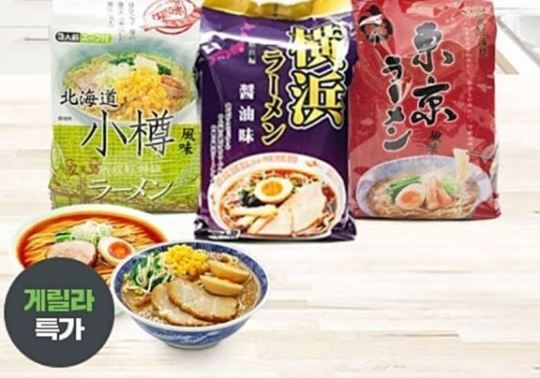
Korean retailers Homeplus and Wemakeprice have discontinued sales of Fukushima-imported instant noodles after the product’s place of origin label stirred up health concerns.
Otaru Shio Ramen — produced in Fukushima, Japan, and imported to Korea by Homeplus and Wemakeprice — has Fukushima printed as the area of production in Japanese. However, the Korean label specifies only Japan as the place of origin, prompting some consumers to point out that the translated label is misleading and takes away freedom of choice for those who do not know Japanese.
Some Koreans have reservations about products imported from Fukushima following a nuclear meltdown during the 2011 Tohoku earthquake.
Homeplus, which sold the product through its offline stores, said, “Otaru Shio Ramen is produced in Kitakata city factory, located over 100 kilometers from the area of the nuclear disaster. The product has no problems, as it has gone thorough radiation inspection.”
The company said the instant noodles do not cause health problems, but discontinued sales in response to concerns.
Wemakeprice, which sold Otaru Shio Ramen through its online channels, deleted the item from its website as of Tuesday night. It had sold just 10 packets before deleting the item.
The company said, “The product went through a radiation inspection before being imported, and no health-related problems were found. However, we decided to discontinue the product in response to consumers’ demands.”
Instant noodles imported from Fukushima unnerve consumers
December 6, 2018
WeMakePrice and Homeplus were found to have sold instant noodles produced in Japan’s Fukushima Prefecture, raising food safety concerns among consumers.
Fukushima is the northeastern part of Japan’s Honshu Island, contaminated by radioactivity following the explosions of reactors at the Fukushima Daiichi Nuclear Power Plant in 2011.
According to industry officials Wednesday, the two retailers had sold the made-in-Fukushima “Otaru Shio Ramen” until early this week.
But they decided to take the instant noodles off shelves as consumers discovered product information written in Japanese shows the manufacturer is located in Fukushima.
The product information written in Korean only says it was made in Japan.
After the revelation, angry consumers claimed the retailers tried to deceive those who cannot read Japanese.
“I hurriedly canceled my purchase before its delivery. I might have been a guinea pig,” said a consumer, who had bought the instant noodles from WeMakePrice.
The companies emphasized the safety of the product, but said they decided to stop selling it to reassure their customers.
“The instant noodles were produced at a factory in a Fukushima city of Kitakata, which is located over 100 kilometers from the contaminated region,” a Homeplus official said. “The product also underwent a radioactivity check before its import, and it was found to be safe.”
The discount chain also refuted criticisms that the retailers tried to deceive consumers.
“According to the Ministry of Food and Drug Safety’s guidelines, the product information does not need to include the specific place of origin. It just needs to include the country of origin,” the official said.
The government has banned the import of agricultural and marine products from Fukushima, but it still allows the import of processed foods from the prefecture, if their importers get certification.
Moreover, Korea may be brought to the World Trade Organization (WTO) if it prohibits the import of made-in-Fukushima foods without any scientific reason.
Japan is seeking to file a complaint with the WTO against Taiwan which held a referendum recently and decided to ban the import of agricultural products from Fukushima.
Korean consumers, however, demand the right to know the specific place of origin at least, if the government cannot ban the overall import of products from Fukushima.
Amid the growing concerns, they have begun filing online petitions on the Cheong Wa Dae website to urge the government to demand retailers specify the exact place of origin of food products.
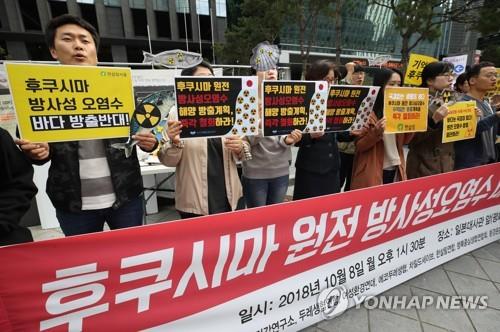
SEOUL, Oct. 8 (Yonhap) — South Korean environmental groups on Monday urged Japan to reverse its recent decision to release radioactive water that has accumulated in the Fukushima nuclear plant into the sea after treatment.
Korea Radioactive Watch, the Korean Federation For Environmental Movement and other civic groups held a joint news conference in Gwanghwamun Square in downtown Seoul, denouncing the decision by the Japanese government and Tokyo Electric Power Co. to discharge Fukushima’s contaminated water into the ocean as “unacceptable.”
“A release of Fukushima’s radioactive, contaminated water will threaten the safety of the waters of South Korea and other neighboring nations that share the Pacific Ocean, as well as the waters in the vicinity of Fukushima,” the activist groups said.
South Korean environmental activists hold a rally in front of the Japanese Embassy in Seoul on Oct. 8, 2018, to protest against Japan’s decision to release the Fukushima nuclear plant’s radioactive, contaminated water into the sea.
In March 2011, a major earthquake and a subsequent tsunami triggered a meltdown at Japan’s Fukushima nuclear power plant, which was the world’s worst nuclear disaster since Chernobyl.
The South Korean groups went on to argue that cost reduction appears to be the main reason for Japan’s push to discharge Fukushima’s radioactive water into the sea without checking its contamination condition.
“The Japanese government should disclose all information related to Fukushima’s radioactive water and listen to the opinions of its neighboring countries about how to dispose of the contaminated water. The South Korean government should sternly protest to Japan and take aggressive countermeasures,” the groups said.
They also insisted that water contaminated by high concentrations of radioactive materials collected around the Fukushima plant buildings after the 2011 accident and that the amount is estimated to reach about 940,000 tons.
PM Lee calls for prudent decision by Japan on water from Fukushima plant
Seoul’s Prime Minister expressed serious concerns over reports that Japan is planning to dump water into the ocean from the Fukushima nuclear power plant which was badly damaged seven years ago.
In Tuesday’s Cabinet meeting, Lee Nak-yon noted that 80 percent of the water from the plant has been deemed by the plant’s operator, Tokyo Electric Power Company, to be too contaminated to be released.
However, TEPCO adds, the water has been treated.
The PM urged Japan to make a prudent decision, and instructed the relevant South Korean ministries to convey the government’s position on the matter.
He stressed the ocean does not belong to any one country, but a resource to be shared by the world, and that dumping such water would have a big impact on the marine environment.
Seoul to Express Concern over Tokyo’s Plan to Release Fukushima Plant Water
South Korea plans to deliver its concern over media reports the Japanese government is mulling releasing treated water from a nuclear plant damaged by the March 2011 earthquake and tsunami.
An official of Seoul’s Foreign Ministry revealed the plan to reporters on Tuesday, saying that given the influences of radiation-related issues and public sensitivity to them, it’s a legitimate concern for South Korea as a neighboring country.
The official said the government will seize a proper opportunity to deliver its concern to the Japanese government and seek cooperation to address the issue.
The move comes after reports emerged that the Japanese government might release water at one of the Fukushima nuclear power plants after purifying it. However, the Japanese media reported more than 80 percent of the purified water still contains radioactive elements.
The World Trade Organization (WTO) has ruled in favor of Japan, in a dispute about South Korea’s ban on imports of Japanese seafood, reports KBS World Radio.
The WTO reaffirmed the ruling in a report in February, four months after it made the decision last October. In response, the Korean government filed an appeal against the ruling by the Geneva-based organization on April 9.
The dispute dates back to 2011, when Japan was hit by a massive earthquake and suffered a nuclear power plant meltdown in Fukushima. Amid fears of radioactive leaks from quake-hit Japan, South Korea prohibited imports of agro-fishery products from Fukushima.
In 2013, the ban was expanded to include 28 fishery products from eight Japanese prefectures near Fukushima. Japan took the case to the WTO in protest. The WTO ruled in favor of Japan in its first hearing, saying that South Korea’s measures lacked transparency. In turn, Korea’s trade ministry has filed an appeal against the ruling.
Korea Appeals WTO Ruling on Imports from Fukushima
April 10, 2018
The government has appealed a World Trade Organization ruling that accused Korea of violating trade regulations by banning imports of seafood from Japan’s Fukushima Prefecture, which was the site of a massive nuclear power plant meltdown in 2011.
“The nuclear fallout persists in Japan, and the ruling is problematic since it’s our job to make sure the food Koreans eat is safe,” a government spokesman said Monday.
In February of this year, the WTO ruled in favor of Japan, which has demanded Korea lift the ban.
Korea banned imports from the region in 2011, just after a massive earthquake there resulted in the nuclear meltdown. Japan sued Korea at the WTO in 2015.
South Korea appeals WTO ruling against import ban on Japanese seafood
April 10, 2018
South Korea has appealed a World Trade Organization ruling against its restrictions on the import of seafood from eight Japanese prefectures following the 2011 Fukushima nuclear disaster.
The government had earlier vowed to fight the ruling to safeguard public health and safety while keeping the ban in place. Seoul announced its appeal on Monday.
In the ruling, announced Feb. 22, the WTO’s dispute settlement panel said the ban was inconsistent with the global trade body’s rules against “arbitrarily or unjustifiably” discriminating against another country, recommending that South Korea take corrective action.
The panel also said a South Korean requirement that Japanese exporters of all marine products submit certificates of inspection if small amounts of radioactive cesium or iodine are detected is an effective barrier to fair trade.
The decision came more than two years after Japan filed a complaint in 2015 over the South Korean ban, claiming it was not based on scientific grounds.
In Tokyo, fisheries minister Ken Saito expressed regret on Tuesday over South Korea’s appeal, telling a news conference it was “extremely regrettable.”
He also said Japan will properly address the matter so that its claims will be accepted by the WTO’s appellate body. In addition, Tokyo will urge Seoul to swiftly lift the ban, Saito said.
Following the nuclear disaster at the Fukushima No. 1 plant, triggered by a powerful earthquake and tsunami on March 11, 2011, South Korea initially imposed a partial ban on imports of marine products from the eight prefectures due to fears of radioactive contamination.
In September 2013, Seoul expanded the restrictions to bar all fishery products from the eight prefectures and strengthened import regulations.
The eight prefectures are Aomori, Iwate, Miyagi, Fukushima, Ibaraki, Tochigi, Gunma and Chiba.
Seven years after a tsunami wiped out the nuclear reactors in Fukushima, causing widespread radiation contamination in a largely agricultural region, the Fukushima prefecture continues to struggle in getting crucial overseas markets to accept its produce.
This is despite a charm offensive that saw japanese foreign minister Taro Kono visiting Hong-Kong last weekend for the first time in 21 years to lobby chief executive Carrie Lam to lift a ban on imports from Fukushima and its surrounding region.
Hong-Kong which accounts for a quarter of Japan’s food export trade, is among the 55 countries that have blocked shipments from Fukushima since the 2011 disaster.
Facing resistance
The trip did not go the way Tokyo planned, with Lam expressing her reluctance to reopen trade.
“She emphasized that it is incumbent upon the government to safeguard public health and hence effective measures must be in place to ensure food safety and to maintain public confidence,” a statement issued by Lam’s office read.
The visit came shortly after South Korea announced it would maintain a blanket ban on imports from north-eastern Japan, even though the World Trade Organization (WTO) ruled this as “arbitrary and unjustifiable” discriminatory measures.
Korea’s trade ministry stated in March that it would appeal the WTO decision, which is equivalent to a court ruling.
“Despite this ruling, the current import ban will remain in force, and the government will make its utmost efforts to ensure radiation-contaminated food does not reach the dinner table,” it said in a strongly-worded statement, ahead of a likely appeal.
Radiation safe?
Meanwhile a Fukushima flatfish festival in Bangkok was forced to cancel amid pressure from consumer goods watchdogs over radioactive contamination.
According to japanese officials, food from the affected area is safe, with no radiation having been detected in rice since 2015. In January, a safety panel announced that contamination inspections would be phased out in favor of random spot checks, to bring rice in line with the current procedure for fruits and vegetables.
This position is backed up by the Food and Agriculture Organization (FAO) of the United Nations, whose director-general publicly ate sweets made from pears and apples grown in Fukushima at an event in Tokyo last May to publicize the safety of produce in the affected area.
“We don’t see any reason to raise concern about the safety of food,” Jose Graziano Da Silva said at the time.
Just a year after the nuclear incident japanese authorities began adopting the strictest radiation standards of any country in the world by lowering the accepted level of contamination by half.
But persuading prime export markets that Fukushima food is safe is proving to be tremendously difficult.
Japan appears to have won the latest World Trade Organization (WTO) battle over South Korea’s post-Fukushima disaster food import ban and restrictions, but the trade spat between the East Asian giants looks set to continue.
South Korea has decided to appeal the World Trade Organization’s ruling on its seafood import restrictions imposed following the 2011 Fukushima nuclear disaster.
The decision came after a WTO dispute panel ruled the restrictions were justified right after the nuclear meltdown, but continuing them violated the WTO’s sanitary and phytosanitary (SPS) agreement.
The ruling, however, does not mean the Seoul government should lift the limits immediately. As it decided to appeal, the country can keep them in place until the world body makes a final ruling which may come in the latter half of the year at the earliest.
Whatever the reason, the government should take the responsibility for losing out to Japan. It has taken only seven samples of affected Japanese seafood. It has failed to publish any reports about this matter in the past seven years. In addition, a committee of civilian radioactivity experts stopped its operations monitoring Japanese seafood. In a word, the authorities were ill-prepared for the dispute.
The seafood row began in May 2015 when the neighboring country filed a complaint against Korea over the restrictions. Korea imposed an import ban on 50 types of seafood caught in the waters near the disaster area. It also took further steps to limit fishery imports from seven other prefectures in 2013.
Those measures were to protect Korean consumers from the potential harmful effects of radioactive contamination. But the government has so far failed to prove such effects exist. Thus, it is no surprise Japan won the case.
Now, related government ministries and agencies should waste no efforts to collect scientific and objective data to prove the harmful effects. They also need to address Japan’s refusal to cooperate in probing seawater contamination near the disaster-hit area.
South Korea also needs to ask for help with 24 countries, including the U.S., Russia and Argentina, which also took measures against Japanese seafood after the Fukushima catastrophe. It must keep in mind that food safety is crucial to ensuring the people’s health.
South Korea vows to maintain its restrictions on Japanese seafood imports and appeal the WTO’s ruling against additional radiation tests and bans on fishery products introduced in the wake of the 2011 Fukushima nuclear disaster.
In 2015, Tokyo filed a complaint with the World Trade Organization (WTO) challenging South Korea’s import bans that were introduced on certain fish caught in Japanese waters over fears of radiation following the meltdown of three reactors at the Fukushima power plant in March 2011. In its official complaint, Japan also challenged additional testing and certification requirements placed by Seoul on Japanese fish caught from eight prefectures near Fukushima.
On Thursday, the WTO ruled in Japan’s favor, claiming that while South Korean practices were initially justified, they now violate the WTO’s sanitary and phytosanitary (SPS) agreement. “By maintaining the product-specific and blanket import bans on the 28 fishery products from the 8 prefectures and the 2011 and 2013 additional testing requirements on Japanese products, Korea acted inconsistently with Article 2.3, first sentence of the SPS Agreement and, as a consequence with Article 2.3, second sentence,” the ruling said.
South Korea on Friday refused to bow to the WTO ruling due to public health and safety concerns, announcing that it will challenge the ruling while maintaining the current level of restrictions.
“The Korean government will appeal to safeguard public health and safety,” the Ministry of Trade, Industry and Energy said in a release. “Regardless of the decision, the current import ban will be put in place until the WTO’s dispute settlement procedure ends.”
Japan’s minister of Agriculture, Forestry and Fisheries, Ken Saito, called Seoul’s disobedience regrettable. “Japan will respond accordingly so that our position will be accepted by the Appellate Body as well. We will also call on South Korea to sincerely and promptly correct their measures,” he said at a news conference.
Twenty-four nations across the globe still have some import limitations on Japanese seafood products. Originally, 46 nations adopted protective measures but over time have eased their restriction practices to allow Japanese imports. Despite the ban on Fukushima products, South Korea has imported 708,566 tons of seafood from Japan since March 2011, according to South Korea’s Ministry of Food and Drug Safety. South Korean authorities returned only around 0.03 percent of those imports, asking for additional radiation level tests.
From The Yomiuri Shimbun, a propaganda mouthpiece close to the Japanese government.
Give new impetus to countries to lift import bans on Japanese seafood
An unfair import ban imposed in reaction to the nuclear accident in Fukushima Prefecture is unacceptable. Japan must make use of this clear judgment for countries to accelerate lifting such bans.
A World Trade Organization dispute settlement panel ruled that South Korea’s ban on fishery products imported from Japan amounts to “arbitrary or unjustifiable discrimination” and violates WTO rules.
Citing the nuclear accident as a reason, South Korea has imposed a blanket import ban on fishery products from eight prefectures, including Fukushima, Miyagi and Iwate prefectures, since September 2013. For some of the import items, the ban has a serious impact on the fishery industries in areas affected by the Great East Japan Earthquake and the nuclear accident.
Japan filed complaints with the WTO in 2015, claiming Seoul’s ban was “not based on scientific grounds and hampered free trade.” It calls for the ban to be lifted on 28 kinds of fishery products, such as bonito and saury.
The WTO has sided with Japan because it did not get a satisfactory explanation from South Korea about why Seoul focused solely on fishery products imported from Japan.
Might Seoul have aimed to exclude Japanese fishery products that compete with those of South Korea? If so, such an attitude would run counter to the WTO’s principle of free trade and losing the case would be inevitable.
The South Korean government announced that it will appeal to a higher WTO panel, equivalent to a higher court. A situation should be avoided in which handing down the final decision is unnecessarily postponed.
Moves by S. Korea, China vital
It is reasonable that Agriculture, Forestry and Fisheries Minister Ken Saito said, “[We] call for South Korea to sincerely and swiftly correct the violation of the [WTO] agreement.”
Japan exports products after subjecting them to an even stricter examination than is required by international standards on the influence of radioactive substances on foods.
The number of countries and regions that imposed import bans on Japanese foods after the nuclear accident was initially 54, but it declined by half to 27 as time went by.
In addition to South Korea, many of Japan’s main trading partners, including China, the United States and the European Union, still impose import restrictions on Japanese foods. Among other steps, they continue to ban importing some items or call for the presentation of certificates of inspection of Japanese foods.
In particular, China has taken the same level of strict restrictive measures as South Korea, and banned importing all foods from Tokyo and nine other prefectures.
The moves of China and South Korea seem to strongly influence other Asian countries and others that are still taking some kind of regulatory measures against Japanese foods.
In parallel with its efforts regarding South Korea, the Japanese government needs to make more efforts toward negotiations with China for lifting its import ban.
Although the government has set the goal of exporting ¥1 trillion worth of agricultural, forestry and fisheries products and other foods in 2019, such exports remain sluggish.
It has been pointed out that meat and fruit imported from Japan, which have become luxury brands, are sought after and praised by wealthy people abroad, yet there are few products for the most populous middle-income bracket of other countries.
There is no doubt that lifting the import bans of each country would also contribute to the improvement of the image of Japanese products overall.









 nuclear-news