83 species now eligible for test fishing off coast of Fukushima
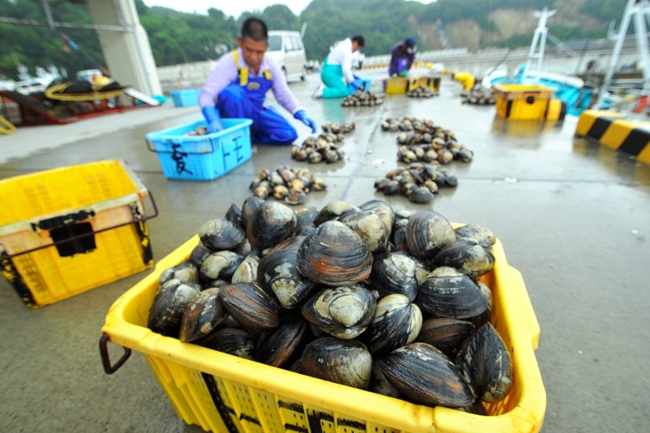
These surf clams, seen here in June at Hisanohama Port in Iwaki, Fukushima Prefecture, were caught during test fishing.
IWAKI, Fukushima Prefecture–Ten species were added to the list of catches eligible for test fishing off the coast of Fukushima Prefecture, but lingering concerns about radiation are keeping sales of such marine products low.
Still, the latest additions, which include the Japanese flounder, the white-spotted conger eel and the spotted halibut, have encouraged fishermen who have been struggling to rebuild their lives since the Fukushima nuclear disaster started in March 2011.
The Fukushima Prefectural Federation of Fisheries Cooperative Associations on Aug. 25 added the 10 species to bring the total number eligible for test fishing to 83. The additions were approved during a meeting in Iwaki of the prefectural council for the rebuilding of regional fisheries.
“I think the 83 fish species accounted for about 70 percent of our pre-disaster hauls,” said Tetsu Nozaki, president of the prefectural fisheries federation. “I am placing particularly high hopes for a great boost in the value of our catches from the resumed fishing of Japanese flounder.”
Test fishing for flounder started on Sept. 2.
The Soma-Futaba fisheries cooperative association, which is part of the prefectural federation, plans to resume catches of white-spotted conger eel in September. But the Iwaki city fisheries cooperative association has decided to wait until water temperatures are low enough to ensure freshness of the white-spotted conger eel.
Test fishing has expanded because the environment of the sea has significantly improved since the initial impact of the nuclear disaster. Radioactivity levels in fish caught there now stably remain within the safety limit for many species.
Despite extensive testing to ensure safety of Fukushima marine products, many dealers are still reluctant to buy the species.
Fish and shellfish from Fukushima Prefecture are being shipped to various parts of Japan, such as the Tohoku, Kanto, Chubu and Hokuriku regions. Prices of seafood items from Fukushima Prefecture are not much lower than those from other prefectures, according to Yoshiharu Nemoto, head of the fishing ground environment division with the Fukushima Prefectural Fisheries Experimental Station.
Yet few dealers are bidding for Fukushima marine products. If this trend continues with more Fukushima fish reaching the market, unsold leftovers from the prefecture could start to pile up and project a negative image, Nemoto said.
“It will become more necessary than ever to make publicity efforts, such as regularly releasing data concerning safety,” he said.
Test fishing began in June 2012, 15 months after the Great East Japan Earthquake and tsunami caused the triple meltdown at the Fukushima No. 1 nuclear power plant. Initially, only three species were covered: two kinds of octopuses and one type of shellfish.
While coverage has since expanded in stages, the latest addition of 10 species at one time is second only to the addition of 12 species, including brown sole and red sea bream, in August 2015.
Since April 2011, the Fukushima prefectural government has been monitoring the impact of radioactive fallout from the Fukushima No. 1 nuclear plant on fish and shellfish. The radiation tests, which cover about 200 samples every week, have so far been conducted on 38,000 samples of 184 species.
The concentration of radioactive cesium initially exceeded the central government’s safety limit of 100 becquerels per kilogram in most of the fish and shellfish surveyed. But the concentration has declined from year to year, and no sample has exceeded the safety limit since April 2015.
In more than 90 percent of the samples tested in July 2015 and later, radioactivity levels were below the detection limit.
Radioactivity levels in fish caught near the Fukushima No. 1 nuclear plant are also falling.
The central government’s Japan Fisheries Research and Education Agency (FRA) on Aug. 25 released data on radioactivity levels in Japanese flounder caught in July in waters around the crippled nuclear plant.
The FRA said its high-precision tests, with a lower limit of detection set at a mere 1 becquerel per kg, found radioactivity levels of less than 10 becquerels per kg in all 41 individual organisms tested. More than 90 percent of them measured less than 5 becquerels per kg.
Catches from test fishing have continued to grow: 122 tons in 2012, 406 tons in 2013, 742 tons in 2014 and 1,512 tons in 2015.
But last year’s catch was only 5.8 percent of the annual catch of 26,050 tons averaged over the decade preceding the 2011 disaster.
Fishermen are holding out high hopes for more fish species being eligible for catches.
Science Subverted by Politics in Fukushima
The high rate of thyroid cancer occuring in Fukushima is not caused by radiation. Or so the government would like everyone to believe!
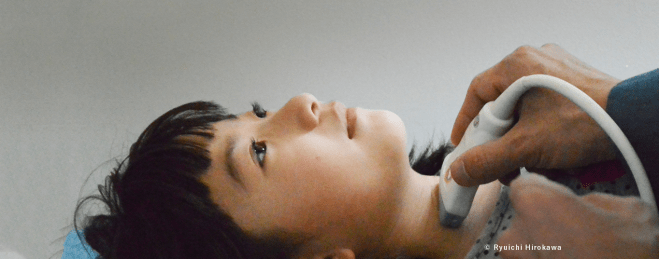
Study draws a blank on thyroid cancer and 2011 nuclear disaster
Researchers have found no correlation between radiation exposure and the incidence rate of thyroid cancer among 300,000 children living in Fukushima Prefecture at the time of the 2011 nuclear disaster.
But the team at Fukushima Medical University, which carried out the study, cautioned that the health of local children should continue to be monitored to be more definitive.
“At the present stage, we have found no evidence pointing to any relationship between doses of external radiation resulting from the nuclear accident and the thyroid cancer rate,” said Tetsuya Ohira, a professor of epidemiology at the university. “But we need to continue to look into the situation.”
The study involves 300,476 children in Fukushima Prefecture who were aged 18 or younger when the Fukushima No. 1 nuclear power plant went into a triple meltdown in March 2011 after the Great East Japan Earthquake and tsunami.
The children underwent the first round of health checks between October 2011 and June 2015.
Of the total, 112 were tentatively diagnosed as having thyroid cancer.
There are two types of radiation exposure: external exposure in which a person is exposed to radiation in the atmosphere, and internal exposure in which a person is exposed through the intake of contaminated food, water and air.
For the study, municipalities in the prefecture were classified into three groups based on the estimate for residents’ external exposure. That data was obtained during a prefecture-wide health survey carried out after the disaster occurred.
The first group is a zone where people with an accumulative dose of 5 millisieverts or more represented 1 percent or more of the population there. The second group is a zone where people with an accumulative dose of up to 1 millisievert account for 99.9 percent or more of the population. The third group is a zone that falls into neither of the other two groups.
The scientists looked at the incidence rate for thyroid cancer in each group and concluded there is almost no difference among the groups.
The number of subjects diagnosed with thyroid cancer was 48 per 100,000 people in the first group, 41 in the second group and 36 in the third group.
The finding was similar to a separate survey in which researchers looked into the possible association among 130,000 or so children whose radiation exposure had been estimated.
Hokuto Hoshi, head of a health survey panel set up at the prefectural government after the nuclear disaster, said he will closely follow the results of future studies to offer a more conclusive finding.
“The outcome of the recent study provides one indication in making any overall judgment,” said Hoshi, who also serves as vice chairman of the Fukushima Medical Association. “The study is substantial and we are going to pay attention to the findings of further studies.”
http://www.asahi.com/ajw/articles/AJ201609100031.html
Radioactive Boar Are Thriving And Causing Havoc Near The Fukushima Power Plant
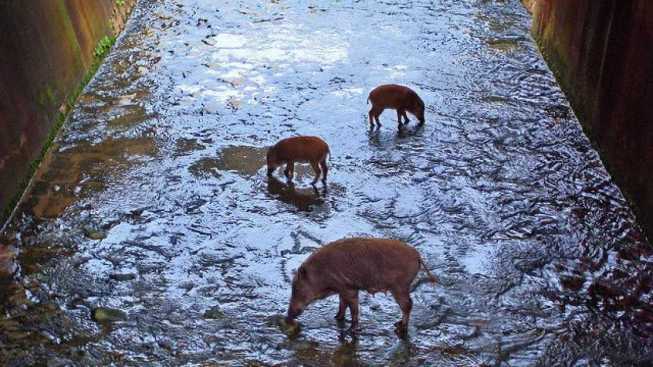
It’s been over five years since tsunami waves crashed into the Fukushima Daiichi power plant and led to its nuclear meltdown. While 20 kilometers (12 miles) of the land around the plant remains a dangerous exclusion zone, the area’s wildlife is taking full advantage of the peace.
Since the nuclear disaster, the population of wild boars has rocketed, much to the dismay of surrounding communities, The Times has reported. In the four years following the disaster, the population of boars is thought to have boomed from 3,000 to 13,000. You might think this ancient Japanese symbol of prosperity and fertility might be welcomed, but it’s estimated they have caused $15 million worth of damage to local agriculture.
Assistant ecology professor Okuda Keitokunin told the Japanese Mainichi newspaper that wild boar, along with racoons, have been using the abandoned houses and emptied buildings in the evacuation zone as a place to breed and shelter.
However, this post-nuclear meltdown town isn’t exactly a safe haven for the boars. It’s thought their diet of roots, nuts, berries and water all contain particularly high concentrations of radiation. The animals show no immediate signs of harm from the radiation, however samples from Fukushima’s wild boar meat has shown they contain 300 times the safe amount of the radioactive element caesium-137. Another study on the area’s fir trees showed evidence of growth mutations.
Hunters have been offered rewards to cull the boars by local authorities. However, the animals are breeding so quickly they can’t keep up. The city of Nihonmatsu, around 56 kilometers (35 miles) from the Fukushima plant, has dug three mass graves capable of holding 1,800 dead boars. Recently, these have become overfilled and authorities are now struggling to cope with the influx of culled beasts.
The boom in boars is a similar story to Chernobyl’s post-meltdown wildlife. A study from late last year showed that the populations of deer and wild boar are thriving in the area surrounding the Ukrainian nuclear power plant.
In a statement Jim Smith, one of the authors of the Chernobyl study, explained, “It’s very likely that wildlife numbers at Chernobyl are much higher than they were before the accident. This doesn’t mean radiation is good for wildlife, just that the effects of human habitation, including hunting, farming, and forestry, are a lot worse.”
Fukushima’s surfers riding on radioactive waves
“I put on sunscreen against the sun, but I haven’t found anything against radiation,” said one surfer. “We will only know the true consequences of our time in the water 20 years from now.”
Fukushima, Japan – On 11 March 2011, at 2:46 pm, Japan was hit by a magnitude 9.0 earthquake which generated a tsunami along the coast. The casualties of the disaster included 18,500 dead, 90 percent of whom drowned in the tsunami wave. The bodies of 2,561 people were never recovered.
The tsunami hit the Daaichi nuclear power plant as well, a level-7 catastrophe that was the equivalent of the Chernobyl nuclear power plant meltdown disaster.
Over the course of five years, nearly 50,000 people have worked to decontaminate the plant and stop leaks according to government press releases. They remove between 5 and 30 cm of contaminated soil every day and place them in plastic bags, which are stored on the outskirts of town, pending a better solution.
In Tairatoyoma beach, a prefecture of Fukushima and some 50km from the nuclear plant, was among the most popular areas for Japanese surfers prior to the nuclear accident.
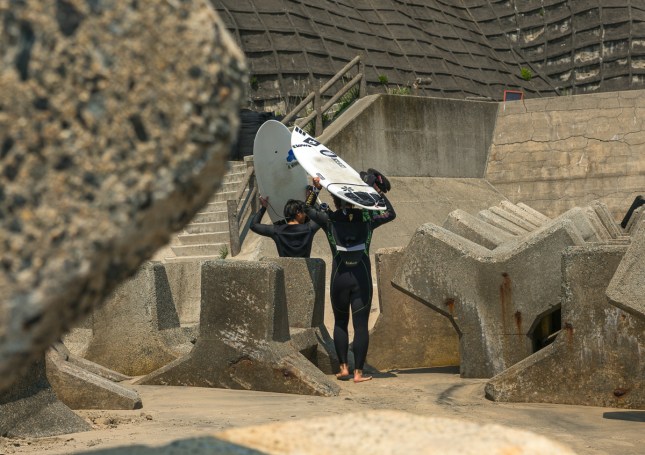
Surprisingly, despite the presence of radiation in the sand and water, some dedicated surfers continue to come here to catch some waves. They are aware of the risks, and the hundreds of bags of contaminated sand piled up on the beach serve as a constant reminder of the health risks to them.
“I put on sunscreen against the sun, but I haven’t found anything against radiation,” said one surfer. “We will only know the true consequences of our time in the water 20 years from now.”
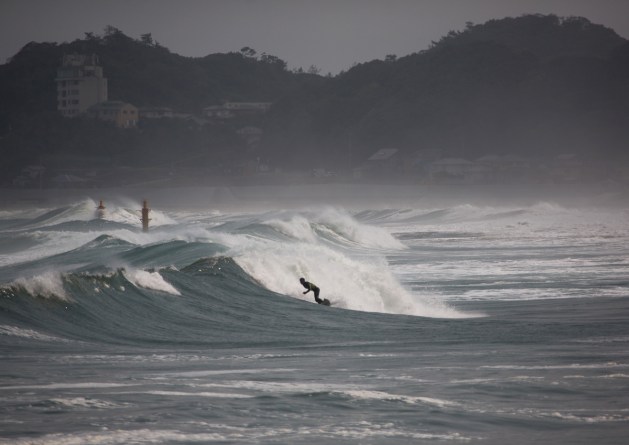
Tairatoyoma beach, in the prefecture of Fukushima, 50km from the nuclear plant, was among the most popular areas with Japanese surfers before the accident.

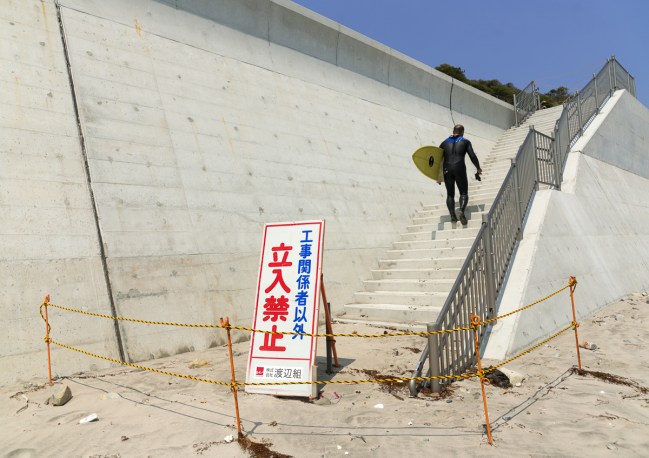
“I come to Tairatoyoma beach and surf several times a week. it is my passion, I can’t stop surfinhg”, says this surfer. The sign next to him in Japanese indicates that the area is restricted area.
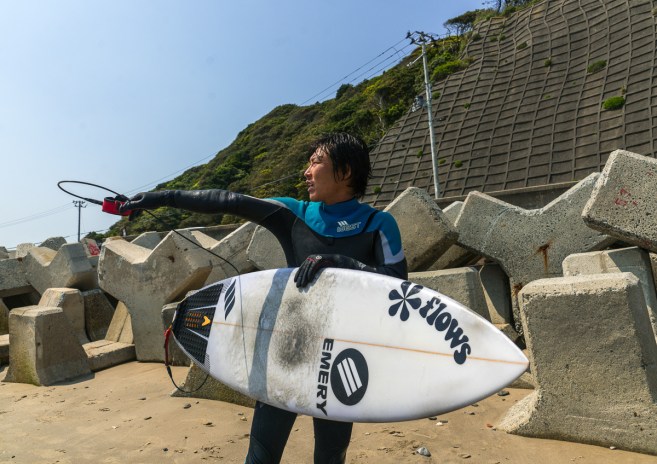
Some surfers were on the beach when the tsunami struck. ‘The earth shook, we came back on Tairatoyoma beach, and a few minutes later, the tsunami wave arrived,’ recalls one surfer. ‘None of the surfers who were on the beach died, as we had time to escape. Those who were in their homes were taken by the waves by surprise and they died.’
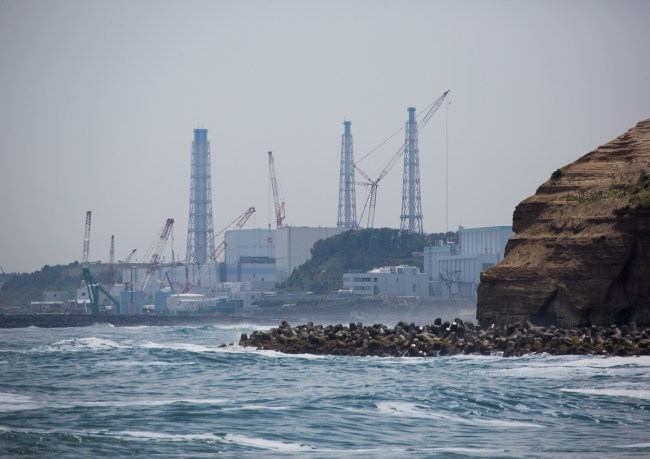
Over the course of five years, nearly 50,000 people have worked to decontaminate the plant and stop leaks. Nearly 500,000 people were evacuated because of the tsunami and the nuclear accident.
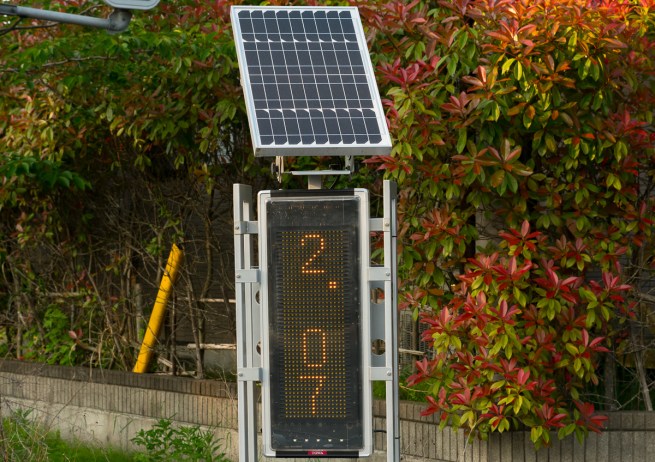
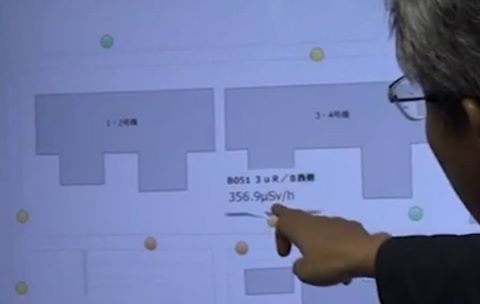
A radiation dosimeter placed in the difficult-to-return zone after the Daiichi nuclear power plant irradiation, Fukushima prefecture, Tomioka, Japan
Radiation sensors indicate the level of radioactivity. But no one is present to read the sensors in the red zones, classified as ‘difficult to return to zones’ by the government.

Roadblock in the difficult-to-return zone after the daiichi nuclear power plant irradiation, Fukushima prefecture, Tomioka, Japan
Residents receive compensation from Tepco company based on the degree of contamination of their homes. In the red zone they receive 1,000$ a month per person. That has created tensions in the population because those who live on the other side of the barrier, like here in Tomioka, do not receive as much.
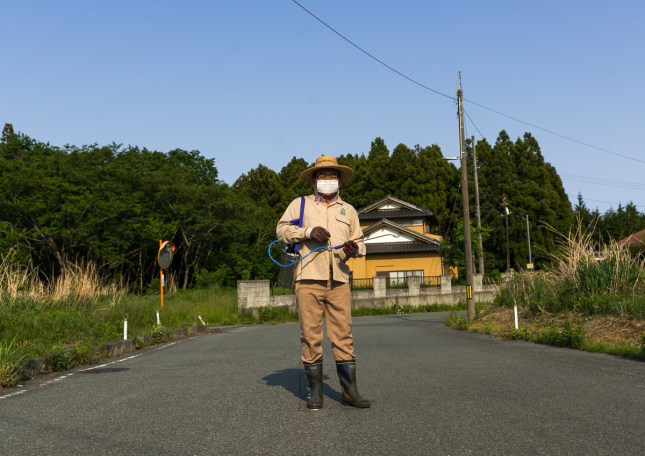
In the ‘orange zone’, residents have the right to visit their home if they wish to take care of it. In the town of Naraha. This man has come to weed his garden. His wife refuses to come back, and he will not bring his children. He never sleeps in his contaminated home. He knows the dangers well as he has worked at the nuclear plant.
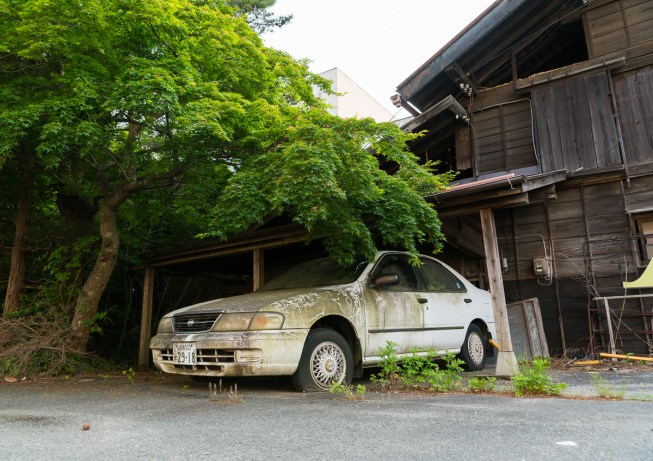
Abandoned car after the 2011 earthquake and tsunami five years after in the difficult-to-return zone, Fukushima prefecture, Tomioka, Japan
Cities distant from the sea, like Tomioka, were only affected by the earthquake and the radiation, not by the tsunami. They have now turned into ghost towns.
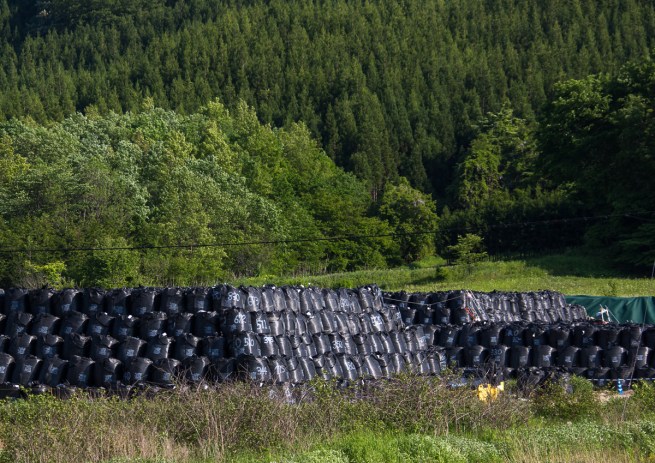
Thirty million tonnes of contaminated soil are stocked in open-air sites.

The Tairatoyoma beach was popular for its sand, but the tsunami washed this sand away. Now, a concrete wall offers protection against the waves. A few rare foreigners venture here to surf according to the Japanese surfers.
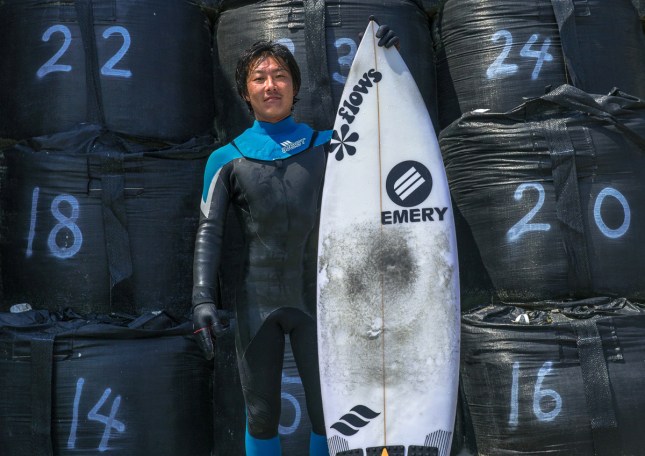
The surfers cannot ignore the riskS. There are hundreds of bags of contaminated sand piled up on the beach. ‘The government keeps telling us that things are back to normal in the region. But we can see that few people have come back. There are only elderly people. Children are kept away,’ said one surfer.
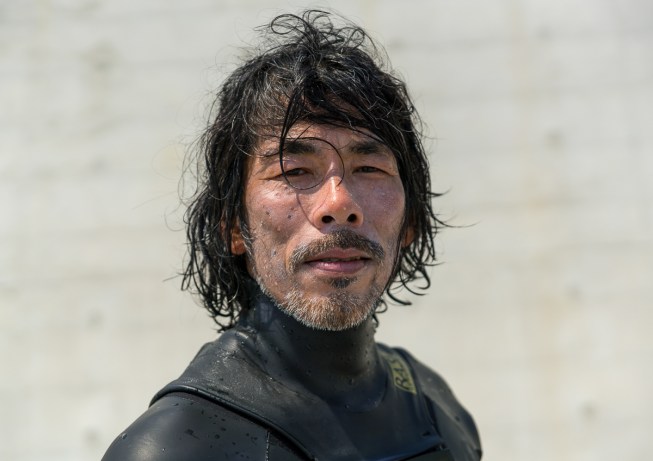
Despite knowing the risks, surfers are undeterred and willing to take the risk to surf in these waters. ‘I put on sunscreen against the sun, but I haven’t found anything against radiation. We will only know the true consequences of our time in the water 20 years from now,’said one surfer.
The people from the Fukushima prefecture had supported the construction of the nuclear power plants in the region because this brought jobs and prosperity to this rural area.
An employee of the nuclear plant said that he would never swim there as the water is too contaminated. Five of his friends who worked at the plant have now brain damage.
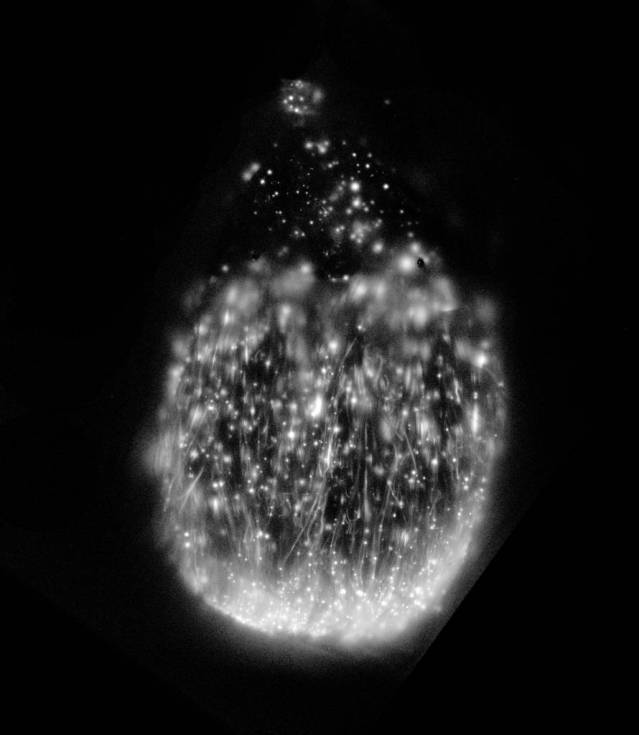
Radioactive Broom in Tomioka House, Fukushima
Via Kurumi Sugita:
“A broom collected in the town of tomioka in Fukushima Prefecture, inside of a house.”
Film focuses on ‘irradiated’ cattle kept alive in Fukushima
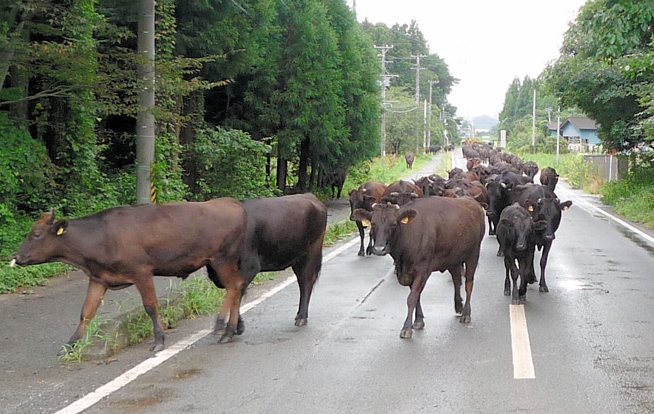
In a scene from “Hibaku-ushi to Ikiru” (Living with irradiated cattle), stray cattle head down a road in the 20-kilometer no-entry zone around the crippled Fukushima No. 1 nuclear power plant in August 2011.
OSAKA–For some cattle farmers in Fukushima Prefecture, the thought of destroying their herds is too painful to bear even if they are contaminated with radioactive fallout.
A new documentary to be shown here this week records the plight of these farmers, who continue to look after their beef cattle in defiance of a government request to euthanize the animals.
“I took on this project because I wanted to capture what is driving farmers to keep their cattle. For all the trouble it is worth, the animals are now worthless,” said Tamotsu Matsubara, a visual director who shot the documentary.
Four years in the making, “Hibaku-ushi to Ikiru” (Living with irradiated cattle) is set for its first screening on Aug. 26 at a local community center in the city.
Matsubara’s interactions with the cattle farmers date to the summer of 2011, a few months after the nuclear crisis unfolded at the Fukushima No. 1 nuclear power plant following the Great East Japan Earthquake and tsunami on March 11 that year. His assignment was to cover a traditional festival in Minami-Soma, which is located near the stricken nuclear plant.
Matsubara, 57, became acquainted with a farmer caring for more than 300 cattle on his land in the 20-kilometer no-entry zone set by the government. Residents in the zone were ordered to evacuate, but the farmer stayed on to look after his animals.
At that time, the government was seeking to destroy the cattle within the no-entry zone by obtaining their owners’ consent, saying animals that were heavily contaminated with radiation from the nuclear accident could not be sold at market.
But some farmers did not want to put their livestock down.
However, keeping them alive costs 200,000 yen ($2,000) a year in feed per head.
Matsubara became curious why the farmers continued to look after cattle that cannot be sold or bred, despite the heavy economic burden.
He soon began making weekly trips from Osaka to Fukushima to film the lives of the farmers, their cattle and the people around them.
After finishing his regular job in promotional events on Fridays, Matsubara would drive 11 hours to Fukushima and spend the weekend documenting the plight of the farmers before returning to Osaka by Monday morning.
He had 5 million yen saved for the documentary, his first feature film. When the money ran out, Matsubara held a crowdfunding campaign to complete it. Shooting wrapped up at the end of December.
About 350 hours of footage was edited into the 104-minute “Hibaku-ushi to Ikiru.”
The film documents the farmers and their supporters who are struggling to keep the cattle alive.
One couple in the film returns to their land in Okuma, a town that co-hosts the Fukushima plant, to care for their herd. They affectionately named each animal and said it would be unbearable to kill them. Their trips are financed using a bulk of the compensation they received for the nuclear accident.
A former assemblyman of Namie, a town near the plant, tends to his animals while asking himself why he used to support nuclear power.
The documentary also sheds light on scientists who are helping the farmers. The researchers believe that keeping track of the contaminated cattle will provide clues in unraveling how low-level radiation exposure impacts large mammals like humans.
Matsubara said the documentary tells the real story of what is going on with victims of the nuclear disaster.
“Not all the farmers featured in the documentary share the same opinion or stance,” Matsubara said. “I would like audiences to see the reality of people who cannot openly raise their voices to be heard.”
Takeshi Shiba, a documentary filmmaker who served as producer of this project, hopes the film will reach a wide audience.
“Matsubara broke his back in making this movie,” he said. “I hope that many people will learn what Fukushima people are thinking.”
Wind and cars disperse radioactive material
By Kurumi Sugita
A remarkable documentary of the RTBF about contaminated areas, including Minami Soma in Fukushima prefecture. These areas are heavily contaminated. Nevertheless, the Japanese government makes the people return by lifting the evacuation order and stopping aid.
The Nos Voisins Lointains 3.11 association, exchanged messages with Mr. Ozawa, the engineer interviewed in the documentary. According to him, the most worrisome problem is the fact that black substances in the mall parking area get attached to car tires and are transported everywhere, as we can see in the documentary. The risk of radiation is thus dispersed.

On the other side of the parking area, we see collective dwellings from where children play outside, according to Mr. Owaza.
See also the video sent by Mr. Ozawa showing the wind lifting and dispersing the contaminated dust from fields now uncultivated.
Linens that are drying on the balcony outside are exposed to radioactive material transported by these dusty winds. Just watch at which height the dust is lifted compared to the passing car towards the end of the video. Farmers working the land inhale this dust.
With the forced return of the population this will become their daily reality.
American nuclear expert Arnie Gundersen warns: “There is a possibility that now in Fukushima recontamination is occurring.”
CCTV (Channel 17 in Burlington, Vermont), published Jun 20, 2016
Maggie Gundersen, Chiho Kaneko and Caroline Phillips of Fairewinds Energy Education discuss the nuclear risk concerns for children not only near the nuclear disaster sites of Fukushima-Dai-ichiin Japan and Chernobyl in Ukraine, formerly the Soviet Union, but globally where areas near all nuclear power plants are contaminated with radiation. Since mothers in Japan especially bear the responsibility to protect children, they experience greater hardships in an environment where just expressing one’s concern about radiation is seen as a treasonous act. Even 30 years later, the Belarus government recognizes the merits of relocating children away from radiation contaminated areas but the children of Japan are socially forced to stay put in highly contaminated areas.
Margaret Harrington, host: I know you mentioned Arnie Gundersen, the chief engineer at Fairewinds, and he said that he measured the radiation there, too. Could you talk about that a little bit?
Maggie Gundersen, Fairewinds Energy Education founder and CEO: He’s working with some other scientists who are studying — both Japanese scientists, the samples that they took, and the US scientists who are evaluating the samples — and they’re finding astronomical amounts of radiation, even in downtown Tokyo outside of METI’s door. METI is the regulatory agency over nuclear power… When he and others were downtown in Tokyo, they took samples right there in a garden right outside the door and on the front doormat, and these are really, really high samples. Frightening, because people walking in Tokyo will then be inhaling that dust. What was the film we saw from Japan that had the mothers who were in an area where kids play and run from middle school?
Caroline Phillips, Fairewinds Energy Education: It’s a fantastic video… it’s a mothers organization, they live in the Fukushima Prefecture and they’re actually using Geiger counters that have been issued by the government. They’re walking along the river [in Fukushima City.]
Maggie Gundersen: What’s so tragic about it – kids are running along dirt paths doing gym class and track and things like that and the mothers are right down in areas that are not posted and the kids can go after school and play, and people do nature hikes and stuff. And the radiation readings are horrific.

Gendai Business Online’s top ranked article is an exclusive interview with Fairewinds Chief Engineer Arnie Gundersen titled, American nuclear expert warns: “There is a possibility that now in Fukushima recontamination is occurring.” With more than 10,000 likes on Facebook, this Japanese article delves into the truth about nuclear contamination from Fukushima Daiichi as uncovered by Arnie Gundersen during his most recent trip to Japan. Fairewinds, with the help of Japanese translators, provides you with an English translation:
On a mid-February morning, just before the 5th anniversary of the triple meltdown at Fukushima Daiichi, a group of young girls in the city of Minami-Soma rode their bikes to school past a shocked and saddened pedestrian. That upset observer was Arnie Gundersen, nuclear reactor expert and Chief Engineer with Fairewinds Associates. Mr. Gundersen has 45 years of experience as a design, operations, and decommissioning nuclear engineer. He has engaged in research of the effects of the meltdown at Three Mile Island (TMI) and conducts independent research of the triple meltdown at Fukushima Daiichi. Mr. Gundersen is in ongoing conversations with both the US and Japanese media concerning the dangers of nuclear reactors and nuclear power operation. Invited by “Peace News Japan” and several other civil groups, Mr. Gundersen visited the Fukushima prefecture five years after the catastrophe at Fukushima Daiichi.
“What surprised me at this visit to Japan [his third since the meltdowns] is that the decontaminated area is contaminated again,” Mr. Gundersen said while explaining why it was such as sad shock to witness the girls on their bicycles. “This was not what I had expected. I had thought that we would not find such high doses of radiation in the decontaminated area. But, sadly, our results prove otherwise.”
During his Japan visit, Mr. Gundersen collected samples of dust from the rooftop of Minami-Soma city town hall, the floor mat of a 7-Eleven convenience store, and the roadsides of Minami-Soma city. Although the official data cannot be released before the publication of formal scientific papers, it is evident that high doses of radiation, usually found in nuclear waste, was detected from these samples.
“This means that highly radioactive dust is flying around the city. In other words, the decontaminated land is contaminated again. Little girls are affected by the radiation 20 times as much as adult men. The Japanese government’s standard of 20 mSv is based on exposure assessments for adult men. The girls on their bicycles are actually being affected by a radiation dose equivalent to as much as 400 mSv.”
Mr. Gundersen also pointed out that human lungs are heavily affected by internal exposures to radiation.
“At this visit, I wore a radiation proof mask that can filter out 99.98% of radiation for six hours. I sent my filter to the lab, and they found a high dose of Cesium. But, unfortunately, the Japanese government only cares about the number on a Geiger counter and does not consider the internal exposure. This has resulted in a hazardous downplay of this kind of data and human lungs are affected by the serious internal exposure.”
Why is the recontamination happening? One of the reasons is that the government did not decontaminate thoroughly. Mr. Gundersen witnessed first-hand the poor decontamination of the prefecture.
“In the house I visited, only half of the garden area was decontaminated because only that half fell into the category of a contaminated area. It should not be like that. The other half would be contaminated too. Furthermore, one person discovered highly radioactive dust in their driveway where decontamination had occurred. So, of course, this person notified the related offices but the related offices told them that it was not necessary to decontaminate the driveway again because it had already been done once. It’s unbelievable. This person’s house is located near a ravine and the opposite side of the ravine is designated a non-habitable zone.”
Another reason for recontamination is that the radiation from the mountains are coming back to the city by way of wind and rain. Mr. Gundersen noted the extreme radioactive contamination of the mountains.
“We tracked wild monkeys in the mountains and found a high dose of radiation in their feces. I received the meat of a wild pig as a gift and since I could not bring it back to the US [it is illegal to bring meat back to the United States from Japan], tested the meat on a Geiger counter. The meat showed 120 counts/min. I think that the Japanese government should spend more money to decontaminate the mountains but they don’t appear to have that kind of political will. I also worry that contamination in the rivers is not monitored as rain from the mountains flow down into the rivers.”
Due to the heavy radiation contamination of the mountains, vegetables grown in that area exceed the government’s standard by 1500 Bq. These vegetables were sold at the MichinoEki in Tochigi prefecture, and the bamboo shoot grown in this contaminated region was used for elementary school lunches in Utsunomiya. These school lunches contained more than twice as much radiation as the government’s standard.
Recontamination is happening due to poor decontamination and residents of Kawauchi village in Fukushima prefecture claim that the decontamination in the forests is not enough. However, the government continues to push for the end of people’s relocation and force the return to recontaminated areas.
“If I had a little child, I would never let them live there,” Mr. Gundersen pointedly states.
Mr. Gundersen also found that Tokyo remains contaminated. He measured dust collected from the sidewalk in front of MITI (Ministry of International Trade and Industry) and found a high dose of radiation. That dust is in the air that will be inhaled by the visitors and athletes of the 2020 Olympic Games. Needless to say, the current residents are inhaling it every day. “Mr. Abe should not take the advice from IAEA, MITI and TEPCO seriously,” Mr. Gundersen insists. “Instead, he should have an independent organization conduct research and listen to the advice from them.”
Footholds Should Be Built in Fukushima No-Go Zone: LDP Team
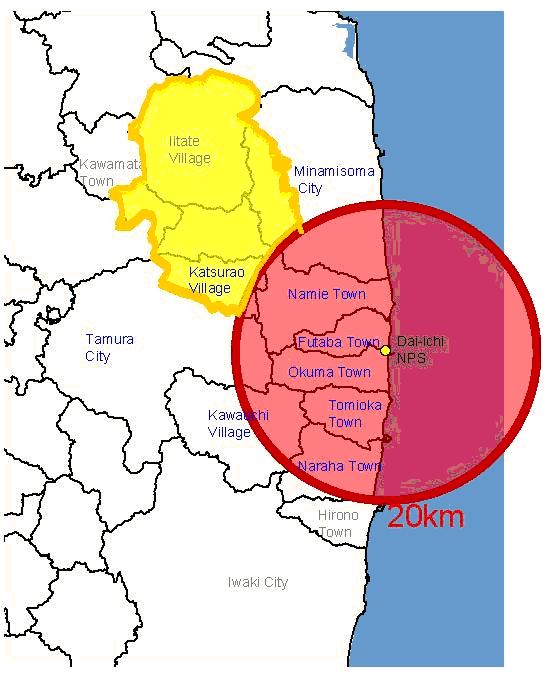
Tokyo, Aug. 17 (Jiji Press)–Reconstruction footholds should be set up in the no-go zone heavily contaminated by the 2011 nuclear accident in Fukushima Prefecture in northeastern Japan, a Liberal Democratic Party team proposed Wednesday.
The footholds should be used for decontamination work and infrastructure development so that evacuation orders for residents of the zone will be lifted in around five years, said the ruling party’s Headquarters for Accelerating Reconstruction after the Great East Japan Earthquake.
At a general meeting, the headquarters broadly agreed on a draft outline of the party’s planned sixth reconstruction proposal for areas damaged by the March 2011 earthquake and tsunami and the subsequent reactor meltdowns at Tokyo Electric Power Company Holdings Inc.’s Fukushima No. 1 nuclear power plant.
The government plans to remove all evacuation advisories in municipalities affected by the nuclear accident by the end of March 2017, excluding in the no-go zone where radiation levels are still too high for local residents to return home anytime soon.
The LDP will submit the proposal to Prime Minister Shinzo Abe later this month, after finalizing it through discussions with its coalition partner, Komeito.
Fukushima Disaster’s Victims
I decided to translate this particular article because this article for a change talks about the Fukushima disaster victims and in details how their everyday lives have been affected.
In most of the Fukushima related articles from websites and mainstream media, the writers usually focus on the Fukushima Daiichi nuclear power plant and its technical failures, about its continuous leaking into the Pacific ocean etc. but somehow they almost always forget to talk about the plight of the victims, the victims who are at the forefront of this tragedy.
August 12, 2016
Article written by Evelyne Genoulaz, from a lecture given by Kurumi Sugita,
translated by Dun Renard.
Source : Fukushima Blog de Pierre Fetet http://www.fukushima-blog.com/2016/08/fukushima-les-vies-sinistrees.html
March 11, 2016, Kurumi Sugita, social anthropologist researcher and founding president of the association “Our Far Neighbors 3.11”, gave a lecture entitled “Fukushima disaster’s lives” in the Nature and Environment House (MNEI) in Grenoble, Isere, an inaugural lecture for the commemoration of the “Chernobyl, Fukushima disasters”.
The speaker outlined the concrete and current situation of the victims of the Fukushima disaster, particularly on health issues. Attached to Japan, committed, Kurumi monitored the situation of 60 affected people, for several years, visiting each once a year to collect field data for her associative actions. It is the project “DILEM”, “Displaced and Undecided Left to Themselves”, from the nuclear accident in Japan – the life course and geographical trajectory of the victims outside of the official evacuation zone.
I offer a written return of this conference, courtesy of Kurumi who also was kind enough to add data to date on her return from Japan in June 2016.
Evelyne Genoulaz
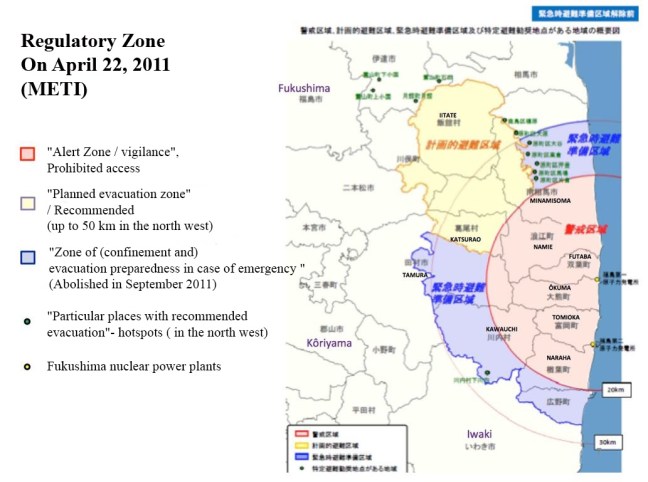
I. The contaminated territories
After the disaster the authorities declared a state of emergency and to this day Japan is still “under that declaration of a nuclear emergency state (genshiryoku kinkyu Jitai sengen).” But over time, the zoning of the contaminated territories has been increasingly reduced by the authorities, as shows the chronological overview on these maps (METI).
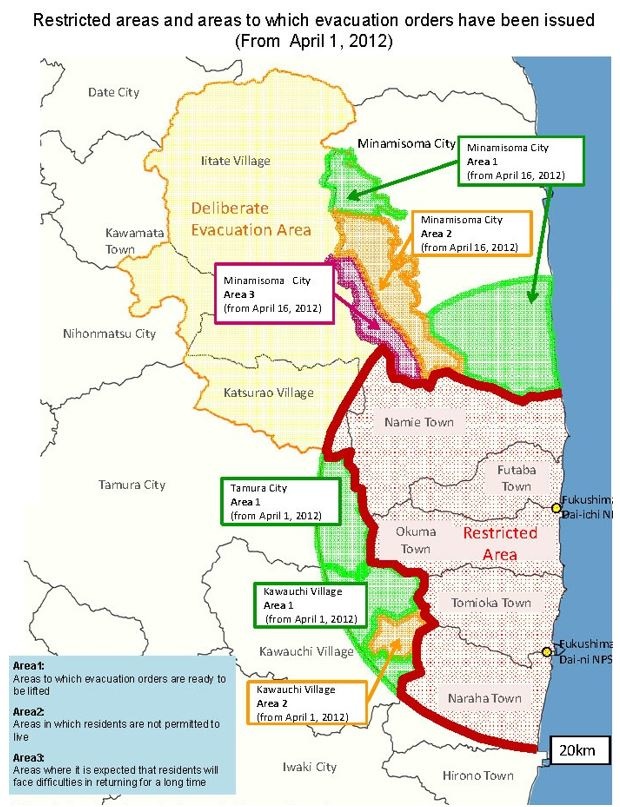
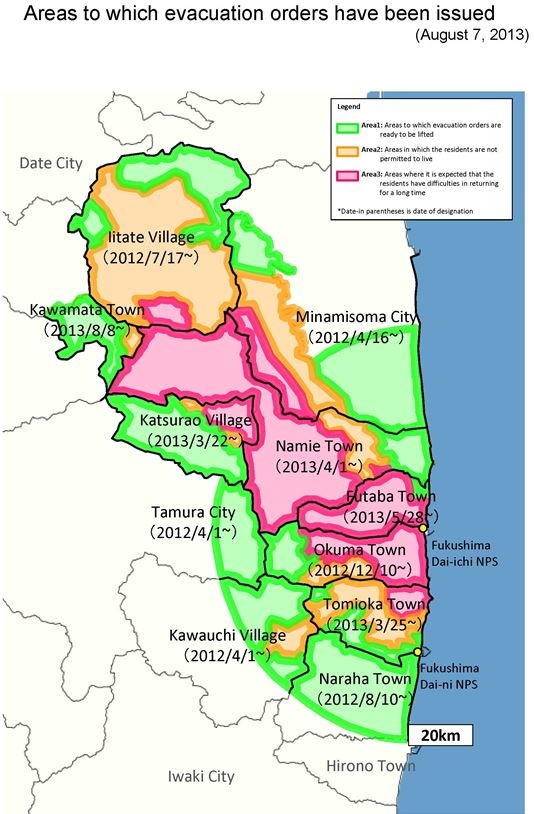
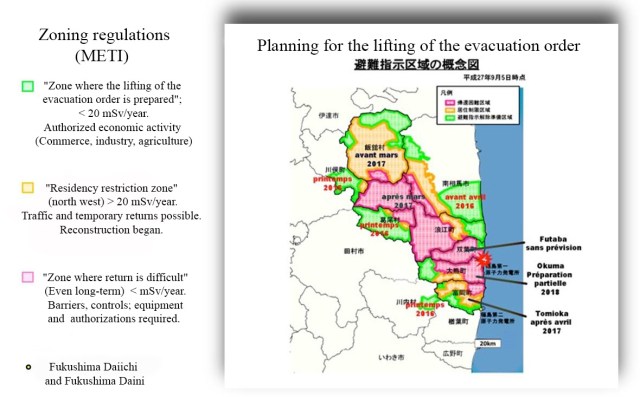
II. The return policy
Starting this month of March 2016, in fact, many areas were “open”. The return to TOMIOKA is programmed by authorities after April 2017; OKUMA partially in 2018. Only FUTABA is labeled “no projection”. Do note that zoning maps were delineated at the beginning of the disaster zoning by concentric circles, while the radioactivity is deposited in “leopard spots” and today, programmed to be returned to areas are gradually getting geographically closer to the Fukushima Daiichi nuclear plant even though these areas are dangerous!
The government is preparing to lift the evacuation order at 20 mSv / year, and areas from 20 to 50 mSv / year will enter the opening schedule after spring 2017 establishing strategic points for reconstruction ( fukkô Kyoten).
To speak only of Iitate, which was the most beautiful village in Japan, its mayor is in favor of return, but today the situation there is poignant: it was decontaminated up to 20 meters of the houses, but as it is surrounded by mountains and forests, the radioactivity will remain dangerous …
Measures delegated to individuals
The control measurement of environmental radioactivity will now be based on the individual rather than on space. Thus, everyone is invited to measure himself or herself, to measure what is consumed, so that if the individual is contaminated it will only be blamed upon his or her own negligence!
The absurd and arbitrary at work in the calculation of dose rates
Official figures on the geographical contamination, dose rates displayed, are using a biased calculation.
Usually to measure in the field a dose rate, we get a figure in mSv / h then multiply it by 24 (hours) x 365 (days) to obtain the annual rate. But this is not the calculation undertaken by the authorities.
The authorities makes first a difference between the level of contamination on one hand inside the housing, and on the other hand on the outside. They decided to consider that an individual spends only 8 hours outside. It is also estimated (official rules) that “the radiation inside a building is reduced to 40% of the radiation reading outside.”
Yet, in Minamisoma for example, studies have shown that the contamination inside was at best 10% lower than the outside, sometimes even worse inside!
That is to say that the authorities uses a biased calculation that ultimately determines if we take an example, a dose rate of 20 mSv / year whereas the actually measured dose rate is 33 mSv / year!
Residents who did not evacuate are distressed because they now know fear, for example those of Naraha who no longer recognize their city because it has changed since the disaster: vandalism, insecurity soon as night falls, since it is now black in the streets, some girls were abused …
Furthermore, Naraha is a coastal town with a seaside road and all night – especially at night – they hear the noise of the incessant and disturbing road traffic of the trucks loaded with radioactive waste, without knowing precisely what is carried …
What motivates the return policy? According to Kurumi Sugita, in view of the Olympic Games coming to Japan in 2020, the government pursues a staistics dependent objective: it comes to lowering the numbers! If the evacuees or the self-evacuees leave the “assisted housing”, they are no longer counted as “evacuees”….
III. Works and Waste
The whole territory of Fukushima Prefecture today is littered with waste bags. Everywhere, at the turn of any road you’ll encounters mountains of waste bags, sometimes piled up so high! It is a sorry sight for the residents. And space lacks where to store them, so much that the authorities have even created dumps that they call “temporary intermediary storage areas! “
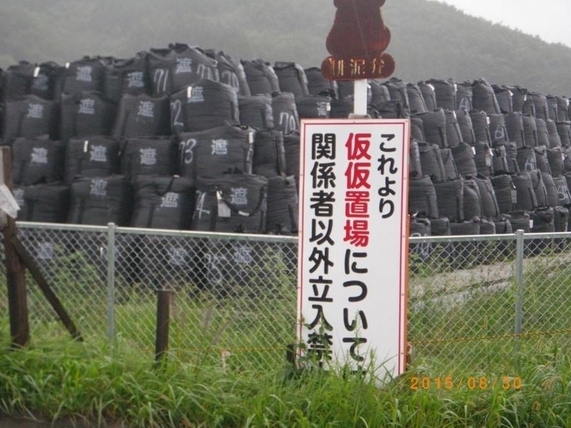
A “temporary intermediary storage area” in Iitate
A row of uncontaminated sandbags is added around the perimeter of the “square” of the most contaminated bags, so as to reduce the number of the dose rate!
As of March 2016, there were no less than 10 million bags and 128,000 temporary dumpsites in Fukushima Prefecture. Waste bags are omnipresent, despite the residents’ distress; near schools, and even in people’s gardens.
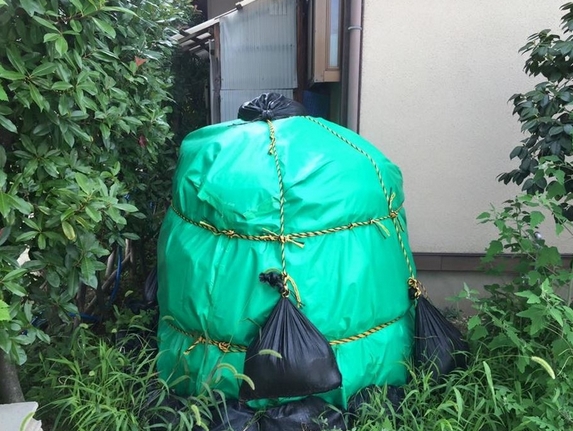
Contaminated waste bags at someone’s house
Short of sufficient storage space, the authorities are forcing residents to an intolerable alternative: if the resident does not want to store the waste on his property, it is his right. But in this case it will not be decontaminated! The resident requesting “decontamination intervention” must keep the waste on his property! This is why we see here and there, everywhere in fact, bags near buildings or in private homes.
According to the “Nuclear Reactor Regulation Law” (Genshiro tô kiseihô), the recycling threshold of “nuclear waste” is 100 Bq / kg. However, on June 30, 2016, the Ministry of Environment has officially decided to “reuse” waste below 8000 Bq / kg (1).
In practical terms, this waste will be used in public works, covered by cement and land in order to lower the ambient radioactivity.
In order to “reduce the volume” of waste, “temporary incinerators” were built to incinerate nuclear waste and to “vaporize” cesium.
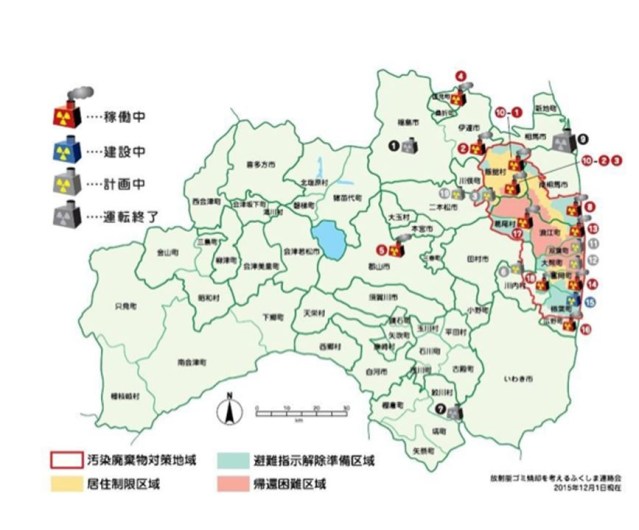
Map of Fukushima prefecture showing the nuclear waste processing establishments locations (shizai-ka center) – Legend: the icons differentiate the various incinerators; red = in operation – blue = under construction – gray / yellow = planned – gray = operation completed
Everywhere on village outskirts there are incinerators of which people know nothing! They often operate at night for two to three months and then everything stops. People wonder what is being burned… Not to mention a rumor about a secret experimentation center where much more contaminated waste would be burned…
Even more frightening, waste processing plants …
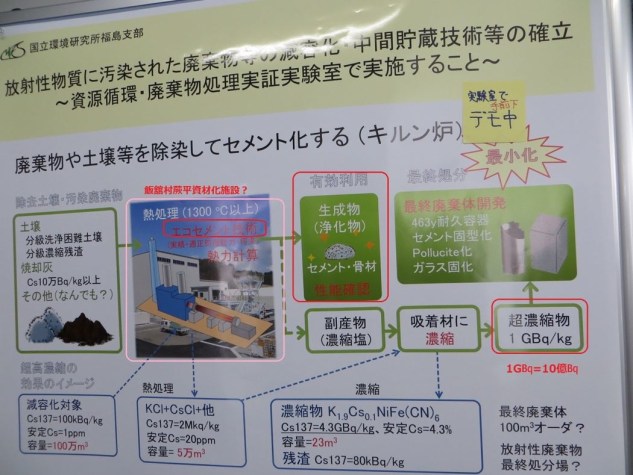
At the “Environmental Design Centre”, a poster about the revolving furnace” which decontaminates waste, debris, soil, etc, transforming them into cement”.
For example, the Warabidaira waste processing plant located in the village of Iitate or the Environment Creation Center (Kankyô Sôzô Center) opened in July 2016 in the town of Miharu, treat contaminated waste (ashes above 100 000 Bq/kg) and contaminated soil coming from land decontamination work.
Now these last two categories are not covered by the Waste Management Law (1) so they have no constraints associated with their treatment… To reduce their volume and to make them … “recyclable”!
In addition, these establishments are registered as “research institutes” and, as such, they are exempt from the building permit application commonly mandated in the framework of the waste management law!
We see inconsistencies and even contradictions between laws. We have already seen the contradiction between the limit of 100 Bq / kg set by the Nuclear Reactor Regulation Law and the 8000 Bq / kg recently adopted by the Ministry of Environment.
IV. Residents, displaced and returned
Citizen radiation measuring. Mothers, and also dads, explore the everyday environment to identify hot spots so as to modify if necessary the route recommended for children, for example “the way to school” (as in Japan all children walk single file).
For that purpose associations use “hot spot finders”. Well aware of the health risk to which children are exposed, they attach sensors connected to GPS on their strollers to walk routes and the way to school or to explore parks.
That system is well thought out: it is a vertical rod 1 meter long that leaves the ground and consists of a measuring device at 10 cm from the ground, another one at 50 cm, and a third at 1 meter to take into account the different sizes of children. If a hot spot is located, others are warned of its location and the children are required to change their route, and authorities are asked to decontaminate. For parents, this work is endless …
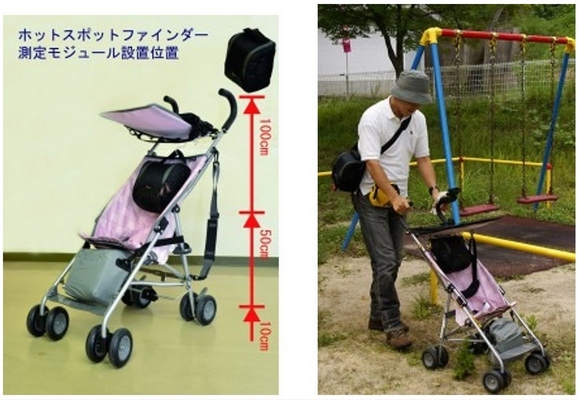
Hot spot finders
People organize citizen actions thru Internet. These independent citizen online databases are many,
and one of them is even translated into English since November 2014. It is the “Minna no Data”: ambient radioactivity measures, soil measurements, food analyzes (2).
Some associations’ logos:
V. Protest actions
The trial against the three former TEPCO executives which began in spring 2016 is the first criminal trial to take place; it could last ten years …
However, in Fukushima Prefecture, there are many other trials at different levels also taking place. For example, in March 2016, a lawsuit was initiated by 200 parents brought against the Fukushima Prefecture, to “get children out of contaminated areas.” People protest to have the “thresholds” lowered. In their opinion the issue of “thresholds” go beyond the strict framework of Japan. They fear that the thresholds of Japan will end up being generalized overseas, which is highlighted in some of the maps captions eg “against the generalization and the externalization of the 20 mSv / year threshold”. Some victims require, as after Hiroshima, “an irradiation book” (personal records) to be used for their access to treatment.
Radiation free health holiday
To send children on a health holiday is now more and more difficult, because people tend to believe that the disaster is already over therefore requests for help have become complicated.
In the city of Fukushima, for example, referring to the nuclear disaster is now taboo …
VI. Social and family catastrophe
It causes “conflicts” among neighbors (one example, one person’s place is decontaminated while its adjoining neighbor’s place is not), between beneficiaries and others, between the displaced and the residents of the hosting location (there are misunderstandings on the issue of compensations; the self-evacuated are not receiving any compensation, but the hosting city locals think they are).
So today many prefer to return their evacuated Fukushima resident card and acquire the resident card of their hosting town (in Japon you are résident of the village from which you keep the residence card) so as to “turn the page” because they can no longer bear to be called “evacuees”. They want to integrate into the community where they moved. Only older people remain unswervingly committed to their original residence; it is mostly the elderly who intend to return.
In many families of the Fukushima Prefecture men stayed by necessity to keep their jobs to provide for their families, while mothers with children evacuated to put them out of danger; but as time has passed, more than five years already, many families have disintegrated… The father visiting the family rarely, often for lack of resources, the marriage falling apart, resulting in many divorces and suicides.
Women are showing remarkable energy, they are on all fronts, openly, and even heavily involved in actions and trials, so that even the articles of the so-called “feminine” press today are often dealing with topics related to the nuclear disaster. Young women in particular are very active in the protests and rallies. This is a significant change in Japanese society.
(1) Waste Management and Public Cleansing Law, Haikibutsu no shori oyobi seisô ni kansuru hôritsu, law N°137 from 1970, last amendment in 2001 https://www.env.go.jp/en/laws/recycle/01.pdf
Nuclear Reactor Regulation Law (Genshiro tô kiseihô).
“Act on the Regulation of Nuclear Source Material, Nuclear Fuel Material and Reactors” (kakugenryô busshitsu,kakunenryô busshitsu oyobi genshiro no kisei ni kansuru hôritsu)
law N°166 from 1957(2) –
English translation of Nuclear Reactor Regulation Law.
http://www.japaneselawtranslation.go.jp/law/detail/?id=1941&vm=03&re=01
(2) – Minna no Data Site (MDS) : http://en.minnanods.net/
_____________________
After his lecture, I asked a simple question to Kurumi Sugita:
Why has she founded the association « Nos Voisins Lointains 3.11 » (“Our Distant Neighbors 3.11”)? …
In France, where lives Kurumi, several Japanese associations exchange about the disaster.
But Kurumi Sugita founded on January 8, 2013 in Lyon, the association « Nos voisins lointains 3-11 » also to inform the French and francophones who do not read Japanese.
The website of the association publishes valuable and moving testimonies, translated into French.
Thanks to donations, the association helps concretely, as much as possible, some affected families in Japan.
To know more
The website of Kurumi Sugita’s association:
http://nosvoisins311.wix.com/voisins311-france
You may find the victims testimonies on her Facebook page:
And general informations on the Fukushima nuclear disaster:
https://www.facebook.com/Nos-Voisins-Lointains-311-555557711144167/
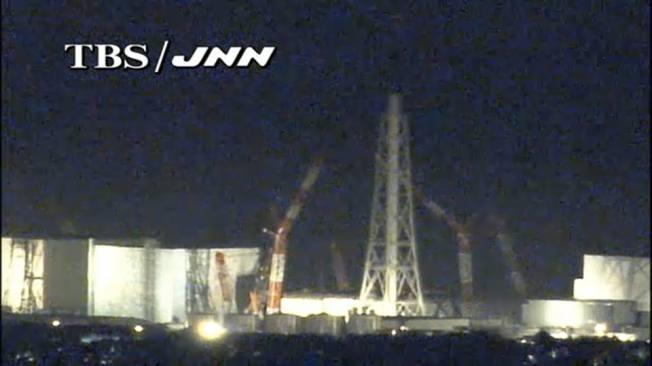
Fukushima Daiichi Still Outgassing Radionuclides
It’s still steaming away 5 1/2 years later and with the tent roof removed from Reactor 1 its poison continues to be widely dispersed.
Unit 1 side : 2016.08.14_00.00-03.00
Unit 4 side : 2016.08.14_15.00-18.00
Biological effects of Fukushima radiation on plants, insects, and animals

This is a pale grass blue butterfly, one of the most common species of butterfly in Japan. Recent research has revealed major impacts on this species from the radiation leaks at the Fukushima nuclear power plant. Credit: Joji Otaki, University of the Ryukyus, Okinawa, Japan
Following the 1986 Chernobyl nuclear power plant meltdown, biological samples were obtained only after extensive delays, limiting the information that could be gained about the impacts of that historic disaster. Determined not to repeat the shortcomings of the Chernobyl studies, scientists began gathering biological information only a few months after the disastrous meltdown of the Fukushima Daiichi power plant in Japan in 2011. Results of these studies are now beginning to reveal serious biological effects of the Fukushima radiation on non-human organisms ranging from plants to butterflies to birds.
A series of articles summarizing these studies has now been published in the Journal of Heredity. These describe widespread impacts, ranging from population declines to genetic damage to responses by the repair mechanisms that help organisms cope with radiation exposure.
“A growing body of empirical results from studies of birds, monkeys, butterflies, and other insects suggests that some species have been significantly impacted by the radioactive releases related to the Fukushima disaster,” stated Dr. Timothy Mousseau of the University of South Carolina, lead author of one of the studies.
Most importantly, these studies supply a baseline for future research on the effects of ionizing radiation exposure to the environment.
Common to all of the published studies is the hypothesis that chronic (low-dose) exposure to ionizing radiation results in genetic damage and increased mutation rates in reproductive and non-reproductive cells.
One of the studies (Hayashi et al. 2014) documented the effects of radiation on rice by exposing healthy seedlings to low-level gamma radiation at a contaminated site in Fukushima Prefecture. After three days, a number of effects were observed, including activation of genes involved in self-defense, ranging from DNA replication and repair to stress responses to cell death.
“The experimental design employed in this work will provide a new way to test how the entire rice plant genome responds to ionizing radiation under field conditions,” explained Dr. Randeep Rakwal of the University of Tsukuba in Japan, one of the authors of the study.
Another team of researchers (Taira et al. 2014) examined the response of the pale grass blue butterfly, one of the most common butterfly species in Japan, to radiation exposure at the Fukushima site. They found size reduction, slowed growth, high mortality and morphological abnormality both at the Fukushima site and among laboratory-bred butterflies with parents collected from the contaminated site.
Multiple sources of exposure were included in the butterfly study. “Non-contaminated larvae fed leaves from contaminated host plants collected near the reactor showed high rates of abnormality and mortality,” explained Dr. Joji Otaki of the University of the Ryukyus in Okinawa, Japan. Some of their results suggested the possible evolution of radiation resistance in Fukushima butterflies as well.
A review of genetic and ecological studies for a range of other species at both Chernobyl and Fukushima (Mousseau 2014) revealed significant consequences of radiation. Population censuses of birds, butterflies, and cicadas at Fukushima showed major declines attributable to radiation exposure. Morphological effects, such as aberrant feathers on barn swallows, were also observed. The authors suggest that long-term studies at Chernobyl could predict likely effects in the future at the Fukushima site.
All of these studies highlight the need for early and ongoing monitoring at sites of accidental radiation release. “Detailed analyses of genetic impacts to natural populations could provide the information needed to predict recovery times for wild communities at Fukushima as well as any sites of future nuclear accidents,” Mousseau said. “There is an urgent need for greater investment in basic scientific research of the wild animals and plants of Fukushima.”
Provided by: American Genetic Association
http://m.phys.org/news/2014-08-biological-effects-fukushima-insects-animals.html
The dead bodies in the exclusion zone of Fukushima Daiichi Nuclear Accident and their treatment
The original blogpost has been largely shortened by the translator. For more information please refer to the article in Japanese 「東京電力福島第一原子力発電所災害に係る避難指示区域内の御遺体の取扱について」. Translated by W. Crane.
June 11, 2016
An article published by Kyodo News on March 31, 2011 immediately raised a lot of attention at the time. It was titled Hundreds to up to a thousand dead bodies within the 20 km radius evacuation zone in Fukushima. “May have been contaminated after death” say police.
Some articles in English followed, such as this one by the Rediff News on the same day:
Japan: Radiation fears leaves bodies rotting, PM for scrapping N-plant
The fear of being affected by radiation has prevented authorities from collecting around 1,000 bodies of the March 11 earthquake and tsunami victims from within the 20-kilometer-radius evacuation zone near the troubled Fukushima nuclear plant.
The Kyodo news agency quoted a local police source as saying that said bodies had been ”Exposed to high levels of radiation after death.” On Sunday, high levels of radiation were detected on a body found in Okuma, Fukushima Prefecture, about 5 km from the Fukushima Daiichi Nuclear Power Station.
The authorities are now reportedly trying to figure out other ways to collect the bodies over fears that police officers, doctors and even family members may be exposed to radiation in their attempt to recover the dead bodies.
They also raised concerns that even after handing over the bodies to relatives, the cremation process could spread further radioactive materials. High levels of radiation detected on the Okuma town victim last Sunday had forced local police to give up on retrieving the body.
””Measures that can be taken vary depending on the level of radiation, so there need to be professionals who can control radiation. One option is to take decontamination vehicles there and decontaminate the bodies one by one,”” an expert on treating people exposed to radiation said.
Or this article in the Japan Times on April 1, 2016:
Hundreds of corpses believed irradiated, inaccessible
Radiation is preventing the retrieval of hundreds of bodies from inside the 20-km evacuation zone around the Fukushima No. 1 nuclear power plant, police sources said Thursday.
Based on initial reports after the March 11 catastrophe, the number of bodies is estimated at between a few hundred and 1,000, one of the sources said, adding that high radiation is now hampering full-scale searches.
That view was supported by the Sunday find of high radiation levels on a body found in Okuma, Fukushima Prefecture, 5 km from the plant.
The rescuers are now in a bind. Even if they retrieve the bodies, anyone who comes into contact with them risks being irradiated, too, whether they’re in the evacuation zone or not.
And if the bodies are cremated, the smoke could spread radioactive materials as well, the sources said. Even burial poses a problem. When the bodies decompose, they might contaminate the soil with radioactive materials.
Authorities are considering decontaminating and inspecting the bodies where they are found, but the sources said cleansing the decomposing bodies could damage them further.
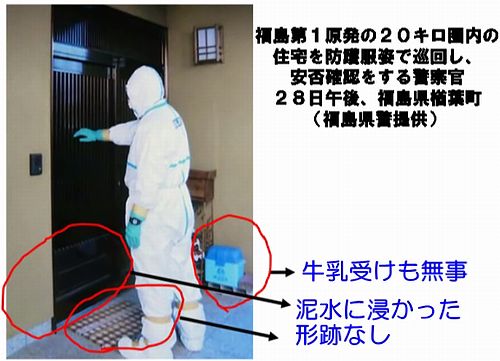
A follow up article was published on May 20 in the Kahoku Shinpo reporting that the above mentioned body was finally collected on April 1 and sent to Minamisoma city where it was diagnosed to have died of illness. No external wound was found on the body. The tsunami is ruled out of cause here completely.
The body found in Okuma
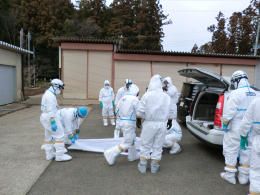
Google Earth as of 2011/3/19
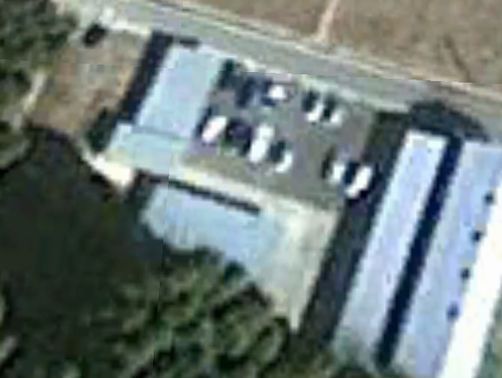
In the original article in Japanese by Kyodo News, it is described that the contamination of the body that was found in Okuma was over the detection limit of the dosimeter, which is 100.000 cpm.
In an official letter discussing what to do with all the contaminated bodies (the title of this blog post comes from this letter) the Nuclear Safety Commission says that the air dose rate of 10 μSv/h at 1 m distance from the body could be considered the equivalent of a surface contamination of 100.000 cpm. It also says that in that case the clothes have to be removed from the body before treating it because such a surface contamination is enough to cause secondary irradiation to the treating person.
If the clothes have been contaminated by a plume then the inside of the lungs must have been contaminated as well.
And this area was indeed hit by such a dense plume. The spot where the body was found was hit by a plume above 10 μSv/h first on March 13, followed by waves far higher than this (up to almost 100μSv/h, nearly 300 times the US army’s evacuation limit) on March 14 and 15. Just imagine breathing the air that was so radioactive that it contaminated the clothes so much as to cause secondary radiation.
unit:nSv/h

In the case of the people in Okuma town it would appear most likely that they died from inhaling the radiation, most probably iodine gas that was released first. But the industry, the regulators and the scientists mysteriously remain quiet about the fatal dose of when one is exposed to radiation internally. Otherwise what can be the explanation for the sudden deaths of several hundred people in a sparsely populated area? When even official sources state they were not earthquake or tsunami victims?
Maybe I am the only one but I cannot help thinking that these people whose bodies ended up being cremated and buried without identification are crying out silently that it is time to clear the real cause of their deaths. May their souls rest in peace.
Space dose 1.55 micro Sv/h, Koriyama city, park waterside hotspot
Published on Jul 20, 2016 by Birdhairjp
July 16, 2016 (five years & four months from the nuclear disaster)
I monitored radiation around Gohyakubuchi-park of Koriyama city, Fukushima Prefecture, Japan.
Space dose of the height of the chest of the promenade circling the pond, was approximately 0.27 to 0.30 micro sievert per hour.
At the entrance of the park, a sighnboad shows the decontamination result by the city.
Before the decontamination: 2.33 micro Sv/h as of Sep of 2011
After the decontamination: 0.21 micro Sv/h as of Jun of 2016
(Air dose rate 50cm high from the ground level)
My monitor shows space dose 0.47 on the pond-side promenade near a floodgate to the waterway into the woods.
Space dose on the promenade in the park forest is at the height of the breast, was 0.3 to 0.45 micro Sv/h
To the waterside in the forest, there is a hot spot that radioactive material is collected.
Approaching to the place, the value of the dosimeter is jumped.
Space dose of the height of the breast in the hot spots were recorded 1.5-1.9 micro Sv/h.
Measuring instrument that was used during the video shoot, Ukraine made, ECOTEST’s MKS-05.
Koriyama city : population, about 330,000 people.
1 This Month

of the week – Shut Down Drone Warfare!


Tell the Ukrainian Government to Drop Prosecution of Peace Activist Yurii Sheliazhenko

Petition to revoke the licensing of the Near Surface Nuclear Disposal Facility (NSDF) at Chalk River. https://www.ourcommons.ca/petitions/en/Petition/Details?Petition=e-7247
To see nuclear-related stories in greater depth and intensity – go to https://nuclearinformation.wordpress.com
-
Archives
- April 2026 (68)
- March 2026 (251)
- February 2026 (268)
- January 2026 (308)
- December 2025 (358)
- November 2025 (359)
- October 2025 (376)
- September 2025 (257)
- August 2025 (319)
- July 2025 (230)
- June 2025 (348)
- May 2025 (261)
-
Categories
- 1
- 1 NUCLEAR ISSUES
- business and costs
- climate change
- culture and arts
- ENERGY
- environment
- health
- history
- indigenous issues
- Legal
- marketing of nuclear
- media
- opposition to nuclear
- PERSONAL STORIES
- politics
- politics international
- Religion and ethics
- safety
- secrets,lies and civil liberties
- spinbuster
- technology
- Uranium
- wastes
- weapons and war
- Women
- 2 WORLD
- ACTION
- AFRICA
- Atrocities
- AUSTRALIA
- Christina's notes
- Christina's themes
- culture and arts
- Events
- Fuk 2022
- Fuk 2023
- Fukushima 2017
- Fukushima 2018
- fukushima 2019
- Fukushima 2020
- Fukushima 2021
- general
- global warming
- Humour (God we need it)
- Nuclear
- RARE EARTHS
- Reference
- resources – print
- Resources -audiovicual
- Weekly Newsletter
- World
- World Nuclear
- YouTube
-
RSS
Entries RSS
Comments RSS
 nuclear-news