Cancer rates in children are sky high, radioactive rubbish is piling up and radiation levels are rising. Yet the government bails out the plant’s operator – even as it announces a profit and plans to resume seaside operations
Seven years after the worst natural disaster to strike Japan in living memory, a handful of people whose homes, schools and livelihoods were in villages that were directly beneath the plume of radioactivity that escaped from the Fukushima Daiichi nuclear plant were this week permitted to return briefly to their communities. Media coverage has shown families picking through the interiors of their abandoned homes and collecting keepsakes to remind them of their lives before March 11, 2011, when a magnitude 9 earthquake off north-east Japan triggered a series of massive tsunami that caused widespread devastation in coastal regions and wrecked the nuclear plant.
Officially, more than 18,000 people died in the triple disaster. Of that total, the remains of 2,546 have never been recovered.
Wakana Kumagai, 7, visits the spot in Miyagi prefecture where her house once stood, before it was washed away by the March 11, 2011 tsunami.
Most of the returnees smiled dutifully for the cameras, but radiation levels are still too high for anything but a fleeting visit and they were soon bused out of an area that the Japanese government still classifies as the “difficult to return to zone”.
The bittersweet images have been eclipsed, however, by the sort of unrelentingly bad headlines with which Fukushima has long been synonymous. On Monday, an investigative committee set up by the prefecture announced that cases of thyroid cancer diagnosed in Fukushima children had risen to 152 in 590,000. A Japanese epidemiologist named Toshihide Tsuda published a paper in 2015 saying the usual rate is a maximum of three cases per million. Officially, however, the cancers are not being linked to the disaster.
Radioactive soil and debris in black vinyl bags continues to pile up in Tomioka, a town adjacent to the crippled Fukushima Daiichi nuclear plant.
Radioactive soil and debris in black vinyl bags continues to pile up in vast storage facilities across the prefecture and Greenpeace has issued a study in which it states that radiation levels in the communities of Iitate and Namie have actually risen since they were last measured in 2016, despite the government’s effort to decontaminate the region.
For Tokyo Electric Power Co (Tepco), the operator of the nuclear plant, the headlines have been arguably worse. The company’s press releases about progress in work to solve a multitude of problems at the site – from cleansing contaminated water to safely removing fuel rods and developing techniques to eventually safely recover the melted nuclear fuel – are being completely overlooked.
Instead, the focus in the last week has been on a much-vaunted and, at 34.5 billion yen (HK$2.56 billion), very expensive “ice wall” that was meant to freeze the soil around the damaged reactors and prevent more ground water seeping into the basement levels. It has managed to slow the flow by half, but 95 tons of water still gets through every day.
People living in temporary housing in the northeastern Japan city of Minamisoma mark the anniversary of the March 2011 earthquake and tsunami.
In court in late February, it emerged that Tepco had in 2008 asked an official at a subsidiary to downplay the likely size of a tsunami in the region. The expert on tsunami modelling was giving testimony in a trial for three former executives of the company who have been charged with professional negligence resulting in death and injury, and said he was initially asked to lower the possible size of a tsunami by changing his calculations. When he refused, his prediction was not accepted by the company.
Even now, critics say, the company is failing to learn its lessons. “Tepco is completely ignoring its responsibilities to the people of Japan and nothing highlights that more than the efforts they are going to in order to resume operations at their Kashiwazaki-Kariwa plant, which is right on the Sea of Japan and has been hit by earthquakes in the past,” said Aileen Mioko-Smith, a campaigner with Green Action Japan. “They should have learned it is going to take half a century, if not more, to clear up the mess at Fukushima and they should have realised the cost of that work continues to rise. Instead they have learned the government will continue to bail them out, whatever happens.”
A mourner in Sendai marks the anniversary of the 2011 earthquake and tsunami.
Mioko-Smith said a combination of “pig-headedness” in the boardroom and government support effectively meant the company had failed to change and was still focused on doing business the “old way” and making money.
She said despite accepting billions of yen in support from the government, all of which comes from the nation’s taxpayers, the company had announced a profit in the last financial year and gave its shareholders a dividend.
“They know that they are indestructible and that the government will always bail them out, so they can take as many risks as they like,” she said. “They have not learned the lessons of Fukushima because the government has not forced them to learn those lessons.”
BREAKTHROUGH BY DRONE
Tepco employees give members of the media a tour of the Fukushima Daiichi nuclear power plant.
A British-built drone that entered the No 3 reactor building at the Fukushima Daiichi nuclear plant late last month, is helping scientists to plot radiation levels for the first time since its meltdown.
Seven years after one of the worst nuclear accidents in history, radiation in three of the six reactor buildings is still too high for humans to tolerate and Tepco, the operator of the plant, has had limited success with conventional robots entering the structures.
Tepco is now using a small unmanned aerial vehicle called Riser (Remote Intelligent Survey Equipment for Radiation) that was developed by Blue Bear Systems Research, based in Bedfordshire. Riser is the first drone to have flown into the building since the plant was hit on March 11, 2011, by a magnitude-9 earthquake and a tsunami estimated to have been 14 metres high.
“Tepco came to us not long after the incident at Fukushima and we briefed them on what Riser can do,” said Ian Williams-Wynn, director of operations for Blue Bear Systems. “Initially, they said they were going to go away and make something similar themselves, but a few years later they came back to us and said they needed our technology after all.”
The No 3 reactor building at Tepco’s Fukushima Daiichi plant.
Measuring 92cm by 81cm and weighing less than 10kg, Riser is equipped with cameras and a dosimeter to measure radiation. The vehicle does not rely on GPS for guidance but instead uses a series of lasers to determine its position and to build up a picture of the obstacles that now litter the inside of the structure.
“Tepco knows what the rooms inside the building used to look like but they have no idea what that terrain looks like now,” Williams-Wynn said. “There will be fallen piping, collapsed walls and electrical wiring hanging from the ceilings, all of which Riser will have to navigate. These are really challenging problems but we believe this can be part of the solution.”
A conventional remote-controlled robot that entered the structure in July took images of what experts believe are some of the reactor’s fuel rods after they were exposed to air and melted through the containment vessel, releasing lethal amounts of radiation. Tepco needs to know the exact location of the debris that has fused together on the lowest levels of the building before a plan can be devised to safely remove the melted fuel. That process is scheduled to begin in 2021 and experts believe it may take a further 40 years before the site is rendered completely safe.
The three undamaged reactors at Fukushima Daiichi have already been shut down and the cost of the entire decommissioning process is estimated at 8 trillion yen (US$75.4 billion).
“Nearly seven years after the triple reactor meltdowns, this unique nuclear crisis is still underway,” Greenpeace International’s Shaun Burnie wrote in a blogpost last December. The word “unique” is an understatement but true. The March 11, 2011 meltdowns are the world’s first combined earthquake-tsunami-reactor catastrophe. Moreover, while other power reactors have run out-of-control, melted down and contaminated large areas, never before have three simultaneously suffered mass earthquake damage, station black-outs, loss-of-coolant and complete meltdowns.
The consequences of its meltdowns-cubed are uniquely over three times deeper, broader and more expensive than anyone was prepared to handle. In the days following the initial quake, tsunami(s), and explosions, the head of the emergency response said, “There is no manual for this disaster.” Managers have had to invent, design, develop and implement the recovery whole cloth. Evacuation was so haphazard that on August 9, 2011, one local mayor accused the government of murder.
The crisis is ongoing in many ways: radioactively contaminated water is still pouring into the Pacific Ocean (permanently contaminating and altering sea life which bio-accumulates and bio-concentrates the radioactivity); radioactive gases and perhaps even “hot particles” are still wafting out of destroyed reactor structures and waste fuel pools; the constant threat of earthquakes and tsunamis in Japan puts millions of gallons of radioactive waste water now stored near the shore in tanks at risk of spilling; and the dangerous work of collecting radioactive soils, leaves and tree trimmings from farmlands, school yards, parks and gardens continuously adds to vast collections of 1-ton radioactive waste bags.
The government estimates that 30 million cubic meters of this collected rad waste — a nearly unimaginable 29 million tons — will eventually require burial, incineration or re-use in road-building. The disaster is ongoing because the dangerous radiation exposures endured by the workers in these disaster response jobs is cumulative and irreversible — and the work will continue for 3 centuries or so. This is because: 1) cesium-137, one of the principle pollutants spewed by the meltdowns, takes 300 years to decay to other isotopes; and 2) in spite of the gigantic amount of contaminated material that’s been scrapped together and bagged — at over 1000 Temporary Storage Sites and elsewhere at 141,000 locations across Fukushima — the effort covers “only a small fraction of the total landmass of radioactively contaminated areas,” as Greenpeace’s Burnie reports. The “largest areas of significant contamination [are] the forested mountains of Fukushima,” Burnie notes, and will continue for three centuries to re-contaminate the soil down-wind and down-river, “through weathering processes and the natural water and lifecycle of trees and rivers.”
Fukushima’s endless radiation effects — from thyroid cancers, to contaminated sea food, from poisoned pregnancies to irradiated clean-up workers — should be the final insult from nuclear power and weapons. And they will be if the general public wises up to the unacceptable risks of continuing to operate nuclear reactors.
In “Fukushima Meltdown” the first scholarly book to appear on the incident, author Takashi Hirose dashed off a grim warning after having published books and articles warning of the terrible danger of nuclear power since the 1980s. His cautions are more important now than ever, because commercial media will this week repeat the tragic-comic assurances that “no one died,” that Fukushima’s “released radiation was less than Chernobyl,” and that “nuclear power is clean.”
Natural disasters will never disappear, Takashi wrote, and there is no way of putting an end to earth quakes and tsunamis. “However, the Fukushima Disaster is neither a natural disaster nor ordained by fate. It is a human-made disaster brought about by bad faith.” In his terrifying 150 pages, Takashi methodically proves the case that the Fukushima catastrophe “was easily predictable and preventable.” In a nutshell, two principle government and corporate lies demonstrate how bad faith brought about the worst reactor accident in history. Exposing and rejecting these lies can prevent another meltdown.
Initially the Japanese government and the Tokyo Electric Power Co. (Tepco) asserted over and over that “there is no crisis” and even that “there will be no radiation release.” A month after the start of the disaster, the government admitted that radiation gushing to the sea and spewing to the atmosphere was at the same level as Chernobyl (the 1986 reactor disaster in Ukraine). Author Takashi calls this use of disinformation “as terrifying as what is happening at the actual site.” “From day one I had been saying that huge amounts of radiation were sure to be escaping.… From day one the situation had reached the highest level for nuclear accidents, Level 7, and from day one the government knew this, but it concealed that information from the people, thus causing far more people to be irradiated than otherwise would have been the case.”
The other glaring example of bad faith has been Tepco’s repeatedly saying, “We could not imagine that a once-in-a-thousand-years earthquake might come,” and further that “the tsunami was beyond our expectation.” These are lies. The destroyed Fukushima reactors were hit by an easily imaginable 14-meter tsunami. In 1896, the Meji-Sanriku quake’s tsunami reached 38.2 meters on the Iwate coast not far from Fukushima; the 1933 Hokkaido quake caused a 28.7 meter tsunami. Indeed, since the late 1970s experts have warned that a disaster like Fukushima was possible. In the late 1990s, seismology professor Ishibashi Katsuhiko at Kobe Univ. coined an explicit new term meaning “nuclear-power-plant-earthquake-disaster.” Because Prof. Ishibashi’s many books on the subject are well-known, “it is impossible that his warnings were unknown to the officials of Tepco,” who just want to dodge criminal charges.
The lessons for the 99 faulty reactors in this country and the other 300 around the world are clear enough. It’s absurd to put reactors near earthquakes or volcanoes or anywhere near the water. And, as Takashi says, “The people responsible for the horror of this nuclear accident are the people who promoted nuclear power.”
Injustice At Sea: the Irradiated Sailors of the USS Reagan
March 7, 2018 by Linda Pentz Gunter
American sailors on the USS Ronald Reagan were exposed to radiation from Fukushima. Many are sick. Some have died. Why can’t they get justice?
Sailors scrub the flight deck aboard the aircraft carrier USS Ronald Reagan following a countermeasure wash down to decontaminate the flight deck while the ship is operating off the coast of Japan on March 23, 2011. The Reagan, along with 15 other ships that took part in the relief effort, still have some radiation contamination more than seven years later, the Navy says.
“Coverage of the USS Ronald Reagan has been astoundingly limited,” wrote Der Spiegel in a February 2015 story. Since then, nothing much has changed.
The German magazine was referring to the saga of the American Nimitz-class nuclear-powered aircraft carrier whose crew pitched in to help victims of the March 11, 2011 Tsunami and earthquake in Japan, then found themselves under the radioactive plume from the stricken coastal nuclear reactors at Fukushima. Since then, crew members in eye-popping numbers have come down with unexplained illnesses — more than 70 and still counting. Some have died. And many are suing.
The USS Reagan was part of Operation Tomodachi, a U.S. armed forces mission involving 24,000 U.S. service members, and numerous ships and aircraft bringing aid to the victims of the tsunami and earthquake.
On January 5, 2018, a federal judge in San Diego, CA, dismissed the latest version of a class action lawsuit brought by USS Reagan sailors and US Marines. This was just the latest milestone in a long and winding path to justice strewn with roadblocks and delays.
The plaintiffs are represented by California attorneys Charles Bonner and Paul Garner, and by Edwards Kirby, the North Carolina firm led by former U.S. Senator, John Edwards.
Cooper now has 236 named plaintiffs and Bartel 157. But, wrote attorney Cate Edwards of Edwards Kirby and daughter of John Edwards, in an email;
“We have about 34 additional plaintiffs who have contacted us since the filing of the Bartel complaint, and that number continues to grow on a weekly basis.” As a class action the suit also “encompasses additional, unnamed class members— up to 70,000 American servicemen and women who served in Operation Tomodachi and may have been exposed to the radiation from Fukushima,” Edwards wrote.
Sadly those numbers sometimes also decline. Nine of the plaintiffs have already died. It is unknown how many others who took part in Operation Tomodachi, but did not join the suit, may also have died.
The Bartel plaintiffs are requesting an award of $5 billion to compensate them for injuries, losses and future expenses associated with their exposure to radiation, as a result of what they allege is TEPCO & GE’s negligence. The Cooper plaintiffs have asked for an award of $1 billion.
Bartel is an extension of Cooper, with different plaintiffs but virtually identical facts and claims. It had to be filed separately, explained Edwards, because at the time more sailors came forward, the Cooper suit was stuck in appeal. Eventually, Edwards said, the lawyers hope to consolidate the two suits “for litigation on the merits.”
But almost seven years after the Fukushima disaster, those merits are yet to be heard, with the case mired in legal wrangling and delays brought by the defendants — TEPCO, along with General Electric, EBASCO, Toshiba and Hitachi, the builders and suppliers of the Fukushima nuclear reactors.
One such delay occurred when TEPCO and the Japanese government tried to force the case to be heard in Japan. But on June 22, 2017, the attorneys won in the US Court of Appeals for the Ninth Circuit and ensured the case would be heard in the U.S.
The plaintiffs charge that TEPCO lied to the public and the U.S. Navy about the radiation levels at the Fukushima-Daiichi nuclear power plant at the time the Japanese government was asking for help for victims of the earthquake and Tsunami. By doing so, TEPCO deliberately allowed those involved in Operation Tomodachi to sail into harm’s way and become exposed to the radiation spewing from the stricken reactors on the battered Japanese coast.
A floating pariah
Whether or not U.S. military commanders knew of the radiation risks once the readings were in, is moot legally. The plaintiffs are barred from suing the U.S. Navy because of the Feres Doctrine, dating from the 1950s, and which prohibits any member of the military from recovering damages from the government for injuries sustained during active military service.
The USS Ronald Reagan arrived off the Japan coast before dawn on March 12, 2011 with a crew of 4,500. It had been on its way to South Korea but returned to join Operation Tomodachi.
But what actually happened to the Reagan after that is still clouded in confusion, or possibly cover-up. After it got doused in the radioactive plume, then drew in radioactively contaminated water through its desalination system — which the crew used for drinking, cooking and bathing — it turned into a pariah ship, just two and a half months into its aid mission.
Floating at sea, the USS Reagan was turned away by Japan, South Korea and Guam. For two and a half months it was the radioactive MS St. Louis, not welcome in any port until Thailand finally took the ship into harbor.
There is no disagreement that the radioactive plume from Fukushima — which largely blew out to sea rather onto land — passed over the Reagan. Radiation meters on board confirmed this. But the levels of exposure are disputed, as is how close the ship came to shore and the melting Fukushima reactors and how often it strayed into — or stayed within — the plume.
Some versions have the radiation readings on board at 30 times “normal,” other 300 times. Official Navy reports say the ship stayed 100 nautical miles away from the Japan coast.
But some crew members dispute that, saying they were at times just two miles away from shore. In an interview with journalist Roger Witherspoon for his article in Truthout, Navy Quartermaster, Maurice Ennis described a “cat and mouse” game played by the ship to try to stay out of the plume.
“We stayed about 80 days, and we would stay as close as two miles offshore and then sail away,” he told Witherspoon. “We kept coming back because it was a matter of helping the people of Japan who needed help. But it would put us in a different dangerous area.”
How close the ship came to the Fukushima reactors specifically, as opposed to the Japanese shoreline, is also a matter of dispute. Until the plaintiffs’ lawyers can issue subpoenas, hopefully getting a look at the ship’s logs, it is an important question that remains unanswered.
Petty Officer 3rd Class Daniel Hair told Stars and Stripes that he was informed the Reagan came within “five to 10 miles off the coast from Fukushima.” Stars and Stripes also reported that “many sailors have disputed the Navy’s accounting, saying they were so close that they could see the plant.”
Ship’s personnel who flew missions to mainland Japan to aid the earthquake and Tsunami victims also risked exposure to the radiation from Fukushima. Their aircraft, like the ship’s decks, had to be decontaminated upon return. In fact, a total of 25 US ships involved in Operation Tomodachi were found to be contaminated with radiation.
In the June 22, 2017 opinion allowing the class action lawsuits to be heard in the U.S., Judge Jay S. Bybee observed of the anomaly about the ship’s location that:
TEPCO makes much of Plaintiffs’ allegations that the U.S.S. Ronald Reagan was initially positioned “two miles off the coast,” while the Navy had been warned to stay at least “50 miles outside of the radius. . . of the [FNPP].” Appellant’s Opening Brief 7. The SAC [Second Amended Complaint of plaintiffs] alleges, however, that the U.S.S. Ronald Reagan was situated so as to provide relief in the city of Sendai, which is located over fifty miles north of the FNPP. Thus, it is possible that the U.S.S. Ronald Reagan was at once two miles off the coast and fifty miles away from the FNPP. Although other portions of the SAC suggest that the U.S.S. Ronald Reagan was closer to the FNPP, where the U.S.S. Ronald Reagan was situated is unclear from the record before us, and further factual development is necessary to resolve this issue.
No worse than flying or eating a banana
At first, any concerns about radiation exposure were dismissed by military brass. Sailors were told the exposures were no worse than flying or eating a banana, according to Naval officer Angel Torres, one of the plaintiffs.
What they didn’t disclose was the very significant difference between eating a banana — during which the body ingests but also excretes identical amounts of radioactive potassium-40 to maintain a healthy balance — and exposure to nuclear accident fallout. Fukushima was leaking cesium, tritium and strontium as well as radioactive iodine which attacks the thyroid. For example, cesium, can bind to muscle, or strontium to bone, irradiating the person from within. This is a very different effect than the brief visit cosmic radiation pays to the body when we fly in an airplane.
There was also, according to former Department of Energy official, Robert Alvarez, now a senior scholar at the Institute for Policy Studies, a problem with the dose methodology.
Alvarez told Who.What.Why that “the only way to get an accurate internal and external dose on any individual is to take continual measurements throughout the time they are exposed. People must wear special monitoring equipment and undergo a regular regime of monitoring. This is especially important in trying to assess the health effects from a multiple meltdown situation with large explosions involving reactor cores, as occurred at Fukushima.”
Who.What.Why was created by long-time journalist, Russ Baker because, as he writes on the site, “the media gatekeepers, both ‘mainstream’ and ‘alternative,’ will not allow the biggest, most disturbing revelations to see the light of day.”
That is precisely the fate that appears to have befallen the undeniably disturbing USS Reagan story.
It has been touched on hardly at all by the mainstream media in the US although Jake Tapper delivered a 7-minute piece about it in February 2014 on CNN. Local television news stations have carried reports when a sailor from their area joined the law suit but rarely covered the bigger picture. An article in the New York Times two days into the disaster, chose to downplay and dismiss radiation concerns.
Aside from the legal trade publication, Courthouse News, most of the consistent coverage in the US has come, unsurprisingly, from the independent media. These include Counterpunch, Thom Hartmann’s The Big Picture on RT (now off the air), Mother Jones and a second piece in Truthout in addition to the Witherspoon article, and the work of anti-nuclear activist reporters, Harvey Wasserman’s Free Press and Libbe HalLevy’s Nuclear Hotseat podcast.
Epidemic of illnesses among sailors too strange to be a coincidence
The delay in getting accurate information, then having to contend with disinformation and official downplaying of the severity of the exposures has cost many of the sailors dearly. Treatment by specialists has often had to come out of their own pockets. Many cannot afford it. Some have paid with their lives.
The sicknesses range from the leukemias and cancers most often associated with radiation exposures, to immune system diseases, headaches, difficulty concentrating, thyroid problems, bloody noses, rectal and gynecological bleeding, weakness in sides of the body accompanied by the shrinking of muscle mass, memory loss, testicular cancer, problems with vision, high-pitch ringing in the ears and anxiety.
Attorney Edwards sees the epidemic of illnesses among the Reagan crew as just too pronounced to be unconnected to Fukushima-related radiation exposure.
“Why are all these young, healthy, fit people getting cancer? Experiencing thyroid issues? It’s too strange to be a coincidence,” she told Courthouse News.
“That just doesn’t happen absent some external cause,” Edwards added. “All of these people experienced the same thing and were exposed to radiation at Fukushima. A lot of this is just common sense.”
Common sense, of course, does not usually prevail in such cases. There are far more powerful forces at work. And, as always, the burden of proof falls upon the victims, not the most likely perpetrator.
The case is dismissed but the lawyers aren’t quitting
In her January 5, 2018 ruling in San Diego, federal judge Janis Sammartino sided with the defendant’s request for dismissal, stating that the plaintiffs had failed to establish that TEPCO’s actions were directed at California — a technicality. The judge also wrote that the plaintiffs “have provided no information to support an assertion that Tepco knew its actions would cause harm likely to be suffered in California.”
However, lawyers in the case plan to press on. “The Bartel case was dismissed without prejudice, which means that we are able to refile those claims,” Edward said in her email. “We plan to refile those claims in the coming weeks, and are still working on determining the best course for doing so.”
She told Courthouse News, that the team intends to “continue to fight for the justice these sailors deserve. We will also be moving forward with the Cooper case in due course, and look forward to reaching the merits in that case.”
Meanwhile, the sailors in the lawsuit still struggle to get either justice or media attention. Official sources who could shed more light on what actually happened, aren’t talking, including the ship’s captain, Thom Burke, who has never spoken out.
Lead plaintiff, Lindsay Cooper, has been told by Veterans Administration officials that her symptoms are likely due to “stress” and has denied her claim for disability based on radiation exposure, claiming there is not enough proof. Yet Cooper suffers from continuous menstrual cycles, and a yo-yoing thyroid that results in massive weight gain and then weight loss every few months. Her gallbladder was removed because it ceased to function.
When another plaintiff, Master Chief Petty Office Leticia Morales, had her thyroid taken out, she learned her doctor had already removed thyroid glands from six other sailors on the Reagan.
As lawyer Garner put it: “These kids were first responders. They went in happily doing a humanitarian mission, and they came out cooked.”
Yet, the other ships that are part of a Carrier group. Never get mentioned.
16 US ships that aided in Operation Tomodachi still contaminated with radiation
March 13, 2016
CAMP FOSTER, Okinawa — Sixteen U.S. ships that participated in relief efforts after Japan’s nuclear disaster five years ago remain contaminated with low levels of radiation from the crippled Fukushima Dai-ichi nuclear power plant, top Navy officials told Stars and Stripes.
In all, 25 ships took part in Operation Tomadachi, the name given for the U.S. humanitarian aid operations after the magnitude-9.0 earthquake and subsequent tsunami on March 11, 2011. The tsunami, whose waves reached runup heights of 130 feet, crippled the Fukushima plant, causing a nuclear meltdown.
In the years since the crisis, the ships have undergone cleanup efforts, the Navy said, and 13 Navy and three Military Sealift Command vessels still have some signs of contamination, mostly to ventilation systems, main engines and generators.
“The low levels of radioactivity that remain are in normally inaccessible areas that are controlled in accordance with stringent procedures,” the Navy said in an email to Stars and Stripes. “Work in these areas occurs mainly during major maintenance availabilities and requires workers to follow strict safety procedures.”
All normally accessible spaces and equipment aboard the ships have been surveyed and decontaminated, Vice Adm. William Hilarides, commander of Naval Sea Systems Command, wrote to Stars and Stripes.
“The radioactive contamination found on the ships involved in Operation Tomodachi is at such low levels that it does not pose a health concern to the crews, their families, or maintenance personnel,” Hilarides said.
The largest U.S. ship to take part in the relief operation was the USS Ronald Reagan aircraft carrier, which normally carries a crew of more than 5,000 sailors. In 2014, three years after the disaster, the Reagan’s ventilation system was contaminated with 0.01 millirems of radiation per hour, according to the Navy. Nuclear Regulatory Commission guidelines advise no more than 2 millirems of radiation in one hour in any unrestricted area, and 100 millirems total in a calendar year from external and internal sources in unrestricted and controlled areas, so full-time exposure on the Reagan would be below that.
Plume of radiation
In the days after the tsunami hit the Fukushima complex, the plant suffered multiple explosions and reactors began to melt down.
Officials from the NRC told Congress that extremely high levels of radiation were being emitted from the impaired plant. Japanese nuclear experts said winds forced a radioactive plume out to sea, and efforts to keep fuel rods cool using sea water caused tons of radiated water to be dumped into the ocean.
The Reagan was dispatched to take part in relief efforts, arriving the next day. Navy officials say the Nimitz-class nuclear-powered supercarrier stayed at least 100 nautical miles away from the damaged plant, but many sailors have disputed the Navy’s accounting, saying they were so close that they could see the plant.
A U.S. Marine sprays the surface of an F/A-18C Hornet aboard the aircraft carrier USS Ronald Reagan during a countermeasure wash down on the flight deck in March 2011. The Reagan, along with 15 other ships that took part in the relief effort, still have some radiation contamination more than five years later, the Navy says. Sailors aboard the ships, however, are not in any danger.
The Navy has acknowledged that the Reagan passed through a plume of radiation. Navy images showed sailors with their faces covered, scrubbing the deck of the Reagan with soap and water as a precautionary measure afterward. The Reagan and sailors stayed off the coast of Japan for several weeks to aid their Japanese allies.
The multibillion-dollar ship, projected to last at least 50 years after its launch in 2001, then was taken offline for more than a year for “deep maintenance and modernization” at the Puget Sound Naval Shipyard and Intermediate Maintenance Facility in Bremerton, Wash., according to Navy officials.
“Procedures were in place to survey, control and remove any low-level residual contamination,” the Navy said. “Personnel working on potentially contaminated systems were monitored with sensitive dosimeters, and no abnormal radiation exposures were identified.”
Upgrades and cleaning also took place at the ship’s next stop in San Diego.
Sailors who performed the work said it entailed entering spaces deep within the ship, testing for high levels of radiation, and if it was found, sanding, priming and painting the areas. They say there were given little to no protective gear, a claim that the Navy denies.
Of the 1,360 individuals aboard the Reagan who were monitored by the Navy following the incident, more than 96 percent were found not to have detectable internal contamination, the Navy said. The highest measured dose was less than 10 percent of the average annual exposure to someone living in the United States.
Radiation effects unknown
Experts differ on the effects of radiation in general and, specifically, for those involved in Operation Tomodachi.
Eight Reagan sailors, claiming a host of medical conditions they say are related to radiation exposure, filed suit in 2012 against the nuclear plant’s operator, the Tokyo Electric Power Co. The suit asserts that TEPCO lied, coaxing the Navy closer to the plant even though it knew the situation was dire. General Electric, EBASCO, Toshiba Corp. and Hitachi were later added as defendants for allegations of faulty parts for the reactors.
A spokesman for TEPCO declined to comment for this story because of the sailors’ lawsuit, which was slated to go forward pending appeals in the U.S. 9th Circuit Court of Appeals.
The illnesses listed in the lawsuit include genetic immune system diseases, headaches, difficulty concentrating, thyroid problems, bloody noses, rectal and gynecological bleeding, weakness in sides of the body accompanied by the shrinking of muscle mass, memory loss, leukemia, testicular cancer, problems with vision, high-pitch ringing in the ears and anxiety.
The list of sailors who have joined the lawsuit, which is making its way through the courts, has grown to 370.
Nearly 7 years after the triple meltdown at Fukushima Daiichi nuclear power plant, Japan’s chief nuclear regulator says the 2011 accident is not over.
Toyoshi Fuketa, Nuclear Regulation Authority Chairman, held a news conference on Wednesday, 4 days before the 7th anniversary of the severe accident.
He suggested the perceived magnitude of damage from the accident can change based on many factors that will influence future judgment. He cited decontamination and radioactive waste disposal efforts, areas where evacuation orders can be lifted, and the reconstruction of affected areas.
Fuketa also said that attitudes towards regulation have changed since the accident but he suggested that people should not forget what happened 7 years ago.
He predicted there would be almost no risk of any new problems affecting areas outside the compounds of the nuclear plant in the decommissioning process.
The biggest challenge of the decommissioning is said to be the removal of fuel debris, a mixture of molten nuclear fuel and broken interior parts, from the 3 reactors.
He said the removal work has not yet reached a point where “exit is in sight.”
We are approaching the Fukushima Daiichi’s anniversary, as the many news reports testify.
My brief “thematic” analysis of this year’s crop of Fukushima anniversary news stories indicates “returning home” as the dominant theme.
Fukushima’s refugees – both official and non-official – are inclined to be suspicious of the government’s assurances that they face no additional health risk by returning to officially de-contaminated areas.
Here is a particularly detailed article describing competing claims about safety:
…The upper limit of the stated safe range in an emergency is 100 mSv/year, but some experts contend that exposure to even 20 mSv/year is too high. Former World Health Organisation regional adviser (Radiation and Public Health) Keith Baverstock said: “It could be, living in your house, the dose rate is 20 mSv/year. The dose rate outside that area that has been cleaned up can be a lot higher. So no, it isn’t safe.”
Cancer specialist Misao Fujita, 55, contrasted the situation in Fukushima with medical X-ray rooms, where the typical maximum amount of radiation allowed is five mSv/year – a level that hospital staff “rarely” get exposed to, he said.
The article describes efforts by 70 Fukushima families to seek justice using the court system, alleging that the government did not release Speedi information (which I’ve documented in my published books), leading to chaotic evacuations and increasing radiation exposure.
A Mr. Konno, a resident of Tsushima, said that his child has had “cold-like symptoms for over two years.”
Japan’s radiation authorities are themselves divided, with some seeing evidence of exposure in people, while others hotly denying that any relationship between disease and radiation exposure can be proven in the absence of definitive evidence of exposure level.
The Channel News Asia article also addresses ongoing contamination of the Pacific Ocean, which I’ve discussed frequently at this blog (most recently here: http://majiasblog.blogspot.com/2018/03/fukushima-daiichis-ongoing-assault.html). Japan’s former prime minister is quoted as saying he is confident contaminated water is flowing into the ocean:
Japanese Prime Minister Naoto Kan, who was the premier when the nuclear accident happened, told Insight there is no doubt “some of the water is flowing into the (Pacific) ocean”.
Japan is not the only nation to have produced radiation refugees and to be contaminating the pacific and other large bodies of water.
In a recent chapter I wrote on radiation refugees I note that Pacific Islanders, whose lives and livelihoods were catastrophically changed by US atmospheric testing during the early Cold War, are still seeking redress. Here is a brief excerpt from this chapter:
For decades after WWII, legal recourse and compensation were denied to entire communities living in landscapes of risk after being exposed to atmospheric testing.
For example, indigenous people exposed to atmospheric testing in the South Pacific Marshall Islands (1946-1955) were studied as experimental subjects by the US military, but to this day are still seeking full compensation for ongoing claims of acute health problems and property lost due to contamination.
In 2012, Calin Georgescu, then-United Nations Special Rapporteur on human rights and toxic waste, concluded after a visit to the Marshall Islands that many communities reported feeling like “nomads” in their own country.
Nomads in their own country. I wonder if that is what Fukushima refugees feel like. I wonder how long it will be before the US has its own newly-made batch of radiation refugees.
Trump’s promise to extend the operating license of nuclear reactors by decades ensures future US radiation refugees:
Radiation refugees are among the dispossessed. Their lives have been discounted.
We see the discounting of the lives of the exposed when we evaluate the assumptions of the new policy toward “ADAPTATION” of people in radioactive zones being promoted by organizations such as the Organization for Economic Co-operation and Development.
Adaptation is occurring as governments, including the US and Japan, raise the allowable exposure level after radiological emergencies. By raising the exposure levels, governments discount the lost years of the exposed and reduce the costs and publicity damage caused by evacuation.
Exposures levels go up while environmental health protections are lifted.
The Fukushima tragedy, seven years later, is still flooding the Pacific with tons of intensely radioactive water daily. Not to mention this report re disbursed radioactive airborne particles, some lasting billions of years.
March 5th, 2018
A new study by a team of international researchers has for the first time “explicitly revealed” uranium and other radioactive materials in the surrounding environment of the damaged Fukushima Daiichi nuclear reactors following the nuclear accident at the site in 2011.
In a study published in the journal Environmental Science & Technology last month based on research conducted by an international team of scientists, explicit evidence of uranium and other radioactive materials — such as caesium and technetium — have been found in the surrounding environment of the Fukushima Daiichi nuclear reactors after being released from the damaged reactor.
We have to turn our attention all the way back to March of 2011 when the magnitude 9 Tōhoku earthquake unleashed a tsunami on the east coast of Japan which, unfortunately, caused an accident at the Fukushima Daiichi Nuclear Power Plant. A cascade of issues resulted in three nuclear meltdowns, hydrogen-air explosions, and the release of radioactive materials from Units 1, 2, and 3.
Ever since, scientists have been keenly observing the site and its surrounding environment for signs of nuclear radiation, and it was almost a year ago that we received our first direct images of the damaged nuclear fuel rods.
The new study published last month, however, focuses further afield from the Fukushima Daiichi Nuclear Power Plant in the search for nuclear materials. While there have been various discoveries in the immediate vicinity of the nuclear meltdown, this is the first time that nuclear reactor fuel debris has been “explicitly revealed” in the surrounding environment, which means that the impact from the fallout might last much longer than had previously been expected.
Among the international team of scientists were experts from The University of Manchester, who explained their research late last month:
“The scientists have been looking at extremely small pieces of debris, known as micro-particles, which were released into the environment during the initial disaster in 2011. The researchers discovered uranium from nuclear fuel embedded in or associated with caesium-rich micro particles that were emitted from the plant’s reactors during the meltdowns. The particles found measure just five micrometres or less; approximately 20 times smaller than the width of a human hair. The size of the particles means humans could inhale them.”
“Our research strongly suggests there is a need for further detailed investigation on Fukushima fuel debris, inside, and potentially outside the nuclear exclusion zone,” further explained Dr Gareth Law, Senior Lecturer in Analytical Radiochemistry at The University of Manchester, and an author on the paper. “Whilst it is extremely difficult to get samples from such an inhospitable environment, further work will enhance our understanding of the long-term behaviour of the fuel debris nano-particles and their impact.”
Prior to this most recent research, it had been assumed that only volatile, gaseous radionuclides such as caesium and iodine were released from the damaged reactors. However, the new research is clarifying that small, solid particles were also emitted from the fallout and that some of these particles contain long-lived radionuclides.
How long lived is “long lived”? Uranium, for example, has a half-life of billions of years.
Look how the Japanese media are routinely censoring the news about the Fukushima situation.
In the first article about the Greenpeace recent report, a short article published in Australia, are clearly stated:
1. Fukushima still has radiation 100 times higher than normal.
2. Greenpeace warned all areas surveyed, including those where people have been allowed to return, had levels of radiation similar to an active nuclear facility “requiring strict controls”, despite the fact that residents had lifted restrictions on access after years of decontamination efforts.
3. “This is public land. Citizens, including children and pregnant women returning to their contaminated homes, are at risk of receiving radiation doses equivalent to one chest X-ray every week.
4. This is unacceptable and a clear violation of their human rights,” Jan Vande Putte with Greenpeace Belgium, and leader of the survey, said.
In the second article about the Greenpeace recent report, a longer article published by the Japan Times in Japan, all those clearly stated 4 points have now disappeared, vanished, having been censored and left out, or spinned down, reduced, minimized such as:
1. “radiation 100 times higher than normal” becomes ” radiation levels higher than the government-set target of 0.23 microsieverts per hour, ranging from 0.2 to 0.8 microsieverts per hour” , meaning 4 times higher than the Japanese government-set target.
This is a typical example that shows you how the Japanese media, unfree from the Japanese government heavy censorship, have been for the past 7 years lying, hiding the true facts of the ongoing yet unsettled nuclear disaster in Fukushima, to the majority of the Japanese population.
A member of Greenpeace checks radiation levels in the village of Iitate in Fukushima Prefecture last October. | GREENPEACE / VIA KYODO
March 1, 2018
Fukushima radiation still high: Greenpeace
A new report by Greenpeace says Fukushima, the sight of 2011’s nuclear accident after an earthquake, still has radiation 100 times higher than normal.
Greenpeace says towns in Japan’s Fukushima prefecture, close to the disaster-hit Fukushima Daiichi nuclear power plant, are exposed to excessive levels of radiation.
In a report published on Thursday, Greenpeace warned all areas surveyed, including those where people have been allowed to return, had levels of radiation similar to an active nuclear facility “requiring strict controls”, despite the fact that residents had lifted restrictions on access after years of decontamination efforts.
“This is public land. Citizens, including children and pregnant women returning to their contaminated homes, are at risk of receiving radiation doses equivalent to one chest X-ray every week. This is unacceptable and a clear violation of their human rights,” Jan Vande Putte with Greenpeace Belgium, and leader of the survey, said.
Japanese authorities have said these areas are progressively returning to normality after the massive 9.1-magnitude earthquake and resulting tsunami which struck on March 11, 2011, triggering the nuclear disaster at Fukushima.
The survey said that in the towns of Namie and Iitate, located between 10 and 40 kilometres from the Fukushima Daiichi plant and where evacuation orders were partially lifted in March 2017, radiation levels continue to be “up to 100 times higher than the international limit for public exposure”.
Greenpeace also noted the “ineffectiveness of decontamination work” in these areas, saying there remained a “significant risk to health and safety for any returning evacuee”, adding that Tokyo’s policy of “effectively forcing people to return by ending housing and other financial support is not working”.
The Japanese government had said radiation levels in the reopened zones posed no risk to human health, noting that its data was corroborated by the country’s medical experts and organisations such as the United Nations Scientific Committee on the Effects of Atomic Radiation.
Considered the worst nuclear disaster since the 1986 Chernobyl disaster in Ukraine, the accident at Fukushima displaced tens of thousands of people, caused serious damage to the local economy.
Radiation levels in Fukushima zones higher in 2017 than 2016, and still above government target despite cleanup: Greenpeace Japan
Following the 2011 nuclear crisis, radiation levels at houses and areas nearby in a Fukushima village remain around three times higher than the government target despite cleanup work having been performed, an environmental group has said.
In some areas of the village of Iitate and the town of Namie, levels of radioactivity detected at some points among tens of thousands checked in surveys last September and October were higher than they had been the previous year, Greenpeace Japan said in a report released Thursday.
Most of the six houses surveyed in Iitate, located around 40 kilometers northwest of the crippled Fukushima No. 1 complex, logged radiation levels higher than the government-set target of 0.23 microsieverts per hour, ranging from 0.2 to 0.8 microsieverts per hour.
Some areas in the village had seen radiation levels rise from 2016, Greenpeace said. “There is a possibility (the environment) was contaminated again as radioactive materials that had accumulated in nearby forests may have moved around,” it said.
One house, located near a municipal office with slightly wooded areas nearby, marked lower radiation levels compared with the previous 2016 survey but levels at another five houses — which are near forests that have yet to be cleaned up — have remained almost the same.
The points surveyed covered areas in Iitate and Namie where evacuation orders have been lifted as well as some parts of Namie that remain designated as “difficult to return” zones following the Fukushima nuclear disaster, which was triggered by the massive March 2011 earthquake and tsunami.
The survey also showed that the effects of cleanup work conducted in 2011 and 2012 in the Tsushima district of Namie, located 40 km northwest of the Fukushima plant, had been limited, with one house there logging radiation levels of 5.8 microsieverts per hour at the highest readings and 1.3 microsieverts per hour on average.
The district is among areas designated as special reconstruction zones by the government. The state plans to carry out cleanup work and promote infrastructure development intensively at its expense to make such areas livable again.
The devastated Fukushima No. 1 nuclear power plant is seen in this April 2011 file photo
An employee with a subsidiary of Tokyo Electric Power Company Holdings Inc. testified in court Wednesday that the unit reported a need to install tide barriers to prevent flooding from a tsunami well before the March 2011 nuclear accident at Tepco’s Fukushima No. 1 nuclear plant.
According to the worker, the Tepco unit produced an estimate in March 2008 on the basis of long-term assessments released by a government organization, saying that a tsunami could occur with a height of 15.7 meters, which is above ground level at the nuclear plant site.
The estimate was presented at a meeting in June the same year that was attended by Sakae Muto, a former Tepco vice president.
The worker testified during a hearing at the Tokyo District Court that the Tepco unit estimated the tsunami height to reflect the latest information on a possible massive earthquake off Fukushima Prefecture, home to the now-devastated nuclear plant.
After finding that the nuclear plant site was vulnerable to flooding, the subsidiary reported at the meeting that installing 10-meter tide barriers would provide protection from a tsunami, the worker said.
The worker gave the testimony as a witness in the trial of three former Tepco executives, including Muto, 67, who were indicted in February 2016 for allegedly neglecting to take measures against massive tsunami. A prosecution inquest panel comprising ordinary citizens has overruled decisions by public prosecutors twice not to charge the executives. In the indictment, they were charged with professional negligence resulting in death and injury over the accident.
Lawyers appointed by the district court to act as prosecutors have said that former Tepco Chairman Tsunehisa Katsumata, 77, and former Vice President Ichiro Takekuro, 67, were also informed of the tsunami estimates on separate occasions. The lawyers claimed that the three former Tepco executives could have foreseen that a massive tsunami might hit the nuclear power plant.
The former executives denied the claim during the first hearing in their trial in June 2017, saying that the company would have been unable to prevent the accident even if measures were taken based on the estimate.
All the figures quoted in this article are from TEPCO and the Japanese government. We can safely assume the true figures to be somehow higher, as we know from the past 7 years that TEPCO and the Japanese government have never been straightforward with their figures.
As we approach the seventh anniversary of the nuclear disaster at the Fukushima Daiichi nuclear powerplant, here are some key figures as they appear in the media and official websites. This article will be updated as they appear.
Situation of the reactors
The work is aimed primarily at securing the damaged reactors that are still threatening. Nearby, the dose rates are such that the work time of the workers must be very limited, which complicates the work.
Reactor # 4
The reactor vessel was empty on March 11, 2011 so there was no core melting, but a hydrogen explosion destroyed the reactor building. Since December 2014, the reactor fuel pool has been emptied and work is stopped because it is no longer threatening.http://www.tepco.co.jp/en/press/corp-com/release/2014/1246703_5892.html
There was a core meltdown and a hydrogen explosion destroyed the reactor building. All top debris were removed using remotely controlled gear. A new building is being finished. Fuel removal is expected to begin this year and end in 2019.
The first images taken inside the containment led to a revision of the core fusion scenario.
The few dose rates available inside the reactor building are here expressed in mSv / h, knowing that the limits are in mSv / year. They date from 2016.
There would be between 188 and 394 tonnes of corium in this reactor, with a nominal value of 364 tonnes for reactor No. 3. The latter contains MOx fuel, which contains plutonium. To know more:
There was a melting of the core, but the reactor building is whole. TEPCO has not started removing used fuel from the pool. The company sent several robots into the containment to locate the corium, the mixture of molten fuel and debris.
Several series of images have been put online by the company. Those taken in January 2017 were analyzed and put back online in December 2017. There is a gaping hole just below the vessel, most likely due to the passage of molten fuel.
Dose rates inside the containment enclosure are lethal within minutes. The latest results published following the January 2018 exploration are quite surprising: not higher near what TEPCO thinks is corium, but higher outside.
The few dose rates available inside the reactor building are here expressed in mSv / h, knowing that the limits are in mSv / year. They date from 2016.
There was a core meltdown and a hydrogen explosion destroyed the reactor building. This building was covered by a new structure in 2011, which was completely dismantled in November 2016. TEPCO began removing the debris from the upper part of the reactor, then rebuilding a new structure to empty the pool. fuels.
The dose rates inside the reactor building are here expressed in mSv / h, knowing that the limits are in mSv / year. They date from 2016.
Reactors 5 and 6 were partially unloaded on March 11, 2011, and a backup diesel generator was still functional, which prevented the core from melting. These reactors are now fully unloaded and will be dismantled.
Contamination of the plant
The last dose rates on the plant site published by TEPCO are from February 2017:
Groundwater also remains contaminated. Figures to come.
Contaminated water
The fuel that has melted and drilled the vessels must always be cooled. To this end, TEPCO injects 72 m3 of water per day into each of the reactors 1, 2 and 3 for this purpose. This makes a total of 216 m3 per day. This water is highly contaminated by contact with the molten fuel and infiltrates the basements of the reactor and turbine buildings where it mixes with the groundwater that infiltrates it.
At the beginning of the disaster, the infiltration amounted to about 400 m3 per day, which became contaminated and had to be stored in tanks. Inversely, the water of the basements, highly contaminated, leaked towards the groundwater then the ocean.
To reduce groundwater seepage, TEPCO pumps upstream of reactors before this water is contaminated and releases it directly into the ocean. It has also built a barrier all along the shoreline and pumps groundwater at the foot of the reactors. Part of this is partially decontaminated and released into the ocean. Another part, too contaminated, is mixed with the pumped water in the basements of the reactors to be put in tanks after treatment, waiting for a better solution.
The last barrier put in place is the freezing of the ground all around the 4 accidented reactors, on 1.4 km in order to stop the infiltrations. After many setbacks, the ice wall is finished since November 2017, but the effect remains limited. Even the Nuclear Regulatory Authority, the NRA, seriously doubts the effectiveness of this technique, which it now considers secondary.
A year ago, during our previous assessment, TEPCO pumped 135 m3 of contaminated water daily in the basements of reactor and turbine buildings, in addition to the one it injected for cooling and 62 m3 of groundwater, which made a total of 197 m3 which accumulated daily in tanks after treatment. It’s more in case of rain, or even more during typhoons.
Now that the soil freeze is over, these flows have been reduced. According to the latest report published by the company, 75 m3 of groundwater infiltrate daily in the basements of reactors to which must be added 15 m3 per pumped groundwater too contaminated to be treated directly before discharge to sea. therefore makes a total of 90 m3 per day. These values correspond to a week without rain. In case of heavy rainfall, it is much more, even if TEPCO has paved and concreted all soils to limit infiltration.
The water pumped into the basements is treated and stored in tanks at the plant site. TEPCO removes 62 radioelements, but it remains notably tritium, radioactive hydrogen, which is difficult to separate. The company announces that it has already treated 1,891,070 m3 of contaminated water, which generated 9,219 m3 of highly radioactive liquid waste and 597 m3 of radioactive sludge. Part of this is used for cooling and the rest is stored in tanks. According to the company, the stock of treated or partially treated water amounts to 1,037,148 m3 plus 35,010 m3 of water in the basements of the reactor and turbine buildings. There are nearly a thousand tanks to keep this water that occupy almost the entire site of the plant.
What to do with this treated water? After considering several unrealistic solutions, there remains only the rejection at sea. The concentration in tritium would be one to five million becquerels per liter, which is more than the authorized limit, set at 60 000 Bq / L. But, just dilute, as is done in normal operation. The problem is rather on the side of the total stock, estimated at 3.4 PBq (3.4 billion million becquerels), which represents about 150 years of rejection to the authorized limit.
By way of comparison, the discharge authorization at the Areva plant in La Hague is 18.5 PBq for tritium and the actual releases in recent years ranged from 11.6 to 13.4 PBq per year. The Fukushima tritium stock therefore represents 3 ½ months of discards at La Hague. What make the Japanese authorities jealous!
On the other hand, we do not know the concentration of other radioelements after filtering. This is important for an impact study before rejection. Toyoshi Fuketa, the president of the Nuclear Regulatory Authority, has asked for a decision to be made this year, saying that the rejection at sea is the only solution. The preparation of the rejection should take two to three years, according to him, and TEPCO will quickly run out of space.
• From March 11, 2011 to March 31, 2016, 46,956 workers were exposed to ionizing radiation at the site of the Fukushima daï-ichi power station, including 42,244 subcontractors. It is the subcontractors who take the highest doses, with an average that varies from 0.51 to 0.56 mSv per month between January and February 2016. It is between 0.18 and 0.22 for employees of TEPCO.
There are also 1,203 people who have a higher limit to continue to enter the site. Their average cumulative dose since the beginning of the accident is 36.49 mSv and the maximum value of 102.69 mSv.
• On April 1, 2016, TEPCO reset all meters. For example, 174 workers who exceeded the dose limit of 100 mSv over 5 years may return. Since then, until December 31, 2017, 18,348 people have worked in controlled areas, including 16,456 subcontractors (90%). It is impossible to know how many of them have been exposed in the first five years. During this period, subcontractors took a cumulative average dose of 4.29 mSv, with a maximum of 60.36 mSv, while TEPCO employees took a cumulative average dose of 1.79 mSv with a maximum of 22.85 mSv. Subcontractors thus took 95.4% of the cumulative collective dose of 74 men.sieverts.
TEPCO reduced the risk premiums paid to workers because dose rates decreased on the site. This subject would be one of the main complaints of the staff engaged on the site. It could reach 20,000 yen (150 €) per day, even if, for the subcontractors, this premium was punctuated at each level of subcontracting, to be reduced, sometimes, to less than half. In March 2016, TEPCO divided the site of the accident site into 3 zones, red, yellow and green, depending on the level of risk. But for many workers, this zoning is meaningless: debris from the red zone is transferred to the green zone. The dust raised by the machines does not respect the boundaries … Thus, subcontractors wear protective equipment such as masks in the green zone, even if TEPCO does not require it.
In the evacuated areas, it is the government that is prime contractor for the decontamination sites and in the areas not evacuated, it is the communes. The monthly report of the Ministry of the Environment (source, page 16) states:
13 million decontaminators in the evacuated areas and
17 million decontaminators in the areas not evacuated according to the data transmitted by the communes.
These numbers are completely unrealistic. This is probably the number of contracts signed. This means that the authorities do not know the number of decontaminators and therefore do not know the individual doses.
An individual dosimetric follow-up was introduced in November 2013 for the decontaminators (source in Japanese) who work in the evacuated zone and who are subject to the same dose limits as the nuclear workers. Data for 2016 show 36,000 decontaminators. We are far from the millions of decontaminators reported by the Ministry of the Environment. The majority (87%) received a dose of less than 1 mSv / yr and the highest dose was 7.5 and 10 mSv. There is also data by number of sites or by zone.
The most recent data in English, dated January 8, 2018, covers the period October 2016 – September 2017. Doses are reported by period of 3 months while the limits are annual. It is difficult to interpret these numbers. If it appears that the vast majority of decontaminators received less than 1 mSv over 3 months, it is not known how much below this limit over one year. The average annual dose is 0.5 mSv.
I did not find any official data on the doses taken by those who continued to work in the evacuated area or the many police officers who guard and patrol the restricted areas.
Mapping of radioactive pollution
• The latest aerial mapping of radioactive pollution around the Fukushima daiichi nuclear power station was made in November 2016 and is available online at the dedicated site.
The immediate vicinity of the nuclear power plant has not been recontrolled, it seems.
Decontamination of evacuated areas is the responsibility of the government. Elsewhere, where the external exposure could exceed 1 mSv / year, it is the municipalities that have to deal with it. See the latest report published by the Ministry of the Environment:
In the evacuated zone, decontamination is complete, except in the parts classified as “difficult return zones” where the external exposure could exceed 50 mSv / year. Decontamination took place only in populated and agricultural areas, not in forests. The ministry announces 22,000 decontaminated homes, 1,600 ha of roads, streets, lanes …, 8,500 ha of agricultural land and 5,800 ha of forest near residential areas.
In the non-evacuated areas, 104 communes were initially concerned, in Fukushima, Iwate, Miyagi, Ibaraki, Tochigi, Gunma, Saïtama and Chiba prefectures and it went down to 92 by simple radioactive decay. The decontamination work is completed in 89 of them and remains to be done in 3 others. The ministry announces 418,582 homes decontaminated in Fukushima and 147,656 in other provinces, 11,958 public facilities in Fukushima and 11,803 in other provinces. There are also 18,403 km of roads, streets, roads in Fukushima and 5,399 in other provinces, 31,043 ha of agricultural land in Fukushima and 1,588 ha in other provinces.
For so-called difficult return zones, the government will decontaminate a center in Futaba and Okuma in order to be able to affirm that it has not abandoned any commune. The end of the work is scheduled for 2022. Who will come back after 11 years of evacuation? This work in a highly contaminated zone will generate exposure of the decontaminators to ionizing radiation. As there is no threshold of safety, the first principle of radiation protection requires the justification of these exposures and this has not been done.
The Ministry of the Environment has budgeted 2.6 trillion yen (24.79 billion dollars) until 2016 to finance the decontamination work. Half is for evacuated areas, without taking into account the so-called difficult return zone and the other half for non-evacuated areas.
Radioactive waste from decontamination
• See our summer 2016 report on the problem of waste from decontamination. Organic waste is incinerated and ash must be stored as industrial waste. Soils, for their part, must be stored for 30 years on a site of 16 km2 around the Fukushima daï-ichi plant, the time to find a final solution.
• According to the Ministry of the Environment, the decontamination of the evacuated areas has generated 8,400,000 m3 of waste containing radioactive soils to which are added approximately 7,200,000 m3 in the areas not evacuated (6,800,000 m3 in Fukushima and 400,000 m3 in the other provinces concerned).
• Regarding the 16-square-kilometer (1,600-hectare) contaminated soil storage site with a capacity of 22 million cubic meters, the government has only been able to lease or purchase 48.4% of the surface area , knowing that 21% of the land already belonged to the government or municipalities. That was 18% a year ago.
This site will only accept Fukushima waste. The ministry announces that it has transferred 404,773 bags of about one cubic meter to this site in 2017. It is still far from the millions of cubic meters, but it required 67,146 truckings. And it will take as much transport to resume in 30 years … The total volume stored for the moment is 633 889 m3.
To learn more about this storage site.
• For radioactive waste from other provinces, the authorities prefer landfill even if they are struggling to find sites (source).
• The last evacuation orders were lifted on April 1, 2017 and it remains mostly so-called back difficult areas where access is prohibited.
Cost of the disaster
Official figures for the cost of the disaster were revised upwards in December 2016 to 21.5 trillion yen (216.88 billion dollars) and have not changed since. This includes the dismantling of the Fukushima daï-ichi reactors, worth 8 trillion yen (80.56 billion dollars), 7.9 trillion yen (79.32 billion dollars) for compensation, nearly 4 trillion yen (40.28 billion dollars) for decontamination and 1.6 trillion yen (16.11 billion dollars) for the temporary radioactive waste storage center.
This sum does not include the cost of storing the waste resulting from the dismantling of the damaged power station nor the creation of a decontaminated island in the so-called “difficult return” zones whose sole purpose is the non-disappearance of the villages concerned.
The bill for the nuclear disaster could be 50,000 to 70 trillion yen (520.67 to 719.02 billion dollars), which is 3 times higher than the government estimate, according to a study by the Japan Center for Economic Research.
TEPCo has already received a total of 8,032.1 billion yen (73.76 billion dollars at the current rate) in advance for compensation. This money is loaned without interest.
In March 2011, a post-earthquake tsunami triggered nuclear meltdowns, hydrogen-air explosions and the release of radioactive materials from the Fukushima Daiichi Nuclear Power Plant in Fukushima Prefecture, Japan. The Fukushima disaster has been called the most significant nuclear incident since the 1986 Chernobyl disaster. Professor Rodney C. Ewing, Frank Stanton Professor in Nuclear Security and co-director at the Center for International Security and Cooperation (CISAC) in the Freeman Spogli Institute for International Studies (FSI), as a member of a team of Japanese researchers, today published a report on the details of what exactly — at the particle level — was released into the air after the disaster.
In the discussion that follows, Ewing explains the team’s findings and why they are important for health and environmental safety.
Why did you decide to study the Fukushima disaster?
The Fukishima Daiichi event surprised me. I now teach a freshman seminar on this event. I am particularly interested to understand why the accident occurred and what the long-term impact will be on the environment. This research paper reflects my interest in answering these questions.
We’ve heard lots about possible health effects from contaminated water after the Fukushima disaster, but less about particulates in the air. What did you find?
During the core melt-down events at Fukushima Daiichi, radioactivity was released as fine particulates that traveled in the air, sometime for distances of tens of kilometers, and settled onto the surrounding countryside.
In order to understand the health risk, it is very important to understand the form and chemistry of these particulates.
Recently, in a previous paper we have described a new type of particulate that is Cs-rich (some Cs isotopes are highly radioactive). The highly radioactive Cs-rich particles formed in the reactor by condensation from a silica-rich vapor, formed from the melting of core and concrete structures. In this paper, we describe the first identification of fragments of the melted core that were entrapped by the Cs-particles and transported away from the reactor site, some 4 kilometers. This is an important discovery because this provides us with samples of the fuel and melted core.
This is a special contribution because it uses very advanced electron microscopy techniques that allow for imaging of individual atoms or clusters of atoms. This advanced technique is required because the particles are so small — nanometers in size.
How did you come to work with your collaborators in Japan?
I have had long standing collaborations with Japanese scientists for decades. The lead researcher for the group, Professor Satoshi Utusunomiya, was once a member of my research group when I was at the University of Michigan. We have always collaborated on topics that involve radioactive materials and the use of electron microscopy. This collaboration is an entirely natural outgrowth of previous collaborations.
What, if any, policy recommendations would you suggest based on your findings?
The most direct result would be to design monitoring systems so that we have a good record of released particulates. Also, we need to push the development of advanced analytical techniques so that these particulates can be quickly identified and characterized.
Fukushima 7th Anniversary Events List As of today this is the list of the major events organized in various countries and towns worldwide for the commemoration of the March 11 2011 beginning of the Fukushima nuclear disaster, ongoing for 7 years now:
JAPAN
In Koriyama – March 11 3・11 Fukushima Anti Nuclear Action ‘ 18 Location : KORIYAMA City Cultural Center , Big Hall Starts at 13:00 After the rally we have demonstration to Koriyama Station http://fukushimaaction.blog.fc2.com/blog-entry-361.html
In Grenoble – March 17 at 6pm Conferences Meeting with three families evacuated from Fukushima Mothers’ tour to protect children from radiation after the Fukushima accident. Bibliothèque Centre-Ville 10 Rue de la République 38000 GRENOBLE
In Valence – March 19 at 8:30pm Conferences Meeting with three families evacuated from Fukushima Mothers’ tour to protect children from radiation after the Fukushima accident. Maison pour Tous Petit Charran 30 Rue Henri Dunant 26000 VALENCE
In Lyon – March 20 at 7pm Conferences Meeting with three families evacuated from Fukushima Mothers’ tour to protect children from radiation after the Fukushima accident. Hôtel Novotel Lyon Confluence 3 Rue Paul Montrochet 69002 LYON
In Geneva – March 16 Conferences Meeting with three families evacuated from Fukushima Mothers’ tour to protect children from radiation after the Fukushima accident.
Workers of theTokyo Electric Power Co, which is tasked with the job to decommission the nuclear power plant in Okuma, Fukushima
Lethal levels of radiation have been detected at Japan’s Fukushima nuclear power plant, seven years after it was destroyed by an earthquake and tsunami.
The Tokyo Electric Power Company (Tepco), which operated the complex and is now responsible for its clean up, made the discovery in a reactor containment vessel last month.
The energy firm found eight sieverts per hour of radiation, while 42 units were also detected outside its foundations.
A sievert is defined as the probability of cancer induction and genetic damage from exposure to a dose of radiation, by the International Commission on Radiological Protection (ICRP). One sievert is thought to carry with it a 5.5 per cent chance of eventually developing cancer.
Experts told Japanese state broadcaster NHK World that exposure to that volume of radiation for just an hour could kill, while another warned the leaks could lead to a “global” catastrophe if not tackled properly.
It came as Tepco said the problem of contaminated water pooled around the plants three reactors that is seeping into the ground has caused a major headache in its efforts to decommission the plant.
Thousands of workers have been hired by the company to as it attempts to secure the plant, which was the scene of the most serious nuclear accident since Chernobyl in 1986.
Three of its reactors went into a meltdown after the earthquake and tsunami which killed at least 15,000 people.
Tepco has admitted that it could be until 2020 until the contamination issue is resolved. Only then can it move onto the second stage of removing nuclear debris at the site, including the damaged reactors.
Richard Black, director of the Energy and Climate Intelligence Unit, said the high levels of radiation found in and around the reactor last month were “expected” and unlikely to pose a danger.
He told The Independent: “Although the radiation levels identified are high, a threat to human health is very unlikely because apart from workers at the site, no-one goes there.
“The high readings from fuel debris would be expected – the higher reading from the foundations, if confirmed, would be more of a concern as the cause is at present unclear. But as officials indicate, it might not be a genuine reading anyway.
“What this does demonstrate is that, seven years after the disaster, cleaning up the Fukushima site remains a massive challenge – and one that we’re going to be reading about for decades, never mind years.”
But Mycle Schneider, an independent energy consultant and lead author of the World Nuclear Industry Status Report, said that Tepco “hasn’t a clue what it is doing” in its job to decommission the plant.
He added that the contaminated water that is leaking at the site could end up in the ocean if the ongoing treatment project fails and cause a “global” disaster, he told The Independent.
“Finding high readings in the reactor is normal, it’s where the molten fuel is, it would be bizarre if it wasn’t,” he said.
“I find it symptomatic of the past seven years, in that they don’t know what they’re doing, Tepco, these energy companies haven’t a clue what they’re doing, so to me it’s been going wrong from the beginning. It’s a disaster of unseen proportions.”
Mr Schneider added that the radiation leaks coupled with the waste from the plant stored in an “inappropriate” way in tanks could have global consequences.
“This is an area of the planet that gets hit by tornadoes and all kinds of heavy weather patterns, which is a problem. When you have waste stored above ground in inappropriate ways, it can get washed out and you can get contamination all over the place.
“This can get problematic anytime, if it contaminates the ocean there is no local contamination, the ocean is global, so anything that goes into the ocean goes to everyone.”
He added: “It needs to be clear that this problem is not gone, this is not just a local problem. It’s a very major thing.”
The Independent contacted Tepco for comment, but the energy giant had not responded at the time of publication.
Government to test safety of burying radioactive soil this spring
Bags of debris contaminated with radiation are seen stored in a field in the town of Okuma, near the Fukushima No. 1 nuclear plant, in this August 2015 photo.
The government plans to conduct a demonstration project sometime this spring to test the safety of burying waste generated by decontamination work following the 2011 Fukushima nuclear disaster, the Environment Ministry said Wednesday.
In the project, soil waste from eastern and northeastern areas of the country other than Fukushima Prefecture will be covered with uncontaminated soil at sites in the village of Tokai, Ibaraki Prefecture, and the town of Nasu, Tochigi Prefecture, with radioactivity levels around the locations being measured.
The government plans to determine its disposal policy for contaminated soil in the fall or later depending on the outcome of the experiment, according to the ministry.
A total of 56 municipalities in seven prefectures — Iwate, Miyagi, Ibaraki, Tochigi, Gunma, Saitama and Chiba — have completed cleanup work with financial support from the central government.
But some 330,000 cubic meters of soil waste has been temporarily kept at around 28,000 locations — including public spaces such as schools and parks — in 53 municipalities, prompting local residents to call for disposal of the waste at the earliest opportunity.
The project will be carried out on the premises of the Tokai Research and Development Center’s Nuclear Science Research Institute in Tokai and at a public space in Nasu.
Some 2,500 cubic meters of soil waste temporarily kept at two locations in Tokai and about 350 cubic meters of soil waste kept at the public space in Nasu will be used in the project.
After the waste is buried, workers’ exposure levels to radiation will also be measured.
“Households in storage locations continue shouldering the burden. I hope (the project) will prove the safety of burying it (soil waste) and lead to the disposal (of contaminated soil),” a Nasu town official said.
“It took time to conduct (the project) but it’s good,” said an official in Tokai, adding that more and more local residents have been asking for the removal of soil waste from a park.
After being asked by municipalities to demonstrate a way to dispose of soil waste, the ministry had been searching for proper locations to carry out the demonstration project.
Japan’s Environment Ministry will carry out tests at 2 sites where soil generated in decontamination work following the 2011 Fukushima nuclear accident is buried.
Outside Fukushima Prefecture, where the crippled Fukushima Daiichi nuclear plant is located, some 330,000 cubic meters of soil are stored in 53 cities, towns and villages in 7 prefectures in eastern Japan.
The soil is currently kept at some 28,000 locations, including schoolyards and parks.
Local residents have called on the government to safely dispose of the soil as quickly as possible. The environment ministry will start testing soil disposal methods in the spring.
The sites chosen are a nuclear research institute in Ibaraki Prefecture and a sports ground in Tochigi Prefecture.
Ministry officials say the stored soil will be buried in the ground and then covered over again with clean new earth. They will then measure radiation levels at areas surrounding the sites and the amount of radiation that workers were exposed to.
The ministry will start negotiating with local governments regarding a full-scale disposal after verifying the test method’s safety and drawing up an appropriate disposal plan.
Landfilling of Radiation-Tainted Soil to Start outside Fukushima
Tokyo, Jan. 31 (Jiji Press)–The Environment Ministry said Wednesday that landfill work for soil tainted with radioactive materials released from the disaster-stricken Fukushima No. 1 nuclear power station will start outside Fukushima Prefecture, northeastern Japan.
The work will be carried out in the village of Tokai, Ibaraki Prefecture, and the town of Nasu, Tochigi Prefecture, on a trial basis from this spring. Both prefectures are south of and adjacent to Fukushima.
In Fukushima, work has already started to store such soil at interim facilities for up to 30 years before its final disposal.
The work in Tokai and Nasu will involve about 2,500 and 350 cubic meters, respectively, of soil removed from ground during decontamination work following the accident at the Tokyo Electric Power Company Holdings Inc. <9501> plant, which was heavily damaged in the March 2011 earthquake and tsunami.
The soil will be buried underground, with the land surface to be covered with a layer of clean soil more than 30 centimeters thick.
A Buddhist priest prays on a beach in Minamisoma, Fukushima Prefecture, in March 2017. The area was hit hard by the 2011 earthquake, tsunami and nuclear disaster.
There are fewer and fewer headlines these days about the catastrophe resulting from the triple core meltdown in March 2011 at Tepco’s Fukushima No. 1 nuclear power plant. But participants at a recent symposium stressed that the disaster’s lingering effects continue to weigh heavily on people and municipalities in Fukushima Prefecture.
“In the post-disaster reconstruction, Miyagi Prefecture had to start from zero,” said former Fukushima University President Toshio Konno, who is from Onagawa, Miyagi Prefecture, and lost five relatives in the town when it was hit by tsunami caused by the Great East Japan Earthquake. “But Fukushima Prefecture had to start from a negative point because of the additional impact of the nuclear calamity. It is really hard for Fukushima to reach the zero point.”
During the symposium at Tokyo’s Waseda University on Saturday, Konno — who served on a Fukushima Prefectural Government committee tasked with judging whether deaths in the years following the March 11, 2011, earthquake and tsunami were disaster-related — said that as of Sept. 30 last year, there were 3,647 such cases in Japan, of which Fukushima Prefecture accounted for 60 percent.
What’s more, Fukushima is the only prefecture among the three disaster-hit Tohoku prefectures that still sees people die from related causes. Since March 2016, Miyagi and Iwate prefectures, which were also hit by the quake and tsunami, have suffered no disaster-related deaths, while Fukushima has seen 50, Konno said.
He also said that the number of disaster-related suicides in Fukushima has grown over time compared with Iwate and Miyagi. Fukushima saw 10 such suicides in 2011, 13 in 2012, 23 in 2013, 15 in 2014 and 19 in 2015. Corresponding figures in Iwate and Miyagi, respectively, are 17 and 22 in 2011, eight and three in 2012, four and 10 in 2013, three and four in 2014 and three and one in 2015.
Takao Suami, a Waseda professor heading the university’s efforts to provide legal support for the reconstruction, said the government’s Dispute Reconciliation Committee for Nuclear Damage Compensation was fairly helpful in addressing compensation issues until around the spring of 2014. But Suami said cases have emerged recently in which the utility, now known as Tokyo Electric Power Company Holdings Inc., refuses to accept reconciliation proposals put forward by the committee.
Yuichi Kaido, a lawyer working with some 3,000 residents of the village of Iitate on the compensation dispute resolution process, said that even though residents suffered exceedingly high levels of external radiation exposure immediately after the meltdowns — measuring 7 millisieverts on average — due to a delayed evacuation order, the committee proposed in December that only people whose exposure was 9 millisieverts or higher should be entitled to compensation, a threshold which covers just 200 people. (Nuclear power stations are legally required to limit the yearly radiation exposure for residents living nearby to 1 millisievert or less.)
Michitaro Urakawa, a professor emeritus of law at Waseda who says he supports the restart of nuclear plants, said the compensation system for victims of the nuclear disaster has a fundamental flaw. Tepco, he said, is benefitting from the injection of funds for compensation from the central government, while consumers — including low-income people in Fukushima Prefecture who did not have assets worth compensation — are helping the utility return the injected money to the government in the form of increased electricity bills.
Kaido and other lawyers called for reconstruction policies that truly meet the needs of Fukushima people, because compensation cannot cover damage that does not have a monetary value, such as the loss of communities, friendship, business ties and fears about the future, including the threat of health problems due to radiation exposure.
Another problem highlighted at the symposium was the unhealthy financial state of disaster-hit municipalities in Fukushima. Waseda professor Yoshihiro Katayama, a former Tottori governor who was internal affairs minister for the Democratic Party of Japan administration at the time of the meltdowns, said the municipalities will end up with excess personnel, creating a financial burden over the long term.
Disaster-hit municipalities in the prefecture are already facing financial strain. The town of Namie — roughly half of whose area lies within 20 km of the nuclear plant — saw its revenue grow from ¥9.48 billion in 2010 to ¥20 billion in 2016. But the portion of the funds from the central and prefectural governments increased to 87.2 percent from 68.6 percent, reducing the percentage of internal revenue to 12.8 percent from 31.4 percent.
Further, if the municipalities decide to end contracts commissioning administrative services to private firms, the local economy will suffer, Katayama said. He also expressed fear that the municipalities may have lost the know-how to assess the value of real estate, the basis of real estate taxes, an important revenue source.
Katayama also said the aging population will lead to a deep and serious problem in disaster-hit areas because many young people who evacuated will not return, causing such problems as difficulty maintaining the public health insurance system as well as city water and sewage systems. There will also be a shortage of nursing care workers and schools will be forced to close, he warned.
“Although the revenue of disaster-hit municipalities enormously expanded, the time will come when their administrative services have to shrink,” Katayama said. “Currently, the central government is taking special measures. But both the central government and the municipalities concerned must think about how to achieve a soft landing.”
The No. 3 reactor at the Fukushima No. 1 Nuclear Power Plant is seen from a Mainichi Shimbun helicopter on Nov. 21, 2017
Tokyo Electric Power Co. (TEPCO), operator of the disaster-stricken Fukushima No. 1 Nuclear Power Plant, refused in 2002 to calculate the potential effects of tsunami in case of an earthquake off Fukushima Prefecture when a now-defunct nuclear watchdog told the utility to conduct an evaluation, the Mainichi Shimbun has learned.
A former safety screening division official of the Ministry of Economy, Trade and Industry’s Nuclear and Industrial Safety Agency (NISA) told the Mainichi Shimbun on Jan. 29 that TEPCO did not accept the agency’s request even though the latter tried to convince the utility after the government released a long-term assessment report that a major earthquake could hit off the Pacific coast including areas off Fukushima Prefecture, possibly triggering massive tsunami. This is the first time that exchanges between the then nuclear agency and TEPCO following the release of the government report have come to light.
In July 2002, the government’s Headquarters for Earthquake Research Promotion released the long-term assessment report saying that an earthquake similar to the 1896 Sanriku Earthquake could hit off the Pacific from the northern Sanriku to Boso areas. The official held a hearing on TEPCO the following month as to whether the report would affect safety measures at the Fukushima No. 1 plant.
According to the official as well as the statement submitted by the government to the trial of a lawsuit filed by Fukushima nuclear evacuees against TEPCO and the state, NISA told the utility to calculate a possible earthquake-tsunami disaster off the coast from Fukushima to Ibaraki prefectures, pointing out that Tohoku Electric Power Co. had been considering conducting an assessment on areas quite far south. In response, TEPCO representatives showed reluctance, saying that the calculation would “take time and cost money” and that there was no reliable scientific basis in the assessment report. The TEPCO officials reportedly resisted for about 40 minutes on the matter. In the end, the agency accepted the utility’s decision to shelve the earthquake-tsunami estimate.
In 2006, NISA again requested TEPCO to prepare its nuclear plants for massive tsunami exceeding envisioned levels, but the company did not comply, before finally conducting a calculation in 2008. The utility concluded that waves up to a height of 15.7 meters could hit the Fukushima plant, but did not take measures according to the estimate.
The former nuclear agency official said as someone involved in the screening of earthquake resistant measures it was very unfortunate that the accident at the Fukushima plant occurred, but stopped short of commenting on the legitimacy of the agency’s handling of the matter, saying, “I can’t put it in words casually.”
The attorney representing Fukushima nuclear evacuees in the redress suit commented that the finding exposes the maliciousness of TEPCO, while also pointing to the responsibility of the central government. A TEPCO public relations official, meanwhile, said that the company would not comment on the matter because the trial was ongoing.


 Sailors scrub the flight deck aboard the aircraft carrier USS Ronald Reagan following a countermeasure wash down to decontaminate the flight deck while the ship is operating off the coast of Japan on March 23, 2011. The Reagan, along with 15 other ships that took part in the relief effort, still have some radiation contamination more than seven years later, the Navy says.
  A U.S. Marine sprays the surface of an F/A-18C Hornet aboard the aircraft carrier USS Ronald Reagan during a countermeasure wash down on the flight deck in March 2011. The Reagan, along with 15 other ships that took part in the relief effort, still have some radiation contamination more than five years later, the Navy says. Sailors aboard the ships, however, are not in any danger.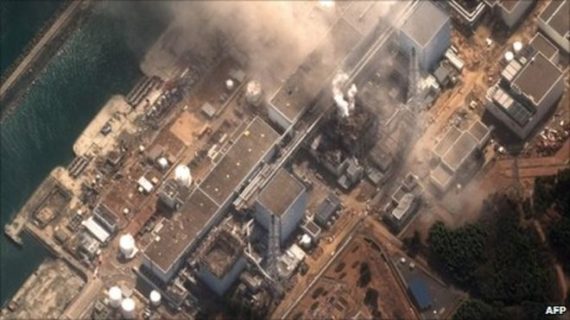






 nuclear-news