A fishing port in Tomioka in Japan’s Fukushima Prefecture is expected to reopen next month after being closed for more than eight years.
The massive earthquake and tsunami that hit eastern Japan in 2011 caused the severe Fukushima nuclear accident in Fukushima Prefecture.
Nine of the prefecture’s 10 fishing ports affected by the triple disaster have already reopened.
Tomioka Port is known as the main port for catching tasty flatfish and flounders.
Its wharves and breakwater were damaged by the quake and tsunami, and an evacuation order was issued for Tomioka and other fishing ports in Fukushima Prefecture.
That evacuation order was lifted in April 2017, and work has been underway to rebuild the port.
Fishing boats based at Tomioka Port were sent to other ports in the prefecture, such as Iwaki City and Namie Town. Officials say these boats are expected to return to Tomioka.
Tomioka Town and the local fisheries cooperative plan to hold a ceremony in July to celebrate the return of the fishing boats and fishers to the port.
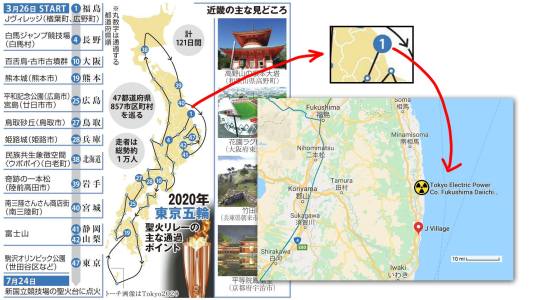
It’s official! The 2020 Tokyo Olympic torch relay starts at the J Village Sports Complex in Fukushima, which is just 10 miles from the crippled nuke plant.
Olympics: Tokyo 2020 torch relay route revealed, uniforms unveiled
June 1, 2019
TOKYO (Reuters) – Tokyo 2020 organisers on Saturday unveiled the uniforms to be worn by 10,000 volunteer runners during the torch relay and presented further details about the route the relay will take.
Organisers said the torch will travel through all 47 of Japan’s prefectures – from Hokkaido in the north to the southern island of Okinawa – and most of the country will have the chance to see the torch with 98% percent of the population residing within an hour’s distance from the route.
The 121-day relay will begin on March 16 at the J-Village in Fukushima, which is Japanese football’s national training centre and a symbol of resilience during the 2011 earthquake and tsunami that killed almost 16,000 people.
Games organisers have sought to stress the importance of Tokyo 2020 as the ‘reconstruction Olympics’ and it was evident in the choice of the route, which will pass through Okuma, where part of the Fukushima nuclear complex is located, and past Kumamoto Castle, which suffered heavy earthquake damage in 2016.
“It is not just about places where people can come or around landmarks, but the torch will also visit areas affected by the Great Japan Earthquake and Kumamoto Castle, recovering from the Kumamoto earthquake,” said Miho Takeda, a Tokyo 2020 committee member and five-time Olympic medallist in synchronized swimming.
“The relay will go through areas of Japan that are working hard to recover from natural disasters.”
The torch will also visit the Hiroshima Peace Memorial Park and pass Mount Fuji before arriving at the National Stadium in Tokyo on July 24 during the Olympics opening ceremony.
The runners’ uniform, designed by fashion designer Daisuke Obana, was unveiled by multiple Olympic gold medallist judoka Tadahiro Nomura.
The uniforms, which are produced in part from recycled plastic bottles, incorporate a diagonally-draped red sash similar to those used as batons in Ekiden, Japan’s famous long distance relay events.
“The torch bearer uniform is eco-friendly. Coca Cola collected plastic bottles in their company and recycled them to use them in the uniform material,” Nomura said.
Rice has been planted in a Japanese town which hosts Fukushima’s damaged nuclear power plant eight years after residents were first evacuated.
Officials and locals in Okuma town planted several crops, including sticky rice and premium quality rice, across more than 17,000 square feet of paddy fields.
The rice planting is the latest sign of life slowly starting to return to Okuma, one of a string of so-called “ghost towns” that were immediately evacuated due to soaring radiation levels after the 2011 earthquake, tsunami and nuclear crisis.
Evacuation orders for Okuma – which along with Futaba town, co-hosts nearby Fukushima Daiichi Nuclear Power Plant – were lifted last month, while its municipal government building also reopened earlier this week.
New public housing for former residents displaced by the disaster is also expected to open next month, while an agricultural manual is being prepared to encourage people to start growing crops again.
Government officials in Okuma have been monitoring radiation contamination in produce while conducting small-scale farming trials for several years, with test results reportedly showing levels below the national safety standards for food.
Fukushima was once famed for its high quality food produce, from peaches and grapes to rice and fish, with the region’s producers hit hard by the 2011 nuclear disaster.
Over the past eight years, the Japanese government has taken numerous steps to attempt to reassure the world that food from Fukushima is safe to eat following a regional clean-up, with rigorous radiation testing in place for all produce.
More than 50 countries introduced import restrictions in the immediate aftermath of the meltdown at the nuclear power plant, with 23 still keeping food limitations from Fukushima in place.
Last month, the Japanese government criticised a World Trade Organisation ruling that supported a continued South Korean ban on imports of a number of Japanese fishery products.
Meanwhile, locals who are slowly starting to return to the region as evacuation orders are lifted are apparently turning to increasingly inventive ways to rebuild local farming businesses.
One group of farmers in Hirata village, just under 28 miles from the Fukushima Daiichi plant, who were also hit hard by the disaster, have garnered widespread attention in Japan for their unusually-flavoured habanero soft ice cream, made from locally grown chilli peppers.
Government officials are also pinning hopes on the 2020 Olympics giving local revitalisation efforts a high-profile boost, with a number of baseball and soccer games scheduled to take place in the region.
“Sacred Cesium Ground and Isa’s Deluge: Two Novellas of Japan’s 3/11 Disaster,” by Yusuke Kimura, translated by Doug Slaymaker (Columbia University Press, 2019, 176 pages, $60 hardcover, $20 paperback)
May 2, 2019
TOKYO >> An anger directed toward Tokyo underlies Yusuke Kimura’s two novellas, “Sacred Cesium Ground” and “Isa’s Deluge.” Born from a keen sense of abandonment felt by the Tohoku region in the aftermath of the catastrophic earthquake and tsunami on March 11, 2011, and the subsequent nuclear accident at the Fukushima Daiichi Nuclear Power Plant, this anger plays out across stories exploring the post-disaster relationships between humans and animals.
The protagonist in “Sacred Cesium Ground” is a woman who travels to Fukushima Prefecture to volunteer at the Fortress of Hope, a farm where cattle irradiated by the Fukushima No. 1 power plant meltdown are tended to despite a government order to kill them.
Based on the story of a real post-Fukushima ranch, the novella carries with it a weight of research born from the author’s own volunteering, though it proves ultimately unsatisfying, never quite reaching the moment of reinvention that the lead character hints at throughout.
“Isa’s Deluge” is the more readable of the two, with a flow and pacing that draws in the reader. Shortlisted for the Mishima Yukio Prize after it was first published in 2012, it follows a family of fishermen who relate the story of their uncle Isa and his “deluge” of pain and depression, an allegory of the 3/11 tsunami.
Both novellas highlight peripheral voices in the post-3/11 period and ultimately return time and again to that tension between a “sacrificial” Tohoku and an all-powerful capital. These perspectives are those not frequently heard and challenge the widespread narrative of an ever-dominant Tokyo. https://www.staradvertiser.com/2019/05/02/news/novellas-express-anger-after-fukushima-disaster/?fbclid=IwAR362Oqn0duTDDCRh0Ta6AIklIq8ippMFC1PbBVUp2bN2v4NupNVg1YS_9I
The madmen’s denial continues, pretending that it is all clean and safe. Like if nothing ever happened. Children’s future sacrificed in the name of politicians’ holy economics.
Children exercise at the J-Village national soccer training center in the town of Naraha, Fukushima Prefecture, on Saturday after it resumed full operations.
April 20, 2019
FUKUSHIMA – The J-Village national soccer training center in Fukushima Prefecture resumed full operation Saturday, eight years after it was converted into an operational base to cope with the nuclear disaster that hit the prefecture in 2011.
The facility, established in 1997, has already been selected as the starting point for the Japan leg of the 2020 Tokyo Olympic torch relay, a move aimed at highlighting the country’s efforts to recover from the devastating earthquake and tsunami on March 11, 2011, that triggered the meltdown at the Fukushima No. 1 nuclear plant.
The torch relay will start at the facility in March 2020.
Until March 2017, the training center was used as a logistics hub and a lodging facility for workers involved in the cleanup and other disaster response operations at the crippled facility located some 20 kilometers to the north. The operational base function has been moved to the power plant.
The training complex has been renovated, and an indoor practice field and hotel with conference rooms have been added.
A large part of the complex had already resumed operations by July 2018, with the exception of two playing fields.
Also on Saturday, East Japan Railway Co. opened a new station near the J-Village.
“I hope (the full reopening) will contribute to Fukushima’s revival,” said a 42-year-old woman arriving at the station on Saturday morning.
The woman, who lives in the prefecture, was planning to visit the J-Village site.
Japanese seafood from Fukushima is banned in South Korea.
April 12, 2019
April 12 (UPI) — South Korea welcomed — while Japan condemned — a World Trade Organization decision to uphold a South Korea ban on Japanese seafood originating from the Fukushima nuclear disaster zone.
Japan is criticizing the decision despite evidence the product is not widely consumed or avoided entirely by Japanese consumers.
“Even though the ruling did not acknowledge that South Korea’s measures comply with the WTO rules, it is extremely regrettable that Japan’s argument was not approved,” Tokyo’s foreign ministry said Friday, after the WTO’s highest court overturned a judgment from 2018. The verdict is final, according to Kyodo and other Japanese news services.
In Seoul, the ruling Democratic Party welcomed the WTO decision. Party spokesman Lee Hae-sik said in statement the verdict reflects the current administration of South Korean President Moon Jae-in to “actively defend the nation’s health and food safety” and described the outcome as a “diplomatic victory,” South Korean news service News 1 reported Friday.
Lee also said the ban on imports of seafood originating from the eight prefectures of Japan’s Tohoku region, which are “at risk” due to the nuclear accidents at Fukushima plants, will be sustained.
Following the WTO verdict, Japan is turning its attention to the specialized United Nations agency.
Japanese Chief Cabinet Secretary Yoshihide Suga suggested Tokyo will “cooperate closely with the United States” on WTO reform in order to “maintain and strengthen the multilateral trading system.”
But the United States also has partial bans in place against Fukushima products. The U.S. Food and Drug Administration continues to monitor the public health risks due to radionuclide contamination and has placed an “import alert” on select Japanese products.
In Japanese fish markets in Tokyo, products labeled “Fukushima region” do not sell well and frequently at below market prices, South Korea television network MBC reported from Japan.
The seafood is not in demand despite safety screenings, according to the report.
Japan will seek to reassure other countries about the safety of food produced in areas affected by the 2011 Fukushima nuclear crisis, officials said Friday, after the World Trade Organization supported South Korea’s import ban on some Japanese seafood.
Fishermen in Tohoku, the region hit hardest by the devastating earthquake and subsequent tsunami that triggered the triple core meltdown at the Fukushima No. 1 nuclear power plant, expressed disappointment with the WTO’s decision, saying their catches clear strict safety checks before shipment.
The WTO “maintained factual findings that Japanese food products are scientifically safe and satisfy safety standards in South Korea,” Chief Cabinet Secretary Yoshihide Suga said at a press briefing.
“We will continue to ask South Korea and other countries to lift or ease import restrictions based on scientific evidence,” the top government spokesman said.
Japan has taken a series of steps over the years, such as screening food products for radioactive substances before shipment, to alleviate safety concerns.
“It’s been eight years since the nuclear accident. Does it mean that it’s still early (for the ban to be lifted) by global standards?” asked a frustrated Norio Takahashi, a 59-year-old fisherman from Fukushima.
In Iwate Prefecture, Mikio Morishita, 69, who runs a fish processing company, pointed to the difficulty of regaining consumer trust.
“Although food products (from the disaster-hit areas) are safe, we have yet to dispel bad perceptions (among consumers). The ruling is unfortunate because it suggests the world does not have a positive image” of items from Fukushima and its vicinity, Morishita said.
Japan has been promoting its agricultural and seafood exports, which have been growing in recent years and reached ¥906.8 billion ($8.1 billion) in 2018, putting the government’s target of ¥1 trillion for this year in sight.
By holding baseball and soccer games in the disaster-hit region, Japan hopes to present the Tokyo Olympics and Paralympics in 2020 as a symbol of reconstruction.
“I will promote the high quality of food products (in the disaster-hit areas),” Olympics minister Shunichi Suzuki said at a news conference held just a day after he was reappointed to his role.
The WTO’s appellate body for dispute settlement on Thursday ruled in favor of South Korea’s import ban on fishery products from Fukushima and seven other prefectures, reversing an earlier decision.
Thursday’s ruling is final as the appellate body is the highest authority in the WTO’s dispute settlement mechanism.
Due to fears of radioactive contamination, South Korea expanded its initial ban to include all fishery products from Fukushima and the seven other prefectures in 2013.
A total of 54 countries and regions introduced import restrictions following the meltdowns. The number has since declined, but South Korea is among 23 that are keeping the restrictions in place, according to the Japanese government.
Japanese newspapers report about the World Trade Organization’s decision in favor of Korea’s import restrictions on Japanese seafood. Yonhap
April 12, 2019
South Korea on Friday welcomed the World Trade Organization’s decision to rule in favor of Seoul’s import restrictions on Japanese seafood in the wake of the 2011 Fukushima nuclear disaster and said it would keep the ban in place going forward.
The WTO appellate body overturned several points of the 2018 verdict earlier in the day, saying the Seoul government’s measures are not unfair trade restrictions and do not fall into the category of arbitrary discrimination.
The appellate body, however, sided with Japan on one point, saying that Seoul has not provided enough information to Tokyo in terms of the import ban measures.
“The government has been making all-out efforts to follow the principle of making the health and safety of the people a priority, and the government highly appraises the WTO’s decision,” the Ministry of Trade, Investment and Energy said in a statement.
The South Korean government said it hopes that there would be no further trade dispute with Japan.
In 2015, Japan officially lodged a complaint at the WTO to challenge South Korea’s import bans and additional testing requirements on fish caught after 2013. Tokyo argued that radioactive levels of its fishery product were lower than those from a number of other nations.
The WTO’s dispute settlement body ruled in favor of Japan in February 2018.
South Korea has been placing import restrictions on 28 kinds of fish caught from eight prefectures near Fukushima since the nuclear power plant accident.
The South Korean government said it will keep the existing import ban on all seafood from the eight prefectures. All Japanese seafood companies will be required to hand in safety certificates when any traces of radiation are found, it added.
About 50 countries have maintained bans on imports since the nuclear disaster, but Japan has complained to the WTO about only one country — South Korea.
“Currently, 19 more countries have implemented an import ban (on Japanese seafood) at different levels,” said Yoon Chang-yul, the head of the social policy coordination office under the Office for Government Policy Coordination.
South Korea, meanwhile, has been replacing its imports of Japanese pollack and mackerel with supplies from Russia and Norway respectively, the Ministry of Oceans and Fisheries said.
“In the past, (South Korea) imported around 20,000 to 40,000 tons of pollack and mackerel from Japan. Now the volume is below 3,000 tons,” an official from the ocean ministry said.
“It is a sovereign country’s right to implement an appropriate level of protection,” an official from the ministry said. “All countries have different standards, and they cannot be judged under the same standard. The Fukushima crisis broke out in a neighboring country, and we needed to review our protection level in a more strict and thorough manner.” (Yonhap)
I remember in 2011 or 2012, a deal between a US company and the Japanese government, buying geiger counters, which failed because the Japanese government wanted that US company to under-calibrate its Geiger-counters, which the US company refused to do. So it is quite possible that all those public monitors have been under-calibrated….
Four elementary schools in Fukushima Prefecture link up via a teleconference system in February and conduct a joint class on ethics.
March 19, 2019
FUKUSHIMA – Eight years after the March 2011 disasters, elementary and junior high schools have reopened in 10 Fukushima Prefecture municipalities after the lifting of nuclear evacuation advisories. Student numbers have not rebounded.
According to statistics released last May, the number of students stood at only about 10 percent of the level before 3/11.
During the protracted evacuations, many families rebuilt their lives in new locations, leading to the sharp fall in students in Fukushima. As a result, local governments are facing difficulties keeping schools operating.
… A man in his 60s who is a member of a neighborhood community association in the Yamakiya district in the town of Kawamata is disappointed by the steep decrease in the number of children.
“The disappearance of children’s voices is like the lights going out,” the man, who did not want his name published, said….
… The central government is working to improve small-class education in depopulated areas through the use of information and communications technology.
8 Years On: Number of Kids Dives in Disaster-Hit Fukushima Municipalities
Fukushima, March 15 (Jiji Press)–In 10 Fukushima Prefecture municipalities where elementary and junior high school have reopened after the lifting of nuclear evacuation advisories, the number of students stood at 758 as of May 1, 2018, about 10 pct of the level before the March 2011 disasters.
During protracted evacuations, many child-rearing families rebuilt their lives in new locations, leading to the sharp fall in the number of students in Fukushima.
As population declines, Fukushima Prefecture to lose 15 of its 96 high schools
The Fukushima Prefectural Board of Education will reduce its number of prefecture-run high schools by 15 by the end of fiscal 2023 as the region continues to struggle with a dwindling number of students due to a declining birthrate.
The mergers will be implemented over the span of three years from fiscal 2021 and will reduce the number of high schools in the prefecture from 96 to 81.
Twenty-five schools will be merged and reorganized into 13 under the plan, which will integrate schools located in close proximity of one another. Each school will retain four to six classes per grade.
Despite government claims, radiation from the 2011 nuclear disaster is not gone.
Fukushima, on the other hand, is dealing with the release of radionuclides, which are fission products from nuclear power plants. These radionuclides are not rays, but dust-like particles that can stick to the body and be inhaled or ingested. Weather factors like wind and rain have displaced many radionuclides like cesium-137, which accumulate in patchy locations, such as ditches, drainage areas, or playgrounds. Because of this uneven dispersion, monitoring posts often overlook the presence of hot spots, places where the level of radiation is significantly greater. Dissatisfied by state-sponsored monitoring, many citizen scientists have collectively tracked and monitored residual radioactivity in Japan, legitimizing the presence of hot spots.
To measure radiation levels in Fukushima, the Japanese government has installed monitoring posts that display the current atmospheric level of radiation on an electronic board. Measurements of radiation levels in the air are taken at different locations and compiled to create an average level of radiation for the cities of Fukushima.
Monitoring posts are also strategically placed and their surrounding areas cleaned so that the levels of radiation remain lower. No monitoring posts are present in forests and mountains, which represent more than 70 percent of the area of Fukushima prefecture.
On top of such problems, radiation posts only measure radiation in the form of gamma rays. Yet the disaster has also released radionuclides that emit ionized particles, that is, alpha and beta particles. These ionized particles are not taken into account by state monitoring posts, even though they are dangerous if inhaled or ingested. Consequently, the data accumulated by monitoring posts is partial and unrepresentative of the extent of radioactive contamination.
Levels of radiation have also decreased due to a massive state-sponsored program of radioactive decontamination in the urban and rural areas of Fukushima. The process of decontamination consists of collecting and removing radioactive pollutants. Radionuclides are then contained in vinyl bags, so as to impede the risk of rescattering residual radioactivity. As a testament of the government-led decontamination, mountains of black plastic bags, filled with contaminated soil or debris, can be seen in many parts of Fukushima, forming a stark contrast against the emerald-green mountains of the region.
As such, decontamination does not imply that radiation has vanished; it has simply been moved elsewhere. Yet in rural regions, where many of the bags are currently being disposed, far away from the eyes of urban dwellers, residents are still forced to live near the storage sites. Many rural residents have criticized the actual efficacy of the decontamination projects. For instance, vinyl bags are now starting to break down due to the build-up of gas released by rotten soil. Plants and flowers have also started to grow inside the bags, in the process tearing them apart. With weather factors, residual radioactivity inside the bags will eventually be scattered back into the environment.
In the end, state-sponsored monitoring and decontamination are remedial measures that manage the perception of radiation in the environment. However, this does not imply that radioactive contamination is gone – not at all. When we look at the official maps of radiation of northeastern Japan, levels are low, but there are many ways to make them appear low. With overall lifespan that exceeds hundreds of years, radionuclides like cesium-137 or strontium-90 will continue to pose a problem for decades to come. However, with the upcoming 2020 Tokyo Olympics, it is doubtful that the Japanese state will ever acknowledge this reality.
Fukushima, after eight years: Of the 19 to 25 million tons of contaminated topsoil bagged up across the country, the government has suggested incinerating 11 million tons..
A cauldron used in the 1964 Tokyo Olympics is displayed in tsunami-hit Ishinomaki, Miyagi Prefecture, on Feb. 19 as a symbol of what the government is dubbing the “Recovery Olympics.”
March 10, 2019
The central government hopes the quadrennial sports event will serve as a platform to show that the nation has recovered from the disasters.
But recovery wasn’t one of the original themes for the Tokyo Games. The concept was added when it became apparent Tokyo wouldn’t be able to secure all the venues needed in the capital or its vicinity. When organizers thus turned to the disaster-hit prefectures of Miyagi and Fukushima, which will host the softball and baseball games, the recovery spin was born, with officials saying the event would contribute to reconstruction.
Moreover, the reconstruction plan for the Tohoku region is expected to end when fiscal 2020 closes in March 2021, putting an end to various central government subsidies that helped both victims and municipalities.
… “The Tokyo 2020 Games have become a goal for us to show the region has recovered,” said Yasuki Sato, a Miyagi Prefecture official tasked with coordinating the preparations.
But residents in the area view the preparations as something happening in the background. In fact, some believe they are actually hindering the region’s recovery….
Representatives from East Japan Railway Co. give an update on the recovery of the Joban Line in the town of Futaba, Fukushima Prefecture, on Thursday.
Mar 9, 2019
FUKUSHIMA – A majority of people under age 50 who had lived in three towns close to the site of the 2011 Fukushima No. 1 nuclear disaster have no plans to return, an official survey showed Saturday.
Many former residents of Futaba, Namie and Tomioka say they have established new lives elsewhere and that their adopted hometowns are more convenient.
The three towns were subject to government evacuation orders in the wake of the crisis at the plant, which was triggered by a magnitude 9.0 earthquake and ensuing tsunami.
The orders for Namie and Tomioka were partially lifted in 2017. But more than 60 percent of evacuees from the two towns in their 20s and 30s and more than 50 percent in their 40s said they would not return, with other major reasons cited including concerns over the lack of medical and commercial facilities.
Regardless of age group, 49.9 percent of former Namie residents and 48.1 percent of former Tomioka residents said they would not return.
As for Futaba, which hosts part of the crippled nuclear plant and remains off limits for residents, similar proportions of those in the 20s, 30s and 40s said they would not return, and the overall figure, regardless of age group, stood at 61.5 percent.



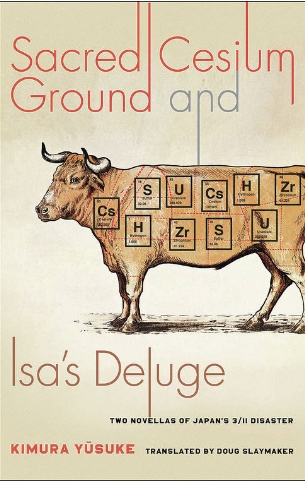 “Sacred Cesium Ground and Isa’s Deluge: Two Novellas of Japan’s 3/11 Disaster,” by Yusuke Kimura, translated by Doug Slaymaker (Columbia University Press, 2019, 176 pages, $60 hardcover, $20 paperback)


 A radiation monitoring post in Fukushima city.


 A cauldron used in the 1964 Tokyo Olympics is displayed in tsunami-hit Ishinomaki, Miyagi Prefecture, on Feb. 19 as a symbol of what the government is dubbing the “Recovery Olympics.”
 Representatives from East Japan Railway Co. give an update on the recovery of the Joban Line in the town of Futaba, Fukushima Prefecture, on Thursday.



 nuclear-news