The island of the post-Fukushima children
Translated by Hervé Courtois

In Kumejima, Mayumi and her two children are recovering their health away from the radioactivity of Fukushima.
Six years ago, Japan experienced the worst nuclear disaster in its history. Since then, the young inhabitants of the contaminated areas are welcomed on a preserved archipelago where they can recover their health.
Green shorts and long-sleeved T-shirt, Tatsuyoshi, 4, runs to the sea, stops halfway. For fear of the sand, he refused to bathe barefoot. “It’s like that, the first few days. Then he gets used to it, “says his mother, Mayumi Moriai, handing him his sandals. The young woman has already come three times to the small Japanese island of Kumejima, located 2200 kilometers south of Tokyo, in the Okinawa archipelago, to allow her two children to reconnect with nature. “We live in Koriyama, in Fukushima Prefecture, 70 kilometers from the nuclear power plant ravaged by the March 2011 tsunami. There the beach runs alongside the forbidden zone,” she said, clasping Masaki, her 10-month-old baby . Koriyama, a city of more than 300,000 inhabitants, recorded very high levels of radioactivity in 2011: more than 8 microsieverts (the unit measuring the effects of radiation on humans) per hour, 13 times more than in areas evacuated after the 1986 explosion of the Chernobyl power plant. However, its inhabitants have not been evacuated.
Strengthening children’s immunity
Beside Mayumi, other mothers accompany their toddlers to swim in the Pacific Ocean. All are hosted in the Kuminosato center, created in 2012 by Ryuichi Hirokawa, editor of the Days Japan magazine. Its purpose: to house, every month, about thirty children living year-round in the contaminated areas of Fukushima. A free detox treatment funded through donations from around the world. The idea of creating a refuge as far away as possible from the disaster area is based on the example of sanatoriums built in Belarus after the Chernobyl disaster. At that time, specialists had proved that a temporary stay outside contaminated areas could lower radioactive particles accumulated in children’s bodies and enhance the immunity of particularly vulnerable young organisms.
“The accident at the nuclear power plant has increased the risk of thyroid cancer, especially in children,” says Ryuichi Hirokawa. As of June 30, 2016, according to the medical university of Fukushima, 174 cases of thyroid cancer were suspected among young people of the region, of which 135 were confirmed after surgery. A survey conducted by the Fukushima Prefecture in September 2016 revealed that 79.5% of mothers fear for the health of their sons and daughters.
“We have been able to accommodate 2,200 children and 550 adults since 2012, but this is not enough,” Ryuichi Hirokawa said. He plans to open another center in Hokkaido, in the far north of Japan, while the government has begun recalling residents in villages initially classified as a forbidden zone (a 30-kilometer perimeter around the plant).

The independent laboratory Tarachine monitors the health of children in Fukushima.
An independent control center
In the center’s large dining room, Mayumi Moriai and her children have their breakfast. Here, no need to worry about food: rice, fish, seaweed, vegetables come from southern Japan. “In Koriyama, at home, I avoid buying tubers and mushrooms. But it is impossible to limit oneself all the time. Here, all products that are eaten are controlled and guaranteed without radioactive cesium, “says Mayumi. “Analyzes of fungi brought by farmers in Fukushima reveal levels of radioactivity about 20,000 times higher than normal. Unfortunately, Japanese people love mushrooms, “says Kaori Suzuki, director of Tarachine, an independent radioactivity measurement center where Kuminosato can offer its residents free thyroid exams.
“We have no other place to go”
At the same table as the Moriai, Naoko Shimoyamada. She also lived in the Fukushima region, before moving to Yamagata, the neighboring prefecture, with her three daughters. Like many mothers, she had to fight with her entourage, and even with her husband, to be able to come to the Kuminosato center. In Japan, talking about radioactivity is taboo. “My friends think this is a brainwashing center!” Mayumi regrets. Unlike many of her fellow citizens, the young mother dares to evoke her anguish when she thinks about the accident. “I was cycling in the rain while the reactors were exploding. We had no information for weeks. “
If Mayumi fears for the health of her children, she does not plan to leave her city. “That’s where we were born, and we have no other place to go,” says her husband Ryuichi, who stayed at the family home. The return to normal praised by the authorities pushed the majority of families to stay. Even if the Geiger counter planted between the swing and the sandbox of the kindergarten in front of the Moriai’s house expresses everything except the normality. The father of the family pointed to a square of earth turned over. “Workers dug a pit in every kindergarten in the city. Then they were seen burying in large black bags. Everyone knows that it is contaminated land, “says Ryuichi.
Back to Kuminosato. On the beach, little Tatsuyoshi runs in the waves. After three days, he forgot his fears. “All I want is for him to grow up healthy,” his mother hopes.

Gardening workshop in the Kuminosato center: the residents reconnect with a protected nature.
A region still affected
Six years after the earthquake and tsunami of 11 March 2011, which caused the worst nuclear accident of the 21st century, 10,000 workers are still mobilized to decommission the Fukushima Daiichi plant since the disaster. The year 2017 will also be marked by the end of the allowances granted by the government for aid to voluntary evacuees, which opponents equate to a forced return for the 26,000 people who evacuated “on their own initiative”, according to the vocabulary official. Japan, which was 30% dependent on nuclear power before the accident, built 54 reactors at the seaside, and only two of them were restarted since the accident. According to a report published last year by two associations of American doctors, the Fukushima accident could cause 10,000 more cancers among the Japanese population due to radiation.
To return ‘home’ or not is a tough call for evacuees from Fukushima

A large portion of Naraha town in Fukushima Prefecture lies within 20 kilometers of the crippled Fukushima No. 1 nuclear power plant.
When I visited recently, I saw mounds of black bags, presumably filled with contaminated soil. Large trucks rumbled on in endless streams. The town’s convenience stores seemed to be flourishing, thanks to an influx of reactor-dismantling crews and reconstruction workers.
After an evacuation order was issued in the immediate aftermath of the March 2011 nuclear disaster, Naraha remained uninhabitable for a long time. It was only 18 months ago that the evacuation order was finally lifted.
“We are merely at the starting line now,” said the mayor at the time.
And true to his observation, the town still faces a long, arduous road ahead. So far, only about 10 percent of Naraha’s 7,000-plus residents have returned.
I met Takayuki Furuichi, 40, who was among the first to return home. Before the disaster, Furuichi worked at a facility for the disabled in Naraha. After his return, he established an NPO for home-visit nursing care. In addition to visiting the disabled and the elderly, his NPO staffers also provide day-care services for disabled children.
Furuichi said it was his “iji,” or stubborn pride, that brought him back to Naraha.
“It’s too vexing to just let my hometown remain in this sorry state. I want to provide support for fellow returnees,” he said.
But he also feels conflicted. Now overrun with large service vehicles, the town looks completely different from before. And worries about radiation have not gone away.
“I cannot really urge anyone to come home,” he lamented.
The lifting of the evacuation order was a step forward. But this also presented a new dilemma to people who had become accustomed to their lives as evacuees. They are still grappling with the tough decision of whether to return home or stay put, or simply hold off any decision for now.
“To use a marathon analogy, Fukushima’s reconstruction is at the 30-km point,” Reconstruction Minister Masahiro Imamura noted recently. But for people who were forced to leave their homes in 2011, the race has only just begun and is in a fog.
This spring, evacuation orders will be lifted in four municipalities, including the town of Namie. This brings to the townspeople not only a sense of relief, but anxiety and vacillation as well.
http://www.asahi.com/ajw/articles/AJ201703020029.html
SIX YEARS AFTER: Poll: At least 20 years to regain lifestyle, half of Fukushima says

Decontamination work is conducted on March 2 in Namie, Fukushima Prefecture, which will no longer be designated an evacuation zone on March 31.
Half of Fukushima Prefecture residents believe it will take at least another 20 years for them to return to the lives they enjoyed before the 3/11 disaster, according to a new poll.
The Asahi Shimbun and Fukushima Broadcasting Co. contacted prefectural residents on Feb. 25-26 to ask about life after the triple nuclear meltdown crisis following the 2011 Great East Japan Earthquake and tsunami. It was the seventh in the annual series of polls on the issue.
In the survey, 50 percent of respondents said “more than 20 years” when asked their outlook on the timescale to restore their previous lifestyle. Twenty-one percent said “about 20 years,” followed by 16 percent who thought “about 10 years,” and 7 percent who responded “about five years.”
In the 2013 poll, those who thought it would take more than two decades for them to regain their pre-disaster life totaled 60 percent. The numbers cannot simply be cross-referenced since 18 and 19 years olds have been included in the latest survey for the first time, but while the results suggest some improvement, they also paint a picture of many residents of the prefecture still unable to have an optimistic outlook on their future.
Thirty percent of respondents of the latest survey said there are times they feel discriminated against for being Fukushima Prefecture residents.
The central government plans to cover part of the costs on the Fukushima nuclear crisis that is estimated to rise to 21.5 trillion yen ($188 billion) by including the expenses in electricity rates on regular households.
It is a plan that has been criticized to be nothing more than a scheme to bail out Tokyo Electric Power Co., operator of the Fukushima No. 1 nuclear power plant, and 76 percent of respondents said they could not accept such a measure.
With the evacuation order for the town of Tomioka scheduled to be lifted on April 1, most residents of the prefecture who were displaced from their homes due to the nuclear disaster will be able to go back, excluding those who lived in areas still designated as “difficult-to-return zones.”
But opinions over the issue varied among respondents, suggesting skepticism over decontamination work and concerns over radiation still linger among many residents.
When asked about the timing of lifting the evacuation order, the most popular answer, from 40 percent, was that it was an appropriate decision. However, 19 percent said it was “too soon,” while 22 percent said the order “should not be lifted in the first place.” Nine percent said it was “too late.”
Respondents were also divided over their evaluation of decontamination work in the prefecture conducted by the central and local governments.
Those who applauded the effort, which comprised the 3 percent who “highly” praised it and the 48 percent who “somewhat” did, was at just over half. But an almost equal amount of respondents, 46 percent, expressed criticism, with 39 percent saying they “did not really” think enough was being done and 7 percent saying they were not at all satisfied.
When asked whether they had any concerns of the effects of radiation on themselves or their family, most residents, at 63 percent, said yes. This comprised the 19 percent who said they were very concerned and the 44 percent who responded they were worried to some extent.
Those who were more critical of the decontamination efforts, as well as respondents who expressed concern over the effects of radiation, tended to reply that the evacuation order “should not be lifted in the first place.”
Regarding “difficult-to-return zones,” the central government plans to concentrate their decontamination work on specific areas to allow residents to live there.
Respondents were divided over this decision as well, with 43 percent for and 42 percent against.
However, when asked about how the central government and TEPCO were handling the buildup of contaminated groundwater at the crippled nuclear plant, the majority of respondents expressed criticism. A total of 71 percent said they were dissatisfied, compared with the 14 percent who thought enough was being done.
The poll targeted eligible voters aged 18 or older living in the prefecture. Valid responses were received from 934 individuals out of the 1,739 randomly generated landline numbers contacted, or 54 percent.
Key Figures for the Fukushima 6th Anniversary
6 years later, the catastrophe at Fukushima is still far from being resolved, still ongoing. 3 reactor core meltdowns still releasing radioactive nanoparticles into the open skies, contaminated water still leaking continuously into the Pacific ocean, plus partially decontaminated water also been dumped into the ocean.
All available information and figures controlled by Tepco and the Japanese government, with no independent party allowed to verify the veracity of the given information. A massive permanent public relations campaign of disinformation and denial, to brainwash the Japanese population and the whole world that everything is now under control and ok, denial of the radiation risks for the people health, economics being the Japanese government priority, not the population health protection. Evacuated persons coerced to return to live with high radiation in their previously evacuated townships. So that Japan would seem safe, clean and beautiful to welcome the Tokyo 2020 Olympics.
If Fukushima taught us one thing it is that people should not expect the government to protect them nor corporations to be held responsible in time of nuclear disaster.
This written article is based on officially released data by Tepco and the Japanese government, therefore all the figures and claims should be therefore taken with a pinch of salt. Always keep in mind that the officially released information does not really teach us the essential about the still ongoing catastrophe and about its victims getting more abandoned than ever.
Key figures for the sixth anniversary
As we approach the sixth anniversary of the disaster, here are some key figures as they appear in the media and official sites.
The main aim of the work is to secure the damaged reactors which are still threatening. In the vicinity, the dose rates are such that the attendance time must be very limited, which complicates the work. See the latest official Tepco document with dose rates. http://www.tepco.co.jp/en/nu/fukushima-np/f1/surveymap/images/f1-sv2-20170224-e.pdf
The reactor vessel was empty on March 11, 2011, and there was no melting of the core, but a hydrogen explosion destroyed the reactor building. Since December 2014, the reactor fuel pool has been emptied and the work is stopped.
There was a core meltdown and a hydrogen explosion destroyed the reactor building. All debris from the upper part were removed using remotely operated gear. A new building that will cover the whole and allow to empty the fuel pool is being assembled. The dose rate is so high that the work is more complex than expected and the site has fallen behind.
There was a core meltdown, but the reactor building is whole. Tepco did not begin to remove the spent fuel from the pool, but attempted to locate the corium, this mixture of molten fuel and debris, by various means. The dose rates inside the building are such that it is impossible to work on it. In the containment, record levels were observed. Even the robots that were sent there did not resist long.
There was a core meltdown and a hydrogen explosion destroyed the reactor building. This building was covered with a new structure in 2011, which was completely dismantled in November 2016. Tepco will begin to remove the debris from the upper part of the reactor and then rebuild a new structure to empty the fuel pool.
Tepco injects 72, 108 and 72 m3 of water per day into reactors 1, 2 and 3 to cool the corium.http://www.tepco.co.jp/en/press/corp-com/release/betu17_e/images/170217e0101.pdf.
This makes a total of 252 m3 / d. This water is strongly contaminated and infiltrates into the basements of the reactor and turbine buildings where it mixes with the ground water that floods these basements.
To reduce radioactive groundwater leakage into the sea, Tepco pump water upstream before that water is contaminated by the reactors and then rejects it directly into the ocean. It has also built a barrier along the shoreline and pumped groundwater at the foot of the reactors. Part of this water is partially decontaminated and dumped into the ocean. Another part, too contaminated, is mixed with the water pumped in the basements of the reactors to be put in tanks after treatment, waiting for a better solution.
As a result, Tepco is pumping 135 m3 of contaminated water into the basements of the reactors and turbine buildings daily, in addition to the one it injects for cooling and 62 m3 of groundwater. A total of 197 m3 is accumulated daily in tanks after treatment. It is more when it is raining, or even more during the typhoons. http://www.tepco.co.jp/en/nu/fukushima-np/handouts/2017/images/handouts_170213_01-e.pdfTepco
Tepco announced that it had already processed 1,730,390 m3 of contaminated water, which generated 597 m3 of radioactive sludge. Part of this is used for cooling and the rest is stored in tanks. According to the company, the stock of treated or partially treated water amounts to 937,375 cubic meters, to which must be added the 52,200 cubic meters of water in the basements of the reactor and turbine buildings. There are nearly a thousand tanks to keep this water that occupy almost the entire plant site. http://www.tepco.co.jp/en/press/corp-com/release/betu17_e/images/170217e0101.pdf
Since March 2016, Tepco has been trying to freeze the ground around the damaged reactors to reduce infiltration and dispersal of polluted water, but this is not as effective as expected. The Nuclear Regulatory Authority, the NRA, seriously doubts the effectiveness of this technique, which it now considers as secondary. It can be seen on this graph, where the drop in the volumes of water to be stored each day is not very high. The ice does not take place, where the underground currents are strongest. Official data on freezing of the ground. About half of the workers on the site are there because of the contaminated water. http://www.tepco.co.jp/en/nu/fukushima-np/handouts/2017/images/handouts_170209_02-e.pdf
Workers
At the Fukushima Daiichi nuclear power plant
From March 11, 2011, to March 31, 2016, 46,956 workers were exposed to ionizing radiation at the site of Fukushima Daiichi, including 42,244 subcontracted workers. It is the subcontracted workers who take the highest doses, with an average of between 0.51 and 0.56 mSv per month between January and February 2016. It is between 0.18 and 0.22 for employees of Tepco.
There are also 1,203 people who have a higher limit to continue entering the site. Their average cumulative dose since the beginning of the accident is 36.49 mSv and the maximum value of 102.69 mSv.
On April 1, 2016, all measures were reset. Thus, 174 workers who have exceeded the dose limit will be able to return. Since that date, up to 31 December 2016, 14,643 workers have been exposed to ionizing radiation at the site of Fukushima Daiichi, of which 13,027 are subcontracted workers (89%). Subcontracted workers take the highest doses. Among them, it is not known how many were already exposed to radiation before April 1, 2016.
• There were workers of Brazilian origin who did not speak good Japanese and did not always understand the instructions of radiation protection. The Embassy of Brazil reacted and protested.
• While progress has been made in working conditions on the site, with the construction of a building dedicated to reception and rest, equipped with a canteen and a mini market, there are still problems thanks to cascade subcontracting.
• 3 workers had their cancer recognized as occupational disease: two leukemias and one thyroid cancer. One filed a complaint against Tepco and Kyûshû Electric. There are 15 cancers in all of these workers, including 8 cases of leukemia.
• The latest aerial mapping of radioactive pollution around the Fukushima Daiichi plant dates from 2015 and is available online on the dedicated site: http://ramap.jmc.or.jp/map/eng/

This new map shows the areas still evacuated and an average decrease of 65% of the ambient dose rate compared to what was measured in autumn 2011. The radioactive decay is responsible for a drop of 53%. The remainder is due to the leaching of soils and, in some places, to decontamination work.
The decontamination of evacuated areas is the responsibility of the government. Elsewhere, where the external exposure could exceed 1 mSv / year, it is the municipalities that have to deal with it.
• In the evacuated areas, decontamination work is officially completed, except for so-called difficult return zones. This means that decontamination has been carried out in homes and their gardens, along roads, on agricultural land and over 20 m in the forest bordering these areas. http://josen.env.go.jp/en/pdf/progressseet_progress_on_cleanup_efforts.pdf.
• In non-evacuated areas, 104 townships were affected, but with the natural decline in radioactivity, the number became now 94. A map is given on page 14 of this document. In Fukushima, 15 out of 36 municipalities have been completed.
The other prefectures concerned are Iwaté, Miyagi, Ibaraki, Tochigi, Gunma, Saïtama and Chiba. The number of townships where work was completed is on page 15 of the same document. It should be noted that a township in Tochigi prefecture has still not established a decontamination program. http://josen.env.go.jp/en/pdf/progressseet_progress_on_cleanup_efforts.pdf
• According to official data, there are 7,467,880 bags of contaminated soil from decontamination work in evacuated areas (one bag is approximately 1 m3), and in non-evacuated areas, 5,740,858 m³ of contaminated soil spread over 146,489 sites. http://josen.env.go.jp/en/pdf/progressseet_progress_on_cleanup_efforts.pdf
• For the interim storage facility, which is expected to contain approximately 22 million cubic meters of waste over 1,600 ha or 16 km2 around the Fukushima Daiichi plant for a maximum of 30 years, the government signed a contract with only 633 landowners (26.8%), for a total area of 287 ha (or 2.87 km2), or just 17.9% of the total area. The authorities want to reuse these soils when they have fallen below the limit of 8 000 Bq / kg for cesium. http://josen.env.go.jp/en/pdf/progressseet_progress_on_cleanup_efforts.pdf
• Japan conducts a census of its population every 5 years. The last two took place in 2010, just before the disaster and in 2015. As of October 1, 2015, the population of Fukushima province decreased by 5.7% compared to 2010 (115,000 fewer people) Miyagi of 0.6% and that of Iwate of 3.8%.
This census is based on the persons actually present and not on the registered persons. Thus, in the townships of Namie, Futaba, Okuma and Tomioka there is zero inhabitant.
The population of Kawauchi, where the evacuation order was partially lifted in 2014, the population decreased by 28.3%. In Naraha, where the evacuation order was fully lifted in September 2015, the population decreased by 87.3%.
Some townships hosting displaced persons have seen their population increase.
In all of Japan, the number of inhabitants decreased by 0.7% (- 947,000) in five years and was 127.11 million by 1 October 2015. The number of inhabitants increased in Tokyo (+2, 7%), Saïtama and Aïchi prefectures. The biggest decline was in Akita prefecture (-5.8%), which was not affected by the triple disaster. Fukushima prefecture has the second biggest drop, with -5.7%.
• In Fukushima, there are still officially 84,289 displaced persons, 40,405 of them residing outside the prefecture. http://www.pref.fukushima.lg.jp/uploaded/attachment/195697.pdf
• The evacuation order was lifted in 5 townships, but only 13% of the persons concerned have returned. It should also be lifted at the end of March 2017 in a part of Iitate and Kawamata.

• With regard to thyroid cancers: the total is 184 potential cases of which 145 are confirmed after surgery. http://fmu-global.jp/survey/the-26th-prefectural-oversight-committee-meeting-for-fukushima-health-management-survey-2/
• The number of disaster-related deaths due to worsening living conditions (worsening of the disease, suicides …) is 2,099 at Fukushima, as of 28 November 2016. http://www.pref.fukushima.lg.jp/uploaded/attachment/195697.pdf
• Of the 54 nuclear reactors operating before the nuclear disaster, 6 were partially or completely destroyed at the Fukushima Daiichi plant. 6 others, too old, were stopped definitively. So there are only 42 nuclear reactors left in Japan.
Only 26 of them have applied for restart authorization and only 12 reactors have been granted a restart authorization. Two reactors at the Sendai power station in Kagoshima prefecture generate electricity to power the grid. A third is in operation at the Ikata power station in Ehime prefecture, both in southern Japan..
Reports on the occasion of the sixth anniversary
• Greenpeace : No Return to Normal
http://www.greenpeace.org/japan/Global/japan/pdf/NRN_FINweb4.pdf
Source: L’ACROnique de Fukushima
http://fukushima.eu.org/chiffres-cles-pour-le-sixieme-anniversaire/
Translated by Hervé Courtois (D’un Renard)
Bribery scandal over Fukushima decontamination

Bribery scandal over Fukushima decontamination
Police in Japan have arrested an environment ministry official for alleged bribery over decontamination work following the Fukushima Daiichi nuclear disaster.
Fifty-six-year-old Yuji Suzuki, who works at a ministry sub-branch in the prefecture, is suspected of helping a construction company land such work in exchange for wining and dining.
The work is aimed at removing radioactive material from houses, soil and woods near the crippled plant.
Fukushima and Tokyo police found that Suzuki was provided entertainment at hostess bars and a free trip worth about 1,750 US dollars from the construction firm in Toyama Prefecture.
Police also arrested a former president of the firm, Mikio Kosugi over the suspected bribery. The 2 have reportedly admitted to the allegations.
Suzuki is among experts hired on a temporary basis by the ministry to deal with reconstruction work including cleaning up widespread fallout from the accident. Police say he was in charge of overseeing decontamination.
Environment Minister Koichi Yamamoto on Thursday expressed regret, saying the scandal could undermine Fukushima people’s trust in the cleanup effort.
He said his ministry will try to win back public trust by tightening discipline and carrying out work properly.
https://www3.nhk.or.jp/nhkworld/en/news/20170302_30/
Bureaucrat held for allegedly taking bribe for Fukushima cleanup work
TOKYO (Kyodo) — Police arrested an Environment Ministry employee Thursday on suspicion of receiving a bribe in exchange for favorable treatment in the allocation of cleanup work in Fukushima Prefecture following the 2011 nuclear disaster.
The police alleged that Yuji Suzuki, 56, who handles radiation decontamination work at a local branch of the ministry, was offered nightclub entertainment several times over a period between 2015 and 2016 by a former company manager, the police said.
The police also arrested Mikio Kosugi, 63, for allegedly wining and dining Suzuki in hopes of getting the public servant to give his Toyama Prefecture company work to remove radioactive materials from near the crippled Fukushima Daiichi plant, the police said.
Both Suzuki and Kosugi admitted the allegation, according to police. Sources close to the matter said the estimated value of the inducements Suzuki received is several hundred thousand yen.
The allegation surfaced as the Ministry of Economy, Trade and Industry has estimated the cost of decontamination work, including soil and tree removals, will surge to 4 trillion yen ($35 billion) from an earlier projection of 2.5 trillion yen.
http://mainichi.jp/english/articles/20170302/p2g/00m/0dm/085000c
Amid Nuclear Reactor Radiation Fears, South Korea Abandons Japan Airport Flights

South Korea’s Jeju airline ditches Fukushima Airport due to radiation fears
SEOUL – South Korean low-cost carrier Jeju Air has decided not to use Fukushima Airport for planned chartered flights between South Korea and northeastern Japan due to crew fears of radiation, officials have said.
The carrier will switch to Sendai International Airport in Miyagi Prefecture to operate the flights between Incheon International Airport and northeastern Japan from March, they said on Tuesday.
Jeju Air had planned a flight from Fukushima to Incheon airport on March 18 with a return flight on March 20.
However, it is understood some of the airline’s staff expressed health concerns over flights to and from the airport in Fukushima Prefecture, where Tokyo Electric Power Company Holdings Inc.’s damaged Fukushima No. 1 nuclear power plant is located.
In a written message to staff, Chief Executive Officer Choi Kyu-nam said there was technically no safety problems associated with Fukushima Airport. But the carrier said it will still cancel its chartered service to allay fears from employees and their families.
Jeju Air will instead use Sendai International Airport to provide Fukushima Prefecture residents with flight access to South Korea, Choi said.
The company’s planned use of Fukushima Airport drew criticism from a South Korean labor organization.
Fears of radiation are still strong in South Korea. The nation has an ongoing ban on imports of all marine products from eight prefectures in Japan, including Fukushima.
Some Jeju Air customers in South Korea reportedly posted online that they wouldn’t use the airline in the future because they didn’t want to “board airplanes that flew over Fukushima.”
H.I.S. Co., which is planning tours using the flights, received a request from Jeju Air to change the route, according to officials of the Japanese firm.
But the travel agency said it hoped that the airline would stick to its original plan and use Fukushima Airport.
Fukushima News: Amid Nuclear Reactor Radiation Fears, South Korea Abandons Japan Airport Flights
South Korean airline Jeju Air announced Tuesday it would cancel all flights to and from Japan’s Fukushima Airport over fears of heightened levels of radiation stemming from the nuclear disaster that befell the city’s nuclear plant in 2011, the Japan Times reported.
The low-cost carrier reportedly abandoned plans for a chartered March 18 flight from Fukushima Airport to Incheon Airport in South Korea and a March 20 return flight after staff complained they did not want to be exposed to potentially harmful levels of radiation in the northwestern Japanese region where the disaster occurred. The airport was located about 40 miles from Tokyo Electric Power Company’s (TEPCO) nuclear power plant when it sustained damage from a deadly March 2011 earthquake and tsunami, causing a massive release of radioactive material and the evacuation of about 160,000 residents.
While TEPCO has undergone a $188 billion recovery effort to clean up the 310-square mile exclusion zone, workers were forced to dump cooling water on the nuclear reactor’s cores, further contaminating the environment by introducing nuclear material to the local groundwater. Radioactive levels within the plant itself were so high, a remote-controlled robot sent to explore the site became incapacitated last month. A study by Japan National Tourism Organization showed that the Feb. 20 levels of radiation at Fukushima Airport were just above twice that of Tokyo, but were less than that of other major cities such as Seoul, Singapore and London.
Fukushima fishermen expand fishing zone to within 10 km of crippled nuclear plant

Restricted fishing zone around Fukushima Daiichi nuclear plant to be reduced to 10km. Tests not looking for Sr-90. In my humble opinion a 7 mile radius is not nearly enough given the unfathomable quantities of radiation that have escaped, or been willingly released into the Pacific ocean. It has reached the west coast of North America via the North Pacific Gyre and the abundance of aquatic life it carries with it.
“We keep saying sea products from Fukushima are safe, based on the results of radioactive tests,” Tetsu Nozaki, chairman of the federation, told reporters after it held a meeting in the city of Iwaki on Tuesday.
yes, you keep saying it…
FUKUSHIMA – Fishermen in Fukushima Prefecture have decided to expand the fishing zone off the northeastern prefecture nearly six years after a nuclear crisis caused havoc in the region.
The Fukushima Prefectural Federation of Fisheries Co-operative Associations will next month narrow down the restricted zone to within a 10-km radius of the crippled Fukushima No. 1 nuclear plant from the current 20 km.
In January last year the federation proposed expanding the fishing area, citing a declining density of radioactive material in the sea following the completion in October 2015 of seawalls to prevent contaminated underground water entering the ocean from the plant.
But the plan was postponed amid concerns over contaminated debris, which has since been removed.
“We keep saying sea products from Fukushima are safe, based on the results of radioactive tests,” Tetsu Nozaki, chairman of the federation, told reporters after it held a meeting in the city of Iwaki on Tuesday.
SIX YEARS AFTER: Abandoned satchels can’t be recovered due to nuclear disaster

School satchels remain left behind at the entrance of Futaba Minami Elementary School in the same position on Feb. 2 as they were six years ago when the earthquake struck followed by the nuclear disaster in Fukushima Prefecture, forcing the children to evacuate.
FUTABA, Fukushima Prefecture–An untidy pile of school satchels lies beside the doorway of an abandoned school near the crippled Fukushima No. 1 nuclear power plant. Beside them the shoes of children remain in a rack. Textbooks are discarded.
When the youngsters fled, they were clearly in a rush and were perhaps wearing only indoor soft shoes.
These simple daily items give an impression of the turmoil immediately following the March 11, 2011, magnitude-9.0 Great East Japan Earthquake and tsunami.
The children were evacuated and have not been allowed to return due to the nuclear disaster triggered by the quake and tsunami. The children still cannot return to pick up their belongings because of high radiation levels.
Reporters have been allowed in to examine the Futaba Minami Elementary School in an area that is still under an evacuation order.
The school itself has been relocated to Iwaki in the same prefecture. It restarted in 2014 with eight pupils, down from the predisaster number of 192.
http://www.asahi.com/ajw/articles/AJ201702280054.html
Fukushima 6 Years After: No Return to Normal
The Japanese government is set to lift evacuation orders in heavily contaminated areas around Fukushima. It will cut compensation and housing support to survivors, who are still struggling six years later.
Their basic rights to health, housing, and environment are being violated. The government is desperately trying to minimize the disaster at the expense of survivors in an attempt to revive the dying nuclear industry and suffocate other cleaner energy sources. We must say no!
Greenpeace has just published report on the Fukushima disaster entitled “No return to normal”. They made a study of the potential doses of the inhabitants who would return to the evacuated areas, with a focus on Iitate-mura. http://www.greenpeace.org/japan/Global/japan/pdf/NRN_FINweb4.pdf
The report is based on many on-site measurements and makes lifetime dose assessments. It should be noted that the samples were taken by the citizen laboratory Chikurin, founded with the support of the ACRO. http://chikurin.org/
The authorities planned to lift the evacuation order at the end of March in Iitaté-mura, except in areas classified as difficult return zones, as well as in the Yamakiya district of Kawamata. Compensation will stop within one year. This concerns more than 6,000 people in Iitate who are facing a dilemma, as in all the other contaminated territories.
Greenpeace recalls that decontamination concerns only areas close to dwellings and cultivated fields and that forest covers 75% of this mountainous area. Even in areas where decontamination work has been carried out, the doses remain high. Greenpeace carried out measurements of soil contamination and dose in 7 dwellings to estimate the exposure for people who would return. This varies between 39 and 183 mSv over 70 years from March 2017. This may exceed the limit of 1 mSv / year which is the dose limit in normal time and the total dose of 100 mSv from which the Japanese authorities admit that there is an increased risk of cancer. The doses taken at the beginning of the disaster are not taken into account in this calculation.
In its calculations, the government estimates that the dose rate is reduced by 60% in homes due to the screening effect of the walls. But the measurements made by Greenpeace in a house show that the reduction in exposure is not as strong.
Source: http://fukushima.eu.org/fukushima-6-ans-apres-rapport-de-greenpeace/
Translation Hervé Courtois
Radiation limit for contaminated soil in reuse experiment lowered after local opposition
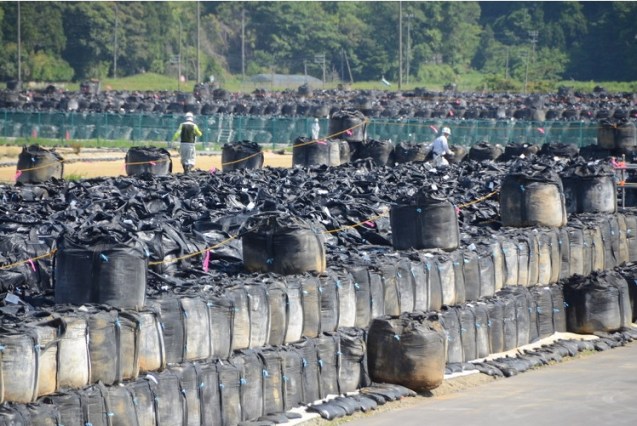
Black bags containing radioactively contaminated soil are seen piled up at a temporary storage site in Minamisoma, Fukushima Prefecture, in this June 2016 file photo. (Mainichi)
The radiation limit for soil contaminated by the Fukushima nuclear disaster in an experiment to reuse it in construction was lowered from 8,000 becquerels per kilogram to 3,000 becquerels per kilogram after strong opposition from a local mayor, it has been learned.
The experiment is to be carried out at a temporary storage site in Minamisoma, Fukushima Prefecture, where around 1,000 bags of contaminated soil will be opened, made into construction foundations, and their radiation levels measured. The experiment will be done to check, among other things, whether the radiation exposure dose remains at the yearly limit of 1 millisievert or less. The experiment will cost around 500 million yen. The results are expected to be put together next fiscal year or later.
From soon after the Great East Japan Earthquake in 2011, municipalities including Minamisoma asked the national government to separate out lower-radiation level concrete and other debris for reuse in things like groundwork for coastal forests used to defend against tsunami. At first, the Ministry of the Environment was negative about this, but in December 2011 the ministry allowed such reuse for debris with a limit of 3,000 becquerels per kilogram. According to documents released in response to a release of information request made by the Mainichi Shimbun, some 350,000 metric tons of this kind of debris have been used in Minamisoma and the towns of Namie and Naraha in projects such as groundwork for coastal forests.
Then in June last year, the Ministry of the Environment decided on a policy of reusing contaminated soil with 8,000 becquerels or less per kilogram in structures such as soil foundations for public works projects.
The same month, Minamisoma’s Mayor Katsunobu Sakurai visited then vice-minister of the environment Soichiro Seki, where he questioned Seki about the 3,000 becquerel limit that had been used until being replaced by the 8,000 becquerel limit. Sakurai reportedly called for the 3,000 becquerel limit to be used in the upcoming experiment in Minamisoma.
Sakurai says, “If they don’t use the 3,000 becquerel limit it is inconsistent. It doesn’t make sense for a ministry that is supposed to protect the environment to relax the standards it has set.”
The ministry confirmed to the Mainichi Shimbun that the experiment will only use soil up to the 3,000 becquerel limit, and said that the soil used will on average contain about 2,000 becquerels per kilogram.
http://mainichi.jp/english/articles/20170206/p2a/00m/0na/009000c
NRA’s radioactive soil concerns omitted from minutes of closed-door meeting

Japan’s post-tsunami recovery plan: tomatoes, fish and hula-dancing
Six years after the Fukushima disaster, local government is working with private firms in one Japanese city to rebuild its economy

Tomatoes growing in Japan’s Wonder Farm as part of Iwaki City’s reconstruction efforts after the 2011 earthquake and tsunami.
It’s a cold January day in Iwaki City, 211km north of Tokyo. But here, in a balmy glasshouse, light and sunny, pop music is being piped in, and tonnes of tomatoes are ripening and being picked.
They’re not in the ground; they’re being grown from waist-high pots of coconut matting. These are no ordinary tomatoes. They are growing on Wonder Farm, an “integrated agricultural theme park”, run by Tomato Land Iwaki, which is part-funded by the local city council and the Fukushima prefecture.
But another of the Wonder Farm partners is train firm Japan Rail East, which sells the tomatoes via its own restaurants. Because these small red fruits are part of plans by the local city government and local businesses to reinvigorate the local Iwaki economy after the devastating impact of the March 2011 earthquake, tsunami and nuclear disaster at the Fukushima Daiichi reactor, a mere 50km up the coast.
After such a cataclysmic series of events, rebuilding an economy based on fishing, agriculture and tourism is not easy. It requires some innovative thinking. Luckily, that’s something with which this area is already familiar. Fifty years ago, another of its industries, coal mining, faced decline. Here in Iwaki City, the Joban coal mining company came up with a novel idea. It retrained coal miners’ daughters as hula dancers and created the Spa Resort Hawaiians, Japan’s first theme park, which from its opening in 1966 until the events of March 2011, attracted thousands of visitors a year to its array of pleasures, including golf, a huge swimming pool and hot springs centre, and, of course, hula dancing and fire knife displays.
“We were driven by the need to survive,” explains Yukio Sakamoto, a director at the Joban coal mining company. “Yes, it was a radical change, but it was a success because everyone in the company focused on the plan. It wasn’t about knowledge or expertise, but mindset.” The idea faced considerable opposition: “People said coal miners should just dig coal. But we trained the daughters of coal miners as professional dancers.”
That kind of ingenuity has been called for even more since 2011 in this part of Japan. It’s been hard work for everyone involved to try and get visitors back to the region and to restart the market for local food and produce. The city government has worked with regional and national bodies to measure radioactivity levels in local produce, and the figures are publicly available. But rebuilding trust that food from Fukushima is safe has been slow. The local fish market may be open, but almost all its stock is from elsewhere in the country.
Still, at least it is open and Senzaka Yoshio, one of the officers at the La Mew Mew fish market, which was badly damaged by the earthquake and tsunami, says visitor levels are now back up to 80% of the pre-disaster days.
Further along the quay from the fish market are more fish. Live ones, this time, in the spacious tanks of the Fukushima Aquarium. When the tsunami hit, this aquarium lost 90% of its creatures. It reopened just four months later, in July 2011, a feat possible, according to executive director Yoshitaka Abe, due to teamwork, local leadership and co-operation with other aquarium authorities, who sent specialists and volunteers to help with the reconstruction work.

The Fukushima aquarium, which reopened just four months after the tsunami of March 2011.
For Sakamoto, at the Spa Resort Hawaiians, overcoming the 2011 disaster has been about local people. The resort has brought more than 9,500 jobs to the area. On the day of the earthquake, there were 617 guests in the hotel. All got safely home. But many employees lost family members and homes. “We continue our operation thinking about the people who suffered,” he says. “Our main idea was not to fire people because of the difficulty in the business, but to redeploy them.”
Up to 4.20µSv near the Fukushima Tetsuzan water dam
This short article is dedicated to a pro-nuke troll, whose alias is Octo.
Octo, should I indulge the reader, is usually present at the chat of the “Fukushima Diary” blog. He enjoys pushing his propaganda of how nuke is safe.
How Tepco is doing a terrific job at Fukushima Daiichi and is in total safety control of everything.
How radiation is now very low in Fukushima How the fish and seafood is now safe etc.
Everyone is believing his crap *cough*, but he, like all of the other bewildered, confused and baffled Japanese *experts? never gives up.
Watching this video, I am thinking about him and his continuous lies, and also all those other Japanese pro-nuke trolls that I encountered on internet in the past few years.
This video was shot last November 2016 South of Soma, it is the mountain trail to reach the Tetsuzan dam, a place approximately 20km from the Fukushima Daiichi nuclear plant.
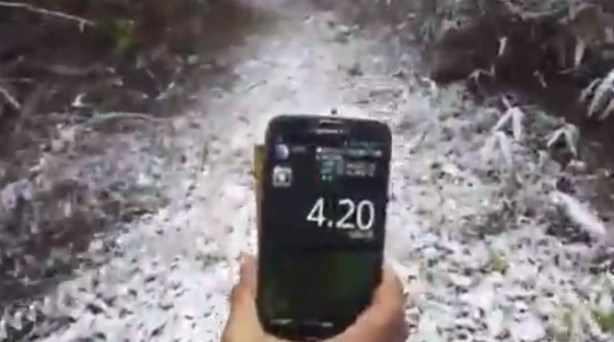
I think all those disinformation spinners paid by Tepco, Dentsu or Government, whose job is to spread lies about the Fukushima disaster on blogs, forums and Facebook, should all go living up there, as they claim it is now completely safe.
They should breath the good air from Fukushima, eat everyday very safe Fukushima rice and vegetables, and of course eat also plenty of safe fish and seafood, and drink plenty Fukushima safe water.
I would give them only one word of advice :
“Don’t forget to smile,
Smile a lot everywhere and everyday, so that the radiation won’t affect you.”
Special credit to the Fukuichi Citizen Radiation Monitoring Project
Convenient Acccounts of Fukushima Radiation Exposure Ignore Glaring Issue

Every time I read something about the Fukushima disaster my blood pressure rises.
For example, recent efforts to represent (hypothesized) remnants of melted fuel rods in unit 2 as evidence of containment is revealed as misleading when one considers the size of the reactor (larger than a bus) and the amount of fuel contained within unit 2’s:
Justin McCurry January 30, 2017, Possible nuclear fuel find raises hopes of Fukushima plant breakthrough. The Guardian, https://www.theguardian.com/environment/2017/jan/31/possible-nuclear-fuel-find-fukushima-plant
Operator says it has seen what may be fuel debris beneath badly damaged No 2 reactor, destroyed six years ago in triple meltdown
Hopes have been raised for a breakthrough in the decommissioning of the wrecked Fukushima Daiichi nuclear plant after its operator said it may have discovered melted fuel beneath a reactor, almost six years after the plant suffered a triple meltdown.
Tokyo Electric Power (Tepco) said on Monday that a remote camera appeared to have found the debris beneath the badly damaged No 2 reactor, where radiation levels remain dangerously high. Locating the fuel is the first step towards removing it. The operator said more analysis would be needed before it could confirm that the images were of melted uranium fuel rods, but confirmed that the lumps were not there before Fukushima Daiichi was hit by a powerful earthquake and tsunami on 11 March 2011.
The amount of fuel contained of fuel in those reactors was substantial. If TEPCO had found all, or most, of the melted reactor fuel they would know it.
According to a November 16 report by Tepco titled, ‘Integrity Inspection of Dry Storage Casks and Spent Fuel at Fukushima Daiichi Nuclear Power Station,’[i] as of March 2010 the Daini site held 1,060 tons of spent uranium fuel. The total spent uranium fuel inventory at Daiichi in March 2010 was reported as 1,760 tons. The 2010 report asserts that approximately 700 spent fuel assemblies are generated every year.[ii] The report specifies that Daiichi’s 3,450 assemblies are stored in each of the six reactor’s spent fuel pools. The common spent fuel pool contains 6291 assemblies. The amount of MOX fuel stored at the plant has not been reported.
I suspect that TEPCO knows that most of the fuel is gone from unit 2’s reactor containment and that what remains is a fraction of the total load, which was either dispersed in the explosions or has left the building.
But what bothers me even more than obfuscation around missing fuel are misleading accounts of radiation exposure.
Case in point: The article published in CNBC below last week alleges that Fukushima radiation exposure was “far lower” than previously found:
Robert Ferris. Jan 24, 2017. Fukushima radiation levels far lower than previously thought, study finds. CNBC.Com, http://www.cnbc.com/2017/01/24/fukushima-radiation-levels-far-lower-than-previously-thought-study-finds.html
Radiation levels remaining from the 2011 disaster at Japan’s Fukushima Daiichi nuclear plant appear to be a small fraction of what previous measurements suggested, according to a recently published study that followed levels in tens of thousands of people living near the site of the accident.
Science magazine highlighted the research Monday, calling it the first study to measure individual radiation levels in locals following a major nuclear disaster. The study was published in the peer reviewed Journal of Radiological Protection in December.
I’ve seen this type of headline before so I was immediately suspicious. I pulled up the journal article and found a glaring issue that problematizes the validity of this conclusion that radiation levels were lower than previously calculated.
Here is the glaring issue ignored in the CNBC’s optimistic headline: The radiation monitoring badges were provided to residents in August of 2011. The disaster and radiation exposure began March 11, 2011.
Consequently, RESIDENTS WERE NOT GIVEN BADGES TO MEASURE EXPOSURE UNTIL FULLY 5 MONTHS AFTER exposure, a fact that is acknowledged in the title of the research article but ignored in the news coverage:
Makoto Miyazaki and Ryugo Hayano. 2017. Individual external dose monitoring of alltizens of Date City by passive dosimeter 5 to 51 months after the FukushimaNPP accident (series): 1. Comparison of individual dose with ambient dose rate monitored by aircraft surveys. J. Radiol. Prot. 37 1(http://iopscience.iop.org/0952-4746/37/1/1) http://iopscience.iop.org/article/10.1088/1361-6498/37/1/1/pdf
For the measurement of individual external doses, Date City distributed individual dosim-eters (radio-photoluminescence (RPL) glass dosimeters: Glass Badge) to kindergarten-, elementary- and junior high school-children in August 2011. The target group was subsequently enlarged as the production capacity of the supplier increased, and the measurements are still ongoing
How is it possible to conclude that exposure was lower than previously thought when the evidence for that claim is generated from a study that excludes the first 5 months of exposure?
Truth has an especially slippery feel when it comes to Fukushima….
????????????????????????????????????????????????????????????
REFERENCES
[i] It is worth noting that although this report was produced on 10/26/2010, the file properties indicate the document was modified on 3/13/2011: Integrity Inspection of Dry Storage Casks and Spent Fuels at Fukushima Daiichi Nuclear Power Station (16 November 2010), http://www.nirs.org/reactorwatch/accidents/6-1_powerpoint.pdf
[ii] Integrity Inspection of Dry Storage Cask.
http://majiasblog.blogspot.fr/2017/02/convenient-acccounts-of-fukushima.html
Fukushima governor rebuts minister’s 3/11 recovery claim

Reconstruction Minister Masahiro Imamura addresses an official conference on the reconstruction and rebuilding of Fukushima Prefecture in Fukushima city on Jan. 28.
FUKUSHIMA–Using marathon analogies, opinions on the current state of Fukushima Prefecture almost six years after the 2011 nuclear accident were running far apart between a national minister and local officials at a conference here to discuss the recovery process.
“If this is a marathon, Fukushima’s recovery is 30 kilometers into the race,” said Reconstruction Minister Masahiro Imamura at the beginning of the conference on reconstruction of quake damage and rebuilding in the prefecture on Jan. 28. “Now, we have come to the crunch.”
A disgruntled Fukushima Governor Masao Uchibori refuted Imamura’s optimistic analogy when he was interviewed by reporters after the conference’s close.
“Some regions in the designated evacuation zones are not even at the starting line,” said Uchibori. “Even in the areas where the designation is already lifted, recovery has only just begun.”
The evacuation order in most of the surrounding area of the Fukushima No. 1 nuclear power plant is scheduled to be lifted at the end of March, apart from some “difficult-to-return zones” where radiation readings remain high.
The affected municipal governments are concerned that the central government’s understanding of areas affected by the 2011 disaster has been fading as the sixth anniversary approaches in March.
Aside from the opening, the conference, chaired by Imamura, was closed to the media.
According to one attendee, Imamura told conference delegates that he put “Fukushima first.”
Aping the catchphrase style of U.S. President Donald Trump and Tokyo Governor Yuriko Koike, Imamura apparently meant he prioritizes the recovery of the disaster-hit area of Fukushima Prefecture, but his choice of words failed to impress local officials.
The head of one municipal government said: “It is not a very good catchphrase to use here as it reminds us of the Fukushima No. 1 nuclear plant.”
“I would like him to be more sensitive about expressions he uses,” another complained.
1 This Month
19 February – VIRTUAL EVENT-Decision Time: AI and Our Nuclear Arsenal
12:45 p.m. Central / 1:45 p.m. Eastern
To see nuclear-related stories in greater depth and intensity – go to https://nuclearinformation.wordpress.com
-
Archives
- February 2026 (141)
- January 2026 (308)
- December 2025 (358)
- November 2025 (359)
- October 2025 (376)
- September 2025 (258)
- August 2025 (319)
- July 2025 (230)
- June 2025 (348)
- May 2025 (261)
- April 2025 (305)
- March 2025 (319)
-
Categories
- 1
- 1 NUCLEAR ISSUES
- business and costs
- climate change
- culture and arts
- ENERGY
- environment
- health
- history
- indigenous issues
- Legal
- marketing of nuclear
- media
- opposition to nuclear
- PERSONAL STORIES
- politics
- politics international
- Religion and ethics
- safety
- secrets,lies and civil liberties
- spinbuster
- technology
- Uranium
- wastes
- weapons and war
- Women
- 2 WORLD
- ACTION
- AFRICA
- Atrocities
- AUSTRALIA
- Christina's notes
- Christina's themes
- culture and arts
- Events
- Fuk 2022
- Fuk 2023
- Fukushima 2017
- Fukushima 2018
- fukushima 2019
- Fukushima 2020
- Fukushima 2021
- general
- global warming
- Humour (God we need it)
- Nuclear
- RARE EARTHS
- Reference
- resources – print
- Resources -audiovicual
- Weekly Newsletter
- World
- World Nuclear
- YouTube
-
RSS
Entries RSS
Comments RSS
 nuclear-news