Study: Radioactive Hot Particles Still Afloat Throughout Japan Six Year After Fukushima Meltdowns
Radioactive particles of uranium, thorium, radium, cesium, strontium, polonium, tellurium and americium are still afloat throughout Northern Japan more than six years after a tsunami slammed into the Fukushima Daiichi Power Plant causing three full-blown nuclear meltdowns. That was the conclusion reached by two of the world’s leading radiation experts after conducting an extensive five-year monitoring project.
Arnie Gundersen and Marco Kaltofen authored the peer reviewed study titled, Radioactively-hot particles detected in dusts and soils from Northern Japan by combination of gamma spectrometry, autoradiography, and SEM/EDS analysis and implications in radiation risk assessment, published July 27, 2017, in Science of the Total Environment (STOLEN).
Gundersen represents Fairewinds Associates and is a nuclear engineer, former power plant operator and industry executive, turned whistleblower, and was CNN’s play-by-play on-air expert during the 2011 meltdowns. Kaltofen, of the Worcester Polytechnic Institute (WPI), is a licensed civil engineer and is renowned as a leading experts on radioactive contamination in the environment.
415 samples of “dust and surface soil” were “analyzed sequentially by gamma spectrometry, autoradiography, and scanning electron microscopy with energy dispersive X-ray analysis” between 2011 and 2016. 180 of the samples came from Japan while another 235 were taken from the United States and Canada. The study further clarifies, “Of these 180 Japanese particulate matter samples, 57 were automobile or home air filters, 59 were surface dust samples, 29 were street dusts (accumulated surface soils and dusts) and 33 were vacuum cleaner bag or other dust samples.”
108 of the Japanese samples were taken in 2016, while the other 72 were gathered in 2011 after the meltdowns. Gundersen and Kaltofen tapped 15 volunteer scientists to help collect the dust and soil — mostly from Fukushima Prefecture and Minamisouma City. “A majority of these samples were collected from locations in decontaminated zones cleared for habitation by the National Government of Japan,” the study revealed. For the 108 samples taken in 2016, an “International Medcom Inspector Alert surface contamination monitor (radiation survey meter) was used to identify samples from within low lying areas and on contaminated outdoor surfaces.”
A Fairewinds Associates’ video from 2012 features Gundersen collecting five samples of surface soil from random places throughout Tokyo — places including a sidewalk crack, a rooftop garden, and a previously decontaminated children’s playground. The samples were bagged, declared through Customs, and brought back to the U.S. for testing. All five samples were so radioactive that according to Gundersen, they “qualified as radioactive waste here in the United States and would have to be sent to Texas to be disposed of.” Those five examples were not included as part of the recently released study, but Gundersen went back to Tokyo for samples in 2016. Those samples were included, and were radioactive, and according to Gundersen were “similar to what I found in Tokyo in [2012].”
Furthermore, 142 of the 180 samples (about 80 percent) contained cesium 134 and cesium 137. Cesium 134 and 137, two of the most widespread byproducts of the nuclear fission process from uranium-fueled reactors, are released in large quantities in nuclear accidents. Cesium emits intense beta radiation as it decays away to other isotopes, and is very dangerous if ingested or inhaled. On a mildly positive note, the study shows that only four of the 235 dust samples tested in the United States and Canada had detectable levels of cesium from Fukushima.
Cesium, due to its molecular structure, mimics potassium once inside the body, and is often transported to the heart where it can become lodged, thereafter mutating and burning heart tissue which can lead to cardiovascular disease. Other isotopes imitate nutritive substances once inside the body as well. Strontium 90 for example mimics calcium, and is absorbed by bones and teeth.
“Different parts of the human body (nerves, bones, stomach, lung) are impacted differently,” Kaltofen told EnviroNews in an email. “Different cells have radio-sensitivities that vary over many orders of magnitude. The body reacts differently to the same dose received over a short time or a long time; the same as acute or chronic doses in chemical toxicity.”
In contrast to external X-rays, gamma, beta or alpha rays, hot particles are small mobile pieces of radioactive elements that can be breathed in, drunk or eaten in food. The fragments can then become lodged in bodily tissue where they will emanate high-intensity ionizing radiation for months or years, damaging and twisting cells, potentially causing myriad diseases and cancer. The study points out, “Contaminated environmental dusts can accumulate in indoor spaces, potentially causing radiation exposures to humans via inhalation, dermal contact, and ingestion.”
The study also explains, “Given the wide variability in hot particle sizes, activities, and occurrence; some individuals may experience a hot particle dose that is higher or lower than the dose calculated by using averaged environmental data.” For example, a person living in a contaminated area might use a leaf blower or sweep a floor containing a hefty amount of hot particle-laden dust and receive a large does in a short time, whereas other people in the same area, exposed to the same background radiation and environmental averages, may not take as heavy a hit as the housekeeper that sweeps floors for a living. People exposed to more dust on the job, or who simply have bad luck and haphazardly breathe in hot radioactive dust, are at an increased risk for cancer and disease. High winds can also randomly pick up radioactive surface soil, rendering it airborne and endangering any unsuspecting subject unlucky enough to breath it in.
Hot particles, or “internal particle emitters” as they are sometimes called, also carry unique epidemiological risks as compared to a chest X-ray by contrast. The dangers from radiation are calculated by the dose a subject receives, but the manner in which that dose is received can also play a critical factor in the amount of damage to a person’s health.
“Comparing external radiation to hot particles inside the body is an inappropriate analogy,” Gundersen told EnviroNews in an email. “Hot particles deliver a lot of energy to a very localized group of cells that surround them and can therefore cause significant localized cell damage. External radiation is diffuse. For example, the weight from a stiletto high heal shoe is the same as the weight while wearing loafers, but the high heal is damaging because its force is localized.”
Kaltofen elaborated with an analogy of his own in a followup email with EnviroNews saying:
Dose is the amount of energy in joules absorbed by tissue. Imagine Fred with a one joule gamma dose to the whole body from living in a dentist’s office over a lifetime, versus Rhonda with exactly the same dose as alpha absorbed by the lung from a hot particle. Standard health physics theory says that Fred will almost certainly be fine, but Rhonda has about a 10 percent chance of dying from lung cancer — even though the doses are the same.
External radiation and internal hot particles both follow exactly the same health physics rules, even though they cause different kinds of biological damage. Our data simply shows that you can’t understand radiation risk without measuring both.
Some isotopes, like plutonium, only pose danger to an organism inside the body. As an alpha emitter, plutonium’s rays are blocked by the skin and not strong enough to penetrate deep into bodily tissue. However, when inhaled or ingested, plutonium’s ionizing alpha rays twist and shred cells, making it one of the most carcinogenic and mutagenic substances on the planet.
“Measuring radioactive dust exposures can be like sitting by a fireplace,” Dr. Kaltofen explained in a press release. “Near the fire you get a little warm, but once in a while the fire throws off a spark that can actually burn you.”
“We weren’t trying to see just somebody’s theoretical average result,” Kaltofen continued in the press release. “We looked at how people actually encounter radioactive dust in their real lives. [By] combining microanalytical methods with traditional health physics models… we found that some people were breathing or ingesting enough radioactive dust to have a real increase in their risk of suffering a future health problem. This was especially true of children and younger people, who inhale or ingest proportionately more dust than adults.”
“Individuals in the contaminated zone, and potentially well outside of the mapped contaminated zone, may receive a dose that is higher than the mean dose calculated from average environmental data, due to inhalation or ingestion of radioactively-hot dust and soil particles,” the study says in summation. “Accurate radiation risk assessments therefore require data for hot particle exposure as well as for exposure to more uniform environmental radioactivity levels.”
Study: Radioactive Hot Particles Still Afloat Throughout Japan Six Years After Fukushima Meltdowns
Fukushima: New Study Shows Full Radiation Risks Are Not Recorded
Today, the scientific journal Science of the Total Environment (STOTEN) published a peer-reviewed article entitled: Radioactively-hot particles detected in dusts and soils from Northern Japan by combination of gamma spectrometry, autoradiography, and SEM/EDS analysis and implications in radiation risk assessment. Co-authored by Dr. Marco Kaltofen, Worcester Polytechnic Institute (WPI), and Arnie Gundersen, Fairewinds Energy Education, the article details the analysis of radioactively hot particles collected in Japan following the Fukushima Dai-ichi meltdowns.
Based on 415 samples of radioactive dust from Japan, the USA, and Canada, the study identified a statistically meaningful number of samples that were considerably more radioactive than current radiation models anticipated. If ingested, these more radioactive particles increase the risk of suffering a future health problem.
“Measuring radioactive dust exposures can be like sitting by a fireplace,” Dr. Kaltofen said. “Near the fire you get a little warm, but once in a while the fire throws off a spark that can actually burn you.”
The same level of risk exists in Japan. While most people have an average level of risk, a few people get an extra spark from a hot particle.
According to Dr. Kaltofen, “The average radiation exposures we found in Japan matched-up nicely with other researchers. We weren’t trying to see just somebody’s theoretical average result. We looked at how people actually encounter radioactive dust in their real lives. Combining microanalytical methods with traditional health physics models,” he added, “we found that some people were breathing or ingesting enough radioactive dust to have a real increase in their risk of suffering a future health problem. This was especially true of children and younger people, who inhale or ingest proportionately more dust than adults.”
Fairewinds’ book Fukushima Dai-ichi: The Truth and the Way Forward was published in Japan by Shueisha Publishing, just prior to the one-year commemoration of the tsunami and meltdowns. “Our book,” Mr. Gundersen said, “which is a step-by-step factual account of the reactor meltdowns, was a best seller in Japan and enabled us to build amazing relations with people actually living in Japan, who are the source of the samples we analyzed. We measured things like house dusts, air filters, and even car floor mats. Collecting such accurate data shows the importance of citizen science, crowd sourcing, and the necessity of open, public domain data for accurate scientific analysis.”
Fairewinds Energy Education founder Maggie Gundersen said, “We are very thankful to the scientists and citizen scientists in Japan, who sought our assistance in collecting and analyzing this data. We will continue to support ongoing scientific projects examining how people in Japan and throughout the world experience radioactive dust in their daily lives.”
The complete peer reviewed report and project audio description by Dr. Kaltofen are available here at the Science of the Total Environment website.
Interactive data and the supporting materials are available here at the Fairewinds Energy Education website.
Fukushima: New Study Shows Full Radiation Risks Are Not Recorded
Soil Radioactive Contamination Measurements of Namie, Fukushima.
Some maps of the “Environmental Radioactivity Project around the Fukushima Daiichi Nuclear Power Plant” project, a measurement group of Japanese citizens based in Minamisoma, Fukushima Prefecture, are published in the blog “Fukushima 311 Voices “, https://fukushima311voices.wordpress.com/

Some maps of the “Environmental Radioactivity Project around the Fukushima Daiichi Nuclear Power Plant” project, a measurement group of Japanese citizens based in Minamisoma in Fukushima Prefecture, are published in the blog “Fukushima 311 Voices “.
This is the area in Namie-cho where the restrictions on living were recently lifted by the government (March 31, 2017).
It is the measurement result of Namie Town in the area which was evacuated, from this spring.
About 10 days from April to July, we measured the air dose rate, surface contamination count rate, and soil contamination density of 314 points, which were the approximate center points of the mesh divided into 375 m × 250 m.
But for the soil contamination density, the numerical value was less than 40,000 Bq / ㎡ (which is the designated standard of a radiation control area) at only 3 points.
Incidentally, the average of the soil contamination density is 858,143 Bq / ㎡ (maximum is 6,780,000 Bq / ㎡, the minimum is 31,400 Bq / ㎡), the average of the air dose rate at 1 m above the ground is 1.12 μSv / h, the surface contamination count rate was 1,199 cpm, which was very high.
Even the Japanese government, even radiation workers, have been given restrictions on staying time, meals, age, etc. in the areas of 40,000 Bq / ㎡ or more, but people who were to be affected by even more severely radiation-contaminated areas (including pregnant women and others) were supposed to return home.
I would like many people to know this reality. Furthermore, I would like to ask for such a great support as we share the thought of Minami-soma who are fighting in trials against such a high evacuation standard setting of 20 mSv / yr by the Japanese government.
Fukuichi Surrounding Environment Radiation Monitoring Project
https://www.facebook.com/fukuichi.mp/
Special thanks to Mr Ozawa, and to Nick Thabit for his translation.
Increases in perinatal mortality in prefectures contaminated by the Fukushima nuclear power plant accident in Japan

While fetal and neonatal deaths within the first week of life (termed perinatal mortality) have been decreasing in Japan consistently since 2002, data examined in Fukushima-affected areas during 2012-2015 show a break in this trend with an increase that, as of 2015, had not reversed.
This recent study examines numbers of perinatal deaths in areas affected by the ongoing Fukushima nuclear catastrophe and compared these data to other areas of Japan supposedly unaffected.
This research is just the latest showing a perinatal mortality increase following Fukushima. A number of studies in Europe also showed similar increases following the Chernobyl nuclear catastrophe.
Increases in perinatal mortality in prefectures contaminated by the Fukushima nuclear power plant accident in Japan
Ethical Foundations of Radiological Protection
“The economic and societal factors of the population living in contaminated territories are not the same as the ones of the other parts of the country.”
It even applies to antinuclear activists. Immediately after 311 the priority for the Fukushima activists was the evacuation of the Fukushima children whereas the priority for the other Japanese antinuclear activists was to keep all Japan’s nuke plants from being restarted.
Sadly at national level the second priority prevailed over the first priority, and no measures were in the end taken to evacuate or to protect the Fukushima children from continuous radiation exposure nor from prolonged internal exposure thru local foods.

“..Regarding existing exposure situations after a large-scale nuclear accident, the economic and societal factors of the population living in contaminated territories are not the same as the ones of the other parts of the country. For example, the former want to sell their agricultural production and the later avoids internal contamination….”
“…ICRP recognize that the assessment of beneficence and non-maleficence is a key challenge but has nothing else to propose than recommending, “that such an assessment [should] be transparent about what was included, recognise disagreements where they arise, and go beyond a simple balancing of direct health impacts against economic costs.” ICRP provides no example of good practice arising from these recommendations that are rarely implemented….”
“…Moreover some categories of people are more sensitive to radiations than others. It is particularly the case of children and infants. Justice would mean a better protection with lower limits for them. This is a strong request from families living around the Fukushima dai-ichi nuclear power plant. Some of them evacuated without any support in order to protect their children.
Similarly, individuals are not all equal in terms of genetic heritage and part of this population of hypersensitivity to the adverse effects of radiation (1 to 3% are heterozygous for ataxia telangiectasia). The radiation protection system cannot be built to protect the majority of citizens, but all citizens…..”
“…CRP does not address this issue of individual health in its draft report. How can it expect to answer to the demands of the populations and be understood by them?
“Intergenerational justice has been addressed by the Commission for the management of radioactive waste […]. The Commission introduces responsibilities towards future generations in terms of providing the means to deal with their protection”. Justice could also be extended spatial consideration by forbidding the export of radioactive waste to foreign countries that did not benefit from the electricity production.
Implementation of radiological protection requires democracy to avoid abuses. Nevertheless, democracy is not considered as a core ethical value by ICRP….”
“…ACRO strongly supports the implementation of these three procedural values and considers that they should be implemented from the justification stage. This is not mentioned in the draft report, although it is a requirement the Aarhus convention for environmental issues. This should be extended to radiological protection….”
“…Most of citizen living around the Fukushima dai-ichi nuclear power plant still do not trust authorities. “Accountability” and “transparency” have being ignored by Japanese authorities. The arbitrary evacuation limit of 20 mSv/y has never been explained nor justified. People refusing this limit might have no other choice than remaining in contaminated territories due to economical constrains.
It is a pity that the ICRP has never tried to grasp the situation in contaminated territories as whole and has limited its so-called “dialogues” to a limited number of people that agrees with the Commission. It would have learned much more about the consequences of its recommendations in talking to all categories of people.
As conclusion, ACRO considers that studying the ethical basis of the radiological protection is a necessity but it is not achieved in the present draft report. It should be submitted to various stakeholders and discussed by other means than a simple public consultation on the Internet….”
High School Girls Used to Promote a Beach in Fukushima
They used high school girls to promote a beach in Fukushima. The same way that they were using highschool kids to pick up trash along the Joban Expressway….

“Photo Journal: Long-awaited laughter”
High school students in the garb of Hawaiian hula dancers play in the waves at the Usuiso seaside resort in Iwaki, Fukushima Prefecture, after the beach opened for the first time in seven years on July 15, 2017. The resort was heavily hit by the 2011 tsunami, which took the lives of 115 residents and destroyed close to 90 percent of homes in the district. However, the resort finally reopened its stretches of white sands to families on Saturday, with lively hula performances by local high school girls. (Mainichi) https://mainichi.jp/english/articles/20170715/p2a/00m/0na/014000c
30Bq/kg of Strontium 90 in Sea Breams in the Sea 2km from the Kido River
TEPCO released a document stating that 30Bq/kg of Strontium 90 was found in sea breams in the sea 2km from the Kido river (near J-Village).
Click to access fish03_170713-j.pdf


5.8-Magnitude Quake Strikes Off Coast of Japan’s Fukushima Prefecture, Near Ongoing Fukushima Nuclear Disaster Site


Evacuations Ordered as Heavy Rains Lashed Fukushima…
Heavy rains lashed Fukushima Prefecture during the last few days, prompting evacuation orders in some areas amid fears of flooding. These rains transport lots of radionuclides from the mountainsides and forests down into the towns, redistributing the insoluble cesium particles, recontaminating places having being previously decontaminated. A never ending story.

Fukushima City Still Struggling with Labor Shortages
 Recent soil contamination map made by the “Environmental Radioactivity Measurement Project around Fukushima Daiichi Nuclear Power Plant.” https://dunrenard.wordpress.com/2017/01/14/new-data-show-massive-radiation-levels-in-odaka-minamisoma/
Minamisoma, Fukushima Pref., July 12 (Jiji Press)–Minamisoma is still struggling with labor shortages, one year after the Japanese government lifted its nuclear evacuation advisory for part of the Fukushima Prefecture city.
In the city, only slightly over 20 pct of residents have returned home, and the productive-age population of people aged 15-64 fell by some 8,200 from the level before the March 2011 meltdowns at Tokyo Electric Power Company Holdings Inc.’s <9501> disaster-crippled Fukushima No. 1 nuclear plant.
The situation is “tough,” said Takuzo Tsuchida, a 58-year-old worker at a factory in the Kashima district that is run by a subsidiary of clothing maker Fukuso Co. The factory saw its number of employees halve to some 70.
The Fukuso unit this year hired five graduates from a dressmaking school with which it held a joint fashion show last year. But the move was insufficient because some workers quit.
To cover its lower output, the company has asked a partner factory for increased production. “We have to continue to put up with” the situation, Tsuchida said.
EU looks at lifting import curbs on Fukushima rice, Tohoku marine products, wild vegetables ???
It could be some propaganda spin on the Japanese side, but I doubt it. It is most probably true as Japan and Europe just signed a new trade deal on Thursday July 6, 2017, when Japan’s Prime Minister Shinzo Abe met top European Union officials in Brussels on the eve of a G20 summit of world leaders, including President Trump, in Germany.
The deal, which had been discussed since 2011, will remove almost all customs duties on European exports to Japan. Those are currently worth as much as €1 billion ($1.1 billion) a year.
That lifting import curbs on Fukushima rice, Tohoku marine products, wild vegetables, into Europe, might have been included in that trade deal package, to the detriment of the health protection of yet unaware Europeans.
 The European Union may lift an import restriction on rice produced in nuclear disaster-hit Fukushima Prefecture.
BRUSSELS – The European Union is considering lifting an import restriction on rice produced in meltdown-hit Fukushima Prefecture as well as on wild vegetables and marine products from Japan, sources said Sunday.
At present, the EU requires that radiation inspection certificates be submitted by exporters of some food products from 13 prefectures in the eastern half of the Japanese archipelago.
But the European Commission, the EU’s executive arm, has drafted import regulation reform plans that call for scrapping the requirement when it comes to rice from Fukushima, home to the crippled Fukushima No. 1 nuclear power plant, the sources said.
The EC also proposes removing the regulation for some kinds of seafood, including shrimp, crab, octopus, yellowtail, red sea bream and bluefin tuna, from the seven prefectures of Fukushima, Miyagi, Gunma, Ibaraki, Tochigi, Chiba and Iwate, and certain wild vegetables from seven prefectures including Akita, Nagano and Yamagata.
Meanwhile, the radiation certificate obligation will remain in place for food imports from Yamanashi, Niigata and Shizuoka prefectures.
A formal decision on the deregulation proposal could come as early as this autumn, the sources said.
The Fukushima No. 1 power plant is run by Tokyo Electric Power Company Holdings Inc.
Voluntary evacuees from 2011 disaster still need support
 Six years have passed since this woman voluntarily evacuated to Chiba city from Fukushima city after the 2011 nuclear accident. She frequently shuttles between the two cities by car.
FUKUSHIMA — Three months have passed since the Fukushima prefectural government stopped providing free housing on March 31 to residents who voluntarily left areas outside the evacuation zone after the 2011 accident at Tokyo Electric Power Company Holdings Inc.’s Fukushima No. 1 nuclear power plant.
More than 2,000 applications have been submitted to a new rental subsidy system started by the prefectural government in place of free housing, to ease this sudden change in evacuees’ lives. This was more than initially predicted, which indicates there are still many voluntary evacuees who require public support.
The number of voluntary evacuees inside and outside the prefecture totals about 12,000 households.
The free housing provision had been promoted under a system in which the prefecture shouldered the rent for those who voluntarily evacuated from areas outside those subject to evacuation orders — up to ¥60,000 per month in principle — using the national budget.
The prefecture ended the rental provision system at the end of fiscal 2016, for reasons including progress in decontamination work. The new system applies to households with a monthly income of ¥214,000 or less, offering up to ¥30,000 per month as a rental subsidy. The subsidy will be reduced to ¥20,000 per month in fiscal 2018.
According to the prefecture, applications for the new system have been accepted since October last year, totaling 874 cases as of the end of March. About 1,200 more came in during the three months from April to June.
The prefecture had estimated 2,000 cases would be approved for the new rental subsidy, but the ultimate number is likely to surpass the initial estimates and applications will likely increase further, according to the prefecture.
However, low-income earners living in public housing, and those who evacuated from Fukushima Prefecture to other prefectures and moved again to another prefecture in response to the end of the free housing provision, are disqualified from the new rental subsidy. Therefore, many evacuees have been put in a worse position by the termination of the free housing provision.
Immediately after the nuclear accident, a 62-year-old woman evacuated with her daughter, 22, who was then a high school student, from Fukushima city to Chiba city. Since the end of the free housing provision, she often pays the rent for her public housing later than the due date. Two-thirds of the deposit to rent her public housing remains unpaid, and she has no savings. She manages to make ends meet by receiving her pension benefits early.
In Chiba city, the woman has been teaching painting techniques for porcelain at a class, but her salary — less than ¥100,000 a month — is not enough to support her family.
Since April, she has been visiting Fukushima city by car to resume teaching painting to her former students.
http://the-japan-news.com/news/article/0003797179
Serious delays in breast cancer diagnosis in Fukushima: study

Serious delays have been seen in breast cancer diagnosis among women living in the northern coastal area of Fukushima devastated by the March 2011 earthquake-triggered tsunami and ensuing nuclear disaster, according to a study by a local doctor.
After the crisis, the proportion of women who consulted with doctors more than three months after noticing breast cancer symptoms rose to 29.9 percent of those who consulted with them about symptoms, compared with 18.0 percent before the disaster, the study found.
Many women who saw a doctor about their symptoms only did so after being encouraged by family members, according to the study. A rise in the number of single-person households and that of those composed only of elderly couples due to protracted evacuation is believed to be behind the trend.
The study was conducted by Akihiko Ozaki, a doctor at Minamisoma Municipal General Hospital in Minamisoma, Fukushima Prefecture, after he noticed that many women began visiting him after their symptoms had progressed.
Early diagnosis is the key to breast cancer treatment. If it takes a woman three months or longer to see a doctor after first noticing symptoms, she is said to face a poor prognosis.
A doctor with knowledge of medical conditions in disaster-affected areas says similar problems could occur in other areas hit by disasters or the Tokyo metropolitan area, where the population is graying just as the rest of the country.
In Japan, breast cancer is the most common cancer for women. Around 13,000 people die of it every year. The number of breast cancer patients including young women has been rising, and the issue has attracted renewed attention after popular TV personality Mao Kobayashi recently died of the disease at age 34.
Ozaki’s research, published in a British journal on cancer, covered a total of 219 breast cancer patients who, after noticing such symptoms as a lump, visited either of two hospitals in the city of Minamisoma between 2005 and 2015. Of those, 122 visited the hospitals before the disaster, while 97 did so after that.
The figures exclude patients who were diagnosed with cancer in health examinations. The average age of the patients before the disaster was 62 compared with 63 after the calamity.
Of the patients who did not see doctors until at least three months after first noticing symptoms, 37.9 percent were living in the households of their son or daughter. Of the patients who saw doctors less than three months after first noticing symptoms, 51.5 percent were living in similar households.
https://english.kyodonews.net/news/2017/07/b97b2f3d9afa-serious-delays-in-breast-cancer-diagnosis-in-fukushima-study.html
Court finds ex-environment ministry official Yuji Suzuki guilty of taking bribes
 An excavator sits among bags of nuclear waste in the town of Tomioka near the Fukushima No. 1 nuclear plant in March 2016.
FUKUSHIMA – The Fukushima District Court on Thursday sentenced a former Environment Ministry official to one year in prison, suspended for three years, for accepting bribes to help a company win a decontamination project in Fukushima Prefecture.
The court also ordered 57-year-old Yuji Suzuki, who formerly worked at a branch of the ministry’s environment regeneration office in Fukushima, to pay a fine of ¥230,000.
Presiding Judge Shoji Miyata said that with people aiming for a swift recovery from the March 2011 earthquake, tsunami and nuclear disaster, rapid and secure implementation of decontamination work was strongly anticipated in areas tainted by radioactive substances from Tokyo Electric Power Company Holdings Inc.’s Fukushima No. 1 plant.
Miyata criticized Suzuki, saying that the fact that he betrayed those expectations “cannot be overlooked” and that the social impact of his actions was “not insignificant.”
As for the reason for the suspended sentence, Miyata said Suzuki was “showing regret.”
According to the ruling, Suzuki helped a civil engineering and construction company based in Takaoka, Toyama Prefecture, join a decontamination project in the Fukushima town of Namie as a subcontractor of a consortium.
In return, Suzuki received ¥25,000 in cash and benefits worth ¥206,000 in the form of dining and accommodation between September 2015 and June 2016.
http://www.japantimes.co.jp/news/2017/06/29/national/crime-legal/court-finds-ex-environment-ministry-official-guilty-taking-bribes/
For Tepco’s new president the town of Futaba does not belong to the No-Go Zone

The new president of Tepco, Tomoaki Kobayakawa, did not even know that the city of Futaba is still part of the evacuated No-Go Zone, a forbidden zone to enter, except for a part of the town for short time visits only during the day.
Quite shameful and irresponsible from a man presiding the company which caused the nuclear disater responsible for the still unfortunate present situation of thousands of evacuees.
1 This Month
To see nuclear-related stories in greater depth and intensity – go to https://nuclearinformation.wordpress.com/
12 February – Webinar The Big Push: New Nuclear Projects in Canada
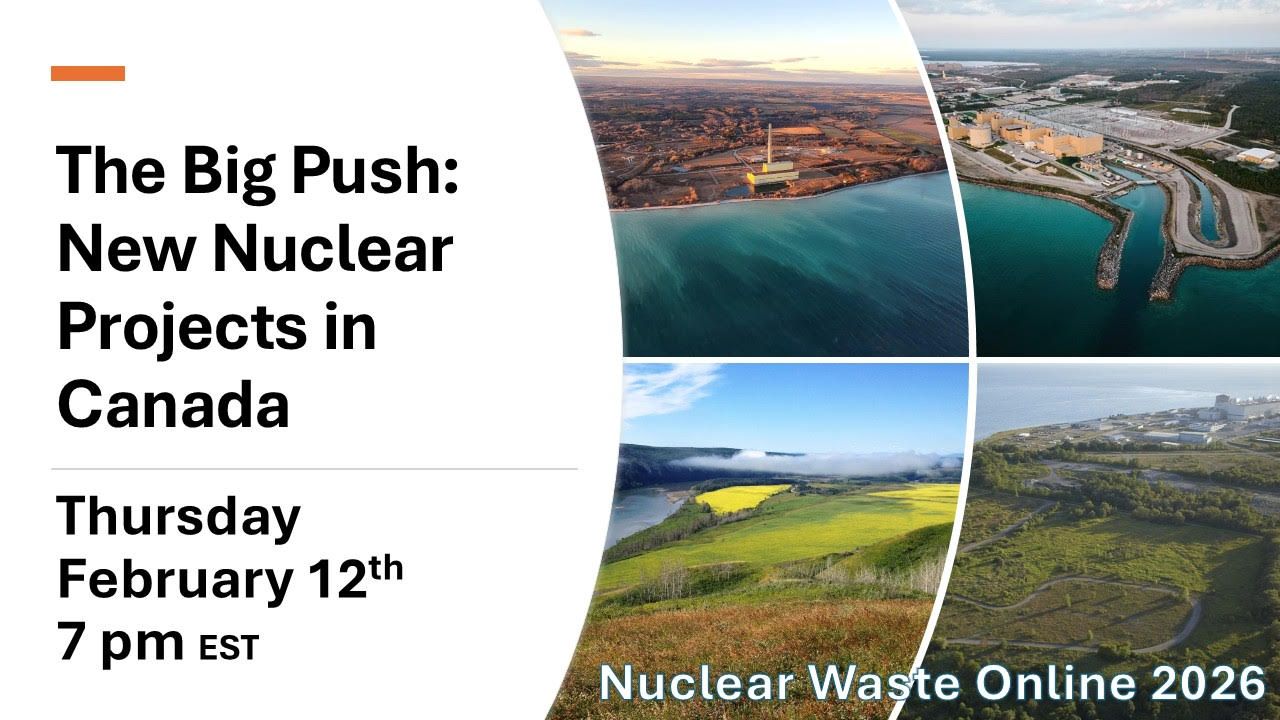
Thursday, February 12, 7 pm Eastern | 2nd of 4 sessions in the 2026 Nuclear Waste Online webinar series
Join a webinar on the push for new nuclear generation in Canada. Go to Northwatch.org to register or use the registration link https://us02web.zoom.us/webinar/register/WN_ZfWOf1GITqSRIZX8CB-A9w
-
Archives
- February 2026 (127)
- January 2026 (308)
- December 2025 (358)
- November 2025 (359)
- October 2025 (376)
- September 2025 (258)
- August 2025 (319)
- July 2025 (230)
- June 2025 (348)
- May 2025 (261)
- April 2025 (305)
- March 2025 (319)
-
Categories
- 1
- 1 NUCLEAR ISSUES
- business and costs
- climate change
- culture and arts
- ENERGY
- environment
- health
- history
- indigenous issues
- Legal
- marketing of nuclear
- media
- opposition to nuclear
- PERSONAL STORIES
- politics
- politics international
- Religion and ethics
- safety
- secrets,lies and civil liberties
- spinbuster
- technology
- Uranium
- wastes
- weapons and war
- Women
- 2 WORLD
- ACTION
- AFRICA
- Atrocities
- AUSTRALIA
- Christina's notes
- Christina's themes
- culture and arts
- Events
- Fuk 2022
- Fuk 2023
- Fukushima 2017
- Fukushima 2018
- fukushima 2019
- Fukushima 2020
- Fukushima 2021
- general
- global warming
- Humour (God we need it)
- Nuclear
- RARE EARTHS
- Reference
- resources – print
- Resources -audiovicual
- Weekly Newsletter
- World
- World Nuclear
- YouTube
-
RSS
Entries RSS
Comments RSS
 nuclear-news