Ten years on, economic growth is faltering in disaster-hit areas
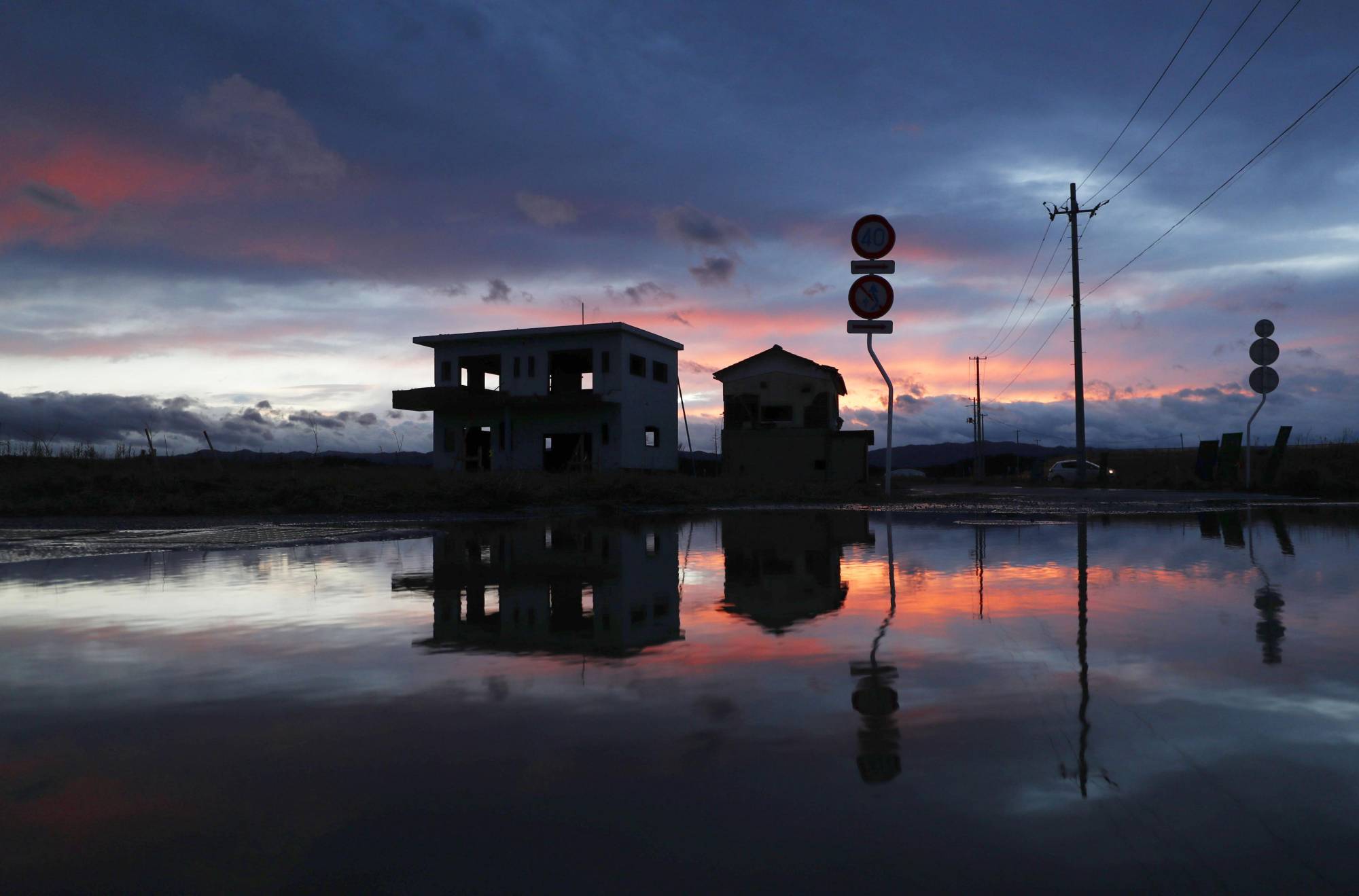
Namie, Fukushima Prefecture, was hit hard by the disaster on March 11, 2011, and an evacuation order remained in place for the subsequent six years
February 11, 2021
While Japan will soon mark the 10th anniversary of the 2011 Great East Japan Earthquake and tsunami, the economy of affected areas is showing signs of faltering.
The prefectures of Fukushima, Miyagi and Iwate have been shored up economically by public investment involving reconstruction projects since being devastated by the disaster on March 11, 2011, and the subsequent nuclear power plant meltdowns.
The three prefectures, however, are seeing reconstruction demand pass its peak.
As the triple meltdown at Tokyo Electric Power Company Holdings Inc.’s Fukushima No. 1 nuclear plant continues to cast a shadow over the coastal areas, the three prefectures now face the challenge of achieving autonomous economic growth orchestrated by firms and others in the private sector.
In the town of Namie, Fukushima Prefecture, an evacuation order issued shortly after the nuclear accident was partially lifted in March 2017. Although industrial complexes have been built and restaurants have opened their doors to customers once again in Namie, there are also many empty plots of land in the town, which shows that some former Namie residents had their houses torn down after giving up on returning from where they had been evacuated.
“Sales halved from before the disaster,” said Yasushi Niizuma, who reopened his restaurant in the town.
Meanwhile, some companies that were not doing business in Namie prior to the disaster have made inroads into the town.
“I don’t expect immediate changes, but I think the situation will be quite different 10 to 30 years from now,” Niizuma said with a sense of hope.
Prefectural gross product data show that the economy has recovered in the three prefectures since the disaster.
In 2011, the year of the disaster, the combined prefectural gross product in Fukushima, Miyagi and Iwate plunged ¥788 billion from a year earlier in nominal terms. But public investment increased sharply from 2012, with many restoration and reconstruction projects being implemented in disaster-affected areas. As a result, the combined gross product in the three prefectures in 2018 increased some ¥3.9 trillion from the 2011 level.
Noting that the region’s economy has been pushed up by public investment over the last 10 years, Yutaro Suzuki, economist at Daiwa Institute of Research Ltd., said, “It was not a self-sustaining growth.”
The three prefectures are seen to have suffered negative economic growth in 2020, chiefly reflecting a decrease in public investments and the spread of the novel coronavirus.
“An industrial recovery is crucial” for further economic growth in the region, Suzuki said.
Coastal areas in the three prefectures hit hard by the disaster are facing a serious population outflow. This is, in areas around the Fukushima No. 1 plant, including the town of Futaba, primarily due to the evacuation order still placed on some locations with high radiation levels.
“There are many areas (within Fukushima) that are nowhere near being restored,” Risa Ueda, head of the Bank of Japan’s Fukushima Branch, said.
While the central government is currently attempting to attract new industries to the region, the effects of such an initiative on the local economy are still unknown.
“Corporate performance has not recovered to the levels prior to the disaster at half of affected businesses,” Sachio Taguchi, president of Bank of Iwate , said. “We are still halfway down the road to reconstruction.”
Hiromi Watanabe, chairman of the federation of chambers of commerce and industry in Fukushima Prefecture, called on the Japanese government to look at the actual state of local economies and introduce precise measures, rather than end its support measures altogether.
As the economy has yet to recover to levels before the disaster in many parts of Fukushima and the coronavirus pandemic is also hitting the prefecture hard, Watanabe said, “What we need the most are job opportunities.”
https://www.japantimes.co.jp/news/2021/02/11/national/quake-disaster-economy/
Dynamics of radiocesium in forests after the Fukushima disaster: Concerns and some hope
Dynamics of radiocesium in forests after the Fukushima disaster: Concerns and some hope
80% of the Fukushima prefecture are mountain forests.

February 3, 2021
Considering the massive threat posed by 137Cs to the health of both humans and ecosystems, it is essential to understand how it has distributed and how much of it still lingers.
w/reminder: there’s no such thing as ‘radioactive decontamination’ the correct term would be ‘trans-contamination’
Scientists compile available data and analyses on the flow of radionuclides to gain a more holistic understanding
Forestry and Forest Products Research Institute
After the Chernobyl disaster of 1986, the 2011 Fukushima Daiichi nuclear power plant (FDNPP) disaster was the second worst nuclear incident in history. Its consequences were tremendous for the Japanese people and now, almost a decade later, they can still be felt both there and in the rest of the world. One of the main consequences of the event is the release of large amounts of cesium-137 (137Cs)–a radioactive “isotope” of cesium–into the atmosphere, which spread farther away from the power plant through wind and rainfall.
Considering the massive threat posed by 137Cs to the health of both humans and ecosystems, it is essential to understand how it has distributed and how much of it still lingers. This is why the International Atomic Energy Agency (IAEA) has recently published a technical document on this specific issue. The fifth chapter of this “Technical Document (TECDOC),” titled “Forest ecosystems,” contains an extensive review and analysis of existing data on 137Cs levels in Fukushima prefecture’s forests following the FDNPP disaster.
The chapter is based on an extensive study led by Assoc. Prof. Shoji Hashimoto from the Forestry and Forestry Products Research Institute, Japan, alongside Dr. Hiroaki Kato from the University of Tsukuba, Japan, Kazuya Nishina from the National Institute of Environmental Studies, Japan, Keiko Tagami from the National Institutes for Quantum and Radiological Science and Technology, Japan, George Shaw from the University of Nottingham, UK, and Yves Thiry from the National Agency for Radioactive Waste Management (ANDRA), France, and several other experts in Japan and Europe.
The main objective of the researchers was to gain a better understanding of the dynamics of 137Cs flow in forests. The process is far from straightforward, as there are multiple elements and variables to consider. First, a portion of 137Cs-containing rainfall is intercepted by trees, some of which is absorbed, and the rest eventually washes down onto the forest floor. There, a fraction of the radiocesium absorbs into forest litter and the remainder flows into the various soil and mineral layers below. Finally, trees, other plants, and mushrooms incorporate 137Cs through their roots and mycelia, respectively, ultimately making it both into edible products harvested from Fukushima and wild animals.
Considering the complexity of 137Cs flux dynamics, a huge number of field surveys and gatherings of varied data had to be conducted, as well as subsequent theoretical and statistical analyses. Fortunately, the response from the government and academia was considerably faster and more thorough after the FDNPP disaster than in the Chernobyl disaster, as Hashimoto explains: “After the Chernobyl accidents, studies were very limited due to the scarce information provided by the Soviet Union. In contrast, the timely studies in Fukushima have allowed us to capture the early phases of 137Cs flow dynamics; this allowed us to provide the first wholistic understanding of this process in forests in Fukushima.”
Understanding how long radionuclides like 137Cs can remain in ecosystems and how far they can spread is essential to implement policies to protect people from radiation in Fukushima-sourced food and wood. In addition, the article also explores the effectiveness of using potassium-containing fertilizers to prevent the uptake of 137Cs in plants. “The compilation of data, parameters, and analyses we present in our chapter will be helpful for forest remediation both in Japan and the rest of the world,” remarks Hashimoto.
When preventive measures fail, the only remaining option is trying to fix the damage done–in the case of radiation control, this is only possible with a comprehensive understanding of the interplay of factors involved.
In this manner, this new chapter will hopefully lead to both timely research and more effective solutions should a nuclear disaster happen again.
###
Reference
Title: Environmental Transfer of Radionuclides in Japan following the Accident at the Fukushima Daiichi Nuclear Power Plant, Chapter 5 “Forest ecosystems”
Published in: International Atomic Energy Agency, IAEA TECDOC no. 1927
Link (open access): https://www.iaea.org/publications/14751/environmental-transfer-of-radionuclides-in-japan-following-the-accident-at-the-fukushima-daiichi-nuclear-power-plant
About the Forestry and Forest Products Research Institute, Japan
Inaugurated as a unit for forest experiments in Tokyo in 1905, the Forestry and Forest Products Research Institute (FFPRI) was largely reorganized in 1988, when it received its current name. During its history of over 110 years, the FFPRI has been conducting interdisciplinary research on forests, forestry, the timber industry, and tree breeding with an agenda based around sustainable development goals. The FFPRI is currently looking to collaborate with more diverse stakeholders, such as international organizations, government agencies, and industry and academic leaders, to conduct much needed forest-related research and make sure we preserve these renewable resources. Website: https://www.ffpri.affrc.go.jp/ffpri/en/index.html
About Dr. Shoji Hashimoto from the Forestry and Forest Products Research Institute, Japan
Shoji Hashimoto obtained Master’s and PhD degrees from The University of Tokyo, Japan, in 2001 and 2004, respectively. In 2005, he joined the Forestry and Forest Products Research Institute, Japan, where he now works as Senior Researcher. He is also Associate Professor at The University of Tokyo. He has published over 50 papers and is a referee for over 30 scientific journals. His main research interests are soil and forest science, environmental dynamics, and climate change, among others. Hashimoto has also been an organizer for various events, including two Symposiums on Fukushima Forests and the Japan?Finland Joint Seminar, and serves as the coordinator of a radioecology unit in International Union of Forest Research Organizations (IUFRO).
Fukushima businesses struggling to stay afloat despite government help

Rokutaro Kurihara, managing director of a company that runs a shopping complex in Iitate village in Fukushima Prefecture, is struggling to keep his business afloat.
Jan 29, 2021
Commercial complexes built as part of revitalization projects in areas affected by the triple meltdown at the Fukushima No. 1 nuclear power plant in March 2011 are struggling to stay afloat.
Faced with difficulties due to swelling costs, business operators often turn to local municipalities for financial aid to help them overcome crises. But the financial struggles will not end soon, given that only a portion of the residents who evacuated from the disaster-stricken areas have returned or are expected to.
Those outlets are now facing a testing moment that will determine whether they can continue with their businesses.
A small village in Fukushima Prefecture located northwest of the power plant, Iitate, which was issued evacuation orders after the nuclear disaster, built the commercial complex Michi no Eki Madeikan for ¥1.4 billion. However, business at the commercial building, which has a convenience store and a vegetable stand, has always been touch and go.
Madei Garden Village Iitate runs the business using a ¥33 million payment from the local government. But even with those funds, the operator saw a deficit of ¥9 million in fiscal 2017 and ¥8 million the following year.
Faced with a severe financial crisis, the company was forced to seek financial aid worth ¥35 million from Iitate in 2018.
After revising its business strategy, the company managed to reduce running costs and decrease the deficit to ¥300,000 in fiscal 2019.
“We are expecting a profit in fiscal 2020. I’ll be dealing with the accumulating debt as a priority,” says Rokutaro Kurihara, the company’s managing director.
Kurihara’s company is among those operating at 12 commercial facilities in 10 towns in areas that used to be designated as no-go zones, including the town of Namie and Tamura city.
Since most of the stores and shops shut down when residents evacuated from the region, local governments have built them for returning residents.
But many of them share the same fate as Kurihara’s.
In the town of Tomioka, Sakura Mall Tomioka, which houses various shops including a grocery store, operates with support from the the town and Fukushima Prefecture, covering its yearly losses worth ¥22 million.
But an official at the municipal government warns that the town will need to raise its rent after the prefecture’s subsidy program ends at the end of fiscal 2021.
Not all tenants deal with financial stress. However, businesses that continue to attract customers worry they may lose them to competitors outside the region.
The operator of Kokonara Shopping Street, a shopping complex that opened in 2018 in the town of Naraha, believes that they cannot meet customers’ needs because they do not have much space. Recent estimates show that cashiers at the center’s 10 stores, including a supermarket and a retailer with daily necessities, served as many as 570,000 customers in fiscal 2019.
But Shigeki Nemoto, who runs a supermarket at the Kokonara shopping facility with limited products available, says he may lose his customers to a nearby, larger shopping complex.
“Our shop is really small and we are struggling to source the product lineup we would like to offer to respond to the needs of our customers,” Nemoto said, adding that he had to reduce its range of meat and fish products.
His store is about 500 square meters, about half the floor space of an average supermarket.
“The neighboring city of Iwaki has a supermarket twice as big as ours with a floor space of 1,000 square meters and we’re worried that we’ll lose out to the competition,” Nemoto added.
Meanwhile, shops operating in areas where the government-run revitalization projects are ongoing depend on workers engaged in the projects for their business.
For instance, Minamisoma city built the only supermarket in its Odaka district, which had its no-go status lifted in 2016, for ¥240 million in 2018.
But the daily number of customers now hovers at around 250.
Many workers for the government reconstruction project visit the store in the afternoon or in the evening to purchase take-out meals or daily necessities. But when the reconstruction project finishes, those workers will disappear as well.
“Operators in the area should invest more in mobile catering and delivery services to boost potential demand and lure former residents back,” a Minamisoma official said.
This section features topics and issues from the Tohoku region covered by the Kahoku Shimpo, the largest newspaper in Tohoku. The original article was published Dec. 30.
https://www.japantimes.co.jp/news/2021/01/29/national/fukushima-business-struggles/
Ex-classmates reunite at school abandoned after Fukushima disaster

Old friends Nozomi Kaminagakura (L) and Mari Yamamoto hug each other in a schoolyard before parting on Jan. 9, 2021
Jan 24, 2021
Namie – “Take care. Let’s meet again,” Nozomi Kaminagakura and Mari Yamamoto said repeatedly as they hugged in a corner of a weed-strewn schoolyard in the town of Namie in Fukushima Prefecture that is still partly under an evacuation order.
The friends were neighbors until they were forced to leave their hometown when they were in the fourth grade because of the Fukushima nuclear disaster triggered by the March 2011 earthquake and tsunami in northeastern Japan.
They smiled for most of the day when they visited Namie in January but became tearful as they were about to part. Wearing kimono, they had attended a coming-of-age ceremony in the town earlier in the day.
Amid the COVID-19 pandemic, seats at the ceremony were spaced apart and the participants only took off their face masks for the commemorative photograph. There was no reunion party afterward.

Former classmates visit Karino Elementary School
Eleven former classmates along with their families visited the abandoned building of Karino Elementary School, which is set to be demolished.
In contrast to the bleak schoolyard, the young adults were cheerful as they shared stories of their school days and took photos.
Their parents also looked delighted to see them enjoying their reunion.
“Where do you live now?” they asked one another. One even asked, “Do you really remember me?”
It was their first return to the school together since the disaster forced all the residents of the town to evacuate.
“We were separated without any time to prepare,” one of them said.

Former classmates take a photo in the schoolyard. As many as 11 of them gathered for the first time in almost a decade
Kaminagakura, now a university student in Sendai in adjacent Miyagi Prefecture, said the area where she and Yamamoto used to lived remains basically off limits because radiation levels are still high.
Affectionately calling each other “Non-chan” and “Mari-chan,” they played almost every day back then, at a nearby river in the summer and sledding on a hill in the winter.
“I never thought we’d be unable to see each other,” Kaminagakura said, adding she had expected to return to the town after a short time.
“It’s not the Namie I knew,” she said.
At the school, however, she was able to freely converse with her former classmates, even after such a long time. “I was glad they haven’t changed.”
Minori Yoshida, who attends a technical school in Yokohama, near Tokyo, was forced to evacuate in the midst of moving to her new home in the town. The house remains vacant.
“I feel at ease whenever I come to Namie,” said Yoshida, who was visiting for the first time in three years with her family, who now live in the city of Fukushima.
When asked why she feels so, Yoshida said, “Because it is in the countryside? I have mixed feelings though, looking at the scenery now.”
About her friends from Namie, she said, “They are special to me.”

The 11 young adults stand side-by-side for a group photo in front of a school building to be demolished.
It might be the last time the former classmates could gather at the school before its demolition. They took a group photo in front of the school building.
A banner placed on the three-story building’s balcony read, “Forever in the hearts of Karino pupils. Thank you, Karino Elementary School.”
The 11 former classmates were slow to leave, even though the sun was setting, and kept repeating, “Take care. Let’s meet again.”

Nozomi Kaminagakura (L) and Mari Yamamoto in kimono pose in the schoolyard.
Fukushima residents demand stricter decontamination to enable safe return
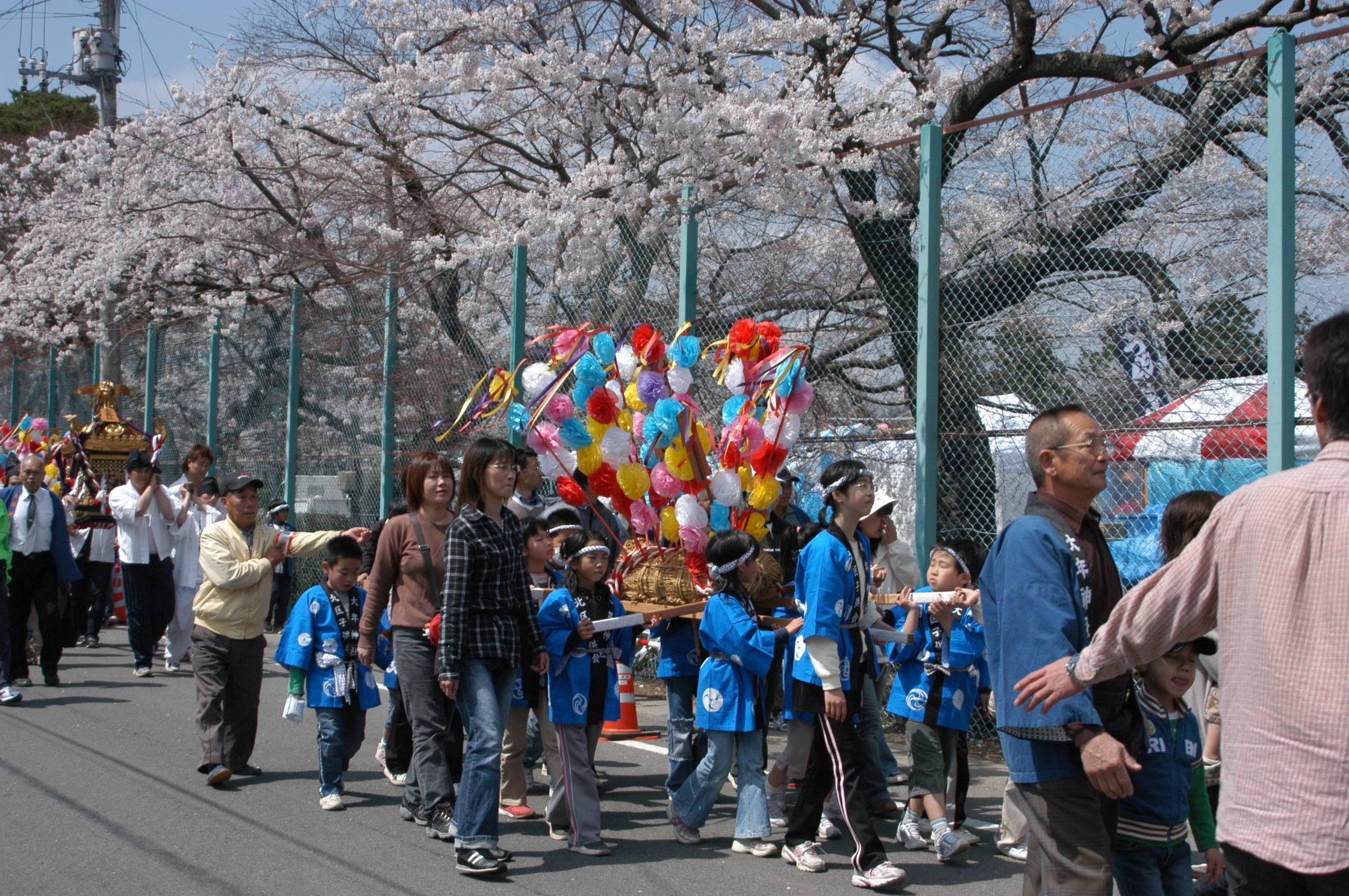
Residents of the Yonomori district in Tomioka, Fukushima Prefecture, march with a portable shrine in April 2007.
January 22, 2021
“Will Tomioka go back to how it was before?” Looking at the results of a survey, Kazuyoshi Kamata, vice head of the Yonomori Station northern administrative district in Tomioka, Fukushima Prefecture, reflects on his hometown and its reconstruction following the Fukushima No. 1 nuclear power plant triple meltdown in 2011.
In the surveys conducted by the Reconstruction Agency last fall, Tomioka residents listed important conditions in deciding whether they would return to their hometown or not, such as the reopening and construction of new medical, welfare and elder care facilities as well as the resumption and improvement of shopping complexes.
One condition that stands out among the list, though, is a further reduction in the amount of radiation, which 1 in 3 residents raised as an important issue. The government has been decontaminating specially designated areas, where it was once thought that settlement was limited for good but which can be reopened for residents. It has set the annual radiation exposure limit to be lower than 20 millisieverts as one of the standards to lift the evacuation orders.
Now that nearly 10 years have passed since the nuclear crisis at the Fukushima No. 1 plant, Kamata stressed the need for the government to decontaminate the area under stricter standards so that residents will feel safer returning to their hometown.
“In order to maintain people’s feelings for their hometowns, I want (the government) to stick to the stance of rebuilding our Tomioka in the form that we all want, including restoring the (basic living) environment.”
Tomioka’s Yonomori district used to be bustling with an increasing population, said Kamata, adding that younger generations supported the local community by planning events utilizing a famous row of cherry blossom trees and developing agriculture centered around rice crops.
“The district was a place full of energy where everyone, regardless of generation, was involved in making the local community,” said Kamata.
At the Yonomori cherry blossom festival held in spring, for example, smiles spread among residents as children strolled around, and the event also featured a mikoshi, or Shinto palanquin, from Otoshi Shrine.
The government is also doing its part in reconstructing the specially designated area in Tomioka by establishing zones focused on revitalizing businesses and agriculture. With creating agricultural corporations and making use of tourism resources such as roadside cherry blossom trees as the two main pillars, the government is working to attract about 1,600 people to live there, which is 40% of the population before the accident.
In the meantime, residents have been raising concerns about the 20 millisieverts condition, demanding a higher standard and more decontamination. In places that have recorded higher radiation levels, it is expected there will be damage from harmful rumors about things including tourism and agriculture.
“Without people, reconstruction would not begin. Creating conditions to invite more people without concerns is of utmost importance,” said Kamata, arguing that alongside other areas, restoring the living environment, including decontamination with the aim of lowering the annual radiation exposure to 1 millisevert or less, will be needed for future generations to live in Yonomori.
“Once the evacuation order is lifted, I want the local community to regain its connections within (the district),” said Kamata, hoping to take on a role of handing down the district’s traditions and way of life, as well as traditional scenery, to younger generations once he returns. As a vice-head of the administrative district, though, Kamata also intends to communicate crucial issues to the local government while residing in the area.
The lifting of the evacuation order in the specially designated area is expected in the spring of 2023, 12 years after the order was first issued.
“Without tackling issues such as restoring the living environment and infrastructure, as well as decommissioning of the Fukushima No.1 plant in a diligent manner, people won’t come back,” said Kamata. Now he hopes the government will share his passion for the hometown’s rebuilding.
This section features topics and issues covered by the Fukushima Minpo, the prefecture’s largest newspaper. The original article was published Jan. 12.
https://www.japantimes.co.jp/news/2021/01/22/national/fukushima-decontaminating-town/
Forests affected by Fukushima Daiichi nuclear accident

November 22, 2020
Forestry was once a thriving industry in Fukushima – until the 2011 nuclear disaster struck. More than 70 percent of the prefecture is covered with trees, but large areas have been abandoned or neglected.
“It’s regrettable. I didn’t even imagine things were so bad,” says forester Akimoto Kimio, who visited a plantation in Tomioka, about 10 kilometers away from the crippled Fukushima Daiichi nuclear power plant. Ever since an earthquake and tsunami triggered a triple meltdown at the facility, the forest has been abandoned. Some of its most prized pine trees, more than 50 years old, have died.
Akimoto, 72, heads a local forestry cooperative that was relocated elsewhere in the prefecture following the nuclear accident. But after nine years and eight months, it returned to Tomioka on November 4.

Akimoto Kimio, the head of the Futaba district forestry cooperative.
The forestry cooperative ships timber and manages maintenance, such as thinning out trees. Akimoto oversees about 2,000 hectares, 60 percent of which is in areas subject to an evacuation order due to high radiation levels.
His cooperative used to have 20 workers. At one point, the number dwindled to just two. Akimoto has worked hard to keep it afloat, negotiating with the central government and plant operator Tokyo Electric Power Company on decontamination work and compensation. He believes forest preservation will one day help to ensure evacuated residents can return.
Unattended areas of woodland can pose various risks, including fires. A contaminated forest would be particularly hazardous in the event of a landslide, because the mud flow is likely to contain radioactive substances.
n 2017, a forest fire near Tomioka burned down trees on a 75-hectare-plot. It took 11 days to extinguish.
“Our mission is to take good care of our hometown forests and enhance the surrounding environment,” says Akimoto on the day his cooperative returned to Tomioka.
“We will help lay the groundwork to ensure residents can return worry-free. We hope many will come home.”
In Rural Fukushima, ‘The Border Between Monkeys And Humans Has Blurred’
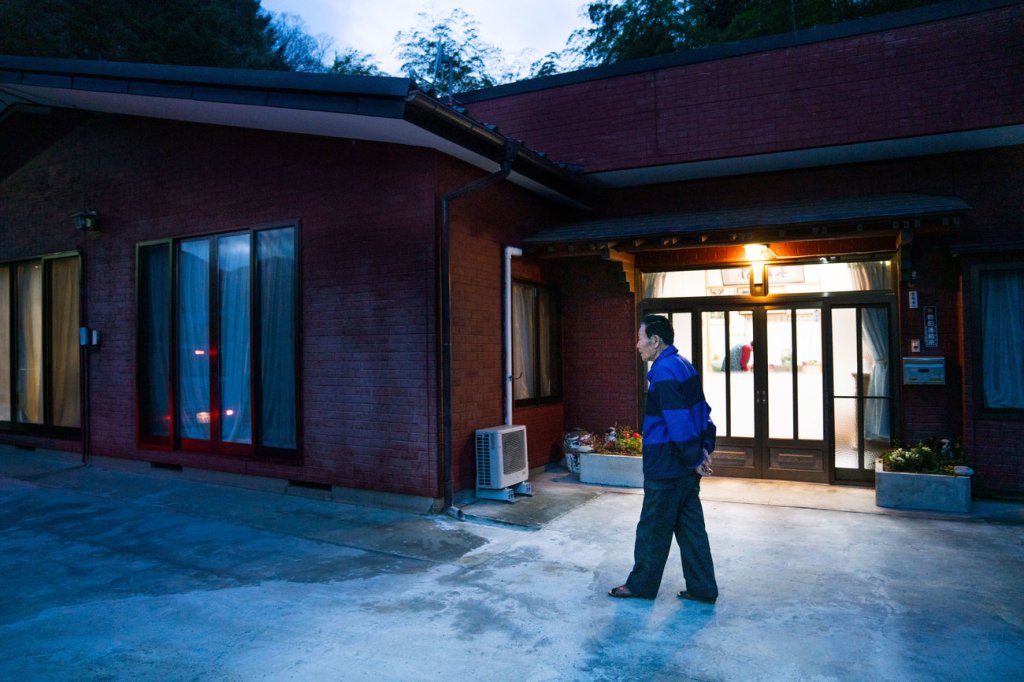
Shuichi Kanno, 79, walks in front of his home at dusk. Kanno has been dealing with hordes of macaque monkeys in his neighborhood in Japan. They frequently wake him up as they climb over his roof in the early morning hours.
September 10, 2020
Shuichi Kanno rips tape off the top of a large cardboard box at his house in the mountains in Fukushima prefecture in Japan. He opens the box and rustles around to pull out pack after pack of long, thin Roman candle fireworks. The words “Animal Exterminating Firework” are written in Japanese on the side of each canister.
Kanno has been battling hordes of macaque monkeys that have encroached upon his neighborhood in a rural area of Minamisoma. These fireworks are his main deterrent — not to cause the monkeys any physical harm, but to scare them away with a loud bang. That is, until they regain their confidence and come back a few days later, which they do like clockwork, Kanno says.

Kanno stacks fireworks on his coffee table to distribute to neighbors. The fireworks make a loud noise meant to scare, not injure, the monkeys.
“In the early morning while I’m sleeping, just when I’m about to wake up, I hear the noise,” the 79-year-old says in Japanese as he stacks the fireworks on his living room table. “The sound of the monkeys running around on the roof, getting into the gardens, eating all my food. I have to fight them.”
Hundreds of thousands of people evacuated this area nine years ago, fleeing plumes of radioactive material after three reactors exploded at the Daiichi nuclear power plant, one of the most serious nuclear disasters in history. Whole towns and neighborhoods like Kanno’s were left empty of human life for years — and, much like Chernobyl, nature started to reclaim the space. Plants poke through sidewalks and buildings, while wild boar, raccoons and foxes roam the streets. But in recent years, many evacuation orders have lifted and people have started to return, meaning humans and animals are having to figure out new ways to coexist — or not.

A macaque monkey in a tree in Fukushima prefecture. After the 2011 nuclear disaster, towns and neighborhoods in Fukushima were left devoid of humans for years, and nature started to reclaim the space.
“The monkeys never used to come here, but after the disaster, the border between monkeys and humans has blurred,” Kanno explains. “The houses were empty, but the gardens were still growing — plums, pears, chestnuts, persimmons. It was a wonderland for monkeys, an all-you-can-eat buffet. And they remembered that.”
His neighborhood is on the very edge of the evacuation area, relatively far from Daiichi. People stayed away for only a few years, but by the time they came back, the monkeys had become comfortable. And, Kanno points out, half the houses are still empty and only older people came back. They just don’t have the numbers they need to win the battle against the monkeys without backup.

From left: Shuichi Kanno, Shigeko Hoshino, Hiroyuki Shima and Hachiro Endo are neighbors who moved back to Fukushima after the nuclear disaster and who get regular visits from monkeys that eat fruits and vegetables from their gardens.
That is where the fireworks come in, subsidized by the local government after residents complained. The governments here have provided several different kinds of tools, such as wild boar traps and electric fences for farmers, to help communities with animal problems.
Yuriko Kanno, 75, Shuichi’s wife, comes into the living room, looks at the pile of fireworks and laughs. “I’ve been worried that this village is going to become like that movie, the monkey planet one,” she says, referring to Planet of the Apes. “I’ve seen it — it could happen!”
She walks away giggling. Shuichi Kanno is laughing too. The monkeys are annoying, yes, but they’re also a source of entertainment for the aging residents, he concedes.
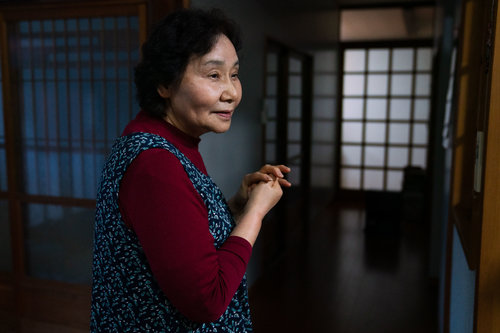
Yuriko Kanno, 75, is amused by the battle between her husband and the monkeys.
“Look, I think they’re cute. I would absolutely never hurt them,” he says. “None of this is their fault. It’s nuclear power’s fault. It’s the fault of humans.”
Shuichi Kanno is a leader in the neighborhood, and he’s in charge of distributing the fireworks to any of his neighbors who want them. The neighbors all have to sign an agreement saying they understand the dangers and — most importantly, he says — that they will not hurt any animals.
He loads the fireworks into the trunk of his car and drives down forest roads from house to house, dropping off packs of fireworks at every stop. As he drives, he points to all the natural beauty in the area. The nuclear disaster didn’t just change his relationship with monkeys, he says.
“I loved hiking, and foraging for wild vegetables, finding wild mushrooms. But now it’s so dangerous,” Kanno explains, referring to the high levels of radioactive cesium still present in the dense forests here. “We can’t have a relationship with nature anymore. It’s gone.”

Kanno drives his truck down a main road in his neighborhood, chasing monkeys that he saw scampering around his house not long ago.
He pulls up to the house of Hachiro Endo, 77, whose family has been in the area for generations. The home has a beautiful garden in front and long strands of drying persimmons hanging in the garage.
Endo is delighted by the delivery. He has gone through his entire stockpile protecting his garden. “I’m alert all the time,” Endo sighs. “The monkeys, they’ve taken over my life.”
He says he remembers a time when he was little and his grandfather tried to lure the monkeys down from the mountains into the village, hoping to boost tourism to the area by becoming a monkey town. He was never successful — the macaques were too afraid of humans to come down and stay.
“If only he could see it now,” he says with a laugh.

A troop of monkeys scampers across a road in Fukushima prefecture.
A few days later, Kanno is out on monkey patrol. He has just seen a troop of monkeys running from his house out into the neighborhood. He’s wearing knee-high rubber boots, a bright orange jacket and a baseball cap while clutching a firework in one hand and the steering wheel of his pickup truck in the other.
He drives slowly, leaning forward to scan the hills as he goes. And then suddenly, he slams on his brakes.
“There they are!” he shouts, pointing behind a shed. Dozens of monkeys are jumping toward the forest, scrambling up trees and crawling up the hillside.
He jumps out of the truck and pulls the firework from underneath his jacket, loading it onto a kind of stick so he can hold it far away. He lights the fuse and smiles, pointing it toward the hill.
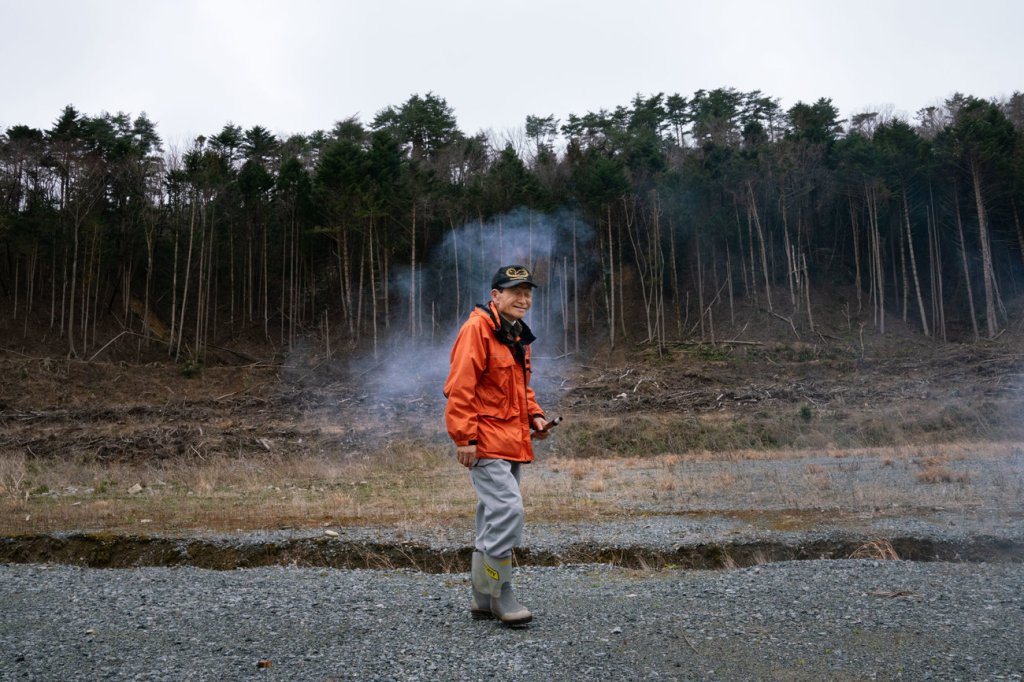
Kanno grins after shooting off a firework to scare off monkeys that were roaming through the neighborhood.
Three loud booms echo through the trees. The monkeys scatter. Kanno bursts into a grin, giggling. Then he runs to every house nearby, making sure his neighbors know that he just saved their gardens from almost certain devastation.
“They won’t be back tomorrow!” Kanno calls, waving the spent firework, giddy with excitement. “I won today!”
But even as he says that he loads a fresh firework and tucks it into his coat. The monkeys will be back, and the battle will continue.
Mr Sugeno Seiji, farming organically in Nihonmatsu City, Fukushima Prefecture
September 11, 2020
Through the nuclear power plant disaster, Mr Sugeno reaffirmed the values of farming. His words leave a strong impression: “The nuclear plant stole our hometowns, they create divisions. This must not be repeated.” “We people of Fukushima need to share our story. To change lifestyles, to change policies. To stand up to the government, to farm our fields, this is want we want to continue to do.”
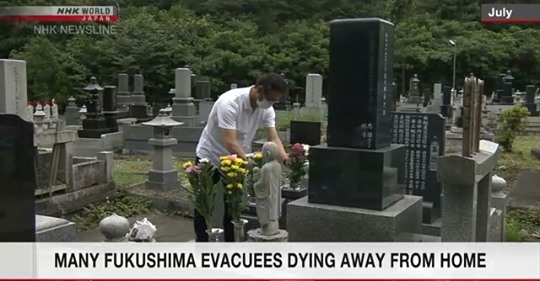
Many Fukushima evacuees die away from home
September 9, 2020
NHK has learned that more than 2,600 people have died over the ensuing years after being evacuated from their hometowns following the meltdowns at the Fukushima Daiichi nuclear power plant in March 2011.
NHK contacted local governments in Fukushima Prefecture and found that at least 2,670 people, about 10 percent of the original population, had died as of August. More than 26,500 people lived in seven municipalities near the plant. Where they lived have been designated no-entry zones for nearly nine and a half years because radiation levels remain high.
By municipality, 895 people from Okuma Town have died, 792 from Futaba Town, 576 from Namie Town, 362 from Tomioka Town, 32 from Iitate Village, 12 from Katsurao Village, and one from Minamisoma City.
The Japanese government is conducting decontamination work and rebuilding infrastructure in some areas with the aim to allow residents to return in two or three years.
But there is no concrete plan to make other parts, or 92 percent of the no-entry zone, habitable again, despite the strong hope of residents to return home.
Billing Olympics as ‘pandemic recovery games’ unfeasible: ex-Fukushima mayor
 Former Minamisoma Mayor Katsunobu Sakurai is seen talking to the Mainichi Shimbun in Minamisoma, Fukushima Prefecture, on July 3, 2020
August 5, 2020
MINAMISOMA, Fukushima — Katsunobu Sakurai, former mayor of Minamisoma, Fukushima Prefecture, who was in office during the March 2011 earthquake and tsunami disaster, firmly stated during a recent interview with the Mainichi Shimbun that it is unfeasible to dub the Tokyo Olympics a “sign of humanity’s triumph over the novel coronavirus,” as suggested by Prime Minister Shinzo Abe.
Sakurai, who was born in the city of Minamisoma himself, served two terms as mayor for his hometown between 2010 and 2018. Sakurai was picked as one of Time magazine’s 100 most influential people in 2011 following the disaster at Tokyo Electric Power Co.’s Fukushima Daiichi Nuclear Power Station.
The following is an excerpt of Sakurai’s remarks to the Mainichi Shimbun on July 3.
* * * * *
Following the postponement of the Tokyo Olympic and Paralympic Games, Prime Minister Shinzo Abe spoke of holding next year’s Olympics as a “sign of humanity’s triumph over the novel coronavirus.” Up until now, the prime minister may have thought that presenting the event with the title “disaster recovery” from the Great East Japan Earthquake would gather worldwide attention, but now he is trying to replace this slogan amid the global spread of the novel coronavirus. However, the concept of a “recovery Olympics,” let alone a “coronavirus Olympics” has no chance of success.
 Former Minamisoma Mayor Katsunobu Sakurai is seen talking to the Mainichi Shimbun in Minamisoma, Fukushima Prefecture, on July 3, 2020.
The torch relay for the 2020 Tokyo Olympics, which was eventually canceled due to the coronavirus outbreak, was just a performance put on for show. The relay was set to start at the J-Village national soccer training center in Fukushima Prefecture, which was used as a base to handle the Fukushima Daiichi nuclear disaster (after the Great East Japan Earthquake). However, the relay route was limited to areas that have been tidied up, and did not show the real nature of the disaster-hit areas. “Recovery” means restoring an environment to a state where people can return. At the very least, if residents have returned and can once again live in a state similar to before the disaster, this may be called a recovery. But the government is trying to show how far the recovery has progressed, when in fact there is much left to be achieved.
There is also talk that flowers grown in the disaster-stricken areas will be used for victory bouquets awarded to Olympic medalists, but would this actually help boost the recovery overall? In Fukushima Prefecture, baseball and softball matches for the Olympic Games are to be held in the prefectural Azuma ballpark in the suburbs of the city of Fukushima, but this site has almost no connection to the coastal areas of the prefecture (that were damaged in the tsunami following the magnitude-9.0 temblor). It appears that it is nothing more than a performance (by the Japanese government).
No matter how much you tout the games as a sign of recovery, the overall picture of only Tokyo prospering while the recovery of the disaster-hit areas in the Tohoku region remains undone will not change. I’ve been to Tokyo many times, and saw that there were more crane trucks at the construction site of the athletes’ village than in the disaster-hit areas. It was obvious at a glance where the national government was placing its resources.
It’s not that I am disapproving of the Olympics itself. It is a festivity celebrating peace, and I am aware that Japan had been long active in its bid to host the games. However, it doesn’t make sense when you start calling it a “recovery Olympics.” The inconsistency becomes clear when labeling the games an event “contributing to the recovery of the disaster-hit areas.”
During the Japan’s bid to host the 2020 Olympics, Prime Minister Abe described the polluted water generated by the nuclear disaster as being “under control,” and then Tokyo Games bid committee chairman Tsunekazu Takeda called Tokyo “safe,” as it is 250 kilometers away from Fukushima. Don’t these very statements run counter to a “recovery Olympics”?
At the time, I was confronted by an elderly resident of my city who asked, “It’s a dangerous place here, isn’t it? Why don’t you let us live in Tokyo?” A “recovery Olympics” should by nature be something that residents of the disaster-stricken areas can feel good about holding, but the authorities’ perceptions are inconsistent with those in such areas.
If a “recovery Olympics” in the true sense of the term is to be held, it will by restoring the coastal regions of disaster-hit areas to a state capable of hosting the events, such as marathons.
During the 2019 Rugby World Cup, matches were held in the city of Kamaishi, Iwate Prefecture, in northeastern Japan, (an area also hit hard by the tsunami) as a way to underscore the recovery. This must have been a large source of emotional strength for local residents. However, Fukushima Prefecture still has zones that people cannot even enter. It just doesn’t seem like it is in any condition to hold the Olympics. I can only presume that the large impact of the nuclear disaster is still being underestimated.
The Japanese government has prepared for the Olympics while upholding the “disaster recovery” label, even though a recovery is far from reality. It is superficial to declare a recovery with no actual progress. The government is now talking of an Olympics that could be a sign of humanity’s triumph over the pandemic, but vaccines have not yet been put into practical use, and the world has not yet been freed from the risk of infection. There is no chance of success by trying to box in reality to meet the labels the government upholds. The idea of a “coronavirus Olympics” may also likely end as a mere fantasy.
(Original Japanese interview by Jun Kaneko, City News Department)
https://mainichi.jp/english/articles/20200805/p2a/00m/0na/003000c
Experts propose two methods to scrap Daiichi plant
July 26, 2020
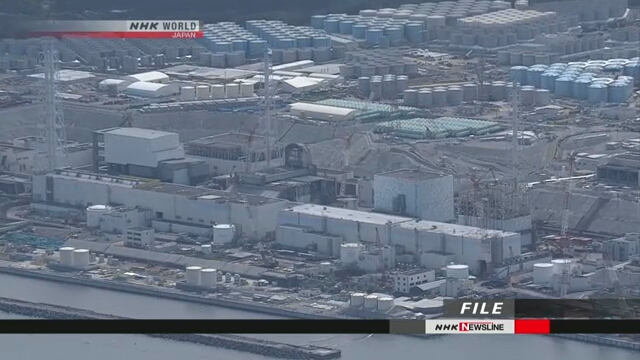
Japanese atomic energy experts have proposed two ways to decommission the crippled Fukushima Daiichi nuclear power plant.
The Atomic Energy Society of Japan floated the two methods in a report.
One proposal is to dismantle and remove all parts of the reactor buildings and leave the site vacant. The other is to dismantle and remove parts of the reactor buildings that are above ground and leave behind the underground structures.
The experts say each method has been studied in the United States and European countries.
They say amounts of radioactive waste to be generated during decommissioning work will vary significantly, depending on when the dismantling of reactor buildings begins — namely, starting to dismantle contaminated buildings soon or waiting a certain period for their radiation levels to drop.
A decommissioning timeline released by the Japanese government and the plant’s operator, Tokyo Electric Power Company, shows the scrapping process will be completed by 2051. But the plan is unclear on how the reactor buildings will be decommissioned.
Miyano Hiroshi, a member of the Atomic Energy Society of Japan, says it will be difficult to draw a conclusion from various arguments on how to decommission the plant. But he adds discussions are important and that he hopes the society’s report will contribute to the debate.
Robots in Fukushima monitor cucumber production in IT-farming joint project
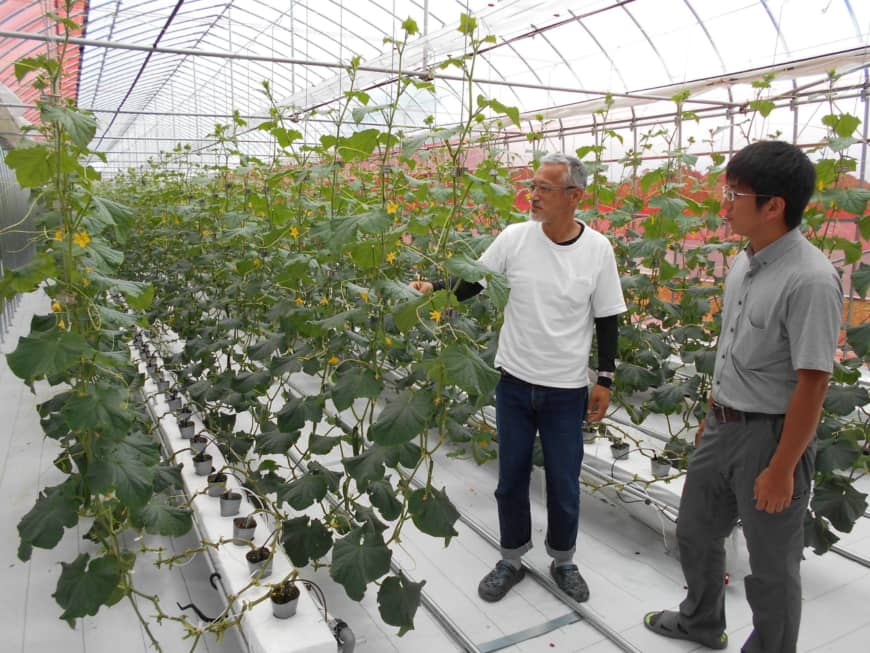 Katsumi Hashimoto (left) president of the Fukushima Seed Center, talks about how he teamed up with two other technology companies to make cucumber farming less labor intensive.
Jul 24, 2020
Three ventures from the IT and farming industries have started testing methods to produce cucumbers with less human labor in Sukagawa, Fukushima Prefecture, in the hope that it will reinvigorate the agriculture industry suffering from a worsening labor shortage, including a lack of successors.
Two technology companies, Benefic Co. and MK tech, have teamed up with Fukushima Seed Center and established a project team called Smart Agri Fukushima.
The team created a 1,300-square-meter testing greenhouse, planted 2,000 cucumbers and is monitoring temperatures, humidity and carbon dioxide among other data remotely using robots. The team has already shipped 1.6 tons of produce to a local agricultural cooperative, with a plan to expand the greenhouse to 1 hectare, or eight times the current scale, in the next five years.
In developing robots to monitor the cucumbers, Benefic will be in charge of its software while MK tech will manufacture the hardware. In the greenhouse, cucumbers are produced through a unique hanging method, which makes it easier for robots to monitor the produce, rather than the usual method which is to cut the plant at a certain height.
According to the seed center, the Sukagawa area, well-known for cucumbers, has been struggling for years with a shortage of labor, causing farmers to automate the farming process to make it more attractive to younger people. In the future, they hope to spread the smart farming method nationwide.
“We want to protect cucumber farming by making the fields less labor intensive,” said Katsumi Hashimoto, president of the seed center.
https://www.japantimes.co.jp/news/2020/07/24/national/robots-farming-fukushima/
New hotel boom in Fukushima capitalizing on reconstruction
July 13, 2020
Areas close to the site of the 2011 Fukushima nuclear disaster might seem like the least likely prospect for a hotel construction boom, but as the region slowly begins to recover, demand for places to stay is at a premium.
Hotel operators are not expecting to cater to people with a morbid fascination for the facility that went into a triple meltdown following the magnitude-9.0 Great East Japan Earthquake and tsunami, but to accommodate those involved in reconstruction projects, and later, business travelers and other visitors.
Coastal areas of Fukushima Prefecture were the first to experience a rush in new hotel construction, mainly facilities offering 100 or so rooms.
This fall, the wave of hotel openings will even extend to Futaba, a town that hosts the Fukushima No. 1 nuclear power plant operated by Tokyo Electric Power Co.
Over the past nine years since the disaster at the Fukushima No. 1 nuclear power plant, hotels have mostly been occupied by construction workers.
However, hotel operators are expecting a more diverse clientele to develop in the future.
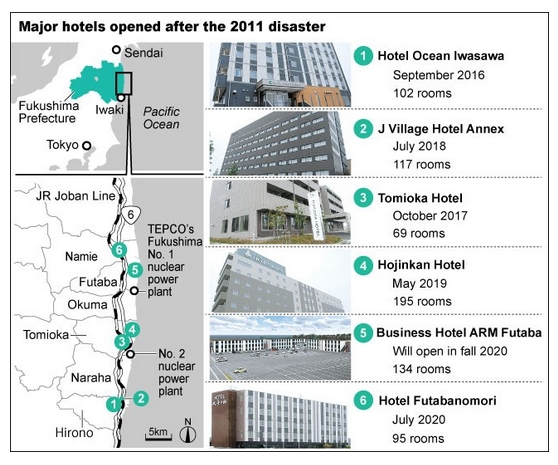
Hotel Futabanomori, located in the town of Namie about nine kilometers north of the crippled Fukushima No. 1 nuclear power plant, is expected to open on July 15.
The hotel has 95 rooms, most of them singles that cost 6,500 yen ($ 61) a night, including taxes, or 9,000 yen with breakfast and supper thrown in.
It is situated not far from the No. 6 national road that rumbles for much of the day with heavy trucks going to and from construction sites.
An evacuation order was lifted in the central part of the town in March 2017. Currently about 1,400 people live there, which accounts for less than 10 percent of the pre-disaster population.
But new businesses are moving into the town. In March, top-level facilities for research and development of robots and hydrogen production were established in Namie as a part of a national project.
Takashi Shiga, the 47-year-old president of Hotel Futabanomori, said he hopes his hotel will create an opportunity for residents to “get together with relatives and old classmates who left their hometown and moved far away back to return to Namie.”
He also said he wanted the hotel to provide workers involved in reconstruction projects “with a sense of comfort.”
Prior to the disaster, towns near the nuclear power plants used to be dotted with small inns and hotels catering to beachgoers, surfers and workers at nuclear and thermal power plants.
After the disaster, residents within a 20-km radius of the Fukushima No. 1 nuclear power plant were ordered to evacuate.
Hirono town, located about 20 km south of the facility, offered the main venue for places to stay for workers involved in cleanup, decontamination and reconstruction projects.
“I received so many phone calls from workers desperately looking for a place to lie down and get some sleep,” said Minoru Yoshida, 64, who runs an inn called Iwasawaso in Hirono.
Yoshida evacuated to Tokyo temporarily immediately after the disaster. But within two months, he started taking in guests.
Parts of Iwasawaso were damaged by the earthquake, but Yoshida opened his own home, which was adjacent to the inn and emerged unscathed, to let guests stay.
He also turned a banquet room in the inn into a space for workers to spend the night.
In 2016, Yoshida built a business hotel with 102 rooms, Hotel Ocean Iwasawa, nearby.
Prior to the disaster, he managed two buildings with 83 rooms. Now, he manages four buildings with 211 rooms.
An average of 150 to 200 guests stay at his properties each day.
“This is my hometown. That’s why I want it to be rebuilt,” Yoshida said. “I wanted to help these people who came here to work for the rebuilding by letting them stay.”
In Futaba town, where the No. 1 nuclear power plant is located, a new business hotel with 134 rooms, “ARM Futaba,” is slated to open this fall.
In March, an evacuation order was lifted for 4.7 percent of the town.
A new museum dedicated to explaining the damage from the March 2011 disaster and the lessons learned from it is also slated to open in the town this fall.
Expectations remain high that former residents will start returning two years from now to live in Futaba.
Arm System, a Hokkaido-based company that manages the new hotel, hopes that evacuees from the town will stay at the property during temporary homecoming visits.
Industrial complexes are also under construction in the area.
“We expect strong demand from business travelers and museum visitors and foresee a sustainable business in the future,” a company representative said.
Tomioka town, about 10 km south of the nuclear power plant, along with surrounding areas, has witnessed a rise in new apartment buildings for single people and company dormitories since April 2017, when the evacuation order was lifted.
In October that year, Tomioka Hotel with 69 rooms was opened by eight residents who ran food and clothing stores in the town.
The hotel has maintained an average 70 percent occupancy rate since then. Most of the guests were engineers and businesspeople visiting the town for reconstruction projects from the Tokyo metropolitan area.
But Tsukasa Watanabe, the 61-year-old president of the hotel, admitted to “feeling nervous about the future,” citing the impact of the novel coronavirus pandemic that caused visits by business travelers to dry up.
The hotel has relied on a central government subsidy that supports two-thirds of a hotel construction fee, and other initiatives.
“But we can’t just continue to rely on such (support),” said Watanabe, who desperately feels the need to come up with a strategy to bolster his hotel’s competitiveness.
Kota Kawasaki, an associate professor of town planning at Fukushima University, noted that the trend of hotel occupancy by construction workers had reached its peak more or less.
“Competition among hotels will increase from now on,” he said. “Each hotel will have to devise more strategic management skills to stay in business.”
Rally opposes proposal for Fukushima radioactive wastewater
July 12, 2020
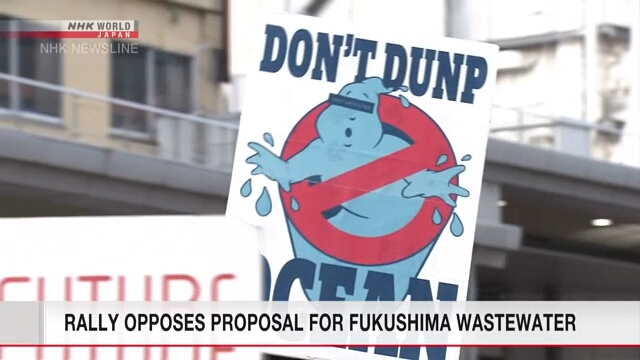
Dozens of young people in Japan’s Fukushima Prefecture have rallied against a government panel’s proposal on how to dispose of radioactive wastewater stored at the crippled Daiichi nuclear power plant.
About 50 people, including fisheries workers, marched through Koriyama City on Sunday.
The demonstration was organized by a group of Fukushima residents in their 20s and 30s, who said detrimental rumors about the prefecture may circulate if the wastewater is disposed of improperly.
Group representative Sato Taiga said a survey shows that most respondents do not know about the issue. He added that he hopes the group’s activities will raise awareness among people, including the younger generation.
Water used to cool molten nuclear fuel from the 2011 accident at the plant has most of the radioactive materials removed before being stored in tanks. But the treated water still contains tritium and some other radioactive substances.
The amount stored has reached some 1.2 million tons. The plant’s operator, Tokyo Electric Power Company, expects to reach capacity around the summer of 2022.
In February, a government panel compiled a report that says a realistic solution is releasing the wastewater into the sea or air after diluting it in compliance with environmental and other standards.
The government is in the process of hearing opinions from local governments and relevant organizations before making its final decision on how to dispose of the treated water.
Video Testimonies from Fukushima in 7 Languages: “We want to protect the ocean of Fukushima, for the future of the fishing industry”
July 11, 2020
Peace Boat has cooperated with the environmental NGO Friends of the Earth Japan (FoE Japan) to launch the next in their series of video testimonies of the current situation in Fukushima in various languages.
Nine years have passed since the Fukushima Nuclear Power Plant Disaster, and the damage continues to be incurred. Although this disaster is still ongoing, efforts are made to render this invisible. FoE Japan has conducted video interviews with evacuees, dairy farmers, fishermen and other community members in order to make the ongoing impacts more known as part of the “Fukushima Mieruka Project.”
The next multilingual installment in this series includes interviews with fishermen from Fukushima, who have been pushed back and forth by the policies of the Japanese Government and TEPCO, and who hold great concerns for their future. These are being released simultaneously in English, French, Spanish, Chinese (simplified and traditional), Korean and German, as well as Japanese.
The fishermen interviewed told us that they are still struggling to sell their fish due to the impacts of the nuclear accident. They are working to restore confidence step by step, by conducting efforts such as test operations and radiation monitoring themselves. However, the Japanese Government and TEPCO have launched a plan to discharge large amounts of radioactive contaminated materials generated at the Fukushima Daiichi nuclear power plant, including tritium, into the ocean.
“From now, our worry is the problems for successors. If an unexpected fish is found in the future, the young generation will really suffer, those in the fishing industry. Really. It’s a life-or-death matter.”
Please listen to the voices of concern and anger of the Fukushima fishermen (12mins 31 sec).
https://www.youtube.com/watch?v=zSVu_52u7z8&feature=emb_logo
Click on the name of each language to watch the clip on Youtube:
- English
- French
- Korean
- Chinese (traditional)
- Chinese (simplified)
- German
- Japanese
- Spanish (coming soon)
See here for a Q&A of more information on Japanese government plans to release contaminated water into the ocean here.
Sign the petition demanding that contaminated water being stored at the Fukushima Daiichi Nuclear Power Station NOT be discharged into the sea, and instead stored on land and solidified via change.org here
1 This Month

of the week – Shut Down Drone Warfare!


Tell the Ukrainian Government to Drop Prosecution of Peace Activist Yurii Sheliazhenko

Petition to revoke the licensing of the Near Surface Nuclear Disposal Facility (NSDF) at Chalk River. https://www.ourcommons.ca/petitions/en/Petition/Details?Petition=e-7247
To see nuclear-related stories in greater depth and intensity – go to https://nuclearinformation.wordpress.com
-
Archives
- March 2026 (244)
- February 2026 (268)
- January 2026 (308)
- December 2025 (358)
- November 2025 (359)
- October 2025 (376)
- September 2025 (257)
- August 2025 (319)
- July 2025 (230)
- June 2025 (348)
- May 2025 (261)
- April 2025 (305)
-
Categories
- 1
- 1 NUCLEAR ISSUES
- business and costs
- climate change
- culture and arts
- ENERGY
- environment
- health
- history
- indigenous issues
- Legal
- marketing of nuclear
- media
- opposition to nuclear
- PERSONAL STORIES
- politics
- politics international
- Religion and ethics
- safety
- secrets,lies and civil liberties
- spinbuster
- technology
- Uranium
- wastes
- weapons and war
- Women
- 2 WORLD
- ACTION
- AFRICA
- Atrocities
- AUSTRALIA
- Christina's notes
- Christina's themes
- culture and arts
- Events
- Fuk 2022
- Fuk 2023
- Fukushima 2017
- Fukushima 2018
- fukushima 2019
- Fukushima 2020
- Fukushima 2021
- general
- global warming
- Humour (God we need it)
- Nuclear
- RARE EARTHS
- Reference
- resources – print
- Resources -audiovicual
- Weekly Newsletter
- World
- World Nuclear
- YouTube
-
RSS
Entries RSS
Comments RSS
 nuclear-news