Outgoing Fukushima plant chief says long road still ahead

The crippled Fukushima No. 1 nuclear power plant has seen improvements over the past three years but it will continue to be a difficult project during its decades-long decommissioning, the outgoing chief of the plant said Thursday.
Akira Ono, who headed the plant for three years until Thursday, said improvements include removing spent fuel rods from the damaged reactor building 4 and reducing the amount of groundwater seeping into reactor buildings, which then mixes with highly contaminated water.
“As for the working environment, workers can now have hot meals at a new, large rest station. In March, we were also able to widen the areas where they can work with their regular clothes” as radiation levels have decreased, Ono said.
Under the high radiation atmosphere, workers have to wear protective suits and full-face masks that are uncomfortable and make it hard to communicate with each other.
But the plant still needs to ensure facilities and equipment are operating more smoothly, and also further improve working conditions over the next two to three years in order to handle decommissioning work expected to take 30 to 40 more years, Ono said.
The Fukushima No. 1 plant faced an electric outage this week, which shut down some of the cooling facilities for its underground ice walls.
Ono said that the decommissioning work will also face other challenges, including identifying the exact location of melted fuel rods.
Shunji Uchida, who will be heading the plant from Friday, said he will spearhead efforts to create a strong foundation for the long decommissioning task ahead.
Ono takes on a new role at the Nuclear Damage Compensation and Decommissioning Facilitation Corporation, a body funded by the government and regional utilities to research technologies for decommissioning work.
Melted fuel may be at the bottom of No.2 reactor
NHK has learned it is highly likely that a large amount of melted nuclear fuel remains at the bottom of one of the damaged reactors at the Fukushima Daiichi nuclear power plant.
Experts from Tokyo Electric Power Company and other institutions confirmed a large black shadow at the bottom of the No.2 reactor, using a device that uses elementary particles called muons.
The probe to see into the reactor’s interior has been conducted with the High Energy Accelerator Research Organization and others.
The analyses of the image led the experts to believe that most of the melted fuel is likely located at the bottom of the reactor together with other structures in the reactor.
This is the first time that an image of what’s believed to be molten fuel has been captured. Similar shadows are said to have been confirmed also on the walls of the reactor.
The results of the probe have a considerable impact on a process to remove melted fuel, the most difficult part of reactor decommissioning.
TEPCO is conducting further analyses of the reactor.
During the accident in 2011, nuclear fuel melted down in the plant’s 3 reactors. Most of the fuel in the No.1 reactor is believed to have melted through the core. But the locations of the fuel in the No.2 and 3 reactors are not yet known.
Prefecture’s subsidies for residents near Fukushima No. 1 plant to run out next year
FUKUSHIMA – Fukushima Prefecture’s fund to provide subsidies to residents living near Tokyo Electric Power Company Holdings Inc.’s Fukushima No. 1 nuclear power plant is expected to run out during fiscal 2017, sources said Tuesday.
The prefectural government will hold talks with nine municipalities around the plant this autumn to decide whether to abolish the subsidy program during fiscal 2016, which ends next March, or find a new revenue source to continue it, the sources said.
The fund finances benefits provided to some 33,770 households and offices in the nine municipalities.
The balance of the fund is expected to decline to about ¥50 million by the end of fiscal 2016 from ¥280 million a year before.
Benefits to residents near the plant began in fiscal 1981. Initially, they were provided by the central government through the prefecture.
The central government halted the grants to the prefecture at the end of fiscal 2014, after Tepco decided in January 2014 to decommission all of the reactors at the plant following its triple meltdown in March 2011.
But the prefectural government continued the provision using subsidies not given to residents whose whereabouts became unknown after the nuclear disaster started.
Power outage at Fukushima nuclear power plant causes machinery to shut down
The operator of the crippled Fukushima No. 1 nuclear power plant said Tuesday a power outage halted some systems but that no problems were detected in the cooling of the three melted-down reactors.
Machinery affected included cooling equipment for an underground ice wall, which is being set up around four reactor buildings in a bid to restrict the flow of groundwater beneath them.
Tokyo Electric Power Co. said an alarm sounded at 3:40 a.m. Tuesday, and workers found a unit that filters radioactive cesium from contaminated water had shut down.
The Nos. 1 to 3 reactors, which suffered meltdowns in the 2011 crisis, are currently being kept cool by having water poured into them every day.
Tepco said no abnormalities were detected with this equipment or in the surrounding environment.
Radioactive cesium fallout on Tokyo from Fukushima concentrated in glass microparticles
Public Release: 26-Jun-2016 Goldschmidt Conference
New research shows that most of the radioactive fallout which landed on downtown Tokyo a few days after the Fukushima accident was concentrated and deposited in non-soluble glass microparticles, as a type of ‘glassy soot’. This meant that most of the radioactive material was not dissolved in rain and running water, and probably stayed in the environment until removed by direct washing or physical removal. The particles also concentrated the radioactive caesium (Cs), meaning that in some cases dose effects of the fallout are still unclear. These results are announced at the Goldschmidt geochemistry conference in Yokohama, Japan.
The flooding of the Fukushima Daiichi Nuclear Power Plant (FDNPP) after the disastrous earthquake on March 11 2011 caused the release of significant amounts of radioactive material, including caesium (Cs) isotopes 134Cs (half-life, 2 years) and 137Cs (half-life, 30 years).
Japanese geochemists, headed by Dr Satoshi Utsunomiya (Kyushu University, Japan), analysed samples collected from within an area up to 230 km from the FDNPP. As caesium is water-soluble, it had been anticipated that most of the radioactive fallout would have been flushed from the environment by rainwater. However, analysis with state-of-the-art electron microscopy in conjunction with autoradiography techniques showed that most of the radioactive caesium in fact fell to the ground enclosed in glassy microparticles, formed at the time of the reactor meltdown.
The analysis shows that these particles mainly consist of Fe-Zn-oxides nanoparticles, which, along with the caesium were embedded in Si oxide glass that formed during the molten core-concrete interaction inside the primary containment vessel in the Fukushima reactor units 1 and/or 3. Because of the high Cs content in the microparticles, the radioactivity per unit mass was as high as ~4.4×10¹¹ Bq/g, which is between 107 and 108 times higher than the background Cs radioactivity per unit mass of the typical soils in Fukushima.
Closer microparticle structural and geochemical analysis also revealed what happened during the accident at FDNPP. Radioactive Cs was released and formed airborne Cs nanoparticles. Nuclear fuel, at temperatures of above 2200 K (about as hot as a blowtorch), melted the reactor pressure vessel resulting in failure of the vessel. The airborne Cs nanoparticles were condensed along with the Fe-Zn nanoparticles and the gas from the molten concrete, to form the SiO2 glass nanoparticles, which were then dispersed.
Analysis from several air filters collected in Tokyo on 15 March 2011 showed that 89% of the total radioactivity was present as a result of these caesium-rich microparticles, rather than the soluble Cs, as had originally been supposed.
According to Dr Satoshi Utsunomiya;
“This work changes some of our assumptions about the Fukushima fallout. It looks like the clean-up procedure, which consisted of washing and removal of top soils, was the correct thing to do. However, the concentration of radioactive caesium in microparticles means that, at an extremely localised and focused level, the radioactive fallout may have been more (or less) concentrated than anticipated. This may mean that our ideas of the health implications should be modified”.
Commenting, Prof. Bernd Grambow, Director of SUBATECH laboratory, Nantes, France and leader of the research group on interfacial reaction field chemistry of the ASRC/JAEA, Tokai, Japan, said:
“The leading edge observations by nano-science facilities presented here are extremely important. They may change our understanding of the mechanism of long range atmospheric mass transfer of radioactive caesium from the reactor accident at Fukushima to Tokyo, but they may also change the way we assess inhalation doses from the caesium microparticles inhaled by humans. Indeed, biological half- lives of insoluble caesium particles might be much larger than that of soluble caesium”.
http://www.eurekalert.org/pub_releases/2016-06/gc-rcf062316.php
Radioactive “Glassy Soot” Fell Over Tokyo After the Fukushima Meltdown
It’s science no one wishes was necessary.
Most of the radioactive material that rained down on Tokyo following the meltdown at the Fukushima Daiichi Nuclear Power Plant was encapsulated in glassy microparticles, researchers have found.
The findings, which will be presented on Monday at the Goldschmidt conference in Japan, show that the radioactive fallout from the 2011 earthquake and subsequent nuclear disaster has been poorly understood. Previously, it was assumed that most of the radiation that fell dissolved in rain. This would mean that it would wash out of the soil and through the environment with the hydrologic cycle.
However, what actually happened is that, in the midst of the meltdown, molecules of radioactive caesium and nanoparticles of iron-zinc oxides became embedded in silicon oxide glass. This occurred because of the interaction between the molten core and the concrete containment units.
These tiny glass particles entered the air and fell as soot on the surrounding region. Because the radioactive molecules are contained in an insoluble medium, they will not wash out of the soil with rainwater to the same extent.
“It looks like the clean-up procedure, which consisted of washing and removal of top soils, was the correct thing to do,” says Dr. Satoshi Utsunomiya, who will present the findings on Monday. “However, the concentration of radioactive caesium in microparticles means that, at an extremely localised and focused level, the radioactive fallout may have been more (or less) concentrated than anticipated.”
Beyond the consequences for the environment, there are significant consequences for human health. Breathing caesium encased in glass particles may have a very different impact from exposure to it as radioactive rain, and it may be dangerous at a much higher or lower concentration. The half-life of the material may also depend heavily on the medium.
This information will be valuable in assessing the ongoing impacts the Fukushima disaster. Hopefully, no nuclear meltdown on that scale occurs again, but if one does, this new science will help governments better respond to the crisis.
Tepco admits they concealed the fact of meltdown 7 million Bq of all β nuclides leaked as contaminated water in Fukushima plant

According to Tepco, highly contaminated water leaked from a water storage tank on 6/26/2016.
All β nuclides density is reportedly 96,000,000 Bq/m3. Cs-134/137 density is also 700,000 Bq/m3.
Tepco states the leaked volume was 72 L. Based on their announcement, at least 6,912,000 Bq of all β nuclides leaked to contain Sr-90.
Tepco says no contaminated water spread to the outside of the tank area.
The type of this tank has unwelded joint parts, which is vulnerable for leakage.
The life of these tanks was reported to be 5 years but in 2013 Tepco admitted it has no basis.
These tanks are not bearable for the contaminated water but these are still in use.
http://www.tepco.co.jp/press/mail/2016/1301003_8708.html
http://www.tepco.co.jp/press/mail/2016/1301004_8708.html
http://www.tepco.co.jp/press/mail/2016/1301009_8708.html
Fukushima evacuees made to feel small if they don’t return

Makiko Sekine tends flowers at a public housing unit for disaster survivors in Kawauchi, Fukushima Prefecture, with her husband, Hiroshi, on June 14. That day, the evacuation order was lifted for parts of the village, including the couple’s home district of Kainosaka.
KAWAUCHI, Fukushima Prefecture–In a rush of sorts, evacuation orders are being lifted from municipalities of this northeastern prefecture that were affected by the 2011 nuclear disaster.
The order was lifted for part of the village of Katsurao on June 12, followed by an area of Kawauchi village on June 14. It will be lifted for a section of Minami-Soma city on July 12.
The central government has decided to have all evacuation orders lifted by March next year, except for in “difficult-to-return” zones where radiation levels remain elevated.
Prime Minister Shinzo Abe, having toured Katsurao and Kawauchi on June 3, said, “I want to make sure that the livelihood of the communities, as well as family and community ties, is revived as soon as possible.”
Having covered news in Fukushima Prefecture for four years, I cannot believe that everything is so rosy simply because evacuation orders are being lifted.
It is certainly good news that disaster-affected areas are becoming freely accessible again, but I know that some residents are being left behind in the process.
Hiroshi Sekine, 88, and his wife, Makiko, 81, a couple I have known for three years, are from the Kainosaka district of Kawauchi, where the evacuation order has been lifted.
They moved there from the neighboring city of Iwaki in 1959, five years before the first Tokyo Summer Olympic Games.
Deep within the mountains far from the center of the village, the couple reclaimed wasteland and turned it into farmland. They raised four children.
The Sekines, who now live in a public housing unit for disaster survivors elsewhere in Kawauchi, said they are not returning home.
Before the nuclear disaster, Kainosaka, home to 13 households, functioned as a small “community” where people helped out each other.
After five years spent in evacuation, the couple no longer have the energy to restart life in their inconveniently situated home district.
Even if they returned, they would be unable to sustain their life because nobody else is going back to Kainosaka.
“The lifting of the evacuation order is about deregulation,” a central government official told the Sekines. “It is up to you to decide whether you are going back or not.”
Once the evacuation order is lifted, however, the couple’s status switches from “those being forced by the central government into evacuation” to “those choosing to remain in evacuation despite having the option of returning.”
This new status will oblige them to feel apologetic, wary of what others may think of them.
The lifting of evacuation orders scheduled through next spring will allow around 46,000 people to return to their homes.
But many communities, like the Kainosaka district, will never be like what they were before.
How can we prevent people like the Sekines from being made to feel small because the evacuation order has been lifted? That is a complicated question about moral dignity, which cannot be solved with cash.
The Law on Special Measures for the Reconstruction and Revitalization of Fukushima was enacted a year after the onset of the nuclear disaster.
The law designates only “people who have been evacuated from zones under evacuation orders” and “people who have moved back to zones where evacuation orders have been lifted” as those entitled to coverage under the central government’s measures for “ensuring stability.”
When the law was enacted, nobody expected the cleanup of radioactive substances to take so long that it would delay the lifting of the evacuation orders, and that so many residents would choose not to return home after the orders are lifted, a central government official said.
The Sekines will be obliged to continue to live a life different from the one they had before the disaster.
I think people like the Sekines should be given the clearly defined status of “evacuees” by, for example, legally guaranteeing them the right to remain in evacuation.
Fukushima nuclear meltdown was covered up, plant operator admits
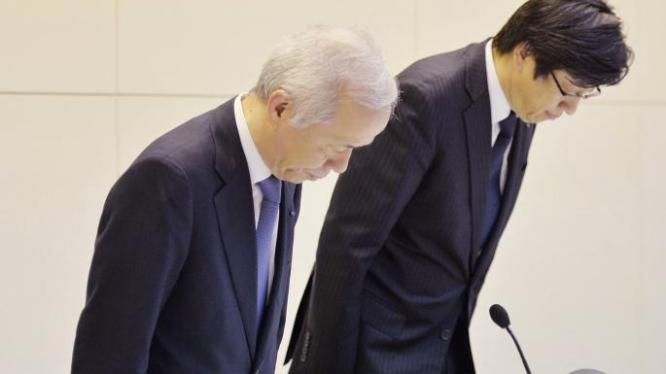
Naomi Hirose, left, TEPCO president, and Takafumi Anegawa, a director, apologise at press conference in Tokyo today
The company responsible for the Fukushima Dai-ichi nuclear power plant has admitted lying about the meltdown of its reactors five years ago, in a deliberate cover-up of the world’s second worst nuclear disaster.
It took two months for the Tokyo Electric Power Company (Tepco) to own up to the meltdown of three reactors after an earthquake and tsunami. A report commissioned by the company says that its president at the time ordered employees to speak of “damage” to the reactors and avoid the world, “meltdown”.
The company’s current president, Naomi Hirose, said: “It is extremely regrettable People are justified in…
Tepco’s “sincere”apology!!!
With Tepco it is always the same song, they apologize for a long ago previous lie and tell the whole world how very very sorry, repenting they are, while they daily continue lying and covering-up the true happenings at Fukushima Daiichi.
FUCK TEPCO!
Press Release (Jun 21,2016)TEPCO APOLOGIZES FOR PREVIOUS LEADERSHIP’S FAILURE TO ACKNOWLEDGE MELTDOWN DURING FUKUSHIMA ACCIDENT
Responding to recent report of an investigating committee, TEPCO restates its commitment to provide comprehensive, accurate and understandable information, while making safety the utmost priority to ensure a safe and secure society
TOKYO, June 21, 2016 In its first response to the June 16 report of the committee investigating the belated acknowledgment that a meltdown had taken place at Fukushima Daiichi NPS in March 2011, TEPCO said it is clear from the report that its previous leadership gave instructions not to use the word “meltdown” in public statements.
“We deeply regret that our previous leadership failed to live up to the standards of transparency and thoroughness that we strive to meet today,” said TEPCO President Naomi Hirose (who was not the company’s leader at the time of the accident). “We sincerely apologize for it,” he said.
In more recent years, through the creation of the Nuclear Reform Monitoring Committee and many other changes, TEPCO has worked to improve the timeliness, thoroughness, and clarity of its communication with the public, both inside Japan and internationally. President Hirose stressed that TEPCO has been learning this lesson and breaking from its past, as it works to build trust with the public and with government through the implantation of its Nuclear Safety Reform Plan. Improvements in communication represent an important element of that Plan, which is overseen both by the company’s Nuclear Safety Oversight Office and by an independent Nuclear Reform Monitoring Committee chaired by the former head of the U.S. Nuclear Regulatory Commission.
“We deeply regret the shortcomings of the past,” President Hirose said, “but it is important to recognize that they do not represent the TEPCO of today while making safety the utmost priority to ensure a safe and secure society.”
http://www.tepco.co.jp/en/press/corp-com/release/2016/1300509_7763.html
To carry better the Fukushima radioactive water into the ocean

New Drainage Channels Start Operations at Fukushima Daiichi Nuclear Power Station
More Drainage “Improvements” at Fukushima Daiichi: In advance of typhoon season, rainwater drainage has been further improved by the construction of a new drainage channel. The channel runs between Units 5-6 and the cluster of Units 1-4. It carries water into two drainages, both of which empty into the protected port area and not the open ocean. The new channel helps manage the increased runoff that results from extensive hard-surfacing that has been done to reduce radiation, prevent rainwater from seeping into the ground, and in turn “improve the environment”.
http://www.tepco.co.jp/en/news/library/archive-e.html?video_uuid=tq4l2aqa&catid=69631
Fukushima 3/11 Breeds Cynicism
There’s an old saying “disasters bring out the best in people,” but Fukushima 3/11 of March 11, 2011 has put an exclamation point on cynicism rather than heartfelt concern.
Similar to America’s experience of outright lies by its government about the Iraqi Massacre, the blowback of cynicism and contempt bring forth a strain of populism, rejecting establishment, attracting lowly dishonorable politics, as America gooses-up an abomination!
Fukushima’s a horror story of hidden agendas, lies, scare tactics, and harsh secrecy laws, yet it’s held up as a icon of safe nuclear power by clever mastery of pro-nuke Oceania Newspeak, which, in the novel 1984 penalized “rebellious thoughts” as illegal, similar to Japan’s 2013 secrecy law wherein the “act of leaking itself” is bad enough for prosecution, regardless of what, how, or why, off to jail for 10 years. These decadent precepts are hard to accept with a straight face.
However, the day is fast approaching when the pro-nukie crowd, which claims Fukushima 3/11 caused few, if any, major radiation casualties, will be forced to “munch on their own words.” As time passes, it becomes ever more obvious that pro-nuke arguments, supporting big fat cumbersome nuclear power plants, metaphorically, hang by fingertips on an electric fence.
As an aside, it is rumored, thru the grapevine in Japan, that hospitals have been instructed to categorize, and officially report, patients’ radiation symptoms as “stress-related cases.” Hmm!
As for pro-nuclear news:
“In spite of this whole theatrical drama the result was…nobody killed or injured, and no indication of long term negative radiation effects on people. So the lesson of Fukushima is that nuclear power is much safer than people thought,” Kelvin Kemm, The Lesson of Fukushima – Nuclear Energy is Safe, Cfact, Feb. 16, 2015.
Another example:
“No one has been killed or sickened by the radiation — a point confirmed last month by the International Atomic Energy Agency. Even among Fukushima workers, the number of additional cancer cases in coming years is expected to be so low as to be undetectable, a blip impossible to discern against the statistical background noise,” George Johnson, When Radiation Isn’t the Real Risk, New York Times, Sept. 21, 2015
And, one more:
“There were no cases of radiation sickness among plant workers, because their radiation doses were too low to produce sickness,” Georgetown Radiation Expert, Author Reflects on 5th Anniversary of Fukushima Meltdown, Georgetown University Medical Center, Newswise, Feb. 23, 2016.
Bunk! To the contrary, not only have several independent sources in Japan reported cover ups of Fukushima worker deaths, bodies incinerated with ashes hidden in Buddhist temples, and instances of hair falling out, nose bleeding, and assorted serious ailments unique to radiation poisoning, now several deaths of U.S. sailors may be closely linked to this disaster that a pro-nuclear crowd claims demonstrates how “safe” nuclear power really is.
Thus, begging the question: Are the pro-nukites liars and/or are they being lied to, or what’s up? Who knows, and who really cares which, but their published articles, grandstanding nuclear power, are prominent throughout mainstream big time, and small time, magazines and newspapers and hyperspace, Oceania redux.
Whereas, in vivid contrast to this pro-nuke claptrap, one of Japan’s most eminent former prime ministers Junichiro Koizumi (2001-06) declares support for the U.S. sailor’s TEPCO lawsuit, more on this later.
Additionally, PM Koizumi has repeatedly urged PM Abe to halt efforts to restart Japan’s nuclear reactors. He is the second former Japanese prime minister, including PM Naoto Kan (2010-11), to plea for a halt to nuclear power. They claim nuclear power is not safe!
Luckily for the nuclear power industry, Abe is the prime minister.
Yet, there’s a festering problem, prevalence of radiation-poisoned deaths:
“The ashes of half a dozen unidentified laborers ended up at a Buddhist temple in this town just north of the crippled Fukushima nuclear plant. Some of the dead men had no papers, others left no emergency contacts. Their names could not be confirmed and no family members had been tracked down to claim their remains. They were simply labeled “decontamination troops” — unknown soldiers in Japan’s massive cleanup campaign to make Fukushima livable again five years after radiation poisoned the fertile countryside,” Mari Yamaguchi, Fukushima ‘Decontamination Troops’ Often Exploited, Shunned, AP & ABC News, Minamisona, Japan, March 10, 2016.
And, here’s another:
“It’s a real shame that the authorities hide the truth from the whole world, from the UN. We need to admit that actually many people are dying. We are not allowed to say that, but TEPCO employees also are dying. But they keep mum about it,” Katsutaka Idogawa, former mayor of Futaba (Fukushima Prefecture), Fukushima Disaster: Tokyo Hides Truth as Children Die, Become Ill from Radiation – Ex-Mayor, RT, April 21, 2014.
And, one more:
Mako Oshidori, director of Free Press Corporation/Japan, investigated several unreported worker deaths, and interviewed a former nurse who quit TEPCO: “I would like to talk about my interview of a nurse who used to work at the Fukushima Daiichi Nuclear Power Plant (NPP) after the accident… He quit his job with TEPCO in 2013, and that’s when I interviewed him… As of now, there are multiple NPP workers that have died, but only the ones who died on the job are reported publicly. Some of them have died suddenly while off work, for instance, during the weekend or in their sleep, but none of their deaths are reported.”
“Not only that, they are not included in the worker death count. For example, there are some workers who quit the job after a lot of radiation exposure… and end up dying a month later, but none of these deaths are either reported, or included in the death toll. This is the reality of the NPP workers,” (The Hidden Truth about Fukushima by Mako Oshidori, delivered at the international conference Effects of Nuclear Disasters on Natural Environment and Human Health held in Germany, 2014 co-organized by International Physicians for Prevention of Nuclear War).
Still and all, PM Abe insists upon fireside chats with pro-nuke campers whilst reopening nuclear power plants even though Japan survived just fine for five years without. He appears to have ants in his pants, pushing hard to restart the ole nuke plants A-SAP.
Meanwhile, in another universe, former PM Koizumi supports the lawsuit of U.S. sailors aboard the USS Ronald Reagan that participated in Operation Tomodachi, providing humanitarian relief after the March 11th Fukushima meltdowns. Allegedly, they were assured that radiation levels were okay!
“There is no excuse for Tokyo Electric Power Co. not to give the 400 U.S. sailors and marines who are now suing the company the proper facts. Things are looking especially good for the plaintiffs now that former Prime Minister Junichiro Koizumi is backing the lawsuit over the Fukushima radiation,” Support for U.S. Sailor’s Tepco Suit, The Japan Times, June 17, 2016.
“Undoubtedly, Koizumi was convinced to help the sailors because they now suffer from radiation poisoning. He said: ‘Those who gave their all to assist Japan are now suffering from serious illness. I can’t overlook them,” Ibid.
According to lawyers representing the sailors, Charles Bonner & Cabral Bonner & Paul Garner, Esq., Sausalito, CA, seven sailors have already died, including some from leukemia.
With passage of time, the number of plaintiffs and numbers of deaths grows as the latency effect of radiation sets in. Thus, over time, the latency effect works against the pro-nuclear squawk talk that “all’s clear.”
Initially, the lawsuit represented less than 200 sailors but over time, the latency effect brings forward 400 sailors claiming radiation-poison complications, including leukemia, ulcers, gall bladder removal, brain cancer, brain tumors, testicular cancer, uterine bleeding, thyroid illness, stomach ailments, and premature deaths. These are youngsters.
The lawsuit process has been exacting for the young sailors: “Lindsey Cooper, for example. The woman who started the whole thing was torn apart on a CNN program by atomic energy experts and was later mocked on conservative radio shows,” Alexander Osang, Uncertain Radiological Threat: US Navy Sailors Search for Justice After Fukushima Mission, Spiegel Online International, Feb. 5, 2015.
As it happens, it’s not disasters that turn people’s stomachs as much as cover-ups and lying, bringing forth cynicism, contempt, and ultimately populist blowback as people get fed up with establishment politics.
It is very likely that, similar to American populist blowback, Japan will meet the same fate.
On second thought:
“There is one thing that really surprised me here in Europe. It’s the fact that people here think Japan is a very democratic and free country.” (Mako Oshidori, director/Free Press Corporation/Japan, speech in Germany)
http://www.counterpunch.org/2016/06/21/fukushima-311-breeds-cynicism/
TEPCO admits meltdown cover-up

TEPCO admits meltdown cover-up
The president of Tokyo Electric Power Company has admitted the company concealed the reactor meltdowns at its Fukushima Daiichi nuclear plant immediately after the March 2011 earthquake and tsunami.
The utility did not officially admit the meltdowns until more than 2 months after the accident.
In February this year, it was revealed the utility could have ascertained a meltdown 3 days after its occurrence if workers had followed an in-house manual.
TEPCO asked a third-party panel to investigate the matter. Last Thursday, the panel released a report that said the company’s then-president, Masataka Shimizu, had instructed officials not to use the words “core meltdown.”
TEPCO President Naomi Hirose said at a news conference on Tuesday that the company’s concealment of the meltdowns at the order of its then-president is a grave issue. He said it is natural for the public to interpret the decision as a cover-up, and he apologized.
The panel report said TEPCO’s then-president received instructions on the matter from the prime minister’s office. But it’s not known what exactly he was told or who gave the orders.
Both then-Prime Minister Naoto Kan and then-Chief Cabinet Secretary Yukio Edano have denied giving such instructions.
http://www3.nhk.or.jp/nhkworld/en/news/20160621_35/
Fukushima meltdown apology: “It was a cover-up”
TOKYO — The utility that ran the Fukushima nuclear plant acknowledged Tuesday its delayed disclosure of the meltdowns at three reactorswas tantamount to a cover-up and apologized for it.
Tokyo Electric Power Co. President Naomi Hirose’s apology followed the revelation last week that an investigation had found Hirose’s predecessor instructed officials during the 2011 disaster to avoid using the word “meltdown.”
“I would say it was a cover-up,” Hirose told a news conference. “It’s extremely regrettable.”
TEPCO instead described the reactors’ condition as less serious “core damage” for two months after the earthquake and tsunami on March 11, 2011, wrecked the plant, even though utility officials knew and computer simulations suggested meltdowns had occurred.
An investigative report released last Thursday by three company-appointed lawyers said TEPCO’s then-President Masataka Shimizu instructed officials not to use the specific description under alleged pressure from the Prime Minister’s Office, though the investigators found no proof of such pressure.
The report said TEPCO officials, who had suggested possible meltdowns, stopped using the description after March 14, 2011, when Shimizu’s instruction was delivered to vice president at the time, Sakae Muto in a memo at a televised news conference. In a video from that day, a company official rushes over to Muto, showing the memo and telling him that the Prime Minister’s Office has banned the word.
Government officials also softened their language on the reactor conditions around the same time, the report said.
Former officials at the Prime Minister’s Office have denied the allegation. Then-top government spokesman Yukio Edano, now secretary general of the main opposition Democratic Party, criticized the report as “inadequate and unilateral,” raising suspicion over the report by the lawyers seen close to the ruling party ahead of an upcoming Upper House election.
TEPCO has been accused of a series of cover-ups in the disaster, though the report found TEPCO’s delayed meltdown acknowledgement wasn’t illegal.
Hirose said he will take a 10 percent pay cut, and another executive will take a 30 percent cut, for one month each to take responsibility.
The report said Shimizu’s instruction delayed full disclosure of the plant’s status to the public, even as people who lived near the plant were forced to leave their homes, some of them possibly unable to return permanently, due to the radiation leaks from the plant.
TEPCO reported to authorities three days after the tsunami that the damage, based on a computer simulation, involved 25 to 55 percent of the fuel but didn’t say it constituted a “meltdown,” even though the figures exceeded the 5 percent benchmark for one under the company manual.
TEPCO in May 2011 publicly acknowledged “meltdown” after another computer simulation showed significant meltdown in three reactors, including one with melted fuel almost entirely fallen to the bottom of the primary containment chamber.
The issue surfaced earlier this year in a separate investigation in which TEPCO reversed its earlier position that it had no internal criteria regarding a meltdown announcement, admitting the company manual was overlooked.
http://www.cbsnews.com/news/fukushima-tepco-power-japan-nuclear-meltdown-apologizes-cover-up/
Tepco head apologizes for 3/11 ban issued on ‘meltdown’
The head of Tokyo Electric Power Co. apologized Tuesday over his predecessor’s order to not use the term “core meltdown” to describe the situation at the Fukushima No. 1 nuclear plant in the early days of the March 2011 crisis.
“It is extremely regrettable. People are justified in thinking it as a coverup,” Tepco President Naomi Hirose said at a news conference in Tokyo.
The remarks came after a report published last Thursday said that then-President Masataka Shimizu instructed a vice president, who was taking part in a news conference on March 14, 2011, not to use “core meltdown” to describe the states of the reactors.
Tepco reported to authorities on March 14, based on a computer simulation, that the event damaged 25 to 55 percent of the fuel rods, but the utility did not say it constituted a meltdown, the report said.
The company’s internal manual defined a meltdown as damage to more than 5 percent of the fuel.
The utility used the less serious phrase “core damage” for two months after the disaster began. In May 2011, Tepco finally used “meltdown.”
The report suggested that efforts were made to make the nuclear crisis look less severe than it actually was at a time when attention was riveted on the condition of the six-reactor complex following a massive earthquake and tsunami that devastated northeastern Japan on March 11, 2011.
The utility said it will cut Hirose’s salary by 10 percent for a month.
Shimizu likely issued the instruction due to pressure from the office of then-Prime Minister Naoto Kan, according to the report, compiled by a third-party commission set up to investigate the utility’s handling of the disaster. But it did not explain how pressure was exerted by the prime minister’s office, citing fading memories of the people involved.
The commission said it had not interviewed Kan or Yukio Edano, who was then chief Cabinet secretary in the administration, in the course of compiling the report because it was not authorized to do so.
The two denied the allegation.
On Friday, Edano called a special news conference to refute the panel’s finding, saying that neither he nor Kan ordered or requested then-President Shimizu to avoid using the term “meltdown” under any circumstance.
He said the party will consider taking legal action against Tepco and a third-party panel that compiled the report. Edano criticized the report as “inadequate and unilateral.”
Edano also said the timing of the report was suspicious ahead of the Upper House election. Kan has suggested it might be some kind of bid by Tepco and the ruling parties to sling mud on the opposition Democratic Party.
The DP is the successor to the Democratic Party of Japan, to which Kan and Edano belonged, before it merged with Ishin no To (Japan Innovation Party) on March 27.
http://www.japantimes.co.jp/news/2016/06/21/national/tepco-head-apologizes-311-ban-issued-meltdown/
The French embassy in Japan held a dinner party with Fukushima food
France being one of the major exporters of nuclear, to be expected that its Embassy in Tokyo would collaborate with the Japanese Government to put on a show that Fukushima products are safe, that Fukushima is no more contaminated, that everything is great.
The event certainly was organized behind the scenes by the Project ETHOS, financed by the nuclear lobby, whose main mission is to minimize the gravity of any nuclear catastrophe in the mind of the affected population, so as to encourage the People to stay and live with the “non-harmful” radiation. Ethos did the same propaganda campaign, same program during the Chernobyl catastrophe.

According to the French embassy in Japan, they held Fukushima food dinner party on 6/17/2016.
Fukushima governor. Uchibori, Minister for Reconstruction. Takagi, and a French singer. Charles Aznavour were invited by the Ambassador of France. Thierry Dana.
Fukushima beef, Cherry, and locally raised chicken were served as French cuisine.
In the press release, the major retail company Aeon is mentioned as a partner of this event.
CEO of Aeon is the older brother of Japanese Democratic Party’s leader. Okada.
Fukushima Governor commented they have not detected excessive density of radioactive material in any of their agricultural products over the past year.
http://www.ambafrance-jp.org/article10203
Edano may take legal action to challenge Fukushima crisis report
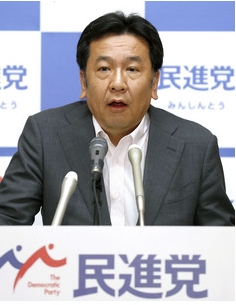
Democratic Party Secretary General Yukio Edano attends a press conference in Tokyo on June 17, 2016. Edano said a report on how Tokyo Electric Power Co. handled the Fukushima nuclear disaster is inappropriate as it notes the then TEPCO chief instructed staff not to use the term “core meltdown” in describing the situation in the early days of the crisis due to pressure from the prime minister’s office. Edano, then chief Cabinet secretary, said, “We may take legal action to challenge it.” (Kyodo)
-
Archives
- October 2026 (112)
- September 2026 (339)
- August 2026 (330)
- July 2026 (355)
- June 2026 (287)
- May 2026 (306)
- April 2026 (356)
- March 2026 (251)
- February 2026 (267)
- January 2026 (308)
- December 2025 (358)
- November 2025 (359)
-
Categories
- 1
- 1 NUCLEAR ISSUES
- business and costs
- climate change
- culture and arts
- ENERGY
- environment
- health
- history
- indigenous issues
- Legal
- marketing of nuclear
- media
- opposition to nuclear
- PERSONAL STORIES
- politics
- politics international
- Religion and ethics
- safety
- secrets,lies and civil liberties
- spinbuster
- technology
- Uranium
- wastes
- weapons and war
- Women
- 2 WORLD
- ACTION
- AFRICA
- Atrocities
- AUSTRALIA
- Christina's notes
- Christina's themes
- culture and arts
- Events
- Fuk 2022
- Fuk 2023
- Fukushima 2017
- Fukushima 2018
- fukushima 2019
- Fukushima 2020
- Fukushima 2021
- general
- global warming
- Humour (God we need it)
- Nuclear
- RARE EARTHS
- Reference
- resources – print
- Resources -audiovicual
- Weekly Newsletter
- World
- World Nuclear
- YouTube
-
RSS
Entries RSS
Comments RSS

