Was Tokyo Electric Power Co. (now Tokyo Electric Power Company Holdings, Inc.) putting top priority on ensuring the safety of residents around its Fukushima No. 1 nuclear power plant when the accident occurred? The findings of a recent probe have raised doubts even about this.
A third-party panel of lawyers set up by TEPCO released a report on why it took as long as two months after the crisis for the utility to acknowledge that the reactors had melted down.
On March 14, 2011, three days after the accident occurred following the massive earthquake and tsunami, then TEPCO President Masataka Shimizu instructed a then executive vice president during a press conference “not to use” the word “meltdown,” according to the report. The message was delivered via a public relations staffer, citing instructions from the Prime Minister’s Office, the report said.
Subsequently, TEPCO used the description “core damage” in connection with the accident. “The nuclear power plant and the head office shared a recognition that they should refrain from using ‘meltdown,’” the report pointed out.
Then Prime Minister Naoto Kan and then Chief Cabinet Secretary Yukio Edano have completely denied issuing such instructions on their own.
At the time of the accident, many politicians, bureaucrats and others concerned were working at the Prime Minister’s Office. The third-party probe failed to identify who gave the instructions to Shimizu.
This shows the limitations that the third-party panel faced as it probed the accident based only on interviews it conducted with TEPCO officials. Furthermore, Shimizu’s memories of those days were vague.
However, the probe revealed that TEPCO was paying too much attention to the Prime Minister’s Office’s intentions in responding to the accident.
Operator holds responsibility
When a nuclear power plant is hit by a serious accident, residents living around the facility face severe consequences. It is the primary responsibility of the plant operator to respond appropriately.
In such a situation, the highest priority should be placed on the safety of local residents. The operator must accurately provide local governments and residents with precise and necessary information regarding the situation the power plant is facing.
TEPCO chose to use “core damage,” an expression that made the status of the accident unclear, instead of “meltdown,” even though “meltdown” would have clearly shown the severity of the developments the Fukushima plant was dealing with. The operator cannot avoid criticism for having betrayed local residents with this decision. This kind of stance taken by the utility has caused increasing distrust of nuclear power plants.
At the time of the accident, TEPCO had internal manuals that described what constituted a meltdown. The operator must seriously reflect on why it failed to follow these guidelines.
When it came to public relations announcements at the time of the accident, the investigation committees set up by the government and the Diet both pointed out that the Prime Minister’s Office had some involvement.
An official at the then Nuclear and Industrial Safety Agency of the Economy, Trade and Industry Ministry was replaced after referring to a “meltdown” during a press conference. TEPCO was told by the Prime Minister’s Office to brief it in advance of any announcements made at press conferences, according to the latest report.
The Niigata prefectural government, whose administrative area is home to TEPCO’s Kashiwazaki-Kariwa nuclear power plant, has called for uncovering the whole process of how information was manipulated, saying this is a prerequisite for reactivating reactors at Kashiwazaki-Kariwa. The government cannot help but cooperate with the probe.
http://www.the-japan-news.com/news/article/0003026750
June 20, 2016
Posted by dunrenard |
Fukushima 2016 | Fukushima Daiichi, Lies & Cover-up, Responsibility, Tepco |
Leave a comment
A panel investigating Tokyo Electric Power Co.’s response to the triple meltdown during the 2011 Fukushima nuclear disaster revealed an unpardonable breach of trust by the operator of the stricken Fukushima No. 1 nuclear power plant.
But there is still a lot more work to be done by the panel to uncover the full scope of the utility’s apparent meltdown cover-up.
Immediately after the catastrophic accident at the Fukushima nuclear plant, then TEPCO President Masataka Shimizu instructed employees not to use the term “meltdown,” leading to a delay in the official announcement, according to a report compiled by the investigation panel commissioned by the company.
A reactor meltdown, or the melting of nuclear fuel in the core of a reactor, is about as bad as it gets.
The panel’s report suggests that in the middle of this unprecedented nuclear disaster the top official of the plant operator was trying to conceal the severity of what was unfolding from the public, including people living in areas around the plant.
For four long years, TEPCO kept giving false explanations about the delay in the announcement of the reactor meltdowns to Niigata Prefecture, which was demanding the truth of what happened. The company claimed it did not have the criteria for defining and determining a meltdown. The firm also said no in-house instruction was given to employees telling them not to use the term.
In February this year, however, the company said it had “found” an in-house manual that spelled out such criteria and set up the third-party panel of legal experts to get to the truth about the delayed announcement of the meltdowns.
With the revelations made in its report, can the panel claim it has accomplished its mission?
We have to say the answer is “no,” although the disclosure of the former TEPCO president’s instruction concerning the meltdowns is definitely a step forward.
What is particularly baffling is the opinion about the president’s instruction voiced by Yasuhisa Tanaka, the former president of the Sendai High Court who headed the investigation. “We cannot say for certain that there was a deliberate cover-up by the company,” Tanaka said during a news conference.
At the time of the accident, a reactor meltdown was defined by the nuclear disaster special measures law as an emergency situation that must be reported. The conditions of the reactors at the Fukushima plant fulfilled TEPCO’s criteria, which say a meltdown means that 5 percent or more of the core of a reactor has been damaged.
But the utility initially denied that a meltdown was happening, while the president instructed employees not to use the term. If this was not a cover-up, what was it?
Also questionable is the panel’s suggestion that the TEPCO chief was probably acting on requests from the prime minister’s office in giving the instruction. The panel interviewed about 60 former and current TEPCO officials, but no government officials or bureaucrats who were involved in dealing with the crisis.
In explaining the panel’s failure to interview key government officials, Tanaka said, “Our authority to investigate is limited, and it is difficult (to uncover the entire truth) in such a short time.” But the panel didn’t even request interviews with them.
Both Naoto Kan, who was then prime minister, and Yukio Edano, who was chief Cabinet secretary, rejected the allegations that the government told TEPCO not to declare a meltdown.
As for the related requests made by Niigata Prefecture, TEPCO says it will continue its joint efforts with the prefectural government to uncover the facts.
The company has a responsibility to clarify the broad picture of the accident and publish the findings of its probe. But the Diet has its own role to play.
Whether the prime minister’s office actually asked TEPCO not to declare a reactor meltdown is not the only remaining mystery about the exchanges between the government and the company during the crisis. Only some fragments of information about the communications between the two sides have been revealed.
A Diet investigation committee has drawn up a report on its inquiry into the accident. But there are still many questions that the Diet should try to answer by using its right to investigate state affairs.
We need to learn all vital lessons from the devastating nuclear accident so as to avoid making the same mistakes.
That requires unearthing all the related facts first. It is our responsibility to tackle this challenge for future generations.
http://www.asahi.com/ajw/articles/AJ201606180026.html
June 20, 2016
Posted by dunrenard |
Fukushima 2016 | Fukushima Daiichi, Lies & Cover-up, Meltdowns, Tepco |
Leave a comment
What this article from Nikkei (the Japanese Business & investment Newspaper) does not say is if the nuclear industry discloses, informs the public about the true facts, the public trust in the nuclear industry will NEVER be restored, and no nuclear plant will ever be allowed to restart.

TOKYO — For Tepco, there is no escaping the accusation that the utility’s deliberate avoidance of the term “meltdown” after the Fukushima Daiichi nuclear disaster was an attempt to minimize the severity of the situation to the public.
Tokyo Electric Power Co. recognized immediately that a core meltdown had occurred at the ill-fated power plant, and so did Japan’s government. On March 12, 2011 — the day after the crisis began — the term was used at a news conference held by the Nuclear and Industrial Safety Agency, Japan’s nuclear power regulator at that time. The spokesman who uttered the word was replaced the following day.
The report issued Thursday by a third-party committee investigating Tepco’s handling of the disaster underscores once again the inability of the prime minister’s office and the bureaucracy at the time to face the reality of the situation. It also deepens the suspicion that officials sought to control the flow of information to the public.
A fear of causing widespread panic is a poor excuse for covering up the truth. If anyone was panicking, it was arguably Tepco’s president at the time, Masataka Shimizu, as well as other officials at the utility and at the prime minister’s office. The report said Shimizu gave instructions at Tepco to avoid using the term meltdown.
Crews at Fukushima Daiichi, led by plant manager Masao Yoshida, made every effort to contain the crisis on the assumption that they were dealing with a meltdown. Even if Tepco headquarters had used this term instead of “core damage” in informing the public, the utility’s response on the ground probably would have been the same. But residents of the evacuation zone, as well as the Self-Defense Forces and other first responders, may have acted differently.
The investigative committee did not determine who in the government might have prompted Shimizu’s directive against using the word. There has been reluctance to examine the involvement of elected officials and bureaucrats in the disaster response. More probing is needed.
It took more than five years for Shimizu’s instructions to come to light. The latest investigation itself never would have occurred if not for the persistence of the Niigata Prefecture government, which has its own Tepco — whose formal name is now Tokyo Electric Power Co. Holdings — nuclear power plant to worry about.
What happens at the nation’s nuclear reactors ought to be made public without disguise — and not just when serious safety breaches like meltdowns are involved. Efforts on disclosure must begin with everyday information in order to restore the public’s trust in nuclear power.
http://asia.nikkei.com/Politics-Economy/Policy-Politics/Public-deserves-closer-look-into-Fukushima-response
June 20, 2016
Posted by dunrenard |
Fukushima 2016 | Fukushima Daiichi, Nuclear Industry, Nuclear Plant Restart, Truth |
Leave a comment

Yasuhisa Tanaka, center, chairman of an outside investigation team appointed by the operator of Japan’s damaged Fukushima nuclear plant, speaks during a press conference in Tokyo Thursday. Two other lawyers of the team are: Zenzo Sasaki, left, and Toshiki Nagasaki.
A Japanese opposition leader who was a senior official during the 2011 Fukushima nuclear plant crisis denied Friday that he or the prime minister at the time pressured the president of Tokyo Electric Power Co. not to use the term “meltdown.”
Democratic Party Secretary-General Yukio Edano called a special news conference to refute a finding in a new report that then-TEPCO President Masataka Shimizu apparently came under political pressure not to use the word. The report did not find direct evidence of that.
“The fact that I or then-Prime Minister (Naoto) Kan ordered or requested then-President Shimizu to avoid using the term ‘meltdown’ under any circumstance does not exist,” Edano said. He said the timing of the report was suspicious ahead of an Upper House election next month.
The report released Thursday by a team of three lawyers appointed by TEPCO found that an instruction from Shimizu to avoid using the term “meltdown” delayed full public disclosure of the status of the nuclear plant, which suffered three reactor meltdowns after a major earthquake and tsunami hit the northeastern Japanese coast on March 11, 2011.
The utility used the less serious phrase “core damage” for two months after the disaster.
TEPCO reported to authorities three days after the tsunami that the damage, based on a computer simulation, involved 25 to 55 percent of the fuel but did not say it constituted a “meltdown,” the report said. Yet the company’s internal manual defined a meltdown as damage to more than 5 percent of the fuel.
In May 2011, TEPCO finally used “meltdown” after another computer simulation showed fuel in one reactor had almost entirely melted and fallen to the bottom of the primary containment chamber, and that the two other reactor cores had melted significantly.
TEPCO has been accused of softening its language to cover up the seriousness of the disaster, though the investigation found TEPCO’s delayed acknowledgement did not break any law.
In the 70-page report, the lawyers said Shimizu instructed his deputy not to use the word “meltdown” during news conferences immediately after the crisis. TEPCO’s vice president at the time, Sakae Muto, used the phrase “possibility of meltdown” until March 14, 2011.
Video of a news conference that day shows a company official rushing over to Muto when he was about to respond to a question, showing him a memo and hissing into his ear, “The prime minister’s office says never to use this word.”
Yasuhisa Tanaka, the lawyer who headed the investigation, said interviews of 70 former and current TEPCO officials, including Muto and Shimizu, showed that Muto had planned to use the word “meltdown” until he saw the memo, which has not been found.
“Mr. Shimizu’s understanding was the term ‘meltdown’ could not be used without permission from the prime minister’s office,” Tanaka said at a news conference at TEPCO headquarters. “The notion that the word should be avoided was shared company-wide. But we don’t believe it was a cover-up.”
Edano criticized the report as “inadequate and unilateral,” and said the team didn’t talk to him or Kan.
Tanaka said his investigation, which did not interview any government officials, could not track down what exactly happened between Shimizu and the prime minister’s office.
The Nuclear and Industrial Safety Agency, Japan’s nuclear regulatory unit at the time, was also reluctant to use the word. Two spokesmen were replaced between March 12 and 13, 2011, after suggesting meltdowns had occurred.
TEPCO has said the delay in confirming the meltdowns didn’t affect the company’s response to the emergency.
The issue surfaced earlier this year in a separate investigation in which TEPCO acknowledged that a company manual had been overlooked, reversing its earlier position that it had no internal criteria for a meltdown. TEPCO has eliminated the definition of a meltdown from the manual in revisions after the Fukushima disaster.
http://abcnews.go.com/International/wireStory/utility-head-blamed-late-mention-fukushima-meltdown-39902188
June 17, 2016
Posted by dunrenard |
Fukushima 2016 | Fukushima Daiichi, Lies & Cover-up, Meltdowns, Tepco |
Leave a comment

Naomi Hirose, president of Tokyo Electric Power Co., speaks in Tokyo on June 16 after an investigation team released its report on the 2011 Fukushima nuclear disaster.
Former government leaders vehemently rejected suggestions in a report that they were pulling the strings behind a suspected meltdown cover-up when the Fukushima nuclear disaster was unfolding in 2011.
The report, compiled by an investigation panel commissioned by Tokyo Electric Power Co., operator of the crippled nuclear power plant, said Masataka Shimizu, who was TEPCO president at the time of the accident, instructed employees not to use the term “meltdown,” leading to a delay in the official announcement.
But the report also implied that Shimizu was acting on orders from high up in the government.
Yukio Edano, who was chief Cabinet secretary of the Democratic Party of Japan-led government when the Great East Japan Earthquake and tsunami triggered the nuclear crisis on March 11, 2011, described the report as preposterous.
“As far as I know, it is unthinkable for government officials back then to ask TEPCO to do such a thing,” Edano, now the secretary-general of the opposition Democratic Party, told reporters on June 16.
He accused the panel of merely skimming the surface of the matter and sidestepping the truth behind the instructions to avoid using the term “meltdown.”
“It is utterly irresponsible for the panel to say that it did not uncover that (Shimizu) was instructed by who and what,” he said.
The third-party panel of legal experts said in the report released on June 16 that it can be assumed that Shimizu understood that he was requested by the prime minister’s office to seek its approval beforehand if the company were to announce the “meltdown.”
The panel also said it would be difficult to conclude that TEPCO’s delay in declaring the meltdown was a “deliberate cover-up.”
“Since TEPCO released information on radiation levels inside the reactors and other related data at that time, just not using the term meltdown cannot be described as an act of a deliberate cover-up,” the panel said.
TEPCO declared the meltdown at three reactors at the Fukushima No. 1 plant in May 2011, two months after it occurred.
According to the report, Shimizu entered the chief Cabinet secretary’s office, which is located at the prime minister’s office building, by himself on March 13, 2011. The following day, Sakae Muto, vice president of TEPCO, explained the conditions of the reactors at the plant.
During the news conference, Shimizu handed a memo to Muto through a TEPCO public relations official, telling him not to use the word “meltdown” on the instructions of the prime minister’s office, according to the panel.
Naoto Kan, who was prime minister at the time of the disaster, denied giving the instruction to TEPCO.
“I myself have never given directions to TEPCO not to use the expression ‘meltdown,’” Kan, a member of the Democratic Party, said in a statement.
One reason for the lack of clarity in the report is that Shimizu, who was interviewed twice for a total of four hours, said, “I do not remember very well” with regard to who gave what instructions.
Another TEPCO employee interviewed by the panel said Shimizu “was under tremendous pressure and must not have a detailed recollection.”
The panel interviewed about 60 former and current TEPCO officials but no government officials and bureaucrats who were involved in dealing with the crisis.
“Our authority to investigate is limited, and it is difficult (to uncover the entire truth) in such a short time,” said Yasuhisa Tanaka, the lawyer who headed the investigation.
Tanaka and another panel member, Zenzo Sasaki, a former prosecutor at the Tokyo District Public Prosecutors Office, were also in charge of the third-party investigation into the accident conducted in 2013.
That investigation, based on interviews of TEPCO officials, came under fire for “only arbitrarily presenting TEPCO’s argument that is convenient to the company.”
The findings by the latest panel showed TEPCO officials looking into the nuclear disaster were aware of Shimizu’s order not to use “meltdown,” but TEPCO’s in-house investigation team did not include it in its report in 2012, apparently believing it was not significant enough to mention.
“TEPCO’s efforts to share information inside the company were insufficient,” Tanaka said. “It lacked consideration for local governments, which should have been top priority.”
The revelation that Shimizu ordered the avoidance of “meltdown” fueled feelings of distrust toward TEPCO among local governments hosting TEPCO nuclear power plants.
“We are still in this stage of the investigation even five years after the accident,” said Toshitsuna Watanabe, mayor of Okuma, which co-hosts the crippled Fukushima plant.
Hirohiko Izumida, governor of Niigata Prefecture, home to TEPCO’s Kashiwazaki-Kariwa nuclear power plant, called for a further investigation to reveal the whole picture of the Fukushima disaster.
“We need to step up efforts to uncover what has not been sufficiently investigated before,” he said. “TEPCO, as an organization, should make a sincere response without hiding anything.”
The latest panel was established in March at the request of the Niigata prefectural government’s technology committee, which aims to determine why TEPCO waited until May 2011 to announce the triple meltdown.
TEPCO initially said it did not have the criteria for defining and determining a meltdown.
But it announced in February this year that the company “found” an in-house manual that explained whether a meltdown was taking place.
http://www.asahi.com/ajw/articles/AJ201606170063.html
June 17, 2016
Posted by dunrenard |
Fukushima 2016 | Fukushima Daiichi, Lies & Cover-up, Meltdowns, Teoco |
Leave a comment
An outside investigation team appointed by the operator of Japan’s damaged Fukushima nuclear plant said Thursday that an instruction from the company’s then-president to avoid using the term “meltdown” delayed the full disclosure of the status of three reactors.
Tokyo Electric Power Co. described the condition of the three reactors as less serious “core damage” for two months after a March 2011 earthquake and tsunami destroyed the plant.
The panel of three TEPCO-commissioned lawyers said the company used the milder term despite knowing that the damage far exceeded its meaning, because of the instructions by then-President Masataka Shimizu. The report said he was apparently under pressure from the Prime Minister’s Office, but that the panel did not find direct evidence of that.
TEPCO reported to the authorities on March 14, 2011, that the damage, based on a computer simulation, involved 25 to 55 percent of the fuel but did not say it constituted a “meltdown,” the report said. The company’s internal manual defined a “meltdown” as a core condition with damage exceeding 5 percent of the fuel.
In May 2011, TEPCO finally used the description after another computer simulation showed fuel in one reactor had almost entirely melted and fallen to the bottom of the primary containment chamber, and that the two other reactor cores had melted significantly.
TEPCO has been accused of softening its language to cover up the seriousness of the disaster. But the investigation found TEPCO’s delayed acknowledgement did not break any law.
In the 70-page report, the lawyers said Shimizu instructed his deputy not to use the word “meltdown” during news conferences immediately after the crisis when officials were peppered with questions about the reactor conditions. TEPCO’s vice president at the time, Sakae Muto, had used the phrase “possibility of meltdown” until March 14, 2011.
Video of a news conference that day shows a company official rushing over to Muto when he was about to respond to a question about the conditions of the reactors, showing him a memo and hissing into his ear, “The Prime Minister’s Office says never to use this word.”
Yasuhisa Tanaka, the lawyer who headed the investigation, said interviews of 70 former and current TEPCO officials, including Muto and Shimizu, showed that Muto had planned to use the word “meltdown” until he saw the memo, which has since not been found.
“Mr. Shimizu’s understanding was the term ‘meltdown’ could not be used without permission from the Prime Minister’s Office,” Tanaka told a news conference at TEPCO headquarters. “The notion that the word should be avoided was shared company-wide. But we don’t believe it was a cover-up.”
The Nuclear and Industrial Safety Agency, Japan’s nuclear regulatory unit at the time of the accident, was also reluctant to use the word. Two spokesmen were replaced between March 12 and 13, 2011, after suggesting meltdowns had occurred.
Government and parliamentary investigations have suggested officials, seeking to play down the severity of the Fukushima Dai-ichi crisis, resisted using the term. Tanaka said his investigation, which did not interview government officials, could not track down what exactly happened between Shimizu and the Prime Minister’s Office.
The Prime Minister’s Office has denied putting any pressure on TEPCO and the safety agency over language. But previous investigations of the accident show it demanded they coordinate with the office and unify approaches before making any announcement.
TEPCO has said the delay in confirming the meltdown didn’t affect the company’s emergency response at the plant. Although the reactors have been stabilized significantly, the company is still struggling with the plant’s decades-long decommissioning.
Delays in the announcement of meltdowns surfaced earlier this year in a separate investigation in which TEPCO acknowledged that a company manual had been overlooked, reversing its earlier position that it had no internal criteria for a meltdown. TEPCO has eliminated the definition of a meltdown from the manual that was revised after the Fukushima accident.
http://abcnews.go.com/International/wireStory/utility-head-blamed-late-mention-fukushima-meltdown-39902188
June 16, 2016
Posted by dunrenard |
Fukushima 2016 | Fukushima Daiichi, Lies & Cover-up, Meltdowns |
Leave a comment
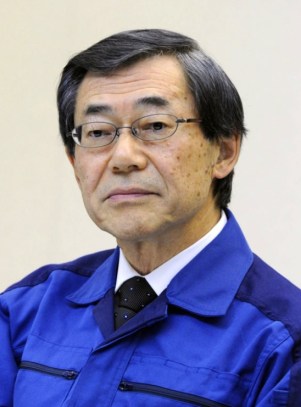
The president of Tokyo Electric Power Co. during the Fukushima nuclear crisis told employees not to publicly use the term “meltdown,” apparently in response to government pressure, a third party report released Thursday said.
The report, compiled by three lawyers, said it is highly likely the government at the time pressured Masataka Shimizu, then Tepco’s president when the monstrous earthquake and tsunami disabled the Fukushima No. 1 nuclear power plant on March 11, 2011, about the utility’s disclosures in the early stages of the crisis.
The report said someone in the government, then headed by Prime Minister Naoto Kan of the Democratic Party of Japan, was unhappy Tepco had revealed a photo of the blown-up building for reactor No. 1 on March 12 without telling the government in advance.
The Prime Minister’s Office then called Shimizu the same day. After Shimizu returned to Tepco’s Tokyo headquarters, he told his fellow executives that they needed to check with the Prime Minister’s Office whenever disclosing information to the public, according to the report.
The report also said Shimizu sent a note on March 14 to Vice President Sakae Muto, who was overseeing the plant and holding a news conference, to warn him not to say meltdown.
“Considering this fact, it is presumable that the Prime Minister’s Office requested Shimizu to be careful about admitting to a meltdown in public,” the report said.
The panel thought this was a critical point that required further investigation but was unable to track down a specific bureaucrat who made such a request. Yasuhisa Tanaka, who headed the panel, said it conducted hearings with 60 Tepco employees but did not talk to anyone from the government side.
Tepco did not acknowledge that a reactor meltdown had occurred until May 15, 2011 — two months after the fact.
Asked whether Tepco was intentionally covering up the meltdowns, Tanaka said that was probably not the utility’s intention at the time.
“Looking at the situation back then, we think it was difficult for Tepco to use the term meltdown because even the Nuclear and Industrial Safety Agency couldn’t use it” due to apparent government pressure, Tanaka said.
The Nuclear and Industrial Safety Agency was Japan’s nuclear watchdog at that time.
The panel spent about three months investigating why Tepco could not publicly reveal the meltdowns occurred earlier than it did.
In February, nearly five years after the crisis, Tepco announced it should have declared the meltdowns earlier, citing the existence of a company manual that listed what constitutes a meltdown. The manual says that meltdown is a state in which 5 percent or more of the fuel rods is damaged.
As of March 14, 2011, Tepco estimated that 55 percent of the fuel rod assemblies in reactor No. 1 and 25 percent of those in reactor No. 3 were damaged but did not declare that they had melted until May that year.
Niigata Prefecture has been pressuring Tepco to look into why it took about two months for the utility to admit to a meltdown.
Niigata hosts Tepco’s Kashiwazaki-Kariwa nuclear plant, which the firm desperately wants to restart, but Niigata Gov. Hirohiko Izumida has stressed that he won’t give the green light until the Fukushima crisis has been thoroughly investigated.
Tepco had explained to Niigata that it did not use the term meltdown because there was no clear definition of it. But it found the manual in February, which contradicted the explanation and led to the third-party investigation.
The report said that workers at the Fukushima plant were apparently following the manual but seemed to avoid using the term meltdown, presumably because there was a common understanding within the company not to use it.
Tokyo Electric changed its name in April to Tokyo Electric Power Company Holdings Inc.
http://jtim.es/kuKR301jNdr
June 16, 2016
Posted by dunrenard |
Fukushima 2016 | Fukushima Daiichi, Government, Lies & Cover-up, Meltdowns, reactors, Tepco |
Leave a comment
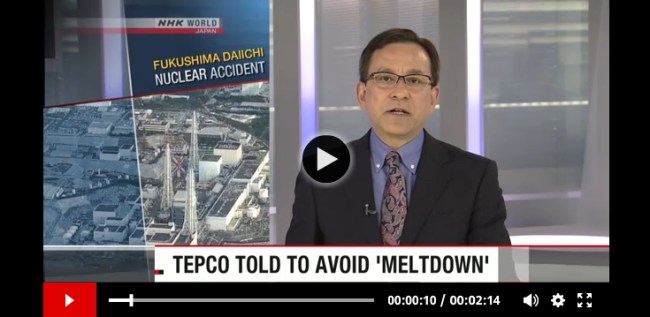
A panel report says a former president of Tokyo Electric Power Company had instructed its officials not to use the words “core meltdown” in explaining the accident at the Fukushima Daiichi nuclear plant. The panel says the president banned use of the words following what he said was an instruction from the prime minister’s office.
TEPCO admitted meltdowns at 3 of its reactors at the Fukushima plant 2 months after the March 2011 accident. It had instead explained that the reactors’ cores had been damaged.
A third-party panel was set up by the utility in March to investigate responses to the accident. It submitted the probe results on Thursday.
The panel report says then-TEPCO president Masataka Shimizu instructed a vice president, who was attending a news conference 3 days after the accident, not to use the words “core meltdown.”
The report says the ban was conveyed to the vice president through a public relations officer and that it was explained as an instruction from the prime minister’s office.
But the panel says it did not carry out investigations of the prime minister’s office and that it could not gain details of the instruction through interviews with Shimizu and other officials. Such details include which member of the prime minister’s office gave it and how.
Another panel set up by the Niigata prefectural government has also been investigating TEPCO’s handling of the accident.
TEPCO earlier told the Niigata panel that it did not use the words “core meltdown” because there is no concise definition of them and that using the words may have given misleading information.
The third-party panel referred to the fact that it took more than 2 months for TEPCO to admit core meltdowns.
The panel report says it cannot say this was improper because TEPCO officials could not determine whether core meltdowns had taken place by inspecting the reactors at that time.
But the report also says core meltdowns were being mentioned within the company at that time and that it could have admitted the phenomena externally.
A panel jointly set up by Niigata Prefecture and TEPCO is expected to carry out further investigations of the matter.
http://www3.nhk.or.jp/nhkworld/en/news/20160616_32/


June 16, 2016
Posted by dunrenard |
Fukushima 2016 | Fukushima Daiichi, Lies & Cover-up, Meltdowns |
Leave a comment
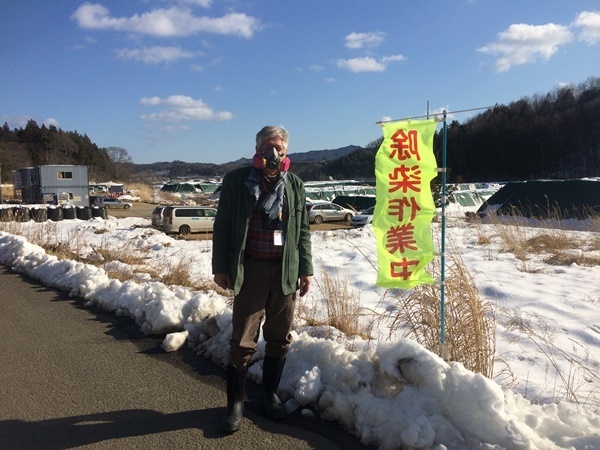
Gendai Business Online’s top ranked article is an exclusive interview with Fairewinds Chief Engineer Arnie Gundersen titled, American nuclear expert warns: “There is a possibility that now in Fukushima recontamination is occurring.” With more than 10,000 likes on Facebook, this Japanese article delves into the truth about nuclear contamination from Fukushima Daiichi as uncovered by Arnie Gundersen during his most recent trip to Japan. Fairewinds, with the help of Japanese translators, provides you with an English translation:
On a mid-February morning, just before the 5th anniversary of the triple meltdown at Fukushima Daiichi, a group of young girls in the city of Minami-Soma rode their bikes to school past a shocked and saddened pedestrian. That upset observer was Arnie Gundersen, nuclear reactor expert and Chief Engineer with Fairewinds Associates. Mr. Gundersen has 45 years of experience as a design, operations, and decommissioning nuclear engineer. He has engaged in research of the effects of the meltdown at Three Mile Island (TMI) and conducts independent research of the triple meltdown at Fukushima Daiichi. Mr. Gundersen is in ongoing conversations with both the US and Japanese media concerning the dangers of nuclear reactors and nuclear power operation. Invited by “Peace News Japan” and several other civil groups, Mr. Gundersen visited the Fukushima prefecture five years after the catastrophe at Fukushima Daiichi.
“What surprised me at this visit to Japan [his third since the meltdowns] is that the decontaminated area is contaminated again,” Mr. Gundersen said while explaining why it was such as sad shock to witness the girls on their bicycles. “This was not what I had expected. I had thought that we would not find such high doses of radiation in the decontaminated area. But, sadly, our results prove otherwise.”
During his Japan visit, Mr. Gundersen collected samples of dust from the rooftop of Minami-Soma city town hall, the floor mat of a 7-Eleven convenience store, and the roadsides of Minami-Soma city. Although the official data cannot be released before the publication of formal scientific papers, it is evident that high doses of radiation, usually found in nuclear waste, was detected from these samples.
“This means that highly radioactive dust is flying around the city. In other words, the decontaminated land is contaminated again. Little girls are affected by the radiation 20 times as much as adult men. The Japanese government’s standard of 20 mSv is based on exposure assessments for adult men. The girls on their bicycles are actually being affected by a radiation dose equivalent to as much as 400 mSv.”
Mr. Gundersen also pointed out that human lungs are heavily affected by internal exposures to radiation.
“At this visit, I wore a radiation proof mask that can filter out 99.98% of radiation for six hours. I sent my filter to the lab, and they found a high dose of Cesium. But, unfortunately, the Japanese government only cares about the number on a Geiger counter and does not consider the internal exposure. This has resulted in a hazardous downplay of this kind of data and human lungs are affected by the serious internal exposure.”
Why is the recontamination happening? One of the reasons is that the government did not decontaminate thoroughly. Mr. Gundersen witnessed first-hand the poor decontamination of the prefecture.
“In the house I visited, only half of the garden area was decontaminated because only that half fell into the category of a contaminated area. It should not be like that. The other half would be contaminated too. Furthermore, one person discovered highly radioactive dust in their driveway where decontamination had occurred. So, of course, this person notified the related offices but the related offices told them that it was not necessary to decontaminate the driveway again because it had already been done once. It’s unbelievable. This person’s house is located near a ravine and the opposite side of the ravine is designated a non-habitable zone.”
Another reason for recontamination is that the radiation from the mountains are coming back to the city by way of wind and rain. Mr. Gundersen noted the extreme radioactive contamination of the mountains.
“We tracked wild monkeys in the mountains and found a high dose of radiation in their feces. I received the meat of a wild pig as a gift and since I could not bring it back to the US [it is illegal to bring meat back to the United States from Japan], tested the meat on a Geiger counter. The meat showed 120 counts/min. I think that the Japanese government should spend more money to decontaminate the mountains but they don’t appear to have that kind of political will. I also worry that contamination in the rivers is not monitored as rain from the mountains flow down into the rivers.”
Due to the heavy radiation contamination of the mountains, vegetables grown in that area exceed the government’s standard by 1500 Bq. These vegetables were sold at the MichinoEki in Tochigi prefecture, and the bamboo shoot grown in this contaminated region was used for elementary school lunches in Utsunomiya. These school lunches contained more than twice as much radiation as the government’s standard.
Recontamination is happening due to poor decontamination and residents of Kawauchi village in Fukushima prefecture claim that the decontamination in the forests is not enough. However, the government continues to push for the end of people’s relocation and force the return to recontaminated areas.
“If I had a little child, I would never let them live there,” Mr. Gundersen pointedly states.
Mr. Gundersen also found that Tokyo remains contaminated. He measured dust collected from the sidewalk in front of MITI (Ministry of International Trade and Industry) and found a high dose of radiation. That dust is in the air that will be inhaled by the visitors and athletes of the 2020 Olympic Games. Needless to say, the current residents are inhaling it every day. “Mr. Abe should not take the advice from IAEA, MITI and TEPCO seriously,” Mr. Gundersen insists. “Instead, he should have an independent organization conduct research and listen to the advice from them.”
http://www.fairewinds.org/nuclear-energy-education//fairewinds-in-the-news-gendai-business-online-feature-article
June 15, 2016
Posted by dunrenard |
Fukushima 2016 | Arnie Gundersen, Contamination, Fukushima continuing, Fukushima Daiichi |
Leave a comment

Sections of the cover upon the base of the fuel removal machine
In preparation for the installation of a fuel removal machine and a protective cover over unit 3 of the damaged Fukushima Daiichi plant in Japan, workers have carried out a practice run of installing roof modules onto the base of the fuel handling machine.
Plans were announced in November 2012 for a cover to be constructed to encase the unit’s damaged reactor building, protecting it from the weather and preventing any release of radioactive particles during decommissioning work.
The section of the reactor building that sheltered the service floor of unit 3 was wrecked by a hydrogen explosion three days after the tsunami of March 2011 – leaving the fuel pond exposed and covered by debris including many twisted steel beams.
The fabrication of the cover has been under way since November 2013 at the Onahama works in Iwaki city. It has been made in sections so that once it is transported to Fukushima Daiichi, the time to assemble it can be shortened and the radiation exposure to the workers on site can be significantly reduced, Tokyo Electric Power Company (Tepco) said.
A separate structure will be built to facilitate the removal by crane of used fuel from the storage pool. This 54-metre-tall structure will include a steel frame, filtered ventilation and an arched section at its top to accommodate the crane. Measuring 57 metres long and 19 metres wide, it will not be fixed to the reactor building itself, but will be supported on the ground on one side, and against the turbine building on the other.
A detailed replica of a portion of the Fukushima Daiichi site has been created at Onahama to enable workers to train in highly realistic conditions, Tepco said. Training began in May and will continue through June.
On 10 June, workers at Onahama assembled sections of the cover on the base of the specially-made fuel removal machine and slid them into place to make a roof, Tepco announced.
Although the largest pieces of rubble have already been removed, once installed the remotely-operated fuel removal machine will be used to clear the remaining rubble and the 566 fuel assemblies from the unit’s storage pool. The removal of debris and fuel using the system is scheduled to begin in fiscal 2017.
The fuel removed from unit 3 will be packaged for transport the short distance to the site’s communal fuel storage pool, although it will need to be inspected and flushed clean of dust and debris.
http://www.world-nuclear-news.org/RS-Test-run-for-Fukushima-Daiichi-3-cover-installation-1306164.html
June 15, 2016
Posted by dunrenard |
Fukushima 2016 | Dome Cover, Fuel Removal Machine, Fukushima Daiichi, Reactor 3 |
Leave a comment
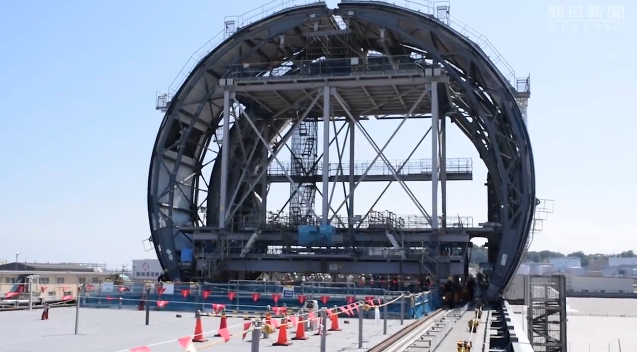
a massive cover will be built over the No. 3 reactor building of the Fukushima No. 1 nuclear power plant during a practice run at Onahama port in Iwaki, Fukushima Prefecture, on June 10.
IWAKI, Fukushima Prefecture–A dress rehearsal is under way to install a huge “hat” over a crippled reactor building at the Fukushima No. 1 nuclear power plant.
The bulky dome-shaped cover is meant to stop the spread of radioactive material and protect equipment necessary to retrieve 566 bundles of nuclear fuel rods from a storage pool in the No. 3 reactor building.
The simulation is designed to get workers fully drilled so they can set up the cover quickly, reducing the time they are exposed to radiation.
Tokyo Electric Power Co., operator of the crippled plant, has started simulating the process at Onahama port in Iwaki.
On June 10, TEPCO invited reporters to witness part of the drill in which portions of the cover measuring about 18 meters high were moved on a rail for about 50 meters.
The No. 3 reactor building, where a meltdown occurred after the March 2011 Great East Japan Earthquake and resulting tsunami, still has an extremely high reading of radiation.
TEPCO plans to begin retrieving the fuel rods during fiscal 2017, starting in April next year.
The drill is expected to continue through this month to ensure there are no flaws in the working procedures and safety measures.
TEPCO plans to first decontaminate the No. 3 reactor building and put up shields so that radiation levels drop when the massive cover is installed.
The cover used in the drill will be dismantled and then shipped to the power plant for reassembly and use in the actual retrieval.
http://www.asahi.com/ajw/articles/AJ201606130029.html

Parts of the cover to be placed over the No. 3 reactor building of the Fukushima No. 1 nuclear power plant are shown during a drill at Onahama port in Iwaki, Fukushima Prefecture, on June 10
June 14, 2016
Posted by dunrenard |
Fukushima 2016 | Dome Cover, Fukushima Daiichi, Reactor 3 |
Leave a comment

On 5/30/2016, a director of Tepco, Anegawa admitted that Tepco concealed the fact of meltdown in 311.
He stated that in the press conference of that day. He says it was obviously meltdown, but Tepco avoided mentioning the term of “meltdown”. He thinks that was concealment.
In Tepco’s internal manual, meltdown is defined to be when over 5% of reactor core is damaged. However Tepco did not mention meltdown even though they knew 55 ~ 70% of the core was damaged by 3/14/2011.
Anegawa commented ordinary engineer would call such a state meltdown even without a manual.
At this moment, third-party inspection committee is investigating Tepco for its arbitrariness.
http://www.tepco.co.jp/tepconews/library/archive-j.html?video_uuid=y3a6i6b2&catid=61697
http://fukushima-diary.com/2016/06/tepco-admits-they-concealed-the-fact-of-meltdown/
June 13, 2016
Posted by dunrenard |
Fukushima 2016 | Admission, Fukushima Daiichi, Lies & Cover-up, Meltdowns, Tepco |
Leave a comment

On 6/2/2016, Tepco reported to NRA (Nuclear Regulation Authority) that they need to inject cement to “frozen” water wall and NRA admitted it.
The feasibility of frozen water wall project was questioned since before the beginning. In the meeting of NRA, Tepco admitted the temperature remains nearly 10 ℃ at 4 “freezing” points to cause no improvement to stop contaminated groundwater. It has been in freezing operation for over 2 months.
These 4 points are situated between the reactor buildings and the sea. The volume of contaminated water to be pumped up has not been decreased regardless of the frozen water wall.
Tepco states the temperature remains over 0 ℃ because of the high speed of groundwater. They inject cement to slower the water.
Click to access handouts_160602_06-j.pdf
http://photo.tepco.co.jp/date/2016/201606-j/160606-01j.html
Tepco to inject cement instead of frozen water wall
June 12, 2016
Posted by dunrenard |
Fukushima 2016 | Cement Injection, Fukushima Daiichi, Ice wall |
Leave a comment
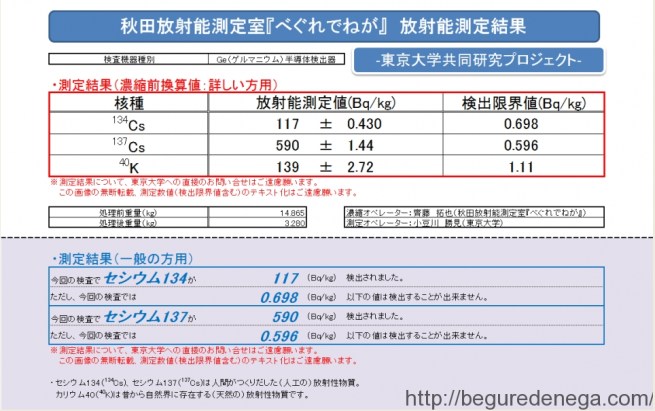
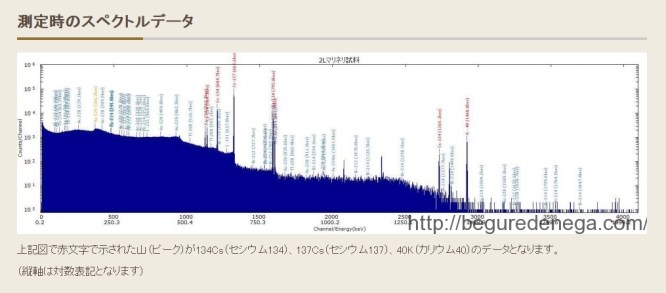
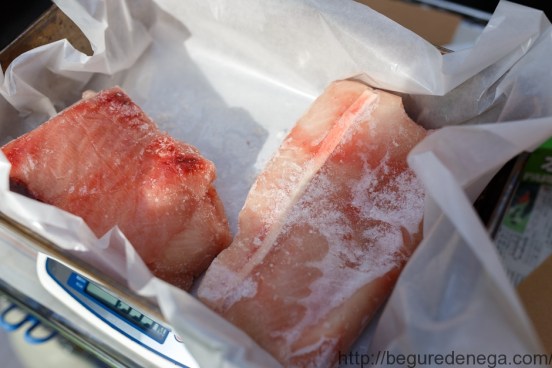
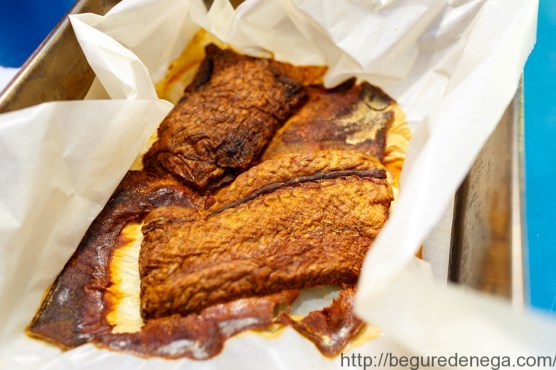
Shortfin mako shark steaks, commonly consumed in Japan, caught off Shizuoka prefecture, more than 500 kms south of Fukushima : 707 becquerels / kg of Cesium 134 + 137
Cesium 134Cs: 117 Bq / kg
Cesium 137Cs: 590 Bq / kg
Thank you Tepco!
The release of radioactive water from the Fukushima Daiichi nuclear plant into the sea continues (300 Tons per day), and its bioaccumulation in living organisms continues as well, especially at the top of the food chain…
Bon appetit!
Source http://beguredenega.com/archives/9498
In the meantime Japanese Ministry of Environment decides to lift shipment restrictions on Fukushima flounder and conger and other types of fish, 18 species:
Shipment Restrictions on Fukushima Flounder, Conger Lifted
Tokyo, June 9 (Jiji Press)–The Japanese government lifted shipment restrictions on Thursday on flounder and whitespotted conger caught off the nuclear disaster-hit northeastern Japan prefecture of Fukushima.
The lifting came after the government confirmed that the samples stably contain less than the government-set standard of 100 becquerels of radioactive substances per kilogram.
The government introduced the shipment restrictions following the March 2011 meltdowns at Tokyo Electric Power Company Holdings Inc.’s Fukushima No. 1 nuclear power plant.
Including flounder and whitespotted conger, 18 species have seen a shipment ban lifted, while shipments of 26 others, including Japanese black porgy and masu salmon, have yet to be approved.
In 2010, flounder and whitespotted conger ranked third and ninth, respectively, in terms of the value of landings off Fukushima.
http://jen.jiji.com/jc/i?g=eco&k=2016060900848
June 10, 2016
Posted by dunrenard |
Fukushima 2016 | Contaminated Fish, Contamination, Food contamination, Fukushima Daiichi, radiation |
Leave a comment


