Nuclear Reactor Design Chosen – Not Because It Was Safe – But Because It Worked On Navy Submarines
From June 20, 2011
Virtually all of the nuclear reactors in the U.S. are of the same archaic design as those at Fukushima (Indeed, MSNBC notes that there are 23 U.S. reactors which are more or less identical to those at Fukushima.)
Called “light-water reactors”, this design was not chosen for safety reasons. Rather, it was chosen because it worked in Navy submarines.
Specifically, as the Atlantic reported in March:
In the early years of atomic power, as recounted by Alvin Weinberg, head of Oak Ridge National Laboratory in his book The First Nuclear Era, there was intense competition to come up with the cheapest, safest, best nuclear reactor design.
Every variable in building an immensely complex industrial plant was up for grabs: the nature of the radioactive fuel and other substances that form the reactor’s core, the safety systems, the containment buildings, the construction substances, and everything else that might go into building an immensely complex industrial plant. The light water reactor became the technological victor, but no one is quite sure whether that was a good idea.
Few of these alternatives were seriously investigated after light water reactors were selected for Navy submarines by Admiral Hyman Rickover. Once light water reactors gained government backing and the many advantages that conferred, other designs could not break into the market, even though commercial nuclear power wouldn’t explode for years after Rickover’s decision. “There were lots and lots of ideas floating around, and they essentially lost when light water came to dominate,” University of Strasbourg professor Robin Cowan told the Boston Globe in an excellent article on “technological lock-in” in the nuclear industry.
As it turned out, there were real political and corporate imperatives to commercialize nuclear power with whatever designs were already to hand. It was geopolitically useful for the United States to show they could offer civilian nuclear facilities to its allies and the companies who built the plants (mainly GE and Westinghouse) did not want to lose the competitive advantage they’d gained as the contractors on the Manhattan Project. Those companies stood to make much more money on nuclear plants than traditional fossil fuel-based plants, and they had less competitors. The invention and use of the atomic bomb weighed heavily on the minds of nuclear scientists. Widespread nuclear power was about the only thing that could redeem their role in the creation of the first weapon with which it was possible to destroy life on earth. In other words, the most powerful interest groups surrounding the nuclear question all wanted to settle on a power plant design and start building.
***
President Lyndon Johnson and his administration sent the message that we were going to use nuclear power, and it would be largely through the reactor designs that already existed, regardless of whether they had the best safety characteristics that could be imagined. [Nixon also fired the main government scientist developing safer types of reactors, because he was focused on safety instead of sticking with Nixon’s favored reactors.] We learned in later years that boiling water reactors like Fukushima are subject to certain types of failure under very unusual circumstances, but we probably would have discovered such problems if we’d explored the technical designs for longer before trying to start building large numbers of nuclear plants.
The Atomic Energy Commission’s first general manager – MIT professor Carroll Wilson – confirmed in 1979:
The pressurized water reactor was peculiarly suitable and necessary for a submarine power plant where limitations of space and wieght were extreme. So as interest in the civilian use of nuclear power began to grow, it was natural to consider a system that had already proven reliable in submarines. This was further encouraged by the fact that the Atomic Energy Commission provided funds to build the first civilian nuclear power plant … using essentially the same system as the submarine power plant. Thus it was that a pressurized light water system became the standard model for the world. Although other kinds of reactors were under development in different countries, there was a rapid scale-up of of the pressurized water reactor and a variant called the boiling water reactor developed by General Electric. These became the standard types for civilian power plants. in the United States and were licensed to be built in France, Germany, Japan and elsewhere.
If one had started to design a civilian electric power plant without the constraints of weight and space as required by the submarine, quite different criteria would apply.
(Wilson also notes that the engineers who built the original reactors didn’t really think about the waste or other basic parts of the plants’ life cycle.)
Ambrose Evans-Pritchard argues that there was another reason why all safer alternative designs – including thorium reactors – were abandoned:
The plans were shelved because thorium does not produce plutonium for bombs.
As Boing Boing notes:
Reactors like this [are] flawed in some ways that would be almost comical, were it not for the risk those flaws impart. Maybe you’ve wondered over the past couple of weeks why anyone would design a nuclear reactor that relied on external generators to power the pumps for it’s emergency cooling system. In a real emergency, isn’t there a decent chance that the backup generators would be compromised, as well?
It’s a good question. In fact, modern reactor designs have solved that very problem, by feeding water through the emergency cooling system using gravity, rather than powered pumps. Newer designs are much safer, and more reliable. But we haven’t built any of them in the United States …
Not the Navy’s Fault
This is in no way a criticism of the U.S. Navy or its submarine reactors. As a reader comments:
There are some things to know about Navy reactors:
-
They don’t store thirty years worth of used, spent fuel rods next to the reactor.
-
They don’t continue to operate a reactor that had a design life of 25 years for 60 years.
-
The spent fuel pool is back on land on a base somewhere.
(In addition, the reactors on subs are much smaller than commercial reactors, and so have almost no consequences for the civilian population if they meltdown. And if an accident were to happen on a nuclear sub, the sub would likely sink or at least flood, presumably keeping the reactor from melting down in the first place.)
There Are No Independent Regulators and No Real Safety Standards
But at least the government compensates for the inherently unsafe design of these reactors by requiring high safety and maintenance standards.
Unfortunately, no …
As AP notes today:
Federal regulators have been working closely with the nuclear power industry to keep the nation’s aging reactors operating within safety standards by repeatedly weakening those standards or simply failing to enforce them.
***
Examples abound. When valves leaked, more leakage was allowed — up to 20 times the original limit. When rampant cracking caused radioactive leaks from steam generator tubing, an easier test of the tubes was devised so plants could meet standards.
***
Records show a recurring pattern: reactor parts or systems fall out of compliance with the rules; studies are conducted by the industry and government; and all agree that existing standards are “unnecessarily conservative.’’
Regulations are loosened, and the reactors are back in compliance.
Of course, the Nuclear Regulatory Commission – like all nuclear “agencies” worldwide – is 100% captured and not an independent agency, and the NRC has never denied a request for relicensing old, unsafe nuclear plants.
Indeed, Senator Sanders says that the NRC pressured the Department of Justice to sue the state of Vermont after the state and its people rejected relicensing of the Vermont Yankee plant, siding with the nuclear operator instead. The Nation notes:
Aileen Mioko Smith, director of Green Action Kyoto, met Fukushima plant and government officials in August 2010. “At the plant they seemed to dismiss our concerns about spent fuel pools,” said Mioko Smith. “At the prefecture, they were very worried but had no plan for how to deal with it.”
Remarkably, that is the norm—both in Japan and in the United States. Spent fuel pools at Fukushima are not equipped with backup water-circulation systems or backup generators for the water-circulation system they do have.
The exact same design flaw is in place at Vermont Yankee, a nuclear plant of the same GE design as the Fukushima reactors. At Fukushima each reactor has between 60 and 83 tons of spent fuel rods stored next to them. Vermont Yankee has a staggering 690 tons of spent fuel rods on site.
Nuclear safety activists in the United States have long known of these problems and have sought repeatedly to have them addressed. At least get backup generators for the pools, they implored. But at every turn the industry has pushed back, and the Nuclear Regulatory Commission (NRC) has consistently ruled in favor of plant owners over local communities.
After 9/11 the issue of spent fuel rods again had momentary traction. Numerous citizen groups petitioned and pressured the NRC for enhanced protections of the pools. But the NRC deemed “the possibility of a terrorist attack…speculative and simply too far removed from the natural or expected consequences of agency action.” So nothing was done—not even the provision of backup water-circulation systems or emergency power-generation systems.
As an example of how dangerous American nuclear reactors are, AP noted in a report Friday that 75 percent of all U.S. nuclear sites have leaked radioactive tritium.
Indeed, because of poor design, horrible safety practices, and no real regulation, a U.S. nuclear accident could be a lot worse than Fukushima.
Robots expected to play key role in Fukushima decommissioning, but challenges remain

As decommissioning work at Tokyo Electric Power Co. (TEPCO)’s Fukushima No. 1 Nuclear Power Plant continues, remote control robots are expected to play an important role in the decommissioning process. However, it is impossible to ignore the fact that the development of these robots faces huge challenges, such as high levels of radiation within the nuclear reactors, as well as a lack of information.
Among the robots that have been designed to carry out decommissioning work is the “muscle robot.” Developed by Hitachi-GE Nuclear Energy, Ltd., the body and limbs of the muscle robot can be controlled with a device that one might typically find attached to a video game console. Another type of robot acts like a crab with claws that can be used to grasp metallic pipes and snap them using a blade positioned on one of its claws. These robots are also able to smash concrete, using a special drill that can be placed at the end of the arm — like something out of a Hollywood movie.
Looking ahead, the government and TEPCO are aiming to start removing the melted nuclear fuel inside the No. 1 to No. 3 reactors at the Fukushima No. 1 nuclear plant in 2021, after announcing exactly how they plan to do so over the summer. Although knowledge regarding the matter is limited, it seems that the melted nuclear fuel in the reactors has cooled and solidified, and the prototypes of the robots have been produced based on the assumption that the devices need to break down and remove such hardened fuel.
The robots’ parts are connected together with springs, and are driven using hydraulic power. One of the main advantages of this system is that they are hardly affected by radiation. There are six types of robot in total, such as the “spider-style” robot which has six arms and legs (length 2.8 meters, width 2 meters, weight 50 kilograms), as well as a “tank-style” robot (length 4.35 meters, width 63 centimeters, weight 700 kilograms), which runs on a conveyor belt. The tank-style robot is capable of lifting objects weighing up to 50 kilograms. A representative from Hitachi-GE Nuclear Energy states determinedly, “I want the muscle robots to remove the melted nuclear fuel.”
However, the process will not be plain sailing. While the bodies of these robots are resistant to radiation, their cameras are somewhat vulnerable. It has been found that the electronic hardware in the cameras breaks easily after being exposed to radiation. For example, when a “cleaning robot” was sent into the No. 2 reactor on Feb. 9, 2017, the camera broke after about two hours after being exposed up to an estimated 650 sieverts per hour of radiation. The camera part of the robot is essential because without it, images cannot be transmitted back to the control room.
To solve this problem, ideas such as placing a metallic plate near the camera that would block out radiation have been discussed, but it is feared that this would make the robot heavier and interfere with its operations. As a Hitachi representative states, “If one were to use an analogy to describe the current development stage in human terms, then we have entered elementary school. We’d like to continue our work, believing we can develop usable robots.” It is clear that a trial-and-error process is very much underway, as the robot developers try their best to achieve perfection.
It will not be an easy road though. Hajime Asama, professor at the University of Tokyo and a member of the Technology Advisory Committee of the International Research Institute for Nuclear Decommissioning (IRID), states, “Robots are usually developed based on confirmation of what exactly lies in the reactors. However, in the case of the No. 1 power plant, no matter how hard you try to predict what is in there, there are often unexpected elements waiting.”
In the No. 2 reactor, a “scorpion-style robot” was sent in on Feb. 16, as a follow-up to the cleaning robot but it got trapped by deposits on the conveyor belt, and came to a halt. The presence of these kinds of deposits was unexpected at the stage when the robot was being designed. Too much is still unknown about the situation inside the reactors, making robot design difficult. Later this month, a “wakasagi ice fishing-type robot” is expected to be placed inside the No. 1 reactor, but it is feared that the same problems that were experienced in the No. 2 reactor will emerge once again.
In recent years, the use of artificial intelligence has been expected to play a key role but a number of unexpected problems have made progress in this area difficult. What is needed is technology that can be controlled remotely by people with flexible judgment. However, professor Asama believes that, “The reactors inside the No. 1 plant are full of unknown challenges. We have no choice but to use our available knowledge to create robots that can deal with these problems.”
https://mainichi.jp/english/articles/20170408/p2a/00m/0na/023000c
Russia’s Rosatom Discusses Projects on Fukushima Disaster Cleanup With Japan

During the visit to Japan, Russia’s Rosatom State Nuclear Energy Corporation’s delegation discussed with Japanese partners possible projects on elimination of consequences of Fukushima nuclear power plant (NPP) disaster, Rosatom said Saturday.
MOSCOW (Sputnik) — Rosatom’s delegation headed by CEO Alexey Likhachev visited Japan on April 4-7 to discuss the Japanese-Russian memorandum on cooperation in the field of peaceful use of nuclear energy, which was signed in December 2016.
“Special attention was paid to the cooperation in overcoming the consequences of the Fukushima accident with the use of Russian technologies in terms of handling nuclear waste and pulling nuclear facilities out of operation…. In particular, opportunities for implementation of projects concerning the problem of melted fuel extraction and rehabilitation of polluted territories were discussed with Japanese partners,” the statement on Rosatom’s website read.
According to the statement, the delegation also visited Fukushima NPP to get acquainted with the current situation and the work on recovery from the accident.
In March 2011, a 9.0-magnitude offshore earthquake triggered a tsunami that hit Fukushima NPP, leading to the leakage of radioactive materials and the shutdown of the plant. The accident is considered to be the world’s worst nuclear disaster since the Chernobyl accident that took place in the Soviet Ukraine in 1986.
Earlier in the year, it was announced that Japan’s research institution Mitsubishi chose two Rosatom subsidiaries, RosRAO and Techsnabexport to take part in the efforts to eliminate the consequences of the 2011 Fukushima nuclear accident.
https://sputniknews.com/environment/201704081052446822-russia-japan-fukushima-cleanup/
The fallout of a damaged reactor versus the fallout of an atomic bomb

Translation from french by Hervé Courtois
By AIPRI, the International Association for the Protection against Ionizing Rays.
The purpose of the AIPRI is to provide scientific disclosure in the field of nuclear physics and the radiological hazards of internal contamination.
While it is undeniable that the fallout to the ground during the few hours following the explosion of an atomic bomb is conducive to cause acute irradiations for a few days, more than the fallout of a damaged reactor, it is equally undeniable that the fallout from a damaged reactor causes a considerably higher number of deferred victims for the simple reason that it releases a much larger and more toxic mass of “lasting” fission products than does a single atomic bomb and also more heavily contaminates a much larger territory.
Clearly, Chernobyl scattered at least 24.6 kilograms of cesium 137, while a plutonium device of 22 kt disseminates 47.6 grams. Chernobyl dispersed more than 16 kilograms of plutonium 239 into fine particles, while a device with a 10% fission yield dropped 11 kg in the environment (The bombs only work in excess of their fission output and spoil a lot of the goods, which is why they disseminated 50 tons of “unconsumed” plutonium nanoparticles during the nuclear weapon tests).
To count only the few hundred early victims of the acute irradiations of each one is to demonstrate a satanic malfeasance and an infatuation unparalleled for falsification and death for it is tantamount to spitting out an abject gall on the countless liquidators who prematurely disappeared to whom we owe our lives and to eradicate the millions and millions of anonymous, proven, programmed and calculated victims of this endless nuclear tragedy.
Yet this is known. An atomic reactor is continuously fissioning and accumulates more lasting” fission products every day. A reactor saves and in fact continuously grows its secular toxic capital. On the other hand, a bomb fission instantaneously but without ever accumulating anything.
This is the reason why the fallout from both of them if they are for the whole made of the same radioelements are not however at all in the same proportions and therefore do not have the same lasting radiotoxicity which is of course the most dangerous because it acts over centuries and centuries.
Comparing one to the other is thus already in itself a somewhat hazardous exercise, moreover, to take into account only the victims of the acute irradiations of both to confront the dangerousness is a criminal scam whose ultimate goal is the concealment of the millions of deferred victims of this modern civil and military nuclear tragedy.
Post scriptum:
Cs137 by kt for a load of Pu239
1.444E + 23 at./kt * 6.58% Rdf = 9.50E21 Cs137 * 7.312E-10 λ = 6.947E12 Bq / kt either 6.95 TBq or 187.82 Ci / kt for 2.16 g / Kt
http://aipri.blogspot.fr/2017/03/coup-de-gueule-atomique.html
Testimony from Disaster
MINES Paris Tech is the leading institution, at the heart of the french nuclear lobby, a state within the State.
Crisis management students in France are hoping to learn from a first-hand account of the Fukushima nuclear disaster.
Franck Guarnieri, a researcher in risk and crisis management at one of France’s leading institutions, MINES ParisTech, has been studying the accident.
Guarnieri and his team have interviewed nearly 30 government officials, experts, and employees at Tokyo Electric Power Company who were active during the aftermath of the 2011 disaster.
He is particularly interested in the actions of the late Masao Yoshida, the plant manager at the time.
Some months after the disaster, Yoshida told the government about what he did. The transcript, titled the Yoshida Testimony, was released in 2014.
When Guarnieri saw it, he decided to publish it in French.
The job of rendering Yoshida’s entire 28-hour testimony into French was recently completed. The translation takes up 3 volumes, 2 of which are now in print.
“This is the first time the testimony of a plant manager has been made public. In the Three Mile Island and Chernobyl accidents, the plant managers did not give testimonies,” says Guarnieri.
Rather than simply focusing on the events and facts of the disaster, Guarnieri and his team are especially interested in Yoshida’s emotional and psychological state, as the person in charge of the accident response.
These are some of his statements:
“There was no manual for this situation. To put it bluntly, I realized I’d have to rely on my intuition and judgment.”
“If we had stopped injecting water into the reactors it would have been catastrophic, so I decided to continue.”
Guarnieri’s team says those words indicate that Yoshida had to make decisions based on information that was potentially incorrect. They say the Yoshida Testimony is quite different from other official accounts, which tend to include little regarding the human element.
France now operates more than 50 nuclear power plants, which supply 70% of the nation’s electricity. To date, there haven’t been any major nuclear accidents.
But Guarnieri believes the officials at these French nuclear power plants need to read Yoshida’s testimony.
Recently, he met with Jean-Marc Cavedon, the director of the French Alternative Energies and Atomic Energy Commission on the outskirts of Paris.
Guarnieri stressed the unique importance of the Yoshida document, and urged them to devise safety measures for extreme situations.
“There will be no progress in risk management unless we learn from other people’s experience and improve as human beings,” says Cavedon.
“Nuclear power plants need to improve their risk management, by facing up to the disastrous events in Fukushima,” says Guarnieri.
Two years after the nuclear accident, Yoshida died of cancer.
Guarnieri is now intent on spreading the lessons of Yoshida’s testimony, to make sure such a tragedy never happens again.
https://www3.nhk.or.jp/nhkworld/en/news/editors/5/20170403/

Yoshida’s Dilemma: if it wasn’t for one man, it could have been much worse

After Fukushima, battling Tepco and leukemia

‘Expendable’: Masaru Ikeda, a former worker at the Fukushima No. 1 nuclear plant, is suing Tepco for failing to take adequate precautions against radiation exposure. Following his second stint at the stricken plant, Ikeda was diagnosed with leukemia, which labor authorities have said is linked to the radiation he was exposed to at the plant.
Eight-year-old Kenji hands his mother a tissue, which she uses to dry her eyes beneath thick-rimmed spectacles, her free hand giving her son’s closely cropped jet-black hair a gentle stroke. Michiko Ikeda has cried before, deeply, achingly, she admits, during a darker time when she faced the very real prospect of having to raise Kenji and his two siblings alone.
Then, Masaru, her husband of 15 years, had been diagnosed with leukemia following stints working at the stricken Fukushima No. 1 nuclear power plant and the neighboring Fukushima No. 2 facility, starting in the fall of 2011.
“Even when he first said it was leukemia I thought it must be a mistake,” Michiko says as the afternoon sun streams through the window of the front room of her home in western Japan. “When the hospital confirmed it, my mind went blank. I couldn’t stop crying, wherever I went. The only image I had in my head was that my husband was going to die.”
The road to Fukushima for Masaru Ikeda began to unfold the day after the March 2011 disasters, when images from the tsunami-devastated Tohoku coast flooded the TV and internet. Among them was footage of bodies being laid out in a makeshift morgue, the feet and legs sticking out from beneath mud-encrusted blankets clearly belonging to children.
“It was overwhelming and I couldn’t help wondering how I’d feel if it was my kids lying there,” says Masaru, 42, who, after 10 months of cancer treatment, was discharged from his hospital cleanroom, the cancer having been found to be one step short of incurable. “I knew I had to to do something to help.”
Shortly after, his boss at the construction company where he worked told him about a Fukushima contractor who was looking for labor to assist with the ongoing battle to bring the devastated nuclear facility under control. Even though he had never set foot in a nuclear power plant before, Ikeda’s 15 years of experience as a welder would be invaluable.
“He asked if any of us were prepared to go up there, but nobody wanted to take the risk,” he says, adding that he, too, had initially hesitated. “I talked with colleagues and they said, ‘The workers at “1F” are like kamikaze pilots.’ … I still wanted to go, not for the sake of the country, but for the people of Tohoku.”
His family and friends objected vehemently. His father told him bluntly that if he went, he’d end up getting leukemia.
“He didn’t say ‘cancer,’ or another illness, but ‘leukemia,’ possibly because of what happened after Hiroshima,” Ikeda says, referring to the leukemia that was the earliest delayed effect of radiation exposure seen among A-bomb survivors. “I told him there was no way that would happen.”
Ikeda’s work at the plant was as varied as it was hazardous. At one point he helped construct a facility to dispose of workers’ TyVek suits, the ubiquitous white hooded jumpsuits that after exposure to radiation were discarded onto mountainous piles inside the plant’s evacuation zone.
Later he was involved in the construction of a temporary elevator at shattered reactor 3 and a 50-meter-tall heavy-duty steel structure to surround reactor 4 and support a huge overhead crane that was needed to remove the smoldering fuel assemblies in the fuel pool. These had been exposed to the elements following an explosion that blew away the reactor roof and the original crane.
“I was shocked when I first got there and saw the sheer volume of abandoned equipment and vehicles — including fire department and military trucks that had become irreversibly contaminated.”
He was also surprised by the makeup of the on-site workers — a curious mixture of day laborers and the homeless — not to mention the pitiful shortage of suitable clothing and masks to protect them from radiation, he says.
“Later, when a lot of fuss was made about radioactivity, that kind of gear and PDMs (pocket dosimeters, which monitor radiation) became more commonplace, but before that it was basically regular work clothes and surgical masks,” he says. “During work at reactor 4 the levels were so high we were supposed to wear lead vests, but there were not enough to go round so some of us had to do without.”
Nonetheless, the high radiation levels meant that work close to the reactors rarely lasted more than an hour per day and on occasion was terminated after just 10 minutes.
In late 2013, Ikeda returned home for rest and recuperation following a dispute with a subcontracting firm that was refusing to honor the daily ¥6,000 hazard allowance promised to workers — considerably less than the ¥19,000 pledged by Tokyo Electric Power Co. (Tepco) president Naomi Hirose a month earlier.
It was about this time that he started to feel unwell. He couldn’t shake off a dry cough and found himself tiring far more easily than usual. Twice he scraped the side of his car without even realizing it.
In early 2014 a local doctor diagnosed him with a cold, making the news of a far more life-threatening illness during a company-sanctioned periodic health check a week later all the harder to swallow.
Results from a subsequent spinal tap revealed that 80 percent of the white blood cells in his bone marrow were abnormal. The doctor told him if he had waited a couple more weeks, treatment would not have been an option.
Nevertheless, it was still touch and go, and fearing he might not have much longer to live, Ikeda ignored the doctor’s recommendation for immediate hospitalization, instead returning home to spend time with his children, who were then only 5, 7 and 9.
“It was only after I saw them through the glass of the cleanroom for the first time that I realized what a painful ordeal I had put them through,” says Ikeda. “I don’t regret going to Fukushima … but I do regret the distress I caused my family.”
Despite his father’s pre-Fukushima dispatch prophecy, Ikeda had yet to contemplate the possibility that his illness may be tied to the plant. The seed of that idea was planted by a surprising source — an official at Kajima Corp., a company he praises despite it being implicated in a kickback scandal that led some workers who had received little or no hazard compensation to take legal action.
For the time being, however, he felt fortunate and relieved. The health and labor ministry had recognized the illness as workplace-related, though it stopped short of stating it was directly tied to the 19.8 millisieverts of radioactivity he had been exposed to while working at nuclear plants.
Under health ministry guidelines, workers who are exposed to 5 mSv of radiation in a year can apply for compensation insurance payments. Ikeda did so successfully, meaning the government would help cover Ikeda’s medical costs and loss of income.
Shortly after, he was contacted by a friend still employed at the plant, who told him of a memo attached to a worker survey undertaken by plant operator Tepco.
“The memo told workers not to worry about the decision to recognize the connection between my leukemia and radiation — that it was bogus,” Ikeda recalls. “It was as though Tepco was trying to erase the recognition of my work-related illness, which by law was its responsibility.”
Until then Ikeda insists he had “no intention” of suing Tepco, but its attitude made him “feel sick to the bone.”
“I started to wonder what kind of people they are,” says Ikeda, who since his transfusions has suffered various ailments linked to the peripheral blood stem cell transplant he received for his acute myeloid leukemia (AML). “This is a company that for months denied the reactor meltdowns, and that caused the explosions by refusing to inject seawater (to cool the reactors) on the grounds it would render the reactors unusable. Then they turn a blind eye to a worker who helped clean up their mess. To them I was just another expendable laborer.”

Heavy price: Masaru Ikeda looks through his bag of copious prescription medication.
Incensed, Ikeda started legal proceedings against Tokyo Electric Power Co. Holdings Inc., accusing the now-nationalized utility of failing to take adequate precautions against radiation exposure. His first hearing, where he filed for ¥59 million damages against both Tepco and Kyushu Electric Power Co., at whose Genkai plant he had also worked, commenced at the Tokyo District Court on Feb. 2.
A Tepco spokesperson denied the claims, saying the utility has endeavored “to manage all radiation exposure of workers,” adding there has been “no medical connection found (between radiation exposure and leukemia) … even from third-party or any other medical experts.”
A health ministry official stopped short of corroborating that view, saying it had awarded Ikeda compensation even though the “causal link between his exposure to radiation and his illness is unclear.”
Researchers worldwide are divided about the relation between radiation and leukemia and, indeed, some other cancers. Imperial College London cancer expert Geraldine Thomas, who is openly pro-nuclear, says there is in fact a connection, though leukemia and other cancers can also result from several factors.
“AML … does have an association with radiation exposure. However, it also has an association with smoking, exposure to benzene (one of the contaminants in cigarette smoke), etc.,” says Thomas, who runs the Chernobyl Tissue Bank, which analyzes samples of tissue from people exposed to radiation after the Chernobyl nuclear disaster. “The problem with … these cases is that it is easy to blame radiation exposure, but almost impossible to prove or disprove, as there are no biomarkers that can be used to distinguish between different etiologies.”
The total dose Ikeda received was “very low,” Thomas adds, leading her to suspect that exposure to cigarette smoke is more likely to be a higher risk factor. Ikeda says he only started smoking after a doctor had recommended it to counter the stress resulting from the sometimes debilitating side-effects of his treatment.
While scientists such as Thomas show caution in their assessment of low exposure doses, Hisako Sakiyama, a medical doctor and former senior researcher at Japan’s National Institute of Radiological Sciences, is among those who insist that even lower doses can cause irreparable DNA damage known as “double strand breaks.” Such doses are therefore “capable of inducing cancer,” she says, “because the energy of radiation is stronger than that of the chemical bonds of DNA.”
Thomas counters that this alone is not enough to prove nuclear plants are the root of the problem because “double strand breaks are not uniquely caused by radiation.”
Ikeda’s lawyer, Yuichi Kaido, concedes that it’s scientifically problematic to prove his client’s leukemia is tied to radiation, even though Ikeda’s illness has been officially declared as being linked to his work.
“More importantly, he has been exposed to a level of radiation clearly exceeding the standard set by the government, and incidences of leukemia (among the general public) are extremely low,” he says, referring to the leukemia incidence rate in Japan of 6.3 per 100,000 people, or 1.4 percent of 805,236 cancers diagnosed in 2010. “In this case, I think it has been proven that the probable cause (radiation) is clearly far beyond the 51 percent probability normally required in these kinds of civil cases.”
To assess Ikeda’s case, painstaking investigations into his medical and employment background were undertaken. Ikeda himself said he had often noticed what he believes were public security officials in black vehicles who he alleges would park near his home and tail him wherever he went, presumably checking on his lifestyle habits and the types of people with whom he kept company.
The outcome of the official investigation was that no other factors, such as viruses or other illnesses, could have caused his leukemia, according to Kaido.

In his corner: Lawyer Yuichi Kaido is cautiously confident about Ikeda’s chances in court against Tepco. ‘It has been proven that the probable cause (radiation) is clearly far beyond the 51 percent probability normally required in these kinds of civil cases,’ he says.
Until now, there have been only two other known lawsuits like Ikeda’s. One of those — involving plumber Mitsuaki Nagao, who had been diagnosed with a type of bone marrow cancer after being exposed to 70 mSv of radiation at nuclear power plants including Fukushima No. 1 — was rejected by the Tokyo High Court in 2009, by which time Nagao had died. Kaido says that ruling could prove to be a “huge hindrance” in gaining justice for the likes of Ikeda.
“The big difference between then and now is the massive accident at Fukushima, where it is unthinkable that no health hazard resulted,” Kaido says, adding that in a wider social context, it is unconscionable that the utility that caused such environmental destruction and has since paid trillions of yen already in compensation to atone for the disaster, should fail to recompense a man who fell sick after helping Tepco overcome the dire situation at Fukushima No. 1.
“Some people in Fukushima who were unable to return to their homes (because of high radiation levels) were paid hundreds of billions of yen, while my client hasn’t received a penny. That’s preposterous. Tepco has washed its hands of its social responsibility.”
Although initially reluctant to take action, Ikeda hopes that his legal suit will encourage others to come forward, even though since 1976, when the compensation regulations were introduced, only 13 workers have been officially recognized as having suffered illnesses related to workplace radiation exposure. Ikeda became No. 14, and the first since the meltdowns in Fukushima (see table).
“I have heard that there are probably many more, but you never hear about them because settlements are reached” to keep them hushed up, says Ikeda, adding that accusations on various internet forums that people like him are nothing more than greedy opportunists had distressed him greatly. “I wouldn’t have taken this action if Tepco had shown some degree of remorse.”
Ikeda’s wife, Michiko, who works in an elderly care facility, says the most difficult time for her was during those long months of treatment, when her husband shed all his hair and over 20 kg in weight. He began to look pale and gaunt and didn’t have the energy to talk for more than five minutes when she visited, even though she remembers him chatting at length with a fellow cancer patient in the cleanroom — a patient who died three days later.
She also remembers the various memory-making trips, to Hokkaido and Okinawa, among others — trips they hoped would remain with their children throughout their lives. Just in case.
“Nobody can say when (the leukemia) will return, and while I worry about that, there’s nothing I can do,” she says. “That’s fate. I still can’t help wishing he had never gone (to Fukushima), but also feel bitter that Tepco didn’t try to prevent this from happening.”
The family asked that their real names and location not be used. This article is based on a chapter from Rob Gilhooly’s book “Yoshida’s Dilemma: One Man’s Struggle to Avert Nuclear Catastrophe: Fukushima — March 2011,” published last month by Inknbeans Press (www.yoshidas-dilemma.com).
Nuclear plant workers’ illnesses officially recognized by the health ministry as being workplace-related (between 1976 and June 2014 — a total of 13 workers):
Leukemia
(recognized limit: over 5 millisieverts/year)
Accumulated doses (mSv) of workers in six cases:
1) 129.8
2) 74.9
3) 72.1
4) 50.0
5) 40.0
6) 5.2
Malignant lymphoma
(recognized limit: over 25 mSv)
1) 175.2
2) 173.6
3) 138.5
4) 99.8
5) 78.9
Multiple myeloma
(recognized limit: over 50 mSv)
1) 70.0
2) 65.0
http://www.japantimes.co.jp/news/2017/04/02/national/fukushima-battling-tepco-leukemia/#.WOG7J2_ys7Y
Street Artist 281_Antinuke Uses Art for His Message
“I feel immense pain, and my art is how I scream.” This man uses street art to remind people that Fukushima’s nuclear disaster is far from over.
An Interview with 281_Anti Nuke
October 1, 2013
The stickers went up a few months after Japan’s triple disaster in 2011—an earthquake and tsunami that took twenty thousand lives, and an ongoing nuclear crisis that threatens more. They first appeared along the shabby backstreets of Shibuya, in downtown Tokyo, a place that offers some of the very few canvasses for graffiti in a city not given to celebrating street art. The British expat photographer and filmmaker Adrian Storey couldn’t ignore them. “Being a foreigner, there was a sort of brief period after 3/11 when there was this sense of community in Tokyo that I haven’t felt before,” Storey says. “Then it kind of went away, and people just went back to shopping. I was drawn to the stickers because I realized it was a Japanese person behind them, and they actually cared about what was happening. I started photographing every sticker I found.”
Some stickers are small, eight inches or so in height. Others are the size of a stunted adult or a large child. In fact, children are featured in many of them, especially the motif of a young girl in a raincoat above the caption “I hate rain,” with the trefoil symbol for radiation stamped between “hate” and “rain.” On other stickers, silhouettes of the bombs dropped on Hiroshima and Nagasaki are suspended in white space beside the logo for the Tokyo Electric Power Company, the government-allied conglomerate responsible for the operation and maintenance of the severely damaged Fukushima nuclear power plants. Sometimes the stark black lines and blotches resemble Rorschach tests. You look and see nothing, then look again and see Japanese Prime Minister Shinzo Abe’s face, his mouth suffocated by an American flag.
The artist behind them calls himself 281_Anti Nuke, and he has become a cult phenomenon among Tokyo locals. The numerals refer to an athletic jersey he wore in high school. “It’s just nostalgia,” he says. “Memories of my happier times.” Tagged as the “Japanese Banksy,” he is an unlikely manifestation of Japan’s shredded identity: a contemporary artist of dissent in a country that rarely tolerates protest and barely supports modern art. His real name is Kenta Matsuyama, though few Japanese know that, since it appears only in the fine print on his manager’s English-language Web site. He is a fortysomething father born and raised near Fukushima, the site of Japan’s most pressing nuclear disaster. We meet in the heart of Shibuya, in a second-story café overlooking the most famous intersection in Japan—a crowded network of diagonal crosswalks that is featured in nearly every film set in Tokyo.
We are hiding in plain sight. “These people,” he says, gesturing toward the window and the masses below, “they only vote for the winner; they only think about the winner. They have no concept of real strength. They feel satisfied just knowing that the party they voted for won.” (That party, the archconservative, U.S.-friendly, and pro-nuclear Liberal Democratic Party, crows about a mandate after sweeping recent elections.) He is wearing a tight-fitting gray hoodie, pitch-black jeans and sunglasses, and a white surgical mask. It’s not always easy to hear him through the mask, so he tugs it down a bit when his speech quickens in anger. “Maybe it’s true that there’s no political party you can count on, but it’s more than that. It’s fear. It’s Japanese people never doubting their leaders. Looking out at Shibuya, I’m sure that nobody out there remembers the idea of radiation anymore. People abroad know more about the crisis in Fukushima than the Japanese. The Japanese are trying to forget. I want to make them remember.”
Anti Nuke is an active Twitter user, but when he first started posting his art, he received death threats so virulent that last year he temporarily took down his Twitter and Facebook accounts and started hiding all of his personal information. Even now, his Web site is often hacked. In public, when he is not cloaked by hoodie, sunglasses, and mask, he wears a full-body hazmat suit. As for his method: “Stickers are better than graffiti,” he says, “because they are faster to apply. You just stick them on and run off. And I use very simple English to be direct, without nuances. Like, ‘I hate rain.’ In Japanese, it’s ‘Watashi wa ame ga kirai.’ So in Japanese, you really need to talk about who hates rain, and why, and in what context. But in English it’s more iconic. There’s more room for the imagination, and that’s powerful.”
281_Anti Nuke’s work is about to reach more people via exhibitions in the New York and Los Angeles, and a documentary film about his art directed by Storey will début in festivals next year. “His mission is personal,” says Storey. “He wants people to think about the same things he’s thinking about, but, like he said to me many times, it’s about the future of his children. It’s the future of everybody’s children in Japan. He doesn’t want to make a name for himself.”
Perhaps. But donning hoodies, shades, and surgical masks, not to mention the occasional hazmat suit, is an odd strategy for anonymity. “It’s fine if I become famous if it helps communicate this huge problem,” Anti Nuke concedes. “There are bigger problems in Fukushima than we know now. I’m sure of that. I’ve communicated with people there. I have family there. The Japanese government will not save them, and since the survivors cannot escape, Fukushima people hate Tokyo people for the electricity they use and cannot conserve.”
He insists that he is not anti-American, just pro-truth. “I love the American people, but I want them to help save Japan. This time, it’s the Japanese people who are to blame. We’re not aware, and we are actively trying to forget. We need foreigners to save us from ourselves.”
http://www.newyorker.com/culture/culture-desk/an-interview-with-281_anti-nuke
https://fr.pinterest.com/0xf2xv5378195w/281_antinuke/
Real cost of Fukushima disaster to reach $626 billion. Think tank estimate triple that of government

A Tokyo-based think tank estimates that the complete cost of dealing with the Fukushima disaster could reach ¥70 trillion.
Fukushima nuclear disaster aftermath cost estimated at Y70 trillion
TOKYO —The total cost to deal with the Fukushima Daiichi nuclear plant disaster has been estimated at 70 trillion yen ($626 billion), over three times more than the government calculation, a study by a private think tank showed Saturday.
The Japan Center for Economic Research said total costs at the Fukushima nuclear complex operated by Tokyo Electric Power Company Holdings Inc could rise to between 50 trillion and 70 trillion yen. It compares with the roughly 22 trillion yen a government panel estimated in December.
“If costs rise, the public burden could greatly increase. The country’s nuclear policy needs to be reviewed,” the JCER said.
Initially in the wake of the Fukushima disaster, the government expected the costs to total 11 trillion.
But a study by the Ministry of Economy, Trade and Industry showed the figure could be double the sum estimated in 2013.
Following that, the government decided to raise electricity rates to secure the money necessary to cover compensation payments, increasing the national burden.
Among the costs, the bill for compensation has been estimated at 8 trillion yen by the ministry. The JCER also adopted the figure.
The JCER, however, estimated costs for decontamination work at 30 trillion yen, compared with the government’s figure of 6 trillion yen, after the think tank made a calculation under a presumption that radioactive substances are disposed of at a facility in Rokkasho village in Aomori Prefecture.
The government is seeking a way to treat waste in Fukushima Prefecture, including radioactive soil, of which the amount could add up to roughly 22 million cubic meters, but where and how it will be disposed of has yet to be decided. Costs related to the procedure are not included in the government’s calculation.
Costs for decommissioning crippled reactors, which is expected to take 30 to 40 years, were estimated by the center at 11 trillion yen, compared with the government’s 8 trillion yen.
Expenses to treat contaminated water that remains in tanks at the plant were estimated by the center at 20 trillion yen unless the toxic water is released in the ocean after being diluted as nuclear regulation authorities recommend.
Real cost of Fukushima disaster will reach ¥70 trillion, or triple government’s estimate: think tank
A private think tank says the total cost of the Fukushima disaster could reach ¥70 trillion ($626 billion), or more than three times the government’s latest estimate.
In a study Saturday, the Japan Center for Economic Research said costs of dealing with the heavily damaged Fukushima No. 1 nuclear plant run by Tokyo Electric Power Company Holdings Inc. could rise to between ¥50 trillion and ¥70 trillion.
In December, the government estimated the costs would reach roughly ¥22 trillion.
“If costs rise, the public burden could greatly increase. The country’s nuclear policy needs to be reviewed,” JCER said.
The government’s initial expectations pegged the costs at ¥11 trillion.
But a study by the Ministry of Economy, Trade and Industry said that the final figure could turn out to be double the sum estimated in 2013.
Following that, the government decided to raise electricity rates to secure the money needed to cover compensation payments to the evacuees.
According to METI’s estimates, the bill for compensation payments will be ¥8 trillion, a figure the JCER decided to adopt.
The JCER, however, estimates the cost of the decontamination work will hit ¥30 trillion, or five times more than the government’s estimate of ¥6 trillion. The think tank based this calculation on a presumption that radioactive substances will be disposed of at a nuclear facility in the village of Rokkasho in Aomori Prefecture.
The government is seeking a way to treat radioactive soil and other waste in Fukushima Prefecture that could grow to roughly 22 million cu. meters, but where and how to dispose of it has yet to be decided.
Costs related to this procedure are not included in the government’s calculations.
In the meantime, JCER estimates that the cost of decommissioning the crippled reactors, which is expected to take 30 to 40 years, will reach ¥11 trillion. The government’s estimate is ¥8 trillion.
JCER also estimates that treating the contaminated water stored in hundreds of tanks at the plant will cost ¥20 trillion unless it is dumped into the ocean after being diluted as recommended by regulators.
Fukushima Bill

Six years after Japan’s Fukushima nuclear disaster, Westinghouse and Toshiba join Tokyo Electric Power in a fight for survival.
Six years after Japan’s Fukushima nuclear accident three global nuclear corporations are fighting for their very survival.
The bankruptcy filing by Westinghouse Electric Co. and its parent company Toshiba Corp. preparing to post losses of ¥1 trillion (US$9 billion), is a defining moment in the global decline of the nuclear power industry.
However, whereas the final financial meltdown of Westinghouse and Toshiba will likely be measured in a few tens of billions of dollars, those losses are but a fraction of what Tokyo Electric Power Co. (Tepco) is looking at as a result of the Fukushima nuclear disaster.
If the latest estimates for the cost of cleaning up the Fukushima plant prove accurate, Tepco faces the equivalent of a Toshiba meltdown every year until 2087.
In November 2016, the Japanese Government announced a revised estimate for the Fukushima nuclear accident (decommissioning, decontamination, waste management and compensation) of ¥21.5 trillion (US$193 billion) – a doubling of their estimate in 2013.
But the credibility of the government’s numbers have been questioned all along, given that the actual ‘decommissioning’ of the Fukushima plant and its three melted reactors is entering into an engineering unkown.
This questioning was borne out by the November doubling of cost estimates after only several years into the accident, when there is every prospect Tepco will be cleaning up Fukushima well into next century.
And sure enough, a new assessment published in early March from the Japan Institute for Economic Research, estimates that total costs for decommissioning, decontamination and compensation as a result of the Fukushima atomic disaster could range between ¥50-70 trillion (US$449-628 billion).
Rather than admit that the Fukushima accident is effectively the end of Tepco as a nuclear generating company, the outline of a restructuring plan was announced last week.
Tepco Holdings, the entity established to manage the destroyed nuclear site, and the Nuclear Damage Compensation and Decommissioning Facilitation Corporation (NDF) are seeking ways to sustain the utility in the years ahead, confronted as they are with escalating Fukushima costs and electricity market reform.
The NDF, originally established by the Government in 2011 to oversee compensation payments and to secure electricity supply, had its scope broadened in 2014 to oversee decommissioning of the Fukushima Daiichi plant on the Pacific Ocean coast north of Tokyo.
The latest restructuring plan is intended to find a way forward for Tepco by securing a future for its nuclear, transmission and distribution businesses. If possible in combination with other energy companies in Japan.
But the plan, already received less than warmly by other utilities rightly concerned at being burdened with Tepco’s liabilities, is premised on Fukushima cost estimates of ¥21.5 trillion — not ¥50-70 trillion.
To date Tepco’s Fukushima costs have been covered by interest-free government loans, with ¥6 trillion (US$57 billion) already paid out. Since 2012 Tepco’s electricity ratepayers have paid ¥2.4 trillion to cover nuclear-related costs, including the Fukushima accident site.
That is nothing compared to the costs looming over future decades and beyond and it comes at a time when Tepco and other electric utilities are under commercial pressure as never before.
The commercial pressure comes from electricity market reform that since April 2016 allowed consumers to switch from the monopoly utilities to independent power providers.
Prior to the deregulation of the retail electricity market, Tepco had 22 million customers. As the Tepco president observed late last year “The number (of customers leaving Tepco) is changing every day as the liberalization continues … We will of course need to think of ways to counter that competition.”
Countering that competition shouldn’t mean rigging the market, yet Tepco and the other utilities intend to try and retain their decades long dominance of electricity by retaining control over access to the grid. This is a concerted push back against the growth of renewable energy.
Current plans to open the grid to competition in 2020, so called legal unbundling, are essential to wrest control from the big utilities.
The message of unbundling and independence, however, doesn’t seem to have reached the Ministry of Economy, Trade and Industry (METI) that oversees the electricity industry.
Current plans would allow Tepco to establish separate legal entities: Tepco Fuel & Power (thermal power generation), Tepco Energy Partner (power distribution) and Tepco Power Grid (power transmission).
Tepco Holdings will retain their stock and control their management, meaning the same monopoly will retain control of the grid. Where Tepco leads, the other nine electric utilities are aiming to follow.
Leaving the grid effectively still under the control of the traditional utilities will throw up a major obstacle to large scale expansion of renewable energy sources from new companies.
Such businesses will be ‘curtailed’ or stopped from supplying electricity to the grid when the large utilities decide it’s necessary, justified for example to maintain the stability of the grid.
The fact that ‘curtailment’ will be permitted in many regions without financial compensation piles further pain onto new entrants to the electricity market, and by extension consumers.
Further, METI plans to spread the escalating costs of Fukushima so that other utilities and new power companies pay a proportion of compensation costs. METI’s justification for charging customers of new energy companies is that they benefited from nuclear power before the market opened up.
The need to find someone else to pay for Tepco’s mess is underscored by the breakdown of the Fukushima disaster cost estimate in November.
When put at ¥22 trillion estimate, ¥16 trillion is supposed to be covered by Tepco. The Ministry of Finance is to offer ¥2 trillion for decontamination, and the remaining ¥4 trillion is to be provided by other power companies and new electricity providers.
The question is how does Tepco cover its share of the costs when it’s losing customers and its only remaining nuclear plant in Japan, Kashiwazaki Kariwa (the worlds largest), has no prospect of restarting operation due to local opposition?
What happens when Fukushima costs rise to the levels projected of ¥50-70 trillion?
The policy measures being put in place by Tepco, other utilities and the government suggests that they know what is coming and their solution for paying for the world’s most costly industrial accident will be sticking both hands into the public purse,
http://www.atimes.com/article/tepcos-fukushima-expensive-industrial-accident-history/
Tepco’s Fukushima: the most expensive industrial accident in history

(MENAFN – Asia Times) Six years after Japan’s Fukushima nuclear accident three global nuclear corporations are fighting for their very survival.
The bankruptcy filing by Westinghouse Electric Co. and its parent company Toshiba Corp. preparing to post losses of 1 trillion (US9 billion), is a defining moment in the global decline of the nuclear power industry.
However, whereas the final financial meltdown of Westinghouse and Toshiba will likely be measured in a few tens of billions of dollars, those losses are but a fraction of what Tokyo Electric Power Co. (Tepco) is looking at as a result of the Fukushima nuclear disaster.
The DailyBrief Must-reads from across Asia – directly to your inbox
If the latest estimates for the cost of cleaning up the Fukushima plant prove accurate, Tepco faces the equivalent of a Toshiba meltdown every year until 2087.
In November 2016, the Japanese Government announced a revised estimate for the Fukushima nuclear accident (decommissioning, decontamination, waste management and compensation) of 21.5 trillion (US193 billion) – a doubling of their estimate in 2013.
But the credibility of the government’s numbers have been questioned all along, given that the actual ‘decommissioning’ of the Fukushima plant and its three melted reactors is entering into an engineering unkown.
This questioning was borne out by the November doubling of cost estimates after only several years into the accident, when there is every prospect Tepco will be cleaning up Fukushima well into next century.
And sure enough, a new assessment published in early March from the Japan Institute for Economic Research, estimates that total costs for decommissioning, decontamination and compensation as a result of the Fukushima atomic disaster could range between 50-70 trillion (US449-628 billion).
If confirmed over the coming years, it will be the most expensive industrial accident in history with even greater implications for the people and energy future of Japan.
Rather than admit that the Fukushima accident is effectively the end of Tepco as a nuclear generating company, the outline of a restructuring plan was announced last week.
Tepco Holdings, the entity established to manage the destroyed nuclear site, and the Nuclear Damage Compensation and Decommissioning Facilitation Corporation (NDF) are seeking ways to sustain the utility in the years ahead, confronted as they are with escalating Fukushima costs and electricity market reform.
The NDF, originally established by the Government in 2011 to oversee compensation payments and to secure electricity supply, had its scope broadened in 2014 to oversee decommissioning of the Fukushima Daiichi plant on the Pacific Ocean coast north of Tokyo.
The latest restructuring plan is intended to find a way forward for Tepco by securing a future for its nuclear, transmission and distribution businesses. If possible in combination with other energy companies in Japan.
Map of Japan’s nuclear plants. Photo: Japan Atomic Industries Forum Inc, 2016.
But the plan, already received less than warmly by other utilities rightly concerned at being burdened with Tepco’s liabilities, is premised on Fukushima cost estimates of 21.5 trillion — not 50-70 trillion.
To date Tepco’s Fukushima costs have been covered by interest-free government loans, with 6 trillion (US57 billion) already paid out. Since 2012 Tepco’s electricity ratepayers have paid 2.4 trillion to cover nuclear-related costs, including the Fukushima accident site.
That is nothing compared to the costs looming over future decades and beyond and it comes at a time when Tepco and other electric utilities are under commercial pressure as never before.
The commercial pressure comes from electricity market reform that since April 2016 allowed consumers to switch from the monopoly utilities to independent power providers.
In the ten months to February 2017, the main electric utilities lost 2.5 million customers, with Tepco alone losing more than 1.44 million. Hence, profits have fallen off a cliff.
Prior to the deregulation of the retail electricity market, Tepco had 22 million customers. As the Tepco president observed late last year “The number (of customers leaving Tepco) is changing every day as the liberalization continues … We will of course need to think of ways to counter that competition.”
Countering that competition shouldn’t mean rigging the market, yet Tepco and the other utilities intend to try and retain their decades long dominance of electricity by retaining control over access to the grid. This is a concerted push back against the growth of renewable energy.
Current plans to open the grid to competition in 2020, so called legal unbundling, are essential to wrest control from the big utilities.
The message of unbundling and independence, however, doesn’t seem to have reached the Ministry of Economy, Trade and Industry (METI) that oversees the electricity industry.
Current plans would allow Tepco to establish separate legal entities: Tepco Fuel & Power (thermal power generation), Tepco Energy Partner (power distribution) and Tepco Power Grid (power transmission).
Tepco Holdings will retain their stock and control their management, meaning the same monopoly will retain control of the grid. Where Tepco leads, the other nine electric utilities are aiming to follow.
Leaving the grid effectively still under the control of the traditional utilities will throw up a major obstacle to large scale expansion of renewable energy sources from new companies.
Such businesses will be ‘curtailed’ or stopped from supplying electricity to the grid when the large utilities decide it’s necessary, justified for example to maintain the stability of the grid.
The fact that ‘curtailment’ will be permitted in many regions without financial compensation piles further pain onto new entrants to the electricity market, and by extension consumers.
Further, METI plans to spread the escalating costs of Fukushima so that other utilities and new power companies pay a proportion of compensation costs. METI’s justification for charging customers of new energy companies is that they benefited from nuclear power before the market opened up.
The need to find someone else to pay for Tepco’s mess is underscored by the breakdown of the Fukushima disaster cost estimate in November.
When put at 22 trillion estimate, 16 trillion is supposed to be covered by Tepco. The Ministry of Finance is to offer 2 trillion for decontamination, and the remaining 4 trillion is to be provided by other power companies and new electricity providers.
The question is how does Tepco cover its share of the costs when it’s losing customers and its only remaining nuclear plant in Japan, Kashiwazaki Kariwa (the worlds largest), has no prospect of restarting operation due to local opposition?
What happens when Fukushima costs rise to the levels projected of 50-70 trillion?
The policy measures being put in place by Tepco, other utilities and the government suggests that they know what is coming and their solution for paying for the world’s most costly industrial accident will be sticking both hands into the public purse.
Shaun Burnie is a senior nuclear specialist with Greenpeace Germany, Tokyo. He has worked on nuclear issues worldwide for more than three decades, including since 1991 on Japan’s nuclear policy.
http://menafn.com/1095358564/Tepcos-Fukushima-the-most-expensive-industrial-accident-in-history
Nuclear Energy Has No Future in Japan, Former PM Says

Former Japanese prime minister Naoto Kan speaking at his lecture “The Truth about the Nuclear Disaster in Fukushima and the Future of Renewable Energy” on Tuesday at Statler Auditorium.
About a year after taking office in 2010, Naoto Kan, the prime minister of Japan at the time, had his worst nuclear nightmare.
Once the Great East Japan Earthquake hit, a tsunami followed and led to the meltdown of the Fukushima Daiichi nuclear plant.
Kan detailed his reaction to the meltdown and the reasons behind his drastic change in position — from strong support of nuclear power to opposing its use — at a packed Statler Auditorium on Tuesday.
While Japanese politicians have extensive experience responding to earthquakes and tsunamis, no one knew how to respond to an accident of this scale and the response mechanism was underprepared, Kan said.
“Not a single person could shed light on what its consequences might be,” he said in Japanese at Tuesday’s lecture, a transcript of which was provided to The Sun.
While the Nuclear and Industrial Safety Agency was built to equip the prime minister with specialized knowledge of nuclear disasters, Kan was surprised to learn that the director-general of NISA was a Tokyo University graduate with a degree in economics.
“How can we fathom the appointment of an economist to be director-general of an agency charged with responding to nuclear accidents?” Kan asked.
What was clear to Kan, however, having majored in applied physics at the Tokyo Institute of Technology, was that it would quickly become an unprecedented disaster.
“I knew that if the cooling systems were disabled, a meltdown would occur,” he said.
Realizing that even the electricity company known as Tokyo Electric Power Company that was responsible for the power plant did not have a grasp on the exact situation, Kan braced the dangers and made a personal visit to the disaster site himself on the morning after the incident.
“I went to Fukushima because I felt that I would need to have an accurate knowledge of the situation at the power plant to determine the radius of evacuation,” he said.
The week following the disaster, a series of accidents occurred: Three reactors had experienced hydrogen explosions.
Goshi Hosono, his special advisor, informed Kan about multiple “worst-case scenarios” — including the need for a forced evacuation within a 170-kilometer radius of the site and a voluntary evacuation within 250 kilometers.
Tokyo was within that range.
That plan involved the evacuation of an unprecedented 50 million people.
“Unimaginable hardship and confusion would ensue,” he said. “Yet there was nothing imaginary about this forecast. We were a hair’s breadth away from this actuality.”
While Japan had lost about 30 of its firefighters at the site during the week, Kan was shocked by TEPCO’s simultaneous request to let its employees leave the Fukushima site.
“Abandoning the reactors would mean that the situation would worsen in a matter of hours,” he said. “If the 10 reactors and 11 spent fuel pools were abandoned, Japan itself would be decimated. My own view was that to abandon the site was unthinkable.”
Kan saw TEPCO as responsible for the accident and, without TEPCO’s technicians, the situation was impossible to keep in control. He demanded that TEPCO remain on site, even if that meant putting lives at risk.
To hold TEPCO accountable, Kan established the Integrated Response Center, which facilitated communication between TEPCO and the Japanese government. This coordination allowed helicopters to pump water into the Unit 2 reactor as a measure against spreading radioactivity.
“Had venting of the Unit 2 reactor been delayed and pressure risen within its containment vessel, explosions would have erupted that shattered the entire reactor like a rubber balloon and we would have confronted my worst-case scenario,” Kan said.
Kan credited the success of avoiding the “worst case scenario” to TEPCO, Self-Defense Force members, firefighters, the police and some luck.
But, reflecting on the root cause of the accident, Kan placed part of the blame on TEPCO, claiming “TEPCO courted disaster by never formulating a contingency plan.”
Evaluating Japan’s current nuclear energy use plan, Kan was critical of the Liberal Democratic Party’s continued support for restoring nuclear power plants.
While Kan, before his resignation, had proposed reaching zero dependence on nuclear energy by 2030, the LDP chose to restore 44 reactors to operation, he said.
“However, the Japanese population at large is against this policy,” Kan said.
Under Kan’s leadership, Japan was able to deflect the worst-case scenario, but the former prime minister was quick to admit that the water contaminated by radiation from the vessels has been leaking.
Kan maintained doubt of TEPCO’s ability to complete incineration of the radioactive debris in 40 years.
“My guess is that at Fukushima the process will take more than 100 years,” he said.
Kan’s personal experience in Fukushima led him to advocate for using renewable sources — solar power, wind power and biomass — instead of relying on nuclear power and fossil fuels.
“I took my last months as Prime Minister proposing to the Diet [the Japanese parliament] a bill for the establishment of the FIT system,” he said. “Since the introduction of the FIT system, the use of renewable energy and especially solar power has grown in Japan.”
More specifically, Kan promoted combining agriculture with supplying renewable energy.
“Sunlight can be shared between crops and solar panels,” he said. “If this practice spreads, Japan could supply over half its energy supply from farmlands.”
Kan called on nations to reduce use of nuclear energy and invest in renewable energy.
“The use of renewable, natural energy and the end of reliance on nuclear energy and fossil fuels, can open a path to a peaceful world,” Kan said. “It is my intention to continue to commit myself without respite toward the achievement of this goal.”
http://cornellsun.com/2017/03/28/nuclear-energy-has-no-future-in-japan-former-pm-says/
“THE STATE OF FUKUSHIMA: Sixth Anniversary 3.11 Nuclear Disaster. Evacuation Orders Being Lifted – Ethical or Not?”

THE STATE OF FUKUSHIMA: Sixth Anniversary 3.11 Nuclear Disaster
Evacuation Orders Being Lifted – Ethical or Not?
by Kerry Anne O’Connor, California native, Tokyo Resident
“The Fukushima accident has shown that people cannot coexist with nuclear power. I believe the only way to preserve human life is to completely turn away from nuclear power.”—Kenzaburo Oe, Nobel Prize-winning Novelist.
On March 11, 2011 at 2:46pm, it felt like the world was ending! Frightened people were screaming in terror. Shattered glass was flying everywhere. The memories of that day are tattooed on my brain and will never be erased.
Many cities damaged in the Great East Japan Earthquake and Tsunami disaster are on their way to slow recovery. One disaster area, however, may never have its place on the map again. The triple meltdown at the Fukushima Daiichi Nuclear Power Plant forced the evacuation of 170,000 people. Six years later 84,000 residents still cannot safely return to their homes in Fukushima due to the high levels of radiation. They are the forgotten ones their stories swept under Japan’s 2020 Tokyo Olympics carpet.
Since March 12, 2011, the day the Fukushima evacuation orders were put into effect, residents near the power plant were woken up in the middle of the night and told to board buses, destination unknown. They were told not to bring personal belongings, including their pets. Thinking they would return soon, pet owners left two to three days’ worth of food and water. Some tied their pets to their homes, some let the animals run loose. The residents never returned. The animals tied to their homes perished.

Animal rescue missions in the exclusion zones near the crippled power plant commenced under the supervision of Animal Rescue Nyander Guard in Fukushima (nyan=meow in Japanese). Staff and volunteers entered the contaminated restricted areas to rescue as many endangered pets as they could. Dogs and cats were easy to transport. Farm animals, however, had no escape and most were euthanized. One woman who ran a dairy farm cried profusely, “You can’t just carry a cow out like a dog. I had fifty dairy cows. They were my babies! I was forced to abandon them!”
Today, Nyander Guard still searches for animals left wandering inside the exclusion zones having saved over 760 animals since April 2011. Six years of unrelenting devotion has helped to reunite pets with their owners, find new families for abandoned animals and shelter those who are still homeless awaiting adoption.
March 11, 2017, marked the 6th anniversary of the ongoing Fukushima Nuclear meltdown. It was also the day I went into the exclusion zones to measure radiation levels and document farmlands that are now nuclear wastelands. Much to my shock, I learned that some areas where the evacuation orders will be lifted at the end of this month are actually higher in radiation than in the exclusion zones!
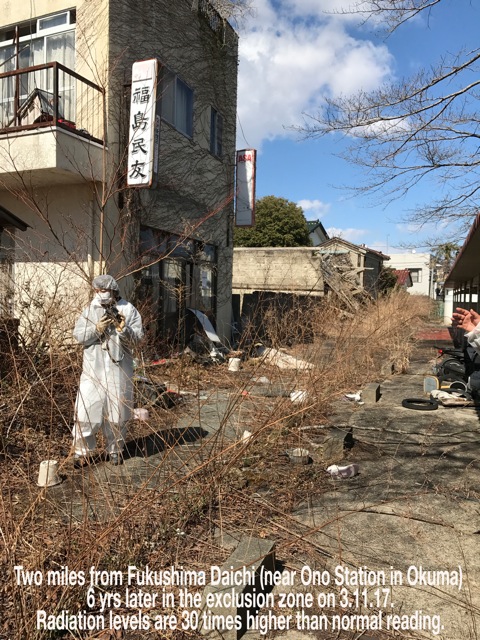
In its haste to reassure the world community that the 2020 Tokyo Olympics are going forward as scheduled with soccer and other games planned for Fukushima, the Japanese government is now forcing people back into heavily contaminated areas. A majority of the returning evacuees may not be well informed about the dangers they face, due to Japan’s Secrecy Law adopted in late 2013 – imposing new legislation to penalize the unauthorized publication of information about the crippled nuclear power plant of up to ten-years-long imprisonment. As a result people and particularly press are intimidated and kept from telling the truth.
The community of Santa Barbara is invited to attend a free public exhibit and presentation at the Karpeles Manuscript Library Museum Auditorium, 1-4pm, Saturday, April 8th featuring the work of volunteers of Nyander Guard. Akira Honda, shelter owner and founder, will also be in attendance to give firsthand details of the traumatic animal rescues in the exclusion zones in the aftermath of the nuclear meltdown. Further accounts of the State of Fukushima will not only be eye opening but also a timely reminder of the 31st Anniversary of Chernobyl Disaster – April 26th, where much of the land there still remains abandoned due to high radiation levels.
In Chernobyl, “Obligatory Resettlement Zones” were areas with over 5mSv/year of radiation, which is the same amount in some parts of Fukushima that will soon open up. Sadly, many pets will still remain at their desolate homes in these areas, living lonely lives with hardly any human contact. On their routine “Animal Watch,” Nyander Guard feeds and cares for these voiceless victims. Being reunited with them on March 11th reaffirmed how unforgiveable and horrific this disaster has become.
Disasters like Chernobyl and Fukushima remind the world how dangerous nuclear power is and how they have devastated humans, animals and lands. This is a worldwide problem affecting us all. By raising awareness of the tragedies innocent people and their loved ones continue to endure, we might be able to unite globally and share our individual stories for the sake of humanity and future generations.
Please sign these two important petitions :
From Greenpeace : Defend the human rights of Fukushima survivors
https://act.greenpeace.org/page/6288/petition/1
From FFAN-Fukushima Fallout Awareness Network : NO 2020 Olympics in Radioactive Fukushima:
https://www.change.org/p/no-olympics-or-paralympics-in-radioactive-fukushima
Exhibit:
THE STATE OF FUKUSHIMA: Sixth Anniversary 3.11 Nuclear Disaster Karpeles Exhibit Part II
This coming Saturday, April 8 at 1PM – 4PM PDT
At the Karpeles Manuscript Library Museum,
21 W Anapamu St, Santa Barbara, California 93101
Tel : +1 805-962-5322
Kerry Anne O’Connor, California born Tokyo resident and volunteer for Animal Rescue Nyander Guard – in Fukushima, Japan will be Santa Barbara Saturday, April 8th for a follow up to the Exhibit and presentation of March 11th in commemoration of the 6th Anniversary of #Fukushima Nuclear Disaster. On 3.11 this year, Kerry was in Fukushima measuring radiation levels and documenting farmlands that are now nuclear wastelands. Among her shocking discoveries, she learned that some areas where the evacuation orders will be lifted at the end of this month are actually higher in radiation than in the exclusion zones.
The community of Santa Barbara is invited to attend this free public exhibit and presentation featuring the work of volunteers of Nyander Guard. Akira Honda, shelter owner and founder, will also be in attendance to give firsthand details of the traumatic animal rescues in the exclusion zones in the aftermath of the #nuclear meltdown which forced 170,000 people to be evacuated; and six years later 84,000 residents still cannot return to their homes due to high radiation levels. Kerry’s further accounts of the “State of Fukushima” will not only be eye-opening but also a good reminder of the 31st Anniversary of #Chernobyl Disaster – April 26 where much of the land there is still abandoned due to high radiation levels.
Media Contact: Kerry O’Connor, 805-482-1745 kerry_in_hachioji@yahoo.co.jp
11,000 Wikileaks documents related to Fukushima

4131 files on Fukushima 2011
https://wikileaks.org/gifiles/?q=Fukushima+2011&mfrom=&mto=&title=¬itle=&date=&nofrom=¬o=&count=50&sort=0&file=&docid=&relid=0#searchresult
4062 files on reactor 2011
https://wikileaks.org/gifiles/?q=Reactor+2011&mfrom=&mto=&title=¬itle=&date=&nofrom=¬o=&count=50&sort=0&file=&docid=&relid=0#searchresult
2470 files on meltdown 2011
https://wikileaks.org/gifiles/?q=Meltdown+2011&mfrom=&mto=&title=¬itle=&date=&nofrom=¬o=&count=50&sort=0&file=&docid=&relid=0#searchresult
262 files on cesium 2011
https://wikileaks.org/gifiles/?q=Cesium+2011&mfrom=&mto=&title=¬itle=&date=&nofrom=¬o=&count=50&sort=0&file=&docid=&relid=0#searchresult
282 files on iodine 2011
https://wikileaks.org/gifiles/?q=Iodine+2011&mfrom=&mto=&title=¬itle=&date=&nofrom=¬o=&count=50&sort=0&file=&docid=&relid=0#searchresult
344 files on Uss Ronald Reagan
https://wikileaks.org/gifiles/?q=Uss+ronald+2011&mfrom=&mto=&title=¬itle=&date=&nofrom=¬o=&count=50&sort=0&file=&docid=&relid=0#searchresult
TEPCO fails to pinpoint melted fuel at Fukushima No. 1 nuclear plant

A photo capturing contaminated water at the Fukushima No. 1 nuclear plant, which was taken by a robot on March 21, 2017.
Tokyo Electric Power Co. (TEPCO) failed to locate melted nuclear fuel inside the No. 1 reactor at the disaster-stricken Fukushima No. 1 Nuclear Power Plant in a robot probe, though it found higher levels of radiation toward the bottom of the reactor container vessel, the utility said on March 27.
TEPCO made the announcement after analyzing data obtained from a probe conducted from March 18 through 22, in which a remotely controlled robot was sent into the No. 1 reactor’s container vessel for research.
The power company is set to finalize a decision to take out melted fuel from the No. 1 through No. 3 reactors as early as this coming summer, accelerating work to decommission the facilities. Like a similar robot probe inside the No. 2 reactor last month, however, the latest survey on the No. 1 reactor also failed to obtain data necessary to extract melted fuel, such as where the fuel is located. Therefore, the utility is compelled to consider fetching melted fuel in the absence of sufficient data.
TEPCO injected a robot that can move on a running belt into the container vessel of the No. 1 reactor. The robot hung a wire holding a camera and a dosimeter at its tip from a metal grating for workers and measured the condition of the contaminated water below. From March 18 to 22, the robot examined an area near a slot from which the device is injected into the vessel and measured 1.5 to 11 sieverts per hour of radiation. Between March 20 and 22, the robot explored an area around the openings for workers at the bottom of the container vessel, which is close where melted fuel is believed to be situated, and detected measurements of 3 to 9.4 sieverts of radiation.
Sand-like sediment was found to be spreading across the bottom of the container vessel. Because of accumulated sediment near the openings, the robot could gauge radiation doses only up to a height of 90 centimeters from the bottom of the vessel. Compared to the radiation levels at the same height of an area where melted fuel is believed not to exist, the area near the openings showed higher radiation readings.
It is believed that most of the melted fuel at the No. 1 reactor has spread across the contaminated water accumulating at the bottom of its container vessel. TEPCO believes that melted fuel is likely leaking from those openings.
Naohiro Masuda, head of TEPCO’s Fukushima Daiichi Decontamination & Decommissioning Engineering Co., told a press conference on March 7, “The results of this probe will be precious resources for us to make a decision on our plan.”
http://mainichi.jp/english/articles/20170328/p2a/00m/0na/014000c

1 This Month

of the week – Shut Down Drone Warfare!


Tell the Ukrainian Government to Drop Prosecution of Peace Activist Yurii Sheliazhenko

Petition to revoke the licensing of the Near Surface Nuclear Disposal Facility (NSDF) at Chalk River. https://www.ourcommons.ca/petitions/en/Petition/Details?Petition=e-7247
To see nuclear-related stories in greater depth and intensity – go to https://nuclearinformation.wordpress.com
-
Archives
- April 2026 (103)
- March 2026 (251)
- February 2026 (268)
- January 2026 (308)
- December 2025 (358)
- November 2025 (359)
- October 2025 (376)
- September 2025 (257)
- August 2025 (319)
- July 2025 (230)
- June 2025 (348)
- May 2025 (261)
-
Categories
- 1
- 1 NUCLEAR ISSUES
- business and costs
- climate change
- culture and arts
- ENERGY
- environment
- health
- history
- indigenous issues
- Legal
- marketing of nuclear
- media
- opposition to nuclear
- PERSONAL STORIES
- politics
- politics international
- Religion and ethics
- safety
- secrets,lies and civil liberties
- spinbuster
- technology
- Uranium
- wastes
- weapons and war
- Women
- 2 WORLD
- ACTION
- AFRICA
- Atrocities
- AUSTRALIA
- Christina's notes
- Christina's themes
- culture and arts
- Events
- Fuk 2022
- Fuk 2023
- Fukushima 2017
- Fukushima 2018
- fukushima 2019
- Fukushima 2020
- Fukushima 2021
- general
- global warming
- Humour (God we need it)
- Nuclear
- RARE EARTHS
- Reference
- resources – print
- Resources -audiovicual
- Weekly Newsletter
- World
- World Nuclear
- YouTube
-
RSS
Entries RSS
Comments RSS
 nuclear-news