Seismologist testifies Fukushima nuclear disaster preventable

In this March 11, 2011 photo provided by Tokyo Electric Power Co., a tsunami is seen just after striking the Fukushima No. 1 nuclear plant breakwater.
May 10, 2018
TOKYO — A seismologist has testified during the trial of three former executives of Tokyo Electric Power Co. (TEPCO), operator of the tsunami-ravaged nuclear plant, that the nuclear crisis could have been prevented if proper countermeasures had been taken.
“If proper steps had been taken based on a long-term (tsunami) evaluation, the nuclear accident wouldn’t have occurred,” Kunihiko Shimazaki, professor emeritus at the University of Tokyo, told the Tokyo District Court on May 9.
Shimazaki, who played a leading role in working out the national government’s long-term evaluation, appeared at the 11th hearing of the three former TEPCO executives as a witness.
Prosecutors had initially not indicted the three former TEPCO executives. However, after a prosecution inquest panel consisting of members of the public deemed twice that the three deserve prosecution, court-appointed lawyers serving as prosecutors indicted the three under the Act on Committee for Inquest of Prosecution.
Court-appointed attorneys insist that former TEPCO Vice President Sakae Muto, 67, and others postponed implementing tsunami countermeasures based on the long-term evaluation, leading to the disaster.
The government’s Headquarters for Earthquake Research Promotion released its long-term evaluation in 2002 predicting that a massive tsunami could occur along the Japan Trench including the area off Fukushima.
In 2008, TEPCO estimated that a tsunami up to 15.7 meters high could hit the Fukushima No. 1 power station, but failed to reflect the prediction in its tsunami countermeasures at the power station.
The Cabinet Office’s Central Disaster Prevention Council also did not adopt the long-term evaluation in working out its disaster prevention plan.
Shimazaki, who was a member of the Headquarters for Earthquake Research Promotion’s earthquake research panel in 2002, told the court that the Cabinet Office pressured the panel shortly before the announcement of the long-term evaluation to state that the assessment is unreliable. The headquarters ended up reporting in the long-term evaluation’s introduction that there were problems with the assessment’s reliability and accuracy.
In his testimony, Shimazaki pointed out that the Central Disaster Prevention Council decision not to adopt the long-term evaluation led to inappropriate tsunami countermeasures.
With regard to factors behind the council’s refusal to accept the evaluation, Shimazaki stated that he can only think of consideration shown to those involved in the nuclear power industry and politics.
“If countermeasures had been in place based on the long-term evaluation, many lives would’ve been saved,” Shimazaki told the court.
Shimazaki served as deputy chairman of the government’s Nuclear Regulatory Authority after the Fukushima nuclear disaster.
(Japanese original by Epo Ishiyama, City News Department, and Ei Okada, Science & Environment News Department)
New Data for Unit 2’s Missing Fuel

TEPCO published a Roadmap document right before leaving for Golden Week vacation. In this document is a 30+ page section of new data for unit 2’s missing fuel.
TEPCO has given varying explanations for unit 2’s meltdown and fuel location. Two muon scans have been completed for unit 2. The first found no fuel remaining in the RPV. A second scan by TEPCO claimed to have found some fuel in the bottom of the RPV, our analysis of the scan found otherwise. It is likely that all of the fuel inside the reactor vessel melted and all of it except for some residues is no longer in the RPV.
Fuel debris volume:
The volume of fuel debris inside unit 2 is difficult to calculate due to a number of factors. The debris is spread between multiple areas including the floor grate level, the pedestal floor and whatever debris may have burned down into the pedestal floor. The total volume of the fuel core is known for unit 2 but the exact size of the pedestal diameter is not known.
A fuel debris volume estimate was made for unit 1 based on known data and meltdown events at that reactor. Unit 1 is smaller than unit 2 in both fuel core size and size of the reactor structures. The general reactor building sizes and the fuel core sizes should be something that could roughly scale up for unit 2. Unit 1 estimate showed a fuel volume of all of the fuel and related melted structural materials as 60-100 cm deep.
Inside unit 2 about 50% of the pedestal floor was found to be covered with 70 cm of fuel debris. Additional fuel debris in an unknown volume is on the floor grate level. An unknown amount is burned down into the pedestal concrete basemat. Further fuel debris may be in lower reactor piping systems or the outer drywell floor. Unit 2’s fuel debris volume would also be reduced as the control rod drive array and bottom head of the reactor vessel are still intact. That large amount of metal structural material is known to not be part of the melted fuel debris in unit 2.
What has been found on inspection may be all of the fuel debris for unit 2 if a portion of the material is burned down into the pedestal basemat concrete. In most meltdown scenarios that is a given assumption unless the containment structure was heavily and repeatedly flooded with water at the time the fuel first dropped into the pedestal. With unit 2 that is an unlikely scenario.
There is an alternative possibility that a large amount of the radioactive materials in the fuel vaporized during the meltdown and escaped containment. This concept requires more investigation to confirm vaporization but this possibility for unit 2 is not completely ruled out. Fused microparticles containing nuclear fuel and other meltdown related materials have been found over a wide swath of Fukushima and beyond. Unit 2’s refueling floor blow out panel and reactor well containment gasket are one escape path for micro materials, steam and other gasses. Unit 2’s venting attempts are another concern. TEPCO has claimed the direct drywell venting of unit 2 didn’t work and the rupture disc for this system did not break as intended. TEPCO has provided no conclusive proof of this claim such as photos, video or other tangible evidence for this claim. Due to this, there is still the possibility that unit 2’s venting released some of these fused microparticles of fuel.
Radiation levels:
The radiation levels found in unit 2’s pedestal including a reading close to the fuel debris pile were between 7-8 Sieverts/hour. The high reading found along the CRD rail in 2017 was between 200-300 Sieverts/hour. These pedestal readings are drastically lower than what would be expected near an unshielded large pile of fuel debris.
By comparison, radiation levels along the outer containment wall in 2012 were within a similar range of the lower readings found on the CRD rail in 2017.
The elephant’s foot at Chernobyl, measured within the first year of the disaster, converted to Sieverts was 100 Sievert/hour.
Underwater readings in unit 1’s torus room near what is suspected fuel debris, taken in 2012 were 100,000 to 1 million Sieverts/hour.
Radiation levels near the fuel debris indicate that the top layers of debris may be mostly metallic materials with little fuel.
Radiation levels indicate that fuel bearing debris is not in the visible layer in the pedestal. (other possible locations – vaporized/vented, beneath the metallic layer, sml amounts in piping).
Roadmap document, section on unit 2:
http://www.tepco.co.jp/nu/fukushima-np/roadmap/2018/images1/d180426_08-j.pdf#page=3
TEPCO photo page for unit 2 findings:
http://photo.tepco.co.jp/date/2018/201804-j/180426-01j.html
Fukushima ETHOS: Post-Disaster Risk Communication, Affect, and Shifting Risks

26 May 2017
Abstract
ETHOS Fukushima is a risk communication (RC) program organized after the Fukushima nuclear accident by the International Commission on Radiological Protection and other international organizations supported by the Japanese government.
ETHOS has been hailed as a model RC that is participatory and dialogue-based. Yet the critical and feminist literature has shown the need for analyzing the power relations in participatory projects, and for analyzing affect as a target of management by neoliberal governmentality.
The affective work of ETHOS is characterized by narratives of self-responsibility, hope and anticipation, and transnational solidarity with Chernobyl victims. These resonate with the affective regime under neoliberalism that privileges self-responsibility, anticipation, maximization of emotional potential, and cosmopolitan empathy.
This particular regime of affect has been integral in shifting risk from the nuclear industry and the government to individual citizens. ETHOS Fukushima has supported continued residence in contaminated areas.
It has helped portray the reduction of government/industry responsibility as morally defensible, and the decision to stay in Fukushima as a free choice made by hopeful and determined citizens.
At the same time, ETHOS has helped characterize the state’s and the nuclear industry’s roles in cleaning up and compensating the victims as restricting individual freedom and demoralizing the local people.
The recent RC literature increasingly argues for a positive assessment of emotion, but this argument warrants careful analysis, as emotion is socially regulated and entangled in power relations.
Moreover, deploying affective tropes is a crucial technique of neoliberal governmentality, especially because of affect’s seemingly oppositional and external relationship to neoliberalism.
TEPCO offers virtual tour of Fukushima No. 1 plant on website

May 5, 2018
Explanations are provided if the questions are clicked when passing through elevated land in front of the No. 1 reactor. (Captured from Tokyo Electric Power Co. website)
FUKUSHIMA–The crippled Fukushima No. 1 nuclear power plant is open for all to explore in a virtual tour on operator Tokyo Electric Power Co.’s website.
TEPCO released the “Inside Fukushima Daiichi” feature, only available on personal computers, so visitors can feel as if they are touring the decommissioning venue by car.
The service is aimed at helping more people understand the current state of the plant, also known as Fukushima Daiichi, after the nuclear crisis triggered by the 2011 Great East Japan Earthquake and tsunami.
While visitors can tour the plant grounds on the website, the radiation level around the displayed area is shown in the lower left portion of the monitor.
Front and side views of the No. 1 to No. 4 reactors, which suffered serious damage, can be seen up close.
In some sections, images taken both recently and immediately after the disaster are shown to offer comparisons. Explanations of the plant are provided in Q&A format for some areas as well.
A 360-degree view of the inside of the No. 5 reactor building, which has almost the same structure as the No. 1 to No. 4 reactors, and other facilities is also offered.
TEPCO is looking to provide an English-language version in the future.
The virtual tour is available at (http://www.tepco.co.jp/insidefukushimadaiichi/index-j.html).
‘Global Consequences’ of Lethal Radiation Leak at Destroyed Japan Nuclear Plant

May 4, 2018
Lethal levels of radiation have been observed inside Japan’s damaged Fukushima nuclear power plant. And they are arguably way higher than you suspect.
According to Tokyo Electric Power Company (Tepco), radiation levels of eight Sieverts per hour (Sv/h) have been discovered within the Fukushima nuclear power plant, which was destroyed after a massive earthquake and a tsunami in March 2011.
Tepco, the company that operated the plant and is now tasked with decommissioning it, reported the discovery after making observations in a reactor containment vessel last month.
Eight Sv/h of radiation, if absorbed at once, mean certain death, even with quick treatment. One Sv/h is likely to cause sickness and 5.5 Sv/h will result in a high chance of developing cancer.
While 8 Sv/h is deadly, outside of Fukushima’s Reactor Number 2 foundations of a much higher level of 42 Sv/h was detected.
A strange occurrence, and experts are still arguing what caused the discrepancy. One possible explanation is that cooling water washed radioactive material off debris, taking it somewhere else.
But here’s a truly terrifying catch: according to the report, Tepco highly doubts the new readings, because, as was discovered later, a cover was not removed from the robot-mounted measurement device at the time of the inspection, NHK World reports.
Exactly one year ago, Sputnik reported that Tepco engineers discovered absolutely insane levels of radiation of about 530 Sv/h within the reactor. Such levels of radiation would kill a human within seconds. By comparison, the Chernobyl reactor reads 34 Sv/h radiation level, enough to kill a human after 20 minutes of exposure.
The levels of radiation within Fukushima reactor number 2 were so high that Tepco’s toughest robot, designed to withstand 1000 Sv/h of radiation, had to be pulled out, as it started glitching due to high radiation levels. Nuclear experts called the radiation levels “unimaginable” at the time.
On November 2017, the New York Times and other news outlets reported a much smaller figure of 70 Sv/h of radiation, more or less on par with a 74 Sv/h reading gathered before an anomalous 530 Sv/h spike.
While that radiation dosimeter cover negligence prevents precise calculations, the actual picture inside Unit 2 is thought to be much worse.
Japanese state broadcaster NHK World quoted experts saying that if the cleaning of the stricken power plant is not properly addressed, it will result in major leak of radioactivity with “global” consequences.
Richard Black, director of the Energy and Climate Intelligence Unit, says that while the readings are not reliable, they still “demonstrate that, seven years after the disaster, cleaning up the Fukushima site remains a massive challenge — and one that we’re going to be reading about for decades, never mind years.”
Mycle Schneider, independent energy consultant and lead author of the World Nuclear Industry Status Report, criticized Tepco, saying the power company has “no clue” what it is doing.
“I find it symptomatic of the past seven years, in that they don’t know what they’re doing, Tepco, these energy companies, haven’t a clue what they’re doing, so to me it’s been going wrong from the beginning. It’s a disaster of unseen proportions.”
In observing the poor maintenance of plant radiation leaks, Schneider also pointed out that the company stores nuclear waste at the site in an inappropriate way.
“This is an area of the planet that gets hit by tornadoes and all kinds of heavy weather patterns, which is a problem. When you have waste stored above ground in inappropriate ways, it can get washed out and you can get contamination all over the place.”
Foreign Trainees Used in the Cleanup of Fukushima Nuke Plant

Foreign workers who have been employed at the Fukushima No. 1 Nuclear Power Plant are pictured in Fukushima Prefecture.
Despite ban, foreign trainees working at crippled Fukushima nuclear plant
May 1, 2018
FUKUSHIMA — At least four foreign technical intern trainees are working at the construction site on the premises of the crippled Fukushima No. 1 Nuclear Power Plant despite the policy of its operator, Tokyo Electric Power Co. (TEPCO), that bans the employment of such trainees there, the Mainichi has learned.
TEPCO has acknowledged to the Mainichi that the foreigners are indeed at work at the plant in Fukushima Prefecture. The plant has been shut down due to the core meltdown accidents at some of its nuclear reactors after the March 2011 earthquake and tsunami devastated northeastern Japan.
A TEPCO official said that the practice of letting the trainees work does not match the intentions of the Technical Intern Training System. “We will demand our contractors to thoroughly check the residency status (of their foreign workers). We will do our own checks too,” the official said.
The Mainichi investigation has found that the four Vietnamese and other trainees are in their 20s or 30s and two of them just arrived in Japan last year and thus speak little Japanese. Two more foreign construction workers operate inside the grounds of the Fukushima plant.
The six workers, employed by a Tokyo-based subcontractor of a major construction company, are involved in laying the foundations of a new facility designed to burn rubble or trees with potential radioactive contamination. The work began in November last year.
According to TEPCO, the area the six workers are assigned to is outside the radiation controlled area where protection from radiation is necessary. Although they are inside the premises of the nuclear power plant, they did not receive training on how to protect themselves from radiation, and there is no need to control their radiation exposure, the company said.
The six workers are made to wear dosimeters but told the Mainichi that they were not aware of the amount of radiation they have received.
The Technical Intern Training System is designed to transfer technology to developing countries, but Vietnam does not have nuclear power plants where workers could be exposed to radiation. The Vietnamese government ended a plan to construct a nuclear power plant in 2016 due to a shortage of funds and out of consideration of public opposition following the nuclear disaster at the TEPCO plant in 2011.
TEPCO officials told a news conference in February 2017 that the company wanted to protect the working environment with its own control measures as the training system was designed for the trainees to acquire knowledge and experience in Japan and pass that on to people at home.
A TEPCO official told the Mainichi that the company does not accept technical intern trainees to work at locations even outside the radiation controlled areas, adding that the company intends to strengthen the contractual management of its contractors.
The president of the construction company that hires the six foreigners said that he was told by the main contractor to refrain from using foreign workers as much as possible. “But our industry cannot carry on without foreigners any longer,” he said.
According to the Ministry of Land, Infrastructure, Transport and Tourism, some 55,000 foreigners were reported to have worked in the construction sector in 2017, more than four times the number recorded five years earlier. Out of the 2017 total, some 37,000 were technical intern trainees.
(Japanese original by Shunsuke Sekiya, Chiba Bureau)
Foreign workers vital for Japanese contractor in cleanup at Fukushima nuke plant
May 1, 2018
FUKUSHIMA — Foreign technical intern trainees have been employed in what is said to be a 40-year-long decommissioning operation underway at the Fukushima No. 1 Nuclear Power Plant operated by Tokyo Electric Power Co. (TEPCO) in the wake of devastating core meltdowns in 2011. While they are not supposed to be there under TEPCO policy, they are still considered indispensable by their employer, commissioned by TEPCO.
The homelands of the interns include Vietnam, a country that abandoned plans to import a nuclear reactor from Japan two years ago. As trainees, they are supposed to “transfer” their experiences in Japan to their compatriots back home. But in the case of Vietnam, there is no chance of using such know-how in the non-nuclear country. What is going through the minds of the trainees as they engage in this work?
“Hosha-kei, hosha-kei, hosha-kei,” one foreign worker repeated when the Mainichi Shimbun asked six workers from Vietnam and elsewhere about their job at the plant in February. It was not clear whether he meant radiation, radioactivity or a dosimeter.
“The job is easy and many Japanese workers are with us. I think (safety) is OK,” said another foreign worker who had the best command of the Japanese language in the group. The location they started working last fall is outside the radiation controlled areas and everyone there is in ordinary workers’ outfits.
The president of the Tokyo-based company that employs the six has nothing but praise for them. “People say they are so good at their work. I depend on them very much.” The six workers make up two-thirds of the company’s workforce, which also includes three Japanese nationals.
When the company was founded some 30 years ago it employed over 20 Japanese workers in their 20s, but now foreigners are vital for its operations. Says the president: “Japanese youngsters quit easily but foreigners stick with us because they borrow heavily to come to Japan and cannot go home at least for three years,” a requirement for technical intern trainees.
The six each borrowed between 1.2 million and 1.5 million yen to pay for their trip to Japan and other expenses. Four of them are paying back the debt as they work. They all share a one-story, three-room wooden apartment near the plant that includes a small dining room and a kitchen.
When one male foreign worker who barely spoke Japanese was asked why he came to Japan, he replied in Japanese, “Okane” (money).
The workers have not told their families they are working at the nuclear plant. “My family would worry and tell me to come home,” one man said in broken Japanese.
(Japanese original by Shunsuke Sekiya, Chiba Bureau)
TEPCO: Foreign trainees worked at Fukushima nuclear plant
May 2, 2018
Six people in the government’s foreign technical trainee program worked at the stricken Fukushima No. 1 nuclear power plant until the end of April despite Tokyo Electric Power Co.’s ban on such dispatches.
A TEPCO official on May 1 said the company had failed to sufficiently check the situation concerning workers at the nuclear plant.
The utility in February 2017 said it would not have foreign trainees work at the plant, which has continued to leak radiation since being struck by the Great East Japan Earthquake and tsunami in March 2011.
The six workers were employed by a subcontractor of Tokyo-based Hazama Ando Corp.
They started working at the plant between October and December last year and were involved in construction of an incinerator on the premises to destroy contaminated protective clothing and other materials.
They were not required to wear protective gear against radiation because they worked outside the radiation-controlled area.
“We will ask prime contractors once more to check the status of workers (under their supervision),” the TEPCO official said.
The company said it also intends to check whether other foreign trainees have ended up working at the plant.
The purpose of the foreign trainee program is to pass down skills and expertise that interns can use to help their home countries. However, a number of cases have shown that companies are exploiting the program to obtain cheap labor, sometimes for dangerous tasks.
In March, it was revealed that a Vietnamese trainee was involved in decontamination work in Fukushima Prefecture but had not been told of the potential hazards.
A Justice Ministry official said decontamination work is an inappropriate job for foreign trainees.
Tepco Staffer Testifies in Court that Tepco Executives Put Off Tsunami Measures at Fukushima Plant

In this March 11, 2011 photo provided by Tokyo Electric Power Co., a tsunami is seen just after striking the Fukushima No. 1 nuclear plant breakwater.
TEPCO staffer testifies execs put off tsunami measures at Fukushima plant
April 11, 2018
TOKYO — A Tokyo Electric Power Co. (TEPCO) employee testified in court here on April 10 that company executives decided to postpone tsunami prevention measures at the Fukushima No. 1 nuclear plant despite an assessment warning that a massive wave could hit the power station.
Three former TEPCO executives including former Vice President Sakae Muto, 67, are on trial for professional negligence causing death and injury over the Fukushima nuclear crisis triggered by the March 2011 Great East Japan Earthquake and tsunami. The TEPCO employee’s statements at the trial’s fifth hearing were in line with the arguments of the court-appointed attorney acting for the prosecution.
Since 2007, the male employee had been part of an internal assessment group tasked with estimating the maximum height of tsunami which could strike the Fukushima No. 1 plant.
The group commissioned a TEPCO-affiliated company to estimate the size of potential tsunami, based on a long-term assessment made by the government’s Headquarters for Earthquake Research Promotion that a massive wave could be generated by a quake in the Japan Trench, including off Fukushima Prefecture. In 2008, the TEPCO subsidiary reported that tsunami as tall as 15.7 meters could hit the plant.
In the trial, the employee stated, “I thought that TEPCO should take the assessment into consideration in taking (earthquake and tsunami) countermeasures, as the assessment was supported by prominent seismologists.” He said he was so confident that the utility would take action that he emailed another working group at the company, “There will definitely be major renovations at the Fukushima No. 1 and other plants.”
When the employee reported the assessment result to Muto, the then vice president gave him instructions that could be interpreted as an order to prepare to build a levee. However, the employee testified that Muto later shifted policy and called for an investigation into whether the long-term tsunami risk assessment is correct rather than taking tsunami countermeasures.
“I thought they (TEPCO) would consider taking tsunami prevention measures, but they changed policy unexpectedly and I lost heart,” the employee told the court.
Along with Muto, former TEPCO President Tsunehisa Katsumata and Vice President Ichiro Takekuro were slapped with mandatory indictments in February 2016 after a decision by the Tokyo No. 5 Committee for the Inquest of Prosecution. Since the trial’s first public hearing, the court-appointed lawyers for the prosecution have claimed that the executives put off tsunami countermeasures even though TEPCO staff tasked with estimating the maximum height of tsunami that could strike the Fukushima plant endeavored to address the threat. The defendants have argued that they did not put off the countermeasures.
(Japanese original by Ebo Ishiyama, City News Department, and Ei Okada, Science & Environment News Department)

The 2011 tsunami damaged pumps at the Fukushima No. 1 nuclear plant.
TEPCO worker: Boss scrapped tsunami wall for Fukushima plant
April 11, 2018
An employee of Tokyo Electric Power Co. testified in court that his boss abruptly ended preparations in 2008 to build a seawall to protect the Fukushima No. 1 nuclear plant from a towering tsunami.
“It was unexpected,” the employee said of former TEPCO Vice President Sakae Muto’s instructions during a hearing at the Tokyo District Court on April 10. “I was so disheartened that I have no recollection of what followed afterward at the meeting.”
Muto, 67, was deputy chief of the company’s nuclear power and plant siting division at the time.
He, along with Tsunehisa Katsumata, former TEPCO chairman, and Ichiro Takekuro, former TEPCO vice president, are now standing trial on charges of professional negligence resulting in death and injury over the 2011 nuclear disaster at the Fukushima No. 1 plant.
To prove negligence, prosecutors are trying to show that the top executives could have predicted the size of the tsunami that swamped the plant on March 11, 2011, resulting in the most serious nuclear accident since the 1986 Chernobyl disaster.
The employee was a member of a team tasked with compiling steps against tsunami at the earthquake countermeasures center that the utility set up in November 2007.
He reported directly to Muto.
According to the employee, TEPCO was considering additional safeguards on the instructions of the then Nuclear and Industrial Safety Agency for all nuclear plant operators to review their anti-earthquake measures.
The group weighed its options based on a long-term assessment of the probability of major earthquakes released by the science ministry’s Headquarters for Earthquake Research Promotion in 2002.
The assessment pointed out that Fukushima Prefecture could be hit by a major tsunami.
Some experts were skeptical about the assessment, given that there were no archives showing a towering tsunami ever striking the area.
But the employee told the court, “Members of the group reached a consensus that we should incorporate the long-term assessment” in devising countermeasures.
The group asked a TEPCO subsidiary to conduct a study on the maximum height of a tsunami on the basis of the assessment.
The subsidiary in March 2008 informed the group that a tsunami of “a maximum 15.7 meters” could hit the Fukushima plant.
The group reported that number to Muto in June that year.
Based on Muto’s instructions, the group studied procedures on obtaining a permit to build a seawall to protect the Fukushima No. 1 nuclear plant, according to the employee.
But in July, Muto, without giving an explanation, told the group at a meeting that TEPCO will not adopt the 15.7-meter estimate, the employee said.
He said Muto’s decision stunned group members who had believed the company was moving to reinforce the plant.
The tsunami that caused the triple meltdown at the Fukushima No. 1 nuclear plant reached 15.5 meters.
But Muto and the two others on trial have pleaded not guilty, arguing that the 15.7-meter prediction was “nothing more than one estimate.”
Why the TEPCO management dropped the tsunami prediction will be the focus of future hearings.
Prosecutors had initially declined to press charges against the three former executives, citing insufficient evidence. However, a committee for the inquest of prosecution twice concluded that the three should be indicted.
Their trial began in June last year. Lawyers are acting as prosecutors in the case.
(This story was compiled from reports by Mikiharu Sugiura, Takuya Kitazawa and Senior Staff Writer Eisuke Sasaki.)
Total tally for Fukushima decommission is $75 billion

April 2, 2018
The decommissioning of the Fukushima nuclear power plant will cost an annual $2 billion (220 billion yen) until 2021, an unnamed source told the Japan Times.
Half of the money will be used to tackle the radioactive water buildup at the site of the plant and for removing radioactive fuel from the fuel pools. A small amount of funds will be used to research ways of retreating melted fuel from the reactors that got damaged during the 2011 tsunami disaster.
The $6 billion for the three years is only part of the total estimated cost for taking Fukushima out of operation.
The total decommissioning tally came in at $75 billion (8 trillion yen), as estimated by the specially set up Nuclear Damage Compensation and Decommissioning Facilitation Corp (NDF). That’s four times more than the initial estimate of the costs around the NPP’s decommissioning.
Now the operator of Fukushima, Tepco, and the NDF are due to submit their financial plan for the facility to the government for approval by the energy industry minister.
In addition to the $6 billion allocated for the cleanup, Tepco will spend another $1.88 billion (200 billion yen) on preparing to start extracting the melted fuel from the three damaged reactors. This seems to be the biggest challenge for the cleanup efforts because of the still high radiation levels as well as technical difficulties.
Tepco is still reeling from the effects of the 2011 tsunami and resulting nuclear meltdown. Around 15,000 people died in March 2011, when a magnitude-9 quake caused a deadly tsunami and erased the coastline in the area of the nuclear power plant.
At the end of 2016, the Japanese government revised upwards the total costs of the disaster to $192 billion (21.5 trillion yen), stepping up pressure on Tepco to clean up its act and implement urgent reforms to its safety procedures.
Fukushima Jitters

April 2, 2018
by Robert Hunziker
Fukushima is full of nasty surprises, similar to John Carpenter’s classic film The Thing (1982), which held audiences to the edge of their seats in anticipation of creepy monsters leaping out from “somebody, anybody, nobody knows for sure,” but unlike Hollywood films, Fukushima’s consequences are real and dire and deathly. It’s an on-going horror show that just won’t quit.
Only recently, a team of international researchers, including a group of scientists from the University of Manchester/UK and Kyushu University/Japan made a startling discovery. Within the nuclear exclusion zone in paddy soils and at an aquaculture center located several miles from the nuclear plant, the research team found cesium-rich micro-particles.
Evidently, the radioactive debris was blown into the environment during the initial meltdowns and accompanying hydrogen blasts. Accordingly, the environmental impact of radiation fallout may last much longer than previously expected. (Source: New Evidence of Nuclear Fuel Releases Found at Fukushima, University of Manchester, Phys.org, Feb. 28, 2018)
According to Dr. Gareth Law, senior lecturer in Analytical Radiochemistry at the University of Manchester: “Our research strongly suggests there is a need for further detailed investigation on Fukushima fuel debris, inside, and potentially outside the nuclear exclusion zone. Whilst it is extremely difficult to get samples from such an inhospitable environment, further work will enhance our understanding….” Ibid.
Their discovery dispels the long-held view that the initial explosion only emitted gaseous radionuclides. Now, it is clear that solid particles with very long-lived radionuclides were emitted. The research team did not discuss the likely impact, as more analysis is necessary before drawing conclusions.
Decidedly, they’d best hurry up, as the Olympics are scheduled for 2020.
Still, this discovery smacks in the face the government’s and TEPCO’s statements about successful cleanup efforts and pressuring prior residents to return to homes in the exclusion zones.
In another recent development, lethal levels of radiation have unexpectedly popped up in leaks at the nuclear plant facility, as explained in an article by Jeff Farrell: Fukushima Nuclear Disaster: Lethal Levels of Radiation Detected in Leak Seven Years After Plant Meltdown in Japan, Independent/UK, Feb. 2, 2018.
TEPCO has discovered lethal levels of radiation leaking around the facilities, radiation that would kill a person within one-hour of exposure. Even though this is not entirely a surprise with 100% total meltdowns and tons of radioactive corium sizzling wildly underneath, irradiating like crazy. This is why radioactive water continues flowing into the Pacific Ocean, necessitated to cool white-hot sizzling corium. Nobody knows what the long-term effect will be for the ocean, but guaranteed, it cannot be good.
Furthermore and distressingly, Mycle Schneider of the World Nuclear Industry Status Report claims, “TEPCO does not have a clue” to decommissioning the plant. That’s not comforting, knowing that mistakes could circumnavigate the planet much worse than the current flow of radioactive water into the Pacific, thus turning into a global catastrophe of unspeakable proportions.
After all, according to the Japan Meteorological Agency, the country has 100,000 earthquakes every year. Who knows what can happen to rickety broken down nuclear reactors in a country that slip slides so easily, so readily, so often, totally unpredictably.
According to Schneider: “It’s a disaster of unseen proportions.” The radiation leaks, coupled with inappropriate storage of radioactive waste has global consequences. Schneider is aghast at the sloppiness and ignorance of TEPCO, in charge of handling the disaster.
“This is an area of the planet that gets hit by tornadoes and all kinds of heavy weather patterns, which is a problem. When you have waste stored above ground in inappropriate ways, it can get washed out and you can get contamination all over the place… This can get problematic anytime, if it contaminates the ocean there is no local contamination, the ocean is global, so anything that goes into the ocean goes to everyone… It needs to be clear that this problem is not gone; this is not just a local problem. It’s a very major thing.” (Schneider)
And remarkably, the Olympics are coming to Tokyo and Fukushima in 2020.
For the world’s best and clearest understanding of the power and imposing danger inherent with nuclear power, the following is a spectacular power point demonstration that discusses the ABCs of nuclear power: The Age of Nuclear Waste, From Fukushima to Indian Point, prepared for the Fukushima anniversary on March 11, 2017 by Gordon Edwards, Ph.D., president Canadian Coalition for Nuclear Resp0nsibiliy. It’s the best-ever most important-ever description of nuclear power, the process, and inherent dangers.
See a list of 211 man-made radionuclides (p.59 of the power point) contained in irradiated nuclear fuel, not found in nature, which should be a big tipoff of potential dangers inherent with irradiated isotopes… umm, not part of nature!
Gordon Edwards discusses the nuclear waste “word game” as follows: (1) Clean-up is moving nuclear waste from one place to another;(2) Decontamination is collecting and repacking, but not eliminating; (3) Nuclear Waste Disposal is abandoning nuclear waste “somewhere.” In short, there is no such thing as “getting rid of nuclear radiation waste.”
According to The Age of Nuclear Waste, From Fukushima to Indian Point, it’s impossible to dispose of nuclear waste!
Postscript: “It would be irresponsible and morally wrong to commit future generations to the consequences of fission power… unless it has been demonstrated beyond reasonable doubt that at least one method exist for the safe isolation of these wastes….” Sir Brian Flowers, UK Royal Commission on Environmental Pollution, London, 1976.
Seven years on, radioactive water at Fukushima plant still flowing into ocean, study finds
Fukushima Daiichi still leaking radioactivity into Pacific Ocean. That expensive Ice wall turned out to be a slushy. Keep trying. Better yet, shut down before meltdown.

Fukushima Daiichi still leaking radioactivity into Pacific Ocean. That expensive Ice wall turned out to be a slushy. Keep trying. Better yet, shut down before meltdown.
More than seven years after the March 2011 Fukushima nuclear crisis, radioactive water is continuing to flow into the Pacific Ocean from the crippled No. 1 plant at a rate of around 2 billion becquerels a day, a study has found.
The amount of leaking cesium 137 has decreased from some 30 billion becquerels in 2013, Michio Aoyama, a professor at the Institute of Environmental Radioactivity at Fukushima University, said in his study, which was presented Wednesday at an academic conference in Osaka.
The study said the concentration of radiation — 0.02 becquerel per liter of seawater found in samples collected near a coastal town 8 km south of the No. 1 plant — is at a level that does not affect the local fishing industry.
The radioactive water is generated in a process to cool melted nuclear fuel at three damaged reactors at the complex. The reactors experienced core meltdowns after the March 2011 earthquake and tsunami.
“It can be assumed that there is a path from the complex to the ocean” through which contaminated water flows, Aoyama said.
The water accumulates in the basements of the buildings at the site after being used to cool the melted fuel.
Tokyo Electric Power Company Holdings Inc., the operator of the Fukushima complex, has been trying to prevent contaminated water from increasing within the facilities by building an underground ice wall in an effort to block ground water. It has also built a seawall aimed at preventing contaminated water from entering the ocean.
Fukushima disaster interest payments to be shouldered by taxpayers now estimated to US$ 29,3 billion, up 58% from previous estimate

Workers are flanked by bags of radioactive debris along a road in the town of Tomioka, Fukushima Prefecture, In July 2016.
Estimated cost of Fukushima disaster might balloon to ¥218 billion
March 24, 2018
In more bad news for taxpayers, the Board of Audit says the cost of the Fukushima nuclear disaster could balloon to ¥218.2 billion, up 58 percent from the previous estimate of ¥126.4 billion.
The board released the latest estimate Friday in light of the government’s adoption of a Cabinet decision in December 2016 to raise the upper limit on financial assistance for Tokyo Electric to ¥13.5 trillion from ¥9 trillion.
The government is borrowing funds from financial institutions for delivery to Tokyo Electric Power Company Holdings Inc. through a public-private body to help it deal with compensation and other costs related to the triple core meltdown in March 2011.
The principal of the funds will be repaid from contributions by Tepco and other power companies to the body, called Nuclear Damage Compensation and Decommissioning Facilitation Corp., and from proceeds from the sale of Tepco shares it owns.
But the interest payments will be shouldered by taxpayers.
According to the latest estimate, if Tepco uses up the ¥13.5 trillion assistance limit, it will take 17 to 34 years for the government to finish repaying the funds, and interest payments will balloon to between ¥131.8 billion and ¥218.2 billion.
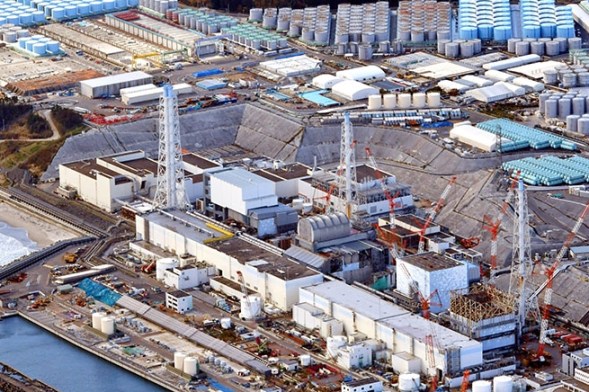
TEPCO’s priority is, and will be, to decommission crippled reactors

March 14, 2018
Toyoshi Fuketa, chairman of the Nuclear Regulation Authority (NRA), told a news conference last week that the Fukushima nuclear accident is far from over, and that it would be a mistake to think of it solely as something that occurred seven years ago.
On the surface, it appears as if a semblance of order has been restored at the Fukushima No. 1 nuclear power plant, the site of one of the most catastrophic nuclear accidents in history. Except for in and around the crippled reactor buildings, workers can now go almost anywhere on the premises without protective clothing.
Measures have been set in place to cool debris from the reactor cores and spent nuclear fuel in storage pools.
The NRA has considerably downgraded the risk of the plant spewing massive amounts of radioactive substances again.
In reality, however, the road to reactor decommissioning is long and arduous.
“We are still in no state to see the peak of the mountain,” Fuketa said. “We don’t even know what sort of uphill slope awaits us.”
The government last year revised its timetable for reactor decommissioning. The basic target of “decommissioning in 30 to 40 years” has not changed, but the removal of spent fuel from the No. 1 and No. 2 reactor pools will not begin until fiscal 2023, three years later than initially projected.
With the state of the immediate surroundings of the reactor cores still being understood only vaguely, any decision on concrete steps for the removal of debris has been postponed by one year to fiscal 2019.
The volume of water containing radioactive substances, stored in 850 tanks, has reached 1 million tons, and it will only keep growing with the passage of time. The bloating costs of reactor decommissioning will translate into a heavier taxpayer burden. But trying to rush the job will raise the risk of exposing workers to radiation and inviting accidents.
Tokyo Electric Power Co. (TEPCO), the operator of the Fukushima No. 1 plant, started last summer to publicly announce troubles encountered by cleanup crews as “deviations from the norm.”
Such issues include injuries or acute illnesses suffered by workers, vehicular collisions while multiple operations are being simultaneously run, and the deterioration of machinery used in emergencies. While most of these cases do not constitute legal violations, they are being reported almost daily.
Ensuring the safety of workers is TEPCO’s top priority. The utility must also pay close attention to other factors while proceeding steadily with reactor decommissioning, such as reducing the risks of environmental pollution. It is also crucial for the company to explain the situation to local residents as well as the general public and heed their voices.
However, some within the NRA, as well as the Nuclear Reform Monitoring Committee, a group of domestic and overseas experts who advise TEPCO’s board of directors, have frequently expressed concern that TEPCO may start prioritizing its corporate profitability.
For TEPCO, which has been bailed out effectively under government control, decommissioning the reactors at the Fukushima No. 1 plant should be its foremost task. As the very party that allowed the nuclear disaster to occur, it is obviously its responsibility to invest sufficient capital and manpower in this undertaking.
In 2013, when Tokyo was bidding for the 2020 Olympics, Prime Minister Shinzo Abe declared in his speech that the issue of contaminated water at the Fukushima plant was “under control.”
But such optimism was hardly warranted, given the difficulty that became clear in disposing of the radioactive water.
This must be firmly borne in mind by TEPCO, as well as the Ministry of Economy, Trade and Industry, which oversees the utility, and the NRA.
Nuclear Power Facing a Tsunami of Litigation

March 12, 2018
Legal fallout from the March 2011 accident at Fukushima Daiichi Nuclear Power Station continues, as dozens of lawsuits and injunctions make their way through Japan’s judicial system. The final rulings could have a profound impact on the government’s energy policy and approach to risk mitigation.
Court cases stemming from the meltdown at Fukushima Daiichi can be divided broadly into two categories. In the first are efforts to assign responsibility for the accident, including one high-profile criminal case and numerous civil suits by victims seeking damages from the government and owner-operator Tokyo Electric Power Company. The second group consists of lawsuits and injunctions aimed at blocking or shutting down operations at plants other than Fukushima Daiichi (whose reactors have been decommissioned) on the grounds that they pose a grave safety threat. In the following, we briefly survey these cases and their implications.
A Foreseeable Danger?
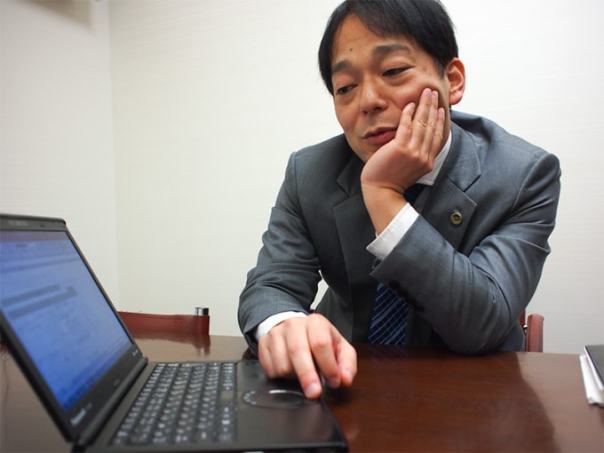
According to lawyer Managi Izutarō, who is handling the largest class-action suit against TEPCO and the government, about 30 such cases are currently moving through courts around the nation. Most of the plaintiffs are Fukushima evacuees who filed suit in the districts to which they fled after the accident.
Meanwhile, TEPCO’s former chairman and two former vice-presidents are facing charges of professional negligence resulting in death and injury in a criminal case currently before the Tokyo District Court. Tokyo prosecutors initially declined to bring charges, but in an unusual reversal, they were overruled by a prosecutorial review panel composed of ordinary citizens.
In all of these cases, the pivotal issues facing the court are (1) whether TEPCO and the state could have foreseen the danger posed to the Fukushima plant by a tsunami on the order of that triggered by the Great East Japan Earthquake, and (2) whether they could realistically have prevented a serious accident through risk-mitigation measures. The “state” in this case is the defunct Nuclear and Industrial Safety Agency (NISA), the regulatory body formerly in charge of the inspection and licensing of nuclear power facilities.
Construction of Fukushima Daiichi Nuclear Power Station began in 1967, when the government’s ambitious nuclear energy development program was shifting into high gear. Seismology and tsunami simulation have advanced considerably since those days, but at the time, the maximum height of any potential tsunami relevant to the Fukushima Daiichi site was estimated at a little more than 3 meters. When the facility was built, in other words, there was no way for TEPCO or the government to foresee that waves 10–15 meters in height could one day inundate the plant.
However, as scientists continued to collect and analyze data on earthquake and tsunami activity around Japan, their thinking evolved. In July 2002, a government panel of seismologists issued a report estimating a 20% chance that a magnitude-8 earthquake would trigger a dangerous tsunami off the coast of northeastern Japan within the next three decades. That August, NISA asked TEPCO to conduct a tsunami simulation for Fukushima Daiichi and other plants on the basis of that report, but TEPCO refused, and NISA did not press the matter.
When TEPCO finally did conduct such a simulation in 2008, it concluded that a major earthquake could trigger a tsunami as high as 15.7 meters, tall enough to flood the Fukushima Daiichi plant. However, the utility took no action to mitigate the risk (as by building up the facility’s seawalls or taking other measures to protect backup generators), and it failed to report the findings to NISA until early 2011, just weeks before the disaster.
Complacency and Opacity
In the wake of the Fukushima accident, NISA (since replaced by the Nuclear Regulation Authority) was faulted for its lack of independence. The agency was under the authority of the Ministry of Economy, Trade, and Industry, which promotes the use of nuclear power, and officials maintain that its regulatory powers were limited. In addition, a closed, inbred environment encouraged unhealthy ties between NISA and the electric power industry. As a consequence, NISA had fallen into the habit of accommodating and supporting the utilities instead of overseeing them. TEPCO, for its part, had developed a deeply rooted culture of denial, habitually concealing information that might supply ammunition to anti-nuclear activists or fuel fears among the local citizenry. The company brushed off the warnings, convincing itself that the danger from a giant tsunami was purely hypothetical.
So far, district courts have reached decisions on three major class-action suits, and in each case they have agreed with the plaintiffs that the state and TEPCO could have foreseen the danger from a major tsunami once the 2002 report on earthquake risks was released. Two of the district courts, Maebashi and Fukushima, found both the state and TEPCO negligent for failing to prevent the meltdowns. The Chiba District Court, on the other hand, dismissed claims against the state on the grounds that the government was focusing on earthquake safety at the time and may not have been able to formulate effective measures in time to protect Fukushima Daiichi against the March 2011 tsunami. With the government and TEPCO girding up to appeal the lower courts’ decisions, the cases could drag on for years.
The final verdicts could have important ramifications in a country prone to natural disasters. Despite the scientific advances of the last few decades, our ability to predict major earthquakes, tsunami, and volcanic eruptions remains extremely limited. How can we ensure that the design and operation of existing nuclear power plants reflect the latest scientific assessments of long-term risks? Are the government and industry responsible for guarding against catastrophic events, however low their probability?
A Tsunami of Lawsuits
Attorney Managi Izutarō estimates that more than 10,000 plaintiffs are currently involved in class-action suits against TEPCO and the state. He represents 4,200 victims in the largest of these cases so far. Managi argues that allowing TEPCO to keep Fukushima Daiichi operating after learning of the risks from a tsunami was “like giving an airline permission to fly an unsafe jetliner.”
In its ruling on Managi’s case last October, the Fukushima District Court agreed that both TEPCO and the state were negligent and ordered damages paid to a majority of the plaintiffs. But the victims and their lawyers deemed the amount and scope of the damages inadequate and opted to appeal. TEPCO and the state have appealed the ruling as well.
The case now moves to the Sendai High Court. “Ultimately, we’re demanding that Fukushima Prefecture be restored to the way it was before the nuclear accident,” Managi explains. “At the same time, we’re fighting to end the use of nuclear power.”
Managi stresses the importance of mobilizing a large number of victims. “Unless you get together a big group of plaintiffs, their case won’t resonate with the judges,” says Managi. “The number of people involved in litigation and the intensity of public sentiment are key. I believe the real battle takes place outside the courtroom.”
In organizing victims into large class-action suits, Managi and others lawyers are following the same playbook that helped turn the tide against big industrial polluters in the 1960s and 1970s, when victims of Minamata disease (mercury poisoning) and itai-itai disease (cadmium poisoning) succesfully banded together to seak legal redress. Whether the current movement will have a comparable impact remains to be seen.

Lawyer Managi Izutarō is representing 4,200 former Fukushima residents in a class-action suit against the state and Tokyo Electric Power Co.
Fighting Nuclear Power, One Plant at a Time
On a different but related front, citizens’ groups and other plaintiffs are vigorously pursuing lawsuits and injunctions aimed directly at shutting down nuclear power plants around the country.
Efforts to block nuclear energy development through legal action date all the way back to the 1970s. Prominent among these early cases was a citizens’ suit challenging the legality of the license granted to Shikoku Electric Power Co. to build and operate the Ikata Nuclear Power Station in Ehime Prefecture. In that case, lawyers called into question the fundamental safety of the facility, given its location near the Median Tectonic Line fault zone. The case made its way up to the Supreme Court, which finally ruled against the plaintiffs in 1992.
Safety concerns are at the core of the 30-odd “anti-nuclear” suits and injunctions currently before the nation’s courts (as of January 2018). Most cite the potential danger from major earthquakes, volcanic eruptions, or tsunami, while others are calling for suspension of operations on the grounds of inadequate evacuation planning. While a few of these cases date back to the pre-Fukushima era, the majority were filed in the wake of the accident.
In December last year, the Hiroshima High Court issued an injunction suspending operations of the number 3 reactor at the aforementioned Ikata Nuclear Power Station. In its decision, the court cited the danger posed to the Shikoku facility from a massive eruption of Mount Aso, all the way across the sea in Kyūshū. Although an eruption on this scale has not occurred in recorded history, the court opined that the risk was sufficient to make the site unsuitable for a nuclear power plant. The decision did not go down well with the Nuclear Regulation Authority, which had cleared the plant for resumption of operations under new, post-Fukushima safety standards.
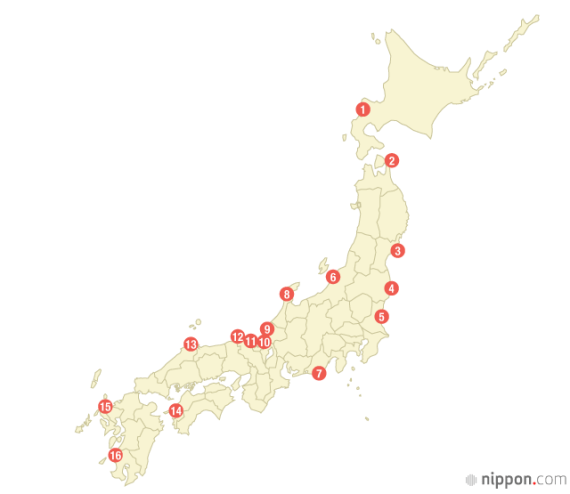
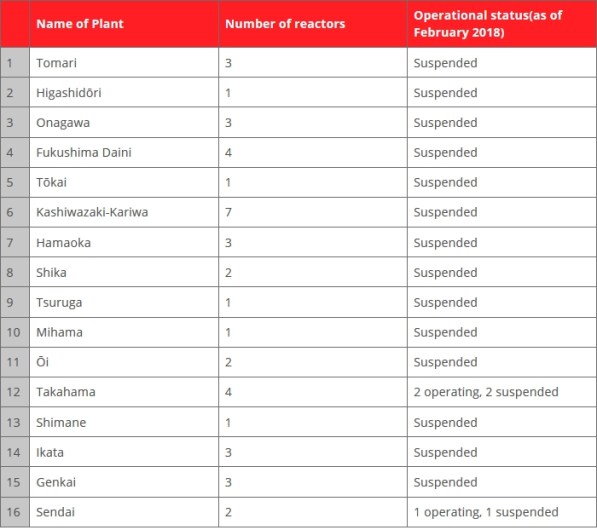
At present, almost all of Japan’s operable nuclear power plants are in the midst of some kind of litigation. In one case, the plaintiff is a local government: The city of Hakodate in Hokkaidō has filed a lawsuit to block the construction and operation of the Ōma Nuclear Power Station across the Tsugaru Strait in Aomori Prefecture.
Status of Japan’s Operable Nuclear Reactors


Note: All six reactors at Fukushima Daiichi Nuclear Power Station were decommissioned between 2011 and 2014.
Lawyers on a Mission
Lawyers Kawai Hiroyuki and Kaido Yūichi have been key figures in the fight against nuclear power since before the Fukushima accident. In the wake of the disaster, they founded the National Network of Counsels in Cases against Nuclear Power Plants, a group that has been pursuing legal action against nuclear facilities on behalf of citizens and other plaintiffs nationwide.
Kawai and Kaido are also representing the shareholders of TEPCO, who are suing the company’s former executives for an unprecedented ¥5.5 trillion. In addition, as lawyers for the Complainants for the Criminal Prosecution of the Fukushima Nuclear Disaster, the two attorneys are working alongside the prosecuting team in the criminal case against three TEPCO executives, which parallels the civil suit in terms of arguments, evidence, and testimony.
Even so, the trial—which officially opened last June and is expected to continue at least through the coming summer—is expected to attract intense media coverage as witness examinations begin this spring. More than 20 witnesses are scheduled to testify. The case also involves a massive volume of documentary evidence, including records of interviews conducted by the government’s Investigation Committee on the Accident at the Fukushima Nuclear Power Station, along with countless pages of emails, internal memos, meeting minutes, and reports. Will all this information shed new light on the human factors behind the Fukushima accident? The nation will be watching closely.
Seven years on, no end in sight for Fukushima’s long recovery
March 11, 2018
Japan faces myriad challenges to decommissioning and decontamination

Removing nuclear fuel from the Fukushima Daiichi power plant will take 30 to 40 years, ‘Tepco says’.
TOKYO — After helping shape nuclear policy in post-Fukushima Japan, Shunichi Tanaka, a former chief of the country’s nuclear watchdog, took on another tough assignment — moving to a village still struggling from the 2011 nuclear disaster to help with its recovery effort.
In February, Tanaka, who chaired the Nuclear Regulation Authority until last September, became a reconstruction adviser in the tiny village of Iitate, Fukushima Prefecture. Like many in surrounding localities, Iitate residents were ordered to evacuate after a powerful earthquake and tsunami on March 11, 2011, led to meltdowns at Tokyo Electric Power Co. Holdings’ Fukushima Daiichi nuclear power plant. To date, only around 10% of residents have returned.
“It won’t be easy to make life like it was before the disaster,” Tanaka said. Nonetheless he will help the village move forward by offering advice on nuclear decontamination and the ongoing dangers of radiation. He also acts as a go-between for the village and the national government.
“I’m a jack of all trades,” he says.

Shunichi Tanaka, former chairman of the Nuclear Regulation Authority.
In his former role at the NRA, Tanaka spearheaded an overhaul of Japan’s nuclear regulatory scheme, setting tough new standards for nuclear power operations intended to prevent another Fukushima-like accident. To date, 12 reactors have cleared the new standards. And yet the public remains largely distrustful of nuclear power — a problem Tanaka believes he can address by building up trust in the areas directly affected by the Fukushima disaster.
Challenges in that region, however, remain immense, none more so than decommissioning the damaged power plant. This involves the unprecedented feat of removing and safely storing the plant’s nuclear fuel, part of which has melted and escaped from the reactors it originally powered.
Back in September, Tepco and the national government reaffirmed their previous timeline for the cleanup, estimating the decommissioning process would take 30 to 40 years to complete. But the herculean nature of this task is becoming increasingly apparent. Nuclear fuel is too radioactive for humans to approach even when wearing protective gear, and must be handled by remotely controlled robots. But precision machinery is sensitive to radiation, and developing technology able to withstand conditions at the Fukushima site has proved intensely challenging.
“I truly cannot say” whether decommissioning can be wrapped up on a 30- to 40-year timeline, and “it is important to be honest,” said Hajimu Yamana, head of the government-backed Nuclear Damage Compensation and Decommissioning Facilitation Corporation.
The process is also extremely costly. The Ministry of Economy, Trade and Industry in 2016 pegged costs such as decommissioning and victims’ compensation related to the disaster at 21.5 trillion yen ($202 billion at current rates), nearly double its initial estimate of 11 trillion yen.
Work to remove and store melted fuel, set to begin as soon as 2021, and assorted other decontamination tasks could pile on additional expenses, depending on how they progress. The Japan Center for Economic Research believes the real cost could be as high as 70 trillion yen. Much of this would be borne by taxpayers, who require a convincing explanation of why costs are so high.
Decontaminating the soil poses another thorny problem. Roughly 640,000 cu. meters of contaminated soil, divided into 1-cu.-meter packages, has been delivered to an interim government storage facility between October and January. Yet up to 22 million cu. meters of contaminated earth remains to be treated in Fukushima Prefecture alone, a far larger amount than can be adequately handled at the current pace of work.
The government has not even locked down the roughly 1,600 hectares of land needed to complete the facility, which is itself only a temporary solution. Tokyo has pledged that Fukushima Prefecture will not be the final resting place for any of this soil, and looks to move it to a more permanent home elsewhere within 30 years. But even initial steps toward choosing such a site remain to be taken.
“It would be difficult and unrealistic to ask other prefectures to shoulder the burden,” Tanaka said. He has proposed decontaminating the soil and using it to fill in wetlands, turning them into farmland or meadowland that would provide a living for residents returning to evacuated areas. An influx of foreign engineers working on decommissioning the Fukushima plant could also give rise to new industry. But whatever plans emerge, the highest and most important hurdle could be simply getting started.
-
Archives
- February 2026 (211)
- January 2026 (308)
- December 2025 (358)
- November 2025 (359)
- October 2025 (376)
- September 2025 (258)
- August 2025 (319)
- July 2025 (230)
- June 2025 (348)
- May 2025 (261)
- April 2025 (305)
- March 2025 (319)
-
Categories
- 1
- 1 NUCLEAR ISSUES
- business and costs
- climate change
- culture and arts
- ENERGY
- environment
- health
- history
- indigenous issues
- Legal
- marketing of nuclear
- media
- opposition to nuclear
- PERSONAL STORIES
- politics
- politics international
- Religion and ethics
- safety
- secrets,lies and civil liberties
- spinbuster
- technology
- Uranium
- wastes
- weapons and war
- Women
- 2 WORLD
- ACTION
- AFRICA
- Atrocities
- AUSTRALIA
- Christina's notes
- Christina's themes
- culture and arts
- Events
- Fuk 2022
- Fuk 2023
- Fukushima 2017
- Fukushima 2018
- fukushima 2019
- Fukushima 2020
- Fukushima 2021
- general
- global warming
- Humour (God we need it)
- Nuclear
- RARE EARTHS
- Reference
- resources – print
- Resources -audiovicual
- Weekly Newsletter
- World
- World Nuclear
- YouTube
-
RSS
Entries RSS
Comments RSS